Introduction
The Himalayas are the highest mountain range in the world and show a rich diversity of eco-climatic zones. In such a landscape, elevational gradients are of particular interest in applied as well as in theoretical ecology (Wolf Reference Wolf1993). The pattern of changes in species-richness with elevation characterizes the vegetation in a simple but powerful way. For example, Yoda (Reference Yoda1967) found gradually decreasing tree species richness with increasing altitude. Later, Hunter & Yonzon (Reference Hunter and Yonzon1993) reported a similar pattern for Nepalese birds and mammals. A number of studies have produced macro-scale elevational gradients for the whole of Nepal, using interpolation methods on data from secondary sources. Several groups of organisms have been studied and exhibit maximum richness at group-specific intermediate elevations, referred to as a unimodal, or humped, elevation pattern. For example, Himalayan vascular plants showed their highest total richness at altitudes between 1500 to 2500m and their highest endemic richness at 4000m (Grytnes & Vetaas Reference Grytnes and Vetaas2002; Vetaas & Grytnes Reference Vetaas and Grytnes2002), while fern richness peaked at 2000m (Bhattarai et al. Reference Bhattarai, Vetaas and Grytnes2004). However, orchids showed their maximum richness at 1600m whereas the highest orchid endemic richness was bimodal with two separate peaks at 1200 and 3300m (Acharya Reference Acharya2008). Liverworts and mosses had their maximum richness at 2800 and 2500m, respectively, and the peak for endemic liverwort richness occurred at 3300m (Grau et al. Reference Grau, Grytnes and Birks2007).
Relatively few studies on elevational richness patterns for lichens have been undertaken (Kessler Reference Kessler2000; Bruun et al. Reference Bruun, Moen, Virtanen, Grytnes, Oksanen and Angerbjörn2006; Grytnes et al. Reference Grytnes, Heegaard and Ihlen2006) and among terrestrial photosynthetic organisms they are the only major group that has not yet been investigated in this respect in Nepal. They are among the most successful organisms in extreme environments such as cold arctic and alpine environments where few other plants can grow (e.g. Schroeter et al. Reference Schroeter, Green, Kappen and Seppelt1994; Kappen et al. Reference Kappen, Schroeter, Scheidegger, Sommerkorn and Hestmark1996). Lichens also show a high diversity as eipiphytes and thus may benefit from high diversity of trees and shrubs with species-specific bark chemistry, texture and stability (Kessler Reference Kessler2000; Bruun et al. Reference Bruun, Moen, Virtanen, Grytnes, Oksanen and Angerbjörn2006; Grytnes et al. Reference Grytnes, Heegaard and Ihlen2006). This paper describes and interprets the Himalayan elevational distribution of lichen species richness in Nepal.
Material and Methods
Study area
Nepal is a mountainous country in the central Himalayas between 26°22′ to 30°27′ N and 80°04′ to 88°12′ E with an area of 147 181 km2. The elevation ranges from 60m above sea level to 8848m (Mt. Everest). The country is surrounded by the Indo-Gangetic Plain in the east, west and south, and the Tibetan Plateau towards the north. Parallel mountain ranges run south-east and north-west dissecting the country into north-south running river valleys that are associated with fertile plains, inner valleys, lakes, and the outer flood plains.
The Indian monsoon beginning in May and ending in September is the main source of precipitation (more than 80%). Monsoon rain forms after condensation of water vapour arising from the Bay of Bengal, and consequently there is a spatial gradient of monsoon rainfall decreasing from east to west. Precipitation also occurs in winter formed from central Asian water vapour and diminishes eastwards.
Physiographically, Nepal has been divided into five zones (Hagen Reference Hagen1969; Upreti Reference Upreti1999). 1) A 30–40km wide southernmost plain is called Terai between 60 and 300m. It is the most fertile, densely populated zone with a tropical climate (between 22–27°C during winter and above 35°C during the warmest summer months); it is mainly cultivated but has still some tropical forests. 2) The Siwalik located from 700 to 1500m in the foothills of the Mahabharat Range. 3) The Mahabharat Range lies between 1500 and 3000m; it belongs to the Midlands or lesser Himalaya and includes the principal inner valleys such as Kathmandu and Pokhara. The climate is mild throughout the year and receives the highest annual rainfall (above 4000mm) south of Annapurna, central Nepal. It includes the lower cloud zone at 2000 to 2500m (Miehe Reference Miehe1989, Reference Miehe1990). 4) The Greater-Himalaya extends above 2700 m. Here the climate varies from dry summers to cold winters with snow, and subzero temperatures on the mountain tops. This zone includes the uppermost limit of cloud-zone forest in Nepal at 4000m (Miehe Reference Miehe1989, Reference Miehe1990). 5) Trans-Himalaya lies towards the northern side of the Greater-Himalaya with elevations above 3000m. It is in the rain-shadow zone with an average annual rainfall between 200 and 400mm.
Vegetation is one of the prime determinants of lichen diversity and distribution (Awasthi Reference Awasthi2007). In Nepal, vegetation has been studied and classified into 8 elevational forest zones (Yoda Reference Yoda1967; Stainton Reference Stainton1972, Reference Stainton2001; Dobremez & Jest Reference Dobremez and Jest1969; Dobremez Reference Dobremez1976; Miehe Reference Miehe1982, Reference Miehe1989). 1) Tropical forest between 60 and 1000 m (Stainton Reference Stainton1972) dominated by Shorea robusta Gaertn., Dalbergia sissoo Roxb., Adina cordifolia (Willd. ex Roxb.) Benth. & Hook. f. ex Brandis, Terminalia spp., Lagerstroemia spp., Michelia champaca L., and Bombax ceiba L. 2) Subtropical forest occurring between 1000 to 2000m with Pinus roxburghii Sarg. as the dominant species on south-facing slopes in the Midlands. 3) Lower temperate broad-leaved forest at 1700–2400m in the east and 2000–2700m in the west. Dominant trees include Alnus nitida (Spach.) Endel., Castanopsis tribuloides A. DC., Castanopsis hystrix A. DC., Lithocarpus pachyphylla (Kurz.) Rehder., and Quercus spp. Moister slopes between 1700–2200m are dominated by Cinnamomum spp. and represent the lower temperate mixed broad-leaved forest. Upper temperate broad-leaved forests are represented by various types. Drier southern slopes at 2200–3000m are dominated by Schima wallichii (DC.) Korth., Castanopsis indica (Roxb.) Miq., and Quercus semecarpifolia J. E. Smith. Moist, north and west slopes between 2500–3500m from central to east Nepal are dominated by Acer spp., Rhododendron spp., Aesculus spp. and Juglans spp. 4)Temperate coniferous forests between 2000 and 3700m dominated by Pinus wallichiana A. B. Jack. Other conifers include Cedrus deodara (Roxb.) G. Don, Picea smithiana (Wall.) Boiss., Juniperus indica Bertol., Larix himalaica W. C. Cheng & L. K. Fu, Larix griffithiana Carriere, Cupressus torulosa D. Don, and Tsuga dumosa (D. Don) Eichler. 5) Sub-alpine forests occurring between 3000 and 4100m (Stainton Reference Stainton1972) dominated by Betula utilis D. Don, Abies spectabilis (D. Don) Mirb., and Rhododendron spp. This forest includes the climatic treeline at 4100–4300m. 6) Open, low-alpine shrub communities including Caragana spp., Lonicera spp., Rosa spp., Sophora spp., Rhododendron anthopogon D. Don, R. lepidotum Wall. ex G. Don, Ephedra gerardiana Wall. ex C. A. Meyer, and Hippophae tibetana Schldl. 7) Mid-alpine zone with dwarf-shrubs but largely dominated by herb communities. 8) Nival zone begins above the mid-alpine zone with more lichens and fewer mosses and angiosperms. Within the nival zone, there are vascular plants of open wind exposed areas as well as those tolerant of snow-lie.
Data sources
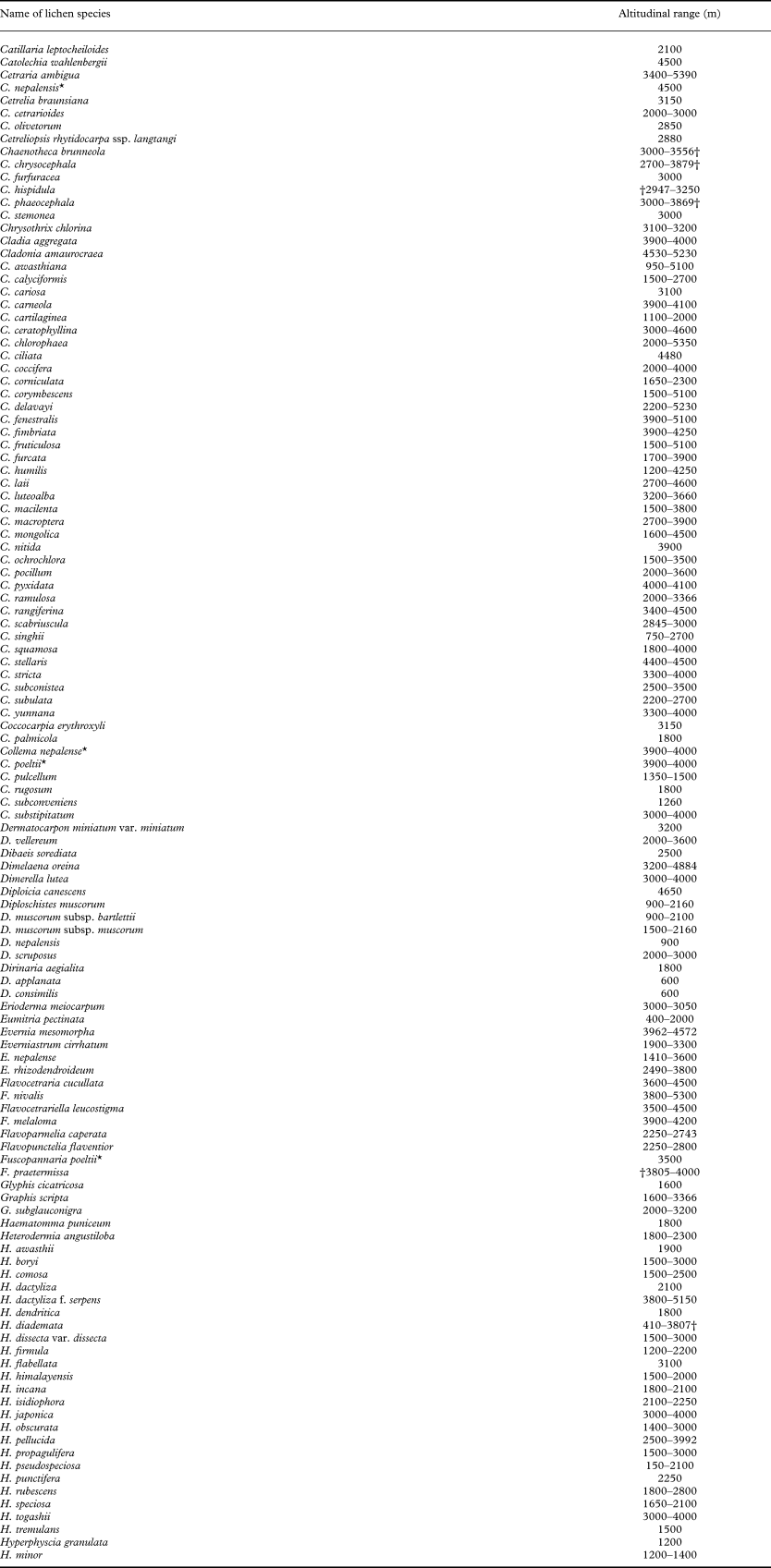
The main source of data for this study is the Lichens of Nepal (Sharma Reference Sharma1995). However, many species reported in Sharma (Reference Sharma1995) lack elevation data and since then many new species have been described. Other relevant and easily accessible literature as well as the recent keys for both microlichens and macrolichens of Nepal, India and Sri Lanka by Awasthi (Reference Awasthi1991; Reference Awasthi2007) have also been checked. In addition, the following literature on Nepalese lichens (Lamb Reference Lamb and Hellmich1966; Poelt Reference Poelt and Hellmich1966a, Reference Poelt and Hellmichb, Reference Poelt, Hellmich and Poelt1974; Bystrek Reference Bystrek, Hellmich and Poelt1969; Poelt & Reddi Reference Poelt, Reddi, Hellmich and Poelt1969; Abbayes Reference Abbayes, Hellmich and Poelt1974; Jahns & Seelen Reference Jahns, Seelen, Hellmich and Poelt1974; Kurokawa Reference Kurokawa, Hellmich and Poelt1974; Mitchell Reference Mitchell, Hellmich and Poelt1974; Schmidt Reference Schmidt, Hellmich and Poelt1974; Vězda & Poelt Reference Vězda, Poelt, Hellmich and Poelt1975; Hellmich & Poelt Reference Hellmich and Poelt1977; Awasthi Reference Awasthi1986; Vitikainen Reference Vitikainen1986; Awasthi & Mathur Reference Awasthi and Mathur1987; Miehe Reference Miehe1990; Awasthi Reference Awasthi1991, Reference Awasthi2007; Esslinger & Poelt Reference Esslinger and Poelt1991; Poelt & Hinteregger Reference Poelt and Hinteregger1993; Sharma Reference Sharma1995; Baniya Reference Baniya1996; Jørgensen Reference Jørgensen2001) have provided information on the elevation ranges of Nepalese lichens. These sources have provided elevational distribution data for 525 species, including 55 Nepalese endemics (Appendix 1). Among the 525 species, 172, including 29 endemics, are reported from above the treeline (> 4300m). In addition, data about life-forms (crustose, foliose and fruticose), photobiont types (cyanobacteria and green algae) and five substratum types (tree bark, wood, mosses, rocks and soil) were obtained. Tripartite lichens were treated as cyanobacterial. There were 50 species of lichens for which elevational data or other important information are either incomplete or lacking; these species were excluded from the analysis. Lignicolous and muscicolous substrata had been reported for a few species (5 and 17, respectively) and were thus also excluded during the analyses involving substrata. Lichen nomenclature follows Awasthi (Reference Awasthi1991; Reference Awasthi2007).
The altitudinal range of lichens in Nepal, 200–7400m, was divided into 73 bands of 100m each and a complete data matrix for all species was assembled. Presence of a species indicates that the species occurs in, or has been collected in the past, from that elevation band and absence means either that the species does not occur or has previously not been collected from that elevation. A species is assumed to be present in all possible 100m bands between its upper and lower elevation limits. For example, a lichen that has elevational occurrences between 210 to 451m in the literature falls between the 200- and 500-m bands. A list of the lichens included in this study together with their elevation ranges is provided in Appendix 1.
Species richness is an estimate of the total number of lichen species occurring in each 100m elevation band. This is a macro-scale study (gamma diversity, sensu Whittaker Reference Whittaker1972) that covers the entire elevational range of Nepal. Fifty-six taxa, varieties, forms or subspecies, were treated as species (Appendix 1).
Data analysis
Patterns related to total lichen species richness and their sub-sets (life forms, algal partners, and substrata) as responses and their elevations as a predictor variable were extracted by using a cubic smooth spline (s) within the framework of Generalized Additive Models (GAM, Hastie & Tibshirani Reference Hastie and Tibshirani1990; Heegaard Reference Heegaard2004) with a default of c. 4 degrees of freedom. Response variables are counts; thus, the variance changes with the mean and negative predictions are meaningless. We found over-dispersion in our data. We thus applied a Quasi-poisson family error distribution with a logarithmic link function (Crawley Reference Crawley2006). We confirmed our assumption of normal distribution of error after the Q-Q diagnostic plots plotted against residuals. The change in deviance follows the F-distribution. We used R 2.7.0 (R Development Core Team 2008) to analyse our data and smoothers were fitted with library GAM (Hastie & Tibshirani Reference Hastie and Tibshirani1990). GAM was used because it is a non-parametric approach that does not make a priori assumptions about the species-elevational relationship.
One of the main purposes of this study is to contrast observed lichen richness patterns with other studies. Biogeographic data have biases and constraints, such as a focus on specific taxa and/or a restriction to easily accessible landscapes. However, these problems are shared among data sets with various taxonomic groups (Grytnes & Vetaas Reference Grytnes and Vetaas2002; Vetaas & Grytnes Reference Vetaas and Grytnes2002; Bhattarai et al. Reference Bhattarai, Vetaas and Grytnes2004; Grau et al. Reference Grau, Grytnes and Birks2007). Thus, a comparison of empirical patterns among available studies is possible.
Results
The 525 lichen species recorded (Appendix 1) represented 40 families and 121 genera. Among these lichens, 35·4% were crustose, 46·3% were foliose and 18·3% were fruticose. A total of 12% had a cyanobacterial photobiont and 88% had a green algal photobiont. Lichens endemic to Nepal (n=55) represented 10% of the total Nepalese lichen flora. There were 172 species reported from above the treeline (≥ 4300m) and 29 of these were endemics. Carbonea vorticosa in Nepalese Himalaya at 7400m was the world's highest reported lichen. Heterodermia pseudospeciosa represented one of the lichens occurring at the lowest elevation ranges in Nepal (150–2100m).
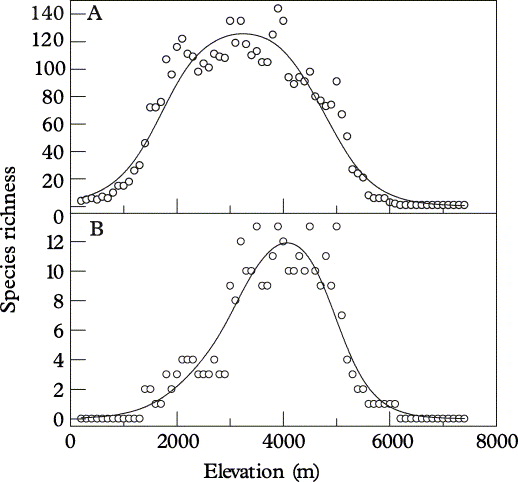
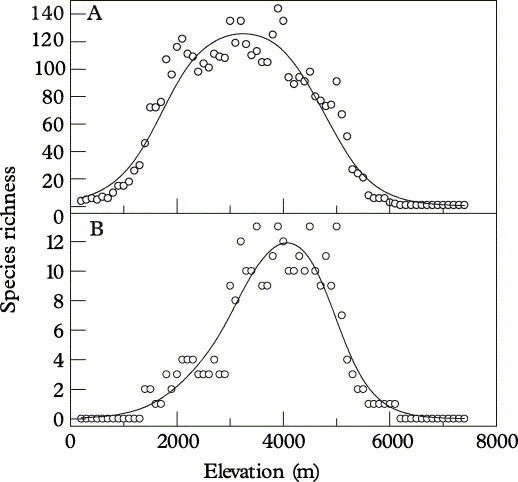
The total lichen species richness showed a unimodal relationship with elevation. The maximum modelled total richness occurred at 3100–3400m (Fig. 1A), whereas the observed maximum richness (144 species) was at approximately 4000m. Endemic lichens also had a unimodal relationship with elevation, but their maximum modelled richness occurred at 3900–4400 m (Fig. 1B) approximately 800m higher than the peak for total species. Non-endemic richness matched closely the elevational patterns of the total species richness (data not shown).
Relationship between elevation and lichen species richness in Nepal. A, total lichen species richness; B, total endemic lichen species richness. The fitted regression lines represent statistically significant (P ≤ 0·001) smooth spline (s) after using GAM with approximately 4 degrees of freedom.
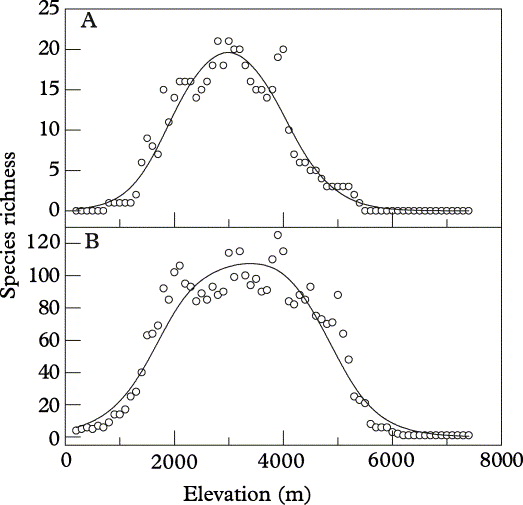
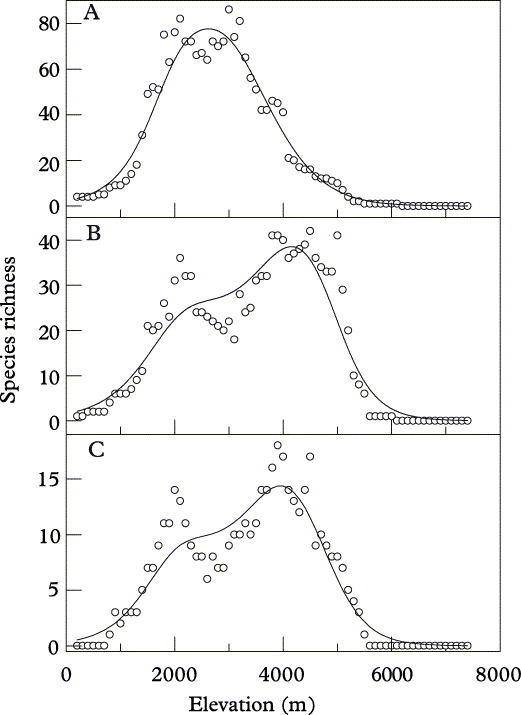
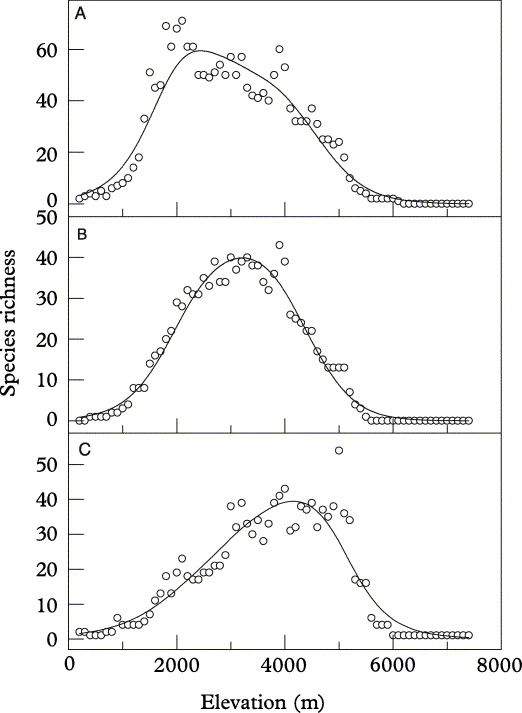
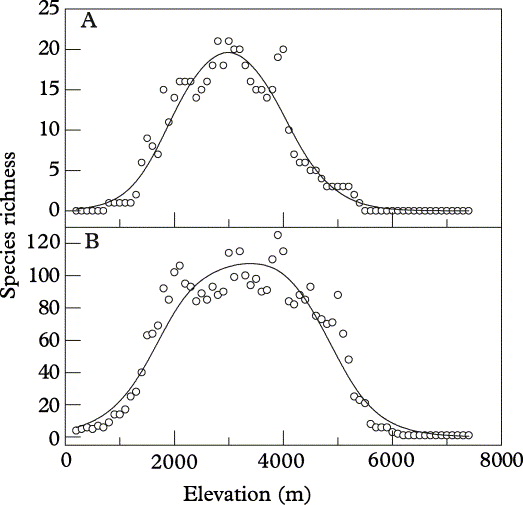
Species richness of all three growth forms of lichens had unimodal responses to elevation (Fig. 2A–C). Among the three morphological types, crustose lichens peaked at the highest altitude (4100–4200m) while foliose lichens had their maximum richness at consistently lower altitudes (2400–2500m). Fruticose lichens peaked at an intermediate elevation (3200m). With respect to photobiont type, cyanolichens exhibited maximum richness at lower altitudes (2900–3000m; Fig. 3A) than green algal lichens (3300–3500m; Fig. 3B).
Relationship between elevation and lichen species life-form richness in Nepal. A, foliose lichen species richness; B, fruticose lichen species richness; C, crustose lichen species richness. The fitted regression lines represent statistically significant (P ≤ 0·001) smooth spline (s) after using GAM with approximately 4 degrees of freedom.
The relationship between elevation and lichen richness for lichens with different photobionts. A, cyanolichen species richness; B, green algal lichen species richness. The fitted regression lines represent statistically significant (P ≤ 0·001) smooth splines (s) after using GAM with approximately 4 degrees of freedom.
Among the five substratum categories studied, corticolous lichens had a clear unimodal relationship to elevation, with the highest species richness occurring between 2500 and 2700m (Fig. 4A) in the lower part of the temperate forests. Saxicolous and terricolous lichens had slightly bimodal patterns with a prominent hump at 3900–4200m (Fig. 4B & C).
The relationship between elevation and lichens preferring specific substrata. A, corticolous lichen species richness; B, saxicolous lichen species richness; C, terricolous lichen species richness. The fitted regression lines represent statistically significant (P ≤ 0·001) smooth splines (s) after using GAM with approximately 4 degrees of freedom.

The regression analysis results showing the best selected model for each response variable are recorded in Appendix 2.
Discussion
Total lichen species richness in Nepal varies strongly with elevation (Figs 1A & B) in line with previous findings for vascular plants (Grytnes & Vetaas Reference Grytnes and Vetaas2002; Vetaas & Grytnes Reference Vetaas and Grytnes2002; Bhattarai & Vetaas Reference Bhattarai and Vetaas2003; Bhattarai et al. Reference Bhattarai, Vetaas and Grytnes2004) including orchids (Acharya Reference Acharya2008), and for bryophytes (Grau et al. Reference Grau, Grytnes and Birks2007). In all these studies, as well as studies dealing with lichens from other countries (Wolseley & Aguirre-Hudson Reference Wolseley and Aguirre-Hudson1997; Negi Reference Negi2000, Reference Negi2003; Wolf & Alejandro Reference Wolf and Alejandro2003; Pinokiyo et al. Reference Pinokiyo, Singh and Singh2008), species richness tends to peak at intermediate altitudes. The various major taxonomic groups exhibit maximum richness at different altitudes: vascular plants (1500 to 2500m; orchids 1600m, ferns 2000m), liverworts 1800m, mosses 2500m and as high as 3100 to 3400m for lichens. Thus, total richness for lichens occurs at higher elevations than for any of the other groups studied.
The total lichen species richness in the Himalayas peaked in the upper cloud-forest zone (following the vegetation classification of Hagen Reference Hagen1969; as modified by Miehe Reference Miehe1982; Reference Miehe1989). This is the zone of the highest rainfall on southernmost slopes (> 4000mm), and the lowest rainfall (< 300mm) on northernmost slopes where the Himalayan föhn causes local drying (Miehe Reference Miehe1989). The zone with maximum lichen richness represents the temperate zone with extremely large local variations in water availability and the accompanying gradients in vegetation cover. According to Bhattarai et al. (Reference Bhattarai, Vetaas and Grytnes2004), the high annual rainfall (> 4000mm) and cool summer temperatures (14–17°C) in this zone are likely to favour forests.The large number of temperate broad-leaved and coniferous trees with bark differing in roughness, moisture retention capacity and pH present a wide variety of habitats for lichens. The slightly bimodal peaks for saxicolous (Fig. 4B) and terricolous lichens (Fig. 4C) tend to show the lower peak in species richness occurring at the same altitude at which corticolous species reach their maximum richness (Fig. 4A). These patterns may be determined by habitat availability and specificity. Corticolous lichens apparently peak at elevations with a high abundance of forests, implying a reduced occurrence of natural and well-lit terricolous and saxicolous habitats.
Fruticose lichens have their maximum richness at a substantially higher altitude than the foliose lichens (Figs 2A & B). A similar relationship, but on a very different scale, can be seen within forest canopies where the biomass of fruticose lichens increases and that of foliose lichens decreases with height above the ground (Goward Reference Goward1998; Campbell & Coxson Reference Campbell and Coxson2001; Gauslaa et al. Reference Gauslaa, Lie and Ohlson2008). In well-lit and open high altitude forests and the upper canopies of trees, fruticose lichens may have the advantage in being able to utilise light from all directions, whereas many foliose and flat lichens maximize the harvest of more or less unidirectional light in shady positions in dense forests and on low canopy branches (Gauslaa et al. Reference Gauslaa, Palmqvist, Solhaug, Hilmo, Holien, Nybakken and Ohlson2009). The foliose lichen richness peaks in the same zone as the highest richness for mosses (Grau et al. Reference Grau, Grytnes and Birks2007), taxa that are also relatively shade tolerant. Furthermore, finely dissected fruticose lichens on twigs lack thick boundary layers. Thus, they are more closely coupled to ambient air than flat foliose lichens and absorb water vapour more readily from the air as discussed by Jonsson et al. (Reference Jonsson, Moen and Palmqvist2008). By contrast, flat lichens and bryophyte carpets are more dependent on rainwater.
The elevation range between 4000 to 4300m is the sub-alpine zone of Nepal (Stainton Reference Stainton1972). This humid upper-cloud zone (Miehe Reference Miehe1989) is densely colonized by epiphytic mosses reflecting the high humidity (Grau et al. Reference Grau, Grytnes and Birks2007). This humidity may also facilitate high lichen richness associated with open canopies with more light facilitating lichen growth (Gauslaa et al. Reference Gauslaa, Palmqvist, Solhaug, Hilmo, Holien, Nybakken and Ohlson2007).
A high degree of isolation creates endemism (Cox & Moore Reference Cox and Moore2000), and isolation might increase with elevation. High mountain peaks with an exceptionally cold and harsh climate act as islands (Grau et al. Reference Grau, Grytnes and Birks2007), and phytogeographical isolation can lead to localized speciation events. The occurrence of 29 endemic species (17%) out of the 172 total species above the treeline (≥ 4300 m) emphasises the link between elevation and endemism. The Nepalese lichen endemism rate is higher than that for mosses (3 out of 480 spp. i.e., < 1%) and liverworts (33 out of 368 spp. i.e., 9%), but slightly less than that for vascular plants (303 out of 1957 spp. i.e., 16%). Above 4500m both total and endemic lichen diversity (Figs 1A & B) decline until 6100m, which is the highest reported elevation for lichens endemic to Nepal. Cold winds leading to rapid freezing and drying may reduce competition from surviving vascular plant species (Grime Reference Grime1977). The harsh climate might lead to various specializations and thus facilitate formation of endemic species (Aptroot & Bungartz Reference Aptroot and Bungartz2007).
Land area might impose a unimodal richness pattern. In general, the larger the area sampled, the greater will be the number of species encountered (Rosenzweig Reference Rosenzweig1995; Qian et al. Reference Qian, Fridley and Palmer2007). A decreasing trend in land area in each 500m band occurs with increasing elevation (Vetaas & Grytnes Reference Vetaas and Grytnes2002) as estimated from the Digitized Map by the International Centre for Integrated Mountain Development (ICIMOD, Kathmandu). This is not always a common pattern (Körner Reference Körner2007). If we consider species-area relationships, more species should be expected towards lower elevations than we observed. However, lichen diversity can be greatly limited by lack of long ecological continuity in forests (Rose Reference Rose, Brown, Hawksworth and Bailey1976) and lichens may be less prevalent at low altitudes because of dense forest canopies and intensive land-use. Furthermore, as lichen species richness also tends to be universally greater in cool or cold climates (Mattick Reference Mattick1953), we believe that the strong reduction in lichen richness at low elevations is real and not a sampling artefact.
In conclusion, lichens and various subgroups of lichens exhibit unimodal patterns similar to those found in other major taxonomic groups, but the highest total lichen richness peaks at higher altitudes than in any other group. The maximum lichen richness occurred at the altitude with the highest diversity of ecological niches in terms of spatial heterogeneity, rainfall, temperature, cloud formation, as well as high phorophyte abundance and diversity implying large variation in bark roughness, moisture retention capacity, and pH.
We are grateful to the Norwegian State Education Loan Fund (Lånekassen) for providing funding and the Central Department of Botany, Tribhuvan University, Nepal, for providing study leave for CBB. Thanks are due to John Birks for his valuable comments, Walter Obermayer and Per Magnus Jørgensen for provision of literature on lichens and to Govind Ghimire and Bijaya Kattel for their feedback. Thanks are also due to Louise Olley, Teuvo Ahti and Tor Tönsberg for their help in revising the species list and to the Senior Editor, Peter Crittenden and two anonymous referees for their useful comments and suggestions.
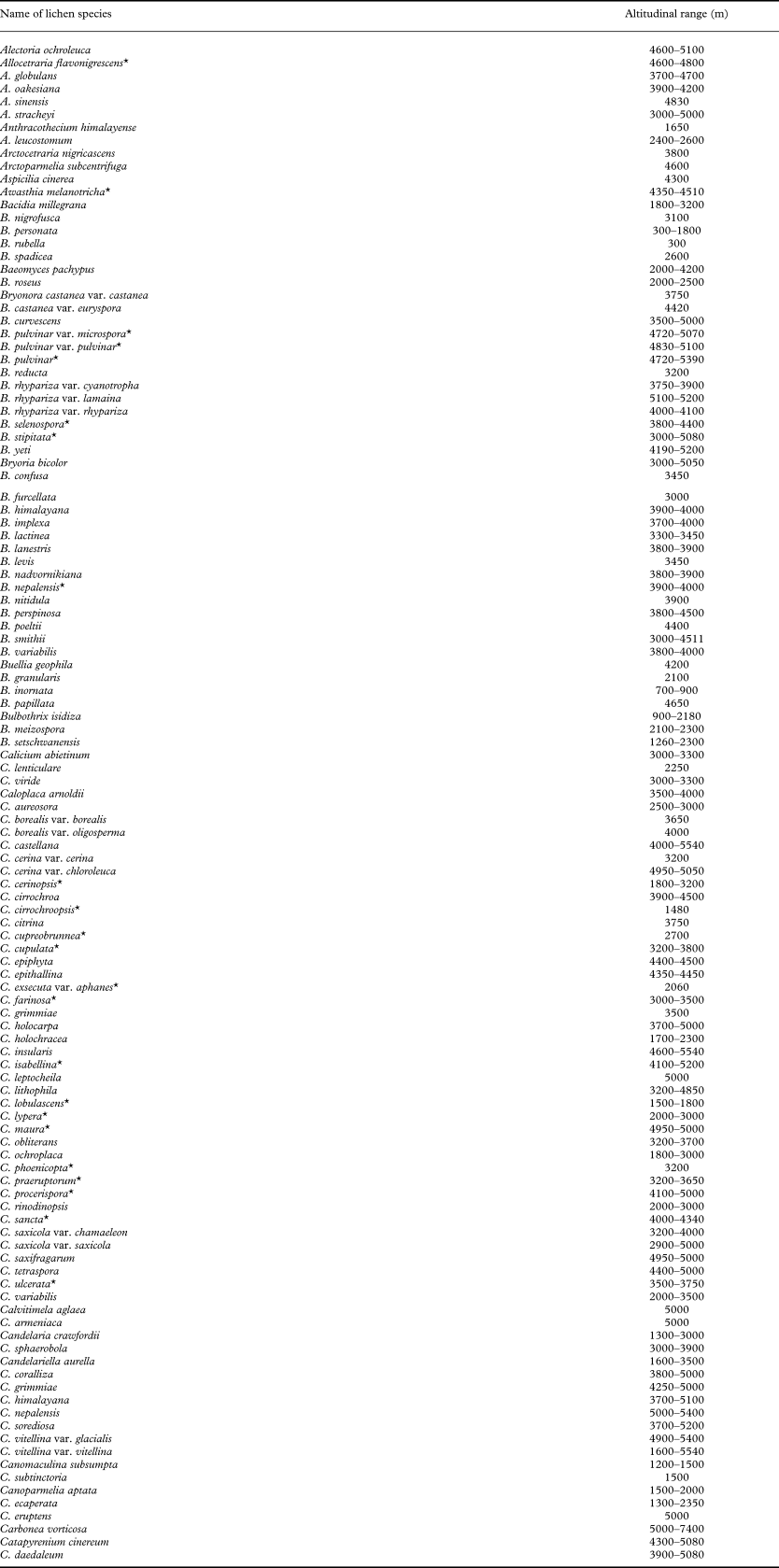
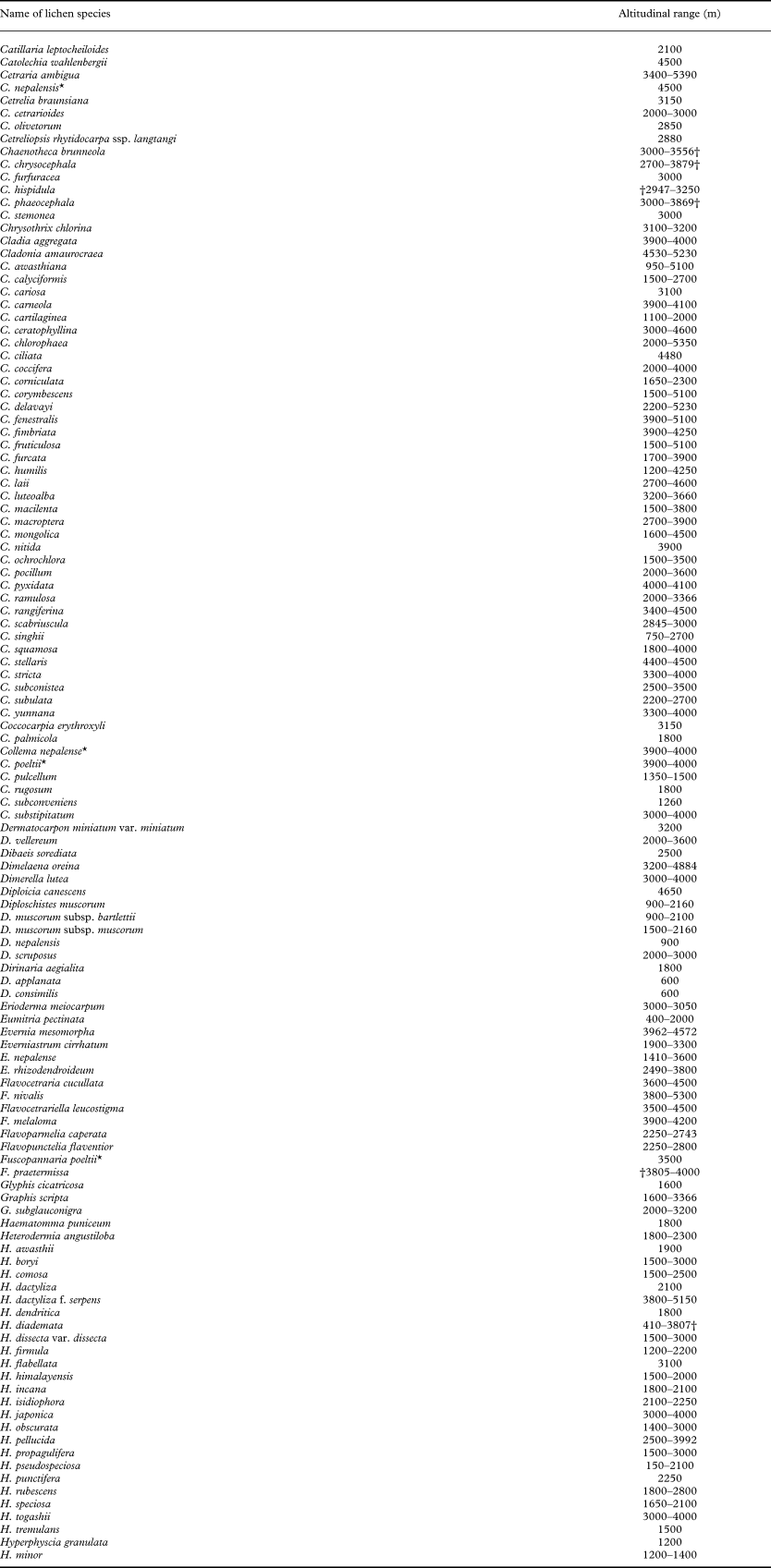
Elevation ranges of lichen species of Nepal.
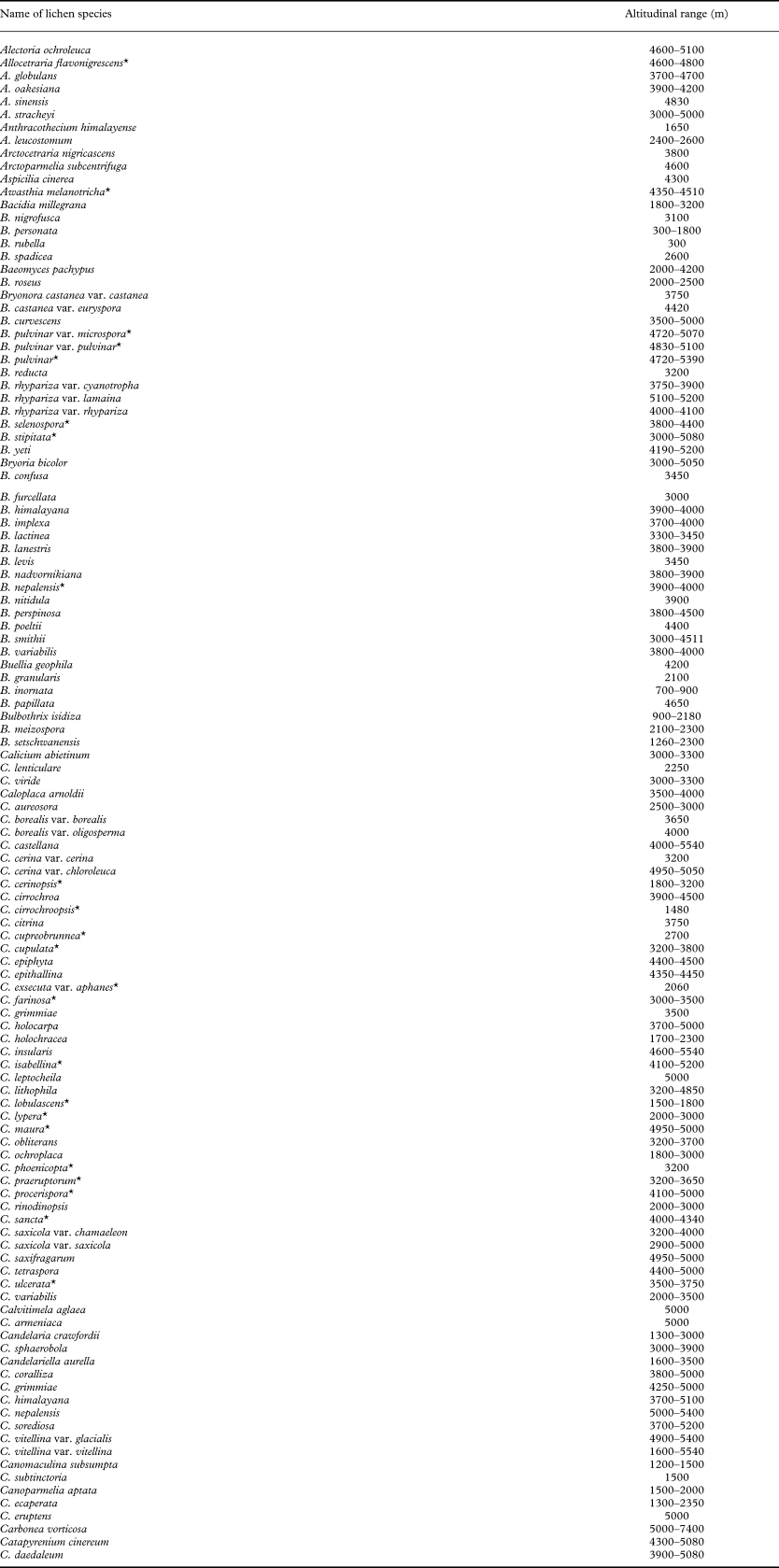
* species endemic to Nepal
† Louise Olley's unpublished personal observation
The elevational gradient of lichen species richness regression analysis results modelled after different species richness as response variables and their elevation as predictor variable. The Quasi-poisson family of error fitted in the GAM model after the cubic smooth spline (s) with approximately 4 degrees of freedom. (P≤0·05)
Df = degree of freedom, Res. = residual, D 2 = regression coefficient of determination