Children's development is complex, evolving via bidirectional and transactional relations between children's endogenous characteristics, such as temperament, and exogenous, environmental factors, such as early caregiving (Cicchetti & Lynch, Reference Cicchetti and Lynch1993; Hinshaw, Reference Hinshaw, Beauchaine and Hinshaw2008; Rutter, Reference Rutter1989). Temperament refers to biologically based, early emerging, and relatively stable individual differences in emotion reactivity and regulation and other behavioral tendencies (Rothbart & Bates, Reference Rothbart, Bates, Eisenberg and Damon2006). Past work highlights the important role of temperament in youth adjustment, with an extensive body of work focusing on the relationship between youth adaptation and two conceptually related traits, behavioral inhibition (BI) and effortful control (EC). BI is characterized by heightened vigilance, fearful affect, and behavioral withdrawal in response to novel situations, especially those social in nature (Kagan, Reference Kagan, Zentner and Shiner2012), and is a risk factor for anxiety problems (Fox & Pine, Reference Fox and Pine2012) and possibly internalizing problems in general. EC, the ability to inhibit a dominant response and activate a subdominant response, is also consistently associated with multiple aspects of child development. For example, low EC predicts increased externalizing behaviors and attentional problems (Eisenberg, Sadovsky, et al., Reference Eisenberg, Sadovsky, Spinrad, Fabes, Losoya, Valiente and Shepard2005; Eisenberg, Zhou, Reference Eisenberg, Zhou, Spinrad, Valiente, Fabes and Liew2005; Rothbart & Bates, Reference Rothbart, Bates, Eisenberg and Damon2006), and high EC predicts greater social competence and self-esteem (Lengua, Honorado, & Bush, Reference Lengua, Honorado and Bush2007; Spinrad et al., Reference Spinrad, Eisenberg, Gaertner, Popp, Smith, Kupfer and Hofer2007).
BI and EC share conceptual overlap in that they both capture individual differences in the extent to which one can (or cannot, in the case of high BI) execute context-appropriate behavior suited to one's current environmental circumstances. In contrast to traits that capture emotional tendencies (e.g., positive and negative emotionality), BI and EC arguably show more ambiguous relations with child outcomes. Most children high in BI do not develop internalizing problems (Pérez-Edgar & Guyer, Reference Pérez-Edgar and Guyer2014), and in some contexts, higher BI may be beneficial. For example, inhibited or introverted individuals tend to be more deliberate and harm avoidant (Carver, Reference Carver2005; Smits & Boeck, Reference Smits and Boeck2006), which may prove useful in many situations. Similarly, while high EC is typically considered conducive to positive child outcomes, it has been associated with adolescents’ deliberate, planful aggression when caregiving is overly controlling (Rathert, Fite, & Gaertner, Reference Rathert, Fite and Gaertner2011). When coupled with other vulnerabilities, high EC may also be related to internalizing symptoms (Pérez-Edgar, Reference Pérez-Edgar, Oettingen and Gollwitzer2015).
This literature indicates that integrative models are needed to understand the dynamic interplay involved in when and how BI and EC portend common childhood mental health issues. Further, bidirectional relations between child temperament and caregiving behaviors may constitute the transactional, and potentially causal, developmental pathways toward child adaption within the broader developmental context (Sameroff, Reference Sameroff2009). Examining such transactional relations is necessary for understanding the mechanisms by which these constructs act together in shaping developmental trajectories. A better understanding of these mechanisms can potentially inform the development of refined, more targeted early prevention strategies that reduce temperamental risk for adjustment problems.
While many parenting constructs have been examined in the interest of predicting child outcomes, structured parenting (Leve et al., Reference Leve, Harold, Ge, Neiderhiser, Shaw, Scaramella and Reiss2009; Natsuaki et al., Reference Natsuaki, Leve, Harold, Neiderhiser, Shaw, Ganiban and Reiss2013) appears particularly relevant, especially in conjunction with certain temperamental traits that are also implicated in child maladjustment (e.g., BI and EC). Structured parenting captures caregiving strategies that provide consistent guidance and scaffolding for the child and regulate child behaviors and mood via the provision of specific instructions and limit setting, especially when the child is facing challenging situations (e.g., Barber, Reference Barber1996; Pomerantz & Eaton, Reference Pomerantz and Eaton2001). In the literature, structured parenting is associated with fewer problem behaviors and greater social competence in children (Denham et al., Reference Denham, Workman, Cole, Weissbrod, Kendziora and Zahn-Waxler2000; Lecuyer & Houck, Reference Lecuyer and Houck2006; Leve et al., Reference Leve, Harold, Ge, Neiderhiser, Shaw, Scaramella and Reiss2009; Natsuaki et al., Reference Natsuaki, Leve, Harold, Neiderhiser, Shaw, Ganiban and Reiss2013). Other parenting styles related to the provision of structure include parent overprotection (or oversolicitousness) and intrusiveness. Overprotective parents typically prevent children from exploring new environments and often provide excessive comfort to children above and beyond the child's needs (Spokas & Heimberg, Reference Spokas and Heimberg2009; Ungar, Reference Ungar2009). Intrusiveness is defined as parental control that commands children's behaviors but fails to consider the child's needs or autonomy (Wood, Reference Wood2006). Thus, with respect to structure, overprotective parents may fail to provide sufficient structure in guiding children through challenging situations, whereas intrusive parents may have inflexible structures that are unresponsive to offspring needs. Here, we refer to structured parenting as predictable, reliable caregiving demonstrative of appropriate authority and control that is also flexible and fostering of children's emergent autonomy. Thus, structured parenting may facilitate the positive development of children's regulatory-related traits (i.e., BI and EC).
BI and Parenting
The extant literature implicates bidirectional relations between aspects of caregiving structure and child temperament in shaping child developmental outcomes. With respect to associations between BI and parenting, Rubin, Burgess, and Hastings (Reference Rubin, Burgess and Hastings2002) found that overprotective parenting observed at age 2 predicted later increases in children's fearful inhibition observed at age 4. Similar patterns were found in preschoolers, where parental self-reported protective parenting predicting parent-reported child inhibited and fearful behaviors a year later (Edward, Rapee, & Kennedy, Reference Edwards, Rapee and Kennedy2010). In a different study, however, parents’ report of their overprotective behaviors at age 2 failed to predict parent-reported child BI at age 4 (Rubin, Nelson, Hastings, & Asendorpf, Reference Rubin, Nelson, Hastings and Asendorpf1999). In older children, using combined parent- and child-report data of temperament and parenting, Lengua and Kovacs (Reference Lengua and Kovacs2005) found that parental inconsistent discipline at age 9 predicted increases in children's fearful inhibition at age 10. Nonetheless, in another study conducted on the same data set (Lengua, Reference Lengua2006), the authors found that inconsistent discipline around age 9 predicted modest decreases in inhibition during the following 2 years. The authors posited that, as youth are transitioning into adolescence, they may perceive highly consistent parental discipline as intrusive or invasive, and inconsistent parenting as granting more autonomy, which in turn leads to decreases in fear and inhibition.
In contrast, child BI may also influence or potentially elicit specific caregiver behaviors. Much of the work along this line has focused on the effects of inhibited children, compared with their noninhibited peers, in eliciting protective behaviors from caregivers. Two-wave longitudinal studies suggest that parental-reported toddler inhibition predicted parents’ self-reported protection and discouragement of independence 2 years later, with the stability of parenting behaviors accounted for (Hastings & Rubin, Reference Hastings and Rubin1999; Rubin et al., Reference Rubin, Nelson, Hastings and Asendorpf1999). Kiel and Buss (Reference Kiel and Buss2009, Reference Kiel and Buss2011) reported that observed overprotective parenting mediated the association between observed toddlerhood BI and later parent- and teacher-reported anxious and withdrawal behaviors. Similarly, in older children, data from combined parental and child reports showed that fearful inhibition at age 9 predicted increased parental protection and acceptance a year later (Lengua, Reference Lengua2006; Lengua & Kovacs, Reference Lengua and Kovacs2005).
EC and Parenting
With respect to EC, Kochanska, Murrray, and Harlan (Reference Kochanska, Murray and Harlan2000) found that observed maternal responsiveness to 22-month-olds predicted greater child EC at 33 months, assessed using both observation and parent report. Observational ratings of parental responsiveness during infancy to age 2 predicted child EC at a 52-month follow-up (Kochanska & Knaack, Reference Kochanska and Knaack2003). Similarly, Olson, Bates, and Bayles (Reference Olson, Bates and Bayles1990) reported that observed maternal responsiveness at age 2 modestly predicted child EC observed at age 6. Spinrad et al. (Reference Spinrad, Eisenberg, Gaertner, Popp, Smith, Kupfer and Hofer2007, Reference Spinrad, Eisenberg, Silva, Eggum, Reiser, Edwards and Gaertner2012) found that observed maternal sensitivity during toddlerhood predicted higher EC a year later, assessed by combined observational and parent-reported data; higher EC further predicted later decreases in children's parent-reported impulsive behaviors. Findings in older children concerning the parenting-to-EC relation are less consistent. A recent multiwave longitudinal study, using combined questionnaire and observational data, found significant relations from positive parenting to child EC during early to middle adolescence (ages 11–12 and 13–14), but not during middle childhood (ages 5 and 7; Tiberio et al., Reference Tiberio, Capaldi, Kerr, Bertrand, Pears and Owen2016). Another study using questionnaire data only failed to observe a predictive relation between parental rejection or inconsistency at age 9 and child EC 2 years later (Lengua, Reference Lengua2006).
As with BI, child EC may also elicit specific caregiver behaviors. Morrell and Murray (Reference Morrell and Murray2003) found that observed infant regulatory abilities, a construct closely related to EC, predicted child conduct problems at age 8. In addition, this association was partially mediated by parental hostility and intrusiveness observed at age 5. Bridgett et al. (Reference Bridgett, Gartstein, Putnam, McKay, Iddins, Robertson and Rittmueller2009) found that parent-report regulatory capacity during infancy contributed to parent-report negative parenting in toddlerhood; however, they did not account for the stability of parenting over time. Using combined questionnaire and observational data of child EC and parenting, a multiwave study found that age 3 EC predicted poor discipline and positive parenting at age 5, and poor discipline only at age 7; as children grew older, EC at age 7 predicted positive parenting at age 11–12 (Tiberio et al., Reference Tiberio, Capaldi, Kerr, Bertrand, Pears and Owen2016). Using questionnaire data, greater EC at age 9 predicted moderate decreases in parental rejection 2 years later, but did not predict changes in parental inconsistency (Lengua, Reference Lengua2006). However, this EC-to-parenting directionality was not replicated in other studies focusing on similar age ranges (i.e., from late childhood to early adolescence; Eisenberg, Sadovsky, et al., Reference Eisenberg, Sadovsky, Spinrad, Fabes, Losoya, Valiente and Shepard2005; Eisenberg, Zhou, et al., Reference Eisenberg, Zhou, Spinrad, Valiente, Fabes and Liew2005; Lengua & Kovacs, Reference Lengua and Kovacs2005).
The Current Study
In sum, the need to study directional and transactional relations between parental and child individual factors has been established for decades (Bell, Reference Bell1979; Patterson, Reference Patterson1982); thus, it is somewhat surprising that many studies aimed at understanding the interplay between early care and child factors do not draw upon strategies capable of capturing transactional processes (e.g., multiwave longitudinal designs that measure the same construct at multiple time points). In the context of longitudinal designs, considering the stability of constructs of interest is important as it facilitates estimates of cross-lagged versus contemporaneous associations of each construct with the other. Temperament as a construct is defined in part by its stability (Nigg & Goldsmith, Reference Nigg and Goldsmith1998), and early care also shows moderate stability (Lovejoy, Graczyk, O'Hare, & Neuman, Reference Lovejoy, Graczyk, O'Hare and Neuman2000), rendering it challenging to infer transactional relations between them over time, if the stability of these constructs cannot be estimated. For these reasons, Kiff, Lengua, and Zalewski (Reference Kiff, Lengua and Zalewski2011), in their review on the interrelations between temperament and parenting, suggested that “future research would benefit from longitudinal designs that include three (or more) time points, assess parenting and temperament across developmental periods, and include indicators of adjustment outcomes” (p. 269). Nevertheless, many studies have inferred directional or transactional relations by using cross-sectional data, relied on two-wave data without measuring child outcomes, or failed to address stability of (or concurrent associations between) child temperament and caregiving (e.g., a construct was measured at one time point only; Kiff et al., Reference Kiff, Lengua and Zalewski2011). While designs such as these provide important clues about ties between parenting and temperament, they speak less clearly to transactional processes related to child adjustment.
We aimed to address these issues by characterizing transactional relations between child temperament and parenting, and how these relations, in turn, predicted later child adjustment outcomes. Specifically, we relied on a large, three-wave longitudinal data set, with observational data of child temperament (BI and EC) and structured parenting collected at child ages 3 (Time 1; T1) and 5 (Time 2; T2), and parent-reported child adjustment problems (internalizing, externalizing, and attention-academic problems) at ages 3 (T1), 5 (T2), and 8 (Time 3; T3). Based on the literature, we expected to observe cross-lagged relations for both directions between temperament and parenting (i.e., from T1 temperament to T2 parenting, and from T1 parenting to T2 temperament), which we anticipated predicting child adjustment at T3. We also tested mediation models not only for the BI-internalizing and EC-externalizing pathways but also for BI-externalizing and EC-internalizing pathways in exploratory analyses aimed at showing whether any trait–symptom associations were specific to internalizing versus externalizing symptoms. In addition, we tested models of BI and EC in predicting children's attention-academic problems at T3 given past work suggesting their relevance to this outcome (Eisenberg, Sadovsky, et al., Reference Eisenberg, Sadovsky, Spinrad, Fabes, Losoya, Valiente and Shepard2005, Eisenberg, Zhou, et al., Reference Eisenberg, Zhou, Spinrad, Valiente, Fabes and Liew2005; Walker, Henderson, Degnan, Penela, & Fox, Reference Walker, Henderson, Degnan, Penela and Fox2014).
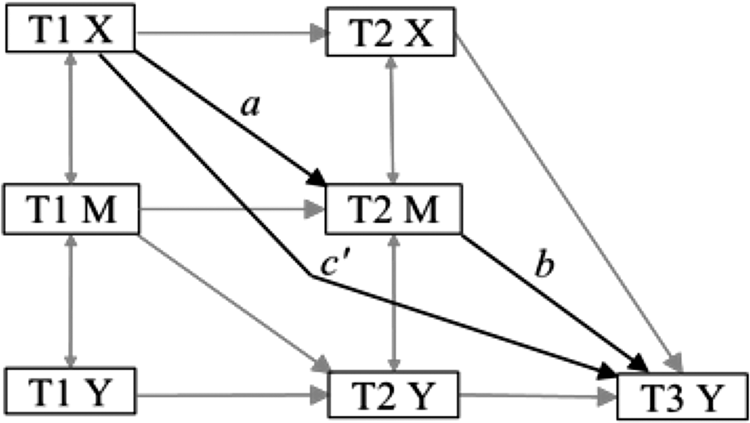
More specifically, we ran two groups of mediation models to examine (a) the predictive effect of T1 child temperament, BI or EC, on T3 child adjustment problems through T2 parenting as the mediator (child-to-parent models), and (b) the predictive effect of T1 parenting on T3 child adjustment through T2 temperament as the mediator (parent-to-child models). The conceptual model is illustrated in Figure 1.
An abridged illustration of the conceptual mediation model. In child-to-parent models, X = child temperament (BI or EC), M = parenting; in parent-to-child models, X = parenting, M = child temperament (BI or EC). Autoregressive and cross-sectional paths are presented in gray. Paths of interest include path a, effect of T1 X on T2 M; path b, effect of T2 M on T3 Y; path c', direct effect of T1 X on T3 Y; path ab (not shown in the figure), indirect effect of T1 X on T3 Y through T2 M.

Method
Data reported in this study were collected at three time points from the same cohort of families. The first wave (T1; N = 409, 201 boys; M age = 3.43 years, SD = 0.30) consisted of a 2-hr laboratory visit (when observed child temperament and parenting were assessed), a 2.5-hr home visit for additional assessment of parenting, and parent-report questionnaires on child behavior. The second wave (T2; N = 394, 193 boys; M age = 5.93 years, SD = 0.31) was conducted an average of 2.49 years (SD = 0.10) after the first laboratory visit, and consisted of a 2-hr laboratory visit (when observed child temperament and parenting measures were collected again) and parent-report questionnaires on child behavior. The third wave (T3; N = 365, 182 boys; M age = 8.59 years, SD = 0.73) was initiated an average of 2.67 years (SD = 0.64) following the second wave, when the parent completed questionnaires on child behavior via mail or on the internet. All parenting and parent-report data were collected from the primary caregiver, which was predominantly the mother (T1, 93.4%; T2, 93.5%; T3, 94%).
Participants
Participants were families of 3-year-olds recruited from the southwestern Ontario community. Eligible children had at least one biological parent and no significant medical, psychological, cognitive, or language impairments. Children were of average cognitive ability as estimated by the Peabody Picture Vocabulary Test (Dunn & Dunn, Reference Dunn and Dunn1997; M = 111.94, SD = 14.32). Ethnically, 93.4% of the children were identified by the primary caregiver as White (0.5% Black, 2% Asian, 1.7% Hispanic, and 2.4% mixed or other races). Approximately 50.4% of the families were middle class with an annual family income of $40,00–$100,000 CAD (3.9% with income <$20,000; 10.7% with income $20,000–$40,000; and 29.8% with income >$100,000). Written consents for both the child and parents were acquired from the parents, and monetary compensation was provided.
Laboratory assessment of temperament and parenting
Children participated in a 1.5- to 2-hr battery of standardized tasks drawn from the Laboratory Temperament Assessment Battery (Goldsmith, Reilly, Lemery, Longley, & Prescott, Reference Goldsmith, Reilly, Lemery, Longley and Prescott1995) with a female experimenter. Tasks were designed to elicit a wide array of child behaviors thought relevant to temperament and were videotaped for coding purposes. Carryover effects were minimized by ensuring that no tasks designed to elicit similar emotional reactions occurred successively; children were also given a short break in between each task to return to a baseline state. A parent was present in the main experimental area with his or her child for the duration of the laboratory assessment except as noted below. He or she was seated at a desk aside the main experimental area and instructed to work on questionnaires, and to avoid interaction with the child. Video recordings of the laboratory tasks were coded by trained graduate and undergraduate coders. Before being allowed to code a specific task independently, coders had to achieve a minimum intraclass correlation (ICC) of .80 with a master coder on approximately 20 participants. Once this standard was reached, periodic reliability checks were conducted on 15%–20% of all recordings for each task (e.g., 3 out of every 15 recordings were coded for reliability). A description of each task, the coding schemes, and coding reliabilities are reported below.
BI tasks
Risk room (T1)
The child and experimenter entered a room containing novel and ambiguous stimuli, including a small staircase, a mattress, a balance beam, a Halloween mask, a cloth tunnel, and a large, black cardboard box. The experimenter left for 5 min after instructing the child to play with the stimuli “however you like.” When the experimenter returned, she asked the child to interact with each stimulus in the room.
Stranger approach (T1)
The child was left alone in the experimental area under the premise that the experimenter needed to get a toy for further play. While the child was alone, an unfamiliar male research assistant entered the room and spoke to the child while slowly moving closer, following a standardized script and timed intervals. After asking the child several standardized questions, the stranger left and the main experimenter returned.
Jumping spider (T1)
The child and experimenter were seated at a table in the center of the room with a fuzzy, fake, black spider on the table. The experimenter asked the child to touch the spider; when the child's hand was close to the spider, the experimenter made it appear to jump by manipulating an attached wire. This was repeated for four trials.
Exploring new objects (T2)
The child and experimenter entered a room containing various novel and ambiguous stimuli, which included a tunnel, a remote-controlled spider, a skull and cloth, a box with a toy heart inside, and a box with “worms” inside. The experimenter left for a total time of 5 min after instructing the child to play with the objects in the room. When the experimenter returned, she asked the child to interact with each stimulus in the room.
Friendly stranger (T2)
The child was left alone in the experimental area with a toy. While the child was alone, an unfamiliar male research assistant entered the room. Following a standardized script and timed intervals, he asked the child friendly questions and asked to play with the toy together.
Object fear (T2)
The experimenter instructed the child to investigate “something scary” in a pet carrier, leaving the child alone in the room. After 1 min, the experimenter returned and asked the child about the item in the animal carrier. If the child had not explored the carrier, the experimenter asked the child to look and to put his or her hands into the carrier.
BI coding and reliability
Microcoding was used for tasks designed to tap BI such that the task was segmented into epochs of 10-s, 20-s, or 30-s duration that were coded for BI-relevant behaviors (Goldsmith et al., Reference Goldsmith, Reilly, Lemery, Longley and Prescott1995). The risk room task at T1 and exploring new objects task at T2 shared similar coding schemes and are described together here. Both tasks were divided into two phases, with the first beginning when the child entered the room and ending when the experimenter returned (segmented into 30-s epochs for risk room, and 10-s epochs for exploring new objects). Latencies to touch each object, to child's first fear response, and first verbalization were coded. In each epoch, peak intensities of facial, vocal, and bodily fear (from 0 = no fear to 3 = high intensity), tentative play, time spent playing, references parent, proximity to parent, fearful or wary questions or comments, and amount of time talking were coded. The second phase (divided into 20-s epochs for both risk room and exploring new objects) began when the experimenter returned and ended when the child and experimenter exited the room. Latencies to comply with the experimenter's request to touch each object were coded. For each epoch, peak intensities of facial, vocal, and bodily fear (from 0 = no fear to 3 = high intensity), tentative play, references parent, proximity to parent, and fearful or wary questions or comments, were coded in the same manner as the first phase of each task. Noncompliance and references experimenter were also coded.
Similar coding schemes were used for the stranger approach at T1 and friendly stranger at T2. The latency from the time the experimenter left the room to the child's first fear response, and the latency from the time the stranger entered the room to the child's first vocalization, were coded. Peak intensities of facial, bodily, and vocal fear were coded for each 20-s epoch (from 0 = no fear to 3 = high intensity). Stilling and freezing was coded as the duration of seconds that a child exhibited a marked decrease in activity that exceeded 2 s and involved little or no movement. Approach, avoidance, gaze aversion, and verbal and nonverbal interaction were also coded for each epoch when the stranger was present. For friendly stranger at T2, the child's attempts to engage stranger to play were also coded.
In coding jumping spider at T1, child's latency to the first definite fear response, peak intensities of facial, bodily, and vocal fear (from 0 = no fear to 3 = high intensity), behaviors of approach, withdrawal, gaze aversion, and startle, and whether the child played with the spider at the end of the task were coded for each of the four trials. For object fear at T2, latencies to first approach the carrier, first touch the carrier, first look inside of the carrier, first touch inside of the carrier, and the tentativeness of these behaviors (from 0 = not tentative at all to 3 = not engage in the behavior due to fearfulness). Latencies to child's first verbalization, first fear response, first withdrawal attempt were also coded. For each 20-s epoch, peak intensities of child's facial, bodily, and vocal fear, behaviors of still and freezing, and approach or avoidance were coded in the same way as in the other tasks.
Codes of certain behaviors were reverse-coded (e.g., time spent playing with the objects in the risk room task), so higher scores in all tasks reflected greater BI. The final BI scale for each time point consisted of an average score of z-transformed codes across different tasks (T1, α = .79, N = 39; ICC = .71, N = 32; T2, α = .88, N = 67; ICC = .98, N = 24).
EC tasks
The EC tasks and coding schemes were adopted from Kochanska and colleagues (Kochanska, Murray, & Coy, Reference Kochanska, Murray and Coy1997; Kochanska, Murray, & Harlan, Reference Kochanska, Murray and Harlan2000; Kochanska, Murray, Jacques, Koenig, & Vandegeest, Reference Kochanska, Murray, Jacques, Koenig and Vandegeest1996).
Tower of patience (T1)
The child and experimenter took turns building a tower with large blocks. During each of her turns, the experimenter adhered to a schedule of varied delays (5 s, 10 s, 15 s, 0 s, 20 s, and 30 s) before placing her block on the tower.
Snack delay (T1)
The child was instructed to wait for the experimenter to ring a bell before eating a bite of a snack. The experimenter adhered to a schedule of varied delays (5 s, 10 s, 0 s, 20 s, 0 s, and 30 s) before ringing the bell.
Simon says (T2)
The child was told to imitate the experimenter's actions (e.g., “rub your tummy”) only when the command was preceded by the words “Simon Says.” Otherwise, they were to remain perfectly still. Out of the 40 trials in total, there were 20 “motion” trials with Simon says and 20 “still” trials without Simon says.
Gift bag (T2)
The child was left alone in the experimental area with a gift bag for 3 min, and told not to touch it until the experimenter came back with the child's parent.
EC coding and reliability
For both EC tasks at T1, the frequency of children's “failures to wait turn” (i.e., did not wait for his or her turn to place the block in the tower task; did not wait for the bell before eating the snack in the snack delay task) was counted in each trial of each task. The number of failures was summed across trials in each task, z-transformed, and averaged across tasks to create an aggregate EC score. As more failures (i.e., greater scores) reflected lower EC, these scores were reversed-coded to facilitate interpretation, and are henceforth referred to as “EC.”
In coding the Simon says task at T2, each motion trial was scored as 0 = no motion, 1 = part, or 2 = done. Each still trial was scored as 0 = done, 1 = part, or 2 = no motion. For subsequent analysis, a total score was summed up across all trials (greater scores = higher EC). For the gift bag task at T2, child's behavior during the 3 min was coded in the following categories: (a) latencies (in seconds) to touch bag, peek inside bag, put hand on bag, pull gift from bag, and leave seat; (b) strategies with the bag (1 = pulls gift from bag, 2 = puts hand in bag, 3 = touches bag and peek, 4 = touches bag no peeking, or 5 = does not touch bag); and (c) the duration of child in seat (1 = <30 s, 2 = 30 s to 1 min, 3 = 1 to 2 min, 4 = >2 min). Finally, the total score of Simon says and the category scores of gift bag were z-transformed and averaged to generate an aggregate score of EC (greater scores = higher EC).
The eventual EC scale for each time point consisted of an average score of z-transformed codes (and reverse-coded when necessary) across tower patience and snack delay for T1 (α = .79, N = 39; ICC = .95, N = 32), and Simon says and gift bag for T2 (α = .64, N = 80; ICC = .99, N = 31).
Parenting tasks
Puzzle with parent (T1 and T2 laboratory visits)
Based on the Teaching Tasks battery (Egeland et al., Reference Egeland, Weinfield, Hiester, Lawrence, Pierce, Chippendale and Powell1995), the child and parent were seated at a table in the center of the experimental area, and worked together on a difficult block puzzle for 4 min (5 min for T2).
Three-bag task (T1 home visit)
In this task (Ipsa et al., Reference Ispa, Fine, Halgunseth, Harper, Robinson, Boyce and Brady-Smith2004; NICHD Early Child Care Research Network, 1997), the parent and the child played together with three numbered bags of toys (a book, a set of cooking toys, and a farm animal set) for 10 min. The pair was instructed to play with the toys however they like using the items in the bags in order and to put away one bag before proceeding to the next.
Prohibition task (T1 home visit)
The parent and the child were given two bins of toys, one containing appealing toys and the other broken and unappealing toys. The experimenter instructed parents on how to interact with their child during the task, and gave parents a small cue card as a reminder. First, the parent instructed the child to play with the unappealing toys and prevented him or her from playing with the desirable toys. After 3 min, the parent allowed the child to play with any of the toys. After 6 min of free play, the parent asked the child to put away the toys, supervising and redirecting the child as necessary (total length = 14 min).
Parenting coding and reliability
Each of the parenting tasks was coded on a number of parenting scales (Cox & Crnic, Reference Cox and Crnic2002; Weinfield, Egeland, & Ogawa, Reference Weinfield, Egeland, Ogawa, Zaslow and Eldred1998). For each scale, a global rating was given based on the parent–child interactions throughout the entire episode. For the purpose of this study, structured parenting was operationalized as the degree to which the parent maintained positive authority over the child, set firm directives and expectations for child behavior, helped the child to structure the situation or regulate his or her behavior as needed, and appropriately responded to the child's needs. Structure was rated on a 7-point scale, with 1 reflecting optimal provision of structure and 7 reflecting a general absence of structure.
Finally, as greater codes indicate less structured parenting, the raw codes were reverse-coded by multiplying by –1 and then adding a constant of 8 (higher scores = more structured parenting; 1 = least structure, 7 = best structure). The final parenting scale for T1 consisted of an average of the reversed scores across the puzzle task, three bags, and prohibition task (α = .74, N = 32; ICC = .83, N = 21). For T2, the reversed scores of the puzzle task were used as the final scale score (α = .77, N = 28; ICC = .89, N = 25).
Children's symptoms of psychopathology and academic performance
Children's symptoms were assessed at all three waves by the parent-report version of the Child Behavior Checklist (CBCL; Achenbach & Rescorla, Reference Achenbach and Rescorla2001). The preschool version (1.5–5 years of age) was used for T1 and T2, and the school-age version (6–18 years of age) was used for T3. The two age versions use slightly different items to better capture developmentally specific characteristics of child behavioral problems during different developmental stages, and show measurement invariance across different ages (Deutz et al., Reference Deutz, Vossen, De Haan, Deković, Van Baar and Prinzie2018; Konold, Walthall, & Pianta, Reference Konold, Walthall and Pianta2004). For both versions, the parent (primary caregiver) was presented with 113 items describing his or her child's emotional and behavioral problems. For each item, the parent was asked to rate the child's behavior as it occurred at present or within the past 6 months, on a 3-point scale (0 = not true, 1 = somewhat or sometimes true, and 2 = very true or often true).
The CBCL yields eight original syndrome scales based on confirmatory factor analysis (Ivanova et al., Reference Ivanova, Achenbach, Dumenci, Rescorla, Almqvist, Bilenberg and Chen2007): aggressive behavior, anxious-depressed, attention problems, rule-breaking behavior, somatic complaints, social problems, thought problems, and withdrawn-depressed. Two broadband scales of internalizing and externalizing problems were also generated by summing up scores of relevant syndrome scales (internalizing = anxious-depressed + withdrawn-depressed + somatic complaints; externalizing = rule-breaking + aggressive behavior). In the current study, we used the original broadband scales to assess children's internalizing and externalizing problems. Further, as we were interested in predicting children's attention-academic problems, we created an attention-academic scale by including relevant items that tapped attentional problems as well as children's school performance, which was included in other available scales of attention-related problems (e.g., the DSM attention-deficit/hyperactivity disorder scale). Given that we changed our version of the CBCL, 4 items were included for T1 and T2 and 6 items were included for T3. All three scales yielded moderate to good internal consistencies at the three time points: T1, internalizing α = .78, externalizing α = .85, attention-academic α = .60; T2, internalizing α = .79, externalizing α = .84, attention-academic α = .70; T3, internalizing α = .84, externalizing α = .90, attention-academic α = .86.
Missing data imputation and data analysis
Patterns of missing data were first examined by entering demographics and main study variables from the three time points into Little's missing completely at random test (Little, Reference Little1988). Results indicated that across the three waves, our data were missing completely at random, χ2 = 162.56, df = 142, p = .11. We conducted multiple imputation of missing data using the mice package in R (van Buuren & Groothuis-Oudshoorn, Reference van Buuren and Groothuis-Oudshoorn2010). Fifty imputations with 10 iterations per imputation were conducted for each variable; averaged data were then calculated across the 50 imputed data sets, which were used for subsequent statistical analysis (N = 409 for all three waves).
In examining the distribution patterns of the imputed data, two variables, T2 structured parenting and T3 internalizing symptoms, showed skewness greater than 2. Base-10 log transformation was carried out for these two variables, with posttransformation skewness for both variables lower than 2. All other variables showed skewness below 2. The transformed data were subjected to Pearson bivariate correlation and mediation analysis by using the PROCESS macro in SPSS (Hayes, Reference Hayes2017). PROCESS conducts mediation analysis by ordinary least squares regression-based path analysis; for models with observed variables, as is the case for our study, regression-based path analysis generates equivalent results as structural equation modeling (Hayes, Montoya, & Rockwood, Reference Hayes, Montoya and Rockwood2017). The same analyses were also conducted on the original, unimputed data set, which yielded comparable results.
As shown in Figure 1, two groups of mediation models, child-to-parent and parent-to-child, examined the bidirectional associations between child temperament and parenting. The child-to-parent models had T1 BI or EC as the predictor, T2 parenting as the mediator, and child internalizing, externalizing, or attention-academic problems at T3 as the outcome. In the parent-to-child models, the predictor and mediator were exchanged to evaluate the influences of parenting on temperament: structured parenting at T1 as the predictor, BI (or EC) at T2 as the mediator, and child internalizing, externalizing, or attention-academic problems at T3 as the outcome. To control for the cross-lagged stability of constructs and concurrent associations between them, autoregressive paths and cross-sectional paths were included in the models (Hayes, Reference Hayes2015). Further, as BI and EC were conceptually associated with each other, when one of them served as the predictor (or mediator), the other was included as a covariate. In running each of the models, the same seed value was used for the random number generator in bootstrap sampling; in doing so, running separate models with a single predictor or outcome at each time is mathematically equivalent to estimating a model including multiple predictors and outcomes at the same time (Hayes, Reference Hayes2017, pp. 194–198).
Results
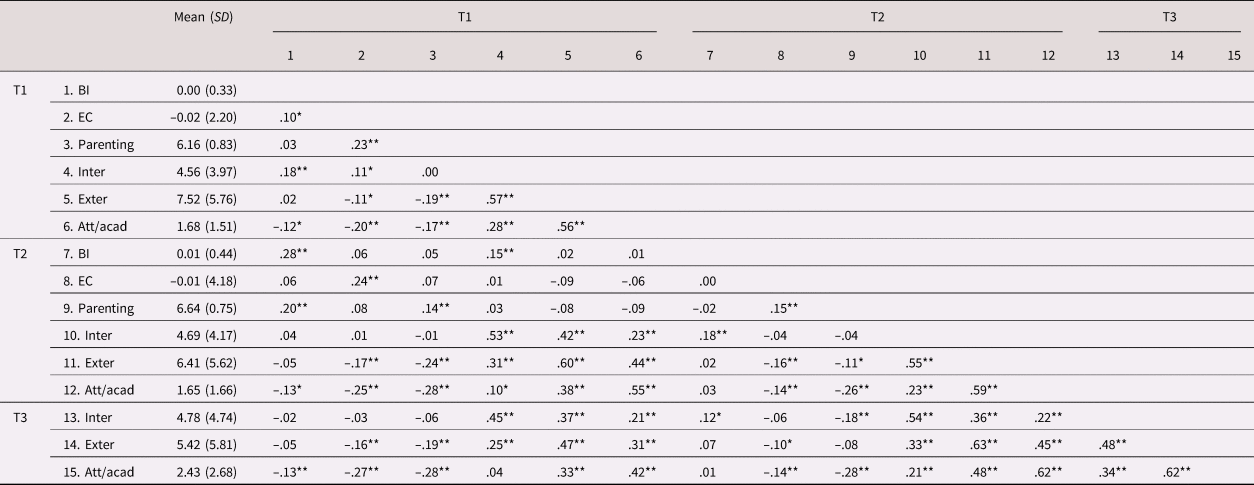
Descriptives of, and bivariate correlations between, major study variables can be found in Table 1. BI, EC, parenting, and parent-reported child symptoms all showed considerable stability over time. Consistent with established BI-internalizing (Fox & Pine, Reference Fox and Pine2012) and EC-externalizing associations (Rothbart & Bates, Reference Rothbart, Bates, Eisenberg and Damon2006), BI was significantly correlated with internalizing symptoms overall, while EC was primarily associated with externalizing problems. Both BI and EC were also significantly correlated with attention-academic problems (Barkley, Reference Barkley1997; Rothbart & Bates, Reference Rothbart, Bates, Eisenberg and Damon2006). BI and EC were marginally correlated at T1 (r = .10, p < .05). Higher EC at T1 was also associated with concurrent internalizing problems (r = .11, p < .05), consistent with previous findings (Eisenberg et al., Reference Eisenberg, Valiente, Spinrad, Liew, Zhou, Losoya, Reiser and Cumberland2009; Murray & Kochanska, Reference Murray and Kochanska2002).
Bivariate correlations between main study variables and descriptives (N = 409)

*p < .05 **p < .01.
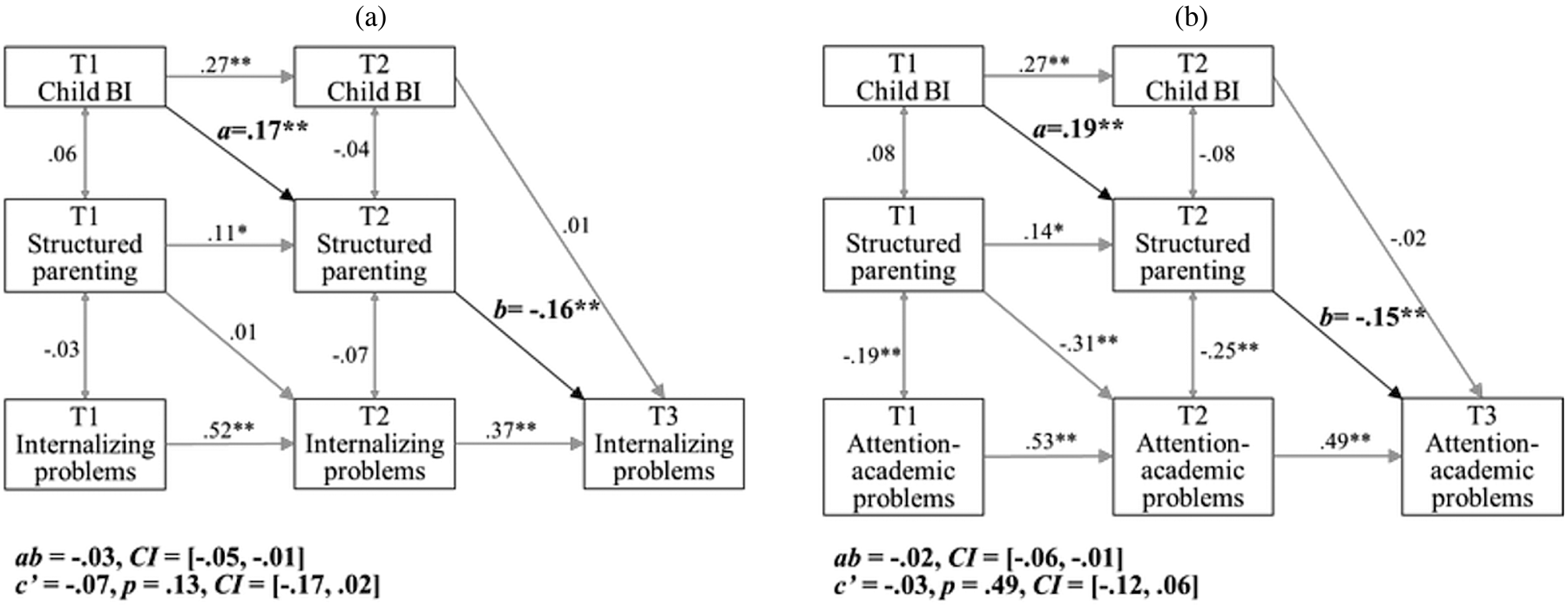
We found significant mediation effects in BI-to-parenting models with T1 BI as the predictor, T2 parenting as the mediator, and T3 internalizing problems (Figure 2a) or attention-academic problems (Figure 2b) as the outcome. As shown in Figure 2, child BI at T1 significantly predicted more structured parenting at T2 (path a); more structured parenting at T2, in turn, predicted reduced internalizing problems and attention-academic problems at T3 (path b). Note that significant mediation effects (path ab) were observed in both models: for internalizing problems, standardized ab = –.03, 95% confidence interval (CI) [–.05, –.01], ratio of indirect effect to total effect = 39.05%; attention-academic problems, standardized ab = –.02, 95% CI [–.06, –.01], ratio of indirect effect to total effect = 19.22%. Overall, higher BI at T1 predicted lower internalizing and attention-academic problems at T3 through structured parenting at T2 as the mediator. The direct effects of T1 BI on T3 internalizing or attention-academic outcomes were not significant (ps > .13).
Results of the BI-to-parenting models with T1 BI as the predictor (X), T2 parenting as the mediator (M), and T3 internalizing problems (left) or attention-academic problems (right) as the outcome (Y). The mediation effect of X on Y through M, ab, was significant in both models; the direct effect of X on Y, c’, was nonsignificant in both models. All coefficients are standardized.

No significant mediation effect was found in any other model. In the BI-to-parenting model with externalizing problems as the outcome, the only significant effect was for simple path a: BI at T1 significantly predicted more structured parenting at T2 (a = .17, 95% CI [.07, .27]). In the EC-to-parenting models, EC at T1 did not predict structured parenting at T2, nor was there significant effect of EC, direct or indirect, on any outcome variable (ps > .07). The only significant association in these models was for simple path b: more structured parenting at T2 predicted lower attention-academic problems (c’ = –.10, 95% CI [–.19, –.01]) at T3, but not for internalizing or externalizing problems (ps > .50). In the parent-to-child models, no significant effect was observed (ps > .57).Footnote 1
Discussion
We investigated bidirectional relations between child temperament (BI and EC) and structured parenting in early childhood, and how these relations predicted later adjustment. We relied on a unique, three-wave longitudinal data set that incorporated measures of child adjustment outcomes at multiple times. Child-to-parent models indicated a significant indirect effect of age 3 BI on age 8 outcomes through age 5 parenting; specifically, age 3 child BI predicted more structured parenting at age 5, which in turn predicted reduced internalizing and attention-academic problems in children at age 8. These effects were significant when the concurrent associations between, and cross-lagged stability of, parenting and BI were included in models, as well as symptoms at all time points. These findings provide novel evidence for the predictive effect of early childhood BI on parenting behaviors, and the mediating effect of parenting in linking early BI to later outcomes. Conversely, parent-to-child models did not support associations between structured parenting at T1 and child BI at T2. No effect was found in any of the EC models. Thus, at least as far as BI and structured parenting are concerned, our data show stronger support for associations between early child BI and later caregiving as opposed to early caregiving and later child BI.
Further unpacking these findings, we found that early child BI predicted structured parenting 2 years later. In facing challenging, unfamiliar situations, behaviorally inhibited young children are likely to withdraw and show less engagement. Over time, such behavior might elicit increased parental guidance, rule and limit setting, and greater structure overall. These more structured parenting strategies, in turn, may lead to better child outcomes. Specifically, in our sample, this model predicted decreased internalizing symptoms and attention-academic-related problems at age 8. This is consistent with findings indicating that more structured, scaffolding parenting behaviors, with more specific instructions and behavioral modeling that are responsive to children's needs, have beneficial effects on child outcomes (Leve et al., Reference Leve, Harold, Ge, Neiderhiser, Shaw, Scaramella and Reiss2009; Natsuaki et al., Reference Natsuaki, Leve, Harold, Neiderhiser, Shaw, Ganiban and Reiss2013).
However, it is important to acknowledge that child characteristics that require active parental management may not always lead to optimal caregiver responding. For example, previous work suggests that inhibited toddlers and older children might elicit greater parental protection (Hastings et al., Reference Hastings and Rubin1999; Lengua, Reference Lengua2006; Lengua & Kovacs, Reference Lengua and Kovacs2005; Rubin et al., Reference Rubin, Nelson, Hastings and Asendorpf1999), which may increase children's inhibited and anxious behaviors (Kiel & Buss, Reference Kiel and Buss2009, Reference Kiel and Buss2011). As overprotective parenting signifies a lack of structure or guidance in the parent's strategies, these previous findings are seemingly inconsistent with what we found in this study (i.e., that high child BI predicts more structured parenting 2 years later). Nevertheless, it should be noted that these previous studies assessed parenting by parent-report (and child-report when applicable) questionnaire data, emphasizing the parent's child-rearing attitudes in a broader sense (e.g., “I encourage my child to be independent of me”; Block, Reference Block1981). In contrast, the current study measured more specific, concrete parenting behaviors during observational tasks. Therefore, it is likely that the divergence between our findings and previous studies resulted from the different measurement approaches that have been used, by which different levels or aspects of “structuredness” have been assessed. In addition, given that our sample was drawn from the community and was relatively low risk, it is not surprising that parents were somewhat capable of responding appropriately to child inhibition.
Buss and Kiel (Reference Buss, Kiel, Vasa and Roy2013) suggest that the relation between parenting behaviors and children's inhibited and anxious behaviors may be curvilinear in nature. Specifically, different parenting variables, including protective and intrusive parenting, reflect a continuum of the degree to which the parent facilitates children's approach to and engagement with challenges. Overprotective parenting can be viewed as one end of the continuum (no encouragement) with intrusiveness reflecting the other extreme (too demanding), both of which serve to exacerbate the risk associated with BI. In line with our findings, we posit that a balance between the two ends, which imposes limits and expectations for children while also responding to children's needs (i.e., more structured parenting strategies), may be the most promising means of promoting positive outcomes for inhibited children.
It should be noted that while the mediation effects in the BI-to-parenting models were significant, the effect sizes were relatively small. This is likely due to the fact that multiple mechanisms underlie complex psychological processes (Preacher & Kelley, Reference Preacher and Kelley2011). Certainly, other mechanisms not the focus of the current study serve to mediate or moderate pathways from early BI to later outcomes, accounting for associations between BI and outcomes. Taken together, our findings emphasize that the link between early BI and later outcomes is multifactorial, unfolding as a complex, evolving process between factors from both the individual and his or her environment. Future studies measuring interplay between BI and other factors will help further elucidate these diverse trajectories.
In the EC-to-parenting model, we did not observe an expected directional relation from child EC at age 3 to structured parenting at age 5, nor a significant mediating effect of parenting between early EC and later externalizing and attention-academic outcomes. Instead, both T1 EC and T2 structured parenting directly predicted less attention-academic problems at T3 (path b and c’). This suggested that initial child EC was not associated with changes in structured parenting 2 years later. Rather, as shown in the bivariate correlation matrix, higher child EC was concurrently associated with more structured parenting at both T1 and T2; both EC and parenting also showed considerable stability from T1 to T2. One possibility is that parents who tended to use more structured parenting strategies might have greater EC capacities themselves. Children of these parents are also likely to have high EC, due to the heritable nature of this temperamental trait (Rothbart & Rueda, Reference Rothbart, Rueda, Mayr, Awh and Keele2005). Thus, child EC and structured parenting might be associated concurrently, rather than in a cross-lagged, directional manner.
Finally, the hypothesized parent-to-child relations were not supported by our models with T1 structured parenting as the predictor and T2 BI or EC as the mediator. No directional relation was found from parenting at age 3 to child temperament at age 5, nor was there an effect of T2 temperament mediating the association between T1 parenting and T3 outcome. However, in bivariate correlation, we observed broader patterns of negative correlation between parenting and adjustment measures, with more structured parenting associated with fewer adjustment problems, both concurrently and over time. It is worth mentioning that parenting and temperament at both T1 and T2 were measured by analogous observational tasks and yielded comparable variances (Table 1). It is thus unlikely that the absence of effect in the parent-to-child models was due to the lack of variance of the parenting measures at T1. As discussed earlier, key features defining structured parenting strategies include guiding children through their environment by giving them explicit, specific instructions and directives contingent on children's needs. Therefore, it is possible that structured parenting might have a more “immediate” impact on child adjustment by directly regulating children's behaviors, as reflected by the bivariate correlations. Instead, other aspects of caregiving behaviors might influence child adjustment in a more indirect, long-term manner (e.g., through shaping child temperament over time). Future studies measuring multiple facets of parenting will help delineate these potential relations.
As stated earlier in this paper, our study had a number of strengths, including the use of a three-wave design, inclusion of child adjustment measures, independent measures of study constructs, and high retention rate of a large longitudinal cohort. While the observational tasks used to measure temperament and parenting are a strength, given that such tasks yield objective, independent measurements of constructs of interest, it is challenging to confirm tasks for different age groups that are intended to be analogous are tapping the same constructs. For instance, among the four EC tasks we used, three of them (Tower and Snack Delay for T1, and Gift Delay for T2) tap into the process of response inhibition, a relatively simple subcomponent of EC. The other task for T2, Simon Says, requires more complicated processing and evaluation of verbal instructions. It is therefore unclear if the more complicated EC component measured by Simon Says at T2 is developmentally analogous to the simpler process of response inhibition measured at T1. However, this issue is pervasive in developmental research aiming to measure the same construct over time. Relatedly, our measurement of EC may overrepresent the subcomponent of response inhibition over other facets of EC. Further, while we measured child adjustment at all three waves, child temperament and parenting were assessed at T1 and T2 (ages 3 and 5) but not T3 (age 8). As children grow older, it becomes more challenging to measure these constructs by observational tasks, as tasks that are developmentally analogous and appropriate become more limited.
While we provided evidence for transactional associations between child temperament and parenting, we acknowledge that the naturalistic longitudinal design we used cannot establish causal relations between constructs without using experimental control. While it is possible that behaviorally inhibited children may “evoke” or “cause” more structured parenting, this association might well be mediated by other processes that are not captured by our data. For instance, the observed association between BI and caregiving might reflect passive gene–environment correlation, such that inhibited children inherit genetic predispositions toward this temperament trait from parents who themselves have a genetic propensity toward certain parenting styles (Knafo & Jaffee, Reference Knafo and Jaffee2013). For example, genetic variation relevant to BI may also influence parenting behaviors via direct and indirect pathways. In future studies, using experimental manipulation of caregiving to disentangle genetic influences on BI from those that shape caregiving may help elucidate causal mechanisms more clearly.
We also acknowledge that our data were obtained from an ethnically homogeneous, low-risk community sample with low rates of adjustment problems. As a result, our data cannot be generalized to more diverse samples and may be limited with regard to capturing mechanisms relevant to high-risk families. In addition, primary caregivers in our data set were predominately mothers. It is unclear if fathers’ structured parenting would play a different role in interacting with child temperament and contributing to adjustment outcomes. Future studies that draw upon diverse populations and oversample high-risk families are therefore warranted.
In sum, in examining the transactional relations between child temperament and structured parenting behaviors, we found a significant association between early child BI at age 3 and more structured parenting at age 5, which, in turn, predicted decreased internalizing and attention-academic problems at age 8. Our unique three-wave longitudinal design with repeated measures of constructs allowed for a rigorous examination of directional and transactional relations as such, and provided important, novel evidence for the complex interrelations between child individual differences and environmental factors along developmental trajectories. Although future work using experimental designs is needed (e.g., randomization and controlling extraneous variables), our study adds to the literature suggesting that children play an active role in their early environments, possibly by eliciting particular parenting behaviors from their caregivers, which may eventually shape their developmental pathways toward various adjustment outcomes.
Acknowledgments
The authors want to thank the families who participated in our studies, and the many individuals who contributed to data collection.
Financial Support
This work is supported by Grant CIHR MOP86458 from the Canadian Institutes of Health Research (to E.P.H.).
Conflict of Interest
The authors report no conflicts of interest.