Introduction
Ascaris sp. is a nematode parasite classified as a soil-transmitted helminth (STH) due to its life cycle and mechanism of transmission. STH infections significantly affect the health of both human populations (particularly children) and animals. Globally, approximately 25–35% of children under 15 years of age are parasitized by these worms (Brooker et al., Reference Brooker, Clements and Bundy2006). In Latin America alone, approximately 84 million children are infected with Ascaris sp. (Hotez et al., Reference Hotez, Bottazzi, Franco-Paredes, Ault and Periago2008). The national prevalence of STH infections in Honduran schoolchildren is higher than 20%, with focal areas where prevalence exceeds 50% (Mejia Torres et al., Reference Mejia Torres, Franco Garcia, Fontecha Sandoval, Hernandez Santana, Singh, Mancero Bucheli, Saboya and Paz2014; Sanchez et al., Reference Sanchez, Gabrie, Usuanlele, Rueda, Canales and Gyorkos2013, Reference Sanchez, Gabrie, Rueda, Mejia, Bottazzi and Canales2014). For instance, a recent study among schoolchildren residing in ‘La Hicaca’, an impoverished rural community on the north coast of the country, reported an astounding STH prevalence rate of 69% (Sanchez et al., Reference Sanchez, Gabrie, Canales, Rueda, Fontecha, Mason, Bearmen and Steven2016). Many factors are certainly contributing to STH hyperendemicity in rural populations (defecation practices, food hygiene, occupation, housing characteristics, health education, etc.) but, in essence, the lack of sanitation derived from poverty is without a doubt the main social determinant.
According to official data, in the year 2016, 60.9% of Hondurans were poor and 38.4% lived in extreme poverty (INE, 2016). Resource constraints are conducive to subsistence agriculture and small-scale livestock production. In rural areas of Mesoamerica, ‘backyard pig keeping’ is a commonplace practice whereby animals live under severe hygiene deficiencies and in close proximity with humans (Sarti et al., Reference Sarti, Schantz, Plancarte, Wilson, Gutierrez, Lopez, Roberts and Flisser1992), which increases the probability of zoonotic transmission (Umar & Nura, Reference Umar and Nura2008). The zoonotic potential of Ascaris sp. causing human infections has been well documented in developed countries in which pigs were the only plausible source of infection (Arizono et al., Reference Arizono, Yoshimura, Tohzaka, Yamada, Tegoshi, Onishi and Uchikawa2010; Bendall et al., Reference Bendall, Barlow, Betson, Stothard and Nejsum2011; Nejsum et al., Reference Nejsum, Betson, Bendall, Thamsborg and Stothard2012; Dutto & Petrosillo, Reference Dutto and Petrosillo2013; Miller et al., Reference Miller, Colby and Manning2015). Several authors have provided evidence of infections in pigs or humans with human-derived or pig-derived Ascaris, respectively (Peng et al., Reference Peng, Yuan, Hu and Gasser2007; Zhou et al., Reference Zhou, Li, Yuan, Deng and Peng2012). Successful experimental cross-infections have been reported as well (Takata, Reference Takata1951; Crewe & Smith, Reference Crewe and Smith1971). Despite this evidence, several authors propose that although cross-infection occurs between hosts in sympatric areas, the gene flow is low. They also argue that the strong genetic subdivision between human- and pig-derived Ascaris indicates reproductive isolation and evolutionary adaptation to the appropriate host (Nadler & Hudspeth, Reference Nadler and Hudspeth2000; Iniguez et al., Reference Iniguez, Leles, Jaeger, Carvalho-Costa and Araujo2012; Leles et al., Reference Leles, Gardner, Reinhard, Iniguez and Araujo2012). Whether human- and pig-derived Ascaris are the same species or two separate species will hopefully be elucidated in the future (Nejsum et al., Reference Nejsum, Betson, Bendall, Thamsborg and Stothard2012; Betson et al., Reference Betson, Nejsum, Bendall, Deb and Stothard2014; Shao et al., Reference Shao, Xu, Alasaad, Song, Peng, Tao and Zhu2014; Soe et al., Reference Soe, Kapel and Nejsum2016). A more immediate concern is the zoonotic potential of this parasite. The capacity for species interbreeding, as revealed by finding putative heterozygous or hybrid worms infecting both humans and pigs in several studies (Criscione et al., Reference Criscione, Anderson, Sudimack, Peng, Jha, Williams-Blangero and Anderson2007b; Zhou et al., Reference Zhou, Li, Yuan, Deng and Peng2012), underscores the need for more research. Studying Ascaris sp. specimens parasitizing human and pig hosts residing in areas where high ascariasis endemicity overlaps with swine backyard farming may provide interesting insights into the zoonotic potential of this parasite.
Materials and methods
Collection of adult worms
Adult Ascaris spp. worms were collected from both children and pigs in separate studies. Human Ascaris infections had been diagnosed in a previous study, which took place in 2015 and 2016. STH infections of children were detected using the Kato–Katz technique in schoolchildren from a rural community (‘La Hicaca’) in the Department of Yoro in the north of Honduras. La Hicaca is a mountainous area located 350 km from Tegucigalpa, the capital city of Honduras, with approximately 2000 inhabitants distributed in 17 villages. Inhabitants have very limited access to medical care and communities lack electricity, potable water and sewerage systems. Free-ranging pigs are common in these villages. Once children were tested for intestinal parasites, the health-centre nurse treated all those infected with a standard, single-dose (400 mg) albendazole chewable tablet.
Eight children with moderate or severe infections agreed to participate in the worm-recovery study. Children received piperazine (75 mg/kg body weight orally per day) on the first day, and 400 mg of albendazole every day for the next 3 days. All faecal evacuations were collected during four consecutive days, beginning the day after the first dose of treatment. Stools were examined macroscopically for worms by diluting with water and filtering through sieves with pores smaller than 2 mm in diameter.
Adult Ascaris specimens were collected from the small intestine of pigs slaughtered for commercial purposes in the local abattoir in Tegucigalpa. Worms obtained from both children and pigs were thoroughly washed with saline solution (0.85% NaCl) and stored individually at room temperature in 70% (v/v) ethanol until further use.
DNA extraction and polymerase chain reaction–restriction fragment length polymorphism (PCR-RFLP)
DNA was extracted through maceration of 100 mg of the anterior body part of worms with lysis solution (1 m Tris–HCl, pH 7.8; 0.5 m EDTA, pH 8.0; 5 m NaCl; 10% cetyl trimethylammonium bromide (CTAB) and 1% 2-mercaptoethanol), followed by incubation at 60°C in a water bath for 1 h under gentle agitation. One volume of phenol:chloroform (1:1) solution was added. After 5 min of centrifugation at 13,000 rpm, one volume of chloroform was mixed with the aqueous phase. The supernatant was recovered, and two volumes of cold isopropanol were added. DNA was precipitated by centrifugation for 10 min at 13,000 rpm. The pellet was washed twice with 80% ethanol. The dried pellet was suspended in 50 μl of nuclease-free water and stored at −20°C until use.
A ~590-bp nuclear internal transcribed spacer (ITS) region was amplified using the primers AsITS1 F (5′–CTT GAA CCG GGT AAA AGT CG–3′) and AsITS1R (5′–ATG TGT CTG CAA TTC GCA CT–3′) (Carlsgart et al., Reference Carlsgart, Roepstorff and Nejsum2009) in a final volume of 25 μl. The reaction mix contained 12.5 μl of 2× MasterMix (Promega®, Madison, Wisconsin, USA), 1.0 μl of each primer (10 μm) and 2.0 μl of DNA (20 ng/μl). PCR was performed in a Veriti Thermal Cycler (Thermo Fisher Scientific®, Waltham, Massachusetts, USA) under the following conditions: denaturation at 95°C for 1 min; 35 cycles of 95°C for 30 s, 59°C for 1 min and 72°C for 1 min; followed by a final extension at 72°C for 10 min.
PCR products were digested with HaeIII, a restriction enzyme that seems to allow human- and pig-derived Ascaris to be differentiated (Anderson, Reference Anderson1995; Zhu et al., Reference Zhu, Chilton, Jacobs, Boes and Gasser1999; Arizono et al., Reference Arizono, Yoshimura, Tohzaka, Yamada, Tegoshi, Onishi and Uchikawa2010). According to this approach, a single nucleotide polymorphism (SNP) gives rise to a two-band restriction pattern in human-derived Ascaris, while pig-derived Ascaris results in a three-band pattern. Both PCR products and digested fragments were separated in 1.5% agarose gels with ethidium bromide.
Sequence analysis and cladogram construction
PCR products were purified and sequenced in both directions by Macrogen Inc. (Maryland, USA). Nucleotide sequences were trimmed and manually corrected using the Geneious® 9.1.2 software (Biomatters Ltd., Auckland, New Zealand). The ClustalW tool of the Geneious software was used to align sequences with the same length. Two cladograms were built using the Tamura–Nei genetic distance model, the UPGMA (Unweighted Pair Group Method with Arithmetic Mean) and neighbour-joining methods, and a bootstrap of 100 replicates. The first cladogram only included sequences obtained in this study, while a second cladogram also included homologous sequences of Ascaris spp. and Baylisascaris spp. downloaded from the GenBank database at the National Center for Biotechnology Information (NCBI).
Results
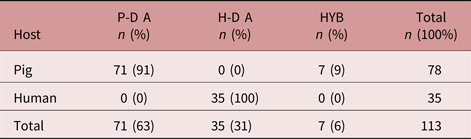
In total, 113 adult worms were collected. Seventy-eight pig-derived worms were obtained from 17 different pigs (1–7 worms per animal) during 2017, and 35 human-derived worms were recovered from eight children (28 worms from four children in 2015, and seven worms from four different children in 2016) (table 1).
Number and percentage of hybrids (HYB), pig-derived (P-D A) and human-derived (H-D A) genotypes of Ascaris worms collected from both hosts.

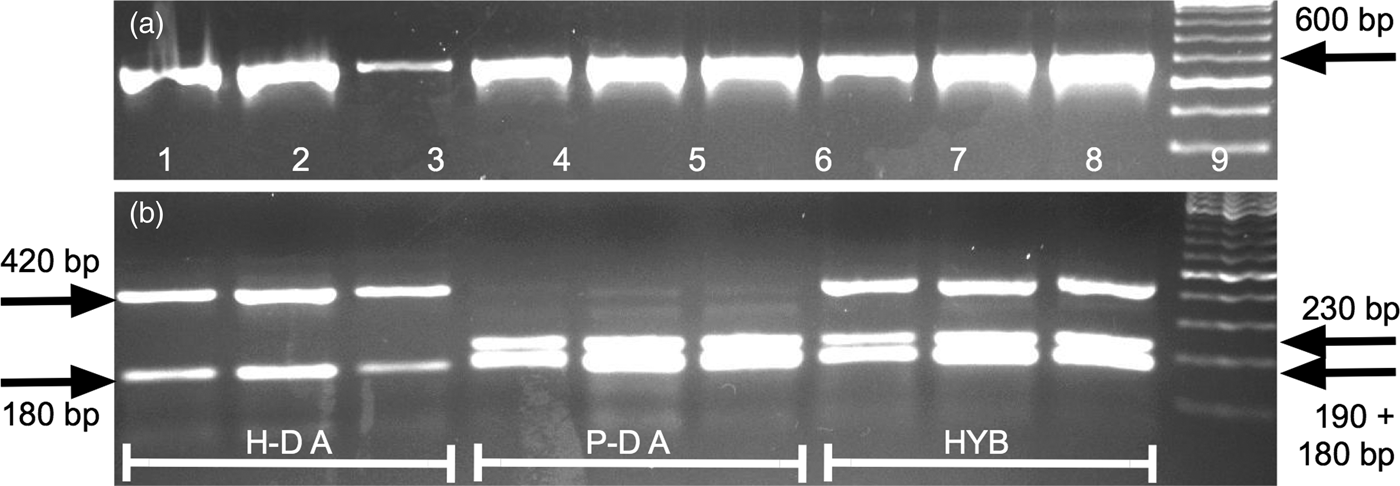
Genomic DNA was successfully extracted and amplified from all worms, showing a PCR product of ~590 bp. After restriction analysis with HaeIII, three different patterns were found: one pattern with two bands (420 and 180 bp), a second pattern with three bands (230, 190 and 180 bp), and the third pattern with four bands (420, 230, 190 and 180 bp) (fig. 1).
Agarose gels before (a) and after (b) digestion of PCR products with HaeIII. Lanes: 1–3 are human-derived Ascaris genotypes; 4–6 are pig-derived genotypes; and 6–8 are heterozygous or hybrid genotypes.

All 35 worms collected from children (n = 35) showed the expected two-band pattern for human-derived Ascaris. In contrast, 71 of 78 (91%) worms from pigs showed the expected three-band pattern for pig-derived Ascaris. The remaining seven worms showed a four-band pattern (420, 230, 190, 180 bp) compatible with a putative hybrid (or heterozygous) human–pig Ascaris genotype (table 1). No hybrids causing human infections or cross-infections among hosts were detected. The seven putative hybrids were recovered from five different pigs, which also harboured other worms possessing a three-band pattern.
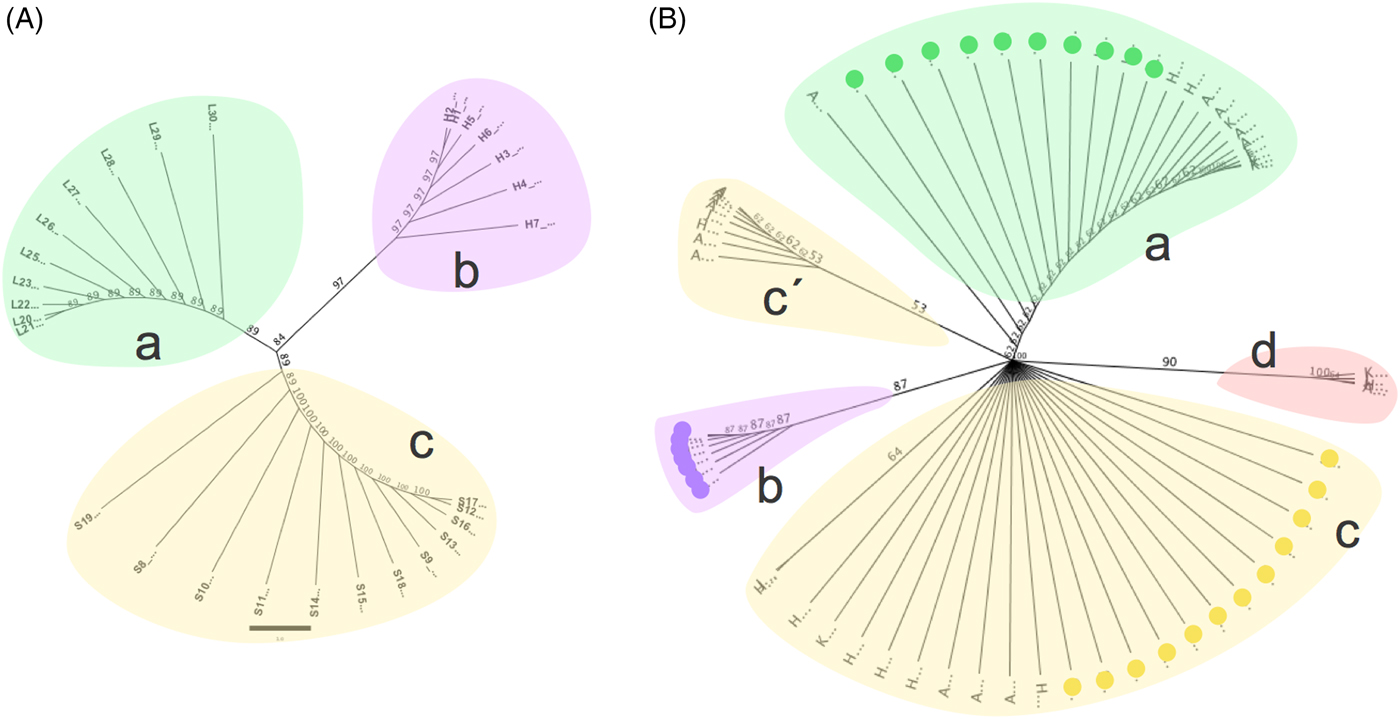
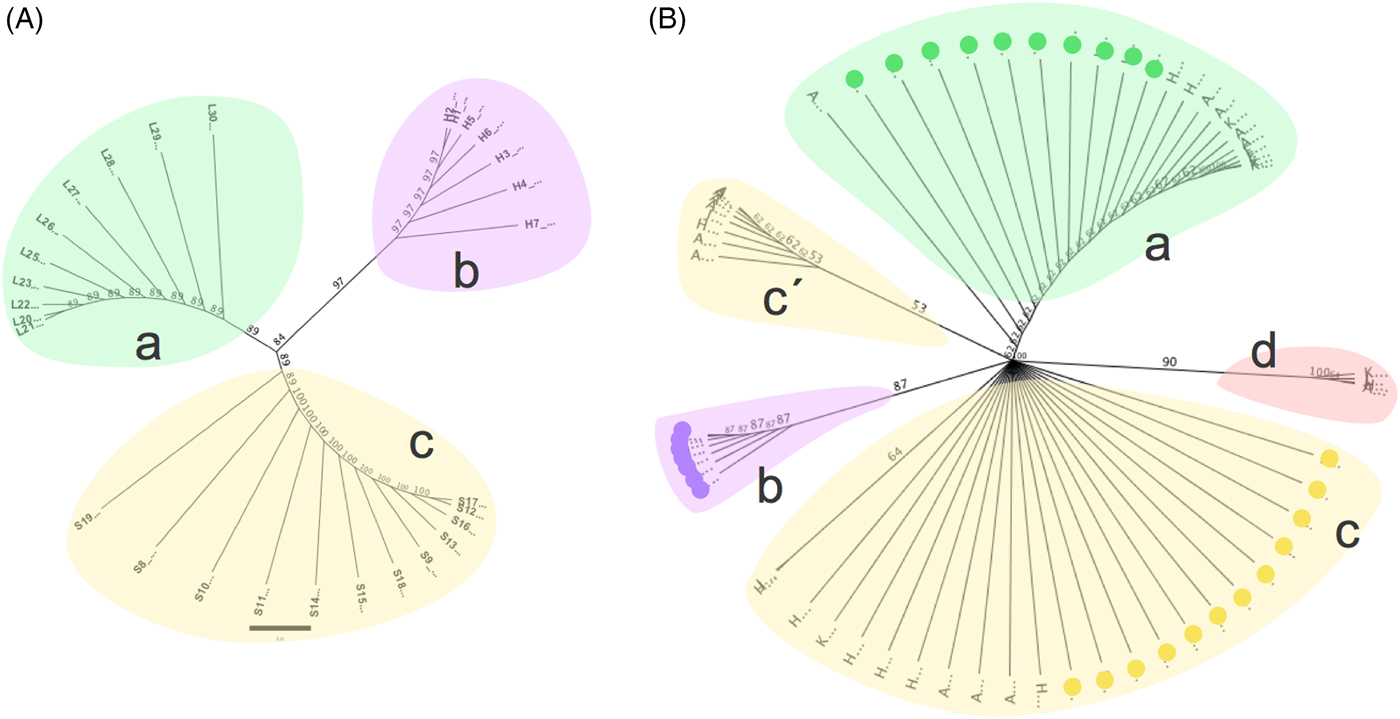
Twenty-nine ITS amplification products were sequenced in both directions: 12 from pigs, ten from children and the seven putative hybrids. One of each of the sequences was deposited in NCBI databases (accession numbers: MG819679–81). A consensus clean sequence of 337 bp was shared for all the individuals. Only five nucleotide positions (1.5%) were polymorphic. The first of these polymorphic positions matched the target of the HaeIII enzyme, able to differentiate between pig-derived (GGCC) and human-derived (GGCG) genotypes. As shown in fig. 2, the first cladogram reveals three distinctive and separated clusters, each of which corresponds with human-derived worms, pig-derived worms and hybrids, respectively. Most of the sequences obtained from the worms with a hybrid genotype show heterozygosis (two bases in the same position) in the HaeIII restriction targets.
Cladograms constructed for ITS ribosomal sequences using the UPGMA method and Tamura–Nei genetic distance model. (A) Cladogram including sequences obtained in this study: (a) human-derived Ascaris, (b) hybrid genotypes and (c) pig-derived Ascaris. (B) Cladogram including homologous sequences available in the NCBI database: (a) accessions classified as Ascaris lumbricoides, (b) sequences compatible with a hybrid or heterozygous genotype, (c, c′) accessions classified as Ascaris suum, (d) accessions classified as Baylisascaris spp. The coloured dots indicate sequences obtained in this study.
Discussion
In recent decades, several molecular markers (ITS, cox1, nad1, amplified fragment length polymorphism (AFLP), microRNAs, single-strand conformation polymorphism (SSCP) and short tandem repeats (STRs)) have been used to elucidate whether human- and pig-derived Ascaris belong to the same species, whether they are races of the same species or if they belong to separate species with host specificity (Macko & Dubinsky, Reference Macko and Dubinsky1997; Peng et al., Reference Peng, Yuan, Zhou, Hu, Abs El-Osta and Gasser2003, Reference Peng, Yuan, Hu, Zhou and Gasser2005; Bendall et al., Reference Bendall, Barlow, Betson, Stothard and Nejsum2011; Iniguez et al., Reference Iniguez, Leles, Jaeger, Carvalho-Costa and Araujo2012; Nejsum et al., Reference Nejsum, Betson, Bendall, Thamsborg and Stothard2012; Betson et al., Reference Betson, Nejsum, Bendall, Deb and Stothard2014; Shao et al., Reference Shao, Xu, Alasaad, Song, Peng, Tao and Zhu2014). These techniques have also been used to elucidate whether both species are reproductively isolated in sympatric regions, as well as to investigate the role of pigs as a source of infections for humans (Anderson et al., Reference Anderson, Romero-Abal and Jaenike1993; Anderson & Jaenike, Reference Anderson and Jaenike1997; Zhu et al., Reference Zhu, Chilton, Jacobs, Boes and Gasser1999; Nejsum et al., Reference Nejsum, Parker, Frydenberg, Roepstorff, Boes, Haque, Astrup, Prag and Skov Sorensen2005; Bendall et al., Reference Bendall, Barlow, Betson, Stothard and Nejsum2011; Dutto & Petrosillo, Reference Dutto and Petrosillo2013; Miller et al., Reference Miller, Colby and Manning2015).
Some authors suggest that the ribosomal ITS region has a very low nucleotide divergence, and that results based on its analysis may hinder our correct understanding of the taxonomy or the population structure for this parasite (Leles et al., Reference Leles, Araujo, Vicente and Iniguez2010). Other markers, such as STRs, have been suggested to be more promising in achieving this purpose (Criscione et al., Reference Criscione, Anderson and Raby2007a; Nejsum et al., Reference Nejsum, Hawash, Betson, Stothard, Gasser and Andersen2017). However, studying the ITS region has been useful to distinguish between human- and pig-derived Ascaris specimens.
In addition, differences within the ITS sequence seem to provide a genetic structure similar to those given by other molecular markers for Ascaris worms (Anderson, Reference Anderson1995; Arizono et al., Reference Arizono, Yoshimura, Tohzaka, Yamada, Tegoshi, Onishi and Uchikawa2010; Bendall et al., Reference Bendall, Barlow, Betson, Stothard and Nejsum2011; Peng & Criscione, Reference Peng and Criscione2012; Dutto & Petrosillo, Reference Dutto and Petrosillo2013; Sparks et al., Reference Sparks, Betson, Oviedo, Sandoval, Cooper and Stothard2015). Despite the low nucleotide divergence within the rDNA region, Nadler & Hudspeth (Reference Nadler and Hudspeth2000) showed that this gene includes six and one unambiguous autapomorphic characters in A. lumbricoides and A. suum, respectively. Even though those authors analysed only a single worm from each host, and their results cannot be used to infer different species, this information might be useful for a preliminary evaluation of the species status of Ascaris.
In the present study, using a PCR-RFLP approach, the ITS ribosomal region of 35 human- and 78 pig-derived Ascaris was analysed. All parasites isolated from children and 91% of those recovered from pigs showed the typical genotype expected for each. Cross-infections between hosts were not demonstrated in this study. These results are consistent with other studies carried out in countries with similar epidemiological characteristics. In the neighbouring country of Guatemala, worms from both humans and pigs were analysed using mtDNA and allozymes, and although cross-infections were found, the authors concluded that both parasite populations had separate transmission cycles, hence suggesting reproductive isolation of species (Anderson et al., Reference Anderson, Romero-Abal and Jaenike1993). However, when the same biological material was used to analyse 23 microsatellite loci, results indicated cross-infections (Criscione et al., Reference Criscione, Anderson, Sudimack, Peng, Jha, Williams-Blangero and Anderson2007b). In China, Peng et al. (Reference Peng, Yuan, Zhou, Hu, Abs El-Osta and Gasser2003, Reference Peng, Yuan, Hu and Gasser2007) used conformational polymorphisms (SSCP) and the ribosomal ITS region to demonstrate the existence of predominant worm genotypes in each host. Their results showed that human and pig hosts tend to harbour a particular genotype of the parasite. Similar results have been found in Ecuador, where Sparks et al. (Reference Sparks, Betson, Oviedo, Sandoval, Cooper and Stothard2015), using ITS as the molecular marker, did not find any cross-infections among humans and pigs. These data, along with our own results, suggest that although natural or experimental cross-infections are plausible, they are less frequent than host-specific infections in environments in which both species coexist (Jungersen et al., Reference Jungersen, Eriksen, Nielsen, Roepstorff and Nansen1996; Bendall et al., Reference Bendall, Barlow, Betson, Stothard and Nejsum2011; Miller et al., Reference Miller, Colby and Manning2015).
As mentioned in a review by Peng & Criscione (Reference Peng and Criscione2012), it is ‘important to establish the frequency of hybridization in additional sympatric populations’. Criscione et al. (Reference Criscione, Anderson, Sudimack, Peng, Jha, Williams-Blangero and Anderson2007b) used a highly sensitive STR approach to conduct Bayesian clustering analyses of worms collected from humans and pigs sampled from Guatemala and China, where they found 4% and 7% of hybrids, respectively. A similar study, using STRs and three software programs to determine hybridization of human and pig Ascaris from China, reported hybrids in both hosts, with 95% of those infections occurring in humans (Zhou et al., Reference Zhou, Li, Yuan, Deng and Peng2012).
The possibility of detecting cross-infections in Honduras by increasing the number of parasites sampled in further studies cannot be ruled out. This is why one of the most interesting results of the present study was the finding of seven adult worms with a hybrid genotype between human- and pig-derived Ascaris parasitizing pigs.
The detection of hybrids using only ribosomal markers is rare (Peng et al., Reference Peng, Yuan, Zhou, Hu, Abs El-Osta and Gasser2003; Dutto & Petrosillo, Reference Dutto and Petrosillo2013). In fact, most of those studies were not able to find evidence of hybridization (Nejsum et al., Reference Nejsum, Parker, Frydenberg, Roepstorff, Boes, Haque, Astrup, Prag and Skov Sorensen2005; Arizono et al., Reference Arizono, Yoshimura, Tohzaka, Yamada, Tegoshi, Onishi and Uchikawa2010; Bendall et al., Reference Bendall, Barlow, Betson, Stothard and Nejsum2011; Sparks et al., Reference Sparks, Betson, Oviedo, Sandoval, Cooper and Stothard2015). In the present investigation, finding seven hybrids among 78 worms analysed underscores the need for further research. Despite the fact that Ascaris parasites in both hosts are reproductively isolated and only low gene flow exists between populations (Soe et al., Reference Soe, Kapel and Nejsum2016), hybridization may not be as uncommon as suggested by the literature, due to the favourable conditions for cross-infection. In fact, according to sequence alignment and cladogram construction (fig. 2), the clear, distinctive clustering of human- and pig-derived Ascaris, and hybrid genotypes, reinforces the hypothesis of an authentic hybridization process between genotypes, which is not based only on a single restriction polymorphism.
In conclusion, for the first time in Honduras, this study characterized, through a molecular approach, Ascaris worms parasitizing humans and pigs. No cross-infections were detected between hosts, but seven worms with a hybrid genotype were detected in pigs. These results contribute to the understanding of ascariasis epidemiology and its zoonotic potential.
Financial support
This research received no specific grant; however, the Research Directorate of the National Autonomous University of Honduras (DICYP-UNAH) supported the project financially.
Conflict of interest
None.
Ethical standards
Human Ascaris infections had been diagnosed in a previous study, which took place in 2015 and 2016. That study was approved by the Ethics Committee of the Microbiology School of the National Autonomous University of Honduras (protocol 04-2014) and by the Bioscience Research Ethics Board of Brock University in Canada (file 13-195 – SANCHEZ).