


1. Introduction
Ellipsotaphrus is a genus of small, peculiar Ordovician pelagic trilobites, allied to the Cyclopygidae. It has five thoracic segments and a single frontally situated visual organ. The slightly acuminate frontal part of the adjacent cranidium (see, e.g., Fig. 6a–d), suggests that this single organ came about through the fusion of lateral eyes (synophthalmy), as documented also through the history of a number of cyclopygid genera, including Cyclopyge, Symphysops, Pricyclopyge and Microparia. As with some cyclopygids, there is no mesial glabellar tubercle. The most distinctive morphological feature in Ellipsotaphrus, termed the ‘foreglabella’ furrow and seen in no cyclopygid, is a continuous furrow, roughly elliptical in plan, which circumscribes much of the glabella (Figs 2h–j, 7a–g, 8a–g, 14a). It is argued below through comparison with Gamops, Girvanopyge and Arisemolobes gen. nov., that this furrow incorporates preglabellar, axial, S1 and occipital furrows and that the L1 glabellar lobes are excluded from the circumscribed area.
An occipital furrow is unknown in any cyclopygid, this being a derived character for that family. This feature alone separates Ellipsotaphrus from the Cyclopygidae and suggests that Kobayashi & Hamada's (Reference Kobayashi and Hamada1971) Ellipsotaphrinae be given full family status within the Cyclopygoidea as advocated by Marek (Reference Marek1977, p. 70) and Hörbinger & Vanĕk (Reference Hörbinger and Vanĕk1983, p. 303). Additionally, a pleuroccipital furrow, of variable depth and extent in different species, is commonly developed on the posterior part of the fixigena.
Amicus Koroleva Reference Koroleva1967 (type species Amicus montanus) was included by Kobayashi & Hamada (Reference Kobayashi and Hamada1971) in their Ellipsotaphrinae (herein Ellipsotaphridae) but, as was pointed out by Marek (Reference Marek1977, p. 70), this genus has much more in common with cyclopygid genera now placed in the Pricyclopyginae. Marek also included Whittard's (Reference Whittard1952) genus Psilacella in the Ellipsotaphridae, as did Fortey & Owens (Reference Fortey and Owens1987), largely because of its three linear pairs of glabellar furrows but it is here excluded, as there is nothing in Psilacella comparable with the diagnostic ‘foreglabella’ typical of ellipsotaphrid genera. Psilacella is considered to be probably a micropariine cyclopygid.
Ellipsotaphridae is here regarded as a sister group to the family Cyclopygidae, with hypertrophied eyes and reduced thoraces, and included with Nileidae and Taihungshaniidae within the Superfamily Cyclopygoidea.
Ellipsotaphrids seem to be invariably associated with deep-water cyclopygid biofacies, for example, in Europe along the margins of the Gondwana continent and its associated terranes, and in Bohemia and northern Germany. Although they are generally rare, these trilobites do have an almost global distribution in the appropriate palaeoenvironments.
In this paper the internationally used stage subdivisions of the Ordovician are supplemented by reference to finer regional chronostratigraphic subdivisions used in Great Britain and summarised in Fortey et al. (Reference Fortey, Harper, Ingham, Owen, Parkes, Rushton and Woodcock2000) and Cocks et al. (Reference Cocks, Fortey and Rushton2010).
2. The Girvan ellipsotaphrids: field occurrence
The small Girvan trilobites assigned herein to the Ellipsotaphridae are among the rarest in substantial cyclopygid biofacies faunas from the Whitehouse Subgroup, upper Ardmillan Group (upper Ordovician) of the Girvan district, south-west Scotland. Current knowledge about these faunas is the result of over 30 years of systematic collecting, associated with detailed mapping in complex ground. The fossils occur almost entirely in the Red Mudstone Member of the Myoch Formation and in the Gray Member of the Mill Formation (Fig. 1). The Myoch Formation consists largely of reddish and green silty mudstones which are believed to be the over-bank fines of channel deposits – the outflow from putative submarine canyons associated with an active fault scarp to the north or north-west of the present coastal outcrop (see Ingham Reference Ingham, Lawson and Weedon1992, p. 408). The waters were deep, probably between 200 and 700 m (see Fortey & Owens Reference Fortey and Owens1987, p. 105) and were largely oxygenated at depth. The seabed commonly supported an almost entirely blind, indigenous trilobite benthos – termed an atheloptic assemblage (Fortey & Owens Reference Fortey and Owens1987, pp. 105–6), the fossils of which are associated with the more mesopelagic forms in composite death assemblages.
Simplified schematic representation of the lithostratigraphy and its correlation of part of the Whitehouse Subgroup (upper Ardmillan Group) as exposed along some 2 km of foreshore, south-west of Girvan. The stratigraphical positions are shown of locality numbers referred to in the systematic text and from which ellipsotaphrids have been collected. Their geographical positions on detailed maps will be published subsequently.

Occurring with the trilobites is a low diversity Foliomena brachiopod community, ascribed to a cold, deep environment (Rong et al. Reference Rong, Harper, Zhan and Li1994, p. 19), together with rare molluscs and even rarer echinoderms. The brachiopods have already been described by Harper (Reference Harper1984–2006) and their deep-water biofacies assessed (Harper Reference Harper2001).
The overlying Mill Formation is probably an even deeper water deposit, concomitant with the cyclical transgressive nature of much of the thick, Dapingian to Wenlock Girvan cover sequence (Bluck & Ingham Reference Bluck, Ingham, Lawson and Weedon1992, p. 304; Ingham in Fortey et al. Reference Fortey, Harper, Ingham, Owen, Parkes, Rushton and Woodcock2000, p. 44). The Gray Member, at the top of the Mill Formation, is a fissile, somewhat dark and lighter banded greenish-grey silty shale in which graptolites are relatively common and in which the remains of many of the pelagic and atheloptic fossils have been transported. It is from this level that the ‘Whitehouse Bay’ specimens in the Gray Collection at the Natural History Museum, London, were collected (Fig. 1). The internal stratigraphy of the Myoch and Mill formations is complex in all sections and involves local channel sequences, marked diachronisms and the penecontemporanious displacement of sediments from inter-channel topographic highs, the latter most evident on the Whitehouse foreshore.
Fossils from the Gray Member of the Mill Formation are invariably crushed to a greater or lesser extent, whereas those from the slightly earlier Myoch Formation are better preserved, commonly with much less sediment compaction deformation. Although the strata exposed all along the foreshore south of Girvan commonly have a near vertical attitude and are associated both with thrust faults, shears and, in some areas, numerous conjugate brittle fracture dislocations, there is little pervasive tectonic deformation of material from any level in the sections.
The pelagic fauna, together with the alethoptic benthos found in the Myoch and Mill formations, comprises the following genera: Cyclopyge, Symphysops, Degamella (two species), Novakella, Microparia, Quadratapyge, Sagavia, Psilacella, Ellipsotaphrus, Girvanopyge, Circulocrania?, Synaptotaphrus gen. nov., aff. Remopleurella, Bohemilla (2 stratigraphical subspecies), Telephina, Shumardia (Shumardoella), Novaspis, Nankinolithus, Dionide, Aethedionide, Lonchodomas, Raphiophorus, Dindymene, Parahawleia, Cekovia?, Phillipsinella, Dividuagnostus, Corrugatagnostus (four species), Sphaeragnostus and, most surprisingly, a probable catillicephalid. Many of the species have a considerable geographical distribution suggesting an oceanic or ocean access habitat and most of them are also members of long-ranging, conservative stocks.
Correlation of the six formations of the Whitehouse Subgroup is partly by means of graptolite and chitinozoan faunas from many levels in the South Shore, Three Mile, Penwhapple, Myoch, Mill and Shalloch Formations (see Ingham in Fortey et al. Reference Fortey, Harper, Ingham, Owen, Parkes, Rushton and Woodcock2000). Most of the graptolites have been assessed by Toghill (Reference Toghill1970) and Williams (Reference Williams1987). Dr Thijs Vandenbroucke is currently researching the chitinozoans and some assessments have already been published (Vandenbroucke et al. Reference Vandenbroucke, Vernier and Clarkson2003; Vandenbroucke Reference Vandenbroucke2005). Limited conodont information is also available (Bergström Reference Bergström1990). There are also ‘normal’, transported, outer platformal shelly associations in channel deposits, such as the Balgaverie Member of the Myoch Formation in Penwhapple Burn and the Forge Member (mud-clast conglomerate) of the Mill Formation on the Myoch Foreshore. The Balgaverie Member is an inland (Penwhapple Burn), mid-channel correlative of the Wall and Revelation members of the Myoch Formation seen in the foreshore exposures and it has yielded a late Katian (Streffordian) assemblage in its lowest beds, including Tretaspis cerioides. The matrix of the Forge Member (mud-clast conglomerate) of the Mill Formation contains a typical late Katian (Pusgillian) association including Tretaspis hadelandica cf. convergens and Skenidioides greenhoughi, but there are also Laurentian (Cincinnatian) elements, including Cryptolithus latus latus [ = C. bellulus]. The Whitehouse cyclopygid biofacies Kation faunas straddle the Caradoc/Ashgill boundary of former British usage.
Although these are the richest and most diverse cyclopygoid and associated atheloptic faunas recorded from the Girvan district, they are not the only ones. Cyclopygids have been discovered at several levels there, all in deeper water sediments. These range in age from the Sandbian Craigmalloch Formation, Nemagraptus gracilis Biozone (Rushton et al. Reference Rushton, Tunnicliff and Tripp1996, p. 27), through the Balclatchie Formation, Laggan Member, to Katian (late Cautleyan and Rawtheyan Quarrel Hill and Lady Burn formations in the Craighead Inlier, north-east of Girvan – largely new material). It can be surmised that these pelagic trilobite assemblages that were typically circum-Gondwanan in the earlier Ordovician reached the low latitude fringes of the Laurentia palaeocontinent later in the period, possibly because they lived below the thermocline in deeper, colder waters, and could migrate within this habitat.
3. Comparative discussion of ellipsotaphrid genera
Two previously described genera – one of which is known to have had a wide distribution commensurate with that of Ellipsotaphrus – exhibit features suggesting that they belong in the same clade. Girvanopyge Kobayashi, Reference Kobayashi1960, is rrepresented by at least three species ranging from Dapingian (Fennian) to Katian (Pusgillian) in Britain and elsewhere. The type species, Girvanopyge problematica (Reed Reference Reed1906), from the Girvan upper Ordovician, previously described only from pygidia and posterior thoracic segments, is now known from cranidia (Figs 2c, 9a–h). Except for proportional differences, these cranidia are closely comparable to those documented for other, older species, Girvanopyge occipitalis (Whittard Reference Whittard1961) and Girvanopyge caudata (Wei & Zhou Reference Wei, Zhou and Qui1983) [ = Girvanopyge barrandei (Hörbinger & Vanĕk Reference Hörbinger and Vanĕk1983), herein]. All of them have what is here termed the circum-foreglabellar furrow, like that of Ellipsotaphrus. However, whereas the S2 and S3 glabellar furrows are simple in Ellipsotaphrus with the former continuous mesially, in Girvanopyge the discrete S2 and S3 furrows are hooked upwards, or what can be described as ‘barbed’ anteriorly near their inner ends (see e.g., Figs 2a–c, 7, 8, 9a–h, 14d), as are the S1 furrows to a small extent, even though they are incorporated into the circum-foreglabellar furrow. Unlike Ellipsotaphrus, Girvanopyge has a sagittally elongated medial glabellar tubercle a little in front of the S2 furrows, but both genera have pleuroccipital furrows, variably impressed, on the posterior part of the fixigenae. Both also possess invaginations of the circum-foreglabellar furrow posterolaterally, which are much more marked in Girvanopyge. These invaginations constitute the S1 furrows and they strongly suggest that L1 lobes are excluded from the circumscribed part of the glabella (see also discussion of Arisemolobes below).
Schematic diagram showing comparative cranidial structure between: (a) Girvanopyge occipitalis (Whittard Reference Whittard1940); (b) Girvanopyge caudata (Wei & Zhou Reference Wei, Zhou and Qui1983) [ = G. barrandei (Hörbinger & Vanĕk Reference Hörbinger and Vanĕk1983)]; (c) Girvanopyge problematica (Reed Reference Reed1906); (d) Gamops triangulatus (Marek Reference Marek1961); (e) Gamops mrazeki Šnajdr, 1976; (f) Gamops karousecki (Vanĕk Reference Vanĕk1995); (g) Arisemolobes zhouzhiyii gen. et sp. nov. (h) Ellipsotaphrus monophthalmus (Klouček Reference Klouček1916); (i) Ellipsotaphrus infaustus (Barrande Reference Barrande1852); (j) Ellipsotaphrus pumilio Whittard Reference Whittard1952 [ = E. zhongguoensis Zhou Tian-mei, 1977]; (k) Circulocrania dichaulax sp. nov.; (l) Synaptotaphrus oarion gen. et sp. nov., together with (m) a ‘typical’ remopleuridid, Remopleurella burmeisteri (Bancroft Reference Bancroft1949) (after Nikolaisen Reference Nikolaisen1982, pl. 14) showing that, unlike the remopleuridid pattern, the L1 lobes are excluded from the circumscribed part of the glabella in typical ellipsotaphrids (a–j) and that the circum-foreglabellar furrow incorporates preglabellar furrow, part of the axial furrows, the S1 glabellar furrows and a mesial part of the occipital furrow. Circulocrania (K) and Synaptotaphrus (L) show partial or complete effacement of the L1/occipital furrow. Pleuroccipital furrows are present on the posterior part of the fixigenae in most ellipsotaphrids and, in addition, in later Girvanopyge species there are fixigenal furrows. Only the earliest species of Girvanopyge and Ellipsotaphrus show axial furrows extending to the posterior cranidial margin, whereas this condition is present in at least two species of Gamops.

The earliest representatives of both Ellipsotaphrus and Girvanopyge retain axial furrows at the occipital and L1 levels but these are subsequently lost. An additional distinctive characteristic of younger Girvanopyge species is a longitudinal (exsagittal) or slightly oblique furrow on each fixigena (fixigenal furrow), just anterior to the pleuroccipital furrow. Comparisons with other ellipsotaphrids show that this furrow is unlikely to be an axial furrow extension from the circum-foreglabellar furrow but is a discrete fixigenal feature.
Unlike Ellipsotaphrus, Girvanopyge has six thoracic segments, although there is some evidence that in the youngest named species G. problematica the last thoracic segment may have remained attached to the pygidium in the holaspis. The thoracic axial rings are simple in Ellipsotaphrus, whereas in Girvanopyge, and in the new genus Arisemolobes, there are well-defined triangular axial lobes. Only in Girvanopyge are the pleurae extended into long, backwardly directed points.
The name Gamops was coined by Šnajdr (Reference Šnajdr1976) for a genus of trilobites considered by him to be related to both Ellipsotaphrus and Girvanopyge (referred there as Cremastoglottos). He created the new family Gamopsidae to encompass them [recte Gamopidae – see Marek Reference Marek1977, p. 71; Hörbinger & Vanĕk Reference Hörbinger and Vanĕk1983, p. 301], evidently being unaware of Kobayashi & Hamada's (Reference Kobayashi and Hamada1971) Ellipsotaphrinae [nom. transl. Ellipsotaphridae, Marek Reference Marek1977, p. 70]. A number of subsequent workers have synonymised Gamops with Girvanopyge, for example, Fortey & Owens (Reference Fortey and Owens1987), Kennedy (Reference Kennedy1988), Vanĕk (Reference Vanĕk1995), Koch & Lemke (Reference Koch and Lemke1997, Reference Koch and Lemke1998), but the cranidial, and possibly pygidial, morphologies are quite distinctive.
The type species of Gamops, Gamops mrazeki Šnajdr, 1976, from the Dobrotivá Formation (Darriwilian–?Early Sandbian) of Bohemia, has an overall cranidial conformation not unlike that of Girvanopyge occipitalis and G. caudata [ = Girvanopyge barrandei]. However, there are deeply incised axial furrows extending to the posterior margin of the cranidium, only present shallowly in the earliest species of Ellipsotaphrus and Girvanopyge. In addition, the post-palpebral fixigenae are swollen and almost equidimensional with shallow pleuroccipital furrows in Gamops and the postero-lateral invaginations of the circum-foreglabellar furrow are much deeper than in Girvanopyge or Ellipsotaphrus. These invaginations, comprising the S1 furrows, clearly define the L1 glabellar lobes both anteriorly and adaxially. Moreover, the posterior margins of the L1 lobes are defined adaxially by a distinct lateral portion to the occipital furrow (Fig. 7h–j), which draws attention to the occipital nature of the posteromesial part of the circum-foreglabellar furrow. The outline of the latter is very distinctive in G. mrazeki: it is sharply angled forwards medially (Figs 2e, 7h–j) and is thus unlike the same feature in Girvanopyge and Ellipsotaphrus. As in Girvanopyge species, G. mrazeki has a subdued, sagittally elongated glabellar tubercle in much the same position but the S2 and S3 glabellar furrows are quite different. The S2 furrows are almost circular, each with a small, elevated central area, while the S3 furrows each consist of a shallow depression a little farther removed from the sagittal line. The pre-occipital part of the glabella in G. mrazeki, together with the fixigenae, is covered with low tubercles of various sizes, a feature seen in no known species of Girvanopyge or Ellipsotaphrus or, to our knowledge, in any other cyclopygoid.
Another Bohemian species, described originally as Ellipsotaphrus triangulatus by Marek (Reference Marek1961), is referable to Gamops, as indicated by Šnajdr (Reference Šnajdr1976, p. 232). Gamops triangulatus, from the Darriwilian (Abereiddian) Šárka Formation, has the essential cranidial morphology of G. mrazeki (see Figs 2d, 7k, l), except that the glabella appears to have been smooth and the shallow S2 furrows are simple, gently arched forwards (exsag.) and faintly confluent behind the medial glabellar tubercle. The S3 furrows are reduced to very shallow depressions and are barely visible. The postero-mesial (occipital) part of the circum-foreglabellar furrow also has a slight forward kink in the middle, but it is not so marked as in G. mrazeki, yet the posterior extensions to the axial furrows are just as clearly defined. The holotype cephalon shows the eyes quite well and while they appear to meet frontally, they are not fully confluent (Fig. 7k, l).
A further smooth species from the Šárka Formation in Bohemia, described originally by Vanĕk (Reference Vanĕk1995, p. 3) as Girvanopyge karouseki, is also referable to Gamops. Only an incomplete glabella is known: it is rather more elongated than in G. mrazeki or G. triangulatus but the posterior part of the circum-foreglabellar furrow matches that of G. mrazeki almost exactly. Also, faint impressions representing the lateral parts of the occipital furrow define the L2 glabellar lobes posteriorly. While the S3 glabellar furrows are merely simple pits, much like those in the other two Gamops species, the S2 furrows are discrete, generally convex forwards and quite deeply impressed, but each has a central posteriorly directed kink. Moreover, to the rear of each S2 furrow, at least on the internal mould, is a shallow, posteriorly convex furrow, which probably defines a muscle attachment area on the ventral surface. This S2 configuration may explain the nature of the near circular S2 furrows in G. mrazeki, noted above. In addition, there is a pair of small pit-like depressions, a short distance anterior to the S2 furrows, which are almost certainly related to the ‘barbs’ on the S2 glabellar furrows in Girvanopyge (Fig. 2f).
In the new Chinese genus Arisemolobes (Figs 2g, 12) the nature and origin of the circum-foreglabellar furrow is clearer than in any other ellipsotaphrid genus. Here the L1 lobes, outside the circum-foreglabellar furrow, are prominent and well-defined on a glabella that otherwise has proportions similar to those of Ellipsotaphrus. There is also a small pit just anterior to the S2 furrow, as in Gamops karouseki. The mesial part of the occipital furrow, between the L1 lobes in Arisemolobes has no forward kink, however. Moreover, in this genus, the six-segmented thorax has triangular axial lobes similar to those seen in species of Girvanopyge but there are no spine-like extensions to the pleurae.
Of late Ordovician genera and species documented herein from Katian strata at Girvan, Synaptotaphrus oarion has an elongate glabella, but its configuration otherwise resembles that of G. karouseki, except that the posteromesial section of the circum-foreglabellar furrow is entirely effaced (Figs 13i–k, 14b). Another ellipsotaphrid trilobite, Circulocrania? dichaulax, carries such effacement to the extreme. The entire posterior part of the circum-foreglabellar furrow is absent, as are the S3 furrows. In addition, the palpebral rim extends backwards much farther than in any other ellipsotaphrid, indicating that the single eye possibly was more extensive than in any known cyclopygoid (Figs 13a–c, 14c). The holaspis pygidium, attributed with confidence to this species, is otherwise like those those associated with species of Ellipsotaphrus (Figs 13e–g, 14c) but it incorporates an additional segment.
The pygidia in all the forms discussed here show wide variation in detail but all of them are built essentially to the same plan. In Ellipsotaphrus species, the pygidium is the simplest and most cyclopygid in form: it approximates to a semicircle and has a short, well-defined axis with one ring and a terminal piece. A well-preserved mature pygidium of Ellipsotaphrus pumilio shows a low post-axial ridge, which dies out before reaching the border (Figs 3f, 8r). There are three pairs of pleural and three pairs of shorter and fainter interpleural furrows terminating at an oblique border furrow: the latter is effaced posteriorly. Circulocrania (as interpreted herein) has a mature pygidium very similar to that belonging to Ellipsotaphrus but it is proportionally longer and there are three axial rings and a low post-axial ridge that expands anteriorly and may incorporate the terminal piece seen in other genera – like an Ellipsotaphrus pygidium incorporating at least one extra segment. This suggests that the thorax of Circulocrania may have had fewer than five segments in the holaspis. In Girvanopyge, the oldest species, G. occipitalis, has the simplest pygidium and the youngest species, G. problematica, has the seemingly most complex one (Fig. 3a–c). In G. occipitalis, the pygidium is transversely oval, with a well-defined axis containing three rings and a terminal piece, behind which is a post-axial ridge. There are five pleural, and four fainter interpleural furrows, all of which end in a shallow border furrow. The pygidium of this species also has a distinctive, tiny terminal mucro that, on enrolment, might relate to the not yet synophthalmic eyes in this species. In the younger G. caudata [ = G. barrandei], the pygidium is very similar but somewhat simpler. It has a more sub-quadrate plan with an axis containing only two rings and a terminal piece, to the rear of which is a post-axial ridge. There are only four pleural furrows and the border furrow is even shallower. Its posterior margin is evenly curved: there is no mucro. Perhaps significantly, G. caudata is fully synophthalmic. In the youngest described species, G. problematica, the pygidium is even more sub-quadrate in plan, with a much more transverse posterior margin also lacking a mucro. The short axis has two rings plus a ring-like terminal piece, and there is a stout post-axial ridge. This, together with the four sharply impressed pleural and four interpleural furrows, almost reach the pygidial margin. There is some evidence that the last thoracic segment is never released. In all known specimens of the pygidium of G. problematica the last thoracic segment is still present. Unlike that of Ellipsotaphrus, the thorax of Girvanopyge has six segments whose axial rings have well-defined, triangular axial lobes and pleurae that extended posteriorly such that the last thoracic pleura is extended into a long point which reaches rearwards well beyond the level of the pygidial margin.
Schematic representations of known, or suspected ellipsotaphrid pygidia: (a) Girvanopyge occipitalis (Whittard Reference Whittard1940); (b) Girvanopyge caudata (Wei & Zhou Reference Wei, Zhou and Qui1983)[ = G. barrandei (Hörbinger & Vanĕk Reference Hörbinger and Vanĕk1983)]; (c) Girvanopyge problematica (Reed Reference Reed1906); (d) Gamops triangulatus (Marek Reference Marek1961)?; (e) Ellipsotaphrus monophthalmus (Klouček Reference Klouček1916); (f) Ellisotaphrus pumilio Whittard Reference Whittard1952 [ = E. zhongguoensis Zhou Tian-mei, 1977]; and (g) Circulocrania dichaulax sp. nov.

In the extremely rare Gamops, it is not surprising that neither the thorax nor the pygidium is definitely known. However, the area which provided the holotype cephalon of G. triangulatus (the Šárka Formation, near Rokycany), has also yielded an almost complete ellipsotaphrid pygidium which may belong to this species, as Vanĕk (Reference Vanĕk1995, pp. 3–4) suspected. It is illustrated schematically here (Fig. 3d). It has a rather rounded, sub-pentagonal shape, is a little wider than long and is somewhat vaulted. The well-defined axis has two rings and a terminal piece and there is a post-axial ridge. There are four shallowly impressed pleural furrows, which, together with the post-axial ridge, die out at a broad submarginal concavity: interpleural furrows are not evident. Significantly, there is a small mucro. This pygidium provides a morphological bridge between those of Ellipsotaphrus and Girvanopyge occipitalis (see Fig. 3d, e). In Arisemolobes gen. nov., the thorax and pygidium most closely resemble those belonging to species of Girvanopyge, but there are no thoracic pleural extensions.
4. Classification and relationships
Fortey (Reference Fortey1981, p. 609), argued that Girvanopyge (as Cremastoglottos), together with Gamops (which Fortey & Owens (Reference Fortey and Owens1987, p. 127) synonymised with Girvanopyge) may have been more closely related to the remopleuridids than the cyclopygoids. This suggestion was made largely on the basis of what was taken to be a totally circumscribed pre-occipital glabella in the Remopleurididae and in Girvanopyge. This interpretation has been followed by all subsequent authors. Koch & Lemke (Reference Koch and Lemke1994, p. 69) even suggested that a new family might be useful, to accommodate Girvanopyge and their Waldminia [ = Girvanopyge, herein], combining characteristics of cyclopygids and remopleuridids. Stilll earlier, Whittard (Reference Whittard1961, p.188), in discussing G. occipitalis (as Cremastoglottos), supposed that this species might be a remopleuridid and classified it accordingly. The arguments given previously show that this is unlikely to be the case and that the circumscribed area and nature of the glabellar furrows are quite different in the Remopleurididae (see Fig. 2). The glabellas of Girvanopyge and Gamops both possess a basic structural identity homologous to that of Ellipsotaphrus, and they are classified here with that genus in the Ellipsotaphridae. This was an alternative also considered by Koch & Lemke (Reference Koch and Lemke1994), but they were concerned with what they considered to be great thoracic and pygidial differences between Ellipsotaphrus, on the one hand, and Girvanopyge and their ‘Waldminia’ on the other hand. Furthermore, Girvanopyge, Gamops and Arisemolobes all have a mesial preoccipital glabellar tubercle like that found in some cyclopygids but never in the Remopleurididae.
5. Distribution and evolutionary relationships
In general, it can be stated that the species of Ellipsotaphridae are unusually widely distributed, and that the more common species have exceptionally long stratigraphic ranges. This seems to be true of Ordovician deep-water trilobite communities in general (Adrain et al. Reference Adrain, Edgecombe, Fortey, Webby, Paris, Droser and Percival2004). Ellipsotaphrids track the distribution of the cyclopygid biofacies. During their earlier Ordovician history this biofacies occupied a belt marginal to Gondwana and its peripheral terranes including northen Germany (Thuringia) (Koch Reference Koch1999) and Bohemia (Mergl et al. Reference Mergl, Fatka, Budil, Rabano, Gozalo and Garcia Bellida2008) eastwards into the Condroz Inlier, Belgium (Owens & Servais Reference Owens and Servais2007) and into appropriate facies in Wales (Fortey & Owens Reference Fortey and Owens1987) and Shropshire (Whittard Reference Whittard1961). Later Ordovician distribution was geographically wider, but in similar biofacies, as shown by the Girvan occurrences discussed above. In the late Ordovician of western Hubei and Hunan, South China, Ellipsotaphrus is found typically in deepest biofacies belts IV and V, as documented by Zhou et al. (Reference Zhou, Zhou and Yuan1999) and Zhou et al. (Reference Zhou, Zhou and Yuan2000a, Reference Zhou, Zhou, Yuan and Zhou2000b). These authors believed this genus to have lived at a water depth of around 200 m, whereas Girvanopyge usually is restricted to biofacies belt V, and is estimated to have occupied the water column at a depth of about 300 m or more. If this is so, the implication is that the water depth in which the Myoch and Mill formations at Girvan were deposited was in excess of this.
A comparison between the cranidia of Gamops triangulatus and Girvanopyge occipitalis (see Fig. 2a, d), both of late Dapingian–early Darriwilian (Abereiddian) age, indicates that they are likely to have shared a common, presumably Floian ancestor. Both have a markedly triangular outline and they also have axial furrows at the occipital and L1 levels, the latter being a feature lost in younger Girvanopyge species. The cranidium of G. triangulatus also shares important characters with the earliest known Ellipsotaphrus, Ellipsotaphrus monophthalmus (Fig. 2d, g), not least the S2 transglabellar furrow, and the posteriorly developed axial furrow. If the suspected pygidium of G. triangulatus is a valid assignment, it also provides a morphological link between Girvanopyge and Ellipsotaphrus. It seems likely, therefore, that these three taxa shared a common ancestor. The Chinese genus Arisemolobes (see below) has cranidial proportions most similar to those of Ellipsotaphrus but with some important glabellar features recalling species of Gamops. As noted, above, the L1 glabellar lobes are the most clearly defined of any ellipsotaphrid. In addition, what is known of the pygidium shows it to be closest to that of G. occipitalis and the thoracic axis is similar to that in all Girvanopyge species but the thoracic pleurae are not extended Fig. 4.
Stratigraphic history and suggested phylogram of Ellipsotaphridae, with some synapomorphies indicated.

The earliest occurrences of these ellipsotaphrid genera is Dapingian or, in the case of Gamops, perhaps earliest Darriwilian and Arisemolobes, early Katian. So far, no Floian, or Tremadocian precursor is known. By the Dapingian–early Darriwilian, Ellipsotaphrus and Girvanopyge were already very widely distributed around the margins of the Gondwana palaeocontinent (see Torsvik & Cocks Reference Torsvik and Cocks2017); genera of Cyclopygidae were already similarly distributed earlier, in the Tremadoc (Zhou et al. Reference Zhou, McNamara, Yuan and Zhang1994, p. 595), suggesting rapid radiation (Fig. 5). The global rarity of available ellipsotaphrid material, together with the limited distribution of suitable unmetamorphosed deep-sea sedimentary rocks currently makes any assessment of migration patterns impossible. A hypothetical ancestor for the ellipsotaphrid clade might have generally resembled the earliest known cyclopygid Prospectatrix (Fortey Reference Fortey1981) but it would probably have possessed an occipital furrow. As interpreted here, the partial presence of an occipital furrow, albeit modified in the Ellipsotaphridae, does not present a problem with respect to the inclusion of the Ellipsotaphridae in the Superfamily Cyclopygoidea (see Fortey & Chatterton Reference Fortey and Chatterton1988, pp. 172–3, 197–200).
The known geographical distribution of ellipsotaphrid genera, shown for convenience on a mid-Ordovician (460 Ma) stereographic south polar reconstruction, derived from that published by Cocks & Torsvik (Reference Cocks and Torsvik2002).

6. Mode of life
In an assessment of the life habits of pelagic trilobites generally, Fortey (Reference Fortey1985) considered that relatively non-streamlined species, such as many cyclopygoids, were relatively sluggish swimmers and this assessment applies to most ellipsotaphrids. The new genus Synaptotaphrus has a longer glabella recalling that of the very streamlined cyclopygid Degamella and some species of Novakella. It may possibly have been a faster swimmer. If it is true that the ellipsotaphrids were mesopelagic and occupied the water column at a depth of 200–300 m or more, light levels would have been minimal there, yet all the ellipsotaphrids had large, often synophthalmic eyes composed of many hundreds of lenses. It seems reasonable to suggest that all of these arthropods possessed a bioluminescent facility, as suspected in the pricyclopygine cyclopygids which carried thoracic axial bulb-like structures sometimes interpreted as photophores (see, eg., Fortey & Owens Reference Fortey and Owens1987, p. 180). The arrangement of the numerous minute lenses indicates that shape and pattern could only have been discriminated at relatively close quarters. It thus seems likely that species recognition might have been possible in these circumstances. The long, spine-like pleural extensions on the thorax of Girvanopyge species are probably, at least in part, a defensive adaptation and are of minor importance in classification. Enrolment in these species would have presented any predator with bilateral fans of needle-sharp points. Because the tendency for the eyes to fuse anteriorly appears independently in several lineages of Cyckpygoidea it is likely that there was a premium on acute vision in a forward direction in such species. In those trilobites of the family Telephinidae that have been claimed as epipelagic there is no such tendency, and these species usually have 360 degrees vision (Fortey Reference Fortey2014). By contrast, such ellipsotaphrids as Girvanopyge had rather poor vertical, and no posterior visual coverage compared with their anterior field of view.
7. Systematic palaeontology
Terminology is essentially that advocated by Whittington and Whittington & Keller (in Whittington et al. Reference Whittington, Chatterton, Speyer, Fortey, Owens, Chang, Dean, Jell, Laurie, Palmer, Repina, Rushton, Shergold, Clarkson, Wilmot and Kelly1997), except where new terms have been employed.
epositories: Most specimens referred to or illustrated are housed in the following museums or institutes: Hunterian Museum, University of Glasgow, Scotland (GLAHM); Natural History Museum, South Kensington, London (NHM); British Geological Survey, Keyworth, Nottinghamshire (BSG); Lapworth Museum, University of Birmingham (BIRUG); National Museum of Wales, Cardiff (NMW); Sedgwick Museum, Cambridge (CAMSM); National Museum, Prague, Czech Republic (NMP); Czech Geological Survey, Prague (CGU); Westbohemian Museum, Plzen, Czech Republic (WBM); Museum of Rokycany, Czech Republic (MR); Geological Survey, Jianxi Province, Nanchang, China (GSJ); Hunan Institute of Geological Sciences, Chiangsha, China (HIGS); Nanjing Institute of Geology and Palaeontology, China (NIGP); Tarim Petroleum Exploration and Development Bureau, Korla, Xinjiang, China (TPEDB); Yichang Institute of Geology and Mineral Resources, Chinese Academy of Geological Sciences, Yichang, China (YAG); and Xi'an Institute of Geology and Mineral Resources, Chinese Academy of Geological Sciences, Xi'an, China (XAG). A small number of fine specimens are in the possession of private collectors. Most figured specimens have been coated lightly with magnesium oxide, considered preferable as it is non-crystalline on sublimation and hardly affected by high relative humidity levels.
Order ASAPHIDA Salter Reference Salter1864
Suborder ASAPHINA Salter Reference Salter1864
Superfamily CYCLOPYGOIDEA Raymond Reference Raymond1925
Family ELLIPSOTAPHRIDAE Kobayashi & Hamada Reference Kobayashi and Hamada1971 (nom. transl. Marek Reference Marek1977, p. 70, ex Ellipsotaphrinae Kobayashi & Hamada Reference Kobayashi and Hamada1971) [ = Gamopsidae (sic) Šnajdr Reference Šnajdr1976]
Diagnosis: Small cyclopygoids, with specialised circumscribed foreglabella incorporating extended S1 furrows and a part of the occipital furrow. Anterior glabellar furrows may be strong and transverse to more or less effaced. Eyes often synopthalmic. Compact pygidium with 2–5 axial segments; terminal piece may have extensive post axial ridge. Hypostome not known.
Genus Ellipsotaphrus Whittard Reference Whittard1952
Type species: Aeglina monophthalma Klouček Reference Klouček1916. Original designation of Whittard Reference Whittard1952, p. 312. From the Dobrotivá Formation, late Darriwilian, (Llandeilian) or earliest Katian, Czech Republic.
Included species: Ellipsotaphrus monophthalmus (Klouček Reference Klouček1916), also from the Katian of Belgium and the Dapingian (Fennian)–Darriwilian (Abereiddian) of South Wales and the Welsh Borderland [ = Ellipsotaphrus whittardi Hörbinger & Vanĕk Reference Hörbinger and Vanĕk1983; Ellipsotaphrus popovicensis Hörbinger & Vanĕk Reference Hörbinger and Vanĕk1983] and possibly the Ellipsotaphrus sp., incomplete cranidium recorded from the Skiddaw Slate Group at a level suspected of equating with the Dapingian in the western Lake District (Allen & Cooper Reference Allen and Cooper1986; Fortey et al. Reference Fortey, Owens and Rushton1989); Ellipsotaphrus infaustus (Barrande Reference Barrande1852), late mid-Katian, Czech Republic; Ellipsotaphrus pumilio Whittard Reference Whittard1952, later Katian (late Streffordian–Pusgillian), Girvan, south-west Scotland and Katian, Hunan Province, China [ = Ellipsotaphrus zhongguoensis Zhou Reference Zhou1977]; Ellipsotaphrus sp. of Zhou et al. (Reference Zhou, Zhou and Yuan2000a), Katian, southern Shaanxi, China; Ellipsotaphrus sp. of Wei & Zhou (Reference Wei, Zhou and Qui1983), Katian, southern Jiangxi, China.
Diagnosis: Glabella largely enclosed by a continuous circum-foreglabellar furrow within which are transverse S2 and S3 furrows, the former continuous mesially. Slight invaginations of the circum-foreglabellar furrow posterolaterally indicate the positions of the excluded and largely suppressed L1 lobes. Continuous palpebral rim frontally and a single frontal visual organ. Axial furrows extend shallowly to the posterior margin of the cranidium in the stratigraphically early species. There is no mesial glabellar tubercle. Thorax of five simple segments. Semicircular pygidium with short, well-defined axis containing one axial ring and a terminal piece. There are up to four pleural furrows. Interpleural furrows may be present.
Remarks: Species assigned to Ellipsotaphrus form a compact group and largely differ from one another only in minor proportions throughout the long-known range of the genus (Dapingian to late Katian). The single visual organ shows that synophthalmy occurred at a very early stage in the evolution of this otherewise conservative gneus, as did the suppression of the L1 lobes and the reduction to five thoracic segments. Nevertheless, the presence of a posterior axial furrow extension in the earliest species provides a link with Gamops and the earlier Girvanopyge species.
Ellipsotaphrus monophthalmus (Klouček Reference Klouček1916)
Figures 2h, 3e, 6a–g.
- 1916
Aeglina monophthalma Klouček, p. 13, plate, figs 4–6.
- 1940
Phylacops monophthalmus (Klouček): Whittard, p.138, pl. 6, figs 1–3.
- 1952
Ellipsotaphrus monophthalmus (Klouček): Whittard, p. 312, pl. 32, figs 10–16.
- 1961
E. monophthalmus (Klouček): Whittard, p. 169, pl. 23, figs 3, 4. (includes full earlier synonymy).
- 1961
E. monophthalmus (Klouček Reference Klouček1916): Marek, p. 60, pl. 6, figs 13–17, textfig. 24.
- 1970
E, monophthalmus (Klouček Reference Klouček1916): Marek in Horný & Bastl Reference Horný and Bastl1970, pl. 7, fig. 6.
- 1977
E. monophthalmus (Klouček, Reference Klouček1916): Marek, p. 70, 71, fig. 2.
- 1983
Ellipsotaphrus whittardi Hörbinger & Vanĕk, p. 304, pl. 1, figs 3, 4; pl. 2, fig. 3.
- 1983
Ellipsotaphrus popovicensis Hörbinger & Vanĕk, p. 303, pl. 1, figs 1, 2; pl. 2, fig. 1.
- 1985
E. monophthalmus (Klouček Reference Klouček1916): Morris & Fortey, Reference Fortey and Morris1985, p. 58.
- ?1986
Ellipsotaphrus Allen & Cooper, p. 69.
- 1987
E. monophthalmus (Klouček, Reference Klouček1916); Fortey & Owens, p. 189, fig. 63a–e.
- 1989
E, monophthalmus (Klouček, Reference Klouček1916): Kennedy Reference Kennedy1989, p. 26.
- 1989
E. monophthalmus (Klouček Reference Klouček1916): Pek & Vanĕk Reference Pek and Vanĕk1989, p. 16.
- ?1989
Ellipsotaphrus sp. Fortey, Owens & Rushton, p.12
- 1991
E. monophthalmus (Klouček Reference Klouček1916): Dean Reference Dean1991, p. 141, pl. 1, fig. 3.
- 1995a
E. monophthalmus: Koch & Lemke, p. 18.
- 1995b
E. monophthalmus (Klouček Reference Klouček1916): Koch & Lemke Reference Koch and Lemke1995b, p. 8.
- 1996
E. monophthalmus (Klouček Reference Klouček1916): Koch & Lemke, pp. 29, 38, pl. 2, figs 2a, b, Text-fig. 3.
- 1997
E. monophthalmus: Koch & Lemke, p. 18.
- 1999
E. monophthalmus (Klouček Reference Klouček1916): Koch, p. 413, fig. 12a–c.
- 2018
E, monophthalmus (Klouček Reference Klouček1916); Kennedy & Stammers, figs 213–215.
(a)–(g) Ellipsotaphrus monophthalmus (Klouček Reference Klouček1916) Holotype, NMP: L 17284. (a) near dorsal view of cephalon with imperfect old glued repair, Dobrotivá Formation (upper Llanvirn, Llandeilian–lowest Caradoc), Praha-Šárka, Bohemia, in full relief, X7; (b)–(d) same, after computer repair, in near dorsal, slightly anterodorsal and marked anterodorsal (frontal) aspects, showing anterior acumination of cranidium and low frontal inflation of glabella, X10. Because of the cranidial convexity, the view in (b) shows the glabellar furrows directed somewhat forwards whereas the view in (c) which is closely normal to the cranidial sagittal line, shows them in a more transverse direction. In compressed specimens, this is the view that predominates; (e, f) rather badly preserved partial cephalon, NMP: L 20698, the holotype of E. popovicensis Hörbinger & Vanĕk Reference Hörbinger and Vanĕk1983, here synonymised with E. monophthalmus, in dorsal and anterodorsal views, Šárka Formation (uppermost Arenig, Fennian–lower Llanvirn, Abereiddian), Popovice, near Brandýs n. Labem, Bohemia, showing a portion of the post-ocular left librigena, both X10; (g) incomplete cranidium, somewhat flattened, CGU: M S3248, Dobrotivá Formation (as above), borehole Rac Rc-8 (45.5 m), Rac, Bohemia, showing characteristic form of the axial furrow portion of the circum-foreglabellar furrow, the invagination of this furrow where it defines the anterior margin of L1, the posterior extension of the axial furrow and the short, but distinct, pleuroccipital furrow on the left fixigena, X10; (h–j) Gamops mrazeki Šnajdr, 1956, holotype cranidium, CGU: M S6252, Dobrotivá Formation (as above), Malé Prílepy, Bohemia; (h, i) internal mould in dorsal and left dorso-lateral aspects; (j) external mould, shown as negative (pseudo-positive). All show nature of occipital furrow, posteriorly complete axial furrow, mesial, elongated glabellar tubercle, isolated L1 lobes and faint pleuroccipital furrow on almost equidimensional left post-ocular fixigena, all X10; and (k, l) Gamops triangulatus (Marek Reference Marek1961), internal mould of holotype cephalon in dorsal and anterodorsal views, NMP: L 17097, Šárka Formation (upper Arenig, Fennian or lower Llanvirn, Abereiddian), Osek, near Rokycany, Bohemia, showing discrete eyes, almost in contact frontally, both X7.

Holotype: By monotypy NMP: L17097 (previously ČD 513), internal mould of damaged cephalon, from the Dobrotivá Formation (essentially Upper Darriwilian), Vokovice, Prague, Bohemia, Czech Republic.
Occurrence: As interpreted here and by Fortey & Owens (Reference Fortey and Owens1987) E. monophthalmus ranges from the Dapingian to Darriwilian. In the Czech Republic, it is known from the essentially late Darriwilian (Llandeilian) Dobrotivá Formation, the type horizon, and from the Dapingian to early Darriwilian Šárka Formation (as E. popovicensis). It is known from the Darriwilian in the Rhenish Massif, Germany and from the Later Darriwilian (Llandeilian) of easten Belgium. In Britain, it is known from the Dapingian–early Darriwilian of South Wales and in western Shropshire; it is present in the early Darriwilian Hope Shale Formation. An additional specimen to those described by Fortey and Owens is now known from the early Darriwilian part of the Llanfallteg Formation, South Wales (R. Kennedy pers. comm. 2021). An internal mould of a thorax and pygydium associated with the exteral mould of an inverted cranidium is now registered at the Lapworth Museum (BIRUG: 4492). Although Whittard described the species as ‘exceedingly rare’ in the Hope Shale (Whittard Reference Whittard1961, p. 169), there are now three or more well preserved complete specimens from the Hope Shale Formation at Leigh, Shelve Inlier, western Shropshire, illustrated in Kennedy & Stammers (Reference Kennedy and Stammers2018). The species probably also occurs in the Dapingian of the English Lake District (see below).
Remarks: Fortey & Owens (Reference Fortey and Owens1987, p. 190) considered that material ascribed to E. whittardi by Hörbinger & Vanĕk (Reference Hörbinger and Vanĕk1983) could not be distinguished readily from E. monophthalmus, partly on preservational grounds. The same argument is applicable to Hörbinger and Vanĕk's E. popovicensis from the Šárka Formation in Bohemia (see Fig. 7e, f, herein). The incomplete, rather poorly preserved and damaged holotype cephalon of E. popovicensis shows the posteriorly convergent axial portion of the circum-foreglabellar furrow, an indication of the slight frontal acumination of the palpebral rim and, more significantly, something of the posterior extension of the axial furrow. This specimen is thus here included with E. monophthalmus. Ellipsotaphrus was recorded from the English Lake District at Beck Grains (Grid Ref. NY 0776 1128), Latterbarrow area, in the Skiddaw Slate Group, in strata thought to equate with the Isograptus gibberulus Biozone (Allen & Cooper Reference Allen and Cooper1986; Fortey et al. Reference Fortey, Owens and Rushton1989). This would put the occurrence near the lower end of the known range of E. monophthalmus. The only specimen consists of the larger part of a rather crushed cranidium (BGS: RX1429, external mould). It may well be referable to E. monophthalmus but precise identification is difficult.
Ellipsotaphrus infaustus (Barrande Reference Barrande1852)
- 1852
Trilobites infaustus Barrande, p. 915, pl. 34, fig. 45.
- 1916
T. infaustus Barrande Reference Barrande1852: Klouček, p. 13.
- 1940
Phylacops infaustus: Whittard, p. 138.
- 1952
Ellipsotaphrus infaustus (Barrande Reference Barrande1852): Whittard, p. 313, pl. 33, figs 4–5.
- 1953
P. infaustus (Barrande Reference Barrande1852): Přibyl Reference Přibyl1953, p. 55.
- 1957
Cyclopyge (Ellipsotaphrus) infausta (Barrande): Přibyl Reference Přibyl1957, p. 61.
- 1961
E. infaustus (Barrande Reference Barrande1852): Marek, p. 61, pl. 6, figs 18, 19.
- 1977
E. infaustus (Barrande Reference Barrande1852): Marek, p. 70.
- 1995b
E. infaustus (Barrande Reference Barrande1852): Koch & Lemke, p. 31.
Ellipsotaphrus pumilio Whittard Reference Whittard1952. (a) uncrushed cranidium, latex peel from external mould, GLAHM: A 6313, Red Mudstone Member of Myoch Formation, locality W8, Whitehouse Foreshore, near Girvan, Ayrshire, Scotland, X20; (b) largest known imperfect cranidium, internal mould, GLAHM: A 9296, trilobite bed at base of Wall Member, Myoch Formation, locality M4, Myoch Foreshore, near Girvan, X10; (c) rather crushed holotype cranidium, NHMUK PI: In 41750 (Gray Collection), figd Whittard Reference Whittard1952, pl. 33, fig. 1, Gray Member, Mill Formation, locality W9, Whitehouse Foreshore, near Girvan, X20; (d) partial, flattened cranidium, latex peel from external mould, NHMUK PI: In 42535b (Gray Collection), same horizon and locality as C, X20; (e) almost complete, uncrushed cranidium, internal mould, GLAHM: A 6275, same horizon and section as (a) locality W7, X10; (f) partial, broken cranidium, internal mould, GLAHM: A 9192, same horizon and locality as (b) X10; (g) crushed cranidium, internal mould, NHMUK PI: In 44006(2) (Gray Collection), same horizon and locality as (c) X20; (h) meraspis degree 2 transitory pygidium, internal mould, NHMUK PI: In 44006(1) (Gray Collection), figd Whittard Reference Whittard1952, pl. 33, fig. 8 as pygidium type C, same horizon and locality as (c) X10; (i) meraspis degree 2 transitory pygidium, latex peel from well-preserved external mould, NHMUK PI: In 41711b (Gray Collection), same horizon and locality as (c) X10; (j) detail from right pleural lobe of same specimen, showing fine reticulate sculpture, X50; (k) meraspis degree 3 transitory pygidium, internal mould, GLAHM: A 7446a, Myoch Formation, Red Mudstone Member, beneath Wall Member, locality as B, X10; (l) latex peel from external mould of same specimen, GLAHM: A 7446b, X10; (m) meraspis degree 3 transitory pygidium, latex peel from external mould, GLAHM: A 7539, same horizon and section as (a) locality W3, X10; (n) meraspis degree 3 transitory pygidium, internal mould, GLAHM: A 6303a, same horizon and locality as (e) X10; (o) latex peel from external mould of same specimen, GLAHM: A 6303b, X10; (p) meraspis degree 4 transitory pygidium, internal mould, GLAHM: A6683, same horizon and locality as M, X10; (q) slightly crushed holaspis pygidium, latex peel from external mould, GLAHM: A 9238b, same horizon and locality as (b) X10; and (r) uncrushed holaspis partial pygidium, the largest one known, showing post-axial ridge, latex peel from external mould, GLAHM: A 6188, same horizon and locality as (a) X10.

Holotype: By monotypy NMP: L15282 (previously IT 634 or ČD 866), external mould of nearly complete cranidium from the Vinice Formation (late Katian) of Trubín, near Beroun, Bohemia, Czech Republic.
Occurrence: Currently, only known from the holotype. Another smaller cranidium, figured by Marek (Reference Marek1961, pl 6, fig. 19), from the same formation in a deep borehole at Záluzí, near Horovice, was evidently in Marek's private collection. It is not in the National Museum's collections nor in the Czech Geological Survey collections and currently its whereabouts is unknown.
Remarks: Ellipsotaphrus infaustus is similar to E. monophthalmus in the posteriorly convergent axial portions of the circum-foreglabellar furrow but differs notably by the absence of posterior extensions to the axial furrows and the strongly curved posterior margin of the occipital area.
Ellipsotaphrus pumilio Whittard Reference Whittard1952
Figures 2j, 3f, 7a–r, 13a.
- 1952
Ellipsotaphrus pumilio Whittard, p. 312, pl. 33, figs 1–3.
- 1952
Pygidium C, Whittard, p. 315, pl. 33, figs 8, 9.
- 1974
Ellipsotaphrus: Ingham & Williams Reference Ingham, Williams, Bassett, Ingham and Wright1974, p. 58.
- 1977
Ellipsotaphrus zhongguoensis Zhou Tian-mei, p. 230, pl. 69, figs 3–5.
- 1982
E. zhongguoensis Zhou: Liu Reference Liu1982, p. 332, pl. 225, fig. 4; pl. 227, figs 2, 3.
- 1985
E. pumilio Whittard Reference Whittard1952: Morris & Fortey, p.58.
- 1985
E. pumilio? Whittard Reference Whittard1952: Morris & Fortey, p. 58
- 1992
Ellipsotaphrus: Ingham, p. 402.
- 1995b
E. pumilio Whittard Reference Whittard1952: Koch & Lemke, p. 31.
- 1995b
E. zhongguoensis Zhou: Koch & Lemke, p. 31.
- 2000
E. zhongguoensis Zhou: Zhou Zhi-yi et al. p. 253, pl. 2, fig. 11.
Holotype: Rather crushed cranidium NHMUK PI: In41750 Gray Collection, Upper Whitehouse Subgroup, Mill Formation, Gray Member (late Katian), Locality W9, Whitehouse Foreshore, near Girvan, south-west Scotland. Original designation of Whittard Reference Whittard1952, p. 312.
Occurrence: Besides its presence in the Gray Member of the Mill Formation at the type locality W9, E. pumilio also occurs in this unit at localities W14 and W16. It is also known from the late Katian Red Mudstone Member of the Myoch Formation at localities W3, W7 and W8 on the Whitehouse Foreshore and at the trilobite bed at the base of the Wall Member at locality M4, Myoch Bay, Girvan, south-west Scotland (see Fig. 1). As interpreted here, the junior synonym, E. zhongguoensis (holotype, YAG: IV70153) occurs in China in the middle to upper part of the Shuangjiakou Formation (mid-Katian), a short distance east of Shimenkou Reservoir, Qidong County, Hunan Province. Two additional figured specimens (Zhou Reference Zhou1977, pl. 69, figs 3, 5, YAG: IV70152 and IV70154) are from the same locality. Ellipsotaphrus zhongguoensis was also reported to occur in the coeval Modoaxi Formation at Xiangtaoyuan, Taojiang County, Hunan Province but, according to Zhou Zhi-yi (pers. comm., 2007); it is very rare there and only known from pygidia. All these latter are a little older than the Girvan occurrences, being in beds correlated with the Dicranograptus clingani Biozone.
Remarks: The cranidial characteristics distinguishing E. pumilio from other species include the more elliptical course of the fore-glabellar furrow. The enclosed fore-glabella does not show the slight rearwards tapering which is evident in both E. monophthalmus and E. infaustus. Like E. infaustus, but unlike E. monophthalmus, there are no axial furrows at the level of L1 and the occipital area, which in the latter species extend to the posterior margin of the cranidium. The occipital margin to the cranidium is also noticeably narrower (tr.), giving emphasis to its rearwards projection. In addition, the pronounced pleuroccipital furrows extend farther adaxially than in the other two species. This is concomitant with the narrowing of the occipital region. The pygidium is very like that of E. monophthalmus but the border furrow tends to be more effaced mesially in larger specimens. Some specimens show traces of a faint postaxial ridge. The features evident in the specimens of E. zhongguoensis figured by both Zhou (Reference Zhou1977) and Zhou et al. (Reference Zhou, Zhou, Yuan and Zhou2000b) are like those in E. pumilio and the Chinese material is therefore here considered conspecific with it. The Chinese material is a little older than the first appearance of E. pumilio at Girvan: its slightly extended range is still not as great as that assessed for E. monophthalmus. As yet, no Ellipsotaphrus has been documented from youngest Katian strata.
Ellipsotaphrus sp. 1
- 1983
Ellipsotaphrus sp. Wei & Zhou p. 216, pl. 72, fig. 12.
Occurrence: A cranidium (GSJ: KT 183) was figured from the mid-Katian Hanjiang Formation of Paiyaxia, Dayu in southern Jiangxi, China.
Remarks: This specimen represents one of only two Asian records of Ellipsotaphrus from the Katian at the approximate level from which cranidia of E. infaustus were discovered in the Czech Republic. Unfortunately the cranidium is badly crushed and cannot be assessed beyond generic level.
Ellipsotaphrus sp. 2
- 2000
Ellipsotaphrus sp. Zhou Zhi-qiang et al. p. 270, pl. 3, fig. 12.
Occurrence: A late meraspis pygidium (XAG: Hj 36a) is known from the mid-Caradoc Hamarodus europaeus conodont Biozone within the Pagoda Formation at Ningqiang, southern Shaanxi, China.
Remarks: The specimen is the second of the two Asian records of Katian Ellipsotaphrus. The pygidium appears to be a degree 2 meraspis and is comparable in size with degree 2 meraspids of E. pumilio. It differs in that the axis is ill-defined posteriorly, as are the posterior ring furrows, compared with this Girvan and Chinese species.
Genus Girvanopyge Kobayashi Reference Kobayashi1960
Subjective synonyms: Cremastoglottos Whittard Reference Whittard1961; Nanlingia Wei & Zhou Reference Wei, Zhou and Qui1983; Waldminia Koch & Lemke Reference Koch and Lemke1994.
Type species: Lichapyge? problematica Reed Reference Reed1906. Original designation of Kobayashi Reference Kobayashi1960, p. 254. Upper Whitehouse Subgroup, Mill Formation, Gray Member (Katian).
Included species: Girvanopyge problematica (Reed Reference Reed1906), Katian, Girvan, south-west Scotland: Girvanopyge caudata (Wei & Zhou Reference Wei, Zhou and Qui1983), late mid-Katian, Jianxi and Hunan Provinces, China [ = Girvanopyge barrandei (Hörbinger & Vanĕk Reference Hörbinger and Vanĕk1983), late Darriwilian–early Sandbian, Czech Republic], includes Girvanopyge sp. (Cremastoglottos sp. of Marek Reference Marek1966) early Katian, Czech Republic; Girvanopyge occipitalis (Whittard Reference Whittard1940), Darriwilian (early Abereiddian), Welsh Borderland, the English Lake District and probably Germany (almost certainly includes Cyclopyge rediviva umbonata? of R. and E. Richter 1954, Cyclopyge (Cyclopyge) cf. rediviva umbonata of Jensch & Stein, 1961, Girvanopyge sp. of Koch & Lemke Reference Koch and Lemke1997, Reference Koch and Lemke1998 and Waldminia spinigera of Koch & Lemke Reference Koch and Lemke1994, Reference Koch and Lemke1995a, Reference Koch and Lemke1996, Reference Koch and Lemke1998 – see below under G. occipitalis), Darriwilian, Didymograptus artus Biozone, Rhenisch Massif, Germany; Girvanopyge sp. 1 (see below), from the latest Darriwilian or early Sandbian of the north-western margin of the Yangtse Block (Zhou et al. Reference Zhou, Zhou, Siveter and Yuan2003; as Girvanopyge); Girvanopyge aff. problematica (Cremastoglottos sp. (sp. n.) of Hörbinger & Vanĕk Reference Hörbinger and Vanĕk1983) (see below), late Katian, Czech Republic; and Girvanopyge sp. 2 (see below), from the late Upper Darriwilian Charchaq Group (middle part), Tarim, Xinjiang, north-west China (Zhou et al. Reference Zhou, McNamara, Yuan and Zhang1994, p. 594).
Diagnosis: Cranidium subtriangular to subpentagonal. Circum-foreglabellar furrow noticeably indented posterolaterally where L1 lobes are partly defined. S1 portion of circum-foreglabellar furrow, together with S2 and S3 furrows ‘barbed’ adaxially. Glabella with elongated mesial glabellar tubercle a little anterior to S2 and with variably developed anterior glabellar tongue. May have posterior extensions to axial furrows, discrete fixigenal furrows and short developments of occipital furrow to the rear of L1 lobes. Pleuroccipital furrows always present. Eyes discrete or synophthalmic. Thorax of six segments with prominent triangular axial lobes. Pleural terminations extended into backwardly directed spines. Pygidium elliptical to subquadrate, margin entire or mucronate. Short axis with two to four axial rings and a terminal piece. Narrow but pronounced postaxial ridge. Up to five pairs of pleural and interpleural furrows.
Remarks: Girvanopyge has long been something of an enigma and its species have experienced a variety of generic placements. Its general cranidial conformation suggested to Whittard (Reference Whittard1961), Fortey (Reference Fortey1981) and Fortey & Owens (Reference Fortey and Owens1987) that it might be a remopleuridid, but the significantly different cranidial construction shows this not to be the case. Girvanopyge has essentially the same cranidial construction as Gamops and Ellipsotaphrus and is considered an ellipsotaphrid cyclopygoid. It differs from Ellipsotaphrus in the overall shape of the cranidium, the glabellar tongue, the ‘barbed’ glabellar furrows, and in having better defined L1 lobes. In addition, Girvanopyge has six thoracic segments with axial lobes and spinose pleural extensions, whereas Ellipsotaphrus has five simple, bluntly terminated segments. The pygidium of Girvanopyge is more distinctly segmented throughout and may be mucronate. Gamops differs from Girvanopyge in having non-‘barbed’ glabellar furrows, pronounced posterior axial furrows, more pronounced L1 lobes and a mesial forward angulation to the occipital furrow.
Girvanopyge problematica (Reed Reference Reed1906)
Figures 2s, 3c, 8a–k, 13d.
- 1880
Dionide (?) sp. ind. (c.) Nicholson & Etheridge Reference Nicholson and Etheridge1980, p. 294, pl. 20, fig. 4.
- 1906
Lichapyge (?) problematica Reed, p. 110, pl. 15, figs 8–10.
- 1960
Girvanopyge [problematica (Reed Reference Reed1906)]: Kobayashi, p. 254.
- 1974
Cremastoglottos Ingham in Ingham & Williams, p. 58.
- 1983
Cremastoglottos problematica (Reed Reference Reed1906): Hörbinger & Vanĕk, pl. 2, fig. 4.
- 1985
G. problematica (Reed Reference Reed1906): Morris & Fortey, p. 68.
- 1987
G. problematica (Reed Reference Reed1906): Fortey & Owens, p. 127.
- 1997
G. problematica (Reed Reference Reed1906): Koch & Lemke, p. 19.
- 1998
G. problematica (Reed Reference Reed1906): Koch & Lemke, p. 497.
Girvanopyge problematica (Reed Reference Reed1906). (a) latex peel from external mould of cranidium, GLAHM: A 7462b, Trilobite Bed at base of Wall Member, Myoch Formation, locality M4, Myoch Foreshore, near Girvan, Ayrshire, Scotland, X15; (b) internal mould of same specimen, GLAHM: A 7462a, X15; (c)–(g), five crushed cranidia, internal moulds, NHMUK PI: In 36980, In 21701(2), In 42526, In 44002, In 21701(3), respectively (all Gray Collection), from the Gray Member, Mill Formation, locality W9, Whitehouse Foreshore, near Girvan, all X10; (h) crushed cranidium, internal mould, GLAHM: A 7565, mudstone near base of Wall Member, Myoch Formation, Myoch Foreshore, near Girvan, locality M5, X10; (i) pygidium with thoracic segment attached, latex peel from external mould, GLAHM: A 6586, Gray Member, Mill Formation, Whitehouse Foreshore, near Girvan, locality W14, X10; (j) pygidium with two thoracic segments attached, latex peel from external mould, GLAHM: A 7431, same horizon and locality as A, X10; and (k) pygidium with two thoracic segments attached, internal mould, NHM: In 42541 (Gray Collection), associated with cyclopygid transitory pygidium, same horizon and locality as (c–g) X10.

Lectotype (here selected): NHMUK PI: In 22813 Gray Collection (one of Reed's Reference Reed1906 syntypes – p. 110, pl. 15, fig. 8), from the Gray Member of the Mill Formation (Katian; very early Ashgill in United Kingdom terminology), Whitehouse Foreshore, locality W9.
Paralectotypes: The remaining two of Reed's Reference Reed1906 syntypes, NHMUK PI: In 22812 and 22814 (both Gray Collection) – Reed (1906), pl. 15, figs 9, 10, respectively.
Occurrence: From the Gray Member of the Mill Formation, localities W9 and W14 (Katian), Whitehouse Foreshore, Girvan, south-west Scotland. Known also from the slightly older Red Mudstone Member of the Myoch Formation, Whitehouse Foreshore, locality W3 and from the trilobite bed at the base of the Wall Member, Myoch Formation, Myoch Foreshore, locality M4 and from mudstone just above this, locality M5.
Description: The discovery of an essentially uncrushed cranidium of this species, together with the recognition of a small number of variably crushed cranidia in the Gray Collection, not recognised by Whittard, enables its full description. Cranidium subpentagonal in outline with a sagittal length equal to about 75% of the maximum width. Much of the glabella is encompassed by the circum-foreglabellar furrow which has a broadly pentagonal plan. There is a short anterior ‘tongue’ which is only downturned to a small degree. To each side of it the circum-foreglabellar furrow has a markedly sigmoidal course and continues smoothly into the axial parts of the furrow, which converge posteriorly at about 100°. There is a sharp angulation where this part of the furrow meets the S1 furrows. These latter are directed adaxially for a short distance before curving posteriorly to meet the transverse mid-section of the occipital furrow. A short anteriorly directed furrow (‘barb’) intersects with the curved S1 furrows at about its mid-length. The discrete and straight S2 furrows are angled forwards a little mesially and near their adaxial ends they are sharply ‘barbed’ in that each becomes confluent with a short, anterolaterally directed furrow. The shorter S3 furrows are similarly ‘barbed’ but in this case the shorter ‘barb’ furrows are directed a little anteromesially. A pronounced sagitally elongated glabellar tubercle is situated a little anterior to the inner ends of the S2 furrows. The L1 lobes are not defined posteriorly. The palpebral rim begins a little to the rear of the S3 furrows. It is relatively broad for much of its length but narrows considerably where it rounds the glabellar ‘tongue’ anteriorly. Nevertheless, it is continuous and this indicates that G. problematica was fully synophthalmic. The posterior parts of the fixigenae have a triangular shape and each bears a sharply impressed pleuroccipital furrow, slightly convex forwards. These furrows become shallow and die out as they approach the position of the subdued L1 lobes. In addition, the fixigenae bear an exsagitally directed shallow furrow which all but connects the pleuroccipital furrow with the axial portion of the circum-foreglabellar furrow. The occipital margin to the cranidium is broad (tr.) and strongly curved rearwards.
Complete thoraces are unknown in this species but the posterior segments have spinose terminations to the pleurae, directed posteriorly. Available material shows that the hindmost segment has the longest pleural termination which extends well beyond the pygidial margin posteriorly, whereas the more anterior segments have shorter terminations. Axial rings have triangular axial lobes anterolaterally. All known specimens have the last thoracic segment attached to the pygidium, which suggests that it was never released in the holaspis. The pygidium is subquadrate with an evenly curved, entire posterior margin. The triangular axis has three rings behind which is a sharply defined post-axial ridge reaching the pygidial margin. In some specimens, an anterior expansion of this ridge suggests that it incorporates an axial terminal piece. There are five pairs of pleural and five pairs of interpleural furrows, all curving progessively rearwards and each almost reaches the pygidial margin.
Remarks: This species most closely resembles the older G. caudata [ = G. barrandei] in that the latter is the only other species with fixigenal furrows. The cranidium of G. caudata is proportionally longer (sag.) and the glabella has a more pronounced ‘tongue’. Nevertheless, G. caudata is known to have reached full synophthalmy. This species also has a very shallow portion of the occipital furrow posteriorly defining the L1 lobes. There is also a more noticeable invagination on the circum-foreglabellar furrow anterolateral to the angle where the axial portion of the furrow meets the S1 furrow. The pygidium of G. caudata has a less transverse pygidial margin, the axis has only two rings and a terminal piece and the pleural and interpleural furrows end well-short of the pygidial margin.
Girvanopyge aff. problematica (Reed Reference Reed1906)
- 1983
Cremastoglottos sp. (sp. n.): Hörbinger & Vanĕk, p. 305, pl. 1, figs 6, 7.
- 1989
Girvanopyge sp. (OKDF) Pek & Vanĕk, p. 28.
Remarks: The youngest known Girvanopyge specimen is from the Králův Dvůr Formation (late Katian) at Prague-Velká Chuchle, Czech Republic. It was overlooked by Shaw (Reference Shaw2000) in his assessment of the trilobites of the Králův Dvůr Formation. The specimen (NMP L 20697) is a very imperfect pygidium. There are stated to be three axial rings and a terminal piece although these are not easy to make out on the photographs. The post-axial ridge and the pleural ribs are sharply defined as in the slightly older G. problematica but, unlike the Girvan species, all of them reach the posterior margin, seen on the counterpart, which is gently curved, as in the type species. It seems likely that this specimen represents a distinctive species closely allied to G. problematica.
Girvanopyge occipitalis (Whittard Reference Whittard1940)
Figures 2a, 3a, 9a–e.
- 1940
Cyclopyge occipitalis Whittard, p. 136, pl. 5, fig. 11.
- ?1954
Cyclopyge (Cyclopyge) rediviva umbonata (Angelin 1854)?: Richter & Richter Reference Richter and Richter1954, p. 12, pl. 1, fig. 1.
- ?1961
Cyclopyge (Cyclopyge) cf. rediviva umbonata (Angelin 1854): von Jentsch & Stein, p. 202, pl. 15, figs 1, 2; textfig. 2 (thorax and pygidium only).
- 1961
Cremastoglottos occipitalis (Whittard): Whittard, p. 187, pl. 25, figs 1–5.
- 1977
C. occipitalis (Whittard Reference Whittard1940): Marek, p. 70.
- 1987
Girvanopyge occipitalis (Whittard Reference Whittard1961[sic.]): Fortey & Owens, p. 127.
- 1988a
G. occipitalis Whittard: Kennedy, pl. 4, fig. 31.
- 1988b
G. occipitalis (Whittard Reference Whittard1961[sic.]): Kennedy Reference Kennedy1989, p. 15, pl. 1, fig. 8.
- ?1988b
Girvanopyge sp. Kennedy Reference Kennedy1989, p. 15, pl. 1, fig. 6.
- 1989
Girvanopyge sp. Fortey, Owens & Rushton, p.12.
- ?1994
Waldminia spinigera Koch & Lemke, p. 67, text-figs 2, 3.
- ?1995a
W. spinigera Koch & Lemke Reference Koch and Lemke1994: Koch & Lemke, p. 18, 25, pl. 1, fig. 1; pl. 2, figs 1a, b; text-fig. 4.
- ?1995b
W. spinigera Koch & Lemke Reference Koch and Lemke1994: Koch & Lemke, p. 8.
- ?1996
W. spinigera Koch & Lemke Reference Koch and Lemke1994: Koch & Lemke, p. 33, pl. 1, fig. 2; text-figs. 2a, b.
- ?1997
W. spinigera: Koch & Lemke, p. 18.
- 1997
G. occipitalis (Whittard Reference Whittard1961 [sic.]): Koch & Lemke, p. 19.
- ?1997
Girvanopyge sp. Koch & Lemke, pp. 18, 20, text-fig. 1a, b.
- 1998
G. occipitalis (Whittard Reference Whittard1961 [sic.]): Koch & Lemke, p. 497.
- ?1998
Girvanopyge sp. Koch & Lemke, p. 498, text-figs 1a, b, 2a, b; table 1
- ?1998
W. spinigera Koch & Lemke Reference Koch and Lemke1994: Koch & Lemke, p. 504, text-figs 3a, b, 4a, b, 5a–d, 6; table 1.
- 2005
Girvanopyge sp. Molyneux & Rushton in Cooper et al. Reference Cooper, Fortey, Hughes, Molyneux, Moore, Rushton and Stone2005, pl. 3q.
- 2018
Girvanopyge occipitalis (Whittard Reference Whittard1940) Kennedy & Stammers, figs 220–223.
Holotype: Internal mould of cranidium, BGS: 62417, from the Hope Shale Formation of Ladyhouse Dingle, north-west of Hope Farm, western Shropshire (Darriwilian, early Abereiddian). Original designation of Whittard Reference Whittard1940.
Girvanopyge occipitalis (Whittard Reference Whittard1940). (a) resin (Milliput) cast (GLAHM: 131184) from external mould of laterally distorted and slightly compressed, nearly complete individual in the private collection of Mr Nigel Cave of Wem, Shropshire, showing fulcral articulations and lengths of pleural extensions on left hand side, X4; (b) external mould (negative image, pseudo-positive) NHMUK PI: It 27822(1), Kennedy Collection, X6. This image has had some prominent descication cracks closed electronically; (c) detail of same specimen, with the intact ocular surface overlapping and hiding the palpebral rim. The anterior margin of this eye is visible at the top, confirming that the eyes were discrete in this species. A small area of the librigenal doublure, near the genal angle (external mould), overlapping a slightly displaced posterior part of the left post-ocular fixigena, is visible at bottom right: it shows closely spaced terrace lines stepped outwards, X10; (d) internal mould of NHMUK PI: It 27822(2), on same piece as It 27822(1), X4.5; and (e) reconstruction of holaspis based on all known specimens, X c.6.

Occurrence: Darriwilian (lower Abereiddian, Didymograptus artus Biozone) of west Shropshire (also cranidia BGS: 87170 and 87171). Two additional, more complete specimens, from the Hope Shale Formation of Whitsburn Dingle (NHMUK PI: It 27822(1), originally Kennedy Collection Rl, and NMW: 86.35G.57) have been figured by Kennedy (Reference Kennedy1988a, Reference Kennedyb, respectively). Additional almost complete specimens are known from the same locality, one (NHMUK PI: It 27822(2)) on the same piece of shale as NHM: It 27822(1). Further complete specimens from the Hope Shale Formation are figured in Kennedy & Stammers (Reference Kennedy and Stammers2018) but are not registered in museum collections. Another specimen therefrom collected by Mr Nigel Cave of Wem has resin casts that are in the Natural History Museum, London, the Lapworth Museum, Birmingham and one is registered at the Hunterian Museum, Glasgow (GLAHM: 131184). An additional specimen (cranidium and anterior thoracic segments) from the Kennedy Collection is now housed in the Lapworth Museum, University of Birmingham (BIRUG: 4491a, b). Also occurs in the Tarn Moor Formation, Skiddaw Slate Group (Darriwilian, early Abereiddian, Didymograptus artus Biozone) of the English Lake District (SM: A 40438). Almost certainly occurs at the same level in the Rhenish Massif, Germany.
Diagnosis: Cranidium is about three-quarters as long as wide, broadly triangular in shape. Circum-foreglabellar furrow is subpentagonal in outline, with a smooth posterolateral course. Glabella with relatively long (sag.) ‘tongue’ barely defined by lateral concavities. L1 invaginations well-defined. Occipital furrow behind L1 lobes only clear adaxially. Shallow axial furrow extensions link the circum-foreglabellar furrow with the posterior margin of the cranidium. Short, transverse glabellar furrows (S1–3) show barb-like expansions at their adaxial extremities. Sagittally elongate mesial glabellar tubercle situated a little anterior to the inner extremities of the S2 furrows. Pleuroccipital furrow is distinct. Longitudinal fixigenal furrows absent. Palpebral rims broadest posteriorly, narrowing forwards and converging at about 80̊. Librigenae partly known from type horizon; eyes are discrete but appear to approach one another to a distance rather less than the anterior width of the glabellar ‘tongue’. Thorax has six segments with posterolateral pleural extremities increasingly more spinose towards the rear. Hindmost extends rearwards beyond the level of the posterior margin of the pygidium to a distance equal to at least 55% of the sagittal pygidium length. Pygidium has five pleural ribs (four pleural and four interpleural furrows), not extending to the pygidial margin. A shallow border furrow is developed anterolaterally. Axis with three well-defined rings, a triangular terminal piece and a sharply defined post-axial ridge, which extends virtually to the pygidial margin at which point there is a tiny mucro.
Remarks: Only cranidia of this species were known to Whittard (Reference Whittard1940, Reference Whittard1961) but an almost complete, partly disarticulated specimen from the Hope Shale Formation was figured by Kennedy (Reference Kennedy1988) permitting this earliest known species of Girvanopyge to be diagnosed more fully. Additional complete specimens are also known; one of them figured by Kennedy (Reference Kennedy1988 – NHMUK PI: It 27822(1)) is refigured here (Figure 10a, c). The relatively long glabellar ‘tongue’ is particularly distinctive as is the presence of shallow axial furrows at the L1 and occipital level. In addition, the pygidial axis, with its three rings and a terminal piece, together with the small mucro, are features not seen in any other described species of Girvanopyge. Girvanopyge occipitalis is the only descibed species in which synophthalmy had not been achieved.
(a) and (b) internal mould and cast from external mould of Girvanopyge sp., a meraspis pygidium, possibly of Girvanopyge caudata, from the lower part of the Pagoda Formation (latest Llanvirn or earliest Caradoc) of Gaomiao, Mianxian, southern Shaanxi, China (NIGP: 132870) X18.

A small, possibly meraspis, pygidium associated with two thoracic segments, from shales correlated with the Didymograptus artus Biozone, south-west of Carmarthen, South Wales (BGS: HT 358) was remarked on and figured by Kennedy as Girvanopyge sp. (Reference Kennedy1988, p.15, pl.1, fig. 6). The axis is poorly preserved but there is a post-axial ridge. The mesial part of the posterior margin of the pygidium is not seen. As Kennedy noted, the pleural ribs show no trace of interpleural furrows, but this could be because of the immaturity of the specimen. It conceivably belongs with G. occiptalis.
Rhenish material described from the early Darriwilian artus Biozone, as Waldminia spinigera or Girvanopyge sp. (see synonymy) is not well preserved, being much affected by sediment compaction and, to a varying extent, by tectonic deformation. In our opinion, all this material is not only congeneric, as was suspected by Owens & Servais (Reference Owens and Servais2007, p. 286), but is also probably conspecific. The best preserved German cranidia ascribed originally to both Girvanopyge and Waldminia (see, e.g., Koch & Lemke Reference Koch and Lemke1996, pl. 1, fig. 2; 1998, textfig. 5c), show not only an indication of the ‘barbed’ glabellar furrows typical of Girvanopyge, but similar cranidial proportions, with a long glabellar ‘tongue’, very similar to those of G. occipitalis. Moreover, Rhenish pygidia (e.g., von Jentsch & Stein Reference von Jentsch and Stein1961, pl. 15, fig. 2; Koch & Lemke Reference Koch and Lemke1995a, pl. 1, fig. 1; 1998, text-fig. 5d) have an axis with three distinct rings and a terminal piece, followed by the post-axial ridge, which terminates at a small mucro. Of described Girvanopyge species, only G. occipitalis has this configuration. It seems likely that all the Rhenish material will eventually prove to be conspecific with that from the same stratigraphical level in western Shropshire.
Girvanopyge has been recorded and figured from the Didymograptus artus Biozone in the Tarn Moor Formation (Skiddaw Slate Group) of the Bampton Inlier of the English Lake District (Fortey et al. Reference Fortey, Owens and Rushton1989). The pygidium and parts of some thoracic segments are preserved. The former is broadly elliptical in shape, has an axis with three axial rings, a terminal piece, a postaxial ridge and a small mucro. There are five clear pleural furrows and four indistinct interpleural furrows, none of which reach the pygidial margin but terminate at a shallow border furrow. These characteristics are like those known for G. occipitalis from the coeval Hope Shale Formation in the Welsh Borderland, figured by Kennedy (Reference Kennedy1988) and the writers have no doubt that the Lake District specimen should be identified with this species.
Girvanopyge caudata (Wei & Zhou Reference Wei, Zhou and Qui1983)
Figures 2b, 3b.
- 1966
Cremastoglottos sp. Marek, p. 193, pl. 1, figs 1–3.
- 1977
Cremastoglottos aff. occipitalis (Whittard Reference Whittard1940): Marek, p. 71, pl. 1, figs 1–4; pl. 2, figs 1, 2; text-fig. 1.
- 1983
Nanlingia caudata Wei Xiu & Zhou Zhi-yi, p. 217, pl. 72, figs 7–9.
- 1983
Cremastoglottos barrandei Hörbinger & Vanĕk, p. 304, pl. 1, fig. 8.
- 1987
Girvanopyge barrandei (Hörbinger & Vanĕk Reference Hörbinger and Vanĕk1983): Fortey & Owens, p. 127.
- 1988
N. caudata Wei & Zhou Reference Wei, Zhou and Qui1983: Liu, pp. 481, 484, 487, pl. 2, figs 1–6.
- 1989
G. barrandei (Hörbinger & Vanĕk Reference Hörbinger and Vanĕk1983): Pek & Vanĕk, p. 28.
- 1989
Girvanopyge sp. (OLF): Pek & Vanĕk, p. 28.
- 1997
G. caudata (Wei & Zhou Reference Wei, Zhou and Qui1983): Koch & Lemke, p. 19.
- 1997
G. barrandei (Hörbinger & Vanĕk Reference Hörbinger and Vanĕk1983): Koch & Lemke, p. 19.
- 1998
G. barrandei (Hörbinger & Vanĕk Reference Hörbinger and Vanĕk1983): Koch & Lemke, p. 497.
- 2000
G. caudata (Wei & Zhou): Zhou et al. pl. 2, fig. 15.
Holotype: GSJ: KT 196, a pygidium from the mid-Katian Hanjiang Formation at Dayu, Yongxin County, southern Jiangxi, China.
Occurrence: Much more complete material was described by Liu (Reference Liu1988) from the Shuangjiakou Formation, of similar age, at Xinhua (HIGS: 8001), Chengbu (HIGS: 7901–7904) and Xinning (HIGS: 8405), all from central Hunan. The pygidium figured by Zhou et al. (Reference Zhou, Zhou and Yuan2000a, Reference Zhou, Zhou, Yuan and Zhou2000b, NIGS: field no. Qs184) is also from the Shuangjiakou Formation at Shuangjiakou, Qidong, in central Hunan.
Girvanopyge barrandei (Hörbinger & Vanĕk Reference Hörbinger and Vanĕk1983), from the Czech Republic, here synonymised with G. caudata, is found in the upper beds of the Dobrotivá Formation, essentially of late Darriwilian age (perhaps earliest Sandbian), and it is thus somewhat older than the Chinese material of G. caudata. The holotype pygidium NMP: L 20696, from Pelc-Tyrolca, is supported by additional material figured by Marek (Reference Marek1977) as Cremastoglottos aff. occipitalis, including an almost complete individual, also from the Dobrotivá Formation, from an excavation at Sedlec, near Starý Plzenec (NMP: L 13985) and a pygidium from the same formation in a deep boring at Březina, near Rokycany (MR: 34/197). A partial cranidium, NMP: L 6849, figured by Marek (Reference Marek1966) as Cremastoglottos sp, is also included here (see below): it was found by Marek in the Libeň Formation (early Katian), in an old quarry on a hill (‘Na židu’), between Drahelčice and Chlustenice, near Beroun. It thus bridges the gap between the stratigraphical occurrences of G. ‘barrandei’ and G. caudata.
With regard to the synonymy of G. caudata with G. barrandei (both dated from 1983), the Palaeontological Atlas of East China 1 (within which is Wei and Zhou's trilobite section) was published in March of that year (pers. com., Zhou Zhi-yi, 2007), whereas Hörbinger & Vanĕk's contribution was published in Part 3 of Volume 28 of Časopis pro mineralogii a geologii. That journal publishes four parts each year at regular intervals. Although there is no precise date of publication on each of the parts, Part 3 is the autumn issue and is known to have been published in September 1983 (pers. com., N Valent, 2007) and thus it appeared six months after the Chinese publication.
Diagnosis: Cranidium broadly subpentagonal in outline with a glabellar ‘tongue’ whose sides converge frontally at a little more than 90̊. Circum-foreglabellar furrow has deep invaginations at the L1 level. Sharp angle where the S1 furrows meet the axial portion of the circum-foreglabellar furrow. Anterolateral to this is an invagination to the furrow, which accentuates the angle. S2 and S3 furrows gently arched anteriorly and slightly angled forwards mesially, their inner terminations distinctly ‘barbed’. A mesial glabellar tubercle is situated a little anterior to the inner terminations of the S2 furrows. Shallow portions of occipital furrow indicate the posterior margins of the L1 lobes. Narrow palpebral rims arise between the levels of S2 and S3 furrows and narrow even farther frontally arount the glabellar ‘tongue’. The Czech material shows that this species was fully synophthalmic. Posterior part of fixigenae has pleuroccipital furrows and short fixigenal furrows directed anterolaterally. Occipital margin of cranidium broad (tr.) and arched posteriorly. Thorax of six segments with triangular axial lobes decreasing in size posteriorly. Pleural terminations extended into long, backwardly directed points. Pygidium rounded subquadrate in plan with an evenly curved posterior margin. Axis with two axial rings and a terminal piece, behind which is a prominent post-axial ridge reaching the posterior margin. Four pairs of pleural and interpleural furrows terminating at a shallow border furrow which is barely evident in flattened material.
Remarks: The cranidium and pygidium of G. caudata and C. barrandei cannot be distinguished satisfactorily. With regard to the cranidia, the distinctive sharp angulation of the circum-foreglabellar furrow posterolaterally and the associated shallow invagination, are present in both the Czech and Chinese material. Minor pygidial differences are regarded as preservational. Moreover, the partial cranidium figured by Marek (Reference Marek1966) from the early Katian Libeň Formation in the Czech Republic shows the angle and invagination typical of G. caudata and G. barrandei and it is thus here synonymised with them.
Girvanopyge sp. 1
- 2003
Girvanopyge: Zhou et al. text-figs 3, 4.
Remarks: An incomplete, apparently late meraspis pygidium with one free thoracic segment articulated is known from the lower part of the Pagoda Formation (Sandbian?) at Gaomiao, Mianxian in southern Shaanxi (north-western marginal area of the Yangstse Block). Its presence was recorded from the deeper water biofacies IV in the Gaomiao section (see Zhou et al. Reference Zhou, Zhou, Siveter and Yuan2003, text-fig. 4). Zhou Zhiyi has kindly sent us photographs of the specimen, provided by Zhou Zhiqiang of the Xi'an Institute of Geology. A second, seemingly extended thoracic segment is fused to the pygidium, which has an axis with three rings and a small terminal piece, implying that in the holaspis there would have been two. This pattern is typical of G. caudata. The post-axial ridge is well developed but unfortunately, the posterior margin of the pygidium is not preserved so the presence, or absence, of a mucro cannot be assessed. Nevertheless, those characters that can be assessed, seem to be most like those typical of G. caudata. Until better material becomes available, this specimen is best kept under open nomenclature.
Girvanopyge sp. 2
- 1994
Girvanopyge sp.: Zhou et al. p. 594.
Remarks: Girvanopyge was recorded from the late Darriwilian Charchaq Group (middle part) at Queerqueke, north-eastern Tarim, Xinjiang, north-west China (Zhou et al. Reference Zhou, McNamara, Yuan and Zhang1994) but it has not yet been described or figured. Its age puts it at the lower end of the known range of G. caudata.
Girvanopyge sp. 3
- 1987
Girvanopyge sp. indet. Fortey & Owens, p. 127, fig. 21a, c (pygidia only).
Remarks: Three specimens from the Dapingian (Fennian) of South Wales were noted by Fortey & Owens' (Reference Fortey and Owens1987). A cranidium from the Bergamia rushtoni Biozone is best compared with Gamops triangulatus (see below). The poorly preserved pygidium (NHMUK PI: It 19595), from the Dionide levigena Biozone in the Llanfallteg Formation is associated with part of one thoracic segment and has an axis with three rings and a terminal piece. The posterior margin is not sufficiently well preserved to show whether or not there is a small mucro. Its assignment must remain in doubt but it most closely resembles Girvanopyge occipitalis. The other pygidium figured (Fortey & Owens 1987, figure 21a, NHMUK PI It 19592) is a little better preserved. It was found at the same horizon as the cranidium mentioned above but at a different locality. It is somewhat triangular in shape and has a post-axial ridge extending to a pronounced mucro. In this respect, it is thus rather different from the Czech pygidium suspected of belonging to G. triangulatus. The axis of this Welsh pygidium is not clearly decipherable. Its posterior margin seems to be effaced and it is not certain whether there are two axial rings and a terminal piece or three. Fortey & Owens (Reference Fortey and Owens1987, pp. 127–8) believed that all these specimens should be referred to Girvanopyge and probably represent a new species, but better material is awaited.
Genus Gamops Šnajdr, 1976
Type species: Gamops mrazeki Šnajdr, 1976. Original designation. From the Dobrotivá Formation, essentially late Darriwilian (perhaps earliest Sandbian), at Malé Přílepy, east of Prague, Czech Republic.
Included species: Gamops mrazeki Šnajdr, 1976 (see below); G. triangulatus (Marek Reference Marek1961), Šárka Formation, Dapingian (Fennian) or early Llanvirn (Abereiddian) at Osek, north of Rokycany, Czech Republic and probably from the Dapingian (Fennian) Pontyfenni Formation, South Wales (as Girvanopyge sp. indet. of Fortey & Owens Reference Fortey and Owens1987 – their locality 23); G. karouseki (Vanĕk Reference Vanĕk1995) (as Girvanopyge karouseki), Dapingian (Fennian) or Darriwilian Šárka Formation at Tlustovousy, east of Prague, Czech Republic; and [?]Girvanopyge sp. of Vanĕk Reference Vanĕk1995, Dapingian (Fennian) or Darriwilian (Abereiddian), Šárka Formation at Díly, near Osek, north of Rokycany, Czech Republic (possibly referable to Gamops triangulatus).
Diagnosis: Broadly triangular, vaulted cranidium, frontally acuminate with distinct L1 invagination of circum-foreglabellar furrow. L1 may be partially defined posteriorly. Occipital furrow angled forwards mesially. S2 furrows may be discrete and subcircular or linear and continuous behind the mesial glabellar tubercle. A pit may be present a little in front of S2. S3 furrows are simple pits. Palpebral rims begin at the level of S2, narrowing markedly anteromesially. In at least one species the discrete eyes meet frontally but are not fully synophthalmic. Posterior parts of fixigenae are swollen, with a very faint pleuroccipital furrow and are isolated from the occipital part of the glabella by very sharp and deeply impressed posterior extensions to the axial furrows. Exoskeletal surface smooth or tuberculate.
Remarks: As noted above, Gamops has been regarded widely as a junior synonym of Girvanopyge. Its distinctive cranidial morphology separates it however, with the clear isolation of the L1 lobes outside the circum-foreglabellar furrow and the swollen posterior fixigenae being most evident. Whereas in Girvanopyge the postero-mesial (occipital) part of the circum-foreglabellar furrow is straight, or gently convex rearwards, usually there is a forward angulation in Gamops, most strikingly shown in the type species. The characteristic ‘barbed’ glabellar furrows of Girvanopyge are lacking and there are sharp axial furrows at the occipital and L1 level, a feature only seen in the earliest known species of Girvanopyge and Ellipsotaphrus. The pygidium possibly is known only in G. triangulatus (see below). There is a post-axial ridge and a small mucro, features otherwise only seen together in the earliest species of Girvanopyge, G. occipitalis.
Gamops mrazeki Šnajdr, Reference Šnajdr1976
- 1976
Gamops mrazeki Šnajdr, p. 232, pl. 1, figs 2, 3.
- 1987
Girvanopyge mrazeki (Šnajdr Reference Šnajdr1976): Fortey & Owens, p. 127.
- 1989
Gamops mrazeki Šnajdr, 1976: Pek & Vanĕk, p. 28.
- 1997
Girvanopyge mrazeki (Šnajdr Reference Šnajdr1976): Koch & Lemke, p. 19.
- 1998
Girvanopyge mrazeki (Šnajdr Reference Šnajdr1976): Koch & Lemke, p. 497.
Holotype: By monotypy, CGU: MS 6252, internal and external moulds of nearly complete cranidium, from the Dobrotivá Formation (essentially Darriwilian, or possibly Sandbian), field east of Malé Přílepy, Bohemia, Czech Republic. Original designation of Šnajdr, 1976.
Occurrence: Currently known only from the holotype.
Diagnosis: Subtriangular, vaulted cranidium with well-defined L1 lobes in the posterolateral invaginations to the circum-foreglabellar furrow. Further invaginations where the swollen posterior fixigenae impinge on the glabella. Sharply defined posterior extensions of axial furrows reach posterior cranidial margin. Mesial part of occipital furrow sharply angled forwards. S2 furrows represented by elevated, small circular features each surrounded by a furrow. S3 furrows are simple pits. Mesial glabellar tubercle situated half way between the S2 and S3 levels. Palpebral rims narrow, beginning at the level of S2, narrowing markedly forwards. Surface sculpture of low tubercles of varying sizes.
Remarks: The overall plan of this highly distinctive species most closely resembles that of the smooth Gamops triangulatus but in this species the S2 furrows are linear and confluent behind the mesial glabellar tubercle. There is a general resemblance to Girvanopyge occipitalis particularly with regard to overall shape and the presence of posterior axial furrows but the glabellar furrows are quite different.
Gamops triangulatus (Marek Reference Marek1961)
Figures 2d, ?3d, 6k, l.
- 1961
Ellipsotaphrus triangulatus Marek, p. 62, pl. 6, figs 20, 21, text-fig. 25.
- 1976
Gamops triangulatus (Marek): Šnajdr, p. 232.
- 1977
Cremastoglottos triangularis (Marek Reference Marek1961): Marek, p. 70.
- ?1987
Girvanopyge sp. indet: Fortey & Owens, p. 127, fig. 21a and fig 21b only.
- 1989
G. triangulatus (Marek Reference Marek1961): Pek & Vanĕk, p. 28.
- ?1995
Girvanopyge sp. Vanĕk, p. 3, pl. 1, figs 4, 5.
- 1997
Girvanopyge triangulata (Marek Reference Marek1961): Koch & Lemke, p.19.
- 1998
G. triangulata (Marek Reference Marek1961): Koch & Lemke, p. 497.
Holotype: By monotypy, incomplete cephalon NMP: L 17097, Šárka Formation, Dapingian or early Darriwilian (Abereiddian), Osek, near Rokycany, Bohemia, Czech Republic. Original designation of Marek Reference Marek1961.
Occurrence: Besides the holotype, a pygidium (private collection of V. Vokáč), possibly belonging to this form, is known from the type area and was figured by Vanĕk (Reference Vanĕk1995, see below). A cranidium, originally identified as Girvanopyge sp. indet. by Fortey & Owens (Reference Fortey and Owens1987), NMW: 84.12G.41, may be conspecific: it is undoubtedly congeneric. It was found at their locality 23 in the Pontyfenni Formation, Dapingian (Fennian, Bergamia rushtoni Biozone) in South Wales.
Diagnosis: Apparently smooth cranidium subtriangular, angled frontally at about 90°. Circum-foreglabellar furrow indented where it incorporates the S1 furrows and also adjacent to the fixigenae. Occipital portion of furrow gently angled forwards. S2 glabellar furrows weakly impressed, slightly arched forwards, shallower where they are confluent mesially immediately behind the glabellar tubercle. S3 furrows very weakly impressed, hardly visible. Palpebral rims narrow, broadest posteriorly, confluent frontally at an angle of about 100°. Post-palpebral fixigena are a little longer than wide, with a shallow pleuroccipital furrow. Librigenae united frontally, dominated by eyes which almost meet anteriorly but which are not synophthalmic. Post-ocular part of librigena small, gently convex, steeply declined abaxially. Genal angle rounded. Posterior portion of facial suture gently sigmoidal, anterior part convex abaxially. Hypostoma and thorax unknown. Pygidium not known with certainty (see below).
Remarks: This is a distinctive species, which first was referred to Gamops by Šnajdr (Reference Šnajdr1976). The general plan of the cranidium is very like that of the type species from which it differs primarily in the nature of the S2 furrows which are shallow, transverse, and are conjoined immediately behind the glabellar tubercle. This S2 configuration is reminiscent of the situation in Ellipsotaphrus, to which genus Marek (Reference Marek1961) originally assigned this species. The occipital portion of the circum-foreglabellar furrow is angled forwards but not so sharply as in the type species. Unlike the younger Gamops mrazeki, the cranidium of G. triangulatus appears to have been smooth.
Reference has been made to a pygidium from the same horizon and from the same area as the holotype cranidium, which Vanĕk (Reference Vanĕk1995, p. 3) suspected belonged to G. triangulatus. Its key characteristics are shown schematically here (Fig. 2d). Morphologically, it is intermediate between Girvanopyge occipitalis and the relative simplicity of Ellipsotaphrus. The chief characteristics, which are reminiscent of the former, are the post-axial ridge and terminal mucro.
Fortey & Owens (Reference Fortey and Owens1987) figured a cranidium (as Girvanopyge sp. indet.) from the Dapingian (Fennian) of South Wales that resembles closely the type specimen of Gamops triangulatus. It differs only in that the Welsh specimen has the S3 furrows a little more deeply impressed. Until additional material is forthcoming, this cranidium probably is best referred to as Gamops cf. triangulatus. Fortey & Owens (Reference Fortey and Owens1987) also figured two pygidia, one very poor, (their figure 21c) also as Girvanopyge sp. indet. (see above, under Girvanopyge sp. 3).
Gamops karouseki (Vanĕk Reference Vanĕk1995)
- 1995
Girvanopyge karouseki Vanĕk, p. 3, pl. 1, fig. 3.
- 1997
G. karouseki Vanĕk Reference Vanĕk1995: Koch & Lemke, p. 19.
- 1998
G. karouseki Vanĕk Reference Vanĕk1995: Koch & Lemke, p. 497.
- 1999
G. karouseki Vanĕk Reference Vanĕk1999, p. 9, pl. 1, fig. 9.
Holotype: Internal mould of partial cranidium (imperfect glabella) WBM: JV RE-116, from the lower part of the Šárka Formation (Dapingian), Tlustovousy, east of Prague, Bohemia, Czech Republic. Original designation of Vanĕk Reference Vanĕk1995.
Occurrence: Known only from the type specimen.
Diagnosis: L1 invaginations of circum-foreglabellar furrow are deep. Mesial part of occipital furrow angled forwards. S2 furrows are discrete, arched anteriorly but each has a small rearwards ‘kink’ at its centre. A faint posteriorly arched furrow to the rear of each S2 furrow probably defines a muscle insertion area. A small pit is situated anterior to the adaxial portion of each S2 furrow. S3 furrows are simple pits. Sagittally elongate mesial glabellar tubercle between the levels of S2 and S3. Surface of glabella apparently smooth.
Remarks: The partial cranidium, consisting of little more than a part of the glabella gives little indication of the overall plan. Nevertheless, the nature of the glabellar furrows and the forwardly angled mesial part of the occipital furrow indicates that the species is correctly assigned to Gamops. The small pits closely anterior to S2, which are thought to relate in some way to the ‘barbs’ in Girvanopyge, are also known in Arisemolobes (see below) and may suggest a close relationship.
Genus Arisemolobes nov.
Type species: Arisemolobes zhouzhiyii sp. nov.
Name: αρισεμοσ + lobes, very notable, very clear lobes, referring to the prominent L1 glabellar lobes, masculine.
Diagnosis: Transverse, moderately vaulted cranidium with entire circum-foreglabellar furrow, the axial parts of which are strongly convergent posteriorly. Transversely elongate L1 glabellar lobes well-defined by S1 portion of circum-foreglabellar furrow anteriorly and by occipital furrow posteromesially. Deeply impressed linear S2 and S3 furrows angled forwards a little mesially. Small pit anterior to adaxial part of S2. Narrow palpebral rim evidently continuous frontally, terminating posteriorly at a level between S2 and S3 furrows. Small mesial glabellar tubercle a little anterior to S2 furrows. Thorax of six segments with well developed triangular axial lobes. Pleural terminations sharply angled but not extended. Pygidium with three axial rings, a terminal piece and a sharp post-axial ridge. Four pairs of pleural and three pairs of interpleural furrows.
Remarks: This is clearly related to the other ellipsotaphrid genera but its well-defined L1 lobes demonstrate more certainly than in any other genus that they are outboard of the circum-foreglabellar furrow. The overall shape of the cranidium resembles that of Ellipsotaphrus but in that genus there is no glabellar tubercle and the L1 lobes are all but effaced. The pit situated anteriorly to S2 is reminiscent of that known in Gamops karouseki. This feature is believed to be closely related to the ‘barbs’ seen on the glabellar furrows in Girvanopyge. The six thoracic segments (five in Ellipsotaphrus) have triangular axial lobes and the thorax is thus very similar to that known for Girvanopyge, but in Arisemolobes there are no spine-like pleural extensions. The pygidium is also close to that in Girvanopyge and is particularly close in axial features to that of Girvanopyge occipitalis. Although it is currently monospecific, the genus is so distinctive, and important in understanding the cephalic structure of ellipsotaphrids that we believe it justifies formal recognition.
Arisemolobes zhouzhiyii
- 1990
Ellipsotaphrus sp. Zhou Zhi-yi, in Lin et al. Reference Lin, Zhou, Huo, Zhong, Hao and Y.1990, pp. 120–121, pl. 5, fig. 13.
- 1994
Ellipsotaphrus sp. Zhou Zhi-yi, in Zhou et al. p. 595.
Arisemolobes zhouzhiyii gen. et sp. nov. (a) Holotype TPEDB: Tr 8656, Charchaq Group, Queerqueke-Yaerdang mountain area, north-eastern Tarim, Xinjiang, north-west China, at a level equating with the lower Caradoc Climacograptus bicornis Biozone. External mould of incomplete and slightly damaged individual, shown here as negative (pseudo-positive), X 13; (b) same with the thoracic segments, pygidial axial rings and terminal piece labelled, showing that the third thoracic segment is partly concealed by the second. Shallow furrows radiating from the glabellar tubercle are compressional cracks; and (c) reconstruction based on all known parts c. X 10. Although the librigenae, ocular surface and pygidial margin are not yet known, their positions are shown diagrammatically for the sake of completeness.
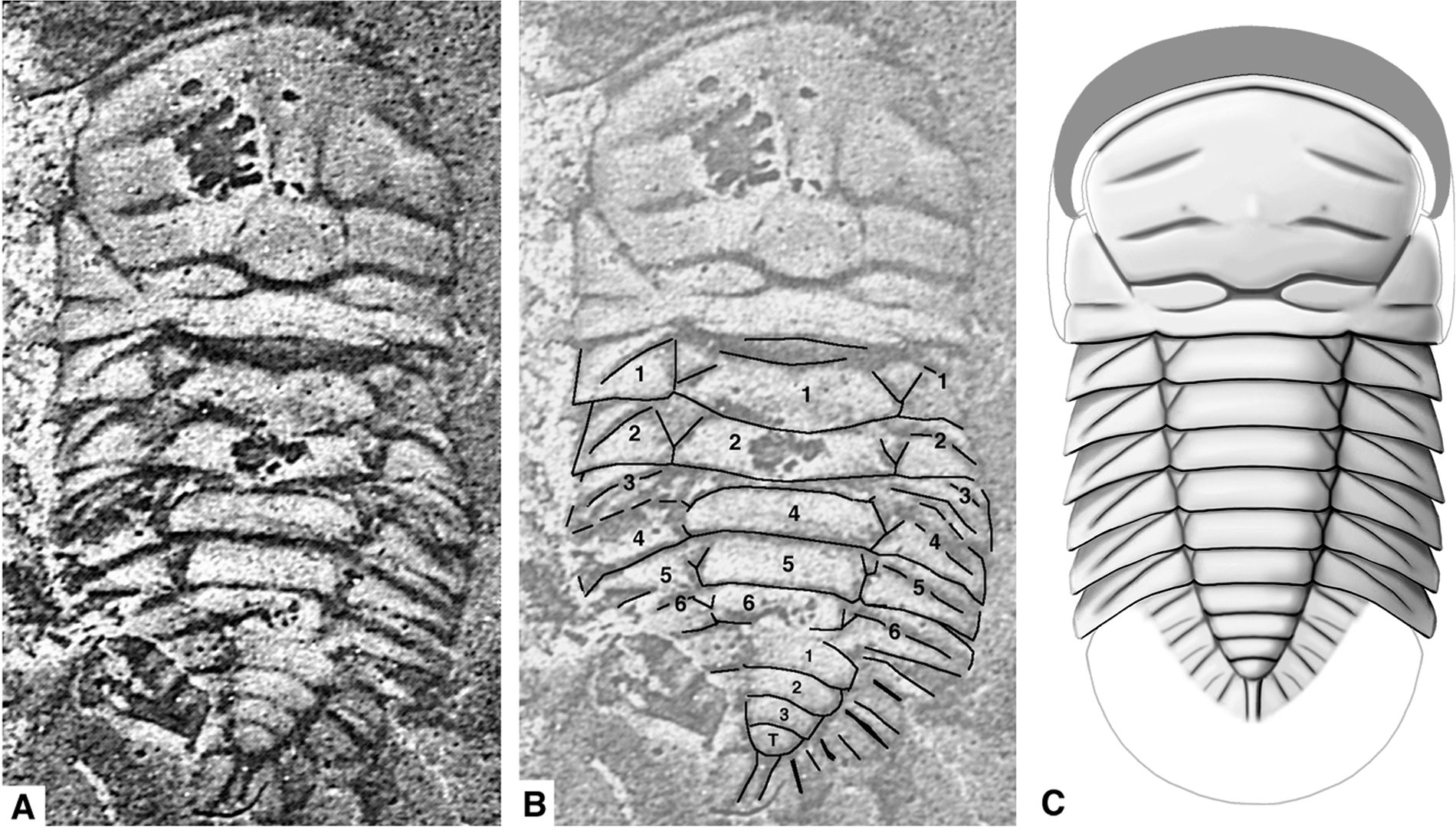
Holotype: External mould of almost complete specimen TPDBE: Tr 8656 (Field no. QII 44–2).
Type locality and horizon: From the Charchaq Group in the Queerqueke-Yaerdang mountain area, north-eastern Tarim, Xinjiang, north-west China, at a level that equates with the Sandbian (Climacograptus bicornis Biozone [ = lower part of the Diplograptus foliaceous Biozone]).
Occurrence: Currently known only from the holotype. The type locality is remote and not easy of access. The writers are informed that it is unlikely that additional specimens of this form will be acquired in the near future.
Name: Named in honour of the eminent Chinese palaeontologist Zhou Zhi-yi, Nanjing Institute of Geology and Palaeontology, Academia Sinica.
Diagnosis: As for genus.
Description: Cranidium subquadrate, arched forwards mesially, with a sagittal length equal to about 70% of the maximum width. Circum-foreglabellar furrow sharply impressed, arched forward frontally and with the axial portions converging posteriorly at about 85̊. Basal (L1) glabellar lobes are prominent, transversely elongated, defined posteromesially by rearwardly curved extensions from the mesial, occipital part of the circum-foreglabellar furrow, which is short, straight and deeply impressed. The lateral extension to the occipital furrow shallows and fades before reaching a short posterior extension to the axial furrow. S1 portions of circum-foreglabellar furrow are deep and gently curved sigmoidally, the strongest curve adjacent to the mesial part of the occipital furrow. S2 furrows discrete, angled forwards a little mesially, sharply impressed and very gently curved sigmoidally. There is a small pit-like hollow a short distance anterior to the adaxial part of S2. S3 furrows almost straight, barely curved a little rearwards and a little shorter than S2. They are a little more angled-forwards towards the mid-line. A mesial glabellar tubercle is situated a very short distance anterior to the adaxial terminations of the S2 furrows. Occipital ring widest (sag.) mesially, narrowing somewhat to the rear of the L1 lobes. Posterior margin of occipital ring arched a little posteriorly but with a gentle anterior curvature mesially. Palpebral rim narrow, probably continuous frontally, terminating posteriorly at a level between S2 and S3 furrows. Posterior part of fixigena triangular with a pronounced pleuroccipital furrow. Pleuroccipital band continues smoothly into the occipital ring.
Thorax of six segments. Axis narrows steadily posteriorly to about half of its anterior width. Each axial ring has conspicuous triangular axial lobes adjacent to the axial furrows which decrease in size posteriorly. Pleurae are short (tr.) anteriorly but increase in length (tr.) towards the rear. Sharply impressed pleural furrows course diagonally across the pleurae and terminate before reaching their sharply angled posterolateral terminations.
Pygidium incompletely known, but has a well-defined axis with three clearly differentiated rings and a terminal piece, behind which is a prominent, narrow postaxial ridge. The pleural fields bear four pronounced pleural furrows and three narrower interpleural furrows. The margin of the pygidium is not preserved.
Genus Synaptotaphrus nov.
Type species: Synaptotaphrus oarion sp. nov.
Name: σψναπτοσ + tafros, divided furrow, masculine, referring to the effaced mesial part of the S1 and occipital furrows.
Diagnosis: Elongated egg-shaped glabella with three pairs of transverse glabellar furrows, S2 slightly hooked forwards mesially. As interpreted here the circum-foreglabellar furrow effaced between S1 furrows.
Remarks: This genus seems to be most closely related to Circulocrania except that furrow effacement is not so extreme and the cranidium is proportionally longer. The general shape of the cranidium is reminiscent of that of some species of the cyclopygid Novakella but the glabellar furrowing pattern is quite different.
Synaptotaphrus oarion sp. nov.
Figures 2l, 12i–k, 13b.
(a)–(g), Circulocrania? dichaulax gen. et sp. nov., all from Trilobite Bed at base of Wall Member, Myoch Formation, locality M4, Myoch Foreshore, near Girvan, Ayrshire, Scotland. (a) paratype partial cranidium, internal mould, GLAHM: A 7461, X7; (b) holotype cranidium, internal mould, GLAHM: A 7460, X7; (c) juvenile paratype cranidium, latex peel from external mould, GLAHM A 9234, X7; (d) paratype pygidium, internal mould, GLAHM: A 7465, X5; (e) paratype pygidium, partially testiferous specimen, GLAHM: A 7466, X8; (f, g) paratype pygidium, latex peel from external mould and internal mould, the former showing low post-axial ridge, GLAHM: A 7467b and A 7467a, X8; (h) Circulocrania? sp., crushed cranidium, composite image, latex peel from external mould (left half), internal mould (right half) NHM: In 37086a,b, (Gray Collection), Gray Member, Mill Formation, locality W9, Whitehouse Foreshore, near Girvan, X15; (i)–(k) Synaptotaphrus oarion gen. et sp. Nov; (i, j) internal mould and latex peel from external mould of incomplete paratype cranidium, GLAHM: A 6422b and A 6422a, Red Mudstone Member of Myoch Formation, locality W9, Whitehouse Foreshore, near Girvan, X8 and X10, respectively; and (k) internal mould of holotype cranidium, GLAHM: 114733, same horizon as (i, j) locality W3, Whitehouse Foreshore, near Girvan, X15.
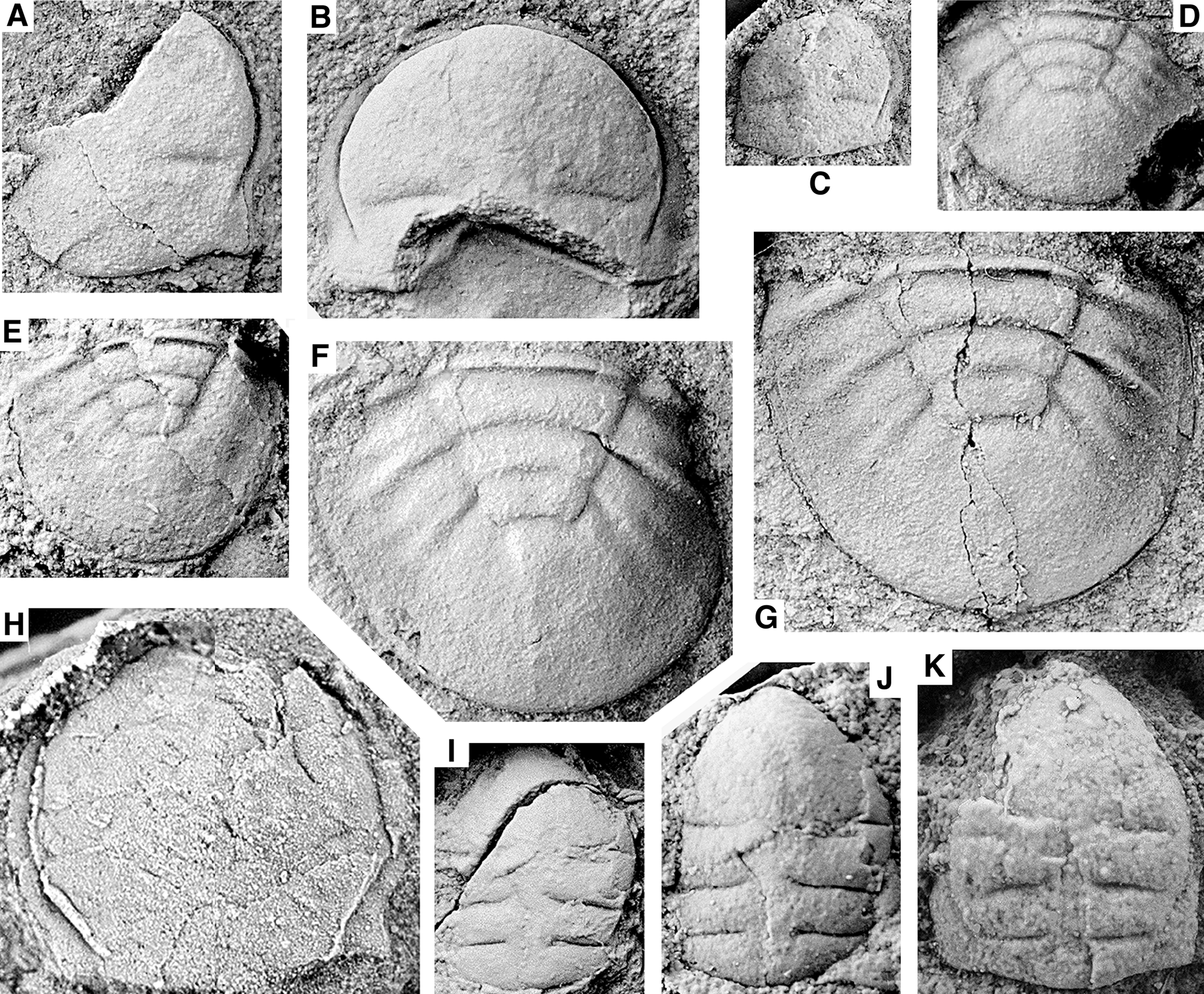
Holotype: GLAHM: 114733, internal mould of cranidium.
Paratype: GLAHM: A6422a, b, internal and external moulds of incomplete cranidium.
Type localities and horizon: From the upper Ardmillan Group, upper Whitehouse Subgroup, Myoch Formation, Red Mudstone Member (upper Caradoc Series, Streffordian Stage, Onnian Substage), Whitehouse foreshore, Girvan, south-west Scotland. Localities W3 (holotype), W9 (paratype), see Fig. 1.
Occurrence: Known only from two localities in the Red Mudstone Member of the Myoch Formation on the Whitehouse Foreshore (see above). Age, very late Caradoc.
Name: ωαριον,, little egg, noun in apposition.
Diagnosis: As for genus.
Description: Cranidium parabolic in outline, about 80% as wide (posteriorly) as sagittal length. Glabella egg-shaped, narrowing frontally, with three pairs of linear glabellar furrows. S1 furrows are transverse and gently convex rearwards, behind which are slight elevations of the narrow (exsag.) L1 lobes on the internal mould. The S2 furrows are deepest, slightly angled forwards towards the mid-line, are very gently arched anteriorly and are slightly hooked forwards at their inner ends. S3 furrows are transversely oriented and are not as mesially extensive as S1 and S2. S2 and S3 furrows do not reach the glabellar margin whereas the S1 furrows are angularly confluent with the axial part of the circum-foreglabellar furrow. The latter is effaced between the inner margins of the S1 furrows. The palprebral rims are narrow (tr.) and narrow even further anteriorly. The very shallow furrow defining their posterior extent lies opposite or slightly in advance of the outer ends of the S2 furrows. The posterior part of the fixigena is therefore rather long and triangular and its surface appears to continue smoothly onto the posterior part of the glabella. Occipital margin of glabella moderately arched rearwards. There is no glabellar tubercle. No other sclerites are yet known from this distinctive yet rare trilobite; it is well characterised on cephalic parts alone.
Genus Circulocrania Fortey & Owens Reference Fortey and Owens1987
Type species: Circulocrania orbissima. Dapingian (Fennian) Pontyfenni Formation, South Wales, Pont-y-Fenni, near Whitland.
Remarks: The type species is known only from cranidia, which are almost circular in outline, and nearly flat and featureless, and with evidence of a narrow encircling palpebral rim. Fortey & Owens (Reference Fortey and Owens1987) were unsure whether the eyes were fused into a single organ but acknowledged that possibility. New finds from Girvan include a much more completely known species that is plausibly derived from a more typical ellipsotaphrid by dorsal effacement. Cranidia of the new species show a single pair of shallow transverse glabellar furrows. They are smaller than C. orbissima. However, a larger cranidium of a similar kind is effaced, and looks almost identical to the type of C. orbissima (Fig. 12h). While it is possible that two genera are involved, it is also plausble that the glabella furrows became more effaced during growth. Hence the species described below is included with question in Circulocrania pending more information of the type species. The stratigraphical separation of the Girvan species from the type species is not a problem as long ranges are typical of ellipsotaphrids.
Circulocrania? dichaulax sp. nov.
Figures 2k, 3g, 12a–g, 13c.
Reconstructions of ellipsotaphrids from the Myoch and Mill formations of the Whitehouse Subgroup in the Girvan district. (a) Ellipsotaphrus pumilio Whittard Reference Whittard1952 (incorporates thoracic details from Chinese material) c. X12; (b) Synaptotaphrus oarion gen. et sp. nov., c. X12; (c) Circulocrania? dichaulax sp. nov. c. X6; and (d) Girvanopyge problematica (Reed Reference Reed1906) c. X12. Position of librigenae and ocular surfaces shown diagrammatically.

Holotype: GLAHM: A 7460, internal mould of cranidium.
Paratypes: GLAHM: A9234, external mould of juvenile cranidium; GLAHM: A7465, internal mould of pygidium; GLAHM: A7466, partially testiferous pygidium; GLAHM A 7467a, b, internal and external moulds of pygidium.
Type locality and horizon: All from the late Katian upper Ardmillan Group, upper Whitehouse Subgroup, Myoch Formation, Trilobite Bed at the base of the Wall Member, Locality M4, Myoch Foreshore (‘Shalloch Mill’), Girvan, SW Scotland (see Fig. 1).
Occurrence: Apart from the type locality, only known from the Red Mudstone Member of the Myoch Formation, foreshore at Port Cardloch, locality P2. Age, Caradoc.
Name: διχοσ + aulax, two furrows, noun in apposition.
Diagnosis: As for genus.
Description: Cranidium moderately vaulted, 78% as long as wide. Round glabella, occupying much of the cranidium defined by a sharp, smoothly curved continuous furrow which incorporates axial and anterior furrows, and which becomes effaced close to the posterior margin of the cranidium. The occipital margin of the glabella is gently and evenly curved towards the rear. There is a single pair of slot-like glabellar furrows, interpreted as S2 and situated about one-third of the cranidial length from the posterior margin. They are separated by a distance equal to their individual lengths and do not reach the axial furrow. These glabellar furrows are gently arched forwards and are slightly inclined forwards towards the midline. There is no glabellar tubercle. A continuous palpebral rim is broadest at the rear and narrows progressively to the front of the glabella. A very shallow furrow defines its extent, which is close to the posterior margin of the cranidium and to the rear of the pair of glabellar furrows. The fixigena behind the palpebral rim is small, subquadrate and is smoothly continuous with the posterior part of the glabella. It is defined abaxially by the short, almost straight posterior branch of the facial suture. Librigenae, including ocular surface, hypostome and thorax not known.
Moderately vaulted pygidium about 80% as long as wide with a smoothly curved sub-parabolic lateral and posterior outline. Axis occupies half the pygidial length and almost half the pygidial width anteriorly. Axial furrows converge posteriorly at 55̊. There are three well-defined axial rings, the posterior one truncated abruptly at the rear, where there is a shallow invagination. A weakly defined post-axial ridge almost reaches the posterior margin of the pygidium. Anteriorly, the axial ridge expands in width towards the posterior axial ring and appears to incorporate the axial terminal piece. There are three well-defined pleural furrows and two interpleural furrows, which become effaced where they meet a very shallow border furrow. The latter dies out posteriorly. A very faint fourth pleural furrow can just be made out adjacent to the posterolateral corner of the third axial ring. Both cranidia and pygidia lack surface sculpture.
Remarks: The most striking feature of the cranidium of this species is its simplicity. Its most distinctive features are the very extensive and continuous palpebral rim, together with the single pair of sharply defined glabellar furrows.
The three known cranidia were found closely associated with three pygidia of similar size. The latter are reminiscent of the smaller holaspid pygidia belonging to Ellipsotaphrus pumilio. Both have two pairs of clearly defined pleural ribs with three pairs of pleural furrows and two pairs of less well-impressed interpleural furrows. Whereas the well-defined axis of Ellipsotaphrus holaspid pygidia has one axial ring and a posteriorly rounded terminal piece, together with a faint post-axial ridge, the pygidia attributed to this species have three axial rings on an axis that is abruptly truncated with a slightly indented posterior margin. Like the pygidium of E. pumilio, the Circulocrania pygidium also has a faint post-axial ridge. The pygidial characteristics suggest that Circulocrania is an extreme ellipsotaphrid probably with a considerable pre-Katian ancestry. The rather crushed cranidium in the Gray Collection, from locality W9, Gray Member, Mill Formation, Whitehouse Foreshore (Fig. 12h), resembles those belonging to the slightly older Circulocrania? dichaulax in the nature of the palpebral rim and the course of what is here interpreted as a residual, partial circum-foreglabellar furrow. The cranidium, however, has a more circular shape and there is no trace of glabellar furrows or any other glabellar feature.
8. Acknowledgements
We are indebted to a number of people who have contributed in various ways over a protracted period. Zhou Zhiyi has been particularly forthcoming with regard to Chinese occurrences and other valuable information. Dr Neil Clark of the Hunterian Museum, Glasgow University and Dr James Floyd of the British Geological Survey, Edinburgh, have helped with collecting and Neil Clark took some original photographs in Prague with the assistance of R. J. Prokop. Neil Clark greatly helped with the publication of this manuscript after Keith's passing. Some necessary alterations have been employed in Fig. 6. We are grateful also to Dr Bob Owens, Dr Alan Owen and to Dr Adrian Rushton for valuable discussions and information and to Dr Jeff Liston formerly of the Hunterian Museum for curatorial assistance. Paul Shepherd of the British Geological Survey, Keyworth, has provided information concerning Lake District samples in the Rushton Collection. We thank Claire Mellish and Phil Crabb of the Natural History Museum, London, for enabling photography of two closely associated Kennedy Collection specimens, employed in Fig. 10. Dr R. J. Kennedy has provided valuable information concerning all of the known Shropshire and Welsh material of Girvanopyge occipitalis and Ellipsotaphrus monophthalmus and Drs Petr Budil and M. Valent have checked publication details and catalogue entries in the National Museum, Prague and in the Czech Geological Survey. All artwork has been achieved with a multi-layering technique using full Adobe Photoshop software on an Apple Macintosh Powerbook.
9. Conflicts of interest
None.



