1. Introduction
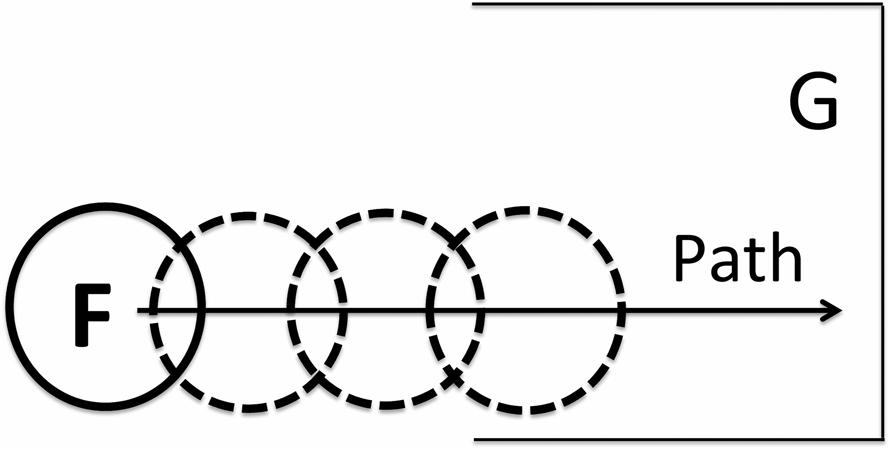
Understanding how we linguistically conceptualize and describe events is important for discovering the workings of the human mind. Regardless of culture and language, speakers routinely talk about the events they have experienced and make efforts to be clear and efficient in their communication (Grice, Reference Grice, Cole and Morgan1975). This is also true of one of the most frequent event types, motion events (Talmy, Reference Talmy and Shopin1985) having to do with the movement of objects, such as putting a cup on the table or placing an apple in a bowl. In Talmy’s classic typological analysis, a motion event consists of four essential components (see Figure 1): Figure (the moving entity), Ground (the reference entity), Motion (the presence of movement), and Path (the trajectory that Figure follows with respect to Ground). To these, Manner or Cause of motion can be added, as shown in the following examples (adapted from Talmy, Reference Talmy and Shopin1985, p. 62):
(1) a. The keg rolled into the storeroom.
Figure Motion+Manner Path Ground
b. John pushed the keg into the storeroom.
Agent Motion+Cause Figure Path Ground
Schematic illustration of Figure (F), Ground (G), and Path in a dynamic motion event. The Figure is the moving entity that follows a particular trajectory/Path (e.g., into, depicted by the arrow) with respect to the Ground. The broken circles indicate the Figure’s locations during its movement along the trajectory through time and space. The Ground is the non-moving reference entity to which the Figure moves. As moving entity, Figure is more perceptually salient (depicted by thick contour) than Ground. Figure and Ground thus have differential and asymmetric roles in a motion event.

While languages encode these basic components in their motion event expressions, they differ in the ways they conflate (or package) the components into single words (i.e., lexicalization). Languages also differ in the grammatical class (e.g., verb, particle, preposition) they assign to express these components. In Talmy’s (Reference Talmy and Shopin1985) typology of lexicalization patterns, two types of languages, namely, verb-framed and satellite-framed languages, have received the most attention in both developmental and adult studies on motion event expressions (Choi, Reference Choi2011; Gennari, Sloman, Malt, & Fitch, Reference Gennari, Sloman, Malt and Fitch2002; Hickmann, Taranne, & Bonnet, Reference Hickmann, Taranne and Bonnet2009; Özyürek, Kita, Allen, Brown, Furman, & Ishizuka, Reference Özyürek, Kita, Allen, Brown, Furman and Ishizuka2008; Papafragou & Selmis, Reference Papafragou and Selimis2010).Footnote 1 The difference between the two types has to do with the lexicalization of Path and Manner. In ‘verb-framed’ languages (e.g., French, Korean), Path is typically conflated with Motion in the verb root (e.g., entrer ‘enter’ in French; tule-kata ‘enter-go’ in Korean), whereas in ‘satellite-framed’ languages (e.g., English, German) Manner conflates with Motion in the verb root (e.g., run in English; laufen ‘run’ in German), and Path is encoded elsewhere in the sentence, such as in ‘prepositions’ and ‘particles’ (e.g., in, up in English; in ‘in’, hinauf ‘up’ in German) (Talmy, Reference Talmy and Shopin1985, Reference Talmy2000).
Studies have shown that these different lexicalization patterns influence cognition: depending on the language they speak, speakers conceptualize Path and Manner differently and pay varying degrees of attention to those aspects (Naigles & Terrazas, Reference Naigles and Terrazas1998; Özyürek & Kita, Reference Özyürek, Kita, Hahn and Stoness1999; Slobin, Reference Slobin, Strömqvist and Verhoeven2004).Footnote 2 For example, when viewing a motion event (e.g., Sara entre dans la chambre en courant in French ‘Sara enters into the room running’; Sara runs into the room in English), speakers of Path languages pay more attention to the Path of motion (e.g., entering, which is encoded in the verb), choosing Path as a basis for categorizing events, while speakers of Manner languages pay more attention to Manner (e.g., running) choosing Manner as a basis for categorization. Here, much has been debated on the extent of the influence of language-specific grammar on non-linguistic cognition. Some studies have shown that the influence of language on cognition only occurs while in a ‘thinking for speaking’ mode (e.g., Gennari et al., Reference Gennari, Sloman, Malt and Fitch2002; Papafragou, Hulbert, & Trueswell, Reference Papafragou, Hulbert and Trueswell2008; Papafragou & Selmis, Reference Papafragou and Selimis2010), while other studies showed that the influence persists even when possible verbal thinking is suppressed (Choi & Hattrup, Reference Choi and Hattrup2012; Flecken, von Stutterheim, & Carroll, Reference Flecken, von Stutterheim and Carroll2014; Soroli, Reference Soroli2012), and thus suggested that the influence permeates into a non-linguistic cognitive domain (Goller, Lee, Ansorge, & Choi, Reference Goller, Lee, Ansorge and Choi2017).
Yet, to date, cross-linguistic research has largely ignored expressions that relate to the core entities of a motion event: Figure and Ground (but see Thiering, Reference Thiering2011, Reference Thiering2015). To start with, in motion events, Figure(F) and Ground(G) are distinct entities and assume asymmetric roles (Talmy, Reference Talmy, Greenberg, Ferguson and Moravcsik1978, p. 627): “… a Figure object is a moving or conceptually movable point whose path or site is conceived as a variable”, while “the Ground object is a reference point, having a stationary setting within a reference-frame …” (see also Talmy, Reference Talmy and Shopin1985, Reference Talmy2000, and Langacker, Reference Langacker1987). As schematically shown in Figure 1, F is perceptually salient, as it moves through space or can be moved easily. G, by contrast, is a non-moving reference object, thus less salient. Nevertheless, G plays a critical role, as Path is determined by how F spatially relates to G and also by the types of G that a particular language encodes (Göksun, Hirsh-Pasek, Golinkoff, Imai, Konishi, & Okada, 2011; Muehleisen & Imai, Reference Muehleisen, Imai, Lee, Sweetwer and Verspoor1997). In Japanese, for example, distinct Path terms are used depending on whether the Ground is bounded (e.g., street) or not (e.g., open field). In English, the Ground’s geometry matters (e.g., Talmy, Reference Talmy, Greenberg, Ferguson and Moravcsik1978, Reference Talmy2000): When a Figure joins a Ground that is concave, the Path is defined by ‘in’ (i.e., containment), but when it joins a flat or a convex Ground, the Path is ‘on’ (i.e., support). Studies have shown that without Ground, children cannot categorize Path (Pruden, Roseberry, Göksun, Hirsh-Pasek, & Golinkoff, Reference Pruden, Roseberry, Göksun, Hirsh-Pasek and Golinkoff2013, p. 331), suggesting that “… [it is] the relation between Figure and Ground [that] defines the Path”. Thus, both in conceptual representation and in linguistic expressions for motion events, F and G are essential (cf. Langacker, Reference Langacker1987).
Prior research has assumed that the encoding of F and G is uniform across languages: the relationship between F and G and their asymmetry are encoded semantically in Path terms (e.g., in, on) as discussed above and also syntactically as they assume differential grammatical roles (Langacker, Reference Langacker1987, Reference Langacker1990; Talmy Reference Talmy, Greenberg, Ferguson and Moravcsik1978, Reference Talmy2000). In an active intransitive clause expressing spontaneous voluntary motion as in (2a), F is typically the subject (SBJ) of a motion verb (e.g., run), as it is the agent of the motion. In an active transitive clause expressing caused motion (2b), F is typically the direct object (OBJ) of a causative motion verb, taking the theme role, which expresses the displaced entity. In both types of clause, G is the oblique object (OBL) of a phrase that describes the goal/location (with spatial prepositions such as on in 2b).
(2) a. Sarah runs into the room. (spontaneous/voluntary motion)
sbj/Agent obl/Goal
Figure Ground
b. Sarah puts the cup on the table. (caused motion)
obj /Theme obl/Goal
Figure Ground
Typicality is another important dimension that comes into play in identifying F and G for linguistic expression. In dynamic motion events such as (2a) and (2b) above, F can be clearly identified and be differentiated from G because F moves and G is stationary. Yet even in a static situation where both entities are stationary, as in (3a) and (3b), canonical rules determine F (Talmy, Reference Talmy, Greenberg, Ferguson and Moravcsik1978, Reference Talmy2000). For example, seeing a bike near a house, it is canonical to view the bike, a movable object, as the F and thus assign it to the subject of a sentence as in (3a). Talmy (1978, p. 628) points out that (3a) represents “a realistic world where a bike is a movable object that can be in different locations at different times” whereas (3b) does not. ‘Realistic world’ refers to what speakers experience frequently and typically in everyday life. Thus, it relates to the pragmatic aspect of a spatial situation.
(3) a. The bike is near the house.
b. The house is near the bike.
While, from a theoretical and conceptual point of view, the grammar differentially encodes the distinct F and G entities and assigns them asymmetric roles, it is largely unknown to what extent speakers of different languages actually encode the asymmetry in their own grammar and whether they do so uniformly across languages. Also unknown is the extent to which F-G grammars are affected by pragmatic factors, namely in this case, speakers’ typical experiences of F-G relations in the real world. These are important inquiries as motion events are a fundamental part of everyday human experiences.
1.1. how languages encode figure–ground relation: background
In recent cross-linguistic research, two lines of work – Path semantics and word order of Figure and Ground in syntax – suggest that languages may in fact differ significantly with respect to how they encode Figure and Ground. We point them out here along with relevant grammatical features in German and Korean, which lead to specific hypotheses and predictions.
1.1.1. Semantic classification of F-G relation
A number of recent studies have shown that the underlying principles of Path classification can differ significantly across languages (Bowerman & Choi, Reference Bowerman, Choi, Gentner and Goldin-Meadow2003; Levinson, Meira, & the Language and Cognition Group, 2003; Majid, Jordan, & Dunn, Reference Majid, Jordan and Dunn2015). For the motion of putting F relative to G, a language such as English differentiates Path according to the geometry of G, distinguishing between when G is a container (putting an apple into a bowl; putting a jigsaw puzzle into its slot) versus when it is a surface (putting a cup on the table; putting a Lego piece onto another). Yet some languages categorize Path on different principles. Korean is a case in point (Bowerman & Choi, Reference Bowerman, Choi, Gentner and Goldin-Meadow2003). In Korean, Path in a dynamic motion is categorized based on the degree of fit between F and G (i.e., tight-fit vs. loose-fit) rather than on the geometry of G. Thus, Korean collapses containment and support into one semantic category when F and G result in a tight-fit relation, using the same Path term, kki(-wu)-ta Footnote 3 ‘fit.tightly(-caus)-decl’, for both.Footnote 4 For example, putting a jigsaw puzzle into its slot and putting a Lego piece onto another are both kkita in Korean. We will discover that these language-specific Path classification systems affect the degree of identifiability of F and G.
1.1.2. F-G word order in syntax and typicality
In recent studies, Thiering (Reference Thiering2011, Reference Thiering2015) has reported ‘reversal of F and G’ in syntax – in terms of word order – in two non-Indo-European languages, Dene (spoken in northern Canada) and Totonac (spoken in central Mexico), and demonstrated that languages differ in positioning F and G in the sentence. While English and German speakers would align F and G in a typical way according to Talmy’s canonical rules, placing F first in the sentence as its subject (i.e., Der Baum steht auf dem Hügel ‘The tree stands on the hill’), speakers of Dene and Totonac – both SOV languages – often reverse the word order of F and G, such that the G is mentioned first (i.e., fills in the subject position) and thus is foregrounded, followed by the F, as in (4).
Example of F-G reversal (Thiering, Reference Thiering2015, p. 111)
(4) Dene
shethlae el ná-ghi-ʔa.
hill.on.top.of spruce.tree in.place/in.front.of-3sg.so.impf.stand.upright
‘On top of the hill the tree stands.’
Thiering (Reference Thiering2011, Reference Thiering2015) demonstrates that reversals of F and G in syntax occur regularly in certain languages and that the frequency of F-G reversals in syntax differs across languages. That is, languages differ in the degree to which they ‘correctly’ assign F and G according to the visual scene. Thiering explains the word order reversals of F and G in Dene and Totonac partly in terms of language affordances. The two languages have some language-specific property that allows speakers to express the F-G situation in a reverse order: “Totonac and Dene speakers are required through language-specific affordances (i.e., detailed specification of location) to depict a scene in a highly specified and often perspectivized and contextualized fashion” (Thiering, Reference Thiering2011, p. 262).
These recent studies suggest that a decision of how to linguistically encode the F and G of a particular scene may depend on several factors: the semantic categorization of Path, the morphosyntax of a particular language, the canonicality/typicality of F-G roles of a given scene, and the speaker’s choice of which entity s/he wishes to foreground or background. The findings suggest that languages vary in the way they set up focal points and encode F-G relations for linguistic expression, and that describing a spatial scene is in part independent of its external properties (i.e., from what has been visually presented). In other words, speakers do not just passively describe what they perceive, but actively ‘construe’ the situation subjectively based on several variables and in a language-particular way (Langacker, Reference Langacker1987, Reference Langacker2008; Thiering, Reference Thiering2015; Vandeloise, Reference Vandeloise and Bosch1991).Footnote 5
1.1.3. Motion event expressions in German and Korean
In the current study, we compare German and Korean, two languages that differ substantially both in general language typology and in their lexicalization pattern of motion events: German is an Indo-European language with a dominant Subject–Verb–Object orderFootnote 6 and is satellite-framed, whereas Korean is an Altaic SOV language and is verb-framed. The two languages also differ in the semantic classification of Path.
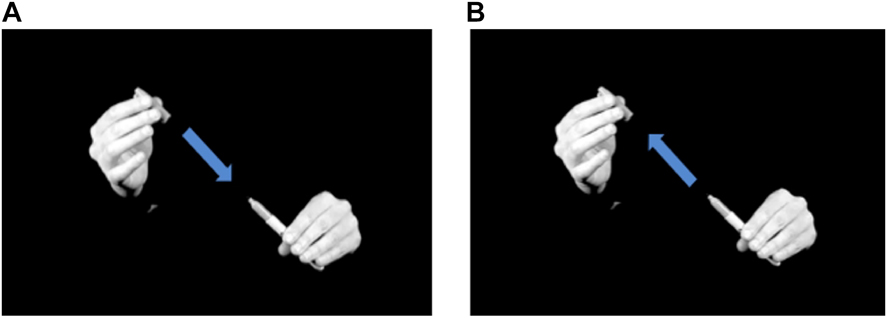
Consider the motion event of Sarah putting a cap on a pen, as shown in Figure 2a. German speakers would describe it as in (5a) and Korean speakers as in (6a). The Path term would be auf ‘on’ in German and kkita ‘fit.tightly’ in Korean. Syntactically, both German and Korean assign the F – the moving object (i.e., cap in 5a and 6a) – as direct object assuming the theme role of a transitive/causative verb, and the G – the reference object – as the oblique object assuming the goal role of the verb.
German
(5) a. Cap moving (Fig. 2a): Sarah steckt die Kappe AUF den Stift.
Sarah put+3sg.prs the cap on the pen.
Figure Ground
‘Sarah puts the cap on the pen.’
b. Pen moving (Fig. 2b): Sarah steckt den Stift IN die Kappe.
Sarah put+3sg.prs the pen into the cap.
Figure Ground
‘Sarah puts the pen into the cap.’
Korean
(6) a. Cap moving (Fig. 2a): 사라가 펜뚜껑을 펜에 끼다.
Sara-ka pheyn-ttwukkeng-ul pheyn-ey KKI-ta.
Sara-sbj pen-cap-obj pen-loc fit.tightly-decl
Figure Ground
‘Sarah fits tightly the cap to the pen.’
b. Pen moving (Fig. 2b): 사라가 펜을 펜뚜껑에 끼다.
Sara-ka pheyn-ul pheyn-ttwukkeng-ey KKI-ta.
Sara-sbj pen-obj pen-cap-loc fit.tightly-decl
Figure Ground
‘Sarah fits tightly the pen to the cap.’
Joining a cap and a pen. In 2a the agent puts the cap (F) on the pen (G), and in 2b the agent puts the pen (F) into its cap (G). Notice that the F-G roles are switched between 2a and 2b.
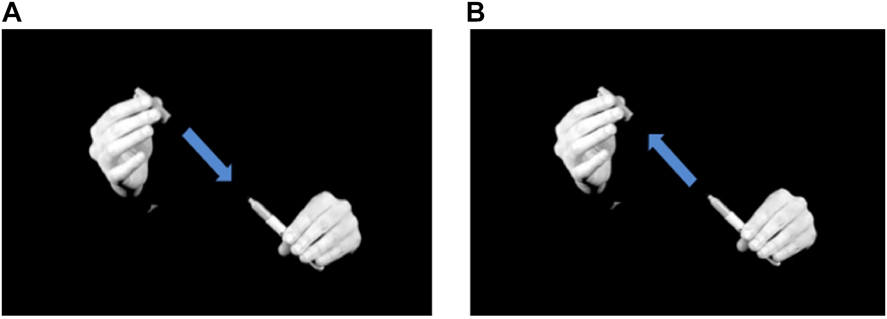
Now consider the opposite F-G roles, such that Sarah puts the pen (F) into its cap (G), as shown in Figure 2b. Following the canonical F-G syntax, this time, both German (5b) and Korean (6b) assign the pen (F) as direct object and the cap (G) as oblique object. However, what is strikingly different between the two languages are the ways in which Path terms are employed for the opposite F-G roles: German speakers would describe it with in ‘into’ (5b), distinguishing the Path from that of (5a), but Korean speakers would describe it again with the verb kkita ‘fit.tightly’ (6b), using the same Path term as in (6a). This is because German and Korean classify spatial relations quite differently. In German, as in English, Path terms are largely determined by the Figure’s topological relationship to the geometry of the Ground (Talmy, Reference Talmy, Greenberg, Ferguson and Moravcsik1978, Reference Talmy2000): when the Figure ends up contained in a concave Ground, the Path is termed in ‘in’ to denote containment, but when the Figure ends up supported by a flat or a convex Ground, it is termed auf ‘on’. To note, similar to English, German also has prepositions such as durch ‘through’ that refers to a Figure object passing through the hollow space of a Ground object, as well as über ‘over/above’ and unter ‘under/below’ that refer to a Figure object going (or being) vertically above and below the Ground object, respectively.
The semantic classification of Path terms in Korean is different from German. In Korean, (6a) and (6b) are both expressed by the tight-fit verb, kkita ‘fit.tightly’, as both result in a tight-fit interlocking relation between F and G. The verb kkita (and other tight-fit verbs such as kkocta, cf. ‘Section 4.1.4.2’ below) is used for all types of tight-fit relations, for example tight attachment, tight cover, tight encirclement, and tight containment (cf. Table 1). Concerning loose-fit relations, Korean is somewhat similar to German in that it distinguishes between containment, support, and encirclement to some extent – nehta ‘put.in.loosely’ for loose containment, nohta ‘put.on.loosely’ for loose support, and t hongkwahata ‘put.through.loosely’ for loose encirclement. But detailed analyses show that these verbs blur the boundaries between loose containment and loose support. For example, Yun and Choi (Reference Yun and Choi2018) report that Korean speakers use the verb nohta ‘put.on.surface.loosely’ not only for loose support (e.g., putting a cup on a table) but also for loose containment when putting something loosely at the bottom of a container (e.g., putting candy in a container). The verb nehta ‘put.in.loosely’ also blurs the boundary between loose containment and loose encirclement. Korean speakers use the verb not only for putting an apple in a bowl (loose containment) but also for passing a large ring loosely over a thin pole (loose encirclement). Furthermore, the verb nehta ‘put.in.loosely’ can refer to the opposite direction of loose encirclement, for example, a thin pole going through a large ring.
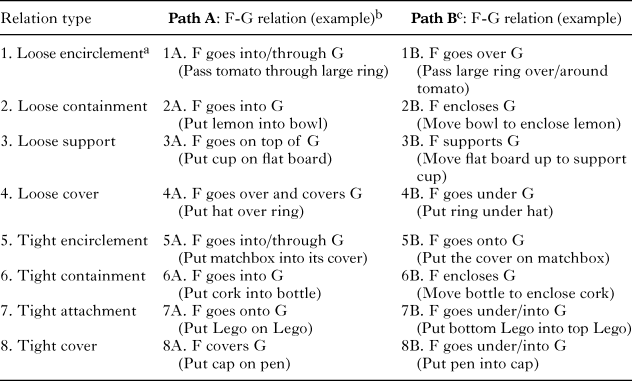
Eight types of spatial relation and two Paths (Path A and Path B) tested for each type

notes:
a Each type was represented in six exemplars;
b See Figure 2 for schematic illustrations of the examples;
c F-G roles in Path B are switched in Path A.
To sum up, while both German and Korean differentiate F and G in syntactic constructions by assigning them to distinct grammatical roles, the two languages differ in the extent to which they distinguish differential Paths. German distinguishes Path primarily based on the geometry of G, but Korean does so based on degree of fit, particularly for a tight-fit relation. For the present purpose, we note that (1) the verb kkita in Korean refers to tight fit regardless of topological relations (i.e., containment or support), and thus (2) the verb kkita alone does not identify which object moves (F) to where (G).
2. The current study
The current study examines expressions for dynamic caused motion events in which F and G are perceptually defined: an agent moves the F object towards and finally places it relative to the stationary G object.Footnote 7 Second, both F and G are inanimate objects and portable in size, which allows us to easily manipulate their F and G status. We can thereby examine how speakers assign F and G roles without biasing them to assign the G status to a physically non-movable (e.g., too heavy) object. Use of two inanimate objects also prevents a typicality bias of assigning F and G on the basis of the animacy/inanimacy distinction (i.e., an F status for animate and a G status for inanimate objects). Third, the types of Path from F to G and the consequential spatial relations between the two objects vary systematically (e.g., containment, support, tight-fit, loose-fit) in ways that relate to the cross-linguistic differences in spatial categorization reported in previous studies (e.g., Bowerman & Choi, Reference Bowerman, Choi, Gentner and Goldin-Meadow2003). This allows us to make specific hypotheses and predictions about how F-G descriptions in German and Korean might differ as a function of different types of Path/spatial relation.
Finally, but importantly, we present two versions of a motion event in which the roles of F and G are switched, as shown in Figures 2a and 2b. (Throughout this paper, we will consistently use the terms ‘switch’ (or ‘opposing/opposite’) to refer to changes of Path in the visual motion and will use the term ‘reverse’ to refer to changes in the grammatical structure.) With such a design, we can systematically examine the degree of identification and differentiation of F and G in semantics (i.e., Path terms) and syntax (i.e., assignment of grammatical roles), as well as the typicality of F-G roles in a given language. To our knowledge, this is the first cross-linguistic study that comprehensively investigates the F-G asymmetry in dynamic motion events, examining various grammatical components as well as the typicality factor in F-G assignment, and does so with systematic elicitation from speakers of different languages.
2.1. hypotheses and expected results
We hypothesize that the grammatical differences between German and Korean would lead to significant differences with respect to the degrees to which the two language groups encode the F-G asymmetry in their descriptions of motion events. Concerning Path terms, our expected results are: (i) German speakers use distinct Path terms for opposing F-G roles more than Korean speakers; and (ii) German speakers differentiate between F and G across the board, regardless of tight-/loose-fit, but Korean speakers differentiate them less for tight- than loose-fit relations. Concerning the syntactic assignment of F and G, we expect the following: (i) Korean speakers produce more misalignment (i.e., reversal) overall in F-G syntax compared to German speakers. To the extent that Korean speakers use the same Path term regardless of F-G roles, they may be less concerned with identifying F and G, and thus use the same syntactic construction for both types of Path; and (ii) in this syntactic inquiry, we also consider the typicality factor and hypothesize that the degree of correct/reverse F-G assignment relates to how typical a particular F-G relation is in an everyday experience. Specifically, we expect that, for both languages, speakers make more correct F-G syntax for typical F-G relations than for non-typical F-G relations. At this hypothesis stage, however, it is difficult to predict whether the degrees to which typicality affects the F-G syntax would differ between the two languages. We will address this question in the current investigation. Finally, we will test the ‘language affordances’ hypothesis: language-specific grammatical features have an impact on the linguistic representation of Figure and Ground. More specifically, we hypothesize that the number of different Path terms used for opposing F-G roles predicts the degree of correct/reverse F-G syntax.
If our hypotheses are borne out, our study will show that linguistic representation of F and G is construed as a function of several linguistic and morphosyntactic as well as pragmatic characteristics relating to F and G, and that languages differ in the degree to which they encode the F-G asymmetry in their grammar. Such results will support the claim that language can misalign with what is visually presented (Thiering, Reference Thiering2011, Reference Thiering2015).
3. Materials and methods
3.1. participants
The analyses were based on data from 23 German speakers and 24 Korean speakers, who were all university students between 18 and 26 years old. German speakers were tested at the University of Vienna, Austria, and Korean speakers at Konkuk University in Seoul, Korea. The participants received either course credit or monetary compensation for participation. In German,Footnote 8 we initially tested 30 participants, but six were excluded because they were bilingual (learned a second language before the age of five), and one because of exceeding the age limit. In Korean, we initially tested 27 participants, but one was excluded because of being bilingual, one because of a computer crash, and one because the participant did not complete the task.
3.2. materials
We prepared a total of 96 target videos with caused motion events (eight relation types × six exemplars/type × two versions/exemplar) in which an agent moves the F object and joins it to the G object, resulting in a particular spatial relationship between F and G. Only the agent’s hands manipulating the objects were shown against a black background (cf. Figures 2a and 2b). The two objects were visually present from the beginning to the end of the video. The 96 target events consisted of eight types of spatial relations, four types that result in a loose-fit relation and four types that result in a tight-fit relation (see Table 1). The eight types differed in terms of the geometry/shape of the G, which included convexity, concavity, or flat surfaces involving various shapes (e.g., ring, ball, square frame). Use of a variety of subtypes of loose- and of tight-fit ensured that any effect of Path type is not due to a specific and narrowly defined spatial relation between the two objects.
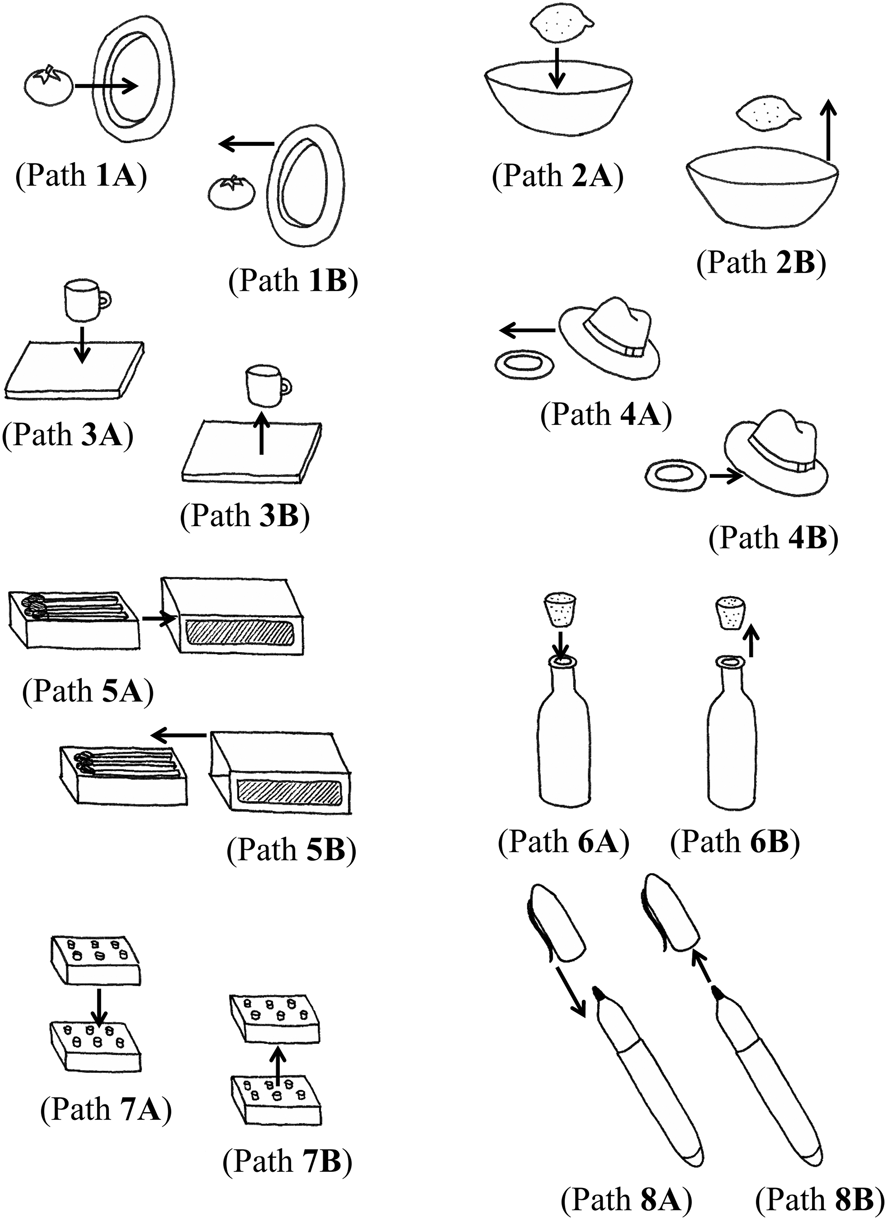
For each relation subtype (e.g., loose containment), six exemplar videos were constructed with everyday objects. Each exemplar consisted of two movable objects that served as either F or G depending on the video version. For each exemplar, two video versions (‘a video pair’ or ‘event pair’) were created with the same two objects but with the F and the G roles switched between the two versions (cf. Path A and Path B in Table 1). For example, for the video pair with a pen and a pen cap, in Path A, the agent puts the cap onto the pen, and in Path B, she puts the pen into the cap (Paths 8A and 8B in Table 1). Figure 3 provides schematic illustrations corresponding to Table 1. To test our hypothesis on typicality, we assigned Path A to be one that we considered more typical, for example, putting a small object through a frame (for encirclement) or in a container (for containment). Within each video pair (Path A and Path B), the status of the two objects relative to each other was identical at the starting point as well as at the end point (e.g., the pen was separated from the cap at the start and it was in the cap at the end of the video). Thus, Paths A and B in a video pair differed in terms of the F (object moved) and the G (stationary object) during movement.
Schematic illustration of video pair examples for each relation type. The Relation Type (1 through 8) and Path (A and B) correspond to those in Table 1. The Figure-Ground roles of Path A are switched in Path B.

In addition, four practice and 32 filler videos showed an agent’s hands opening/closing an object (e.g., folding fan) or moving a pair of objects together in one direction in parallel (e.g., up, down). These filler motions did not involve any changes in spatial relation between objects, and were randomly interspersed during the experiment.
3.3. design and procedure
Participants were tested individually with a laptop computer. Each video lasted 4 seconds and each was presented twice with a 0.5-second interval of blank screen between the two presentations. Apart from the four practice videos at the beginning of the experiment, all videos were presented in a computer-generated random order. Participants were instructed as follows: “Imagine a person sitting opposite you. The person is holding the same objects as those you see in the video, but he/she does not know what to do with the objects. Your task is to instruct the person to do the same action as you see in the video.” After seeing each video twice, participants typed their instructions on the computer and pressed the ‘enter’ key, which prompted the next video to appear. The whole experiment was conducted in the participant’s native language, German or Korean.
3.4. database
We obtained a total of 4,512 descriptions (47 participants (23 Austrians + 24 Koreans) × 8 Relations × 6 exemplars per relation × 2 video versions per exemplar), consisting of 2,208 descriptions in German and 2,304 in Korean.
For an analysis of Path expressions, the relevant spatial verbs and spatial prepositions/particles in German, and relevant spatial verbs in Korean, were annotated. Note that in Korean, verb (or verb compound) is the primary and obligatory grammatical class for expressing the Path that F takes in relation to G in a dynamic motion event. In describing a dynamic event, Korean speakers can additionally and optionally use locative nouns (e.g., wui ‘top’, an ‘inside’). In the current study, locative nouns were used optionally (24% of the whole dataset) and irregularly and thus were not included in the analysis. For the analysis of syntactic assignment of F and G, the syntactic expressions – more specifically the grammatical roles – that relate to the F and G of the target video were examined.
4. Coding, analysis, and results
4.1. path expressions
4.1.1. Coding details
All Path expressions were included in the initial dataset. In German, the Path expressions were either single verbs occurring alone (e.g., verschließen ‘close’) or VPs (verb + preposition, e.g., heben an ‘lift.up’). In Korean, they were either single verbs (e.g., kki(wu)ta ‘fit.tightly’) or compound verbs (e.g., kki(wu)e-machwuta ‘fit.tightly-match’). We then excluded those expressions that contained no relational meaning (e.g., den Ring bewegen in German / ring-ul wumcikita in Korean, ring-obj move ‘move the ring’) and those of low frequency – five tokens or fewer in the entire dataset – for example, greifen ‘grab’, senken auf ‘lower on(to)’ in German or camkita ‘immerse’ in Korean. In German, there were 51 such instances in total (2.19% of the entire dataset), and in Korean there were 72 instances (3.13% of the entire dataset).
We then merged particular responses into the same linguistic categories as follows: in German, we collapsed affix variations of the same verb stem that are synonymously used into one type. For example, bedecken ‘cover’, verdecken ‘cover’, abdecken ‘cover’, and zudecken ‘cover’ were collapsed into one type of -decken ‘cover’ because they all can be and were used synonymously to describe the action of covering an object. We also collapsed verb phrases with the same verb stem and the same preposition that can be synonymously used with or without an affix. For example, heben ‘lift’, anheben ‘up.lift’, and heben an ‘lift to’ were collapsed into one type, as they all describe lifting something up. Both the prefix an- (which has many functions but here it describes moving in an upward direction) and the preposition an ‘to’ simply underline the upward motion.
With this cleaned-up data, we coded the German data in two ways. First, we coded the data in terms of preposition/particle. For example, responses such as legen auf ‘lay/put on’ were coded as auf in the preposition dataset. Single verbs without any prepositions (e.g., verschließen ‘close’) were not included in the preposition dataset. Use of a verb alone only occurred in 72 instances (3.26%) of the data.Footnote 9 Second, we coded the data in terms of verb phrase (VP). Responses such as legen auf were coded as such. Note that a VP includes not only Verb + Preposition (e.g., legen auf) but also single verbs (e.g., verschließen ‘close’).
In Korean, we collapsed single and compound verbs that share the same Path verb into one type. For example, the verb nehta ‘put.in.loosely’ and a compound verb cipe-nehta ‘pick/hold.with.hands-put.in.loosely’ both refer to the same Path – that is, ‘put.in.loosely’. Similarly, tephta ‘cover’ and tephe-ssuiwu-ta ‘cover-cover.over’ both refer to covering, and kki(wu)ta ‘fit.tightly’ and kki(wu)-e machwuta ‘fit.tightly-match’ both refer to fitting tightly. Also, verbs, such as swumkita ‘hide’ and kamchwuta ‘hide’, which hardly differ in meaning, were collapsed into one type. Note that while the present data and the statistical codes are not open for public access, they are available upon request.
4.1.2. Coding of ‘same’ versus ‘different’ Path terms per video pair
Recall that a video pair consisted of two versions (Paths A and B, cf. Table 1), where the F-G roles are switched between the two versions (e.g., putting pen into cap vs. putting cap on pen). The question is: To what degree do German and Korean speakers use distinct Path terms for the two opposing F-G roles? Use of distinct Path terms means that the participant linguistically encodes the differential Paths of F to G between the two items of the pair and thus encodes the asymmetrical relationship between F and G. For coding, we took each participant’s descriptions for a video pair one by one and coded whether he/she used the same or different Path terms for the given pair.
4.1.3. Analysis
Our analyses test whether Korean and German differ significantly in encoding the F-G asymmetry, specifically in the frequency of same/different Path terms for opposing F-G roles and in the amount of correct/reverse F-G syntax in which typicality may play a role. We also hypothesized that the type of relation, loose-fit and tight-fit, may affect Korean speakers differentially, particularly in their use of Path terms. To test our hypotheses, we conducted a series of linear mixed-effect logistic regressions to control for the variances of participants and items simultaneously (see Jaeger, Reference Jaeger2008), using the R programming language (version 3.5.1; R Development Core Team, 2018) and lme4 (version 1.1-17; Bates, Maechler, Bolker, & Walker, Reference Bates, Maechler, Bolker and Walker2015). In all quantitative analyses on Path terms and on F-G syntax below, the fixed effects were entered as categorical variables: Language (‘0’ for German, ‘1’ for Korean), Relation (‘0’ for Loose fit, ‘1’ for Tight fit). In the F-G syntax analysis, Typicality was also entered as a categorical variable (‘0’ for Typical and ‘1’ for Non-typical). In all analyses, participants and items (stimuli) were included as random variables (random intercepts and random slopes for the effect of the designated fixed factors) to control for unwanted participant and item variability. Each model fit was optimized based on 100,000 iterations. When models failed to converge, we removed random slopes for the effect of fixed factors of items while keeping random intercepts for participants and items, and random slopes for participants. Prior to running models, all dummy-coded fixed factors were centered in order to make it easy to understand the interaction terms and to lessen the correlation between the interaction terms and their fixed factors, in particular, in multilevel regression models (cf. Enders & Tofighi, Reference Enders and Tofighi2007).
4.1.4. Results: Path expressions
4.1.4.1. Quantitative analyses.
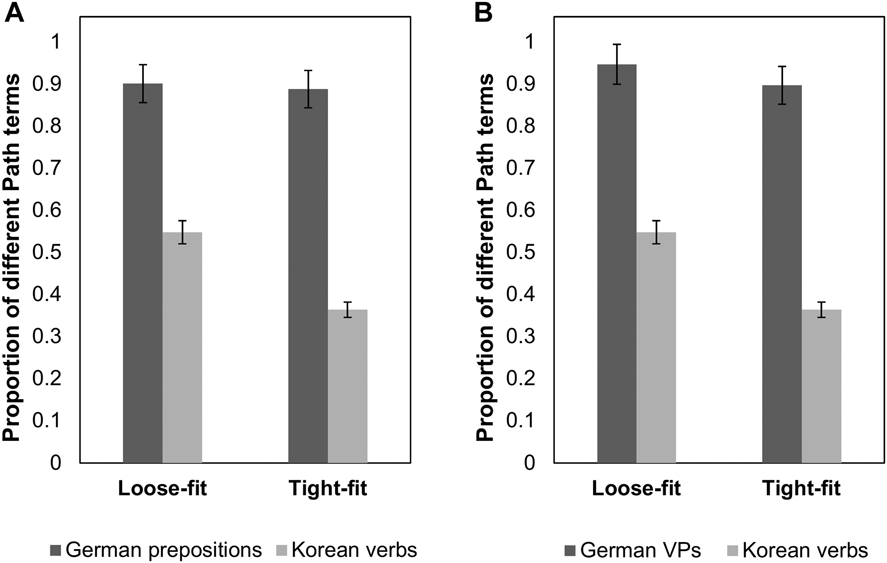
To test the hypothesis that German speakers produce more differential Path terms than Korean speakers, proportions of different Path expressions were computed for each language by relation type. Proportions were calculated based on the total number of video pairs tested per relation. Figures 4a and 4b show the proportions by Language and by Relation (Loose-fit vs. Tight-fit) compared in two ways, one with German prepositions (Figure 4a) and the other with German VPs (Figure 4b). In both comparisons, the cross-linguistic differences are clear. German speakers produced more different Path terms for opposing F-G roles than Korean speakers.
Average proportions of different Path terms used for video pairs by Relation (Loose-fit vs. Tight-fit) and by Language. Within a video pair, the two events have opposite F-G roles, Path A and Path B. Korean verbs are compared against German prepositions (4a) as well as against German VPs (4b). In all cases, German speakers used different Path terms significantly more often than did Korean speakers. Error bars indicate SEs of the mean proportions.

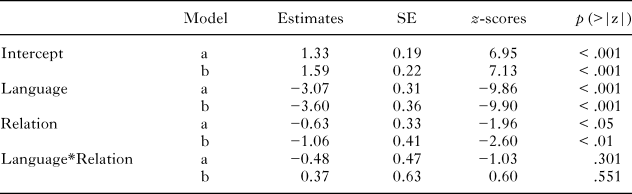
In conducting the mixed-effect regression models as described above, the Path terms (dependent variable) were coded as a categorical variable, ‘0’ for same and ‘1’ for different terms. As for fixed effects, we entered Language (German, Korean), Relation (Loose-fit vs. Tight-fit), and their interaction into the model. As for random effects, we had intercepts for participants and items, and their random slopes for the effect of Language and Relation. (For all statistical analyses in this study, the R code of our models is available in the Supplementary materials online at <https://doi.org/10.1017/langcog.2019.3>.) In German, the two types of grammatical unit (prepositions and VPs) were compared separately against spatial verbs in Korean. Table 2 compares Korean verbs with German prepositions (Model a) and with German VPs (Model b). We found significant main effects of Language and of Relation but their interaction was not significant in either model. The effect of Language indicates that German speakers used different Path terms more often than Korean speakers regardless of Relation (Loose-fit or Tight-fit). The effect of Relation reveals that speakers, both German and Korean, used different Path terms more often for a loose-fit relation than for a tight-fit relation.
Fixed effects in mixed models comparing Korean Path verbs with German prepositions (Model a) and with German VPs (Model b)

Although we did not obtain a significant interaction between Language and Relation from the model reported in Table 2, we conducted two within-language analyses to test the hypothesis that the type of relation may affect Korean speakers differentially, but not German speakers, in their use of Path terms. We split the data by Language and tested the effect of Relation (Loose-fit vs. Tight-fit) in each language. In these models, we entered Relation as a fixed factor. We also included random intercepts for participants and items and random slopes for the effect of Relation of participants. The results are shown in Table 3. As we have obtained the same results for both German prepositions and VPs for this and all other analyses, for the sake of succinctness we report only the preposition results. To note, we interpret the same results for both German preposition and German VPs to mean that Path terms in German are primarily driven by prepositions rather than verbs, as the addition of the verb in the VP analyses in this study did not change the results. While more detailed discussion of this aspect is beyond the scope of this paper, we refer to Yun and Choi (Reference Yun and Choi2018) for similar results and discussion for English Path terms.
Fixed effects of Relation (Loose-fit vs. Tight-fit) in mixed models on different Path terms in each language (German prepositions, Korean verbs)

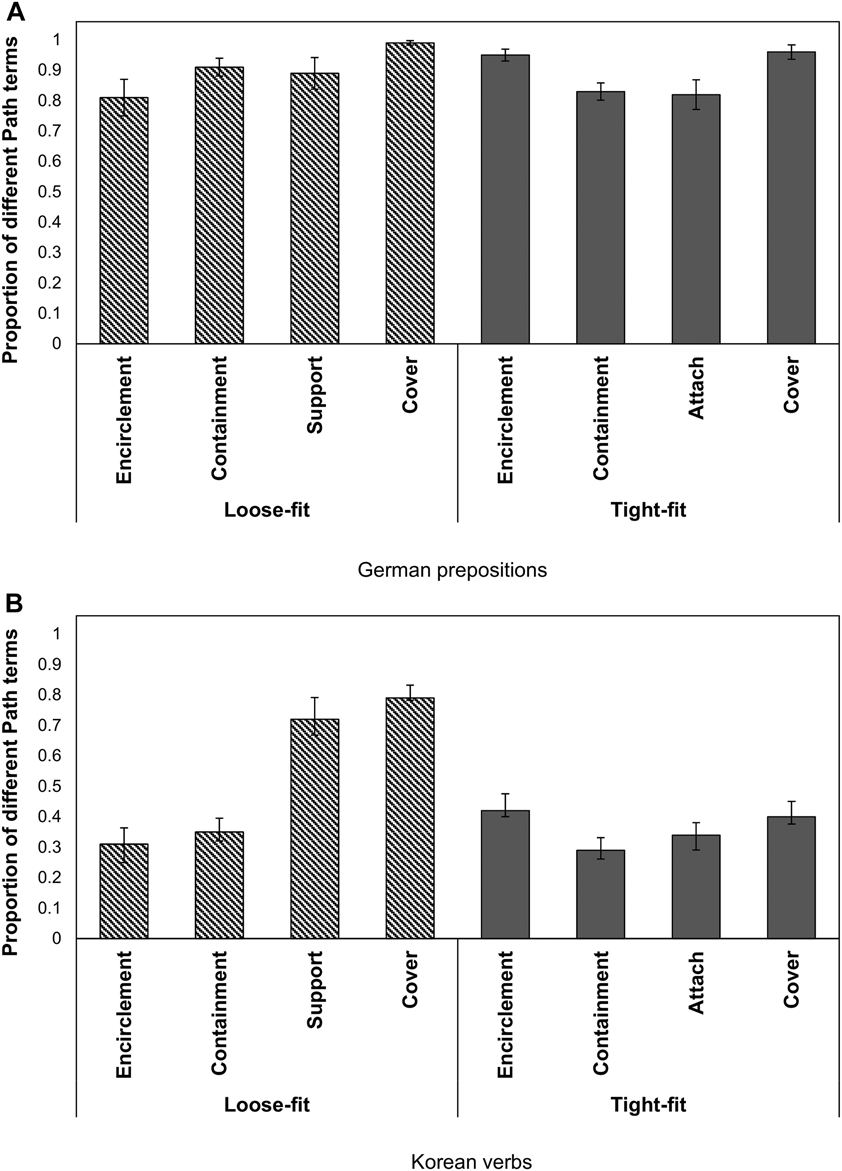
The effect of Relation was significant in the Korean model but not in the models of German prepositions as well as German VPs. As we had expected, there were no differences in German between loose- versus tight-fit relations in the frequency of different Path terms, but there were in Korean. To identify the specifics, we examined the proportions of different Path terms for all eight relation types in each language (Figure 5a-b). German speakers used different Path terms at similar rates, ranging between 80% and 100%, across all relation types (Figure 5a). In contrast, Korean speakers showed a distinct pattern: they used many more different Path terms for the loose-support and loose-cover relations (75–80%) than for the other relations (30–40%) (Figure 5b). Thus, the significant effect of Relation (Loose-fit vs. Tight-fit) in Korean was mostly due to the increased amounts of different Path terms for those two types of loose-fit relations (cf. Table 4b).
Average proportions of different Path terms used for video pairs by Relation Type for each language, German prepositions (5a) and Korean verbs (5b). German speakers predominantly produced different Path terms contrasting between the two opposing Paths of event pairs and did so across all eight relation types at similar rates. In contrast, Korean speakers primarily produced the same Path terms (i.e., low rates of different terms) for all four types of Tight-fit relations and for Loose-encirclement and Loose-containment. For Loose-support and Loose-cover, Korean speakers produced increased amounts of different Path terms. Error bars indicate SEs of the mean proportions.

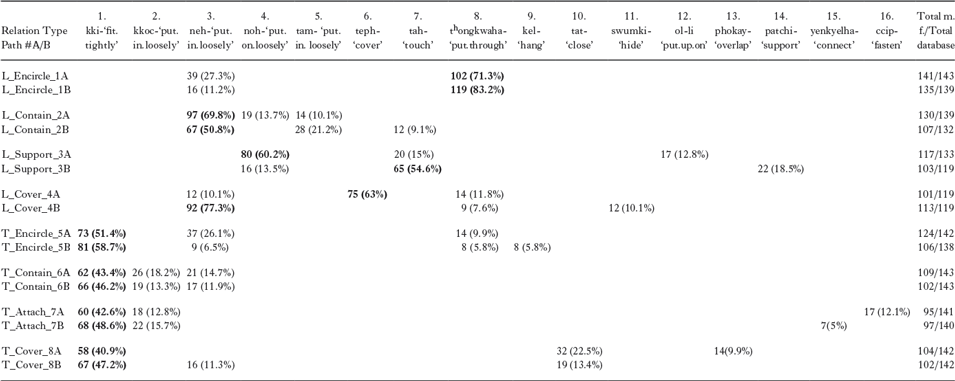
Three most frequently used verbs in Korean for each Relation Type by Path type (A and B)

To summarize, German speakers primarily used distinct Path terms for event pairs that differed in terms of which one moved (F) and which one was the reference point (G), and they did so consistently for all relation types with prepositions or with VPs. In sharp contrast, Korean speakers used the same Path terms for event pairs more often than not, showing that they were less sensitive in differentiating between F and G. In addition, in Korean, the degrees of non-distinction differed as a function of type of spatial relation. Korean speakers used the same Path terms for tight-fit relations significantly more often and more consistently than for loose-fit relations.
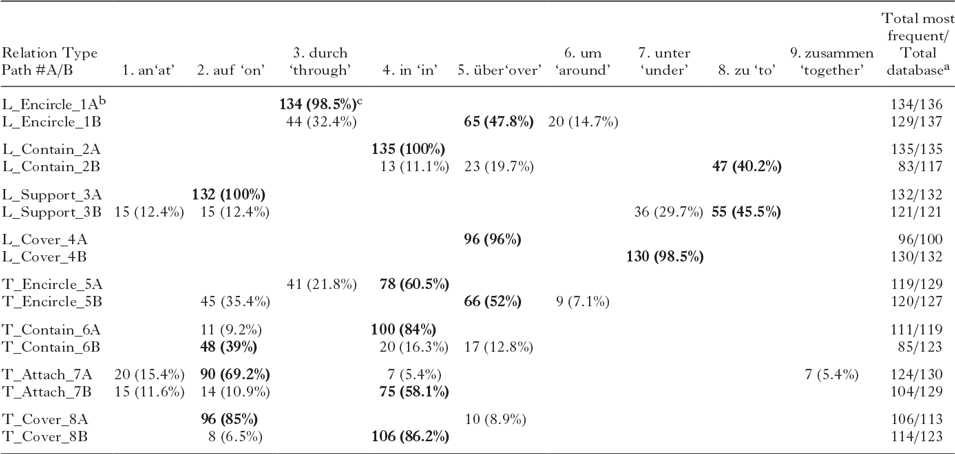
4.1.4.2. Frequency distribution of Path terms.
What specific Path terms do German and Korean speakers use and how do they semantically categorize Path? We examined the frequency distributions of Path terms for each type of Path. To see the major patterns, in Tables 4a (German) and 4b (Korean), we report the three most frequent Path terms used for Paths A and B of each relation type. The distribution patterns of Path A and Path B are strikingly different between German and Korean. Looking at the Path term of the highest frequency (bold-faced in the Tables) used for each relation type, German speakers predominantly differentiated between Paths A and B with distinct terms. In contrast, Korean speakers semantically merged Paths A and B essentially into the same Path category for all relation types, except for loose-support and loose-cover as already reported in the above quantitative analyses. In addition, for the loose-encirclement relation and all four types of tight-fit relations, not only the most frequent terms but also the second most frequent terms were the same for Paths A and B in Korean. More specifically, German speakers used nine different prepositions/particles with various frequency rates to describe Path (Table 4a). They used the term auf ‘on’ for putting F on or over G in both loose- and tight-fit relations (Path As of loose-support, tight-attachment, and tight-cover). Interestingly, auf ‘on’ was also the most frequent Path term, albeit only 39.02%, for Path B of tight-containment, suggesting that auf ‘on’ may also refer to ‘tight enclosure by contact’. For the Path term in ‘in’, German speakers used it for all types of putting F in/into G. The term über ‘over’ was the most frequent term for F encircling and passing over G (e.g., Path Bs of loose- and tight-encirclement). The term durch ‘through’ was used primarily for F going loosely into and passing through G (Path A of loose-encirclement), and the term unter ‘under’ was primarily used for F going into space below G (Path B of loose-cover). Interestingly, a general Path term zu ‘to’ was used for a flat surface (F) going up to support G (Path B of loose-support) and for a container (F) going up to contain G (Path B of loose-containment). The data suggest that German lacks a specific term assigned to these two types of Path. This may relate to infrequency or non-typicality of such Paths in everyday life.
Three most frequently used prepositions in German for each Relation Type by Path type (A and B)

notes:
a The total database refers to the total token number of prepositions used by speakers for the given Relation and Path type;
b Due to lack of space, Relational type names are abbreviated. For example, L_Encircle refers to loose encirclement. 1A refers to Relation Type number (cf. Table 1) and Path Type;
c For each preposition, the percentage is calculated based on the total token number of prepositions used by speakers for the given Relation Type and Path type (e.g., 1A). For each Relation Type and Path, the most frequently used term is bold-faced, the second most frequent term in a regular font, and the third most frequent term in a smaller font size.
In Korean, speakers used 16 different verbs in various frequency rates (Table 4b). More diversity in Path terms compared to German is probably due in part to the difference in morphological productivity between closed and open grammatical classes, i.e., prepositions and verbs, respectively (Yun & Choi, Reference Yun and Choi2018). As noted, in Korean, many of the Path terms were used for both Paths A and B for a given relation type. In addition, unlike German, most verbs in Korean (14 out of 16) were used exclusively for tight-fit relations or loose-fit relations but not for both. Notably, kkita ‘fit.tightly’ and kkocta ‘fit/place.elongated.object.in/on’ were used exclusively for tight-fit relations. Moreover, kkita ‘fit.tightly’ was the most frequent verb for all types of tight-fit relation for both Paths, demonstrating that the verb refers to a tight-fit relation regardless of F-G roles. As for loose-fit relations, nohta ‘put.on.loosely’ was primarily used for putting F on top of G (Path A of loose-support), but for the inverse Path – putting F under G – tahta ‘touch/reach’ was used. For F covering G loosely, tephta ‘cover’ was primarily used, but for its inverse Path – F going under/being covered by G – nehta ‘put.in.loosely’ was used.
Both the quantitative and qualitative analyses reveal that Korean speakers categorize Paths A and B into a single semantic category, regardless of which object moved in the actual motion event. Put differently, Korean speakers encode the eventual spatial relation between F and G in terms of the degree of the fit between F and G, rather than the way the moving object (F) relates to the geometry of the G. German speakers, by contrast, encode the latter: while they also encode the eventual relation, German speakers take the viewpoint of the F and encode its trajectory to the G, thus, highlighting the F-G asymmetry. These results on Path expressions lead to our inquiry on F-G syntax: To what extent do German and Korean speakers encode the F-G asymmetry correctly in syntactic construction?
4.2. syntactic assignment for Figure and Ground
4.2.1. Syntactic coding of correct/reverse
All description data were coded in terms of whether the description was ‘Correct’ (=aligned, e.g., (7a) and (8a), see also (5a–6b)), ‘Reverse’ (= misaligned, e.g., (7b) and (8b)) with respect to the F-G roles presented in the video, or ‘Other’ for which the F-G was not determinable (e.g., Put the pen and the cap together) or when only one of the entities was mentioned (e.g., Close the bottle). The criterion for ‘Correct’ was to assign F to the direct object (obj) of the verb and G to the oblique object (obl). The F could also be the subject of a passive sentence (e.g., The pen (F) is put into the cap) or the object of an instrumental phrase (e.g., Cover the baby with a blanket (F)) (Talmy, Reference Talmy, Greenberg, Ferguson and Moravcsik1978, Reference Talmy2000). To note, such constructions were rarely used. A ‘Reverse’ F-G syntax is to assign F to oblique object and G to direct object, incorrectly representing the Ground (= stationary object) to be the moving object (7b and 8b). Note that our criteria of ‘Correct’ or ‘Reverse’ are grammatical role assignment, not order of mention in the sentence.
Video event: An agent moves A CAP and puts
 on (cf. Figure 2a).
German:
(7a) Correct: Stecke die Kappe auf den Stift.
‘Put the cap on the pen’
(7b) Reverse: Stecke den Stift in die Kappe.
‘Put the pen into the cap’
Korean:
(8a) Correct: 펜뚜껑을 펜에 끼세요.
pheyn-ttwukkeng-ul pheyn-ey kki-seyo.
Pen-cap-obj pen-loc tight-fit-req
‘Fit the cap tightly to the pen.’
(8b) Reverse: 펜펜을을 펜뚜껑에 끼세요.
pheyn-ul pheyn-ttwukkeng-ey kki-seyo.
Pen-obj pen-cap-loc tight-fit-req
‘Fit the pen tightly to the cap.’


4.2.2. Results: syntactic analysis
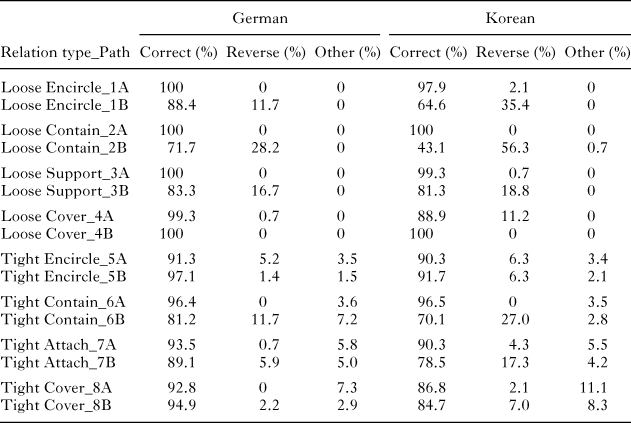
With the coded data, we examine our hypotheses on typicality and frequency rates of correct/reverse F-G syntax within and across languages. Table 5 shows mean percentages of ‘Correct’ and ‘Reverse’ F-G syntax as well as ‘Other’ for each relation type by Path and by Language.
Percentages of Correct, Reverse, Other types of F-G syntactic construction by Language, Relation type, and by Path

4.2.3. Typicality of Figure-Ground roles in motion events by Relation
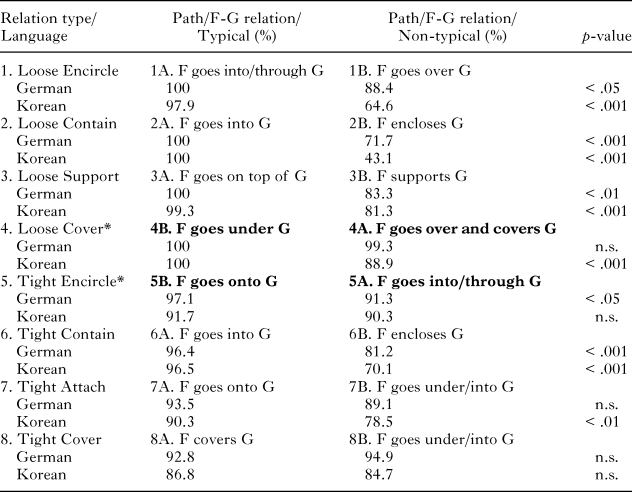
We first examine whether one type of F-G roles (i.e., Path A or B) is more typical than the opposite F-G roles, and whether there are cross-linguistic differences. We assume that the more typical a Path is, the more speakers will provide correct syntactic assignment to represent the Path. Conversely, a non-typical Path may induce more reverse F-G syntax. Table 6 compares the frequency of correct F-G syntax by Path type, by Relation Type, and by Language. Note that the Path types with higher correct %s are consistently placed in the left column.
Percentages of ‘Correct’ F-G syntax by Language and by Relation Type; within-language comparison between Path A and Path B for each Relation Type (note that, in contrast to what was stated in the ‘Material and methods’ section, typicality was now strictly defined by a higher rate of ‘Correct’ F-G syntax uses)

note: * For the loose-cover and tight-encirclement relations, Path B (i.e., 4B and 5B) yielded more correct F-G syntax than Path A in both languages, and the differences reached statistical significance in one of the two languages. Thus, we consider 4B and 5B to be Typical Paths.
Table 6 makes several important points. First, for each type of spatial relation, one type of Path (A or B) elicited correct F-G syntax more often, in fact significantly more often in many cases, than the opposite Path. Second, the frequency pattern of correct percentages was the same in the two languages for all relation types (except for tight-cover). For example, for loose-encirclement, speakers in both languages gave correct F-G syntax significantly more for Path A (100%, German; 97.9%, Korean) than the inverse F-G roles in Path B (88.4%, German; 64.6%, Korean). For the tight-cover relation, German speakers provided correct F-G syntax 2% more often for Path B than for Path A, whereas Korean speakers showed an opposite pattern. However, in both languages the differences between Paths A and B were statistically non-significant, suggesting that speakers use correct F-G syntax equally often for both Paths. Third, Paths A, which we had initially considered typical consistently yielded higher correct percentages than Paths B in both languages for all relations except for loose-cover and tight-encirclement. For those two relation types, in both languages, Path B (i.e., 4B and 5B) yielded more correct F-G syntax than did Path A.
The data reveal that the two language groups – German and Korean – are similar in terms of the types of Path that elicit more correct syntax. Assuming that a more typical Path yields a higher proportion of correct F-G syntax, we now re-label the Path with higher correct percentages ‘Typical’ and the Path with lower correct percentages ‘Non-typical’ F-G roles, as indicated in Table 6. Between the two Paths of tight-cover, we assign Path A – F covering G – to be Typical and Path B – F going under G – to be Non-typical, because in both languages Path B yielded relatively more reverse F-G syntax compared to Path A (cf. Table 5). In the next section, we will discover that typicality is a significant factor in the cross-linguistic differences in F-G syntax.
4.2.4. Figure-Ground syntax reversals in German versus Korean speakers
We now examine the extent to which the two languages use more reverse F-G syntax and whether typicality has an impact on the syntactic structure of F and G. In this analysis, we focus on the ‘reverse’ rather than the correct F-G syntax because reversals would reveal more clearly the extent of misalignment between linguistic representation and actual motion event.
The F-G syntax (dependent variable) was coded as a categorical variable (‘0’ for ‘Correct’ and ‘1’ for ‘Reverse’ syntax). As for fixed effects, we entered Language (German, Korean), Relation (Loose-fit, Tight-fit), and Typicality (Typical, Non-typical) into the overall model, as well as the three two-way interactions, each involving two of the factors (i.e., Language*Typicality, Language*Relation, and Typicality*Relation). A three-way interaction was not included because we did not have a specific hypothesis regarding this interaction. We also had random intercepts for participants and items, and random slopes for the effect of Language, Relation, and Typicality of participants.
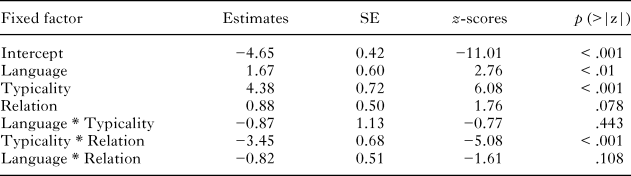
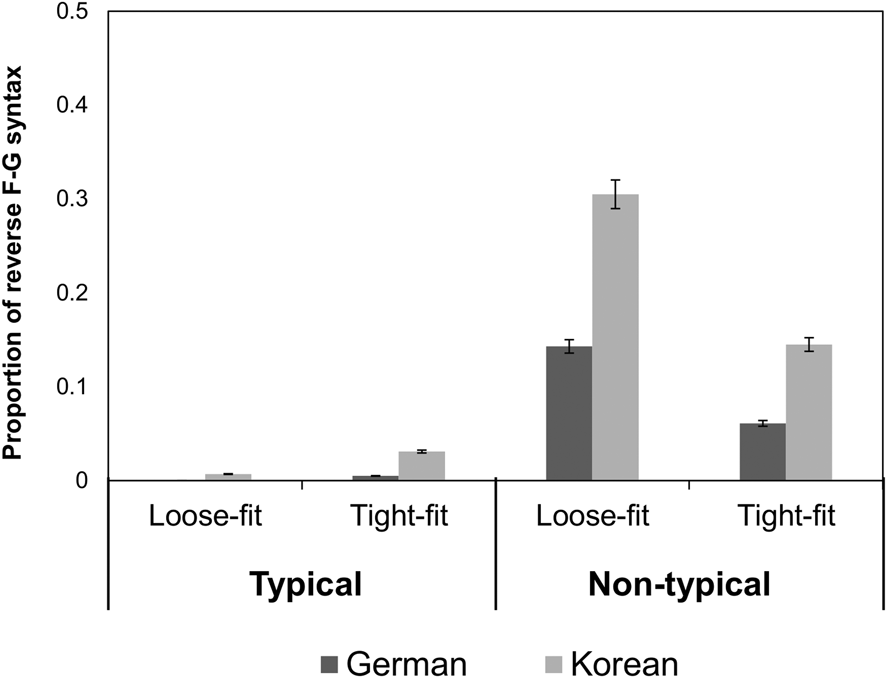
We found significant main effects of Language and of Typicality, as well as a significant interaction between Relation and Typicality (Table 7). The main effect of Language indicates that Korean speakers produced reverse syntax significantly more than German speakers. The main effect of Typicality reveals that both language groups produced reverse syntax significantly more when describing Non-typical Paths in comparison to Typical Paths (cf. Figure 6). The interaction between Relation and Typicality means that there was a significant difference between loose-fit and tight-fit relations in the rate of reverse syntax – more reverse syntax for loose-fit than for tight-fit – in the Non-typical Path (cf. Figure 6), but that there was no difference between the two types of relation in the Typical Path.
Fixed effects in mixed model on data of ‘Reverse’ syntax

Proportions of reverse F-G syntax by Typicality, Language, and Relation (Loose-fit vs. Tight-fit). Overall, speakers reversed F-G syntax significantly more for Non-typical than for Typical Paths. But Korean speakers produced significantly more reverse F-G syntax than German speakers particularly for Non-typical Paths. Error bars indicate SEs of the mean proportions.

Although the first set of linear mixed models did not show any evidence of a two-way interaction between Language and Typicality, as we asked at the outset whether Typicality affects the F-G syntax of the two languages to different degrees we conducted a set of planned analyses: two single-factor models in which the effect of Language (a fixed factor) was examined separately for the Typical Path condition and for the Non-typical Path condition. As was previously done, random intercepts for participants and items were included and random slopes for the effect of Language of participants and items. The results, summarized in Table 8, showed a significant effect of Language in the Non-typical Path, but only a tendency in the Typical Path. That is, Korean speakers produced reverse syntax significantly more than German speakers, particularly when describing Non-typical Paths (cf. Figure 6).
Fixed effects of Language (German, Korean) in mixed model on data of ‘Reverse’ syntax split by Typicality

From the syntactic analysis we conclude that:
(1) For a given spatial relation, typicality of the Path type – F-G roles – is consistent between German and Korean cultures. In addition, in both languages, speakers misalign syntactic representations more frequently for Non-typical F-G roles than for Typical ones.
(2) Korean speakers are more affected by Non-typical F-G roles, as they use reverse F-G syntax for Non-typical F-G roles significantly more than German speakers. By doing so, Korean speakers are essentially converting Non-typical F-G roles into Typical ones, and keep the same F-G syntax for both events of an event pair.
4.3. relation between Path lexicon and F-G syntax
In this final section of ‘Results’, we test the ‘language affordances’ hypothesis (cf. Thiering, Reference Thiering2011; see Section 1.1.2 above). A language, such as German, whose Path lexicon predominantly distinguishes between two opposing F-G roles, may give speakers more opportunity to encode the F-G asymmetry accurately in syntax and conversely less opportunity to reverse the F-G roles of a visual motion event than a language such as Korean, in which the Path lexicon makes fewer distinctions.
We conducted a linear mixed-effect logistic regression to test whether F-G syntax and Language could significantly predict the variances of same/different Path terms. The Path terms (dependent variable) were coded as a categorical variable (Same, Different). As fixed effects, we entered Language (German, Korean) and F-G syntax (Correct, Reverse) and their interaction into the model. As for random effects, we had random intercepts for participants and items, and the random slopes for the effect of Language and F-G Syntax of participants and items.
The effects of Language and F-G syntax and their interaction were all significant (Table 9). The significant effect of Language indicates that German speakers used more different Path terms in comparison to Korean speakers. Importantly, the effect of F-G syntax reveals that different Path terms were used more frequently as reverse F-G syntax decreased. The interaction between Language and F-G syntax means that the effect of F-G syntax was bigger in German (estimate = −4.43, SE = 0.51, z-score = −8.73, p < .000) than in Korean (estimate = −0.84, SE = 0.25, z-score = −3.32, p < .000). That is, the negative correlational pattern between Path terms and F-G syntax – more differentiation of opposing F-G roles with Path terms, the less reverse F-G syntax – was stronger in German than in Korean. These results confirm a significant relationship between the Path lexicon and F-G syntax, and make clear that this is language-specific.
Fixed effects of Language and F-G syntax in mixed model predicting path expressions

5. Discussion
The current study has found that German and Korean speakers differ significantly in the way they linguistically encode the F-G asymmetry both in the use of Path terms and in the syntactic assignment of F and G. Our analyses also revealed that linguistic description for F and G is motivated by several language-specific and pragmatic factors. To that extent, the linguistic representation of F and G can misalign with the physical properties of the visually presented motion event.
A critical manipulation was to systematically switch the F-G roles within a video pair. German speakers used distinct terms (particularly with prepositions/particles) for opposing F-G roles for all types of spatial relation, meaning that they represented the F-G asymmetry in their linguistic description. In sharp contrast, Korean speakers frequently used the same Path terms (with spatial verbs) for opposing F-G roles, revealing that they often did not clearly discriminate between F and G with Path terms. In particular, Korean speakers did so for all types of tight-fit relations as well as for loose-encirclement and loose-containment (cf. Figure 5b). For loose-support and loose-cover relations, Korean speakers used distinct Path terms for the opposing Paths of an event pair. Interestingly, these two Path types relate to verticality – from above or from below – a contrast that has been proposed to be universal as infants discriminate the two from very early on (Quinn, Cummins, Kase, Maartin, & Weissman, Reference Quinn, Cummins, Kase, Maartin and Weissman1996). The similarity between German and Korean in the two types of loose-fit relations also converges with Yun and Choi’s (Reference Yun and Choi2018) finding that languages semantically categorize a loose-fit relation much more similarly than a tight-fit relation.
Overall, however, Korean speakers used the same Path terms between two opposing F-G relations and did so significantly more than German speakers for all relation types (cf. ‘Section 4.1.4.1’). We argue that the cross-linguistic difference in Path terms has to do with how spatial relation is construed and perspectivized (Langacker, Reference Langacker1987, Reference Langacker2008; Thiering Reference Thiering2015). The Korean language gives more weight to the eventual relationship between F and G than to F’s trajectory to the geometry of G. Such perspective on F-G relations would lead speakers to use the same term regardless of which object moved, as long as the two objects end up in the same spatial relation. In contrast, while the German language also specifies the eventual relation, it does so by taking the perspective of the F and specifying its topological relation with respect to G. By doing so, spatial descriptions in German highlight the F-G asymmetry (Talmy, Reference Talmy2000). We speculate that these differences between German and Korean may be characteristic of languages that use closed-class morphemes (e.g., satellite-framed languages) versus languages that use open-class verbs (e.g., verb-framed languages) to express Path. That is, Path morphemes in a closed-class (i.e., a grammatical class that does not allow novel morphemes into the class) may divide up the differential Paths of a motion event in a categorical and topological way that constrains the encoding of Path/spatial relation to a restricted set, whereas open-class verbs may allow more flexibility (because one can express differential Paths/spatial relations more freely with novel words) in expressing diverse perspectives. But, to test this hypothesis, other languages of the two types need to be investigated.
Regarding F-G syntax, first, in both German and Korean, Non-typical F-G roles led to significantly more reverse F-G syntax than Typical F-G roles. The finding supports Talmy’s (Reference Talmy and Shopin1985, 2000) claim that particular assignments of F-G roles are consistently more ‘realistic’ in the world, and thus more canonical than their opposite in motion event expression. In the current study, this influence was similar across cultures. Here, it is important to note that, as this study deals with not only naturalistic language production but also pragmatic factors, data from non-academic participants in a non-laboratory setting will be valuable to assess the generality of the findings in the two language communities (Hutchins, Reference Hutchins1995; Pederson, Danziger, Wilkins, Levinson, Kita, & Senft, Reference Pederson, Danziger, Wilkins, Levinson, Kita and Senft1998; Thiering, Reference Thiering2015).
In terms of the syntactic construction for F and G, however, the two groups differed significantly. Korean speakers reversed the grammatical assignment of F and G significantly more than German speakers, and particularly for Non-typical F-G relations. We suggest that the syntactic misalignment is motivated by several factors: perspectivization of the F-G relation in a given language and interaction between the Path lexicon and the spatial grammar.
As discussed earlier, Korean speakers may be more concerned about encoding the resulting relation between F and G, rather than the F-G asymmetry. In addition, major spatial categories in Korean, such as tight-fit and loose-fit categories, may have more to do with functional relationship than object-geometry relationship between F and G (cf. Vandeloise, 1991). Hespos and Spelke (2004; cf. Baillargeon, Li, Gertner, & Wu, Reference Baillargeon, Li, Gertner, Wu and Goswami2010) have suggested that a difference between tight- and loose-fit containments has to do with the functional relationship between the container and the thing contained. In a tight-fit relation, the thing contained moves with the container (i.e., has a common fate), whereas in a loose-fit relation it can move independently of the container. Compared to Korean spatial verbs, the spatial prepositions in German (e.g., in ‘in’, auf ‘on’) describe the Path of the Figure more objectively based on the geometry of the Ground, with little implication of pragmatic meaning (but see Coventry & Guijarro-Fuentes, Reference Coventry, Guijarro-Fuentes, Robinson and Ellis2008).
If it is indeed the case that Korean Path terms are more contextually oriented, then this may be a basis for Korean speakers to be more biased towards the typical F-G roles in conceptualizing a particular relation (e.g., loose-containment). That is, Korean speakers are more sensitive to the typicality of F-G roles of a given pair of objects, and thus have more difficulty in correctly describing the F-G roles that are Non-typical. This would lead to more reverse syntactic assignments for Non-typical F-G roles. By contrast, as the German language encodes the geometric relation of F with respect to G in a more objective way, its speakers have more ease in correctly assigning F-G roles that are Non-typical.
We speculate that the typicality emphasis of the Korean language implies more perspective-taking in communication, and hence descriptions of more efficient actions when instructing another person to perform an action (as imagined in the current study). As the descriptions of the Typical events were those of more efficient actions (e.g., moving the smaller of two objects; moving an object downward in accordance with gravity rather than upward), the grammatically reversed descriptions of the Non-typical F-G relations would have facilitated the (imagined) listener to perform the eventual spatial relation event in a more parsimonious manner than a veridical description of these events. Studies designed with a more naturalistic communication set-up could further examine this possibility.
Importantly, another factor explaining the cross-linguistic difference is the language-internal structure, i.e., ‘language affordances’ (Thiering, Reference Thiering2011). We found a statistically significant relationship between the Path lexicon and F-G syntax. The more the Path lexicon distinguishes opposing F-G roles, the less the reverse (= misaligned) F-G syntax is produced. That is, the frequency of reverse F-G syntax was a function of differentiation of opposing F-G roles by the Path term. As German has more distinctive Path terms for opposing F-G roles than Korean does, the relationship between Path lexicon and F-G syntax was stronger in German than in Korean.
The language-specific encoding patterns of F and G found in this study call for investigation of their implications in the relevant non-linguistic domains, such as memory of spatial events, which has been much examined with regard to Path versus Manner (cf. ‘Section 1’ above), but hardly with regards to F and G. For example, does habitual use of the same Path term for opposing F-G roles and frequent construction of reverse F-G syntax conduce Korean speakers to be less sensitive about retaining the actual F-G roles of a motion event and thus render them to be less accurate than German speakers in remembering the F and the G? Further studies are necessary to investigate the relationship between linguistic expressions of the F-G asymmetry and spatial cognition.
To conclude, the differences we have found in the way German and Korean speakers use lexical and syntactic devices to distinguish and identify F-G roles have demonstrated that languages do not universally encode the F-G asymmetry in the same way or to the same degree. Linguistic descriptions of F-G in motion events are made within the boundaries of linguistic constraints or the availability of terms and phrases of the particular language one speaks. In addition, there is misalignment between what one perceives and how a speaker encodes it in language (Thiering, Reference Thiering2011, Reference Thiering2015). Such misalignment is a function not only of the language one speaks but also of the speaker’s real-world experiences of motion events. In the debate on the relationship between language and perception/cognition, the current study has demonstrated that language is a complex system with its own internal and language-specific grammar, and that these components enter into play as language interacts with spatial perception/cognition.
Supplementary materials
For supplementary materials please visit <https://doi.org/10.1017/langcog.2019.3>.