Introduction
One of the most widely discussed research questions in the bilingualism literature is whether individuals who speak more than one language show superior executive control compared to monolingual participants. Despite the relatively large number of studies investigating executive processing in monolingual and bilingual young adults, the findings are inconsistent (Hilchey, Aubin & Klein, Reference Hilchey, Saint-Aubin and Klein2015). Some authors report a bilingual advantage in specific executive functions, such as conflict resolution (Costa, Hernández & Sebastián-Gallés, Reference Costa, Hernández and Sebastián-Gallés2008) or selective attention (Salvatierra & Rosselli, Reference Salvatierra and Rosselli2011), while others suggest that bilingual individuals only show a more general processing advantage compared to their monolingual peers (Hilchey & Klein, Reference Hilchey and Klein2011). A third group of investigators argues that there is no difference in executive control between bilingual and monolingual participants (Yudes, Macizo & Bajo, Reference Yudes, Mazico and Bajo2011).
There are a number of contributing factors that have been identified in the literature with regards to these contradictory findings. These critical issues can be categorized as variations in participants’ profiles, such as language history, type of bilingualism, age, education, etc. (Hernández, Martin, Barcelo & Costa, Reference Hernández, Martin, Barcelo and Costa2013), a lack of sensitive executive function tasks (Kousaie, Sheppard, Lemieux, Monetta & Taler, Reference Kousaie, Sheppard, Lemieux, Monetta and Taler2014; Marton, Reference Marton2015), and inconsistencies across target functions and task conditions (Paap & Greenberg, Reference Paap and Greenberg2013). Many executive processing tasks target various underlying functions (Valian, Reference Valian2015) and show no correlation with each other (Paap & Greenberg, Reference Paap and Greenberg2013).
Furthermore, there is little evidence to date regarding what aspects of the bilingual experience may be linked to components of executive control. The present study was designed within a cognitive control framework, which emphasizes flexibility and adaptation (Botvinick, Braver, Barch, Carter & Cohen, Reference Botvinick, Braver, Barch, Carter and Cohen2001). We chose this framework because in everyday situations bilingual individuals may often need to switch between their languages or avoid doing so. Depending on the context, they either complete the switch or resist the interference and keep performing the current task while monitoring performance.
Recently, Green and Abutalebi (Reference Green and Abutalebi2013) have put forward the adaptive control hypothesis in which they articulate subcomponents of the control system and link them to various bilingual contexts. For example, a bilingual individual who communicates with a monolingual person must suppress one of his languages, whereas a bilingual individual who is engaged in a dense code-switching language context must identify cues in the conversation and engage or disengage in one language or the other accordingly. These two individuals exercise differing aspects of control as they adapt their cognitive system to different tasks and contexts (Green & Abutalebi, Reference Green and Abutalebi2013). Task demands guide our behavior but adjustments are needed according to variations in performance. One well-known example for such adjustments is the increase in both accuracy and speed of processing following an error (post error slowing; Botvinick et al., Reference Botvinick, Braver, Barch, Carter and Cohen2001). Another example for adjustment is that repeated exposure to a stimulus results in strengthened memory representations, consequently in a decrease in susceptibility to interference (Morton & Munakata, Reference Morton and Munakata2002). Henik and colleagues showed that participants exhibit more interference in the first couple of trials in each block of the Stroop task than in consecutive trials (Henik, Bibi, Yanai & Tzelgov, Reference Henik, Bibi, Yanai and Tzelgov1997). We explored both of these phenomena in the present study because previous research has suggested that bilingual individuals show superior skills in adjusting to different executive processing mechanisms (Morales, Gómez-Ariza & Bajo, Reference Morales, Gómez-Ariza and Bajo2013). Understanding the effects of bilingualism on specific control processes may be the key to resolving the inconsistencies in the literature.
What do executive control tasks measure?
A large number of previous studies on executive processing in young adults included tasks that measured a number of functions simultaneously. Kousaie and colleagues (Reference Kousaie, Sheppard, Lemieux, Monetta and Taler2014) found no bilingual advantage in younger and older adults with various well-known neuropsychological tests, such as the Wisconsin Card Sorting Test (WCST), the Simon and Stroop tasks, as well as the digit span task from the Wechsler Adult Intelligence Scale. One of the problems is that most of these tests were designed at a time when theoretical models did not include specific executive components and neuropsychological tests were developed to measure frontal lobe functions in more global ways. For example, the WCST simultaneously measures inhibition, working memory and switching. Thus, even if bilingual individuals had better switching skills than monolingual participants, the results of the WCST would not necessarily show this group difference because the task also measures other executive components and provides global scores. Further, the WCST measures overlapping sources of errors that cannot be dissociated, therefore the same errors, such as perseveration, may be explained by pointing to various causes (Eling, Derckx & Maes, Reference Eling, Derckx and Maes2008). The test also shows psychometrically weak validity (O'Donnell, MacGregor, Dabrowski, Oestreicher & Romero, Reference O'Donnell, MacGregor, Dabrowski, Oestreicher and Romero1994). Kousaie and colleagues (Reference Kousaie, Sheppard, Lemieux, Monetta and Taler2014) noted in their discussion that the lack of group difference between bilingual and monolingual participants in their study may be related to the lack of task sensitivity.
Based on our review of the literature on bilingualism, we suggest that tasks that comprise experimental manipulations and target more specific executive components are more likely to obtain group differences between bilingual and monolingual individuals. For example, Costa et al. (Reference Costa, Hernández and Sebastián-Gallés2008) found that bilingual young adults differed from monolingual young adults along various measures on the Attentional Network Task (ANT; Fan, McCandliss, Sommer, Raz & Posner, Reference Fan, McCandliss, Sommer, Raz and Posner2002), which consists of different experimental conditions. Compared to monolingual participants, their bilingual participants showed faster processing speed across conditions, as well as greater improvement in performance in the cue condition compared to the no-cue condition, less interference in the incongruent flanker condition, and smaller switch cost, particularly for the congruent trials.
A further question related to task type is whether the bilingual advantage reflects superior overall processing speed generally, as suggested by Hilchey and Klein (Reference Hilchey and Klein2011), or better performance accuracy and differences in error types in more specific executive components. To date, there are only a few studies that suggest a bilingual advantage in specific executive components in young adults (e.g., Costa et al., Reference Costa, Hernández and Sebastián-Gallés2008). Several studies have found, however, that bilingual young adults outperformed their monolingual peers in reaction time (RT) on both the congruent and incongruent trials in different cognitive tasks (e.g., Bialystok, Craik, Klein & Vishwanathan, Reference Bialystok, Craik, Klein and Viswanathan2004). This finding has been called a ‘global advantage’ or a bilingual advantage in ‘global RT’ in the bilingualism literature (Hilchey & Klein, Reference Hilchey and Klein2011, p. 629). Executive functions and speed of processing show a complex interaction. On the one hand, individual processing speed affects the functioning of the cognitive system; on the other hand, processing speed is measured by tasks that engage different executive components. The more complex a speeded task, the more executive processing is presumably involved (Cepeda, Blackwell & Munakata, Reference Cepeda, Blackwell and Munakata2013). According to the cognitive control model (Botvinick et al., Reference Botvinick, Braver, Barch, Carter and Cohen2001), individuals with better cognitive control show faster adjustments in their cognitive system. If bilingual young adults exhibit more flexibility in adjusting their cognitive system than monolingual adults, then we might expect faster overall processing speed. To examine whether bilingual young adults show superior performance compared to monolingual participants in specific executive components or in global RT, we tested three executive components that have been suggested to play an important role in bilingual language processing (e.g., Kroll & Bialystok, Reference Kroll and Bialystok2013): inhibition, performance monitoring, and switching, via a battery that included various experimental conditions.
Inhibition
There has been extensive discussion in the literature about the inhibition skills of bilingual individuals; however, inhibition is not a unitary construct and there are different models of inhibitory control. Friedman and Miyake (2004) described three inhibition functions: 1. inhibition of a prepotent response; 2. resistance to distractor interference; and 3. resistance to proactive interference.
The first type of inhibition – inhibiting a prepotent response – refers to the suppression of an automatic behavior. The most common tasks to study it are variations of the Stop-signal and Go-NoGo tasks. Distractor interference, by contrast, is about resisting distracting stimuli while performing a task. For example, in a picture-picture interference paradigm, one has to select the target item from four pictures that include competing distractor items. The third inhibition function in this model is proactive interference, which is about resisting memory traces that may hinder efficient processing of relevant information. Proactive interference is often measured with conflict paradigms, where previously relevant representations might interfere with currently relevant representations if working memory is not updated regularly (e.g., Oberauer, Reference Oberauer2005). Most studies on bilingualism have focused either on response inhibition or on distractor interference and rarely on proactive interference in young adults. Most of these studies involved the Simon, Stroop, and flanker tasks. As discussed above, the findings on these tasks are inconsistent.
Those researchers who found group differences reported that bilingual young adults performed faster than monolingual peers on both congruent and incongruent trials of these tasks (e.g., Bialystok et al., Reference Bialystok, Craik, Klein and Viswanathan2004). This finding suggests a global advantage in RT. Additional outcomes of the same study, however, revealed more specific differences. Bilingual adults showed a smaller Simon effect than their monolingual peers, which indicates less distraction by the incongruent items. Thus, Bialystok and colleagues found supporting evidence for both the global advantage hypothesis and for an advantage in a more specific executive component, but only in one condition.
Further support for better inhibitory control in bilingual young adults compared to their monolingual peers has been reported by Prior (Reference Prior2012). Bilingual individuals exhibited stronger inhibition in a task-switching paradigm using color, shape, and size dimensions. In contrast to the findings of Bialystok and colleagues (Reference Bialystok, Craik, Klein and Viswanathan2004), however, there was no overall speed of processing difference between the groups in Prior's study. One reason for the lack of a global RT difference was that bilingual adults showed a trade-off between inhibition and speed of processing in Prior's study, namely they applied stronger inhibition even if it resulted in slower speed of processing.
Inhibitory control, particularly resistance to interference, is associated with several other cognitive processes, such as goal maintenance and conflict resolution (Kane & Engle, Reference Kane and Engle2003). Colzato and colleagues (Reference Colzato, Bajo, van den Wildenberg, Paolieri, Nieuwenhuis, La Heij and Hommel2008) found that bilingual young adults showed superior performance compared to monolingual participants in selecting goal-relevant information and in differentiating between that information and competing irrelevant stimuli, despite the groups’ similar performance in response inhibition using the stop signal task. The authors’ explanation was that conflict resolution may not necessarily involve inhibition, decreasing the activation of irrelevant representations, but it may signal the strengthening of activation of relevant representations. Morales and colleagues also administered the stop signal task to bilingual and monolingual young adults and, similarly to Colzato and colleagues, found no group difference (Morales et al., Reference Morales, Gómez-Ariza and Bajo2013). Interestingly, in contrast to the response inhibition data, bilingual young adults outperformed the monolingual adults in accuracy on task conditions that required proactive and reactive interference control. The RT data provided further evidence suggesting that bilingual young adults were more efficient in adjusting inhibitory control and monitoring than monolingual adults. The authors concluded that studying dual processes of inhibition in bilingual populations may enhance our understanding of the bilingual advantage.
These examples show that studies examining the bilingual advantage in executive control differ not only in tasks and procedures but in their theoretical approach as well. The differences in theoretical background influence task selection and interpretation of the results.
Monitoring and switching
These two executive components are frequently discussed together in the bilingualism literature because switching between tasks involves monitoring and researchers often use similar tasks to examine these processes. Task-switching paradigms may involve various executive components, depending on the experimental manipulations across conditions. Another reason for task impurity in these paradigms is that performance monitoring is associated with maintaining task goals and working memory. Individual differences in working memory have been linked to monitoring conflicts and actions. Specifically, individuals with greater working memory skills show more efficient monitoring and updating performance than participants with low working memory capacity (Miller, Watson & Strayer, Reference Miller, Watson and Strayer2012). Previous research suggests that bilingual individuals show better working memory skills than their monolingual peers (Bialystok et al., Reference Bialystok, Craik, Klein and Viswanathan2004): consequently, we may expect better monitoring skills as well. The findings in the literature are not consistent, however. Costa and colleagues used tasks such as the Simon, Stroop or flanker tasks to measure conflict resolution because of their high monitoring demands, particularly in mixed trials. Bilingual individuals’ responses in these conditions were often faster than those of monolingual participants (Costa et al., Reference Costa, Hernández and Sebastián-Gallés2008; Costa, Hernández, Costa-Faidella & Sebastián-Gallés, Reference Costa, Hernández, Costa-Faidella and Sebastián-Gallés2009), however, the groups typically did not differ in mixing cost, which is considered to be an indicator of monitoring. Despite the findings on mixing cost, the authors suggested that bilingual participants’ faster responses across both congruent and incongruent trials reflected better monitoring performance, which was related to their practice of continuously monitoring two or more languages in different communication contexts.
Prior (Reference Prior2012) measured the fadeout effect within a task-switching paradigm as an indicator of monitoring performance. The fadeout effect reflects how well individuals adjust their cognitive systems when moving from a complex condition, such as a mixed block, to a simple condition that puts less demand on executive processing. The author found no group differences in fadeout and concluded that bilingual and monolingual adults show comparable monitoring skills.
Similarly to the results on inhibition and monitoring, the findings about the switch cost are mixed as well. Prior and MacWhinney (Reference Prior and MacWhinney2010) found a bilingual advantage in switching cost, whereas Hernández et al. (Reference Hernández, Martin, Barcelo and Costa2013) showed similar switch costs in bilingual and monolingual participants. The differences in outcomes for these two studies are not easy to explain because the tasks were similar. Further, Hernández and colleagues used three different task conditions to control switching. The authors speculated about the possible causes for the inconsistent findings, suggesting that differences in participants’ profiles (the languages they spoke, whether they were immersed in a society where both languages were used, etc.) may be responsible for the discrepancies. Indeed, Prior and Gollan (Reference Prior and Gollan2011) had suggested that bilingual people's language-switching practice has a positive effect on their general task-switching abilities.
In contrast to Prior and Gollan's (Reference Prior and Gollan2011) suggestion, in a more recent study, Yim and Bialystok (Reference Bialystok, Craik and Luk2012) found a dissociation between verbal and non-verbal task switching. Bilingual individuals showed smaller switch cost than monolingual participants in verbal trials but not in the non-verbal tasks. Verbal switch cost in bilingual individuals was further linked to code-switching frequency. There was a negative correlation between the frequency of code switching and the size of the switch cost. Thus, individuals who frequently used code-switching showed smaller switch cost in the verbal switching task, consistent with what the adaptive control hypothesis would predict (Green & Abutalebi, Reference Green and Abutalebi2013).
In summary, the literature on the bilingual advantage in young adults shows many inconsistencies in findings from executive processing tasks. Most of the current tasks measure several functions concurrently and show little or no correlation with other tasks that allegedly target the same functions. In the present study, we employed a series of tasks that offers better isolation of executive control subcomponents than the traditional behavioral tests.
Aims and research questions
The present study differs from most previous studies in the bilingualism literature involving young adults in its research approach. We employed tasks with several experimental conditions to assess different executive processes (resistance to interference, monitoring, switching) independently. Further, we aimed to test the hypothesis that speed of processing alone accounts for performance differences between monolingual and bilingual individuals as Hilchey and Klein (Reference Hilchey and Klein2011) suggested.
First, we selected participants from two groups based on language status (monolingual and bilingual) and measured their performance in simple baseline conditions (see more details about the different conditions in the Methods section). Then, we matched the monolingual participants to a comparable subset of bilingual individuals based on their speed of processing across baseline measures. Following these procedures, we examined whether bilingual young adults show superior performance compared to monolingual participants in interference, monitoring, and switching tasks even when the groups are matched on baseline measures for speed of processing.
In our attempt to control for major participant-related factors, we also matched our participant groups on age, gender, and years of education. Previous research has shown that these factors may have significant effects on executive control processes (e.g., Paap & Greenberg, Reference Paap and Greenberg2013).
Based on our goals, we asked the following research questions:
-
1. Is there an overall/global processing speed advantage for bilingual young adults compared to monolingual individuals? Specifically, do the groups differ across various baseline measures in processing speed? This question was relevant because processing speed shows a complex interaction with different executive components (Cepeda et al., Reference Cepeda, Blackwell and Munakata2013).
-
2. If bilingual young adults show superior processing speed in baseline measures compared to monolingual participants, are they also more efficient in task performance? To this end, we compared performance changes on repeated items to see whether the groups that had previously been matched on baseline processing speed show different learning curves. This question was based on previous research (e.g., Henik et al., Reference Henik, Bibi, Yanai and Tzelgov1997; Morton & Munakata, Reference Morton and Munakata2002) suggesting that individual differences in resistance to interference may reflect more efficient adjustment to repeated items (i.e., a steeper learning curves).
-
3. Do bilingual young adults outperform monolingual participants on different executive control tasks – namely, resistance to interference, monitoring, and switching – even when speed of processing is matched between the two groups? That is, do bilingual participants show an advantage in the above executive control functions beyond their superior speed of processing compared to monolingual young adults?
Methods
Participants
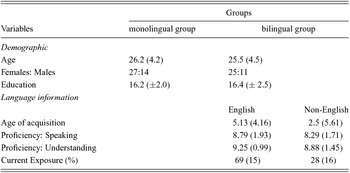
Participants were 77 healthy young adults: 41 monolingual speakers of English and 36 highly proficient, balanced bilingual speakers, all between the ages of 18 and 35 (see more demographic details in Table 1). Participants of this study were either university students at the time of testing, or professionals who had at least high school degrees. Participants reported no history of any neurological disorder, learning disability, speech-language problem, or other cognitive deficit. The two groups did not differ in average age, years of education, or gender distribution.
Demographic information and language proficiency scores. Mean (SD).

Note. For proficiency: 0 = None, 10 = Highest level.
Bilingual participants were eligible for participation if they spoke two languages on a daily basis. The languages spoken among the bilingual speakers consisted of Chinese, Dutch, Greek, Haitian Creole, Hungarian, Italian, Korean, Russian, and Spanish. Although English was not necessarily their first language, all bilingual participants were highly proficient in English as well as in the other language. The Language Experience and Proficiency Questionnaire (LEAP-Q; Marian, Blumenfeld & Kaushanskaya, Reference Marian, Blumenfeld and Kaushanskaya2007) was administered to obtain bilingual participants’ self-reported ratings of language proficiency on a Likert scale from 0 (i.e., extremely low) to 10 (i.e., perfect, native level). All bilingual individuals reported their spoken language proficiency at or above 7 points on the scale for both languages. All bilingual participants acquired both languages early, with a mean age of exposure of 2.5 and 5.1 for non-English and English, respectively. Although all of them reported using both languages regularly, their exposure to English was greater than their exposure to the non-English language (see Table 1 for more information on language proficiency)Footnote 1 . Monolingual participants were eligible for participation if they were not proficient in any foreign language, even though they might have taken a foreign language class in high school or college.
Participants were recruited using flyers and online advertisement. Eligibility was checked during a phone screening. The project was approved by the Institutional Review Board (IRB) of the City University of New York. Informed consent was obtained from all participants prior to testing. All participants received monetary compensation at the end of testing.
Stimuli and Procedures
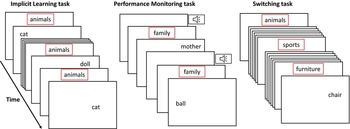
The experimental tasks were part of a larger information processing battery (Marton, Campanelli, Eichorn, Scheuer & Yoon, Reference Marton, Campanelli, Eichorn, Scheuer and Yoon2014). The tasks involved category judgments. Participants were presented with a category name (e.g., family) followed by a target word (e.g., mother) or a distractor item (e.g., ball). In all conditions, they were asked to read each stimulus word on the screen and determine whether the word belonged to the given category. Category names were presented at the top of the screen 1–2 seconds prior to the appearance of the target or distractor item. The stimuli were simple high-frequency words, typically acquired early by children (Hall, Nagy, Linn & Bruce, Reference Hall, Nagy, Linn and Bruce1984). The vocabulary items were simple because we were not interested in participants’ categorization abilities; rather, in their executive processing. Different conditions targeted different cognitive functions, such as implicit learning (to examine the repetition effect), resistance to proactive interference, performance monitoring, and switching. The task was similarly structured across all conditions (see Figure 1 for the structure of the tasks.)
Task paradigm: Presentation of trials in each condition.

All participants were tested individually in our laboratory. Participants were provided with detailed instructions and sufficient practice time. The order of task presentation was counterbalanced across participants. The tasks were administered via a tablet computer along with response buttons. Three round response buttons were used for data collection (one red and two black ones). Participants were instructed to respond as quickly and as accurately as possible. Accuracy and RT data were automatically collected for all responses by the computer.
Participants were instructed to press and hold the red button to start each trial until they saw a category name on the screen. Once they read the category name, they were asked to release the red button (recorded as ‘category recognition response’). For target items, participants were asked to press one of the black buttons corresponding to the side on which the stimulus word appeared on the screen (recorded as ‘word categorization response’). Location of the target items was randomized to minimize perceptual anticipation. For distractor items, participants pressed the red button, regardless of the location of the stimulus. Pressing the red button was necessary for the non-target responses to distinguish between withheld responses and no responses (in which case no buttons were pressed). Failure to respond within 5 seconds resulted in termination of the current trial and the automatic presentation of the subsequent trial. Participants did not receive any explicit feedback about their performance.
For data analysis, category recognition response was used to measure monitoring performance, whereas word categorization response was used for all other conditions (see details of experimental conditions below). A software that was specifically developed for our information processing battery was used to present stimuli and record responses.
Baseline word categorization
This simple word categorization task was used as a baseline to match the groups on speed of processing. It also served as the baseline for the Implicit learning, Proactive interference, and Switching conditions (the Performance monitoring task had its own baseline). The baseline word categorization task included 6 blocks of 14 trials each, consisting of 60 trials with targets and 24 trials with distractors (total number of categorization trials = 84). This task did not include any item repetition or other experimental manipulation. All targets and distractors were novel items.
Implicit Learning condition
This task focused on performance changes as a function of repeated presentation of items over time. There were 6 blocks of 14 trials, consisting of 60 trials with targets and 24 trials with distractors. Target items consisted of both repeated words and new words, whereas distractor items were never repeated in this experimental condition. In each block, one target item was presented four times; the others were presented only once.
Resistance to Proactive Interference condition
The task was designed to increase proactive interference by using distractor items that had been targets in previous trials (interference items). Six blocks were created with 14 trials per block. There were 60 trials with targets and 24 trials with distractors (interference items).
Performance Monitoring condition
This task condition was developed to examine performance monitoring with auditory cueing. To increase participants’ focus of attention, single pure tones were presented on randomized trials via headphones prior to the visual presentation of the category name. The manipulation of auditory cueing served to orient participants’ attention to the upcoming stimuli (category name). Participants were instructed to anticipate a tone signal in some of the trials, prior to the presentation of the category name. The task consisted of 140 trials without tones and 154 trials with tones. The tones randomly varied in duration between 1000 and 3500 ms. Trials without tones served as the baseline measure for this task. Performance monitoring was measured by comparing category recognition responses in pre-error trials to those in post-error trials across conditions (with and without tones).
Switching condition
In the switching task, there were more frequent category switches (9 category switches) relative to the baseline condition (6 category switches). There were a total of 60 targets and 24 distractors.
Data analysis
Mixed-effects regression analysis was used to examine accuracy and RT data. Mixed-effects modeling allows accounting for the clustered nature of the data, with responses (level-1) nested within participants (level-2); furthermore, it allows one to examine the variability within and between subjects and to study the effects and interactions within and across participants. In addition, mixed-effects modeling is flexible in handling missing data and unbalanced designs (Raudenbush & Bryk, Reference Raudenbush and Bryk2002).
For accuracy data, we fitted mixed-effects logistic regression models by specifying family binomial and link logit. The logistic component allows modeling the nonlinear component of the dependent variable, and this approach is superior to other techniques such as analysis of variance on transformed data (e.g., arcsine-square-root transformation) (Jaeger, Reference Jaeger2008). For RT data, the models fitted were linear mixed-effects regressions with Maximum Likelihood as the estimation method. In spite of the slightly skewed distribution, RT data were kept in their original scales because analyses performed on transformed data produced the same pattern of results. Only response time for correct answers was used. All models included random intercepts for subjects. Random slopes for the within-subjects independent variables were tested and did not improve the model fit in any of the analyses.
Within- and between-subject outliers were trimmed following a 3-stage procedure: first, for each task and dependent variable, we determined upper and lower criteria based on the overall distribution and we dropped extreme values beyond those limitsFootnote 2 ; second, values more than 3 SD below or above the means were excluded; last, for each model, we examined level-1 and level-2 standardized residuals and we re-fitted the model without observations with residual values more than 3 SD below or above the mean. This 3-stage procedure never led to the exclusion of more than 3.9% of the data.
Data were analyzed with Stata 13.1 (StataCorp, 2013) using the functions mixed, for RT data, and melogit, for accuracy data. Effects are reported as significant for p < .05.
Results
Processing speed
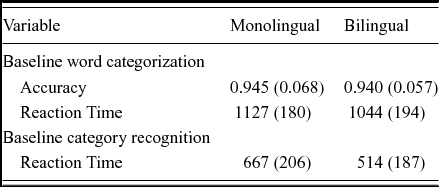
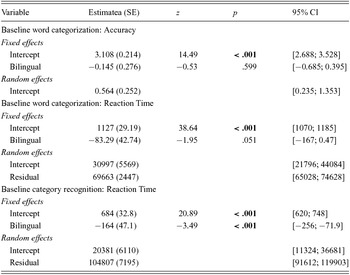
To test whether there was an overall processing speed advantage for bilingual compared to monolingual adults, we fitted three mixed-effects regression models. These analyses examined performance accuracy and RT for baseline word categorization and RT for baseline category recognition. The only predictor variable included in the models was language group (Monolingual and Bilingual). Descriptive statistics are reported in Table 2.
Descriptive statistics for two baseline measures of processing speed.

Note. Mean (SD). All reaction times are in ms. For Monolingual participants, n = 41; for Bilingual participants, n = 36.
Baseline word categorization
Accuracy. As evident from the table of descriptive statistics (Table 2), performance accuracy was at ceiling for both monolingual and bilingual participants, indicating that participants could easily and reliably perform the word categorization task. Mixed-effects logistic regression analysis confirmed the absence of any statistically significant difference between the two language groups (Table 3).
Summary of mixed-effects regression analyses for two baseline measures of processing speed.

Note. aFor fixed effects, the data reported are coefficients; for random effects, variance. For Monolingual participants, n = 41; for Bilingual participants, n = 36. Significant effects in bold.
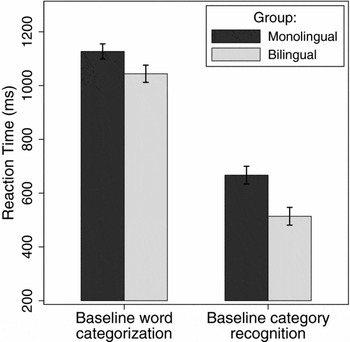
Reaction Time. A linear mixed-effects regression analysis was performed on RT data to examine whether bilingual adults were faster than monolingual participants in this baseline categorization condition. Results showed that the p-value for the group effect approached significance (p = .051; see Table 3). The estimated difference between the two groups was 83 ms, indicating that bilingual participants were 7.4% faster than monolingual individuals (Figure 2).
Effect of language group on two baseline reaction time measures. Error Bars: ± SE.

Baseline category recognition
The second reference measure of speed of processing was based on participants’ category recognition performance. The analysis of RT showed a large and highly significant group effect with an estimated speed of processing advantage for the bilingual group of 164 ms (Figure 2). That is, bilingual participants were 24% faster than monolingual participants. Results of linear mixed-effect regression analysis are summarized in Table 3.
Controlling for baseline speed of processing
The analysis of baseline performance revealed, overall, a solid speed of processing advantage for bilingual participants compared to monolinguals. In spite of a very high proportion of correct responses, which showed that the tasks could be easily performed, RT differences between the two groups were medium to large in size. This baseline performance difference could constitute a serious confounding factor in the analyses of specific executive control processes. Any experimental effect could have been interpreted solely in terms of general speed of processing differences between the two language groups.
Rather than using statistical control, we decided to employ the technique of Propensity Score Matching (PSM) (Austin, Reference Austin2011; Rosenbaum & Rubin, Reference Rosenbaum and Rubin1984). PSM allowed us to select and equate two subgroups of participants to the greatest extent possible on the baseline measures described above. We first selected a subgroup of 36 monolingual participants (from the complete sample of 41 participants) matched with the 36 bilingual adults on baseline speed of processing. However, the outcome was unsatisfactory: In one of the two baseline conditions the difference between the two groups was still statistically significant and medium in size. Then we ranked the bilingual participants by average RT in the baseline conditions, excluded the 6 fastest participants, and using the PSM procedure, selected a matched subgroup of 30 monolingual participants. This second attempt provided satisfactory results, such that, for the group differences on the baseline conditions, p > .4 and ω2 < .01. This subsample of 60 participants was used to answer our research questions regarding implicit learning, resistance to interference, monitoring, and switching. The PSM procedure was conducted using the Stata package psmatch2, version 4.0.10 (Leuven & Sianesi, Reference Leuven and Sianesi2003). Results of the analyses performed on the complete sample of 77 participants are provided as Supplementary Material Online.
Implicit learning
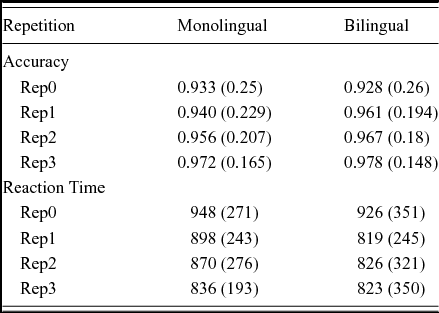
Implicit learning skills were tested by examining participants’ performance in conditions with and without repeated presentation of items. As described in the methods section, repeated items were presented four times and the repetition variable was coded 0–3, with 0 representing the item's first appearance, 1 representing its second appearance (first repetition), 2 its third appearance (second repetition), and 3 representing the item's fourth appearance (third repetition). The control condition consisted of non-repeated items matched on serial position that were drawn from a baseline task with identical structure. This baseline condition allowed us to control for the possible effects of both learning and fatigue.
We fitted a mixed-effects logistic regression model (accuracy data) and a linear mixed-effects regression model (RT data) to examine the effects of Repetition (0, 1, 2, and 3) and Language Group (monolingual and bilingual). Descriptive statistics are reported in Table 4.
Implicit learning task: Descriptive statistics for accuracy and reaction time data by group and repetition number.

Note. Mean (SD). All reaction times are in ms. Rep0 = item's first appearance; Rep1 = item's second appearance; Rep2 = item's third appearance; Rep3 = item's fourth appearance (third repetition). Propensity score matched sample: for Monolingual participants, n = 30; for Bilingual participants, n = 30.
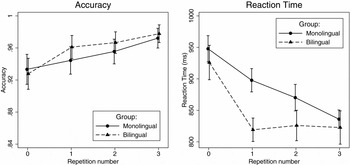
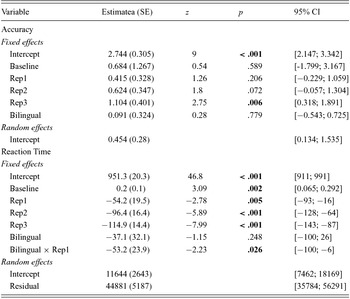
Accuracy. Performance accuracy showed a gradual, although not large, improvement with repetition (Figure 3). Only response accuracy at Repetition 3, and not at Repetition 1 or 2, was significantly better than accuracy at Repetition 0 (first appearance of the item) (Table 5). The effect of language group and the interaction Group × Repetition were not statistically significant, indicating comparable learning rate in monolingual and bilingual participants.
Implicit learning task: Effect of language group and item repetition on performance accuracy and reaction time. Error Bars: ± SE.

Summary of mixed-effects regression analyses for the implicit learning task.

Note. aFor fixed effects, the data reported are coefficients; for random effects, variance. Baseline = see text for description; Rep0 = item's first appearance (reference level); Rep1 = item's second appearance (first repetition); Rep2 = item's third appearance; Rep3 = item's fourth appearance (third repetition). For accuracy, the interaction Bilingual × Repetition did not improve the model fit (χ2(3) = 0.51, p = .916), therefore is not reported in the table. Similarly, for Reaction Time we do not report the interactions Bilingual × Rep2 and Bilingual × Rep3 because they did not improve the model fit (χ2(2) = 0.11, p = .947). Propensity score matched sample: for Monolingual participants, n = 30; for Bilingual participants, n = 30. Significant effects in bold.
Reaction Time. Reaction time, as compared to accuracy, showed a faster and larger improvement with repetition. Performance at the second appearance of the item (first repetition) was already significantly better than performance at the item's first appearance (Table 5). At the third repetition of the item (fourth appearance) the estimated RT was on average 115 ms (about 12.4%) faster than RT at the item's first appearance.
No overall group differences emerged but the interaction Group × Repetition#1 was statistically significant, indicating a steeper learning rate in bilingual participants compared to their monolingual peers (Table 5 and Figure 3): for monolingual participants, RT at the first repetition of the item (second appearance) was 54 ms (5.7%) faster than at repetition 0; bilingual adults were 107 ms (11.7%) faster at the second appearance of the items than at their first presentation.
Resistance to proactive interference
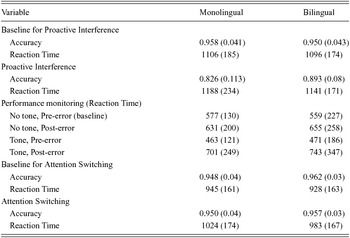
Next, we examined the ability to resist proactive interference from previously presented but no longer relevant items. A mixed-effects logistic regression model (accuracy data) and a linear mixed-effects regression model (RT data) were fitted to examine the effects of condition (baseline and interference) and Language Group (monolingual and bilingual). For these analyses, only distractor items were used; we compared rejection of new distractors (baseline) to rejection of intrusion distractors (interference condition). Descriptive statistics are reported in Table 6.
Descriptive statistics for different executive control tasks.

Note. Mean (SD). All reaction times are in ms. Propensity score matched sample: for Monolingual participants, n = 30; for Bilingual participants, n = 30.
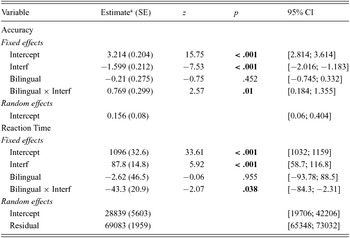
Results showed similar patterns of effects and interactions for accuracy and RT data (Table 7). Group differences in the baseline condition were negligible in size and statistically non-significant – as expected because of the group matching. Participants’ performance in the interference condition compared to the baseline decreased for both groups, but this effect was significantly larger for monolingual than for bilingual participants. For accuracy, the estimated decrease in performance was 0.13 (13.2%) for monolingual adults and 0.05 (5.8%) for bilingual participants. For RT, rejection of intrusion items was 88 ms (8%) slower than rejection of new distractors in monolingual participants, and 45 ms (4.1%) slower in bilingual adults.
Resistance to proactive interference: Summary of mixed-effects regression analyses for accuracy and reaction time data.

Note. aFor fixed effects, the data reported are coefficients; for random effects, variance. Interf = Interference. Propensity score matched sample: for Monolingual participants, n = 30; for Bilingual participants, n = 30. Significant effects in bold.
Performance monitoring
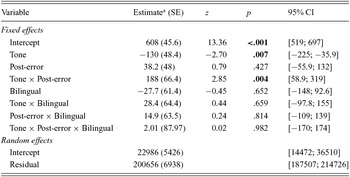
Performance monitoring was studied in conditions with and without auditory cues by comparing response time in pre-error trials to RT in post-error trials. As discussed elsewhere (Dutilh, Vandekerckhove, Forstmann, Keuleers, Brysbaert & Wagenmakers, Reference Dutilh, Vandekerckhove, Forstmann, Keuleers, Brysbaert and Wagenmakers2012), this method is more valid than other methods, such as comparing post-correct trials to post-error trials. The average number of post error trials is 7.2. Items before the errors (the same number of trials = 7.2) were used as baseline. From a preliminary analysis of the data, it emerged that the response times across trials with different tone durations did not differ: therefore, all trials with tones were collapsed. A linear mixed-effects regression model was fitted to assess the effect of Position (pre-error and post-error), Condition (no tone and tone), and Language Group (monolingual and bilingual). Descriptive statistics are reported in Table 6.
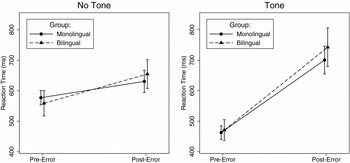
Results are summarized in Table 8. There was a significant effect of Condition, but not of Position, and a significant interaction of Condition × Position. In the absence of auditory cues, no post-error slowing was observed. In the Tone condition participants speeded up in pre-error trials (as compared to pre-error trials in the no tone condition) and showed slower response time in post-error position than pre-error position (Figure 4). The effect of Group and the interaction of Group with Position and Condition were not statistically significant and the size of the effects was negligible. This indicates that the ability to use auditory cues to enhance performance and self-monitoring skills as measured in this task was comparable in the two language groups.
Performance monitoring: Summary of mixed-effects regression analyses for reaction time data.

Note. aFor fixed effects, the data reported are coefficients; for random effects, variance. Propensity score matched sample: for Monolingual participants, n = 30; for Bilingual participants, n = 30. Significant effects in bold.
Performance monitoring: Effect of language group, tone, and position on reaction time. Error Bars: ± SE.

Switching
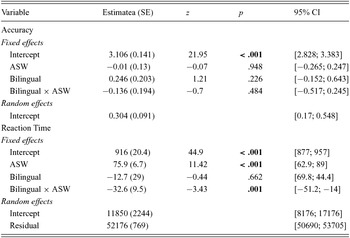
Two mixed-effects regression analysis models were fitted to assess participants’ accuracy and RT in conditions where the switching load of the task was experimentally manipulated. The models fitted were logistic for accuracy (mixed-effects logistic regression) and linear for RT (linear mixed-effects regression). In both analyses independent variables included Condition (baseline and high-switching) and Group (monolingual and bilingual). Descriptive statistics are reported in Table 6.
Accuracy. For accuracy data, no significant effects emerged (Table 9). All participants performed at ceiling in both baseline and high-switching conditions.
Attention switching: Summary of mixed-effects regression analyses for accuracy and reaction time data.

Note. aFor fixed effects, the data reported are coefficients; for random effects, variance. ASW = Attention Switching. Propensity score matched sample: for Monolingual participants, n = 30; for Bilingual participants, n = 30. Significant effects in bold.
Reaction Time. For RT data, analysis revealed, as expected, a negligible and statistically non-significant difference between language groups in the baseline condition. However, the effect of Condition and the Group × Condition interaction were statistically significant (Table 9). These findings indicate that the high-switching condition placed a greater cognitive demand on monolingual than bilingual participants: the former language group was 76 ms (8.3%) slower in the high-switching condition than the baseline; the bilingual group was only 43 ms (4.8%) slower in the high-switching condition compared to baseline. In other words, the proportional slowing between baseline and high-switching condition was significantly smaller in bilingual than monolingual participants.
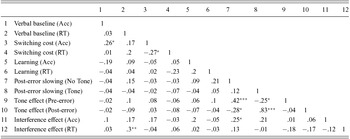
Finally, we examined the correlations among the tasks to assess the degree of overlap in our measures of distinct executive components (see Table 10). Pearson correlations revealed limited inter-correlation among our measures, with most p values greater than .05. The few stronger correlations signal a relationship between different conditions or measures within the same task, rather than relations between tasks (e.g., tone and no-tone conditions in the monitoring task and pre and post-error measures within the same task).
Pearson product-moment correlation of cognitive ability variables.

Note. *p < .05; **p < .01; ***p < .001 (two-tailed). N = 77.
Discussion
The aim of this study was to examine whether bilingual young adults show superior executive processing compared to monolingual individuals in experimental tasks that target specific executive components if we control for global processing speed. The bilingual literature in young adults shows contradictory data on executive processing with at least three main groups of findings: no bilingual advantage (Paap & Greenberg, Reference Paap and Greenberg2013; Yudes et al., Reference Yudes, Mazico and Bajo2011), an advantage in overall processing efficiency (Hilchey & Klein, Reference Hilchey and Klein2011), and bilingual advantage for a more specific executive function, such as selective attention or conflict resolution (Costa et al., Reference Costa, Hernández and Sebastián-Gallés2008; Salvatierra & Rosselli, 2010). As discussed in the Introduction, there are a number of complex variables that contribute to the inconsistencies in the literature; one being task type. Many researchers used tasks that measure various executive components simultaneously (e.g., Stroop, Simon, flanker, etc.). We argue that to overcome this problem, distinct functions need to be assessed separately, and speed of processing needs to be considered independently. Moreover, following Green & Abutalebi (Reference Green and Abutalebi2013), we need to link these distinct processes with the bilingual experience.
In the present study, we used experimental manipulations within a series of tasks designed to examine different components of executive control. Our tasks targeted implicit learning, resistance to interference, monitoring, and switching, because previous research indicated that these executive components play an important role in language processing (e.g., Kroll & Bialystok, Reference Kroll and Bialystok2013). In addition, to address the hypothesis that the differences previously found between bilingual and monolingual participants can be accounted for by a bilingual global speed of processing advantage (Hilchey & Klein, Reference Hilchey and Klein2011), we also explored the role of processing speed in executive control. As suggested by Botvinick and colleagues (Reference Botvinick, Braver, Barch, Carter and Cohen2001), adjustments in cognitive control happen in response to task demands. Individuals with better cognitive control show faster adjustments. If bilingual young adults show more flexibility in adjusting their cognitive system as they perform different cognitive tasks, then we might expect faster overall processing speed. To examine this hypothesis and to test our first research question, we compared monolingual and bilingual young adults’ speed of processing on verbal baseline measures. We examined speed of processing in baseline measures because we assumed that these trials involved minimal executive control but required quick adjustments. There is evidence in the experimental literature that the more complex a speed of processing task, the more executive control is involved in task performance (Cepeda et al., Reference Cepeda, Blackwell and Munakata2013). Our goal was to study speed of processing and specific executive control functions independently.
Three mixed-effects regression models were used to test whether bilingual young adults show an overall speed of processing advantage compared to monolingual participants. The results indicated significant differences in processing speed between the two groups. Bilingual young adults were 24% (164 ms) faster than their monolingual peers. Both groups performed with high accuracy, so this speed of processing advantage was not the result of a trade-off between accuracy and RT in the bilingual group. Thus, the next question was whether there are further differences between the two groups in executive control, beyond the advantage in overall speed of processing in bilingual individuals. We used Propensity Score Matching (Austin, Reference Austin2011) to select individuals into two subgroups (monolingual and bilingual) that showed equal speed of processing on baseline measures. This manipulation resulted in the exclusion of the fastest bilingual young adults’ data for the remaining analyses. Our results indicated that even after matching the groups on global processing speed, bilingual individuals performed better and/or faster than monolingual participants on implicit learning, interference control, and switching.
To examine implicit learning, we analyzed performance on repeated items in our simple categorization task. The findings showed similar accuracy outcomes for the two groups but different learning curves in RT. Although the two groups showed no RT difference at the first presentation of the target items (the groups were matched on baseline speed of processing), they exhibited significant differences after one repetition. Bilingual young adults showed significantly greater decrease in RT, thus a steeper learning curve than the monolingual participants. The group difference disappeared with repeated presentations of the same stimuli. This finding is consistent with the findings reported in Bialystok et al. (Reference Bialystok, Craik, Klein and Viswanathan2004), demonstrating that the bilingual advantage initially found on the Simon test disappeared when the number of items included in the task increased, as the monolingual participants seemed to catch up with their bilingual peers.
The results may also be explained based on the weaker links hypothesis (Gollan, Montoya, Cera & Sandoval, Reference Gollan, Montoya, Cera and Sandoval2008). That account suggests that bilingual individuals show greater frequency effects than monolingual adults in different naming tasks. Thus, item repetition in our task may have helped bilingual participants to improve their category judgments faster than their monolingual peers. This suggestion is not necessarily in contradiction with the cognitive control hypothesis. More efficient adjustment of the cognitive system may be reflected in a greater frequency effect. The learning curves we found indicate that bilingual young adults show faster adjustment to task conditions than their monolingual peers and that this change is not solely the result of an overall speed of processing advantage. This outcome indicates more advanced cognitive flexibility in bilingual individuals compared to their peers. Current findings suggest that bilingual proficiency is associated with cognitive flexibility (Ibrahim, Shoshani, Prior & Share, Reference Ibrahim, Shoshani, Prior and Share2013) but future research is needed to further explore this finding using different task conditions.
Executive processing: Interference control, monitoring, and switching
Recall that we examined possible group differences in specific executive components (resistance to interference, monitoring, and switching) with a series of tasks that involved experimental manipulations.
Interference control
Resistance to proactive interference was measured with a conflict paradigm. Our task consisted of target, new, and interfering distractor items. The latter type of distractors were distractors that had been targets in previous trials, therefore participants were familiar with these items. The question was whether bilingual young adults were better at resisting proactive interference than their monolingual peers. As suggested in the literature (Bialystok, Craik & Luk, Reference Bialystok, Craik and Luk2012; Green & Abutalebi, Reference Green and Abutalebi2013), bilingual individuals regularly need to make decisions about which language to use at a given moment, therefore they are expected to show more advanced skills in differentiating goal-relevant information from goal-irrelevant information than monolingual participants.
We analyzed the data from our interference task by comparing rejection of new distractor items to rejection of interfering distractors (previous targets). As expected, both groups showed an interference effect, a decrease in performance in the interfering condition compared to the baseline measures. However, this effect was significantly larger for the monolingual than for the bilingual group. Thus, bilingual young adults showed more efficient resistance to interference than their monolingual peers. This bilingual advantage was present in both accuracy and RT data, despite the fact that the two groups were matched for overall processing speed. These findings are consistent with the outcomes of Colzato and colleagues (Reference Colzato, Bajo, van den Wildenberg, Paolieri, Nieuwenhuis, La Heij and Hommel2008), who found that bilingual young adults outperformed their monolingual peers in selecting goal-relevant information and in differentiating between goal-relevant information and goal-irrelevant stimuli. Colzato and colleagues explained their findings as reflecting better conflict resolution in the bilingual than in the monolingual group. More efficient conflict resolution was signaled by decreased activation of irrelevant representations and strengthened activation of the relevant ones in their study. Although our task presented participants with a different conflict, both experiments required updating of working memory contents and selecting goal-relevant responses in interfering conditions. Individuals who update their working memory regularly and monitor its content efficiently are typically more resistant to proactive interference in these types of conflict tasks than those who perform the task based on item familiarity (Kane & Engle, Reference Kane and Engle2003).
An alternative explanation might be that individuals who are more efficient in suppressing irrelevant information are less susceptible to proactive interference. Bilingual young adults who use two or more languages daily often need to suppress one language while using the other. Although our study does not allow for the direct testing of this relationship, we suggest that this line of research is fertile ground for future studies.
Monitoring
The second executive component of interest in our study was monitoring. We measured performance monitoring with a task in which pure tones were presented prior to the appearance of the stimuli to facilitate attention orienting. We compared reaction times in pre-error trials to post-error trials across conditions (tone alert versus no tone) and measured post-error slowing in the two groups. Post-error slowing is an indicator of monitoring and it reflects how well the cognitive system is able to adapt following an error (Botvinick et al, Reference Botvinick, Braver, Barch, Carter and Cohen2001). The question in our study was whether bilingual individuals, who need to keep their two languages separate most of the time, show better performance in monitoring than monolingual individuals. Moreover, we were interested in examining whether an alerting cue (a pure tone) could facilitate attention orienting, which in turn could improve performance monitoring.
The results from the matched groups showed an effect for condition (tone versus no tone) but not for group. Similarly to previous findings by Costa and colleagues (Reference Costa, Hernández and Sebastián-Gallés2008), the presentation of an alerting cue enhanced participants’ performance. Unlike in that study, where bilingual individuals performed faster than their monolingual peers in the cued condition, in the current study, both bilingual and monolingual participants showed significant post-error slowing within the tone condition. When we compared their performance to the baseline measure (no tone), however, it became evident that the difference between the two conditions was driven by a decrease in RT for the pre-error trials in the tone condition (see Figure 4). Both bilingual and monolingual participants showed increased task vigilance when a pure tone was presented prior to the stimuli. Prior (Reference Prior2012) reported similar findings on monitoring using a task-switching paradigm. She found no group difference in monitoring between bilingual and monolingual adults. Interestingly, participants in her two groups did not differ in overall speed of processing either.
It is worth noting that our original findings on post-error slowing in the total group of participants (including the fastest bilinguals who were excluded once the groups were matched on speed of processing) showed a different pattern. In the larger sample, post-error slowing was present even in the no-tone condition for the bilingual group but not for the monolingual participants (see Supplementary Material Online). This monitoring effect in the no-tone condition disappeared when we matched the groups on processing speed and excluded the fastest bilingual participants. This finding suggests a strong relationship between overall processing speed and monitoring performance, but this issue needs to be further studied in future research.
Switching
The third executive component explored in this study is switching. Switching rate is often viewed in the literature as an indicator of cognitive flexibility (e.g., Monsell, Reference Monsell2003). Bilingual individuals who use their two or more languages on a daily basis may show advanced language switching skills. As described in the Introduction, young adults’ task-switching findings to date are mixed. Prior and MacWhinney (Reference Prior and MacWhinney2010) suggested that bilingual speakers who are good at switching from one language to another also show superior performance in cognitive rule switching but Hernández et al. (Reference Hernández, Martin, Barcelo and Costa2013) could not replicate those results. Our switching task differed from traditional rule-switching tasks, such as the card sorting task by Zelazo and Frye (Reference Zelazo and Frye1998) or the Wisconsin Card Sorting Test (Kongs, Thompson, Iverson & Heaton, Reference Kongs, Thompson, Iverson and Heaton2000) because it required frequent category changes instead of rule switches. Participants needed to show flexibility in activating different semantic networks as the categories in the task changed. As with all other experimental conditions, we compared performance on the switching task to baseline measures.
Both groups performed with high accuracy rate in both conditions but there was an interaction between condition and group for RT. Monolingual individuals showed significantly greater increase in RT in the switching condition compared to the baseline task than bilingual participants (there was no group difference in the baseline condition because the groups had been matched on speed of processing). Monolingual young adults needed more time than bilingual participants to activate the semantic network related to a given category when the category switches were more frequent. Similarly to our findings on implicit learning, the outcomes from the switching task also suggest that bilingual participants show more flexibility in adjusting to changing task conditions than monolingual participants.
Alternatively, proponents of the weaker links hypothesis (Gollan et al., Reference Gollan, Montoya, Cera and Sandoval2008) might suggest that it is easier to switch if the words have weaker representations, as may be the case in bilingual young adults compared to monolingual adults. For our data, this interpretation is less likely because our bilingual participants showed faster processing even in the baseline word categorization task than monolingual adults. Thus, they did not show a disadvantage in categorization and accessing different lexical items compared to their monolingual peers, as one would expect based on the weaker links hypothesis. One reason for this finding might be related to the nature of the stimuli. All lexical items were high frequency words that children acquire during preschool years. Our participants were young adults, so the words in our tasks were highly familiar to them. It is more likely that their superior switching performance was the result of their advanced cognitive flexibility.
Several researchers have suggested that bilingual individuals who use both of their languages frequently, exercise switching skills regularly, especially when speaking with other bilingual people or when speaking with monolingual and bilingual individuals within the same context (e.g., Soveri, Rodriguez-Fornells & Laine, Reference Soveri, Rodriguez-Fornells and Laine2011). A number of authors have suggested that language context, such as dual-language or dense code-switching contexts, may play a critical role in enhancing language-switching skills (Green & Abutalebi, Reference Green and Abutalebi2013; Muysken, Reference Muysken2000; Prior & Gollan, Reference Prior and Gollan2011; Tokowicz, Michael & Kroll, Reference Tokowicz, Michael and Kroll2004). It is an important question for future research to examine the underlying mechanisms of this superior flexibility in bilingual individuals and to map bilingual characteristics, such as code-switching habits, to specific executive control skills.
Conclusions
We may draw at least two conclusions from the present study. One is related to task selection and the use of experimental manipulations, the second to differences in performance patterns between monolingual and bilingual young adults. Tasks that include series of experimental manipulations provide us with tools to examine different executive components independently. Comparing experimental conditions to baseline measures and studying executive processes step-by-step across conditions help us to examine associations among executive components and language processes, as well as the relationship between executive components and processing speed. Well-controlled experimental tasks are more likely to indicate areas in which bilingual participants may show a cognitive advantage than more global tests.
Our findings suggest that depending on task complexity and on the target executive function, we see different patterns of bilingual advantage. In the baseline measures and the monitoring task, we only observed an overall speed of processing advantage in bilingual participants compared to their monolingual peers. In resistance to interference, bilingual individuals showed superior performance compared to monolingual participants in both accuracy rate and RT, whereas in the switching condition, both groups performed at ceiling in accuracy but there was a bilingual advantage in RT, even though the two groups were matched for overall processing speed.
One common trend across conditions including the implicit learning task was that bilingual participants, despite being matched for age and education, showed more flexibility in adjusting to task goals and to changing experimental conditions. Superior adjustment was reflected in steeper learning curves, smaller interference effect, and faster processing speed. Future research is needed to describe more precisely the underlying mechanisms behind this flexible cognitive adjustment in young adult bilingual participants.
Supplementary Material
For supplementary material accompanying this paper, visit http://dx.doi.org/10.1017/S1366728915000930