Introduction
Ovarian cancer is the third most frequently diagnosed gynaecological malignancy and is the most lethal of all gynaecological malignancies worldwide, being responsible for 5% of all cancer-related deaths in women each year (Refs Reference Siegel1, Reference Torre2). Because of the lack of early clinical symptoms and screening, most patients are diagnosed with metastasis of the pelvic and peritoneal cavities (Refs Reference Torre2, Reference Hennessy3, Reference Siegel4). Although surgery and systemic chemotherapy have made great advances in the last two decades, almost all patients in stages III and IV will relapse and develop resistance to chemotherapy after first-line treatment. The 5-year survival rate of these patients is less than 25% (Refs Reference Torre2, Reference Odunsi5). Consequently, new treatment strategies and paradigms are of great need for these patients. Immune checkpoint inhibitors (ICIs) have attracted tremendous attention as promising new therapeutic targets with the recent improved understanding of the molecular basis of tumour immune microenvironment. Indeed, ICIs have revolutionised the therapeutic landscape of many solid tumours. However, there are currently no approved ICIs for ovarian cancer. Ovarian cancer is known to be an immunogenic disease in which peripheral tumour-infiltrating lymphocytes (TILs) actively recognise tumour antigens and generate tumour-specific T cells to destroy tumour cells. Unfortunately, even if large numbers of tumour-specific T cells are generated in patients by immunotherapy, these T cells fail to destroy tumour cells in vivo (Ref. Reference Anadon6). Previous studies have reported many mechanisms for this failure. For example, ovarian cancer has an extraordinarily complex immunosuppressive tumour microenvironment (TME) that is full of a large number of negative immune regulatory components, such as myeloid-derived suppressor cells (MDSCs), tumour-associated macrophages (TAMs), regulatory T cells (Tregs), cytokines, soluble factors, which have been demonstrated to be immunosuppressive functions and are associated with tumour invasiveness, spread and angiogenesis (Refs Reference Maiorano7, Reference Yin8, Reference Kolomeyevskaya9, Reference Yuan10, Reference Curiel11). Furthermore, immune checkpoint molecules have been identified as crucial regulators of the immune response. The binding of immune checkpoint receptor to ligand negatively regulates T cells activation and weakens antitumour immune responses by delivering immunosuppressive signals, ultimately leading to escape of tumour cells from immune destruction (Ref. Reference Odunsi5). ICIs could effectively prevent this effect. However, ICIs have yielded modest benefits in ovarian cancer. Therefore, a more comprehensive understanding of the mechanistic basis of the immune checkpoints is needed to improve the efficacy of ICIs in ovarian cancer.
Immune checkpoints in ovarian cancer
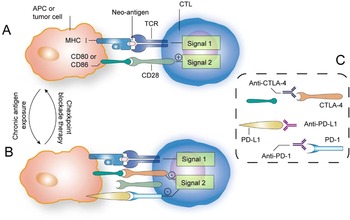
Immune checkpoints are a series of inhibitory regulators that directly regulate the initiation, duration and magnitude of immune responses. Normally, when the immune response is activated, immune checkpoints work as negative regulators, suppressing the immune responses, maintaining self-tolerance and preventing damage to normal tissues (Ref. Reference Edner12). However, tumour cells selectively utilise these inhibitory regulatory mechanisms to suppress effector T cells, leading to immune escape of tumour cells (Ref. Reference Jiang13) (Fig. 1). Therefore, a comprehensive understanding of the immune checkpoints in ovarian cancer is needed. We summarise immune checkpoints and functions in Table 1.
Neo-antigens derived from tumour cells to CTL through MHC class I–TCRs and a co-stimulation signal of CD80 and/or CD86–CD28 interactions, CTLs are subsequently activated to destroy tumour cells. However, tumour cells often escape immune destruction through upregulation of immune checkpoint ligands, such as programmed cell death 1 ligand 1 (PD- L1), that can bind the immune checkpoint receptors programmed cell death 1 (PD-1) on the CTLs to deliver suppressing signals, finally inhibit the proliferation and activation of CTLs. Another negative-regulate immune checkpoint molecule cytotoxic T lymphocyte protein 4 (CTLA-4) that binds CD80 and CD86 and prevents their interaction with CD28, inhibit the co-stimulation signal of CD80 and/or CD86-CD28 interactions, thus inhibit the proliferation and activation of CTLs. ICIs could effectively prevent this effect. ICIs highly specifically bind to immune checkpoints, blocking this inhibitory mechanism and thereby reactivating the anti-tumour immune response.

Summary of immune checkpoints and functions

PD-1
The immune checkpoint molecule programmed cell death protein 1 (PD-1) is expressed on activated T cells, B cells, natural killer (NK) cells, natural killer T (NKT) cells, dendritic cells (DCs) and macrophages and interacts with two ligands, programmed death ligand 1 (PD-L1) and programmed death ligand 2 (PD-L2), to exert inhibitory effects on both peripheral lymphocytes and the TME (Refs Reference Ishida32, Reference Nishimura33). PD-1 is a type I transmembrane receptor, the cytoplasmic tail is composed of two tyrosyl residues and the N-terminal tyrosine residues constitute an immunoreceptor tyrosine-based inhibitory motif (ITIM). The C-terminal domain constitutes an immunoreceptor tyrosine-based switch motif (ITSM). When PD-1 interacts with PD-L1/PD-L2, ITIM and ITSM are phosphorylated, recruiting and activating the Src homology (SH) domains of SH-containing phosphatase (SHP), which dephosphorylates the crucial downstream intracellular signalling pathway PI3K-Akt. Ultimately, this leads to a reduction of both cytokine production and T-cell proliferation, thereby suppressing T-cell-mediated immune response (Refs Reference Ishida32, Reference Nishimura33, Reference Marasco34). In addition, when PD-1 interacts with PD-L1/L2, it upregulates the E3 ubiquitin ligases casitas B-lineage lymphoma-b (CBL-b) and c-casitas B-lineage lymphoma (c-CBL) and triggers PD-1 pathway-mediated suppression of antitumour immune responses. Tregs are strongly associated with advanced stages of ovarian cancer and have immunosuppressive effects on tumours. Terme et al. claimed that PD-1 binding to ligands could regulate the differentiation of Tregs and maintain their immunosuppressive functions. The latest study illustrated that the immunosuppressive cytokine interleukin-18 produced by tumour cells upregulates PD-1 expression on activated mature NK cells, thereby inhibiting NK cell-dependent immunosurveillance in many tumours (Ref. Reference Terme35). In addition, B cell receptor (BCR) induces the expression of PD-1 on the surface of B cells, which inhibits B cells function in tumours (Ref. Reference Okazaki15). These results indicate that PD-1 inhibits the antitumour immune response through multiple pathways and that targeted PD-1 therapies play an antitumour role in part by inhibiting Treg cells and restoring B-cell and NK-cell functions.
In ovarian cancer, Matsuzaki et al. elaborated that compared with peripheral blood lymphocytes, tumour-derived NY-ESO-1-specific CD8(+) T cells enriched co-expression of inhibitory molecules lymphocyte activation gene 3 (LAG-3) and PD-1, dual blockade of LAG-3 and PD-1 during T-cell priming efficiently augmented proliferation and cytokine production by NY-ESO-1-specific CD8 (+) T cells (Ref. Reference Matsuzaki36). Tu et al. used Oncomine and PrognoScan database analyses to investigate the expression levels and prognostic values of PD-1 in ovarian cancer, and found that the expression of PD-1 was closely associated with relatively poor survival in an advanced stage of ovarian cancer (Ref. Reference Tu37). Moreover, Rådestad et al. reported that CD8+ T cells coexpressed the immune checkpoints LAG-3, PD-1 and T-cell immunoglobulin domain and mucin domain-3 (TIM-3) in tumours, the most common combination being PD-1 and TIM-3, and dual blockade of these molecules improved CD8+ T-cell response to non-specific stimulate in the TME by synthesising effector (Ref. Reference Rådestad38). Another study has shown that CD8+ T cells that do not express LAG-3, PD-1 and TIM-3 are beneficial for OS (Ref. Reference Hensler39). These results provide new insights to investigate the simultaneous blockade of multiple immune checkpoints in the treatment of ovarian cancer.
On the contrary, PD-L1 has received a great deal of attention. It has been reported that PD-L1 is not expressed in normal tissue but is increased in ovarian cancer, PD-L1 expression is significantly higher in malignant disease than in benign/borderline disease, tumour cells lysis by cytotoxic T lymphocytes (CTLs) was attenuated when PD-L1 was overexpressed and promoted when it was silenced in mouse ovarian cancer cells, and PD-L1 expression in tumour cells promotes peritoneal dissemination by repressing CTL function (Refs Reference Hensler39, Reference Maine40, Reference Abiko41, Reference Parvathareddy42). In addition, PD-L1 expression in tumours correlates with FIGO stage of ovarian cancer. Obviously, the PD-1/PD-L1 signalling pathway plays a crucial role in the occurrence and development of ovarian cancer. However, some studies have reported different results, with no significant correlation between PD-1 expression and infiltration of effector T cells in tumours (Refs Reference Hensler39, Reference Darb-Esfahani43). In conclusion, the relationship between PD-1 and PD-L1 expression and the prognosis of ovarian cancer patients remains controversial, and more studies are needed to investigate the role of immune checkpoints in ovarian cancer.
CTLA-4
Cytotoxic T lymphocyte-associated antigen-4 (CTLA-4), also known as CD152, is a leucocyte differentiation antigen and a transmembrane receptor. Its intracellular structural domain consists of 36 amino acids forming the ITIM, which plays an opposite role in the intracellular ITAM structural stimulatory molecule CD28 (Ref. Reference Lingel17). CTLA-4 is mainly expressed on the surface of activated CD4+ and CD8+ effector T cells and on Tregs, and is involved in early T-cell activation in secondary lymphoid organs. In ovarian cancer, CTLA-4 competitively binds to the same ligands as the costimulatory receptor CD28, namely, B7 (B7-1: other name CD80; B7-2: other name CD86), expressed on the surface of antigen-presenting cells (APCs) but with greater affinity (Refs Reference Egen16, Reference Linsley44). CTLA-4 interacts with ligands to upregulate inhibitory signals, inhibiting the cell cycle progression of T cells from the G1 to S phase and attenuating or even terminating T-cell immune response (Ref. Reference Krummel45). Furthermore, another biological function of CTLA-4 is endocytosis, which induces CD80/CD86 endocytosis and downregulates CD80 and CD86 expression, thereby further inhibiting T-cell function.
Recently, an increasing number of experiments have demonstrated the important roles of CTLA-4 in ovarian cancer. Jaikumar et al. reported that one-third to half of CD8+ TILs coexpressed PD-1 and CTLA-4 in ovarian cancer, and PD-1 + CTLA-4 + CD8+ TILs have more severe dysfunctional features than PD-1+ or CTLA-4+ TILs. Dual blockade of PD-1 and CTLA-4 reverses CD8+ TIL dysfunction and activates antitumour immune responses in the majority of mice (Ref. Reference Duraiswamy46). Furthermore, some experiments have provided evidence that TILs usually express multiple immune checkpoints in patients with ovarian cancer. In total, CTLA-4 plays a crucial role in immune escape, and dual blockade may be an effective strategy to activate antigen-specific effector T cells.
LAG-3
Lymphocyte activation gene 3 (LAG-3) is mainly expressed on the surface of activated T cells. Its extracellular molecular structure is similar to that of CD4, and it interacts stably with major histocompatibility complex (MHC)-II molecules in a non-competitive manner with a significantly higher affinity than CD4 (Ref. Reference Huard47). This interaction suppresses T-cell receptor (TCR)-mediated T-cell proliferation and activation by downregulation of intracellular STAT5 phosphorylation and reducing CD3 and TCR expression (Refs Reference Duraiswamy46, Reference Grosso48). However, several studies reported that the binding of LAG-3 to MHC-II was not the main inhibitory mechanism. Galectin-3 is the second major LAG-3 functional ligand independent of MHC-II. Interaction of LAG-3 with galectin-3 is needed for galectin-3-mediated CD8(+) T cells inhibition in vitro (Ref. Reference Kouo49). LSECtin, a cell surface lectin constitutively expressed in many tumour cells, is also a ligand for LAG-3, and blocking the interaction of LAG-3 with LSECtin restores interferon-γ secretion and regulates the function of CD8+ T cells and NK cells (Ref. Reference Xu50). Notably, in 2019, Jun et al. reported another ligand, FGL1, is produced by human cancer cells and that blocking the FGL1–LAG-3 interaction preferentially stimulates T cells in tumours and can treat established mouse tumours (Ref. Reference Wang51). Furthermore, LAG-3 negatively regulates T-cell proliferation by upregulating Tregs, thereby promoting the immune escape of tumour cells (Ref. Reference Workman19). In ovarian cancer, researchers observed that CD8+ T cells coexpressing LAG-3 (+) PD-1 (+) have more severe dysfunction than LAG-3 (+) PD-1 (−) or LAG-3 (−) PD-1 (−) subsets. Dual blockade of LAG-3 and PD-1 significantly increased effector T-cell function and dual anti-LAG-3/anti-PD-1 antibody treatment cured most mice of established tumours that were largely resistant to single-antibody treatment. But not by blocking either molecule alone (Refs Reference Matsuzaki36, Reference Woo52, Reference Huang53). This suggests that dual blockade of these molecules remains one of the most promising regimens to explore immunotherapy.
TIM-3
T-cell immunoglobulin domain and mucin domain-3 (TIM-3) are expressed on T cells, Th1 cells, cytotoxic T cells, Treg cells and innate immune cells (Ref. Reference Das54). A study reported that the interaction of TIM-3 and galectin-9 secreted by tumour cells increased apoptosis of CD8+ TIL cells in colorectal cancer (Refs Reference Kang22, Reference Zhu55). TIM-3 interacts with ligands ceacam1 to inhibit the function of effector T cells, and ligands galectin-9 and ceacam1 have a synergistic effect on the TIM-3 signalling pathway. High-mobility group box1 (HMGB1) is another ligand of TIM-3. TIM-3 interacts with HMGB1 to suppress nucleic acid-mediated innate immune responses (Ref. Reference Chiba21). PtdSer (PS) is a non-protein ligand for TIM-3, binds to TIM-3 and recognises apoptotic cells, resulting in clearance of apoptotic cells by resident phagocytes (Ref. Reference Santiago56).
In ovarian cancer, TIM-3 is involved in tumourigenesis and progression by suppressing immunity. In 2017, Xu et al. observed that TIM-3+ CD4T cells isolated from tumour tissue were significantly higher than those isolated from normal tissue. This phenomenon was related to tumour grade, with further increased expression of TIM-3 in T cells (CD4+ and CD8+) from high-grade tumours compared with other lower-grade tumours (Ref. Reference Xu57). Another study showed that TIM-3 + Foxp3 + CD4T cells induce TIM-3 + Tregs in ovarian cancer. It is well known that TIM-3 + FoxP3 + Treg is a promoter of T-cell dysfunction in tumours, thus TIM-3-FoxP3 + Tregs may cause strong immunosuppression in ovarian cancer (Refs Reference Yan58, Reference Sakuishi59). Overall, TIM-3 may negatively regulate antitumour immune responses through various T-cell subsets.
TIGIT
T-cell immunoglobulin and ITIM domain (TIGIT) is a promising new target for cancer immunotherapy. Similar to CD28 and CTLA-4, it competes with CD226 for the same ligands CD155 (PVR) and CD112 (PVRL2, nectin-2), thereby inhibiting the function of T cells and NK cells. TIGIT is upregulated by immune cells in tumours, and its ligands CD155 and CD112 are overexpressed in various tumour cells, but almost absent in normal cells. Whelan et al. reported that ovarian cancers having the highest percentage of PVR−PVRL2+ tumour cells, and a combination of PVRIG blockade with TIGIT or PD-1 blockade further increased T-cell activation (Ref. Reference Whelan60). Furthermore, TIGIT was observed to suppress the antitumour immune response by enhancing the CD4 + Treg cell response (Refs Reference Li61, Reference Harjunpää62, Reference Maas63). Chen et al. reported that anti-TIGIT treatment reduced CD4 + Tregs without affecting CD4+ or CD8+ T cells or NK cells (Ref. Reference Chen64).
BTLA
B and T lymphocyte attenuator (BTLA) is the third coinhibitory molecule observed from the CD28 family and is structurally similar to CTLA-4 and PD-1. BTLA is constitutively expressed on resting T cells and upon activation continues to be expressed. Herpesvirus entry mediator (HVEM), a ligand for BTLA, binds to BTLA, induces its phosphorylation and binds to the tyrosine phosphatase SHP-2, suppressing the immune responses and leading to tumour immune tolerance (Refs Reference Han27, Reference Yu65).
An early study elucidated that BTLA is overexpressed on the surface of CD4+ and CD8+ T cells in patients with various tumours. In addition, HVEM expression was elevated in ovarian cancer cells compared with benign tissues, and T cells numbers and secretion of anti-tumour cytokines were increased in HVEM (−) ovarian cancer (Ref. Reference Zhang66). Chen et al. reported that BTLA is mainly expressed in B lymphocytes and its detection in cancer tissues predicts poor outcome of epithelial ovarian cancer (EOC) patients. Preclinical experiments showed that blocking BTLA in combination with chemotherapy significantly reduced peritoneal tumour volume in tumour-bearing mice (Ref. Reference Chen67).
VISTA
V-domain immunoglobulin suppressor of T-cell activation (VISTA) is a recently discovered negative regulator that is persistently expressed on naive T cells. VISTA acts as a ligand, receptor or both in the TME. VISTA is overexpressed in a variety of tumours, and blocking the VISTA signalling pathway can enhance the antitumour immune response in mice (Refs Reference Lines68, Reference ElTanbouly69). Some studies found that VISTA was almost absent in normal ovarian epithelial cells but was overexpressed in ovarian cancer, and anti-VISTA therapy markedly prolonged the survival of mice bearing tumours that expressed high VISTA (Ref. Reference Mulati70). Notably, Zong et al. gave the opposite conclusion that VISTA expression has been associated with favourable clinical outcomes in patients with high-grade serous ovarian cancer (Ref. Reference Zong71). The differences in these results were related to the variability of the study samples, the complex immunosuppressive microenvironment of ovarian cancer and the weak immunosuppressive functions of VISTA. Targeting VISTA might be a way to enhance antitumour immune responses. However, more studies are still needed to investigate the effects of NISTA on humans.
IDO-1
Tryptophan is involved in multiple catabolic processes and is required for T-cell activation. Indoleamine 2,3-dioxygenases (IDO-1) are tryptophan-degrading enzymes that degrade tryptophan to kynurenine, and the depletion of tryptophan and generation of kynurenine play important immunosuppressive functions by activating Tregs and MDSCs, suppressing the functions of effector T and NK cells. Moreover, IDO-1 modulates the downstream effector pathway, promoting neovascularisation of solid tumours, which promotes tumour growth (Refs Reference Liu72, Reference Wainwright73, Reference Mellor74). Several studies claimed that upregulation of IDO-1 expression in ovarian cancer suppresses T-cell expansion and reduces the number of CD8 + TILs, resulting in a poor prognosis in patients. Another study described that IDO-1 induced PD-1 expression in T-cell ovarian cancer, which was positively associated with paclitaxel resistance (Refs Reference Qian75, Reference Okamoto76, Reference Takao77, Reference Amobi-McCloud78). Importantly, these results demonstrate that IDO-1 plays an important role in ovarian cancer.
Clinical trials of ICI monotherapy in ovarian cancer
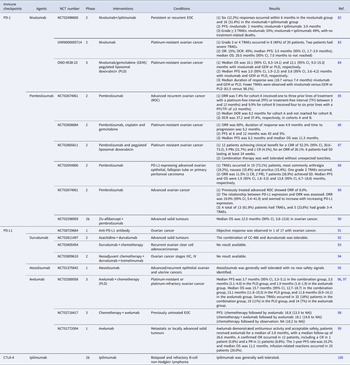
In the second part, we describe the mechanisms of immune checkpoints and their crucial roles in ovarian cancer. Therefore, we believe that immune checkpoints are the most promising targets for ovarian cancer therapy. ICIs are small-molecule agents that target immune checkpoints and specifically recognise and bind immune checkpoint molecules, reducing immunesuppression and thus enhancing antitumour immune responses. Currently, several ICIs have been approved by the U.S. Food and Drug Administration (FDA) for cancer treatment (Refs Reference Boland79, Reference Wolchok80, Reference Hodi81). Although none have been approved for ovarian cancer, several clinical trials are currently underway to evaluate the clinical activity of ICIs in ovarian cancer. Table 2 lists the completed clinical trials of ICI monotherapy in ovarian cancer.
Clinical trials of ICI monotherapy in ovarian cancer

PD-1 inhibitors
Nivolumab
Nivolumab is an immunoglobulin G4 (IgG4) monoclonal antibody that targets PD-1 receptors. Nivolumab binds to PD-1 block negative/suppressing signal delivery to the T cell, activating them and enhancing host anti-tumour immunity. To date, nivolumab has been approved by the FDA for treatment of various tumours.
In 2014, Hamanishi et al. evaluated the efficacy of nivolumab in ovarian cancer in a phase II clinical trial that enrolled 20 patients with platinum-resistant ovarian cancer. In this trial, patients were sequentially assigned to the high-dose group (nivolumab 3 mg/kg; n = 10) and the low-dose group (nivolumab 1 mg/kg; n = 10) and received nivolumab monotherapy. A better objective response ratio (ORR) [20%; 95% confidence interval (CI), 2.5–55.6] was found in the 3 mg/kg cohort compared with an ORR of 10% (95% CI, 0.3–44.5) in the 1 mg/kg cohort. The incidence of treatment-related adverse events (TRAEs) did not differ between the two groups. Consequently, it can be concluded that ovarian cancer patients may benefit more from nivolumab 3 mg/kg (Ref. Reference Hamanishi83). Subsequently, in 2021, Hamanishi et al. compared the efficacy of nivolumab alone or chemotherapy in patients with platinum-resistant ovarian cancer, demonstrating that the nivolumab group was more well tolerated than the chemotherapy group. However, no remarkable clinical benefit was observed in this study, with a median overall survival (OS) of 10.1 months (95% CI, 8.3–14.1) in the nivolumab group and 12.1 months (95% CI, 9.3–15.3) in the chemotherapy group, and there was no significant difference in OS between groups (Ref. Reference Hamanishi84). Normann et al. also evaluated the efficacy of nivolumab in patients with platinum-resistant ovarian cancer and reported that the disease control rate (DCR) was 44% (95% CI, 19–87), the median OS was 30 weeks (95% CI, 14–42) and the progression free survival (PFS) was 15 weeks (95% CI, 13–17) (Ref. Reference Normann101). This study reported similar DCR and PFS to the trial reported by Hamanishi in 2014.
In conclusion, nivolumab monotherapy has limited clinical efficacy in patients with advanced or platinum-resistant ovarian cancer. However, nivolumab showed an acceptable safety profile, suggesting that more investigations would be valuable to elucidate the clinical efficacy of nivolumab in ovarian cancer.
Pembrolizumab
Pembrolizumab (Keytruda) is a humanised monoclonal IgG4 antibody that blocks the PD-1 pathway and has been extensively investigated in a variety of malignancies.
In a phase Ib trial (NCT02054806), the clinical efficacy and safety of pembrolizumab monotherapy in patients with PD-L1-expressing advanced ovarian cancer was evaluated, TRAEs occurred in 19 (73.1%) patients. One grade 3 TRAEs (increased plasma transaminase level) occurred. No deaths and no treatment discontinuations because of TRAEs occurred. The ORR was 11.5%, with seven patients (26.9%) having stable disease, and the median PFS and OS were 1.9 (95% CI, 1.8–3.5) and 13.8 (95% CI, 6.7–18.8) months, respectively (Ref. Reference Varga88). Matulonis et al. reported a phase II clinical trial of 376 patients with advanced recurrent ovarian cancer in which pembrolizumab monotherapy; ORR was 8%, DCR was 37% and PFS was 2.1 months. The study also found that high levels of PD-L1 were related to an increased clinical efficacy of pembrolizumab. Nishio et al. also reported in advanced ovarian cancer pembrolizumab monotherapy had an ORR of 19.0% (95% CI, 5.4–41.9) and seemed to increase with increasing PD-L1 expression. A total of 13 (61.9%) patients had TRAEs, and five (23.8%) had grade 3–4 TRAEs (Refs Reference Matulonis85, Reference Nishio89). These results indicated that the levels of PD-L1 expression in tumour cells may be a valid predictor of disease prognosis. However, a variety of trials have also reported that patients can benefit from the combination of ICIs with other therapies regardless of their PD-L1 expression levels.
Overall, these trials demonstrated an ORR of 5–20% with manageable toxicities in patients with advanced ovarian cancer with pembrolizumab monotherapy. Further studies are needed to identify appropriate predictors to facilitate pembrolizumab efficacy.
Dostarlimab
Dostarlimab (TSR-042) is another anti-PD-1 inhibitor that interacts with the PD-1 receptor with high affinity. Currently, no clinical trials have reported the clinical activity of dostarlimab in ovarian cancer. However, multiple phase III clinical trials (NCT04679064; NCT03602859; NCT03806049) are being performed to test dostarlimab as a monotherapy or in combination with other agents in ovarian cancer, and we expect promising outcomes from these treatments.
PD-L1 inhibitors
Atezolizumab
Atezolizumab is a fully humanised monoclonal antibody that selectively targets PD-L1 to prevent interaction with PD-1. Liu et al. investigated single-agent atezolizumab in 12 patients with recurrent EOC in a first-in-human phase 1 study. Antitumour activity of atezolizumab was observed in two patients with mostly grade ≤ 2 TRAEs and no grade ≥ 4 TRAEs were reported (Ref. Reference Liu95). Overall, atezolizumab monotherapy was generally well tolerated in patients with recurrent EOC, and its clinical efficacy warrants further investigation.
Avelumab
Avelumab is a fully humanised IgG1 monoclonal antibody against PD-L1. It is the only agent that kills cancer cells using both antibody-dependent cell-mediated cytotoxicity and immune checkpoint inhibition simultaneously. Disis et al. first investigated the clinical activity of ipilimumab in previously treated patients with recurrent or refractory ovarian cancer in a phase Ib trial (NCT01772004). The ORR was 9.6% (95% CI, 5.1–16.2), the 1-year PFS rate was 10.2% (95% CI, 5.4–16.7) and the median OS was 11.2 months (95% CI, 8.7–15.4 months). Other frequent TRAEs were fatigue (17 [13.6%]), diarrhoea (15 [12.0%]) and nausea (14 [11.2%]). Grade 3 or higher TRAEs occurred in nine patients (7.2%). Twenty-one patients (16.8%) had TRAEs of any grade (Ref. Reference Disis99). Another phase 3 trial evaluated avelumab alone or avelumab plus chemotherapy compared with chemotherapy alone in patients with platinum-resistant or platinum-refractory ovarian cancer. The results showed that the median OS was 15.7 months (95% CI, 12.7–18.7), 13.1 months (11.8–15.5) and 11.8 months (8.9–14.1) in the combination group, chemotherapy group and avelumab group, respectively. Here, we found no significant clinical benefit of avelumab alone or in combination with chemotherapy compared with chemotherapy, and worse PFS and OS were observed in the avelumab group (Ref. Reference Pujade-Lauraine96). Overall, avelumab showed limited clinical activity in recurrent or refractory ovarian cancer. Monk et al. compared chemotherapy plus avelumab, chemotherapy followed by avelumab maintenance and chemotherapy alone in stage III–IV epithelial ovarian, fallopian tube or peritoneal cancer. The median PFS was 18⋅1 months [14.8 to not estimable (NE)] with avelumab combination treatment and 16.8 months (95% CI, 13⋅5 to not estimable) with avelumab maintenance. No significant clinical benefit was observed with either avelumab maintenance therapy or chemotherapy plus avelumab in this trial. More studies are needed to evaluate the clinical efficacy of avelumab as a first-line therapy (Ref. Reference Monk98).
CTLA-4 inhibitors
Ipilimumab is the first FDA-approved ICI that effectively blocks the CTLA-4 pathway. A phase II study (NCT01611558) in 40 patients evaluated the safety and efficiency of ipilimumab monotherapy in recurrent platinum-sensitive ovarian cancer. This trial found that the incidence of grade ≥3 TRAEs was 50%, and the best ORR was 15% (5.7–29.8). However, studies on ipilimumab are limited. Randomised phase 2 or 3 clinical trials of CTLA-4-targeted agents in ovarian cancer patients have not reported a clear overall survival benefit, either alone or in combination with available agents.
In conclusion, ICIs have yielded only modest responses as monotherapy for advanced or recurrent ovarian cancer. There are extensive challenges for further clinical applications of ICIs alone in ovarian cancer, such as the limited effectiveness of monotherapy, the lack of investigation of identified biomarkers to predict prognosis and serious TRAEs and primary and acquired resistance. Therefore, further research is needed to develop combination approaches to allow more patients to benefit from ICIs.
Clinical trials of ICIs combined with other small-molecule-targeted agents in ovarian cancer
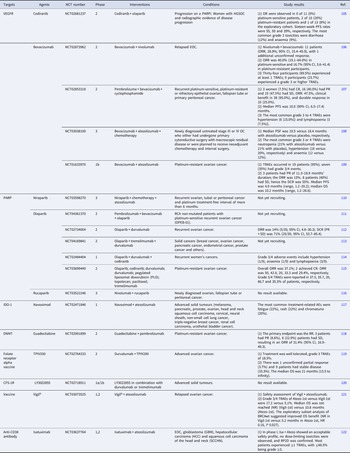
The antitumour function of ICIs depends on TILs, and the activation of TILs requires immunogenic tumour-specific antigens (Refs Reference Linette102, Reference Cheng103). The standard treatment for ovarian cancer includes surgery followed by platinum-based chemotherapy. Chemotherapy can lead to the destruction of cancer cells and the release of immunogenic molecules (Ref. Reference Bezu104). Combining gemcitabine chemotherapy drugs with a CTLA-4 blockade could induce a potent CD4+ and CD8+ T-cell-dependent antitumour immune response. Furthermore, small-molecule-targeted agents induce tumour cell death and lead to the release of large amounts of neoantigens, thereby enhancing the infiltration and activation of effector T cells in the TME. Therefore, the combination of ICIs with other small-molecule-targeted agents achieves cumulative or synergistic therapy to show the greatest antitumour immune responses. Clinical trials of ICIs combined with other small-molecule-targeted agents in ovarian cancer are listed in Table 3.
Clinical trials of ICIs combined with other small-molecule-targeted agents in ovarian cancer

Multiple ICIs in combination
Several preclinical studies have demonstrated that 33–50% of CD8 (+) TILs coexpress more than one immune checkpoints, and that blocking any of these immune checkpoints compensatively increase the expression of other immune checkpoints, and that tumour cells may choose this replacement immunosuppressive molecule to continue evading attack from the immune system (Refs Reference Rådestad38, Reference Li123). Tumour cells also overexpress several immune checkpoints ligands, to synergistically exploit coexpression of immune checkpoints at the T-cell surface as an immune escape mechanism (Ref. Reference Curdy124). Huang et al. observed that dual blockade of PD-1 with CTLA-4 or LAG-3 synergistically enhanced effector T-cell function and led to tumour rejection in mouse ovarian tumours (Ref. Reference Huang125). Therefore, blocking multiple immune checkpoints could improve the efficacy of ICIs in ovarian cancer.
A phase 1, 2 trial NCT03287674 evaluated ipilimumab and nivolumab in metastatic ovarian cancer and showed that the ORR was 16.7%, and the stable disease rate was 83.3%. Although it had limited efficacy, the combination strategy showed better efficacy than monotherapy. Subsequently, Zamarin et al. reported results from the phase II trial NCT02498600, which evaluated ipilimumab plus nivolumab compared with nivolumab alone in patients with persistent or recurrent EOC. Grade ≥3 TRAEs occurred in 33 and 49% of patients in the nivolumab and combination groups, respectively. Within 6 months of treatment responses occurred in six (12.2%) patients in the nivolumab group and 16 (31.4%) patients in the nivolumab plus ipilimumab group (OR, 3.28; 85% CI, 1.54 to infinity), and the median PFS was 2 and 3.9 months in the nivolumab and combination groups, respectively. These results demonstrated that combination therapy for persistent or recurrent EOC improved response rates and prolonged PFS compared with nivolumab alone (Ref. Reference Zamarin82). Overall, the combination regimens showed superior efficacy in patients with persistent or recurrent EOC.
Combination of ICIs and PARP inhibitors
In tumours, the rapid expansion of cancer cells is prone to DNA damage, which requires rapid DNA damage repair (DDR). There are two most common modalities of DDR: DNA single-strand break (SSB) repair involving poly (ADP-ribose) polymerase (PARP) enzymes and homologous recombination repair in which BRCA1/2 plays an important role (Ref. Reference Venkitaraman126). During DNA replication, when SSB repair is blocked, the replication fork collides with the unrepaired SSBs, forming a double-strand break (DSB). Therefore, if only the SSB repair pathway is blocked, cells can still rely on HR to repair DSBs. However, in HR deficiency (HRD) cancer cells, PARPi impairs the repair of DNA SSBs, rendering DSBs ineffective and leading to the accumulation of damage, chromosomal rearrangements, genomic instability and synthetic lethality (Refs Reference Venkitaraman126, Reference Konstantinopoulos127, Reference Pilié128), which means, patients with BRCA1/2 mutations are particularly sensitive to PARPi (Refs Reference Foo129, Reference Zheng130). It has been reported that HRD-related DDR was observed in approximately 40–50% of patients with ovarian cancer (Ref. Reference da Cunha Colombo Bonadio131), and the majority of them are strongly associated with BRCA1/2 mutation. BRCA1/2 mutation EOC showed higher neoantigen load and PD-L1 expression compared with BRCA1/2 wild type and HR proficient. Ding et al. described the results from preclinical studies; PARPi drives powerful local and systemic antitumour immunity in mice bearing BRCA1-deficient ovarian tumours, and this antitumour effect is further enhanced when PARPi is combined with a PD-1 inhibitor (Refs Reference Ding132, Reference Wang133, Reference Shen134). Therefore, these results provide a powerful molecular basis for PARPi in combination with ICIs playing a synergic role in ovarian cancer.
A phase 2 clinical trial NCT02484404 enrolled 35 ovarian cancer patients and evaluated the efficacy of olaparib and durvalumab; the ORR was 14% (5/35; 95% CI, 4.8–30.3), and the DCR was 71% (25/35; 95% CI, 53.7–85.4) (Ref. Reference Lampert112). In addition, Konstantinopoulos et al. reported results from an open-label, single-arm, phase 1 and 2 trial that evaluated niraparib in combination with pembrolizumab in patients with recurrent ovarian carcinoma. The ORR was 18% (90% CI, 11–29), and the DCR was 65% (90% CI, 54–75). Overall, these results suggested that niraparib combined with pembrolizumab has a favourable safety profile tolerable and showed promising antitumour activity in patients with recurrent ovarian cancer, and this combination strategy may represent a new choice for these individuals (Ref. Reference Konstantinopoulos135). In addition, several ongoing trials (NCT02657889, NCT04169841) are also investigating the efficacy of ICIs in combination with PARPi therapy in patients with solid tumours and expect promising results.
Combination of ICIs and VEGF/VEGFR inhibitors
Vascular endothelial growth factor (VEGF) is a highly biologically active glycoprotein, and its ligand vascular endothelial growth factor receptor (VEGFR) is expressed on endothelial cells, thereby triggering angiogenesis signals. Neovascularisation in the TME plays a key role in tumour progression, invasion and metastasis. Recently, several studies have found that VEGF/VEGFR expression is significantly higher in tumour vascular cells than in normal vascular cells, and the highest levels of VEGF were observed in patients diagnosed with advanced tumours (Refs Reference Bekes136, Reference Nagy137, Reference Luo138, Reference Mahner139). VEGF inhibitors exert antitumour effects by targeting the blocking of VEGF signalling pathways, inhibiting tumour neovascularisation and causing tumour vascular regression. Currently, VEGF inhibitors have shown therapeutic efficacy in an increasing number of human cancers (Refs Reference Azam140, Reference Bergers141). Moreover, some researchers reported that PD-L1 inhibitors plus antiangiogenic agents can inhibit angiogenesis and tumour progression induced by the direct interaction of PD-L1 and VEGFR2, and this combination therapy can also overcome single-drug resistance (Ref. Reference Yang142). Furthermore, antiangiogenic therapy attempts to normalise the tumour vasculature and improve the efficiency of anticancer drug delivery, and better efficacy can be achieved with a lower dose of ICIs, which can decrease TRAEs. Combining PD-L1 antiangiogenic agents may be a potential therapeutic strategy for ovarian cancer patients.
A single-arm, phase 2 trial evaluated the combination of nivolumab and bevacizumab in 38 patients (18 had platinum-resistant and 20 had platinum-sensitive disease) with relapsed EOC. In this trial, the ORR was 40.0% (19.1–64.0%) in platinum-sensitive participants and 16.7% (95% CI, 3.6–41.4) in platinum-resistant participants. Nivolumab combined with bevacizumab has significant clinical activity in relapsed ovarian cancer patients, with greater activity in the platinum-sensitive setting (Ref. Reference Liu106). Moroney also reported similar safety and clinical activity in a platinum-resistant ovarian cancer setting, with an ORR of 15% and stable disease in eight patients (40%) (Ref. Reference Moroney109). In conclusion, ICIs combined with VEGF inhibitors have a better benefit in platinum-sensitive ovarian cancer, but their clinical efficacy in platinum-resistant ovarian cancer is still limited.
Combination of ICIs and DNMT inhibitors
In normal cells, DNA methylation is crucial for regulating gene expression and is required for the maintenance of genome stability. Aberrant DNA methylation leads to alterations in chromatin structure and silencing of tumour suppressor genes, ultimately leading to tumourigenesis (Ref. Reference Klose143).
DNA methyltransferase (DNMT) is an important epigenetic molecule for DNA methylation that can catalyse DNA methylation and inhibit gene transcription. Therefore, DNMT inhibitors can block abnormal DNA methylation during tumourigenesis, promoting the activation of tumour suppressor genes and achieving antitumour effects. Some studies have elaborated that DNMT is expressed at levels three times higher in ovarian cancer cells than in normal ovarian epithelial cells (Ref. Reference Ahluwalia144).
Guadecitabine is a second-generation hypomethylating agent, phase I/II randomised trial (NCT02901899) evaluating the clinical efficacy of guadecitabine and pembrolizumab in recurrent ovarian, peritoneal and fallopian tube carcinomas. Final results have not yet been available.
Combination of ICIs and IDO-1 inhibitors
The immunosuppressive enzyme IDO-1 catalyses the cleavage of l-tryptophan to produce a series of kynurenine metabolites that inhibit the action of CD8+ T lymphocytes (Refs Reference Stone145, Reference Li146). IDO-1 inhibitors have been reported to be synergistic with ICIs and may increase the effectiveness of ICIs in cancer patients. Several studies are evaluating the efficacy and safety of IDO-1 inhibitors plus ICIs in ovarian cancer.
Combination of ICIs and FRα inhibitors
Folate is an important regulator of cell growth and survival. The binding of folate to folate receptor α (FRα) is one of the main methods by which folate enters cells. Several studies found that FRα was selectively overexpressed in ovarian cancers, whereas expression was not detectable in normal ovarian surface epithelium (Refs Reference Choi147, Reference Scaranti148, Reference Figini149). Furthermore, FRα can be transferred into the nucleus, where it acts as a transcription factor to regulate the expression of key developmental genes in tumour cells. At the same time, folate regulates tumour growth and development by participating in a variety of intracellular signalling pathways and downregulating cell adhesion molecules (Ref. Reference Nawaz150).
A phase II trial of durvalumab in combination with the multiepitope FRα vaccine TPIV200 in 27 ovarian cancer patients observed a treatment-related grade 3 toxicity rate of 18.5%. Although the ORR in this trial was only 3.7%, all patients had increased T-cell responses at 6 weeks with a median OS of 21 months (13.5 to infinity). These observations demonstrated that a combination therapeutic strategy of ICIs and FRα inhibitors or FRα vaccines is extremely valuable (Ref. Reference Zamarin119).
Combination of ICIs and HDAC inhibitors
Histone acetyltransferases (HATs) and histone deacetylases (HDACs) are involved in transcription, cell cycle regulation and cell transformation. Normally, histones are in a dynamic balance between acetylation and deacetylation and are coregulated by HAT and HDAC. In human cells, increased levels of histone deacetylation result in alterations of the normal cell cycle and metabolic behaviour, which ultimately induce tumours (Ref. Reference Wade151). Anti-HDAC therapy can activate histone acetylation, promote the expression of antitumour transcription factors and inhibit tumourigenesis. Furthermore, HDAC inhibitors promote the degradation of the proto-oncoprotein (Ref. Reference Eckschlager152). Several studies have observed that HDACs are frequently overexpressed in ovarian cancer and are often associated with poor prognosis (Refs Reference Li153, Reference Weichert154, Reference Yano155). ICIs combined with HDAC inhibitors may be a new treatment strategy for ovarian cancer patients. The phase II trial NCT02915523 is testing in combination with entinostat and avelumab in ovarian, fallopian tube, or primary peritoneal cancer, and we expect good outcomes from this treatment.
Combination of ICIs and RAF/MEK/ERK pathway inhibitors
Ras has been identified as an oncogene, and the RAF–MEK–ERK pathway is an important downstream effector of Ras. Ras mutation activates the RAF–MEK–ERK signalling pathway, which plays a key role in cancer cell expansion, invasion and metastasis. Hence, each component of the RAS/RAF/MEK/ERK pathway has become an important target of antitumour therapy (Refs Reference Roberts156, Reference De Luca157). Currently, RAF and MEK inhibitors are being developed as cancer treatments. Some studies have demonstrated that MEK inhibitors show good treatment effects in ovarian cancer patients (Ref. Reference Shrestha158). Clinical trials NCT03363867 and NCT03363867 for the treatment of patients with ovarian cancer are ongoing.
Conclusion
The development of ICIs has revolutionised the management of many types of solid tumours, particularly advanced-stage cancers. Herein, we describe the mechanisms and expression of immune checkpoints and summarise recent updates regarding ICIs monotherapy or combined with other small-molecule-targeted agents in ovarian cancer. It is worth noting that the ICIs monotherapy have limited efficacy in ovarian cancer. Although synergistic therapies exhibit superior efficacy in patients with persistent or recurrent ovarian cancer compared with monotherapy, fundamental research and clinical use of combination therapy still encounters many obstacles, such as treatments with ICIs have limited response rates, no identified predictive biomarkers to select patients suited for ICIs, cannot effectively avoid the immune-related adverse events and the number of clinical trials of ICIs in ovarian cancer is relatively limited. Therefore, a more comprehensive understanding of immune checkpoints and immunosuppressive TME is crucial to improve the efficacy of ICIs in ovarian cancer.
Acknowledgements
We thank all authors who contributed to this article.
Conflict of interest
The authors have no other conflicts of interest to declare.
Ethical standards
The authors are accountable for all aspects of the work in ensuring that questions related to the accuracy or integrity of any part of the work are appropriately investigated and resolved.