Implications
Before slaughter, lambs may experience several stressors such as feed and water deprivation, handling and transport that have the potential to negatively impact welfare and meat quality. Increased enforced physical activity and the presence of a psychological stressor such as a dog resulted in behavioural and physiological changes indicative of stress in lambs and changes in meat quality characteristics. The results from this study suggest that limiting glycogen expenditure before slaughter by reducing the stressors experienced by lambs during handling may prevent elevation of meat pH and improve lamb welfare.
Introduction
Before slaughter, animals may experience several stressors in addition to transport (Ferguson and Warner, Reference Ferguson and Warner2008), including the stress associated with loading and unloading from the truck and during lairage (Petersen, Reference Petersen1983; Broom et al., Reference Broom, Goode, Hall, Lloyd and Parrott1996; Parrott et al., Reference Parrott, Hall and Lloyd1998). Furthermore, the stress associated with handling at the time of loading and unloading can vary according to factors such as the quality of handling (gentle v. rough), experience of the handler, animal temperament, the condition of the animals and the quality of the facilities (Schwartzkopf-Genswein et al., Reference Schwartzkopf-Genswein, Faucitano, Dadgar, Shand, González and Crowe2012). A combination of stressors, rather than a single factor, is often responsible for an animal’s condition post-transport (Bray et al., Reference Beausoleil, Stafford and Mellor1989; Broom et al., Reference Broom, Goode, Hall, Lloyd and Parrott1996).
As a consequence of the stress experienced by lambs pre-slaughter, carcass and meat quality and animal welfare can all be negatively affected. Stressful conditions before slaughter can reduce muscle glycogen stores, which may result in elevated ultimate pH of meat and low residual levels of glucose (Bray et al., Reference Beausoleil, Stafford and Mellor1989; Bond et al., Reference Bray, Graafhuis and Chrystall2004; Warner et al., Reference Warner, Ferguson, McDonagh, Channon, Cottrell and Dunshea2005). This can substantially influence postmortem muscle biochemistry and physiology that govern important meat quality attributes such as tenderness, water-holding capacity, flavour, meat colour and microbiological shelf-life (Newton and Gill, Reference Nicholson, Osman and Belkhiri1981; Honikel, Reference Honikel2014). Meat with high ultimate pH can have distinct differences in meat quality characteristics (Devine et al., Reference Devine, Graafhuis, Muir and Chrystall1993) and a variable susceptibility to spoilage by microorganisms (Newton and Gill, Reference Nicholson, Osman and Belkhiri1981). Factors that negatively impact meat quality can also negatively impact animal welfare, including poor handling, feed and water deprivation and over stocking. This close link between carcass and meat quality and animal welfare means that improvements in animal welfare are also likely to improve carcass yield and meat quality and vice versa. In addition, animal welfare is an important aspect of food production that is considered by consumers when making purchasing decisions.
In extensive farming systems, lambs often have to walk long distances to reach the holding yards where they are loaded and then transported to the abattoir. In New Zealand, it is common for stock people to use dogs to aid in handling of lambs. Both exercise (Warner et al., Reference Warner, Ferguson, McDonagh, Channon, Cottrell and Dunshea2005; Cockram et al., Reference Cockram, Murphy, Ringrose, Wemelsfelder, Miedema and Sandercock2012) and the presence of a dog (Beausoleil et al., Reference Bond, Can and Warner2005; Zimerman et al., Reference Zimerman, Domingo, Grigioni, Taddeo and Willems2013) are known to cause behavioural and physiological changes in lambs indicative of stress. Furthermore, 10 to 15 min of enforced exercise is sufficient to have a negative impact on meat quality characteristics in lambs (Bond et al., Reference Bray, Graafhuis and Chrystall2004; Warner et al., Reference Warner, Ferguson, McDonagh, Channon, Cottrell and Dunshea2005). Few studies, however, have directly studied the effect of handling regimes relevant to extensive systems (an extended exercise period in combination with the presence of a dog) on welfare and meat quality of lambs. Therefore, the objective of this study was to evaluate the effect of quality of pre-slaughter handling on the behaviour and physiology of lambs and meat quality at slaughter.
Material and methods
Animals and experimental design
In total, 60 female Romney lambs were selected for this study, which was conducted at the AgResearch research farm at Whatawhata, North Island, New Zealand. This study was conducted over a 6-day period during March (Southern Hemisphere summer) 2013. Ambient temperature (T) at the holding yards ranged from 16.2°C to 29.1°C (average 20.0°C), relative humidity (RH) ranged from 54.3% to 85.6% (average 68.4%) and the temperature–humidity index (THI) ranged from 60.4 to 82.3 (average 66.3) during the study period. Kelly and Bond (Reference Kelly and Bond1971) formula was used to calculate the THI: THI=(1.8×T+32)–((0.55–0.0055×RH)×(1.8×T–26)). All procedures involving animals were approved by the Ruakura Animal Ethics Committee under the New Zealand Animal Welfare Act 1999.
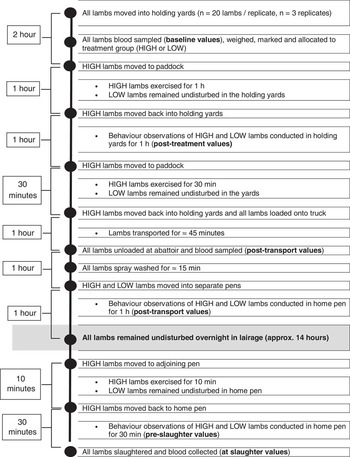
Before the start of the study, all 60 lambs were maintained in one group. Lambs were ~6 months of age at the time of the study and weighed 39.1 (SD=2.97) kg. In all, 20 lambs were tested at one time and allocated to one of the two treatment groups (n=30 lambs/treatment): low intensive handling (LOW) or high intensive handling (HIGH). This study was replicated three times (n=20 lambs/replicate; three replicates). Each replicate was conducted over a 2-day period and replicates were run sequentially within a 6-day period. The timeline and design of the study are presented in Figure 1.
Flow diagram of study design timeline (durations are approximate). HIGH=high intensive handling; LOW=low intensive handling.

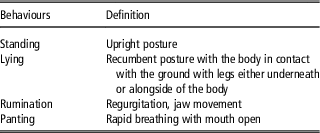
On the day of the study, 20 lambs were moved from their home paddock to the holding yards, a distance of ~500 m. Lambs were moved quietly by three experienced handlers without the use of dogs or loud noises. The holding yards consisted of a covered, open-sided building with dirt flooring. Lambs were randomly allocated to one of the two treatments: LOW or HIGH then restrained by one handler while the second handler removed the wool from the lamb’s neck using clippers and collected a blood sample (baseline values) from the jugular vein. The lamb was then marked using spray paint (Tell-tail paint; FIL New Zealand, Mount Maunganui, New Zealand) for easy identification of individual animals for behavioural observations. Lastly, the lambs were weighed and then released into one of the two pens depending on treatment allocation. Once all lambs were blood sampled, weighed and marked, the HIGH lambs were moved from the holding yards into an adjoining paddock (~100×100 m) that was out of view of the LOW lambs. The HIGH lambs were then moved around the paddock for 1 h by one of the handlers and a dog. This experience was designed to simulate a more intensive handling process by incorporating a longer walking distance from the home paddock to holding yards and presence of a dog. The same handler and dog were used for all three replicates. A rattle device was used to encourage the lambs to continue moving, if necessary. Lambs were kept moving at a minimum of a walk (~5.0 km/h) for the entire 1 h period. During this time, the LOW lambs were left undisturbed in the holding yards. After the 1 h period, HIGH lambs were moved back into the holding yards. At this time (post-treatment) an observer recorded the behaviour of all LOW and HIGH lambs using 5-min scan sampling (Martin and Bateson, Reference Martin and Bateson1993) to estimate the percentage of time lambs spent performing different behaviours. LOW and HIGH lambs were in adjoining pens and the observer stood quietly in the middle of the two pens, which allowed the behaviour of animals to be scored in both pens within the 5-min scan period. One trained observer recorded behaviour during all recording periods. Behaviours recorded included standing, lying, rumination and panting (Table 1). While in the holding yards, lambs did not have access to feed or water. Lambs were withheld from feed for at least 4 h before transport as part of the regulations under the Animal Welfare Transport code.
Description of behaviours measured using 5-min scan sampling for 1 h post-treatment, 1 h post-transport and 30 min pre-slaughter

Thirty min before transport, HIGH lambs were moved from the holding yards into the adjoining paddock where they were forced to move around the paddock for 30 min by the handler and dog. This experience was designed to simulate more intensive handling and a longer walking distance from the holding yards to the truck. Approximately 5 h after the lambs were removed from their home paddock they were loaded onto the stock trailer. LOW and HIGH lambs were held in separate pens within the trailer (10 animals/pen, ~0.3 m2/animal). The order with which the different treatment groups were loaded onto the trailer alternated for each replicate. The stock trailer used stock crates constructed from Al alloy. On all trips, the experimental lambs were loaded into pens on the top deck that was open at the top. The lambs were then transported to the Ruakura abattoir, ~50 min (47 km) from the Whatawhata farm. The truck travelled on State Highway 23, which is a sealed road.
At the abattoir, lambs were unloaded from the trailer, placed in separate pens and blood samples were taken again (post-transport values) from all animals. LOW and HIGH lambs were held in separate pens (10 animals/pen). Pens were constructed with railings, so lambs could hear, see and smell lambs in the adjoining pen. All lambs then underwent spray washing for 15 min as part of the normal hygiene routine at the abattoir. Once the lambs were returned to their pens, an observer recorded the behaviour (post-transport) of LOW and HIGH lambs using 5-min scan samples for 1 h. The lambs were then left overnight undisturbed. During this time they had access to water but not feed.
At ~0700 h the following morning, HIGH lambs were moved to an adjoining pen and forced to move around for 10 min using a rattle device before being returned back to their pen. This experience was designed to simulate more intensive handling of animals within the abattoir and a longer walking distance from the holding pen to the stunner. An observer then recorded the behaviour (pre-slaughter) of LOW and HIGH lambs using 5-min scan samples for 30 min. Approximately 30 min after cessation of behavioural observations, lambs were moved from their pens, up a ramp and then stunned.
Abattoir protocols
The lambs were head-to-back electrically stunned for 3 s at 400 V followed by a throat cut to sever the carotid arteries and jugular veins. Immediately after electrical stunning, lambs were exsanguinated and blood was collected again (at slaughter values). The lamb carcasses had electrical stimulation of 90 V peak, 180 mA peak (at 500 Ω load for calibration), 14.28 pulses/s for 30 s applied at 15 min postmortem. Carcasses then followed the standard commercial practice and were chilled overnight for 24 h.
The pH/temperature decline of the M. longissimus lumborum was measured at ~1, 3, 6, 9 and 24 h postmortem, using a calibrated HANNA HI99163 (HANNA Instruments, Woonsocket, RI, USA) probe with an FC232D dual pH and temperature probe (HANNA Instruments, Woonsocket, RI, USA). At 24 h postmortem, the left and right M. longissimus lumborum (short-loin cuts) were excised from each carcass, packed and taken to AgResearch laboratories in a refrigerated condition for meat quality assessment.
Blood sample analysis
Blood samples were collected from all animals at arrival at the holding yards (baseline), at the abattoir after transport (post-transport) and at exsanguination (at slaughter) to assess cortisol, lactate and non-esterified fatty acid (NEFA) concentrations. During each blood collection period, 10 ml was collected over heparin for analysis of cortisol and NEFA concentrations and 4 ml over sodium fluoride for analysis of lactate concentrations. Blood samples were centrifuged at 3000 r.p.m. for 10 min within an hour of collection, the supernatant was aliquoted and frozen for future analysis. Cortisol, lactate and NEFA concentrations were measured using commercially available kits (Siemens Cortisol Coat-A-Count® Kit; Cruinn Diagnostics Ltd, Dublin, Ireland; Wako Pure Chemical Industries Ltd, Osaka, Japan; and Roche Diagnostics GmbH, Mannheim, Germany, respectively).
Assessment of meat quality characteristics
The short loin was trimmed of fat and connective tissue before being cut into one smaller piece (~40 g), which was used for drip-loss measurements, and the remainder was cut into two equal pieces and vacuum packaged for tenderness testing. The two halves of each loin were randomly assigned to either being immediately frozen at −30°C or aged at −1.5°C for 28 days before freezing at −30°C. This occurred after the carcass had been chilled for 24 h as it went into rigour.
Drip loss was measured 24 h post-slaughter by following the procedure of Honikel (Reference Honikel1998). A sample of M. longissimus lumborum was removed, weighed and then placed in plastic ‘onion bag’ netting and suspended by a hook within a closed container so that no meat was touching any surface other than the netting. It was then incubated for 48 h at 4°C before being removed from the container, blotted dry and then reweighed. The drip loss was calculated as weight lost expressed as a percentage of the original sample weight.
For tenderness testing, short-loin samples were weighed then placed into weighted Tuf-flex bags, suspended in a boiling water bath and cooked until an internal temperature of 75°C was reached. The temperature was monitored and displayed using a 12-channel Digi-Sense Scanning Thermocouple Thermometer (Cole-Parmer, Vernon Hills, IL, USA) positioned in the centre of each sample. The cooked samples were then cooled in an ice-water slurry until the internal temperature was below 10°C at which point samples were blotted dry and a post-cook dry weight was recorded to determine cooking loss (expressed as a percentage of the uncooked weight). Shear force was measured as described by Chrystall and Devine (Reference Chrystall and Devine1991) and MacFarlane and Marer (Reference Macfarlane and Marer1966). The 10×10 mm cross-section meat samples (n=10 from each sample) were prepared from cooked meat and shear force (kgf) measured using a MIRINZ Tenderometer (MIRINZ Inc., Hamilton, New Zealand).
Statistical analysis
All data were tested for homogeneity of variance and normal distribution. Data lacking normality were transformed logarithmically using the natural log function. Transformed data included cortisol, lactate and NEFA concentrations and standing, lying, ruminating and panting behaviour. Data were subjected to ANOVA using the mixed model procedure of SAS version 9.3 (SAS Institute Inc., Cary, NC, USA). The model included the fixed effects of treatment (LOW and HIGH) and sampling period (baseline/post-treatment, after transport and at slaughter/pre-slaughter) and the interaction of treatment and sampling period. Replicate (1, 2 and 3) was included as a random effect within the model. Differences between means were examined using pair-wise contrasts (PDIFF option). Statistical significance was determined at P⩽0.05 and 0.05<P⩽0.10 were considered a tendency. Data displayed in graphs and tables are summarised by least squares means±SEM. In the tables, data in parentheses are back-transformed values included to make the data more biologically interpretable.
Results
Behaviour
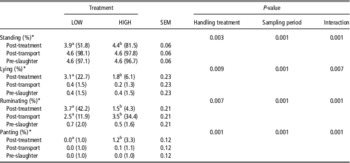
There was an effect of handling treatment, sampling period and the interaction of both variables on standing and lying times of lambs (Table 2). HIGH lambs spent more (P<0.001) time standing post-treatment than LOW lambs, but the time spent standing was similar between LOW and HIGH lambs post-transport and pre-slaughter. Both HIGH and LOW lambs spent more time standing post-transport (P<0.001) and pre-slaughter (P<0.001) than post-treatment. Conversely, HIGH lambs spent less (P<0.001) time lying post-treatment than LOW lambs, but the time spent lying was similar between LOW and HIGH lambs post-transport and pre-slaughter. Both HIGH and LOW lambs spent less time lying post-transport (P<0.001) and pre-slaughter (P<0.001) than post-treatment.
Percentage of observations (least squares means±SEM) low intensively (LOW: n=30) and high intensively handled (HIGH: n=30) lambs spent standing, lying, ruminating and panting before treatment (post-treatment), post-transport and before slaughter (pre-slaughter) at the abattoir

a,bMean values within a row with unlike superscript letters were significantly different (P<0.05).
* Log-transformed means. Back-transformed means are shown in parentheses·
There was an effect of handling treatment, sampling period and the interaction on rumination and panting time of lambs (Table 2). HIGH lambs spent less (P<0.001) time ruminating post-treatment but more (P<0.001) time ruminating post-transport than LOW lambs, but time spent ruminating did not differ between treatment groups pre-slaughter. Post-treatment, HIGH lambs spent more (P<0.001) time panting than LOW lambs, but time spent panting did not differ between treatment groups post-transport and pre-slaughter. HIGH lambs spent more time panting post-treatment than post-transport (P<0.001) or pre-slaughter (P<0.001), but LOW lambs spent a similar time panting post-transport and pre-slaughter as post-treatment.
Blood measures
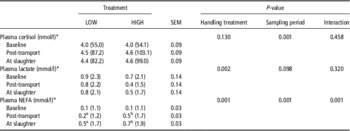
Plasma cortisol concentrations did not differ between handling treatments, and there was no interaction between handling treatment and sampling period (Table 3). However, cortisol concentrations were greater in lambs post-transport (P<0.001) and at slaughter (P<0.001) compared with baseline values, irrespective of handling treatment. Handling treatment affected plasma lactate concentrations in lambs (Table 3). Overall, lactate concentrations were lower in HIGH compared with LOW lambs. Furthermore, lactate concentrations were lower in lambs post-transport (P=0.044) and tended to be lower at slaughter (P=0.095) compared with baseline values, irrespective of handling treatment. There was no interaction between handling treatment and sampling period on lactate concentrations. There was an effect of handling treatment, sampling period and the interaction of both variables on plasma NEFA concentrations in lambs (Table 3). NEFA concentrations were higher (P<0.001) post-transport and higher (P<0.001) at slaughter in HIGH compared with LOW lambs. Furthermore, NEFA concentrations were higher in both HIGH and LOW lambs post-transport (P<0.001) and at slaughter (P<0.001) compared with baseline values.
Plasma cortisol, lactate and non-esterified fatty acid (NEFA) concentrations (least squares means±SEM) in low intensively (LOW: n=30) and high intensively handled (HIGH: n=30) lambs before treatment (baseline), post-transport and at slaughter at the abattoir

a,bMean values within a row with unlike superscript letters were significantly different (P<0.05).
* Log-transformed means. Back-transformed means are shown in parentheses.
Meat quality
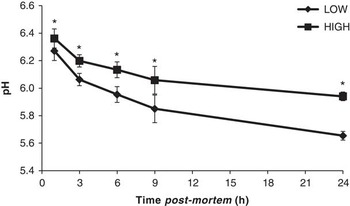
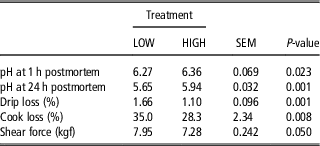
Meat pH was higher (P<0.05) in HIGH compared with LOW lambs at 1, 3, 6, 9 and 24 h postmortem and pH declined quicker (P=0.012) in LOW than HIGH lambs (Figure 2). Cook loss, drip loss and shear force were lower (P<0.05) in HIGH compared with LOW lambs (Table 4).
Postmortem pH decline in the M. longissimus lumborum muscle (least squares means±SEM) of low intensively (LOW: n=30) and high intensively handled (HIGH: n=30) lambs. *Treatments differ at P<0.05.

Meat tenderness values of low intensively (LOW: n=30) and high intensively handled (HIGH: n=30) lambs

Discussion
The HIGH intensity pre-slaughter handling regime used in the present study resulted in behavioural and physiological changes indicative of stress (increased panting and reduced rumination and plasma lactate levels) in lambs and had a correspondingly negative impact on meat pH. Increased standing, panting and reduced rumination performed by lambs exposed to the HIGH handling regime suggest that the 1.5 h enforced activity period before transport, in addition to the presence of a dog, and the 0.5 h enforced activity before slaughter was sufficient to cause stress in lambs. Animals experiencing stress or fear often spend less time ruminating. Herskin et al. (Reference Herskin, Munksgaard and Ladewig2004) found that rumination decreased in dairy cattle exposed to acute stress. In addition, sheep mainly ruminate when lying down (Caroprese et al., Reference Caroprese, Annicchiarico, Schena, Muscio, Migliore and Sevi2009). Therefore, low levels of rumination observed in HIGH lambs could be due to stress associated with the enforced physical activity and the presence of a dog and/or the increase in standing behaviour. Interestingly, HIGH lambs spent more time ruminating after transport. An i.v. injection of adrenaline was shown to increase rumination in sheep (Nicholson et al., Reference Newton and Gill1988), therefore increased rumination performed by HIGH lambs may suggest that transport stimulated a greater sympathetic nervous response in these animals. Alternatively, increased rumination performed by the HIGH group post-transport could be a compensatory effect due to lower pre-transport levels of rumination.
Cortisol concentrations were elevated in response to transport and lairage, suggesting that transport and lairage overnight at the abattoir were sufficient stressors to elevate cortisol levels in lambs regardless of previous handling experience. Elevated cortisol concentrations in sheep in response to loading and transport was also found by Broom et al. (Reference Broom, Goode, Hall, Lloyd and Parrott1996), Parrott et al. (Reference Parrott, Hall and Lloyd1998) and Zhong et al. (Reference Zhong, Liu, Zhou, Sun and Zhao2011). Differences in cortisol levels could also reflect natural fluctuations due to the circadian rhythm of cortisol in lambs. However, cortisol concentrations are usually lowest in the afternoon (Fulkerson and Tang, Reference Fulkerson and Tang1979; Simonetta et al., Reference Simonetta, Walker and McMillen1991) when the post-transport sample was taken and the baseline and slaughter samples were taken at approximately the same time of day, therefore the values found in the present experiment suggest the effect of sampling period. Cortisol concentrations increased by >35% in response to transport and lairage in lambs in the present study, however, the additional stress caused by the HIGH handling regime did not further stimulate the hypothalamic–pituitary–adrenal axis. The HIGH handling regime used may not have been sufficient to elicit a cortisol response or the marked cortisol response caused by transport and lairage may have masked the response to the HIGH handling treatment.
NEFA concentrations were elevated in lambs after transport and remained elevated at the time of slaughter. Increased plasma NEFA concentrations are indicative of enhanced lipolysis and energy mobilisation, and have been shown to occur in response to increased energy demands caused by withdrawal from feed and water (Knowles et al., Reference Knowles, Brown, Warriss, Phillips, Dolan, Hunt, Ford, Edwards and Watkins1995), exercise (Cockram et al., Reference Cockram, Murphy, Ringrose, Wemelsfelder, Miedema and Sandercock2012) and transport (Zhong et al., Reference Zhong, Liu, Zhou, Sun and Zhao2011) in sheep. The high intensive handling regime used in the present study exacerbated the NEFA response to transport and lairage in lambs, likely due to the extra energy demands caused by the three extra periods of enforced physical activity.
Transport and high intensive handling resulted in reduced lactate concentrations in lambs. Interestingly, De la Fuente et al. (Reference De la Fuente, Sánchez, Pérez, Lauzurica, Vieira, González de Chávarri and Díaz2010) found that lactate dehydrogenase was greater in lambs after a 30 min transport period but lower after a 5 h transport period compared with baseline values. In addition, lactate concentrations of sheep exercised for 2 h on a treadmill at a speed of 4.5 km/h increased by 55% in the first 15 min before declining below baseline levels (Pethick et al., Reference Pethick, Harman and Chong1987). Therefore, the lower lactate concentrations found in HIGH lambs and lambs after transport in the present study suggest that the physical activity associated with the HIGH handling regime, loading and unloading, and transport in combination with feed withdrawal may have diminished the animals’ glycogen reserves and hence ability to produce lactate.
High intensive handling caused higher meat pH levels and a slower pH decline compared with less intensively handled lambs. Several stressors imposed before slaughter have been shown to elevate postmortem pH levels in sheep, including transport alone (Zhong et al., Reference Zhong, Liu, Zhou, Sun and Zhao2011), transportation on rough roads (Ruiz-De-La-Torre et al., Reference Ruiz-De-La-Torre, Velarde, Diestre, Gispert, Hall, Broom and Manteca2001), exercise (Bond et al., Reference Bray, Graafhuis and Chrystall2004; Warner et al., Reference Warner, Ferguson, McDonagh, Channon, Cottrell and Dunshea2005) and swim washing (Geesink et al., Reference Geesink, Mareko, Morton and Bickerstaffe2001). Interestingly, stressors appear to have an accumulative effect on meat pH. In lambs exposed to underfeeding, shearing and swim washing, either singularly or combined, only lambs experiencing all three stressors consecutively were found to have elevated pH values (Bray et al., Reference Beausoleil, Stafford and Mellor1989). Furthermore, a linear relationship was found between the number of times lambs were washed on arrival in lairage and the mean ultimate pH (Petersen, Reference Petersen1983). Higher meat pH levels and a slower pH decline found in HIGH lambs suggest that the handling treatment used in the present study caused depletion of muscle glycogen stores before slaughter that resulted in a decrease in lactic acid production after slaughter. Sufficient glycogen in the muscle at the time of slaughter is needed to support lactate production post-slaughter to a level that results in desirable ultimate pH levels (⩽5.8; Meat & Livestock Australia, 2002; Bond et al., Reference Bray, Graafhuis and Chrystall2004). In the present study, pH levels of HIGH lambs were still higher than 5.8, 24 h post-slaughter. Therefore, limiting glycogen expenditure during handling and transport before slaughter by reducing the stressors experienced by lambs is one way which could potentially help prevent elevation of ultimate meat pH.
In the present study, drip loss and cooking loss was lower and meat (M. longissimus lumborum) was more tender from lambs that were intensively handled. Correspondingly, Warner et al. (Reference Warner, Ferguson, McDonagh, Channon, Cottrell and Dunshea2005) found that exposing lambs to acute exercise pre-slaughter caused high ultimate pH, increased tenderness, improved overall eating quality but caused dark-cutting (DC) meat. Meat & Livestock Australia (2002) and Bond et al. (Reference Bray, Graafhuis and Chrystall2004) classify meat with an ultimate pH between 5.8 and 6.9 and 5.7 and 5.9 as DC, respectively. However, others have categorised meat with pH values ⩾6.0 as DC (Newton and Gill, Reference Nicholson, Osman and Belkhiri1981; Devine et al., Reference Devine, Graafhuis, Muir and Chrystall1993; Apple et al., Reference Apple, Dikeman, Minton, McMurphy, Fedde, Leith and Unruh1995). Regardless, pH has a significant effect on meat colour and meat with high pH levels often appears darker-purple red and the surface of the meat is usually sticky (Newton and Gill, Reference Nicholson, Osman and Belkhiri1981). Although meat with a high ultimate pH is known to have greater water-holding capacity and tenderness (Sañudo et al., Reference Sañudo, Campo, Olleta, Joy and Delfa2007), colour is a key attribute that consumers use to assess meat freshness and wholesomeness and make purchasing decisions. A bright red colour is generally thought to indicate product freshness (Newton and Gill, Reference Nicholson, Osman and Belkhiri1981). Furthermore, DC meat is considered unsuitable for vacuum packaging and has a reduced shelf-life (Newton and Gill, Reference Nicholson, Osman and Belkhiri1981). Intense handling pre-slaughter may improve some aspects of meat quality; however, it could also potentially cause detrimental product quality.
After unloading at the processing facility, beef cattle and sheep are commonly held in pens to allow them to recover from transport before being slaughtered. During this lairage period animals have access to water but not feed and this lairage period can range from a few hours to overnight. In New Zealand animals are often left in lairage overnight. Lambs exposed to the high intensive handling regime in the present study still had high ultimate pH levels after a 14-h rest period, suggesting that these animals had not completely recovered from the stress caused by handling before slaughter. Ekiz et al. (Reference Ekiz, Ekiz, Kocak, Yalcintan and Yilmaz2012) found that an 18-h lairage period was sufficient to reduce the effect of transport on ultimate pH. Therefore, animals exposed to transport and intensive handling may require longer in lairage to recover. In the present study, cortisol concentrations at slaughter were still higher in LOW and HIGH lambs than baseline values. In addition, Ekiz et al. (Reference Ekiz, Ekiz, Kocak, Yalcintan and Yilmaz2012) found that cortisol concentrations of lambs after a 30 min or 18 h lairage period were still evaluated compared with baseline values. However, Liste et al. (Reference Liste, Miranda-de la Lama, Campo, Villarroel, Muela and María2011) found that lambs given a 12-h lairage period had lower cortisol concentrations than non-rested animals. Even though the purpose of the lairage period is to enable animals to recover from the stress of handling and transport, during this period animals are also exposed to a novel environment and usually feed deprivation, which could potentially cause additional stress. These findings highlight the potential impact that the pre-slaughter experience, transport, handling and lairage, can have on the resulting stress response and meat quality characteristics of lambs.
In conclusion, the high intensity pre-slaughter handling regime used in the present study resulted in behavioural and physiological changes indicative of stress in lambs, which resulted in some changes in M. longissimus lumborum meat quality characteristics, including a reduced rate of postmortem pH decline and higher ultimate pH. These results suggest that the time in lairage was not sufficient for animals to recover from the high intensity handling regime. Furthermore, limiting glycogen expenditure before slaughter by reducing the stressors experienced by lambs during handling may prevent elevation of meat pH and improve lamb meat product quality and consistency.
Acknowledgements
The authors gratefully acknowledge the assistance from AgResearch staff and Bella Worth. This study was funded by AgResearch Core Funding, contract A19124.