INTRODUCTION
Frugivores are essential for the maintenance of the plant community in tropical forests, where more than 80% of species produce fleshy animal-dispersed fruits (Howe & Smallwood Reference HOWE and SMALLWOOD1982). In the Brazilian Atlantic Forest, the percentage of animal-dispersed species can reach 90%, with approximately 50% of these being dispersed by birds (Almeida-Neto et al. Reference ALMEIDA-NETO, CAMPASSI, GALETTI, JORDANO and OLIVEIRA-FILHO2008). Anthropogenic disturbances that threaten the bird community, such as fragmentation and habitat loss (Marini & Garcia Reference MARINI and GARCIA2005, Ribon et al. Reference RIBON, SIMON and THEODORO DE MATTOS2003), constitute a maintenance challenge for plants because animal–plant interactions, including seed dispersal, are often broken (Cordeiro & Howe Reference CORDEIRO and HOWE2003, Galetti et al. Reference GALETTI, ALVES-COSTA and CAZETTA2003).
Agroforestry systems can maintain the general canopy structure of native forest, presenting an opportunity to ally agricultural development with biodiversity conservation (Bhagwat et al. Reference BHAGWAT, WILLIS, BIRKS and WHITTAKER2008). In some anthropogenically altered landscapes, they may constitute the only habitats with native tree cover (Greenberg et al. Reference GREENBERG, PERFECTO and PHILPOTT2008). Agroforests are often able to retain high avian species richness, compared with deforested areas or land under monoculture (Estrada et al. Reference ESTRADA, COATES-ESTRADA and MERITT1997, Goulart et al. Reference GOULART, VANDERMEER, PERFECTO and DA MATTA-MACHADO2011), and upon abandonment they can be integral in the regeneration of bird and plant communities (Lozada et al. Reference LOZADA, DE KONING, MARCHE, KLEIN and TSCHARNTKE2007). However, conversion of primary forest to agroforest usually results in some form of impoverishment of the avian species assembly, often with a loss of forest frugivores and proliferation of generalist species (Pardini et al. Reference PARDINI, FARIA, ACCACIO, LAPS, MARIANO-NETO, PACIENCIA, DIXO and BAUMGARTEN2009). These community alterations can affect seed dispersal and compromise plant recruitment in the area (Breitbach et al. Reference BREITBACH, LAUBE, STEFFAN-DEWENTER and BÖHNING-GAESE2010, Reference BREITBACH, BÖHNING-GAESE, LAUBE and SCHLEUNING2012).
Cocoa (Theobroma cacao L.) agroforests are used by a variety of bird species (Greenberg et al. Reference GREENBERG, BICHIER and ANGÓN2000, Laps et al. Reference LAPS, CORDEIRO, KAJIWARA, RIBON, RODRIGUES, UEJIMA, Rambaldi and Oliveira2003, Van Bael et al. Reference VAN BAEL, BICHIER, OCHOA and GREENBERG2007), however, avian diversity also depends on the percentage of forest present in the landscape (Faria et al. Reference FARIA, LAPS, BAUMGARTEN and CETRA2006). Few studies address whether agroforests are able to maintain important community ecological interactions, and this approach at the landscape scale is nonexistent in the literature. Understanding the ecological functionality of these environments is of fundamental importance. Therefore the main objective of this study was to evaluate the influence of forest and cocoa agroforest systems on understorey fruit consumption by birds in two landscapes with different percentages of forests.
Previous studies developed in the cocoa region from southern Bahia have demonstrated a reduction in frugivorous and increase in generalist bird species in agroforests in comparison to forested areas, and also in landscapes dominated by agroforests (Faria et al. Reference FARIA, LAPS, BAUMGARTEN and CETRA2006, Laps Reference LAPS2006, Laps et al. Reference LAPS, CORDEIRO, KAJIWARA, RIBON, RODRIGUES, UEJIMA, Rambaldi and Oliveira2003). Thus, we expected to find greater avian fruit consumption in the landscape with greater natural forest cover. Within each landscape, we predicted that avian fruit consumption would be greatest in natural forest fragments compared with cocoa agroforests, especially those in landscapes with low forest cover. We also predicted higher fruit consumption in abandoned cocoa agroforests compared with managed cocoa agroforests, since regenerating plants may provide a more continuous understorey in abandoned cocoa agroforests, facilitating use by birds (Laps et al. Reference LAPS, CORDEIRO, KAJIWARA, RIBON, RODRIGUES, UEJIMA, Rambaldi and Oliveira2003).
METHODS
Study sites
The southern Bahia is located in the centre of the cocoa region, where cocoa plantations are shaded by native species in a system known locally as cabrucas. These agroforests can contain a high species diversity of trees (Sambuichi et al. Reference SAMBUICHI, VIDAL, PIASENTIN, JARDIM, VIANA, MENEZES, MELLO, AHNERT and BALIGAR2012) and a well-known fauna (Faria et al. Reference FARIA, PACIENCIA, DIXO, LAPS and BAUMGARTEN2007). We studied two landscapes in southern Bahia, with contrasting amounts of natural forest versus shade cocoa plantation cover. Landscape A, with high forest cover, is located in the municipality of Una, which holds one of the largest remnants of Atlantic Forest in north-eastern Brazil, found in the Una Biological Reserve. Established in 1980, it is an 18,000-ha conservation area (Araujo et al. Reference ARAUJO, ALGER, ROCHA and MESQUITA1998, Coimbra-Filho et al. Reference COIMBRA-FILHO, DIETZ, MALLINSON and SANTOS1993, Schroth et al. Reference SCHROTH, FARIA, ARAUJO, BEDE, VAN BAEL, CASSANO, OLIVEIRA and DELABIE2011). Landscape A is composed of a mosaic of habitats characteristic of southern Bahia, with fragments of primary and secondary forest of various sizes (Pardini Reference PARDINI2004). Land use in the area includes cattle pasture, rubber plantations, piassava palm (Attalea funifera Mart.) and cocoa plantations shaded by native trees, rubber (Hevea brasiliensis (Willd. ex A.Juss.) Müll.Arg.) and exotic species like Erythrina spp. (Araujo et al. Reference ARAUJO, ALGER, ROCHA and MESQUITA1998). Over 60% of the landscape is composed of primary and secondary forest fragments, characterizing this landscape as variegated (McIntyre & Hobbs Reference MCINTYRE and HOBBS1999); existing cocoa plantations are small and spaced far apart in the landscape (Araujo et al. Reference ARAUJO, ALGER, ROCHA and MESQUITA1998, Faria et al. Reference FARIA, LAPS, BAUMGARTEN and CETRA2006). Landscape B is dominated by shade cocoa plantations greater than 50 y old and is located in the municipalities of Ilhéus and Uruçuca. The cocoa is cultivated in medium to high soil fertility (Santana et al. Reference SANTANA, RAMOS, RUIZ, ARAUJO, ALMEIDA, FILHO, MENDONÇA and SANTOS2003) and is shaded by native canopy trees, as well as exotics, like Erythrina spp. (Sambuichi & Haridasan Reference SAMBUICHI and HARIDASAN2007). The few existing forest fragments are small compared with those in Landscape A (< 200 ha) and are located within a matrix of large areas of shade cocoa plantations (Faria et al. Reference FARIA, LAPS, BAUMGARTEN and CETRA2006).
We defined our landscapes as an area of 10-km radius around each set of habitats sampled, and calculated the per cent forest and shade cocoa plantation cover within each landscape using buffer analysis. Landscape A is composed of 49.8% forest and 16.1% shade cocoa plantation, while Landscape B is composed of 19.6% forest and 45.5% shade cocoa plantation. It is important to point out that the map used in our study was created approximately 12 y ago and since then both landscapes have been altered, however, the contrast in the quantity of forest and shade cocoa plantation cover has remained the same.
In each landscape we sampled six areas, three forest fragments and three managed shade cocoa plantations. To minimize effects caused by environmental variation, we sampled the different habitat types in pairs (forest and shade cocoa plantation) located approximately 5 km away. In addition to the six sites sampled in each landscape, we also sampled three additional sites in Landscape A, dominated by natural forest. These sites were in areas of abandoned shade cocoa plantations; two had not been managed nor experienced cocoa harvesting for approximately 7 y and one still underwent cocoa harvesting, but understorey thinning did not regularly occur. The principal criterion for selection of abandoned shade cocoa plantations was the presence of a developed understorey. We did not sample abandoned shade cocoa plantations in the agroforestry-dominated landscape because all cocoa plantations habitats were under current cultivation and underwent frequent understorey thinning.
Many metrics can be used to evaluate the landscape but we select forest cover because it is a simple measure less open to misinterpretation and it is an effective means of synthesizing factors that influence habitat selection (Cunningham & Johnson Reference CUNNINGHAM and JOHNSON2011). In addition, studies have demonstrated that the abundance of forest habitat is a measure of landscape more important to be taken into account than the characteristics of fragmentation (Cunningham & Johnson Reference CUNNINGHAM and JOHNSON2011, Lichstein et al. Reference LICHSTEIN, SIMONS and FRANZREB2002, Trzcinski et al. Reference TRZCINSKI, FAHRIG and MERRIAM1999).
Field protocols
In each sampling location, we set up 25 experimental stations spaced every 50 m along a pre-existing transect, with sampling initiated 200 m from the edge of the forest fragment or shade cocoa plantation. The total transect length was 1.25 km. Each experimental station consisted of a shrub, 1–2 m in height, onto which we affixed 15 artificial fruits with sewing thread, with a minimum distance of 20 cm between another fruit to guarantee that a perched bird could not peck two fruits.
We used artificial fruits made from non-toxic, blue Acrilex® modelling clay. Fruits were round and 14 mm in diameter, following Alves Costa & Lopes (Reference ALVES COSTA and LOPES2001). This fruit size was chosen because birds usually consumed fruits smaller than 20 mm in diameter (Wheelwright Reference WHEELWRIGHT1985, Willson et al. Reference WILLSON, IRVINE and WALSH1989). Alves Costa & Lopes (Reference ALVES COSTA and LOPES2001) suggested that the use of artificial fruits is an efficient way to evaluate fruit consumption by birds. This method allows controlling many variables that influence fruit selection by birds such as size, colour and number (Alves-Costa & Lopes Reference ALVES COSTA and LOPES2001). Artificial fruits were also used successfully in a previous study to evaluate the effect of forest fragmentation on fruit consumption by birds (Galetti et al. Reference GALETTI, ALVES-COSTA and CAZETTA2003). We used blue fruits because they provide the highest chromatic contrast with the natural background of green leaves, facilitating detection by birds (Cazetta et al. Reference CAZETTA, SCHAEFER and GALETTI2009).
We considered as fruits consumed the fruits pecked or removed by birds after 72 h, but it is worth mentioning that birds do not consume fruits effectively. We used bite mark characteristics to distinguish whether a mammal, bird or invertebrate was responsible for marking the artificial fruits (Alves Costa & Lopes Reference ALVES COSTA and LOPES2001). Mammals left teeth marks in the clay, invertebrates left dots or striations, and birds left beak marks. Since our focus was on avian frugivory, we excluded fruits marked only with evidence of mammal or invertebrate marks from our analysis (N = 84 fruits). Removed fruits were considered as consumed by birds because most of them were found close to the experimental station with beak marks.
Since the quantity of incident light present in the understorey can influence fruit detection by birds (Endler Reference ENDLER1993), we took hemispheric photographs above each experimental station to evaluate canopy openness. We analysed photos using Gap Light Analyzer® (GLA, version 2.0), which converts the photograph into black-and-white and counts pixels not covered by vegetation to supply a value of canopy openness (Frazer et al. Reference FRAZER, CANHAM and LERTZMAN1999).
Statistical analyses
To compare mean fruit consumption between landscapes and between habitat types within landscapes, we used a nested analysis of variance (ANOVA). We used a one-way ANOVA to examine whether fruit consumption varied among forest fragments, managed shade cocoa plantations, and abandoned shade cocoa plantations in Landscape A. For analysis, the total number of fruits consumed (bitten + removed) was transformed into log10 (x + 1).
We developed logistic regression models to evaluate the relationship between fruit detection (dependent variable) and habitat and landscape type (independent variables), and possible interactions between them. For this, fruit detection was considered as a binary variable, receiving a value of one when at least one fruit from the experimental station was bitten or removed and zero when all fruits at the station remained intact.
Canopy openness values were used as a predictive variable in a two-way ANOVA to evaluate if there was a difference in canopy openness between habitats or landscapes. Relationships between the probability of fruit detection and canopy openness of areas within the landscapes and the interaction between the predictor variables were tested using models of logistic regression. All analyses were performed using software R.
RESULTS
Between-landscape comparisons
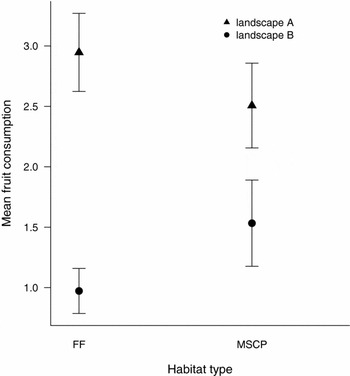
Landscape A showed the greatest fruit consumption in both forest fragments and shade cocoa plantations, with 19.5% (N = 1125) of fruits consumed in the forest fragments and 16.7% (N = 1125) in the shade cocoa plantations. In Landscape B, 6.5% (N = 1080) of fruits were consumed in forest fragments and 10.2% (N = 1125) in shade cocoa plantations. Fruit consumption was significantly different between Landscapes A and B (nested ANOVA, F = 37.7, df = 1, P < 0.001), but we found no significant difference in fruit consumption between habitat types (forests versus shade cocoa plantations) (F = 0.58, df = 1, P = 0.44; Figure 1).
Mean number and SE of artificial fruits consumed per experimental station in landscapes dominated by natural forest fragments (Landscape A) and shade cocoa plantation (Landscape B) in southern Bahia, Brazil (FF, forest fragment; MSCP, managed shade cocoa plantation).

The probability of fruit detection was also different between the landscapes (χ2 = 26.4, df = 1, P < 0.001), with detection greater in Landscape A (72.7% N = 150) than Landscape B (43.5%, N = 147). Forest fragments (80%, N = 75) and shade cocoa plantations (65.3%, N = 75) in Landscape A had higher detection than forest fragments (45.3%, N = 64) and shade cocoa plantations (42.6%, N = 75) in Landscape B. There was no significant difference in the probability of fruit detection between habitat types within each landscape (χ2 = 2.3, df = 1, P = 0.12).
Landscape A: forest-dominated Una landscape
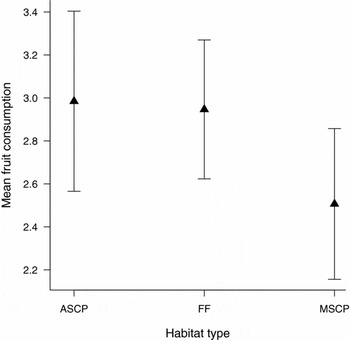
In Landscape A, 18.7% (N = 3225) of the fruits were consumed, 19.6% (N = 1125) in forest fragments, 19.9% (N = 975) in abandoned shade cocoa plantations, and 16.7% (N = 1125) in managed shade cocoa plantations, however, differences were not significant (F = 1.02, df = 2, P = 0.36; Figure 2). Forest fragments showed the highest percentage of fruit detection (80%, N = 75), compared with abandoned shade cocoa plantations (67.7%, N = 65) and managed shade cocoa plantations (65.3%, N = 75), however the probability of fruit detection also did not differ between these habitats (χ2 = 4.64, df = 2, P = 0.1).
Mean number and SE of artificial fruits consumed per experimental station in forest fragments (FF), abandoned shade cocoa plantation (ASCP) and managed shade cocoa plantation (MSCP), located within a landscape dominated by natural forest fragments (Landscape A), southern Bahia, Brazil.

Canopy openness
Mean canopy openness was 10.2% in shade cocoa plantations in both landscapes and 6.96% and 7.04% in forest fragments, for landscapes A and B, respectively. There was no significant difference in canopy openness between Landscapes A and B. However, within each landscape, canopy openness differed significantly between habitat types (F = 85.4, df = 1, P < 0.001), with shade cocoa plantations exhibiting greater canopy openness than forest fragments. We found no significant interaction between area and landscape (F = 0.03, df = 1, P < 0.85).
DISCUSSION
Our results demonstrate the importance of the presence of natural forest fragments in agricultural landscapes for the maintenance of frugivory by birds. Contrary to what we expected, forests and shade cocoa plantations showed similar fruit consumption by birds. However, as we predicted, fruit detection and consumption was significantly lower in the landscape dominated by agroforests compared with landscapes predominated by primary- and secondary-forest fragments, which may have important consequences for the recruitment of plant species in these environments.
Schroth et al. (Reference SCHROTH, HARVEY, VINCENT, Schroth, Fonseca, Harvey, Gascon, Vasconcelos and Izac2004) showed that the role of agroforests in the maintenance of biodiversity depends on the presence of intact forest in the landscape. Faria et al. (Reference FARIA, LAPS, BAUMGARTEN and CETRA2006, Reference FARIA, PACIENCIA, DIXO, LAPS and BAUMGARTEN2007) and Pardini et al. (Reference PARDINI, FARIA, ACCACIO, LAPS, MARIANO-NETO, PACIENCIA, DIXO and BAUMGARTEN2009) demonstrated that anthropogenically modified forested landscapes, similar to our Landscape B, experienced an increase in generalist species and a reduction in forest specialists compared with landscapes where forests were left intact. These studies may help explain the similar fruit consumption found between habitat types in Landscape B.
Fahrig & Merriam (Reference FAHRIG and MERRIAM1994) called attention to the importance of the landscape matrix in which forest remnants are found. Attention must be given to the permeability of the matrix to movement of species between fragments, rather than only focusing on the capacity of fragments to hold species. A landscape with a permeable agricultural matrix with highly reduced forest cover and highly disturbed forest fragments is likely unable to support a diverse avian community. Because the seed dispersal process is positively related to bird diversity (Bleher & Böhning-Gaese Reference BLEHER and BÖHNING-GAESE2001, Cordeiro & Howe Reference CORDEIRO and HOWE2003, Wright & Duber Reference WRIGHT and DUBER2001) consequently, ecological processes involving birds may cease to function. Furthermore, Jordano (Reference JORDANO1987) showed a high dependence of a plant species on a bird species in systems where bird diversity is low. Thus seed dispersal process becomes vulnerable to any anthropogenic disturbance.
The simplification of the understorey and scarcity of food resources causes a reduction in the species richness of avian frugivores of this stratum in shade cocoa plantations (Laps Reference LAPS2006, Laps et al. Reference LAPS, CORDEIRO, KAJIWARA, RIBON, RODRIGUES, UEJIMA, Rambaldi and Oliveira2003). The periodic thinning of the understorey in cocoa plantations greatly reduces plant recruitment. Consequently, agroforest-dominated landscapes often experience a collapse in their understorey plant community (Alves Reference ALVES1990), which further reduces fruit consumption rates, as well as future plant recruitment.
Landscapes with larger percentages of forest cover have less isolated fragments (Fahrig Reference FAHRIG2003), so perhaps it is unsurprising that in the Una landscape (A), dominated by natural forest fragments, we found similar fruit consumption between forest fragments, managed shade cocoa plantations and abandoned shade cocoa plantations. The presence of emerging secondary forests, cocoa plantations and pastures connected by large blocks of forest constitutes a heterogeneous matrix favouring the movement of birds among habitats (Laps et al. Reference LAPS, CORDEIRO, KAJIWARA, RIBON, RODRIGUES, UEJIMA, Rambaldi and Oliveira2003).
Our results showed that even in a landscape dominated by agroforests, fruit detection and consumption by birds were similar between shade cocoa plantations and forest fragments. This may indicate that bird communities in our system exhibit some degree of ecological redundancy (Walker Reference WALKER1992), so that frugivory may continue in these habitats, carried out by the more generalist species often found to increase when forests are converted to shade cocoa plantations or other types of agroforest (Faria et al. Reference FARIA, LAPS, BAUMGARTEN and CETRA2006). Although we found no difference in fruit consumption between areas (forests versus shade cocoa plantations), we did not measure plant reproductive success, so we do not know whether it varies between these habitats. We know that different species of birds disperse seeds in different patterns (Loiselle & Blake Reference LOISELLE, BLAKE, Levey, Silva and Galetti2002), and the impoverishment of an assembly of birds can cause the loss of important dispersers that play particular roles (Bleher & Böhning-Gaese Reference BLEHER and BÖHNING-GAESE2001). For example, Breitbach et al. (Reference BREITBACH, LAUBE, STEFFAN-DEWENTER and BÖHNING-GAESE2010, Reference BREITBACH, BÖHNING-GAESE, LAUBE and SCHLEUNING2012) did not find differences in the seed removal rate of wild cherry (Prunus avium) in farms versus primary forests, however, the distance of dispersal and consequent recruitment of seedlings was lower in agricultural habitats.
While canopy cover is often reduced in agroforests, causing declines in avian abundance (Philpott & Bichier Reference PHILPOTT and BICHIER2011), we found no relationship between canopy openness and the detection and consumption of fruits in our study area. Canopy cover was similar between the shade cocoa plantations in the two landscapes, while fruit consumption differed. Fruit consumption in the shade cocoa plantations of Landscapes A and B may be more influenced by landscape composition than by management practices on shade cocoa plantations, such as the amount of shade in which the cocoa is cultivated (Perfecto et al. Reference PERFECTO, MAS, DIETSCH and VANDERMEER2003).
Freemark & Merriam (Reference FREEMARK and MERRIAM1986) evaluated the importance of habitat heterogeneity for the avian assembly in forest fragments, and found a positive relationship between avian abundance and understorey tree diversity of an area. Laps et al. (Reference LAPS, CORDEIRO, KAJIWARA, RIBON, RODRIGUES, UEJIMA, Rambaldi and Oliveira2003) suggested that abandoned shade cocoa plantations are used more by understorey birds than managed shade cocoa plantations, since the absence of cultivation provides a more natural understorey for the bird community. However, we found that forest fragments and shade cocoa plantations did not differ in avian fruit consumption within each landscape, so that understorey modification is not influencing the number of fruits consumed.
Tabarelli et al. (Reference TABARELLI, AGUIAR, RIBEIRO, METZGER and PERES2010) showed that agroforests are valuable to conservation, since they can act as ecological corridors in anthropogenically altered landscapes where protected areas are not sufficient to maintain species diversity. However they are unable to substitute for primary forests (Sambuichi et al. Reference SAMBUICHI, VIDAL, PIASENTIN, JARDIM, VIANA, MENEZES, MELLO, AHNERT and BALIGAR2012). Our study show that the characteristics of the landscape matrix in which agroforests occur might determine the roles agroforests can play in the maintenance of ecological interactions, in agreement with previous studies on avian species richness and abundance in these habitats (Faria et al. Reference FARIA, LAPS, BAUMGARTEN and CETRA2006, Reference FARIA, PACIENCIA, DIXO, LAPS and BAUMGARTEN2007). To evaluate only the capacity of agroforestry systems themselves to shelter bird species, while neglecting the maintenance of ecological interactions, is insufficient to create effective conservation strategies.
ACKNOWLEDGEMENTS
We thank FAPESB (PPP 0041/2010) and the Universidade Estadual de Santa Cruz (00220.1100.773) for financing the Project and Dr Gil Marcelo Reuss Strenzel for cartographic assistance. J. A. Bomfim thanks the Brazilian National Council of Technological and Scientific Development (CNPq) for her Master's degree fellowship (133967/2010-7).