INTRODUCTION
The occurrence of cetaceans along most of the West African coast is poorly documented (Jefferson et al., Reference Jefferson, Curry, Leatherwood and Powell1997; Weir, Reference Weir2010). This is particularly the case between Angola and the Gulf of Guinea, where civil unrest and logistical challenges have hindered the development of cetacean studies. In recent years, research has commenced in some more accessible countries within this region, primarily focusing on coastal wintering populations of the humpback whale Megaptera novaeangliae, e.g. off Angola (Best et al., Reference Best, Reeb, Morais and Baird1999), Gabon (Walsh et al., Reference Walsh, Fay, Gulick and Sounguet2000; Rosenbaum & Collins, Reference Rosenbaum and Collins2006), São Tomé (Picanço et al., Reference Picanço, Carvalho and Brito2009) and Benin (Van Waerebeek et al., Reference Van Waerebeek, Tchibozo, Montcho, Nobime, Sohou, Sehouhoue and Dossou2001). However, knowledge of the basic occurrence of cetacean species remains poor, and practically nothing is known of the status, ecology and biology of most species in the region.
Angola, located between 6°S and 17°S, has the longest coastline in this region. Previous knowledge of cetacean occurrence off Angola was largely limited to whaling records originating predominantly between 1770 and 1928. Yankee whalers followed by modern shore-based whaling stations and floating factories operated mostly in southern Angola (12°20′S to 16°40′S) at Baia dos Tigres, Tombwa (formerly Porto Alexandre), Namibe (formerly Mossamedes), Baia dos Elefantes and Lobito (Townsend, Reference Townsend1935; Mouzinho de Figueiredo, Reference Mouzinho de Figueiredo1958; Best & Ross, Reference Best and Ross1986). Catches off Angola primarily comprised humpback whales but also included blue Balaenoptera musculus, fin B. physalus, sei B. borealis, Bryde's B. cf. brydei, southern right Eubalaena australis and sperm Physeter macrocephalus whales (Harmer, Reference Harmer1928; Townsend, Reference Townsend1935; Best, Reference Best1994). Small catches of sperm whales (Mikhalev et al., Reference Mikhalev, Savusin, Kishiyan and Ivashin1981) and Bryde's whales (misidentified at the time as ‘sei whales’: Best, Reference Best1996, Reference Best2001) continued in the region into the 1970s.
Other than whaling data, published records of cetaceans in Angolan waters comprise a handful of opportunistic sighting, stranding and bycatch records (see Weir, Reference Weir2010), with the exception of a short dedicated study of humpback whales from a platform off northern Angola (6°52′S) in September 1999 (Best et al., Reference Best, Reeb, Morais and Baird1999). However, in 2004 two separate events resulted in a marked increase in interest and knowledge of Angola's cetacean fauna. Firstly, the oil and gas industry began to implement biologists onboard geophysical survey vessels working in northern Angola, producing novel information on the occurrence of cetaceans particularly in offshore waters (Weir, Reference Weir2008). Secondly, an amateur naturalist kayaking along Angola's coast in the summer of 2004 recorded four sightings of humpback dolphins Sousa sp. between Namibe and Tombwa in Namibe Province, southern Angola (Van Waerebeek et al., Reference Van Waerebeek, Barnett, Camara, Cham, Diallo, Djiba, Jallow, Ndiaye, Samba Ould Bilal and Bamy2004; Weir, Reference Weir2008). These dolphins were presumed to be Atlantic humpback dolphins S. teuszii rather than the closely-related Indo-Pacific humpback dolphin (S. chinensis), based on the known geographical distribution of the two species. The latter observations were significant, since although endemic to tropical and subtropical West Africa, the Atlantic humpback dolphin had not previously been confirmed to occur in Angola (Van Waerebeek et al., Reference Van Waerebeek, Barnett, Camara, Cham, Diallo, Djiba, Jallow, Ndiaye, Samba Ould Bilal and Bamy2004). Furthermore, the species is thought to be under considerable anthropogenic pressure throughout its range and is considered vulnerable to extinction (IUCN, 2009).
This paper reports on cetacean species recorded in the coastal waters of Namibe Province, Angola during the austral summer and winter of 2008. The study was primarily aimed at collecting data on the number, distribution and behaviour of Atlantic humpback dolphins in the region (Weir, Reference Weir2009). However, since almost no information is available on the cetaceans inhabiting coastal Angolan waters, particularly in the southern region, the current paper had the following objectives: (1) to describe the species of cetacean occurring off Namibe Province during the austral summer and winter; (2) to determine whether their occurrence varied between the two study seasons; and (3) to examine the group size and composition, the occurrence of mixed-species schools and the behaviour of cetaceans in the region.
MATERIALS AND METHODS
Data collection
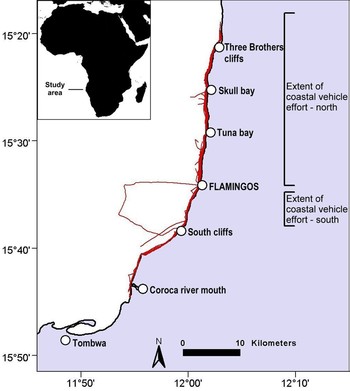
The study area comprised approximately 55 km of coastline centred off Flamingos (15°33′S 12°01′E), located between Tombwa and Namibe in Namibe Province, southern Angola (Figure 1). The continental shelf is narrow and extends only around 15 km from the coast; however, accurate water depth data are not available due to poor oceanographic coverage of the area. The study area is influenced by spatio-temporal movements of the Angola–Benguela front, which forms at around 14–17°S latitude (depending on season) at the convergence of the southward-flowing warm Angola Current and the coastal northward-flowing cold Benguela Current (Hardman-Mountford et al., Reference Hardman-Mountford, Richardson, Agenbag, Hagen, Nykjaer, Shillington and Villacastin2003). This area forms the northern boundary of the productive Benguela Current ecosystem, and extends furthest northwards during the winter months.
Location of the study area off southern Angola, showing the location of boat effort (red) and the extent of the coastal vehicle effort.

Survey data were collected using a combination of boat, fixed-shore and vehicle survey methods from 11–30 January 2008 (austral summer) and 16 June–5 July 2008 (austral winter). Boat surveys were carried out using a 5-m rigid-hulled inflatable boat fitted with an 85 hp Yamaha outboard engine. The typical survey route comprised return surveys either 30 km north or 25 km south of Flamingos, and usually within 1 km of the coast (since the survey was particularly aimed at recording the Atlantic humpback dolphin). However, one survey covered an area out to 12 km from the coast (Figure 1). Vehicle surveys were conducted using a 4 × 4 vehicle which was driven along the beach within 100 m of the water and at a survey speed of around 15 km/h. The daily vehicle survey route included return surveys along 7 km of coast south of Flamingos and up to 30 km north of Flamingos (Figure 1). Timed shore-based cetacean watches were conducted by the author from a fixed 4-m height vantage point at Flamingos.
The survey methodology comprised continuous scanning (Mann, Reference Mann1999) by the author with the naked eye and 10 × 42 binoculars. Environmental data (Beaufort sea state, swell visibility and sun glare) were logged throughout, and during boat- and vehicle-based surveys the position was recorded at 1-minute intervals using a Garmin GPS 76CSx.
Whenever cetaceans were observed, the survey effort switched from ‘search’ to ‘encounter’ mode, and data including the species, group size and composition, behaviour and GPS position were noted. A sighting was considered to be any encounter with one or more cetaceans. A best estimate of group size was recorded, with ‘group’ defined as animals engaged in the same activity or travelling in the same direction as others (Shane, Reference Shane, Leatherwood and Reeves1990). Cetacean species were considered to be in a ‘mixed-species group’ if they were swimming close to one another (within 200 m), in a similar direction and exhibiting similar behaviour.
Animals were classified into adults, juveniles and calves where possible, using the following criteria: individuals that appeared full grown were recorded as ‘adult’, individuals obviously smaller than full-grown (75% adult size) were defined as ‘juveniles’ and very small animals (often with foetal folds) closely association with an adult, were classified as ‘calves’.
Behaviour was defined as the activity that most (>50%) of the group were engaged in (ad libitum sampling; Mann, Reference Mann1999), and was assigned to five categories: (1) resting when animals were motionless at the surface; (2) travelling when they exhibited persistent, directional movement in one direction; (3) foraging, indicated by lower directional movement with regular coordinated changes of direction, longer dives and less coordination; (4) feeding comprising frequent dives in varying directions accompanied variously (depending on species) by splashing, surface-rushing, fish chases, lunges and prey capture; and (5) play/socializing including breaching, surfing, high-speed movement and body contact with other animals (including sexual).
Sea surface temperature (SST) was measured at the location of boat-based cetacean sightings using a Minilog 8-bit data logger.
Data analysis
Only data collected by the author in Beaufort sea states ≤4, visibility ≥5 km and while in cetacean ‘search’ mode are included in the analyses. All sightings were allocated to one of four categories: (1) boat on-effort; (2) vehicle on-effort; (3) fixed-site on-effort; and (4) off-effort (opportunistic sightings and those recorded during cetacean ‘encounter’ mode). Only on-effort sightings were used to calculate sighting rates.
Sighting rates were calculated separately for each survey platform. For boat and vehicle data, sighting rates were calculated as the number of sightings per km travelled. For fixed-site data, the sighting rate was calculated as the number of sightings per hour of observation time. Since the amount of data collected from each platform in some Beaufort sea states was small, species-specific correction factors to compensate for the effect of sea state on detection (Palka, Reference Palka1996) could not be calculated. Instead, only data collected in Beaufort sea states 0 to 4 (see Hammond et al., Reference Hammond, Berggren, Benke, Borchers, Buckland, Collet, Heide-Jørgensen, Heimlich, Hiby, Leopold and Øien2002) were utilized.
Seasonal changes in the sighting rate of each species could not be directly compared due to seasonal variation in the type of survey platform used. However, the overall occurrence of cetaceans in each season was examined for evidence of seasonality. The combined dataset was also analysed to examine the group size and composition (in each season when sample size was sufficient), and behaviour of each species.
RESULTS
Survey effort
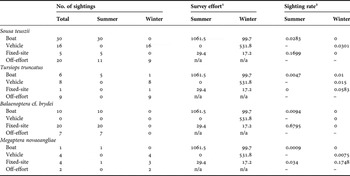
A total of 1161.2 km (96.5 hours) of boat-based search effort was carried out in Beaufort sea states ≤4 (Table 1), with most (1061.5 km) occurring during the summer and only two surveys (99.7 km) during the winter due to engine failure of the survey vessel. Vehicle effort occurred only during the winter months (Table 1). A total of 46.6 hours of fixed-site survey effort was collected at Flamingos over both seasons (Table 1).
Survey effort (Beaufort sea states ≤4) and sighting rates of four cetacean species recorded off Namibe Province during summer and winter 2008.

1 km travelled for boat and vehicle effort, and hour surveyed for fixed-site effort; 2 calculated as sightings/km for boat and vehicle datasets, and sightings/hour for the fixed-site dataset; n/a, not applicable.
Cetacean sightings
The surveys resulted in a total of 148 cetacean sightings, 143 of which comprised four species (Table 1). One sighting of an unidentified baleen whale and four sightings of unidentified dolphins (at least one thought to be common dolphin, Delphinus sp.) are not considered further in this paper.
ATLANTIC HUMPBACK DOLPHIN (SOUSA TEUSZII)
The Atlantic humpback dolphin was the most frequently-sighted species in the study area, with a total of 71 sightings and 263 animals recorded. Most sightings occurred during the summer (Table 1), but the sighting rate was similar during summer (using boat-based effort) and winter (using vehicle-based effort) indicating a year-round occurrence (Table 1). Encounters were recorded at distances of between 5 and 1400 m from shore, with a mean closest distance of 91.8 m (SD = 122.2, N = 71) and a mean greatest distance of 297.1 m (SD = 226.4, N = 71). During most (N = 46, 65%) encounters, dolphins remained entirely within 300 m of the shore. Mean SST during boat-based sightings was 22.15°C (SD = 1.62, N = 19).
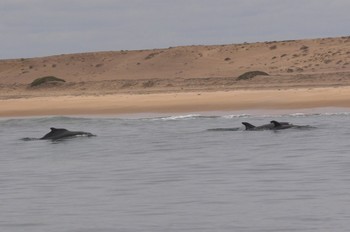
Group size ranged from 1 to 8 animals, with a median of 2.0 individuals (N = 71, interquartile range (IQR) = 5.0). The median group size was significantly higher (Mann–Whitney U-test, U = 373.50, P = 0.011) during the winter (median = 7.0, IQR = 7.0, N = 25) than the summer (median = 2.0, IQR = 5.0, N = 46). The majority of sightings (N = 31) comprised single adult animals. Adult pairs were observed on 8 occasions. The remaining sightings (N = 32) comprised groups of 4–8 animals including calves and juveniles. One sighting involved a mixed-species aggregation between a single humpback dolphin and three bottlenose dolphins (Figure 2).
A mixed-species association between Atlantic humpback dolphin (left) and bottlenose dolphins (right) off Flamingos.

Atlantic humpback dolphins exhibited a combination of travel and forage/feed behaviour, travelling along the coast for extended periods and then stopping to forage/feed in particular areas. Behaviour and habitat use are fully described by Weir (Reference Weir2009).
BOTTLENOSE DOLPHIN (TURSIOPS TRUNCATUS)
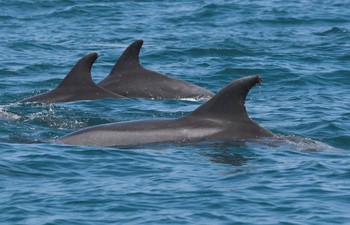
There were a total of 24 bottlenose dolphin sightings during the surveys, comprising at least 336 animals. These animals exhibited a moderate-length beak and a notably marked pale cape blaze (Figure 3). The taxonomy of bottlenose dolphins worldwide requires further genetic clarification, but the dolphins seen off Namibe seemed consistent with an inshore form of the common bottlenose dolphin (T. truncatus).
Bottlenose dolphins in the study area, showing the marked pale cape blaze (the barnacle Xenobalanus globicipitis is attached to the tip of their dorsal fins).

Although present during both survey seasons, the number of sightings and the sighting rate of bottlenose dolphins were higher during the winter (Table 1). Bottlenose dolphin group size ranged from 1 to 50 animals, with a median of 8.0 individuals (IQR = 20.8, N = 24). The group size was higher during the winter (median = 10, IQR = 24.0, N = 19) than during the summer (median = 2, IQR = 2.0, N = 5). Mean SST during boat-based sightings was 22.07°C (SD = 0.23, N = 3).
Bottlenose dolphin sightings were recorded at distances of between 0.03 and 1.4 km from shore, with a mean closest distance of 0.4 km (SD = 0.3, N = 24) and greatest distance of 0.5 km (SD = 0.4, N = 24). Group composition was assessed during 12 sightings. Six of these (group size = 1–5) comprised adult animals only, 4 groups (group size = 3–8) included a juvenile, and the two largest groups (group size = 25–40) contained 20–23% calves and juveniles.
The dominant behaviour during all bottlenose dolphin sightings was travel parallel to the beach, occasionally accompanied by Cape fur seals (Arctocephalus pusillus). In most instances (N = 19) dolphins headed south. One school of three dolphins observed on 29 January opportunistically ceased travel and briefly fed on a shoal of South African mullet (Liza richardsonii).
BRYDE'S WHALE (BALAENOPTERA CF. BRYDEI)
The taxonomic status of Bryde's whale is confused, with at least two species (B. edeni and B. brydei) evident from molecular analysis (Wada et al., Reference Wada, Oishi and Yamada2003). Best (Reference Best2007) adopts brydei for all Bryde's-like whales occurring around Africa based on the lack of records of a small form referable to edeni.
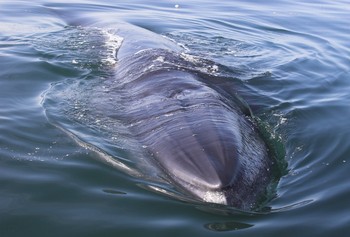
The Bryde's whale can be problematic to identify at sea, being similar in appearance to other large rorqual species particularly the sei whale (B. borealis). However, Bryde's whales were approached sufficiently closely during the 14 boat-based sightings to observe the diagnostic three rostral ridges (Figure 4). Given the location of the study area (in warm, coastal waters), the seasonality of the records and the photographic evidence for some individuals, all large whales seen from shore and presenting a Bryde's-like dorsal profile and blow were also considered to be this species.
A Bryde's whale surfacing off Flamingos, showing the diagnostic three rostral ridges.

The Bryde's whale was the second most-frequently observed cetacean species, with a total of 37 sightings and at least 45 animals recorded. However, they exhibited marked seasonality within the study area, with all sightings occurring during the summer (Table 1). Bryde's whales had the highest sighting rate of any of the species during watches from the fixed site, at 0.65 sightings per hour during the summer (Table 1). They were observed at a mean closest distance from shore of 2.7 km (range = 0.5–6.0, SD = 1.5, N = 37). Mean SST during boat-based sightings was 22.41°C (SD = 1.97, N = 9).
Group size ranged from 1 to 3 animals, with a median of 1.0 individuals (IQR = 0, N = 37). The majority of sightings (N = 33) comprised adult animals only. However, a single juvenile and three adult–calf pairs were also recorded. Most Bryde's whale sightings (N = 27) involved animals travelling, primarily either northwards (N = 9) or southwards (N = 12) along the coast. During ten sightings whales exhibited foraging behaviour, as indicated by numerous changes of direction, long dives and associations with dense shoals of sardines (Sardinella spp.). Lunge-feeding and surface-rushing were observed during some of these encounters.
HUMPBACK WHALE (MEGAPTERA NOVAEANGLIAE)
There were 11 sightings of the humpback whale, with 17 animals recorded. This species was present during both seasons, although the sighting rates indicate that it was more numerous during the winter (Table 1). Only two sightings were recorded during the summer, both comprising adult–calf pairs that were travelling south through the study area on 16 and 27 January. In contrast, eight of the nine (one was not aged) winter sightings comprised adults only, all of which were travelling northwards either as single animals (N = 5) or as pairs (N = 4). The median group size of humpback whales was 2.0 individuals (IQR = 1.0; N = 11). Humpback whales were seen at distances as close as 500 m to as distant as 8.5 km from the shore, with a mean closest approach of 3.8 km (SD = 2.9, N = 11).
DISCUSSION
This study during summer and winter 2008 in the coastal waters off Namibe Province identified a cetacean community predominantly comprising four species, including two baleen whales and two dolphin species. Sightings of other species including common dolphin (Delphinus sp.) and killer whale (Orcinus orca) were also described to the author by local people, and probably occur on a sporadic basis.
It should be emphasized that variation in the survey platform used both within and between seasons is likely to have influenced the results, since certain platforms were more likely to encounter particular species. For example, most of the large whales were sighted during fixed-site watches when higher eye height and a greater proportion of time using binoculars meant that sightings further from shore were more readily recorded. Similarly, boat and vehicle surveys covered a much larger area than the fixed site vantage point, and were more likely to encounter dolphin groups travelling along the coast. However, although comparisons between the seasons are limited by variability in platform, broad patterns in seasonal occurrence can be considered using the entire combined dataset.
Further to several sightings of Atlantic humpback dolphins reported in January/February 2004 (Van Waerebeek et al., Reference Van Waerebeek, Barnett, Camara, Cham, Diallo, Djiba, Jallow, Ndiaye, Samba Ould Bilal and Bamy2004; Weir, Reference Weir2008), the survey confirmed a regular and apparently year-round occurrence of this species in the coastal waters of Namibe Province. The strictly nearshore habitat occupied by Atlantic humpback dolphins in Angolan waters is consistent with observations of this species in other range states (Van Waerebeek et al., Reference Van Waerebeek, Barnett, Camara, Cham, Diallo, Djiba, Jallow, Ndiaye, Samba Ould Bilal and Bamy2004) and may be at least partly explained by the apparent preference of humpback dolphins for reef-dwelling prey species (Barros & Cockcroft, Reference Barros and Cockcroft1991; Van Waerebeek et al., Reference Van Waerebeek, Barnett, Camara, Cham, Diallo, Djiba, Jallow, Ndiaye, Samba Ould Bilal and Bamy2004).
The bottlenose dolphin was also observed only in nearshore waters, typically within 500 m of the shore. While the bottlenose dolphin is expected to occur in coastal waters along the entire West African coast (Jefferson et al., Reference Jefferson, Curry, Leatherwood and Powell1997), records of its presence off Angola are scarce. Weir (Reference Weir2008) reports nine sightings of bottlenose dolphins in deep waters (>1000 m) off Angola, and six sightings from the continental shelf including records close to shore in Luanda (08°49′S 13°14′E) harbour and along the coast between Baia dos Tigres (16°40′S 11°47′E) and Tombwa. The 24 sightings from Namibe Province reported here therefore add considerably to knowledge of this species off Angola.
Bottlenose dolphins seemed to exhibit seasonality within the study area, with both more sightings and larger group sizes during the winter than the summer. Similar seasonal variation in coastal bottlenose dolphin occurrence has been recorded in other areas worldwide and potential explanations have included changes in water temperature with direct (e.g. thermal barriers) or indirect (e.g. via prey) influence (Shane, Reference Shane1980; Barco et al., Reference Barco, Swingle, McLellan, Harris and Pabst1999), changes in prey availability and distribution (Shane, Reference Shane1980; Barco et al., Reference Barco, Swingle, McLellan, Harris and Pabst1999; Bearzi, Reference Bearzi2005), seasonal use of nursery areas (Barco et al., Reference Barco, Swingle, McLellan, Harris and Pabst1999) and seasonal abundance of predatory sharks (Heithaus & Dill, Reference Heithaus and Dill2002). It is plausible that changes in water temperature, overall productivity and the availability of particular prey species associated with the seasonal influx of the Benguela Current ecosystem could all potentially influence the winter increase in bottlenose dolphins in the study area.
Both humpback and Bryde's whale also exhibited seasonality within the coastal study site, particularly the Bryde's whale which was frequently recorded during the summer but was absent in winter. Bryde's whale is the only baleen whale species that does not make extensive seasonal migrations to high latitude feeding grounds, but seasonal movements at lower latitudes are evident. Using whaling data, Best (Reference Best2001) identified a ‘Southeast Atlantic Stock’ of Bryde's whale which ranges from equatorial waters to around 34°S and exists within 550 km of the coast. This stock inhabits the waters between southern Angola and South Africa during the summer months, and migrates northwards to occur primarily between central Angola and Gabon during the winter (Best, Reference Best1996, Reference Best2001). The sightings of Bryde's whales in coastal waters of Namibe Province during January correspond with the seasonal movements described by Best (Reference Best2001). In northern Angola, Bryde's whales are usually seen in coastal waters later in the year during August and September, while most offshore records occur between June and November (Weir, Reference Weir2008). A movement of Bryde's whales along the coast of Angola therefore likely occurs northwards during the autumn and southwards during the spring.
While humpback whales occurred in the region during both study seasons, the number of sightings and the sighting rate were higher during the winter than the summer. Humpback whales exhibit strong seasonality in the waters off West Africa, as indicated by both sighting surveys (Best et al., Reference Best, Reeb, Morais and Baird1999; Rosenbaum & Collins, Reference Rosenbaum and Collins2006; Weir, Reference Weir2008) and historical whaling catches (Townsend, Reference Townsend1935; Best, Reference Best1994), related to their use of the region as a winter calving and mating ground. While most records off West Africa occur between June and October, some sightings do occur outside of this period, for example in May and as late as January offshore of northern Angola (Weir, Reference Weir2008). The sightings in coastal waters off Namibe Province likely represent both ends of this seasonal migration, with records from January comprising mother–calf pairs travelling southwards and the records in winter comprising adults moving northwards towards the breeding grounds. The calving ground for wintering southern hemisphere humpback whales was recently found to extend north of the equator to the waters off Togo and Benin (Van Waerebeek et al., Reference Van Waerebeek, Nobimé, Sohou, Tchobozo, Dossou-Bodjrenou, Dossou and Dossou-Hountoudou2002), with whales occupying this region between July and December. The seemingly ‘late’ records of humpback whale mother–calf pairs recorded off Namibe during January might therefore relate to animals migrating south from this northernmost part of their range.
To conclude, the coastal waters of Namibe Province in Angola were occupied similarly in summer and winter by Atlantic humpback dolphins and only in summer by Bryde's whales. Bottlenose dolphins and humpback whales were observed in both study seasons but had higher occurrence during the winter months. While humpback whales seemingly utilize the region as a migratory corridor, the area potentially provides year-round foraging habitat for humpback dolphins and may be of seasonal foraging significance for both bottlenose dolphins and Bryde's whales. The continental shelf in the study area is only around 15 km wide, and it is likely that a variety of deep-water cetacean species also occur slightly further from shore. Further survey work is required off southern Angola to clarify the distribution, ecology and potential threats to cetacean species in the region.
ACKNOWLEDGEMENTS
This study received financial support from Ketos Ecology, the Whale and Dolphin Conservation Society and the University of Aberdeen (UK) Small Grants Fund. The author is grateful to Rico Sakko and the staff of Flamingo Lodge in Namibe Province for their hospitality. Kabous Vryenhoek, Rod Haestier, Neil Gouws and Chico provided valuable assistance during fieldwork. Thank you to the referees for making useful comments to improve this manuscript.