Implications
This study describes, for the first time, the types of disease control practices applied on commercial sheep farms in the UK. The study is the first to assess the degree of penetration of these actions among the British sheep farming industry. The identification of husbandry practices with a positive association with sheep flock performance can be used to promote flock health practices among the sheep farming community. This study shows that lamb sales data can be used for a baseline comparison of productivity levels between farms.
Introduction
In 2016, 290 000 tonnes of lamb meat were produced under extensive, grass-based systems located in the UK, accounting for 36% of the total European Union sheep meat production in that year (Food and Agriculture Organization statistics).
Despite the large size of the sheep population, there are limited data on how sheep farmers manage their flocks in the UK. The limited data available provides only numbers of sheep, mean production metrics from small samples of flocks and passive disease surveillance activities. Several surveys have gathered specific information on disease prevalence, but none has collected information on whole sheep flock husbandry practices and their associations with flock output. Therefore, investigating factors that affect flock performance could prove beneficial for the sheep farming sector. In the past, research based on experimental studies has identified single factors with an impact on flock productivity, including genetics (Walkom et al., Reference Walkom, Brien, Hebart, Fogarty and Hatcher2016), nutrition (Fraser et al., Reference Fraser, Speijers, Theobald, Fychan and Jones2004), disease (Green et al., Reference Green, Berriatua and Morgan1998) and reproduction (Kelly and Johnstone, Reference Kelly and Johnstone1982). However, comparisons on the relative importance of different factors have not been established.
To estimate the relative impact of multiple factors that influence flock production, a small number of international studies have investigated the effect of management practices on flock performance (Doré et al., Reference Doré, Meek and Dohoo1987; Townsley and Parker, Reference Townsley and Parker1987; Bohan et al., Reference Bohan, Shalloo, Creighton, Boland and Mchugh2017) showing that a number of management factors are associated with flock performance, but the different proxies of flock performance hamper a direct comparison between factors. This suggests that the use of a standardized metric based on abattoir data could simplify the identification of factors with a consistent effect on flock performance. Although abattoir clinical feedback is routinely used for disease surveillance purposes, its use for monitoring livestock flock performance is limited.
Against this background, the aims of the current study were (a) to gather key background information on current commercial flock management practices carried out in UK commercial sheep farms, (b) to explore the use of lamb abattoir sales data as a proxy of flock productivity, and (c) to investigate the relationship between flock husbandry practices and flock productivity. Given that husbandry practices carried out on sheep enterprises are comparable between the UK and other sheep-producing nations, the hypothesis explored in this study are likely to be relevant to a worldwide audience.
Material and methods
Questionnaire design
The questionnaire was composed of three sections: (i) farm and flock characteristics, (ii) animal movements on and off farm, and (iii) flock disease control and prevention management practices. Decisions around which questions to include were taken from a literature review and the clinical experience of an author of this manuscript (F.L.). The first section of the questionnaire asked about farm location and altitude, flock size and breeds, participation in ‘environmental schemes’, other farm enterprises and grassland area. The second part of the questionnaire inquired about animal movements in and off farm such as number of lambs sold for meat per month, ewe culling rate and store lambs purchased. The final and largest section of the questionnaire focused on the management of lambing and flock disease prevention and control actions. The first questions of this section asked about the frequency of contact with a veterinary surgeon, flock information recording practices, criteria for selecting culling ewes and types of vaccines used in the flock. Then, questions on parasite control and procedures carried out in quarantined sheep were presented. The lambing management questions included type of procedures carried out in baby lambs. All questions referred to practices carried out from May 2015 to April 2016, except the questions relative to lambing management, which referred specifically to 2016. The questionnaire was piloted by F.L. on eight sheep farmers, and their comments were used to make a final version of it. The final questions were entered in a software specifically designed for the purpose of this study.
Data collection
The population under study comprised commercial sheep farmers supplying finished lambs to a major British food retailer. Nine hundred and twenty farmers who regularly supplied and were engaged with the retailer were selected for the study and asked to respond to the questionnaire. Out of these, 746 accepted, and 615 provided sufficient data to be used in a final model (initial response rate = 81%, final model response rate = 67%). Farmers who agreed to participate were visited during summer 2016 by 12 trained interviewers who were independent of the retailer and researchers. Interviewer training, undertaken by F.L., included an explanation of the purpose of the questionnaire with discussion and clarification of individual questions where necessary. During training, the interviewers undertook role-play scenarios to ensure consistency while asking the questions in a conversational style. Responses were entered into questionnaire software. Before the farm visit, abattoir sales data (i.e., monthly lamb sales) for each farm were provided by the meat processors and entered into the study software. During the visit, farmers were asked to validate these records by comparing them with their own data. If necessary, lamb sales records were amended to account for lambs sold for meat to other parties.
The questionnaire responses and corresponding abattoir sales data for each farm were provided to the authors of this paper in a spreadsheet, with farmers and farms’ identity coded to maintain anonymity.
Data cleaning
Farm, flock and lamb sales records were imported to Stata version 15 (Stata Corp., College Station, TX) for data cleaning and analysis (n = 746). Farms purchasing store lambs were excluded from the dataset (n = 80) as purchased lambs would interfere with the calculation of the flock productivity index, which focused on lambs born on farm. In order to detect data entry errors or farms with biologically implausible values, indexes representing the number of lambs born per ewe per year and the number of lambs sold per ewe per year were calculated and compared with industry reference values. Based on this, a cut-off of maximum level of 2.0 lambs sold for meat per ewe per year was set, and farms with values above this were excluded from the analysis (n = 18). The final sample was composed of 648 farms.
Statistical analyses and model building
Following coding of categorical variables, descriptive statistics were calculated. Since not all respondents answered all questions, denominators are reported when relevant. Descriptive statistics of variables with more than 300 data-points were evaluated and reported, but to avoid loss of analytic power, only variables with a minimum of 475 data-points were carried forward to be tested in multivariable analysis. Median and interquartile ranges (IQR) were used to represent the spread of distributions due to the skewness of responses. Chi square tests were used to explore pairwise associations between categorical variables.
We defined flock productivity as the ‘number of lambs sold for meat per 100 ewes per year’ (relative to the period between June 2015 and June 2016), and this was the outcome of interest in this study. This index was based exclusively on the sales of lambs for meat, not comprising animals kept or sold for breeding.
The explanatory variables of interest were flock management practices carried out between April 2015 and June 2016. In order to explore management factors most likely to be associated with flock productivity (number of lambs sold for meat per 100 ewes per year), univariable linear regressions were carried out. Following this screening process, variables with P ≤ 0.1 and at least 475 data-points were taken forward as well as variables considered potential confounders. Non-linear effects were tested by adding polynomial terms of continuous variables into the model. Interactions terms were tested between terms that were included in the final model, although it was recognized that the sample size may have been limiting for the identification of interaction terms (Gelman, Reference Gelman2018).
Model assumptions were checked. The normal distribution of residuals was assessed by visual observation of the plotted residuals and observation of the kernel density estimate. Homoscedasticity (constant variance) of the residuals was verified both graphically and by running the Breusch–Pagan test (P>0.05). The absence of multicollinearity in the model was assessed by examining the variance inflation factor. The overall influence of each observation on the final model was checked by calculating the Cook’s distance (Dohoo et al., Reference Dohoo, Martin and Stryhn2003).
Due to the great number of variables assessed in the context of this study and the inherent increased risk of multicollinearity, we also compared the multiple regression model results with the results of a penalized regression method, elastic net (Zou and Hastie, Reference Zou and Hastie2005; Kuhn and Johnson, Reference Kuhn and Johnson2013). Additionally, we conducted analysis using multivariate adaptive regression splines (MARS)(Friedman, Reference Friedman1991; Kuhn and Johnson, Reference Kuhn and Johnson2013) to investigate non-linear relationships between the predictors and the outcome.
Results
Descriptive statistics
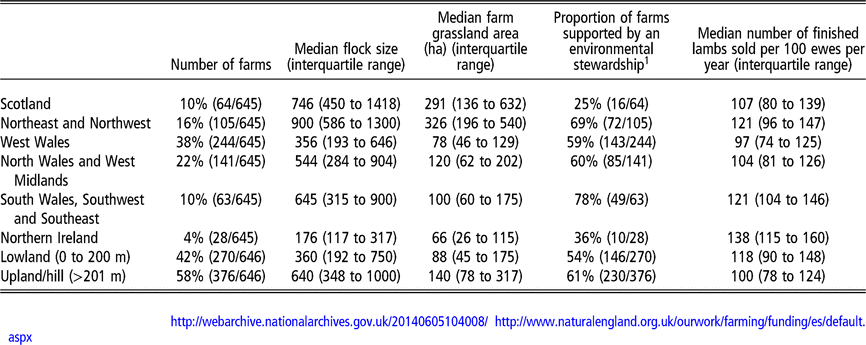
Farm and flock characteristics. The median flock size and median farm grassland area were 500 ewes (IQR, 269 to 900) and 118 hectares (IQR, 60 to 235), respectively (648/648 observations). Seventy-seven per cent (500/648) of the farms operated a mixed enterprise (beef and sheep). Overall, the number of finished lambs sold per 100 ewes per year was 108 (IQR, 82 to 135) (648 observations). Detailed information about farm characteristics and animal movements in and off farm is provided in Table 1 and Supplementary Material S1.
Farm and flock characteristics of 645 sheep farms participating in the study, stratified by farm’s geographical location and altitude

1 Environmental stewardship is defined as ‘an agri-environment scheme that provides funding to farmers and other land managers in England to deliver effective environmental land management’ (http://webarchive.nationalarchives.gov.uk/20140605104008/; http://www.naturalengland.org.uk/ourwork/farming/funding/es/default.aspx, accessed 27 February 2018), but this classification was recently updated and new categories apply. At the time of this survey, 58% of the studied farms were integrated in at least one type of environmental stewardships, such as ‘higher level scheme’ or ‘sites of special interest’.
Frequency of contact with a veterinary surgeon. Sixty-seven per cent (242/362) of the farmers indicated they had one visit from the veterinarian, 15% had two visits, 14% had three or more visits in the last year, and only 2% had no visits from a vet.
Culling management. Ewe’s age was indicated by 42% (272/641) of respondents as the primary reason for selecting ewes for culling, followed by mastitis (25%) and tooth loss (21%); lameness, infertility, prolapse or poor condition was indicated by only 2% of the farmers. For record-keeping of culling information, 69% of the farmers (236/341) used a notebook, 25% a handheld EID (electronic identification), 6% a computer and 2% a smartphone.
Lambing management. Twelve per cent (79/663) of the farms started lambing in January, 21% in February, 46% in March and 18% in April. Not all farms weaned lambs at the same age: 38% of the flocks weaned lambs between 15 and 17 weeks of age, 24% weaned lambs when they were ≥17 weeks, 20% weaned lambs between 13 and 15 weeks and 18% at 11 to 13 weeks. Less than half of the farmers weighed the lambs at least once during lactation (45%; 287/632). Additional procedures carried out in newborn lambs are presented in Supplementary Material S2.
Vaccination practices. Thirty-nine per cent (252/648) of the farmers vaccinated ewes against both clostridial diseases and abortion agents. Fifty-five per cent (354/648) of the farmers vaccinated ewes against clostridial diseases only, 2% vaccinated their ewes against abortion agents only (Chlamydia abortus or Toxoplasma), and 5% (34/648) of farmers did not use any vaccines in their flock.
Endoparasite control. When asked about the reasons for administrating anthelmintics to lambs, 50% (318/631) of farmers indicated using anthelmintics based on a predefined schedule, 28% based on the presence of clinical signs compatible with endoparasitism, 19% based on the results of faecal egg count (FEC), 3% on grazing history and <1% on lamb live-weight gains. Seventy-one per cent (452/633) of farmers did not carry out an FEC in the previous year, and 12% conducted an FEC up to three times. The great majority (>80%) of farmers did not test for anthelmintic resistance in their flock. For information on anthelmintic resistance types, refer to Supplementary Material S3.
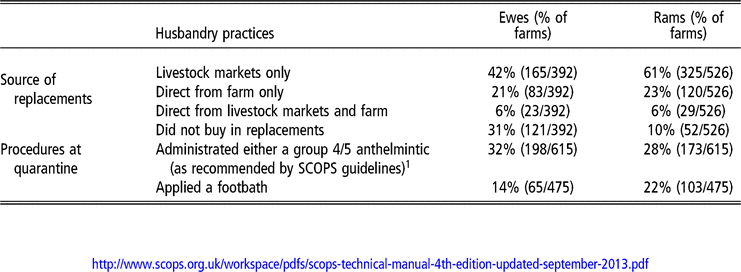
Flock biosecurity. Only a small proportion of farms was breeding their own replacement ewes and rams (31% and 10% of the flocks, respectively). For additional information on procedures carried out during quarantining, see Table 2. A very small proportion of farms screened their flock for ‘iceberg’ infectious diseases during the previous year; for instance, only 5% (32/640) of the farms screened their flock for maedi-visna, and <2% of farms screened their flock for caseous lymphadenitis, border disease or ovine Johne’s disease.
Source of replacement sheep and health and control practices undertaken during quarantining of ewes and rams

1 The SCOPS (Sustainable Control of Parasites in Sheep Initiative) group was created to develop sustainable strategies for the control of parasites in sheep. According to the SCOPS manual, broad-spectrum anthelmintics can be divided into five groups on the basis of chemical structure and mode of action: group 1, benzimidazole; group 2, levamisole; group 3, macrocyclic lactones; group 4, amino-acetonitrile derivatives; and group 5, spiroindoles (http://www.scops.org.uk/workspace/pdfs/scops-technical-manual-4th-edition-updated-september-2013.pdf).
Associations between variables
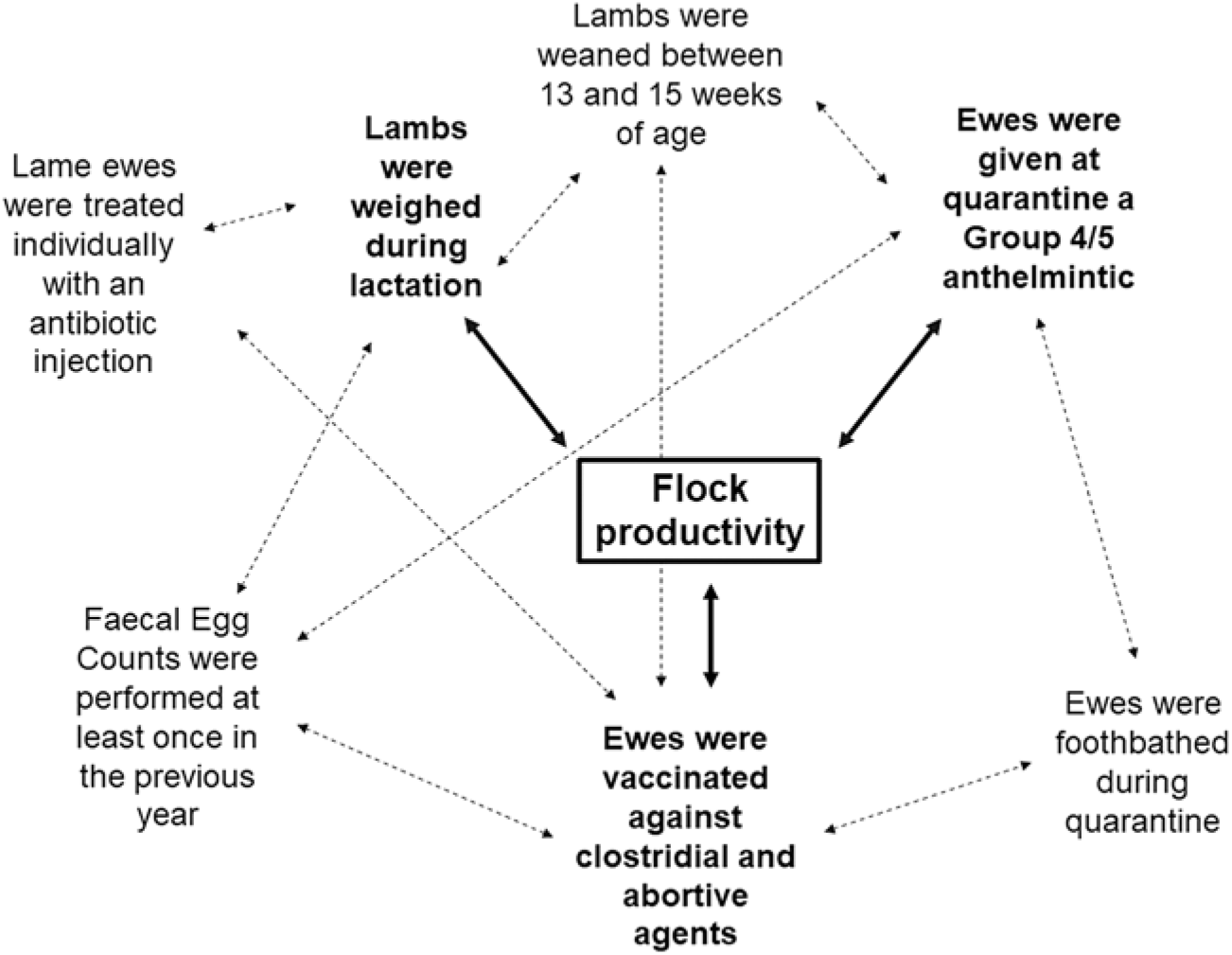
Figure 1 summarizes the significant associations found between flock management practices. For instance, a farmer weighing lambs during lactation was more likely to perform several other practices (e.g., treating individual lame ewes with an antibiotic injection, weaning lambs at age 13 to 15 weeks of age, testing for flock anthelmintic resistance and purchasing ewe replacements from farms) compared with a farmer not doing so. A farmer vaccinating against both clostridial and abortive agents was more likely to footbath ewes during quarantining, wean lambs between 13 and 15 weeks of age, perform FEC in lambs and record culling information using an EID device and have a greater number of visits from a veterinary surgeon. For the P-values of the associations between these variables, refer to Supplementary Material S4.
Associations between husbandry practices and their relationship with flock productivity (defined as the number of lambs sold for meat per 100 ewes per year). Note that arrows represent associations rather than causality between variables. Bold arrows represent associations between model predictors and flock productivity, and dashed arrows indicate associations (assessed with a chi square test) between model predictors and other flock management practices. A higher flock productivity was associated with the variables ‘lambs were weighed during lactation’, ‘ewes were vaccinated both against clostridial and abortion agents’ and ‘ewes were given a group 4/5 anthelmintic’. Several other variables were associated with these, suggesting that a higher flock productivity is associated with the implementation of a wider set of ‘good practices’.

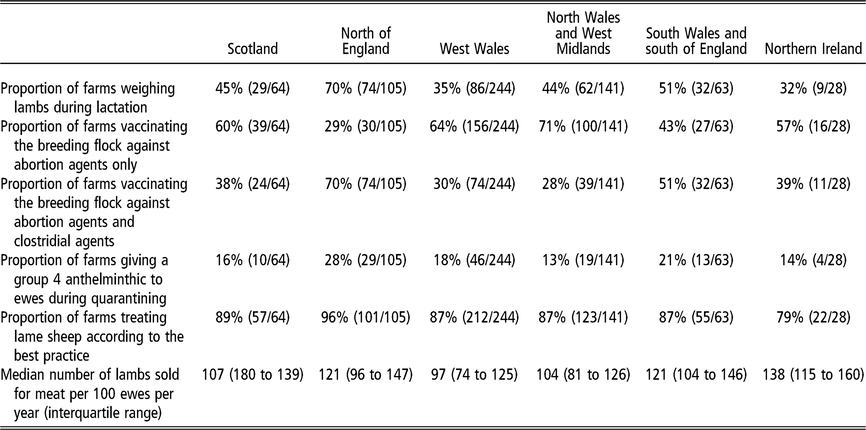
The proportion of farms applying management practices varied by UK region (Table 3). While there was a wide variation in the proportion of farms weighing lambs during lactation (from 32% in northern Ireland to 71% in the north of England), there was little difference in the proportion of farms treating lame sheep with the best practice among regions (from 79% to 95%).
Proportion of sheep farms carrying out disease control and prevention practices by region

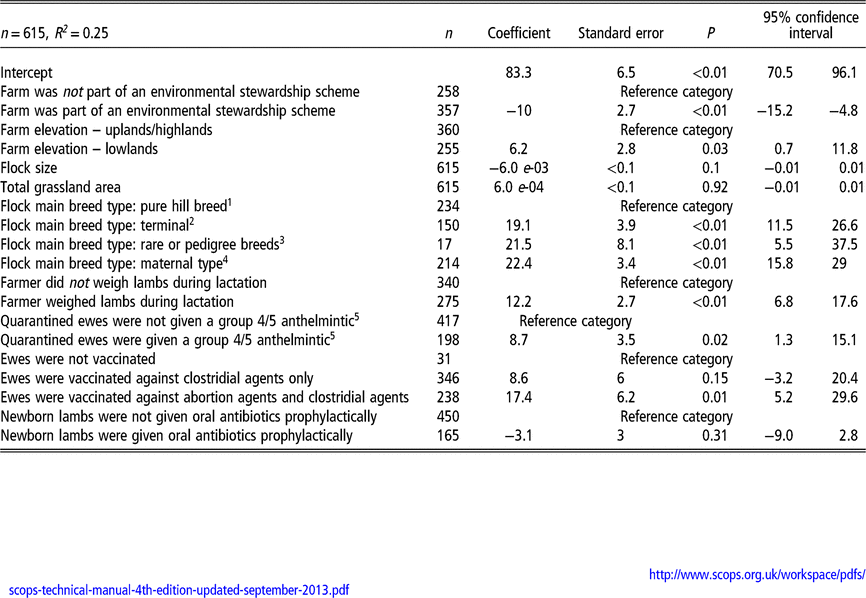
Multivariable regression model of flock and husbandry factors associated with flock productivity (number of lambs sold per ewe per year)
A higher flock productivity (i.e., a higher number of lambs sold for meat per 100 ewes) was associated with a number of flock husbandry practices in multivariable analysis (Table 4). Weighing lambs during lactation, administering a group 4/5 anthelmintic (monepantel or a combination of derquantel and abamectin, respectively) to ewes during quarantining and vaccinating ewes against both abortion (Chlamydophila abortus or Toxoplasma) and clostridial agents were associated with a higher flock productivity. Additionally, flocks with maternal or terminal types showed higher productivity compared with flocks with pure hill or pedigree breeds. Being part of an environmental stewardship scheme showed a negative association with flock productivity. In contrast, being a lowland farm (i.e., farm located <200 m of altitude) was associated with a higher flock performance. This model explained 26% of the total variance (R 2 = 0.26).
Multivariable regression model of sheep flock characteristics and husbandry practices associated with flock productivity (number of lambs sold per 100 ewes per year)

1 Breeds include Welsh Mountain, Balwen Welsh Mountain, Swaledale, Blackface, Rough Fell, Herdwick, Nelson South Wales Mountain, Kerry Hill, Badger Face, Beulah Speckled Face, Easycare, North Country Cheviot, Welsh Mountain Hill Flock, Welsh Hill Speckled Face and Cheviot.
2 Breeds include Texel, Suffolk, Meatlinc, Berrichon, Dorset Down, Southdown, Hampshire Down, Beltex, Blue Texel and Charollais.
3 Breeds include Jacob, Exmoor Horn, LLanwenog, Bluefaced Leicester, Charmoise Hill, Dorset Horn and Devon Closewool.
4 Breeds include Welsh Half-bred, Welsh Mule Sheep, North of England Mule, Scotch Mule, Romney and Lleyn.
5 The SCOPS (Sustainable Control of Parasites in Sheep Initiative) group was created to develop sustainable strategies for the control of parasites in sheep. According to the SCOPS manual, broad-spectrum anthelmintics can be divided into five groups on the basis of chemical structure and mode of action: group 1, benzimidazole; group 2, levamisole; group 3, macrocyclic lactones; group 4, amino-acetonitrile derivatives; and group 5, spiroindoles (http://www.scops.org.uk/workspace/pdfs/scops-technical-manual-4th-edition-updated-september-2013.pdf).
Due to the fact that the variable ‘vaccinating ewes against both clostridial and abortion agents’ was strongly associated with the variable ‘ewes were treated for lameness individually with an antibiotic injection’, an alternative model using this variable instead was built. This predictor had a coefficient of 8.8 (CI = 1.1 to 16.4), meaning that, according to this model, treating individual lame ewes with an antibiotic injection was associated with an additional production of 8.8 lambs per 100 ewes per farm per year. This alternative model explained approximately the same proportion of model variance (0.25 in contrast to 0.26).
Model fit results
The major assumptions of a linear regression model were confirmed by visual observation. All observations had a Cook’s distance ≤0.3, suggesting that no observations had a large influence on the outcome (Dohoo et al., Reference Dohoo, Martin and Stryhn2003). The best elastic net model and the MARS models were very similar to the multiple linear regression model, with similar coefficients and model fit. This suggested that multicollinearity was not an issue and that non-linear relationships were not present within the data, indicating that the model coefficients were reliable.
Discussion
Current sheep flock health management practices in the UK
This is the first large-scale study investigating flock health practices carried out during a full production cycle on commercial UK sheep farms. The study brings new insights on the actions carried out during quarantining, vaccination practices, infectious diseases screening, main source of replacement animals and reasons for selecting animals for culling.
The results suggest that the uptake of disease prevention practices in the studied farms was relatively poor. Only 10% and 18% of the respondents footbathed newly purchased sheep (for lameness prevention) and administered a recommended anthelmintic drug, respectively, and a low proportion screened their flock for anthelmintic resistance or production-limiting infectious diseases. Considering the large numbers of sheep that are being moved between farms in the UK and that 82% of the flocks in this study were not ‘closed’ (i.e., female replacement animals were not bred on farm), the relatively low rate of application of disease prevention practices may be a cause for concern from a disease transmission perspective. The lack of baseline data on the uptake of disease control measures by UK sheep farmers does not allow an evaluation of trends over time; however, these results were not unexpected. Previous studies showed that the extensive nature of sheep farming coupled with the lack of labour to gather sheep act as barriers for the implementation of disease control practices (Morgan-Davies et al., Reference Morgan-Davies, Waterhouse, Milne and Stott2006).
Farmers’ responses on how flock decisions are made and type of records collected suggest that flock record-keeping in the sheep farms was low, confirming previous evidence (Kaler and Green, Reference Kaler and Green2013); the fact that 82% of the respondents did not ear-tag any lamb during the previous lambing season suggests that lamb performance recording was not a priority. The use of anthelmintics ‘based on a predefined schedule’ was preferred over other types of assessment that required the use of records, and the selection of ewes for culling was mainly based on ewe age, rather than metrics such as lameness or low productivity, which require record-keeping but are more useful from a flock productivity point of view. Poor record-keeping is likely to be a missed opportunity for improved production efficiencies because keeping records is crucial for the evaluation of production system alternatives (Croston and Pollot, Reference Croston and Pollot1994; Kaler and Green, Reference Kaler and Green2013).
In light of the concerns regarding antibiotic usage, it is worthy of note that a relatively high proportion of farmers indicated having administered oral antibiotics prophylactically to newborn lambs (31%) and that 5% did so with an unlicensed product. In line with these results, a recent study quantifying the amount of antibiotics prescribed to sheep enterprises reported that 47% of studied flocks were prescribed oral antibiotics for newborn lambs, although the type of usage (treatment/prophylaxis) was not specified (Davies et al., Reference Davies, Remnant, Green, Gascoigne, Gibbon, Hyde, Porteous, Schubert, Lovatt and Corbishley2017). An even higher proportion (68%) of farmers administrating oral antibiotics prophylactically to newborn lambs was reported by Douglas and Sargison (Reference Douglas and Sargison2018); however, the study design and type of farms studied differed, which may explain the differences found.
Associations between flock performance and husbandry practices
This is the first study to use data provided by abattoirs about numbers of lambs sold to estimate flock performance. The identification of flock management decisions associated with a higher productivity is of potential interest for the development of the sheep farming industry. Flock breed was a powerful factor explaining flock productivity (i.e., number of lambs sold for meat per 100 ewes per year per farm). Flocks with maternal breeds (i.e., Welsh ‘half-bred’, north of England ‘mule’) had a higher productivity than flocks composed of ‘pure hill’, ‘terminal’ or ‘pedigree’ breeds. A partial explanation of this is the greater number of breeding animals kept or sold by ‘pure’ or ‘pedigree’ flocks, which were not accounted for by this study. Maternal breeds tend to show higher fertility, fecundity and good mothering traits (Bradford, Reference Bradford1972), possibly contributing to greater flock outputs. Similar results were reported by Bohan et al. (Reference Bohan, Shalloo, Creighton, Boland and Mchugh2017). Interestingly, weighing lambs during lactation was associated with a higher flock productivity, possibly because data on lamb weights allows more targeted management interventions in nutrition and endoparasite control. Weighing lambs was also reported by Townsley and Parker (Reference Townsley and Parker1987) to be associated with higher flock productivities. A positive association between higher flock productivity and vaccinating the flock against abortion agents (toxoplasmosis/chlamydiosis) was also observed. This is likely due to a lower number of lamb deaths during pregnancy and the first weeks of life, resulting from protection against the former infectious agents. Both toxoplasmosis and chlamydiosis have a relatively high prevalence in the UK (Hutchinson et al., Reference Hutchinson, Wear, Lambton, Smith and Pritchard2011) and a considerable impact on sheep farming (Buxton et al., Reference Buxton, Maley, Wright, Rodger, Bartley and Innes2007). Additionally, an association between flock productivity and administrating a ‘group 4’ or ‘group 5’ anthelmintic to ewes during quarantining was observed, which is in line with the guidelines promoted by the Sustainable Control of Parasites in Sheep Initiative (McMahon et al., Reference McMahon, McCoy, Ellison, Barley, Edgar, Hanna, Malone, Brennan and Fairweather2013). Increased resistance rates to older anthelmintics are leading to reduced efficacy of treatments against endoparasites (Sargison et al., Reference Sargison, Jackson, Bartley, Wilson, Stenhouse and Penny2007; Glover et al., Reference Glover, Clarke, Nabb and Schmidt2017), with consequent related deleterious effects on sheep production. In contrast, resistance to group 5 anthelmintics has not been reported, and resistance to group 4 anthelmintics only reported recently (Hamer et al., Reference Hamer, Bartley, Jennings, Morrison and Sargison2018). A greater number of days to finish lambs not treated with group 5 products has been reported (Miller et al., Reference Miller, Waghorn, Leathwick, Candy, Oliver and Watson2012), which again aligns with the results of the present study.
Farms located in lowland areas (<200 m of altitude) tended to have a higher flock productivity. Lower areas of the country are generally associated with higher agricultural outputs (Croston and Pollot, Reference Croston and Pollot1994). Additionally, farms that were part of an environmental stewardship schemes showed lower productivity per ewe than farms not part of these programs. Environmental schemes promote a responsible use of land and protection of the natural environment, and are not always compatible with more intensive flock management options (such as the application of grassland fertilizer), which may explain the differences seen.
Importantly, administrating antibiotics prophylactically at lambing time was not associated with an increase in flock productivity. Given the current concerns about antibiotic usage in livestock and the relatively high proportion of farms administrating oral antibiotics prophylactically to newborn lambs observed in the present and previous studies, this is worthy of note.
It is important to highlight that, despite limited numbers of observations being available for some explanatory variables, there appears to be a set of disease control practices identified in our final model that were associated with other actions (Figure 1). Further research is needed to carefully quantify the impact of specific health management practices on productivity and to ensure that relationships identified are truly causal.
Results of this study confirmed that flock genetics are a relevant factor explaining flock productivity, and also that health-related husbandry practices are an important aspect of flock performance. The relevance of disease control practices on the performance of more intensively reared livestock species is well recognized (Dorea et al., Reference Dorea, Berghaus, Hofacre and Cole2010), but to the authors’ knowledge, this is the first time such a relationship was observed in sheep farming. Since health-related factors explained 26% of the overall flock productivity, it is likely that factors such as flock nutrition, grassland management, farmer objectives or farmer attitudes (Townsley and Parker, Reference Townsley and Parker1987; Denney et al., Reference Denney, Ridings and Thornberry1990) could help to explain additional variability between farms.
This study illustrated that lamb sales data can be a useful source of information for baseline farm benchmarking, which is less sensitive to recall bias than other sources of data relying exclusively on farmer records. However, a drawback of the productivity index used in this study (i.e., number of lambs sold for meat per 100 ewes per year) is that farms keeping or selling a higher number of breeding animals, and therefore selling fewer lambs to the abattoir, was classified as less productive. Future research incorporating these additional aspects of lamb productivity would be beneficial.
Limitations of this study
It is difficult to be certain that the sample of farms responding to the survey was representative of the target population (i.e., commercial sheep farmers supplying finished lambs to a major British food retailer); farms that decided to participate in the development group may have been systematically different from those not participating (e.g., flock size, geographical distribution). Therefore, a baseline assumption in our study is that the biological associations identified in this research would remain applicable to this wider population. Unfortunately, a lack of published data (on general farm characteristics) hampers any comparison between our study and target populations that could help to confirm representativeness.
Other potential areas of bias in the sample population could have arisen from volunteer bias (responders being different from non-responders), recall bias (farmers having difficulty in recalling practices carried out during the previous year), interviewer bias (answers to questions being influenced by the person asking questions) and acceptability bias (farmers tending to give replies expecting that they be placed in a good light).
Given the response rate (67%), the extent of volunteer bias is likely to be minimal. The very high response rate of this study could be due to three reasons. Firstly, all the data requested were to be collected at a single farm visit, which required minimal effort from the farmer. Secondly, and perhaps more importantly, farmers participated after being requested by a party purchasing their lamb, with whom they already have a history of business and goodwill. And thirdly, we believe farmers were interested to know the results of the research as they were assured of receiving feedback on the results.
Acceptability bias could have arisen because data were collected on behalf of a retailer, and responses could have been biased if respondents feared a possible breach of anonymity. However, the distribution of responses on sensitive areas suggests that there was no systematic alignment of responses with what is considered ‘best practice’. Responses were compared with data from previous studies, when available, and showed no considerable differences. For instance, the rates of prophylactic usage of antibiotics at lambing were only slightly below that previously reported (Davies et al., Reference Davies, Remnant, Green, Gascoigne, Gibbon, Hyde, Porteous, Schubert, Lovatt and Corbishley2017), and some farmers reported the use of antibiotics not authorized for use in sheep.
Interviewer bias could have arisen from aspects such as social desirability (especially relevant for sensitive questions) or normative question order effects (i.e., respondents adjusting their answers taking answers to earlier questions into account) (Dillman et al., Reference Dillman, Smyth and Melani2009). To minimize this bias, interviewers were thoroughly trained on how to administer the questionnaire. A term for ‘interviewer’ could have been used in the statistical models to adjust for any systematic influences of the interviewers, but unfortunately this information was not available. Therefore, a baseline assumption of the study was that the influence of interviewer was minimal and, in particular, did not affect the relationships between predictor variables and lamb production.
A final potential source of bias was recall bias. This was limited by carefully phrasing the questions and using abattoir-reported data (which was further validated by farmers’ records) for estimating flock productivity. Furthermore, farmers were asked to use records to confirm their responses wherever possible.
Despite the possible limitations of this study, the associations found between husbandry practices and flock productivity represent the first evidence in the identification of important management strategies with beneficial impacts on the productivity of commercial sheep flocks.
Conclusions
Results of the current study provide plausible estimates of the extent of implementation of disease control practices by commercial sheep farmers supplying finished lambs to a major British food retailer. The study offers novel insights into the importance of disease control practices and routine monitoring for greater flock efficiencies, which is highly pertinent to the sheep farming industry. The research also illustrated that lamb sales data are a useful and easily available source of information on flock performance, although the accuracy of the productivity index could be further enhanced by collecting information on breeding lambs kept and sold for breeding and by incorporating more detailed abattoir data (such as carcass grades or deadweight information). Further research is needed to explore additional factors with a potential influence on flock productivity, including an assessment of generalizability based on model cross-validation.
Acknowledgements
We are grateful to all farmers who gave their time to participate in this study. Eliana Lima is supported by studentship from AHDB (http://beefandlamb.ahdb.org.uk/).
E. Lima, 0000-0002-2819-2345
Declaration of interest
The authors have declared that no competing interests exist.
Ethics statement
The study was approved by the School of Veterinary Medicine and Science ethics committee (no. 1537-150907).
Software and data repository resources
Stata 15 was used for data cleaning and analysis. The model has not been deposited in an official repository.
Supplementary material
To view supplementary material for this article, please visit https://doi.org/10.1017/S1751731119001058