Introduction
Some aspects of language processing are based on efficient implicit learning abilities. Indeed, continuous speech contains a series of cues (e.g., pauses, stress patterns, sentence type) that are implicitly acquired by children in their early life (Jusczyk, Friederici, Wessels, Svenkerud, & Jusczyk, Reference Jusczyk, Friederici, Wessels, Svenkerud and Jusczyk1993). More specifically, it appears that implicit learning is implicated in different aspects of the acquisition of both the serial and grammatical structure of language, such as detection of word boundaries (Saffran, Newport, & Aslin, Reference Saffran, Newport and Aslin1996) and extraction of grammar-like structures (Gomez & Gerken, Reference Gomez and Gerken1999). Indeed, infants aged 7.5 months already use metrical patterns as a cue for segmenting word-like units from speech (Jusczyk, Houston, & Newsome, Reference Jusczyk, Houston and Newsome1999). In addition to metrical and acoustic cues, 9-month-old infants are sensitive to the phonotactic patterns of the native language (Friederici & Wessels, Reference Friederici and Wessels1993), and they use phonotactic cues for segmentation (Mattys, Jusczyk, Luce, & Morgan, Reference Mattys, Jusczyk, Luce and Morgan1999). Other studies also show that babies can acquire knowledge of serial order relations (Saffran et al., Reference Saffran, Newport and Aslin1996), as well as knowledge of more abstract rule-based structural relations (Marcus, Vijayan, Bandi Rao, & Vishton, Reference Marcus, Vijayan, Bandi Rao and Vishton1999). These studies suggest that language acquisition is based to some extent on the computation of statistical properties of language input, which in turn is dependent on procedural learning mechanisms.
Given that implicit learning mechanisms are involved in language learning (Aslin & Newport, Reference Aslin and Newport2008), specific language impairment (SLI) could be partly explained by poor procedural learning mechanisms. SLI refers to a developmental condition in which children present with slow development of spoken language in the absence of hearing loss, other neurodevelopmental disorders, or intellectual and emotional impairments (Evans, Saffran, & Robe-Torres, Reference Evans, Saffran and Robe-Torres2009). Some definitions of SLI have exclusively centered on linguistic disorders to explain language impairment (Van der Lely, Reference Van der Lely2003). According to this view, the core deficit concerns language, and more specifically, grammar. Alternatively, SLI may result from co-occurring non-language factors (Bishop, Carlyon, Deeks, & Bishop, Reference Bishop, Carlyon, Deeks and Bishop1999). For example, deficits in several non-linguistic abilities co-occur with SLI, such as slow auditory temporal processing (Tallal et al., Reference Tallal, Miller, Bedi, Byma, Wang, Nagarajan and Merzenich1996), limited working memory capacity (Ellis Weismer, Evans, & Hesketh, Reference Ellis Weismer, Evans and Hesketh1999), slower general speed of processing (Miller, Kail, Leonard, & Tomblin, Reference Miller, Kail, Leonard and Tomblin2001), or processing capacity limitations (Ellis Weismer et al., Reference Ellis Weismer, Tomblin, Zhang, Buckwalter, Gaura Chynoweth and Jones2000). In 2005, Ullman and Pierpont proposed the Procedural Deficit Hypothesis (PDH) according to which difficulties in procedural learning would account for the linguistic but also non-linguistic difficulties observed in SLI. This PDH of SLI is based on the Declarative/Procedural model of language learning (Ullman, Reference Ullman2001) which suggests a clear association between lexical and declarative memory, and between aspects of grammar and procedural memory. In addition, dissociations between lexicon and grammar would parallel dissociations between the two memory systems. Declarative memory would process the binding of conceptual, phonological, and semantic representations. This memory system—involved in the learning and storing of lexical items—would be preserved in SLI. On the other hand, procedural memory—involved in the learning and storing of regularities—would be impaired in SLI. The procedural memory system, which is supported by the brain structures (i.e., basal ganglia) that underlie aspects of rule-learning, would be particularly important for the acquisition and use of skills involving sequences—whether the sequences are abstract, sensory-motor, or cognitive, such as probabilistic category learning or grammatical rules.
Furthermore, the originality of the PDH is to try to integrate the linguistic and non-linguistic deficits observed in SLI to explain not only SLI, but also the frequent association between SLI and other developmental disorders. Ullman and Pierpont (Reference Ullman and Pierpont2005) have thus proposed their PDH to account for SLI which would be a more general deficit of procedural memory. Therefore, if children with SLI have a more general procedural deficit, they should show lower performance on all tasks requiring the procedural system, regardless of the linguistic or non-linguistic nature of these tasks.
Although the PDH generated interest in procedural learning in SLI, few studies have directly assessed this relationship. Most of the investigations on implicit learning in SLI showed poor procedural learning (Evans et al., Reference Evans, Saffran and Robe-Torres2009; Plante, Gomez, & Gerken, Reference Plante, Gomez and Gerken2002). However, these results might be explained by deficits other than procedural learning since the majority of children with SLI present with phonological processing impairments (Hill, Hogben, & Bishop, Reference Hill, Hogben and Bishop2005; McArthur & Bishop, Reference McArthur and Bishop2004). Therefore, the PDH is better supported if the procedural learning deficit was also observed in SLI for non-linguistic material. Indeed, as long as the procedural deficit is observed for linguistic material only, one cannot totally rule out the possibility that it is due to linguistic aspects.
To the best of our knowledge, only four studies have investigated procedural learning in SLI in the non-linguistic domain. Most of them used a serial reaction time task (SRT task) in which participants were asked to react as quickly and accurately as possible to stimuli that appeared on a computer screen by pressing the corresponding key on the keyboard (Nissen & Bullemer, Reference Nissen and Bullemer1987). Unbeknownst to the participant, the stimuli followed a repeated sequence. Usually, sequence learning is shown by longer reaction times (RTs) in a transfer block in which the sequence of stimuli is new, in contrast with the last learning block. The study by Tomblin et al. (Reference Tomblin, Mainela-Arnold and Zhang2007) was the first to explore procedural learning in SLI with a SRT task. In their study, Tomblin and colleagues compared the performance of 15-year-olds with and without SLI. A decrease in RTs was observed among all participants from the first to the last learning block. However, RTs were significantly longer for adolescents with SLI than controls. Moreover, they showed that participants with SLI exhibited a slower learning rate compared to controls. Thus, these results seemed to support the hypothesis that poor procedural learning may explain the grammatical impairment in SLI. Lum et al. (Reference Lum, Gelgec and Conti-Ramsden2009) also confirmed procedural memory impairments in children with SLI based on weaker learning rates for children with SLI. In this study, the difference between the last learning block and the transfer block was significantly larger for the normal language (NL) than for the SLI group, even after removing the variance related to motor speed. In 2010, Kemény and Lukács showed that children with language impairment (LI) displayed a deficit in learning on a probabilistic category learning task, the Weather Prediction (WP; Knowlton, Squire, & Gluck, Reference Knowlton, Squire and Gluck1994) task. On the WP task, participants were presented cues to help them predict weather. In the early phases of the task, performance relies on the procedural system, while during the later phase it shifts toward the declarative system. The results of Kemény and Lukács (Reference Kemény and Lukács2010) showed that children with LI performed significantly worse than controls from the beginning of the task. Moreover, they showed a severe inability to use strategies. Together, the results of these prior studies support the premise of the PDH.
However, methodological issues with the SRT task limit these findings. Indeed, Gabriel, Stefaniak, Maillart, Schmitz and Meulemans (manuscript submitted for publication) investigated procedural learning with an SRT task in which more sequence presentations (48 instead of 27) and shorter sequences (8 elements vs. 10 elements) relative to previous studies were used. Moreover, a touch screen was used to reduce motor and cognitive constraints related to the keyboard given that SLI and motor deficits are often comorbid (i.e., Hill, Reference Hill2001). These changes allowed children with SLI to respond as quickly and accurately as children with NL. Moreover, they showed differences in RTs between the last learning block and the transfer block similar to controls. Therefore, and contrary to previous studies, these findings suggest that children with SLI demonstrate comparable procedural learning abilities to children with NL, even when grammatical deficits were present.
The aim of the present study was to further test the PDH (Ullman & Pierpont, Reference Ullman and Pierpont2005) in children with SLI. Specifically, the goal was to determine whether learning of a deterministic sequence (Gabriel et al., manuscript submitted for publication) can apply to a probabilistic sequence (i.e., a sequence in which some irregularities are inserted; Schvaneveldt & Gomez, Reference Schvaneveldt and Gomez1998) in children with SLI. A probabilistic sequence was used because it more closely mimics natural language constraints (Aslin & Newport, Reference Aslin and Newport2008) (e.g., English past tense finish with “ed” for regular verbs but not for irregular verbs). While deterministic sequences are limited to co-occurrence frequency computation, probabilistic sequences are needed to acquire complex systems (like language) which contain irregularities. Because probabilistic sequences are more difficult to learn than deterministic ones (i.e., Stefaniak, Willems, Adam, & Meulemans, Reference Stefaniak, Willems, Adam and Meulemans2008), they are particularly relevant in assessing procedural learning efficiency in children with SLI.
According to the PDH, children with SLI will show lower learning rates than children with NL (e.g., shorter RTs differences between the last learning block and the transfer block). Moreover, the theory would predict that RTs between the probable and improbable items would be shorter for children with SLI compared to NL. As in the Tomblin et al. (Reference Tomblin, Mainela-Arnold and Zhang2007) study, we wanted to investigate whether individual differences in SRT learning were more strongly associated with individual differences in grammar abilities than lexical abilities. In order for the PDH to explain SLI, a positive correlation should exist between performance on grammatical tasks and the SRT learning effect (i.e., the children who suffer from grammatical disabilities should show poor learning effects in the SRT task).
Method
Participants
Thirty-two children aged 7 to 13 years (16 children with SLI aged 122.3 ± 18.7 months and 16 children with NL aged 123.2 ± 17.4 months; 11 boys in each group) participated in the study, and it was their first participation in an SRT study. Children with NL were recruited from schools near the University of Liège, Belgium. Children with SLI were recruited in “language classes,” where they had received a previous clinical diagnosis of SLI by professionals (speech-language pathologists and child neurologists). All children came from low (unemployed parents) or middle-class (at least one parent with undergraduate education) socioeconomic background, which was determined by the parents’ profession. The parents were asked to complete a medical history questionnaire to assure that all children were French monolingual speakers (i.e., no significant regular exposure to other languages), had no history of psychiatric or neurological disorders, and had no neurodevelopmental delay or sensory impairment (e.g., motor coordination disorder). Moreover, children with NL presented neither language impairment nor other learning impairments. We received parental informed consent for all participants.
Children were tested individually in a quiet setting at their school. Each child with SLI was matched with a child with NL based on socioeconomic status, gender, non-verbal IQ, and chronological age. In this study, we deliberately applied diagnostic criteria in line with those typically used in studies of SLI in English-speaking children, such as scores lower than or equal to 1.25 SD in two or more of four language tests in conjunction with performance-IQ scores of 85 or higher (Wechsler Intelligence Scale for Children - Fourth Edition [WISC-IV]; Wechsler, Reference Wechsler2005).
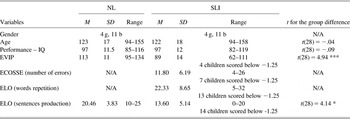
We administered a battery of standardized language tests to children with SLI to establish a profile of weaknesses for each children and to examine the relationships between SLI in French and procedural learning. Thus, the language scores were not used to confirm diagnostic status. The SLI group exhibited significant difficulties in both producing and understanding language materials; specific difficulties were observed in phonology, grammar, and narrative. To test the PDH, all children with SLI had to present at least one grammatical deficit. Four language tests were administered: 2 receptive tests (EVIP; Dunn, Thérault-Whalen, Dunn, Reference Dunn, Thériault-Whalen and Dunn1993; ECOSSE, Lecocq, Reference Lecocq1996) and 2 expressive tests (sentence production and word repetition, ELO; Khomsi, Reference Khomsi2001). Receptive vocabulary was assessed by the Echelle de Vocabulaire en Images Peabody (EVIP; Dunn et al., Reference Dunn, Thériault-Whalen and Dunn1993), a receptive vocabulary test that is a published, normed Canadian French version of the Peabody Picture Vocabulary Test (PPVT; Dunn & Dunn, Reference Dunn and Dunn1981). In this test, children have to select the picture that corresponds to a word pronounced by the examiner among four choices. Reception of grammatical knowledge was assessed by the Epreuve de COmpréhension Syntaxico-SEmantique (ECOSSE; Lecocq, Reference Lecocq1996), a receptive grammar test that is a published, normed French version of the Test for Reception of Grammar (TROG, Bishop, Reference Bishop1989). In this test, children have to select the picture that corresponds to a sentence pronounced by the examiner among four possibilities. Two subtests of the Clinical Evaluation of Language (sentence production and word repetition) from the Evaluation du Langage Oral (ELO, Khomsi, Reference Khomsi2001) battery, a standardized test, were also administered. Words repetition is a subtest assessing phonological abilities. This subtest contains 32 words to repeat. Omissions, substitutions of phonemes or syllables, distortions, and additions were counted as incorrect. The sentence production subtest contains 25 items assessing productive morphosyntactic abilities. The child has to complete the sentence produced by the examiner. Participants’ characteristics are reported in Table 1. None of the SLI participants presented an associated motor coordination disorder.
Descriptive statistics for the different measures administered

Note. NL = normal language; SLI = specific language impairment; IQ = intelligent quotient; N/A = not applicable; EVIP, French version of Peabody Picture Vocabulary Test (Dunn & Dunn, Reference Dunn and Dunn1981), standard scores have a mean of 100 and an SD of 15; Performance QI = Block Design, Picture Completion, and matrix subtests of the Wechsler Primary Scale of Intelligence – Revised (Wechsler, 4th Edition), standard scores have a mean of 100 and an SD of 15; ECOSSE, French adaptation of the Test for Reception of Grammar TROG (Bishop, Reference Bishop1989), raw scores have been reported (a minimum of 0 and a maximum of 92); ELO = Evaluation du langage oral (Khomsi, Reference Khomsi2001), raw scores have been reported (sentences production: a minimum of 0 and a maximum of 25; words repetition: a minimum of 0 and a maximum of 32).
*p < .05.
**p < .01.
***p < .001.
Children with NL were administered the same tests as children with SLI, except the ECOSSE and the word repetition of ELO (note that these children were reported to exhibit normal development in all these areas by their teachers and parents).
The exclusion criteria of the study were: participants who were unwilling or unable to complete the task due to fatigue, attention limitations, fine motor deficits, or other related issues. Two children with SLI and their matched NL controls were excluded from the study because they were characterized as “outliers” (i.e., RTs that were 2 SDs from the mean of the SLI group). SRT tasks were administered to the children in one session lasting approximately 20 min. The local research ethics committee approved the study, which was carried out in accordance with the guidelines of the Helsinki Declaration.
Stimulus Materials and Procedure
SRT task
The experiment consisted of 13 blocks of a four-choice RT task. One experimental block consisted of a probabilistic 8-element-long sequence repeated eight times, for a total of 64 trials by block and 832 for the whole task. The eight-element learning sequences were 31432412 and 14234132. Half of the participants were trained with the first sequence for Block 1 to Block 12 and with the second sequence for Block 13 (the transfer block). The design was reversed for the other half of the children. On each trial, a stimulus (a “Disney” figure) appeared at one of the four possible locations (one of the four corner windows of a scene), and children were asked to respond as fast and as accurately as possible to each stimulus by pressing the location on the touch screen. The task began with a series of 20 randomly generated practice trials.
For the probabilistic constraints of the sequence, the probable location appeared with a probability of .90 and the improbable location appeared with a probability of .10. The improbable locations were randomly produced among the two other permitted locations (e.g., in sequence 1, the locations “3 1” are usually followed by the location “4”; for an improbable location, the permitted locations that were used were either “2” or “3” since no repetition was allowed). In each block, 58 trials (.90 of 64 trials) were probable locations and 6 trials were improbable location (.10 of 64 trials). Sequence learning would be defined by longer RTs during Block 13 than during Block 12 along with lower error rates and faster RTs for the probable in comparison with the improbable locations.
Procedure
The control of image presentation and recording was performed by E-Prime Software. Participants were seated behind a computer screen that was open at an 180° angle with the keyboard. The average eye/screen distance was 70 cm. More specifically, the picture of a scene with four windows (i.e., the locations where the stimuli might appear) remained constantly displayed on the 15″ PC screen. Two windows were in the tower of the scene (upper left and right) and two windows were placed on the ground floor (lower left and right). The distance between both the horizontal and vertical windows was 25 and 14.5 centimeters, respectively. The task was presented as a game in which the child had to catch a figure to free his/her friends. The figure was removed once a target had been caught, or when 4000 ms had elapsed. No feedback was given to the participant when an error was made. The next figure appeared after a 250-ms-response-stimulus interval. The participants were given a break after each experimental block.
We used a modified version of the original SRT task to suit children with SLI. Indeed, children had to touch the location on the screen where the figure appeared as fast and as accurately as possible instead of pressing the corresponding key on the keyboard. The touch screen was placed on the laptop screen and was of the same size. Moreover, the laptop screen formed a 180° angle with the keyboard to ensure a position as comfortable as possible for the child. The use of reversed screen for the presentation of both material and stimuli ensured that the children processed the presented information. The touch screen was used to assure that children with SLI experienced the same ease of responding to the stimuli as children with NL.
Results
Median response RTs for correct responses and error rates were computed for each block.
RT Analyses
To determine whether RTs decreased between Block 1 and Block 12, we first performed an analysis of variance (ANOVA) with Block (12 levels: Blocks 1–12) as a within-participant variable, and Group (2 levels: NL vs. SLI) as a between-participant variable. Results showed that children with SLI were globally as fast as children with NL, F(1,28) = .56, MSE = 118449, p = .46, η2p = .019, and that the RT improvement from Block 1 to Block 12 was significant, F(11,308) = 11.17, MSE = 2554, p < .001, η2p = .28. The improvement differed by group, as shown in the significant group by block interaction, F(11,308) = 1.98, MSE = 2554, p < .05, η2p = .066. To determine whether the decrease differed between both groups between the first and the last learning blocks, we performed linear polynomial comparison with Block (12 levels: Block 1 to Block 12) and Group (2 levels: SLI vs. NL). This analysis revealed that the RTs improvement was similar in both groups, F(1,28) = 0.21, p = .64. Thus, our results suggest that the interaction effect observed in the main analysis is related to other factors than the learning curves. We hypothesize that attentional fluctuations might be more important in the SLI than the NL group. Note that, because of these attentional fluctuations, most studies that used the SRT task focused more specifically on the RTs difference between the last learning block and the transfer block.
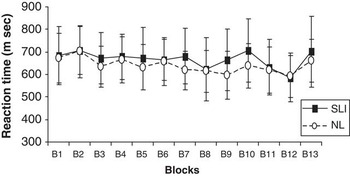
We then performed an ANOVA with Block (2 levels: Block 12 vs. Block 13) as a within-participant variable, and Group (2 levels: NL vs. SLI) as a between-participant variable. This analysis showed that RTs were similar in both groups, F(1,28) = .36, MSE = 21873, p = .55, η2p = .01 and that Block 12 was processed faster than Block 13, F(1,28) = 26.48, MSE = 5254, p < .001, η2p = .48 for both groups (non-significant interaction, F(1,28) = 2.61, MSE = 5254, p = .11, η2p = .085). Thus, learning appears to be similar in both groups. The Figure 1 shows mean RTs for each block and for each group.
Mean reaction times (RTs) for each block for children with Specific Language Impairment (SLI; square) and children with normal language (NL; circle) for the adaptation of the serial reaction time (SRT) task plotted separately for each block. Note: Bars represent standard deviations of the mean.

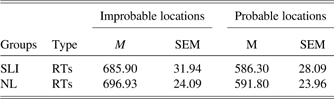
We also investigated the correct response RTs for the probable and improbable locations (see Table 2). To determine whether the probable locations were performed faster than the improbable locations, we performed an ANOVA with Probability (2 levels: probable vs. improbable) as a within-participant variable, and Group (2 levels: NL vs. SLI) as a between-participant variable on the last learning block (Block 12). This analysis revealed that the difference between groups was not significant, F(1,28) = .053, MSE = 19268, η2p = .002, p = .81, that the probable locations were processed faster than the improbable locations, F(1,28) = 52.92, MSE = 2970, η2p = .65, p < .001, and that the Probability by Group interaction was non-significant, F(1,28) = .039, MSE = 2970, η2p = .0014, p = .84, suggesting that all children (SLI vs. NL) responded faster for probable than improbable locations.
Mean reaction times (in milliseconds; with standard errors of the means) in Block 12 functions of probability effect (probable vs. improbable locations) during the SRT task
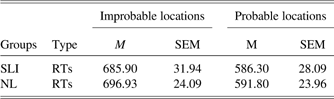
Note. SRT = serial reaction time; SLI = specific language impairment; NL = normal language; RTs = reaction times.
Correct Responses (CR) Analyses
Given that the normality of the CR distribution was violated, the number of correct responses was transformed using a logarithmic transformation.
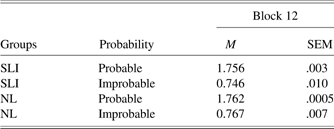
To determine whether the probable trials were processed more accurately than the improbable trials, we performed an ANOVA with Probability (2 levels: probable vs. improbable) as a within-participant variable, and Group (2 levels: NL vs. SLI) as a between-participant variable on the last learning block (Block 12) (see Table 3). This analysis revealed that there was a marginally significant difference between the groups, F(1,28) = 4.13, MSE = .0007, η2p = .13, p = .051. This marginal difference suggests that children with SLI (CR proportion of .98 and .93 respectively for the probable and improbable locations) might produce more errors than children with NL (CR proportion of .997 and .97 respectively for the probable and improbable trials). However, this difference is small and is mainly due to one child with SLI who gave only 53 CR for the probable trials. The analysis also revealed that more CR were given for the probable than for the improbable locations, F(1,28) = 8.06, MSE = .0005, η2p = .22, p < .05, and that the Probability by Group interaction was non-significant, F(1,28) = 1.41, MSE = .0005, η2p = .048, p = .24, suggesting that the Probability effect was similar in both groups. If we exclude the participant who gave only 53 CR for the probable trials and his matched NL child from the analysis, the results show a non-significant difference between the groups, F(1,26) = 2.56, MSE = .0006, η2p = .090, p = .12, a significant Probability effect, F(1,26) = 6.91, MSE = .0005, η2p = .21, p < .05 for both groups, and a non-significant Probability x Group interaction, F(1,26) = .94, MSE = .0005, η2p = .035, p = .34. Therefore, children with SLI did not produce more errors than controls.
Logarithm on number of correct responses (means and standard errors of the means) in Blocks 12 for both groups’ functions of probability effect (probable vs. improbable locations) during the SRT task
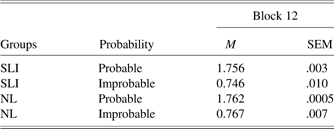
Note. SRT = serial reaction time; SLI = specific language impairment; NL = normal language.
Reaction time and Vocabulary or Grammar Status
As in the study by Tomblin et al. (Reference Tomblin, Mainela-Arnold and Zhang2007), we wanted to investigate whether individual differences in the SRT task were more strongly associated with individual differences in grammar abilities than in lexical abilities (Ullman, Reference Ullman2001). Using the raw scores from the EVIP, ELO (sentence production), and ECOSSE measures, we performed correlation analyses across the entire sample (including both the NL and SLI groups) to assess the association between grammar or lexical abilities and a learning index. Correlation analyses revealed that learning in the SRT task as measured by the learning indexes (Block 13 − Block 12)/ (Block 12 + Block 13) (e.g., Meulemans, Van der Linden, & Perruchet, Reference Meulemans, Van der Linden and Perruchet1998) marginally correlated with the increase in grammar knowledge [ELO (sentence production): r = −.35; p = .058], and did not correlate with the increase in lexical knowledge (EVIP: r = −.26; p = .16). The negative correlation between the learning indexes and grammar knowledge differed from the results of Tomblin et al. (Reference Tomblin, Mainela-Arnold and Zhang2007). Nevertheless, we also computed correlation analyses within each group. Results of children with SLI show no significant correlation between SRT learning indexes and both grammar knowledge (ECOSSE: r = .27; p = .33; ELO: r = −.44; p = .10) and lexical knowledge (EVIP: r = −.32; p = .23). Regarding children with NL, the results also show no significant correlation between SRT learning indexes and both grammar (ELO: r = .18; p = .52) and lexical knowledge (EVIP: r = .19; p = .49). Overall, our results do not indicate that grammatical abilities would be directly related to sequential pattern learning performance in a visual spatial task.
General Discussion
The aim of this study was to explore the hypothesis that language impairment observed in children with SLI is not a specific linguistic phenomenon, but results from dysfunction of a more general cognitive system: the procedural system. This hypothesis—the Procedural Deficit Hypothesis (PDH)—has been proposed by Ullman and Pierpont (Reference Ullman and Pierpont2005). Currently, few studies have directly investigated procedural learning in SLI. The existing studies reported controversial findings, with some authors observing impaired procedural learning in children with SLI (Kemény & Lukács, Reference Kemény and Lukács2010; Lum et al., Reference Lum, Gelgec and Conti-Ramsden2009) and adolescents (Tomblin et al., Reference Tomblin, Mainela-Arnold and Zhang2007), while others found intact procedural learning in children with SLI (Gabriel et al., submitted). The aim of the present study was to further explore this topic using material that is closer to the statistical language constraints than that used in previous studies. More specifically, we used a probabilistic sequence in which irregularities were inserted in contrast to a deterministic sequence (i.e., without irregularities) previously used. One of the factors known to have a large impact on procedural learning is the complexity of the statistical information that is acquired during learning. However, the statistical characteristics of the sequences—that is, the non-deterministic pattern of oral language statistical regularities—were not taken into account in the previous studies on SLI. Therefore, it was not clear to what extent a relative weakness in the procedural system could affect language development. The purpose of the current study, based on methodologies previously used, (Gabriel et al., manuscript submitted for publication), to investigate the influence of statistical complexity on procedural sequence learning in children with SLI by presenting a probabilistic sequence. Such a sequence is more complex than a deterministic one and mimics the statistical properties of language input by avoiding linguistic structures that are widely used in artificial grammar learning tasks (Evans et al., Reference Evans, Saffran and Robe-Torres2009; Plante et al., Reference Plante, Gomez and Gerken2002). To the best of our knowledge, this study is the first to explore probabilistic sequence learning in SLI. To do so, we compared children with SLI who exhibited significant difficulties in both producing and comprehending language materials.
Results of this study showed sequence-specific learning in children with SLI. RTs decreased between the first and the last learning block. Children with SLI were as fast as controls. Analyses concerning the processing of both probable and improbable locations and the impact of the transfer block on RTs showed similar learning effect between groups. The error rate analysis also confirmed this learning effect. Once the outlier participant (who gave fewer correct responses for the probable trials) was excluded from the analysis, the error frequency was similar in children with SLI and controls. Moreover, as expected, more correct responses were given for the probable than the improbable locations in both groups. We did not find a positive correlation between grammatical knowledge and SRT learning indexes, rather a negative correlation was found.
The findings of this study stand in contrast to previous studies that explored procedural learning with non-linguistic material. Indeed, these previous studies showed that the procedural learning mechanisms were not as efficient in children with SLI relative to children with NL. Methodological issues might explain some of these discrepancies, at least for the studies by Lum et al. (Reference Lum, Gelgec and Conti-Ramsden2009) and Tomblin et al. (Reference Tomblin, Mainela-Arnold and Zhang2007). The current study used more sequence presentations than previous studies and a touch screen. Thus, it is possible that children with SLI might learn motor sequential information as well as children with NL if fine motor requirements are minimized. These observations allowed us to exclude a specific motor learning deficit in children with SLI. Nevertheless, the response mode could also play a crucial role in learning in children with SLI; indeed, we showed in a previous study (Gabriel et al., submitted) that it is only when the motor and cognitive processing are reduced (i.e., when the children have to respond by means of a touch screen) that children with SLI could respond as fast and as accurately as children with NL, while this was not the case when a classical SRT task was used (i.e., when the children had to respond by means of a keyboard; Lum et al., Reference Lum, Gelgec and Conti-Ramsden2009; Tomblin et al., Reference Tomblin, Mainela-Arnold and Zhang2007). In other words, if children with SLI do not have to focus their attention on the motor constraints of the task, they seem to be able to learn similarly to children with NL.
Another explanation of why our results contrast with previous reports of sequence learning deficits in SLI concerns the number of presentation of the sequence (108 in the present study, and less than 30 in previous studies). The greater number of sequence presentations allowed for investigation of which children with SLI could show the same developmental pattern as children with NL, but at a slower rate (Rice, Buhr, & Nemeth, Reference Rice, Buhr and Nemeth1990). Therefore, a higher number of encounters would be required for the children with SLI (Bavin, Wilson, Maruff, & Sleeman, Reference Bavin, Wilson, Maruff and Sleeman2005; Evans et al., Reference Evans, Saffran and Robe-Torres2009). Thus, it is possible that the differences between our study and the previous ones (Tomblin et al., Reference Tomblin, Mainela-Arnold and Zhang2007; Lum et al., Reference Lum, Gelgec and Conti-Ramsden2009) could be related to differences in the speed to acquire procedural knowledge between children with SLI and with NL, and not to differences in the ability to learn such information per se. However, our results do not support this hypothesis: in our study, sequence-specific learning effects are already observable in the first learning blocks.
According to the PDH (Ullman & Pierpont, Reference Ullman and Pierpont2005), abnormalities of brain structures that underlie the procedural system should be widespread in SLI and should explain the observed impairments of grammar, lexical retrieval, and non-linguistic functions that depend on these structures. In contrast, declarative memory should be largely spared in SLI. Finally, individuals with SLI could compensate for their grammatical/procedural deficit by increasing their reliance on lexical/declarative memory. Therefore, children with SLI would present with difficulties in procedural learning, regardless of the linguistic or non-linguistic nature of the material, and the correlation between grammatical knowledge and SRT learning indexes should be positive.
Our previous (Gabriel et al., manuscript submitted for publication) and current results do not support either of these predictions. In both studies, which used different samples of participants and similar experimental designs (length of sequence, touch screen as response mode), we observed that children with SLI were able to learn non-linguistic regularities regardless of the sequence complexity (deterministic vs. probabilistic). Moreover, they learned the sequence as quickly and accurately as controls. Therefore, these results challenge the PDH by showing procedural learning abilities in SLI. However, these findings do not allow complete dismissal of the possibility that children with SLI are less able than children with NL to use efficient procedural learning mechanisms to discern certain sequential information in the input. It is possible that the procedural mechanisms suggested in language acquisition differ somewhat from those suggested in sequential learning. Thus, differences in the involved mechanisms might explain why children with SLI would be able to learn procedural non-linguistic sequential motor information, and why they would fail with linguistic information. Moreover, difficulties in procedural memory might be reduced by a high number of repetitions, as was the case in our studies. As existing studies of the PDH are still limited, questions with important implications for both SLI and procedural learning still remain. Future studies are needed to further assess the PDH in language impairment. Nevertheless, results of the present study do not confirm the hypothesis of a global deficit of the procedural system in children with SLI.
Acknowledgments
The support for the conduct of this research was provided by the University of Liège (doctoral fellowship for fields not eligible for FRIA). We thank the teachers, children, and the families who generously contributed their time. We also thank Laura Janzen who has volunteered to serve as the consultant for this study. We acknowledged (a) that the information in this manuscript and the manuscript itself has never been published either electronically or in print and (b) that there is no conflict of interest.