Introduction
Increasing evidence suggests that subjective cognitive concerns (SCC) may indicate subtle cognitive decline in clinically normal (CN) older adults that is otherwise undetected using standardized memory tests (Jessen et al., Reference Jessen2014). Cross-sectional studies of CN older adults reveal a relationship between SCC and beta-amyloid (Aβ) burden, a hallmark biomarker of Alzheimer's disease (AD), further suggesting that SCC arise during the pre-clinical stage of AD (Amariglio et al., Reference Amariglio2012; Mielke et al., Reference Mielke2012; Perrotin et al., Reference Perrotin, Mormino, Madison, Hayenga and Jagust2012; Amariglio et al., Reference Amariglio2015; Snitz et al., Reference Snitz, Small, Wang, Chang, Hughes and Ganguli2015). Previous studies indicate, however, that the meaningfulness of SCC may vary depending on demographic factors, such as age and years of education (Rabin et al., Reference Rabin2015). Thus, the sensitivity of SCC as a risk factor for AD may further increase when examined in targeted demographic populations.
Several cross-sectional, population-based studies have found that fewer years of education are associated with greater SCC (Bolla et al., Reference Bolla, Lindgren, Bonaccorsy and Bleecker1991; Derouesné et al., Reference Derouesné1993; Stewart et al., Reference Stewart2008), whereas others have found no significant difference (Kim et al., Reference Kim, Stewart, Shin, Choi and Yoon2003; Wang et al., Reference Wang2004; Trouton et al., Reference Trouton, Stewart and Prince2006; Mendes et al., Reference Mendes2008; Benito-León et al., Reference Benito-León, Mitchell, Vega and Bermejo-Pareja2010). By contrast, some longitudinal studies have suggested that individuals with greater years of education endorse complaints that are more prognostic of cognitive decline than those with fewer years of education (Geerlings et al., Reference Geerlings, Schmand, Braam, Jonker, Bouter and van Tilburg2000; Jonker et al., Reference Jonker, Geerlings and Schmand2000; van Oijen et al., Reference van Oijen, de Jong, Hofman, Koudstaal and Breteler2007). Thus, SCC may be an appealing method for identifying highly educated individuals at risk for AD who are performing normally on standardized memory tests.
With regards to age, several population-based studies have found that SCC steadily increase in individuals without dementia as they age over 65 years (Bolla et al., Reference Bolla, Lindgren, Bonaccorsy and Bleecker1991; Derouesné et al., Reference Derouesné1993; Kim et al., Reference Kim, Stewart, Shin, Choi and Yoon2003; Trouton et al., Reference Trouton, Stewart and Prince2006; van Oijen et al., Reference van Oijen, de Jong, Hofman, Koudstaal and Breteler2007; Benito-León et al., Reference Benito-León, Mitchell, Vega and Bermejo-Pareja2010), although this finding is not consistent across all studies (Geerlings et al., Reference Geerlings, Schmand, Braam, Jonker, Bouter and van Tilburg2000; Mendes et al., Reference Mendes2008; Stewart et al., Reference Stewart2008). Ginó et al. (Reference Ginó2010) found that different types of concerns may be more salient at different ages, and as such, may confer different meanings across the age spectrum. A prior review found that SCC in the oldest-old denoted possible early changes associated with dementia, notably in individuals who already demonstrated signs of cognitive impairment (Jonker et al., Reference Jonker, Geerlings and Schmand2000). By contrast, in CN individuals, findings suggest that SCC may confer greater risk of AD in the younger-old compared to the oldest-old. Wang et al. (Reference Wang2004) conducted a longitudinal study that revealed an endorsement of SCC was associated with greater risk of developing dementia in 70 year olds versus those over 80 years. The authors suggested that SCC become more ubiquitous in the oldest-old, and so become unrelated to a specific disease pathology, which reduces the predictive effect of SCC for dementia risk (Wang et al., Reference Wang2004). These results were corroborated by Zwan and colleagues (Reference Zwan2016), who found that SCC predicted greater Aβ burden in the younger-old compared to the oldest-old.
In terms of sex, findings have been equivocal across several population-based studies. Some studies have found that females report more SCC (Kim et al., Reference Kim, Stewart, Shin, Choi and Yoon2003; Stewart et al., Reference Stewart2008; Tomita et al., Reference Tomita2014), while another study found that males report more SCC (Wang et al., Reference Wang2004). Others have found that males and females may potentially report phenomenologically different SCC (Derouesné et al., Reference Derouesné1993), and that females use more mnemonic strategies to cope with these perceived changes in comparison with males (Bolla et al., Reference Bolla, Lindgren, Bonaccorsy and Bleecker1991). Yet, other studies found no significant sex differences (Derouesné et al., Reference Derouesné1993; Geerlings et al., Reference Geerlings, Schmand, Braam, Jonker, Bouter and van Tilburg2000; Jonker et al., Reference Jonker, Geerlings and Schmand2000; Trouton et al., Reference Trouton, Stewart and Prince2006; van Oijen et al., Reference van Oijen, de Jong, Hofman, Koudstaal and Breteler2007; Mendes et al., Reference Mendes2008). It remains unclear whether SCC confer greater risk of AD in men versus women.
In this study, we sought to investigate whether education, age, and sex modify the relationship between SCC and risk for AD in CN older individuals, as measured by level of neocortical Aβ burden. We hypothesized that age and years of education would modify the relationship, whereby younger age and greater years of education would be associated with a stronger relationship between SCC and Aβ burden. As the sex literature was relatively equivocal, our analyses regarding the potential modifying role of sex on SCC and Aβ burden were exploratory.
Methods
Subjects
In the current cross-sectional study, a total of 252 participants were enrolled in the Harvard Aging Brain Study, a longitudinal volunteer-based study conducted at Massachusetts General Hospital. The Partners Human Research Committee approved protocols and informed consent procedures. Participants were CN, defined by a global Clinical Dementia Rating (CDR) (Morris, Reference Morris1993) score of 0, an age and education-adjusted Mini-Mental State Examination (MMSE) (Folstein et al., Reference Folstein, Folstein and McHugh1975) score greater than or equal to 27, performance above education-adjusted cut-off scores on the Logical Memory IIa (story recall) of the Wechsler Memory Scale-Revised (Wechsler, Reference Wechsler1987), and a 30-item Geriatric Depression Scale (GDS) (Yesavage et al., Reference Yesavage1982) score of less than 11.
All participants’ statuses were confirmed to be CN and underwent a detailed review of medical history, functional performance, and a physical and neurological examination. None of the participants had a history of alcoholism, drug abuse, or head trauma; nor did they have a current serious medical or physical illness. All study staff who assessed the participants clinically, as well as the participants themselves, were blinded to biomarker status. All assessments were conducted within a six-month window. The original sample was 274 participants, but not all participants had interpretable imaging, or received all three components of the SCC composite, which resulted in a final sample of 252 participants.
Demographic measures
Years of education and age were measured continuously. Additional measures of educational attainment and socioeconomic status were included in secondary analyses in order to determine if they demonstrated similar trends with education. These measures included the American version of the National Adult Reading Test (AMNART), a measure of premorbid intelligence (Blair and Spreen, Reference Blair and Spreen1989; Ryan and Paolo, Reference Ryan and Paolo1992), and the Occupation score from the Hollingshead Two-Factor Index of Social Position (Hollingshead, A. B. (1957). Two-factor index of social status. Unpublished manuscript.), a measure of socioeconomic status based on educational and occupational attainment. An adjusted GDS score was computed that discarded four questions that overlapped with SCC items.
Subjective cognitive concerns measures
A SCC composite was calculated using the Everyday Memory subscale of the Everyday Cognition (E-Cog) scale, the General Frequency of Forgetting subscale of the Memory Functioning Questionnaire (MFQ), and a set of seven questions that were adapted from the Structured Telephone Interview for Dementia Assessment (STIDA), as described previously (Amariglio et al., Reference Amariglio2012). The Everyday Memory subscale of the E-Cog scale is an 8-item self-report measure scored on a Likert scale where a score of 1 = “Better or no change” and a score of 4 = “Consistently much worse.” It was specifically developed to assess cognitive abilities in older adults (Farias et al., Reference Farias2008). The questions are framed in the context of current performance compared to ten years ago. The General Frequency of Forgetting subscale of the MFQ (Gilewski et al., Reference Gilewski, Zelinski and Schaie1990) is comprised of 32-items scored on a Likert scale where a score of 1 = “Serious problem” and a score of 7 = “Never a problem.” This subscale was specifically developed to assess how an individual would rate his/her memory in terms of the kinds of problems he/she has. The scale has been formally validated. The STIDA questions consist of a set of seven yes or no questions that have been used previously in large epidemiological studies to assess recent difficulty carrying out everyday activities, though it is not formally validated (Amariglio et al., Reference Amariglio, Townsend, Grodstein, Sperling and Rentz2011). Answers on these questions (0 = No, 1 = Yes) were added together to create a summary score that was used for the statistical analyses. Raw scores for all three measures were converted into z-scores for each participant. All three z-scores were subsequently averaged to create a SCC composite score with higher z-scores indicating greater SCC. The overall distribution of SCC was slightly skewed due to a few outliers (SCC z-score > 2.58; n = 3), so analyses were run with and without outliers for comparison.
Positron emission tomography (PET)
PiB-PET was performed as previously described, with 60-minute 3D dynamic acquisition, and expressed as a mean distribution volume ratio (DVR) in a large aggregate of amyloid-vulnerable cortical regions using cerebellar reference (Johnson et al., Reference Johnson2007). Twenty-six percent of our sample was considered Aβ positive, which is the same sample previously published (Mormino et al., Reference Mormino2014).
Statistical analyses
A series of separate linear regression models were run using Aβ burden, education, age, and sex as predictors of SCC. Analyses did not change significantly depending on inclusion of outliers; thus, models were run with the full sample. Covariates for the models were the remaining demographic variables not of interest in the model. For all models, the Aβ × demographic variable interaction term was the predictor of interest. For example, SCC = Education + Aβ + (Aβ × Education) + Age + Sex. Secondary analyses were conducted to determine whether AMNART and Occupation score demonstrated similar trends as education in predicting SCC with the interaction between Aβ burden. We included secondary analyses with adjusted GDS scores as a covariate since this was significantly associated with the SCC composite. Finally, we ran a mediation model as a post-hoc test to further understand the relationship between Aβ burden, education and SCC. We used the Hayes PROCESS tool to determine whether the strength of the relationship between Aβ burden and SCC would be reduced after accounting for education level (Hayes, Reference Hayes2013). We used the Sobel test in order to measure the magnitude of the indirect effect, and presented both the direct and indirect effects in diagrammatic form for ease of interpretation. Significance was set a priori as p < 0.05. All data were analyzed using SPSS v22.0.
Results
Characteristics of the sample
The participants had an average age of 73 years (range: 63–90 years). Females made up 57.7% of the sample. Average years of education was 15.8 years (range: 6–20), average AMNART VIQ was 120.7 (range 78–132) and the average Occupation score was 2.7 (range: 1–7). While our sample tended toward higher socioeconomic status on all measures, years of education represented the most normally distributed score compared to AMNART and Occupation score. Group means and standard deviations on the SCC questionnaires, screening measures, and demographic variables are presented in Table 1.
Sample characteristics

All values (except sex, SCC composite) represent means ± SD. SCC composite is reported as a z-score, with a higher z-score indicating higher endorsement of concerns.
Higher scores on the E-Cog refer to greater concerns. Higher scores on the STIDA sum refer to greater concerns. Lower scores on the MFQ refer to greater concerns.
Associations between SCC and demographic variables
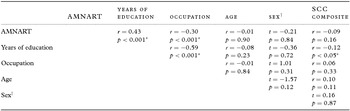
Years of education was significantly correlated with the SCC composite, whereas AMNART (r = −0.09, p = 0.16) and Occupation score (r = 0.06, p = 0.33) were not. Years of education was inversely correlated with SCC, such that individuals with fewer years of education tended to report greater SCC than those with more education (r = −0.12, p < 0.05). Age was not found to correlate with the SCC composite (r = 0.10, p = 0.11), although it was at a trend level. There were no significant differences between males and females in their SCC severity (t (251) = 0.16, p = 0.87) (see Table 2).
Pearson's correlations between the three measures of educational attainment, age, and sex, and the SCC composite

*Correlation is significant at the 0.05 level.
† p-values are based on correlations, except for sex, where p-values are based on t-tests.
Association between SCC and Aβ burden modified by age, sex, and education
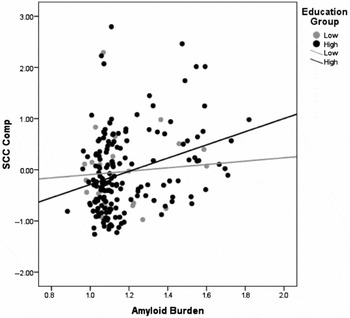
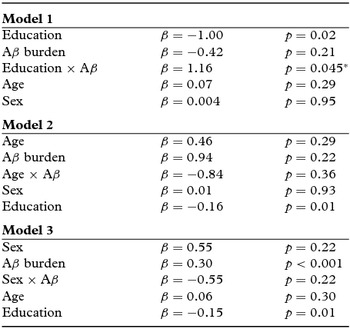
The interaction between years of education and Aβ burden was found to significantly predict SCC, while controlling for age and sex (β = 1.16, p = 0.045; see Figure 1). The interaction between age and Aβ burden was not found to predict SCC after controlling for sex and education (β = −0.84, p = 0.36). The interaction between sex and Aβ burden was also not found to predict SCC after controlling for age and education (β = −0.55, p = 0.22) (see Table 3).
Scatter plot of amyloid burden by SCC modified by education group. Education was dichotomized for illustrative purposes (high > 17 : low ≤ 16). The relationship between Aβ burden and SCC was stronger in individuals with greater years of education than those with fewer years of education.

Summary of the series of separate linear regression models for an outcome of SCC

*Statistically significant (p < 0.05).
Using an adjusted GDS score as an additional covariate, we found that the interaction between education and Aβ burden fell to trend level, although the standardized coefficient was similar (β = 0.90, p = 0.10). In our secondary analyses examining educational attainment and socioeconomic status, we found that neither the interaction between AMNART and Aβ burden (β = 0.48, p = 0.63), nor the interaction between Occupation score and Aβ burden, modified SCC (β = −0.09, p = 0.85).
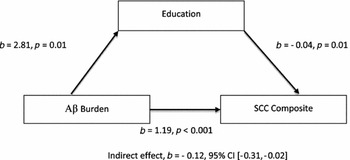
In the mediation model, we found significant direct effects of Aβ on education level and SCC, and of education level on SCC (see Figure 2). We also found an indirect effect of Aβ burden on SCC via education that reached statistical significance, b = −0.12, 95% CI [−0.31, −0.02]. This suggested multiple mechanisms by which Aβ could influence SCC. The indirect pathway exhibited, however, a relatively small effect, K 2 = 0.03, 95% CI [0.004, 0.07].
Model of the mediation analysis of Aβ burden as a predictor of SCC, and mediated by education. The confidence interval for the indirect effect is bootstrapped based on 1,000 samples (Hayes, Reference Hayes2013).

Discussion
In this study, we investigated the modifying role of demographic variables on the relationship between SCC and Aβ burden in CN older individuals. While fewer years of education was associated with greater overall SCC, interestingly the relationship between Aβ burden and SCC was stronger in individuals with greater years of education than those with fewer years of education. Furthermore, follow-up analyses revealed that the relationship between Aβ burden and SCC is indirectly mediated by education. It is important to note that the indirect effect was small, suggesting that other factors also play a role in explaining the variance between these SCC and neocortical Aβ burden. These findings are consistent with previous reports demonstrating that individuals with fewer years of education endorse greater amounts of complaints (Bolla et al., Reference Bolla, Lindgren, Bonaccorsy and Bleecker1991; Derouesné et al., Reference Derouesné1993; Stewart et al., Reference Stewart2008), yet those who are highly educated have complaints that are more prognostic of cognitive decline than those with fewer years of education (Geerlings et al., Reference Geerlings, Schmand, Braam, Jonker, Bouter and van Tilburg2000; Jonker et al., Reference Jonker, Geerlings and Schmand2000; van Oijen et al., Reference van Oijen, de Jong, Hofman, Koudstaal and Breteler2007). As such, individuals who are highly educated may be more perceptive of subtle memory changes that are occurring. Those that are highly educated may hold higher positions of employment, making nuanced changes in memory more apparent. Yet, those who have received greater years of education may be better able to compensate for these difficulties, concealing the risk of disease progression. This heightened perceptiveness sits in contrast to standardized objective memory measures, which typically are less sensitive in detecting pathology in individuals with more education (Stern, Reference Stern2009), although this can be overcome with challenging cognitive measures (Rentz et al., Reference Rentz2010). This suggests that SCC may be of particular importance in highly educated individuals who may be at risk for AD dementia (Rabin et al., Reference Rabin2015).
We also investigated whether premorbid estimates of IQ (i.e. AMNART) and socioeconomic status (i.e. Occupation score of Hollingshead) modified the relationship between SCC and Aβ burden, but did not find an association. We may have been unable to detect these associations due to a more restricted range in AMNART and Occupation score compared with years of education.
Greater age trended with increased SCC, although it was not a statistically significant finding. This is in contrast to several previous reports that have found greater age is associated with greater SCC, (Bolla et al., Reference Bolla, Lindgren, Bonaccorsy and Bleecker1991; Derouesné et al., Reference Derouesné1993; Jonker et al., Reference Jonker, Geerlings and Schmand2000; Kim et al., Reference Kim, Stewart, Shin, Choi and Yoon2003; Trouton et al., Reference Trouton, Stewart and Prince2006; van Oijen et al., Reference van Oijen, de Jong, Hofman, Koudstaal and Breteler2007; Benito-León et al., Reference Benito-León, Mitchell, Vega and Bermejo-Pareja2010) although many of these studies included a much wider age span than our more restricted sample. In general, SCC typically increase with age, as perceived memory changes become increasingly more common, but may not necessarily reflect underlying pathology (Wang et al., Reference Wang2004; Zwan et al., Reference Zwan2016). This is the case, particularly for the oldest-old, for whom the meaningfulness of SCC may be quite different from the younger-old. Furthermore, age did not have a significant modifying role with Aβ burden and SCC. This finding is in contrast to a previous study (Zwan et al., Reference Zwan2016) that found that SCC predict Aβ burden in the younger-old group (<73 years old) compared to the older-old group (≥73 years old). In contrast with the current study, their sample was enriched for APOEε4 carrier status, which is known to increase the likelihood of greater Aβ burden and an earlier age of onset of AD symptomatology, perhaps influencing the relationship between age and SCC.
Sex was not associated with SCC, which is consistent with previous studies (Derouesné et al., Reference Derouesné1993; Geerlings et al., Reference Geerlings, Schmand, Braam, Jonker, Bouter and van Tilburg2000; Jonker et al., Reference Jonker, Geerlings and Schmand2000; Trouton et al., Reference Trouton, Stewart and Prince2006; van Oijen et al., Reference van Oijen, de Jong, Hofman, Koudstaal and Breteler2007; Mendes et al., Reference Mendes2008). Additionally, sex did not play a significant modifying role with Aβ burden and SCC. Thus, it appears that reports of SCC in both men and women carry equal weight in its association with Aβ burden.
When we controlled for depression, we found that the interaction between education and Aβ burden was no longer associated with SCC. However, it is well-known that depressive symptoms, even sub-clinical symptoms, relate more strongly to SCC than cognition or biomarkers. While this relationship is important to explore, the strong association between these two self-report measures can obscure relationships with smaller effect sizes, such as with AD biomarkers in CN individuals. Though these effects are quite modest across a number of studies, they may be the earliest sign of change in the AD process. Thus, SCC studies should consider the role of depressive symptoms, but should not dismiss potential relationships with AD biomarkers if including depressive symptoms attenuates relationships.
Our analyses had several limitations. First, our sample included individuals who are highly educated; the mean level of education was a four-year college degree, which may not generalize to the population at large. Second, a composite measure was created for SCC; combining questionnaires may attenuate the influence of individual variability inherent within each SCC domain and hinder our ability to detect relationships across various aspects of memory that may differentially relate to Aβ burden (Amariglio et al., Reference Amariglio2015). Furthermore, it is possible that other cognitive concerns that are not memory related may also be important in the risk of AD progression.
The current study proposes that consideration of education level when interpreting SCC may improve enrichment of those likely to manifest greater neocortical Aβ burden. It is important to determine the earliest point in the AD disease trajectory to intervene when a highly educated individual is concerned about memory changes, as these individuals tend to perform at ceiling on standardized measures of memory, particularly in the context of secondary prevention trials. Likewise, our findings suggest that SCC may be less useful in individuals with fewer years of education, who may report SCC that are unrelated to risk for AD. Further work will be needed to analyze the modifying role education has with SCC and Aβ burden over time. Ultimately, these findings have important implications in the clinical setting; that is, individuals who report concerns of memory changes but comprise an otherwise normal memory examination should not be disregarded, and should be assessed within the context of their level of educational attainment.
Conflict of interest
None.
Description of authors’ roles
S.L. Aghjayan assisted with data collection and wrote the paper. R.F. Buckley aided with carrying out the statistical analysis and with writing the paper. P. Vannini helped with writing the paper. D.M. Rentz supervised the data collection, collected the data, and assisted with writing the paper. J.D. Jackson collaborated with data collection and with writing the paper. R.A. Sperling designed the study, supervised the data collection, and assisted with writing the paper. K.A. Johnson assisted with the development of the study design, with supervising the data collection, and with writing the paper. R.E. Amariglio assisted with data collection, with carrying out the statistical analysis, and with writing the paper.
Acknowledgments
Supported by NIH grant P01AG036694. REA was supported by NIH grant K23AG044431 and Alzhiemer's Association grant NIRG-12-243012.