Carbapenem-resistant Enterobacteriaceae (CRE) are a global threat, and CRE containment is a clinical and public health priority. CRE epidemiology in acute-care and long-term care facilities,Reference Schwaber, Klarfeld-Lidji, Navon-Venezia, Schwartz, Leavitt and Carmeli1, Reference Chopra, Rivard and Awali2 facility networks,Reference Han, Goldstein, Wise, Bilker, Tolomeao and Lautenbach3 and localized geographical regionsReference Satlin, Chen and Patel4 has been described. Antibiograms are used to describe antimicrobial resistance at the facility, regional,Reference Hostler, Moehring and Ashley5 and statewide level.Reference Guarascio, Brickett, Porter, Lee, Gorse and Covvey6 Data describing CRE resistance and carbapenemase gene carriage at a statewide level have not been published. A statewide CRE antibiogram and CRE-specific epidemiological data are valuable to public health practitioners seeking to characterize CRE epidemiology and clinicians making therapeutic decisions, including empiric antibiotic therapy selection.
In 2014, CRE was added to Connecticut’s List of Reportable Laboratory Findings. In 2016, the Connecticut Department of Public Health (CT DPH) Healthcare-Associated Infections Program and State Public Health Laboratory (SPHL) established a Multidisciplinary Antimicrobial Resistance/Antimicrobial Stewardship Technical Advisory Group that designed a system for CRE surveillance and antibiotic susceptibility testing. This group includes stakeholders from clinical laboratories, acute-care hospitals, long-term care facilities, long-term acute-care hospitals, governmental public health, and academia. Members include clinical laboratory leaders, infectious diseases physicians and pharmacists, hospital and public health epidemiologists, and infection preventionists. The group designed a CRE antibiotic susceptibility panel and a panel of carbapenemase genes detected by polymerase chain reaction (PCR) to complement clinical laboratory testing.
Methods
In 2017, the submission of clinical CRE isolates to the Connecticut SPHL became a required component of mandatory laboratory reporting. CRE isolates were tested for susceptibility to doripenem, imipenem, ertapenem, and meropenem and the custom panel of antibiotics with activity against CRE. Susceptibility testing was conducted by broth microdilution using the Trek Custom Sensititre frozen panel (Thermo Scientific, Cleveland, OH) and disk diffusion and interpreted using 2017 Clinical and Laboratory Standards Institute (CLSI) break points (MS-100 S27), if available. For designing the antibiogram and performing this analysis, colistin MICs were interpreted using the EUCAST epidemiological cutoff value (version 7.1), and CLSI fosfomycin interpretations for Escherichia coli were applied to all Enterobacteriaceae.7
Carbapenemase-producing CRE (CP-CRE) were identified using the modified carbapenem inactivation method (mCIM).Reference Pierce, Simner and Lonsway8 A multiplex real-time PCR protocol developed by the US Centers for Disease Control and Prevention (CDC) and validated at the CT SPHL was used to identify genes for common carbapenemases including Klebsiella pneumoniae carbapenemase (KPC), New Delhi metallo-β-lactamase (NDM), OXA-48-like carbapenemases, verona integron-encoded metallo-β-lactamase (VIM), and imipenemase metallo-β-lactamase (IMP). Any mCIM-positive isolates without an identified carbapenemase mechanism were sent to the CDC for characterization.
A statewide CRE antibiogram was developed according to CLSI guidance (M39-A4)9 using 2017 data. The antibiogram and carbapenemase analyses included the first isolate per patient in 2017 that was nonsusceptible to at least 1 carbapenem. Frequency distributions and cross tabulations were calculated to create the antibiogram. We used χ2 testing to test associations between CP-CRE and non–CP-CRE isolates (SAS version 9.4 software, SAS Institute, Cary, NC). P values <.05 were considered statistically significant.
Results
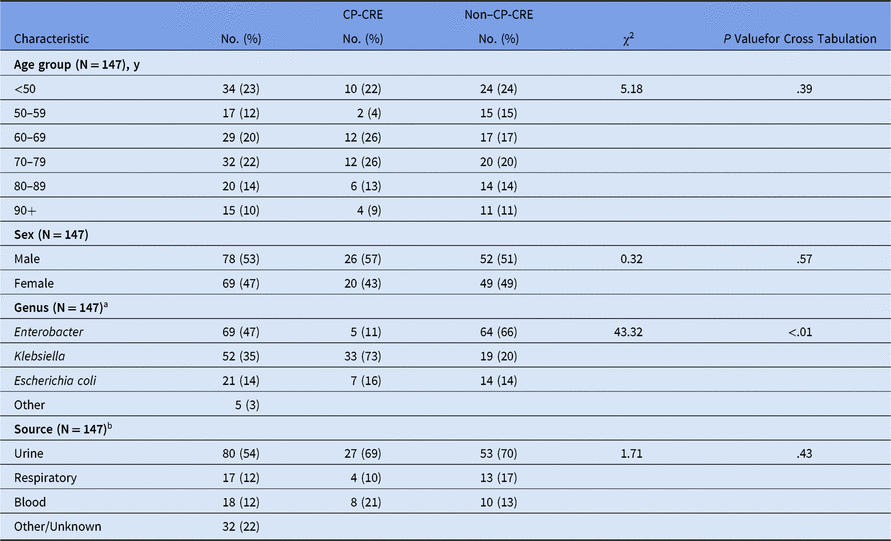
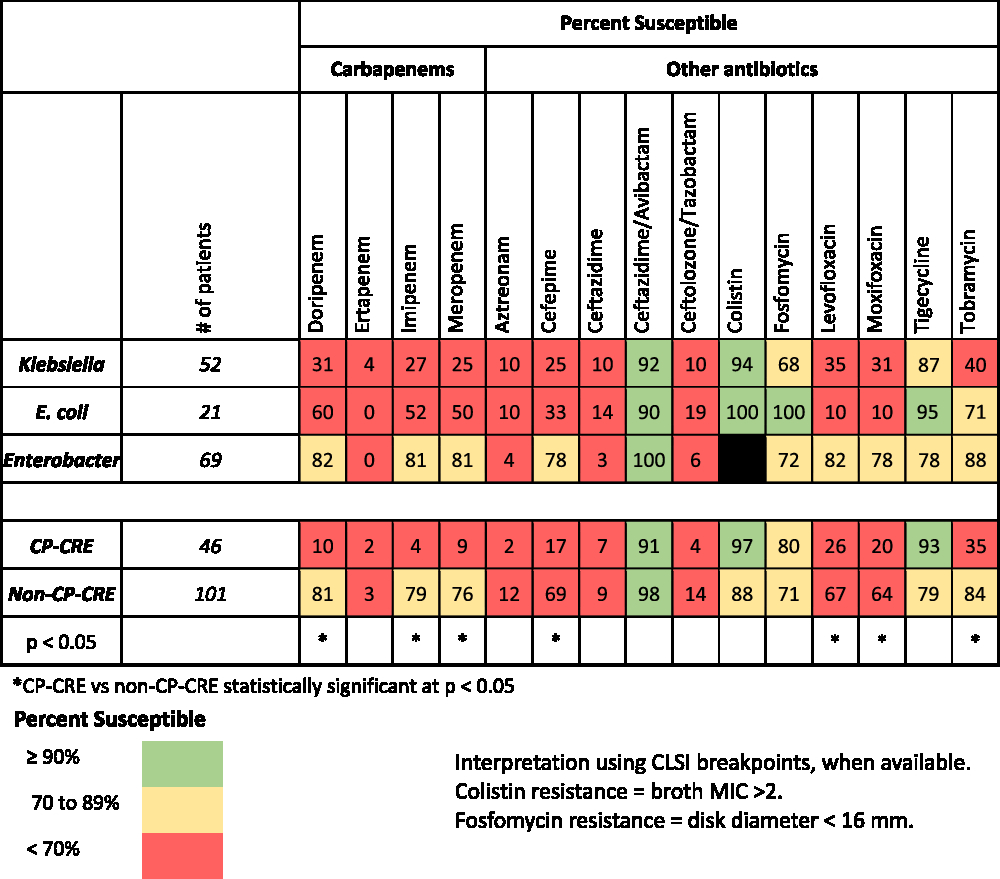
Of 198 isolates received in 2017, 166 (83.8%) were confirmed as carbapenem resistant. After patient deduplication, 147 individual patient isolates remained. Most isolates were from urine (n = 80, 58%) and most were Enterobacter (n = 69, 47%), Klebsiella (n = 52, 35%), or Escherichia coli (n = 21, 14%) (Table 1). Among the 147 patients, 78 (53%) were male and 113 (77%) were 50 years of age or older. Phenotypic mCIM testing identified 46 (31%) of the isolates as CP-CRE; carbapenemase gene detection identified 39 as bla KPC, positive, 4 as bla NDM positive, 2 as bla OXA-48–like positive. One isolate yielded bla IMI/bla NMC by PCR performed at the CDC. The antibiogram (Fig. 1) indicated that most CRE isolates were susceptible to ceftazidime-avibactam (range, 90%–100%) and colistin (range, 94%–100%). Non–CP-CRE isolates were more frequently susceptible to cefepime (69 vs 17%; χ2 = 33.67; P < .01), levofloxacin (67 vs 26%; χ2= 21.24; P < .01), moxifloxacin (64 vs 20%; χ2 = 24.88; P < .01), and tobramycin (84 vs 35%; χ2 = 35.37; P < .01).
Patient and Clinical Isolates Characteristics

Note. CP-CRE, Carbapenemase-producing carbapenem-resistant Enterobacteriaceae.
a Comparison excludes 5 isolates that were of other genus.
b Comparison excludes 32 isolates from another or unknown source.
Antimicrobial susceptibility among CRE isolates in Connecticut, 2017.

Discussion
This antibiogram suggests that ceftazidime-avibactam and colistin are appropriate choices for empiric treatment of CRE infection in Connecticut. Compared to non–CP-CRE, CP-CRE frequently demonstrated resistance to noncarbapenem antibiotics. Thus, among CP-CRE isolates in Connecticut, carbapenemase resistance mechanisms may be linked to other resistance mechanisms, and this possibility warrants further investigation.
This study had some limitations. Not all CRE isolates identified by CT clinical laboratories were available for testing at SPHL. However, there is no reason to believe this factor introduced systematic error. The intention of a CT antibiogram and carbapenemase testing is to provide state-specific information, limiting geographical generalizability. Our limited sample size prohibited the ability to analyze resistance patterns by patient setting and other factors.
This work exemplifies the benefits of a dynamic and effective partnership between public health agencies, clinicians, pharmacists, and laboratorians, leveraging timely, local data from public health surveillance for improving clinical care. Given the utility of mitigating CRE spread at the regional level,Reference Lee, Bartsch and Wong10 a statewide approach to reducing CRE spread is appropriate for Connecticut given its size and CRE prevalence. The statewide antibiogram data can detect changes in antibiotic resistance and guide infection control practices to mitigate CRE spread. These data, when provided to clinical facilities, can guide empiric prescribing and institutional antibiotic formulary selection. The CT DPH continues statewide CRE surveillance with antibiotic susceptibility and carbapenemase testing, partnering with the technical advisory group to update the antibiogram and the antibiotic susceptibility panel as new antibiotics become available and CRE epidemiology evolves. A statewide CRE antibiogram provides valuable information to clinicians and laboratory technicians who encounter CRE infrequently at individual facilities, and such antibiograms include isolates collected across facility types, including long-term acute care and nursing facilities, which frequently provide care for patients with CRE.
Acknowledgements
None.
Author ORCIDs
David B. Banach MD, MPH 0000-0003-4429-7750
Financial support
This work was supported by the Centers for Disease Control and Prevention (CDC) Epidemiology and Laboratory Capacity for Infectious Diseases (ELC) Cooperative Agreement.
Conflicts of interest
All authors report no conflicts of interest relevant to this article.