The scattering of plane and cylindrical waves by various dielectric cylindrical structures has been studied in many classical textbooks [Reference Harrington1–Reference Jin3] and by authors [Reference Wait4–Reference Henin, Elsherbeni and Sharkawy8] due to their important applications in microwave and optical regimes. Initially, the problem of electromagnetic scattering from a perfectly conducting strip loaded dielectric cylinder was studied by Elsherbeni and Hamid [Reference Elsherbeni and Hamid9], which provides a useful model to study the scattering from the fuselage of an aircraft or rocket. They have solved the problem using integral equations derived from Green’s theorem along with the applications of boundary conditions to transform the resulting integral equations into an equivalent matrix equation of infinite order. Asymptotic scattering of electromagnetic waves from an array of dielectrically loaded conducting strips under oblique incidence has been investigated by Elsherbeni and Jin [Reference Elsherbeni and Jin10]. They concluded that the scattering cross section of a perfectly conducting strip or an array of strips can be greatly minimized or maximized by loading each strip into a dielectric cylinder or dielectric shell. An analysis of the scattering properties of strip loaded circular dielectric cylinders has been carried out by Tsalamengas et al. [Reference Tsalamengas, Vardiambasis and Fikioris11] in the case of oblique incidence and arbitrary polarization. They found that the scattering characteristics can be controlled by varying the electromagnetic and geometrical parameters of the considered structure. Transverse magnetic (TM) and transverse electric (TE) scattering from strip loaded dielectric cylinders based on direct singular integral equation technique has been studied by Tsalamengas [Reference Tsalamengas12]. He has shown numerical results for dielectric cylinders loaded with flat or curved strips. An analytical solution of scattering from strip loaded lossy dielectric elliptic and circular cylinder has been investigated by Hamid and Hussein [Reference Hamid and Hussein13] using TM incident polarization. According to them, a significant reduction in echo width patterns can be found for different loss tangents using some specific parameters.
Recently, there has been a great deal of interest in the physics and engineering of single near zero (SNZ) and double near zero (DNZ) metamaterials due to their important technical applications [Reference Engheta and Ziolkowski14–Reference Abbasi, Awan and Hussain35]. An SNZ metamaterial can be further classified into epsilon near zero (ENZ) and mu near zero (MNZ) metamaterials. An ENZ metamaterial has its permittivity close to zero whereas an MNZ metamaterial has its permeability close to zero. A metamaterial having both permittivity and permeability close to zeros is called a double, near zero or near zero refractive index metamaterial. A DNZ metamaterial supports propagating modes with extremely large wavelength because its refractive index is very small, i.e., close to zero. These metamaterials with almost zero electromagnetic parameters can be used to realize energy tunneling [Reference Silveirinh and Engheta16–Reference Liu, Cheng, Hand, Mock, Cui, Cummer and Smith18], wavefront shaping [Reference Alu, Silveirinh and Engheta19, Reference Wang and Huang20], directional emission [Reference Gao, Sun, Deng, Mathai, Gangopadhyay and Yang23, Reference Pacheco-Pena, Torres, Beruete, Cia and Engheta24], and cloaking [Reference Guo, Jiang, Zhu, Sun, Li and Chen27].
In this paper, scattering of plane and cylindrical waves from a strip loaded metamaterial cylinder is considered. The types of metamaterial considered in the present study are SNZ and DNZ. We have extended the work of Elsherbeni and Hamid [Reference Elsherbeni and Hamid9] which was mainly relevant to the TM excitation of a strip loaded dielectric cylinder to the TE excitation, electric line source (ELS) and magnetic line source (MLS) excitations of a strip loaded metamaterial cylinder. We have also shown and discussed numerical results for each type of excitation whereas in [Reference Elsherbeni and Hamid9], numerical results for only TM polarization have been shown and discussed. In the case of plane wave excitation, the obtained numerical results are also compared with CST simulations and a good agreement is found between them. During the study, it was found that a strip loaded DNZ metamaterial cylinder enhances the back scattering as compared to the back scattering of an unloaded DNZ metamaterial cylinder for both types of incident polarization. It is also noticed that a specifically located ELS can be used to significantly reduce the magnitude of total field from a strip loaded DNZ metamaterial cylindrical object at specific observation angles as compared to an unloaded DNZ metamaterial cylindrical object. Likewise, for a specifically located MLS excitation, the magnitude of total field of a strip loaded MNZ metamaterial can be significantly enhanced as compared to unloaded MNZ cylinder in the specific observation directions. These abovementioned findings are novel and have not been reported previously in the literature. This study is helpful in the design of cylindrical metamaterial based devices.
Formulation of the problem
To formulate the problem, an infinite length circular cylinder of fixed radius a is considered. The axial direction of a cylinder is parallel to the z-axis and the center of the cylinder coincides with the origin of the standard Cartesian coordinate system. This cylinder has electromagnetic parameters of  $\varepsilon_{1}=\varepsilon_{o}\varepsilon_{r1}$ and
 $\mu_{1}=\mu_{o}\mu_{r1}$ where ɛo and µo are the permittivity and permeability of the free space, respectively. The parameters
 $\varepsilon_{r1}$ and
 $\mu_{r1}$ represent the relative permittivity and relative permeability of the cylinder material, respectively. The material of the cylinder is taken to be linear, homogeneous, and isotropic. For the present theory, it is assumed that the material of a cylinder is lossless, but the proposed theory can also be used for lossy materials as well. A perfectly conducting strip of length 2a is located inside the cylinder which lies in the xz-plane and divides the cylinder into two regions, i.e., region 1 and region 2. This strip loaded cylinder is embedded in the free space background which occupies region 3. The geometrical configuration of strip loaded cylinders with plane wave and cylindrical wave excitation has been shown in Fig. 1(a) and (b), respectively. A time dependence of
 $e^{{j}{\omega} t}$ has been assumed and suppressed throughout.
The geometrical configuration of strip loaded cylinders with (a) TM and TE plane wave excitation and (b) electric and magnetic line source excitation.

Suppose there exists an electric field vector E and a magnetic field vector H due to a pair of sources, i.e., electric current density J and magnetic current density M outside the cylinder in region 3. Inside the cylinder, there exists an electric field vector Em and a magnetic field vector Hm in the mth region with  $m = 1, 2$. These electric and magnetic field vectors, i.e., E, H, Em, and Hm may exist within a surface S, enclosing a volume V, of a linear, homogeneous and isotropic medium. By using Green’s vector theorem [Reference McIsaac36], we can write,
 \begin{equation}
\int_{s} (\mathbf{E}_{m} \times \mathbf{H} - \mathbf{E} \times \mathbf{H}_{m})\cdot \hat{\mathbf{n}} ds = \int_{V} (\mathbf{H}_{m} \cdot \mathbf{M} - \mathbf{E}_{m} \cdot \mathbf{J})dV
\end{equation}
where  $\int_{s}$ and
 $\int_{V}$ represent the surface integral and the volume integral, respectively. Here
 $\hat{\mathbf{n}}$ is a unit vector normal to the cylinder at
 $\rho = a$, i.e.,
 $\hat{\mathbf{n}}$ =
 $\hat{\boldsymbol{\rho}}$.
Plane wave excitation
In the case of plane wave excitation, the strip loaded dielectric cylinder is illuminated by an incident plane wave. In order to analyze the complete scattering characteristics of this strip loaded material cylinder, both types of incident wave polarizations have been considered, i.e., TM and TE. The incident plane wave makes an angle ϕo with +x-axis as shown in Fig. 1(a). Here, the z-direction is taken to be the axial direction of a strip loaded cylinder. For TM polarization, the incident electric field is parallel to the z-axis, i.e., the incident electric field vector has only a nonzero z-component. On the other hand, for TE polarization, its incident magnetic field is parallel to the z-axis, which shows that the incident magnetic field vector has only a nonzero z-component.
For TM polarization, using the procedure as outlined in [Reference Elsherbeni and Hamid9], the z-component of electric fields in all the three regions can be written in terms of cylindrical coordinates (ρ, ϕ, z) as below,
 \begin{equation}
E_{3z} = E_{o}H^{(2)}_{p}(k_o \rho) e^{{j}{p} \phi}, \ \ \ p=0,\pm1,\pm2,...
\end{equation}
 \begin{equation}
E_{1z} =E_{o}\sum_{n=1}^{\infty} C(n,p)\ J_{n}(k_{1} \rho) \sin( n \phi)
\end{equation}
 \begin{equation}
E_{2z} =E_{o}\sum_{m=1}^{\infty} D(m,p)J_{m}(k_{1} \rho) \sin (m (\phi-\pi))
\end{equation}
where ko =  $\omega\sqrt{\varepsilon_{o}\mu_{o}}$ , k 1 =
 $\omega\sqrt{\varepsilon_{1}\mu_{1}}$ and Eo is the amplitude of the incident plane wave. Also, Euz is the z-component of the electric field in uth region with
 $u = 1,2,3$ as shown in Fig. 1(a). Here
 $C(n,p)$ and
 $D(m,p)$ are unknown expansion coefficients which are needed to be determined. The function
 $J_{n}(\cdot)$ represents an nth order Bessel function of first kind and
 $H_{p}^{\ (2)}(\cdot)$ represents a pth order Hankel function of second kind. It should be noted that
 $H_{p}^{\ (2)}(k_o \rho)$ represents an outward traveling cylindrical wave for the assumed time convention. It can be shown that the electric field
 $E_{3z}$ as given by Eq. (2) satisfies the radiation condition. In order to determine the unknown coefficients C and D, one may use the following boundary conditions,
 \begin{equation}
E_{1z} = E_{3z}, \ \ \ \ \ \rho = a, \ \ \ \ 0\leq\phi\leq\pi
\end{equation}
 \begin{equation}
E_{2z} = E_{3z}, \ \ \ \ \ \rho = a, \ \ \ \ \pi\leq\phi\leq2\pi.
\end{equation}
Using Eqs. (2)–(4) in the boundary conditions given by Eqs. (5) and (6) and after some manipulations, the unknown coefficients  $C(n,p)$ and
 $D(m,p)$ can be found. Once these coefficients are known, we can find the z-components of the electric field in regions 1 and 2 as given by Eqs. (3) and (4). Likewise, the ϕ-components of the magnetic field in all three regions, i.e.,
 $H_{u\phi}$ with
 $u = 1,2,3$, can be found from Maxwell’s equations by taking
 $E_{u\rho} = E_{u\phi} = 0$. By following the steps as given in [Reference Elsherbeni and Hamid9] and using Eq. (1) for all the three regions, we can write an equation in terms of the unknown electric field Ez at the boundary
 $\rho = a$ as below,
 \begin{eqnarray}
\int_{0}^{\pi}E_{z}H_{1\phi}\,d\phi+\int_{\pi}^{2\pi}E_{z}H_{2\phi}\,d\phi -\int_{0}^{2\pi}E_{z}H_{3\phi}\,d\phi \nonumber\\
= -\frac{4je^{j[p(\phi_{o}+\frac{\pi}{2})+ \frac{\pi}{2}]}}{\eta_o k_o a}E_{o}^{2}.
\end{eqnarray}
By substituting the ϕ-components of the magnetic fields of all the three regions, i.e.,  $H_{1\phi}$,
 $H_{2\phi}$, and
 $H_{3\phi}$ in above Eq. (7), we can write an equation in terms of the electric field Ez at the boundary
 $\rho = a$ which is given below,
 \begin{equation}
\begin{aligned}
\frac{1}{j \eta_{1}} \sum_{n=1}^{\infty} C(n,p)J_{n}^{\prime} (k_{1} a)\int_{0}^{\pi} E_{z} \sin ( n \phi) d \phi + \\
\frac{1}{j \eta_{1}}\sum_{n=1}^{\infty} D(m,p)J_{m}^{\prime}(k_{1}a) \int_{\pi}^{2 \pi} E_{z} \sin (m( \phi-\pi )) d\phi \\
- \frac{1}{j \eta_o} H_{p}^{(2)\prime}(k_o a) \int_{0}^{2 \pi} E_{z} e^{{j}{p} \phi} d\phi = -\frac{4je^{j[p(\phi_{o}+\frac{\pi}{2})+ \frac{\pi}{2}]}}{\eta_o k_{o}a}E_{o}
\end{aligned}
\end{equation}
where  $(\prime)$ denotes the differentiation with respect to the argument. Also, ηo is the intrinsic impedance of the free space and
 $\eta_{1} = {\sqrt{\mu_{1} / \varepsilon_{1}}}$ is the intrinsic impedance of the material cylinder. The solution of the above Eq. (8) gives the values of the field Ez at the boundary
 $\rho = \mathrm{a}$. This electric field, Ez in region 3, can be expressed in the following series as,
 \begin{equation}
E_{z} = E_{o}\sum_{q= -\infty}^{\infty} c^{TM}_{q} H^{(2)}_{q}(k_o \rho) e^{{-j}{q} \phi}
\end{equation}
where  $c^{TM}_{q}$ is the unknown coefficient and needs to be determined. By substituting Eq. (9) in Eq. (8), the infinite set of equations in unknown
 $c^{TM}_{q}$ can be found. In order to obtain the convergent results for coefficients
 $c^{TM}_{q}$, it is required to define the same truncation index N for both indices p and q which should be chosen large enough to give the accuracy required. Thus, the final equation for unknown
 $c^{TM}_{q}$ is given below,
 \begin{equation}
\begin{aligned}
\frac{1}{\eta_{1}} \sum_{q = -N, q\neq p}^{N} c^{TM}_{q} H^{(2)}_{q}(k_{o}a)f_{c}(p,q)+ \frac{1}{\eta_{1}}c^{TM}_{p} H^{(2)}_{p}(k_{o}a)\cdot\\
f_{c}(p,p) - \frac{2\pi}{\eta_o} c^{TM}_{p} H_{p}^{(2)\prime}(k_{o}a) H^{(2)}_{p}(k_{o}a)
= \frac{4e^{j[p(\phi_{o}+\frac{\pi}{2})+ \frac{\pi}{2}]}}{\eta_{o}k_{o}a}
\end{aligned}
\end{equation}
 \begin{eqnarray}
f_{c}(p,q) &=& \sum_{n=1}^{\infty}C(n,p)J_{n}^{\prime}(k_{1}a)f_{a}(n,q) + \sum_{m=1}^{\infty}D(m,p)\nonumber\\
&& \cdot J_{m}^{\prime}(k_{1}a)f_{b}(m,q)
\end{eqnarray}
where  $f_{a}(n,q)$ and
 $f_{b}(m,q)$ have been defined by Eqs. (19) and (20) in [Reference Elsherbeni and Hamid9]. The coefficient
 $c^{TM}_{q}$ is determined numerically by solving Eqs. (10) and (11). In region 3, the z-component of the total electric field
 $E_{z}^{t}$ can be taken as a sum the incident plane wave and the z-component of the scattered electric field from the strip loaded material cylinder. For this, it is desired to express the incident plane wave as an infinite sum of cylindrical waves [Reference Balanis2]. Likewise, the z-component of the scattered field can also be expressed in terms of an infinite sum of outward traveling cylindrical waves with the unknown scattering amplitude coefficient
 $D_{n}^{TM}$. Mathematically, the total electric field
 $E_{z}^{t}$ can be expressed as below,
 \begin{equation}
E_{z}^{t} = E_{o}\sum_{n= -\infty}^{\infty}[j^{n}J_{n}(k_o \rho)+D_{n}^{TM} H^{(2)}_{n}(k_o \rho)] e^{{-j}{n} (\phi-\phi_{o})}
\end{equation}
where  $D_{n}^{TM}$ is the unknown and can be found by comparing Eqs. (9) and (12) at
 $\rho = a$ as below,
 \begin{equation}
D_{n}^{{TM}}=c^{TM}_{n} e^{{-j}{n}\phi_{o}}-\frac{j^{n}J_{n}(k_{o}a)}{H^{(2)}_{n}(k_{o}a)}.
\end{equation}
Here  $D_{n}^{{TM}}$ is known provided that if
 $c^{TM}_{n}$ is known. In the case of a perfectly electric conducting (PEC) cylinder without a strip, it can be shown that
 $c^{TM}_{n} = 0$ and
 $D_{n}^{{TM}}$ becomes as,
 \begin{equation}
D_{n}^{{TM}}=-\frac{j^{n}J_{n}(k_{o}a)}{H^{(2)}_{n}(k_{o}a)}.
\end{equation}
In the case of a material cylinder without a strip, the coefficient  $D_{n}^{{TM}}$ can be found by applying the usual tangential boundary conditions at
 $\rho = a$ for
 $0\leq\phi\leq2\pi$. Thus, using this information and following the procedure as outlined above, the coefficient
 $D_{n}^{{TM}}$ for a material cylinder without a strip becomes as,
 \begin{equation}
D_{n}^{{TM}}=-j^{n}\frac{\eta_{1} J^{\prime}_{n}(k_{o}a)J_{n}(k_{1}a)-\eta_o J_{n}(k_{o}a)J^{\prime}_{n}(k_{1}a)}{\eta_{1}H^{(2)\prime}_{n}(k_{o}a)J_{n}(k_{1}a)-\eta_o H^{(2)}_{n}(k_{o}a)J^{\prime}_{n}(k_{1}a)}. \\
\end{equation}
For TE polarization, we do not have a component of the electric field in the z-direction for all the considered three regions, i.e.,  $E_{uz} = 0$ and
 $H_{uz}\neq$ 0 with
 $u = 1,2,3$. Extending the same procedure as outlined above for the TE case, the z-components of magnetic fields in all three regions can be written in terms of cylindrical coordinates as below,
 \begin{equation}
H_{3z} = \frac{E_{o}}{j \eta_o} H^{(2)}_{p}(k_{o}\rho) e^{{j}{p} \phi}, \ \ \ p=0,\pm1,\pm2,...
\end{equation}
 \begin{equation}
H_{1z} = \frac{E_{o}}{j \eta_{1}}\sum_{n=1}^{\infty} A(n,p)J_{n}(k_{1} \rho) \sin(n\phi) \end{equation}
 \begin{equation}
H_{2z} = \frac{E_{o}}{j \eta_{1}}\sum_{m=1}^{\infty} B(m,p)J_{m}(k_{1} \rho) \sin \ (m(\phi-\pi))
\end{equation}
where  $A(n,p)$ and
 $B(m,p)$ are the unknown expansion coefficients and can be determined using the following boundary conditions as given below,
 \begin{equation}
H_{1z} = H_{3z}, \ \ \ \ \ \rho = a, \ \ \ \ 0\leq\phi\leq\pi \end{equation}
 \begin{equation}
H_{2z} = H_{3z}, \ \ \ \ \ \rho = a, \ \ \ \ \pi\leq\phi\leq2\pi.
\end{equation}
Once the coefficients  $A(n,p)$ and
 $B(m,p)$ become known, then the z-components of magnetic fields in regions 1 and 2 can be determined by Eqs. (17) and (18). The ϕ-components of the electric fields in all three regions, i.e.,
 $E_{1\phi}$,
 $E_{2\phi}$, and
 $E_{3\phi}$, can be found from Maxwell’s equations. Using Eq. (1) for all three regions, we can develop an equation similar to Eq. (7) for the considered TE polarization in terms of an unknown electric field Eϕ at
 $\rho = a$ and z-components of the magnetic fields in all three regions, i.e.,
 $H_{1z}$,
 $H_{2z}$, and
 $H_{3z}$. For the unknown electric field Eϕ in region 3, the following series expansion can be used, i.e.,
 \begin{equation}
E_{\phi} = E_{o}\sum_{q= -\infty}^{\infty} C^{TE}_{q} H^{(2)\prime}_{q}(k_{o}\rho) e^{{-j}{q}\phi}
\end{equation}
where  $C^{TE}_{q}$ is the unknown. Following the same steps as adopted for TM case, we can write an equation in unknown
 $C^{TE}_{q}$ as below,
 \begin{equation}
\begin{aligned}
\sum_{q= -N,q\neq p}^{N} C^{TE}_{q} H^{(2)}_{q}(k_{o}a)f_{c}(p,q)+ C^{TE}_{p} H^{(2)}_{p}(k_{o}a)f_{c}(p,p) \\
- 2\pi C^{TE}_{p} H_{p}^{(2)\prime}(k_{o}a) H^{(2)}_{p}(k_{o}a) = -\frac{4e^{j[p(\phi_{o}+\frac{\pi}{2})+ \frac{\pi}{2}]}}{k_{o}a}.
\end{aligned}
\end{equation}
The unknown  $C^{TE}_{q}$ can be made known by solving Eq. (22) numerically and adopting similar conditions as used for the TM case. The ϕ-component of total electric field in region 3 can also be expressed in terms of the unknown scattering coefficient
 $d_{n}^{TE}$ as below,
 \begin{equation}
E_{\phi}^{t} = E_{o} \sum_{n= -\infty}^{\infty}[j^{n}J^{\prime}_{n}(k_{o}\rho)+d_{n}^{TE} H^{(2)\prime}_{n}(k_{o}\rho)] e^{{-j}{n} (\phi-\phi_{o})}.
\end{equation}
By comparing Eqs. (21) and (23) at  $\rho = a$, the unknown scattering coefficient
 $d_{n}^{TE}$ can be found and given below,
 \begin{equation}
d_{n}^{TE}=C^{TE}_{n} e^{{-j}{n}\phi_{o}}-\frac{j^{n}J^{\prime}_{n}(k_{o}a)}{H^{(2)\prime}_{n}(k_{o}a)}.
\end{equation}
Here  $d_{n}^{{TE}}$ is known provided that if
 $C^{TE}_{n}$ is known. In the case of a PEC cylinder, we have
 $C^{TE}_{n}=0$ and
 $d_{n}^{{TE}}$ becomes as,
 \begin{equation}
d_{n}^{TE}=-\frac{j^{n}J^{\prime}_{n}(k_{o}a)}{H^{(2)\prime}_{n}(k_{o}a)}.
\end{equation}
Following the same procedure as outlined above, the coefficient  $d_{n}^{{TE}}$ for a dielectric cylinder without a strip becomes as,
 \begin{equation}
d_{n}^{TE}=- j^{n} \frac{\eta_o J^{\prime}_{n}(k_{o}a)J_{n}(k_{1}a)-\eta_{1} J_{n}(k_{o}a)J^{\prime}_{n}(k_{1}a)}{\eta_o H^{(2)\prime}_{n}(k_{o}a)J_{n}(k_{1}a)-\eta_{1} H^{(2)}_{n}(k_{o}a)J^{\prime}_{n}(k_{1}a)}.
\end{equation}
In the present study, the scattering width is a quantity of interest for both types of incident polarization. For this, it is required to find the far zone scattered field pattern, i.e.,  $F_{TM}(\phi)$ and
 $F_{TE}(\phi)$ which can be found from the second term of Eqs. (12) and (23) after using the large argument approximation of the Hankel function and its derivative, respectively. They are given below,
 \begin{equation}
F_{TM}(\phi) = \sum_{n= -\infty}^{\infty} D_{n}^{TM} j^{n} e^{{-j}{n} (\phi-\phi_{o})}
\end{equation}
 \begin{equation}
F_{TE}(\phi) = -\sum_{n= -\infty}^{\infty} d_{n}^{TE} j^{n+1} e^{{-j}{n} (\phi-\phi_{o})}.
\end{equation}
Based upon these above far zone scattered field patterns, the normalized scattering width [Reference Balanis2], i.e.,  $\sigma(\phi) = \sigma_{2D}(\phi)/\lambda_{o}$, can be written as below with
 $p=TM,TE$,
 \begin{equation}
\sigma(\phi) = \frac{2}{\pi} | F_{p}(\phi)|^{2}
\end{equation}
where λo is the wavelength in the background free space medium.
Line source excitation
In the previous section, the source of excitation is taken to be the plane wave, which is independent of the location of source. Contrary to this, if a strip loaded material cylinder is excited by a line source, then the location of source plays an important role for modeling the complete scattering characteristics. For this case, two types of line sources can be considered. (1) An ELS with the magnitude of electric current I and (2) MLS with the magnitude of magnetic current Im. It is assumed that the locations of both line sources are assumed to be (ρo, ϕo) in the usual cylindrical coordinates and their axial directions are taken to be parallel to the axial direction of strip loaded material cylinder, i.e., z-axis. This geometrical configuration has been shown in Fig. 1(b).
In the first case, an ELS excitation has been assumed. For this case, the total electric field,  $E_{z}^{l}$ which is the sum of incident and scattered electric fields, can be written as below [Reference Balanis2],
 \begin{equation}
E_{z}^{l} =
\begin{cases}
\frac{-\eta_{o}k_{o}}{4}\sum\limits_{n= -\infty}^{\infty}[I J_{n}(k_{o}\rho)
+ E_{n} H^{(2)}_{n}(k_{o}\rho)]\\
\cdot H^{(2)}_{n}(k_{o}\rho_{o}) e^{{-j}{n} (\phi-\phi_{o})}, \ \ \ \ a\leq\rho \lt \rho_{o}\\
\ \ \ \\
\frac{-\eta_{o}k_{o}}{4}\sum\limits_{n= -\infty}^{\infty}[I J_{n}(k_{o}\rho_{o})
+ E_{n} H^{(2)}_{n}(k_{o} \rho_{o})]\\
\cdot H^{(2)}_{n}(k_{o} \rho )e^{{-j}{n} (\phi-\phi_{o})}, \ \ \ \ \rho \gt \rho_{o}
\end{cases}
\end{equation}
where En is the unknown scattering coefficient and can be found by comparing the total electric field in region 3 as given by Eq. (9) to the total electric field as given by Eq. (30) at  $\rho = a$. Using this above procedure, it is found that the unknown scattering coefficient En can be written as,
 \begin{equation}
E_{n}=-\frac{4 E_{o}c_{n}^{TM} e^{{-j}{n} (\phi_{o})}}{\eta_{o}k_{o} H^{(2)}_{n}(k_{o} \rho_{o})} -\frac{I J_{n}(k_{o}a)}{H^{(2)}_{n}(k_{o}a)}.
\end{equation}
In the case of a material cylinder without a strip, the unknown scattering coefficient En can be written in terms of coefficient  $D_{n}^{TM}$ as below,
 \begin{equation}
E_{n}=\frac{D_{n}^{{TM}} I}{j^{n}}
\end{equation}
where  $D_{n}^{TM}$ has been derived previously and given by Eq. (15).
In the case of a strip loaded material cylinder when excited by an MLS, the total magnetic field  $H^{m}_{z}$ is a sum of the incident magnetic field and the scattered magnetic field, which is given below,
 \begin{equation}
H^{m}_{z} =
\begin{cases}
\frac{-k_{o}}{4\eta_{o}}\sum\limits_{n=-\infty}^{\infty} [I_{m} J_{n}(k_{o}\rho)
+ M_{n} H^{(2)}_{n}(k_{o} \rho)]\\
\cdot H^{(2)}_{n}(k_{o}\rho_{o}) e^{{-j}{n} (\phi-\phi_{o})}, \ \ \ \ a\leq\rho \lt \rho_{o}\\ \ \ \ \\
\frac{-k_{o} }{4\eta_{o}}\sum\limits_{n= -\infty}^{\infty}[I_{m}J_{n}(k_{o}\rho_{o})
+ M_{n} H^{(2)}_{n}(k_{o} \rho_{o})]\\
\cdot H^{(2)}_{n}(k_{o} \rho ) e^{{-j}{n} (\phi-\phi_{o})}, \ \ \ \ \rho \gt \rho_{o}\\
\end{cases}
\end{equation}
where Mn is the unknown scattering coefficient and needs to be determined. Using Maxwell’s equation, we can find  $E^{m}_{\phi}$. Now, by comparing
 $E^{m}_{\phi}$ with the total electric field Eϕ in region 3, which is given by Eq. (21) at
 $\rho = a$, we can find the coefficient Mn as below,
 \begin{equation}
M_{n}=-\frac{4 E_{o} C^{TE}_{n} e^{{-j}{n} \phi_{o} }}{j k_{o} H^{(2)}_{n}(k_{o} \rho_{o})} -\frac{I_{m} J^{\prime}_{n}(k_{o}a)}{H^{(2)\prime}_{n}(k_{o}a)}.
\end{equation}
For a material cylinder without a strip, the coefficient Mn becomes,
 \begin{equation}
M_{n}=\frac{d_{n}^{{TE}} I_{m}}{j^{n}}
\end{equation}
where the coefficient  ${d_{n}^{{TE}}}$ is given by Eq. (26). For both types of line source excitation, we are interested in the total field pattern, i.e.,
 $F_{l}(\phi)$ with
 $l = \mathrm{ELS}$, MLS, and are given below,
 \begin{eqnarray}
F_{ELS}(\phi) &=& \frac{-\eta_{o}k_{o}}{4}\sum_{n= -\infty}^{\infty}j^{n}[I J_{n}(k_{o}\rho_{o})+ E_{n}\cdot \nonumber\\
&& H^{(2)}_{n}(k_{o}\rho_{o})] e^{{-j}{n} (\phi-\phi_{o})}
\end{eqnarray}
 \begin{eqnarray}
F_{MLS}(\phi) &=& \frac{- k_{o} }{4\eta_{o}}\sum_{n= -\infty}^{\infty}j^{n}[I_{m} J_{n}(k_{o}\rho_{o})+ M_{n}\cdot \nonumber\\ && H^{(2)}_{n}(k_{o}\rho_{o})] e^{{-j}{n} (\phi-\phi_{o})}.
\end{eqnarray}
Numerical results and discussions
In this section, numerical results have been shown and discussed along with the demonstration of the validation of the proposed formulation. For all numerical results, we have assumed  $\phi_{s} = \phi$,
 $\epsilon_{r} = \varepsilon_{r1}$, and
 $\mu_{r} = \mu_{r1}$. Likewise, the size parameters of all strips loaded metamaterial cylindrical objects and metamaterial cylindrical objects without strips are assumed to be ka = 5 with
 $\phi_{o} = 90^{\circ}$ for all figures except Figs. 3 and 10 where they are different and mentioned accordingly. It should be noted that for
 $\phi_{o} = 90^{\circ}$, the forward scattering direction is characterized by an angle of
 $\phi_{s} = 270^{\circ}$ and the back scattering direction occurs for
 $\phi_{s} = 90^{\circ}$. In order to ensure the convergent results for the summations appearing in Eqs. (10) and (21), it is required to define the truncation index N. Here N is the absolute value of the upper limit of the index of summation in the series expressions. The typical value of the truncation index N is taken to be equal to
 $k_{1}a$+5 as given by [Reference Li and Shen38, Reference Awan and Seetharamdoo39]. It should be noted that for all the numerical results related to “Numerical results and discussions” section, Eo is taken to be unity.
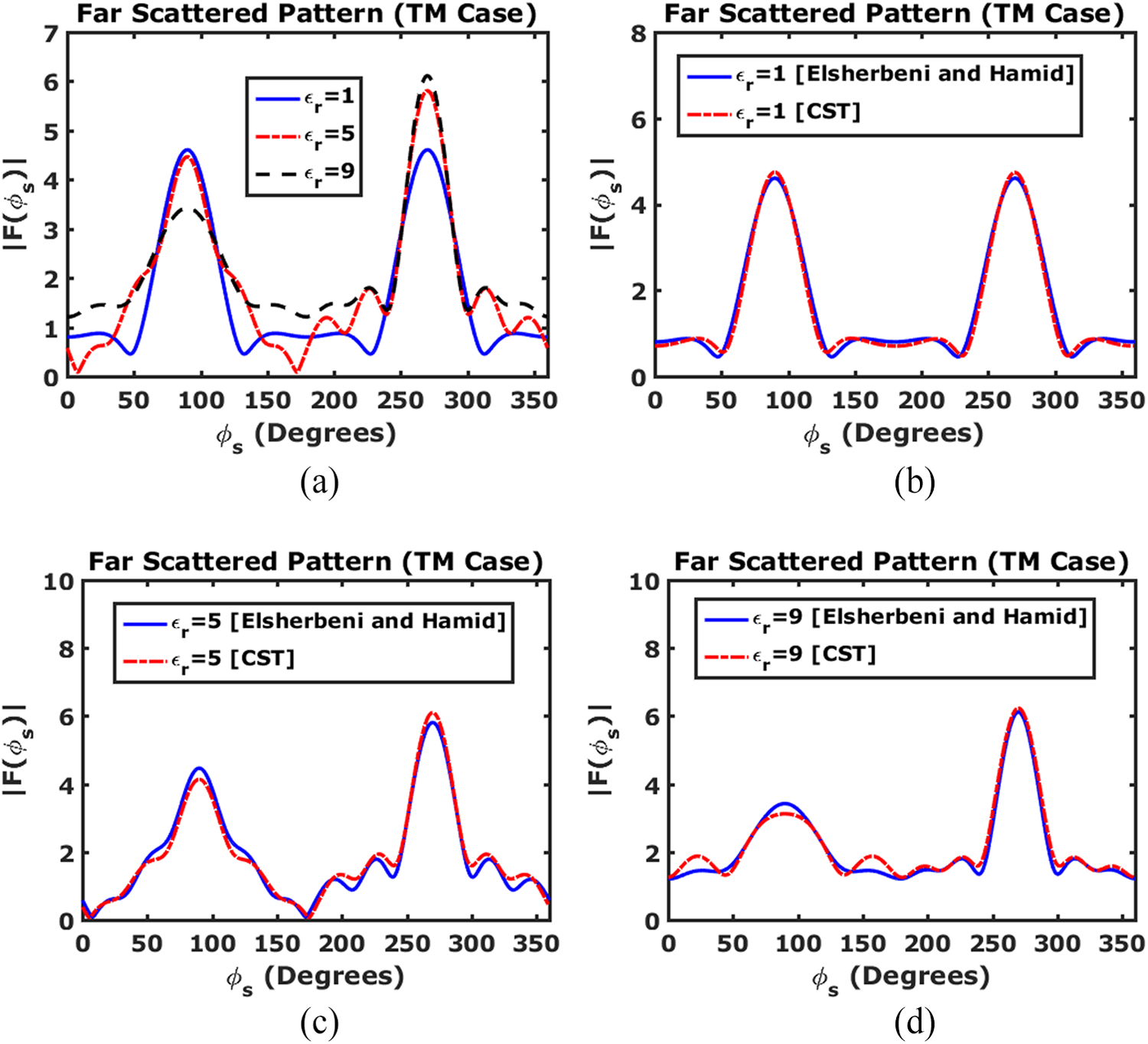
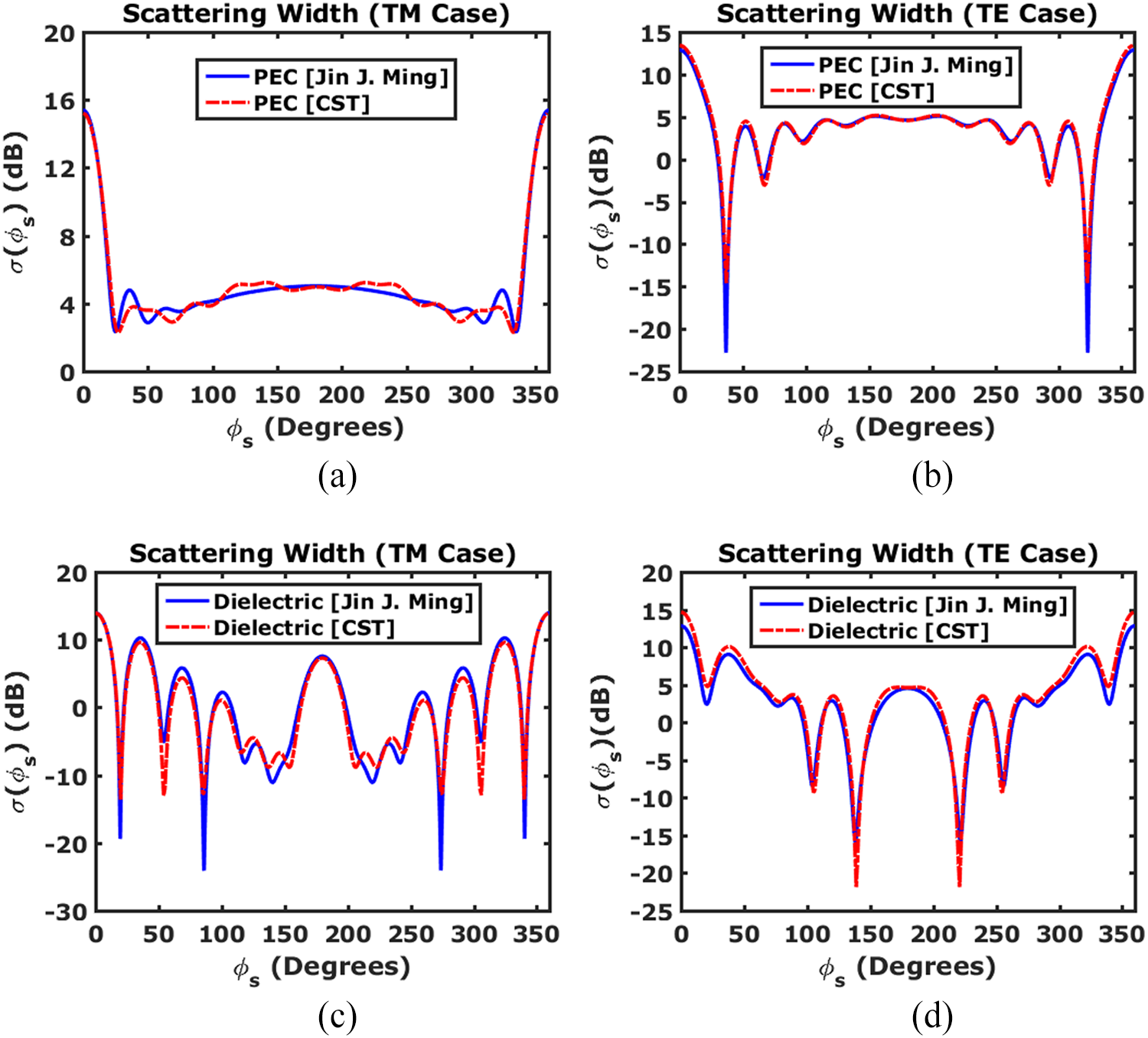
In order to validate the proposed formulation, the reproduced far scattered field patterns of a strip loaded dielectric cylinder or cylindrical object with variable values of ϵr have been shown in Fig. 2(a) which are in good agreement with those given in Fig. 5(b) of Elsherbeni and Hamid [Reference Elsherbeni and Hamid9]. Likewise, these reproduced far scattered field patterns are compared with CST in Fig. 2(b)–(d). In Fig. 3, the normalized scattering widths of PEC and dielectric cylindrical objects without a strip based on the proposed theory have been shown and compared with their respective normalized scattering widths simulated using CST for both types of incident polarization, i.e., TM and TE. Here the radius of both cylinders are taken to be equal to free space wavelength. Also,  $\epsilon_{r} = 4$ for a dielectric cylinder. The agreement between the proposed theory and simulated results obtained using CST is good. These findings validate the accuracy of the proposed formulation presented in this paper.
(a) Reproduced far scattered field patterns of strip loaded dielectric cylinder due to a TM incident plane wave based on the proposed theory as given in Figure 5(b) of Elsherbeni and Hamid [Reference Elsherbeni and Hamid9]. Here  $\phi_{o} = 90^{\circ}$, ka = 5, and
 $\epsilon_{r} = 1, 5$, and 9, which are adopted from [Reference Elsherbeni and Hamid9]. (b)–(d) Far scattered field patterns as given in part (a) and their comparisons with the CST simulations.

The normalized scattering widths of a perfectly electric conducting (PEC) cylindrical object for (a) TM and (b) TE cases are based on proposed theory and their comparisons with respective scattering widths computed using CST studio. The normalized scattering widths of a dielectric cylindrical object for (c) TM and (d) TE polarizations are based on proposed theory and their comparisons with respective scattering widths simulated using CST studio. For both PEC and dielectric cylindrical objects, electromagnetic and geometrical parameters have been adopted from Jin [Reference Jin3].

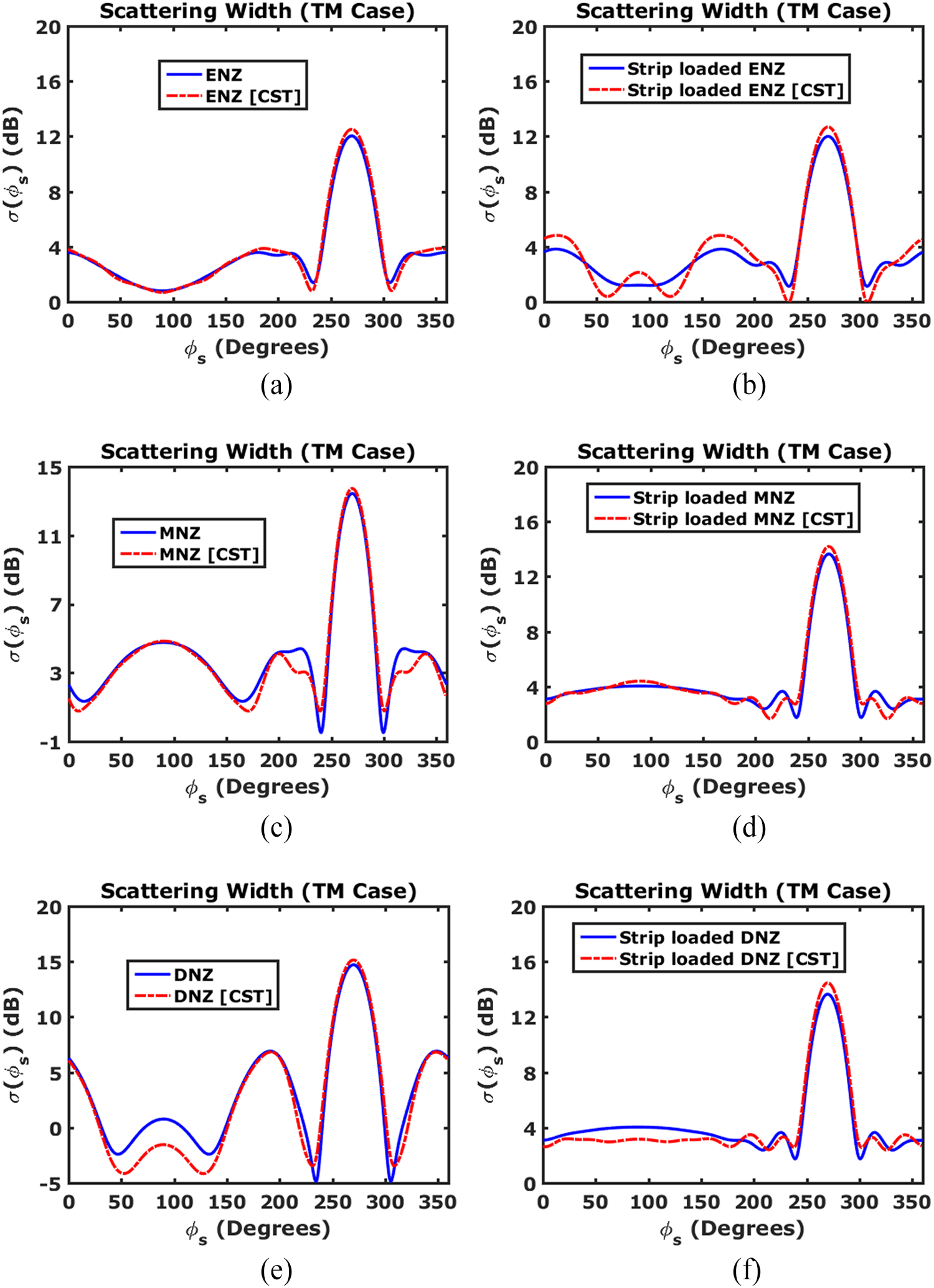
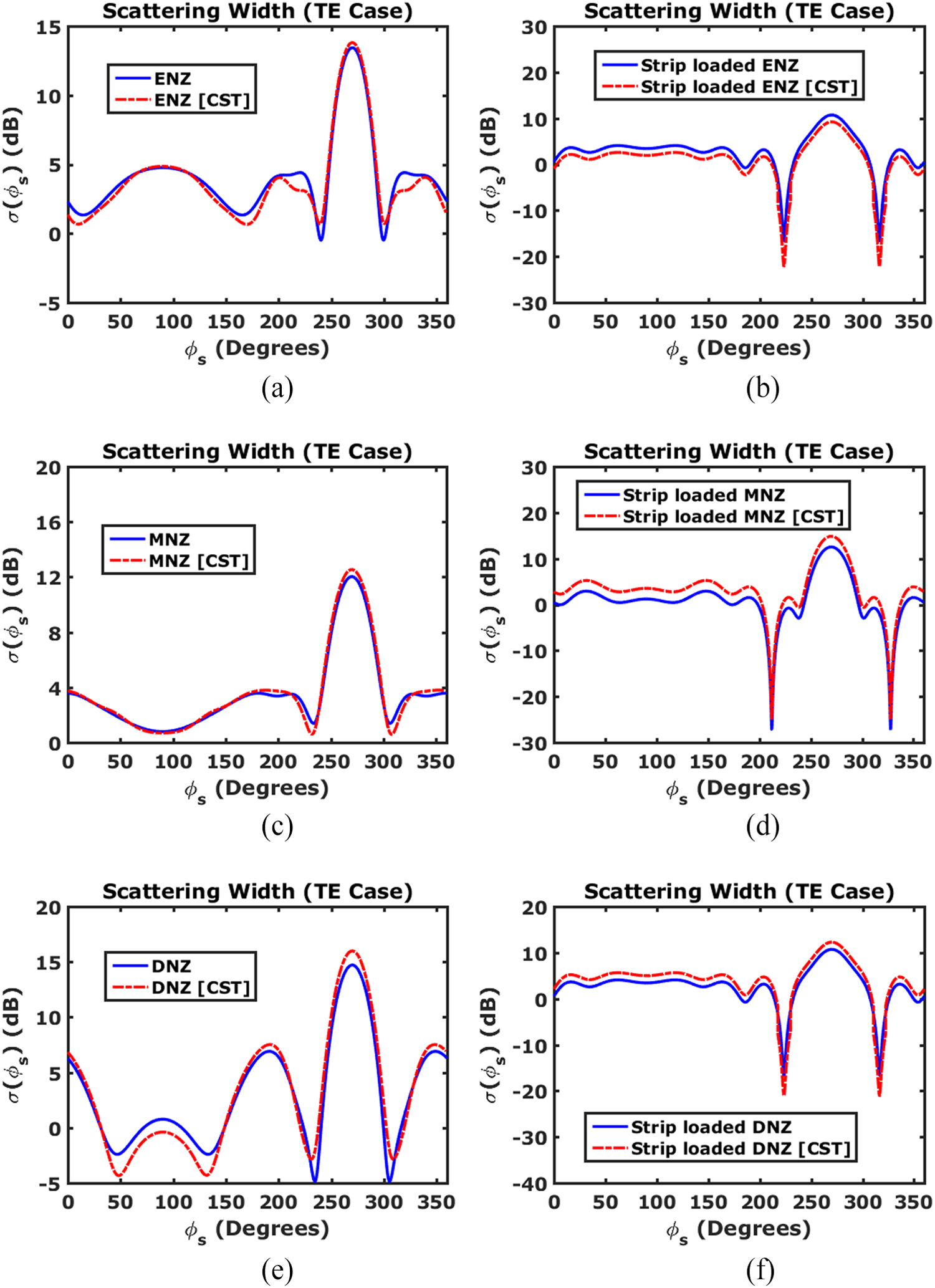
Figure 3 deals with the normalized scattering widths of PEC and dielectric cylinders, which are based on the proposed theory and their comparisons with the normalized scattering widths of respective cylinders using CST simulations. In this case, all electromagnetic and geometrical parameters have been taken from [Reference Jin3]. It is found that the normalized scattering widths of PEC and dielectric cylinders based on the proposed theory are in excellent agreement with Figs. 6.10(e)–(f) and 6.12(e)–(f) of Jin [Reference Jin3]. Some discrepancies in the scattering widths are apparent between the proposed theory and CST. This is because of the finite length cylinder assumption used in CST and the infinite length cylinder assumption which is adopted for proposed formulations. In Figs. 4–5, the normalized scattering widths of strip loaded ENZ, MNZ, and DNZ cylindrical objects along with their comparisons of respective normalized scattering widths for these metamaterial cylindrical objects without strip have been shown for both types of incident polarizations, i.e., TM and TE. These scattering widths are also compared with scattering widths simulated using CST. The electromagnetic parameters of ENZ, MNZ, and DNZ metamaterial cylinders have been taken from [Reference Awan37]. For ENZ cylinder, we have assumed  $\epsilon_{r} = 10^{-3}$,
 $\mu_{r} = 1$ and for MNZ cylinder, it is assumed that
 $\epsilon_{r} = 1$,
 $\mu_{r} = 10^{-3}$. Likewise, for a DNZ cylinder, it is assumed that
 $\epsilon_{r} = 10^{-3}$ and
 $\mu_{r} = 10^{-3}$. It is clear from Fig. 4 that the forward scattering widths of strip loaded cylinders and strip unloaded cylinders have almost the same forward scattering widths for ENZ, MNZ, and DNZ metamaterials. It is seen that an enhancement of 3 dB occurs in the back scattering width as compared to the back scattering width of a DNZ cylinder without a strip in the case of TM polarization. It is argued from Fig. 5(e)–(f) that by loading a strip onto a DNZ cylinder, the forward SW diminishes by almost 4 dB and back SW enhances by 3 dB as compared to an unloaded DNZ cylinder.
The normalized scattering widths of (a) ENZ, (b) strip loaded ENZ, (c) MNZ, (d) strip loaded MNZ, (e) DNZ, and (f) strip loaded DNZ cylinders and their comparisons with the normalized scattering widths computed using CST studio for TM polarization.

The normalized scattering widths of (a) ENZ, (b) strip loaded ENZ, (c) MNZ, (d) strip loaded MNZ, (e) DNZ, and (f) strip loaded DNZ cylinders and their comparisons with the normalized scattering widths computed using CST studio for TE polarization.

The electric field distributions inside and outside of PEC, dielectric cylinder with  $\epsilon_{r} = 4$, and strip loaded dielectric cylinders with
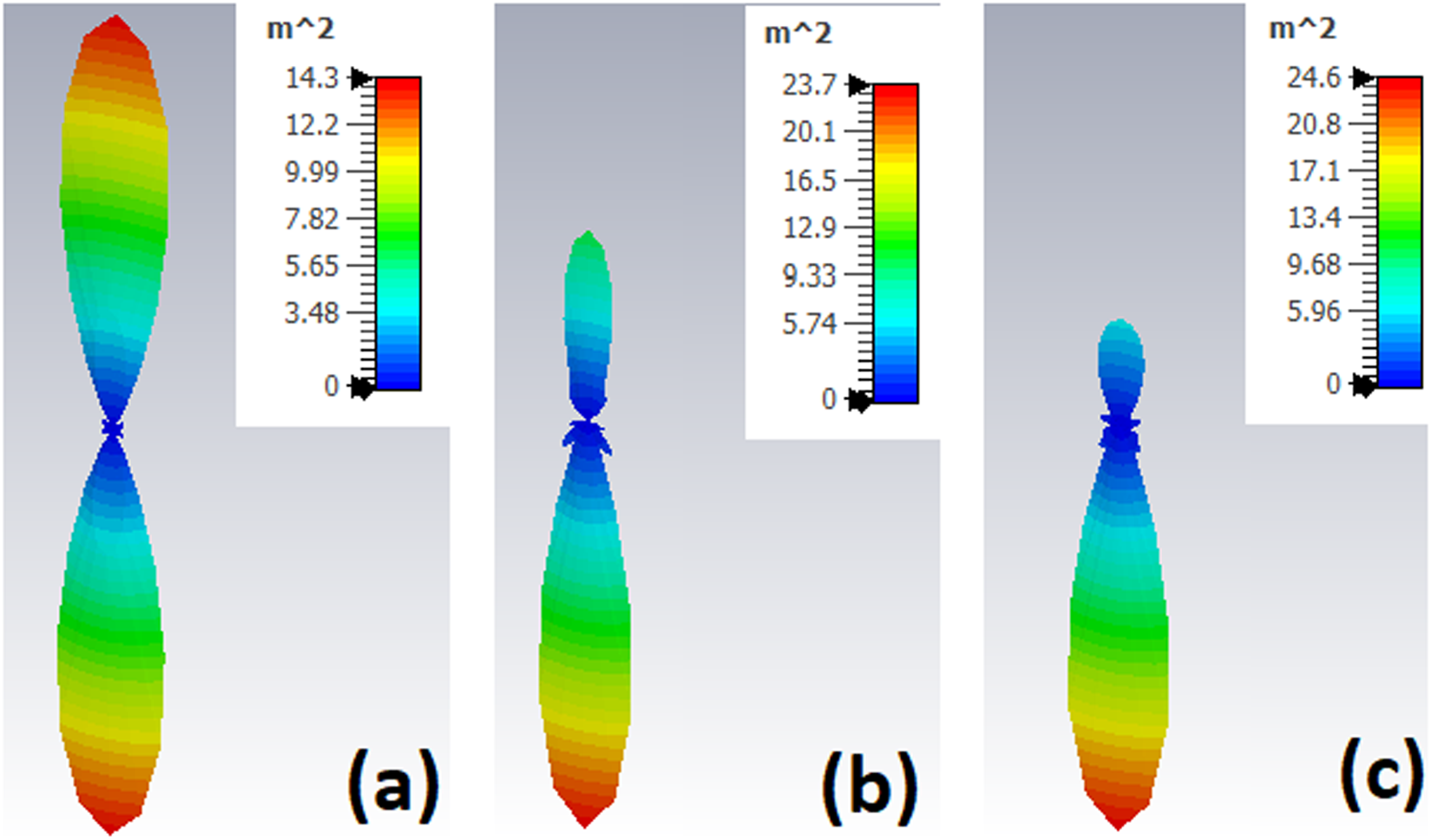
 $\epsilon_{r} = 1, 5, 9$ have been shown in Figs. 6(a)–(e). It is observed from Fig. 6(d)–(e) that with an increase in the value of ϵr from 4 to 9, the concentration of electric field below the strip increases. It is seen from Fig. 7 that for
 $\epsilon_{r} = 1$, the cylinder is absent, and the three-dimensional field pattern is the same as that of the three-dimensional field pattern of an isolated strip placed in the free space background. It is also observed that it has almost identical scattering in the forward and back scattering directions. As the value of ϵr increases from 5 to 9, then the forward scattering increases and backward scattering decreases. These findings can also be confirmed by Fig. 2(a). The electric field and magnetic field distributions inside and outside unloaded and strip loaded ENZ, MNZ, and DNZ cylindrical objects have been shown in Figs. 8 and 9, respectively.
The electric field distribution for (a) PEC cylinder and (b) dielectric cylinder with  $\epsilon_{r} = 4$ and strip loaded dielectric cylinders with (c)
 $\epsilon_{r} = 1$, (d)
 $\epsilon_{r} = 5$ and (e)
 $\epsilon_{r} = 9$. These electric field distributions have been computed using CST.

Three-dimensional scattering width patterns for strip loaded dielectric cylinders with (a)  $\epsilon_{r} = 1$, (b)
 $\epsilon_{r} = 5$ and (c)
 $\epsilon_{r} = 9$ and have been computed using CST.

The electric field distribution for (a) ENZ cylinder, (b) strip loaded ENZ cylinder, (c) MNZ cylinder, (d) strip loaded MNZ cylinder, (e) DNZ cylinder, and (f) strip loaded DNZ cylinder due to TM polarization which has been computed using CST.

The magnetic field distribution computed using CST for (a) ENZ cylinder, (b) strip loaded ENZ cylinder, (c) MNZ cylinder, (d) strip loaded MNZ cylinder, (e) DNZ cylinder, and (f) strip loaded DNZ cylinder due to TE polarization.

It is well known that for plane wave excitation, the scattering characteristics of a scatterer, e.g., a cylindrical object, are independent of the location of the plane wave source. Contrary to this, if the same cylindrical object is excited by an ELS or MLS, then its scattering characteristics do depend upon location of line source excitation, i.e., ρo and ϕo and have been discussed and shown in Figs. 10–12. In order to validate the proposed theory of line source excitations, we have considered only ELS excitation, whereas similar findings can be found for MLS excitation. For an ELS excitation of a strip loaded dielectric cylinder based on the proposed theory, we have assumed that ϵr approaches to infinity with  $\mu_{r} = 1$. In this case, it is found that coefficients
 $c_{n}^{TM}$ become zero in Eq. (31) and coefficients En reduce to the well-known scattering coefficients of a perfectly conducting cylinder [Reference Balanis2]. Using these reduced coefficients En in Eq. (36), we can find that the total field pattern
 $F_{ELS}(\phi_{s})$ becomes equivalent to the total field pattern of a PEC cylinder. This normalized total field pattern, i.e.,
 $F_{ELS}(\phi_{s})/F_{1}$ with
 $F_{1} = (Ik_{o}\eta_{o})/4$, has been shown in Fig. 10(a) based on the proposed theory for
 $k_{o}a = 10\pi$,
 $\phi_{o} = 0$,
 $\rho_{o} = 5.25\lambda_{o}$, and
 $\rho_{o} = 5.5\lambda_{o}$ at an operating free space wavelength λo of 0.1 m. These geometrical parameters have been adopted from Balanis [Reference Balanis2]. It is found from Fig. 10(a) that the magnitudes of the normalized total field pattern are in good agreement with those reported by Balanis. In the second case, we have used our proposed theory of ELS excitation of a dielectric cylinder without strip and computed the scattering gain
 $G(\phi_{s})$ based on the theory as given by Aslam et al. [Reference Aslam, Saleem and Awan40]. Also, we have assumed
 $\epsilon_{r} = 2, \mu_{r} = 1, k_{o}a = \pi$,
 $\phi_{o} = 0$, and
 $\rho_{o} = 0.9\lambda_{o}$ as adopted in [Reference Aslam, Saleem and Awan40]. It is clear from Fig. 10(b) that the proposed theory is in good agreement with those of Aslam et al. These agreements validate the proposed formulation presented in this paper for ELS excitation. The influence of ELS and MLS locations upon the magnitude of far zone total field patterns of strip loaded and unloaded metamaterial cylinders have been shown in Figs. 11–12. For these figures, it is assumed that
 $\phi_{o} = 0$. It is studied from Fig. 11(a) that the magnitude of total field of an unloaded ENZ cylinder becomes −35 dB at
 $\phi_{s} = 259^{\circ}$, 281∘ with an ELS location of
 $\rho_{o} = 0.9\lambda_{o}$. If the same ENZ cylinder is loaded with a strip, then, the total field becomes −20 dB at angles
 $\phi_{s} = 259^{\circ}$ and 281∘. From here, it is concluded that an embedded strip can be used to enhance the total electric field of an ENZ cylinder by 15 dB at these specific angles. Likewise, for an ELS location of
 $\rho_{o} = 1.8\lambda_{o}$, the total field of an MNZ cylinder is −17 dB for angles
 $\phi_{s} = 265^{\circ}$ and 275∘ which is shown in Fig. 11(d). In this case, the total field of a strip loaded MNZ cylinder becomes −32 dB at these specific angles of ϕs. This shows a reduction of the total field by 15 dB due to strip loading. It is observed from Fig. 11(f) that for
 $\rho_{o} = 1.8\lambda_{o}$, the total field of an unloaded DNZ cylinder is −12 dB at angles of
 $\phi_{s} = 262^\circ$ and 274∘. For this specific case, the total field becomes −32 dB for a strip loaded DNZ cylinder at
 $\phi_{s} = 262^\circ$, 274∘. Thus, it is argued that by loading a strip, one can reduce the total field by 20 dB for this specific case. In the case of MLS excitation, it is seen from Fig. 12(a) that for a strip loaded ENZ cylinder with
 $\rho_{o} = 0.8\lambda_{o}$, there exists an enhancement of 15–20 dB in the magnitude of total field as compared to unloaded ENZ cylinder for ϕs lying between 65∘ and 110∘. In the case of an unloaded MNZ cylinder with
 $\rho_{o} = 0.9\lambda_{o}$, the magnitude of total field is −62 dB at angles
 $\phi_{s} = 259^{\circ}$, 281∘ which is obvious from Fig. 12(c). For the same case, the magnitude of total field becomes almost −37 dB for a strip loaded MNZ cylinder at these considered angles, which signifies an enhancement of total field by 25 dB as compared to an unloaded MNZ cylinder. In the case of a DNZ cylinder, the total field for
 $\rho_{o} = 0.9\lambda_{o}$ becomes −50 dB at angles
 $\phi_{s} = 186^{\circ}$, 356∘ which is clear from Fig. 12(e). For this case, if a strip is inserted, then the total field becomes −30 dB at these specific angles. Thus, it is concluded that a strip can be used to enhance the total field by an amount of 20 dB at these specific angles.
(a) The normalized total far-field pattern of a strip loaded dielectric cylinder due to an ELS illumination based on the proposed theory in the limit ϵr approaches to infinity and  $\mu_{r} = 1$. In this case, a strip loaded dielectric cylinder equivalently becomes a PEC cylinder and its total far-field pattern is compared with the total far-field pattern as given by Balanis [Reference Balanis2] and both total far-field patterns being compared are in good agreement. (b) The computed scattering gain [Reference Aslam, Saleem and Awan40] of a dielectric cylinder without strip and excited by an ELS based on the proposed theory. The computed scattering gain based on the proposed theory is in good agreement with the scattering gain as given by Aslam et al.

The influence of ELS locations upon the magnitudes of total field patterns for (a)–(b) ENZ cylinder and strip loaded ENZ cylinder, (c)–(d) MNZ cylinder and strip loaded MNZ cylinder, and (e)–(f) DNZ cylinder and strip loaded DNZ cylinder.

The magnitudes of total field patterns for (a)–(b) ENZ cylinder and strip loaded ENZ cylinder, (c)–(d) MNZ cylinder and strip loaded MNZ cylinder, and (e)–(f) DNZ cylinder and strip loaded DNZ cylinder for various locations of MLS.

Conclusions
The scattering characteristics of a strip loaded metamaterial cylindrical object under a plane and cylindrical wave excitation have been investigated. The types of metamaterial considered in the present study are SNZ and DNZ. The proposed problem has been solved using integral equations derived from Green’s theorem along with the applications of usual tangential boundary conditions. In the case of plane wave excitation, the proposed numerical results are validated by comparing them with CST simulations. In this case, scattering characteristics of strip loaded dielectric and unloaded dielectric cylinder have also been shown and discussed for completeness. It is studied that by increasing the permittivity of a dielectric cylinder in the case of a strip loaded dielectric cylinder, the forward scattering increases whereas the backward scattering decreases. It is argued that there exists an enhancement of 3 dB in the back scattering for a strip loaded DNZ cylinder as compared to the back scattering of an unloaded DNZ cylinder for both types of incident polarization. For a specifically located ELS, there exists a significant reduction of 20 dB in the magnitude of total field from a strip loaded DNZ cylinder as compared to an unloaded DNZ cylinder at specific observation angles. In the case of a specific location of an MLS, a significant enhancement of 25 dB in the magnitude of total field from a strip loaded MNZ cylinder is noticed as compared to an unloaded MNZ cylinder in the specific observation directions. These above findings are interesting and find applications in the design of cylindrical metamaterial based devices.
Funding statement
This research received no specific grant from any funding agency, commercial or not-for-profit sectors.
Competing interests
The authors report no conflict of interest.

Abdul Raqeeb received his Bachelor degree in Physics from Bahauddin Zakariya University, Multan, Pakistan in 2021. He has also received his Master of Philosophy degree in Electronics from the Quaid-i-Azam University, Islamabad, Pakistan in 2023. Currently, he is doing his Ph.D. at Wayne State University, Detroit, MI, USA. His main areas of research include electromagnetic scattering and metamaterials.

Zeeshan Akbar Awan received the Master of Philosophy form Department of Electronics, Quaid-i-Azam University, Islamabad, Pakistan in 2002. He has completed his Ph.D. degree in Electronics from the same university. He has worked as a Post-Doctoral candidate within LEOST Laboratory of the COSYS department in IFSTTAR, Lille, France from January to July 2018. He is presently an associate professor at the Department of Electronics, Quaid-i-Azam University, Islamabad, Pakistan. He has authored or co-authored more than 40 research articles. His research interests include electromagnetic scattering, metamaterials, metasurfaces, and antenna theory.

Arshad Hussain received the M.Phil form Department of Electronics, Quaid-i-Azam University, Islamabad, Pakistan in 2002. He completed his Ph.D. form State Key Laboratory of Analog and Mixed-Signal VLSI, Department of Electrical and Computer Engineering, Faculty of Science and Technology, University of Macau, Macau (SAR), China. He also completed 1-year Post-Doctorate from Department of Information and Communication Engineering, Chosun University, GwangJu, South Korea. He is currently working as Assistant Professor at the Department of Electronics, Quaid-i-Azam University, Islamabad, Pakistan. His current research interests are analog circuits, switched-capacitor circuits, design of low power high resolution delta-sigma ADCs, and electromagnetics.