Introduction
Cranberry (Vaccinium macrocarpon Ait.) is a perennial evergreen vine that is native to wetland habitats and requires plentiful water supplies for its cultivation. Evolution in a wetland setting has resulted in the ability of cranberry plants to withstand periodic flooding without harm. Commercial cranberry farms in Massachusetts are associated with natural ponds or constructed reservoirs that can store the water needed for seasonal flooding and irrigation needs. A system of ditches, to facilitate movement of water for flooding and improve drainage, typically bounds the bed on all sides. Water can be used and re-used within a cranberry bog because the irrigation system and water storage reservoir are interconnected. Flooding is so important in cranberry cultivation that bogs that cannot be flooded are not considered profitableReference DeMoranville, Sandler and DeMoranville1. Recent research showing that spring (late water) floodsReference Averill, Sylvia, Kusek and DeMoranville2 and fall floodsReference DeMoranville, Sandler, Shumaker, Averill, Caruso, Sylvia and Pober3 reduce weed and insect populations in cranberry farms has supported a resurgence of flooding for pest management.
Dodders are obligate parasitic plants consisting of yellow twining stems that produce small clusters of white flowersReference Parker and Riches4. The stems will wrap around the host and insert specialized structures (haustoria) into the vascular system of the host and become a strong sink for photosynthates. Swamp dodder is a serious threat to the production of cranberries in southeastern MassachusettsReference Devlin and Deubert5, Reference Bewick, Binning and Dana6. In commercial production areas, dodder spreads rapidly, damages cranberry vines significantly, develops a substantial seed bank and can reduce yields by 80–100%Reference Devlin and Deubert5–Reference Else, Sandler and Schluter7. Current management strategies include the use of pre-emergence and post-emergence herbicides, hand removal of seedlings and raking dodder stemsReference Sandler8. The goal is to reduce the seed bank and, to that end, controls are targeted to minimize the number of emerging seedlings, as well as the number of successful attachments made by the parasite.
Flooding has been used for cranberry pest management for many decadesReference Franklin9, Reference Beckwith10. In most situations, flooding a cranberry farm is inexpensive and easy to accomplish, and many growers have incorporated flooding regimes into their regular IPM programReference Blake, Sandler, Coli, Pober and Coggins11. Current flooding strategies include 30-day floods held in late spring (late water floods) for general pest controlReference Averill, Averill and DeMoranville12, 10–14-day fall floods for insect controlReference Cockfield and Mahr13, Reference Scammell14, multi-week floods for weed and insect managementReference DeMoranville, Sandler, Shumaker, Averill, Caruso, Sylvia and Pober3 and 2-month floods during the summer months are recommended for perennial weed controlReference Demoranville15; the latter technique eliminates the crop for that year. Reports from the 19th century indicated flooding for 24–48 h in mid-May could manage black-headed fireworm (Rhopobota naevana)Reference Goff16. Although recent research indicated that oxygen levels, water temperature, egg hatch and plant development are important parameters for black-headed fireworm and cranberry girdler (Chrysoteuchia topiaria) control with short (<72 h) floodsReference Cockfield and Mahr13, Reference Fitzpatrick17, short floods have never been utilized for weed management in cranberry.
The reintroduction of traditional horticultural or pest management practices into modern usage encompasses multiple commodities and disciplines. Policies of fire suppression were lifted after decades of use to improve forest health in western US forest systems and improved biodiversityReference Huntzinger18; both fire and thinning were reintroduced to improve general forest health in ponderosa pine (Pinus ponderosa) in ArizonaReference Stephens and Wagner19. Switching from burning to mowing in lowbush blueberry (Vaccinium angustifolia) caused an increase in mummy berry (Monilinia vaccinii-corymbosi)Reference Lambert20; an outbreak of Valdensinia leaf spot (Valdensinia heterodoxa)Reference Hildebrand and Renderos21 in 2009 has caused growers to reintroduce burning back into their disease management regimes (P. Hildebrand, pers. comm.). Grazing was reintroduced to aid in the restoration of semi-natural grasslands with positive effects on species richness and improved habitat qualityReference Lindborg and Eriksson22. An example associated with the use of flooding includes the reintroduction of vlei (seasonally water-logged depressions) cultivation, which was determined to be a feasible option for the production of maize and rice in ZimbabweReference Mharapara23. Less traditional situations include the reintroduction of shade trees to enhance biophysical conditions in cocoa (Theobroma cacao)Reference Obiri, Bright, McDonald, Anglaaere and Cobbina24 and the restoration of whole agroecosytems to protect declining weed communities associated with the reintroduction of rice paddiesReference Yamada, Okubo, Kitagawa and Takeuchi25; the latter project was largely motivated by labor shortages and cost issues, a situation similar to that seen in the present cranberry example.
The inception of this project was born of necessity. At the onset of the cranberry economic crisis in 1999–2000, innovative and inexpensive control strategies were needed to control dodder and broad-leaved weeds. One large-scale cranberry operation in Massachusetts opted to hold several 18- to 30-h floods during May for dodder management. Using the lack of dodder growth as an indicator, the growers felt they had good success with these floods. Cranberry growers were also interested in using short (10-day) summer floods for broad-leaved weed control instead of stick-wiping with glyphosate, a very labor-intensive technique. It was thought that shorter summer floods would cause less yield reduction than the traditional 2-month flood. Although flooding has been a technique utilized for pest management in cranberry for decades, the use of short floods for dodder control had not been previously evaluated. In addition, holding a short summer flood for general weed control was novel for its potential to minimize significant crop loss while still obtaining weed control. If this cultural strategy is used in lieu of herbicide application, flooding would decrease production costs and provide environmental benefits due to overall lowered pesticide inputs.
The objectives of the current research were to: (1) document the anecdotal observations of dodder management with short-term spring floods using systematic data collection; and (2) evaluate the potential of integrating short floods as a sustainable practice for the management of dodder and broad-leaved weed species.
Materials and Methods
Dodder floods
Seven and five paired sites were selected in 2002 and 2003, respectively. A paired site was defined as proximal production areas at which one bog was flooded, while its neighbor was not flooded. Efforts were made to select sites that were adjacent areas of similar variety, soil type and size. Pairs were selected based on the ability of the grower to control the flooding process, knowledge of previous dodder infestations and willingness of the grower to use the flooding practice while withholding conventional weed control measures. Although this does not conform to traditional experimental design, this method has been used previously in similar demonstration-style studiesReference DeMoranville, Sandler, Shumaker, Averill, Caruso, Sylvia and Pober3. All paired sites were on established (>3-year-old) cranberry farms located in Wareham, Massachusetts and Carver, Massachusetts. Three varieties (Early Black, Howes and Stevens) were used in the study.
Floods, which were 30–36 cm deep and covered the vine tips, were held for 24–48 h between May 3 and May 16 in 2002 and for 45–50 h starting May 12 in 2003. Our plan was to place pouches containing known numbers of dodder seeds onto each of the paired sites approximately 2 weeks prior to the flood, collect the pouches and evaluate germination. However, in 2002, all bogs were flooded prior to pouch placement due to severe infestations of black-headed fireworm (R. naevana Hubner). Black-headed fireworm larvae can be devastating and the grower needed to take control actions quickly. Short-term floods are known to control larval populations in lieu of insecticidesReference Cockfield and Mahr13, Reference Averill and Sylvia26, Reference Franklin27. Given the circumstances, we made alternate plans to evaluate the dodder populations in 2002.
In 2002, approximately 10 and 20 weeks post-flooding, dodder stems and seeds were collected, respectively. The entire bog was inspected for the presence of dodder and selected areas of representative growth. Six 465-cm2 quadrats were randomly placed in the infested areas. Paired sites were harvested on the same day. Dodder stems or seeds were removed by hand from the uprights (vertical stems) in the field when possible. If not, the upright was cut, and the dodder plant and cranberry upright were separated in the laboratory. Field samples were placed in plastic resealable bags and a cooler was used for transport back to the laboratory. Stem samples were transferred into paper bags, dried at 60°C for at least 48 h and dry weights obtained. Seed capsules were crushed and seeds separated from the chaff and counted. No germination tests were conducted in 2002.
In 2003, six pouches containing 200 scarified dodder seeds each were secured to the bog floor with a tent pin at each paired site by April 15. Seeds were physically scarified by grinding the seeds with sand (1:1 mix) for 2 min in a mortar and pestle. The pouches were constructed to permit movement of the flood water with the seeds while prohibiting unnecessary release of seeds onto the commercial farm. The seeds were placed in a piece of muslin cloth (11.4×11.4 cm, folded in half), which was then placed in the center of a pouch made of 18×16 mesh insect screen (10.2 cm×20.3 cm, folded in half). The pouch was sealed on three sides with silicone caulk and allowed to dry. The open end was folded over and secured with staples, which could be removed later.
After the removal of the flood waters, all pouches were retrieved from the paired sites. The pouches were opened in the laboratory and seeds removed. Seeds were placed in glass Petri dishes lined with moistened filter paper and incubated at 22°C. On a regular basis, emerged seedlings were counted and removed from the dishes. Percentage germination was determined after 4 weeks.
Summer flood
A 10-day flood was maintained on a 0.9 ha Howes bog in South Carver, Massachusetts from July 2 to July 11, 2002 and it was paired with a 0.25 ha Howes bog that was not flooded. Ten 1-m2 quadrats were marked with pin flags on the flooded and nonflooded bog. Prior to the flood (June 20, 2002) and after the removal of the flood (July 24, 2002), plant community parameters were assessed. Identified plant species were assigned to one of 10 possible cover classes: 0%=0, <1%=1, 1–5%=2, 6–10%=3, 11–25%=4, 26–40%=5, 41–60%=6, 61–75%=7, 76–90%=8 and 91–100=9. Mean species value (MSV), species richness (number of species), evenness and Shannon's diversity index were calculated. MSV, an indication of average plant coverage, was calculated by dividing the sum of the cover class values for the sampling unit by the number of species or the number of plots, as appropriate.
Statistical analysis
Data were analyzed with Statistical Analysis System software28. Comparisons of measured parameters between flooded and nonflooded treatment areas were made by Student's t-test (P=0.05).
Results and Discussion
Dodder management
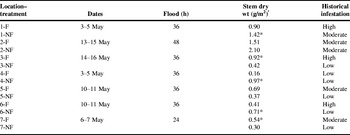
Dodder stem dry weight was lower on the flooded area compared to the nonflooded area at three sites, higher at two sites and was not affected at two sites in 2002 (Table 1). To explain these variable results, we considered the possibility that the nonflooded bog of each pair was selected by the grower because it was known to have low dodder pressure and thus would be a low-risk bog to include in the study. Consequently, historical information was obtained on the dodder populations for each bog (Table 1). At sites 1, 4 and 6, the flooded areas had lower dodder stem weights even though the historical infestation of dodder on the nonflooded bog was either equivalent to or less than the flooded bog. At site 2 (both areas had equivalent histories of infestation), the flooded area trended toward lower stem weights, but was not statistically significant from the nonflooded site. At sites 3 and 7, the flooded area had higher stem weights (and historically higher dodder infestations) than the nonflooded area. We wondered if the higher dodder stem weights were due to the failure of the flood and/or very high dodder pressure? Would the dodder stem production have been even higher on the flooded areas if they had not been flooded at all? The use of the pouches may have helped in the assessment of the relative success of the 2002 study.
Weight of dodder stems collected from seven Massachusetts cranberry bogs that were flooded (F) or not flooded (NF) in 2002. Stems were collected 10 weeks post-flood.

1 Asterisk indicates significant difference between treatment pairs according to Student's t-test (P=0.05).
Seeds were collected from four out of the seven potential sites; three sites were harvested for fruit prior to seed collection. Flooding did not affect the number of seeds produced (data not shown). Seed number may not have been the best assessment of reproductive impact, so changes were made for the 2003 tests to evaluate germination (viability) instead of the number of seeds. In the second year, we used seed pouches for evaluation of the flood instead of the labor-intensive process of biomass and seed collection. No differences were noted for any of the flooded/nonflooded pairs for dodder seed germination in 2003 (data not shown).
It is difficult to know if treatment differences with the pouch method were not detected because the floods did not work in 2003 due to timing (see below) or other issues, or if this method was inferior in measuring dodder response. Retrospectively, using a combination of approaches (e.g., biomass assessment, seed collection and seed germination) may have clarified treatment effects. We hypothesize that the timing of the flood may be critical to adversely affect the dodder population. Seedling emergence patterns for dodder have been tracked yearly since 1997 at the University of Massachusetts Cranberry StationReference Sandler and Ghantous29. In 2002, floods were started 16 days after first seedling emergence (April 17) and peak emergence occurred on c. May 20–26. In 2003, first seedling emergence was on May 5 and the floods were started 7 days later; peak emergence occurred between May 29 and June 2. It is likely that seedlings are more vulnerable to flooding than seeds; allowing more time to elapse between first seedling emergence and flood initiation may be more effective (as seen in 2002). Future research should examine the impact of flood duration, flood initiation and environmental factors (e.g., water temperature and dissolved oxygen levels) to further define the best way to utilize short-duration floods for dodder control.
The role of saturated soils on weed seedling emergence has been studied from the perspective of maintaining well-drained soils. For example, a greenhouse study showed that the emergence of hairy beggarticks (Bidens pilosa) seedlings decreased with increased duration of shallow (1.5 cm) flooding following plantingReference Reddy and Singh30. Similarly, although flooding detrimentally impacted Virginia buttonweed (Diodia virginiana), the emphasis was to encourage managers to minimize water use in turfgrass situationsReference Baird and Dickens31. On the other hand, manipulation of flooding regimes has been investigated for weed management potential in rice (Oryza sativa). A greenhouse study on two species of morning glory (Ipomoea wrightii and Ipomoea lacunosa) indicated successful emergence was related to the number of days after planting, as well as the initiation date and depth of the flood; the response also varied by speciesReference Gealy32. Germination of texasweed (Capernoia palustris) was inhibited, while the soil was constantly saturated or flooded to a depth of 10 cm for 30 daysReference Kroger, Reddy and Poston33. Dodder is not a weed problem in rice and no research has been pursued for dodder management in the rice system. The purposeful use of floods on a dry-cultivated crop to control dodder is a new application of a traditional strategy.
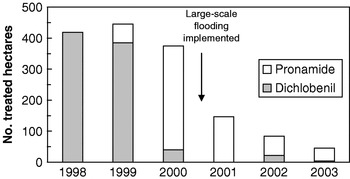
Short-term spring floods are being used periodically by the cranberry grower communityReference Sandler and Ghantous34; this indicates that the practice must be efficacious since it is being implemented on working farms. Our grower-cooperator, whose farms represent 12% of the total Massachusetts cranberry acreage, provided 6 years of pre-emergence herbicide use data for dodder control (Fig. 1). These data indicate a reduction in pesticide use for dodder management due to the implementation of short-term spring floods during 2001–2003 (L. Lemmertz and A.D. Makepeace Company, pers. comm.). Compared to the previous 3-year period (1998–2000), herbicide inputs for the control of dodder decreased by 65–89%. The company reported that, in most situations, they were pleased with the dodder management obtained from the use of the spring floods. Short-term floods hold promise for integration as a sustainable and nonchemical practice for dodder management in cranberries but more research is certainly warranted.
Herbicide applications for dodder management by a Massachusetts cranberry company before and after the large-scale adoption of short-term (24–48 h) flooding practice (A.D. Makepeace Company, pers. comm.).

Broad-leaved weed management
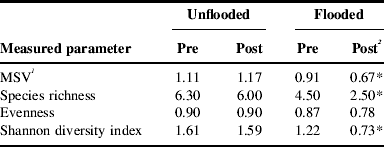
The 10-day flood had a detrimental effect on several weed species and resulted in the reduction of overall weed coverage. Student's t-tests indicated that MSV, species richness and diversity were lower for the flooded bog after the flooding treatment than prior to the flood (Table 2). Measured survey parameters were the same for the nonflooded bog before and after the flood. When looking at individual species, post-flood parameters were lower for many species than pre-flood values (data not shown), but t-tests were not significant. Several weed species were dead or not detected after the flood. Species not detected post-flood (which were present prior to the flood) included ground nut (wild bean), asters, slender-leaved goldenrod, chokeberry and poison ivy. Some negative impacts of cranberry were noted (e.g., bog edges were severely impacted from the warm water, which necessitated flood removal at day 10). Additional work is needed to validate the efficacy of short summer floods for reducing perennial weed populations as demonstrated at the single site used in the present study.
Effect of a 10-day summer flood (July 2–11, 2002) on several plant community parameters on a commercial cranberry bog in southeastern Massachusetts (N=10).
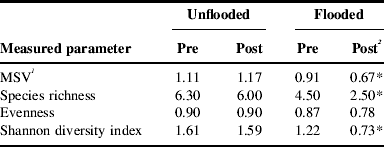
1 MSV, mean species value; coverage value divided by the number of species in the treatment. Species richness=mean number of different species present per plot. Evenness describes the distribution (equitability of abundance) of the species.
2 Asterisk denotes significant difference between pre- and post-flood values at P<0.05 according to Student's t-test.
Acknowledgements
This work was partially supported with funds from the U.S. EPA Region 1 Strategic Agricultural Initiative/Food Quality Protection Act grant program (X-981531010 N). We thank the A.D. Makepeace Company and the Slocum-Gibbs Cranberry Company for the use of their properties in this study.