


Background
The William Schnaper Visiting Scientist (WSVS) program was developed by the NIH National Center for Advancing Translational Sciences (NCATS) Clinical and Translational Science Awards (CTSA) TL1 Visiting Scientist Working Group. First launched in 2021, the WSVS program includes three complementary training opportunities: Mini-Symposium, Debate Forum, and Grand Rounds (GR), which is the subject of this report. Collectively, these three offerings are designed to support trainees across the full spectrum of translational research training stages. The Debate Forum is primarily targeted to early-stage predoctoral trainees and engages participants in structured, team-based debates on controversial or emerging issues in biomedical research. The Mini-Symposium is aimed at late-stage predoctoral trainees and early-stage postdoctoral fellows and features a curated panel of six to eight trainees, each delivering an eight-minute scientific presentation followed by two minutes of moderated discussion.
The Grand Rounds component (WSVS-GR program), which was developed by a Subcommittee of the TL1 Visiting Scientist Working Group, is the focus of this report, and was specifically designed and implemented to create a forum for scientific exchange for predoctoral and postdoctoral Translational Science (TS) Trainees across CTSA hubs. Trainees were part of TL1 and T32 CTSA programs funded by the NIH’s NCATS. The purpose was to provide trainees with networking opportunities and encourage collaborations throughout the CTSA Consortium. The program is intended for late-stage trainees who have generated substantial research findings and are preparing to transition into careers in academia, industry, government, or the nonprofit sector. The main goal is to provide a forum for advanced trainees to present a substantive portion of their data and research at another CTSA hub. In doing so, the trainee gains exposure on a national level, affording the potential to broaden and strengthen their professional network with scientific experts engaged in similar or complementary research, and receives valuable feedback. Organizing the program is a multistep process that requires collaboration amongst dozens of CTSA hubs.
While many CTSA hubs bring together trainees from various departments, schools, and institutions within their CTSA, this program enriches these efforts by creating new opportunities for TL1/T32 trainees to capitalize on the breadth of scientific expertise across CTSA hubs and NCATS. No such national program existed for these TS trainees prior to the implementation of this program.
The WSVS-GR program was inspired by the Visiting Scholars Program that was established in 2016 by the University of Kentucky Center for Clinical and Translational Science in partnership with the Indiana Clinical and Translational Sciences Institute to provide KL2 scholars from three regional CTSA hubs (Indiana University, Purdue University, and the University of Notre Dame) the opportunity for cross-institutional training experiences [Reference Robb, Kelly, King, Blackard and McGuire1]. In the original program, scholars submitted applications including the CTSA institutions they wished to present and ranked the faculty with whom they intended to network. Host institutions then chose scholars primarily on two criteria: the opportunity to network based on the scholar’s area of research and equal distribution between host institutions. The intention of this program was for early-career KL2 scholars to visit the CTSA hubs to present their work and meet with faculty in-person to discuss shared interests and network with research program faculty members.
However, before the WSVS-GR program was launched, the COVID-19 pandemic arose, so the program had to become virtual, instead of in-person, like the model programs. One positive aspect of the catastrophic pandemic was the widespread reimagining of graduate biomedical education and academic exchange, particularly in how trainees engage with scientific communities across institutions. One such innovation to emerge during this transition was the establishment of the WSVS-GR program as a virtual, cross-institutional forum. This forum offers more than just an alternative to in-person lectures; they have become powerful tools to support professional development, scientific identity, and collaborative networks of clinical and translational science trainees [Reference Underhill, Poulose, Harzman and Huang2,Reference Roth, Mogilner, Talib, Silver and Friedman3]. The WSVS-GR program exemplifies this transformation by creating a structured, low-pressure, high-feedback environment where TL1/T32 predoctoral and postdoctoral trainees can present a substantial portion of their data to a national TS audience.
The WSVS-GR format is particularly well suited to trainees at critical career junctures. It offers an opportunity to deliver extended presentations in a supportive environment that emphasizes feedback and discussion over critique. Unlike traditional, faculty-centered GR, this program centers the trainee experience, offering visibility and skill development, while simultaneously fostering cross-hub mentorship and dialogue. Importantly, it allows trainees to meet with faculty from other CTSA hubs who are engaged in related or complementary work, thus enabling conversations that may evolve into future collaborations [Reference Hollenhorst, Braun and Burtner4,Reference Salavitabar, Popov and Nelson5]. These personalized one-on-one meetings give participants a window into academic cultures beyond their home institutions and opens doors to future research opportunities and even employment.
Beyond the individual benefits, the WSVS-GR program advances the CTSA Consortium’s mission to train the next generation of clinical and translational researchers. By showcasing trainee expertise and promoting inter-institutional collaboration, the program contributes to workforce development, builds community across geographically distributed hubs, and enhances the visibility of TS as a broad and dynamic discipline. The format has proven effective not only for internal CTSA purposes, but also as a platform for public-facing dissemination, highlighting the value of the Consortium to the broader biomedical community [Reference Snow, McDaniel, Bronheim and LaPorte6,Reference DeFilippis, Muppala and Kaur7]. In doing so, the program aligns strongly with the NCATS Translational Science Principles, including a focus on unmet training needs, emphasizing creativity and innovation, and the advancement of cross-disciplinary team science.
Methods
Program interest surveys
The WSVS-GR program conducted two Research Electronic Data Capture (REDCap) program interest surveys for each Grand Rounds event – one survey was sent to trainees and the other to host institutions – with the assistance of the Center for Leading Innovation and Collaboration (CLIC) program (2020–2023) and the Coordination, Communication, and Operations Support (CCOS) program (2024–2026). REDCap is a firewall-protected, HIPAA-compliant, data-gathering platform hosted at the University of Rochester by the CCOS Survey Team [Reference Harris, Taylor, Thielke, Payne, Gonzalez and Conde8].
The program interest surveys included combinations of single-and multiple-response items, Likert scales, and short open-text response questions. Drafts of surveys were reviewed by the CCOS Survey Team and WG members, who beta-tested the drafts and provided critical feedback that informed revised final surveys. The initiative was reviewed by the University of Rochester Institutional Review Board and determined to be exempt from the requirements of the Code of Federal Regulations.
Interest surveys were sent out several months ahead of time to trainees and potential hosts across the CTSA Consortium, followed by post-event surveys after the entire cohort had completed their GR events for both trainees and host institutions. The surveys used a similar format to previously published CTSA Consortium-wide surveys [Reference Mendell, Knerich and Ranwala9–Reference Sancheznieto, Sorkness and Attia12].
The Trainee Interest Survey introduced the WSVS-GR program as “a vehicle for predoctoral students and postdoctoral fellows to present substantial data to a national audience.” Interested trainees were asked to provide their name, email address, phone number, and a current NIH biosketch. They were also asked to select their home CTSA hub name and status (predoc, postdoc, or other) from dropdown lists.
The Host Interest Survey introduced the WSVS-GR program as an initiative “geared towards more senior trainees” where “they would be invited to give a 45-minute presentation and meet with faculty.” The survey explained that once a trainee has been matched with a CTSA hub, the WG would connect the trainee and CTSA hub to set up the virtual event. Survey respondents were asked to select their CTSA hub from a dropdown list and to provide the names and email addresses of the TL1/T32 program director and administrative/staff support or main contact person to coordinate the event.
Web links to the surveys were emailed prior to and immediately after events as described above. Two reminders were sent to encourage completion of each survey. Data from responsive trainees and hosts were collected and managed using REDCap.
A core operational element of the WSVS-GR program was the maintenance of a centralized trainee communication infrastructure that enabled coordination and outreach across the national CTSA consortium. National TL1/T32 Trainee Representatives oversaw and curated a centralized email listserv that served as the primary mechanism for communicating program announcements and recruitment materials to TL1/T32 trainees across participating CTSA hubs. The listserv was actively maintained and updated on an ongoing basis, with targeted outreach three times per year at the National TL1/T32 Directors’ Meeting, during which program leadership were prompted to review and refresh trainee contact information. As of the fourth quarter of 2025, the listserv included contact information for approximately 430 trainees. Message delivery metrics indicated successful reach to roughly 85% of listed addresses, with the remaining emails either returned as undeliverable or reflecting trainee-initiated requests to be removed from the distribution list.
Trainee and host matching
The WG Chairperson provided the CTSA hub list to the trainees and asked them to indicate all CTSA hubs they were interested in visiting. Then, the WG Chairperson reached out to the designated contact person at that CTSA hub to ask if they could accommodate the interested trainees. No criteria were used for the match except for the trainee’s preferred institutions. Once a match was found, and the date was set, the program advertised the Grand Rounds presentation to the entire CTSA Consortium.
Day of logistics
Day of logistics included a 45-minute GR presentation, followed by three one-on-one meetings with faculty members, and ending with a networking mixer with the local TS trainees. This was roughly a 5-hour commitment for the trainee and CTSA hub.
The 45-minute presentation was the core of the Grand Rounds experience. To prepare for this, the trainee was required to assemble a cohesive narrative of their data and explain the importance of their research through a TS lens. This served as an integral opportunity to practice a potential job talk. After the presentation, the trainee fielded questions from the audience, which both served as a point of feedback and exploration.
The three one-on-one meetings with faculty were organized by the CTSA hub institution liaison, with consideration of the trainee’s preferences. A scaffolding document (Supplement A) was provided to support trainees in preparation for their GR experience, offering additional support and structure, to help them express their goals and key takeaways from their presentation. Additionally, there was space for the trainee to prepare for the one-on-one faculty meetings by asking about how their research overlapped with the faculty members and brainstorming about potential questions to ask them. Finally, the document had questions for the trainee to consider after the Grand Rounds experience.
Trainee and host institution program assessment
After the visit, the WG conducted two additional REDCap surveys, with the assistance of CLIC and CCOS. Trainees were asked to rate their level of agreement (strongly disagree, disagree, neutral, agree, or strongly agree) with seven statements:
-
1. Giving a formal presentation during my site visit was a valuable experience.
-
2. Overall, the conversations I had with others at the host institution were valuable in terms of advancing my research.
-
3. Overall, the conversations I had with others at the host institution were valuable in terms of my professional development.
-
4. The operational logistics surrounding my visits were well executed.
-
5. I have met at least one person I am likely to contact in the future.
-
6. I would recommend this institution to other trainees.
-
7. I would recommend the GR program to other trainees.
Host institutions were asked to rate their level of agreement (strongly disagree, disagree, neutral, agree, or strongly agree) with four statements:
-
1. Hearing trainee formal presentations/talks during visits was valuable to our program’s trainees.
-
2. The visits were valuable in terms of our trainees’ career development.
-
3. Operational logistics were easy to execute for the visits.
-
4. I would recommend hosting a trainee as part of the GR program to other institutions.
Trainees and host institutions were also asked open-ended questions about their experience. Additionally, trainees were asked about their prior training (terminal degree, clinical degree, research degree), current roles, and demographics, while host institutions were asked to rate their level of agreement (1 = not at all likely to 5 = highly likely) regarding how likely their institution was to participate in another GR event. Three attempts were made to solicit responses.
Data and statistical analysis
Survey data were exported from REDCap into a Microsoft Excel spreadsheet. Descriptive analyses were performed on aggregate data from all respondents. To maintain anonymity of responses to the post-event surveys during data analysis, respondents and hubs were identified only by a code number. Open-ended questions invited text responses for qualitative data analysis. Identifiers were redacted from text responses prior to qualitative data analysis.
For structured survey questions, the responses were summarized as counts and percentages. For open-ended survey questions, the coauthors picked comments that were particularly insightful and/or illustrative of common themes.
Results
Trainee survey responses
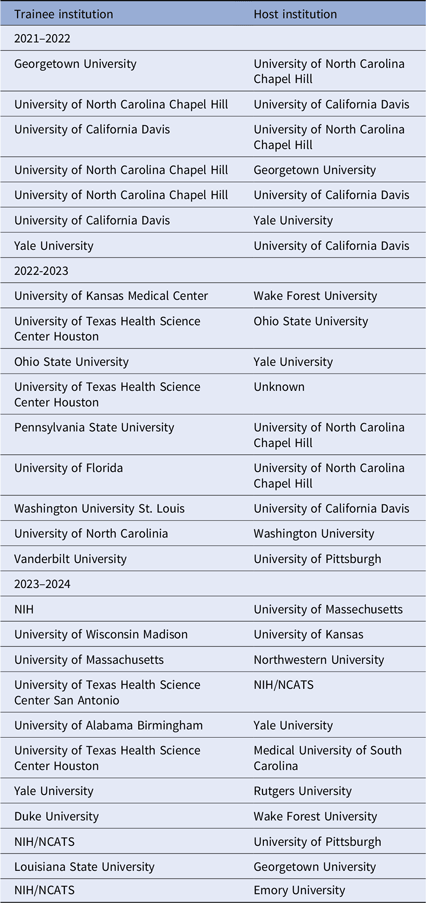
See Table 1 for a list of trainee and host institutions. Post-survey data were collected and made available for trainees in 2021–2022 (n = 4 completers from 7 participants) and 2023–2024 (n = 6 completers from 11 participants); an overall response rate of 56% (n = 10/18). For 2022–2023, there were nine participants, but post-survey responses were not available due to a technical error. Different questions were asked each year. Survey respondents were overwhelmingly positive; all trainees recommended the program to peers and affirmed the value of presenting at another CTSA hub.
Trainee and host institutions

Table 1. Long description
The table lists trainee and host institutions for the academic years 2021-2022, 2022-2023, and 2023-2024. It has two columns: Trainee institution and Host institution. The table includes the following data: 2021-2022: Georgetown University with University of North Carolina Chapel Hill, University of North Carolina Chapel Hill with University of California Davis, University of California Davis with University of North Carolina Chapel Hill, University of North Carolina Chapel Hill with Georgetown University, University of North Carolina Chapel Hill with University of California Davis, University of California Davis with Yale University, Yale University with University of California Davis. 2022-2023: University of Kansas Medical Center with Wake Forest University, University of Texas Health Science Center Houston with Ohio State University, Ohio State University with Yale University, University of Texas Health Science Center Houston with Unknown, Pennsylvania State University with University of North Carolina Chapel Hill, University of Florida with University of North Carolina Chapel Hill, Washington University St. Louis with University of California Davis, University of North Carolina with Washington University, Vanderbilt University with University of Pittsburgh. 2023-2024: NIH with University of Massachusetts, University of Wisconsin Madison with University of Kansas, University of Massachusetts with Northwestern University, University of Texas Health Science Center San Antonio with NIH/NCATS, University of Alabama Birmingham with Yale University, University of Texas Health Science Center Houston with Medical University of South Carolina, Yale University with Rutgers University, Duke University with Wake Forest University, NIH/NCATS with University of Pittsburgh, Louisiana State University with Georgetown University, NIH/NCATS with Emory University.
Trainees from 2023 to 2024 agreed or strongly agreed with these statements (Figure 1).
Trainee survey responses.

-
100%: “I would recommend the Grand Rounds program to other trainees.”
-
100%: “Giving a formal presentation was a valuable experience.”
-
83%: “The conversations I had with others at the host institution were valuable in terms of my professional development.”
-
67%: “The conversations I had with others at the host institution were valuable in terms of advancing my research.”
-
83%: “I would recommend visiting this institution to other trainees.”
-
83%: “I have met at least one person I am likely to contact in the future.”
-
83%: “The operational logistics surrounding my visits were well executed.”
Host institution survey responses
Post-survey data were collected and made available for host institutions in 2021–2022 (n = 7 completers from 7 participants) and 2023–2024 (n = 11 completers from 11 participants); an overall response rate of 100% (n = 18/18). For 2022–2023, there were nine participants, but post-survey responses were not available due to a technical error. Identical questions were asked both years, so data were combined (n = 18 completers); 44% of survey respondents were training program (“T”) directors.
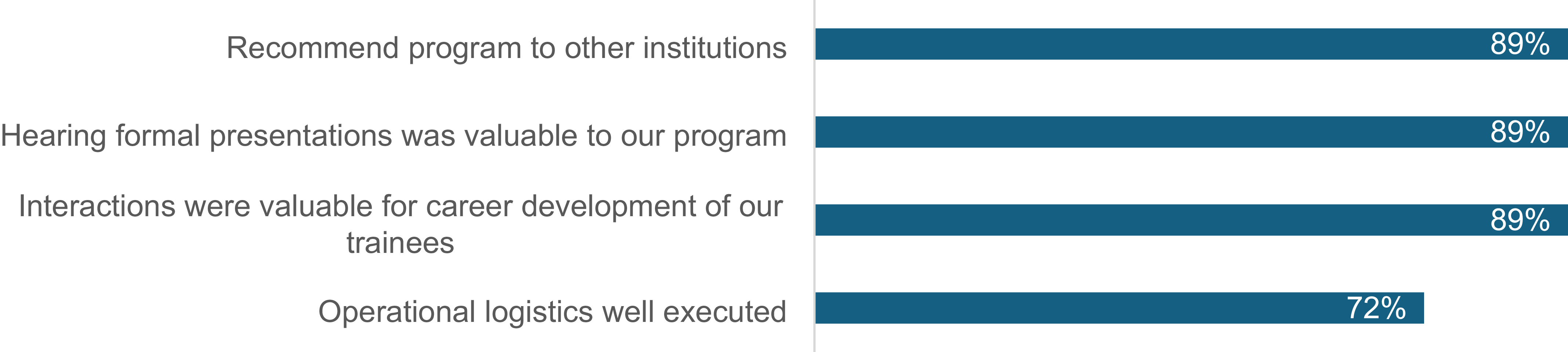
Host institutions agreed or strongly agreed with these statements (Figure 2).
Host institution survey responses.

-
89%: “I would recommend hosting a trainee as part of the GR program to other institutions.”
-
89%: “Hearing trainee formal presentations/talks was valuable to our programs/trainees.”
-
89%: “The interactions were valuable in terms of our trainees’ career development.”
-
72%: “Operational logistics were easy to execute.”
-
83% of host institution survey respondents indicated they were likely or high-likely to participate in another round of the program again.
Open-ended responses from trainees and host institutions
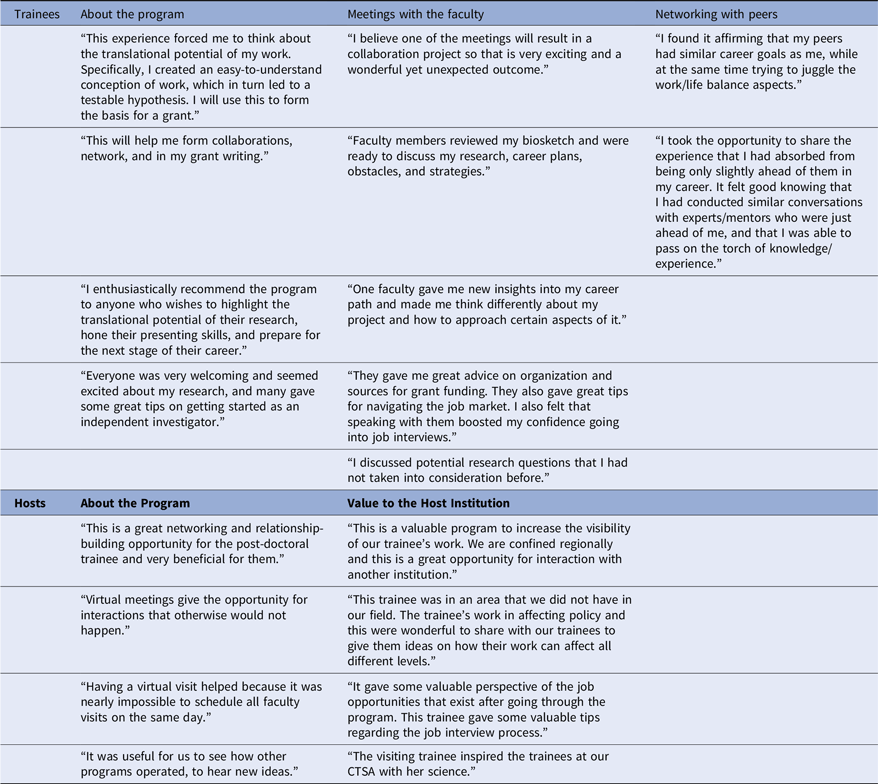
See Table 2 for open-ended responses from trainees and host institutions.
Open-ended responses from trainees and host institutions

Table 2. Long description
The table is divided into two main sections: Trainees and Hosts. Each section is further divided into columns detailing different aspects of the program. The Trainees section has three columns: About the program, Meetings with the faculty, and Networking with peers. The Hosts section also has two columns: About the Program and Value to the Host Institution. Each row under these columns contains quotes from participants. The Trainees section has five rows, each with quotes about the program’s impact on their work, collaborations, career plans, and personal growth. The Hosts section has four rows, each with quotes about the program’s benefits, networking opportunities, and value to their institutions. The table captures the qualitative feedback and experiences of both trainees and hosts, highlighting the program’s positive outcomes and areas of improvement.
Discussion
The WSVS-GR initiative aligns with broader NIH/NCATS efforts to help trainees to develop the phenotype of a Translational Scientist [Reference Gilliland, White and Gee13], in order to “speed the translational of research discoveries into improved care [14].” The program addresses unmet workforce development needs by creating structured, high-impact speaking opportunities for advanced trainees. This aligns with the NCATS principle of focusing on unmet needs in the translational research ecosystem. And, by facilitating collaborative, cross-hub programming that connects trainees and senior investigators across institutions, the program fosters cross-disciplinary team science. Finally, the unique environment of the national CTSA Consortium likely facilitated interactions across CTSA hubs.
Post-survey feedback from participants and host institutions underscores the importance of the structured professional development and networking opportunities afforded by this program. Trainees reported benefits, including enhanced ability to describe the translational nature of their work, ideas and approaches for grant writing, strategies for career development, and opportunities for collaboration. All of these benefits have the potential to accelerate scientific impact and career progression, especially strategic research collaborations [Reference Lane, Allgood, Schexnayder, Bosworth, Baumann and Lewinski15]. Networking emerged as a critical component of the program, with trainees noting the value of interactions with faculty members and peers. Professional social networks are critical for long-term research career development [Reference Spann, Hua and Shimbo16]. The program’s ability to facilitate connections across CTSA hubs is a unique and valuable feature, as this addresses a common gap in traditional training environments, where networking is often limited to local opportunities.
Host institutions recognized the program’s value, citing its role in exposing their own trainees to broad scientific perspectives, inspiring them to pursue innovative research with higher impact, and to pursue new career pathways. The positive comments about the virtual platform suggest this technology helps to overcome logistical and financial barriers, making such initiatives scalable and sustainable, a finding supported by prior literature [Reference Wu, Rajesh and Huang17].
The COVID-19 pandemic accelerated the adoption of virtual learning formats across biomedical training environments. In-person GR – long a cornerstone of academic medicine – were reimagined to preserve education, foster professional identity, and maintain scholarly discourse during a period of clinical and institutional disruption [Reference Roth, Mogilner, Talib, Silver and Friedman3,Reference Chahar, Choudhary, Ahuja and Choudhary18]. In this context, virtual GR emerged as an economically scalable and adaptable tool for addressing gaps in trainee engagement and exposure, especially during times of reduced clinical volume and increased uncertainty.
Other reports have demonstrated that well-designed virtual forums improved accessibility, allowing participation from a geographically dispersed audience. In some cases, programs saw increases in trainee satisfaction, perceived relevance of content, and interaction with national experts [Reference Underhill, Poulose, Harzman and Huang2,Reference Salavitabar, Popov and Nelson5]. One prior report demonstrated that programs that integrated trainee leadership, mentorship, and interdisciplinary case presentations were especially effective in building academic confidence and scientific identity among early-career researchers [Reference Hollenhorst, Braun and Burtner4].
Our report has limitations. The sample size is small, survey response rates were low, survey questions differed by year, and data were not available for all program years. Fortunately, program participation has grown over time, so this will help with sample size in future program assessments.
We also identified some strategies (i.e., lessons learned) to improve/enhance the program. For instance, feedback should be systematically collected from the people who built and led the program, especially the trainee members. Checks-and-balances should be developed and implemented to ensure data are collected and stored for all cohorts. The same survey questions should be asked each year, so that these data can be combined to summarize the collective benefits and challenges across program years. Data about participant training, degrees, and demographics should be collected prior to the visit (rather than after) and should be shared with the host institution, as it might prove helpful to the hosts. A question could be added to separate engagement with faculty versus their peer T32s at the host institution. The timing of the surveys is important. In the future, participant surveys should be distributed immediately after each individual GR event, rather than waiting until the entire cohort has completed the program for the year. And it might yield a more positive experience if additional criteria were used to make the match, such as trainee topic and institution expertise, rather than relying solely on the trainee’s institutional preferences. Additional metrics could also be added to explore long-term outcomes, such as collaborations formed and sustained and future positions at the hubs the participants visited. Integrating structured follow-up activities might also amplify the program’s impact. And selected GR forums could be disseminated to audiences outside of the CTSA Consortium to highlight the CTSA Consortium and its value to biomedical science.
In summary, the WSVS-GR program exemplifies how targeted interventions can enhance trainee development and foster inter-institutional collaboration across the CTSA Consortium. The program’s blend of mentored interactions and a key scholarly task ultimately contributes to a more connected and innovative research community. The WSVS-GR represents a replicable model for cross-institutional trainee development. It serves as a vehicle for scientific communication, network expansion, and national exposure for predoctoral and postdoctoral trainees. By fostering a culture of collaboration and feedback, the program not only supports individual career growth but also builds the relational infrastructure necessary for sustained advancement in translational research. As the CTSA Consortium continues to explore strategies for cultivating a skilled and connected TS workforce, the WSVS-GR demonstrates how virtual GR can be leveraged to help meet those goals.
Conclusions
The WSVS-GR program demonstrated strong value for both trainees and host institutions, as reflected in survey responses and qualitative feedback. Trainees consistently reported that the program enhanced their translational thinking, professional development, and presentation skills, and fostered meaningful networking opportunities. Host institutions emphasized the advantages of virtual visits for accessibility and cost-effectiveness, as well as the program’s role in exposing trainees to broad perspectives and new opportunities.
Overall, these findings suggest that the WSVS-GR program is an effective mechanism for promoting translational research, professional growth, and inter-institutional collaboration across the CTSA Consortium. Continued refinement and expansion of the program could further strengthen its impact on trainees and host institutions alike regardless of discipline.
Supplementary material
The supplementary material for this article can be found at https://doi.org/10.1017/cts.2026.10837.
Acknowledgments
The WSVS-GR program would like to thank Abby Spike and Julie Schwan, of CCOS, for their excellent assistance with the surveys and survey reports, and Olivia Laster, a Doctor of Pharmacy student at the University of Texas at Austin College of Pharmacy, for assisting with incorporating thoughtful revisions suggested by the peer reviewers.
Author contributions
Christopher R. Frei: Conceptualization, Formal analysis, Investigation, Methodology, Writing – original draft; Alexander T. Brunfeldt: Scott McIntosh: Conceptualization, Data curation, Formal analysis, Methodology, Resources, Writing – review & editing; Abby E. Spike: Conceptualization, Data curation, Formal analysis, Methodology, Resources, Writing – review & editing; Daniel J. Moglen: Project administration, Writing – review & editing; Dexter L. Lee: Project administration, Writing – review & editing; Kathryn L. Sandberg: Conceptualization, Investigation, Methodology, Project administration, Supervision, Writing – review & editing.
Funding statement
This research is supported by the National Center for Advancing Translational Sciences (NCATS) of the National Institutes of Health (NIH) under the following grants and contracts: U24TR002260, UL1TR001409, UL1TR001860, UL1 TR002001, UM1TR004538, and 75N95022C00030. The views expressed in this article are those of the authors and do not necessarily represent the views of the National Institutes of Health or the authors’ affiliated institutions.
Competing interests
All authors declare no conflicts of interest.



 Open access

