





Introduction
Lifestyle medicine focuses on daily behaviours that protect our well-being, moving beyond Western medicine’s traditional focus on disease and drugs (Lianov et al., Reference Lianov, Fredrickson, Barron, Krishnaswami and Wallace2019). Recognizing that health behaviours are the root cause of over 80% of premature death, chronic disease, healthcare costs, and disability (Phillips et al., Reference Phillips, Frates and Park2020), lifestyle medicine focuses on evidence-based practices that help individuals and families adopt and maintain behaviours (Lianov and Johnson, Reference Lianov and Johnson2010). Lifestyle medicine leverages its six pillars to address the root causes of various health conditions, centrally positioning the patient over medications or procedures. It integrates expertise from diverse fields like nutrition, positive psychology, behaviour change, exercise physiology, and sleep medicine, ultimately aiming to improve the health of both the patient and the clinician (Lippman et al., Reference Lippman2024).
Emerging as a medical specialty in the United States in 2004, lifestyle medicine quickly grew, advocating for intensive healthy behaviours to prevent, treat, and even reverse chronic diseases. The American College of Lifestyle Medicine and the American Board of Lifestyle Medicine saw rapid expansion, certifying thousands of physicians and advancing lifestyle medicine education through conferences, student groups, and residency programmes. Despite challenges in recognition, integration, and reimbursement, lifestyle medicine’s future in the US is promising. Globally, lifestyle medprograms ando rapidly spread, establishing international standards, increasing educational programmes, and initiating public health efforts to combat noncommunicable diseases and foster healthier communities worldwide (Lippman et al., Reference Lippman2024).
Suggested lifestyle medicine competencies for primary care physicians outline key areas essential for integrating lifestyle interventions into practice. Leadership involves promoting healthy behaviours as foundational to care and modelling them personally. Knowledge requires understanding the evidence linking lifestyle changes to positive health outcomes and the impact of physician engagement. Assessment skills focus on evaluating patients’ predispositions, readiness for change, and performing lifestyle-specific histories/exams, including ‘lifestyle vital signs’ to diagnose and monitor related diseases. Management skills emphasize using national guidelines, building effective patient relationships, collaborating on achievable action plans, and facilitating sustained healthy practices, including appropriate referrals. Finally, use of office and community support highlights the importance of interdisciplinary team collaboration, leveraging office systems and technology, measuring outcomes for quality improvement, and utilizing community resources to support healthy lifestyles (Lianov and Johnson, Reference Lianov and Johnson2010).
A majority of people cite their physician as their primary source of information regarding healthy lifestyle decisions, and these patients are more likely to adopt healthy habits when recommended by their doctor. Physicians and medical students with healthy personal habits more consistently counsel their patients on these habits, leading to greater patient adherence to preventive care. Consequently, it is increasingly evident that medical schools should proactively produce healthy doctors. This ‘Healthy Doc = Healthy Patient’ relationship emphasizes the importance for prevention-oriented healthcare systems to evaluate and support the significant positive effects of physicians’ personal health on the well-being of their patients (Holmes and Frank, Reference Frank and Holmes2019). This is a crucial topic for not only high-income countries, but also low-income countries are increasingly burdened by a dual epidemic: the persistent threat of infectious diseases coexisting with a sharp rise in chronic, lifestyle-related conditions. These non-communicable diseases (NCDs) are driven largely by modifiable risk factors such as poor nutrition, physical inactivity, and environmental stressors. Compounding this crisis is a category of overlooked conditions – neglected NCDs including gout, sickle cell disease, and unintentional injuries – which are poised to become major public health threats. Currently, nearly 75% of global NCD deaths (31.4 million) occur in developing nations, where access to preventive care and lifestyle interventions remains limited (Bhattacharya et al., Reference Bhattacharya2022).
More precisely, family physicians (FPs) are pivotal health role models, whose own healthy habits predict effective patient counselling, given that patients highly trust physician recommendations. Despite this, current health promotion counselling rates are low, largely due to physicians’ difficulty advising on behaviours they personally struggle with and significant time constraints (Oberg and Frank, Reference Oberg and Frank2009). A study (Brotons et al., Reference Brotons, Godycki-Cwirko and Sammut2003) involving 2082 General Practitioners (GPs) across eleven European countries revealed a discrepancy between their belief in advising preventive and health promotion activities and their actual practice, with a significant number reporting difficulties in carrying out such activities. The primary barriers identified were heavy workload/lack of time and no reimbursement. The research also found associations between GPs’ personal health behaviours and their engagement in health promotion. Specifically, GPs who smoked felt less effective in helping patients reduce tobacco consumption compared to non-smoking GPs, while those who exercised reported greater effectiveness in helping patients practice regular physical activity than sedentary GPs. Even NCDs, such as cancers could be considered as the preventive and also therapeutic area of lifestyle medicine (Bhattacharya et al., Reference Bhattacharya, Juval, Hossain and Singh2020)
Health promotion counselling by physicians is often infrequent, a phenomenon rooted in both personal challenges faced by doctors and significant systemic barriers within clinical practice. This situation is potentially influenced by the physician’s work setting – whether in a public or private hospital – which may impact their stress levels and health behaviours. Physicians often perceive private medical institutions as better organized and providing faster, more comprehensive access to healthcare services compared to public ones (Zgliczyński et al., Reference Zgliczyński, Jankowski, Rostkowska, Sytnik-Czetwertyński, Śliż, Karczemna and Jław2020). Furthermore, compared to their public sector counterparts, private sector physicians reported higher job satisfaction, greater organizational commitment, and fewer psychological distress symptoms and sleeping problems (Heponiemi et al., Reference Heponiemi, Kuusio, Sinervo and Elovainio2011). In particular, while public hospital doctors experience high stress levels due to factors such as emergency calls, aggressive patients during peak hours, monotonous routines, sleep deprivation, and irregular mealtimes, private hospital doctors, despite also considering working conditions important, report slightly greater satisfaction with their work environments compared to their public sector counterparts (Aslam et al., Reference Aslam, Mansoor and Suleman2013).
In sum, given that lifestyle medicine remains a relatively nascent field, there is a growing need for empirical research evaluating physicians’ knowledge, attitudes, and practices concerning it. Existing literature increasingly highlights the connection between physicians’ personal health behaviours and their capacity to effectively guide patients toward healthy lifestyles. Additionally, studies suggest that physicians’ own health status may be shaped by occupational stress, which often varies by sector of employment. While a recent study (Gökdemir et al., Reference Özden, Kazdağlı and İlgi Şemin2025) has examined FPs’ health-promoting lifestyles and engagement with lifestyle medicine in their clinical practices, it remains descriptive in nature and does not statistically assess the relationship between these variables. Moreover, the potential moderating role of healthcare sector attainment (public vs. private) in this relationship has yet to be empirically explored. Addressing this gap, the current study aims to investigate both the direct and moderating effects involved, offering novel insights into the contextual factors that shape FPs’ attitudes toward lifestyle medicine. Accordingly, the following hypotheses were formulated:
H1 There is a positive relationship between FPs’ health-promoting lifestyles and their attitudes toward lifestyle medicine.
H2 Healthcare sector attainment (public vs. private) moderates the relationship between FPs’ health-promoting lifestyles and their attitudes toward lifestyle medicine, such that the relationship is more evident among those in the private sector.
Methods
This study employed a quantitative, cross-sectional design. Data were gathered through an online survey specifically administered to FP. To recruit participants, a purposive-convenience sampling approach was utilized, prioritizing both accessibility and the inclusion of relevant individuals.
Measures
Sociodemographic and healthcare sector information form
The sociodemographic section of the survey collected data on FPs’ age, marital status, education, and region of origin. This study adopted a gender-neutral approach, and as such, respondents were not asked to provide information regarding their gender identity on the survey form. Healthcare sector attainment was assessed via a single item, asking participants to select their current primary work setting from the following options: public sector or private sector.
Attitudes toward lifestyle medicine questionnaire
Attitudes toward lifestyle medicine were assessed using three distinct questions, which consisted of 10 items. The first question utilized a 5-point Likert scale (0 = Never, 4 = Always) to ask participants how often they recommend lifestyle changes for disease prevention and treatment. The second question, employing a binary response format (0 = No, 1 = Yes), inquired whether participants are willing to improve their knowledge of lifestyle medicine. The third question, also with a binary response (0 = No, 1 = Yes), asked participants to indicate which specific lifestyle medicine topics (i.e., nutrition, physical activity, stress management, healthy sexual life, addiction-smoking, sleep, health behaviour change techniques, other) they wish to enhance their knowledge in. The total score, ranging from 0 to 13, was calculated by an unweighted summation of all items to create a composite index of both current clinical practices and future educational intent. Higher scores are interpreted as a stronger overall commitment to lifestyle medicine, reflecting a multi-dimensional attitude that encompasses both active behavioural engagement and professional openness. The internal consistency of this measure was observed to be acceptable (Nunnally and Bernstein, Reference Nunnally and Bernstein1994), with Cronbach’s alpha of α = .71.
The Health-Promoting Lifestyle Profile II (HPLP-II)
HPLP-II was originally developed in 1987 and revised in 1996 by Walker, Sechrist, and Pender, was used to assess health-promoting lifestyle behaviours. This 52-item scale comprises six subscales: health responsibility, physical activity, nutrition, spiritual growth, interpersonal relations, and stress management. Participants rated the frequency of each habit on a 4-point Likert scale, ranging from 1 (Never) to 4 (Routinely). Higher total scores on the scale, as well as on its subscales, indicate a higher level of health-promoting lifestyle behaviours. The overall internal consistency of the HPLP-II was excellent, with Cronbach’s alpha of .93. The internal consistency for the subscales was also acceptable (Charter, Reference Charter1999), with Cronbach’s alpha values of .84 for health responsibility, .84 for physical activity, .67 for nutrition, .80 for spiritual growth, .76 for interpersonal relations, and .77 for stress management.
Data collection and analysis
A power analysis was conducted using G × Power 3.1.9.7 to determine the minimum sample size. For a multiple regression analysis that included one continuous dependent variable, one continuous independent variable, a two-categorical moderator (represented by one dummy variable), and four covariates, minimum sample size of 143 participants was calculated. This estimation was based on an alpha error probability of .05, a desired statistical power of .80, and a small-to-medium effect size of f 2 = .10.
This study received ethical approval from İzmir University of Economics (Approval No.: 07.03.2022-48). A total of 215 complete responses were collected with no missing data between March 2022 and May 2025 using Google Forms. We reached FPs from various countries (i.e., Andorra, Angola, Austria, Belgium, Bosnia and Herzegovina, Colombia, Croatia, Czech Republic, Denmark, France, Germany, Greece, India, Kosovo, Latvia, Luxembourg, Malta, Mexico, Peru, Philippines, Poland, Portugal, Romania, Serbia, Sierra Leone, Spain, Turkey, Ukraine, United Kingdom) via the authors’ professional networks (e.g., WhatsApp groups). All participants provided informed consent before completing the survey.
For data analysis, we used descriptive statistics, correlational analyses, and multiple regression models. Before conducting Pearson’s correlation analyses, the assumption of normality was examined, and no violations were observed. Multiple regression models (i.e., Hayes’ (Reference Hayes2018) Model 1) were performed using the bootstrapping technique (5000 resamples). Data were analysed using SPSS 22.0 and PROCESS Macro 4.3 programmes.
Findings
Descriptive statistics
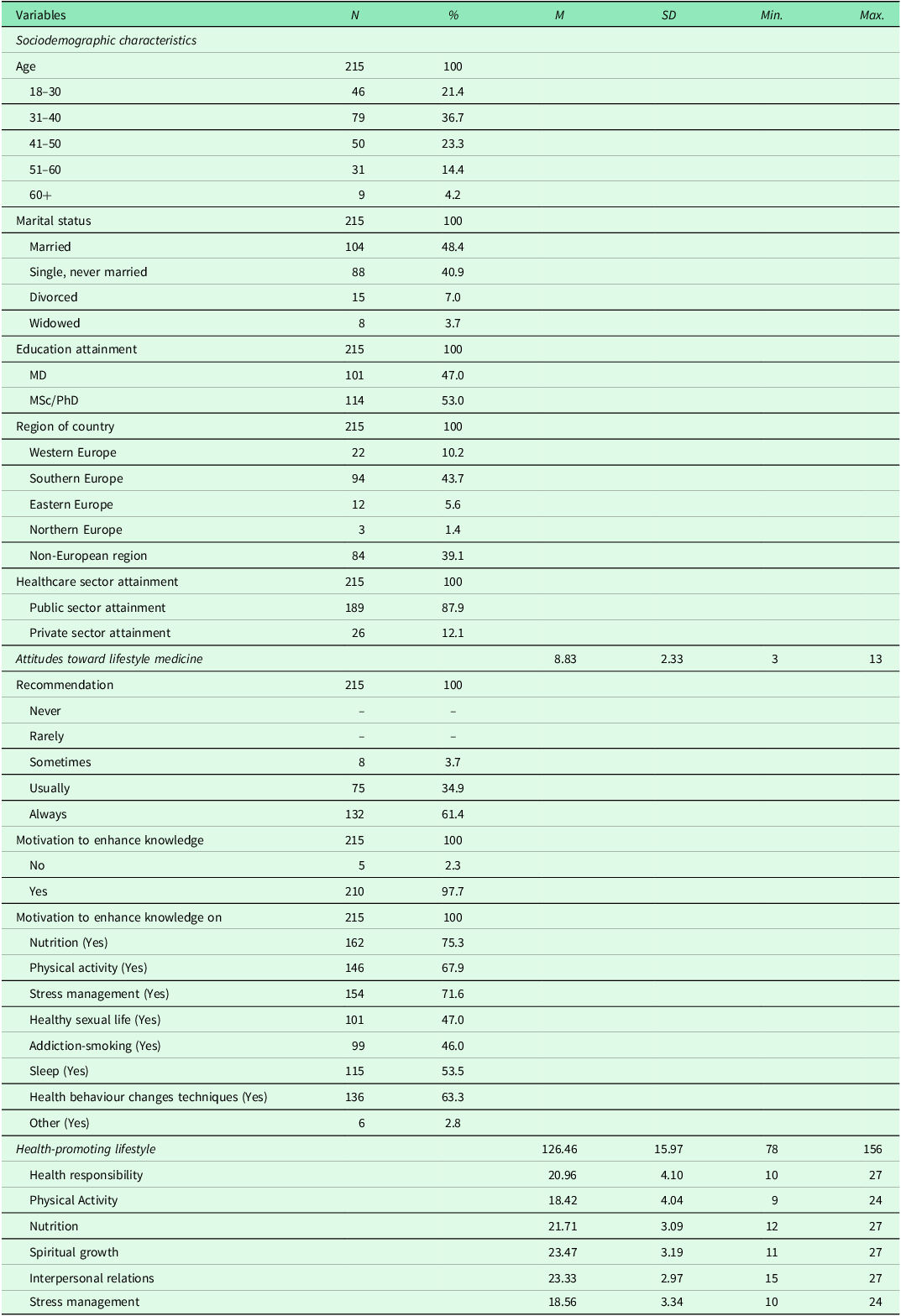
Table 1 provides descriptive statistics for the sociodemographic characteristics, healthcare sector attainment, attitudes toward lifestyle medicine, and health-promoting lifestyle behaviours of the 215 FPs who participated in the study. The FPs’ age distribution showed the largest group was 31–40 years old (36.7%), followed by those 41–50 years old (23.3%) and 18–30 years old (21.4%). Almost half of the physicians were married (48.4%), while a substantial portion were single, never married (40.9%). Regarding education, the sample was highly educated, with similar proportions holding an MD (47.0%) or an MSc/PhD (53.0%). Geographically, most physicians were from Southern Europe (43.7%) and non-European region (39.1%). The vast majority worked in the public healthcare sector (87.9%) (Table 1).
Descriptive statistics for the study’s variables

Table 1. Long description
The table presents descriptive statistics for sociodemographic characteristics, healthcare sector attainment, attitudes toward lifestyle medicine, and health-promoting lifestyle behaviors of 215 physicians. The table has 215 rows and 12 columns. Column headers are Variables, N, percent, M, SD, Min, and Max. Row labels include Age, Marital status, Education attainment, Region of country, Healthcare sector attainment, Attitudes toward lifestyle medicine, Recommendation, Motivation to enhance knowledge, Motivation to enhance knowledge on, Health behavior changes techniques, Health-promoting lifestyle, Health responsibility, Physical Activity, Nutrition, Spiritual growth, Interpersonal relations, and Stress management. Row 1: Age, 215, 100, 31.4, 12.4, 18, 60 plus. Row 2: 18-30, 46, 21.4. Row 3: 31-40, 79, 36.7. Row 4: 41-50, 50, 23.3. Row 5: 51-60, 31, 14.4. Row 6: 60 plus, 9, 4.2. Row 7: Marital status, 215, 100. Row 8: Married, 104, 48.4. Row 9: Single, never married, 88, 40.9. Row 10: Divorced, 15, 7.0. Row 11: Widowed, 8, 3.7. Row 12: Education attainment, 215, 100. Row 13: MD, 101, 47.0. Row 14: MSc/PhD, 114, 53.0. Row 15: Region of country, 215, 100. Row 16: Western Europe, 22, 10.2. Row 17: Southern Europe, 94, 43.7. Row 18: Eastern Europe, 12, 5.6. Row 19: Northern Europe, 3, 1.4. Row 20: Non-European region, 84, 39.1. Row 21: Healthcare sector attainment, 215, 100. Row 22: Public sector attainment, 189, 87.9. Row 23: Private sector attainment, 26, 12.1. Row 24: Attitudes toward lifestyle medicine, 215, 8.83, 2.33, 3, 13. Row 25: Recommendation, 215, 100. Row 26: Never, 0, 0. Row 27: Rarely, 0, 0. Row 28: Sometimes, 8, 3.7. Row 29: Usually, 75, 34.9. Row 30: Always, 132, 61.4. Row 31: Motivation to enhance knowledge, 215, 100. Row 32: No, 5, 2.3. Row 33: Yes, 210, 97.7. Row 34: Motivation to enhance knowledge on, 215, 100. Row 35: Nutrition (Yes), 162, 75.3. Row 36: Physical activity (Yes), 146, 67.9. Row 37: Stress management (Yes), 154, 71.6. Row 38: Healthy sexual life (Yes), 101, 47.0. Row 39: Addiction-smoking (Yes), 99, 46.0. Row 40: Sleep (Yes), 115, 53.5. Row 41: Health behavior changes techniques (Yes), 136, 63.3. Row 42: Other (Yes), 6, 2.8. Row 43: Health-promoting lifestyle, 215, 126.46, 15.97, 78, 156. Row 44: Health responsibility, 215, 20.96, 4.10, 10, 27. Row 45: Physical Activity, 215, 18.42, 4.04, 9, 24. Row 46: Nutrition, 215, 21.71, 3.09, 12, 27. Row 47: Spiritual growth, 215, 23.47, 3.19, 11, 27. Row 48: Interpersonal relations, 215, 23.33, 2.97, 15, 27. Row 49: Stress management, 215, 18.56, 3.34, 10, 24.
FPs generally held positive attitudes toward lifestyle medicine, with a mean score of M = 8.83 (SD = 2.33). Their practice of recommending lifestyle medicine was high, with most reporting ‘usually’ (34.9%) or ‘always’ (61.4%) doing so. A remarkable 97.7% of physicians expressed motivation to enhance their knowledge in this area. Specifically, motivation was highest for nutrition (75.3%), stress management (71.6%), and physical activity (67.9%). On the other hand, the FPs reported a high overall health-promoting lifestyle, with a mean score of M = 126.46 (SD = 15.97). Among the subdimensions, spiritual growth (M = 23.47, SD = 3.19) and interpersonal relations (M = 23.33, SD = 2.97) received the highest mean scores, indicating these areas are well-integrated into their lifestyle.
Correlations
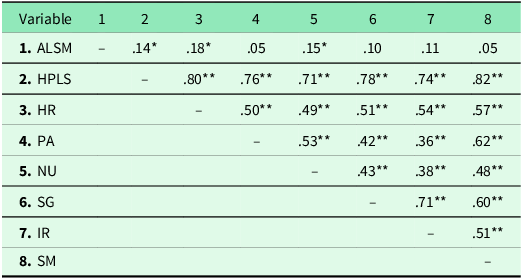
Table 2 presents the correlation matrix for attitudes toward lifestyle medicine, health-promoting lifestyle, and its subdimensions. As expected, health-promoting lifestyle showed significant positive correlations with all its subdimensions. Specifically, it correlated highly with health responsibility (r = .80, p < .01), physical activity (r = .76, p < .01), nutrition (r = .71, p < .01), spiritual growth (r = .78, p < .01), interpersonal relations (r = .74, p < .01), and stress management (r = .82, p < .01). This indicates that higher scores on the overall health-promoting lifestyle scale are consistently associated with higher scores across its individual components (Table 2).
Correlation matrix for ALSM, HPLS and its subdimensions

Table 2. Long description
A table titled ‘Correlation matrix for ALSM, HPLS and its subdimensions’ with eight rows and eight columns. The table includes correlation values between different variables labeled as ALSM, HPLS, HR, PA, NU, SG, IR, and SM. Each cell in the table contains a correlation value, with some values marked with asterisks indicating significance levels. Row 1: ALSM, .14*, .18*, .05, .15*, .10, .11, .05. Row 2: HPLS, .80**, .76**, .71**, .78**, .74**, .82**. Row 3: HR, .50**, .49**, .51**, .54**, .57**. Row 4: PA, .53**, .42**, .36**, .62**. Row 5: NU, .43**, .38**, .48**. Row 6: SG, .71**, .60**. Row 7: IR, .51**. Row 8: SM.
*p < .05, **p < .01, ALSM: Attitudes toward Lifestyle Medicine, HPLS: Health-Promoting Lifestyle; HR: Health Responsibility, PA: Physical Activity, NU: Nutrition, SG: Spiritual Growth, IR: Interpersonal Relations, SM: Stress Management.
Regarding the relationship between attitudes toward lifestyle medicine and health-promoting lifestyle, a small but significant positive correlation was observed (r = .14, p < .05). This suggests that more positive attitudes toward lifestyle medicine are modestly linked to healthier lifestyle behaviours. When examining attitudes toward lifestyle medicine’s relationship with the health-promoting lifestyle subdimensions, attitudes toward lifestyle medicine correlated positively with health responsibility (r = .18, p < .05) and nutrition (r = .15, p < .05).
Moderation model
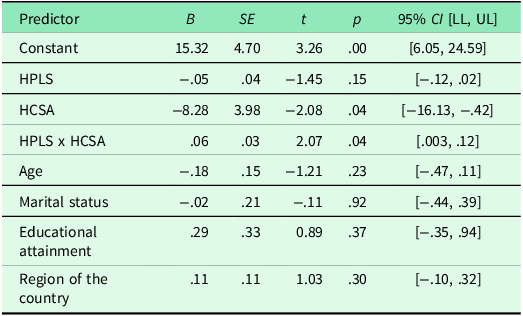
A moderation analysis was conducted using Hayes’ (2018) PROCESS Macro, Model 1 to examine whether the relationship between health-promoting lifestyle (X) and attitudes toward lifestyle medicine (Y) was moderated by healthcare sector attainment (W), while controlling for age, marital status, educational attainment, and region of countries (see Table 3). The sample consisted of N = 215 participants.
Model summary

Table 3. Long description
A table summarizing a moderation analysis model. The table has six rows and seven columns. The columns are labeled Predictor, B, SE, t, p, and 95% CI [LL, UL]. The rows are labeled Constant, HPLS, HCSA, HPLS x HCSA, Age, Marital status, Educational attainment, and Region of the country. The values in the table are as follows: Row 1: Constant, 15.32, 4.70, 3.26, .00, [6.05, 24.59]. Row 2: HPLS, -.05, .04, -1.45, .15, [-.12, .02]. Row 3: HCSA, -8.28, 3.98, -2.08, .04, [-16.13, -.42]. Row 4: HPLS x HCSA, .06, .03, 2.07, .04, [.003, .12]. Row 5: Age, -.18, .15, -1.21, .23, [-.47, .11]. Row 6: Marital status, -.02, .21, -.11, .92, [-.44, .39]. Row 7: Educational attainment, .29, .33, 0.89, .37, [-.35, .94]. Row 8: Region of the country, .11, .11, 1.03, .30, [-1.10, .32].
B: Unstandardized Coefficient, SE: Standard Error, CI: Confidence Interval, LL: Lower Limit, UL: Upper Limit, HPLS: Health-Promoting Lifestyle, HCSA: Healthcare Sector Attainment.
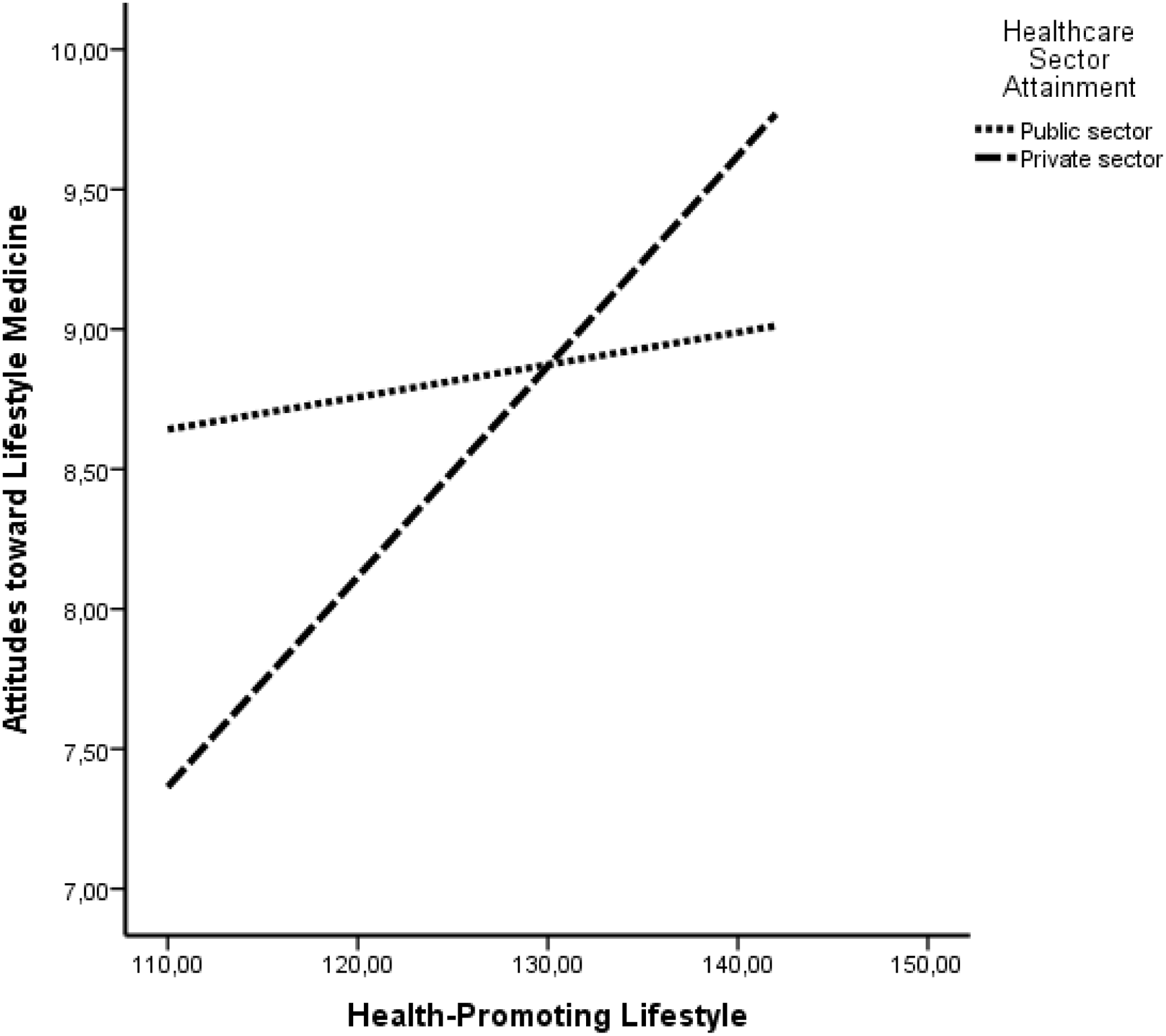
The interaction term (health-promoting lifestyle × healthcare sector attainment) was statistically significant, ΔR 2 = .020, F(2, 207) = 4.29, p = .04, suggesting a moderating role of the healthcare sector attainment (see Figure 1). As shown in Table 4, the conditional effects analysis revealed that the positive association between health-promoting lifestyle and attitudes toward lifestyle medicine was significant among FPs working in the private sector (B = .08, p = .01). This relationship was not statistically significant in the public sector. These findings suggest that the healthcare sector attainment plays a moderating role in shaping the impact of individual health-promoting behaviours on their attitudes toward lifestyle medicine (Table 4).
Interaction between health-promoting lifestyle and healthcare sector attainment on attitudes toward lifestyle medicine.

Conditional effects of HPLS on ALSM by healthcare sector attainment

Table 4. Long description
A table with three columns and two rows. The columns are labeled ‘Effect of HPLS’, ‘SE’, ‘t’, ‘p’, and ‘95% CI (LL, UL)’. The rows are labeled ‘Public sector’ and ‘Private sector’. For the public sector, the values are: Effect of HPLS: .01, SE: .01, t: 1.09, p: .28, 95% CI (LL, UL): [-0.01, .03]. For the private sector, the values are: Effect of HPLS: .08, SE: .03, t: 2.61, p: .01, 95% CI (LL, UL): [.02, .13].
SE: Standard Error, CI: Confidence Interval, LL: Lower Limit, UL: Upper Limit, HPLS: Health-Promoting Lifestyle, ALSM: Attitudes toward Lifestyle Medicine.
The model was re-run for all subdimensions of the health-promoting lifestyle variable. A significant interaction effect was observed for stress management (ΔR 2 = .03, F(2,207) = 5.64, p = .02). For health responsibility (ΔR 2 = .017, F(2,207) = 3.71, p = .06), physical activity (ΔR 2 = .018, F(2,207) = 3.88, p = .05) (b = .27, p = .04), and nutrition (ΔR 2 = .015, F(2,207) = 3.39, p = .07) (b = .34, p = .01), the interaction was marginally significant. However, no significant results were found for spiritual growth (ΔR 2 = .006, F(2,207) = 1.24, p = .27), and interpersonal relations (ΔR 2 = .004, F(2,207) = .74, p = .39). A positive association for stress management (B = .44, p = .01), health responsibility (B = .30, p = .01), physical activity (B = .27, p = .04), and nutrition (B = .34, p = .01) between health-promoting lifestyle and attitudes toward lifestyle medicine was significant among FPs working in the private sector (Figure 1).
Discussion
Our study advances lifestyle medicine research by examining the relationship between FPs’ health-promoting lifestyle and their lifestyle medicine attitudes, while investigating the previously unexamined moderating role of healthcare sector attainment. Findings reveal that although physicians hold positive lifestyle medicine attitudes, workplace contextual factors shape how their personal health behaviours align with these professional beliefs. Drawing on Social Cognitive Theory (Bandura and National Institutes of Mental Health 1986), the Job Demands-Resources Model (Evangelia et al., Reference Evangelia, Bakker Arnold, Friedhelm and wilmar2001), Work-Life Spillover Theory (Greenhaus and Beutell, Reference Greenhaus and Beutell1985), and the Effort-Reward Imbalance Model (Siegrist, Reference Siegrist1996), all while grounding the interpretation in the existing literature.
A foundational finding is FPs’ strong professional endorsement of lifestyle medicine. Most of our sample reports ‘usually’ or ‘always’ recommending lifestyle interventions and expresses high motivation to enhance their knowledge – aligning with the global recognition of lifestyle medicine as critical for chronic disease management (Lianov and Johnson, Reference Lianov and Johnson2010; Lippman et al., Reference Lippman2024). We also observed a small but significant positive correlation between physicians’ health-promoting lifestyle and their lifestyle medicine attitudes. This relationship is supported by Social Cognitive Theory (Bandura and National Institutes of Mental Health, Reference Bandura1986), which posits reciprocal interactions between beliefs, behaviours, and environment. A recent systematic review confirms that Social Cognitive Theory–based interventions in primary care consistently improve outcomes such as physical activity and dietary knowledge, with self-efficacy and observational learning as key drivers (Islam et al., Reference Islam, Awal, Mazumder, Munni, Majumder, Afroz, Tabassum and Hossain2023). As suggested by Erica Frank (Frank and Holmes, Reference Frank and Holmes2019; Pira et al., Reference Pira, Gökdemir, Frank, Mevsim and İşcan2025), a ‘Healthy Doc’ is more likely to create a ‘Healthy Patient’, healthy personal habits lead to more consistent counselling and greater patient adherence. This congruence between personal practice and professional advocacy stems from increased self-efficacy and credible understanding of lifestyle change. Our finding that attitudes correlated specifically with health responsibility and nutrition behaviours reinforces this perspective, highlighting a direct link where personal discipline in these areas strengthens professional conviction. This affirms calls for medical schools and healthcare systems to support physicians’ personal health as a means of improving patient outcomes (Pira et al., Reference Pira, Gökdemir, Frank, Mevsim and İşcan2025).
India’s shift from communicable to NCDs has sharply increased chronic conditions like cardiovascular disease and diabetes. One in four Indian adults has hypertension, yet only 12% achieve controlled blood pressure – a critical gap given the 2025 target of a 25% relative reduction among 188.3 million affected adults. Examining this gap through primary healthcare workforce realities reveals fundamental constraints: workload pressures, staffing shortages, and administrative burdens limit time for preventive counselling and sustained patient engagement – essential for lifestyle modification. Without grounding solutions in this evidence, interventions risk theoretical soundness but practical failure. Moreover, loss to follow-up reflects not only system failures but also cultural norms around chronic illness management and patient expectations of curative versus preventive care. Acknowledging these sociocultural factors explains why community outreach programmes (mobile health, community health worker engagement, door-to-door screenings) have shown promise. A comprehensive hypertension control strategy must strengthen primary and wellness centres while capacitating Community Health Officers, informed by workforce evidence. Although community-led, tech-enabled private interventions offer potential, public system integration remains essential for cost-effective adoption. Tailored strategies accounting for both workforce constraints and sociocultural factors are critical to addressing loss to follow-up across India’s evolving disease landscape (Bera et al., Reference Bera, Mondal and Bhattacharya2023).
While a general link between attitudes and behaviours exists, our study’s most critical contribution is demonstrating a moderation effect of healthcare sector attainment. This finding addresses a gap in the literature, which has explored physicians’ personal health and occupational stress separately but has not empirically integrated these variables with professional context (Brotons et al., Reference Brotons, Godycki-Cwirko and Sammut2003; Gökdemir et al., Reference Özden, Kazdağlı and İlgi Şemin2025). Our results reveal that the relationship between a physician’s health-promoting lifestyle and their lifestyle medicine attitudes is contingent upon their work environment – interpreted through the Job Demands-Resources Model (Demerouti et al., Reference Demerouti, Bakker, Nachreiner and Schaufeli2001; Evangelia et al., Reference Evangelia, Bakker Arnold, Friedhelm and wilmar2001) and Work-Life Spillover Theory (Greenhaus and Beutell, Reference Greenhaus and Beutell1985). For FPs in the public sector (where most of our sample worked), we found no statistically significant link between their health-promoting lifestyle and their lifestyle medicine attitudes. This disconnect can be explained by the Job Demands-Resources Model: high job demands without sufficient resources lead to burnout, preventing physicians from translating positive attitudes into personal health behaviours. Recent research corroborates that physicians face the highest quantitative demands – work volume and time pressure – among healthcare workers (Gynning et al., Reference Gynning, Karlsson, Teoh, Gustavsson, Christiansen and Brulin2024) Public sector environments are often characterized by heavy patient loads, emergency calls, and monotonous routines while concurrently providing fewer resources critical for adopting lifestyle medicine, such as time for patient education or practice autonomy. This imbalance of high demands and limited resources creates a system where, despite positive beliefs, immense stress prevents attitudes from translating into consistent personal or professional behaviours (Brotons et al., Reference Brotons, Godycki-Cwirko and Sammut2003; Aslam et al., Reference Aslam, Mansoor and Suleman2013).
This situation is further exacerbated by Work-Life Spillover Theory (Greenhaus and Beutell, Reference Greenhaus and Beutell1985), which posits that stress from work directly affects private life. Public sector physicians experience higher stress, psychological distress, and sleep problems than private sector counterparts (Heponiemi et al., Reference Heponiemi, Kuusio, Sinervo and Elovainio2011).
This negative spillover means workplace exhaustion bleeds into personal life, making it difficult to maintain a health-promoting lifestyle – directly explaining our null finding for public sector healthcare sector attainment: environmental pressures overwhelm physicians’ capacity to act on their lifestyle medicine attitudes.
In contrast, private sector results show a significant positive association between health-promoting lifestyle and lifestyle medicine attitudes. Private institutions are often better organized, with faster care access, higher job satisfaction, and fewer distress symptoms (Heponiemi et al., Reference Heponiemi, Kuusio, Sinervo and Elovainio2011; Zgliczyński et al., Reference Zgliczyński, Jankowski, Rostkowska, Sytnik-Czetwertyński, Śliż, Karczemna and Jław2020). This environment provides resources such as autonomy and less time pressure, allowing physicians to live their professional beliefs – a positive Work-Life Spillover effect. Hasan et al. (2020) further found that among healthcare professionals, work-life balance enhances subjective well-being through increased job satisfaction, a relationship particularly pronounced for those with low intrinsic motivation, underscoring the critical role of the work environment.
The specific subdimensions of health-promoting lifestyle further underscore this theoretical distinction. Significant moderation effects for stress management, health responsibility, physical activity, and nutrition were found exclusively in the private sector. These behavioural domains are most impacted by workplace demands and resources; their salience in the private sector confirms that a supportive context is a prerequisite for physicians to embody core lifestyle medicine attitudes.
Finally, the Effort-Reward Imbalance Model (Siegrist, Reference Siegrist, Cooper and Quick2017) adds another interpretive layer: health is compromised when high work effort is not sufficiently compensated by rewards. A systematic review confirms this imbalance is widespread among health workers, linked to increased workload and inadequate human resources (Van et al., Reference Van2018). The public sector’s high workload and systemic barriers (e.g., lack of time, reimbursement issues; Brotons et al., Reference Brotons, Godycki-Cwirko and Sammut2003) represent a high-effort environment. When these efforts lack proportional rewards – time for meaningful counselling, recognition for lifestyle advocacy, or personal well-being – a chronic imbalance arises, leading to stress and disengagement. This weakens the link between physicians’ lifestyle medicine attitudes and their health-promoting lifestyle, particularly within the public healthcare sector attainment context (Brotons et al., Reference Brotons, Godycki-Cwirko and Sammut2003).
Clinical and policy implications
Our findings have important implications for clinical practice and public health policy. The observed disparities in the relationship between health-promoting lifestyle and lifestyle medicine attitudes across healthcare sector suggest a need for tailored interventions. For private sector FPs, interventions could leverage their existing positive attitudes and health behaviours – underpinned by high self-efficacy and positive Work-Life Spillover (Greenhaus and Beutell, Reference Greenhaus and Beutell1985) – to further enhance their role as lifestyle medicine champions, for example through advanced training or leadership opportunities in health promotion.
In contrast, the public sector may require more fundamental systemic changes. Through the Job Demands–Resources (Evangelia et al., Reference Evangelia, Bakker Arnold, Friedhelm and wilmar2001) and Effort-Reward Imbalance (Siegrist, Reference Siegrist, Cooper and Quick2017) models, our analysis indicates that policy must address structural barriers faced by public sector physicians. Excessive patient loads and inadequate resources create a high-effort environment, leading to burnout and negative work-life spillover that hinders their ability to integrate lifestyle medicine into practice. Policies supporting physician well-being – including access to stress management, health responsibility, physical activity, and nutrition programmes – could improve physicians’ health-promoting lifestyle and strengthen their professional lifestyle medicine attitudes. Ultimately, fostering alignment between physicians’ personal health behaviours and professional attitudes across all levels of healthcare sector attainment is crucial for advancing preventive care and improving population health outcomes.
Limitations and future research directions
Our study provides valuable insights into FPs’ attitudes toward lifestyle medicine and its association with their health-promoting lifestyle behaviours across different healthcare sectors. However, it’s essential to acknowledge certain limitations that may impact the generalizability and interpretation of these findings. First, the cross-sectional design of this study prevents us from establishing causal relationships between the variables. While we observed significant associations, particularly concerning the reciprocal relationship between beliefs and behaviours as proposed by Social Cognitive Theory (Bandura and National Institutes of Mental Health, Reference Bandura1986; Islam et al., Reference Islam, Awal, Mazumder, Munni, Majumder, Afroz, Tabassum and Hossain2023), we cannot definitively conclude that attitudes directly cause changes in health behaviours or vice versa. Future research employing longitudinal designs would be beneficial to explore the temporal dynamics and potential causality between these factors. Second, our reliance on self-reported data for both attitudes and health-promoting lifestyle behaviours introduces the potential for social desirability bias. Physicians might have reported more positive attitudes or healthier behaviours than they practice due to their professional roles. Future studies could benefit from incorporating objective measures where feasible, such as tracking physical activity or utilizing validated clinical data for certain health indicators, to complement self-reported information.
Third, while our study effectively utilized established theories like the Job Demands-Resources Model (Evangelia et al., Reference Evangelia, Bakker Arnold, Friedhelm and wilmar2001) and the Effort-Reward Imbalance Model (Siegrist, Reference Siegrist, Cooper and Quick2017) to interpret the findings, we did not employ the specific, validated scales associated with these theoretical constructs. This means our explanation of the moderating effect is inferential, based on the literature, rather than a direct empirical test of the models themselves. Future research should address this limitation by incorporating specific scales to measure constructs such as job demands, job resources, effort, and reward. Doing so would provide a more precise, direct assessment of how these theoretical mechanisms operate within the healthcare sector and influence the relationship between a physician’s personal and professional life.
Fourth, the sample, while diverse across regions, was predominantly composed of FPs and had a higher representation from certain sectors (e.g., public healthcare). This might limit the direct generalizability of our findings to other medical specialties or to healthcare systems with significantly different structures or cultural contexts. Future research should strive for broader representation across various specialties and geographical regions to enhance external validity. Finally, while we identified the healthcare sector as a moderator, our study did not delve into the specific mechanisms or nuances within each sector that contribute to these moderating effects. Factors such as organizational culture, available resources, workload, and specific training opportunities within public versus private settings could play significant roles, directly influencing job demands, resources, and the resulting work-life spillover.
Further qualitative research, such as in-depth interviews or focus groups with FPs, could provide richer insights into the specific facilitators and barriers within different healthcare sectors. Understanding the lived experiences and perceptions of physicians in public versus private settings could elucidate why certain health-promoting lifestyle subdimensions show a greater correlation with attitudes in specific contexts, particularly concerning stress management, health responsibility, physical activity, and nutritional behaviour. Moreover, future research could explore the impact of targeted interventions aimed at improving physician well-being and health-promoting behaviours in both public and private sectors. Evaluating the effectiveness of such programmes on physicians’ attitudes toward lifestyle medicine and their subsequent patient counselling practices would be highly valuable. Investigating the role of specific training programmes in lifestyle medicine and their differential impact across various healthcare settings would also provide actionable insights for curriculum development and continuing medical education. Finally, expanding the scope to include patient outcomes would be a vital next step. Understanding how physicians’ attitudes and behaviours, moderated by their practice sector, ultimately influence patient engagement in lifestyle changes and subsequent health outcomes would strengthen the evidence base for promoting lifestyle medicine within diverse healthcare contexts.
Conclusion
This study demonstrates the significant role of healthcare sector attainment in moderating the relationship between FPs’ health-promoting lifestyles and their attitudes toward lifestyle medicine. While a general positive link exists, Associations were particularly salient for stress management, health responsibility, physical activity, and nutrition behaviour among physicians in the private sector. These findings highlight the need for sector-specific strategies to foster lifestyle medicine integration, suggesting that supporting physicians’ personal well-being within their professional environments is crucial for advancing preventive care.
In conclusion, our research confirms the ‘Healthy Doc = Healthy Patient’ link (Holmes and Frank, Reference Holmes and Frank2024) but, more critically, demonstrates that this relationship is contingent on the work environment. By integrating our findings with key social and organizational psychology theories, we provide a compelling framework for understanding that a physician’s ability to champion lifestyle medicine is not merely a function of their personal attitudes or willpower, but is powerfully shaped by the demands, resources, and systemic pressures of the healthcare sector in which they practice.
Data availability statement
The datasets generated and/or analysed during the current study are available from the corresponding author upon reasonable request.
Author contributions
OG, HP: Conceptualization.
OG, GB, MRS, MJI, HSK, OA, MB, AW: Data curation.
OG, HP: Formal analysis.
OG, HP, GB, MRS, MJI, HSK, OA, MB, AW: Investigation.
HP: Methodology.
OG, GB, MRS, MJI, HSK, OA, MB, AW: Resources.
OG, HP: Supervision.
OG, HP, GB, MRS, MJI, HSK, OA, MB, AW: Writing – original draft.
OG, HP: Writing – review & editing.
Funding statement
This research received no specific grant from any funding agency in the public, commercial, or not-for-profit sectors.
Competing interests
The authors have no conflicts of interest to declare.
Ethical standards
All procedures performed in this study adhered to the ethical standards of the Declaration of Helsinki. Ethical approval was granted by the İzmir University of Economics Ethics Committee (Decision No: No.: 07.03.2022-48).
Informed consent
All participants provided informed consent prior to their participation in this study.


 Open access

