


Introduction
Medically unexplained symptoms and the cognitive behavioural model
Medically unexplained symptoms (MUS) are defined as symptoms for which an organic medical explanation cannot be found after appropriate investigation and examination (van Dessel et al., Reference Van Dessel, Den Boeft, van der Wouden, Kleinstaeuber, Leone, Terluin and van Marwijk2014). A medical cause does not need to be entirely absent, but level of impairment should outweigh the symptoms being experienced (American Psychiatric Association, 2013). Such somatic symptoms in childhood are extremely common and in most cases they are not persistent or significantly impairing (Rask et al., Reference Rask, Ornbol, Fink and Skovgaard2013). However, approximately 10–25% of children and adolescents report chronic somatic complaints and 4–10% are severely affected and likely to require treatment (Hinton and Kirk, Reference Hinton and Kirk2016; Garralda and Rask, Reference Garralda and Rask2015). For these children, the symptoms experienced may result in daily functional impairment, including school absence, poor academic performance, impairments in social and physical activities, and difficulties with eating and sleeping (Hoftun et al., Reference Hoftun, Romundstad, Zwart and Rygg2011; Hughes et al., Reference Hughes, Lourea-Waddell and Kendall2008; Rask et al., Reference Rask, Bonvanie and Garralda2018; Roth-Isigkeit et al., Reference Roth-Isigkeit, Thyen, Stöven, Schwarzenberger and Schmucker2005).
Deary et al. (Reference Deary, Chalder and Sharpe2007) devised a cognitive behavioural model of MUS, generating a feasible explanation for the production of symptoms. The ‘three P’ structure of a generic cognitive behavioural therapy (CBT) model is retained, considering pre-disposing, precipitating and perpetuating factors (Rask et al., Reference Rask, Bonvanie and Garralda2018). Recognising the absence of an obvious cause, a key focus of the model is on the cycle of cognitive processes, physiology, behaviours and social factors that serve to maintain physical symptoms and distress. Treatment often targets these maintaining factors, such as recognising and changing unhelpful negative cognitive or behavioural patterns that are likely to perpetuate symptoms.
The cognitive behavioural model provides a theoretical framework for the development of MUS, but there is little consensus regarding the model in children. A review of risk factors in children’s MUS concluded that a comprehensive model would consider biological and psychological vulnerability, the tendency to focus on somatic as opposed to psychological symptoms in young people, alongside the concern of parents, school avoidance and medical investigation (Rask et al., Reference Rask, Bonvanie and Garralda2018). Importantly, in contrast to adults, children are not independent figures and often look to their parents for attention, care and decision-making (Eminson, Reference Eminson2007). Despite somatising complaints coming directly from children, they can manifest through parental responses, and parental responses may therefore fuel the maintenance cycle (Garralda and Rask, Reference Garralda and Rask2015).
Information seeking and online resources
Healthcare professionals have traditionally been the gatekeepers of knowledge regarding children’s symptoms and illnesses (Nicholl et al., Reference Nicholl, Tracey, Begley, King and Lynch2017). Now more than ever, parents are seeking health-related information for their children via the internet (Pehora et al., Reference Pehora, Gajaria, Stoute, Fracassa, Serebale-O’Sullivan and Matava2015), regarding the information obtained as more up-to-date and easily accessible (Walsh et al., Reference Walsh, Hamilton, White and Hyde2015). However, it can be difficult to distinguish between credible and non-credible sources of online information (Starcevic and Berle, Reference Starcevic and Berle2013). In a study of 146 parents of healthy children investigating usage and perceptions of the reliability of websites for health-related information (Pehora et al., Reference Pehora, Gajaria, Stoute, Fracassa, Serebale-O’Sullivan and Matava2015), 98% reported using the internet to access information regarding their child’s health, with 50% reporting that they crosschecked information found with their GP; 80% of participants conducted internet searches using public search engines, such as Google, although only 24% regarded them as accurate and safe. Hospital- and government-run websites were perceived to be more accurate and up-to-date by 76% of participants, but all were less likely to access these sources. Similarly, Khoo and colleagues (Reference Khoo, Bolt, Babl, Jury and Goldman2008) found that 55% of 360 parents surveyed expressed concerns regarding the reliability of sources and content of health information published online. As the internet does not always provide accurate, relevant or up-to-date information (Starcevic, Reference Starcevic2017), instead of providing immediate reassurance it can result in increased levels of anxiety, encouraging reassurance seeking (Starcevic and Berle, Reference Starcevic and Berle2013). Although this may be true of poor-quality websites, it may also be the case that simply reading more in-depth information – even if accurate – serves to increase anxiety and negative beliefs by encouraging attention and hypervigilance to a range of benign symptoms. Alternatively, reading accurate information could be assuring and alleviate concerns rapidly and cost-effectively.
Parents’ level of anxiety may be an important predictor in determining the extent of information seeking, and in turn, the impact on beliefs, emotions and behaviours exhibited in response to MUS in children. Parental anxiety has been found to play a significant role in the development and maintenance of anxiety disorders in children and adolescents (Eley et al., Reference Eley, McAdams, Rijsdijk, Lichtenstein, Narusyte, Reiss and Neiderhiser2015; Creswell et al., Reference Creswell, Cooper and Murray2010). Parental anxiety can also heighten sensitivity towards physical symptoms of anxiety through the misinterpretation of symptoms being dangerous (Bilsky et al., Reference Bilsky, Feldner, Bynion, Rojas and Leen-Feldner2018).
Online information-seeking in health anxious individuals has been found to be significantly positively related to the frequency of health-related internet searches and negative responses to online health information (Baumgartner and Hartmann, Reference Baumgartner and Hartmann2011; Doherty-Torstrick et al., Reference Doherty-Torstrick, Walton and Fallon2016; Muse et al., Reference Muse, McManus, Leung, Meghreblian and Williams2012). Data from 731 adults who frequently used the internet to search for their symptoms showed that those participants with high levels of health anxiety recalled feeling worse after searching the internet and those with low levels of health anxiety recalled feeling more relieved (Doherty-Torstrick et al., Reference Doherty-Torstrick, Walton and Fallon2016). Therefore, parents who already have higher levels of anxiety may experience negative responses to searching for MUS information online, which may further negatively impact their beliefs, emotions and behaviours towards their child’s illness.
Preliminary evidence suggests that the credibility of online sources does not negate the effect of anxiety on online searching. Baumgartner and Hartmann (Reference Baumgartner and Hartmann2011) found, in contrast to predictions, health anxiety led to greater negative responses to health information from a trustworthy online source, but not a less trustworthy source. Although more research is needed, the credibility of online information may affect individuals with anxiety differently from those without anxiety.
The present study
To date, no studies have investigated the use of internet searching on parental beliefs, emotions and behaviours associated with children’s MUS, and how this may be moderated by the accuracy of the information and parental anxiety. The primary aim of the present study was therefore to investigate the impact searching different websites had on beliefs, emotions and behavioural intentions on visual analogue scales (VAS) to a vignette in which adults were asked to imagine they were the parent of a child with MUS.
Firstly, we examined the possible effects of internet searching symptoms of MUS compared with performing unrelated internet activity (‘control condition’) on responses to MUS. Secondly, we sought to investigate whether there were differential effects on change in beliefs, emotions and behavioural intention scores when searching either (a) reputable websites providing evidence-based information (‘reputable search condition’) or (b) free searching of any websites for symptom-related information (‘free search condition’). Lastly, we examined whether pre-search anxiety moderated the impact of searching on change in beliefs, emotions and behavioural intentions. We hypothesised:
-
1. Internet searching for symptoms of MUS (reputable search or free search condition) would lead to a significant increase in negative beliefs, emotions and behaviour VAS scores compared with an unrelated internet search (control condition).
-
2. Free search would lead to a greater increase in negative beliefs, emotions and behaviour VAS scores compared with the reputable search condition.
-
3. There would be a significant interaction between pre-search anxiety and search condition on beliefs, emotions and behaviour VAS scores. Specifically, there would be greater differences between reputable and free search conditions in those with greater anxiety at baseline.
Method
Power analysis and participants
In order to detect a small effect (0.25) at 80% power, at the 5% (two-tailed) significance level, and accounting for 30% attrition (Åström et al., Reference Åström, Jergeby, Andershed and Tengström2013), approximately 120 participants were required, equating to 40 per condition. Participants were recruited via advertisement on the social networking platforms Facebook, Instagram, Twitter and LinkedIn between 28 April 2018 and 16 May 2018. Inclusion criteria were English as a first language and minimum 18 years of age. Participants had to have access to a computer and be able to spend approximately 30 minutes completing the study. There were no exclusion criteria for the present study.
Ethics and consent
The study was approved by UCL Research Ethics Committee (REC), project ID number: 12735/001. The study was hosted on a Qualtrics platform. Participants were required to read an information sheet at the beginning of the study and provided informed consent on the platform.
Procedure
The procedures were initially piloted with 12 participants and adapted according to the feedback received. The results from these 12 participants are not included within the present paper. Following informed consent, participants completed a brief demographic questionnaire and the GAD-7 before being presented with a vignette of a child (‘Katie’) with MUS. VAS were then completed. Following completion of the VAS, participants were automatically randomised to one of three internet search conditions: reputable search, free search or unrelated search (control). Randomisation was carried out directly via Qualtrics. After completing the 10-minute search task, participants were again presented with the vignette about Katie and asked to complete the VAS. Participants were required to answer questions asking whether they followed the instructions provided to them and if they participated in other activities during the 10-minute search task. These were to assess their compliance with the task instructions. Finally, participants were asked to provide detailed explanations of what they perceived the study to be about. At the end of the questionnaire, participants were provided with a debrief form explaining the process of randomisation, study hypotheses and were encouraged to contact their GP if necessary. Participants were also entered into a £50 prize draw.
Vignette
The vignette (see Supplementary material: Appendix A) used in this study was based on previous studies reflecting children with somatic complaints (Geist et al., Reference Geist, Weinstein, Walker and Campo2008; Williams et al., Reference Williams, Smith, Bruehl, Gigante and Walker2009) with stomach pain being the symptom chosen based on its high prevalence rate among children and adolescents (Korterink et al., Reference Korterink, Diederen, Benninga and Tabbers2015).
Search conditions
Reputable search
Those assigned to the reputable search condition were required to search the symptoms Katie had been experiencing online using only the following websites or any links the pages suggest:
-
1. https://www.nhs.uk/conditions/medically-unexplained-symptoms/
-
2. https://www.evidence.nhs.uk/search?q=medically+unexplained+symptoms
-
3. https://www.rcpsych.ac.uk/healthadvice/physicalandmentalhealth/medicallyunexplainedsymptoms.aspx
These websites were chosen based on the availability of accurate and up-to-date evidence-based information regarding MUS.
Free search
Within the free search condition, participants were asked to search the symptoms Katie had been experiencing online and to copy and paste the links to the websites they visited into the text box that was provided.
Control – unrelated search activity
Participants in the control condition were asked to think about what tasks they last did whilst on the internet and to spend the 10 minutes using the internet as they usually would (e.g. check emails) and provide details of what they did in the text box provided.
Materials
Demographics
Participants were asked to provide information on their gender, age, student status and parental status.
Generalised Anxiety Disorder 7 (GAD-7; Spitzer et al., Reference Spitzer, Kroenke, Williams and Löwe2006)
The GAD-7 is a 7-item measure assessing frequency of anxiety symptoms over the last 2 weeks and is used as a brief screening tool for generalised anxiety disorder. Each item is rated on a 4-point Likert scale from zero (not at all) to three (nearly every day), with a range in scores of 0–21. The present sample demonstrated good internal consistency (α = .91), which is comparable to other psychometric studies (Dear et al., Reference Dear, Titov, Sunderland, McMillan, Anderson, Lorian and Robinson2011).
Visual Analogue Scales (VAS; see Supplementary material: Appendix B)
VAS were used to measure parent beliefs, emotions and behaviours pre- and post-internet searching in response to the vignette. Participants indicated how much each item applied to them with regard to their beliefs (three statements, e.g. how likely their child has an undetected medical illness), emotions (three statements, e.g. how worried they are about their child’s health), and behaviours (four statements, e.g. how likely they are to seek another medical opinion) on a 0 to 100 horizontal slider scale, with ‘not at all’, ‘a moderate amount’ and ‘a significant amount’ labels evenly located along the line. A higher score indicated more negative responses to the vignette. Past research has considered VAS to be a reliable and valid measurement tool for a variety of subjective experiences (Wewers and Lowe, Reference Wewers and Lowe1990), and in the present sample Cronbach’s alpha for each VAS variable shows moderate to high internal consistency (α = .63 to .91).
Manipulation check
Participants were asked if they followed the instructions that were provided and whether they participated in other activities during the 10-minute task.
Design and statistical analysis
Preliminary analyses
One-way ANOVAs were conducted to compare participants’ characteristics (gender, age, student status, parent status, anxiety) and baseline beliefs, emotions and behavioural intentions scores between the conditions to test for the effectiveness of the randomisation. Participants could not complete the study unless they had completed all questions, thus all participants completed all aspects of the study, so no data were excluded.
Main analysis
A one-way multivariate analysis of covariance (MANCOVA) was performed to investigate any differences in change in VAS responses according to group (reputable search, free search or unrelated search), while controlling for anxiety. While separate ANCOVAs for each of the VAS (beliefs, emotions and behaviours) could be conducted to analyse the variables, the use of multiple ANCOVAs inflate the Type I error rate. MANCOVA analysis adjusts for such inflation (Raykov and Marcoulides, Reference Raykov and Marcoulides2008). Preliminary MANCOVA assumption testing was conducted with no serious violations evident. Change in VAS scores were entered as the dependent variables and internet search group was entered as the independent variable. GAD-7 scores were entered as a covariate to assess whether participant’s anxiety levels affected their responses. For the first hypothesis, the contrast subcommand was used to compare change in VAS scores in the reputable search and free search conditions with the unrelated search condition. For the second hypothesis, the contrast subcommand was used to compare change in VAS scores in the reputable search with the free search condition. For the third hypothesis, to examine whether anxiety moderated the impact of the internet search group on change in VAS scores, the interaction between anxiety and internet search group was included in the model.
Results
Sample characteristics
One hundred and twenty-seven participants were recruited into the study and were randomised. The majority of participants were female (n = 104), 46 were parents, and 48 were students. The mean age of participants was 32.5 years (SD = 14.00) within an age range of 18–78 years. There were 47 participants in the reputable search condition (85.1% female), 38 participants in the free search condition (76.3% female) and 42 participants in the unrelated condition (83.3% female) (see Table 1 for participant characteristics). ANOVAs exhibited no significant effect of internet searching conditions on gender: F (2,124) = .583, p = .560; age: F (2,124) = .871, p = .513; student status F (2,124) = .167, p = .846; parent status: F (2,124) = 1.488, p = .230; or anxiety F (2,124) = .656, p = 521. All participants were fluent in English and there were no missing data. No differences were found between conditions in baseline beliefs scores, F (2,124) = .047, p = .954; emotions scores, F (2,124) = 1.847, p = .162; and behaviours scores, F (2,124) = 2.550, p = .082.
Participant characteristics

Manipulation check
All participants were asked if they followed the instructions provided to them. Within the reputable search condition, 100% of participants followed the instructions, with 97.4% of participants in the free search condition and 92.9% within the unrelated condition. Participants were also asked whether they participated in other activities during the 10-minute internet search task: 28.9% of participants stated that they participated in other activities during the 10-minute task within the reputable search condition, 31.6% within the free search condition and 40.5% within the unrelated search condition. Seven participants watched TV; five checked their emails and two checked their social media.
Descriptive statistics
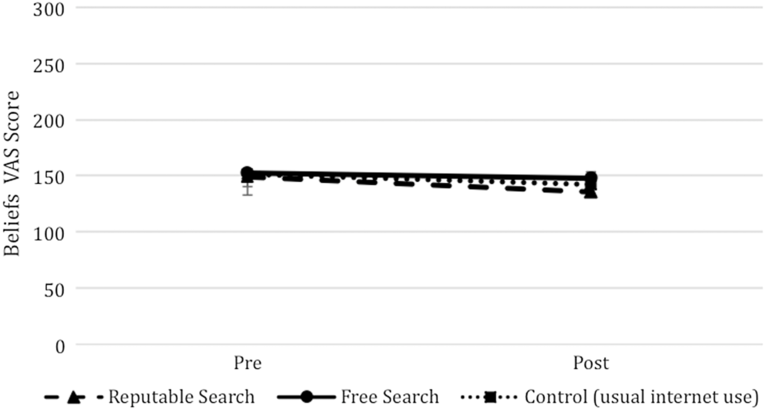
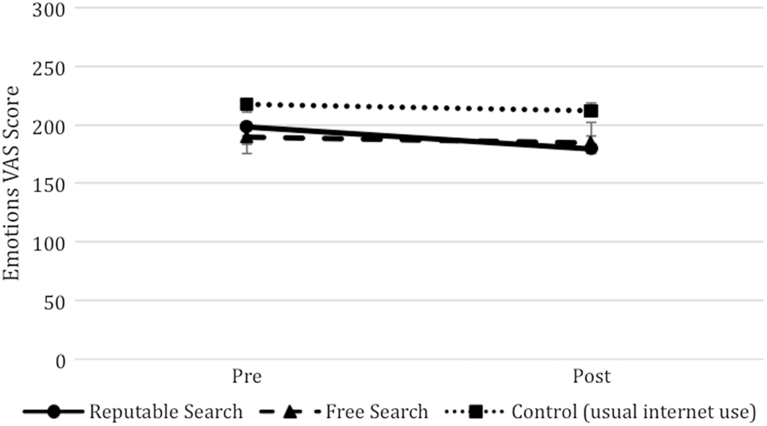
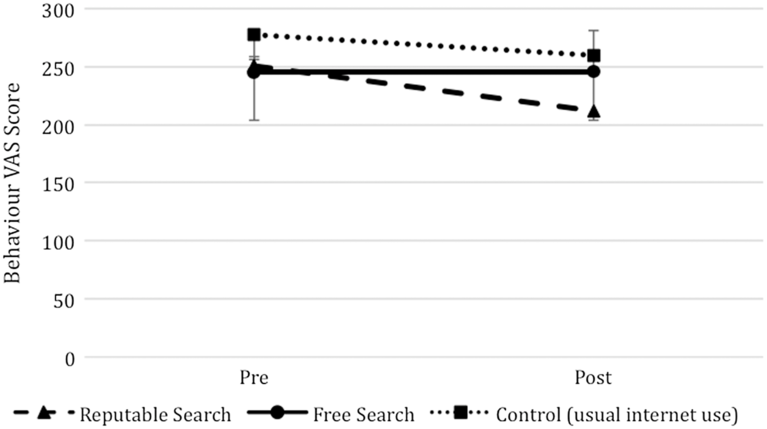
The beliefs, emotions and behaviour responses of the total sample decreased following internet searching (see Table 2 and Figs 1–3). The reputable search condition showed the greatest decrease in mean beliefs scores (mean = –13.34) and in mean emotions scores (mean = –18.81), although the pre- to post-trend across the three conditions was generally similar. However, mean behaviour scores decreased in the reputable search (mean = –38.77) and unrelated search (mean = –17.67) conditions, whereas in the free search conditions mean behaviours scores remained almost unchanged (mean = 0.84).
Means and standard deviations of change in VAS scores for the internet search conditions

Change in beliefs scores from pre- to post-search by condition.

Change in emotions scores from pre- to post-search by condition.

Change in behaviours scores from pre- to post-search by condition.

Hypothesis 1: Internet searching for symptoms of MUS (reputable search or free search condition) would lead to a significant increase in negative beliefs, emotions and behaviour VAS scores compared with an unrelated internet search (control condition)
A comparison of the search conditions combined (reputable search and free search) with the unrelated search control condition demonstrated no overall significant differences in change in belief, emotions and behaviours scores between the combined search conditions and control condition; Pillai’s trace = F (3,121) = .200, p = .896, partial η2 = .005.
Hypothesis 2: Free search would lead to a greater increase in negative beliefs, emotions and behaviour VAS scores compared with the reputable search condition
A comparison of reputable search and free search conditions found a statistically significant difference in change in belief, emotions and behaviours scores between the two conditions; Pillai’s Trace = F (3,121) = 3.940, p = .010. The effect size was moderate (partial η2 = .089), which implies that 8.9% of the total variance in parental responses was accounted for by the type of internet search of symptoms conducted. The MANCOVA results were then followed up with ANCOVAs for each of the changes in VAS scores independently, finding a significant difference between reputable search and free search conditions in change in behaviours scores only, F (1,123) = 11.374, p = .001. Reputable search decreased negative behaviours to a greater extent than free search.
Hypothesis 3: There would be a significant interaction between pre-search anxiety and search condition on beliefs, emotions and behaviours VAS scores. Specifically, there would be greater differences between reputable and free search conditions in those with greater anxiety at baseline
Examination of the interaction between internet search group and anxiety found no significant effect [Pillai’s trace = F (6,240) = .124, p = .993, partial η2 = .003], implying that baseline anxiety did not moderate the change in VAS scores between the conditions.
Description of the websites visited in the free search condition
Of the 38 participants randomised to free search, one visited the website provided for participants in the reputable search condition: https://www.nhs.uk/conditions/medically-unexplained-symptoms/. Others visited a range of websites, including evidence-based sites and less reputable sites, which referred only to serious organic illnesses that required immediate medical attention (e.g. gallbladder disease) (see Table 3 for free search condition findings). Six of the most common websites looked at were specifically related to abdominal pain in children, with the remaining for pain in adults or organic health conditions (e.g. appendicitis, pancreatic disease). Of the websites specifically related to children visited by participants in the free search condition only one was considered an evidence-based provider of accurate information regarding abdominal pain, yet this website included no insight to the possibility of symptoms being medically unexplained (see Supplementary material: Appendix C, for full list of websites visited).
Free search condition findings

* Participants visited multiple websites.
Discussion
Summary of findings
The present study investigated the impact of internet searching of symptoms on beliefs, emotions and behavioural intentions after reading a vignette concerning a child with MUS. Participants were randomised to one of three conditions: reputable search, free search or unrelated activity. The study revealed three findings.
First, contrary to Hypothesis 1, there were no significant differences between either of the internet searching symptoms of MUS and the control condition of unrelated use of the internet on change in belief, emotions and behavioural intentions. This is not aligned with previous research, which has indicated that health-related information seeking has increased negative responses (Baumgartner and Hartmann, Reference Baumgartner and Hartmann2011; Doherty-Torstrick et al., Reference Doherty-Torstrick, Walton and Fallon2016). This may be due to lack of elevated anxiety symptoms within the sample, and thus internet searching may have provided some relief as opposed to increasing distress.
In partial agreement with Hypothesis 2, there was a significant difference between the reputable and free search conditions on behavioural intentions but not emotions or beliefs. The reputable search condition lead to a significantly greater decrease in behavioural intention scores. This indicates that after searching reputable sites, participants would be less likely to engage in potentially negative behaviours related to the child’s MUS, such as seeking another medical opinion or preventing the child from partaking in daily activities. Analysis of the websites visited by participants in the free search condition indicated that only three participants looked at information about MUS, with the remaining focusing on organic causes of abdominal pain which often indicated serious illness. This highlights the importance of the provision of reliable information, as those with illness concerns are less likely to pay attention to the validity of sources (Doherty-Torstrick et al., Reference Doherty-Torstrick, Walton and Fallon2016). Our research suggests that providing participants with reliable, accurate information regarding MUS may reduce the likelihood of unnecessary healthcare utilisation and accommodating behaviours, and provide more effective reassurance than unreliable information found on the internet.
There was no significant effect of pre-search anxiety on internet search condition, contrary to the third hypothesis. This is not aligned with previous findings, which have suggested that those with increased levels of anxiety experience more distress after internet searching (Baumgartner and Hartmann, Reference Baumgartner and Hartmann2011; Doherty-Torstrick et al., Reference Doherty-Torstrick, Walton and Fallon2016; te Poel et al., Reference te Poel, Baumgartner, Hartmann and Tanis2016). The discrepancy may be due to the sample in the present study not reporting elevated levels of pre-existing anxiety and also because previous research has predominantly considered the moderating effects of health anxiety rather than generalised anxiety.
Theoretical and clinical implications
Theoretical implications
Overall, there was little difference in change in cognitions or emotions between the search groups. The significant difference found between the reputable and free search conditions on behavioural intentions may be understood in the context of the CBT model of MUS, whereby treatment seeking and avoidance of usual activities are key maintaining factors for the presence of physical symptoms (Deary et al., Reference Deary, Chalder and Sharpe2007; Thorgaard et al., Reference Thorgaard, Frostholm, Walker and Rask2013).
When children present to primary care with MUS, further examination and treatment is often sought by parents rather than children themselves (Eminson, Reference Eminson2007), with parents also deciding whether a child stays at home to rest rather than going to school or partaking in their usual activities. The present study suggests that searching of reputable websites could decrease the likelihood of treatment-seeking behaviour and avoidance of usual activities.
The impact of online information-seeking will be different depending on its population and purpose. It is often considered to maintain anxiety disorders (Baumgartner and Hartmann, Reference Baumgartner and Hartmann2011; Doherty-Torstrick et al., Reference Doherty-Torstrick, Walton and Fallon2016); however, it can be beneficial in enhancing understanding and knowledge of physical health conditions (Khoo et al., Reference Khoo, Bolt, Babl, Jury and Goldman2008). The present study adds to this literature by reaffirming the importance of distinguishing between the reliability of information sources to make more accurate predictions of the impact of internet searching for health-related information.
Clinical implications
With the prevalence of online information-seeking becoming more prominent, it is not a question of whether people use it, but more how they use it. Previous research indicates that parents often use the internet to seek information (Khoo et al., Reference Khoo, Bolt, Babl, Jury and Goldman2008; Pehora et al., Reference Pehora, Gajaria, Stoute, Fracassa, Serebale-O’Sullivan and Matava2015;) but are frequently unaware of or less likely to access reliable information in comparison with less trustworthy internet sources. This study indicates that redirecting people towards reliable and evidence-based information is important in determining the impact on symptoms.
As primary care is commonly the first port of call for children presenting with MUS (Rask et al., Reference Rask, Ornbol, Fink and Skovgaard2013), the results of the present study suggest that it may be important for primary care practitioners to educate and familiarise themselves on websites that provide the most accurate and up-to-date information regarding MUS in children (Bernhardt and Felter, Reference Bernhardt and Felter2004) and consider recommending specific websites to visit and those that should be avoided to parents during consultations (Powell et al., Reference Powell, Darvell and Gray2003).
Strengths and limitations
This study has several significant methodological strengths. The study was adequately powered to detect between-group differences, with no loss of data. The sample was recruited from a wide variety of sources to ensure that parents were adequately represented. The VAS questions created yielded moderate to high internal consistency, indicating that the measures themselves were reliable and effectively measure parental beliefs, emotions and behaviours in line with the CBT model of MUS (Deary et al., Reference Deary, Chalder and Sharpe2007).
Study limitations include reliance on participant self-report and associated vulnerability to the effects of response bias (Demetriou et al., Reference Demetriou, Ozer and Essau2015). However, research suggests that use of web-based platforms reduces the amount of social desirability present (Reips, Reference Reips2002). Within this research participants were required to complete a 10-minute online task, whilst participants were not able to proceed to the next question until the 10 minutes were finished; the manipulation check was subjective self-report rather than an objective measure. It is therefore not possible to confirm with certainty whether participants followed the instructions of the task during the time frame. Furthermore, data were collected on a non-clinical sample, with 38% of participants being parents and 36% being students. It may be that student populations, particularly those interested in health topics, were more likely to look at reputable websites or be familiar with MUS. This may have reduced differences between the reputable and free search conditions. Similarly, as participants were not diagnosed with anxiety disorders, there may not have been sufficient variance in baseline anxiety to examine the extent to which it was associated with change in beliefs, behaviours and/or cognitions. Although participants were asked to imagine that they were the parent of the child within the vignette, responses may have differed depending on parental or student status. To maximise recruitment for this investigation, participants did not have to be parents and the study focused on hypothetical responses. Data on parental status were collected at baseline to compare potential differences between parents and non-parents, and none were found.
Furthermore, the vignette technique is designed to investigate a participant’s responses to a particular situation and is regarded as a survey’s equivalent to experimental investigations (Taylor, Reference Taylor2006). Although the vignette was adapted accordingly based on previous research (Geist et al., Reference Geist, Weinstein, Walker and Campo2008; Williams et al., Reference Williams, Smith, Bruehl, Gigante and Walker2009) and attempted to create a real-life scenario of a child with MUS, a vignette cannot completely capture reality (Hughes and Huby, Reference Hughes and Huby2004). Although the present study demonstrates good evidence that behavioural intentions may be affected, we cannot be certain that the behavioural intentions reported would directly translate into actions.
Future directions
There is a body of literature behind the impact of online help-seeking in a broad range of fields, including information science, psychology and human computer interaction. As this was a preliminary investigation into the impact of internet information seeking on parental responses to MUS and there are no other studies to compare to, the findings would benefit from replication in the first instance. If replication were to occur, it would be useful to conduct the study within an experimental setting where the researcher can have full control over the experiment. This would ensure that participants completed the 10-minute task accurately. It would also be useful to screen record the 10-minute task to gain further findings such as the search terms used initially; the time spent on each website; and what information the websites provided. Further research utilising a clinical sample of parents of children with MUS would be beneficial.
Conclusion
In summary, this study demonstrated that internet searching impacted responses, specifically behavioural intentions, to a vignette of a child presenting with MUS. Participants who searched reputable websites containing evidence-based information on MUS had a greater reduction in behaviours that may maintain MUS (e.g. seeking a second opinion) compared with those who freely searched the internet for information about the symptoms. The websites those participants viewed were generally not reputable and provided information about serious organic causes of pain. It may therefore be advisable for health professionals meeting children with MUS to provide the family with information links to reputable sources. Replication and further research utilising a clinical sample of parents of children with MUS is recommended.
Supplementary material
To view supplementary material for this article, please visit https://doi.org/10.1017/S1352465820000752
Acknowledgements
We thank Grazia Manzotti for her guidance on searching the literature and Great Ormond Street Hospital Biomedical Research Centre (BRC).
Financial support
This research did not receive any specific grant from funding agencies in the public, commercial, or not-for-profit sectors. All research at Great Ormond Street Hospital NHS Foundation Trust and UCL Great Ormond Street Institute of Child Health is made possible by the NIHR Great Ormond Street Hospital Biomedical Research Centre. The views expressed are those of the author(s) and not necessarily those of the NHS, the NIHR or the Department of Health.
Conflicts of interest
The authors declare no conflicts of interest.
Ethical statements
The authors have abided by the Ethical Principles of Psychologists and Code of Conduct as set out by the BPS. The study was approved by UCL Research Ethics Committee (REC), project ID number: 12735/001.







Comments
No Comments have been published for this article.