Introduction
Depression and anxiety are disabling disorders that affect people of all ages (Lindesay et al., Reference Lindesay, Briggs and Murphy1989; Steffens and McQuoid, Reference Steffens and McQuoid2005; Prince et al., Reference Prince2007; Almeida et al., Reference Almeida, Alfonso, Hankey and Flicker2010). There is evidence that they share risk factors in later life, and that the overlap between these two conditions may be more than coincidental (Gale et al., Reference Gale2011). British data showed that the distribution of age, education, social class, disability, and living arrangements is similar in older people with depression and anxiety (Kvaal et al., Reference Kvaal, McDougall, Brayne, Matthews and Dewey2008), while Dutch findings revealed that nearly half of older people with depression fulfill criteria for a concurrent anxiety disorder (Beekman et al., Reference Beekman, de Beurs, van Balkom, Deeg, van Dyck and van Tilburg2000). Such an overlap has led some investigators to suggest that depression and anxiety may not be discrete disorders in later life, representing instead phenotypical expressions of the same condition along a continuum (Schoevers et al., Reference Schoevers, Deeg, van Tilburg and Beekman2005).
Kendell and Jablensky suggested that the use of structured criteria enhances the reliability of psychiatric diagnoses, although this does not mean that these are, by consequence, valid or useful (Kendell and Jablensky, Reference Kendell and Jablensky2003). They argued that a valid clinical diagnosis is characterized by “zones of rarity” that set them apart from normality and from other medical illnesses in terms of signs and symptoms, pathophysiology, and etiology. In contrast, the usefulness of a diagnosis is largely based on its ability to predict response to treatment and prognosis over time. Hence, if depression and anxiety are distinct disorders, one might expect minimal overlap between them. In addition, they would show easily distinguishable risk factor profiles and well-delineated courses over time. An alternative way of thinking about this is that similar conditions must share risk factors and natural history, although commonality of factors may not be sufficient to guarantee that two apparently distinct conditions are but one. Moreover, because of the large number of risk factors associated with these conditions in later life (Pirkis et al., Reference Pirkis2009; Almeida et al., Reference Almeida2011), investigating such associations is only possible by means of large longitudinal surveys.
We used data gathered as part of a study of over 20,000 community dwelling older Australians to determine: (1) the point prevalence of depression, anxiety, and of depression associated with anxiety (DA); (2) the risk factor profile of depression, anxiety, and DA; and (3) the course of depression, anxiety, and DA over 24 months.
Methods
Study design and participants
The present analyses are based on data originating from the Depression and Early Prevention of Suicide in General Practice (DEPS-GP) study, a clustered randomized trial that was originally designed to investigate how a GP-centered intervention changed the prevalence of depression among their patients. Details regarding the recruitment have been reported elsewhere (Williamson et al., Reference Williamson2007; Almeida et al., Reference Almeida2011). Between May and December 2005, each patient aged 60 years or over of participating primary care practices was sent a questionnaire. We asked potential participants to return the questionnaires (blank in the case of non-consenting subjects) so that we could estimate the true denominator of the target population. We received 22,258 questionnaires with written informed consent. Another 9,087 questionnaires were returned not completed, 2,934 were returned to the sender because the person named on the envelope was not known at the address, and 820 failed to be posted (total number of questionnaires tracked: 35,099). A small number of older adults who consented were found to be ineligible because they were under 60 years of age (n = 120) or did not reside in the community (nursing home n = 54), while a further 243 had incomplete data on basic demographic characteristics (age and gender) and were excluded from the analysis, leaving a sample of 21,841 older people, of whom 20,036 reported information on depressive and anxiety symptoms. The Ethics Committees of the University of Western Australia, the University of Melbourne, and the Royal Australian College of General Practitioners approved the study protocol and all participants provided informed consent.
Outcomes of interest
The outcomes of interest in this study were major depressive symptoms, clinically significant anxiety symptoms, or comorbid major depressive and anxiety symptoms.
We used the Patient Health Questionnaire (PHQ-9) to assess depression (Kroenke et al., Reference Kroenke, Spitzer and Williams2001) and a validated algorithm to establish the presence of major depressive symptoms according to DSM-IV criteria (Spitzer et al., Reference Spitzer, Kroenke and Williams1999). The PHQ-9 consists of nine questions about how often the respondent has been bothered by depressive symptoms during the past two weeks, each of which is scored from 0 to 3. To meet criteria for depression, the respondent had to score at least 2 on one of the first two questions of the PHQ-9 (items “a” or “b” below). In addition, he or she should have experienced at least five of the nine symptoms described in the PHQ-9 for most days during the same two-week period: (a) decreased interest or pleasure; (b) low mood; (c) sleep disturbance; (d) lack of energy; (e) disturbed appetite; (f) feelings of failure or guilt; (g) poor concentration; (h) psychomotor disturbance; and (i) suicidal thoughts.
We measured anxiety symptoms with the anxiety subscale of the Hospital Anxiety and Depression Scale (HADS-A) (Zigmond and Snaith, Reference Zigmond and Snaith1983; Bjelland et al., Reference Bjelland, Dahl, Haug and Neckelmann2002). Possible scores range from 0 to 21, with scores of 11 or greater indicating the presence of clinically significant anxiety (Zigmond and Snaith, Reference Zigmond and Snaith1983). Each of the following items is scored on a scale that ranges from 0 to 3: feeling tense or wound up, feeling frightened as if something awful is about to happen, worrying thoughts, inability to sit at ease or relax, feelings of “butterflies’” in stomach, restlessness, sudden feelings of panic.
Other study measures
Participants provided information about their gender, place of birth (Australia vs. overseas), marital status, highest educational achievement, and date of birth, which we used to calculate their age (in years). We also asked participants if, as a rule, they did at least half an hour of moderate or vigorous exercise on five or more days of the week (yes/no) (Elley et al., Reference Elley, Kerse and Arroll2003), if they smoked (never, past, current), and how many standard drinks they normally had on each typical day of the week. People who reported consuming seven or more drinks on any one day or who had three or more drinks nearly every day were considered risk drinkers (NHMRC, 2009). We used self-reported height and weight to calculate the body mass index (BMI) in Kg/m2, and classified as overweight or obese participants with BMI ≥ 25. We collected information about living arrangements (alone vs. with others) and used the Duke Social Support Index (DSSI) to measure perceived social support (Koenig et al., Reference Koenig, Westlund, George, Hughes, Blazer and Hybels1993). DSSI scores ≤ 31 represented the lowest quartile of scores in our sample and were used as an indicator of poor social support. Older adults in the lowest quintile of the Index of Relative Socio-Economic Disadvantage were considered socially disadvantaged (Pink, Reference Pink2008). In addition, participants indicated whether they attended religious services regularly (yes/no) and whether they were experiencing financial strain (distinctly or very much vs. slightly or not at all). They recorded (yes/no) whether they had lost a parent or had been victims of physical or sexual abuse before they were aged 15 years (“Were you the victim of physical or sexual abuse before you were 15 years old?”) (Draper et al., Reference Draper2008), and rated their overall health (fair/poor compared with good to excellent), their experience of pain (not at all or a little vs. quite a bit to extreme pain that interfered with work during the preceding four weeks) (the latter two questions are part of the Health Survey SF-12) (Ware et al., Reference Ware, Kosinski, Turner-Bowker and Gandek2002), and reported whether they had been advised by their doctor that they had had depression, anxiety, diabetes, hypertension, a heart attack, or a stroke (i.e., doctor-made diagnosis).
Procedures for the collection of endpoints
Consenting participants completed the self-rating postal questionnaire at baseline and after 24 months. We used these two assessments to determine the proportion of participants who fulfilled the study criteria for the diagnosis of anxiety at baseline and 24 months (persisting anxiety), depression at baseline and 24 months (persisting depression), or both anxiety and depression at baseline and 24 months (persisting anxiety plus depression).
Between the baseline and 24-month assessment, the GPs of participants were randomly assigned to a control group or to an educational intervention that consisted of three components: (1) printed educational material about the assessment and management of depression and self-harm behavior in later life, (2) detailed feedback on up to 20 practice audits, and (3) educational newsletters posted 6, 12, and 18 months after recruitment. The control group did not receive educational material nor did they receive detailed individualized feedback for their practice audits.
Statistical analysis
Data were managed and analyzed with Stata software version 12.0 (StataCorp, College Station, TX, USA, 2011). We used descriptive statistics to summarize the data and cross-tabulation to determine their distribution according to depression status. Participants were divided into four groups according to the results of their PHQ-9 and HADS-A ratings at the baseline assessment: no depression or anxiety, depression, anxiety (HADS-A≥11), depression and anxiety (DA). We then investigated the association between measured factors (independent variables) and the clinical groupings (dependent variable) using multinomial logistic regression (command: mlogit), with those participants without depression or anxiety representing the reference group. The reported odds ratio (OR) and respective 95% confidence interval of the OR (95% CI) were derived from a multivariate model that included all measured factors. The models were checked for goodness of fit using the Pearson goodness-of-fit test. We also calculated the OR of depression, anxiety, DA, and loss to follow up at the 24-month assessment according to the clinical status of participants at baseline. We included all demographic, lifestyle, socioeconomic, and clinical factors in the multivariate model, which was further adjusted for the participation of treating GPs in the educational activity.
Finally, we created clinical groups of repeated anxiety (HADS-A≥11 at baseline and at the 24-month assessment), repeated depression (depression at baseline and at the 24-month assessment), and repeated DA (HADS-A≥11 and depression at the baseline and at the 24-month assessment). Again, we applied multinomial multivariate logistic regression to estimate the OR of these clinical groupings according to baseline exposures, and took into account in the analyses the participation of GPs in the educational activities about depression and self-harm. Alpha was set at 5% and all probability tests used were two-tailed.
Results
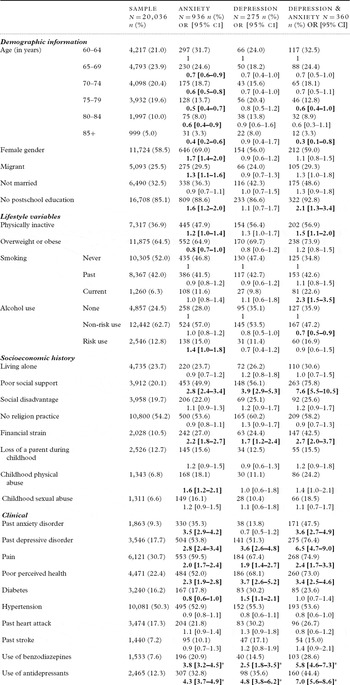
The study sample consisted of 20,036 participants: 936 (4.7%) had anxiety but no depression, 275 (1.4%) had depression but not anxiety, and 360 (1.8%) showed evidence of both at the baseline assessment. Their demographic, lifestyle, socioeconomic, and clinical characteristics of participants are summarized in Table 1. The prevalence of anxiety was highest among the youngest older adults (aged 60–64 years) and lowest amongst the oldest old (aged over 85 years). A similar distribution pattern was observed for comorbid DA, but such an association was not significant for depression. The odds of anxiety were comparatively higher in women, migrants, people without higher education, those who were physically inactive or used alcohol at risky levels, participants in the lowest quintile of social support or who were experiencing financial strain, and those who reported they had been victims of physical abuse during childhood. Anxiety was more frequent among participants with past history of anxiety and depression, concurrent pain, or poor self-perceived health. In contrast, the prevalence of anxiety was comparatively lower among people who were overweight/obese or who reported having diabetes. Finally, the use of benzodiazepines and antidepressants was higher among those with anxiety than those without anxiety or depression.
Demographic, lifestyle, social, and clinical characteristics of participants with clinically significant symptoms of anxiety, major depression, and both

Reported odds ratio originated from a multivariate logistic regression where all measured factors were entered in the model together.
OR: odds ratio; 95% CI: 95% confidence interval of the odds ratio.
Bold print indicates p < 0.05.
* Unadjusted OR.
Demographic and lifestyle variables showed no marked association with depression at baseline (Table 1), although poor social support, financial strain, history of depression, pain, poor perceived health, and diabetes did. Apart from the latter, there was no evidence that vascular risk factors were associated with depression. In addition, participants with depression were more frequent users of benzodiazepines and of antidepressants than people without anxiety or depression.
The distribution of demographic, lifestyle, socioeconomic, and clinical variables among participants with DA at baseline was very similar to that observed for people with anxiety alone, except that current smoking increased and non-risk alcohol use decreased the odds of DA. Moreover, the association between poor social support and DA was particularly strong, as was past depression. The odds of DA were higher among benzodiazepine and antidepressant users.
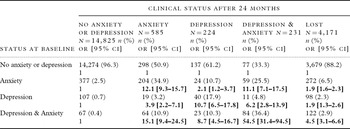
We then used multinomial logistic regression to calculate the odds of anxiety, depression, and comorbid DA at the 24-month assessment according to the clinical status of participants at the time of entry into the study. The results of these analyses are summarized in Table 2. We found that the presence of anxiety at baseline increased the odds of anxiety, depression, DA, and loss to follow up by 24 months. The same pattern was observed for baseline depression and for comorbid DA. We also found baseline anxiety was more strongly associated with follow-up anxiety and comorbid DA than with depression, whereas baseline depression was more strongly associated with follow-up depression, followed by comorbid DA and, finally, anxiety. Baseline DA was strongly associated with follow-up DA, followed by anxiety and then depression. Participants who showed evidence of comorbid DA at baseline were 4.5 (95% CI = 3.1–6.6) times more likely than those without anxiety or depression to be lost to follow-up. Supplementary table S1 (available online) shows the demographic, lifestyle, socioeconomic, and clinical characteristics of participants at the baseline assessment according to whether or not they were available for follow-up. Patients of GPs who took part in the educational activity about depression and self-harm behavior in later life had 10% (95% CI = 0–20%) lower odds of being lost during follow-up.
Clinical status of participants after 24 months of follow-up according to the presence of anxiety, major depression, or both at the baseline assessment

OR: odds ratio; 95% CI: 95% confidence interval of the odds ratio. The OR reported were derived from multivariate logistic regression analyses, with all measured factors forced into the model. The involvement of treating GPs in an educational activity about depression and self-harm (yes/no) during the follow-up period was also taken into account in the analysis.
Bold print indicates p < 0.05.
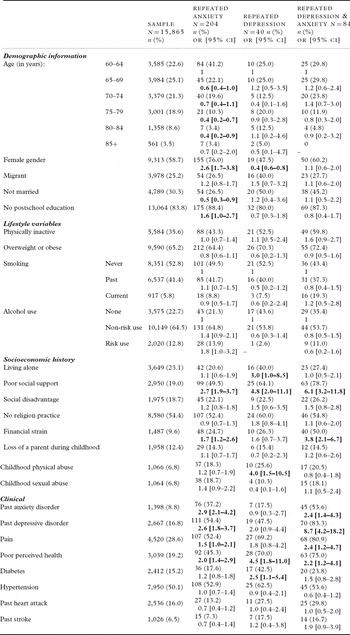
Finally, we investigated the association between baseline measures and repeated anxiety, repeated depression, and repeated DA. The results of these analyses are summarized in Table 3. Women had greater odds of presenting with repeated anxiety, but the opposite occurred for repeated depression. Those without postschool education or who were married were also more likely to present with repeated anxiety, but these factors showed no apparent association with repeated depression or with repeated DA. Poor social support increased the odds of repeated anxiety, repeated depression, and of repeated DA, whereas living alone increased the odds of repeated depression. Financial strain increased the odds of both repeated anxiety and of repeated DA, but not of repeated depression. In contrast, history of childhood physical abuse increased the odds of repeated depression, but not of repeated anxiety or comorbid DA. History of anxiety or depression before the baseline assessment increased the odds of repeated anxiety and of repeated DA, but not of repeated depression. A similar distribution pattern was observed for baseline pain. Poor self-perceived health increased the odds of repeated anxiety, repeated depression, and repeated DA. Finally, diabetes at baseline increased the odds of repeated depression at follow-up, but not of repeated anxiety or of comorbid DA.
Adjusted odds ratio of repeated anxiety, major depressive symptoms, and comorbid anxiety & major depression after 24 months according to demographic, lifestyle, social, and clinical exposures at baseline

OR: odds ratio; 95% CI: 95% confidence interval of the odds ratio. The OR reported were derived from multivariate logistic regression analyses, with all measured factors forced into the model. The involvement of treating GPs in an educational activity about depression and self-harm (yes/no) during the follow-up period was also taken into account in the analysis.
Bold print indicates with p < 0.05.
Discussion
The results of this study found a prevalence of clinically significant anxiety, depression, and comorbid DA of 4.7%, 1.4%, and 1.8%. About 57% of depression cases showed evidence of comorbid anxiety, while only 28% of those with anxiety met criteria for concurrent depression. There was overlap in the distribution of risk factors among participants with anxiety, depression, and comorbid DA, but there were also differences. For example, the prevalence of clinically significant anxiety symptoms declined steadily with increasing age, but the same did not occur for depression. In addition, some risk factors had opposing effects on the odds of anxiety and depression: diabetes was associated with decreased odds of anxiety but increased odds of depression. The two-year course of these disorders seemed to differ as well: 31% of older adults with anxiety at baseline were also anxious at follow-up, whereas only 23% of those with depression at baseline displayed the same symptoms after two years; this figure was 35% for comorbid DA. Furthermore, repeated anxiety was more prevalent among women, whereas repeated depression was more common in men. Participants with repeated comorbid DA were more frequently exposed to socioeconomic stressors, such as poor social support and financial strain.
The relationship between depression and anxiety in older age is possibly akin to the relationship that exists between diabetes and hypertension: these two conditions share numerous risk factors (e.g., increasing age, obesity, smoking, and physical inactivity), contribute to similar outcomes (e.g., cardiovascular events), and seem to increase the risk of one another (e.g., more people with than without diabetes have hypertension) (Fillenbaum et al., Reference Fillenbaum, Pieper, Cohen, Cornoni-Huntley and Guralnik2000). The interpretation of our results is also consistent with those from the Longitudinal Ageing Study Amsterdam (LASA), in which 1,712 participants were followed up every three years for nine years and the risk factor profiles for anxiety and depression were found to differ (Vink et al., Reference Vink2009). Participants with anxiety at baseline were at increased risk of subsequently developing mixed anxiety and depression or repeated anxiety, but not depression alone. Likewise, a longitudinal Swedish twin study involving 1,391 participants (mean age 61 years) found that although anxiety and depression were correlated, a model with distinct anxiety and depression factors fit the data better than a single mental health factor (Wetherell et al., Reference Wetherell, Gatz and Pedersen2001).
Our results also show that a large proportion of older people with pure anxiety and with pure depression recover over a period of two years, but those with comorbid anxiety and depression have a less favorable outcome: most are either lost to follow-up or remain anxious and depressed. This suggests that comorbid DA may have a more chronic and disabling course than either anxiety or depression alone. Indeed, Cairney and colleagues reported that older adults with two or more disorders (depression, social phobia, agoraphobia, or panic disorder) had greater impairment in activities of daily living and total number of disability days than people with no or one mental disorder (Cairney et al., Reference Cairney, Corna, Veldhuizen, Herrmann and Streiner2008). These results are consistent with the possibility that anxiety or depression precede comorbid DA, which in turn follows a more chronic course than either condition alone. If that is the case, then the early successful management of older adults with “pure” anxiety or “pure” depression might prove critical to avert such a development. Our data also suggest that comorbid DA in later life may demand a more intense and, perhaps, different treatment approach compared with pure anxiety or depression.
We had access to a large sample of community dwelling older adults that was broadly representative of the Australian community (Pirkis et al., Reference Pirkis2009), although response to invitations was suboptimal and may have introduced bias as a result of healthy persons being more willing to participate (Table S1, available online). The consequence of such a bias would have been a reduction in the prevalence of anxiety, depression, and in the number of people with disabling medical conditions. We had access to information about relevant exposures and used accepted approaches to assess and diagnose clinically significant anxiety and depression (Zigmond and Snaith, Reference Zigmond and Snaith1983; Spitzer et al., Reference Spitzer, Kroenke and Williams1999), but acknowledge that the latter were not derived from structured clinical interviews or diagnostic criteria. In addition, the interpretation of our results needs to take into account the underlying assumption that the association between the exposures (risk factors) and outcomes is causal. There is also the possibility of recall bias, as people with anxiety and depression may report life circumstances in a more negative way than people without either of these conditions. This would introduce some imprecision in the ascertainment of the exposures and inflation of their association with the outcomes, but should not have biased the “patterns of association” that we found. Furthermore, given the design of the study, it is difficult to establish with certainty whether the association between exposures (risk factors) and mental health outcomes is causal. Notwithstanding such a caveat, our analyses indicate that the pattern of associations (regardless of causality) with anxiety, depression, and DA is not exactly the same, and this finding is consistent with the hypothesis that anxiety and depression in later life are distinct clinical disorders.
Loss to follow-up can be a significant source of bias in longitudinal studies, particularly when outcomes of interest increase the risk of such a loss (21% in our study). We found that anxiety, depression, and comorbid DA all increased the risk of loss to follow-up, and that this association was particularly strong for participants showing evidence of comorbidity. Nevertheless, this differential loss is informative because it suggests that the course of comorbid anxiety and depression is different from anxiety without depression and from depression without anxiety. Our results are also in line with previous surveys that reported relatively low prevalence of major depression in older age (Trollor et al., Reference Trollor, Anderson, Sachdev, Brodaty and Andrews2007), although subsyndromal depression may be more common and perhaps as disabling (Snowdon, Reference Snowdon2001), suggesting that future studies might need to take such a factor into account. Finally, our data were derived from a trial of education of general practitioners (GPs) about depression and self-harm behavior (Williamson et al., Reference Williamson2007). Data from the trial showed that the intervention was not associated with a decline in the prevalence of depression, although it did reduce suicide ideation (Almeida et al., Reference Almeida2012). In this study, we found that older adults treated by GPs assigned for the intervention had a 10% reduction in the odds of being lost to follow-up compared with control GPs. For this reason, we took into account in all analyses the group assignment of treating GPs to ensure that the results of this study were not confounded by that intervention.
In summary, the results of this study indicate that anxiety and depression have overlapping, but not identical, risk factor profiles. The presence of anxiety increases the odds of depression and of comorbid DA after two years, while the presence of depression increases the odds of both anxiety and comorbid DA. Our findings are consistent with the view that anxiety and depression are separate disorders that frequently coexist in later life, and that when they appear together older adults endure a more chronic, and possibly disabling, course of illness. Repeated comorbid DA is associated with various factors, most notably poor social support and financial strain, which suggests that effective psychosocial interventions may be required to adequately address the needs of this population and decrease the burden of both anxiety and depression in later life.
Conflict of interest
None.
Description of authors’ roles
Osvaldo P. Almeida conceived and designed the study. He had full access to all data and takes responsibility for the integrity of the data and the accuracy of the data analysis. Osvaldo P. Almeida, Jon J. Pfaff, Jane Pirkis, Ngaire Kerse, Moira Sim, Brian Draper, John Snowdon, Gerard Byrne, Leon Flicker, Nicola T. Lautenschlager, and Nigel Stocks acquired the data. Osvaldo P. Almeida performed all analyses and drafted the paper, which was critically revised by all the authors for important intellectual content.
Acknowledgments
The investigators thank participants and research staff for their generous contribution. This project was supported by a competitive project grant from the National Health and Medical Research Council of Australia (NHMRC, no. 353569). The sponsors had no role in the design and conduct of the study; collection, management, analysis, and interpretation of the data; or preparation, review, or approval of the paper.