Self-control (SC) is generally defined as the ability to behave according to socially approved norms, in the absence of external monitoring or authority, even when this behavior competes with immediate desired goals (Gagne, Reference Gagne2017; Kopp, Reference Kopp1982). The ability to control emotions and behaviors is critical for young children's socioemotional adjustment, predicting academic and social competence, both concurrently and longitudinally (Blandon, Calkins, Grimm, Keane, & O'Brien, Reference Blandon, Calkins, Grimm, Keane and O'Brien2011; Denham et al., Reference Denham, Blair, DeMulder, Levitas, Sawyer, Auerbach-Major and Queenan2003; Tangney, Baumeister, & Boone, Reference Tangney, Baumeister and Boone2004).
The acquisition of SC is considered an important milestones of the early childhood period. The development and consolidation of children's SC abilities across this period is strongly influenced by children's relationships quality with caregivers, namely parents and teachers (Calkins & Ashley, Reference Calkins, Ashley and Gross2007; Olson & Sameroff, Reference Olson and Sameroff2009; Thompson & Meyer, Reference Thompson, Meyer and Gross2014). Secure relationships with caregivers can stimulate the development of SC, whereas disruptive and dysregulated interactions, high levels of directiveness, physical disruptions, conflict, and relational stress can boost the emergence of SC difficulties. The relational processes’ quality involving the child and caregivers is influenced by a broad range of interdependent factors, that can be grouped into proximal, contextual, and more distal ones (Olson & Sameroff, Reference Olson and Sameroff2009; Volling, Kolak, & Blandon, Reference Volling, Kolak, Blandon, Olson and Sameroff2009). Proximal factors include characteristics of caregivers’ interactive pattern (e.g., responsiveness, overreactivity, or dysfunctional discipline practices), contextual factors refer to conditions that might influence the way children's interactive behavior is perceived and responded by caregivers (e.g., parental work-related stress or marital conflict), whereas distal factors include sociodemographic variables that can stress the caregiving system (e.g., low levels of social support or stressful life events) (Olson & Lunkenheimer, Reference Olson, Lunkenheimer and Sameroff2009; Olson & Sameroff, Reference Olson and Sameroff2009).
Another major determinant of the quality of relationship processes is the child itself. Children with difficulties in controlling their behaviors tend to elicit conflict and negative responses from their caregivers, which in turn might contribute to accentuate SC difficulties. These feedback cycles illustrate the transactional processes through which the child and the environment transform each other, and is a core notion in the transactional theoretical view of development (Sameroff & Chandler, Reference Sameroff, Chandler, Horowitz, Hetherington, Scarr-Salapatek and Siegal1975; Sameroff & MacKenzie, Reference Sameroff and MacKenzie2003). According to this framework, the development of SC processes is strongly affected by the reciprocal influences between the child and the environment across time. Furthermore, children's behavior, caregivers’ interactive style, and the transactional processes between children and caregivers are products of previous recurring dyadic interactions and might potentially constrain the quality of child future interactions with distinct caregivers (Olson & Sameroff, Reference Olson and Sameroff2009; Sameroff & MacKenzie, Reference Sameroff and MacKenzie2003).
Framed by a transactional model (Sameroff & MacKenzie, Reference Sameroff and MacKenzie2003), the current study clarifies the development of SC abilities across early childhood by examining the interplay between child SC and relationships’ quality with mother and teacher. We specifically focus on two negative relational dimensions, maternal relational frustration (RF) and teacher–child conflict, investigating their bidirectional associations with child SC across time. Moreover, we analyzed the influence of a contextual factor, maternal work-related conflict, on maternal RF, and investigated whether mother– and teacher–child relationships affect each other across time.
Maternal relational frustration and child self-control
Early childhood is a critical period for the development of SC competence, during which children might demonstrate particular high levels of challenging and noncompliant behaviors (Kopp, Reference Kopp1982; Olson & Sameroff, Reference Olson and Sameroff2009). The acquisition of SC during this stage is largely influenced by caregivers’ ability to select and organize environmental stimuli, guide children's focus of attention, and modulate their emotional experience in challenging situations (Kopp, Reference Kopp1982). Mother×Child interactions are optimal opportunities for the development of strategies for managing and controlling emotions and behaviors. Therefore, mothers who are able to maintain a positive interactive style, even when facing challenging behaviors from the child, will likely enhance child SC abilities. Conversely, negative patterns of Parent×Child interactions have been linked to SC difficulties and behavior problems (Choe, Olson, & Sameroff, Reference Choe, Olson and Sameroff2013; Denham et al., Reference Denham, Workman, Cole, Weissbrod, Kendziora and Zahn-Waxler2000; Eisenberg, Taylor, Widaman, & Spinrad, Reference Eisenberg, Taylor, Widaman and Spinrad2015; Smith, Calkins, Keane, Anastopoulos, & Shelton, Reference Smith, Calkins, Keane, Anastopoulos and Shelton2004). Excessive anger, emotional negativity, and high reactivity in Parent×Child interactions are some of the features previously associated with increased child behavior problems over time (Denham et al., Reference Denham, Workman, Cole, Weissbrod, Kendziora and Zahn-Waxler2000; Karreman, Van Tuijl, Van Aken, & Deković, Reference Karreman, Van Tuijl, Van Aken and Deković2009). Furthermore, previous research suggests that negative discipline practices, resulting from parental distress, can undermine child opportunities to develop new SC abilities within the context of Parent×Child interactions (Barnett, Shanahan, Deng, Haskett, & Cox, Reference Barnett, Shanahan, Deng, Haskett and Cox2010; Choe et al., Reference Choe, Olson and Sameroff2013; Shaffer, Suveg, Thomassin, & Bradbury, Reference Shaffer, Suveg, Thomassin and Bradbury2012). It appears that parents’ way of interpreting and reacting to children's behavior, namely challenging and noncompliant behavior, can influence the acquisition of SC during the early childhood period. Specifically, the emergence of dysregulated parent–child patterns of interaction that jeopardize the development of SC abilities is probably boosted by parental RF, here defined as parental stress related to child noncompliant behavior, along with the tendency to overreact and become frustrated in parenting situations. Parental RF shares some aspects with other parenting dimensions (e.g., negative control, parental anger, and reactivity) that previous studies have linked to child behavior problems and self-regulation difficulties (Barnett et al., Reference Barnett, Shanahan, Deng, Haskett and Cox2010; Choe et al., Reference Choe, Olson and Sameroff2013; Denham et al., Reference Denham, Workman, Cole, Weissbrod, Kendziora and Zahn-Waxler2000; Karreman et al., Reference Karreman, Van Tuijl, Van Aken and Deković2009). However, to the best of our knowledge, no study has tested the connection between parental RF and SC to date.
Just as parental RF might contribute to worsening children's SC difficulties, also child SC difficulties can intensify parental RF. Child SC difficulties are associated with high prevalence of noncompliant defiant behavior that might evoke parents’ reactivity and negativity (McBride, Schoppe, & Rane, Reference McBride, Schoppe and Rane2002; Rothbart & Bates, Reference Rothbart, Bates, Eisenberg, Damon and Lerner2006). These bidirectional influences facilitate the emergency of feedback cycles that can aggravate children's SC difficulties and parental RF over time. Although the existence of reciprocal processes between mother and child behavior gathers broad theoretical support (Bronfenbrenner & Morris, Reference Bronfenbrenner, Morris, Damon and Lerner2006; Olson & Sameroff, Reference Olson and Sameroff2009), the empirical support for these transactional processes is somewhat scarce (Eisenberg et al., Reference Eisenberg, Taylor, Widaman and Spinrad2015; Smith et al., Reference Smith, Calkins, Keane, Anastopoulos and Shelton2004; Wittig & Rodriguez, Reference Wittig and Rodriguez2019). In a recent prospective longitudinal study, Wittig and Rodriguez (Reference Wittig and Rodriguez2019) examined the bidirectional effects between maternal parenting styles and infant temperament from the prenatal period to 18 months of life. Their findings suggest maternal prenatal perceptions of parenting style predict infant regulatory capacity reported by parents, which in turn predict later parenting style. Similar reciprocal influences across time were reported by Eisenberg et al. (Reference Eisenberg, Taylor, Widaman and Spinrad2015) in a cross-lagged panel study involving children from 2 to 4 years of age. They found a bidirectional relation between intrusive parenting and child effortful control, a temperament dimension related to children's ability to regulate their own emotions and behaviors. Overall, findings from these previous works suggest that SC emerges from the complex and dynamic relational processes involving the child and their caregivers over time (Olson & Lunkenheimer, Reference Olson, Lunkenheimer and Sameroff2009). However, we need more evidence to fully understand how distinct dimensions of parenting and child self-regulatory abilities affect each other across life-span. Furthermore, as these transactional processes take place in dynamic social environments, clarifying the influence of contextual factors is pivotal to comprehend how they translate in child development.
Work–family dynamics and maternal relational frustration
Contemporary societies have witnessed a growing number of dual-earner families and increased insecurity associated with working life. These phenomena shape the daily lives of workers and their family members, and the relationships’ quality within the family system (Gottfried, Gottfried, & Bathurst, Reference Gottfried, Gottfried, Bathurst and Bornstein2002). Several studies pointed out that mothers from dual-earner families face exceptional work and family demands, that can impair several dimensions of parenting, namely parental engagement, psychological availability, and the overall quality of mother–child daily interactions (Cooklin et al., Reference Cooklin, Westrupp, Strazdins, Giallo, Martin and Nicholson2015; Ferreira et al., Reference Ferreira, Cadima, Matias, Vieira, Leal, Verschueren and Matos2018; Matias et al., Reference Matias, Ferreira, Vieira, Cadima, Leal and Matos2017; McLoyd, Toyokawa, & Kaplan, Reference McLoyd, Toyokawa and Kaplan2008; Vieira, Matias, Lopez, & Matos, Reference Vieira, Matias, Lopez and Matos2016). Work–family conflict (WFC), defined as the experience of stress and overwork resulting from overwhelming competing work and family demands, is associated with maternal depressive symptomatology, decreasing parental availability, and high levels of parental RF (Matias et al., Reference Matias, Ferreira, Vieira, Cadima, Leal and Matos2017; McLoyd et al., Reference McLoyd, Toyokawa and Kaplan2008; Vieira, Matias, Lopez, et al., Reference Vieira, Matias, Lopez and Matos2016). Also, the experience of high levels of WFC can negatively affect children's behavioral adjustment and well-being through their influence on parenting (Matias et al., Reference Matias, Ferreira, Vieira, Cadima, Leal and Matos2017; Vahedi, Krug, & Westrupp, Reference Vahedi, Krug and Westrupp2019; Vieira, Matias, Ferreira, Lopez, & Matos, Reference Vieira, Matias, Ferreira, Lopez and Matos2016). In one of the few available studies investigating these indirect influences longitudinally, Vahedi et al. (Reference Vahedi, Krug and Westrupp2019) found that WFC conflict predicts higher levels of parenting irritability (i.e., hostile, angry or rejecting behaviors toward the child), which, in turn, links to higher levels of child externalizing behaviors. Despite these recent findings, there is a need for further evidence to clarify how the experience of WFC might influence the transactional processes between the mother and the child, and understand the paths through which this experience can influence the development of SC abilities during early childhood.
Teacher–child conflict and child self-control
Although mothers have a major role in the acquisition of SC abilities during early childhood, it is crucial to consider other relational influences outside the family system. In line with developmental systems models, researchers have stressed the importance of teachers in promoting children's ability to control emotions and behavior in social interactions (Olson & Sameroff, Reference Olson and Sameroff2009; Pianta, Hamre, & Stuhlman, Reference Pianta, Hamre, Stuhlman, Reynolds and Miller2003; Verschueren & Koomen, Reference Verschueren and Koomen2012). The establishment of warm and close relationships with the preschool teachers, characterized by a positive emotional tone, has been consistently associated with children's social–emotional functioning (Brock & Curby, Reference Brock and Curby2014; Hamre & Pianta, Reference Hamre and Pianta2001; Myers & Morris, Reference Myers and Morris2009). Children who frequently experience a conflict relationship with their teachers, characterized by disruptive interactions and ineffective behavior management, more likely display lower levels of social competence and higher rates of problem behaviors (Brock & Curby, Reference Brock and Curby2014). Conversely, children with an inability to regulate and express emotions in adaptive ways may have later higher levels of teacher–child (T-C) conflict (Garner & Mahatmya, Reference Garner and Mahatmya2015; Myers & Morris, Reference Myers and Morris2009; Rudasill, Reference Rudasill2011; Rudasill & Rimm-Kaufman, Reference Rudasill and Rimm-Kaufman2009). One noteworthy study addressed the reciprocal association between child SC and T-C relationships’ quality across the elementary-school years, showing that T-C conflict affects and is affected by children's to ability suppress or inhibit impulsive behavioral responses (Berry, Reference Berry2012). Although this study provides relevant evidence, more empirical data are needed to clarify whether the reciprocal association between T-C relationships’ quality and the development of SC across early childhood, can be generalized to other groups of children and dimensions of self-regulation other than inhibitory control.
Cross-context influences between mother– and teacher–child relationships
There is a strong theoretical framework establishing that development is mainly a product of the dynamic and reciprocal influences between a child and multiple social contexts (Bronfenbrenner & Morris, Reference Bronfenbrenner, Morris, Damon and Lerner2006; Lerner, Reference Lerner and Lerner2006; Olson & Sameroff, Reference Olson and Sameroff2009). These social contexts are interdependent, meaning that the developmental processes taking place in a given social system can influence and might be influenced by processes occurring in other systems. In this perspective the development of human self-regulatory system is primarily the product of dyadic coregulatory interactions taking place within mutually interacting social systems (Cicchetti & Toth, Reference Cicchetti, Toth, Luthar, Burack, Cicchetti and Weisz1997; Olson & Lunkenheimer, Reference Olson, Lunkenheimer and Sameroff2009).
Previously, we discussed the bidirectional links between children's self-regulatory competence and relationships’ quality with the mother or the teacher. In addition to these already complex reciprocal interactions, it is possible that mother–child and T-C relationships influence each other across time, through their effect on child behavior. Over the course of development, the recursive social exchanges involving the child and a given caregiver are products of past interactions and can potentially constrain future interactions in distinct relational systems (Cicchetti & Toth, Reference Cicchetti, Toth, Luthar, Burack, Cicchetti and Weisz1997; Olson & Sameroff, Reference Olson and Sameroff2009). For example, recurring negative Mother×Child interactions can boost the development of negative patterns of regulation that might impact child relationship with teacher or other social partners. The other way around, a positive T-C relationship may foster child SC abilities, which in turn may contribute to reducing the emergence of challenging behaviors in Mother×Child interactions.
The link between distinct relational contexts can also be framed within attachment theory. As Bowlby argued, children's working models of relationships are based on early real-life experience of daily interactions with their early caregivers (Bowlby, Reference Bowlby1988). These models set the foundations for children's social–emotional functioning, guiding their expectations in further social interactions, namely with teachers (Bowlby, Reference Bowlby1988; Main, Kaplan, & Cassidy, Reference Main, Kaplan and Cassidy1985). In this perspective, mothers can influence T-C relationships’ quality by modeling the children's feelings about social relationships and by fostering important socioemotional skills, such as the ability to control emotions and behaviors.
Despite the broad theoretical support for this rationale, few studies have examined the links between multiple relationships across time, limiting our ability to comprehend how distinct relationships affect one another and contribute to child SC. Considering the evidence pointing out the contribution of children’s SC to their social relationships’ quality, we might reasonably expect that the ability to control emotions and behaviors can work as a mediator for the reciprocal influences between mother–child and T-C relationships across time. To our knowledge, however, no previous study investigated the dynamic transactions between different relational contexts over time.
The current study
The current study examined the bidirectional links between child SC, maternal RF and T-C conflict across time, in children from dual-earner families. Specifically, we investigated whether child SC affects and is affected by maternal RF and T-C conflict across time. Based on a transactional perspective (Sameroff & MacKenzie, Reference Sameroff and MacKenzie2003), we expected to observe positive feedback cycles in which child SC difficulties exacerbate maternal RF and T-C conflict across time and vice versa. Furthermore, framed by an ecological perspective (Bronfenbrenner & Morris, Reference Bronfenbrenner, Morris, Damon and Lerner2006), this study addressed the role of maternal WFC in predicting maternal RF, analyzing whether WFC affects child SC via maternal RF. We anticipated that WFC relates to higher levels of maternal RF, subsequently predicting lower rates of child SC. Finally, we investigated the interplay between the quality of child relationships with mother and teacher, analyzing how maternal RF and T-C conflict connect across time. Considering the literature highlighting children's capacity to influence the quality of their relational processes (Bronfenbrenner & Morris, Reference Bronfenbrenner, Morris, Damon and Lerner2006; Cicchetti & Toth, Reference Cicchetti, Toth, Luthar, Burack, Cicchetti and Weisz1997; Lerner, Reference Lerner and Lerner2006; Sameroff & MacKenzie, Reference Sameroff and MacKenzie2003), we hypothesized that children’s ability to control behaviors and emotions would work as the mediator for the interplay between maternal RF and TC conflict across time.
Method
Participants
Participants were 214 children (97 girls; M age = 3.99 years, SD = 0.58), their mothers (M age = 47.64 years, SD = 6.85), and teachers (M age = 39.39 years, SD = 9.30). They were recruited from 48 preschool classrooms in 25 public and private preschool centers in the metropolitan area of Porto, Portugal. The average number of participating children per classroom was 4.46 (SD = 3.47). Portuguese preschool system includes children between 3 and 6 years of age. The vast majority of the Portuguese children enroll in private or public preschool programs at age 3 and the universal access to preschool education for 4- and 5-year-olds was recently established by law. The preschool attendance rates are very high, with 93% of 4-year-olds and 98% of 5-year-olds attending preschool (European Commission/EACEA/Eurydice/Eurostat, 2014). Children typically move to elementary school at age 6.
Most of the participating families had one (58%) or two (39%) children (M = 1.46, SD = 0.58) at the baseline assessment. The majority of mothers had graduated from college, 63% (n = 129), and 24% (n = 49) completed high school. A reduced amount of mothers had completed 9 or fewer years of education, 13% (n = 26). The mothers’ average number of working hours per week was 39.87 (SD = 7.71). Mothers reported spending on average 2.01 hr per day (SD = 0.92) in joint activities with their children during a regular work week. The sample's characteristics were comparable with the averages of Portuguese dual-earner population, namely regarding family structure, parents’ age and working hours, including, however, a large proportion of parents with higher education (Instituto Nacional de Estatística, 2011).
Data were obtained at four assessment points. We conducted the baseline assessment (T1) during children's first or second year of preschool. These children were assessed annually for the following two years (T2 and T3). The last assessment (T5) was conducted two years after T3. On average, the lapse in time between T1 and T2 was 1.17 years (SD = .23, range = .82–1.86), and .98 years (SD = .30, range = .72–1.98), between T2 and T3. The average time gap between T3 and T5 was 2.29 years (SD = .10, range = 2.08–2.41). Children's mean age was 5.14 at T2 (SD = .67), 6.04 at T3 (SD = 59), and 8.38 (SD = .63) at T5.
Seventy children had missing data at T2 (33%), 26 children had missing data at T3 (12%), and 99 children had missing data at T5 (46%). The attrition rate was 5% (n = 11) at T2, 3% (n = 6) at T3, and 38% (n = 82) at T5. Attrition at T2 and T3 was mostly because parents and/or teachers refused to participate in data collection. The large percentage of attrition at T5 was mainly due to a relatively long time gap between T3 and T5, during which children transitioned from preschool to elementary school. Some children also moved out from their original preschool centers to elementary schools and could not be located by the research team. Missing data follow a monotone pattern (Dong & Peng, Reference Dong and Peng2013) since a large proportion of missing values were due to attrition. To examine whether the pattern of missing data was consistent with the assumption of missing completely at random (MCAR) we used the Little's MCAR tests (Little, Reference Little1988) to assess means (χ 2 (921) = 962.60, p = .166) and the test proposed by Jamshidian and Jalal (Reference Jamshidian and Jalal2010) to assess covariances (χ 2 (14) = 17.26, p = .243). The results from these two tests converged, suggesting that the missing data were MCAR. In addition, we conducted a series of logistic regressions to determine the extent to which the absence of data at T2, T3, and T5 was related to any of the demographic or study variables. Mother education predicted missing data at T2 (b = .23, p = .049, OR = 1.27) and, marginally, at T4 (b = .28, p = .083, OR = 1.32). Mothers’ average weekly working hours was also associated with missing data at T2 (b = .04, p = .057, OR = 1.04) and T3 (b = −.10, p = .026, OR = .90). None of the study variables (i.e., mother WFC, maternal RF, child SC, and T-C conflict) predicted the odds of not participating at T2, T3, and/or T5.
Measures
WFC was assessed from T1 to T3 through mothers’ report, using an abbreviated version of the Work–Family Conflict Scale (Carlson, Kacmar, & Williams, Reference Carlson, Kacmar and Williams2000; Vieira, Lopez, & Matos, Reference Vieira, Lopez and Matos2014). This 6-item short scale measures the personal experiences regarding the interference from work to family (e.g., “I am often so emotionally drained when I get home from work that it prevents me from contributing to my family”) and from family to work (e.g., “I have to miss work activities due to the amount of time I must spend on family responsibilities”). Items were rated using a 5-point Likert scale (1 = strongly disagree, 5 = strongly agree), with higher scores indicating higher levels of WFC. The Cronbach's alpha was .69 at T1, .76 at T2, and .69 at T3.
Maternal RF was self-reported by mothers from T1 to T5, using the “relational frustration” subscale from the Parenting Relationship Questionnaire – Preschool Form (Kamphaus & Reynolds, Reference Kamphaus and Reynolds2006; Vieira, Cadima, Leal, & Matos, Reference Vieira, Cadima, Leal and Matos2013). This 8-item subscale taps parental stress related to controlling child affect and behavior, along with the tendency to overreact and become frustrated in common parenting situations (e.g., “I overreact when my child misbehaves”). Parents are asked to consider their current experience as a parent and to express their perspective on different statements, using a 4-point Likert scale, ranging from 1 (never) to 4 (always). Higher scores indicate higher levels of maternal RF. Mothers’ ratings had a median Cronbach's alpha of .79, ranging from .69 to .81 across the assessments.
Children's SC was measured from T1 to T5 using the social skills rating system (Gresham & Elliont, Reference Gresham and Elliont1990). The SC subscale includes 10 items measuring teachers’ perceptions of children's ability to control their behaviors in conflict (e.g., “controls temper when arguing with other children”) and nonconflict situations (e.g., “waits turn in games or other activities”). Teachers were asked to rate on a 3-point scale (1 = never to 3 = often) how characteristic each behavior was of a particular child, with higher scores indicating higher SC. For this study's sample, the median Cronbach's alpha coefficients for all the assessments were .89, ranging from .86 to .92.
T-C was measured from T1 to T5 using the conflict subscale from the Student–Teacher Relationship Scale (Pianta, Reference Pianta2001). The conflict subscale (e.g., “The child and I always seem to be struggling with each other”, 5 items) captures the degree of negative and antagonistic interactions and emotions involving the teacher and child. Items were rated by teachers, using a 5-point Likert scale, ranging from 1 (definitely does not apply) to 5 (definitely applies). Higher scores indicate higher levels of T-C conflict. The median Cronbach's alpha was .81, ranging from .70 to .88.
Procedure
This study was part of a broader research project aiming to understand the impact of work–family dynamics on parenting and children's development. This research project was approved by the faculty's ethics committee and the schools’ board. After these approvals, the research team explained the study to teachers, who then invited the families of all children in their classroom to participate. Of 1360 families invited to the study, 510 agreed to participate (participation rate = 38%). The research team was only allowed to contact and collect information from families who agreed to participate and signed the informed consent. Two hundred and ninety-six children were excluded from the final sample because they did not meet the research project's eligibility criteria (i.e., they were not from families with working and cohabiting parents, or they were moving to elementary school the year after the baseline assessment).
After their written informed consent, mothers and teachers were asked to fill in an individual questionnaire focusing on their parenting/teaching experience and on several indicators of the child's behavior. Mothers reported on their WFC and maternal RF, while teachers reported on child SC and T-C conflict. Nearly 60% of children (n = 126) were assessed twice during the preschool (T1 and T2) and twice during elementary school (T3 and T5). The remaining children (41%, n = 88) were assessed three times during the preschool (T1, T2, and T3) and once in elementary school (T5). All the assessments were conducted approximately 6 months after the beginning of each school year.
Data analyses
The analytical plan proceeded in three main steps. First, we inspect the descriptive statistics using composite mean scores for maternal WFC and RF, child SC, and T-C conflict. Second, we evaluate the measures’ factor structure through confirmatory factor analysis (CFA) and tested for their measurement invariance (MI) across time. Finally, we use structural equation modeling (SEM) to investigate the links between WFC, RF, child SC, and T-C conflict across time.
All analyses were conducted in R (R Core Team, 2018), using the lavaan (Rosseel, Reference Rosseel2012), and the semTools packages (Jorgensen, Pornprasertmanit, Schoemann, & Rosseel, Reference Jorgensen, Pornprasertmanit, Schoemann and Rosseel2018). To avoid excluding participants with missing data and achieve more precise models’ estimation, we employed full-information maximum likelihood estimation. Given its association with missing data, mothers’ average working hours per week was included in the model as auxiliary variable, using the saturated correlates approach (Newsom, Reference Newsom2015). The use of auxiliary variables has been associated with benefits in model estimation in the presence of missing data, reducing the bias in means, variance, and covariance estimates (Collins, Schafer, & Kam, Reference Collins, Schafer and Kam2001). Model fit was examined using the chi-square goodness-of-fit statistic, the root mean square error of approximation (RMSEA), the comparative fix index (CFI), the Tucker–Lewis index (TLI), and the standardized root mean square residual (SRMR). Values lower than .06 for RMSEA, greater than .95 for CFI and TLI, and lower than .08 for SRMR indicate good model fit (Hu & Bentler, Reference Hu and Bentler1999).
The latent variables in all the CFA models were defined using three parcels of items. This option offers several advantages, reducing the number of parameters in the models and contributing to less biased estimates (Coffman & Maccallum, Reference Coffman and Maccallum2005). The CFA models were identified using the fixed factor scaling method. Following Widaman and Thompson (Reference Widaman and Thompson2003), we used the appropriate null model for multi-rater comparisons in our computation of relative fit indices (CFI and TLI). Longitudinal MI was tested by comparing CFA models representing configural, weak, strong, and strict MI across time (Widaman & Reise, Reference Widaman, Reise, Bryant, Windle and West1997). An equivalent factor structure without formal equality of loadings, intercepts, or error variances is known as the condition of configural invariance. If, in addition to configural invariance, equal factor loadings are found across time, this is referred to as weak or metric invariance. Weak invariance plus equal intercepts constitute the condition of strong or scalar invariance, while strong invariance plus equal error variances constitutes the condition of strict invariance. CFA models with different levels of MI are nested models and can thus be directly compared using chi-square difference tests (Satorra & Bentler, Reference Satorra and Bentler2001). We also computed the differences in CFI values to examine the magnitude of differences between models (Cheung & Rensvold, Reference Cheung and Rensvold2002).
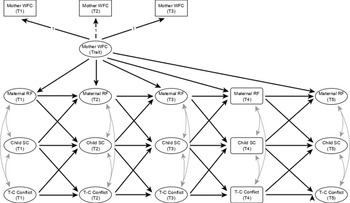
We used SEM to test the model displayed in Figure 1. This model included a latent variable representing the stable underlying trait of mother WFC, specified using the observed mean scores of mothers’ WFC measured at T1, T2, and T3. Their loadings were set to 1 to give an equal contribution from each measurement of WFC to the factor. This latent variable captures the stable variance of WFC over time, ignoring the state variance. The observed mean scores of maternal RF, child SC and T-C conflict measured at T1, T2, T3, and T5 were used to define an equal number of latent variables representing each one of these variables measured over time. This modeling approach is usually referred to as the quasi-simplex or quasi-Markov simplex (Jöreskog, Reference Jöreskog1970), allowing to estimate measurement error at each time point, even with only one manifest variable at each moment. For identification purposes, we set to 1 the loadings for each one of these latent variables and constrained to be equal across all the time points the residual variances for each manifest variable. We used phantom variables to account for the unequal time intervals of measurements (Rindskopf, Reference Rindskopf1984). We recall that the time lags between T1, T2, and T3 were one year while the time lag between T3 and T5 was two years. The phantom variables, represented by round rectangles in Figure 1, were specified to artificially create a time point between T3 and T5 (i.e., T4), resulting in a model with five equally spaced time points for RF, SC, and T-C conflict. These three phantom variables had no indicators and were identified by imposing equality constraints, at each time point, to the same autoregressive and cross-lagged paths. Through the use of phantom variables, we were able to specify five times of measurement, equally spaced with a 1-year lag. The baseline, fully constrained model assumed parameters’ stationarity, that is, the invariance in the relationships among RF, SC, and T-C conflict over time. This model provided estimates for the effects of mothers’ WFC on maternal RF across time, and for the autoregressive and cross-lagged effects involving mother RF, child SC, and T-C conflict measured across five-time points – T1, T2, T3, T4, and T5 (see Figure 1). The model included child age, sex (0 = boys; 1 = girls), and mothers’ education as control variables at all time-points.
Representation of the tested cross-lagged panel model; observed, latent, and phantom variables are depicted as rectangles, ellipses, and round rectangles, respectively; WFC = work–family conflict; RF = relational frustration; SC = self-control; T-C = teacher-child.

In addition to the direct effects, the model allowed for the estimates of the indirect associations between mother WFC, maternal RF, child SC, and T-C conflict over time. Monte Carlo (MC) method was used to estimate confidence intervals for the indirect effects (Mackinnon, Lockwood, & Williams, Reference Mackinnon, Lockwood and Williams2004; Preacher & Selig, Reference Preacher and Selig2012; Tofighi & Mackinnon, Reference Tofighi and Mackinnon2016). The best fitting and parsimonious model was achieved by adding equality constrains on autoregressive and cross-lagged effects, and by trimming nonsignificant effects. Nested model comparisons were conducted to evaluate the impact of these constrains in model fitting.
Results
Descriptive statistics
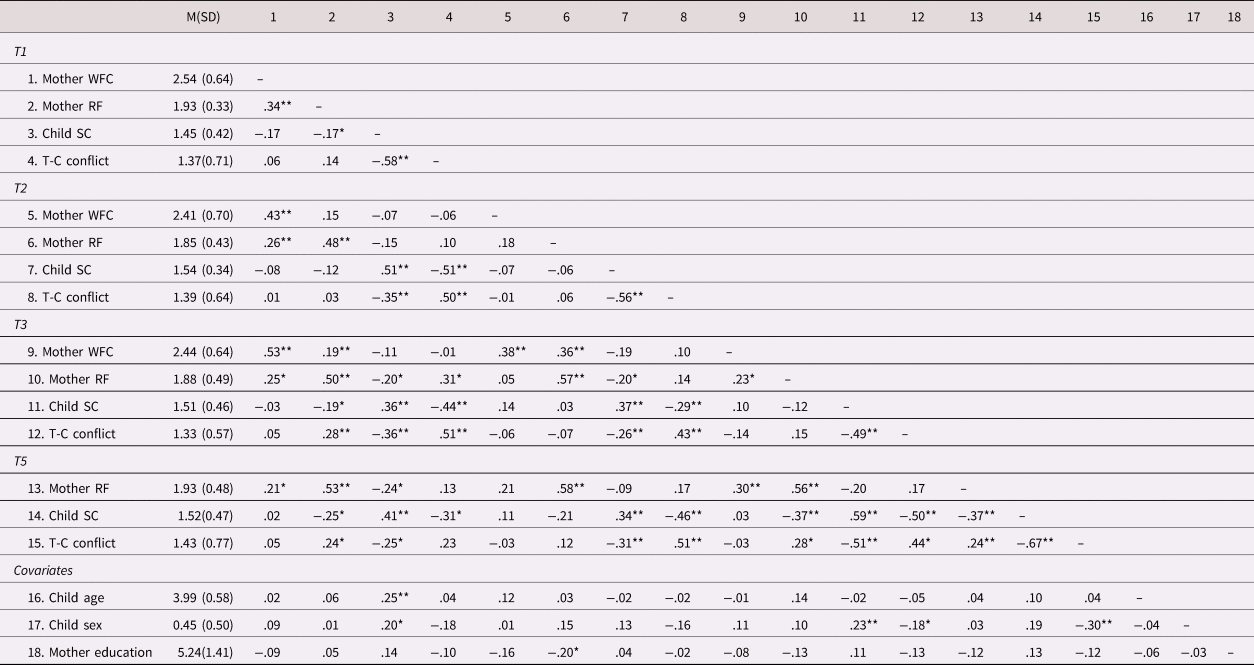
Means, standard deviations, and zero-order correlations for the observed variables can be found in Table 1. Mothers reported moderate average levels of WFC and RF across all the assessment points. Results from multilevel linear regression indicated there were no significant changes on mothers WFC across time, χ 2 (2) = 4.18, p = .124, neither on maternal RF, χ 2 (3) = 7.10, p = .069. Teachers reported moderate to high average levels of child SC, with no significant changes across time, χ 2 (3) = 3.02, p < .389. Overall, teachers reported low average levels of T-C conflict. There were no significant changes on T-C conflict over time, χ 2 (3) = 2.75, p = .432.
Means, standard deviations, and zero-order correlations for the observed variables

Note: WFC = Work–family conflict; RF = relational frustration; S C = self-control; T-C = teacher–child; *p < .05, **p < .01.
The zero-order correlations in Table 1 suggested a moderate rank-order stability in mothers’ WFC, and RF, child SC and T-C conflict across time. Overall, mothers with higher levels of WFC tended to report higher levels of maternal RF, both within and across time. Higher levels of maternal RF were associated with lower levels of child SC, particularly at T3 and T5. Also, there was a consistent negative association between child SC and T-C conflict across all the assessment points. Maternal RF at T3 and T5 was positively related to T-C conflict at T5. There was a positive association between child age and SC at T1 (r = .25, p = .002). Globally, girls were more likely to exhibit higher levels of SC and experience lower levels of T-C conflict than boys.
Confirmatory factor analysis and measurement invariance
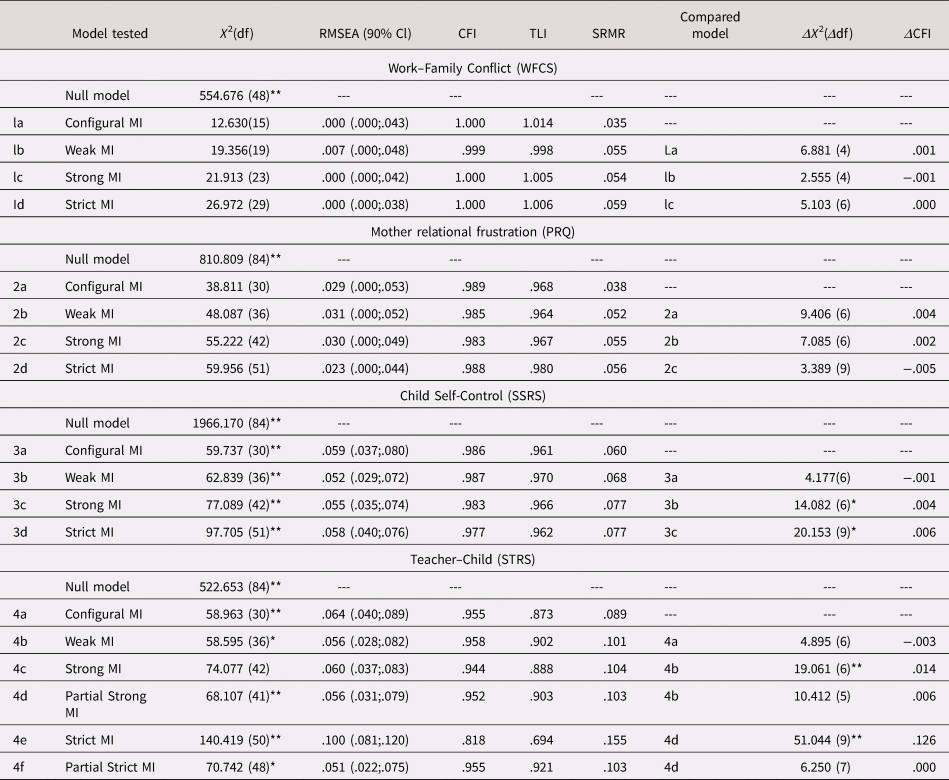
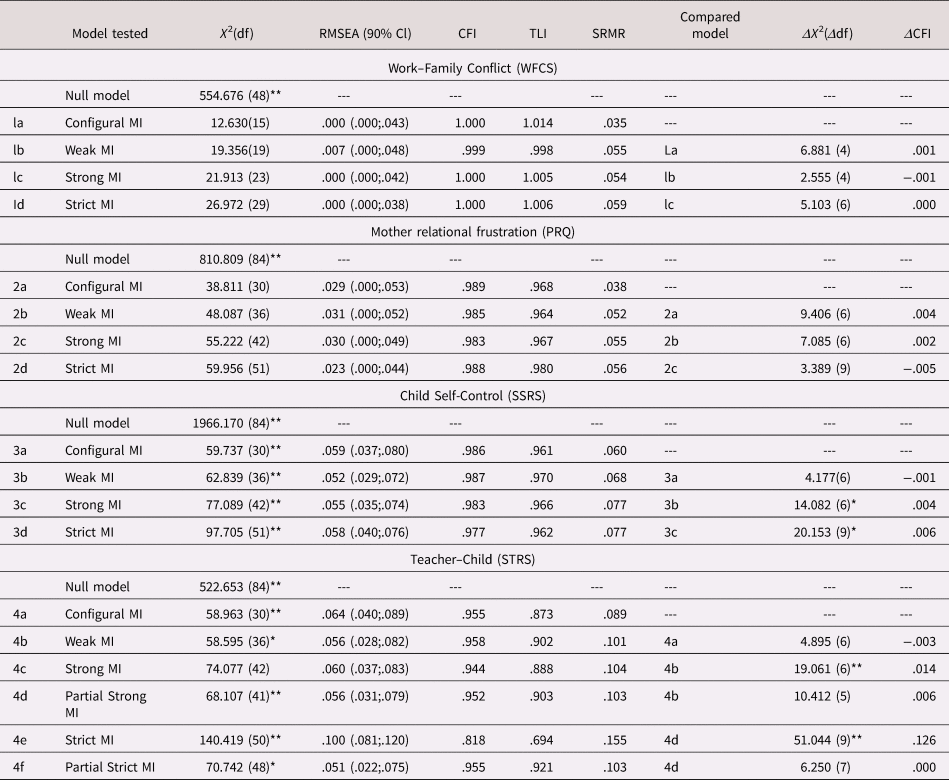
A longitudinal CFA model was fit to each measure independently. Latent variables were freely correlated across time and residual variances of the corresponding indicators measured at different time points were also allowed to correlate. This model is referred to as the configural invariance model and was used as the baseline model for testing MI. As previously described, the test of MI across time was conducted by imposing sequential equality constrains on loadings (weak or metric MI), intercepts (strong or scalar MI), and residual variances (strict MI). Results from CFA and MI analyses for all the study's main variables are presented in Table 2.
Model fit information for different confirmatory factor analysis (CFA) models
Note: *p < .05, **p < .01.
CFI = comparative fix index; MI = measurement invariance; RMSEA = root mean square error of approximation; SRMR = standardized root mean square residual; TLI = Tucker–Lewis index
As shown in Table 2, the configural invariance model for WFC (Model 1a) provided a good fit for the data from mothers’ report at T1, T2, and T3, χ 2 (15) = 12.63, p = .631, RMSEA = .00 (90% CI [.00; .04]), CFI = 1.00, TLI, = 1.00, SRMR = .06. Results from the chi-square difference test and CFI difference suggested that the weak, Δχ 2 (4) = 6.88, p = .142, ΔCFI = 0.001, strong, Δχ 2 (4) = 2.56, p = .635, ΔCFI = - 0.001, and strict MI, Δχ 2 (6) = 5.10, p = .531, ΔCFI = 0.000, could be assumed across time.
The configural invariance model for maternal RF (Model 2a) also provided adequate fit for mothers’ report at T1, T2, T3, and T5, χ 2 (30) = 38.81, p = .130, RMSEA = .03 (90% CI [.00; .05]), CFI = .99, TLI, = .97, SRMR = .04. The chi-square difference test showed no deterioration of fit when the conditions of weak, Δχ 2 (6) = 9.41, p = .152, ΔCFI = 0.004, strong, Δχ 2 (6) = 7.09, p = .313, ΔCFI = 0.002, and strict MI, Δχ 2 (9) = 3.39, p = .759, ΔCFI = −0.007, were imposed.
The configural invariance model for child SC (Model 3a) showed acceptable overall fit to the data collected through teacher report from T1 to T5, χ 2 (30) = 59.74, p = .001, RMSEA = .06 (90% CI [.04; .08]), CFI = 0.99, TLI, = 0.96, SRMR = .06. The weak MI model (Model 3b) did not fit significantly worse than the configural MI model (Model 3a), Δχ 2 (6) = 4.18, p = .653, ΔCFI = −0.001, thereby establishing metric invariance. Although the chi-square difference test for the weak (Model 3b) and strong (Model 3c) MI models was significant, Δχ 2 (6) = 14.082, p = .028, the change of CFI between these models was negligible (Cheung & Rensvold, Reference Cheung and Rensvold2002), ΔCFI = 0.004, indicating that strong longitudinal MI could be assumed. Strict MI (Model 3d) could also be established based on the same criterion (Cheung & Rensvold, Reference Cheung and Rensvold2002), Δχ 2 (9) = 20.15, p = .017, ΔCFI = 0.006.
The configural model for T-C conflict had an acceptable fit to the data collected through teacher report, χ 2 (30) = 58.96, p = .001, RMSEA = .06 (90% CI [.04; .09]), CFI = .96, TLI, = .87, SRMR = .09. Although, weak invariance was achieved, Δχ 2 (6) = 4.90, p = .557, ΔCFI = −0.003, the assumption of strong MI across time did not hold as indicated by the significant decline in model fit when comparing the weak MI model (Model 4b) to the strong MI model (Model 4c), Δχ 2 (6) = 19.061, p = .004, ΔCFI = 0.014.
We tested a partial MI model for T-C conflict (Model 4d) by removing the imposed equality constraint on the intercept pertaining to the first parcel of items measured at T1 [item 20 (“Dealing with this child drains my energy.”) and item 22 (“When this child is in a bad mood, I know we're in for a long and difficult day”)]. This item intercept significantly deviated from intercepts for the corresponding items measured at T2, T3, and T5. The difference between intercepts indicates that teachers more easily endorse these parcels of items at T1 than in later assessments. The decrease in model fit from the weak MI model (Model 4b) to the partial strong MI model (Model 4d) was not statistically significant, Δχ 2 (15) = 10.41, p = .064, ΔCFI = 0.006, indicating that partial strong MI could be assumed across time.
The assumption of full strict MI (Model 4e) for the T-C conflict subscale was also not tenable based on the chi-square difference test, Δχ 2 (9) = 51.04, p < .001, ΔCFI = 0.126. We subsequently tested whether partial strict MI held by releasing the residual variance parameters for item 3 (“This child easily becomes angry with me”) at T2 and T3. The residual variance for this item was higher at T2 and T3 than at the remaining assessment points. The partial strict MI model (Model 4f) did not result in significant poorer fit when compared with the partial strong MI model (Model 4d), Δχ 2 (7) = 6.25, p = −.003, ΔCFI = 0.000.
In summary, results from CFA and MI analyses indicated that, overall, the study's measures met the condition of strict MI over time. The equivalence of residual variances across time is usually recommended for longitudinal analyses based on the manifest composite scales (Newsom, Reference Newsom2015; Steinmetz, Schmidt, Tina-booh, Wieczorek, & Shalom, Reference Steinmetz, Schmidt, Tina-booh, Wieczorek and Shalom2009). This level of MI ensures that items used in a composite measure have comparable residual variance over time, avoiding mistaken conclusions and biased estimates due to changes in reliability.
Cross-lagged panel model
We tested a cross-lagged panel model to examine concurrent and longitudinal associations between mothers’ WFC, maternal RF, child SC, and T-C conflict, while controlling for child sex, age, and maternal education (see Figure 1). This model includes the paths between the latent variable representing mothers’ average levels of WFC across time and their maternal RF at T1, T2, T3, T4, and T5. Autoregressive and cross-lagged paths between adjacent time points (i.e., lag 1) for maternal RF, child SC, and T-C conflict were also specified. The baseline model assumed parameters’ stationarity (i.e., invariance of parameter estimates over time), including equality constraints on measurement residual variances, factor residual variances and covariances, autoregressive, and cross-lagged effects across time. To reduce model complexity, we also constrained the effects of the control variables (i.e., child sex, age, and maternal education) on each one of the study's main variables to be equal from T2 to T5. Factor variances and covariances were freely estimated at T1. Results indicated that this model did not reach the conventional recommendations for fit, χ 2 (141) = 224.68, p < .001, RMSEA = .05 (90% CI [.04; .07]), CFI = 0.87, TLI, = 0.83, SRMR = .09.
We achieved an improved model fit by releasing the factor variance for child SC at T3 and by fixing the residual variance for maternal RF's measurement at T1 to zero. Based on the results from a series of nested model comparisons, we followed a step-wise re-specification process, relaxing specific constraints, first among the autoregressive effects and, then among the cross-lagged effects. Specifically, the path from maternal RF at T2 to T3 was freely estimated, and the autoregressive effects of child SC from T1 to T2 and T4 to T5 were set equal. The following cross-lagged effects involving the study's main variables were also unconstrained: (a) SC [T1] → RF [T2]; (b) SC [T3] → RF [T4]; (c) WFC → RF [T3]; (d) RF [T1] → SC [T2]; (e) T-C conflict [T2] → SC [T3]; (f) SC [T2] → TCC [T3]. We also removed several equality constraints involving the effect of the control variables, namely child age, sex, and mother education, on WFC, maternal RF, child SC, and T-C conflict at different time points. Allowing these additional estimates resulted in a model that fit the data well, χ 2 (118) = 156.58, p = .010, RMSEA = .04 (90% CI [.02; .06]), CFI = 0.94, TLI, = 0.91, SRMR = .07. Although more complex, this partially constrained model provided a significantly better fit to the data than the baseline, fully constrained model, Δχ 2 (23) = 67.28, p < .001.
We proceeded by dropping the nonsignificant path coefficients from the previous model. Trimming the nonsignificant paths resulted in a more parsimonious model, without worsening model fit, Δχ 2 (22) = 10.60, p = .980. This final, trimmed, model provided a very good fit to the data, χ 2 (140) = 163.29, p = .087, RMSEA = .03 (90% CI [.00; .05]), CFI = 0.96, TLI, = 0.95, SRMR = .07.
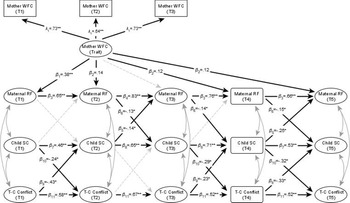
Figure 2 presents standardized coefficients for the final model. We used subscripts in Figure 2 to identify the equality constraints imposed among some of the autoregressive and cross-lagged effects. Also, dashed lines represent path coefficients fixed to 0 (i.e., trimmed). The WFC trait standardized factor loadings were fairly high (range = .64–.73), indicating that a large proportion of the WFC scores’ variance was stable over time. Maternal RF, child SC and T-C conflict were quite stable across all assessments.
Representation of the tested cross-lagged panel model; observed, latent, and phantom variables are depicted as rectangles, ellipses, and round rectangles, respectively; Subscripts indicate equality constraints; WFC = work–family conflict; RF = relational frustration; SC = self-control; T-C = teacher–child; child sex, age, and mother education were included as control variables; Mothers’ average working hours per week was included as auxiliary variable, using the saturated correlates approach; *p < .05, **p < .01.

Within T1, maternal RF was negatively associated with child SC (r = −.23, p = .024) and positively associated with T-C conflict (r = .21, p = .039). Child SC was negatively related to T-C conflict at all concurrent time point in the model. Mothers’ WFC was positively connected to maternal RF at T1 (b = .27, p < .001, 95% CI [.15, .39]). We also found a marginally significant positive effect of mothers’ WFC on RF at T2, T4, and T5 (b = .10, p = .074, 95% CI [−.01, .21]). Higher levels of maternal RF in T2, T3, and T4 predicted lower child SC abilities respectively at T3, T4, and T5 (b = −.16, p = .046, 95% CI [−.32, −.00]). Conversely, a negative link between child SC and maternal RF was only observed from T2 to T3 and from T4 to T5 (b = ��.19, p = .038, 95% CI [−.36, −.00]). Children lower in SC were likely to have more conflict in their relationships with the teacher, particularly at T2, T4, and T5 (b = −.41, p = .017, 95% CI [−.75, −.08]). In turn, T-C conflict at T2, T3, and T4 negatively predicted children's later SC (b = −.22, p = .021, 95% CI [−.41, −.03]).
Compared to boys, girls were more likely to display higher levels of SC at T1 (b = .18, p = .003, 95% CI [.06, .30]) and T3 (b = .18, p = .003, 95% CI [.06, .30]). We also found a gender effect on the levels of T-C conflict measured at T1 (b = −.25, p = .027, 95% CI [−.47, −.03]) and subsequently at T2, T3, T4, and T5 (b = −.10, p = .016, 95% CI [−.18, −.02]). Children's age was positively linked to SC abilities at T1 (b = .17, p = .003, 95% CI [.06, .28]), T4 and T5 (b = .10, p = .003, 95% CI [.03, .17]). Mothers with higher education levels more likely experienced lower levels of RF towards parenting and their child behavior at T2 (b = −.06, p = .005, 95% CI [−.10, −.02]).
Lastly, we used the MC method for assessing the indirect effects between mothers’ WFC and child SC, and between maternal RF and T-C conflict, and evaluating the bdirectional association between child SC, maternal RF, and T-C conflict longitudinally. The confidence interval for the indirect effect of mothers’ WFC predicting child SC (T3 and T5) via maternal RF (T2 and T4) included zero (b = −.02, 95% CI [−.04, .00]), indicating that this estimate was not significantly different from zero. However, the confidence limits for the indirect effect from maternal RF to T-C conflict, via child SC (i.e., maternal RF [T2] → child SC [T3] → T-C conflict [T4] and maternal RF [T3] → child SC [T4] → T-C conflict [T5]), did not contain zero (b = .07, 95% CI [.00, .19]). The indirect effect in the opposite direction, namely from T-C conflict to maternal RF through child SC (i.e., T-C conflict [T1] → child SC [T2] → maternal RF [T3] and T-C conflict [T3] → child SC [T4] → maternal RF [T5]), was also significant (b = .04, 95% CI [.00, .10]). The bdirectional associations between child SC and maternal RF across time (i.e., child SC [T2] → maternal RF [T3] → child SC [T4] and maternal RF [T3] → child SC [T4] → RF [T5]) were not significant (b = .03, 95% CI [−.00, .08]), whereas the bdirectional effect involving child SC and T-C conflict across time (i.e., child SC [T3] → T-C conflict [T4] → child SC [T5] or T-C conflict [T3] → child SC [T4] → T-C conflict [T5]) was significantly different from zero (b = .09, 95% CI [.01, .22]).
Discussion
Early childhood is a critical period for the development and consolidation of a set of SC abilities. These abilities shape the way children interact with their environment, ultimately leading to long-lasting adaptive patterns of psychological (mal)adjustment. Inspired by an ecological and transactional view of human development (Bronfenbrenner & Morris, Reference Bronfenbrenner, Morris, Damon and Lerner2006; Sameroff & MacKenzie, Reference Sameroff and MacKenzie2003), the current study addresses the complex interplay between children's SC and the quality of their caregiving relationships over time. Specifically, our first goal was to investigate the reciprocal influence between child SC, maternal RF, and T-C conflict from preschool to first years of schooling. Second, we clarified whether mothers’ RF towards the child was influenced by their WFC, an important contextual factor particularly for children from dual-earner families. Finally, we investigated whether maternal RF and T-C conflict link with each other through child SC abilities.
Caregiving relationships and child self-control
The results from the current study highlight the consistency of the associations between mother– and T-C relationships’ quality and children's SC across time. Children whose mothers reported higher levels of parental stress and excessive reactivity related to their noncompliant behavior (i.e., parental RF) were more likely to exhibit lower SC abilities. Similarly, children exposed to disruptive interactions and ineffective behavior management in their relationship with the teacher (i.e., T-C conflict) displayed more difficulties in regulating emotions and behavior. These relations were robust, accounting for children's prior SC abilities, and extend a growing body of literature stressing the impact of early caregiving relationships’ quality on the development of SC (Barnett et al., Reference Barnett, Shanahan, Deng, Haskett and Cox2010; Berry, Reference Berry2012; Brock & Curby, Reference Brock and Curby2014; Choe et al., Reference Choe, Olson and Sameroff2013; Myers & Morris, Reference Myers and Morris2009; Shaffer et al., Reference Shaffer, Suveg, Thomassin and Bradbury2012).
Our results suggest that high levels of maternal RF and T-C conflict can predict SC difficulties during early childhood. The negative effects of maternal RF and T-C conflict on children's SC were relatively constant over time. Specifically, maternal RF negatively predicted children's SC at T3, T4, and T5, whereas T-C conflict predicted children's SC at T2, T4, and T5. Overall, the paths from T-C conflict to child SC had slightly larger effect sizes than the ones from maternal RF to child SC. This probably happened because SC was reported by teachers, considering child behavior within the school context. Future studies should use a multi-informant perspective of child SC to replicate these findings, this way reducing the potential bias associated with the observation context of child SC.
Work–family conflict, maternal relational frustration, and child self-control
The current study provides a substantial contribution to clarifying how work–family related dynamics can affect the quality of mother–child relational processes and child behavior afterward. We examined the extent to which maternal RF is influenced by WFC over time. Although mothers’ perceptions of WFC can partially change over time, in this study we focused on the more stable aspects of this construct over time. Overall, the WFC trait factor explained about half of the variance in indicators of WFC collected at T1, T2, and T3, denoting the stability of mothers’ WFC across time. We found a positive association (albeit marginally significant) between this trait representing the stability of WFC, and maternal RF at most of the measurement occasions. Compared to those with lower WFC, mothers who experience higher levels of conflict in managing work and family roles were more likely to display higher reactivity and negativity towards children's noncompliant behaviors. According to a bioecological perspective (Bronfenbrenner & Morris, Reference Bronfenbrenner, Morris, Damon and Lerner2006), these findings characterize an exosystemic influence of maternal employment on the mother–child relationship microsystem. Our results support the claim that mother–child relationships are vulnerable to the stress experience resulting from the balancing of work and family demands (Matias et al., Reference Matias, Ferreira, Vieira, Cadima, Leal and Matos2017; McLoyd et al., Reference McLoyd, Toyokawa and Kaplan2008; Vieira, Matias, Lopez, et al., Reference Vieira, Matias, Lopez and Matos2016).
Reciprocal associations between child self-control, maternal relational frustration, and teacher–child conflict
Young children can display considerable individual differences in their ability to control emotions and behaviors during social interactions. Different levels of SC competence can influence the pattern of interactions between children and caregivers. Previous studies established a connection between SC abilities and the quality of children's relationships with mother (McBride et al., Reference McBride, Schoppe and Rane2002; Rothbart & Bates, Reference Rothbart, Bates, Eisenberg, Damon and Lerner2006) and teacher (Garner & Mahatmya, Reference Garner and Mahatmya2015; Myers & Morris, Reference Myers and Morris2009; Rudasill & Rimm-Kaufman, Reference Rudasill and Rimm-Kaufman2009). Our results are consistent with this evidence, indicating that children's difficulties in controlling behaviors and emotions might potentiate maternal RF and T-C conflict. Moreover, the test of indirect effects provided support for the bidirectional relations between child SC and T-C relationship over time. Children with difficulties in controlling behaviors and emotions tended to experience higher levels of T-C conflict, which in turn might exacerbate SC difficulties. Conversely, T-C conflict can boost child SC difficulties, which predicted T-C conflict afterwards. These findings are consistent with the transactional model of development, supporting the claim that child and context affect each other across time (Olson & Sameroff, Reference Olson and Sameroff2009; Sameroff & MacKenzie, Reference Sameroff and MacKenzie2003). According to this theoretical framework, the reciprocal and dynamic processes between the child and environment over time profoundly shape the development of the self-regulatory competence. These processes can take the form of feedback cycles in which children's difficulties in regulating behaviors and, consequently, relational conflict with caregivers, may be exacerbated. Despite its theoretical relevance, few previous studies have documented the bidirectional influences between child SC abilities and relationships’ quality both with parents (Eisenberg et al., Reference Eisenberg, Taylor, Widaman and Spinrad2015; Wittig & Rodriguez, Reference Wittig and Rodriguez2019) and teacher (Berry, Reference Berry2012) over time. The current investigation supports and extends this literature, suggesting the co-occurrence of reciprocal influences involving the child and distinct relational contexts, namely mother–child and T-C relationships.
In addition to the reciprocal associations between child SC and caregiving relationships’ quality with mother and teacher, the current study provides a noteworthy contribution to further understand the mechanisms through which relationships at the family and school contexts connect to one another across time. As already noted, the transactional processes between child SC abilities and caregiver interactive style are the product of previous recurring interactions and might potentially constrain the quality of future interactions with distinct caregivers (Olson & Sameroff, Reference Olson and Sameroff2009; Sameroff & MacKenzie, Reference Sameroff and MacKenzie2003). Accordingly, we found that maternal frustration and T-C conflict can indirectly affect each other across time, via child SC. It appears that children who experience maternal RF more likely display SC difficulties that increase the likelihood of later T-C conflict. On the opposite way, the experience of conflict in T-C relationship predicts child SC difficulties that, in turn, relate to higher maternal RF. These findings underline the role of children's regulatory competence in the complex interplay between mother–child and T-C relationships as they suggest that child SC mediates the reciprocal relations between maternal RF and T-C conflict over time.
Contributions, limitations, and implications for practice
Children's ability to control their own behavior in social interactions is a crucial developmental acquisition that predicts later social adjustment and competence. This study's findings emphasize the role of early relationships with mother and teacher in fostering child SC competence across the early childhood period. The results corroborate that the development of child SC abilities can be significantly impaired by mothers’ tendency to overreact and express emotional negativity towards child behavior and by the presence of negative T-C interactions. Given its developmental importance, this study provides a notable contribution in understanding the processes through which contextual factors and the child might influence mother–child and T-C relationship's quality over time. Specifically, we found evidence that work–family strains may negatively impact the quality of maternal interactive style and, subsequently, child SC abilities. The general pattern of findings reveals a noticeable contribution of child SC to maternal RF and T-C conflict and vice versa. We found evidence for the bidirectional effects between these variables and for the role of child SC in connecting maternal RF and T-C conflict through time. All these findings are congruent with the transactional theoretical view of development, according to which the child and the environment transform each other across time to promote distinct levels of functioning and adaptation.
This study has several strengths, namely the consideration of data from multiple sources, the use of statistical procedures to ensure measurement equivalence across time, and the adoption of a longitudinal panel design for hypotheses testing. However, there are some limitations that must be acknowledged. The descriptive nature of the data does not allow for strong conclusions regarding causal relations among variables. Despite the clear and well-established theoretical framework for the model hypothesized and tested in this study, we conducted some data-driven re-specifications to achieve the best-fitting model. The results should be interpreted with caution and in need of replication with independent samples.
Our modeling approach has limitations that result from the autoregressive cross-lagged panel models’ inability to disentangle the between- from the within-person. Recent critiques of the cross-lagged panel models underline their lack of alignment with the dynamic developmental processes they usually target and their tendency to produce estimates that are difficult to interpret meaningfully (for a discussion on the limitations of cross-lagged panel models, see Berry & Willoughby, Reference Berry and Willoughby2017). More robust modeling strategies that comprise the estimation of both within- and between-person parameters have been proposed to tackle these issues, namely the autoregressive latent trajectory model (Berry & Willoughby, Reference Berry and Willoughby2017; Bianconcini & Bollen, Reference Bianconcini and Bollen2018; Bollen & Curran, Reference Bollen and Curran2004; Mund & Nestler, Reference Mund and Nestler2019). Unfortunately, these alternatives to the cross-lagged panel model imply a substantial increment in model complexity which, given our sample size, would result in inadequate levels of statistical power.
Although our model controls for the potentially confounding effects of different variables, namely child sex, age and maternal education, there are other nonconsidered variables that might have biased the reported results. Child temperament difficulties, mothers’ coping strategies, the quality of father–child relationship and quality of peer interactions at the school context are only some of the variables that potentially could have influenced some of the findings documented in this work. Also, results may have been influenced by shared method bias due to an exclusive reliance on teachers to report children's SC and T-C conflict, as well as on mothers to rate their WFC and RF towards the child. Because WFC and RF assessments were both based on mothers’ self-report, their associations might reflect an influence of unmeasured variables, such as mothers’ psychological vulnerability to emotional distress. Finally, results were based on data from children and mothers from dual-earner families, including a large proportion of highly educated parents. Therefore, the generalization of the findings to children from other family configurations (e.g., single-parent or single-earner families), low socioeconomic families, or minority groups may not be appropriate.
Despite these limitations, the present study has practical implications and may provide some directions for the efforts of early childhood practitioners to promote children's SC. As we found, difficulties in controlling behaviors and emotions seem to exacerbate negative patterns of interactions and relationships with caregivers, thereby placing the child in negative trajectories for the development of more stable patterns of behavioral maladjustment. Considering this evidence, early childhood curricula and intervention aiming at facilitating the acquisition of early SC abilities might be of great importance, as their outcomes will indirectly benefit the quality of child interactions with caregivers. According to our findings, family- and school-centered interventions to improve the quality of mother–child and T-C interactions, respectively, can also be considered as a way to foster the development of child SC. Children's regulatory competence may benefit from policies and programs that ease the balancing of work and family demands, and from parental interventions that give mothers a set of coping strategies and interactive skills for dealing with challenging behaviors. Also, interventions that seek to improve T-C relationships’ quality, reducing levels of conflict and enhancing the opportunities for positive dyadic interactions may be important for promoting child SC. In conclusion, results from this study underline the complexity and transactional nature of relationships between child and environment across time. To deal with this inherent complexity, practitioners may have to combine distinct lines of intervention to more significantly impact the development of SC during early childhood.
Financial Statement
This research was supported by FEDER, COMPETE program, and by the Portuguese Foundation for Science and Technology, PTDC/MHC-CED/5218/2012 and PD/BD/114269/2016 grants.
Conflicts of Interest
None.