


I. Introduction
In his last memoir, Touch and Go, Studs Terkel noted a shift in his life from the role of “observer to activist.”Footnote 1 In a series of vignettes focussed on his adolescence, Terkel repeatedly depicted himself as wide-eyed and open-eared. As Terkel recounts his burgeoning political awareness, he configures his activism as moving from listening and observing to remembering and speaking. The chapter jumps chronologically between the 1930s, in which he listens to woman widowed by the Haymarket affair, to a more recent moment in which Terkel harangues a young yuppie couple for their anti-union opinions by reminding them of those in the past who fought for workers' rights.Footnote 2 Significantly, Terkel does not recount his own experiences working with striking laborers in his attempt to solve the couple's “ignorance of our history.”Footnote 3 Rather, he relates a story he heard the Haymarket widow speak long ago from a soapbox. In this example and throughout his life, Terkel aligned his activism with his use of oral history – his was an activism in which he collected the stories of others and then retold those stories so that his audience might regain a lost sense of their history.
Working to remind his audience of their history and to solve the crisis he labeled “national Alzheimer's,” Terkel often dismissed the broader methodological debates within the field of oral history.Footnote 4 He described his methods as similar to those of a “prospector for gold” sifting through the statements of his subjects to create essays that reveal each person's “essence.”Footnote 5 Terkel chose interviewees he felt were representative individuals, played an active role in his interviews, and then effaced his role from the transcripts when he edited for publication. This article examines Terkel's construction of his “essence” narratives for two of his best-known works: Hard Times and “The Good War”.Footnote 6 Drawing on his planning documents, interview transcripts, manuscripts, and published texts, I trace Terkel's approach to oral history through three stages: his planning and performance of interviews, his editing of the individual transcripts, and his construction of the completed text. Given the popularity of his books and the provocative nature of his practice, consideration of Terkel's methods can provide a useful platform for consideration of broader methodological questions within the field of oral history itself.
Terkel crafted his texts into a hybrid genre I call “documentary memory” – he relied on a series of rhetorical practices that borrow from documentary expression and suggest objectivity while always reminding readers that “this is a memory book rather than one of hard fact and precise statistic.”Footnote 7 In other words, Terkel interviewed those he felt could serve as representative individuals, distilled their statements down to their “essences,” and then thematically grouped and strategically juxtaposed those narratives into a montage that appeared to be a documentary collection of unmediated memories.
Most importantly, Terkel invested the act of remembering the past with political significance; an exploration of Terkel's work illuminates intersections between the practice of oral history and activism throughout the twentieth century. Although he did not publish Hard Times and “The Good War” until many years after the 1930s and 1940s, Terkel's methods suggest the ways in which a social outlook and an aesthetic practice he acquired during the Depression continued to shape his career. In this way, Terkel's long life as an activist and his work documenting memory illustrate continuities within the history of the left and Popular Front forms of cultural expression. Most oral historians today privilege transparency with respect to their methods and attempt to avoid crafting overtly politicized works. Terkel, however, aggressively edited his texts, crafting documentary memories of the past to politicize the present. Terkel believed telling stories of the past to be a form of social action – he sought to solve the crisis of a “national Alzheimer's” by reminding his readers of earlier periods in American history relevant to the cultural moment in which he published.
II. Planning and Performing an Interview
Prior to beginning both Hard Times and “The Good War”, Terkel determined the various categories of background and experience for which he would like to find representative voices. His list of potential interviewees for “The Good War” includes the names of people such as “Ray Wax” and “Norman Corwin” alongside vague descriptions such as “black marketer” and “Japanese internee.”Footnote 8 Terkel performed hundreds of interviews for each book and noted that finalizing his collection for publication “feels like casting a play – you've got four equally good people for one character – only in the case of a book it's four people representing one point of view. It's a tough decision to make.”Footnote 9 Communications scholar John Louis Lucaites has argued that during the 1930s – a period Terkel often claimed had a profound impact on his life – documentary artists portrayed their subjects as “visual synecdoches” valuable less for their individuality than for the broader social category each represented. Might we see the same move toward creating representative subjects in Terkel's planning, interviewing, and editing practices? Discussing how he chose his interviewees, Terkel explained that when selecting his subjects he looked for someone who was “an individual – in that individual is more than one person … I look[ed] for certain kinds.”Footnote 10 Terkel often listed his subjects only by their job categories, their race, or their socioeconomic status, or he referred to the people he interviewed as “characters.” His notes and planning documents suggest that he selected his subjects for their representative qualities as a director might seek particular characters representing distinct points of view for a documentary film.Footnote 11
Terkel also constructed for himself a folksy, bumbling, man-of-the-people character that he performed through many iterations over his long life. Every day for the last fifteen years of his life Terkel wore a red-checked gingham shirt and he often told and retold the same stories of bungling an interview with a poet laureate or of wandering the halls of the radio station where he worked muttering aloud to himself. In an interview with biographer Tony Parker, Terkel insisted,
That role I'm playing – “the great guy” – he may be an invented character. The role's one I've been playing for more than eighty years now – which would make it one of the longest runs in the history of the theater.
Put that in, OK? Footnote 12
Terkel playfully hinted that he “may be an invented character” but his insistence that Parker include this quote in the biography suggests that he was acutely aware of the performative aspect of his personality. Terkel tightly controlled his image, his self-representation, even the representation of his self-representation. During the Great Depression Terkel joined the Worker's Theater (later the Chicago Repertory), acting in plays such as Cradle Will Rock and Waiting for Lefty and performing street theater for strikers on the picket line. While performing with the theater troupe he also voraciously read left-wing author James T. Farrell's novels and emulated the plain-spoken, streetwise main character Studs Lonigan, from whom Terkel took his nickname.Footnote 13 After World War II Terkel launched an early television program called Studs' Place, in which he played a quirky local bartender. Although he was best known for the oral histories he began publishing in the late 1960s, Terkel had a long career performing average, humble characters and adopting populist personas.
When Terkel took his fumbling, technologically inept persona into the interview setting he did so in order to downplay the disparity in power between himself and his subjects. He acknowledged that his performance of technological ineptitude is one of his “biggest assets,” saying,
Why it's an asset? Well, would you be frightened of a little old guy who wants to tape record a conversation with you – and he can't even work his tape recorder?
Sometimes I can get more out of it too. I don't overplay it, but I'll often accompany the fumbling around with a question. “Heh, can you tell me if I've got this OK now, is this thing working OK?” That helps to ease the tension … so what's being done is this: you're asking for help, making it into you-and-them-together on the same side against the machine.Footnote 14
His statement that he did not “overplay” his ineptitude points to Terkel's intentional playing, or performing. Moreover, Terkel seemed to recognize that his playing the role of a “fumbling” “little old guy” directly allowed him to “get more out of” his subjects.
Terkel's role in the creation of the oral-historical document went far beyond crafting a persona in order simply to gain access to the stories of his subjects. Terkel, as with all oral-history practitioners, also played an important role in determining the content of the oral narrative. In the passage above, Terkel suggests that his intentional fumbling with the tape recorder creates the collaborative relationship required in the construction of oral history. His performance helps to “ease the tension” between him and his subject and establishes a bond of “you-and-them-together on the same side against the machine.” Oral historian Michael Frisch argues that the creation of oral history is a collaborative effort impacted by the relationship between the interviewer and interviewee – the document produced reflects one of joint power and joint authorship in which the “particular nature of the oral historical method affects the nature of the evidence produced.”Footnote 15 More than simply pressing “play” and pointing a microphone, Terkel played a part in the authoring of the oral-historical document.
The tapes of Terkel's interview with Joseph Small reflect the collaborative nature of their interaction. Although his impact on the interview would later be edited from the final published work, the transcript shows Terkel firmly guiding Small toward desired topics of discussion, interjecting with directives such as, “we're leading naturally to your certain World War experience” and “we're going to start at the beginning.”Footnote 16 His collaborative role in creating the narrative with Small can be seen when Terkel pursues the topic of religion:
small: I consider what I went through an experience worth having gone through.
terkel: You really feel that?
js: I really feel that.
st: That's almost a religious kind of feeling … Do you feel that had anything to do, your experience, with your becoming as devout as you are?
js: No.
st: Huh?
js: No. I don't think that at all. I don't think my Navy experience had anything to do with it.
st: No? I would think that about yourself and surviving. No. You just got the vision. Is that it?
js: I think, if you want to take it from a religious standpoint, I think that God has had his hand on me all through my life. This was just another incident where I went through and the protecting hand of God kept me for the work I'm doing now.Footnote 17
Through questions such as “You really feel that?” “Huh?” and “No?” and through modeling the desired line of thought, “I would think that...,” Terkel led Small from a flat denial of any religious understanding of his experience to the exact opposite expression. Small's final statement indicates that both he and Terkel arrive at this understanding together. Small begins with himself as the subject “I” and then defers to Terkel, “if you want to take it from a religious standpoint.”
Terkel did want to approach this narrative from both a religious and racially conscious standpoint. His participation in this interview pressed toward these particular interpretations. Throughout his interviews in moments like those with Small, Terkel constructed the narrative themes of the interview and then instructed his interviewees. He directed Small, “you're a young man – you're a young black man. Why don't you tell it? World War II, how it began, how you got in it.”Footnote 18 Terkel's pause and self-correction reveal his desire for the interview to focus thematically (as it did) on the topics of race and racism. Small's response to Terkel echoed the wording of the question and indicates Terkel's direct influence on this narrative: “Well … it started in 1943. I was, as Mr. Terkel said, ‘a young black man’.”Footnote 19 While it is unclear what form and content Joseph Small might have created for his oral history without the influence of his interviewer, it is certain that Terkel desired his subject to serve as a representative of the African American experience in World War II and so directed Small's narrative toward overt themes of race and racism.
Not all of Terkel's subjects followed his gentle guiding during the interview, however; and to his credit, Terkel occasionally included the oral histories of these interviewees despite their resistance to the narrative theme he was attempting to construct. Frisch notes that the reviews of Terkel's Hard Times mistakenly praised the book as a tribute to the triumphant American spirit.Footnote 20 In a later interview Terkel agreed with Frisch's assessment, commenting that in Hard Times he attempted to show the American people's tendency to feel shame, to blame themselves during the Depression. Terkel believed his subjects felt “guilty because, ‘I didn't work,’ the Protestant ethic, ‘I didn't work. Therefore, something's wrong with me.’”Footnote 21 Most of Terkel's subjects in Hard Times did reaffirm this personal feeling of failure and ultimately upheld Terkel's broader thesis. Peggy Terry, however, refused Terkel's suggestion that she might “feel any sense of shame” and attributed her impoverished childhood to the failure of the government.Footnote 22 In his phrasing of the question “You don't recall at any time feeling a sense of shame?”, Terkel attempted to lead his interviewee. The negative phrasing implied doubt over Terry's ability to recall the shame, rather than questioning whether she felt any shame at all. Terry resisted Terkel's suggestions here but this exchange does raise questions as to whether all his subjects truly remembered their Depression-era experiences with feelings of guilt or whether they were simply expressing their memories in these terms because of the influence of Terkel. It seems more likely that his subjects would report feelings of shame in response to the question “Didn't you feel any shame?” than perhaps to the question “Did you feel shame?” or “How did the Depression make you feel?”
Debates abound within the oral-historical community with respect to the appropriate role of the interviewer in the creation of oral history. William Cutler urges that “interviewers should always try to know their biases and suppress them,” and Paul Thompson advises “the less their [the interviewee's] testimony is shaped by the interviewer's questions the better.”Footnote 23 Generally, oral historians seem to agree that it is best to try and diminish the impact of the interviewer on the subject by refraining from leading questions, antagonizing statements, or interacting too often with the subject.Footnote 24 Post-structuralist theory led many in the field to question the “myth of noninterference,” as oral historian Alessandro Portelli terms it, and to argue for more recognition of the role of the interviewer in the collaborative construction of knowledge.Footnote 25 Portelli and others raised theoretical questions about whether objective, uninfluenced, historical knowledge is something to be desired or is something that can ever be accomplished in an interview setting. This is, fundamentally, an epistemological issue and one with which any person performing ethnographic research – oral historians, anthropologists, sociologists, linguists – will have to contend. Terkel was certainly aware of the impact of his interactions with his subjects on the interview process. It is this awareness of himself as a socially located individual that led him to perform particular personas. It is when Terkel's oral histories moved from the interview context onto the printed page that the power dynamics shifted dramatically. Terkel moved from his self-constructed performance of an individual with little knowledge and less power, to an individual with the power to construct his subjects in order to create historical knowledge.
III. The Role of Editor
As he moved from interviewing his subjects to working with the transcripts and constructing his texts, Terkel favored aggressive editing techniques. Here is the same interview between Terkel and Joseph Small, again, the first from my transcription, the second as it appears in the published text of “The Good War”:
Audio transcript:
small: I consider what I went through an experience worth having gone through.
terkel: You really feel that?
js: I really feel that.
st: That's almost a religious kind of feeling … Do you feel that had anything to do, your experience, with your becoming as devout as you are?
js: No.
st: Huh?
js: No. I don't think that at all. I don't think my Navy experience had anything to do with it.
st: No? I would think that about yourself and surviving. No. You just got the vision. Is that it?
js: I think, if you want to take it from a religious standpoint, I think that God has had his hand on me all through my life. This was just another incident where I went through and the protecting hand of God kept me for the work I'm doing now. (CHM Part 6, 13.35–14.25.)
Published text:
In fact, I consider what I went through an experience worth having gone through. I hold no animosity against anybody. I think that God has his hand on me all through my life. This was just another incident where I went through and the protecting hand of God kept me for the work I'm doing now. (“The Good War”, 401)
As mentioned earlier, Terkel led Small to a religious understanding of his experience but later removed all evidence of their collaborative interaction as he reordered sentences and reworked phrasing.
Terkel viewed his role as an editor as one of intense involvement with the text. He would begin with fifty to sixty pages of typed transcript before condensing this material down to five or six published pages. By withholding most of his questions from the published versions of his interviews, Terkel managed to convey a sense of immediacy to the narratives of his subjects. Because he sought the “essence” in his subjects and suppressed his role in the creation of these accounts, it is as though the subjects are speaking directly to the readers. Removing himself from the final product seems to empower his subjects: these prose narratives read like autobiographical literature and appear to be the unmediated memories of the speakers.Footnote 26
Certainly all of his editing makes Terkel's texts more enjoyable to read – they are lyric oral histories. Terkel, however, occasionally sacrificed the individuality of his subjects in order to craft their narratives into representative voices. He often rewrote run-on sentences and subordinate clauses as simple statements, increasing both the clarity and the poetic effect of the written speech. For example, the following two passages are Joseph Small's account of the explosion at Port Chicago as he spoke it and as Terkel published it:
Audio transcript:
terkel: Go ahead, so you were in the, you and the guys in your, your, your crew were in the barracks. You were sleeping?
small: Yes. Well I wasn't asleep, but I was in the bunk. Most of us was in the bunk.
st: Yes, now describe what –
js: And I was, I was on the top bunk, the bunks were two tiers deep, and I was laying on the top bunk on my stomach when the first explosion happened and I raised up my I raised my head up, I heard it then the barracks just started to disintegrate.
st: The barracks you were in?
js: The barracks we were in just started to disintegrate, right? And the odd part about it is that it wasn't an implosion it was an explosion. Now if I can, if I can explain that a little. Pressure from the outside would cause the walls to come in, a vacuum on the outside would cause the walls to go out and that's what happened. All of the windows blew out. You see what I mean?
st: Huh.
js: Now, I was picked up off the bunk and flipped over and landed on the floor on my back but I had the mattress, I had gripped the edge of the mattress, so the mattress was on top of me, I mean, and that prevented me from getting cut by the glass that that fell into and the the dunnage and the lumber and everything that fell into the barracks.
(CHM, 2.9.53–10.45)
Published text:
I was laying on the top bunk on my stomach when I heard it. Then the barracks just started to disintegrate. All the windows blew out. I was picked up off the bunk and flipped over and landed on my back. But I had gripped the edge of the mattress, so it was on top of me. That prevented me from getting cut by the glass and the dunnage and the lumber and everything that fell into the barracks. (“The Good War,” 395)
There are several things to notice in this example of editing from transcript to published text. As discussed earlier, Terkel removed all of his comments and questions from the final text. In the published version, Terkel streamlined the story, and in his effort to preserve the dramatic elements of Small's narrative he omitted the more introspective or interpretive components. Terkel favored the plot-driving information “all of the windows blew out” over Small's explanation for why this might have occurred – “pressure from the outside would cause the walls to come in, a vacuum on the outside would cause the walls to go out.” Linguistics scholar Miriam Pemberton notes that Terkel deleted or altered even the most minute instances of evaluative expression in several of his manuscripts.Footnote 27 While Pemberton correctly asserts that Terkel often deletes indications of his interviewee's feelings to increase the dramatic nature of the stories, there is more at stake in Terkel's decision to remove evaluative remarks. Editing evaluative statements from the majority of the manuscript allowed Terkel to erase the temporal distance between the time of the event described and the time of the interview. This editing practice creates a narrative that appears to provide unmediated direct access to a historical moment and effaces the ways in which each story might reflect the opinions of the speaker and the perspective that comes with the passing of time. The reader, then, has an opportunity to observe a seemingly unmediated document of an earlier historical moment.
In his final edited version of Peggy Terry's interview, Terkel repeated this editing preference for plot-driven narratives rather than evaluative expressions. Throughout her narrative, Terry combined stories of the 1930s with powerful indictments of the current administration and with comparisons to Vietnam and the civil rights movement. Terry told Terkel that she had seen Martin Luther King Jr. beaten outside a jail and that she believed that “during the Depression if the government had tried to do to a country what we're doing now to Vietnam … the people would have marched right up there and snatched Roosevelt out.”Footnote 28 Terkel omitted these examples of Terry's (then) contemporary political consciousness in order to create a narrative that reads as the powerful and poetic story of a single moment in time. Moreover, Terkel removed overt political statements, preferring instead to lead his subjects toward universal, reflective statements that may then resonate with his readers in their own cultural moment.
This is not to suggest that Terkel deleted all instances of evaluative or reflective speech. Terkel noted, about the people he selected for his books, “I'm looking for those who have grown to think a certain way, who have changed their views.”Footnote 29 Once he interviewed these people he further edited their transcripts so that they each form a dramatic narrative arc moving from ignorance to enlightenment. In her interview for Hard Times, Peggy Terry spoke at length about her earlier racist beliefs and about the interactions she had with individuals of other races who were struggling alongside her during the Depression. Terry's story reflects a growing respect, even a sense of universal kinship, and a disavowal of her former feelings. There are, however, significant differences in structural organization between the story told by Terry and the version published by Terkel:
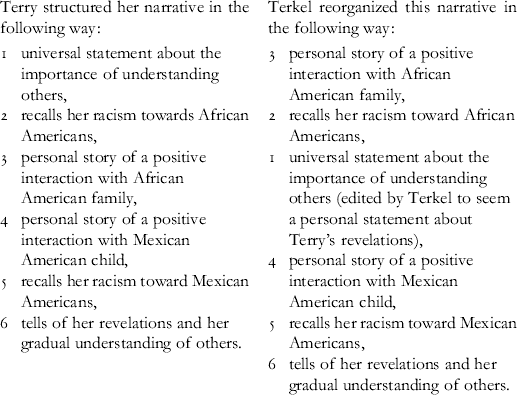
Terry told the story of her growing self-awareness and her recognition of her racist mentality from the perspective of an enlightened person reflecting on her former self. Her story, as she actually told it, began with a universal call for all people to put an end to their racism, used her past as an example, and ended with a further emphasis on her revelation that racism was wrong. Terkel reorganized the narrative so that Terry seems to tell two stories of her former racist self, one in respect to African Americans and one in respect to Mexican Americans. Terkel edited her interview into a prose passage structured similarly to the Popular Front form Barbara Foley identifies as the “proletarian bildungsroman.”Footnote 30 In this genre the protagonist experiences or witnesses a series of injustices and comes to recognize the need for class solidarity – often across lines of racial difference. Foley argues that writers of the proletarian Bildungsroman “portray protagonists who become heroes because they actually change,” and that “whatever political insight the character has gained, it is implied, the reader can gain as well.”Footnote 31 Terkel, as though working with this model in mind, edited Peggy Terry's narrative into a subtly didactic story for the purpose of enlightening his readers.
Just as with his reworking of Peggy Terry's transcript, Terkel aggressively edited the transcript of his interview with Joseph Small. Terkel increased the poetic and didactic impact of his published texts by rearranging the narratives of his subjects to create dramatic, reflective endings. We have already seen how, in his interview with Small, Terkel worked from a topical agenda of racial and religious themes and led Small toward a particular perspective about his experience during World War II. The final edited version of this interaction (quoted at length above) appears quite different from the audio record of the interview. Terkel edited all the collaborative discussion of religion into a reflective paragraph in the last few sections of the narrative of Joseph Small. The audio interview now reads in published form:
I think that God had his hand on me all through my life. This was just another incident where I went through and the protecting hand of God kept me for the work I'm doing now.
While Small did reflect on his experience in this way, in suppressing the interaction that precedes this reflection and in setting off the statement as a separate paragraph at the end of the narrative, Terkel enhanced the significance of Small's words. In this way, the text guides Terkel's readers toward an interpretation that Small might not originally have intended.
Terkel used the same type of restructuring in Terry's story, telling his readers in a “postscript” that “a sudden flash of memory by Peggy occurs as [he] was about to leave.”Footnote 32 Terkel then included a heart-wrenching story told by Terry about a Christmas she experienced without any gifts. Terkel employed italics and set the story off typographically so that it seems a deeply subjective, personal reminiscence. In fact, this story was relayed much earlier in the interview – Terkel invented the context of a “sudden flash of memory” in order to heighten the poignancy of such a remembrance. Again, Terry is held up as a mentor figure whose changing political and social consciousness ought to be emulated. In order to highlight the change in perspective, Terkel edited his subjects' narratives to include final revelatory moments in which the speaker recalls poignant memories of a historical event. Moreover, he established his speakers as mentor figures – people who have “grown to think a certain way, who have changed their views” – and so suggested that his readers might also alter their thinking about these earlier historical moments and, by extension, about the present through the process of reflecting on the past.
IV. Documentary Memory
After Terkel reworked each interview into an “essence” narrative, he began constructing his collection into his final published text. Terkel prescribed the roles each person represented within his text by identifying speakers according to various indicators of race, class, age, and gender in introductory statements for each passage. For “The Good War” Terkel described Joseph Small as a “devout Christian” living in a “working-class neighborhood,” and for Hard Times he noted nothing more than “Fran is twenty-one. She's from Atlanta. Her family is considered affluent.”Footnote 33 Moreover, Terkel organized the narratives into sections according to their similarities in plot, theme, gender, age, or class. Finally, Terkel used montage to create meaning, often contrasting different perspectives in his oral histories. Terkel juxtaposed the narratives of wealthy businessmen with the narratives of social workers struggling to make rent. For “The Good War” he paired a story told by an American pilot who flew bombing runs with a story told by a Japanese student in Tokyo during the bombing of Hiroshima. Terkel worked with a particular vision and noted, “I like to relate seemingly unrelated things, to illuminate from the unexpected quarter … As you're crafting each individual interview, you keep in mind the span of the entire book.”Footnote 34 Terkel's rhetorical juxtaposition of these experiences makes it appear as though the text is an objective and comprehensive collection of various perspectives and that all people have an equal contribution to make in the writing of history.
It is not surprising that Terkel turns to a documentary approach when constructing his oral histories of the Great Depression and World War II – throughout his memoirs and interviews he often dated his turn toward political awareness to the decade of the 1930s, a decade William Stott identifies as characterized by the genre of documentary expression. Stott argues that not only was “documentary expression” central to the 1930s “but that recognition of it is essential to an understanding of American life at the time.”Footnote 35 During the Depression, Terkel worked for the New Deal's Federal Rehabilitation Administration documenting the extent of unemployment in large cities, and later for the Works Progress Administration writing for and appearing on radio programs as a “pro-Roosevelt commentator.”Footnote 36 He also spent several years with the progressive Chicago Repertory Theater performing plays and street theater “in the radiance of commitment,” and reminisced about the 1930s, recalling, “if there ever was an experience that altered my life, not simply in a political way, but in every aspect, it was the Great American Depression.”Footnote 37 Terkel was one of many activists, artists, and public intellectuals working in the “radiance of commitment” during the Depression and a consideration of his methods throughout the 1960s, 1970s, and 1980s indicates the extent to which an aesthetic practice and social purpose formed during the decade of the 1930s defies easy periodization.
Terkel's works both draw on a claim to truth in their reliance on documentary expression and trouble that notion of truth by making the shifting nature of memory a central theme. It is difficult to pin down Terkel's exact position with respect to what we might call the “truthfulness” of his texts because he maintained a playful stance with respect to notions of truth, objectivity, history, and memory. He insisted that his goal as an oral historian was to “get the truth and cut out the facts,” and he emphasized in his prefaces to Hard Times and “The Good War” that both are “memory books.” Frisch has previously argued that we ought to recognize Hard Times as an attempt to grapple with historical memory and that Terkel's work questioned the difference between history and memory before post-structuralist theory made it popular to do so.Footnote 38
Despite Terkel's toying with the line between history and memory, he still took pains to craft his texts into seemingly objective collections of earlier historical moments. In an interview with Playboy magazine Terkel explained,
Forget objective journalism. What you try to do is be as fair as you possibly can, state the facts and details, but accept that you have your own point of view. I say my piece at the beginning of my books, very briefly, to give the reader an idea of how I feel, then I let the people portray themselves with absolute freedom, with no imposition from me.Footnote 39
In insisting that he says his “piece at the beginning,” Terkel attempted to create stable and separate designations of subjective and objective representation. By calling attention to his “own point of view” as it is (supposedly) relegated to the preface only, Terkel implied that the body of his text should be taken as an unmediated document “with no imposition” on his part.
The point here is not to evaluate Terkel's texts as more or less “authentic.” Terkel himself dismissed the issue of whether his texts are “telling the truth,” as a question “as academic as the day Pilate asked it.”Footnote 40 Terkel knew well the debates that surround the creation of oral history and often took pains to position himself well outside the elite circle of academic historians. He was wary of formal titles, saying, “oral historian? I'm not sure I'm an historian.”Footnote 41 Perhaps we can place Terkel's practice on a continuum that privileges aggressive editing of the transcripts at one end and unedited transcripts at the other. However, oral histories that appear unmediated and oral histories that call attention to the many layers of mediation both make truth-claims – one suggests authenticity by effacing the constructed nature of the polished document while the other suggests that laying bare all the levels of constructedness provides unmediated access. Rather than focus on the question whether his texts are telling the truth, perhaps we might be better served by considering why Terkel constructs his texts as documentary memories of his subjects.
Because Terkel configured listening to and telling stories of the past to be a form of social action, he used his oral histories to comment politically on the moment in which he published. Terkel asked Americans to remember the Great Depression and the rise of the New Deal just as that New Deal order began unraveling in the early 1970s. Similarly, when Terkel turned to the topic of World War II for his 1984 text “The Good War” he worked with the recent memory of the Vietnam War in mind, noting in his preface that it “appears that the disremembrance of World War Two is as disturbingly profound as the forgettery of the Great Depression.”Footnote 42
Although he crafted his texts into seemingly unmediated documents, Terkel used his oral histories to comment on the current cultural and political context. In his theses on history, Walter Benjamin suggests that historians do not “articulate the past historically … ‘the way it really was’,” but rather seize “hold of a memory as it flashes up in a moment of danger.”Footnote 43 Terkel – invested in the importance of remembering the past – did not simply document an earlier historical time but suggested the relevance of these memories to the current cultural moment. Invested in fixing the “forgettery” brought on by a “national Alzheimer's,” Terkel manipulated the memories of his representative individuals into politically poignant reminiscences and called for his readers to reflect along with his subjects.Footnote 44 Moreover, his use of a documentary approach allows his audience to read what appear to be unmediated memories – readers are able to witness these earlier moments in American history and perhaps to follow the same trajectory as Terkel himself and move from being observers to being activists.


