Introduction
The challenges associated with measuring and evaluating the outcomes of welfare and other social programmes are well known. These programmes typically have multiple objectives, both tangible and intangible outcomes, long-term and even inter-generational effects and are realised through highly indirect pathways (Monro, Reference Monro2003). Nevertheless, evaluating the outcomes achieved through welfare service delivery is vital in order to be able to establish the benefits of the service, identify areas for improvement and inform the allocation of resources. In this study, carried out in the Australian Department of Human Services, we explored whether the outcomes described in welfare recipients’ and welfare employees’ accounts of frontline service delivery interactions could be captured using a capability approach (Alkire et al., Reference Alkire, Bastagli, Burchardt, Clark, Holder and Ibrahim2009; Burchardt and Vizard, Reference Burchardt and Vizard2007; Ipsos MORI, 2007; Sen, Reference Sen2001).
The Department of Human Services (formerly Centrelink) is the government agency responsible for administering Australia's welfare programmes which include income programmes, special payments and additional services for a wide range of recipients including retirees, the unemployed, families, carers, parents and people with disabilities. As a provider of income support, the Department is often the first point of contact for the most disadvantaged and isolated members of society. For this reason, connecting people with existing services and resources in the community is also an important element of the Department's business (Winkworth, Reference Winkworth2005). Given this role, and the then Labor government's policy on social inclusion, the Department is required to demonstrate how its service delivery efforts promote social inclusion.
Researchers have argued that the service delivery encounter between welfare recipients and employees is critical in determining the extent to which policy objectives such as social inclusion are met. In his study of ‘street-level bureaucrats’, Lipsky (Reference Lipsky1980) highlighted the important role played by public service workers, arguing that their actions actually constitute the services delivered by government. Lipsky found that workers often have considerable discretion in interpreting centrally decided allocation principles and thus, through their choices, can either enable or hinder recipients’ access to services and resources. Meyers et al. (Reference Meyers, Glaser and Donald1998) subsequently argued that welfare officers play a key role in determining whether welfare policy objectives are achieved because they control critical information and, through their interpretation of this information for welfare recipients, influence recipients’ understanding of their rights and obligations.
Below, we provide an overview of Amartya Sen's (Reference Sen2001) capability approach, outlining our reasons for examining the impact of frontline welfare service delivery interactions on welfare recipients’ capabilities. We then describe the approach we took to capture the outcomes achieved from welfare service delivery and how they were analysed within the capability approach. The capability impacts reported by study participants are described in the Results section, and in the final section of this paper we consider the implications of our findings, focusing on how the capability approach can be used to assess and improve the social value achieved from welfare service delivery.
The capability approach
The framework that we used to explore the social value of welfare service delivery was Sen's (Reference Sen2001) capability approach. The capability approach evaluates societal arrangements and institutions in terms of their enhancement of the substantive freedoms or capabilities of individuals, such as accessing knowledge, receiving support and respect, having a secure source of livelihood and satisfying leisure hours (Sen, Reference Sen2001; United Nations Development Program, 1990). This approach addresses some of the limitations of more traditional measures such as national income in that it takes into account the fairness with which social progress is shared amongst all members of society, allows for freedom of choice (when individuals have capabilities they are free to choose how to use them to live the life that they want to live) and directly assesses things of value to members of society.
For these reasons, the capability approach is well-suited to the analysis of outcomes achieved through welfare service delivery. The capability approach is concerned not only with the actual capability or freedoms that people have, but also with whether the processes through which these capabilities were achieved allowed the individual freedom of actions and decisions (Sen, Reference Sen2001). Since our research was concerned with the outcomes of service delivery, our analysis focused on what capabilities were achieved, rather than the processes through which they were achieved. However, the two aspects of freedom are interdependent (Sen, Reference Sen2002) and in our analysis we draw out instances in which study participants mentioned the process of service delivery as affecting their freedom within the welfare system.
Several capabilities lists have been developed which aim to identify the central and important capabilities that all individuals should be able to enjoy (Ackerly, Reference Ackerly2000; Burchardt and Vizard, Reference Burchardt and Vizard2007; Clark, Reference Clark2002; Narayan, et al., Reference Narayan, Patel, Schafft, Rademacher and Koch2000; Nussbaum, Reference Nussbaum2000). We used the capabilities list that was developed for the UK Equalities Review (Alkire et al., Reference Alkire, Bastagli, Burchardt, Clark, Holder and Ibrahim2009; Burchardt and Vizard, Reference Burchardt and Vizard2007), which was developed through a systematic, two-stage process, reflecting both the international human rights framework and public input. The work that was done to consult with excluded groups in developing this capabilities list represents one of its strengths, as it reduces the likelihood that the list of capabilities merely reflect researchers’ own ethnocentric views as to what is important (Clark and Gough, Reference Clark, Gough and Manderson2005; Okin, Reference Okin2003). While other capabilities lists have been developed through consultation with excluded groups, this work has mostly been carried out in developing countries where societal arrangements and living conditions differ considerably from those in Australia (e.g., Ackerly, Reference Ackerly2000; Clark, Reference Clark2002; Nussbaum, Reference Nussbaum2000). However, the Equalities Review capabilities list was developed in a social environment and culture that is similar to Australia's and therefore was likely to be relevant in the Australian context. The capabilities list consists of ten domains of valuable capabilities covering: Life; Physical security; Health; Education and learning; Standard of living; Productive and valued activities; Individual, family and social life; Participation, influence and voice; Identity, expression and self respect; and Legal security.
Capability development and welfare service delivery
An important contribution of this study lies in testing the utility of the capability approach in terms of whether it can be used to capture the outcomes that are experienced from welfare service delivery. There are several reasons for expecting that the Department's service delivery should affect welfare recipients’ capabilities. One reason is that social inclusion, which is a policy objective for the Department, is similar in focus to the capability approach. Both approaches are concerned with an individual's ability to take part in valued and important activities across a range of domains including individual, social and economic life (Hayes et al., Reference Hayes, Gray and Edwards2008), the extent to which these opportunities are shared by all members of society and the way in which social structures and social relations, at local, national and international levels, affect the choices available to individuals (Burchardt and Vizard, Reference Burchardt and Vizard2007). For these reasons, the capabilities approach was adopted as a framework for understanding and assessing social inclusion in the United Kingdom's Equalities Review (Alkire et al., Reference Alkire, Bastagli, Burchardt, Clark, Holder and Ibrahim2009; Burchardt and Vizard, Reference Burchardt and Vizard2007). Following the same logic, we argue that the overlap in focus between social inclusion objectives and the capability approach should mean that the Department's focus on social inclusion will be reflected in capability development outcomes for recipients of the Department's service delivery efforts. It should be noted, however, that social inclusion interventions have the potential to restrict capabilities if, in the attempt to address social exclusion, an individual's choices and freedom are reduced (Green and Orton, Reference Green and Orton2009; Monteleone and Mozzana, Reference Monteleone and Mozzana2009). In this study, we examined both positive and negative outcomes associated with welfare service delivery, allowing us to examine whether service delivery either promoted or constrained welfare recipients’ capabilities.
Second, prior research carried out in Australia utilising the capability approach (e.g., Baker et al., Reference Baker, Panzironi, Sparrow, Panzironi and Gelber2012; Morris, Reference Morris, Panzironi and Gelber2012; Panzioroni, Reference Panzioroni, Panzironi and Gelber2012) reveals that policy frameworks and the provision of government services affects capabilities similar to those identified for the UK Equalities Review (Alkire et al., Reference Alkire, Bastagli, Burchardt, Clark, Holder and Ibrahim2009; Burchardt and Vizard, Reference Burchardt and Vizard2007; Ipsos MORI, 2007). Perhaps most relevant for the purposes of our research is the study carried out by Morris (Reference Morris, Panzironi and Gelber2012) exploring the impact of public housing for elderly renters. Morris found that government provision of affordable, adequate and secure housing affected participants’ nutritional intake, stable housing and self-respect, as well as their ability to maintain their health, to develop strong social networks and to engage in local activities. These capability impacts map well the capabilities identified in the UK Equalities Review.
Third, other researchers have found that the structure and delivery of welfare services can affect capabilities. For example, a Swedish study examining a labour market re-activation project found that the initiative promoted capability development by providing welfare recipients with choice and individualised pathways (Gascoigne and Whiteside, Reference Gascoigne and Whiteside2009). Another study revealed that the eligibility criteria associated with a welfare initiative affected the extent to which the programme was successful in empowering and fostering voice for all potential participants (Galster et al., Reference Galster, Rosenstein and Bonvin2009). Other studies have found that capability effects were constrained when initiative requirements and strategies were largely decided by central government or beneficiaries of the programme were not given input into decision-making (Green and Orton, Reference Green and Orton2009; Monteleone and Mozzana, Reference Monteleone and Mozzana2009). These studies illustrate that the characteristics of welfare service delivery can affect capability development.
However, there are also reasons why we might not see an effect of welfare service delivery on recipients’ capabilities. First, although capabilities such as employment and life expectancy represent goals for the entire welfare system, in Australia (as in other countries, see Riccucci et al., Reference Riccucci, Meyers, Lurie and Han2004) responsibility for finding a home or getting an individual into a job rests with other welfare service providers, not the Department of Human Services. The Department's prescribed role in the welfare sector may restrict the extent to which employees are able to directly influence the full range of welfare recipients’ capabilities. Second, there are multiple values and objectives associated with welfare service delivery, some of which may not be captured by the capability framework. A more traditional priority for welfare service delivery is timely and accurate benefit determination (Riccucci et al., Reference Riccucci, Meyers, Lurie and Han2004). A study by Meyers et al. (Reference Meyers, Glaser and Donald1998) suggests that this type of concrete and measurable objective may be more influential in shaping the service delivery encounter than the policy objective of social inclusion. Thus, it was important to adopt an open approach for this research, not constraining or directing the way in which study participants described the effects or value that they experienced from welfare service delivery.
Method
The current study was conducted within a larger research programme that had a secondary aim of exploring whether ‘place based services’ (PBS) initiatives (programmes offering intensive support for customers experiencing multiple barriers to social inclusion) had an effect on the outcomes of welfare service delivery. Therefore, participants were recruited from six Human Services Customer Service Centres, three of which had PBS initiatives and three of which represented comparison sites. The six Customer Service Centres were located in Queensland, New South Wales and Victoria. We recruited welfare recipients who represented the relevant PBS target groups as identified by the Department of Human Services. In Queensland, the target group were welfare recipients who were either leaving foster care, victims of domestic violence or diagnosed with mental illness, and known to be disconnected from other sources of support. In New South Wales, the target group were young refugees who were considered ‘at risk’, either due to homelessness, or lack of social support or physical or mental illness. In Victoria, the target group were welfare recipients who had been unemployed for more than two years (Social Justice and Social Change Research Centre, 2009).
A letter, distributed by the Department of Human Services, was sent to welfare recipients in the target groups, inviting them to take part in the study. A total of 957 letters were distributed to welfare recipients, and 111 individuals returned the form indicating that they would be willing to take part in an interview. Interviews were scheduled with sixty-two of these individuals (the remaining individuals either could not be contacted or were not available during the two or three days when the researchers were on site). Eight individuals subsequently cancelled their appointment because of conflicting commitments or difficulties getting to the interview and another three individuals did not show up without explanation. Thus, our final sample represented fifty-two welfare recipients (thirty-one males and twenty-one females).
The employee participants for the study were identified using a stratified random sampling procedure. Employees were grouped according to the Customer Service Centre where they worked and their work role (e.g., social worker, senior customer service advisor, customer service advisor, job capacity assessor, project manager). Of the forty-seven employees at the centres, twenty-three employees were invited to take part in an interview, and of these seventeen (twelve females and five males) chose to participate, representing a 74 per cent response rate. All of the employee participants were front-line service workers, but a wide range of roles were represented, from more professional roles (e.g., social workers) to more rule-oriented administrative roles (e.g., customer services advisors).
One-on-one interviews were conducted with each of the study participants. The interviews with welfare recipients were carried out face-to-face at a neutral location, whereas interviews with employees were carried out over the telephone. At the time, the organisation was known as ‘Centrelink’ rather than the Department of Human Services, so our framing question for employees was: ‘Can you think of an experience with a Centrelink customer that stands out for you? Would you tell me about it?’ Similarly, in the welfare recipient interviews we asked: ‘Does any particular experience with Centrelink stand out in your mind as important? Would you tell me about it?’ Interviews were tape-recorded and transcribed verbatim for more detailed analysis. On average, each interview lasted approximately forty-five minutes.
The coding was carried out in NVivo (QSR International Pty Ltd, Australia) by the two researchers who conducted the interviews and another independent researcher. While coding, the researchers used memos and annotations to record their ideas and reactions and to draw out emergent themes and relationships. The coders met regularly to ensure consistency in the coding of capabilities, and to discuss other emerging themes and concepts. An initial list of codes was derived from Burchardt and Vizard's (Reference Burchardt and Vizard2007) capability list and included both the capability domains and the capabilities listed within each domain. Three criteria had to be met for an outcome to be coded as a capability impact. First, there needed to be a clear connection between a service delivery experience (involving a Department of Human Services employee and a welfare recipient) and the outcome achieved. Second, the outcome described had to fit one or more of the listed capability items. Third, there had to be evidence that the outcome was sustained over the long-term, without requiring ongoing service delivery support from the Department of Human Services.
Results
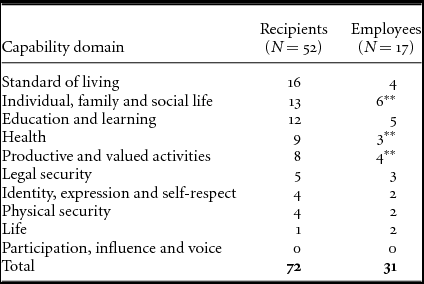
Both employees and welfare recipients described service delivery outcomes that could be classified as capability impacts (see Table 1). As welfare recipients and employees often identified multiple effects associated with welfare service delivery experiences, the total number of capability impacts reported is greater than the number of participants in the study.
Number of capability impacts reported by welfare recipients and employees*
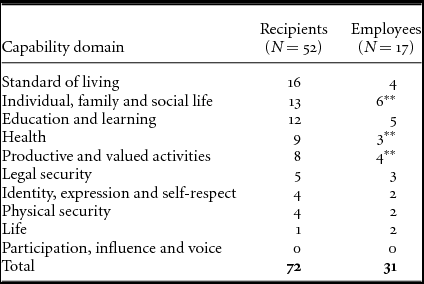
Note: * The number of participants who described each type of capability impact. Some participants described several types of capability impacts.
** Two of these employees appeared to be describing the same service delivery experience.
It is also important to note that the capability impacts reported in Table 1 represent both positive and negative capability impacts. We have not differentiated between positive and negative impacts because it was difficult to make this differentiation from the rich accounts provided by the study participants. Participants sometimes described a sequence of events that illustrated both positive and negative impacts for the same capability domain. In the future, a coding framework might be developed to enable more precise quantification of these capability impacts; however, given that our goal was to establish whether welfare service delivery was seen to affect recipients’ capabilities, we judged this to be beyond the scope of the current study.
Standard of living
Twenty participants (sixteen recipients, four employees) described service delivery experiences in which welfare recipients’ standard of living capabilities were affected, most commonly by providing (or withdrawing) welfare payments, or by determining eligibility for a higher level of payment. These decisions were only classified as a standard of living impact if the recipient had not received these payments for three months or more and it was evident that this had had an impact on his or her ability to access necessities such as food and housing.
In the stories that participants told, accessing payments was described as an outcome of service delivery rather than simply being determined by policy or eligibility requirements. The types of service delivery behaviours that were associated with standard of living impacts were understanding and responding to recipients’ individual circumstances, ensuring that recipients understood the eligibility requirements affecting their payments and identifying additional benefits and services (sometimes external to the Department of Human Services) to which recipients were entitled.
In the majority of cases, recipients’ standard of living was improved through interaction with the Department of Human Services, in that they received payments for which they were eligible. There were, however, instances described by participants that had a negative impact on welfare recipients’ standard of living. The following story related by one welfare recipient illustrates the potential negative consequences that can arise when a recipient does not understand the eligibility requirements affecting their payments:
because I got paid out from my workplace, from my holiday pay, I didn't get paid for like two months. And it took me ringing up and finding out why I wasn't getting paid to understand . . . we had to get assistance from the church for food because we needed to pay rent. It was only my wife's payments coming in. It wasn't explained to us – that we – if I’d known, I would have hung on to that $3000. Instead, we used that to do car payments so that we were ahead, and paid some other bills . . . we basically through that time also had to max out the credit card paying for my wife's medication so we were totally stuffed . . . we had to declare bankruptcy. [Recipient ID27]
Individual, family and social life
Nineteen participants (thirteen recipients, six employees) reported that the Department of Human Services’ service delivery had affected recipients’ capability to enjoy individual, family and social life. In the main, this effect occurred through either enabling or hindering recipients’ ability to spend time with, and care for, others, including wider family. For example, several participants reported that the Department had allowed welfare recipients to concentrate on providing special care for family members by exempting them from job search activity and sometimes providing them with a carer's payment. Although there are criteria associated with these decisions, the interaction between employee and welfare recipient seemed to be critical in terms of whether the recipient's eligibility was identified. Another way in which this capability domain was affected was by assisting welfare recipients to separate from a partner who was violent or abusive. For victims of domestic violence with children, the assistance that the Department of Human Services provided in establishing independent, safe living conditions meant that they felt they were doing a better job of caring for their children.
We also heard about instances (mainly from participants in the Place Based Services initiatives) in which employees had linked welfare recipients to external sources of support that gave them access to emotional support and friendships, ranging from a support group to a local book club. Recipients also reported that when employees spent time with them, helping them formulate goals and identify options, they developed a sense of hope for the future where previously they had lacked options and direction.
Education and learning
Seventeen participants (twelve recipients, five employees) identified instances in which service delivery had affected recipients’ education and learning capabilities. In most of these instances, the impact was seen to be positive. These impacts were achieved when employees took the time to understand recipients’ skills and goals and used that information to identify courses, learning activities or training opportunities that met their individual needs. These capabilities were also affected when employees identified resources that assisted welfare recipients to overcome financial, social or language barriers to learning and education. One of the employee participants explained:
So I worked with them through TAFE, got them mentored and helped them through that. They were able to get into uni through a scholarship programme . . . because the uni has programmes pertaining to young refugees. So we went to the uni, assist them with applications, we talk to the university and say, ‘This case, I’m sure they will pass all their marks but they might have problem with the English language. I’m sure they won't have problems if you link them with someone who can assist them with that language that they need while they’re in the unicourse.’ They are both doing very well. [Employee ID57]
These service delivery behaviours not only assisted recipients to access education and training, but also helped them develop broader skills for participation in productive and valued activities. For example:
He [the Centrelink employee] asked me . . . what do you study and your family. And I say everything's okay . . . And I say I want . . . to find some, voluntary work . . . And I think he went with me and he find that voluntary work, and he contact, he do everything for me . . . And to do voluntary work, I think it good, give me confidence, and also I know how to communicate to other people, yeah. And I know many things about how to apply the job, and how to looking for the job, yeah . . .’cause you know, we just arrived in Australia and we don't have any qualifications, and we don't know how to communicate with people. [RecipientID38]
Health
Twelve participants (nine recipients, three employees) described instances in which service delivery affected recipients’ health capabilities. In the main, the effect on recipients’ health capabilities was achieved by identifying resources (either payments from the Department of Human Services or external resources) that the recipient could access to overcome financial barriers to treatment, as described below:
I was in a counselling session [at Centrelink], and he picked up and suggested that I could get dental work done . . . at the moment I’ve got five grand's worth of dental work thanks to this young dude in Centrelink . . . Yeah. So, I’m getting – getting false teeth, like, ’cause my teeth have been shocking my whole life and that . . . And he said – he said, no you can get $5,000 rebate from Medicare. [Recipient ID5]
There were also instances in which recipients’ health was seen to be directly affected by service delivery. These recipients were experiencing an illness that prevented them from meeting their job search requirements, and, when their payments were subsequently withdrawn, the added financial stress led to a worsening of their health condition. However, when departmental employees were able to exempt these recipients from job search requirements, their physical and mental health was seen to improve.
Productive and valued activities
Twelve participants (eight recipients, four employees) described service delivery experiences that affected their capability to engage in productive and valued activities. In the majority of these cases, this impact was positive. Most of the examples that were given involved a welfare recipient taking up either paid work or volunteer work. This process usually began with the recipient identifying that he or she was seeking paid or unpaid work and the employee identifying an organisation where suitable work was available. However, for a few welfare recipients this outcome was achieved when the employee was able to support them to make positive lifestyle changes (e.g., cessation of drinking, resolving family disputes), which subsequently enabled them to gain paid employment.
Service delivery experiences also affected recipients’ sense that their caring roles were recognised and valued. One of the study participants was a single parent with two children, one of whom had been diagnosed with Asperger's syndrome and was frequently violent at home and at school. She believed that she could not meet her caring responsibilities and hold down a job, so the fact that she was still required to seek work left her feeling that her caring responsibilities were not being recognised and valued:
Well, I’m just really disappointed that they . . . knowing my circumstances, I would think that they would back off and leave me alone. And not try to make me go to all these – like the job centres and looking for work and – I don't have time for it. It's just more stress on me with the situation that I have . . . these people from government that have never been in this position don't know, and they don't understand. [Recipient ID2]
Legal security
We identified eight examples (five recipients, three employees) of service delivery experiences in which a welfare recipient's legal security capabilities appeared to have been affected, half of which represented a positive impact and half of which represented a negative impact. Three recipients gave examples of experiences in which their privacy had not been respected in their dealings with the Department, such as when they were required to provide information about their sexual activity and religious orientation or allow departmental employees to contact their medical practitioner to determine their eligibility for a payment. In other instances, employees supported recipients’ legal security by serving as an advocate for recipients in dealings with other government agencies or by clarifying their legal rights and entitlements for them.
Identity, expression and self-respect
Six participants (four recipients, two employees) recounted service delivery experiences that affected ‘identity, expression and self-respect’ capabilities. These impacts were mostly described in terms of welfare recipients’ self-respect. Welfare recipients reported that their sense of worth, confidence and self-esteem were strengthened when employees took the time to understand their values and concerns and gave them choices and input into decision making. In particular, the ‘strengths based approach’ that was utilised within some of the PBS initiatives was seen to strengthen participants’ self-esteem.
Physical security
Six participants (four recipients, two employees) described instances in which service delivery had affected a recipient's physical security capabilities. In five of these cases, the recipient was a female who had been experiencing domestic violence. Departmental employees were able to support the woman to move to a safer situation by determining that she was eligible for crisis payment that would allow her to relocate. Employees also supported welfare recipients by talking through their options, identifying external services that were available to them or exempting the recipient from the requirement to obtain child support payments from the child’s father. One participant described the way in which departmental employees had helped her achieve greater physical security as follows:
They guided me where to go, they supported me in finding [my own home]. Otherwise . . . I would have kept on putting up with the abuse and probably committed suicide or something . . . But to be able to move out, take care of myself and my kids and most of all, give them a peaceful environment, that meant so much. [Recipient ID46]
Life
Three participants (one recipient, two employees) described instances in which service delivery had affected a recipient's life capability. In two of these examples the recipient was in a state of crisis when he/she arrived at the Customer Service Centre. The employees responded by giving him or her as much time as needed to talk through issues and identify sources of support or solutions to their problems. As one participant explained:
If it wasn't for the [Place Based Services initiative], I’m sorry but I probably would’ve committed suicide that day . . . if I hadn't have seen somebody, I probably would’ve walked straight out of the office and straight out into the middle of the road and the first car I would’ve come across. Or straight down the train station and jumped . . . I think I was there that day for four hours, four hours, horrid . . . These guys [the Place Based Services initiative employees], it all comes from their heart and you can see it comes from their heart. [Recipient ID45]
The third instance in which a welfare recipient's life capability was affected involved a man who had been drinking heavily for more than twenty years. Departmental employees established a connection with him and then connected him to services through which he achieved a more healthy lifestyle (including giving up alcohol), thereby potentially increasing his life expectancy.
Participation, influence and voice
None of the outcomes described by the study participants was classified within the capability domain for participation, voice and influence as defined by Burchardt and Vizard (Reference Burchardt and Vizard2007). The subdomains of this capability relate to participation in activities such as formulation of government policy, elections and forming and joining civil organisations and solidarity groups. These types of outcomes were not described by our study participants. However, other outcomes were identified that are relevant to the construct of participation, such as learning how to communicate and engage with government organisations. Currently, these types of outcomes are captured within other domains, but it might be appropriate to consider re-organising the capability list to provide a broader view of the range of ways in which people can participate, have voice and influence.
Process capability
Our analysis focused on the outcomes that were seen to be achieved from welfare service delivery but participants did also describe instances in which the process of welfare service delivery related to the capabilities. Many of the employees working within the Place Based Services initiatives identified the fact that participants were encouraged to set their own goals and to decide how best to achieve those goals as a feature that differentiated service delivery under the Place Based Services initiatives. They linked this process capability to outcomes such as improved self-respect and having goals and direction for the future. Welfare recipients were also conscious of the process aspect of welfare service delivery. Two reported that they had not been given a real choice as to whether or not to participate in the Place Based Services initiatives. Another was concerned that in order to obtain financial support for a prescription she was required to provide access to her doctor, which she considered a breach of privacy. Some participants in areas with high unemployment considered their job search activities to be demeaning because they were made compulsory even though everyone involved knew that the activities were meaningless (since no jobs were available). Thus, the processes involved in the delivery of welfare services were also seen to affect capabilities.
Outcomes that were not represented in the capability list
Although we documented many capability impacts associated with welfare service delivery, not all of the outcomes described by our study participants could be classified within the capability approach (Alkire et al., Reference Alkire, Bastagli, Burchardt, Clark, Holder and Ibrahim2009; Burchardt and Vizard, Reference Burchardt and Vizard2007; Ipsos MORI, 2007; Sen, Reference Sen2001). These included outcomes such as:
• Emotional reactions (e.g., stress, frustration, gratitude and calm)
• Confidence in the welfare system
• Referrals to services and other sources of support
• Short-term financial situation
• Understanding of the welfare system (e.g., entitlements and obligations)
• Time spent on Department of Human Services business (or job searching)
• Perceived value of departmental service delivery
• Identifying options that assisted with the recipient's goals
• Outcomes affecting family members
These outcomes were often mentioned in service delivery experiences for which capability impacts were achieved. However, in other cases these outcomes were not associated with a capability impact, either because they did not have a long-term effect or because their long-term impact was unknown (i.e., the long-term impact was not discussed by the recipient/employee in the interviews). Consequently, these outcomes represent short-term impacts which, if reinforced over time, should result in capability development.
One outcome that is particularly relevant in the context of this study is ‘confidence in the welfare system’. Twenty-nine of our study participants (twenty-three recipients, six employees) described interactions that affected recipients’ understanding of their welfare rights and entitlements, their trust and willingness to engage with the Department and their belief that they could access care and support through the welfare system in times of need. The following report from a long-term recipient of unemployment benefits, illustrates how service delivery interactions can affect both recipients’ understanding of their rights and entitlements and their belief that they can access care and support from the Department:
‘The money's not for you to live.’ I’ve been told that about fifty billion times by Centrelink. ‘The dole money is for you to go and look for work so you’ve got no excuse, if you’ve got to go to Dandenong every day, you can afford to get a train. You don't have to worry about rent, eating or nothing . . . The money we give you is not for you to survive. We don't care about you. The money is for you to go and look for work.’ [Recipient ID11]
Some welfare recipients reported that their interactions with departmental employees were only ever concerned with ensuring that they were meeting their obligations to the Department. For welfare recipients who were struggling with significant challenges, this focus left them feeling that the Department did not care about them as individuals. For others, negative service delivery experiences had such an impact on them that they avoided going to the Customer Service Centre whenever possible, even if this meant going without some of the payments to which they were entitled. Repeated communication failures also affected recipients’ confidence in the Department's service delivery:
it was like, you lost any sort of faith in the system because when you asked the question, you didn't get the same answer. Or you would act on the answer that you got from somebody who supposedly would know and you went to do that thing and then when you went back after doing what was told to you to do, somebody else would say, ‘No’. [Recipient ID43]
Variation in outcomes for employees and welfare recipients at sites with and without intensive support
Finally, we explored the data to see whether there were systematic differences in the types of outcomes described by different types of study participants. We expected that employees would be more motivated than welfare recipients to emphasise the positive outcomes that are achieved from welfare service delivery. We were also interested in whether or not study participants from the sites that offered more intensive support (via the Place Based Services initiatives) would report more capability impacts than participants from the comparison sites. It is important to reiterate that capability impacts were not classified according to whether they were positive or negative. In addition, the sample sizes (particularly for employees) were small. For these reasons, these analyses must be considered very exploratory.
When we took into account the relative number of welfare recipients and employees who took part in the study, we found, as expected, that employees were more likely to report capability impacts than were the welfare recipients. Specifically, they were more likely to report capability impacts in the domains of education and learning, legal security and life. There was also a tendency for participants (both employees and welfare recipients) at the Place Based Services sites to report more capability impacts than participants from the comparison sites. The difference between Place Based Services sites and comparison sites was most evident for the capability domains Identity, expression and self-respect, Individual, family and social life and Productive and valued activities. Interestingly, there was one capability domain for which this trend was reversed. That is, participants at the comparison sites were actually more likely to report impacts on standard of living than participants from the Place Based Services sites. The latter finding could reflect the fact that it is part of the Department's core business to determine eligibility for payments. Thus, this type of capability impact could be achieved without intensive support.
Discussion
This study explored whether welfare service delivery was seen to affect welfare recipients’ capabilities. By testing the utility of the capability approach as a way of assessing the outcomes achieved through welfare service delivery, this study builds on prior work operationalising the capability approach (Alkire et al., Reference Alkire, Bastagli, Burchardt, Clark, Holder and Ibrahim2009; Clark, Reference Clark2002). The fact that we were able to identify many instances in which welfare service delivery achieved capability impacts provides support for the proposition that we can evaluate social institutions on this basis.
Our participants did identify other outcomes (e.g., negative emotional reactions, referrals to other services) that could not be categorised as capability impacts. These outcomes were mentioned in some accounts as precursors of capability development, but in other accounts the outcome either had only a short-term impact or its long-term impact was unknown (because it was not discussed by the participant). Because these outcomes generally represented short-term effects, they do not indicate a need to broaden or redefine the list of capabilities. Rather, we believe these additional outcomes reflect the prescribed role of the Department of Human Services within the welfare system. The complexity of the social problems contributing to social exclusion have fostered inter-institutional approaches to tackling this exclusion (Galster et al., Reference Galster, Rosenstein and Bonvin2009; Wiklund, Reference Wiklund2007). Employees in the Department are encouraged to work with service providers in different fields (e.g., health, education, social care, employment) to break down the multiple barriers that face individuals experiencing social exclusion (Australian Government, 2009). Under these circumstances, short-term measures of impact (that have been found to be associated with long-term capability effects) may be required to evaluate an organisation's immediate contribution to capability development. Thus, one avenue for further research would be to explore the connection between these short-term outcomes and long-term capability development.
We suggest that welfare recipients’ ‘confidence in the welfare system’ is likely to be one of these short-term outcomes (i.e., an early indicator for capability development) for the Department of Human Services. The ability and willingness to access welfare services in time of need can be vital to an individual's survival. The importance of confidence in welfare services has been demonstrated in a recent study of twenty-six European countries (Yur’yev et al., Reference Yur’yev, Varnik, Varnik, Sisask and Leppik2012). This study found that greater confidence in welfare provision was associated with a lower level of suicide mortality among male recipients of welfare benefits. Other researchers have found that the effects of public service delivery extend to affect trust in the government of the day (Citizens First 3, 2003; Heintzman and Marson, Reference Heintzman and Marson2005; Kampen et al., Reference Kampen, Van de Walle and Bouckaert2003). Thus, we believe that this outcome is not only clearly connected to the quality of service delivery in the Department, but is also a potential precursor of capability development.
One limitation associated with this study reflects the difficulties associated with achieving input from disadvantaged and excluded groups. Although the Department of Human Services sent out 957 letters inviting welfare recipients to take part in the research, only 111 recipients responded to this opportunity. The final number of participants was further reduced due to difficulties in contacting participants and cancelled appointments. This poor response was not unexpected as we had been warned by employees that many welfare recipients do not read the letters they receive from the department and have trouble keeping appointments. However, it suggests that those recipients who took part in the study may have differed from those who did not participate (e.g., in terms of their accommodation security, their literacy and their ability to participate in civic life). Thus, while the welfare recipients who took part in this research certainly had experience with social exclusion, we may not have obtained insight into the experiences of the most excluded members of society.
Second, in this study we used the capability list developed for the UK Equalities review to guide the identification of themes. There are other approaches to assessing capability development, and our choice of framework will have influenced the types of outcomes that we identified. However, given that the different capability lists identified in the literature are considered to have a high degree of commonality (Clark and Gough, Reference Clark, Gough and Manderson2005), we believe that similar findings would be obtained even if a different approach was used to analyse effects of welfare service delivery on recipients’ capabilities.
Implications for the measurement of the social value of welfare service delivery
Theoretically, our findings provide important support for the capability approach by demonstrating that welfare service delivery is seen to develop the capability of underprivileged Australians. Existing research exploring the effects of welfare programmes and initiatives on recipients’ capabilities has tended to highlight the barriers to capability development (Galster et al., Reference Galster, Rosenstein and Bonvin2009; Green and Orton, Reference Green and Orton2009; Monteleone and Mozzana, Reference Monteleone and Mozzana2009). Our study focused on welfare service delivery experiences that ‘stood out’ or were important to study participants. Therefore, our study does not provide a picture of typical service delivery outcomes. However, it suggests that societal institutions, such as the Department of Human Services, can support capability development for welfare recipients.
Although we were able to identify the types of capability impacts that were reported by study participants, it was sometimes difficult to classify a particular welfare service delivery account as either positive or negative because it represented a mixture of positive and negative impacts across multiple capabilities. The conceptual overlap between the capabilities also made it difficult to determine whether an outcome described by a participant represented one capability (e.g., develop and maintain self-respect, self-esteem and self-confidence) or another (e.g., have self-respect). In addition, adaptive preferences (the tendency to adjust to one's negative circumstances; Sen, Reference Sen1984) may mean that welfare recipients accept demeaning treatment or lack of choice as legitimate behaviour towards welfare recipients and thus fail to identify the resultant capability impacts. To some extent, these issues are inherent to the capability approach because of the intrinsically inter-related nature of the capabilities (Clark, Reference Clark2002; Sen, Reference Sen2001) and the subjectivities associated with measures of capability. For these reasons, we believe that quantitative measures of capability impacts should be interpreted with circumspection.
While these issues have implications for using the capability approach as a tool for comparative analysis (e.g., comparing initiatives or organisations in terms of their relative contribution to capability development), our own experience with the capability approach highlights its potential when used within a qualitative research approach to identify how positive and negative capability impacts are achieved and under what conditions. That is, while it is important to evaluate the effectiveness of welfare institutions, the value of this investigation is enhanced when such an analysis is used to explore differences between those instances where positive capability impacts are achieved and those instances where negative capability impacts are achieved. Such an approach allows one to identify opportunities and avenues through which service delivery effort can be targeted to achieve greater capability development. In addition, given the common ground between the capability approach and social inclusion research, the findings from such work would also have value in terms of identifying processes through which social inclusion can be fostered.
Acknowledgements
This research was funded by the Department of Human Services and the Commonwealth Scientific and Industrial Research Organisation under the Human Services Delivery Research Alliance. We thank the welfare recipients and employees who participated in the study and shared their experiences with us – and the other employees of the Department who provided their advice and guidance. We also thank the anonymous reviewers who provided constructive feedback on the manuscript.