U.S. musicians' goodwill tours to foreign countries were a celebrated staple of cold war cultural life. Famous musicians such as Duke Ellington, Dave Brubeck, Louis Armstrong, Marian Anderson, the New York Philharmonic, and Blood, Sweat & Tears toured the world to great acclaim.Footnote 1 Many lesser-known musicians also toured for the government, including college chamber ensembles, jazz and blues bands, concert pianists, folk dance troupes, and gospel singers; often these musicians traveled to places where more famous performers could not or would not go. Even secondary cities and remote villages received visits from touring musicians. These tours were carefully planned by officials at the State Department and the United States Information Agency (USIA) in Washington, D.C., together with Foreign Service officers in U.S. embassies worldwide, and in consultation with the government agencies responsible for intelligence and national security.Footnote 2 Coverage of the tours in U.S. newspapers captured the imagination of the public: Constituents wrote to their representatives in Congress both to request sponsorship of their favorite musicians and to criticize the Department's taste in music. One might go so far as to say that cultural exchange was one of the ways citizens of the United States liked to imagine their role in the world order. It seemed peaceful and productive, and it encouraged them to feel proud of their country's cultural achievements.
In the recipient countries, officials at U.S. embassies tried to engage as many participants as time and resources would permit. The embassies publicized concerts widely and held receptions so that visiting musicians could meet local politicians and cultural figures. In addition to those who listened to concerts in person, radio and TV audiences often heard part or all of a performance as well as interviews with the visiting performers. Embassy staff ensured that local musicians could meet and sometimes even perform with the visitors, offering jam sessions after concerts as well as clinics and conversations in music schools and conservatories. All of these efforts aimed to build cultural and political connections in each locality within the span of a visit lasting only a few days.
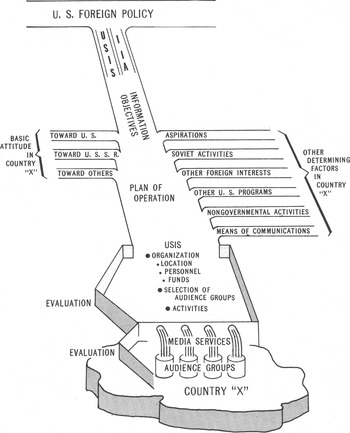
The government officials who planned cultural and informational propaganda sometimes imagined these programs as a unidirectional instrument by which the United States could exert a significant influence on its target countries. International understanding and “mutual respect” among peoples were always explicit aims of U.S. information programs, which might suggest an equality of exchange between partner countries. However, the short-term aim of combating Soviet propaganda about the United States meant that broadcasting the U.S. message to other peoples usually seemed more urgent than developing truly mutual cultural exchange. With the exception of the Soviet-U.S. exchanges that were regulated by treaty, the United States sent out more musicians than it received as guests.Footnote 3 A 1953 pamphlet published by the International Information Administration (IIA) offered a diagram depicting U.S. cultural and information programs as water flowing directly into a vessel labeled “Country X.” This image literally invokes the idea of “cultural flow” from the United States to other places (Figure 1) and suggests that U.S. propaganda could be vastly influential abroad.Footnote 4 Viewed from Eisenhower-era Washington, the tours were a relatively simple means to improve the country's image. According to this picture, the presence of friendly musicians would pour ideas and values from the United States into the minds of the foreign public, making them more receptive to U.S. policy objectives.Footnote 5
Diagram depicting the flow of information into “Country X.” From IIA: The International Information Administration Program, Department of State Publication 4939, International Information and Cultural Series 32, released April 1953, p. 8.

The simplicity of this concept, however, belies the complex purposes and effects that were manifest in cultural presentations. The programs were described in the clearest and most unidirectional terms in part to appease a bureaucracy that demanded demonstrable results to justify their continuation. To secure funding from Congress to continue the Cultural Presentations program, the State Department had to produce regular reports about the effectiveness of the tours. These reports described how cultural presentations programs altered public opinion abroad by demonstrating the sophistication and worth of U.S. culture; whenever possible they related the performers' achievements to concrete propaganda objectives.Footnote 6 Nonetheless, it would be a mistake to assume that these reports accurately represented the views and purposes of everyone who participated in planning the programs, let alone all the other people involved. In particular, the Foreign Service officers who made local arrangements for concerts abroad readily acknowledge that even under conditions specifically prepared for diplomatic effect, presenting culture from the United States to foreign audiences may not achieve concrete propaganda objectives. The undeniable value of artistic presentations in acquainting people with American culture is complicated by the uncontrollability of the outcomes. According to longtime Foreign Service officer William Morgan, this unpredictability actually became an asset because it increased the excitement and interest of everyone involved and set the performance at a remove from direct political action. In Morgan's experience, audiences were aware of and appreciated this open-ended quality.Footnote 7 Ron Post, a musician who toured for the State Department and later became involved in cultural exchange during his Foreign Service career, believes it was not primarily a matter of conveying a message: The aim was to “create the conditions for understanding.”Footnote 8 The difference between the view from Washington and the view from the diplomatic field seems a crucial one for understanding the accomplishments of cultural presentations.
Keeping in mind this tension between unidirectional “effectiveness” in achieving U.S. propaganda objectives and the unpredictable effects of bringing music and musicians to new places, the case study presented here examines in detail the University of Michigan Jazz Band's 1965 tour of Latin America and the Caribbean in order to describe the “cultural presentations” phenomenon from a perspective other than that of official reports. Through oral history interviews as well as examination of written records, audio recordings, and photographs of the tour, it becomes clear that the musicians who toured for the State Department had a much less coherent experience than the Department's typical “Evidence of Effectiveness” reports might suggest; they adapted on the spot to a vast variety of audiences, communities, and political situations. The political results of the band's activities did not conform to the IIA's diagram of mass influence: As we will see, the band's presence seems to have had political effects of a variety of kinds, but influence on the culture as a whole seems to have been the least of these. Rather, the band's most conspicuous achievement was that it opened new channels of communication among members of select groups of people, including embassy staff, Latin American students, and jazz fans.
It is important to understand the nature and extent of this communication because it plays a central role in our own assessment of U.S. cultural diplomacy as a practice. In a study of government-sponsored tours by jazz musicians, Penny Von Eschen claims that U.S. officials had no interest in reaching “the man on the street” in the global south, and that the State Department never anticipated that musicians and audiences would interact.Footnote 9 These claims support an interpretation of U.S. cultural programs as imperialist impositions rather than as a form of engagement. Yet, as we will see in the case of the University of Michigan Jazz Band, the musicians were specifically briefed to prepare for interaction with the public, and their presence fostered a variety of personal connections that furthered U.S. interests. Moreover, whatever the intentions in Washington, the touring musicians entered contexts in which those intentions could not play a determining role in events; the evidence presented below suggests that local relationships and values were more significant in determining the band's impact. As we will see, a close examination of the band's interaction with Latin Americans renders problematical the perception that the tours were strictly a one-way, imperial policy instrument—for these performances changed not only the target audiences, but also the students who toured and even the musical landscape to which they returned after their trip.
That the IIA used the metaphor of “flow” to describe cultural presentations tours is noteworthy because “flow” is now a central metaphor in globalization studies. Cold war political pressures caused governments to push or pull culture across borders as part of the effort to win the war of ideas and thereby influence populations; yet the relationships between governments' international information and aid activities and the emergence of cultural globalization have not yet been studied in detail.Footnote 10 Kenneth Osgood has noted that after the U.S. government's large-scale propaganda programs of the 1950s failed to change international public opinion, officials increasingly turned to “softer” propaganda methods, such as cultural diplomacy and public information programs, that would affect attitudes over a longer time horizon.Footnote 11 If the diplomacy of ideas that arose in the 1960s was more limited in its ambitions than the direct propaganda of the 1950s, it was also conceptually closer to our contemporary idea of globalization: In 1965 Edmund Gullion, the former U.S. ambassador to the Congo, described the “transnational flow of information and ideas” as “central to public diplomacy.”Footnote 12 Of course, many kinds of non-state actors, especially corporations, played key roles in the movement of culture across borders during this period; yet the channels of communication built by government-sponsored musicians may well be part of the same story. It is thus worth asking to what extent cold war cultural diplomacy may have contributed to cultural globalization. To assert a link between the two poses a challenge to those who regard globalization as the order that arose to replace the cold war system and as a development predicated on technological communication.Footnote 13 The story of the University of Michigan Jazz Band recounted here is therefore not merely a study in propaganda methods and effects; it is an attempt to understand the transnational projects engaged in by governments during the cold war and to examine closely the particular relationships engendered by cultural diplomacy.
Musicians on the Road
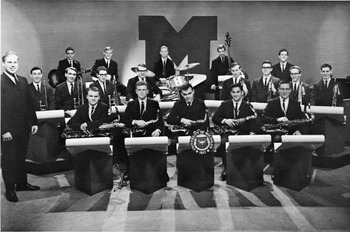
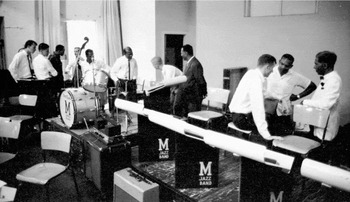
From January to May 1965, the University of Michigan Jazz Band traveled extensively in Central and South America and the Caribbean under the sponsorship of the State Department's Cultural Presentations program. The band (shown in Figure 2) was sent to demonstrate the excellence of student musicians in the United States and to make friendly personal contacts with Latin Americans, especially university students. Foreign students were a vital target population because university campuses were a major site of political unrest: Many students were inspired by Communism, and students typically played a major role in the political scenes of their respective countries.Footnote 14 In this period Latin America and the Caribbean were important battlegrounds for cold war ideologies, and cultural presentations were only one of many persuasive measures used in these regions by the United States and the Soviet Union.Footnote 15
The University of Michigan Jazz Band, 1965. Standing left, Bruce Fisher. First row (saxophones) Lanny Austin, Jack Kripl, Tom Asboth, José Mallare, Tom Berryman. Second row (trombones) Jeff Joseph, Dennis Garrels, Bill Benninghoff; (tuba) Brent Herhold; (trumpets) Doug Anderson, Ron Post, Rob Roy McGregor, Larry Davidson. Third row (guitar) Carl Passal, (percussion) Geoff Smith, (drums) Wilbur England, (bass) John Miller, (piano) David Lewitz. Photographer unknown. Photograph courtesy of Bruce Fisher.

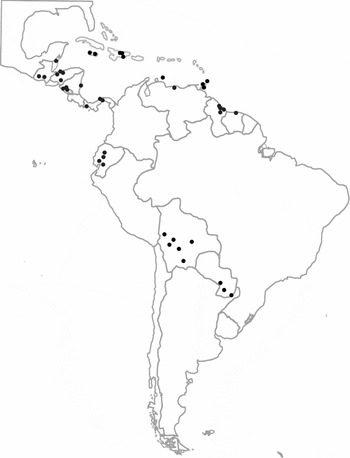
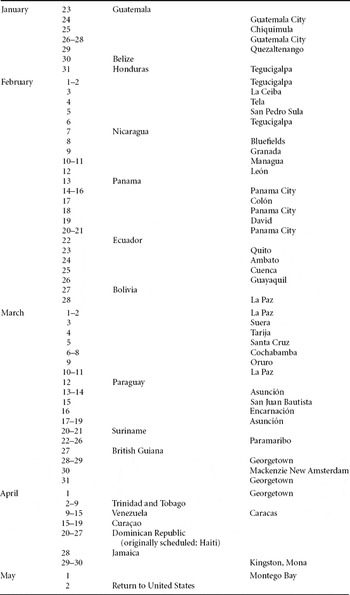
From the State Department's perspective, the tour was “an outstanding success.”Footnote 16 According to an official report, the band performed in forty-four cities and towns in fifteen countries; more than 85,000 people attended their performances, and the Department estimated that their radio and television audiences exceeded 2.5 million.Footnote 17 (See map, Figure 3. The band's itinerary is included as Appendix 1.) These successes were achieved in spite of serious challenges, including grueling travel up mountains and through forests to extremely inaccessible towns and villages; altitude sickness and other maladies; and a revolution in the Dominican Republic, during which the band experienced gunfire at close range and had to be evacuated by the United States military. In the words of band member Lanny Austin, it was “not a glamorous tour.”Footnote 18 Yet the nine band members who were interviewed in 2006 recall the trip as a high point of their lives.Footnote 19
This map shows key destinations on the band's itinerary. Because there were many side trips from the listed destinations and the itinerary was subject to change, the map is illustrative rather than definitive. Outline map from Fabiola Franco and Karl Sandberg, Spanish for Reading (New York: Barron's Educational Series, 1998), 81. Used by permission.

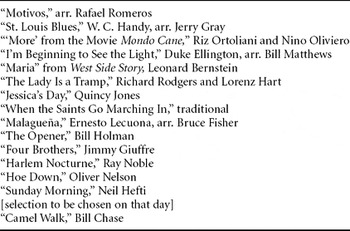
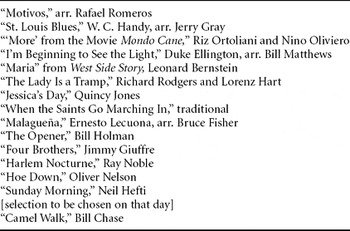
The State Department had already sent other student jazz bands on international tours by 1965, but was seeking to expand its programming of academic groups. Officials chose the Michigan jazz band on the basis of its strong performance at the Collegiate Jazz Festival at the University of Notre Dame in April 1964. (The tour was initially offered to Northwestern University's Jazz Workshop Band, which, like Michigan's jazz band, was not an official university ensemble. Northwestern refused to allow its jazz band to represent the university outside the country.)Footnote 20 Three members of the State Department's selection committee were present at the festival to search for groups to send abroad: Charles Ellison, director of the Cultural Presentations staff; Louis G. Wersen, a music educator; and John S. Wilson, a jazz critic. In their report they commented that although the judges of the festival preferred “new and weird sounds,” a cultural presentations tour would require a focus on more mainstream music.Footnote 21 At the festival the Michigan band had played a twelve-tone piece and a modal piece in 5/4 time; but the band's director, Bruce Fisher, recalls that the group didn't take any of their “far out stuff” on tour.Footnote 22 Fisher's usual goal was the bright, blaring Stan Kenton sound, but on tour the band played music in a wide range of jazz styles, from Dixieland and swing to new selections from Woody Herman's repertoire and a recent arrangement by Quincy Jones. (See Appendix 2 for a sample of the band's tour repertoire.)Footnote 23
The University of Michigan Jazz Band that played at the festival at Notre Dame was a racially integrated ensemble with one African American, saxophonist Bill Wiggins.Footnote 24 His involvement may have increased the band's appeal to the State Department, for Department officials actively sought to include both black and integrated groups in its tour programs to counter Soviet claims about the oppression of African Americans in the United States.Footnote 25 Wiggins did not remain with the band for the 1964–65 academic year, however, so the band that toured did not meet this criterion. It is not surprising that an ensemble based at the University of Michigan in the mid-1960s would lack students of color: Although School of Music ensembles had been integrated for some time, public universities in Michigan at this time were still populated overwhelmingly by white students. The university did not compile official statistics on race until several years later, but a 1967 estimate suggested that only about eight hundred students at the University of Michigan (2 percent of the student population) were African Americans.Footnote 26 The band members, many of whom admired and sought to emulate African American jazz musicians, recall that the band's ethnic makeup was coincidental rather than deliberate, and that students of color were always welcome in the band.Footnote 27 Several of the band members I interviewed expressed the opinion that in trying to convey abroad a sense of jazz as an American music rooted in African American traditions, the tour would have made a better impression had there been African Americans in the band. Yet I have found no evidence that they were censured on that basis by critics or audiences at any point during their tour.Footnote 28
As a result of racist attitudes about jazz as African American music and the tendency to belittle jazz as mere entertainment music that was inferior to the European classics, jazz had only a tenuous place in U.S. universities in 1965.Footnote 29 The University of Michigan was no exception. William Revelli, the director of bands, had never approved of jazz; the group had therefore been operating solely on student initiative, without support from the School of Music. Until they were offered the tour, they were not even granted rehearsal space on campus.Footnote 30 As Fisher describes it,
I went in and asked [Revelli] if he would be the faculty adviser to the University of Michigan Jazz Band. I stood there for half an hour while he screamed at me about how jazz was the music of the devil, it was the worst thing, it ruined people, only drug addicts and dope fiends played jazz, it was the worst thing that ever happened to music. . . . I was about an inch tall by the time he got done, and then he said, “Yeah, I'll be the faculty adviser.” This was 1961. Do you know the first time he heard the jazz band? It was when we got the South American tour. He never even heard it [until then]: he hated jazz.Footnote 31
When the State Department contacted Revelli to ask about the possibility of a tour, he referred them instead to the dean of the School of Music. Although Revelli had worked with the State Department on the University of Michigan Symphony Band's tour to the U.S.S.R. in 1961, he was apparently unwilling to promote the student-led jazz ensemble.Footnote 32 The tour was ultimately arranged with the dean's support; musicology faculty member Richard Crawford was recruited to supervise the students, and the band left Detroit for Guatemala in January 1965.
The band's performances were arranged by the U.S. embassies in the countries they visited and included short concerts in public squares at no charge; free concerts for university or secondary school students; and, one to three times a week, full-length concerts with paid admission in local theaters. The theater concerts were typically played to packed houses and attended by high-ranking officials as well as the general public.Footnote 33 At times the band split into two combos that traveled separately for a day or two; on one occasion, in British Guiana (now Guyana), a three-passenger Cessna airplane delivered a combo to a remote mining town in multiple trips, including one in which the neck of a string bass stuck out a window of the aircraft.Footnote 34
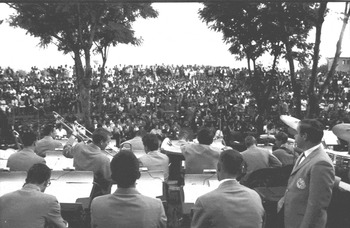
The audiences for the band's performances abroad were large and heterogeneous (Figure 4). Some listeners were extremely poor, but others had enormous record collections.Footnote 35 In some of the areas visited by the band, such as Caracas, jazz was well established; in other regions it was apparently still little known.Footnote 36 One band member complained in writing that some audiences “had never heard jazz before and had no idea of what we were trying to do.”Footnote 37 Rural listeners in particular did not always know what to expect; Austin reports that the opening number “scared the hell out of them; they looked at us in horror covering their ears.”Footnote 38 Ironically, this number, Rafael Romero's arrangement of “Motivos,” had been selected for its Latin flavor as well as its energetic style (audio example on www.journals.cambridge.org/sam2010004). Several band members also recall being surprised when their audiences responded with whistling or silence instead of applause.Footnote 39 The band addressed this situation in a variety of ways. They leavened their performances with physical humor that they themselves found hokey: During the big diminuendo of “In the Mood,” the saxophone section sank lower and lower behind their music stands to elicit a laugh.Footnote 40 At the suggestion of the embassies, they played their own arrangements of national anthems and local melodies. Often listeners were moved by hearing their own music performed by visitors, although sometimes audiences failed to recognize their own tunes in a jazz arrangement.Footnote 41 Crawford not only chaperoned the band, but also served as master of ceremonies for the concerts: He worked up Spanish-language introductions and engaged the crowds with references to objects of local pride. Perhaps most importantly, the band included their most accessible numbers on almost every program: “When the Saints Go Marching In,” “In the Mood,” “A Hard Day's Night,” and their special version of Woody Herman's “Camel Walk,” in which bassist John Miller sang an account of the tour, complete with a growing list of all the places they had visited.Footnote 42 Reviews of the concerts in Latin American newspapers show that audiences throughout the tour consistently favored the Dixieland numbers.Footnote 43 One student band member objected to these selections in his written comments after the tour, saying that “pleasing is important but education more so.”Footnote 44 Still, most of the players recognized the need to entertain, even if pleasing their audiences meant they would not always play the modern jazz that many of them preferred.Footnote 45
According to State Department estimates, large crowds were common. Photograph courtesy of Lanny Austin.

On the other hand, the band was deeply impressed by the audiences they found in Caracas and Quito, urban centers where jazz had long flourished. John Miller compared Quito to Paris: “They were the most sophisticated, well-dressed, hip audience I'd ever seen.”Footnote 46 Several band members also recall that at almost every concert on the tour, even rural ones, they would encounter one or two extremely knowledgeable jazz fans who were eager to talk with them about the details of modern jazz. As Lanny Austin described it:
You'd think you're playing to an audience of [musical] dullards, but there'd be one guy who was this monster musician. . . . You'd want to cut the concert short, then later realize someone really astute was in the audience. People would approach the band during and after concerts—there would be Q and A after concerts, questions about instruments, what is that instrument, what is different between that and the others, all the questions you could have, then all of a sudden somebody says, “I notice you played all minor blues—don't you do any major blues?” A question that shows there is someone out there who knows.Footnote 47
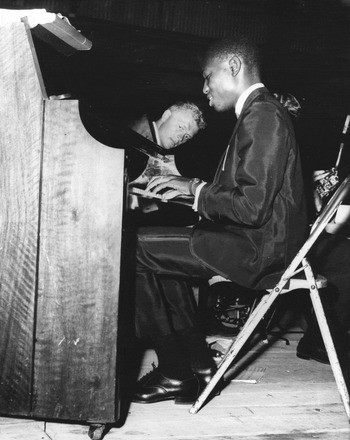
Audience members in various places requested that the band play selections by Thelonious Monk, Benny Golson, Charles Mingus, and Gerald Wilson.Footnote 48 In the remote mining town of Mackenzie, British Guiana, a band member was asked to discuss Ornette Coleman's style. In many cases record collectors would invite band members to their homes after performances to talk about recordings.Footnote 49 Post characterizes the jazz band they heard in Caracas as “better than we were.”Footnote 50 In Trinidad they met the pianist Felix Roach, who sat in with the band and received warm recognition from them (Figure 5). In places where jazz was already well established, the expert fans may have represented local jazz traditions, but in many cases the existence of such experts likely reflected another U.S. propaganda effort: the broadcasting of jazz on Voice of America radio, especially Willis Conover's “Music USA” program.Footnote 51 The band's visit brought together fans and musicians in a way that seems to have been highly significant to those who sought out the band. The selection committee erred in its judgment about the inappropriateness of “new and weird sounds,” for many of these fans would best be reached by modern jazz, and the band's mixed programs were a key to their success. As a music with popular elements that also encouraged thoughtful connoisseurship, jazz was uniquely able to reach both novices and experts, making it extraordinarily versatile as an instrument of cultural diplomacy.Footnote 52
Jazz pianist Felix Roach performed with the band during their concert at the Chinese Association in Port-of-Spain, Trinidad. Jack Kripl looks on. Photographer unknown. Photograph courtesy of the Bentley Historical Library, University of Michigan, Ann Arbor, Michigan (Richard Crawford Papers, box 1).

These impromptu conversations and transient personal contacts were also among the most meaningful aspects of the tour for the travelers, some of whom learned a great deal from the fans. Crawford recalls a conversation on the trip that changed his own understanding of jazz:
It might have been in Curaçao—it was either there or some other island republic—but this guy—this collector—was a big Ellington fan. . . . This collector said, “You know, your sax section is pretty good, but the sound I like in a sax section is Ellington.” And one of the guys in the band said, “Well, Ellington's sax section plays out of tune.” And, oh man, this guy had an ear—he was absolutely right—he said, “That's what makes the Ellington sound distinctive. You can hear two bars of the Ellington [Crawford hums]—that's all you need to hear. You know it's Ellington, and it's because he wanted everybody to play in his own way, and he never tried to synchronize the vibrato. This is one of the things that certain swing bands always did—they'd play as one—so you'd get this uniform sound from top to bottom—actually, Basie was a little bit into that—and certainly that was the Glenn Miller applesauce sound. You could put anybody into that spot, and if they could read music and listen a little bit, in three days they'd have it. But with this Ellington thing, you had these vibratos that were kind of up against each other—so they had this incredibly exciting sound, and this made such an impression on me. . . . As a sax player I had always been thinking, “You know, I don't love Ellington,” and I think maybe one of the reasons was that I never understood what it was about that sound.Footnote 53
In Crawford's later research he wrote with deep appreciation about the particulars of Ellington's sound and the roles of individual members within the band.Footnote 54 To consider cultural diplomacy a one-way flow of ideas from the United States to other places, as suggested by the State Department document cited above, would be to miss the rich dialogue among musicians that was made possible by the tours, as well as the education the U.S. travelers picked up along the way.
Politics on the Road
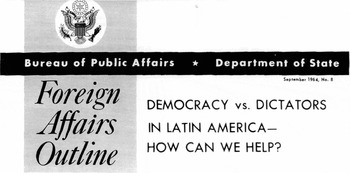
All the band members interviewed for this project recalled that even though they were instructed on how to behave politely in each country, they were not given explicit political messages to convey. However, the State Department did send political “background” information for band members to read, pamphlets with titles such as “Democracy vs. Dictators,” “Why We Treat Different Communists Differently,” “Alliance for Progress,” and “U.S. Policy toward Cuba.”Footnote 55 One band member, Joe Mallare, not only remembers the pamphlets but also still has one in his possession (Figure 6).Footnote 56 Nevertheless, Crawford and Mallare recollect that they were probably distributed right before winter break, and that the students were unlikely to have read them.Footnote 57 Dennis Garrels told me that any political briefing was taken as a joke; and Brent Herhold recalls that another band member protested, saying, “What do we care about this stuff? We're going to play.”Footnote 58 Several of the band members report that by 1965 they had strong antiwar feelings, but that the government didn't ask them about their political views, and such personal opinions seemed irrelevant to the tour. The students felt that they were representing not the U.S. government, but the nation.Footnote 59
One of the pamphlets given to the band before their tour. Courtesy of Joe Mallare.

Comments the students wrote after the tour indicate that they did receive a detailed political briefing, but that they were not inclined to use this information. One student called the pre-tour orientation “more than sufficient” and complained that too many acronyms for specific organizations were introduced during the orientation: “the talk on the [Latin American] University student organizations—the ‘alphabet soup'—could have been eliminated entirely.” Another commented that “we do not need to know the political climate of each country during orientation. It all became confused.”Footnote 60 Michael Boerner, then Cultural Affairs Officer at the U.S. Embassy in La Paz, Bolivia, found the students politically naïve at best; Boerner felt that they did not care enough about local politics.Footnote 61 According to Austin, the band was also told not to worry about making a political statement, but just to “be themselves” and bring some good will. Crawford characterizes the tour not primarily as ambassadorship but as “a bunch of musicians on the road,” and Garrels agrees with this assessment.Footnote 62
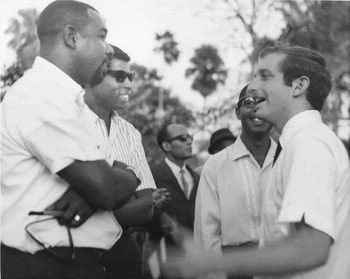
The question of language skills compounds the uncertainty about the band's capacity for political communication. Barely three months had passed between Ellison's initial invitation in October 1964 and the band's departure in January 1965, leaving the musicians little time to study the languages and cultures of the places they would visit. Only a few band members spoke Spanish; therefore, political communication would have been limited to contexts in which their interlocutors spoke English (such as Trinidad and Tobago [Figure 7] or British Guiana), although translators were provided for many of the band members' outings as tourists, and many university students were able to converse in English. Crawford recalls most of the occasions for person-to-person exchange as involving socializing and dancing rather than political conversation, and reminiscences about band members' flirtations with female admirers in Nicaragua and Honduras suggest that although opportunities for conversation were ample, politics may not have been the primary topic. Brent Herhold, who apprenticed himself to escort officer Thomas Huff, remembers having a great deal of contact with local people at every stop as they made arrangements to move the band's equipment and luggage.Footnote 63 If we allow that all direct personal contact offers the opportunity to make an impression, it seems that such opportunities were plentiful.
Bassist John Miller in conversation with jazz fans after the concert at the Botanical Gardens, Port-of-Spain, Trinidad and Tobago. Photograph courtesy of the Bentley Historical Library, University of Michigan, Ann Arbor, Michigan (Richard Crawford Papers, box 1).

Band members disagree about the extent of anti-U.S. sentiment they encountered on the tour. Some do not recall any outcry against the United States, or even any political discussion.Footnote 64 Others remember moments of overt protest: anti-U.S. signs in Panama; shouts and jeers in Cochabamba, Bolivia; and cries of “Castro sí, Yankees no.”Footnote 65 Post, the trumpet player who later entered the Foreign Service, recalls that the embassies instructed the band not to respond to these protests, and that no harm came to anyone. He also recalls a more explicitly political experience in Caracas. The Michigan band's concert at the Central University of Venezuela had been canceled because of a strike by Communist students. (The band had been denounced by a Communist daily as “imperialist culture”; however, the conflict on campus was not due to the band's presence, but to the death of a student protester in anti-government riots the previous week.)Footnote 66 Post tells the story:
As I wended my way down the seemingly endless, dark streets of a residential area—a very middle-class area—there was some jazz coming out of a house, and it sounded like it was live. So I went up to the house and said, “I'm with the U of M jazz band, and I'm a bit lost and trying to find my hotel.” They were practicing for a jazz festival; they invited me in and pretty soon whisked me off to a jazz club in the city. We heard musicians there, and they were very good. They said, “We're having a concert at the University on Sunday; why don't you come?” And I thought that was a little strange because we were supposed to have played at the university, but they had had protests, so they wouldn't allow us to play there. But they invited me; so I invited a couple of the other band members and we went to the University of Caracas for the jazz festival. I was seated with the president of the jazz and drama club, who got up at intermission and gave a harangue against America and the American jazz band. It was really something—they were protesting us but they had invited us to this thing. But it was all good feeling, you know, and we got along with them fine. I leaned over to the guy next to me and said, “What's going on?” He said, “Well, this is sort of the political aspect of the thing, but don't pay attention—it's just what we do.” It was quite an experience.Footnote 67
Post continued his reminiscences:
Then the next day, of course, I invited them to our concert which had been moved from the university that Sunday to a bowl outside the city. So many people came to the concert that we had to actually go out to play rock ’n’ roll for a while, because people were still streaming in and the people who'd been there for a long time started clapping, asking us to perform. . . . There were about 8,000 people at that concert and it was just a fantastic experience—you get inspired from something like that—so we played really well, they loved us, and there were all the guys from the jazz and drama club, which I later learned was the Communist front of the university. We had a great time with them again.Footnote 68
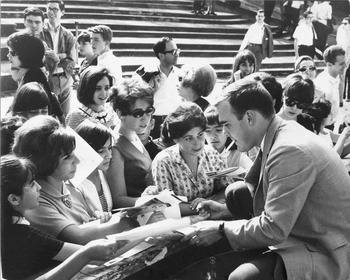
Post insists that the visiting band members weren't made to feel uncomfortable: “It was so matter of fact, although the speech was given with a good deal of vigor as I remember it—they certainly weren't angry at us; they treated us very well.”Footnote 69 Despite the political furor at the university, the Caracas concert was very successful and aroused significant enthusiasm among students there (Figure 8). This mixture of personal hospitality with political hostility demonstrates the political ambiguities of student-to-student contact.
Saxophonist Tom Asboth signs autographs after the band's performance at the Concha Acústica, Caracas. Photograph courtesy of the Bentley Historical Library, University of Michigan, Ann Arbor, Michigan (Richard Crawford Papers, box 1).

Nevertheless, the presence of the Michigan jazz band did markedly alter at least one situation within a Latin American university. According to Boerner, the Cultural Affairs Officer in La Paz, the process of preparing the concerts could be as important as the concerts themselves. The Michigan band's visit was the embassy's first successful attempt to organize a cultural event on the campus of the Universidad Mayor de San Andrés in La Paz. To make arrangements for the band's performance at the university, Boerner enlisted the cooperation of a small group of influential student leaders; little could be accomplished on the campus without these leaders' consent.Footnote 70 The student leaders valued the jazz band's presence because so many students would enjoy jazz, and bringing good music to campus would reflect well on the leaders. From Boerner's point of view, the tour was a way to “get into the university” and make constructive contact with these influential students. In this case the relationship was fruitful: After the Michigan band's departure, Boerner continued to cultivate relationships with the student leaders, and he eventually was able to arrange for a group of them to travel to the United States, despite the difficulty of obtaining visas for political radicals. That trip, in turn, made a deep impression on the students; they were enthusiastic witnesses to an election in New York, and Boerner believes they felt more friendly to the United States after their return to Bolivia. According to Boerner, the jazz band's tour was not an opportunity to promote U.S. culture: It was a means of making productive contact with politically important individuals who otherwise would have had nothing to do with U.S. citizens, least of all embassy personnel. Yet the appeal of jazz was vital to the success of this project, for the cooperation of the student leaders was won only because bringing good music to campus allowed the leaders to demonstrate their effectiveness in improving student life. The prestige factor of the event was essential.Footnote 71 Like Boerner, the band members understood their interaction with the student leaders as something of an icebreaker. Both Austin and Mallare report that the student leaders helped them carry their equipment as they prepared to leave La Paz. Several members of the band felt that the rapport they had developed constituted a political success of sorts; in Mallare's words, “They saw we were normal people.”Footnote 72
In other situations, the tour was clearly beneficial to U.S. relations with the Latin American public. Susan Migden Socolow, who was Assistant Cultural Affairs Officer at the U.S. Embassy in Paraguay during this period, explains that the band's presence in the secondary cities of the country, far from the embassy in Asunción, allowed those citizens to feel that the embassy, and by extension the United States, was present and attending to them. In rural places people were surprised and grateful that anyone had come at all: These people felt flattered that the embassy thought them important enough to send them musicians, and good ones at that.Footnote 73 Thus, through the gift of a musical performance, the U.S. government encouraged some Latin American citizens to imagine themselves in closer relationship with both the United States itself and its ambassadors.Footnote 74 This practice was standard: Harry Hirsch, who served as escort officer on many cultural presentations tours, wrote that “usually, [Cultural Affairs Officers] use these up-country trips to cement their relations and connections with the locals.”Footnote 75 Socolow reports that the effects of this work were significant and possibly long-lasting; she continued to receive favorable comments for months after the end of the tour.Footnote 76
Another means of influencing public opinion included personal and economic factors, for audience members could make judgments about the United States based on what they saw of it through the band. The Michigan students were young, clean-cut, musically well educated, and glad to be there. The quality of the playing was impressive; furthermore, Bruce Fisher told the press that there were four or five other universities in the United States with “better quality bands” than this one, thus making it apparent that this level of musical education was flourishing not just at Michigan, but all over the country.Footnote 77 The band members gave some clinics, mostly at secondary schools; they were generally disappointed by the level of student music making and especially the lack of playable instruments. By contrast, the band carried excellent instruments; audiences asked many admiring questions about the instruments after performances and at the clinics (Figure 9).Footnote 78 The overall impression, therefore, included the affluence of the United States—a significant message in an era when foreign aid swayed governments to align with the United States or its rival, the Soviet Union.Footnote 79
Band members discuss their instruments at a clinic. Photograph courtesy of Lanny Austin.

At the same time, the band's obvious affluence could also be a complicating factor in interpersonal relations. The college-age youths, unschooled in diplomacy, entered situations in which colonial power relations profoundly affected local customs. In Suriname the band visited a place where people were dressed in native costume. As Crawford tells it, “There was a young woman there who had enormous uncovered breasts. . . . She knew two words if you approached her with a camera: ‘PAY ME.’ You had to fork over money to have the right to photograph her.”Footnote 80 Several band members did take pictures, and they now recall this incident with a mixture of embarrassment and rueful humor. In this context the band could hardly fulfill its diplomatic role of making positive, meaningful connections with local people: The colonial expectations that cast the band in the role of white, wealthy tourists made it difficult for them to establish relationships of other kinds. This incident was unique in the personal accounts I heard from band members; but it is difficult to know whether the band might have inadvertently and unknowingly created similar situations in other places.
Michigan in the World; the World in Michigan
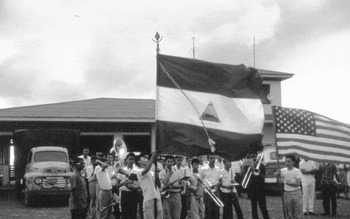
As Socolow's remarks suggest, the presentations of the University of Michigan Jazz Band encouraged Latin Americans to see themselves as personally connected to the United States and its representatives. In much the same way, the tour encouraged the members of the band to find Michigan in the world. When Austin met the U.S. ambassador to Panama, he found out that the ambassador had known his father and stepfather back in Michigan. Odder still, when the band arrived at the airport in Bluefields, Nicaragua, an isolated town of 10,000 people, they were greeted by a ragtag group of musicians holding Nicaraguan and U.S. flags and doing their best to play “The Victors,” the University of Michigan's fight song (Figure 10).Footnote 81 A Nicaraguan who had studied at Michigan had arranged the trip to Bluefields and had tried from memory to teach the local musicians the fight song. The tune had escaped him; he just remembered it as “very fast.”Footnote 82
In Bluefields, Nicaragua, the band was greeted by a rendition of “The Victors,” the University of Michigan's fight song. Photograph courtesy of Rob Roy McGregor.

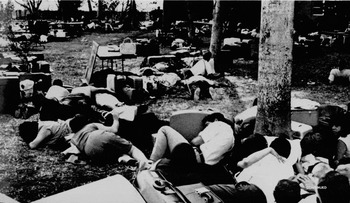
Apart from these moments of recognition, the event that most dramatically made the traveling students feel connected to worldwide political events was the revolution in the Dominican Republic. Toward the end of the tour, the band had been scheduled to travel to Haiti, but these appearances were canceled for political reasons. The autocratic president of the country, François “Papa Doc” Duvalier, had studied public health at the University of Michigan twenty years earlier; rumors that he planned to present the band's visit as an official endorsement of his regime by his old university prompted the State Department to eliminate that stop and substitute the Dominican Republic.Footnote 83 The band played three successful concerts in and around Santo Domingo, but their radio interview and concert on 24 April were canceled because rebels had taken over part of the city. At first, the band was told to remain in the downtown Hotel Jaragua; they watched the military conflict from the hotel balconies and roof, eating mangoes that grew outside the hotel as the food ran out. When they were ordered to move to a different location as the fighting threatened the downtown area, a few band members and one of the embassy staff were allowed to go at night to retrieve some instruments from storage; but ultimately many of the larger instruments and equipment were lost. They found the new hotel, the Hotel Embajador, packed with U.S. citizens preparing to evacuate. On the night of 26 April they received instructions to assemble on the lawn early the next morning. As they waited among throngs of other Americans, rebels came into the hotel and fired shots at a fleeing man; everyone dropped to the ground, seeking cover from the gunfire (Figure 11). The fighting at the hotel was brief and targeted only the fleeing man, not the cowering visitors.Footnote 84 After leaving the hotel, the band was evacuated to Puerto Rico by a Navy ship. On 28 April, the day after the band left the island, the United States invaded the Dominican Republic.
Band members and other Americans take cover from gunfire at the Embajador Hotel. Photograph by J. P. Cooper from Life 58/18 (7 May 1965): 85. Copyright © 1965 J. P. Cooper. Despite a good faith effort to locate the photographer, I was unable to do so.

As they think about their experiences, two band members wonder even now whether the State Department knew about the uprising in advance, sending them into harm's way as an excuse for the invasion.Footnote 85 Curiously, the group's escort officer, Tom Huff, had left them to travel on their own in the Dominican Republic, planning to rejoin them in Puerto Rico: Huff's absence only underscored the students' perception that the revolution had been anticipated.Footnote 86 Although no known archival records support the theory that the band was purposefully sent to the Dominican Republic in anticipation of the revolution, the destination was clearly risky: The CIA did foresee an uprising as a “definite possibility.” A memorandum from the CIA's Office of Current Intelligence named the Dominican Republic as the Latin American nation with the highest threat of civil war and described the possibility of a coup with “little or no warning.”Footnote 87 The students in the band were not incorrect to see themselves as part of this story: The incident at the Hotel Embajador “proved to be a major reason for President Johnson's later decision to land the Marines.”Footnote 88 Johnson justified the invasion publicly by citing the safety of U.S. citizens, although historians have cast considerable doubt on the validity of this justification.Footnote 89
As the band members talk about the revolution today, they convey a sense of mystery and drama in being part of an event of worldwide political importance that they did not fully understand. There were many smaller mysteries, too. For instance, they noticed throughout the tour that their visits were more significant for local politics in some places than in others, but they were never told of the political objectives that they were sent to fill.Footnote 90 Furthermore, when they received reimbursement for their lost instruments, the checks came not from the government, but from a private account in Virginia, with instructions not to tell anyone about the reimbursement.Footnote 91 Some of the band members learned a few years after the tour that one of their hosts had been a CIA operative.Footnote 92 These experiences taken together reinforced the feeling that they were bit players on a vast stage, participating actively in world politics without fully understanding their role. Like the imaginary connection forged between villagers and the U.S. embassies, this imagining of the self links the personal with the global.
These global experiences also returned with the band to Michigan. Their new audience-pleasing skills and the musical insights from the people they had met lingered with them. For most of the band members, this trip was their first time abroad, as well as their first sustained encounter with people of color. The dichotomies between modernized and traditional ways of living left a vivid impression on the students: Miller reported that the band would attend receptions “out of the pages of Cosmopolitan magazine—but then walk out to get on the bus, and see donkeys, as uncosmopolitan a scene as it could be.”Footnote 93 Rob Roy McGregor explained that the tour helped break down racial barriers: After the tour, he was more likely to strike up conversations with African Americans.Footnote 94 Post chose his Foreign Service career as a result of the tour. The band shared their remarkable stories about the revolution with friends and family, in interviews with the press, and at their post-tour concert, where John Miller sang a version of “Hard Day's Night” that included a rapid-fire description of the incident at the Hotel Embajador.Footnote 95 In these ways the tour added a global perspective not only to the band members' individual lives, but also to their communities in Michigan.
Furthermore, the tour may also have helped jazz to gain a foothold at the University of Michigan. Although William Revelli offered no support for the jazz band, he received accolades for its success: He was credited in the international press as the band's sponsor and was photographed with the band after its return.Footnote 96 Wilbur England recalls the band's homecoming concert as triumphant and warmly received, and the dean praised the group's performance in a faculty meeting.Footnote 97 The group did not immediately win official recognition as a university ensemble, however, and they returned to much the same situation they had left. School of Music publications highlighted the State Department-sponsored Soviet tour of Revelli's Symphony Band for more than ten years after the 1961 event, while the jazz band's tour went unmentioned in those publications.Footnote 98 The lack of recognition from the university is still a sore point for several members of the band. Nonetheless, it may be that the imprimatur of the State Department bettered the band's situation both by encouraging the students to stick with the project and by calling the institution's attention to the students' achievements. Beginning in 1971, the year Revelli retired from the university, jazz band was offered as a course for credit in the School of Music.Footnote 99
Cultural Diplomacy as Cultural Globalization
The University of Michigan Jazz Band's foremost diplomatic achievement was the building of international connections. Conversations with jazz fans in many countries cemented the visitors' respect for these fans and reinforced the already strong appreciation for jazz that the fans had acquired through radio and sound recordings. The band's presence seems to have been a catalyst for political unrest among Latin American students, but also an occasion for interested personal contact. The band helped to strengthen the connection between the embassies and the surrounding populations, providing a form of personal attention that flattered the citizens with the feeling that they mattered to the United States. Likewise, the band members began to regard themselves not only as U.S. citizens, Midwesterners, and musicians, but also as participants in a broader sweep of activity that included the CIA's intrigues and U.S. relations with other peoples. Even the University of Michigan's gradual recognition of the jazz band reveals a reluctant awareness of the national and international reputation a State Department tour could bring. All of these connections offered the band members and their audiences a new way of seeing themselves not only locally, but also in an international arena. John Tomlinson has argued that globalization is not primarily about mobility or even direct communication, but about altering local contexts and changing the frame of reference in which people think.Footnote 100 This shift in thinking, changing people's understanding of their places in the cold war world by adding an international element to their local experiences, was a subtle but important outcome of the Michigan band's tour.
Imagined connectedness of this kind is generally taken for granted today: The “rapidly developing and ever-densening network of interconnections and interdependences” is a frequently noted feature of the globalization that characterizes modern social life.Footnote 101 International communication has a long history, of course; yet the particular form of cultural diplomacy practiced during the cold war offers valuable insight into the creation and significance of global ties. In the case of the Michigan jazz band, technological mediation via radio and sound recordings had already formed an international musical connection (witness the jazz fans' knowledgeable remarks); but the opportunity to make personal and tangible connections with people from afar was still a novelty in the more remote areas the band visited. Although many of the contacts created by the tour were transient, the positive feelings, the lessons learned, and even some of the relationships forged through the tour seem to have had enduring significance for some of the participants. It is striking that even though fans already had access to jazz, they eagerly sought out the opportunity for conversation with the Michigan students. Anna Tsing has commented that in discussions of globalization, scholars have tended to valorize cultural “flow . . . but not the carving of the channel” that enables that flow. In the activities of the Michigan jazz band we can see the creation of precisely these channels of communication.Footnote 102
As Tsing's formulation suggests, understanding the cultural presentations tours of the cold war years in terms of globalization usefully shifts the terms of discourse about globalization from a focus on technological mediation (the “how” of global connectivity) toward the political interests that fostered the creation of global connections (the “why”). Kenneth Osgood reports that in the early 1960s U.S. propagandists were moving away from persuading foreign publics to support specific political ideologies toward cultivating a generally positive image of the United States and creating bonds of affection and respect.Footnote 103 These softer aims could be achieved only by building a sense of connection, a project for which cultural presentations were well suited. Even if the relationships that were built during the tours differed in some respects from what officials in Washington envisioned when they first funded the tours in the 1950s, these transnational connections did serve U.S. interests; they also fostered the sense of self within a global scene that characterizes globalized culture. To draw on Tsing once more: What is noteworthy is not the mere existence of cultural flow, but rather that U.S. government officials saw how important this flow could be for national security and political persuasion and actively sought to carve the channels that would promote it. The open channel created by these newly created relationships could be used for many purposes, good or ill, or even both simultaneously; but first the channel had to exist.Footnote 104 The case study considered here suggests a broad understanding of globalization as the creation of real and imagined connections across borders, regardless of medium (broadcast, personal contact, or—as in this case—both).
Cultural Diplomacy “On the Ground”
The “on-the-ground” view of the Michigan jazz band's experiences offered here also provides an unusual vantage point from which to view the tangled ethics surrounding the proliferation of U.S. culture in other parts of the world. Since the 1960s many commentators have described U.S. cultural relations with other nations as “imperialist,” implying that state-cultivated cultural connections were malign in intentions and results, with strong overtones of colonial domination. This view has recently been challenged by scholars who use more neutral terms such as “cultural transfer.”Footnote 105 Richard Kuisel wisely suggests a middle ground between these two positions, taking into account the mutual influences that come with cultural exchange while at the same time recognizing that the extent of U.S. political power prevents exchange from occurring on equal terms.Footnote 106
If we look at cultural diplomacy from a “top-down” perspective, considering primarily the motivations of states in sending artists abroad, it is easy enough to identify an imperialist impulse behind musical exports. Indeed, the diagram in Figure 1 suggests a startling vision of power over the informational and cultural life of Country X. Yet if we focus our attention not on the planners' hopes and imaginings, but instead on the day-to-day activities of the musicians on tour—seeing the tour from the “bottom up”—little of the coercive power depicted in that diagram is apparent. In the University of Michigan Jazz Band's tour, we encounter cultural diplomacy not as a wholesale cultural invasion, but rather as several simultaneous and voluntary forms of engagement: encouragement of subcultural groups who become more attached to a particular style of American music; establishment of practical working relationships with people of local importance; and outreach to the general public, serving as a gesture of friendship from the local embassy.Footnote 107 The disparity between the top-down and bottom-up visions is striking: Each is revealing in its own way, but neither by itself provides a complete picture of musical presentations as a form of cultural engagement. Because the experiences of musicians and audiences constitute the front line of cultural diplomacy, we should consider their impressions as seriously as we do the motivations of those who planned the tours. Given the large number of people who had a stake in musical diplomacy—officials from several government agencies in Washington, Foreign Service officers in the field, musicians and their promoters, audience members, and members of Congress, among others—it should not surprise us that the tours presented many different and contradictory implications rather than a coherent ideological program.
A factor that complicates any judgment of cultural presentations as “imperial” is that cultural products can be pushed across borders by a great power, but also pulled in by listeners—and these phenomena are rarely distinct. The attractiveness of jazz to Latin American fans is hardly separable from the power of the United States, from press reports about its racial politics, and from its own propaganda programs that spread jazz, such as Willis Conover's “Music USA.” Theories that seek to demonstrate the existence of an “American cultural empire” will have to take into account not only the U.S. might that pushed culture to remote places, but also the factors that suggest a more nuanced relationship. The open, peaceful, even naïve quality of interactions between musicians and the public; the extent to which some citizens in the host countries actively sought out and welcomed the musicians; and the degree to which audience members differentiated among various parts of the U.S. message, accepting some and rejecting others—all these factors suggest that there is more to the practice of cultural diplomacy than the imperialist impulse, even though U.S. information programs were sometimes envisioned in imperialist terms.
As far as intentions are concerned, State Department officials seem to have anticipated that political conversations and confrontations would be an important element of the cultural presentations experience: Therefore, they briefed the musicians from Michigan on the Latin American student organizations they might encounter and gave them political materials during their orientation. Nonetheless, the band members' recollections indicate that the tour included much less explicitly political dialogue than the officials anticipated. This gap between the Department's expectations and the musicians' experience suggests that in 1965 Department officials may still have been thinking to some extent in terms of pouring political messages directly into “Country X,” even as the tour was achieving subtler ends.
The extent to which cultural diplomacy succeeded in conveying political messages is notoriously difficult to assess. Relying largely on government documents demonstrating the official plans and purposes of public diplomacy—the “top-down” evidence—Walter Hixson has described U.S. cultural efforts in Eastern Europe in terms of “cultural infiltration,” a term that implies both secrecy and the ability to carry subversive political content.Footnote 108 In Eastern Europe, where simply listening to music deemed unfit by Communist governments was understood as a powerful political act, these ideas do indeed describe some important elements of U.S. cultural activity.Footnote 109 Von Eschen has likewise claimed that jazz was considered a “stealth weapon.”Footnote 110 Outside the Soviet Bloc context, however, ideas of “infiltration” and “stealth” are unsuitable for capturing the nature and effects of the tours. One cannot assume that audiences were passive recipients of an imperial message, or that any coherent message was delivered. In particular, the response of Bolivian and Venezuelan students to the Michigan jazz band suggests that they had no difficulty distinguishing between the music's appeal and the political motivations of the government that sent the music, accepting the former and assessing the latter more skeptically. Paradoxically, the band's greatest asset was its lack of ideological baggage: Musicians who did not bother to memorize the names of Communist front groups and would not recognize one when they saw one were perfectly chosen to engage a citizenry suspicious of U.S. intentions. The ability of musicians to represent several contradictory messages and impressions simultaneously while also cultivating relationships that made people feel closer to the United States might be construed as the softest form of “soft power.”Footnote 111
Of course, the naïve messenger might still convey a great deal. As we have seen, the mere presence of the cheerful, affluent, well-spoken students who played well conveyed several potentially important messages; yet the Michigan jazz band's presence seems to have been less a form of political imposition than the offering of impressions and connections, to be accepted or rejected by the citizens of the host country. At the same time, it would also not be correct to regard cultural diplomacy as anodyne if the channels it opened facilitated the transmission of political ideas or commitments over time; in the absence of extensive opinion data it is difficult to trace changes in sentiment and belief in response to particular events. The view “from the ground” does not allow conclusions about the bigger picture, the deepest intentions of the planners, or the long-term consequences of the tours—yet the details of the exchange we see from this vantage point do offer us compelling reasons to take into account not only the “great power” aspect of propaganda, but also the ways in which cultural diplomacy was constituted by the experience of individual, non-state actors.
Taken by itself, the Michigan jazz band's tour is a remarkable instance of global interconnectedness in the making. When we consider that during the late 1950s and the 1960s, hundreds of traveling musicians were sponsored by the U.S. government every year, many more by other governments, and many traveling independently, we might begin to grasp the power of cultural presentations to alter sensibilities, one connection at a time.
Tour itinerary. This itinerary does not include some side trips, and the dates of the Jamaica concerts are uncertain due to the delay in the Dominican Republic. Based on an itinerary printed before the trip, courtesy of Bruce Fisher.

Program of the University of Michigan Jazz Band's benefit concert for the Honduran Association against Poliomyelitis, presented at the Honduran Institute for Interamerican Culture, Tegucigalpa, Honduras, 1 February 1965. Program provided by Bruce Fisher.