INTRODUCTION
The number of Neolithic sites in the Fars region increased considerably during the pottery Neolithic period. How this pattern indicates the high capability of the pottery Neolithic period of Fars is not clear yet. Even though a definite path to the growth of indices of Neolithic settlement patterns in Fars during the 7th and 6th millennia BC has been recommended (Sumner Reference Sumner, Fish and Kowalewski1990), which may indeed be true, for this period we cannot solely rely on the Kur River Basin (KRB) and its adjacent regions, but rather on the settlements that are also located in the valleys between mountains in Fars as well (Weeks et al. Reference Weeks, Alizadeh, Niakan, Alamdari, Khosrowzadeh, McCall and Zeidi2006), even though most of the known pottery Neolithic sites are located in KRB (Sumner Reference Sumner1977, Reference Sumner, Fish and Kowalewski1990; Alden et al. Reference Alden, Abdi, Azadi, Biglari and Heydari2004; Pollock et al. Reference Pollock, Bernbeck and Abdi2010). Until now, most archaeological studies and research conducted in the Fars region had focused on the KRB and Marvdasht plain in particular. Regarding the diversity of the Fars region environment, which is composed of various valleys and plains with different environmental characteristics, more comprehensive studies, as well as surveys and excavations in other regions, are required to present a more accurate analysis of the Neolithic period in Fars. The results of the studies conducted in the region demonstrate different Neolithic cultures in southern Fars. According to these studies, regions such as Fasa and Darab of the southern Qareagaj river basin had a different pottery culture from that of northern Fars. The present paper discusses the northern cultures of Fars, which are parallel to those of KRB.
Considering existing problems in the Fars cultural zone, an archaeological survey was conducted in the Bavnat river cultural area (Khanipour Reference Khanipour2015), during which the Hormangan Neolithic site was discovered and selected for excavation (Khanipour Reference Khanipour2016). Excavation of that site was important for several reasons: (1) it is a site outside the Marvdasht plain; (2) the site is located at an elevation of about 2360 m, making it the highest Neolithic site throughout the Fars region; and (3) the Hormangan and Mushki synchronization could contribute to clarify not only the chronology of Mushki itself but to the re-evaluation of the subsistence economy of the Neolithic in the region. In this paper, the existing challenges within the chronology of the Fars Neolithic period will be presented and then the results of the excavations in the Hormangan site, as well as the absolute chronology of the site, will be discussed.
Fars Neolithic Chronology Challenges
Taking into account the rather long history of Neolithic period studies in this site, there remain some unanswered questions, the most important of which is the problem of its chronology. The beginning of the Fars Neolithic period is not yet certain—and how, when and from where the inhabitants of the Fars Neolithic populations entered Fars is not fully clear yet, either (Alizadeh Reference Alizadeh2004a: 75). Before the Rahmat Abad excavations (Azizi Kharanaghi Reference Azizi Kharanaghi2014), most scholars considered the Mushki period to be the oldest phase of the Fars Neolithic period, even though Vanden Berghe hints that it is probable for a number of the sites discovered in the survey to be related to the pre-pottery Neolithic period; even Sumner during his research did not discover any other pre-pottery Neolithic sites (Sumner Reference Sumner1972). Alizadeh also believes it is possible for an older period than Mushki to exist in Fars, however, based on his comparative study on the pottery specifications, he came to conclude that both the Mushki and Jari periods in the Fars Neolithic could be related to the contemporary or even the earlier cultures from central Zagros. Further, he emphasized the considerable similarities that have existed between the late Neolithic cultures of central Zagros such as Qale Rustam I and II and those from the Fras Neolithic sites such as Mushki, Jari, and especially the Kutahi site. By such an analogy between the material culture of two regions, he eventually pointed to a proposition explaining the possible origins for the Fars Neolithic developments. In the end, he viewed the most ancient pottery traditions of Mushki and Jari to have originated from the Shahr-e-Kord and Khanmirza regions somewhere in the Zagros mountainous areas (Alizadeh Reference Alizadeh2004a: 75–76). The chronological relations between the two cultural phases of Mushki and Jari have given rise to many arguments from the 1950s to the present (Vanden Berghe Reference Vanden Berghe1953–1954; Fukai et al. Reference Fukai, Horiuchi and Matsutani1973; Egami et al. Reference Egami, Masuda and Gotoh1977; Sumner Reference Sumner1977; Maeda Reference Maeda1986; Alizadeh Reference Alizadeh2004a, Reference Alizadeh2004b). Vanden Berghe did not succeed in correctly separating the sequences of the two excavated phases of Tol-e-Mushki and Jari, however, he tentatively designated the Jari phase to have been older (Vanden Berghe Reference Vanden Berghe1951–1952: 212–213, Reference Vanden Berghe1953–1954). From the Japanese excavation in the lowest cultural levels of Tol-e Jari, many Mushki potteries were discovered (Egami Reference Egami and Pope1967: 2939) but whether these potteries are associated with Jari’s pottery is not yet clear. In any event, the excavators believe that the Mushki pottery style is older than that of Jari (Fukai et al. Reference Fukai, Horiuchi and Matsutani1973: 77).
Sumner, in order to present conclusive evidence from both sites and also the distribution of the sites that he had explored during his surveys (Sumner Reference Sumner1977: 299), concluded that the Mushki phase is older than the Jari one. Moreover, in the TMB trench from Tol-e Mushki, pottery similar to Jari B and Tol-e Bashi was found, however, the chronological relationships between these types of pottery with that of the Mushki period are not fully clear. Based on inter-regional pottery evidence, Voigt and Dyson also believed that Mushki pottery is older (Voigt and Dyson Reference Voigt, Dyson and Ehrich1992: 135–137). They suggest that Mushki is similar to Sialk (I3), while Jari, even no more pottery groups are available, is closer to Sialk (I4). Alizadeh commented that the pottery assemblages of Mushki and Jari show that although Mushki might be slightly older than Jari, and the two cultures evolved parallel to each other for some time before finally Jari replaced Mushki (Alizadeh Reference Alizadeh2004a: 76).
Following the excavations conducted by the Japanese team, the sequential precedence of Mushki against the Jari phase has been accepted by most archaeologists. Nevertheless, even though in his book The Origins of State Organizations in Prehistoric Fars, Alizadeh to a great extent argued about the Fars Neolithic chronology, in the chronological table represented, he maintained that Jari A and Bakun B1 seem to be much earlier so that they were coinciding with the Archaic Susiana 3 of Khuzistan and Archaic Plateau (lower Zagheh). He proposed a date of about 6000 BC for Jari A and Bakun B1 sequences, which have been followed by Jari B about 6000–5500 BC. In his statement, Mushki is assumed to have been contemporary with the early Susiana, the early middle Susiana of Khuzistan and the early plateau A-B (Sialk I and II), which lasted up to early 5000 BC (Alizadeh Reference Alizadeh2004a: 91, table 4). In the footnote of the table presented, he claimed that by his recent fieldwork (April and May 2005) in the Tol-e Mushki, Tol-e Jari A and B, and Tol-e Bakun A and B sites, he was able to bring about a complete change to the early sequences of prehistoric Fars. Thus, based on the foregoing statement, the oldest prehistoric layer was to be seen in Tol-e Bakun B (layer B1), and Tol-e Jari sites were subsequently followed by Jari B and Mushki phases, respectively. The chronological framework proposed by Alizadeh faced the Fars Neolithic chronology with a great challenge in such a way that it seems such propositions may ignore some obvious results of many years of excavations and research achieved from the Fars region. Nishiaki, to establish a Mushki-Jari-ShamsAbad chronology framework—before his recent 14C analysis on the cultural materials of Tol-e Mushki—had suggested a date of about 6000–5400 BC for Mushki period, 5400–4900 BC for Jari, and 4900–4600 BC for Shams Abad (Nishiaki Reference Nishiaki2003: fig 3). Further, by considering the findings from the Kushk Hezar site, Alden and his colleagues suggested a date of ca. 6100–5600 BC for the Mushki period, ca. 5600–5000 BC for Jari, and ca. 5000 to nearly 4800 BC for Shams Abad (Alden et al. Reference Alden, Abdi, Azadi, Biglari and Heydari2004: 27, fig 2). It seems that any effort for understanding the expansion of the Neolithic Fars cultures in the absence of absolute dating would remain hypothetical. One of the reasons for such problems concerns the lack or limited number of 14C dates from the Mushki or Jari B sites. In addition, from the Jari B excavation project, only a preliminary report has been published (Egami Reference Egami and Pope1967), which has led to the presentation of a variety of chronology tables separating the Mushki and Jari phases into different time units (Fukai et al. Reference Fukai, Horiuchi and Matsutani1973; Hori Reference Hori1989; Voigt and Dyson Reference Voigt, Dyson and Ehrich1992; Alden et al. Reference Alden, Abdi, Azadi, Biglari and Heydari2004; Nishiaki Reference Nishiaki2010a); luckily, during the past few years, cultural materials from these regions were reassessed by Nishiaki, and several examples of absolute chronology from the regions were presented by him (Nishiaki Reference Nishiaki2010a, Reference Nishiaki2010b). However, by the excavation of Tol-e Bashi, a new cultural phase by the name of Bashi, between the two phases of Mushki and Bashi, has been suggested (Bernbeck et al. Reference Bernbeck, Pollock and Abdi2004; Pollock et al. Reference Pollock, Bernbeck and Abdi2010), which leads to more complexity within the cultural/historical framework of this region.
In 2003, Tol-e Bashi was excavated by Abdi, Bernbeck, and Pollock where the excavators of this site believed that a phase could be added between the two phases of Mushki and Jari by the name of the Bashi phase (Pollock et al. Reference Pollock, Bernbeck and Abdi2010), which also added to the challenges of the Fars Neolithic chronology. Over the years, the Bashi phase has gone under review and evaluation by the researcher Nishiaki, in the analysis of cultural materials from Tol-e Mushki’s TMB trench, while referring to the Bashi phase uses the term Bashi or TMB instead and declares that the Bashi phase, the phase named during the second sounding in Tol-e Mushki TMB (Maeda Reference Maeda1986), is considered the transitional stage between Mushki and Jari phases (Nishiaki Reference Nishiaki2010a: 5). By excavating the Rhmat Abad tepe, according to the pottery evidence and absolute dating, Azizi Kharanghi tried to compare evidence of Rahmat Abad with those of Bashi, Mushki, and Jari. He maintained that there is no strong evidence to prove the presence of the Bashi phase in Rahmat Abad layers and thus in his belief, the presentation of a special type or pattern of pottery in the cultural layers does not necessarily indicative of a new cultural phase.
On the basis of information available from Tol-e Mushki, Jari B, and Rahmat Abad sites, he eventually came to conclude that what we referred to as Beshi phase pottery is indeed a typical type of pottery with a special style and motif that has been commonly used by Mushki peoples. Moreover, this type was also represented by the same contexts of Mushki at the Rahmat Abad site (Azizi Kharanaghi et al. Reference Azizi Kharanaghi, Nishiaki and Khanipour2012b: 92). However, Weeks places the Bashi phase to have occurred between the two phases of Mushki and Jari (Weeks Reference Weeks, Matthews and Fazeli Nashli2013). It is necessary to mention here that according to the excavations carried out in the various parts of the Fars region, the Jari phase was followed by Bakun B or shams Abad phase, about which there is not much information available and the only cultural characteristics known from which are the coarse and unpainted potteries found in the Tol-e Bakun B and Jari layers (Langsdorff and MacCown Reference Langsdorff and McCown1942: 23; Egami Reference Egami and Pope1967; Alizadeh et al. Reference Alizadeh, Zeidi, Askari, Niakan and Atabaki2004). Nevertheless, the absolute dates of the Shams Abad period and therefore the end of the Neolithic period in the Fars region remain to be determined.
Hormangan Site
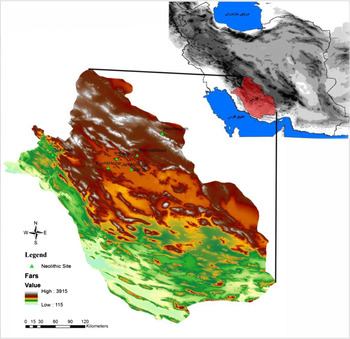
Hormangan is located west of Jeshnian (UTM: 39 R 741396 3377711), the southern basin of Bavanat River, at 2364 m altitude (Figures 1 and 2). The site was discovered during archaeological surveys conducted in the Bavanat district by Khanipour (Khanipour Reference Khanipour2015: 156). Hormangan extends north–south and its eastern parts were disturbed during agricultural activities. The first season of excavation took 45 days from March to April 2016. The most important goals were to understand settlement sequences, establish relative and absolute chronology, investigate regional interactions and interactions during settlement periods, investigate animal and vegetal remains in order to recognize regional subsistence patterns, fauna, and flora during every cultural period, find evidence of cultural and commercial exchanges relying on archaeological findings, and determine the function of the site during different settlement periods and political and social evolutions.
Map showing the location of Neolithic sites in Fars as discussed in the text (image by the author).

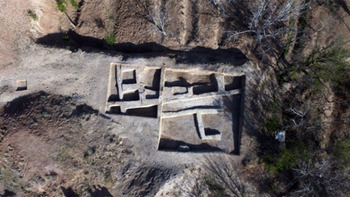
The Neolithic building structure of Hormangan in the excavated site (photo by the author).

To determine the site extent, 1 × 1-m test trenches (14 total) were dug in the different parts of the mound, which was followed by digging 3 additional trenches, sized 8 × 8 m, 5 × 5 m, and 4 × 4 m. They were dug to 1-m depth, which resulted in recognizing cultural layers from the late 7th century. Test trenches, however, revealed that the Neolithic village of Hormangan might occupy an extent of about 0.5 hectare. This site was southwardly stretched and disturbed by the following agricultural activities (Khanipour Reference Khanipour2016). Following excavation of Trench 1 and removing disturbing levels, traces of a wall consisting of several right-angled structures appeared (Figure 3). The walls were made of plastered chaff-tempered clay (piece). Continuing excavations revealed cultural sedimentation under the structure including several ovens, burnt soil, and ashes, less than 30 cm thick. Therefore, two settlement phases were identified. The earliest phase revealed no architectural remains, whereas ovens and ash indicated seasonal settlement, while the later phase included architectural remains and indicated a sedimentary lifestyle and permanent settlement. Excavations at Trench 2, after removing the surficial layer, revealed traces of walls including several spaces. Following excavations at Trench 3, there appeared a burnt structure, on which surfaces boiled, agglomerated, and became green under heating. There was a layer of red soil, because of heating, under the former level.
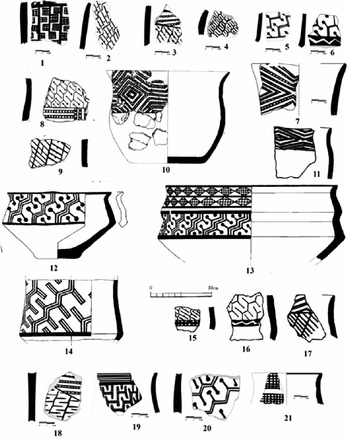
Painted Neolithic Potteries found at the following sites: 1–7 Hormangan, 8–10 Tol-e Bashi (after Bernbeck Reference Bernbeck, Pollock, Bernbeck and Abdi2010: 150), 11–17 Tol-e Mushki (after Fukai et al. Reference Fukai, Horiuchi and Matsutani1973, PL: XLVII; Maeda Reference Maeda1986, Fig. 8), 18–21 RahmatAbad Tape (after Azizi Kharanaghi et al. Reference Azizi Kharanaghi, Nishiaki and Khanipour2012b, fig. 12).

During excavation of the Hormangan site, efforts focused on gathering charcoal from different layers for 14C absolute dating. The sampling method aimed to avoid hand contact with dating materials. The samples were meticulously put inside aluminum foils using scourge to avoid contact with hands, smoke, or exposure to light.
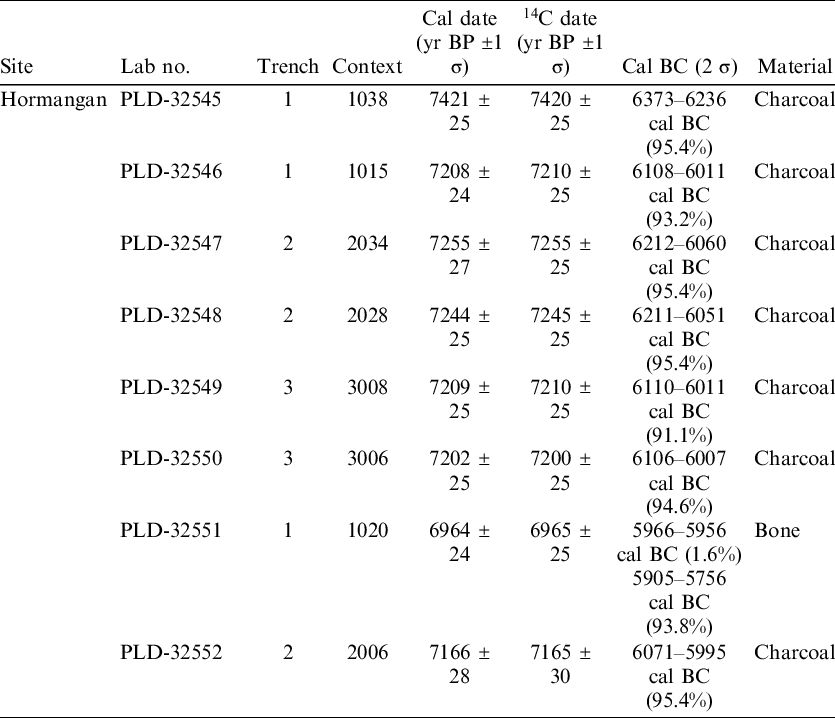
A total of 24 samples were taken from different trenches and layers, among which 7 coal samples and 1 animal bone sample were sent to the Paleo Labo in Japan for 14C dating (Table 1). According to the results, 1 coal sample from an early phase showed a date of about 6373–6236 BC and 6 coal samples that were taken from a late phase show a date between 6000 and 6200 BC, however, the only bone sample that was tested showed to be slightly later than the other samples. According to the survey and excavation results, it can be concluded that the Hormangan region had been occupied seasonally at about 6350 BC, and then after 6200 BC it had been occupied permanently by inhabitants with the same culture, and also considering the 14C dating results, it showed that the furnace found from Trench 3 had been used simultaneously with the late Hormangan phase (Khanipour and Niknami Reference Khanipour and Niknami2017).
A simplified version of 14C dates for Hormangan site.

Fars Neolithic Chronology Evaluation Based on Absolute Dating
As explained, up until recent years, the beginning of the Fars Neolithic period was subject to various discussions and opinions. Recent excavations by Azizi Kharanaghi at the two sites of Rahmat Abad (Azizi Kharanaghi et al. Reference Azizi Kharanaghi, Nishiaki and Khanipour2012b, Reference Azizi Kharanaghi, Fazeli Nashli, Nishiaki, Matthews and Fazeli Nashli2013; Azizi Kharanaghi and Khanipour Reference Azizi Kharanaghi, Khanipour, Azizi Kharanaghi, Khanipour and Naseri2014) and Qasr e Ahmad Kavaar (Azizi Kharanaghi et al. Reference Azizi Kharanaghi, Khaloei and Khanipour2012a) revealed some evidence from pre-pottery Neolithic and also the early pottery Neolithic in Fars. According to the excavations, it was revealed that at about the middle of the 8th millennium BC, Fars was inhabited by people with the rudimentary agronomical—and more probably with an early herding subsistence economy. For the Fars region, the pre-pottery has been introduced as the Rahmat Abad phase since on the basis of absolute dating data derived from Rahmat Abad, Azizi Kharanaghi proposed date of ca. 7450 to ca. 7000 BC for the earliest phase of Rahmat Abad Tape (Azizi Kharanaghi et al. Reference Azizi Kharanaghi, Fazeli Nashli, Nishiaki, Matthews and Fazeli Nashli2013, Reference Azizi Kharanaghi, Fazeli Nashli and Nishiaki2014; Azizi Kharanaghi Reference Azizi Kharanaghi2014; Azizi Kharanaghi and Khanipour Reference Azizi Kharanaghi, Khanipour, Azizi Kharanaghi, Khanipour and Naseri2014). After that, the early phase of Rahmat Abad data was manipulated to have been as the commencing period of Neolithization in the entire Fars region. Soon after, it became a criticism against the previous belief that regarded the Mushki pottery as the oldest in the Kur River Basin of the Fars region.
Through excavations at Rahmat Abad, it became clear that before the Mushki period, people from Rahmat Abad had achieved and used pottery-making techniques for several centuries, a period which came to be known as the Mushki formation phase, a term that has been proposed by some archaeologists based on stratigraphy evidence, pottery characteristics, as well as 14C dating and most importantly the Mushki formation phase sequentially, was to be seen before the Mushki period consequently can be regarded as the first stages of pottery production in the pottery Neolithic of Fars region. Since there is no a considerable cultural gap between the Mushki formation phase and the Mushki phase itself, which has been located immediately above it thus it can be possible to conclude that the Mushki pottery has been continued from the early Neolithic culture known here as the formative Mushki. In summary, archaeological and 14C data from Rahmat Abad as well as other well-known Neolithic sites from the Fars region (Alizadeh Reference Alizadeh2006: 121; Mashkour et al. Reference Mashkour, Mohaseb, Debue and Alizadeh2006: 121; Nishiaki Reference Nishiaki2010a: 8) would suggest a period of about 7000–6400 BC for the duration of the Mushki formation phase located within the Rahmat Abad cultural sequences (Azizi Kharanaghi and Khanipour Reference Azizi Kharanaghi, Khanipour, Azizi Kharanaghi, Khanipour and Naseri2014: 74).
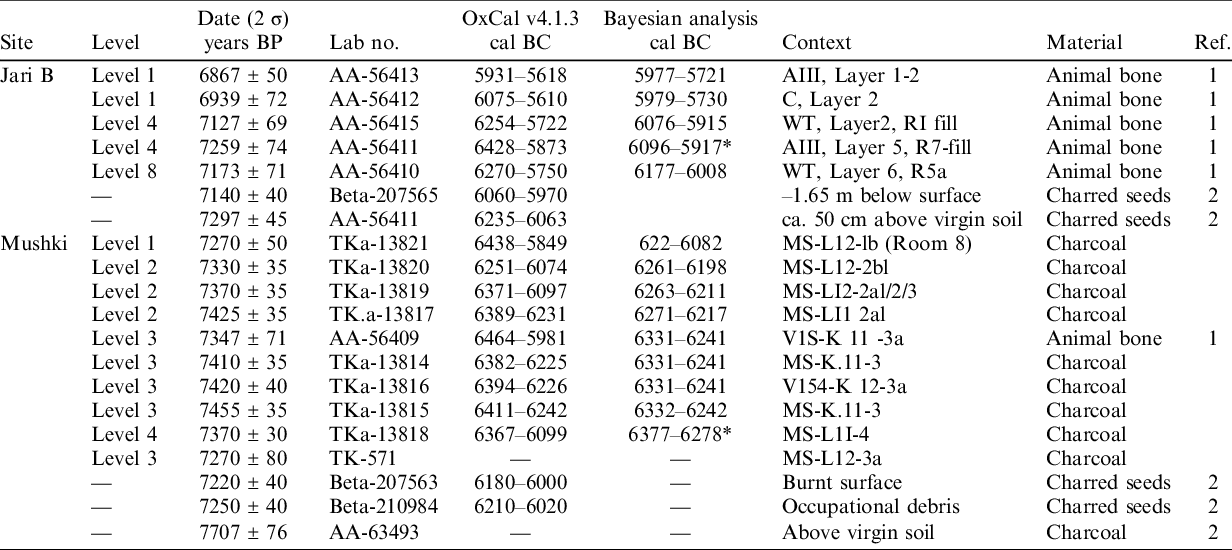
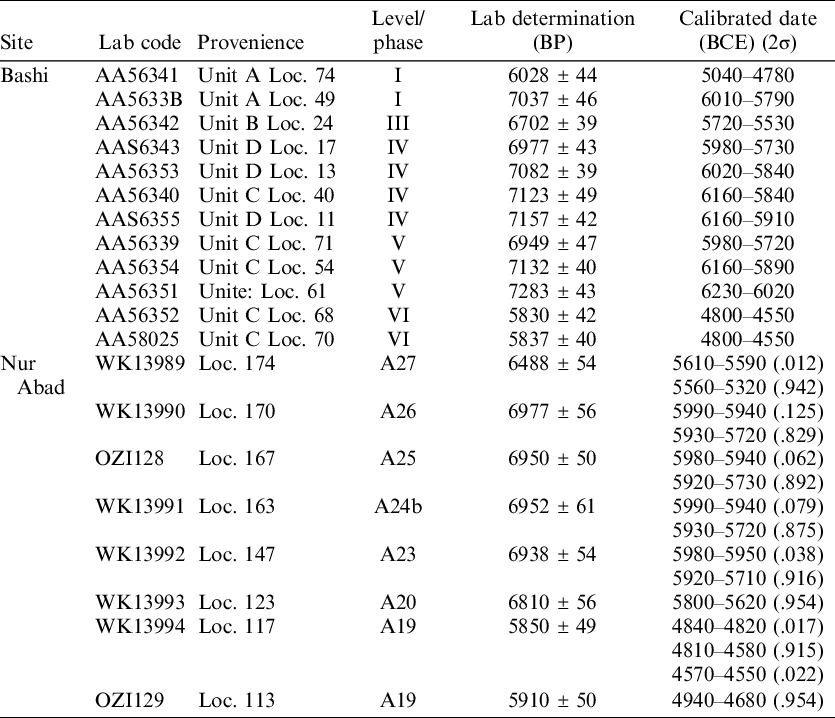
In the Fars region for the pottery Neolithic period, there has been a small number of sites with absolute dating. The second half of the 7th millennium BC has been introduced as the Mushki period in Fars. Alizadeh evaluated four samples from Tol-e Mushki in two laboratories and on the basis of an accurate stratification he proposed a chronological sequence for the Mushki site. In his statement Mushki has witnessed the successive occupations from the lowermost 22nd layer (ca. 6235–6063 BC), the 17th layer (ca. 6180–6000 BC), the 12th layer (ca. 6210–6020 BC), and Jari B (ca. 5970–6060 BC), respectively (Alizadeh Reference Alizadeh2006: 120–121, table: 9–10). A few years later, Nishiaki reexamined the Mushki data in order to acquire absolute dating. He assigned the first inhabitants of Mushki (from 1st to the 4th layer) to have occupied the site around 6400–5981 BC. He also proposed date of about 5730–6177 for the Jari B period. (Nishiaki Reference Nishiaki2010a: 5). He assessed the data provided by the Japanese team through their excavation in Mushki during 1950–1960. By examining 11 bone and charcoal samples he proposed an absolute date of ca. 6050–6350 BC for the Mushki settlements (Nishiaki Reference Nishiaki2010a: 8; see Table 2). For Neolithic dating purposes, was another pioneering fieldwork carried out at Tol-e Bashi by Bernbeck, who located the site to have been settled in the transitional stage between Mushik and Jari (Bernbeck et al. Reference Bernbeck, Pollock and Abdi2004: 76–78). Two samples collected from the 6th layer of this site dated it to 4800–4500 BC, while tree samples from the 5th layer indicated a date of about 6230–5720 BC for the layer 5 depositions. The same procedure was also applied the 4th layer by taking four samples, which showed a date of 6160–5730 BC, and another extra sample from that layer proposed a date of 5720–5530 BC. Moreover, two samples taken from the 1st layer are about a thousand years apart (Table 3; Pollock et al. Reference Pollock, Bernbeck and Abdi2010: 263).
14C dating for sites Tol-e Jari B and Mushki (Nishiaki Reference Nishiaki2010a: 5).

14C dating for sites Tol-e Bashi (Pollock Reference Pollock, Pollock, Bernbeck and Abdi2010a: 262) and Tol-e Nur Abad (Potts and Rustaei Reference Potts and Roustaei2006: 68).

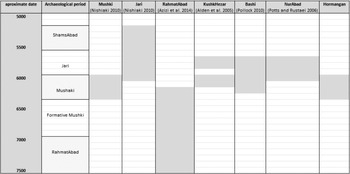
It should be mentioned here that through this research the Jari phase at Tol-e Bashi, known as the final phase Neolithic Fars, was dated to ca. 6050–5800 BC (Nishiaki Reference Nishiaki2010a: 8). Tol-e Nur Abad (phases A27 to A20) is a Neolithic site in the Fars region that witnessed 14C dating by taking six charcoal samples. Although the excavator gave a date between 5990–5320 to samples of this site and assigned the lowermost samples to be comparable with Muski, further analysis proved that samples from Tol-e Nur Abad were synonymous with Jari (Potts and Rustaei Reference Potts and Roustaei2006: 68 table 4). Although there have been some Neolithic sites in the Fars region such as were subjected to excavations and data collection for 14C datings such as Tol-e_Mian Ruod (Ebrahimi et al. Reference Ebrahimi, Zare, Abolahrar, Aminpour, Azizi Kharanaghi, Khanipour and Naseri2014) and Tol-e Qasre Ahmad Kavaar (Azizi Kharanaghi et al. Reference Azizi Kharanaghi, Khaloei and Khanipour2012a) but nothing reported yet to be considered here (Figure 4).
Chronological framework of the Neolithic period proposed for the Fars region (by author).

As discussed previously, there are some major problems regarding the Fars Neolithic absolute chronology that require more rigorous studies. At the first stage of the study, comparative studies should be made to assess in situ relative chronological order cultural materials explored from the different Neolithic sites of Kur River Basin areas through which comparing the physical morphology and diagnostic characteristics of finds may well help to place them in their exact order. At the same time, an attempt is necessary to conduct a study on the absolute datings of the same Neolithic sites especially from the Hormangan to enable researchers to solve the chronological complexities and eventually the problems of the Fars Neolithic. For this, it is reasonable to say that the close similarities of cultural materials observed between Hormangan site and those from Tol-e Mushki and also absolute chronologies between them may lead to the conclusion that the Mushki period should be considered older than the Jari period. The result appears to be confronted with what Alizadeh previously commented (Alizadeh Reference Alizadeh2004a: 91).
Furthermore, potteries found from Hormangan are fully comparable to the same finds in terms of shape, pattern, production, and baking quality from Tol-e-Mushki, Tol-e-Bashi, and the 8th layer of Tol-e-Jari B and the latest Neolithic layers of Rahmat Abad sites (Figure 3). In summary, Azizi Kharanaghi and his colleagues have correctly pointed out (Azizi Kharanaghi et al. Reference Azizi Kharanaghi, Nishiaki and Khanipour2012b: 92) while most of the patterns and other characteristics of potteries were similar, the presence or absence of a specific pattern cannot imply new or different phases.
Also, according to 14C dating, pottery motifs known as Bashi phase were in use by the inhabitants of the two phases of the Hormangan site, and as the 14C dating showed, these types of pottery were used in the Hormangan (simultaneous with Mushki phase) from about 6350 BC as well as by the Bashi peoples in 6100–6000 BC.
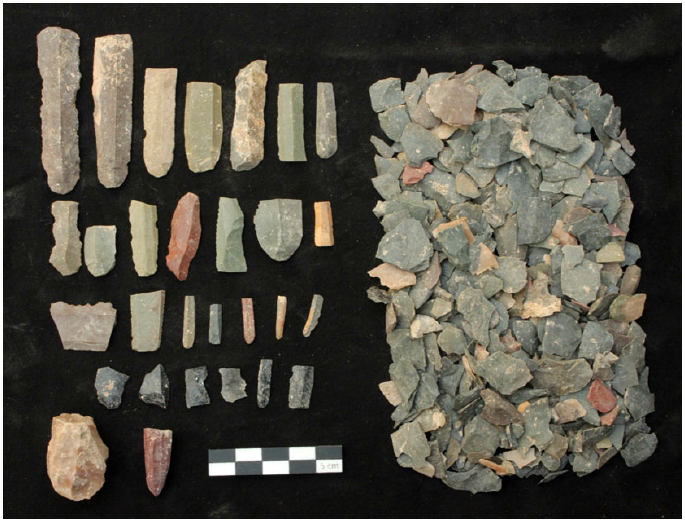
To establish accurate relative chronological sequences for the Neolithic Fars there has been evidence playing an important role in the ordering structures rater than the pottery themselves. This evidence includes many stone tools discovered from different Neolithic sites. The stone tools obtained from the Horamngan, Mushki, and Bashi sites would be indicative of close similarities to each other, whereas stone tools from those sites were quite different in some character in terms of raw material used and technology applied from their early and even from their subsequent sequences. At these three sites, geometric microblade tools made from fine cherts and shaped mainly in the trapeze (broad geometrics) and lunate (narrow geometrics) forms were dominantly visible (Fukai et al. Reference Fukai, Horiuchi and Matsutani1973; Hori Reference Hori1989; Ghasidian et al. Reference Ghasidian, Azadi, Pollock, Pollock, Bernbeck and Abdi2010; Nishiaki Reference Nishiaki, Borrell, Ibáñez and Molist2013). While the Jari B site produced only trapeze-shaped blades. Hori has emphasized that the broad geometric microblades tool type from Jari B is smaller than from that of Mushki tools and suggests that this might be part of the process by which the sizes of tools are being minimized intentionally (Hori Reference Hori1989). The stone tool industries of Hormangan and Mushki to some extent may be viewed to be in accordance with the the late Moallafat in Mesopotamia. However, the modified types of this particular lithic industry are seen from the post-Moallafat period at the beginning of the early 6th millennium BC through which utilization of the bullet-shaped cors by impressed percussion techniques for blade production and producing backed bladelets were considerably reduced. To this end, the geometric tools also became uncommon so that all types showed a rather simple form; probably reflecting a change in the methods of arrowhead production (Abe Reference Abe, Healy, Campbell and Maeda2011).
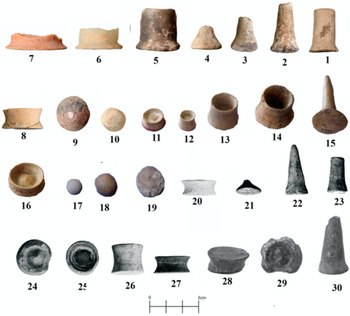
What most characterizes Hormangan, Bashi (Pollock Reference Pollock, Pollock, Bernbeck and Abdi2010b), and Mushki (Fukai et al. Reference Fukai, Horiuchi and Matsutani1973) from the other Neolithic sites is the presence of many small stone-clay objects (Figure 5). Many debates have centered around their usage until recently. However, the abundance of these objects is extremely limited among the Neolithic sites during the second half of the 7th millennium BC. To conclude, objects of this kind discovered from Hormaigan, Bashi, and Mushki sites represent a typologically similar pattern, which allows us to draw inferences that these three sites may account for having simultaneous cultural identity, as 14C datings from the Hormangan site also indicate time overlaps between the absolute chronological sequences of the Hormangan with the Mushki and Bashi sites.
Clay and stone objects from the Neolithic site of Fars: 1–10 from Hormangan, 11–19 from Tol-e Bashi (after Javari et al. Reference Javari, Abdi and Bernbck2010, Figure 10.1; Pollock Reference Pollock, Pollock, Bernbeck and Abdi2010b, figs. 9.1–3), 20–27 from Tol-e Mushki (after Fukai et al. Reference Fukai, Horiuchi and Matsutani1973, PL: XXXVIII–XXXIX), 28–30 from RahmatAbad Tape (after Azizi Kharanaghi et al. Reference Azizi Kharanaghi, Nishiaki and Khanipour2012b, fig. 13).

Pre-Pottery Neolithic Period at Fars
Over the past few decades, there have been many studies on the transition from the Paleolithic to the Neolithic in the Near East (Braidwood Reference Braidwood1960, Reference Braidwood1961; Flannery Reference Flannery1965; Binford Reference Binford, Binford and Binford1968; Hole Reference Hole1984; McCorriston and Hole Reference McCorriston and Hole1991; Zeder Reference Zeder2009, Reference Zeder2010). Over the last two decades, excavation at sites such as Sheikh-e Abad (Matthews et al. Reference Matthews, Matthews and Mohammadifar2013), Chogha Golan (Riehl et al. Reference Riehl, Zeidi and Conard2013), and east Chia sabz (Darabi et al. Reference Darabi, Naseri, Young and Fazeli2011, Reference Darabi, Fazeli, Naseri, Riehl, Young, Matthews and Fazeli Nashli2013; Darabi Reference Darabi2015) has provided valuable information about the transition of societies to food production and the emergence of sedentary groups. Based on this, it has been determined that the initial stage of this transition in Iran should be found in central Zagros and other regions such as Dehloran, Khuzestan, and Fars lowland plains have been inhabited in the next stage, i.e. the second half of the 8th millennium BC, so that the first settlements such as Chogha bonut (Alizadeh Reference Alizadeh2003) in Shushan, Ali Kosh in Dehloran (Hole et al. Reference Hole, Flannery and Neely1969: 29; Hole and Flannery Reference Hole and Flannery1962; Hole Reference Hole2000; Darabi et al. Reference Darabi, Bahramiyan, Mostafapour, Khademi Bami and Yari2017), Mahtaj site in Behbahan (Darabi Reference Darabi2016), RahmatAbad (Azizi Kharanaghi et al. Reference Azizi Kharanaghi, Fazeli Nashli, Nishiaki, Matthews and Fazeli Nashli2013), and Tol-e Sangi (Khanipour Reference Khanipour2019) have been formed in the Polvar River Basin and Tol-e Qasr Ahmad (Azizi Kharanaghi et al. Reference Azizi Kharanaghi, Khaloei and Khanipour2012a) in the Qara Aghaj River Basin in Fars Province.
Recent excavations of Azizi Kharanaghi in the two tell sites of Rahmat Abad (Azizi Kharanaghi et al. Reference Azizi Kharanaghi, Nishiaki and Khanipour2012b, Reference Azizi Kharanaghi, Fazeli Nashli, Nishiaki, Matthews and Fazeli Nashli2013; Azizi Kharanaghi and Khanipour Reference Azizi Kharanaghi, Khanipour, Azizi Kharanaghi, Khanipour and Naseri2014) and Qasr-e Ahmad of Kavar (Azizi Kharanaghi et al. Reference Azizi Kharanaghi, Khaloei and Khanipour2012a) and Tol-e Sangi (excavation by one of the authors) revealed evidence of the pre-pottery Neolithic period in Fars. As a result of the excavations, it was discovered that around the middle of the 8th millennium, the population of Fars depended upon agriculture for their subsistence; the pre-pottery Neolithic period was labeled the Rahmat Abad phase. According to absolute dating, this phase was determined to be in 7450–7000 BC. Primary results of the archaeobotanical study of Rahmat Abad led to some expectations: cereals (glume wheat, and to a lesser degree, barley) are recorded throughout the occupational sequence. Since the earliest pre-pottery Neolithic levels, spikelet remains are of the domestic-type (tear-off scar) and there is no sign of a local domestication process of either wheat or barley. It is therefore likely that crops arrived at the site in an already domesticated form as a result of diffusion from other sites or regions. This is consistent with the largely accepted opinion that agriculture first occurred in the central Zagros range before spreading to other parts of western Iran (Weeks Reference Weeks, Matthews and Fazeli Nashli2013). Glume wheat species (einkorn and emmer) constitute the main agricultural production during all periods. Even though agriculture was part of the subsistence economy at Rahmat Abad since the pre-pottery Neolithic.
According to recent excavations and available information, it seems that the process of Neolithization occurred in other areas and in the middle of the 8th millennium BC it entered Fars, although this view may change with the new excavations. Concerning the excavations carried out in Fars, there is a stratigraphic interruption and no connection between the Epipaleolithic and Neolithic sites. Also, in terms of chronology, there is a gap of more than a thousand years between the lower strata of RahmatAbad mound and Tol-e Sangi with the oldest pre-pottery Neolithic sites of central Zagros. Also the lack of any evidence of pre-domestication of goats or pre-domestication of grains in this area compared to such evidence in pre-pottery Neolithic sites in Southwest Asia such as goats in Sheikh-e Abad (Matthews et al. Reference Matthews, Matthews and Mohammadifar2013), and Nevali Çori in the heights of Torus (Peters et al. Reference Peters, Vonden Driesh and Helmer1999) and Ganj Darreh (Zeder and Hesse Reference Zeder and Hesse2000) all indicate that the process of Neolithization in Fars was not internal. It seems that grains and animals were domesticated outside the Fars region and then entered the Fars region as a package. It is not clear at this time whether the spread of these domesticated Neolithic products was due to Demic Diffusion or the Cultural Diffusion in the area.
Emergence of Pottery in Fars and Iran
The invention of pottery signifies the beginning of genuine pyrotechnology, the most important technological innovation in human history. It is clear that these technological innovations went hand in hand with social advancement. Therefore, to provide a complete sketch of human history, we need to consider pottery’s emergence as an initial technological advance (Tsuneki Reference Tsuneki, Tsuneki, Nieuwenhuyse and Campbell2017a: 1). So far, a lot of research has been done on pottery’s emergence, the results of which show the emergence of pottery in West Asia lagged a few millennia behind that of East Asia. Recent dates of ca. 16,000–15,800 cal BC are associated with sherds in the Yuchanyan Cave in southern China (Boaretto et al. Reference Boaretto, Wu, Yuan, Bar-Yosef, Chu, Pan, Liu, Cohen, Jiao, Li, Gu, Goldberg and Weiner2009), southern Sahara, and the Nile Valley (e.g. Jesse Reference Jesse2003; Huysecom et al. Reference Huysecom, Rasse, Lespez, Neumann, Fahmy, Ballouche, Ozainne, Maggetti, Tribolo and Soriano2009) provides another context in which pottery appeared earlier than in West Asia. In comparison to Europe at least, pottery appeared at a relatively early date in West Asia (Campbell Reference Campbell2017: 133). There are many debates about the earliest pottery in West Asia. Some consensus has been reached that practical and stable pottery production started at the beginning of the Neolithic pottery, around 7000 cal, BC in West Asia (Le Mière and Picon Reference Le Mière and Picon1998; Aurenche et al. Reference Aurenche, Galet, Régagnon-Caroline and Évin2001; Campbell Reference Campbell2017). However, it is also true that “pottery” has been reported from many pre-pottery Neolithic sites (Cauvin Reference Cauvin1974: Fig. 1; Smith and Crepeau Reference Smith and Crépeau1983; Le Mière and Picon Reference Le Mière and Picon1998: Fig. 3; Tsuneki Reference Tsuneki, Tsuneki, Nieuwenhuyse and Campbell2017b). All of these artifacts, except those at Jericho, were discovered in the context of burnt layers, and we cannot confirm if they were originally unbaked or intentionally burnt clay vessels (Tsuneki Reference Tsuneki, Tsuneki, Nieuwenhuyse and Campbell2017a: 3).
One of the most comprehensive studies about early pottery of Southwest Asia was conducted by Campbell. He analyzed the onset of the pottery Neolithic period based on 281 samples of absolute chronology analyzes from 13 sites (Campbell Reference Campbell2017: 133). Bernbeck also published a comprehensive article on the emergence of pottery in Iran (Bernbeck Reference Bernbeck2017). Prior to RahmatAbad excavations, the Mushki period pottery was known as the oldest pottery in the region. Alizadeh also maintains that it may be possible for an older period than Mushki to exist in Fars, however, based on his comparative study on the pottery specifications, he eventually came to conclude that both the Mushki and Jari periods in the Neolithic Fars could be related to the contemporary or earlier cultures originating from the central Zagros areas. At the end, he viewed the most ancient pottery traditions of Mushki and Jari to have originated from the Shahr-e-Kord and Khanmirza regions somewhere in the Zagros mountainous areas (Alizadeh Reference Alizadeh2004a: 75–76). Bernbeck also considered the widespread use of pottery in southern Zagros to be 500–1000 years after the initial use of pottery compared to other areas (Bernbeck Reference Bernbeck2017).
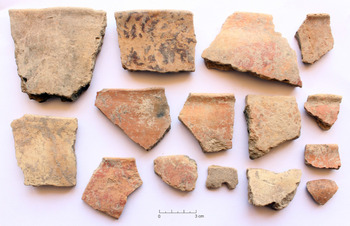
Pottery samples from the Rahmat Abad excavation (Azizi Kharanaghi and Khanipour Reference Azizi Kharanaghi, Khanipour, Azizi Kharanaghi, Khanipour and Naseri2014; Azizi Kharanaghi et al. Reference Azizi Kharanaghi, Fazeli Nashli, Nishiaki, Matthews and Fazeli Nashli2013, Reference Azizi Kharanaghi, Fazeli Nashli and Nishiaki2014), Tol-e Sangi (Khanipour Reference Khanipour2019) and the Polvar river basin seem to have been produced before Mushki, and they can be regarded as the earliest pottery production samples in Fars. On the top of the pre-pottery deposits in the both sites of Rahmat Abad and Tol-e Sangi, there have been so called red plain potteries were categorized as pre-Mushki style and dated back to 7000–6400 BCE (Azizi Kharanaghi et al. Reference Azizi Kharanaghi, Fazeli Nashli, Nishiaki, Matthews and Fazeli Nashli2013, Reference Azizi Kharanaghi, Fazeli Nashli and Nishiaki2014). These sherds are almost red with clay slip on exterior side with vegetal tempers, whereas in Tol-e Sangi some sherds were painted (Figures 6 and 7). Tol-e Sangi, located in the Morghab plain, was excavated in 2019, the data from which revealed pre-pottery Neolithic and early pottery Neolithic period in the region (Khanipour Reference Khanipour2019). Tol-e Sangi, with an area of about half a hectare and 5 m of Neolithic deposits, can be used as a key site for the transition from pre-pottery Neolithic to pottery Neolithic to determine many of the ambiguities of this period. Considering the fact that this site has been recently excavated, its absolute dating has not been determined yet, but by comparing its ceramics with Rahmat Abad and considering there is no gap between pre-pottery Neolithic and pottery Neolithic deposits in the stratigraphy sequence, probably the beginning of the pottery Neolithic in this site was about 7000 BC. Also in the Kerman region, the Gav Koshi site was excavated, although the ceramics of the new phase are comparable to the sites of Fars such as Qasr Ahmad, Kushk-e Hezar, and Hormangan, but its oldest deposits, which include the beginning of pottery Neolithic, except for one example, show a date between 7083 and 6653 BCE (Alidadi Soleimani and Fazeli Reference Alidadi Soleimani and Fazeli Nashli2018, Tab: 1). In central Zagros, the beginning of pottery Neolithic in Tappe Guran is about 7000 BC (Zeder Reference Zeder2006; Bernbeck Reference Bernbeck2017: 101–102). The datings of Ganj Dareh have been conducted by Zeder and Hesse (Reference Zeder and Hesse2000) and Housley (Reference Housley1994) as well as Hole (Reference Hole, Aurénche, Evan and Hours1987).
Emergence of pottery, Tol-e Sangi (photo by author).

Stone tools, Tol-e Sangi (photo by author).

There is no date from Level S, the earliest with pottery, but there are dates from both Level T (the final aceramic level) and Level R. The boundary between the two, which might approximate to the start of ceramics, is 7124–7011 cal BC at 1 standard deviation. Nonetheless, it can be used to suggest Ali Kosh Pottery is present for the first time in the Mohammed Jaffar phase at Ali Kosh (Hole et al. Reference Hole, Flannery and Neely1969). There are 14 recent dates from Ali Kosh, all produced by Beta Analytic, with four of them from the Mohammed Jaffar phase (Zeder Reference Zeder, Vila, Goucherin, Choyke and Buitenhius2008).
Darabi’s recent excavations in Ali Kosh and applying 14C dating to two samples showed the beginning of Mohammad Jafar phase dated 7064–6902 BC and 7061–6823 BC (Darabi Reference Darabi2018). It seems that according to the excavations carried out in Rahmat abad, Tol-e Sangi, Gav koshi, and Ali Kosh, some areas of Iran such as Fars (Alizadeh Reference Alizadeh2004a: 75–76; Bernbeck Reference Bernbeck2017) and central Zagros (Mortensen, Reference Mortensen and Yarshater1991; Darabi Reference Darabi2015) where the beginning of the pottery Neolithic is considered to be more recent, should be reviewed. dates for the beginning of the pottery Neolithic in each region fluctuate by several hundred years around 7000 cal BC. Although we estimate that these fluctuations are quite large, we cannot help but consider that pottery Neolithic societies in each region exchanged their ideas on making pottery (Tsuneki Reference Tsuneki, Tsuneki, Nieuwenhuyse and Campbell2017a: 4).
CONCLUSIONS
By the beginning of the Neolithic studies in Fars, the formerly proposed chronologies have always faced some challenges. In this paper, we first attempted to express the challenges concerning the Neolithic period of Fars, and second we tried to give a concise explanation on the Neolithic site of Hormangan, which has been recently excavated by one of us (M. Khanipour), and how the absolute dating of which could help somewhat in evaluating the different proposals of the Fars Neolithic chronologies. Before the recent excavations conducted in Hormangan, the origins of pottery Neolithic of Fars faced several uncertainties, and some were thinking that the central Zagros region might have been the origin, but with the recent excavations carried out at the Rahmat Abad site and its absolute dating, a gap of more than one thousand years of Fars settlement history of the Fars Neolithic that had remained blank was corrected. The excavator of the Rahmat Abad site proposed a date of about 7450–7000 BC for the site, which is related to the pre-pottery Neolithic in this region. Most importantly, through stratigraphic sequences of the Rahmat Abad site, it is also made clear that in this site the pottery Neolithic has been laid down immediately above the pre-pottery Neolithic depositions since those potteries were as primitive as Mushki’s pottery, thus it has been named afterward as Formative Mushki and given a date of about 7000–6400 BC. While the Mushki itself is known as the Mushki phase based on 14C dating derived from Mushki, Bashi, and Hormangan, it was located in the time zone of nearly 6400–6000 BC. The subsequent prehistoric cultural period in Fars known as the Jari period came on the scene after the excavations at Jari A and Tol-e Nur Abad were completed. For the Jari period in the context of the Fars Neolithic, a date of about 6000–5600 BC was proposed. This point, of course, should be taken into account that the Mushki and Jari periods more likely coexisted for a short time and after that a cultural period representing the coarse and plain pottery has been replaced. That is known as Bakun B1 or Shams Abad, by which the Neolithic period in the Fars region came to its end. According to the excavation of Rahmatabad and Tal-e Sangi, it seems that Fars was inhabited in the middle of the 8th millennium BC and the Neolithic package entered this area, and there is no evidence of the Neolithization process. However, in the past, the Mushaki period was introduced as the oldest pottery Neolithic period, but with new excavations, it seems that the use of pottery had become common in Fars, as in many parts of Southwest Asia around 7000 BC.
ACKNOWLEDGMENTS
We would like to thank Dr. M. H. Azizi Kharanaghi, professor Y. Nishiaki, and L. Weeks for their very helpful comments. We wish to thank Dr. Masashi Abe for 14C dating and studying stone tools and Dr. Sejji Arai for studying animal bone. We also appreciate the excavation team members Miss Sh. Pourmomeni, Z. Hadi, and Z. Ghasemi. Many thanks to Iran's National Elites Foundation for supporting Morteza Khanipour, the corresponding author, for his postdoctoral fellowship.