Childhood trauma stands as one of the most robust environmental risk factors for psychotic disorders (Bendall, Jackson, Hulbert, & McGorry, Reference Bendall, Jackson, Hulbert and McGorry2008; Fisher et al., Reference Fisher, Jones, Fearon, Craig, Dazzan, Morgan, Hutchinson and Morgan2010; Matheson, Shepherd, Pinchbeck, Laurens, & Carr, Reference Matheson, Shepherd, Pinchbeck, Laurens and Carr2013; Trotta, Murray, & Fisher, Reference Trotta, Murray and Fisher2015; Varese et al., Reference Varese, Smeets, Drukker, Lieverse, Lataster, Viechtbauer and Bentall2012) and has also been associated with attenuated (subthreshold) psychotic symptoms (Kraan et al., Reference Kraan, Velthorst, Smit, de Haan and van der Gaag2015; van Dam et al., Reference van Dam, van der Ven, Velthorst, Selten, Morgan and de Haan2012; Velikonja, Fisher, Mason, & Johnson, Reference Velikonja, Fisher, Mason and Johnson2015; Velthorst et al., Reference Velthorst, Nelson, O'Connor, Mossaheb, de Haan, Bruxner and Thompson2013). Similar observations have been reported for young people at clinical high risk (CHR) for psychosis (Kraan et al., Reference Kraan, Velthorst, Smit, de Haan and van der Gaag2015), who have a substantially higher risk of developing a full-threshold psychosis than is observed in the general population (Fusar-Poli et al., Reference Fusar-Poli, Bonoldi, Yung, Borgwardt, Kempton, Valmaggia and McGuire2012). Individuals who are at CHR are identified based on clinical criteria (also referred to as psychosis risk syndrome) that include one of the following presentations: attenuated positive psychotic symptoms, genetic risk for schizophrenia and a significant decrease in functioning, or a brief, limited and intermittent full-blown psychotic symptom (Miller et al., Reference Miller, McGlashan, Rosen, Somjee, Markovich, Stein and Woods2002). A meta-analysis of childhood trauma (defined as the report of at least one traumatic experience such as emotional neglect and/or emotional, physical, or sexual abuse before the age of 17) in CHR studies reported a mean prevalence rate of 87% (Kraan et al., Reference Kraan, Velthorst, Smit, de Haan and van der Gaag2015), which is significantly higher than that seen in the general population (range 42.7–60.0%; Addington et al., Reference Addington, Stowkowy, Cadenhead, Cornblatt, McGlashan, Perkins and Cannon2013; Tikka et al., Reference Tikka, Luutonen, Ilonen, Tuominen, Kotimaki, Hankala and Salokangas2013). Furthermore, clustering of victimization (co-occurrence of multiple forms of childhood abuse) is common (Dong et al., Reference Dong, Anda, Felitti, Dube, Williamson, Thompson and Giles2004; Kessler et al., Reference Kessler, McLaughlin, Green, Gruber, Sampson, Zaslavsky and Williams2010), and it is associated with even greater risk for developing psychotic symptoms (Arseneault et al., Reference Arseneault, Cannon, Fisher, Polanczyk, Moffitt and Caspi2011; Kelleher, Keeley, et al., Reference Kelleher, Keeley, Corcoran, Ramsay, Wasserman, Carli and Cannon2013).
One theory of the association between childhood trauma and psychotic symptomatology suggests that adverse childhood experiences may increase psychosis risk through their negative effects on social and nonsocial cognitive development (Rokita, Dauvermann, & Donohoe, Reference Rokita, Dauvermann and Donohoe2018). Because early childhood is a sensitive period for the development of attachment relationships (Dozier, Reference Dozier, Stovall-McClough, Albus and Shave2008), exposure to traumatic events during this time may have irreversible effects on the mental processes that underlie socioemotional functioning. This hypothesis is supported by findings in the general population that indicate that individuals with a history of childhood trauma have poorer cognitive functioning than those without such history (Beers & De Bellis, Reference Beers and De Bellis2002; Koenen, Moffitt, Caspi, Taylor, & Purcell, Reference Koenen, Moffitt, Caspi, Taylor and Purcell2003; Mezzacappa, Kindlon, & Earls, Reference Mezzacappa, Kindlon and Earls2001; Navalta, Polcari, Webster, Boghossian, & Teicher, Reference Navalta, Polcari, Webster, Boghossian and Teicher2006).
Cognitive deficits are well documented in individuals with established psychotic illness (Giuliano et al., Reference Giuliano, Li, Mesholam-Gately, Sorenson, Woodberry and Seidman2012; Hou et al., Reference Hou, Xiang, Wang, Everall, Tang, Yang and Jia2016), and qualitatively similar (but less severe) deficits have been reported in CHR groups (Barbato et al., Reference Barbato, Colijn, Keefe, Perkins, Woods, Hawkins and Addington2013; Bora & Murray, Reference Bora and Murray2014; Cannon et al., Reference Cannon, Caspi, Moffitt, Harrington, Taylor, Murray and Poulton2002; Fusar-Poli et al., Reference Fusar-Poli, Bonoldi, Yung, Borgwardt, Kempton, Valmaggia and McGuire2012; Reichenberg et al., Reference Reichenberg, Caspi, Harrington, Houts, Keefe, Murray and Moffitt2010; Thompson, Bartholomeusz, & Yung, Reference Thompson, Bartholomeusz and Yung2011) including impairments in social cognition (Piskulic et al., Reference Piskulic, Liu, Cadenhead, Cannon, Cornblatt, McGlashan, Perkins and Addington2016), executive function (Fusar-Poli et al., Reference Fusar-Poli, Deste, Smieskova, Barlati, Yung, Howes and Borgwardt2012), processing speed (Kelleher, Clarke, Rawdon, Murphy, & Cannon, Reference Kelleher, Clarke, Rawdon, Murphy and Cannon2013), and verbal- (Seidman et al., Reference Seidman, Giuliano, Meyer, Addington, Cadenhead, Cannon and McGlashan2010) and working memory (Fusar-Poli et al., Reference Fusar-Poli, Deste, Smieskova, Barlati, Yung, Howes and Borgwardt2012). However, despite the growing evidence for an association between childhood trauma and cognitive functioning in various psychiatric disorders (Aas et al., Reference Aas, Dazzan, Fisher, Morgan, Morgan, Reichenberg, Zanelli, Fearon, Jones and Pariante2011; Velikonja et al., Reference Velikonja, Velthorst, McClure, Rutter, Calabrese, Rosell, Koenigsberg, Goodman and Perez-Rodriguez2019), findings in the psychosis literature are inconsistent (Campbell et al., Reference Campbell CB, Shannon, Hoy, Rushe, Cooper and Mulholland2013; Dauvermann & Donohoe, Reference Dauvermann and Donohoe2019; Ucok et al., Reference Ucok, Kaya, Ugurpala, Cikrikcili, Ergul, Yokusoglu and Direk2015). More specifically, a history of childhood trauma has been associated with both lower (Aas et al., Reference Aas, Dazzan, Fisher, Morgan, Morgan, Reichenberg, Zanelli, Fearon, Jones and Pariante2011) and higher (Campbell et al., Reference Campbell CB, Shannon, Hoy, Rushe, Cooper and Mulholland2013) baseline cognitive functioning in individuals with psychotic illness relative to those without such history. Given such discrepancies in findings, many questions are still left unanswered. It remains unclear whether childhood trauma may have a different effect on social vs. nonsocial cognitive functions. Also, little attention has been given to the relationship between childhood trauma and specific cognitive domains among CHR youth. Notably, studies have shown that childhood trauma has a significantly greater effect on cognition among healthy individuals (Malarbi et al., Reference Malarbi, Abu-Rayya, Muscara and Stargatt2017) than among individuals with psychotic illness (Vargas et al., Reference Vargas, Lam, Azis, Osborne, Lieberman and Mittal2019). Some have hypothesized that this might be because the effect of trauma is overpowered by factors that are associated with psychotic illness itself (e.g., genetic effects, medication use; van Os et al., Reference van Os, Marsman, van Dam and Simons2017). Therefore, understanding the relationship between childhood trauma and cognition in subthreshold states might help to explain the inconsistencies in findings from clinical samples and would offer more insight into the pathogenesis of psychosis. In the only study to date exploring the association between childhood trauma and nonsocial cognition in CHR youth, Ucok et al. (Reference Ucok, Kaya, Ugurpala, Cikrikcili, Ergul, Yokusoglu and Direk2015) found an association between physical abuse (but not sexual/emotional abuse or emotional neglect) and cognitive deficits, in particular in the domains of attention, working memory, and cognitive flexibility. This study was limited by a relatively small sample and the absence of follow-up data, so the relationship of baseline cognition to psychotic conversion could not be explored, nor could the changes over time.
Importantly, childhood trauma may also have an effect on cognitive trajectories. In a study by Campbell et al. (Reference Campbell CB, Shannon, Hoy, Rushe, Cooper and Mulholland2013), first-episode psychosis patients with a history of childhood trauma had higher premorbid IQ (vs. those without childhood trauma) and showed significant cognitive decline after the onset of illness (as assessed by differences in premorbid IQ estimates relative to current IQ), whereas individuals without childhood trauma had a lower premorbid IQ but did not show a significant change after the onset of psychosis. This study's findings tentatively suggest different pathways to illness onset (i.e., those who develop psychosis with no history of childhood trauma may have early neurodevelopmental impairments that reveal vulnerability, whereas those who experience childhood trauma may be more typically developing, so they “require” an additional stressor to reach the psychosis threshold).
Considering the lack of previous research in this area (and noted discrepancies between findings in the above-mentioned studies), the current study was considered exploratory in nature, without any predefined hypotheses. Our primary purpose was to examine the association between multiple types of childhood trauma and baseline cognitive function scores in a large sample of individuals who were at CHR for psychosis. Moreover, while it was previously reported that childhood trauma does not contribute to the prediction of psychosis/conversion in our CHR sample (see Stowkowy et al., Reference Stowkowy, Liu, Cadenhead, Cannon, Cornblatt, McGlashan and Addington2016), we do not yet know whether CHR converters with and without a history of (multiple types of) childhood trauma differ in their cognitive trajectories over the early course of illness. Our objective was to explore this in CHR converters by examining differences in cognitive changes from pre- to postconversion between those who reported multiple types of childhood trauma and those with no/one trauma.
Method
Participants
Clinical high risk (CHR) participants and healthy controls were recruited as part of the North American Prodrome Longitudinal Study 2 (NAPLS-2; Addington et al., Reference Addington, Cadenhead, Cornblatt, Mathalon, McGlashan, Perkins and Cannon2012), which sought to evaluate the predictors and mechanisms of conversion to psychosis. All of the CHR participants met the criteria for prodromal syndromes (COPS; McGlashan, Reference McGlashan T and Woods2010), which is characterized by attenuated positive symptom syndrome (APSS), genetic risk and deterioration (GRD), and/or brief intermittent psychotic syndrome (BIPS). All of the participants that were included in our analysis completed a baseline clinical and cognitive assessment, and they were followed over a two-year period (at 6-, 12-, 18-, and 24-month follow-up assessments). For those who converted to psychosis, the follow-up assessment was completed at the time of psychotic conversion (Mean = 288.4 days). The exclusion criteria for the CHR group included any current or lifetime Axis I psychotic disorders (identified by The Structured Clinical Interview for DSM-IV, SCID [First, Reference First, Gibbon, Williams and Williams1995]), IQ of less than 70, history of a central nervous system disorder and/or substance dependence in the last six months. Use of antipsychotic medication was not an exclusion criterion if there was clear evidence that the antipsychotic was not prescribed for frank psychosis and if the CHR criteria continued to be met despite antipsychotic use. Control participants were considered eligible for the study if they did not meet any criteria for prodromal syndromes, had no current or past psychotic disorder or cluster A personality disorder diagnosis, were not using psychotropic medication, and did not have a family history (first-degree relatives) of any psychotic disorder. For more details about the study design and the inclusion and exclusion criteria see previous publications (Addington et al., Reference Addington, Cadenhead, Cornblatt, Mathalon, McGlashan, Perkins and Cannon2012; Addington et al., Reference Addington, Liu, Buchy, Cadenhead, Cannon, Cornblatt and McGlashan2015).
The study obtained ethical approvals by Institutional Review Boards at all eight sites (Addington et al., Reference Addington, Cadenhead, Cornblatt, Mathalon, McGlashan, Perkins and Cannon2012) that were participating in NAPLS-2. An informed consent or assent (i.e., parental informed consent for minors) was obtained for all of the participants.
Measures
Prodromal syndromes, severity of symptoms, and psychotic conversion criteria
The Structured Interview for Prodromal-risk Syndromes (SIPS; Miller et al., Reference Miller, McGlashan, Rosen, Cadenhead, Cannon, Ventura and Woods2003) was used to determine whether individuals met the criteria for prodromal syndromes. Also, for each CHR participant a vignette was developed for the purpose of obtaining a consensus diagnosis (once approved at the site level, it was discussed by members of each of the participating sites). The severity of symptoms was measured with the Scale of Psychosis-Risk Symptoms (SOPS; Miller et al., Reference Miller, McGlashan, Rosen, Cadenhead, Cannon, Ventura and Woods2003), which contains four subscales: positive symptoms (hallucinations, delusions), negative symptoms (e.g., social anhedonia or withdrawal, decreased expression of emotions), disorganization (e.g., odd behavior or appearance), and general symptoms (e.g., sleep and motor disturbances).
Conversion to full-threshold psychosis was defined according to the presence of Psychosis Scale criteria on the SIPS (Miller et al., Reference Miller, McGlashan, Rosen, Cadenhead, Cannon, Ventura and Woods2003), that is, any positive symptom of psychotic-level intensity (a score of 6) that is sustained for at least an hour per day at an average of four days per week during the past month or symptoms that have seriously affected functioning (e.g., participant severely disorganized or dangerous to self/others).
Childhood trauma
Childhood trauma up to the age of 16 was primarily assessed by using a semistructured interview (The Childhood Trauma and Abuse Scale; Janssen et al., Reference Janssen, Krabbendam, Bak, Hanssen, Vollebergh, de Graaf and van Os2004), which covers emotional neglect, physical abuse, psychological abuse, and sexual abuse. In addition, participants were asked if they had experienced either psychological or physical bullying.
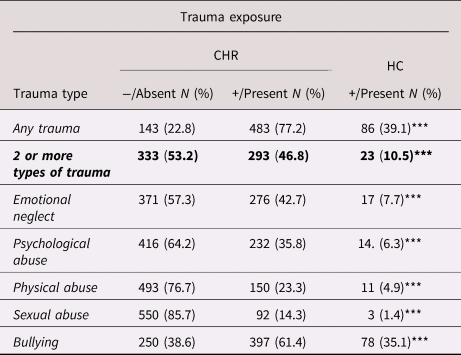
Each of the individual childhood trauma types were rated as 0 = Trauma absent or 1 = Trauma present. A total trauma score was then created to include the sum of all five types of childhood trauma: physical, psychological, or sexual abuse, emotional neglect, and bullying (combined psychological and/or physical). In total, 77.2% (N = 483) of CHR group reported experiences of at least one type of trauma. Because of this high prevalence of childhood victimization in this group and building on the literature outlining the effect of multivictimization on psychotic symptoms (Arseneault et al., Reference Arseneault, Cannon, Fisher, Polanczyk, Moffitt and Caspi2011; Kelleher, Keeley, et al., Reference Kelleher, Keeley, Corcoran, Ramsay, Wasserman, Carli and Cannon2013), a more restrictive trauma cutoff was adopted for our analysis. That is, childhood trauma was considered to be “Present” if two or more types of trauma were reported/identified (46.8%, N = 293 of CHR) and “Absent” if none or one type of trauma was reported/identified (53.2%, N = 333 of CHR individuals). Also, the more restrictive threshold allowed us to create roughly equivalent groups, and this subsequently gave us more power for additional analyses (comparing “multiple trauma types present/absent” with “those who reported no/one trauma” for nonconverters and converters separately).
Cognitive functioning
The neurocognitive battery included measures of nonsocial and social cognition. Ten measures of nonsocial cognition that cover seven cognitive domains as identified by the MATRICS Consensus Cognitive Battery (Nuechterlein et al., Reference Nuechterlein, Green, Kern, Baade, Barch, Cohen and Marder2008) were used. Processing speed was measured by: (a) The Trail Making Test (TMT), Part A (Reitan Neuropsychology Laboratory, 1944), where the participant is asked to draw a line to connect consecutively numbered circles; (b); Category Fluency (Animal Naming; Spreen, Reference Spreen and Strauss1998), which involved the listing of as many animals as possible in 60 seconds; and (c) the Symbol Coding subtest of the Brief Assessment of Cognition in Schizophrenia (Keefe et al., Reference Keefe, Goldberg, Harvey, Gold, Poe and Coughenour2004), where the subject fills in the corresponding numbers beneath each mark. Verbal learning was assessed with the Hopkins Verbal Learning Test–Revised (HVLT-R; Benedict, Schretlen, Groninger, & Brandt, Reference Benedict, Schretlen, Groninger and Brandt1998), in which the participant is asked to repeat a list of 12 words in three taxonomic categories over three trials. Working memory was measured by (a) The Spatial Span subtest of the Wechsler Memory Scale, Third Edition (WMS3; Wechsler, Reference Wechsler1997), during which the participant's nonverbal working memory is assessed; and (b) The Letter Number Span (Gold, Carpenter, Randolph, Goldberg, & Weinberger, Reference Gold, Carpenter, Randolph, Goldberg and Weinberger1997) task, where the participant is asked to mentally recall and rearrange in a numerical and alphabetical order strings of letters and numbers that are of varying lengths. For reasoning and problem solving, the Mazes subtest of the Neuropsychological Assessment Battery (NAB; Stern, Reference Stern and White2003) was administered, using seven paper-and-pencil mazes of increasing difficulty. Visual learning was measured by using the Brief Visuospatial Memory Test–Revised (BVMT-R; Benedict, Schretlen, Groninger, Dobraski, Sphritz, Reference Benedict, Schretlen, Groninger, Dobraski and Sphritz1996), in which the participant is asked to reproduce six geometric figures from memory. A computer-administered measure, the Continuous Performance Test-Identical Pairs (CPT-IP; Cornblat & Erlenmeyer-Kimling, Reference Cornblatt and Erlenmeyer-Kimling1985), was used to assess the attention/vigilance domain.
In addition, three domains of social cognition were evaluated:
(1) Theory of mind was measured by the social inference subscale of The Awareness of Social Inference Test (TASIT; McDonald, Flanagan, Rollins, & Kinch, Reference McDonald, Flanagan, Rollins and Kinch2003). The TASIT includes 16 short videos wherein actors are engaged in everyday conversations and use lies and sarcasm. Four questions (using Yes/No/Don't know response options) on each video relate to what characters are thinking, doing, feeling, and saying, respectively. The total score ranges from 0 to 64. The measure has been widely used with patients who have been diagnosed with schizophrenia (Green et al., Reference Green, Bearden, Cannon, Fiske, Hellemann, Horan and Neicherlein2012; Kern et al., Reference Kern, Green, Fiske, Kee, Lee, Sergi and Nuechterlein2009; Sparks, McDonald, Lino, O'Donnell, & Green, Reference Sparks, McDonald, Lino, O'Donnell and Green2010) and individuals at CHR for psychosis (Green et al., Reference Green, Bearden, Cannon, Fiske, Hellemann, Horan and Neicherlein2012).
(2) Emotion perception (affect processing) was gauged by two computerized assessments: The Penn Emotion Recognition task (ER40; Gur et al., Reference Gur, Sara, Hagendoorn, Marom, Hughett, Macy and Gur2002) and the Penn Emotion Differentiation task (EDF40; Kohler, Bilker, Hagendoorn, Gur, & Gur, Reference Kohler, Bilker, Hagendoorn, Gur and Gur2000), both previously adopted in schizophrenia (Goghari & Sponheim, Reference Goghari and Sponheim2013) and CHR (Kohler et al., Reference Kohler, Richard, Brensinger, Borgmann-Winter, Conroy, Moberg and Calkins2014) studies. In ER40, the participant is shown a face and asked to indicate the emotion, choosing between anger, fear, neutral, happy, or sad. In EDF40, the participant is asked to identify the most intense emotion (either happiness or sadness) between the two faces shown. The total score on both measures ranges from 0 to 40.
(3) Social perception was assessed by a shortened version of the Relationship Across Domains (RAD-45; Sergi et al., Reference Sergi, Fiske, Horan, Kern, Kee, Subotnik and Green2009) measure that was specifically developed for patients with schizophrenia (Sergi et al., Reference Sergi, Fiske, Horan, Kern, Kee, Subotnik and Green2009). The RAD is based on relational models theory (Fiske, Reference Fiske1991), which argues that people use their implicit knowledge of four relational models to regulate their social relationships and social interactions (Fiske, Reference Fiske1991). The first model, named Community Sharing, is focused on commonality among persons in the relationship (i.e., being equivalent and undifferentiated). The Authority Ranking model focuses on asymmetric hierarchical ordering that makes a distinction between “decisions makers” and “followers.” The third model, Equality Matching, is based on reciprocity of like behaviors among members and one-to-one distribution of efforts and resources. In contrast, in the Market Pricing model, the relationships are organized by ratios and rates, where each member is entitled to a fair rate of return that is proportional to their contribution. In the RAD task, vignettes are presented, each involving a male–female dyad whose interpersonal behaviors reflect one of the four relational models (see Fiske, Reference Fiske1991). Each vignette is followed by three statements, and the participants are required to use the information from the vignette to indicate (with Yes/No response options) whether the behaviors described in each statement are likely to occur. Performance is measured by the total number of correct responses (ranging from 0 to 45).
Statistical analysis
Differences in demographic, clinical, and cognitive scores between the study groups (i.e., healthy controls (HC) vs. CHR, and CHR with multiple types of childhood trauma (CHR/Multiple Trauma Types +) vs. CHR without multiple types of childhood trauma (CHR/Multiple Trauma Types −) were assessed by using chi-square and t tests, as appropriate.
Baseline differences in cognitive functioning
Group differences in baseline cognitive functioning (combining nonsocial and social cognitive measures) between CHR/Multiple Trauma Types + and CHR/Multiple Trauma Types − participants were evaluated by using a repeated-measures analysis of covariance (RM-ANCOVA). The measures of cognitive functioning were the within-subject factor, and CHR subgroup (Multiple Trauma Types + or Multiple Trauma Types −) was the between-subject factor. The RM-ANCOVAs were then repeated for each of the childhood trauma types individually. In addition, Multiple Trauma Types + /Multiple Trauma Types − comparisons for cognition were carried out for CHR individuals who converted to psychosis. All of the analyses adjusted for sex, baseline age, and years of education. The overall effect sizes (based on the comparison between CHR Multiple Trauma Types + and Multiple Trauma Types − groups) were computed and can be interpreted using the Cohen d effect sizes conventions, described as 0.2 for small, 0.5 for medium, and 0.8 for large.
Differences in cognitive change from baseline to time of psychotic conversion
To examine differences in the patterns of cognitive change over time between CHR psychotic converters with and without a history of multiple childhood traumas, linear mixed models were carried out including baseline cognition and follow-up cognition (at time of psychotic conversion) scores. Covariates were sex, baseline age, and years of education. All of the analyses were performed using STATA/MP 15.0 (StataCorp, 2017) software.
Results
Group comparisons of sociodemographic and clinical characteristics
CHR vs. HC
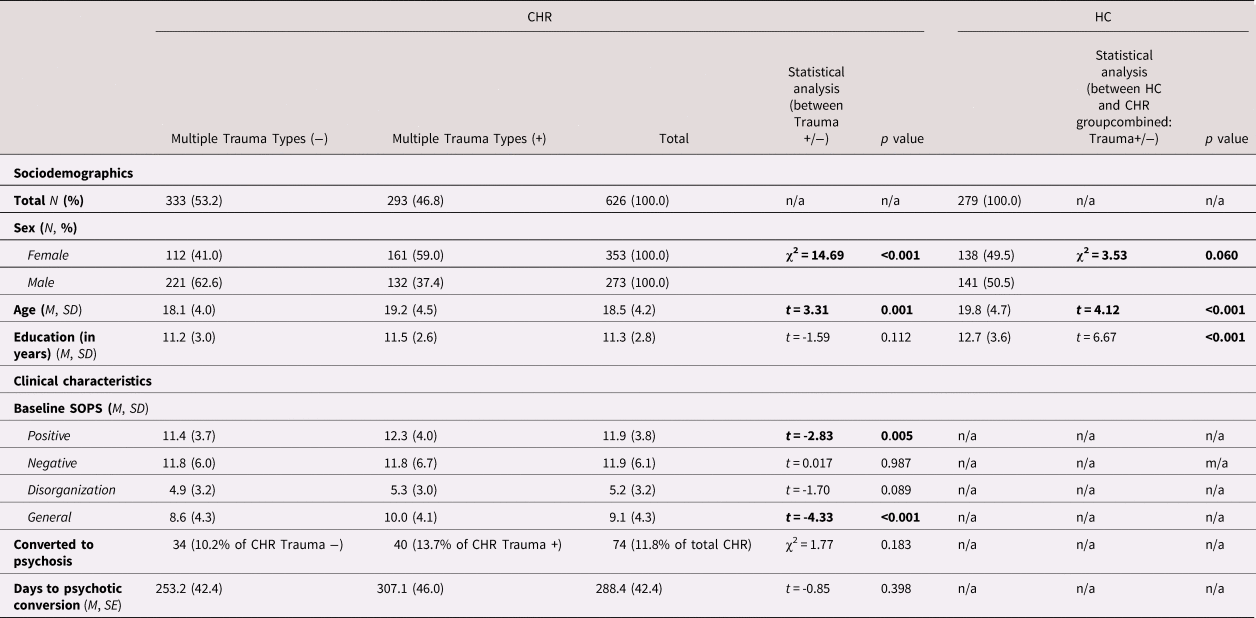
The study sample consisted of 626 CHR individuals (43.6% females) and 279 HC participants (49.5% females), with ages that ranged from 12 to 35 years. For the CHR group, mean age = 18.5 (SD = 4.2); for the HC group, mean age = 19.8 (SD = 4.7). All sociodemographic and clinical characteristics as well as frequencies of trauma exposures for the HC and CHR subgroups (Multiple Trauma Types +/Present; Multiple Trauma Types −/Absent) are presented in Tables 1 and 2. As shown in our previous publications, HCs performed better across social (see Piskulic et al., Reference Piskulic, Liu, Cadenhead, Cannon, Cornblatt, McGlashan, Perkins and Addington2016; Barbato et al., Reference Barbato, Liu, Cadenhead, Cannon, Cornblatt, McGlashan and Addington2015) and nonsocial (Seidman et al., Reference Seidman, Shapiro, Stone, Woodberry, Ronzio, Cornblatt and Woods2016) cognitive measures than the CHR group did.
Sociodemographic and clinical characteristics for CHR Trauma subgroups (Multiple Trauma Types +/Present; Multiple Trauma Types −/Absent) and healthy controls (HC)

Note: CHR, Clinical-High-Risk group; HC, Healthy Controls; SD, Standard Deviation; SE, Standard Error; SOPS, Scale of Psychosis-Risk Symptoms; n/a, not applicable.
Frequencies of trauma exposure for CHR Trauma subgroups (+/Present; -/Absent) and healthy controls (HC)

Note: CHR, Clinical-High-Risk group; HC, Healthy Controls; asterisks indicate the statistically significant differences between the HC and CHR groups (combined Trauma+/−), *p < 0.05, ** p < 0.01, ***p < 0.001.
CHR/Multiple Trauma Types + vs. CHR/Multiple Trauma Types −
The CHR subgroups (Multiple Trauma Types +/Multiple Trauma Types −) differed in sex distribution, with more females in the Multiple Trauma Types + group. The individuals with childhood trauma were also slightly older than those without (Table 1). Also, there was a statistically significant difference found in severity of current symptomatology between the two groups, with the CHR/Multiple Trauma Types + group reporting more severe positive symptoms and general symptoms (see Table 1). Seventy-four individuals (11.8%) with available baseline cognition data made a transition to a psychosis within a two-year period. Forty-five converters (7.2% of CHR sample) had both baseline and follow-up data available and were included in the cognitive change analyses. The CHR converters with follow-up cognitive data did not differ on demographic variables from those without (see Supplemental Material, Table S2). Psychotic conversion rates and average number of days to transition were comparable between the trauma subgroups.
Baseline cognitive functioning: CHR/Multiple Trauma Types + vs. CHR/Multiple Trauma Types −
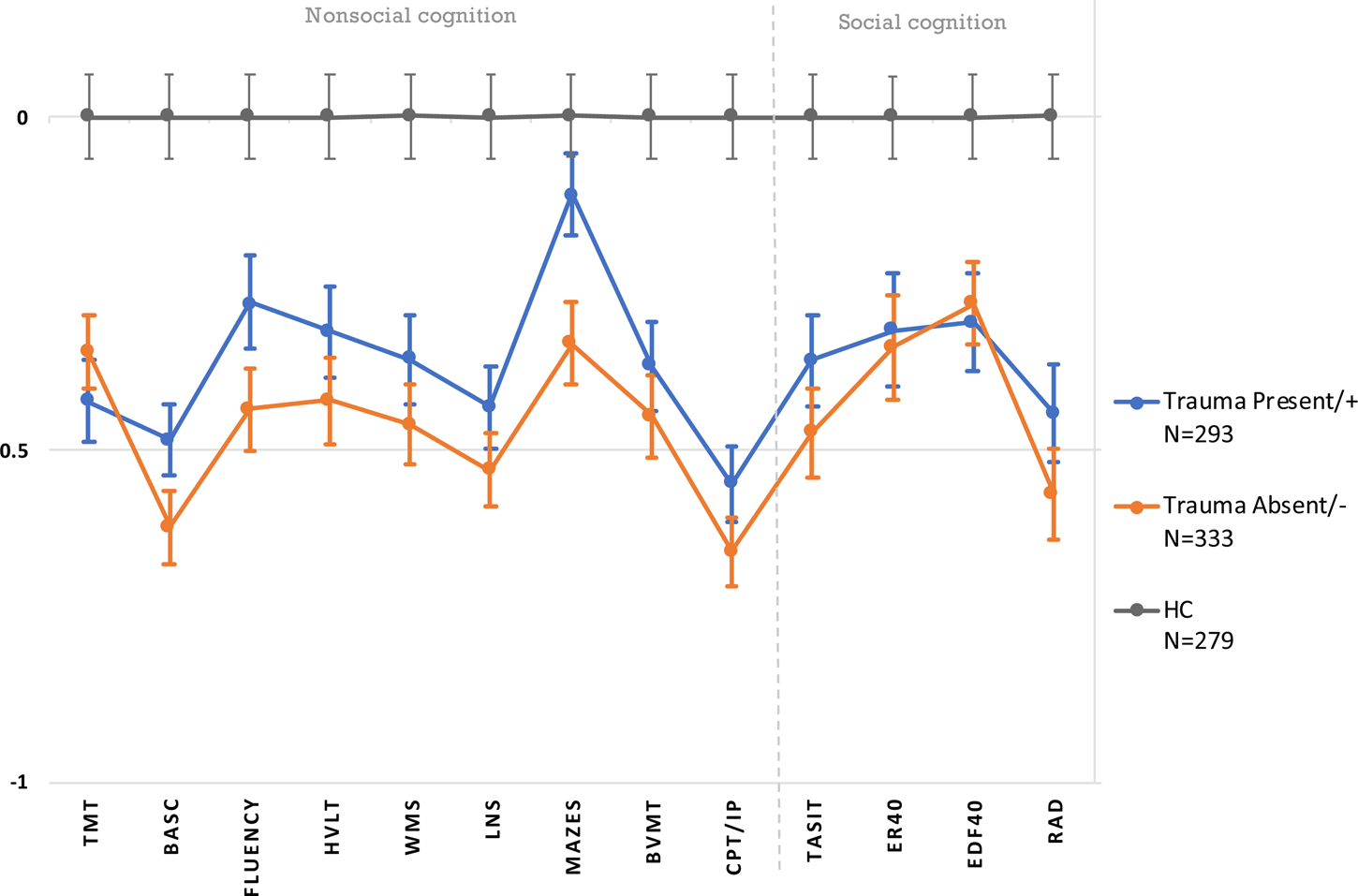
The baseline standardized z-scores for cognitive functioning in the CHR Trauma subgroups (Multiple Trauma Types + /Multiple Trauma Types −) are displayed in Figure 1 (for raw scores see Supplemental Material, Table S.1). Overall, there was a trend for better performance of CHR individuals with multiple types of childhood trauma across cognitive domains compared with those with no/one type of childhood trauma, F (1, 498) = 3.11, p = 0.079; Cohen d = 0.16. For additional analyses, we also looked at the relationship between childhood trauma (Multiple Trauma Types + /Multiple Trauma Types −) and social and nonsocial domains separately (neither reached traditional statistical difference, see the Supplemental Materials).
Baseline standardized z-scores (y-axis) and standard errors (indicated by the bars) across cognitive assessments for the CHR trauma subgroups (Multiple Trauma Types +/Present; Multiple Trauma Types −/Absent), standardized with healthy control (HC) means (and SDs) to convert to z-scores, adjusted for sex, baseline age, and years of education. Symbol Coding: TMT, Trail Making Test; BACS, Brief Assessment of Cognition in Schizophrenia; Fluency, Category Fluency; HVLT, Hopkins Verbal Learning Test-Revised; WMS, Wechsler Memory Scale-Spatial Span; LNS, Letter Number Span; Mazes, Neuropsychological Assessment Battery-Mazes; BVMT, Brief Visuospatial Memory Test-Revised; CPT/IP, Continuous Performance Test-Identical Pairs; TASIT, The Awareness of Social Inference Test; ER40, The Penn Emotion Recognition task; EDF40, Penn Emotion Differentiation task; RAD, Relationship Across Domains.

Looking at each of the childhood trauma types individually (Trauma Present vs. Trauma Absent), there was a trend observed for better overall cognitive performance in CHR youth reporting history of psychological abuse, F (1, 523) = 3.29, p = 0.070; Cohen d = 0.17, and emotional neglect, F (1, 520) = 3.08, p = 0.080; Cohen d = 0.17, vs. those who did not report these types of traumatic experiences. No differences in cognitive performance were found for other types of abuse (physical, sexual) or bullying (all ps > 0.3).
Baseline cognitive functioning in CHR converters, as a function of trauma history
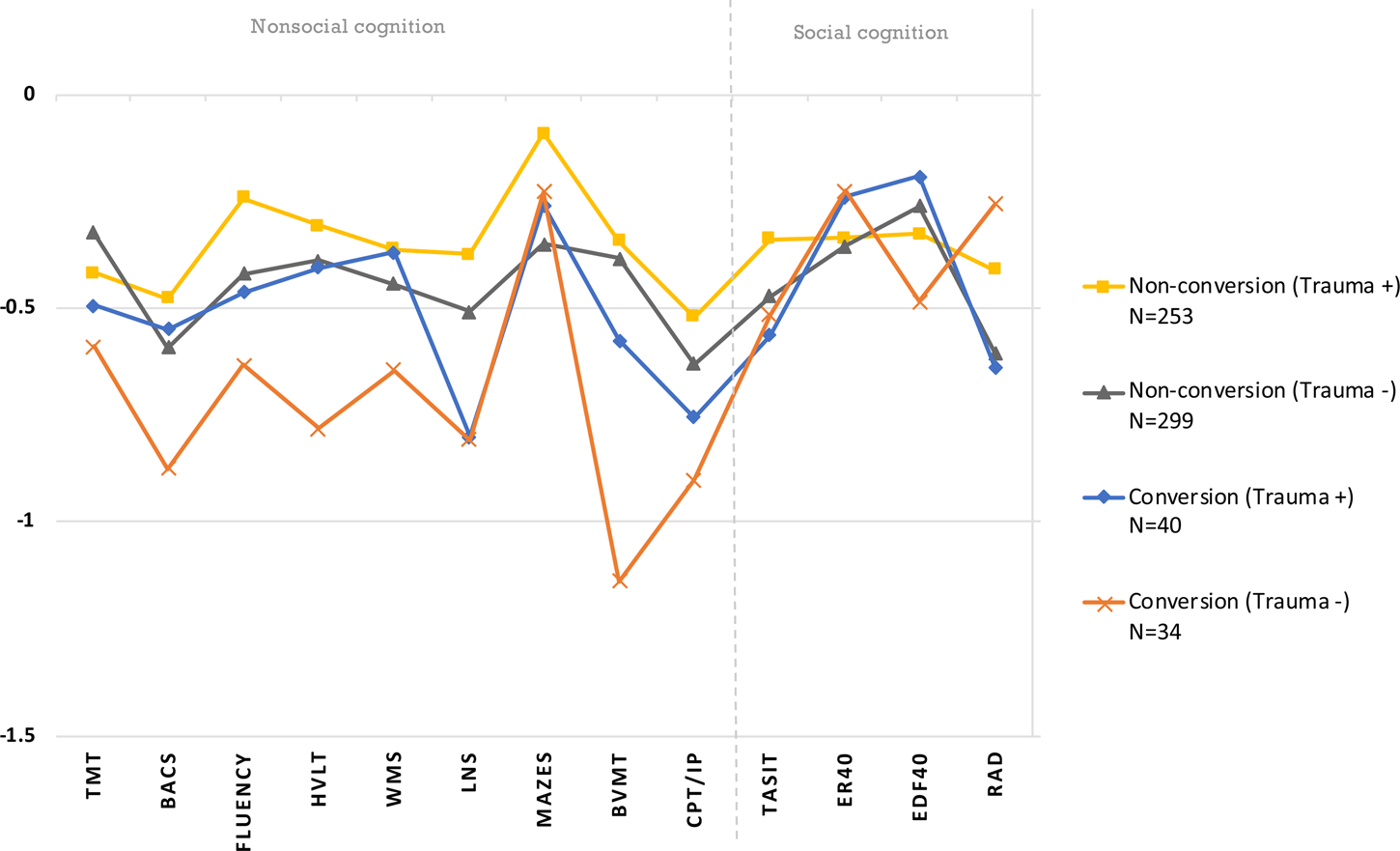
Within CHR converters only, there was no significant difference in cognitive performance between individuals with a history of multiple types of trauma and those who reported no/one type of childhood trauma (p = 0.6). Statistical information for each of the cognitive domains is presented in the supplemental materials (Table S3).
Baseline standardized z-scores (y-axis) across cognitive assessments for the CHR subgroups (Converters and Nonconverters to full-threshold psychosis), split by childhood trauma (Multiple Trauma Types +/Present; Multiple Trauma Types −/Absent) and standardized with healthy control (HC) means (and SDs) to convert to z-scores, adjusted for sex, baseline age, and years of education. Symbol Coding: TMT, Trail Making Test; BACS, Brief Assessment of Cognition in Schizophrenia; Fluency, Category Fluency; HVLT, Hopkins Verbal Learning Test-Revised; WMS, Wechsler Memory Scale-Spatial Span; LNS, Letter Number Span; Mazes, Neuropsychological Assessment Battery-Mazes; BVMT, Brief Visuospatial Memory Test-Revised; CPT/IP, Continuous Performance Test-Identical Pairs; TASIT, The Awareness of Social Inference Test; ER40, The Penn Emotion Recognition task; EDF40, Penn Emotion Differentiation task; RAD, Relationship Across Domain.

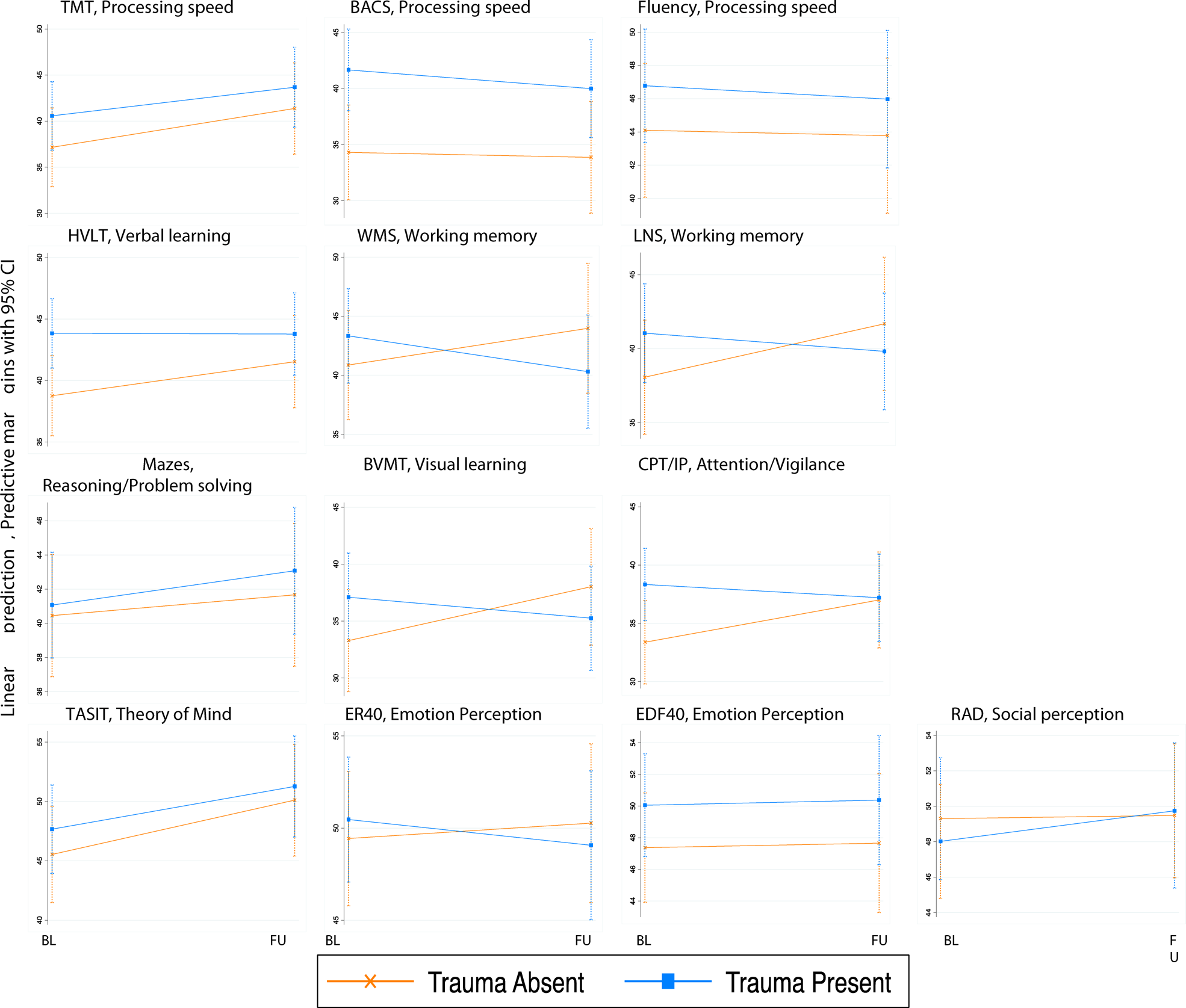
Cognitive changes in CHR-converters, as a function of multiple trauma types history
Linear mixed models showed no significant differences in change in cognitive functioning over time between those who reported multiple types of childhood trauma and those who did not. For cognitive trajectories/changes in scores for each of the cognitive domains split by trauma subgroups, see Figure 3.
Cognitive changes (T-scores) of cognitive functioning for CHR individuals who converted to full-blown psychosis by Trauma subgroups (Multiple Trauma Types +/Present; Multiple Trauma Types −/Absent); BL represents baseline and FU is follow-up time of conversion to full-threshold psychosis. Symbol Coding: TMT, Trail Making Test; BACS, Brief Assessment of Cognition in Schizophrenia; Fluency, Category Fluency; HVLT, Hopkins Verbal Learning Test-Revised; WMS, Wechsler Memory Scale-Spatial Span; LNS, Letter Number Span; Mazes, Neuropsychological Assessment Battery-Mazes; BVMT, Brief Visuospatial Memory Test-Revised; CPT/IP, Continuous Performance Test,-Identical Pairs; TASIT, The Awareness of Social Inference Test; ER40; The Penn Emotion Recognition task; EDF40, Penn Emotion Differentiation task; RAD, Relationship Across Domains.

Discussion
To our knowledge, this is the first study to date to examine differences in cognitive functioning and cognitive change over time in youth at clinical high risk for psychosis with and without childhood trauma. The results indicate that among the CHR group, those who reported a history of multiple types of childhood trauma tended to show better overall cognitive performance than individuals without multiple types of childhood trauma did. In particular, this trend was observed for CHR individuals reporting psychological abuse and emotional neglect vs. those who did not report these types of traumatic events. A history of multiple types of childhood trauma was not associated with a higher rate of psychotic conversion or with greater cognitive change in CHR converters with multiple trauma types than those without.
The high prevalence of adverse childhood events in our CHR group is consistent with our expectations, as childhood victimization has been widely recognized to be associated with increased levels of subclinical (Arseneault et al., Reference Arseneault, Cannon, Fisher, Polanczyk, Moffitt and Caspi2011; Kraan et al., Reference Kraan, Velthorst, Smit, de Haan and van der Gaag2015; Varese et al., Reference Varese, Smeets, Drukker, Lieverse, Lataster, Viechtbauer and Bentall2012) and clinical psychosis (Bendall et al., Reference Bendall, Jackson, Hulbert and McGorry2008; Fisher et al., Reference Fisher, Jones, Fearon, Craig, Dazzan, Morgan, Hutchinson and Morgan2010; Morgan & Fisher, Reference Morgan and Fisher2007) in both child (Arseneault et al., Reference Arseneault, Cannon, Fisher, Polanczyk, Moffitt and Caspi2011) and adult (Fisher et al., Reference Fisher, Jones, Fearon, Craig, Dazzan, Morgan, Hutchinson and Morgan2010) populations.
Our findings are generally consistent with those of Campbell et al. (Reference Campbell CB, Shannon, Hoy, Rushe, Cooper and Mulholland2013), where first-episode psychosis patients who reported childhood trauma had better premorbid IQ than those without early trauma. That is, our results are inconsistent with findings from general population studies (where people with a history of trauma are generally found to have worse cognitive functioning than their peers); moreover the cognitive performance of CHR individuals with multiple types of trauma was trending in the opposite direction. Although this trend was not upheld in the subgroup of individuals who converted to psychosis (possibly due to limited power), the magnitude of the difference in cognitive performance (for some measures) between individuals reporting multiple types of trauma and those without was actually larger.
Similar patterns were observed for nonsocial and social cognition. Our findings are unexpected for social cognition, as childhood trauma has been associated previously with deficits in the ability to recognize one's own affect and that of others (Lysaker et al., Reference Lysaker, Gumley, Brune, Vanheule, Buck and Dimaggio2011). Nevertheless, a recent study by Trauelsen et al. (Reference Trauelsen, Gumley, Jansen, Pedersen, Nielsen, Haahr and Simonsen2019) found that in patients with first-episode psychosis, individuals who reported childhood trauma displayed better metacognitive abilities than those without such experiences.
The (trending) better cognitive functioning in CHR individuals with a history of childhood trauma may point towards differential (not mutually exclusive) pathways that lead to clinical-high-risk states and potentially psychosis: one that is primarily triggered by external stressors and one potentially representing a more neurodevelopmental/genetic pathway. In the first pathway, childhood trauma may serve as a substantial environmental stressor. It has now been well established that environmental stress is an important factor in the development of psychosis (Bendall et al., Reference Bendall, Jackson, Hulbert and McGorry2008; Cannon et al., Reference Cannon, Caspi, Moffitt, Harrington, Taylor, Murray and Poulton2002; Kraan et al., Reference Kraan, Velthorst, Smit, de Haan and van der Gaag2015; Morgan & Fisher, Reference Morgan and Fisher2007; Read, Perry, Moskowitz, & Connolly, Reference Read, Perry, Moskowitz and Connolly2001; Tienari et al., Reference Tienari, Wynne, Moring, Lahti, Naarala, Sorri and Laksy1994; Varese et al., Reference Varese, Smeets, Drukker, Lieverse, Lataster, Viechtbauer and Bentall2012). Multiple studies suggest that early trauma can lead to neurochemical abnormalities, such as dysregulations of the hypothalamus–pituitary–adrenal axis (HPA; Corcoran et al., Reference Corcoran, Walker, Huot, Mittal, Tessner, Kestler and Malaspina2003; Walker & Diforio, Reference Walker and Diforio1997) and dopaminergic activity (Howes, McCutcheon, Owen, & Murray, Reference Howes, McCutcheon, Owen and Murray2017). Consequently, childhood trauma can have an enduring effect on adult stress sensitivity (the stress–vulnerability model; Nuechterlein & Dawson, Reference Nuechterlein and Dawson1984; Zubin, Reference Zubin and Spring1977), which may underlie more severe psychopathology, including psychosis. Findings by Myin-Germeys et al. (Reference Myin-Germeys, Krabbendam, Jolles, Delespaul and van Os2002) showed no positive association between (nonsocial) cognitive deficits and stress sensitivity. Instead their results showed no association or a reverse association for some cognitive domains, which may provide further support for a stress versus genetic neurodevelopmental pathway (where premorbid cognitive deficits are often apparent). The second pathway may represent a stronger genetic vulnerability to psychosis (Agnew-Blais & Seidman, Reference Agnew-Blais and Seidman2013; Cornblatt, Obuchowski, Roberts, Pollack, & Erlenmeyer-Kimling, Reference Cornblatt, Obuchowski, Roberts, Pollack and Erlenmeyer-Kimling1999; Harvey, Walker, & Wielgus, Reference Harvey, Walker and Wielgus1986; Snitz, Macdonald, & Carter, Reference Snitz, Macdonald and Carter2006) because those who did not experience childhood victimization displayed more severe cognitive dysfunction. Furthermore, this “genetic vulnerability” pathway to psychosis might reflect more prominent structural brain abnormalities (Cannon et al., Reference Cannon, Mednick, Parnas, Schulsinger, Praestholm and Vestergaard1993) that are possibly already evident at birth (Weinberger, Reference Weinberger1987).
Baseline symptom profiles and sociodemographic characteristics of CHR trauma subgroups (Multiple Trauma Types + and Multiple Trauma Types−) may offer more insight into distinct underlying mechanisms that predispose individuals to psychosis. Previous work has suggested distinct symptom and sociodemographic profiles in individuals with a predominantly stress-related pathway to psychosis. And consistent with previous findings relating to a stress-related pathway (Myin-Germeys et al., Reference Myin-Germeys and van Os2007), CHR individuals with a history of multiple types of childhood trauma in our sample were more likely to be female and presented with more positive psychotic symptoms and general psychopathology.
An alternative explanation of the findings of a tendency toward better cognitive abilities in CHR individuals with history of multiple types of childhood trauma (compared with those with no/one type of childhood trauma) is that CHR individuals with better cognition were better able to recall traumatic events. Unfortunately, our study did not evaluate long-term memory (delayed recall), so we cannot directly address this. Additionally, better cognitive performance in the trauma-positive (defined as Multiple Trauma Types +) subgroup could be contributed to Type 1 errors (false positives), but the consistent nature of the findings across cognitive measures makes this unlikely.
Looking at cognitive changes over time within individuals converting to psychosis, we observed no statistically significant differences in those with and without history of multiple trauma types. Interestingly, the group with multiple types of childhood trauma showed slightly (but not significantly) higher baseline nonsocial cognition scores without further decline on domains like working memory and visual learning, which was not evident for individuals who were not exposed to multiple types of adverse childhood experiences. Nevertheless, more longitudinal research is required (with longer follow-up periods) to truly unravel the trajectories of cognitive function in this population over time.
Also, it is important to highlight that the two proposed theories/pathways to clinical high-risk states and psychosis are not the only potential mechanisms underlying these clinical phenotypes. The literature shows substantial heterogeneity and complexity of factors that predispose individuals to psychosis (Radua et al., Reference Radua, Ramella-Cravaro, Ioannidis, Reichenberg, Phiphopthatsanee, Amir and Fusar-Poli2018), with some yet to be elucidated. Moreover, further studies are needed to untangle and validate these different pathways to psychosis because they may not necessarily be mutually exclusive and they may also occur during different developmental periods (Davis et al., Reference Davis, Eyre, Jacka, Dodd, Dean, McEwen and Berk2016).
Limitations and recommendations for future research
The current results need to be considered in light of several limitations. First, it is important to note that the differences in cognitive functioning between multiple trauma types-positive and multiple trauma types-negative CHR individuals were small (effect size of 0.16) and only trending towards significance. Second, childhood trauma was only defined as “present” or “absent,” with no differentiation of severity, frequency, and age/developmental timing of trauma occurrence, all of which are significant factors that are associated with psychotic symptomatology (Fisher et al., Reference Fisher, Jones, Fearon, Craig, Dazzan, Morgan, Hutchinson and Morgan2010). Future studies would benefit from carefully mapping these various characteristics of childhood trauma (timing, chronicity, and severity) when exploring cognition among clinical-high-risk groups. Also, polyvictimization (i.e., exposure to multiple forms of victimization) has been widely reported (Dong et al., Reference Dong, Anda, Felitti, Dube, Williamson, Thompson and Giles2004; Kessler et al., Reference Kessler, McLaughlin, Green, Gruber, Sampson, Zaslavsky and Williams2010) and considered in our study. Yet, we have not assessed the interrelationships among multiple forms of adverse childhood experiences, which makes it difficult to differentiate which combination of traumas has the highest effect on cognitive functioning. Additionally, we were not able to account for multiple incidences of the same trauma types (i.e., complete victimization profiles), a largely unaddressed issue in studies of child victimization (Finkelhor et al. Reference Finkelhor, Ormrod and Turner2007). The focus on incidences of different childhood trauma types may have hindered the identification of the most victimized CHR individuals in our study (i.e., those with chronic exposure to one particular trauma type; Turner et al., Reference Turner, Finkelhor and Ormrod2010). In a similar vein, certain types of childhood trauma (e.g., sexual abuse; Thompson et al., Reference Thompson, Nelson, Yuen, Lin, Amminger, McGorry and Yung2014) have showed the most robust association with psychosis, but in our study individuals with a single occurrence of these types of trauma might have been included in the trauma-negative group (no/one type of trauma vs. multiple types of trauma). Nevertheless, our secondary analyses confirmed that the association that was observed between childhood trauma and cognition in our study did not appear to be driven by sexual abuse. Third, the main childhood trauma measure that was used in this study (the Childhood Trauma and Abuse Scale; Janssen et al., Reference Janssen, Krabbendam, Bak, Hanssen, Vollebergh, de Graaf and van Os2004) was based on retrospective self-report. However, although several concerns have been raised with regard to retrospective reporting (amnesia [Howe & Courage, Reference Howe and Courage1993], mood-congruent recall [Bower, Reference Bower1981], and the reconstructive nature of memory [Schacter, Reference Schacter1999]), it has been shown that patients with a psychotic disorder report past abuse reliably (Fisher et al., Reference Fisher, Craig, Fearon, Morgan, Dazzan, Lappin, Hutchinson and Morgan2011). Fourth, the types of traumas that were considered for our analyses paint only a partial picture of the adverse environment to which the individual is exposed, which calls for inclusion of other factors that have been shown to influence cognition in clinical high risk groups (e.g., domestic violence [Koenen et al., Reference Koenen, Moffitt, Caspi, Taylor and Purcell2003]), or lifetime revictimization [Widom, Czaja, & Dutton, Reference Widom, Czaja and Dutton2008]). Moreover, childhood trauma may be confounded by or related to socioeconomic status (Hackman & Farah, Reference Hackman and Farah2009), lack of stimuli or undernutrition (Burchinal, Vernon-Feagans, Cox, & Key Family Life Project, Reference Burchinal, Vernon-Feagans, Cox and Key Family Life Project2008), and insecure attachment style (Ding, Xu, Wang, Li, & Wang, Reference Ding, Xu, Wang, Li and Wang2014) among others. Fifth, the number of CHR psychotic converters was low (11.8% of the CHR sample, N = 74) yet comparable to other CHR samples (Fusar-Poli et al., Reference Fusar-Poli, Cappucciati, Borgwardt, Woods, Addington, Nelson and McGuire2016), which precluded a more fine-grained analysis (e.g., sex differences in cognitive change over time). Finally, the assessment of cognitive functioning in our study was limited to two points (baseline and follow-up at psychotic conversion). A longer follow-up duration would allow for a measurement of the stability of cognitive functioning over time in those who do and do not report childhood trauma.
Conclusion
This study demonstrated that among individuals at clinical high risk of psychosis, there was a trend for better cognitive performance in those with multiple types of childhood trauma than among those who reported no/one type of trauma. In particular, this trend was observed for CHR individuals who reported psychological abuse and emotional neglect when they were compared with those who did not report these types of trauma. These findings lead us to speculate that CHR individuals with and without childhood trauma follow different trajectories to clinical-high-risk states. More studies are needed to validate these different trajectories and fully unravel the complexity of mechanisms underlying the pathways to psychosis.
Supplementary Material
The supplementary material for this article can be found at https://doi.org/10.1017/S095457941900155X.
Financial Support
Dr. Velikonja received support from the Seaver Foundation; Dr. Velikonja is a Seaver Postdoctoral Research Fellow. Dr. Velthorst received support by a 2018 NARSAD Young Investigator Award from the Brain and Behavior Foundation and from the Seaver Foundation; Dr. Velthorst is a Seaver Faculty Scholar. This study was also supported by the National Institute of Mental Health (grant U01MH081984 to Dr. Addington; grants U01 MH081928, P50 MH080272, and Commonwealth of Massachusetts SCDMH82101008006 to Dr. Seidman; grants R01 MH60720, U01 MH082022, and K24 MH76191 to Dr. Cadenhead; grant MH081902 and U01MH081902 to Dr. Cannon; grant P50 MH066286 to Dr. Bearden; grant U01MH082004-01A1 to Dr. Perkins; grant U01MH081988 to Dr. Walker; grant U01MH082022 to Dr. Woods; and grant UO1 MH081857 to Dr. Cornblatt) as well as a gift from One Mind to Dr. Bearden.
Conflict of Interest
None reported.