Introduction
The brazilian basslet Gramma brasiliensis is a fish endemic to the brazilian coast, distributed from Maranhão to Rio de Janeiro state and also found in the Fernando de Noronha archipelago (Sazima et al., Reference Sazima, Gasparini and Moura1998; Leite, Reference Leite2013), and the only representative of the Grammatidae family occurring in Brazil. Mainly due to intensive harvest by the ornamental fish trade, the natural stocks have been affected, resulting in its inclusion in the list of endangered species from Brazil (Brasil MMA and IBAMA, 2004). Currently, its capture, transport and sale are prohibited throughout the brazilian territory, except for individuals from aquaculture enterprises duly registered in fishing activity and with a valid licence in the aquaculture category (Brasil MAPA/SAP, 2021).
In the natural environment, G. brasiliensis breed in pairs or small harems, with one dominant male, other male(s) and females (Leite, Reference Leite2013, Reference Leite, Freitas, Sanches, Gomes, Hostim-Silva and Cole2016). This species exhibits nesting behaviour using macroalgae to form nests resembling a cushion for egg laying (Leite et al., Reference Leite, Pereira, Sanches, Moura and Hostim-Silva2018). Nest behaviour reported male participation only (Leite et al., Reference Leite, Pereira, Sanches, Moura and Hostim-Silva2018; Araújo-Silva et al., Reference Araújo-Silva, Mendonça, Mattos, Sales and Tsuzuki2021) and, like its congener Gramma loreto Poey, 1868, nests are formed in holes and depressions in the reefs, where the female can release asynchronous demersal egg masses (Asoh and Yoshikawa, Reference Asoh and Yoshikawa1996; Leite et al., Reference Leite, Freitas, Sanches, Gomes, Hostim-Silva and Cole2016, Reference Leite, Pereira, Sanches, Moura and Hostim-Silva2018).
This species shows intraspecific aggressive behaviour and, despite the courtship activity, spawning events in captivity can be rare (Araújo-Silva et al., Reference Araújo-Silva, Mendonça, Mattos, Sales and Tsuzuki2021). Information on reproductive biology, and egg and larval development is scarce but necessary to develop a breeding protocol for the species. Therefore, the purpose of this study was to provide data on spawning and a brief description of the eggs and larvae, including mouth size information. This information would help in determining appropriate diets and prey-shift time during the larviculture of the species.
Materials and methods
Wild Gramma brasiliensis specimens (3–5 cm; n = 16) were collected in December 2017 from the coast of Bahia state (12°57′26.0″S, 38°31′46.5″W; authorization SISBIO/ICMBio 22051–4) and sent to the Laboratory of Marine Fish and Ornamentals (LAPOM), Federal University of Santa Catarina (UFSC), Brazil. All experiments were performed with the authorization of the Ethics and Animal Use Committee (CEUA/UFSC 3189250520).
The broodstock was maintained in pairs, in tanks and glass aquaria. Information regarding tanks and aquaria, pair formation, number of pairs, structures used to provide refuge, nesting location and materials for nesting is described in Araújo-Silva et al. (Reference Araújo-Silva, Mendonça, Mattos, Sales and Tsuzuki2021). Once several spawning events (n = 4) had been obtained at LAPOM, egg masses from an ornamental fish producer (n = 2) (Ivan Oliveira, Piscicultura Tanganyika, Brazil), were kindly provided to increase sampling size, and were transported in plastic bags with filtered seawater and oxygen (similar to traditional fish transportation).
Egg clutches were manually opened and stretched on a Petri dish to be photographed for more accurate and easy counting, which was performed using the Paint 3D program (Microsoft®). An exact count was not made (except for the clutches with fewer than 200 eggs), as the egg masses were kept alive until hatching. For larval description, the largest egg clutch was chosen to have a sufficient number of larvae to photograph. The egg clutch was incubated in an egg tumbler with an air supply made of a clear polyethylene terephthalate (PET) bottle with small holes on the sides, kept in a rectangular glass aquarium with dark sides (35 cm length × 25 cm width × 25 cm depth), and filled with 17 L of filtered seawater (∼35 g/L salinity). The temperature was kept between 27ºC and 28ºC during the incubation and throughout the larviculture period.
The pH (8.2) (YSI EcoSense pH 10, Yellow Springs, OH, USA), ammonia (<0.25 mg/L), nitrite (<0.25 mg/L) (LabconTest Marine, Alcon®), and dissolved oxygen (>5 mg/L) (YSI pro 20, Yellow Springs, OH, USA) were measured daily. After hatching, the egg tumbler was removed and larvae were maintained in the same aquaria.
In total, 70 larvae were fed enriched (Algamac 3050®, Aquafauna, USA) rotifer Brachionus rotundiformis (5–10/ml) for the first 10 days. A green water system was used by adding live microalgae Isocrysis galbana (200,000 cells/mL) and Chaetoceros muelleri (80,000 cells/mL). Illumination was provided by pairs of white fluorescent lights (5000 K, 32 W each; Phillips®, The Netherlands) placed 50 cm above the system, and the illumination was switched on for 16 h per day. No water change occurred on the first 3 days of the larviculture and live food was provided in the mornings if the rotifer density was less than 5/ml. Afterwards, 50% of the water was changed daily and microalgae and rotifers were counted and replaced if needed. From day 10 onwards, rotifers were not replaced and Artemia sp. nauplii started to be offered at a density of 1/mL, and after day 15, enriched Artemia sp. metanauplii (Algamac 3050®, Aquafauna, USA) started being provided (1/mL). Live food was provided once a day, in the mornings after siphoning and water change.
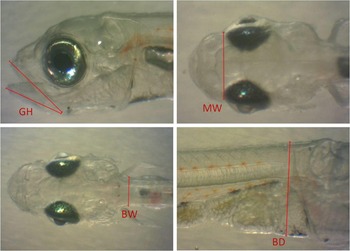
Larvae were collected daily from day 1 to day 8 (n = 5), and on days 11, 16 and 21 (n = 3), immobilized by immersion in cold water (5 parts ice/1 part water, 0–4ºC) and photographed after cessation of movement. We used a stereomicroscope with a camera attached (Dino-Lite®) with DinoCapture 2.0 software for measurements of standard length (SL; from the tip of the mandible to the posterior end of the notochord), body depth (BD; measured at the pectoral fins position) and body width (BW; from dorsal view at the pectoral fins position) (Figure 1).
Gape height (GH), mouth width (MW), body width (BW) and body depth (BD) measurements of Gramma brasiliensis larvae on 5 days post-hatch (dph).

Mouth gape height (MGH) and mouth width (MW) were also determined. The minimum gape height (MinGH) was considered to be a measure from the upper and lower jaws with the opening at a 45º angle (Ma et al., Reference Ma, Guo, Zhang, Hu and Jiang2015), using the equation
 ${\rm{MinGH}} = {\rm{\;}}\sqrt {{\rm{UJ}}{{\rm{L}}^2} + {\rm{LJ}}{{\rm{L}}^2} - 2.{\rm{UJL}}.{\rm{LJL}}.cos45} $
and the maximum gape height (MaxGH) a measure from the upper and lower jaws with an opening at a 90º angle (Shirota, Reference Shirota1970; Wittenrich and Turingan, Reference Wittenrich and Turingan2011), using the equation
 ${\rm{MaxGH}}=\sqrt {UJ{L^2} + \;LJ{L^2}} $
, where UJL is the upper jaw length and LJL is the lower jaw length. MW was measured from the dorsal view of the maxilla, considering the widest distance across the mouth opening, when the mouth was closed (Qin and Fast, Reference Qin and Fast1997; Figure 1). Linear regression and Pearson correlation were performed between SL and MW.
Results and Discussion
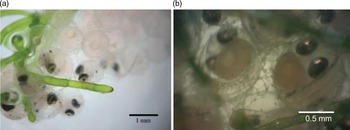
Six spawning events produced egg masses with 27, 127, 600, 750, 850, and 950 eggs. Clutches with 27 and 127 eggs presented embryos with similar developmental stages, featuring a single batch each. Larger egg masses contained embryos with at least two different developmental stages (Figure 2a), indicating that the female spawned more than once and at a few days apart; the egg mass containing ∼950 eggs had 250 embryos with well developed eyes. It was not possible to identify the exact interval between one spawning and another in the same egg mass. For royal gramma (Gramma loreto), a congeneric species, Wittenrich (Reference Wittenrich2007) observed smaller batches (25–40 eggs), sometimes produced for several consecutive days, and also resulting in masses with eggs at different developmental stages.
(a) Gramma brasiliensis egg mass with embryos at different developmental stages. (b) Filaments entangled on the chorionic projections connecting G. brasiliensis eggs with well developed embryos, showing pigmented eyes and yolk sac.

Eggs are spherical with a diameter of 1.0 ± 0.06 mm [mean ± standard deviation (SD)] (n = 20) (Figure 2b), similar to that found by Asoh and Yoshikawa (Reference Asoh and Yoshikawa1996) for G. loreto (0.95 ± 0.06 mm), and were held together by filaments entangling chorionic projections. This adhesion could occur to join eggs themselves and to the substrate used in the nest-building process.
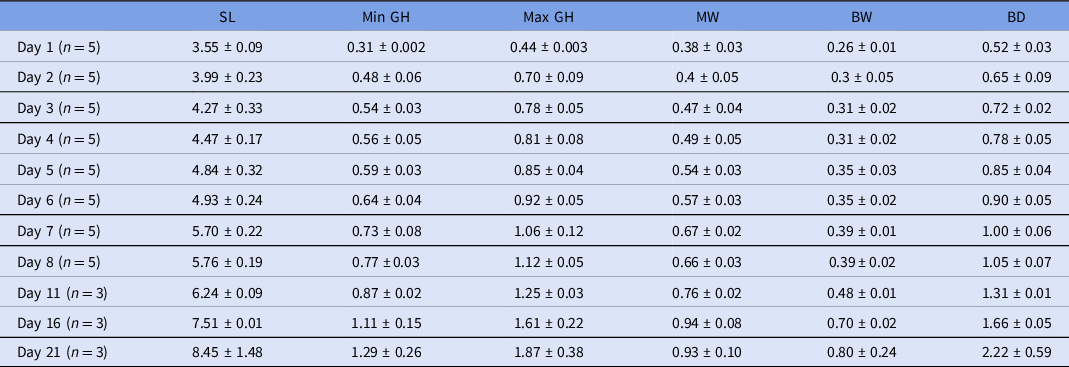
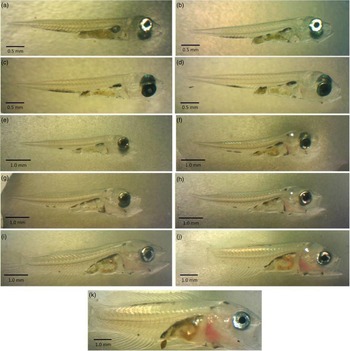
Similar to observations by Asoh and Yoshikawa (Reference Asoh and Yoshikawa1996) with newly hatched larvae of G. loreto (3.38 ± 0.35 mm SL), larvae of G. brasiliensis within a few hours (<12 h) after hatching had a 3.55 ± 0.09 mm SL, had well developed eyes, fully absorbed yolk sac, an inflated swim bladder, and an open mouth. Exogenous feeding on rotifers began within 12 h post-hatch (hph). The first larva with initial flexion of the notochord was observed on 7 days post-hatch (dph) (5.99 mm SL). On 8 dph, 60% of the larvae started notochord flexion (5.8 ± 0.2 mm SL) and by day 11, all larvae showed completion of notochord flexion (6.24 ± 0.09 mm SL). The postflexion larvae increased reddish pigmentation in the head, and completed the anal and dorsal fins separation and the first settled larvae were noted by day 21. G. brasiliensis larvae measurements and development from day 1 to day 21 are presented in Table 1 and Figure 3, respectively.
Measurements (mm) of reared Gramma brasiliensis larvae (27–28ºC)

Data are presented as mean and standard deviation. Abbreviations: BW, body width; BD body depth; Min GH, minimum gape height; Max GH, maximum gape height; MW, mouth width; SL, standard length.
Larval development of Gramma brasiliensis in captivity. Multiple individuals are shown. (a) Preflexion larva with fewer than 12 hph (hours post-hatch) with well developed eyes, no yolk sac, inflated swim bladder, and a gut full of rotifers. (b) Preflexion larva on 2 dph (days post-hatch). (c) Preflexion larva on 3 dph. (d) Preflexion larva on 4 dph. (e) Preflexion larva on 5 dph. (f) Preflexion larva on 6 dph. (g) Preflexion larva on 7 dph. (h) Larva on 8 dph with initial flexion of the notochord and initial formation of caudal fin rays. (i) Postflexion larva on 11 dph with formed caudal fin and formation of anal and dorsal fin. (j) Postflexion larva on 16 dph with increased reddish pigmentation in the head. (k) Postflexion settled larva on 21 dph with anal and dorsal fin.

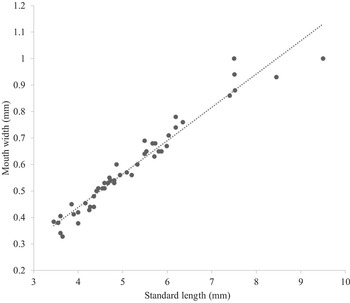
The average MW of G. brasiliensis at first feeding was 0.38 mm, increasing linearly with body SL (Figure 4). Information regarding mouth size measurements is important to the development of a larviculture protocol (i.e. adequate live food and prey-shift periods) as there are concerns in meeting the changing requirements for greater sized food as larvae grow (Moorhead and Zeng, Reference Moorhead and Zeng2011). The ratio between prey width and MW should be less than 50% (Shirota, Reference Shirota1970; Fernández-Diaz et al., Reference Fernández-Diaz, Pascual and Yúfera1994; Busch, Reference Busch1996; Krebs and Turingan, Reference Krebs and Turingan2003), yet, mouth gape height and width measurements are absent for many species of marine ornamental fish, the fact that constrains the determination of potential larval diets (Burgess and Callan, Reference Burgess and Callan2018).
Linear regression between standard length (SL; mm) and mouth width (MW; mm) of Gramma brasiliensis larvae from 1 to 21 dph (days post-hatch). Each data point represents one larva. R = 0.973 (y = 0.1259x − 0.0654); P < 0.05; n = 49.

This study is the first larval-rearing report for G. brasiliensis; we used the traditional live food for marine larval fish (rotifer, Artemia sp. nauplii and Artemia sp. metanauplii). The limited number of healthy larvae prevented a replicate being performed, therefore impairing survival rate evaluation. Despite that, two settled individuals reached total metamorphosis, with violet coloration on the anterior half of the body and a yellowish colour on the posterior, by day 27, similar to the 26 days observed by Wittenrich (Reference Wittenrich2007) for G. loreto. This indicates the viability of captive breeding for this species, despite the difficulties reported in aspects such as pairing and spawning (Leite, Reference Leite2013; Araújo-Silva et al., Reference Araújo-Silva, Mendonça, Mattos, Sales and Tsuzuki2021).
The use of copepods as food or as a supplement with traditional diets has shown positive results such as improved growth, survival, and pigmentation rates for several species of marine fish (Heath and Moore, Reference Heath and Moore1997; McEvoy et al., Reference McEvoy, Naess, Bell and Lie1998; Naess and Lie, Reference Naess and Lie1998; Gopakumar and Santhosi, Reference Gopakumar and Santhosi2009; Zeng et al., Reference Zeng, Shao, Ricketts and Moorhead2018). Therefore, subsequent studies should evaluate possible improvements to the larviculture of G. brasiliensis with the inclusion of copepods and the evaluation of prey-shift periods. Data provided here describing information on larvae should aid the next steps.
Supplementary material
To view supplementary material for this article, please visit https://doi.org/10.1017/S0967199423000059.
Data availability statement
The data that were analyzed in the present study are available upon justifiable request to the corresponding author.
Acknowledgements
We would like to thank the Laboratory of Marine Mollusks (LMM), at the Federal University of Santa Catarina (UFSC), for kindly supplying the microalgae to be used in this study.
Financial support
This study was financed in part by Coordenação de Aperfeiçoamento de Pessoal de Nível Superior, Brasil (CAPES); Finance Code 001 (scholarships provided to the first author) and the Project ‘Sustentabilidade e inovação de espécies marinhas nativas’, Ciências do Mar 2 nº 43/2013, funded by CAPES.
Conflicts of interest
The authors declare no conflict of interest.