INTRODUCTION
‘Broadcast yourself’, the slogan of YouTube, captures the essence of social media as platforms for self-presentation, friendship maintenance, and impression management (boyd & Ellison Reference boyd and Ellison2008). Indeed, over the last fifteen years, social media have not only spawned new forms of cultural production and participation (e.g. posting, commenting, ‘stories’, memes) but have also engendered new ways of being—and of becoming famous. It is now possible for completely unknown, ‘ordinary’ individuals to amass a great number of social media followers and in that process also to monetize on their online fame. The success of these ordinary celebrities hinges on the creation and distribution of original content across multiple platforms and the curation of a visible and distinct persona capable of sustaining a loyal audience (Khamis, Ang, & Welling Reference Khamis, Ang and Welling2017).
Given the cultural salience of such microcelebrities and social media influencers, analyses of their carefully performed online selves constitute a growing area of scholarly research into the cultural and communicative aspects of self-presentational digital media. This article is aligned with this scholarship through its focus on the mediated communicative activities of a Chinese online microcelebrity, Jiang Yilei (姜逸磊), better known by her stage name Papi Jiang. Papi has been highly popular in China, with 34,828,000 followers on Tik Tok and 6,379,000 fans on bilibili, both popular among teenagers, and 3,100,000 followers on the more established Chinese video-sharing platform IQIYI, at the time of writing. Many of Papi's videos, certainly the subset examined in this article, can be read as critical-satirical commentaries on contemporary social issues in China such as consumerism, gender norms, and family relations. Yet the topics of her videos alone are insufficient to account for Papi's massive popularity; the key to her fame and resonance with audiences must also come from the manner in which Papi presents herself and engages her online audience.
This article aims to explore how the sociolinguistic notions of stance and style could be usefully employed to empirically analyze mediated performances as constructions of microcelebrity personae. We are by no means the first ones to analyze style/ing in relation to performance; in fact staged performances specifically have been studied in the last ten years as important sites for sociolinguistic creativity and critique (Podesva Reference Podesva2007; Bell & Gibson Reference Bell and Gibson2011; Coupland Reference Coupland and Mesthrie2011; Koven & Marques Reference Koven and Marques2015; Britt Reference Britt2016). In these studies, persona is generally studied as the instantiation of a stylized identity or character type, performed through the display of (mostly) phonological/acoustic features taken to index them, and often to parodic effect. Building on work in media and celebrity studies, we view persona as ‘material forms of public selfhood’ (Marshall, Moore, & Barbour Reference Marshall, Moore and Barbour2015:290) that are pervasive in digital culture. Similar to sociolinguistics studies, persona in this sense is seen as arising from durable associations between types of personhood and associated expressive/stylistic attributes. But unlike many sociolinguistic studies, we aim to investigate persona not as it is performed through the in situ assembly of stylistic resources but rather as a cluster of diverse semiotic elements that converge in their expressive stance across instantiations. The study of persona in this sense also has methodological implications.
The immediate aim of the article is to account for the semiotic foundations of Papi's microcelebrity persona through an analysis of her videos as staged performances (Bell & Gibson Reference Bell and Gibson2011). But in fulfilling this research objective, the study also offers some important contributions to sociolinguistic research on mediated performances. First, it employs a combination of corpus linguistic tools with qualitative discourse analysis to identify unique expressive elements of Papi's style, demonstrating the value of such methodological approach for the semiotic study of persona as habituated public self. Second, the analysis focuses on a wide range of semiotic resources including some not considered in previous research on mediated performances, such as editing techniques. Third, we argue that a combined use of stance and style when analyzing microcelebrity communicative practices has important theoretical purchase: it draws attention to the dual role of such practices in digital publics as both a source of aesthetic pleasure and social critique. We argue that style is a crucial attribute of performance as artful expression, while stance helps us understand microcelebrity digital expressions as potentially performative critical social action.
PERFORMANCE, STYLE, AND STANCE
Due to the expansion of digitally mediated online spaces as both repositories of and platforms for expressive genres, sociolinguists have increasingly turned to performance as a key concept to theorize the role of linguistic variation in social life. Performance has a rich conceptual history within the ethnography of speaking as a marked mode of communicative practice during which ‘the act of expression is put on display, objectified, marked out to a degree from its discursive surroundings and opened up to interpretive scrutiny and evaluation by an audience’ (Bauman Reference Bauman2000:1). Sociolinguists have been particularly interested in mediated performances, which are predominantly media texts that are recorded and accessed via the internet (Bell & Gibson Reference Bell and Gibson2011). Mediated performances can be broadcast shows or live recordings that have been digitized and made available online (e.g. comedy sketches or musical performances uploaded to YouTube), or may be digital texts specifically produced for online consumption and dissemination (e.g. TikTok videos), with the former group receiving the bulk of scholarly attention in sociolinguistics (e.g. Gibson Reference Gibson2011; Britt Reference Britt2016).
Sociolinguistic work on mediated performance brings together several theoretical developments in the field. The analytic focus is on performed language, which is self-conscious and practiced, drawing attention to itself through metapragmatic devices and artful ways of speaking (Bauman Reference Bauman1977). Second, while phonological features remain the central focus, performed productions are recognized as multimodal communicative acts where signification takes place through diverse semiotic resources, which must be accounted for (Auer Reference Auer2008). Third, identity is principally implicated in performance, given that performance often involves situated fashionings of identity. In other words, performers routinely draw on and play with the indexical relationship between semiotic forms and types of personhood (Bauman Reference Bauman2011) for comedic or serious effect. Finally, reflexivity is central to performance not only through an overt focus on the act of expression but also because performances often convey meta-commentary on self and society (Bauman & Briggs Reference Bauman and Briggs1990; Bell & Gibson Reference Bell and Gibson2011).
Style has been a central analytic tool in the sociolinguistic study of mediated performance. Following Bell's (Reference Bell1984) contribution of style as audience design, language use (as stylistic variation) is seen in this work as a resource for the discursive accomplishment of identity, aiding the creation of a ‘relationship between communicator and audience’ (Bell Reference Bell1984:192). In line with this agentic view, style is generally understood as styling; a dynamic process of bricolage (Eckert Reference Eckert, Warner, Ahlers, Bilmes, Oliver, Wertheim and Chen1996) that involves appropriating and recombining a broad range of resources to construct distinct ways of being and relating to others. In fact, mediated performances may draw on stylistic features that are not the performer's ‘own’ or do not come from a bounded repertoire of speech (Coupland Reference Coupland2007). Styling thus may involve stylization—the ‘appropriation and revoicing of someone else's style’ (Ray Reference Ray2016:45)—which has become an important analytic concept in sociolinguistic research on mediated performances (Coupland Reference Coupland2001).
The development of style into a dynamic and multifaceted concept that encompasses not just phonological variables but a range of semiotic features has paralleled a move away from correlational models of identity which equated linguistic features directly with a particular social group or type (Bucholtz Reference Bucholtz and Jaffe2009). Building on linguistic anthropological theories of indexicality (e.g. Silverstein Reference Silverstein, Basso and Selby1976), an indexical approach to identity posits that linguistic forms are multi-functional, and thus their social meaning is necessarily context-bound in the first instance. As Ochs’ (Reference Ochs, Duranti and Goodwin1992) work on gender demonstrated, for example, linguistic forms such as tag questions principally index (or ‘mean’) interactional stances (such as hesitancy) in unfolding discourse. However, over time, such interactional stances can become habitually associated with particular social identities or broader styles; this link however is not a direct one but rather mediated through ideologies (Ochs Reference Ochs, Duranti and Goodwin1992; Bucholtz & Hall Reference Bucholtz and Hall2005). There is thus a level of ‘pragmatic work’ (Ochs Reference Ochs, Duranti and Goodwin1992:342) of expressing social (viz. affective, attitudinal, epistemic) meanings through stance taking as an intermediary between linguistic resources and style as the socially recognizable expressive dimension of identity. A number of sociolinguists have productively employed stance to investigate style in relation to performance specifically (Jaffe Reference Jaffe2015; Slobe Reference Slobe2018; Valentinsson Reference Valentinsson2018). In fact, Bauman (Reference Bauman2011:710) himself considered performance as ‘an act of stance-taking’ whereby the performer takes up a particular alignment to their act of expression.
This study combines stance and style as focal analytic categories in studying and understanding Papi Jiang's unique persona empirically. In line with indexical theories of identity, we consider stance to be the analytically primary category in studying persona as publicly presented self. In other words, semiotic resources deployed in Papi's performance of various characters in her videos do not directly index her style; rather, as we show shortly, they facilitate the expression of affective-attitudinal meaning toward the content of her performance. Her style then emerges through repeated sets of stance staking (Johnstone Reference Johnstone and Jaffe2009) across multiple videos as she communicates similar pragmatic meaning through a variety of semiotic means. Our corpus and qualitative analysis is thus geared toward demonstrating how attitudinal stance expressed through diverse grammatical, discourse-level, and non-linguistic means converge to create a recognizable style.
MICROCELEBRITY PERSONAE
Microcelebrities, according to Marwick (Reference Marwick2013:114), are individuals who attract fans/followers through online interactions, primarily by ‘creating a persona, producing content, and strategically appealing to online fans’. Microcelebrity practices essentially pivot around self-branding: the need to maximize visibility and recognition in the social media market where attention is the main currency (Khamis et al. Reference Khamis, Ang and Welling2017). Yet self-branding in social media is a delicate affair; users have to balance self-promotional activity with the need to present an authentic self (Marwick & boyd Reference Marwick and boyd2010; Valentinsson Reference Valentinsson2018). Similarly, microcelebrities must achieve and cultivate a unique and exclusive ‘brand’ that sets them apart from others (including their followers) while also remaining ‘ordinary’ and accessible to their fan base. This calls for highly strategic self-presentation that combines creativity with a significant amount of business acumen (Khamis et al. Reference Khamis, Ang and Welling2017) among successful microcelebrities.
Marshall (Reference Marshall2014, Reference Marshall2016) sees microcelebrities as part of a much larger phenomenon tied to the rise of identity and self-presentation as a key element in contemporary media, labor, and social organization. According to Marshall (Reference Marshall2014), persona should constitute a central analytic lens through which to understand the role of individuals in attracting micro-communities that command considerable affective, political, and economic power. In his view, public (dis)plays of identity are not simply narcissistic efforts of individuals; they constitute powerful nodes within a new online publics where identity performances and the values they communicate are consumed and spread through the virtual social ties of a microcelebrity's followers. As such, digital self-expressions clearly can be political, particularly among networked youth for whom self-actualization, social responsibility, and democratic innovation are simultaneously pursuable projects (Bennett & Segerberg Reference Bennett and Segerberg2011).
Our analysis of Papi Jiang's style is couched in two intersecting bodies of work which we hope to bring together in this article. On the one hand, we follow sociolinguistic studies of stance and style as a central aspect in the performance of personae, empirically analyzable through careful examination of the configured deployment of a range of semiotic resources. On the other hand, Papi Jiang's online performances need to be understood as located within a digital ecology where play, critique, and monetary gains sit ambivalently together. This then points to the need to conceptualize persona as more than a situational-semiotic act but rather as a central cultural-economic imperative underpinning online self-presentation.
PAPI JIANG: A BRIEF BIO SKETCH
Papi Jiang/Papi 酱 (stage name), or Jiang Yilei/姜逸磊 (real name), was born in 1987 and grew up in Shanghai. A graduate of the Central Academy of Drama in Beijing, the top Chinese university for the performing arts, Jiang Yilei shot to fame in 2016 through her satirical videos posted primarily on Sina Weibo. In these videos, Papi offers cultural critique through witty, outspoken and animated tirades, often delivered by Papi acting out scenes shot in her cluttered apartment. She is considered among the top Chinese social media influencers whose online fame seems to have resulted in financial gains as well, with Jiang Yilei selling her first ad for twenty-two million RMB (3.2 million USD) in 2016 and having also founded her production startup Papitube for nurturing young content creators (Fan Reference Fan2019).
Most of Papi Jiang's videos can be read as critical commentary on contemporary Chinese society, especially concerning gender relations. In terms of the genre of her videos, many feature Papi taking on the role of multiple characters, using video-editing techniques and minimal props for transitions across characters or scenes. In some other videos, she offers monologic tirades on a variety of topics, enhanced through her acting skills. There is some academic literature on her public identity construction as a famous microcelebrity, but the emphasis has been on Papi's ‘ordinariness’ rather than her unique expressive style, with researchers stressing her education background and acting talent (Chen, Liu, Sun, & Zhou Reference Chen, Liu, Sun and Zhou2016). A few Chinese scholars have also examined Papi's videos from the angle of female gender roles by looking at topics and vlogging techniques (e.g. Deng Reference Deng2017) without scrutinizing style as a key component in Papi's persona. At the same time, commentators on Chinese social media have repeatedly called her ‘frantic’, ‘exaggerated’, and even ‘crazy’—adjectives no doubt shaped by impressions of her online persona. Our study takes such folk labels as a point of departure in an effort to understand how to capture her style and persona empirically.
METHODOLOGY
This study combines corpus-assisted and qualitative discourse analysis in order to examine style in Papi Jiang's microcelebrity persona. Corpus analysis has become an important methodology within literary stylistics (e.g. Culpeper Reference Culpeper2009), yet its use to study style as mediated forms of self-expression has been limited. Ray's (Reference Ray2016) study of Amazon customer reviews of a controversial pen is a clear exception. His corpus analysis was able to show that the 671-review corpus contained significantly more stereotypically ‘feminine’ linguistic forms as compared to a reference corpus, while through qualitative analysis Ray illustrated how review writers used these feminine forms as stylized expressions clearly intended as critique of a pen explicitly marketed as feminine.
In this study, we utilize corpus techniques in order to identify ‘keywords’ that occur more frequently in the Papi corpus than in a reference corpus. Keywords enable researchers to gain an initial insight into how the corpus under investigation is different from texts comparable in genre or content (Gabrielatos Reference Gabrielatos, Taylor and Marchi2018). While it is not uncommon for researchers to disregard function words in keyword lists and instead only rely on content words, function words have been demonstrated as highly influential in revealing patterns of ideological and attitudinal meaning in texts (Weninger Reference Weninger2010; Pearce Reference Pearce2014). Given our interest in precisely such meanings and given that the majority of keywords in the Papi corpus were function words (pragmatic particles, to be precise), the corpus analysis in the present study is focused on what function words can reveal about Papi's style.
To do so, we utilize the notion of semantic prosody (Sinclair Reference Sinclair2004) which in corpus linguistics is understood to capture the discourse function of attitudinal meaning that is invoked through co-occurrence of certain lexico-grammatical items. As such, semantic prosody is quite similar to stance in interactional studies, and in fact the analysis shows how function words are crucial in communicating a negative, intensive attitudinal meaning in Papi's videos. The corpus findings provided linguistic evidence for the markedness (i.e. distinctiveness) of these patterns which would have been difficult to establish through micro-analysis of a few videos. The results from the corpus analysis thus offered a useful entry point into the data, highlighting in a way an initial attitudinal contour of the corpus which could be further examined through qualitative means. In other words, guided by the corpus findings, the qualitative analysis aimed to discover further grammatical, discourse-level, and non-linguistic features of Papi's videos that produced similar attitudinal meaning but which would have been difficult to find through corpus analytic means. Overall, we aim to demonstrate the combined strength of corpus and qualitative analytic modes in giving a more complex account of stance and style in Papi Jiang's videos.
The corpus analysis
At the time of data gathering (April 2018), there were altogether 126 videos posted on YouTube by Papi Jiang, the earliest dating from 2016. On Papi's official YouTube channel, her videos are listed as belonging to fourteen playlists, though these playlists do not reflect any chronological ordering but rather a topical classification. From this longer list, the ‘Monday Post Series’ was chosen because (a) this is the playlist with the most videos that are roughly of equal length, around four to five minutes, and (b) it is the most stable list to which videos are being uploaded regularly. Further, since Papi posted these videos as belonging to one set, one can assume that there is some kind of (thematic) coherence within this series.
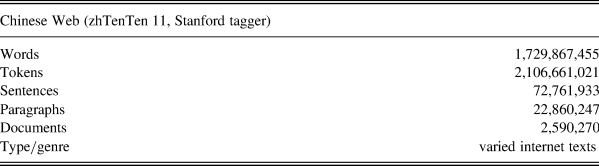
To enable corpus analysis, we first transcribed the selected twenty-two videos in two steps: first using a commercial software for audio transcription and then manually double-checking the transcripts, which was done by three Chinese native-speaker applied-linguistics master's students. Any discrepancies were eliminated through discussion and majority agreement. The next step was to find a suitable reference corpus, given corpus linguistics’ central tenet that corpus patterns are meaningful primarily when compared to typical language use within the genre or communicative domain under examination. In the absence of a suitable downloadable corpus of Mandarin Chinese, we chose Sketch Engine; an online corpus tool that offers a variety of corpora in over ninety languages. Sketch Engine's corpora were used among others for the latest authoritative reference grammar of Mandarin Chinese (Huang & Shi Reference Huang and Shi2016) and the platform is widely used among linguists. From Sketch Engine's Chinese corpora, the ‘zhTenTen 11’ subcorpus was chosen as the most comprehensive collection of internet texts with the latest data collection period (2011), consisting of over 1.7 billion words and based on texts crawled from a wide variety of internet sources (see Table 1 for corpus information). There is no information provided by Sketch Engine on the precise genre make-up of the zhTenTen 11 subcorpus, given the notorious difficulty in obtaining such metadata from websites and the sheer size of the zhTenTen 11 subcorpus. Nevertheless, given the widespread use of Sketch Engine corpora in linguistics as well as the lack of an alternative internet corpus of Chinese, we consider zhTenTen 11 as an adequate reference corpus for the current study.
Information about Sketch Engine's zhTenTen 11 Chinese subcorpus.

Working with Sketch Engine involved first creating our own focal corpus (Papi corpus, roughly 18,200 words) by uploading the twenty-two Chinese Mandarin transcription files. Based on the Stanford Word Segmenter (The Stanford Natural Language Processing Group 2020) and the word sketch grammar of Sketch Engine, a list of the top thirty keywords (see Appendix B) was generated for the preliminary identification of features of the Papi corpus. In Sketch Engine, the keyness score of a word is calculated as the ratio of the normalized frequency (per million) of the word in the focus corpus and in the reference corpus, with the addition of n = 1 to all counts as a smoothing parameter. Keywords generated this way are considered to be reliable indicators of how the focus corpus (in this case, the Papi corpus) is different from the reference corpus (Kilgarriff Reference Kilgarriff, Mahlberg, González-Díaz and Smith2009). Keywords are presented and discussed in the first part of the Findings section, with examples highlighting their contextual pragmatic function as stance markers.
The qualitative analysis
Keyword analysis is limited in that it can only identify linguistic features at the word level. In order to obtain a fuller understanding of Papi's persona, we analyzed more closely three videos from the ‘Monday Post Series’. The qualitative analysis was guided by insight from the corpus analysis, which means that we were particularly interested in identifying semiotic features in Papi's performance that communicated attitudinal meanings similar to what was revealed through the corpus analysis. The findings of the qualitative analysis thus focus on discussing these features as expressing particular stances, which we then link to style and persona in the Discussion section.
A brief description of the three videos is in order. The first video, ‘My Mom’ (Papi Jiang Reference Jiang2017b), sees Papi enacting a conversation between a mother and her school-aged daughter, both played by Papi. During the conversation, the mom admonishes her daughter for everything from her study habits and exam results to details of her appearance, dismissing the daughter's feeble attempts at protesting. The episode is a caricature of Chinese parents who are overly demanding of their children and constantly compare their offspring to peers who are thought to surpass them. In the second video, titled ‘Modern Women’ (Papi Jiang Reference Jiang2017c), Papi plays a consultant who offers various ‘suggestions and instructions’ to women on a wide range of aspects including their figure, hairstyle, career, appearance, personality, marriage, and even fertility issues in an effort to help them become truly modern women. The video is again satirical, which becomes evident through the ridiculous list of dos and don'ts women are advised to follow. Finally, the third video, ‘Men and Women’ (Papi Jiang Reference Jiang2017a) is dedicated to the question of male-female relationships and features Papi discussing a broad range of things women find puzzling or annoying about men. All three videos thus deal, in one way or another, with gender and gender relations, ensuring some thematic similarity in the dataset.
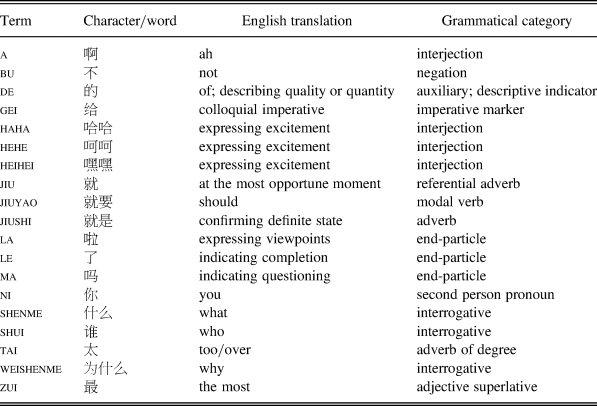
A final point: when discussing examples from the videos, it is necessary to sometimes provide grammatical glosses, in addition to the Chinese original, the Romanized script (Pinyin), and the English translation. In these cases, labels for grammatical categories from Yip & Rimmington (Reference Yip and Rimmington2004) are used (see Appendix A for a list).
FINDINGS
Grammatical patterns in the Papi corpus
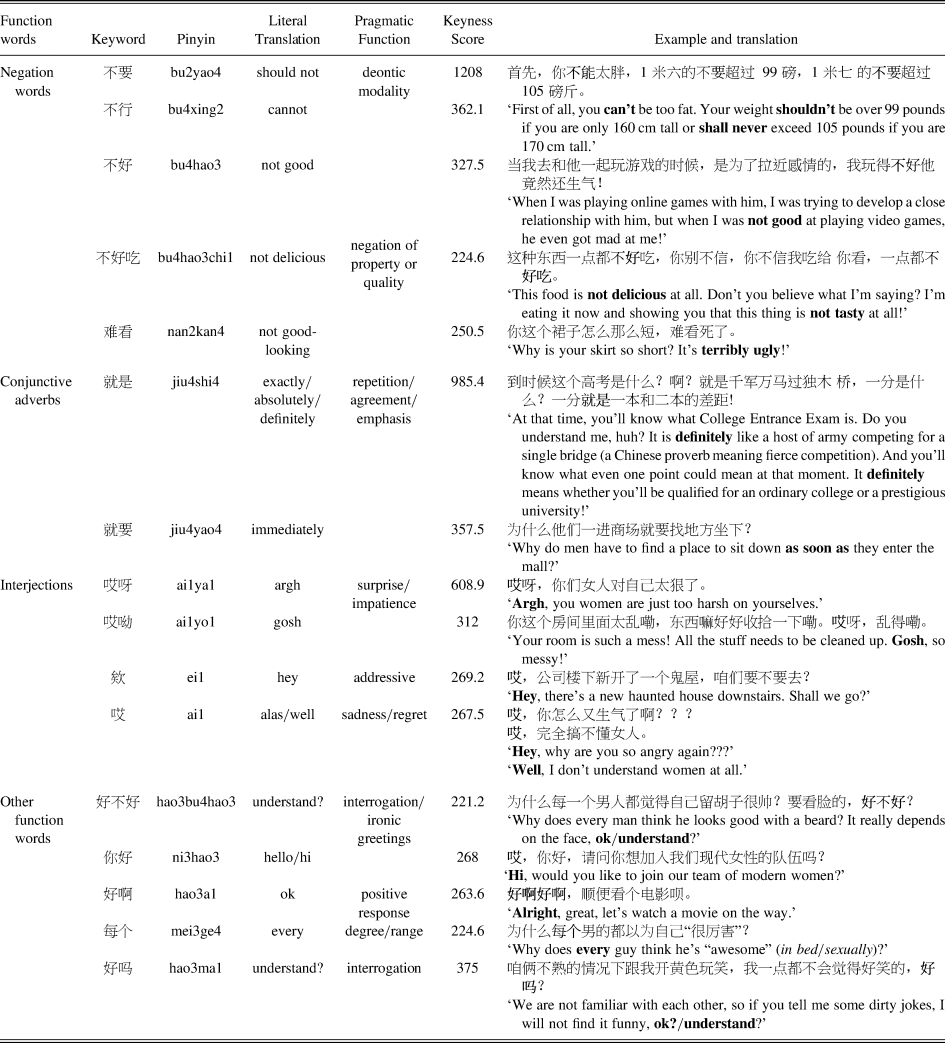
We start by discussing the findings of the corpus analysis based on a close examination of the keywords generated by Sketch Engine (see Appendix B for the original keyword list, rank-ordered according to keyness scores). Given our interest in function words, in Table 2 we regrouped the function words from the thirty keywords into four types that fulfil similar pragmatic functions in Chinese. Some general linguistic features and the overall semantic prosody of the corpus are discernible immediately.
Keywords of the Papi corpus, grouped based on grammatical categories.

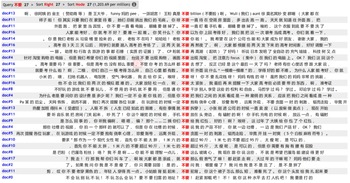
As the name suggests, the first category of keywords features words that express some form of negation. For instance, Figure 1 shows that there are twenty-seven occurrences of bu2yao4 ‘don't’, which is the word with the most marked keyness as compared to the reference corpus. While it features five times in two of the twenty-two videos, overall, it is found in more than half the videos, which shows that its distribution is not concentrated in only a few videos. Similarly, another negative particle, bu4xing2, has a frequency of 402.5 per million words in the Papi corpus and a frequency of just 0.1 in the reference corpus. In other words, the grammatical element that most distinguishes Papi's videos from other online texts is the negative particle. Exactly what is being negated is less important here; the marked proportion of negation can be interpreted as a unique feature of the corpus, and one that reveals the semantic prosody of the twenty-two videos as communicating negativity.
Concordance lines of 不要 bu2yao4 ‘do not/should not’.

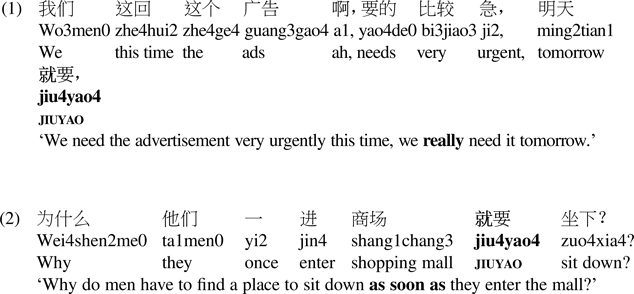
There are two keywords starting with the adverb 就 jiu4 (see conjunctive adverbs in Table 2) whose meaning depends on the verb it is attached to. 就 jiu4 is a highly frequently used adverb in Mandarin Chinese (Huang & Shi Reference Huang and Shi2016:336). Though 就 jiu4 can be used to denote time which is earlier than expected, literally ‘just, right now, about to’ in English, this functional use of 就 jiu4 is absent in the Papi corpus. Rather, in seven out of eight instances jiu4 acts as an intensifier to express a feeling of urgency and haste, as in the following examples.

The context of examples (1) and (2) is very different; the first is from a video where Papi talks about annoying clients who place excessive demands on ad agencies, while the second one is a complaint about men. Yet in both examples, jiuyao intensifies the degree of urgency expressed in the statements, thus helping to mark the speakers's stance toward such behaviors as unreasonable.
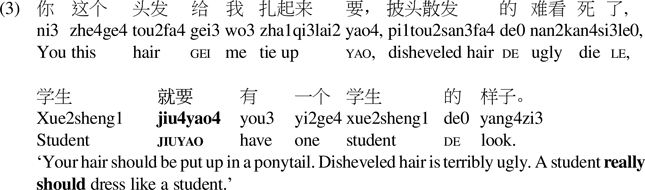
Even more interestingly, these two keywords can also serve as stance markers to strengthen the speaker's attitude toward a topic which is also communicated verbally, as in the following example from ‘My Mom’.

Jiu4shi4 and jiu4yao4 are in the top ten keywords of the corpus. We argue that in the immediate interactional context, they should be taken as stance markers. In example (3), the mom criticizes her daughter's hairstyle and dispenses her opinion about proper hairdo for students. jiu4yao4 overlays the propositional content of the mom character's speech with an attitudinal intensity that helps to convey her stance of annoyed insistence. This immediate or localized pragmatic meaning of jiu4yao4 as stance marker is tied to this particular character. However, what is noteworthy is how similar stances (realized through different linguistic elements) form a pattern across the corpus.
The third group of keywords are interjections. In Chinese, interjections can be grouped into at least two types. The first type is what we call laughter onomatopoeia such as 哈哈 ha1ha1, 呵呵 he1he1, 嘿嘿 hei1hei1, and so on, which are used to express happiness or excitement. Another group of interjections is usually monosyllabic and can be thought of as vocalized sighs, which typically represent some negative emotions, such as regret, impatience, annoyance, or sadness (Huang & Shi Reference Huang and Shi2016). Words in this category include 哎 ai0, 咳 hai0, 嗨 hai0, and so on. It is this second type, mostly negatively charged interjections that are most pervasive in Papi's speech, such as 哎呀 ai0ya0, 哎呦 ai0you0, 欸 ei0, and 唉 ai0 as illustrated in example (4) from ‘My Mom’.

Ai0ya0 is an interjection used to express disapproval; in this case it signals a vocalized expression of negativity which is followed up and reinforced through the semantic content of the mother's words, which admonish her child for not eating enough. In fact, these interjections align well with the other two groups of key function words; interjections in the Papi corpus are emotive-attitudinal stance markers (similar to jiu4shi4 and jiu4yao4) that express negative emotions of annoyance or irritation of Papi or the characters she plays (similar to the marked presence of negative particles in the corpus).
The simple grammatical patterns that the corpus analysis has surfaced provide an initial indication as to the semantic prosody of the corpus. The assumption of the analysis was that linguistic features that differentiate the corpus of her texts from a reference corpus may give us an initial insight as to the linguistic-attitudinal contour of Papi Jiang's style. The prevalence of negation words that express prohibition (don't, cannot) or negative evaluation (not pretty, not good), the frequent occurrence of conjunctive adverbs such as 就是 ʽexactly’ or 就要 ‘immediately’, which intensify the degree of the negative emotions, in addition to interjections, all contribute to an overall negative and intensified emotive tone of Papi Jiang's performances.
Qualitative analysis of Papi Jiang's style
The corpus analysis identified individual grammatical elements that distinguished Papi's texts from other online discourse. Yet style clearly goes beyond function words. Guided by the corpus findings, the qualitative analysis of three videos aimed at discovering further lexico-grammatical and discourse strategies as well as non-linguistic semiotic features of her videos that contribute to the negative emotive intensity that seems to characterize Papi's peformances. The goal therefore was not to provide a detailed analysis of one video. Rather, we selected semiotic features from across the three videos in line with the analytic focus on recurrent patterns and their relationship to microcelebrity persona as a somewhat stable form of public personhood.
Grammatical and discourse markers of forcefulness and intensity
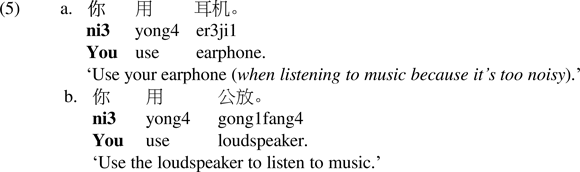
In ‘My Mom’, Papi enacts scenes of conversation between a Chinese mother and her daughter in which the mother constantly admonishes the child for what she perceives as the daughter's various shortcomings. The mother character is a recognizable enactment of the ‘Tiger Mom’ and the video a critique of this stereotypical figure well-known in China. Papi's rendition of this characterological figure (Agha Reference Agha2007) is infused with intensity and negativity, and a key grammatical resource for achieving that is the use of imperatives in many parts of the video. These instructions target painfully mundane aspects of the daughter's existence, and often communicate conflicting advice, as in the following examples.

The grammatical pattern that these imperatives follow is noteworthy. Unlike in English, imperative sentences in Mandarin do not have to start with a verb. In addition, the addressee (clause subject) in a conversation must be explicitly stated only if more than one person is involved, to avoid ambiguity. As can be seen from example (5), the subject of the imperative is included in a dyadic conversation, which makes this a marked case. Pragmatically, the presence of the second-person singular subject as a marked imperative expresses an emphasis of the speaker's status and dominance, implying that the addressee has no choice but to comply. In other words, the marked imperatives help to portray the character of Tiger Mom as one commanding absolute obedience from her children.
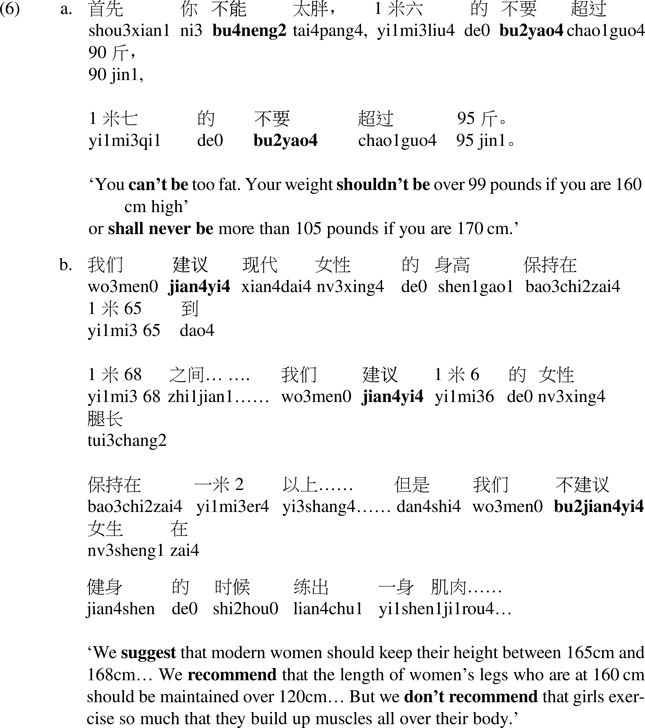
A similar discourse strategy is used in the video ‘Modern Women’. In this video Papi plays a ‘professional’ consultant who purportedly gives women advice on how to become the ‘perfect’ modern woman. Expectedly, the video features instructional language through which Papi tells women what to do and what not to do as modern women.

There is a prevalence of deontic modal verbs in the video (can't, shouldn't) and well as advice verbs (suggest, recommend) detailing the dos and don'ts of modern womanhood. In addition, the protagonist employed a host of adjective superlatives and adverbs of degree to specify the ideal features (physical and psychological) that modern women should strive for. For instance, when talking about women's physical appearance, phrases such as 太胖 tai4pang4 ‘too fat’ and 太瘦 tai4shou4 ‘too slim’, 太高 tai4gao1 ‘too tall’ and 太矮 tai4ai3 ‘too short’, 最好 zui4hao3, 最佳 zui4jia1 ‘the best’, 最当红 zui4dang1hong2 ‘the most popular’, and so on are densely distributed in the paragraph. Importantly, the ideal image is not simply described; it is deduced through the contrast of what it is not, similar to the contrast achieved through the interplay of deontic modals and verbs of advice (shouldn't vs. we recommend). When compared to the title of the video, ‘The Simple Requirements for a Modern Woman’, the irony is blatant since the requirements advocated by Papi's character propositionally are incredibly narrow and specific, and anything but simple—clearly a caricature of the impossibly perfect ideal of physical and personal characteristics expected of (Chinese) women today. Further, the use of deontic modals, adverbs, and adjectives here helps to create opposition (too fat… too slim; recommend… do not recommend), while their dense distribution and rapid alteration adds an attitudinal stance of frantic matter-of-factness. When combined with the complexity of the rules communicated semantically, the impossibility of the advice and thus the satirical nature of the performance becomes evident.
The main grammatical resources that are deployed in the third video, ‘Men and Women’, are interrogatives and repetition/parallelism. In this video, Papi Jiang narrates in the first person about male-female interactions and (romantic) relationships, essentially showing various female characters’ bewilderment at male habits and males’ inability to understand females. Somewhat similar to ‘Modern Women’, the video also has an element of advice-giving (the English subtitle on Youtube says ‘Boyfriend's Survival Guide’) but realized quite differently.
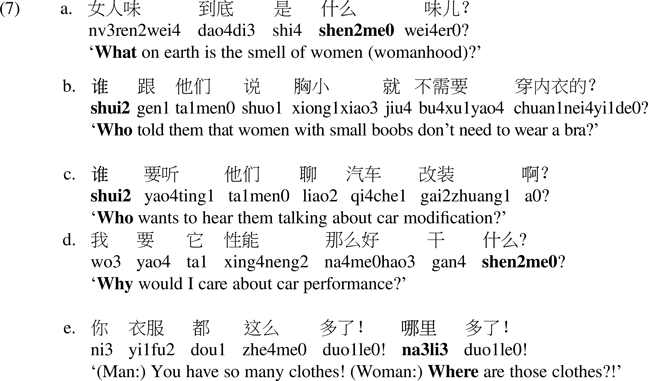
Questions are pervasive throughout the video. From the nine categories of interrogative sentences in Mandarin (Yip & Rimmington Reference Yip and Rimmington2004:347–58), question-word interrogatives are the most salient in ‘Men and Women’, as in example (7).

Although the list in example (7) is not exhaustive, most of the wh-question words in Mandarin Chinese appear in the video. However, these interrogatives are not actual information questions but rather express a sense of puzzled surprise, incredulity, and bewilderment: 怎么 zen3me0 ‘how come’, 哪里 na3li3 ‘where’, 什么 shen2me0 ‘what’, 干嘛 gan4ma2 ‘do what’ are used to convey a stance of irritation and opposition. The use of interrogatives allows Papi to express incredulity at men's behavior and assumptions and thus to communicate her critique. At the same time, the prevalence and rapid succession of these questions communicates an overall emotive stance of discontent, and even anger in the text. A similar effect is achieved through Papi's use of repeated questions starting with Why in this video, as exemplified in example (8). Due to space constraints, we are only reproducing the English translation here as the key analytic point centers on the repetitive use of the question word, rather than grammatical details.
(8) Why don't they wash hands after peeing?
Why (how) could they go to bed without taking a shower?
Why aren't they willing to wash their hair every day since it is so short?
Why can men sit on the bed with their jeans on?
Why do they wash clothes, socks, underwear together?
Why do men never carry tissue paper when they go out?
Why do men carry the same bag for dates, work, parties, and business trips?
Why does every man think that he is handsome?
Why does every man feel that he has a handsome beard? It depends on your face, ok?
Why do they all feel that they are more mature than others who are the same age?
Why does every man think he is quite good in bed?
In this short excerpt, a very distinct repetition of 为什么 wei4shen2me0 ‘why’ gives Papi's lamentations a rhythmic character. These ‘whys’ are so dense and compressed together that they create a feeling of ‘being swept along’ in the doubts expressed through the interrogatives. Clearly, the content of the questions represents extremely common, almost cliched critiques levelled against men by women, some of which are recognizable to non-Chinese readers as well. It is the rhetorical device of repetition here that seems to make this a novel and effective way of communicating critique, clearly giving testimony to Papi's talent. The repeated interrogative pattern communicates a stance of urgency, insistence, and an attitude of extreme irritation, laminating the content of her words and thus sharpening her critical stance toward particular aspects of male behavior.
As another form of repetition, syntactic parallelism, which interlaces the interrogatives, is also a salient discourse feature of ‘Men and Women’.

Tannen (Reference Tannen1987) argued that repetition in discourse can be best understood as a sense-making system in that it helps to create coherence that connects metamessage with message, form with meaning. This is precisely how it functions in Papi's videos. The repeated questions of example (8) not only help viewers process and comprehend the utterances’ propositional meaning (the substance of her critique), the repetition itself amplifies the negative attitudinal meaning already captured semantically. From the perspective of stance taking, the parallelism contributes to the intensification of point of view and emotion, which creates a sense of irritation and desperation that the video emanates.
Non-linguistic resources and post-production techniques
In all three episodes, the linguistic-discursive resources identified in the analysis so far are accompanied by various non-linguistic resources, which are further enhanced through the application of post-production techniques. All three converge and aid Papi's characterological portrayals, the intense emotive stance as well as the meta-message of critique. We discuss three resources here that are pervasive in the corpus: facial expression, voice quality, and editing.
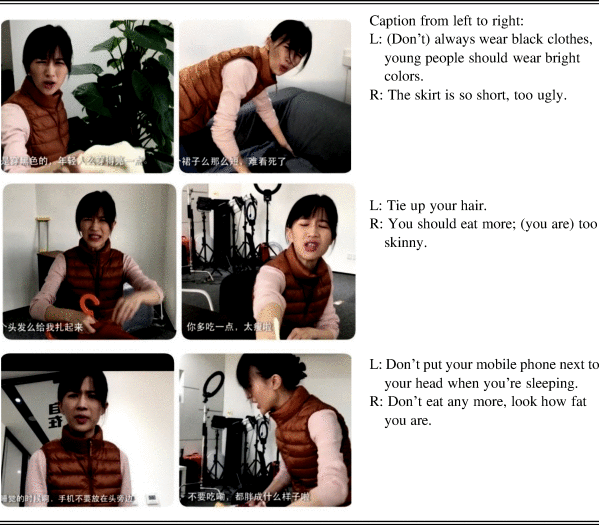
Papi makes extensive use of exaggerated facial expressions in the three videos, often though not exclusively in order to communicate negative emotions through furrowed eyebrows, squinting eyes and lip distortions. The screenshots in Table 3 come from the video ‘My Mom’ and exemplify Papi's use of facial expression.
Use of exaggerated facial expressions in ‘My Mom’.

We have already analyzed the role of imperatives in this video. Here, Papi's facial expressions work together with her verbal admonishments as mimicry to enact the constantly disapproving Tiger Mom character for whom nothing is ever good enough. The role of mimicry in comedy has been described as a performative act that ‘takes what is known to be the norm and twist, falsify, disfigure, and then represent it to the audience’ (Filani Reference Filani2016:95). This comedic device thus fulfils multiple purposes that include generating laughter and enjoyment from the audience, a joint construction of a perspective on the mimicked act or actors, and establishing the ability and credibility of the comedian (Filani Reference Filani2016). Facial mimicry is a pronounced feature of Papi's videos, and we interpret it as embodied stance-taking complementing the attitudinal meaning created through linguistic means, and ultimately also enabling her to construct a perspective of critique. Papi's use of facial mimicry in Table 3 is in synch with her verbal utterances of admonishment, and in that sense support her portrayal of a Tiger Mom. Their exaggerated and relentless nature, just as we have seen with the marked imperative, produce a stance of extreme irritation, which at the same time draws attention to the performance itself, and to its highly satirical character. We would also argue that since Papi uses minimal props, facial mimicry is quite central to her craft and evidences links to the rich tradition of rapid face changing and the use of masks in Chinese opera that enable the audience to glimpse the inner states or the transformation of characters (Siu & Lovrick Reference Siu and Lovrick2013).
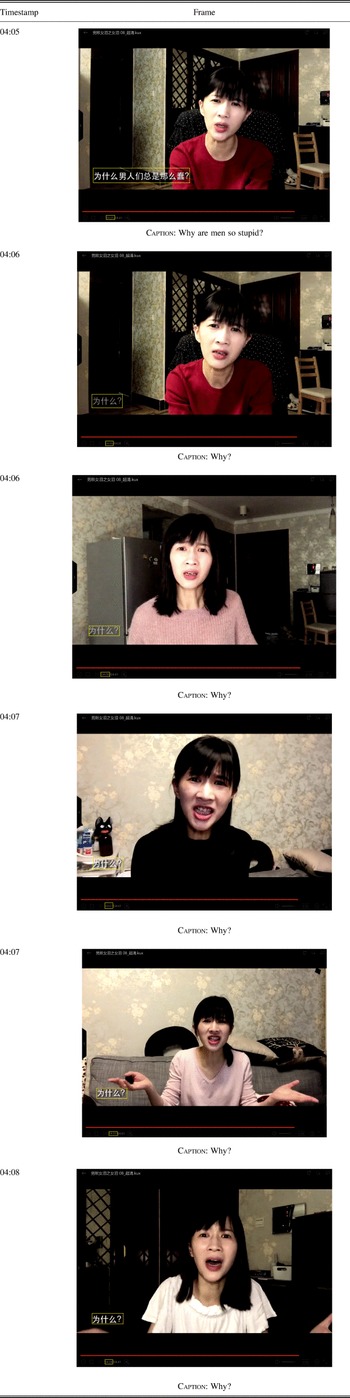
The communicative effects of facial expressions are further supported in Papi's videos through a rapid change of frames. The screenshots in Table 4 are from the video accompanying example (8) above where a repeated string of why-questions constructs an emotive tone of irritation and exasperation. Within the span of two seconds (04:06–04:08), there is a succession of five different frames that cut to a differently dressed Papi united by verbal repetition of the same question word (why) and by a facial expression of displeasure (see Table 4). The rapid shifts in frame here act as an editing resource in order to visually punctuate the stance taking already being realized through language and facial expression: annoyance at stereotypical male behavior.
Screenshots exemplifying rapid frame switches from ‘Men and Women’.

A defining feature of all three videos, in fact, many of her videos, is that Papi's voice is modulated through a software application resulting in accelerated and raised-pitch speech. (Her voice sounds similar to the Minion characters in the animated feature Despicable Me). While her speech remains largely intelligible despite the distortion, it adds an obviously non-natural quality to Papi's voice. The higher pitched voice is clearly quite unpleasant and plays a major role in conveying the attitudinal meaning of annoyance which is also being communicated through the verbal commentary (see examples (7)–(9)). Further, the modulated voice, along with the frequent frame switches (Table 4) adds an agitated quality to the videos and is thus a major paralinguistic resource in contributing to the negative emotive-attitudinal prosody of Papi's performances.
DISCUSSION
The analysis set out to identify Papi Jiang's style as a Youtube microcelebrity via stance, combining two types of investigation. The corpus analysis uncovered grammatical elements that distinguished Papi's texts from other internet discourse and demonstrated how these elements can be understood as stance markers to express negativity, intensity, and urgency. Building on findings from the corpus analysis, we then described key discourse and non-linguistic features from three videos that expressed similarly intensive negative stances. The analysis of diverse semiotic resources through quantitative and qualitative methods therefore produced a bundle of stance markers that are highly convergent in their semantic prosody or attitudinal-emotive meaning. Together, they constitute Papi's expressive style, congealing into unpleasant, frantic, and oppositional performances.
What is the significance of the analysis and its findings? Let us go back to the study's theoretical interest in persona as an attribute of microcelebrity and to our goal to find ways to empirically study features of Papi's style that traversed across its various instantiations. Departing from most sociolinguistic work on mediated performance, the analysis did not intend to describe the real-time unfolding of performed personae, and as such it also did not detail all of the semiotic resources that Papi drew on in each video. For instance, the marked Shanghainese accent of the mother in the ‘My Mom’ episode indexes a metropolitan, high-competition environment, clearly contributing to the portrayal of the Tiger Mom character. Instead, the analysis in this article aimed to answer the question: what are shared features in Papi's mediated performances that help her create a unique style that sets her apart from other microcelebrities within Chinese online media?
Following interactional and indexical sociolinguistic theories of identity, stance was taken as the primary analytic category, understood in the first instance as attitudinal meaning expressed through various semiotic resources, and in the second instance, as a metapragmatic comment on the issues and questions taken up in the ‘content’ of the videos. Although not in the context of mediated performance as defined in this study, Johnstone's (Reference Johnstone, Montgomery and Moore2017) analysis of two talking dolls embodying a Pittsburgh-linked (‘Yinzer’) working-class identity made a similar point. She argued that the various semiotic features on display in the dolls’ vocal and material make-up were not a representation of Pittsburghese but an expressive stance of opposition and authenticity that had been historically associated with working-class speech/culture. Similarly, while the characterological figures that Papi animates in her videos (like the Tiger Mom or the image consultant advising us on how to become an ideal woman) provide the base material for her videos, the particular verbal, vocal, and embodied ways in which she performs them simultaneously communicate her satirical-critical stance toward the figures. In other words, recurrent patterns of stance taking realized across her videos can be understood as metapragmatic devices, rendering Papi Jiang's performance style as a semiotic ensemble that is intimately linked to social critique a central aspect of her microcelebrity persona.
Papi's social critique of patriarchal gender and family norms is therefore not only, or we would argue, even primarily, communicated through the propositional content of her videos. Her persona, constructed through an expressive style that is characterized by intensity, negativity, even franticness, is itself an attempt to defy stereotypes of Chinese female submissiveness. Her style also contrasts with the ubiquitous online persona of 白富美 bai2fu4mei3: a beautiful woman with white skin and perfect physique who likes expensive things. As Li & Blommaert (Reference Li and Blommaert2017) pointed out, baifumei is a discursive-aesthetic performance—an entrepreneurial project of the self offered up for consumption and reward by (male) audiences as part of a ‘sexual economy’ (Zurndorfer Reference Zurndorfer2015). Conventionally valued aesthetics of apprearance are completely absent in Papi's videos, although her stage name could be seen as an ironic nod to their existence. Jiang is a Chinese transliteration of the Japanese word chan (ちゃん) which roughly means ’miss’, but is also used to refer to children and female family members, close friends, and lovers. So Papi Jiang roughly means ‘Miss Papi’ but adds a (Japanese) loveliness and intimacy to the name. As the analysis showed, Papi's persona is the opposite of lovely. Her choice of stage name is thus emblematic of her persona: through cleverly performed satire, she embodies a critique of both conventional Chinese female roles and contemporary, trendy microcelebrity images of ideal females.
There are further theoretical gains to conceptualizing microcelebrity persona as linked to both stance and style in mediated performances. As discussed earlier, performance is characterized by a heightened attention to form. Papi's videos are clearly performance in this sense; some of the features identified by the analysis (e.g. her facial expressions, the change of voice quality, the parallelism) act as dramaturgical devices of the performance frame. In fact, it would be possible to analyze mediated performance solely in terms of style. In Papi's case, we could link the distorted voice quality directly to style, without the intermediary of stance, and argue that it is a unique feature of her brand of performance style. However, incorporating stance in the analysis allows for a deeper understanding of Papi's videos and similar playful creations as also performative. Performativity, as distinct from performance, draws attention to speech as social action; and for Bauman & Briggs (Reference Bauman and Briggs1990:63), performance ‘provides a setting in which speech and society can be questioned and transformed’. In other words, for Bauman & Briggs, the poetics and politics of performance as verbal art are coterminous; performance as artful expression is at the same time performative as social action and may question the social and indexical order (Jaffe, Koven, Perrino, & Vigouroux Reference Jaffe, Koven, Perrino and Vigouroux2015). Clearly, Papi's videos are also performative, delivering satirical critiques of the topics and character types of her performances. Given that there is not one single feature or element in a performance that accounts for its performative aspects (Bauman & Briggs Reference Bauman and Briggs1990), we argue that stance enables us to examine and describe mediated performances as performative. This study identified a multitude of semiotic resources which were argued to function as stance markers in the videos. They contribute to the performativity of Papi's videos through their metapragmatic function of critique, often realized through exaggerated attitudinal stances of characters. Importantly, stance is also reciprocal, invoking audience evaluation. By taking up a position vis-à-vis the performed act, and at the same time compelling the audience to do the same (Bauman Reference Bauman, Bendix and Rokem2012; Jaffe Reference Jaffe2015), microcelebrity personae such as Papi may offer a new, critical perspective on social reality.
Conceptualizing digital self-expression as performance/performative thus makes possible its dual function as a source of aesthetic pleasure (including humor) and a form of transformative action. With regards to the latter, Jones (Reference Jones, Hartley, Burgess and Burns2013) argued that verbal art, playfulness, and satire are thespian tools for the creation of alternative realities in the transformative speech acts of digital humor. As such, online performativity offers an alternative publics ‘where play may model new civic possibilities’ (Hartley Reference Hartley2010:244). This brings us full circle to the role of persona in the expanding discourse and culture of celebrity in contemporary digital media. Marshall (Reference Marshall2014) sees the roots of this celebrity expansion in three interrelated developments: individualism, foundational shifts in the labor market, and a technologically mediated reorganization of social life. Entrepreneurial individuals emerge at key nodal points of social networks primarily by virtue of their ability to generate affective power through self-presentational public personae. Such ‘affect clusters’, according to Marshall (Reference Marshall2014:167), constitute a form of micropublics, a kind of public-private network where ideas and sentiments can travel ‘from their affective origins into effective movements and moments in contemporary culture’.
Microcelebrity as a particular manifestation of public-private self-presentation in the vernacular digital space embodies the kind of entrepreneurial agency that has been claimed to be a central feature of contemporary personhood both online and offline (Bröckling Reference Bröckling2016). It is possible to critique the entrepreneurial self as a neoliberal phenomenon resulting from market logic now governing matters of identity and the intimate sphere (e.g. Mautner Reference Mautner2010). Yet we argue that the issue is more complex. Understanding the role of microcelebrity personae as an interface between the personal and collective within digital social networks illuminates the hybrid character of their agency (Howard Reference Howard2008). Microcelebrity digital performances are enabled by and financially benefit from techno-cultural environments that are built upon the playful personae they enact. At the same time, ordinary celebrities through their playful theatrics can also subvert institutional power in a way that is consequential, given their nodal position in intersecting micropublics. Communicative acts are at the heart of this process and need to be studied more vigorously. Stance, style, and performance as sociolinguistic concepts offer powerful conceptual tools to empirically examine and further theorize the role of microcelebrity personae in today's digital culture.
APPENDIX A: GRAMMATICAL CATEGORIES USED IN EXAMPLES BASED ON YIP & RIMMINGTON (Reference Yip and Rimmington2004).
APPENDIX B: THE THIRTY TOP KEYWORDS IN THE PAPI CORPUS.