Introduction
The decision to re-enter entrepreneurship after failure has long been a central topic in the field of entrepreneurship (Hsu, Wiklund, & Cotton, Reference Hsu, Wiklund and Cotton2017; Szkudlarek, Reference Szkudlarek2010). Although the literature on reentry has explored various factors, such as costs (Ucbasaran, Shepherd, Lockett, & Lyon, Reference Ucbasaran, Shepherd, Lockett and Lyon2013), learning (Shepherd, Reference Shepherd2003) and emotions (Shepherd, Reference Shepherd2009), the role of time remains underexplored. In most studies, time is treated as a background factor, primarily influencing reentry decisions indirectly through past experiences (Lévesque & Stephan, Reference Lévesque and Stephan2020) or the duration of failure (Cope, Reference Cope2011). However, time plays a crucial role in understanding entrepreneurs’ reentry decisions (Baù, Sieger, Eddleston, & Chirico, Reference Baù, Sieger, Eddleston and Chirico2017), serving not only as a context for failure and reentry but also as a key determinant.
Two decades ago, scholars emphasized the importance of examining the relationship between time and entrepreneurship (Bird & West, Reference Bird and West III1998), recognizing time as both an objective phenomenon marked by clock time and a subjective experience shaped by individual perception (Fleischer, Reference Fleischer2013; Shipp, Edwards, & Lambert, Reference Shipp, Edwards and Lambert2009; Wang, Reference Wang2024). Current research on time and entrepreneurship has explored both objective aspects, such as age (Gielnik, Zacher, & Wang, Reference Gielnik, Zacher and Wang2018), and subjective dimensions, such as personal time preferences (Gutierrez, Sloof, & Crilly, Reference Gutierrez, Sloof and Crilly2024) and future orientation (Das & Teng, Reference Das and Teng1998). These studies have underscored the critical role that time plays in shaping entrepreneurial behavior (Bluedorn & Denhardt, Reference Bluedorn and Denhardt1988; Shipp & Cole, Reference Shipp and Cole2015). Despite the recognition of time as a fundamental dimension of entrepreneurship, the integration of time factors in the study of entrepreneurial reentry remains underexplored. Understanding the role of time in reentry is crucial because it can help explain why some entrepreneurs choose to quickly re-enter entrepreneurship after failure, while others may take a longer break or even abandon the entrepreneurial path altogether. Moreover, reentry provides a particularly relevant context for studying temporal dimensions, as the duration and nature of past entrepreneurial experiences can significantly influence future entrepreneurial decisions (Baù et al., Reference Baù, Sieger, Eddleston and Chirico2017; Hsu et al., Reference Hsu, Wiklund and Cotton2017; Lafuente, Vaillant, Vendrell‐Herrero, & Gomes, Reference Lafuente, Vaillant, Vendrell‐Herrero and Gomes2019; Simmons, Wiklund, & Levie, Reference Simmons, Wiklund and Levie2014).
Accordingly, this study examines the impact of entrepreneurs’ prior firm lifespan on their subsequent entrepreneurial reentry from the perspective of failure costs. Firm lifespan is defined as the duration of an entrepreneur’s previous venture, from its inception to its closure (Abdesselam, Bonnet, & Le Pape, Reference Abdesselam, Bonnet and Le Pape2004). Entrepreneurial failure is understood as the cessation of engagement in a venture due to failure to meet the minimum threshold of economic viability set by the entrepreneur (Ucbasaran et al., Reference Ucbasaran, Shepherd, Lockett and Lyon2013), while entrepreneurial reentry refers to the act of launching a new venture after business failure (Baù et al., Reference Baù, Sieger, Eddleston and Chirico2017; Hsu et al., Reference Hsu, Wiklund and Cotton2017). Specifically from the perspective of failure costs, a longer firm lifespan suggests that the entrepreneur has invested more time and financial resources (Cope, Reference Cope2011; Singh, Corner, & Pavlovich, Reference Singh, Corner and Pavlovich2007; Ucbasaran et al., Reference Ucbasaran, Shepherd, Lockett and Lyon2013). Additionally, entrepreneurs who have managed their businesses for an extended period may experience increased psychological burdens after failure (Serrasqueiro, Nunes, & Silva, Reference Serrasqueiro, Nunes and Silva2016). The emotional bond that entrepreneurs form with their businesses can also be severely damaged by failure, resulting in significant emotional distress (Walsh & Cunningham, Reference Walsh and Cunningham2024). These cumulative costs and tensions may deter entrepreneurs from pursuing a new venture after a failure.
Additionally, the decisions made by individuals are influenced by where their attention is directed (Gardner, Dunham, Cummings, & Pierce, Reference Gardner, Dunham, Cummings and Pierce1987). Thus, entrepreneurs who focus on the past, present, or future are likely to perceive entrepreneurial failure events differently. Temporal focus, which reflects an individual’s orientation toward the past, present, or future, influences how they integrate past experiences, current circumstances, and future expectations into their attitudes, cognition, and behaviors (Shipp et al., Reference Shipp, Edwards and Lambert2009; Shipp & Jansen, Reference Shipp and Jansen2021). Building on these insights, our study explores the moderating role of temporal focus, positing that variations in entrepreneurs’ temporal focus will lead to different evaluations of their experiences and failure costs, thereby affecting the relationship between firm lifespan and entrepreneurial reentry. We hypothesize that as a firm’s lifespan increases, the likelihood of entrepreneurial reentry after failure decreases. Furthermore, we propose that entrepreneurs’ past focus strengthens the negative main effect of failure, while focusing on the present or future weakens this negative relationship.
To test these hypotheses, we use a matched dataset from the IT Orange Death database, Tianyancha, and Weibo, resulting in a total sample of 368 entrepreneurs for analysis. In September 2022, we collected data with failure dates spanning from 2008 to 2022. By manually searching and matching the data, we gathered information on entrepreneurs’ ages and whether their firms are located in first-tier cities in China. Using the Tianyancha database, we match data on firm size, industry, and number of failures. We then matched the final dataset with entrepreneurs’ names and company names. Next, we performed text analysis to identify entrepreneurs’ temporal focus and applied logistic regression techniques to analyze the data. Our findings indicate that firm lifespan negatively influences the likelihood of entrepreneurial reentry among failed entrepreneurs, and that this negative effect is further intensified for those with a past-focused temporal orientation.
This study makes two important contributions to the literature on entrepreneurship. First, it extends previous research on the antecedents of entrepreneurial reentry by examining the relationship between objective time, represented by firm lifespan, and entrepreneurial reentry. Although prior research has emphasized the critical role of time factors in shaping entrepreneurial intentions (Gielnik et al., Reference Gielnik, Zacher and Wang2018; Gutierrez et al., Reference Gutierrez, Sloof and Crilly2024) limited attention has been paid to how entrepreneurs experience time during the reentry process. This study empirically examines the direct impact of firm lifespan on entrepreneurial reentry, thereby linking two previously distinct domains, namely temporal dynamics and entrepreneurial reentry, and enriching the framework of antecedents to entrepreneurial reentry.
Second, this study advances our understanding of the interaction between objective time and subjective time (temporal focus), offering a more nuanced view of entrepreneurial behavior (Biron & St-Jean, Reference Biron and St-Jean2023; Volery, Mueller, & von Siemens, Reference Volery, Mueller and von Siemens2015). Our findings suggest that entrepreneurs’ differing temporal foci moderate the influence of firm lifespan on entrepreneurial reentry, demonstrating how entrepreneurs with distinct temporal foci interpret and respond differently to objective time in failure contexts. This moderating effect contributes a theoretical perspective on the role of subjective time in the entrepreneurial process, thereby expanding foundational knowledge of re-entrepreneurial behaviors.
Theoretical Background and Hypotheses
Entrepreneurial Reentry After Failure
Research has identified entrepreneurial reentry after failure as a key driver of wealth creation, job generation, and innovation (Carree & Thurik, Reference Carree and Thurik2010; Lee, Yamakawa, Peng, & Barney, Reference Lee, Yamakawa, Peng and Barney2011). When entrepreneurs abandon their ventures, it represents a significant loss for both society and the individuals involved (Ucbasaran et al., Reference Ucbasaran, Shepherd, Lockett and Lyon2013). Consequently, a growing body of literature examines the factors that influence failed entrepreneurs’ decisions to re-enter the entrepreneurial sphere (Costa, Ferreira, & Torres de Oliveira, Reference Costa, Ferreira and Torres de Oliveira2023). Research has explored various determinants of entrepreneurial reentry, such as failure costs (Ucbasaran et al., Reference Ucbasaran, Shepherd, Lockett and Lyon2013), learning from failure (Shepherd, Reference Shepherd2003), and the grief recovery process (Shepherd, Reference Shepherd2009). This body of work highlights the need to explore not only why and how failed entrepreneurs decide to embark on new ventures but also how the associated costs of failure affect these decisions.
Entrepreneurs often incur significant financial, social, and psychological costs after failure, which can severely hamper their decisions to re-enter the entrepreneurial arena (Stam, Audretsch, & Meijaard, Reference Stam, Audretsch and Meijaard2008). Ucbasaran et al. (Reference Ucbasaran, Shepherd, Lockett and Lyon2013) categorized these costs into three main types: financial, social, and psychological. Financial costs include the loss of personal income and the accumulation of debt, which increase with the duration of business operations and subsequent failure (Cope, Reference Cope2011; Shepherd, Covin, & Kuratko, Reference Shepherd, Covin and Kuratko2009). Social costs involve the stigma of failure and damage to the entrepreneur’s reputation within their social network, which may reduce their willingness to undertake new ventures or engage in high-risk endeavors (Armour & Cumming, Reference Armour and Cumming2008; Lee, Cottle, Simmons, & Wiklund, Reference Lee, Cottle, Simmons and Wiklund2021; Stam et al., Reference Stam, Audretsch and Meijaard2008). Psychological costs, such as low self-efficacy and high stress levels, underscore the critical need for effective psychological recovery to mitigate these adverse effects and facilitate reentry (Singh et al., Reference Singh, Corner and Pavlovich2007). Additionally, attachment theory (Solomon & George, Reference Solomon and George1996) suggests that entrepreneurs, like parents, adopt a caregiving system to meet the needs of their ventures and ensure their healthy development (Lahti, Halko, Karagozoglu, & Wincent, Reference Lahti, Halko, Karagozoglu and Wincent2019). Consequently, when a business fails, the emotional bond between the entrepreneur and the venture is severed, leading to profound emotional distress or even psychological collapse.
Despite these challenges, research suggests that entrepreneurs can leverage their failure experiences to identify new opportunities, thereby increasing their likelihood of reentry (Cope, Reference Cope2011; Ucbasaran, Westhead, & Wright, Reference Ucbasaran, Westhead and Wright2009). This perspective on learning from failure highlights how entrepreneurs refine their knowledge and strategies based on past experiences, as well as the importance of grief recovery, which integrates the effects of failure costs and learning (Shepherd & Kuratko, Reference Shepherd and Kuratko2009). Moreover, effective grief recovery is crucial for overcoming unresolved emotions that might otherwise hinder reentry (Shepherd, Reference Shepherd2003; Shepherd, Covin, et al., Reference Shepherd, Covin and Kuratko2009).
However, most studies have overlooked the role of time as a key factor influencing reentry. While some longitudinal studies have examined the impact of time on entrepreneurial outcomes (Fisch & Block, Reference Fisch and Block2021), they have often neglected the direct influence of objective time factors. For example, although age and other time factors affect entrepreneurial intentions and re-entrepreneurship (Baù et al., Reference Baù, Sieger, Eddleston and Chirico2017; Gielnik et al., Reference Gielnik, Zacher and Wang2018), the impact of objective time factors at the organizational level, such as firm lifespan, remains unexplored. This study addresses this gap by investigating how the lifespan of previously failed ventures influences entrepreneurs’ re-entrepreneurial behaviors. Firm lifespan, as an objective measure of time, not only imposes psychological and financial costs but also contributes to experience and resource accumulation (González, Guzmán, Pombo, & Trujillo, Reference González, Guzmán, Pombo and Trujillo2013; Sirén, Hakala, Wincent, & Grichnik, Reference Sirén, Hakala, Wincent and Grichnik2017; Ucbasaran et al., Reference Ucbasaran, Westhead and Wright2009). Understanding the correlation between firm lifespan and entrepreneurial reentry will provide valuable insights into the role of objective time in the reentry process.
Objective and Subjective Time in Entrepreneurship Research
Time is ‘one of the entrepreneur’s most valuable resources’ (McCarthy, Krueger, & Schoenecker, Reference McCarthy, Krueger and Schoenecker1991) and can be conceptualized from both objective and subjective perspectives, each influencing behavior and decision-making in distinct ways (Karniol & Ross, Reference Karniol and Ross1996; McKay, Cole, Sumnall, & Goudie, Reference McKay, Cole, Sumnall and Goudie2012; Tang, Richter, & Nadkarni, Reference Tang, Richter and Nadkarni2020). Objective time, often understood as clock time, captures discrete ‘snapshots’ of the passage of time (Das, Reference Das1993; Wadhwani, Kirsch, Welter, Gartner, & Jones, Reference Wadhwani, Kirsch, Welter, Gartner and Jones2020), while subjective time centers on personal perceptions of the past, present, and future, weaving these snapshots into a coherent ‘story’ (Weisbord, Reference Weisbord1988). Although objective and subjective time are typically examined independently, Shipp and Jansen (Reference Shipp and Jansen2021) emphasized that they are ‘interwoven and inseparable in practice’. Indeed, perceptions of objective and subjective time differ between individuals (Branzei & Fathallah, Reference Branzei and Fathallah2023; Powell & Baker, Reference Powell and Baker2014), leading to varied interpretations and emotional responses to identical events. The interaction between time and entrepreneurship has been acknowledged in the literature, with early studies positioning temporal dynamics as central to the entrepreneurial process (Bird & West III, Reference Bird and West III1998; Slevin & Covin, Reference Slevin and Covin1998), and more recent work highlighting the impact of both objective and subjective time on entrepreneurial intentions or propensity (Das & Teng, Reference Das and Teng1998; Gielnik et al., Reference Gielnik, Zacher and Wang2018).
Recent studies have further explored the intersection of time and entrepreneurship, focusing primarily on subjective time (Frémeaux & Henry, Reference Frémeaux and Henry2023; McMullen & Dimov, Reference McMullen and Dimov2013; Sirén, Parida, Frishammar, & Wincent, Reference Sirén, Parida, Frishammar and Wincent2020). For example, Das and Teng (Reference Das and Teng1998) found that entrepreneurs’ future orientation and time horizon influenced their entrepreneurial behaviors and risk propensity, with those adopting a long-term perspective being more likely to take risks and achieve significant goals. Gutierrez et al. (Reference Gutierrez, Sloof and Crilly2024) discovered that entrepreneurs who underestimate future time investment are more likely to develop strong entrepreneurial intentions. Additionally, Zabelina, Cruz-Cárdenas, Deyneka, Maksimenko, Guadalupe-Lanas, and Ramos-Galarza (Reference Zabelina, Cruz-Cárdenas, Deyneka, Maksimenko, Guadalupe-Lanas and Ramos-Galarza2023) observed that green entrepreneurs, who are often more critical of their past and focused on future possibilities, differ from their non-green counterparts in their temporal orientations.
Objective time factors, such as age, have also been explored in relation to entrepreneurial activities. For example, Gielnik et al. (Reference Gielnik, Zacher and Wang2018) found that younger entrepreneurs, who tend to have a broader future time perspective, are more likely to progress from opportunity identification to entrepreneurial intentions, while older entrepreneurs, with more experience, were more likely to transition from intentions to active engagement. However, research on the age of failed entrepreneurs has yielded mixed results, showing both a higher likelihood of reentry among younger individuals and a non-linear relationship between age and reentry (Baù et al., Reference Baù, Sieger, Eddleston and Chirico2017; Lévesque & Minniti, Reference Lévesque and Minniti2006). Despite these insights, most studies have simply controlled for objective time measures such as age, without thoroughly examining their direct impact on entrepreneurial reentry (Serrasqueiro et al., Reference Serrasqueiro, Nunes and Silva2016). Consequently, there remains a lack of clarity in current research regarding the relationship between objective time and entrepreneurial activities, particularly at the firm level, where the role of objective time remains largely unexplored.
Although previous research has conceptualized entrepreneurship as a temporal process influenced by both subjective and objective time factors (Lévesque & Stephan, Reference Lévesque and Stephan2020; McMullen & Dimov, Reference McMullen and Dimov2013), a significant gap remains in understanding how these time factors influence entrepreneurial decisions following failure. The longer a firm survives, the higher the potential costs of failure for the entrepreneur, and the more severe the psychological impact. However, individuals’ ability to reflect on the past, perceive the present, and anticipate the future (Bluedorn & Denhardt, Reference Bluedorn and Denhardt1988; George & Jones, Reference George and Jones2000) shapes their responses to failure. Specifically, entrepreneurs’ temporal focus influences how they allocate their attention across different time frames, namely the past, present, and future (Ocasio, Reference Ocasio1997; Pourtois, Schettino, & Vuilleumier, Reference Pourtois, Schettino and Vuilleumier2013). Entrepreneurs’ temporal focus also affects how they experience and adapt to challenges (Branzei & Fathallah, Reference Branzei and Fathallah2023), thereby influencing their perception of the costs associated with a firm’s lifespan.
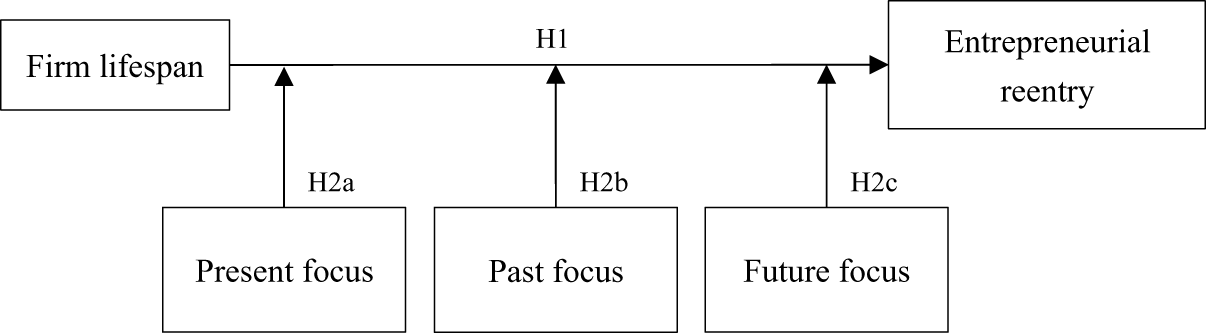
Next, we develop our hypotheses regarding the impact of firm lifespan on entrepreneurial reentry, focusing on the perspective of failure costs. We seek to explore how the duration of a failed venture influences entrepreneurs’ decisions to reenter entrepreneurship. Additionally, we investigate how entrepreneurs’ temporal focus – whether oriented toward the past, present, or future – moderates this relationship. By examining these moderating effects, we aim to provide a more nuanced understanding of how different temporal foci shape entrepreneurs’ decisions to launch a new venture after failure. Figure 1 illustrates the conceptual model.
Conceptual model

The Effect of Firm Lifespan on Entrepreneurial Reentry
Firm lifespan, defined as the duration from a company’s founding to its closure (Abdesselam et al., Reference Abdesselam, Bonnet and Le Pape2004), reflects the time, financial, emotional, and experiential investments entrepreneurs make in their ventures. This concept implies that a longer firm lifespan is associated with higher failure costs for entrepreneurs. Consequently, we hypothesize that a longer firm lifespan decreases the likelihood of entrepreneurial reentry following venture failure.
From a psychological cost perspective, entrepreneurs who manage ventures over extended periods often develop strong emotional attachments and a sense of ownership toward their firms (Pierce, Kostova, & Dirks, Reference Pierce, Kostova and Dirks2001). Such emotional attachments can lead to significant psychological distress following venture failure, including identity loss and anxiety about uncertain change (DeTienne & Cardon, Reference DeTienne and Cardon2012; Shepherd, Wiklund, & Haynie, Reference Shepherd, Wiklund and Haynie2009; Yu, Liu, He, & Li, Reference Yu, Liu, He and Li2023). Moreover, entrepreneurs may experience reduced self-efficacy and emotional exhaustion, exacerbating feelings of fatigue (Cope, Reference Cope2011; Shepherd, Reference Shepherd2003). Many entrepreneurs view their firms as ‘children’, having invested substantial time and energy in them, such that venture failure can evoke profound psychological trauma, akin to the loss of a cherished child (Cardon, Zietsma, Saparito, Matherne, & Davis, Reference Cardon, Zietsma, Saparito, Matherne and Davis2005; Ucbasaran et al., Reference Ucbasaran, Westhead and Wright2009).
From a financial costs perspective, a longer firm lifespan is associated with greater economic losses for entrepreneurs (González et al., Reference González, Guzmán, Pombo and Trujillo2013). The failure of a long-running business can cause greater losses for entrepreneurs, particularly in terms of invested capital, unrecovered costs, and debt burdens. The extended duration intensifies these economic costs, resulting in greater financial pressure on entrepreneurs after experiencing business failure (Cardon, Stevens, & Potter, Reference Cardon, Stevens and Potter2011).
From a social–relational cost perspective, the failure of a long-running business can result in a decline in entrepreneurs’ status within their social networks, strained interpersonal relationships, and diminished social support (Stam et al., Reference Stam, Audretsch and Meijaard2008). Research has shown that entrepreneurs often face difficulties in securing the capital needed for re-entrepreneurship following failure (Lee, Peng, & Barney, Reference Lee, Peng and Barney2007) or in gaining recognition from external stakeholders (Mitsuhashi & Bird, Reference Mitsuhashi and Bird2011). Overall, although past entrepreneurial experiences can provide valuable insights (Jia, Yu, Yue, & Li, Reference Jia, Yu, Yue and Li2025; Ucbasaran et al., Reference Ucbasaran, Westhead and Wright2009), the failure of a long-running company can impose significant costs and pressures, including psychological, financial, and social strains. These challenges make it extremely difficult for entrepreneurs to recover and restart. Therefore, we argue that the longer the lifespan of a firm, the higher the costs borne by the entrepreneur in the event of failure, leading to a decreased likelihood of entrepreneurial reentry.
Hypothesis 1 (H1): Firm lifespan negatively affects entrepreneurial reentry.
Having established that a longer firm lifespan reduces the likelihood of entrepreneurial reentry due to increased costs, it is essential to explore how entrepreneurs’ temporal focus moderates this relationship. Entrepreneurs’ perceptions of failure and their reentry decisions can be influenced by their focus on the past, present, or future. We now examine how these temporal foci affect the relationship between firm lifespan and entrepreneurial reentry.
The Moderating Effect of Entrepreneurs’ Temporal Focus
When faced with the same firm lifespan, entrepreneurs do not necessarily make similar decisions. According to Simon (Reference Simon1997), a key factor in behavioral decision-making is the effective allocation of limited attention by the decision maker, suggesting that individual differences in temporal focus shape variations in cognitive processing. This implies that even with identical firm lifespans, entrepreneurs with different temporal foci allocate their attention in distinct ways and perceive failure events and costs differently. An entrepreneur’s temporal focus is essential to understanding their choices (Nadkarni & Chen, Reference Nadkarni and Chen2014). We hypothesize that following entrepreneurial failure, an entrepreneur’s temporal focus – whether on the past, present, or future – shapes their perception of the costs of failure, thereby moderating the relationship between firm lifespan and entrepreneurial reentry.
Past focus
When entrepreneurs focus on the past, they tend to immerse themselves in past events after a failure (Shipp et al., Reference Shipp, Edwards and Lambert2009), relive past experiences (Shipp & Cole, Reference Shipp and Cole2015), and become deeply absorbed in their personal history. This intense focus on the past can reignite negative emotions and influence their perception of the costs of failure. Specifically, past-focused entrepreneurs are likely to dwell on previous financial losses and the breakdown of close relationships (Cope, Reference Cope2011; Ucbasaran et al., Reference Ucbasaran, Westhead and Wright2009). They may also experience regret over past actions, which can lead to fear or aversion toward the failure event itself (Mohammed & Harrison, Reference Mohammed and Harrison2013; Morgan & Sisak, Reference Morgan and Sisak2016). For entrepreneurs with a strong past-focused temporal orientation, the longer their firm’s lifespan, the more pronounced the negative impacts of their financial and social losses. This makes it increasingly difficult for them to recover from the grief associated with failure, thereby reducing their willingness to reengage in entrepreneurship (Costa et al., Reference Costa, Ferreira and Torres de Oliveira2023; Shepherd & Kuratko, Reference Shepherd and Kuratko2009). Essentially, the more entrepreneurs are preoccupied with the past, the more acutely they experience the cumulative failures and losses associated with a longer firm lifespan. This makes recovery more difficult and reduces the likelihood of entrepreneurial reentry.
Hypothesis 2a (H2a): Entrepreneurs’ past focus strengthens the negative relationship between firm lifespan and entrepreneurial reentry.
Present focus
A present focus directs attention to the ‘here and now’ (Nadkarni & Chen, Reference Nadkarni and Chen2014), which can mitigate the negative impact of firm lifespan on entrepreneurs. Focusing on the present enhances personal morale, enriches self-awareness, and enables individuals to cope effectively with adversity (Havens, Reference Havens1984; Lewin, Reference Lewin and Watson1942). Entrepreneurs with a present focus are less likely than their counterparts to dwell on past negative experiences (Holman & Silver, Reference Holman and Silver1998), which facilitates recovery from failure. Research shows that present-focused individuals experience greater happiness and are more likely to take risks and pursue opportunities (Shipp, Gabriel, & Lambert, Reference Shipp, Gabriel and Lambert2022). More importantly, a present focus provides entrepreneurs with up-to-date information on technological and market trends (Nadkarni & Chen, Reference Nadkarni and Chen2014), thereby contributing to their discovery of new opportunities and reengaging in entrepreneurship. A longer firm lifespan allows entrepreneurs to gain more experience and accumulate valuable learning. A present focus emphasizes attention to the firm itself, guiding entrepreneurs to respond to real-time feedback from market information (Crossan, Cunha, Vera, & Cunha, Reference Crossan, Cunha, Vera and Cunha2005), thereby facilitating re-entrepreneurship decisions. Therefore, for entrepreneurs with a strong present focus, the negative impact of firm lifespan diminishes, enabling them to better cope with adversity and increasing their willingness to engage in entrepreneurial reentry.
Hypothesis 2b (H2b): Entrepreneurs’ present focus weakens the negative relationship between firm lifespan and entrepreneurial reentry.
Future focus
In contrast to a present focus, a future focus emphasizes an individual’s expectations and attention toward the future. Entrepreneurs with a strong future focus are less susceptible than others to negative effects associated with a prolonged firm lifespan. The stronger their future focus, the more entrepreneurs orient themselves toward aspirational goals and anticipated outcomes (Shipp & Jansen, Reference Shipp and Jansen2011), often concentrating on future opportunities (Gamache & McNamara, Reference Gamache and McNamara2019). Therefore, when entrepreneurs focus more on the future, they are less likely to be influenced by the losses associated with past failure. They concentrate their limited attention on events and opportunities that address long-term strategic challenges (Yadav, Prabhu, & Chandy, Reference Yadav, Prabhu and Chandy2007), which leads them to choose re-entrepreneurship. Future-focused entrepreneurs evaluate current situations through the lens of future expectations rather than historical contexts (Shipp & Jansen, Reference Shipp and Jansen2011) and are less engaged in feedback-based learning (Nadkarni & Chen, Reference Nadkarni and Chen2014). Moreover, entrepreneurs with a strong future focus remain optimistic and confident about their next entrepreneurial venture, even in the face of a prolonged firm lifespan. Such optimism stems from their tendency to focus on the future and maintain positive expectations about what lies ahead. Thus, when entrepreneurs direct their attention to the future, they can significantly mitigate the psychological and social burdens imposed by firm lifespan on entrepreneurial reentry.
Hypothesis 2c (H2c): Entrepreneurs’ future focus weakens the negative relationship between firm lifespan and entrepreneurial reentry.
Methods
Data and Sample
To test our hypotheses, we draw data from the IT Orange Death database (https://www.itjuzi.com/deathCompany), the Tianyancha database (https://www.tianyancha.com/), and Sina Weibo (https://weibo.com/). The IT Orange Death database, a subset of the IT Orange platform, is the most comprehensive data disclosure platform for the companies that have been deregistered and closed down in China. The database includes information at both the enterprise and individual levels, enabling us to accurately match an enterprise (e.g., business name, name of the failed project, and time of death) and the entrepreneur’s information (e.g., Weibo account and name). By matching data from the IT Orange Death database with data from Tianyancha, we can identify the entrepreneurs and retrieve their information. Tianyancha is a platform that starts from public data as an entry point and focuses on relationships, allowing us to determine a company’s business registration, operational risks, and other information (Xiong, Lian, Zeng, He, Zhu, & Yang, Reference Xiong, Lian, Zeng, He, Zhu and Yang2023). It covers various aspects such as a company’s background, actual controllers, financing history, and equity structure. It also facilitates real-time tracking of changes within companies. Its primary function is to retrieve information about company owners, company details, and relationships between different parties. Additionally, Weibo, one of the largest social media platforms in China (akin to X in the USA), contains text information from publishers. Therefore, computer-assisted text analysis can be used to obtain information that is difficult to obtain in a questionnaire, such as capturing entrepreneurs’ personality characteristics (Freiberg & Matz, Reference Freiberg and Matz2023; Obschonka, Fisch, & Boyd, Reference Obschonka, Fisch and Boyd2017).
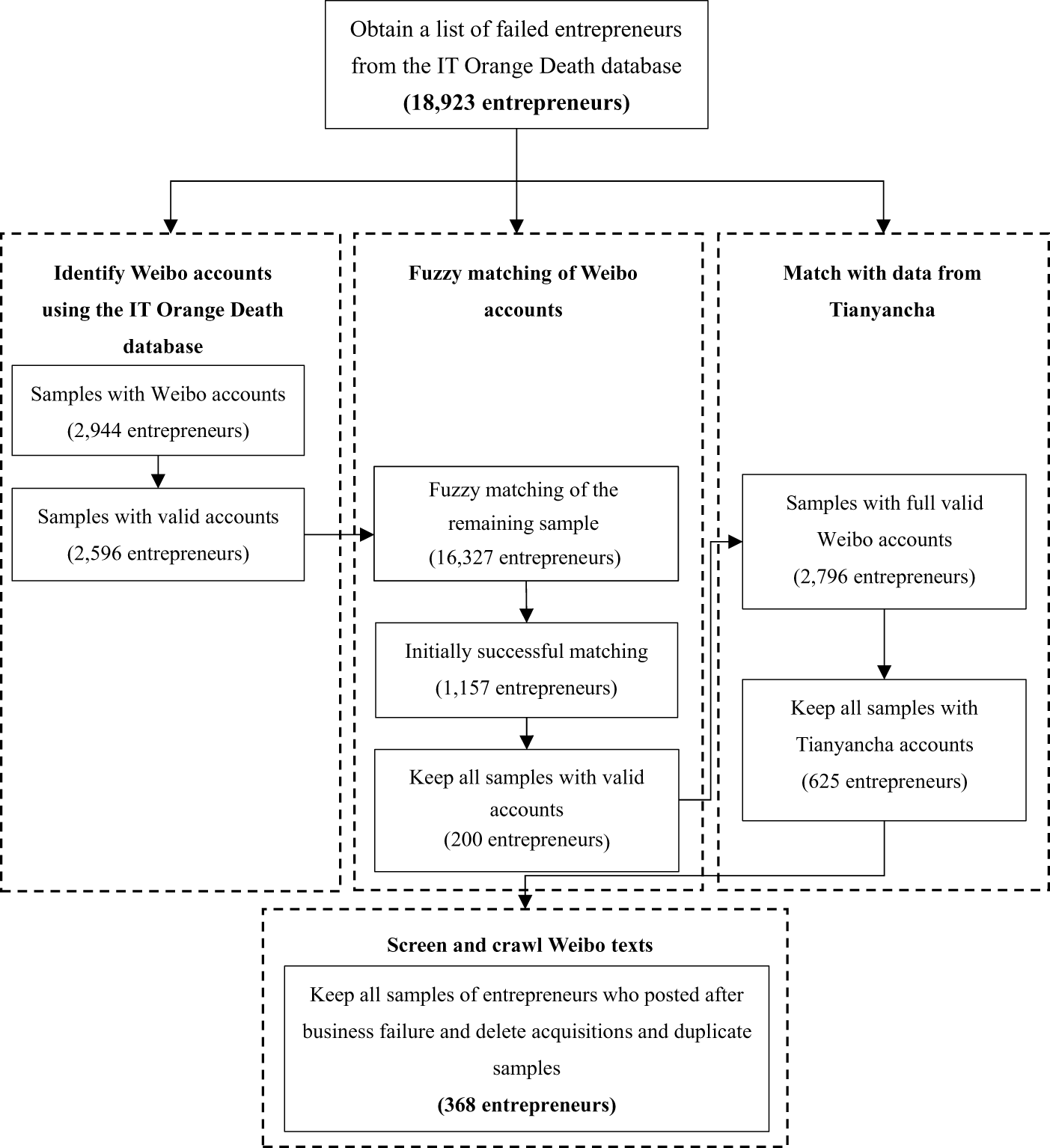
We first obtained the list of entrepreneurs who have failed at least once as of 31 September 2022 from the IT Orange Death database, leading to a total of 18,923 entrepreneurs. Among them, 2,944 entrepreneurs have Weibo account information, and 2,596 valid Weibo accounts are retained after excluding 348 Weibo accounts that were canceled or not disclosed due to privacy settings.
We searched for the Weibo accounts of the remaining 16,327 entrepreneurs who did not have valid Weibo information in the IT Orange database based on fuzzy keyword matching, by using the following steps: (1) searched for Weibo accounts with the keywords ‘Entrepreneur’s name + Failed project name’ (e.g., Lei Hui + AOI Technology Network), or ‘Entrepreneur’s name + Failed business name’ (e.g., Lei Hui + Dongguan Yijing Information Technology Co., Ltd) and obtained 1,157 Weibo accounts through this fuzzy matching method; (2) removed 286 duplicate accounts; (3) in the obtained fuzzy matching results, the Weibo accounts had some discrepancies, for example, the match is for employees of failed companies instead of their entrepreneurs. To address this issue, we determined whether the match identifies the entrepreneurs themselves based on their Weibo personal profile information and identified 267 Weibo accounts that met the requirements; (4) removed 67 of the 267 entrepreneurs who have never publicly posted on Weibo, and ultimately made fuzzy matches with 200 valid entrepreneur Weibo accounts.
According to the above steps, we identified 2,796 entrepreneurs who experienced failure. We used Python to develop crawler code and extracted the blog content of the 2,796 Weibo accounts identified. To obtain data on entrepreneurs’ subsequent decisions after failure, we used the Tianyancha database to identify the 2,796 entrepreneurs with Weibo accounts through a combination of their business name and their own name, and successfully retrieved the basic information of 625 entrepreneurs in Tianyancha. Among these 625 identified entrepreneurs, 391 posted on Weibo after the failure of their business. We excluded nine samples involving acquisitions, as prior research has indicated that acquisitions are often strategic and should not be classified as failures (DeTienne & Cardon, Reference DeTienne and Cardon2012). Meanwhile, as some entrepreneurs choose to start multiple businesses after their most recent failure, 14 duplicate entrepreneur samples are removed to ensure the uniqueness of each entrepreneur in our dataset. Therefore, as shown in Figure 2, the final sample used for the analysis includes 368 entrepreneurs.
Steps to obtain the research sample

Variables and Measures
Entrepreneurial reentry
Following the criteria set by the IT Orange Death database, business failure is defined by one of the following conditions: (1) public media reports of a firm closing or entering bankruptcy proceedings; (2) announcements of closure or bankruptcy liquidation by the firm itself on platforms such as WeChat or Weibo; or (3) obvious operational anomalies, such as company deregistration. Integrating IT Orange’s criteria with existing definitions of entrepreneurial failure, we consider the cessation of a venture that fails to meet expected objectives as a case of entrepreneurial failure (Ucbasaran et al., Reference Ucbasaran, Shepherd, Lockett and Lyon2013). Based on this definition, we define entrepreneurial reentry as the act of creating a new company following a previous business failure (Baù et al., Reference Baù, Sieger, Eddleston and Chirico2017). In this study, we crawl information on failed enterprises from the IT Orange Death database and match it with data from Tianyancha to determine whether entrepreneurs started new ventures after their past failure. Those who created new ventures after failure are coded 1, while those who did not create new ventures are coded 0.
Firm lifespan
Firm lifespan refers to the duration (Abdesselam et al., Reference Abdesselam, Bonnet and Le Pape2004) of a company’s survival, namely the time elapsed between its date of creation and its closure. We use the natural logarithm of survival days to measure firm lifespan, which is the closure date minus the creation date.
Temporal focus
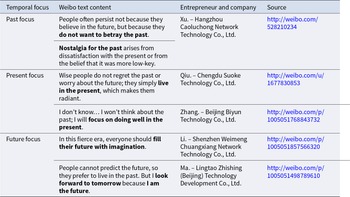
The concept of temporal focus is based on Lewin (Reference Lewin and Watson1942)’s concept of individual time perception, which refers to the extent of psychological attention that an individual devotes to the past, present, and future – that is, past focus, present focus, and future focus. Research has suggested that an individual’s temporal focus typically remains stable throughout adulthood and is constant over time (DesJardine & Shi, Reference DesJardine and Shi2020; Gamache & McNamara, Reference Gamache and McNamara2019; Shipp et al., Reference Shipp, Edwards and Lambert2009). Table 1 provides examples of Weibo texts that illustrate entrepreneurs’ temporal focus, showing that it is possible to measure entrepreneurs’ temporal focus through social media content. We select posts written by entrepreneurs after their business failure as our primary textual data for analysis, as these post-failure posts can effectively capture entrepreneurs’ personalities, emotions, and traits before any subsequent entrepreneurial activity (Fisch & Block, Reference Fisch and Block2021). To measure temporal focus, we adopt the following approach. First, we use TextMind software, a text analysis tool optimized for simplified Chinese and based on the Linguistic Inquiry and Word Count dictionary, which has demonstrated high validity and reliability for large-scale Chinese text analysis (Yu, Jiang, Ren, Xu, Zhang, & Hu, Reference Yu, Jiang, Ren, Xu, Zhang and Hu2021; Yuan, Hong, & Wu, Reference Yuan, Hong and Wu2021). Second, we import each entrepreneur’s post-failure Weibo content into TextMind, which calculates their past, present, and future foci using predefined keywords (see the Appendix for the temporal focus keyword list in Chinese). Specifically, TextMind calculates each temporal focus category by dividing the number of words associated with each temporal focus by the total number of words in a post.
Example of temporal focus from Weibo posts

Control variables
Based on previous studies on entrepreneurial reentry, we use the following control variables at the individual level in this study: Gender, which is assigned a value of 1 for men and 0 for women; Education level, which is assigned a value of 1 for a bachelor’s degree or higher and 0 for a high school diploma or lower (Block, Hoogerheide, & Thurik, Reference Block, Hoogerheide and Thurik2013); Individual age, measured in years to control for the influence of entrepreneurs’ age on their entrepreneurial reentry (Baù et al., Reference Baù, Sieger, Eddleston and Chirico2017; Fu, Larsson, & Wennberg, Reference Fu, Larsson and Wennberg2018); and Narcissism, a personality trait that can influence entrepreneurial decision-making (Keith Campbell, Bosson, Goheen, Lakey, & Kernis, Reference Keith Campbell, Bosson, Goheen, Lakey and Kernis2007). To measure Narcissism, we adopt the narcissism word lists developed by Anglin, Wolfe, Short, McKenny, and Pidduck (Reference Anglin, Wolfe, Short, McKenny and Pidduck2018). First, the word lists were translated by doctoral students specializing in psychology and English language studies. We then invited two experts familiar with psychological research to evaluate the Chinese keywords to ensure content validity (Zhang, Wang, & Jia, Reference Zhang, Wang and Jia2021). Finally, we used the ‘Jieba’ Python library to segment and remove stop words from Weibo texts and to calculate narcissism scores by dividing the frequency of narcissism-related words by the total number of words in Weibo texts. We also control for Portfolio entrepreneurship, which is assigned a value of 1 for portfolio entrepreneurship, and 0 otherwise (Baù et al., Reference Baù, Sieger, Eddleston and Chirico2017); Number of failures, the number of failed attempts by an entrepreneur before re-entering entrepreneurship. By controlling for the number of failures, we can mitigate entrepreneurs’ reluctance to start over due to repeated failures (Kirkwood, Reference Kirkwood2007), enabling a more precise evaluation of how firm lifespan influences their reentry choices. Entrepreneurial interval is measured by subtracting the date of the last failure from the date of reentry, in days. In addition, we control for four firm-level variables. Specifically, registered capital comes from Tianyancha and is measured by the natural logarithm of a firm’s registered capital. Number of shareholders comes from Tianyancha and may affect an entrepreneur’s decision to start a new business (Zahra, Reference Zahra1996). This variable takes a value of 1 if the new business has shareholders, and otherwise 0. The variable First-tier cities (Lin & Yang, Reference Lin and Yang2024) is manually determined and takes a value of 1 if an enterprise is established in Beijing, Shanghai, Guangzhou, or Shenzhen, and otherwise 0, indicating non-first-tier cities (Zhang, Li, Hui, & Li, Reference Zhang, Li, Hui and Li2016). Total amount of financing is obtained from the IT Orange database and is measured by the natural logarithm of the amount of money raised by a firm. Finally, Industry is based on a firm’s affiliation with the service sector, taking a value of 1 in this case, and otherwise 0.
Results
Descriptive Statistics and Correlations
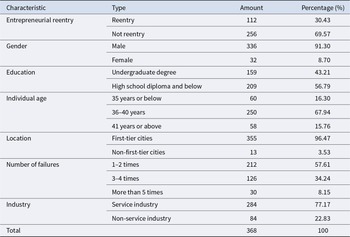
We performed statistical analysis on the characteristics of the 368 entrepreneurs. Table 2 shows the statistics of the sample characteristics. Among the 368 entrepreneurs, 112 engage in entrepreneurial reentry, accounting for 30.43% of the full sample. The majority of failed entrepreneurs are men, comprising 91.30% of the sample, indicating that men still represent a large proportion of the entrepreneurial community. In terms of educational attainment, entrepreneurs with a bachelor’s degree or higher are relatively fewer in number than those with a high school diploma or lower. Most of the entrepreneurs are aged between 36 and 40 years, accounting for 67.94% of the sample. Those who live in first-tier cities (Beijing, Shanghai, Guangzhou, and Shenzhen) account for 96.47% of the sample, which is higher than the proportion of those who live in non-first-tier cities. Among the 368 entrepreneurs who experienced failure, 57.61% encountered one or two failures. Finally, 77.17% of the entrepreneurs are engaged in the service industry, while the remaining 22.83% work in non-service industries.
Statistics of sample characteristics
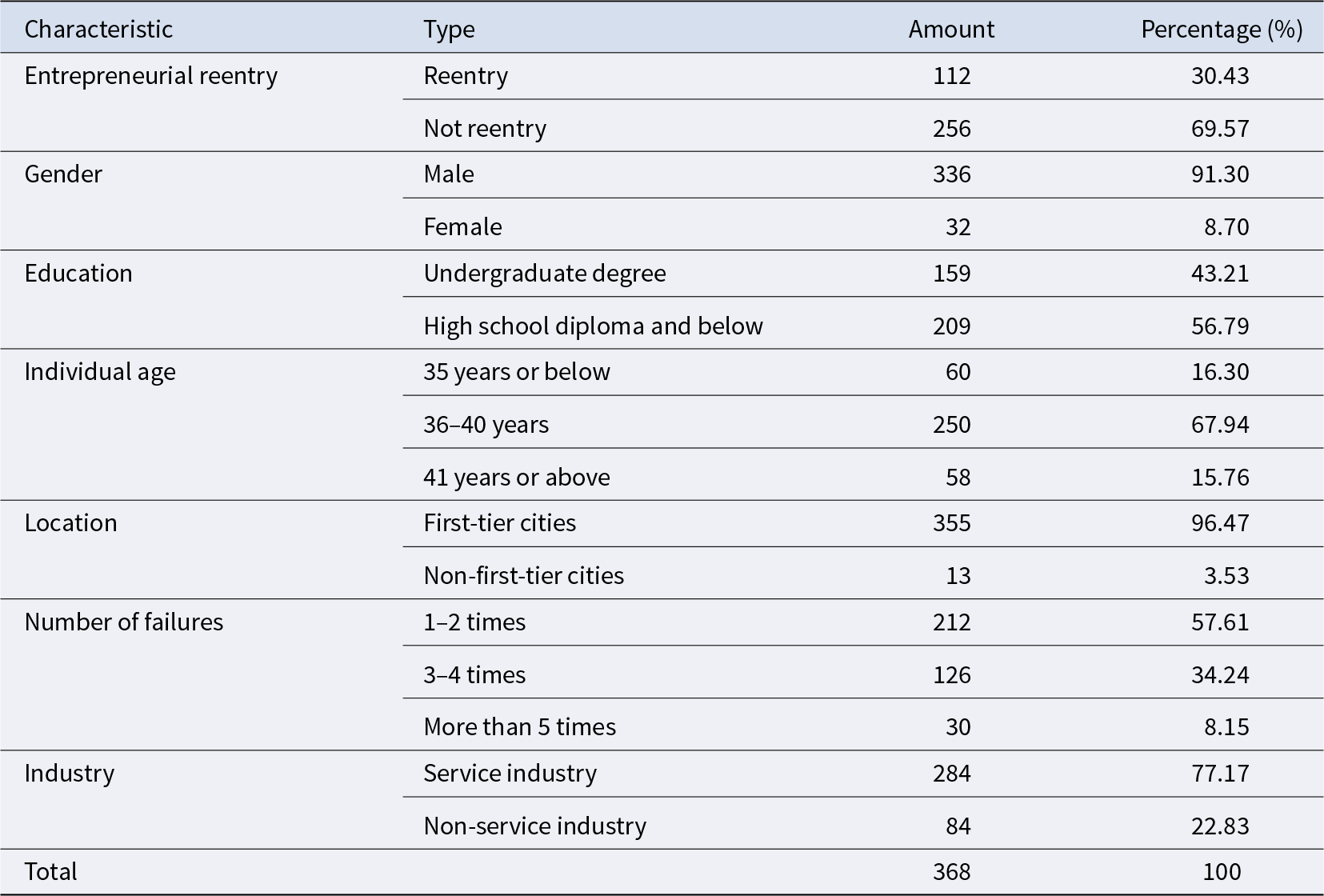
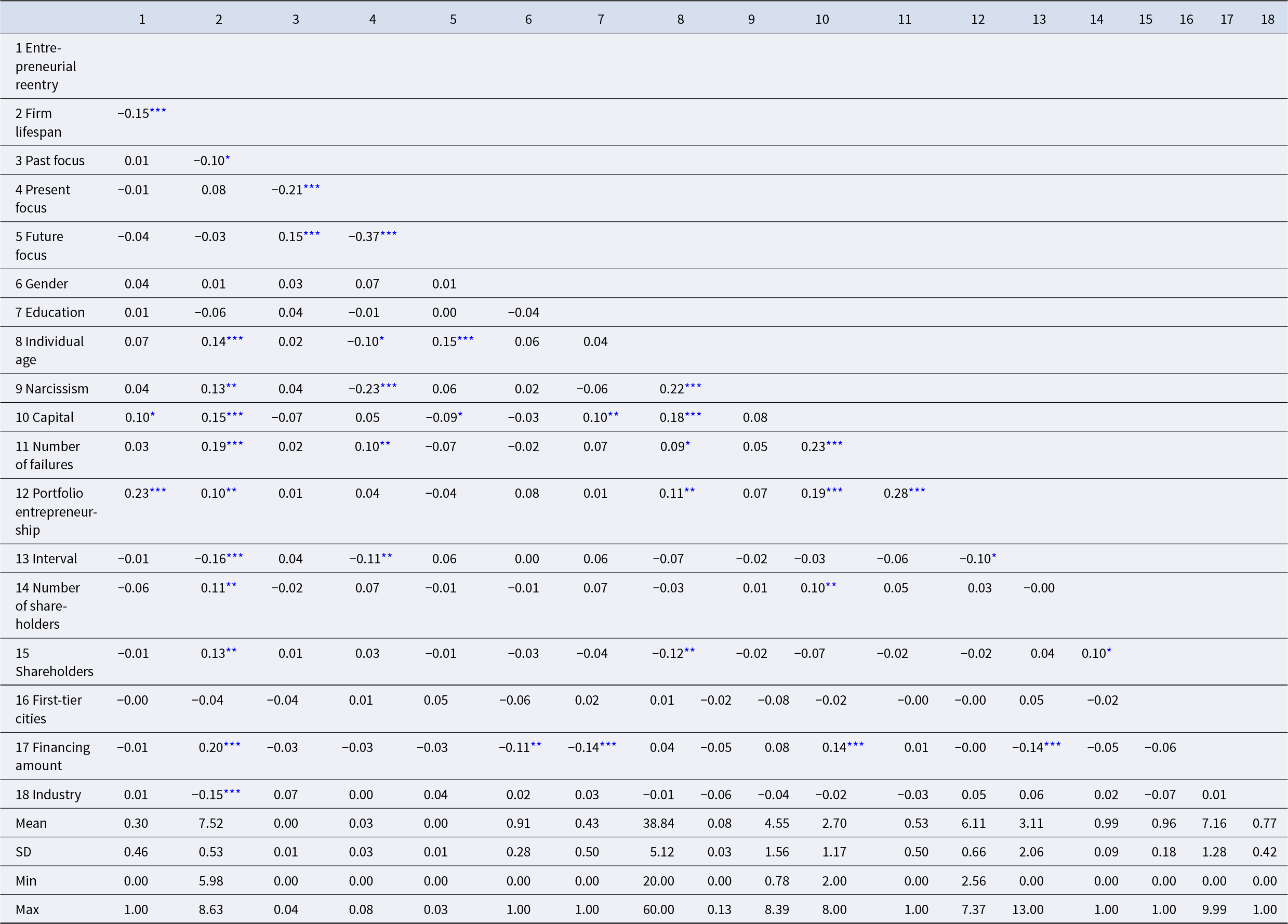
Table 3 presents the descriptive statistics and correlations, showing the correlations between the variables studied as well as their means and standard deviations. Entrepreneurial reentry is negatively related to firm lifespan (r = −0.15, p < 0.001), past focus (r = 0.01, n.s.), present focus (r = −0.01, n.s.), and future focus (r = −0.04, n.s.). In addition, the maximum absolute value of the correlation coefficient between all variables is 0.37, which is below the threshold value of 0.70 (Anderson, Fornell, & Lehmann, Reference Anderson, Fornell and Lehmann1994), suggesting that severe multicollinearity is not a concern in our study.
Descriptive statistics and correlations
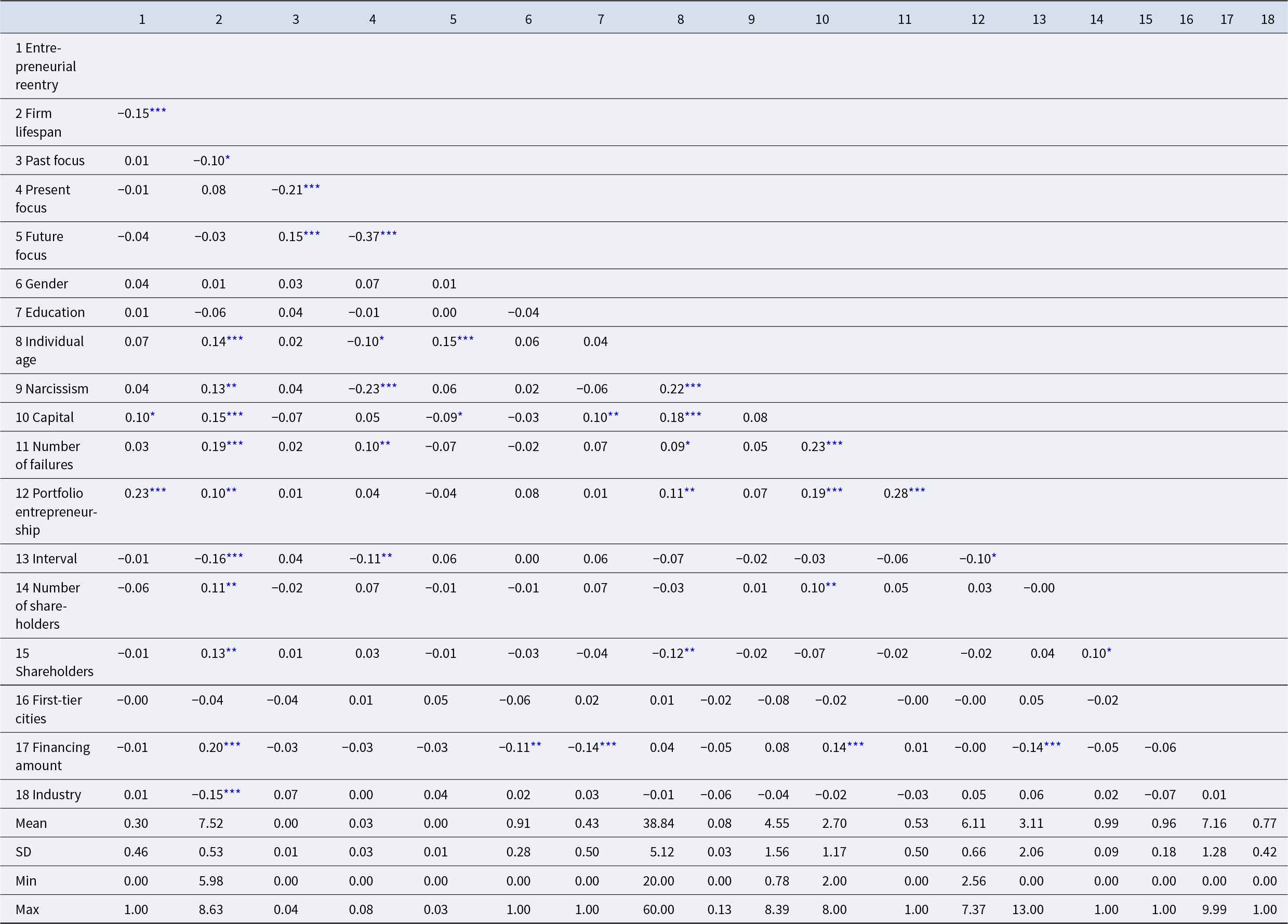
+ Notes: p < 0.1, *p < 0.05, **p < 0.01, ***p < 0.001.
Regression Results
As our dependent variable, entrepreneurial reentry, is binary, we use a binomial logistic regression model to analyze the data. This statistical method is well suited for estimating the probability of an event occurring and for examining the independent variables associated with a binary outcome, as shown in previous research (Arenius & Minniti, Reference Arenius and Minniti2005; Robson, Akuetteh, Westhead, & Wright, Reference Robson, Akuetteh, Westhead and Wright2012).
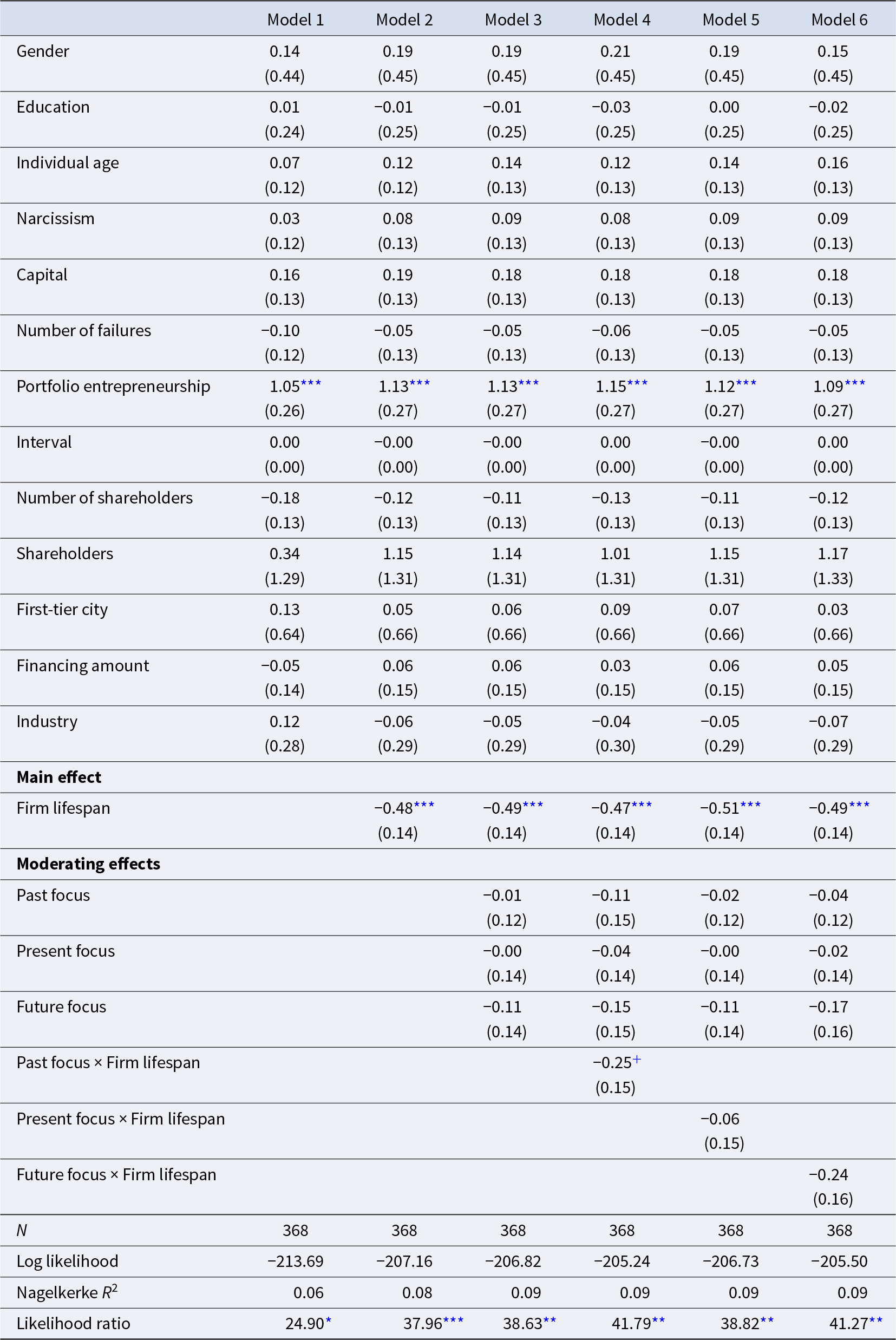
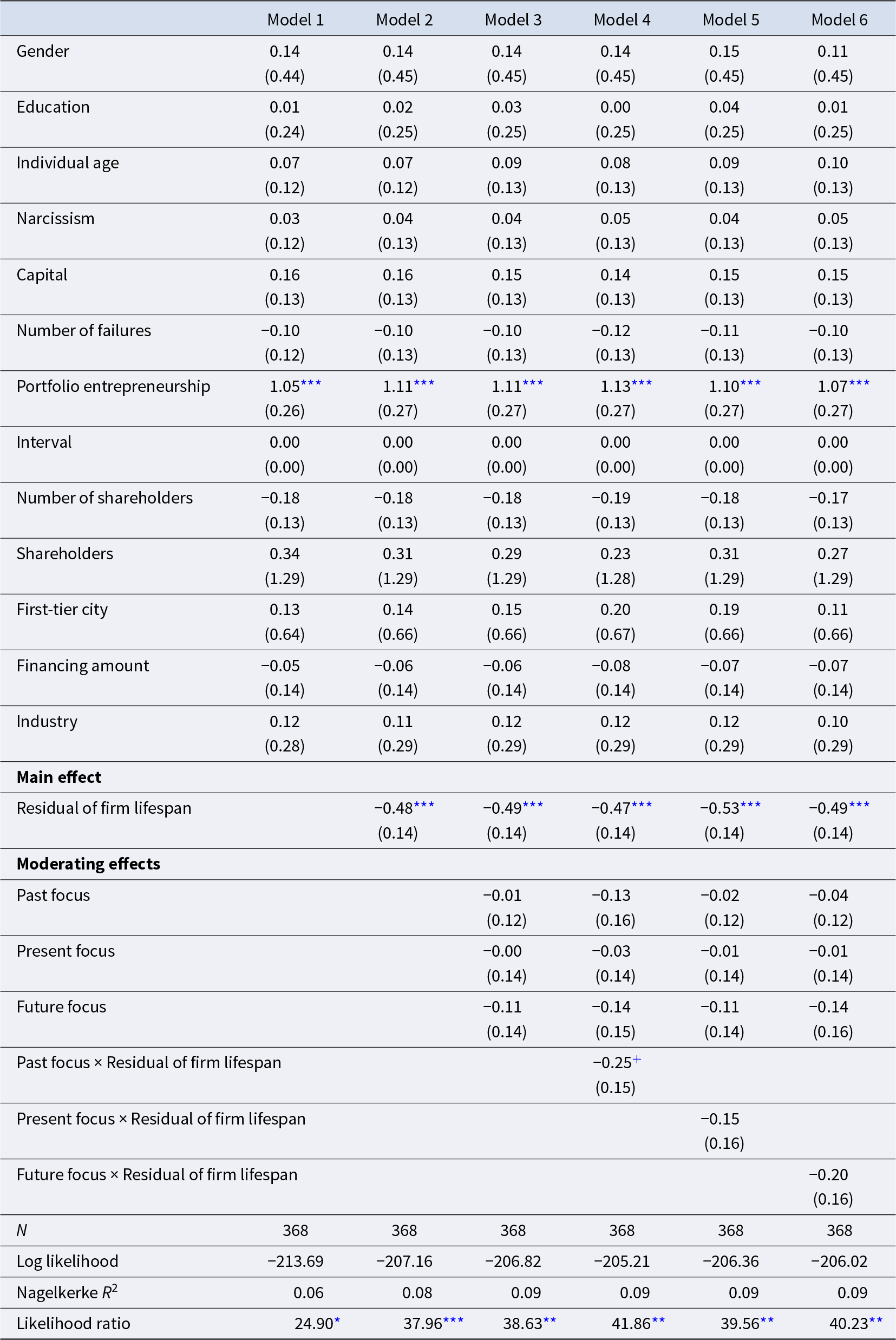
Table 4 presents the logistic regression results. Model 1 includes all of the control variables, while Models 2–6 test the influence of our hypothesized relationships on entrepreneurial reentry as the dependent variable.
Logistic regression results

Notes: Unstandardized coefficients are reported with robust standard errors in parentheses. We also perform data testing using probit regression, and the results are consistent with those of logistic regression. +p < 0.1,
* p < 0.05, **p < 0.01, ***p < 0.001.
Model 2 reveals a statistically significant negative coefficient (β = −0.48, p < 0.001) on firm lifespan, providing evidence in support of H1. As we log-transform and standardize our independent variables before regression, the coefficients in Table 4 do not directly represent the direct relationship between firm lifespan and entrepreneurial reentry. Therefore, we conduct an additional regression analysis using untransformed and unstandardized independent variables to interpret the relationships. The regression coefficient on firm lifespan is −0.0005, indicating that with each additional day of a firm’s lifespan, the probability that an entrepreneur will choose to re-enter entrepreneurship decreases by 0.05%. Model 3 includes three moderating variables in addition to the independent variables, and the results show that past focus, present focus, and future focus do not independently affect the dependent variable.
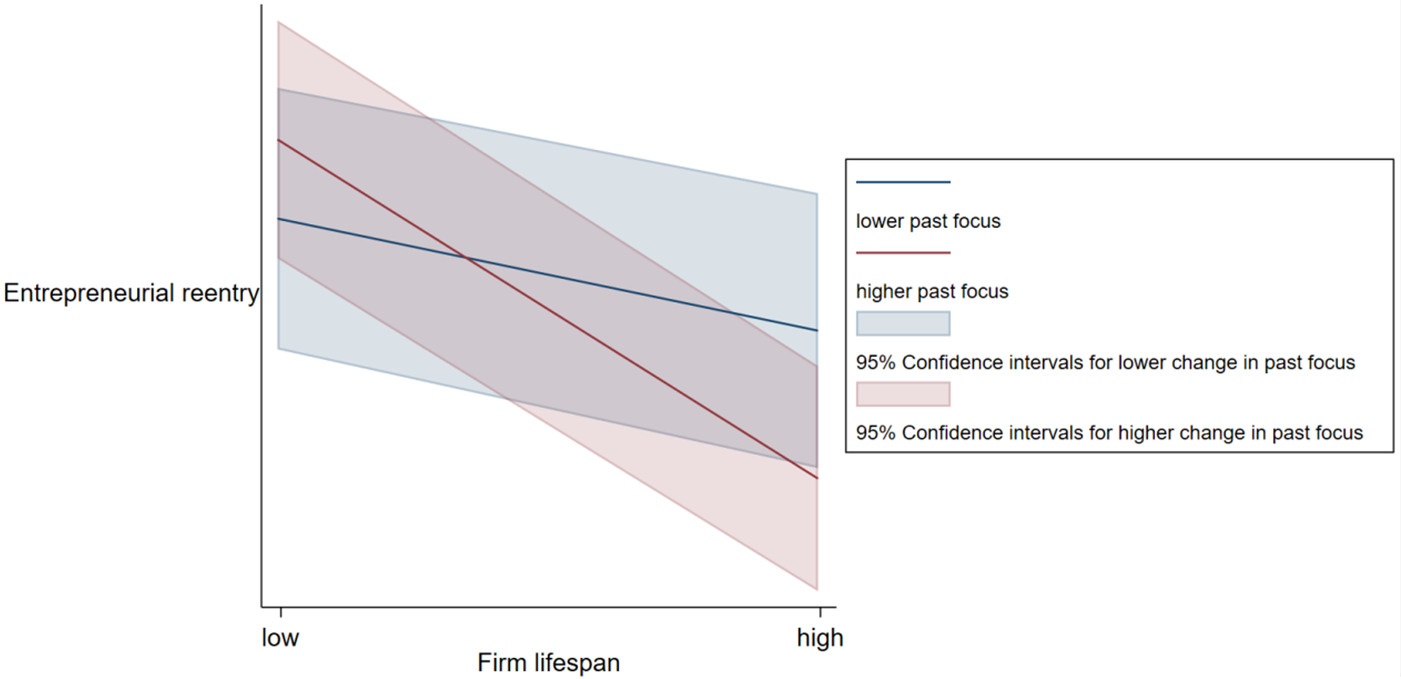
Models 4–6 in Table 4 examine the moderating effects of past focus, present focus, and future focus. Model 4 includes the interaction term between past focus and firm lifespan, which exerts a significant negative effect on entrepreneurial reentry (β = −0.25, p < 0.1). Furthermore, we conduct a simple slopes analysis (Aiken, West, & Reno, Reference Aiken, West and Reno1991) and present the interaction effects graphically. Figure 3 shows the predictive marginal effects plotted with 95% confidence intervals, revealing the impact of the interaction between past focus and firm lifespan on entrepreneurial reentry, supporting H2a. Model 5 includes the interaction term between present focus and firm lifespan, which does not significantly affect entrepreneurial reentry (β = −0.06, n.s.). Hence, H2b is not supported. The reason may be that entrepreneurs’ present focus tends to be stable, with entrepreneurial failure having little effect on it (Gamache & McNamara, Reference Gamache and McNamara2019). Thus, whether or not they experience failure, such entrepreneurs are likely to maintain a stable attitude toward the present. Model 6 includes the interaction term between future focus and firm lifespan, which has a negative impact on entrepreneurial reentry (β = −0.24, n.s.). This contradicts H2c. One possible reason is that cost losses resulting from entrepreneurial failures reduce entrepreneurs’ future focus (Fisch & Block, Reference Fisch and Block2021). As concerns about the future and expectations diminish, entrepreneurs may decide not to re-enter the market.
Interaction between firm lifespan and past focus on entrepreneurial reentry

Robustness Tests
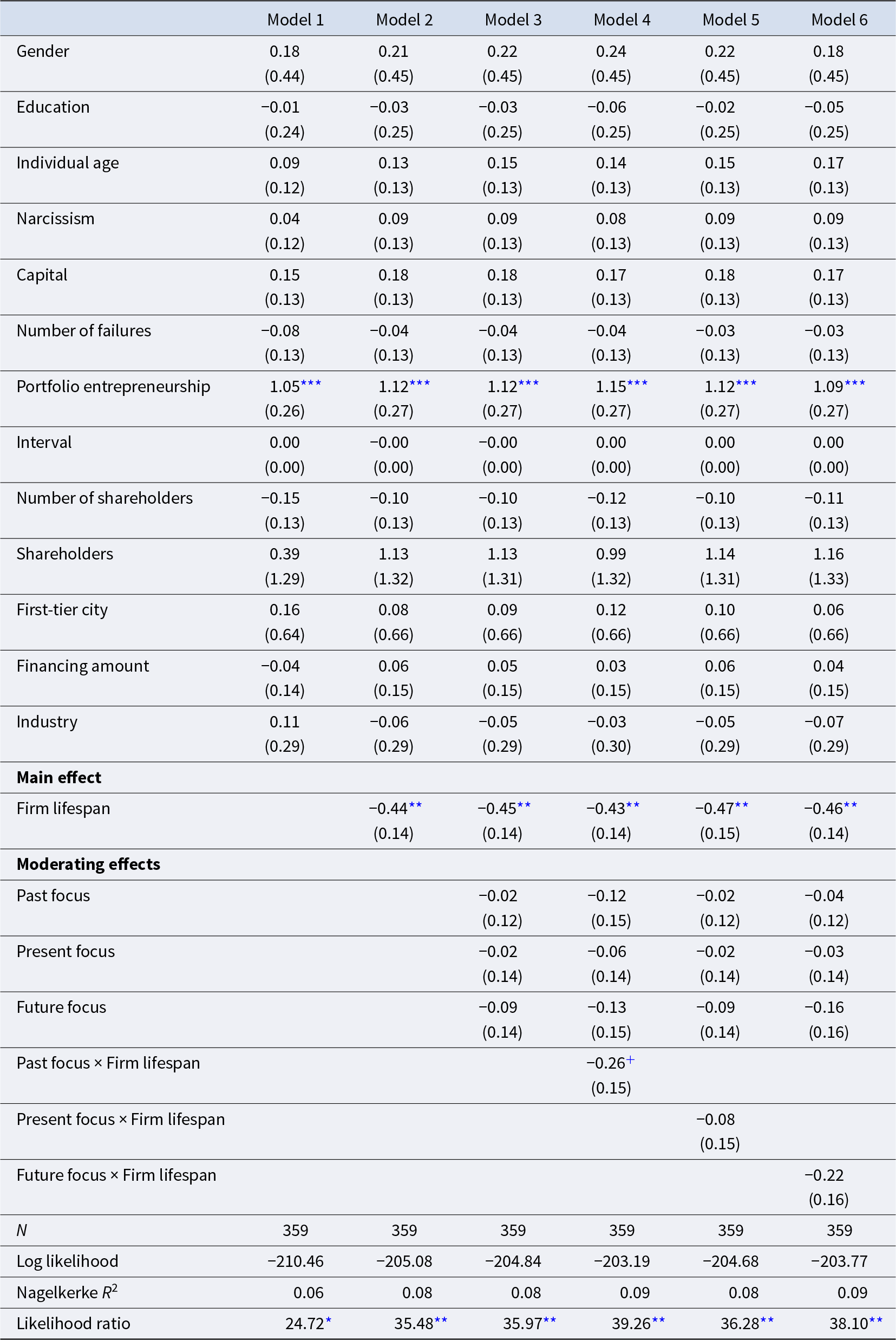
We conduct several tests to assess the robustness of our main findings. First, in our sample, there are cases where the failure date is very recent (e.g., an enterprise’s failure date is September 21, 2022), which we classify as ‘not reentry’. However, these entrepreneurs may choose to re-enter the market in the future, but because of their recent failure within our sample period, they have not yet had the opportunity to make this choice. Therefore, we exclude from our sample all entrepreneurs who experienced failure after January 1, 2022 (14 samples). The results of this robustness test are shown in Table 5 and indicate that firm lifespan has a significant negative impact on entrepreneurial reentry (β = −0.44, p < 0.01). In addition, the interaction term between past focus and firm lifespan negatively affects entrepreneurial reentry (β = −0.26, p < 0.1). These findings indicate that our conclusions remain robust after changing the sample.
Robustness test 1: Excluding firms that closed in 2022 and beyond

Notes: Unstandardized coefficients are reported with robust standard errors in parentheses. +p < 0.1,
* p < 0.05, **p < 0.01, ***p < 0.001.
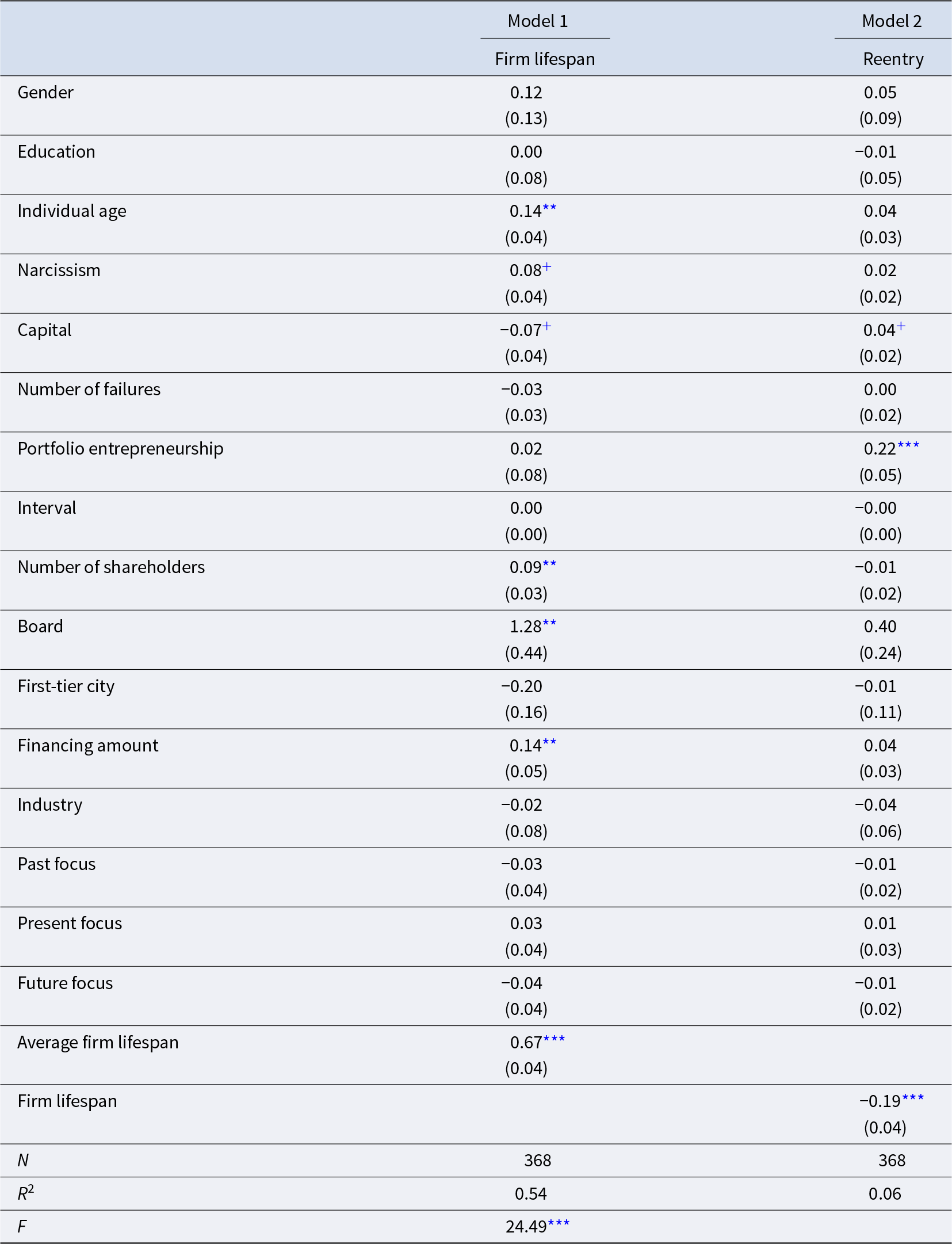
Second, we use two methods to test for endogeneity. The first method focuses on the residuals of the independent variables. Firm lifespan may be associated with many factors, including the socioeconomic environment and policy measures, which can influence entrepreneurs’ decisions to re-enter the market (Younis & Sundarakani, Reference Younis and Sundarakani2020). To address this endogeneity issue, following prior studies (Wiersema & Zhang, Reference Wiersema and Zhang2011), we first regress all control variables on firm lifespan in the main analysis, then use the residuals from this regression (referred to as firm lifespan residuals) as a proxy for firm lifespan, and subsequently perform a regression analysis on entrepreneurial reentry using this proxy. The results are presented in Table 6, indicating that firm lifespan has a significant negative impact on entrepreneurial reentry (β = −0.48, p < 0.001). In addition, the interaction term between past focus and firm lifespan negatively affects entrepreneurial reentry (β = −0.25, p < 0.1). The second method is the instrumental variable method. In our sample of 368 entrepreneurs, we calculate the average firm lifespan of failed enterprises in the same industry and year as an instrumental variable for firm lifespan. We then re-estimate the regression using the two-stage least squares (2SLS) model. Table 7 reports the 2SLS results for reentry. The first-stage regression results indicate a significant positive correlation between our firm lifespan and the instrumental variable (β = 0.67, p < 0.001). The second-stage regression results indicate that firm lifespan has a significant negative impact on entrepreneurial reentry (β = −0.19, p < 0.001). Overall, these additional analyses confirm the robustness of our main findings.
Robustness test 2: Endogeneity check

Notes: Unstandardized coefficients are reported with robust standard errors in parentheses. +p < 0.1,
* p < 0.05, **p < 0.01, ***p < 0.001.
Robustness test 3: Instrumental variable

Notes: Robust standard errors are reported in parentheses. +p < 0.1,
* p < 0.05, **p < 0.01, ***p < 0.001.
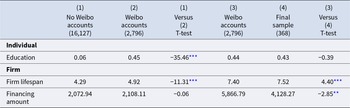
Third, we test for sample selection bias and report the results in Table 8. We first compare the 2,796 entrepreneurs with Weibo accounts to the 16,127 entrepreneurs without Weibo accounts. Analyzing individual-level variables such as education and firm-level variables such as firm lifespan, financing amount, and acquisition, we find that entrepreneurs with Weibo accounts have a higher education level (t = −35.46, p < 0.001) and older firms (t = −11.31, p < 0.001) than those without Weibo accounts. However, there are no significant differences between the two groups in terms of firm lifespan and total financing amount. In addition, we compare the differences between the 2,796 entrepreneurs with Weibo accounts and the final sample of 368 entrepreneurs used in our main analysis. We find that our final sample differs from that based on Weibo accounts in terms of firm lifespan (t = 4.50, p < 0.001) and financing amount (t = −2.86, p < 0.01), but does not differ significantly in terms of education level. Overall, although the comparison results show some statistically significant differences, the actual differences in group means are minimal, suggesting that any potential sample selection bias has a negligible impact on our findings.
Robustness test 4: Sample selection bias test

Notes: The data used in the table are nonstandardized regression coefficients. +p < 0.1,
* p < 0.05, **p < 0.01, ***p < 0.001.
Discussion
This study investigates how objective and subjective time factors influence entrepreneurial reentry, addressing a significant gap in the literature. Although prior research has established the importance of time in shaping entrepreneurial intentions (Gielnik et al., Reference Gielnik, Zacher and Wang2018; Gutierrez et al., Reference Gutierrez, Sloof and Crilly2024), time has typically been treated as a control variable in studies of entrepreneurial reentry (Serrasqueiro et al., Reference Serrasqueiro, Nunes and Silva2016). This narrow focus fails to clarify how specific time factors affect entrepreneurs’ decisions to engage in new ventures after failure. By examining the effects of firm lifespan on entrepreneurial reentry and the moderating role of temporal focus, our study reveals that a longer firm lifespan leads to increased psychological, financial, and social relational costs, thereby significantly decreasing the likelihood of reentry. These findings highlight the critical role of the costs of failure in mediating the impact of firm lifespan on reentry decisions. Moreover, our results show that a past-focused temporal orientation intensifies this negative effect, while present and future foci do not significantly alter the relationship. This highlights how entrepreneurs’ attention to different temporal dimensions shapes their interpretation of failure and their subsequent reentry behavior.
Theoretical Implications
This study makes three important contributions. First, it empirically reveals the relationship between objective time, as represented by firm lifespan, and entrepreneurial reentry, thereby enriching the knowledge base on re-entrepreneurship. The literature has predominantly focused on the costs of failure (Ucbasaran et al., Reference Ucbasaran, Shepherd, Lockett and Lyon2013), learning from failure (Shepherd, Reference Shepherd2003), and recovery from grief (Shepherd, Reference Shepherd2009). Although these studies have implicitly underscored the importance of time factors (Ancona, Okhuysen, & Perlow, Reference Ancona, Okhuysen and Perlow2001; McGrath & Rotchford, Reference McGrath and Rotchford1983), research on the impact of objective time on entrepreneurial reentry remains limited (Hsu et al., Reference Hsu, Wiklund and Cotton2017). Addressing this theoretical gap, our study offers the first empirical examination of the effect of firm lifespan on post-failure entrepreneurial reentry, providing theoretical insights through the lens of failure costs. Specifically, this research extends the applicability of failure cost theory, demonstrating that a longer firm lifespan exacerbates the psychological burden on entrepreneurs (akin to the abrupt loss of a ‘child’ raised for years), intensifies economic losses, and accentuates the erosion of social status and social support, all of which significantly reduce the likelihood of reentry. This finding not only deepens our understanding of the influence of failure costs on re-entrepreneurial behavior but also emphasizes the role of objective time factors in entrepreneurial decision-making by introducing firm lifespan as a critical determinant. Accordingly, this study contributes a new perspective on the role of time in entrepreneurial decision-making, expands the literature on the dynamic relationship between firm lifespan and entrepreneurial behavior, and underscores the potential impact of objective time in entrepreneurship research.
Second, this study extends the exploration of the interaction between objective time (firm lifespan) and subjective time (temporal focus) and their effects on entrepreneurial reentry. In the entrepreneurship literature, time is typically recognized as a critical research dimension, generally conceptualized through objective and subjective lenses (Branzei & Fathallah, Reference Branzei and Fathallah2023). Research has documented the substantial influence of time on entrepreneurial intentions and propensity (Frémeaux & Henry, Reference Frémeaux and Henry2023; McMullen & Dimov, Reference McMullen and Dimov2013; Sirén et al., Reference Sirén, Parida, Frishammar and Wincent2020). For example, both objective time (e.g., age) and subjective time (e.g., future orientation) have a significant impact on entrepreneurial decision-making (Das & Teng, Reference Das and Teng1998; Gielnik et al., Reference Gielnik, Zacher and Wang2018). However, limited attention has been paid to the combined effects of objective and subjective time in the context of entrepreneurial failure (Baù et al., Reference Baù, Sieger, Eddleston and Chirico2017). Therefore, our study contributes to the reentry literature by addressing the gap regarding temporal focus as a moderating variable. Specifically, by analyzing the decision-making processes of entrepreneurs with varying temporal foci in failure contexts, we reveal how subjective temporal perceptions shape their interpretations of objective time. For example, we find that entrepreneurs with a past focus are more likely to dwell on past failures and burdens, thereby intensifying the negative relationship between firm lifespan and reentry. These findings not only expand the application of temporal focus in entrepreneurial contexts but also provide new insights into the relationship between subjective time and entrepreneurial behavior. By examining how temporal focus moderates the relationship between firm lifespan and entrepreneurial reentry, our study introduces a new theoretical perspective on temporal research in entrepreneurship, underscoring the importance of subjective time for a comprehensive understanding of entrepreneurial decisions.
Third, our study integrates archival methods with textual analysis tools to more objectively measure entrepreneurs’ temporal focus (Pennebaker, Francis & Booth, Reference Pennebaker, Francis and Booth2001). The literature suggests that traditional survey methods have limitations when measuring failed entrepreneurs, such as data collection challenges and the potential influence of intrusive surveys on subjects (O’Malley, Patterson, & Evans, Reference O’Malley, Patterson and Evans1997), factors that can introduce measurement error. In contrast, we use a psycholinguistic textual analysis approach, thus avoiding the biases inherent in traditional survey methods and enabling a more reliable assessment of entrepreneurs’ temporal focus. This approach responds directly to the call of Peterson, Smith, Martorana, and Owens (Reference Peterson, Smith, Martorana and Owens2003) for the use of archival methods to assess the psychological traits of senior managers. Furthermore, by utilizing a longitudinal design, our study infers causal relationships between firm lifespan and entrepreneurial reentry, effectively overcoming the limitations of cross-sectional studies, which often lack clarity in establishing causal order. This methodological innovation provides valuable insights for subsequent research on entrepreneurial reentry.
Practical Implications
Our research has important practical implications for failed entrepreneurs and policymakers. First, our study offers new insights into the re-entrepreneurial behaviors of failed entrepreneurs from a temporal perspective, helping them better understand the influence of time. Specifically, we find that entrepreneurs with a strong past focus are likely to be adversely affected by the duration of their previous ventures. Therefore, we suggest that entrepreneurs adjust their temporal focus, paying less attention to past events to mitigate the negative impacts of business failure. Moreover, research has indicated that the experience of business failure can be one of the most valuable assets for entrepreneurs (Amankwah‐Amoah, Khan, Ifere, Nyuur & Khan, Reference Amankwah‐Amoah, Khan, Ifere, Nyuur and Khan2022; Eberhart, Eesley & Eisenhardt, Reference Eberhart, Eesley and Eisenhardt2017). Thus, entrepreneurs should adopt a positive view of business failures and learn from them to guide their future work or start another enterprise (Wang, Reference Wang2024: Yu, Cao, & Wang, Reference Yu, Cao and Wang2024).
In addition, our findings have implications for the development of entrepreneurial policies. Given that our study reveals that firm lifespan significantly affects entrepreneurs’ willingness to re-enter entrepreneurship, policymakers could formulate targeted policies for enterprises of different maturities (Macher & Mayo, Reference Macher and Mayo2015), thereby stimulating entrepreneurial vigor. For instance, providing specialized re-entrepreneurship training and financial aid to entrepreneurs of more mature businesses (Shane, Reference Shane2008) could enhance their ability to use their past experiences and resources effectively. Furthermore, by providing psychological counseling and emotional support, policymakers can encourage entrepreneurs to adopt a forward-looking perspective and minimize the impact of past failures. This approach not only cultivates a spirit of entrepreneurship but also significantly promotes economic growth.
Limitations and Future Research Directions
Our study has several limitations, which offer avenues for future research. First, this study focuses on the moderating role of entrepreneurs’ temporal focus. However, the diverse personal traits of entrepreneurs (Szkudlarek, Reference Szkudlarek2010), the level of competition in the industry, the policy environment, and the social pressures they face at the time of failure can also affect their entrepreneurial reentry (Javalgi, Deligonul, Dixit, & Cavusgil, Reference Javalgi, Deligonul, Dixit and Cavusgil2011; Phillips & Lindsay, Reference Phillips and Lindsay2011). Thus, future research could explore the boundary conditions between firm lifespan and entrepreneurial reentry, based on entrepreneurs’ traits and external circumstances, to deepen the understanding of entrepreneurial reentry behaviors. Additionally, entrepreneurs with different traits may interpret failure differently (Fisch & Block, Reference Fisch and Block2021). Although our study examines the main effect of failure from a failure cost perspective, the learning perspective also represents a crucial theoretical mechanism in the study of entrepreneurial failure (Cope, Reference Cope2011; Shepherd, Reference Shepherd2003, Reference Shepherd2009). Thus, we encourage future research to enrich the explanatory mechanisms of the impact of firm lifespan by incorporating insights from the learning perspective.
Second, this study uses data from Chinese entrepreneurs who experienced business failure to establish a linear relationship between firm lifespan and entrepreneurial reentry. Future research could build on these findings by examining potential non-linear dynamics between firm lifespan and reentry into entrepreneurship. For instance, a shorter firm lifespan may reflect an entrepreneur’s proactive decision to terminate their business early to minimize losses. Thus, future studies should differentiate between types of entrepreneurial failure, distinguishing between voluntary and involuntary exits. This distinction would offer a better understanding of how different types of failure can influence the relationship between firm lifespan and entrepreneurial reentry.
Furthermore, the decision of entrepreneurs to either re-enter the same industry or pursue cross-industry entrepreneurship is a highly valuable area for further investigation (Eggers & Song, Reference Eggers and Song2015; Koçak, Morris, Buttar, & Cifci, Reference Koçak, Morris, Buttar and Cifci2010). Future research could explore the impact of firm lifespan on reentry within the same industry. While a longer firm lifespan may suggest that the entrepreneur has developed a high level of familiarity with the industry, it could also imply that the industry of the failed venture no longer holds significant appeal for the entrepreneur. These factors may influence the likelihood of entrepreneurial reentry, including the decision to re-enter the same industry. Therefore, future studies may also consider investigating the moderating role of industry attractiveness, further examining how variations in industry appeal could moderate the relationship between firm lifespan and reentry in the same industry.
Third, this study analyzes entrepreneurs’ Weibo posts using TextMind, which calculates the frequency of specific words from a predefined list, providing basic information about entrepreneurs’ posts. This approach can only calculate the frequency of temporal focus in posts, but it cannot account for their specific context (McKenny, Aguinis, Short, & Anglin, Reference McKenny, Aguinis, Short and Anglin2018). Therefore, future research could integrate natural language processing tools (Pandey & Pandey, Reference Pandey and Pandey2019), such as word embedding (Rodriguez & Spirling, Reference Rodriguez and Spirling2022), to precisely quantify the variable of temporal focus.
Fourth, the sample in this study consists of Chinese entrepreneurs, and in different sociocultural contexts (Cardon et al., Reference Cardon, Stevens and Potter2011), entrepreneurs’ temporal focus may vary, meaning that the impact of entrepreneurial failure may not affect entrepreneurs from different regions uniformly. Therefore, the generalizability of our findings may be limited. For example, cultural factors, especially long-term orientation (Lumpkin, Brigham, & Moss, Reference Lumpkin, Brigham and Moss2010), can influence entrepreneurs’ temporal focus. Additionally, as the IT Orange Death database primarily assembles data on failed companies in the context of the new economy, it may not fully represent entrepreneurial activities in all settings. Therefore, future research should use data from other countries and collect larger or more comprehensive samples to explore the validity of our conclusions.
Funding statement
This research is supported by the National Natural Science Foundation of China Grants (72532008, 72232010, and 72402125). Professional English language editing support provided by AsiaEdit (asiaedit.com).
Appendix
TextMind Software’s Temporal Focus Dictionary (In Chinese)

Xiaoyu Yu (yuxiaoyu@shu.edu.cn) is a professor of innovation and entrepreneurship at the School of Management of Shanghai University, China. His main research interests include entrepreneurship, innovation, and strategy. He published more than 50 papers in premier journals such as Journal of Organizational Behavior, Small Business Economics, Long Range Planning, and so on. He is co-editor of the Entrepreneurship Research Journal and served on the editorial board for the Journal of Management Studies, Journal of Business Venturing, Human Relations, Journal of the Association for Information Systems, among others.
Xiaoli Liu (lxl2023@shu.edu.cn) is a postgraduate at the School of Management of Shanghai University, China. Her current research interests include entrepreneurship and innovation.
Gang Cao (120250019@aufe.edu.cn) is a lecturer at the International Business School, Anhui University of Finance and Economics, China. He earned his doctorate in management from Shanghai University in 2025. His research interests include entrepreneurship and AI. Dr. Cao’s work appears in international journals such as R&D Management and Journal of Business Research.
Xiaoyu Zhou (zhouxy@shanghaitech.edu.cn) is an associate professor at the School of Entrepreneurship and Management, ShanghaiTech University, China. His research interests focus on corporate ESG, strategic responses to crisis events, and science of science. His related papers have been published in academic journals such as Science, Academy of Management Journal, Journal of Management, among others.
Yajie Li (roxyli@i.shu.edu.cn) is a doctoral candidate at the School of Management, Shanghai University, Shanghai, China. She has published widely in academic journals such as Long Range Planning, Asia Pacific Journal of Management, and Technological Forecasting and Social Change. Her current research interests include entrepreneurial behavior and emotion and interdisciplinary research of entrepreneurship and strategy.