Introduction
Parasitic nematodes cause considerable mortality and morbidity in animals and plants. They are responsible for great economic losses, particularly in regions where extensive livestock husbandry and agriculture are practiced. For instance, Haemonchus contortus is a gastrointestinal nematode (GIN) of major prevalence and veterinary medical importance for small ruminants of tropical, subtropical and high-temperature countries, having third-stage larvae (L3) as the infective form. The effects of infections, particularly in younger animals, range from inappetence and mild anaemia to mortality (Holmes, Reference Holmes1987; Amarante et al., Reference Amarante, Susin, Rocha, Silva, Mendes and Pires2009; Hosking et al., Reference Hosking, Griffiths and Woodgate2009; Miller et al., Reference Miller, Waghorn, Leathwick, Candy, Oliver and Watson2012). On the other hand, Nacobbus aberrans (Thorne & Allen, Reference Thorne and Allen1944) is a plant-parasitic nematode (PPN) that is one of the main phytosanitary problems affecting crops including beans, peppers, tomato, beet, wheat, potatoes and others (Cristóbal-Alejo et al., Reference Cristóbal-Alejo, Mora-Aguilera, Manzanilla-López, Marbán-Méndoza, Sánchez-Garcia, Cid Del Prado-Vera and Evans2006; Mugniéry & Phillips, Reference Mugniéry, Phillips and Vreugdenhil2007). It is considered one of the top ten PPNs based on scientific and economic importance (Jones et al., Reference Jones, Haegeman and Danchin2013). This species is endemic to the American continent (Sher, Reference Sher1970) and has quarantine importance (EPPO, 2009). Nacobbus aberrans is known as the false root-knot nematode because it also induces the formation of galls in the roots of hosts such as Meloidogyne spp.
A possible and promising approach to nematode control is the use of inorganic and organometallic compounds, which have contributed to expanding the range of nematicidal agents; for example, ferrocene-based compounds and other metallocenes have attracted particular attention because they are neutral, chemically stable, non-toxic and able to cross cell membranes, which make them good candidates for the design of novel drugs for medicinal chemistry (Kealy & Pauson, Reference Kealy and Pauson1951; Woodward et al., Reference Woodward, Rosenblum and Whiting1952; Dombrowski et al., Reference Dombrowski, Baldwin and Sheats1986; van Staveren & Metzler-Nolte, Reference van Staveren and Metzler-Nolte2004; Fouda et al., Reference Fouda, Abd-Elzaher, Abdelsamaia and Labib2007). For example, ferrocifen and ferroquine are two model examples of ferrocene (Fc)-based compounds in medicinal chemistry (Top et al., Reference Top, Tang, Vessieres, Carrez, Provot and Jaouen1996; Biot et al., Reference Biot, Glorian, Maciejewski and Brocard1997). More recently, the incorporation of ferrocenic moiety to chalcone compounds has been found to confer a substantial improvement in their biological effects. Chalcones (substituted 1,3-diphenylprop-2-en-1-ones) are naturally occurring derivatives belonging to the flavonoid family (Marais et al., Reference Marais, Deavours, Dixon and Ferreira2006). They have been reported to exhibit a broad range of biological and pharmacological properties, such as antibacterial (Nielsen et al., Reference Nielsen, Boesen, Larsen, Schønning and Kromann2004), antifungal (Lahtchev et al., Reference Lahtchev, Batovska, Parushev, Ubiyvovk and Sibirny2008), antiviral (Park et al., Reference Park, Jeong, Kim, Park, Rho, Park, Ryu and Lee2011), antiparasitic (Nielsen et al., Reference Nielsen, Kharazmi and Christensen1998), anticancer (Modzelewska et al., Reference Modzelewska, Pettit, Achanta, Davidson, Huang and Khan2006), antitubercular (Shivakumar et al., Reference Sivakumar, Geetha Babu and Mukesh2007) and antileishmanial (Liu et al., Reference Liu, Wilairat and Go2001) activities. Taking these results into account and because the current literature does not include reports on the anthelmintic activity of ferrocenyl chalcones (FcCs) against H. contortus (L3) and N. aberrans (second-stage juveniles (J2) strains, this work is aimed to synthesize, characterize and evaluate the anthelmintic property of FcCs-1 and 2. Thus, to our knowledge, this is the first study exploring the anthelmintic activity of FcCs against H. contortus and N. aberrans.
Materials and methods
FcCs
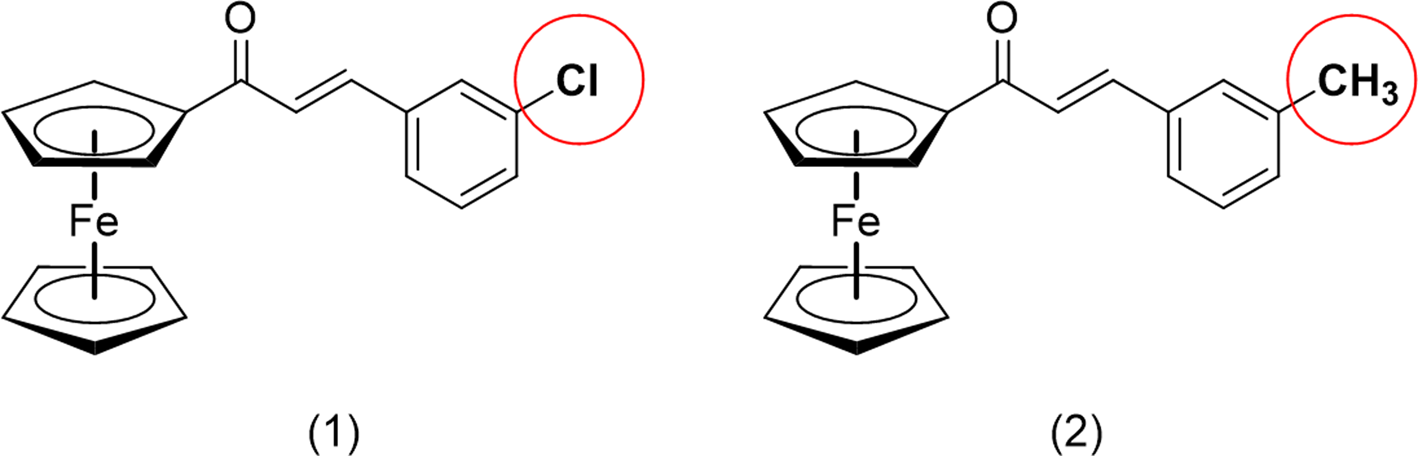
Compounds (2E)-1-ferrocenyl-3-(3-chlorophenyl)prop-2-en-1-one (FcC-1) and (2E)-1-ferrocenyl-3-(3-methylphenyl)prop-2-en-1-one (FcC-2) were synthesized by a base-catalysed Claisen–Schmidt condensation between acetylferrocene and an appropriately substituted aromatic aldehyde (fig. 1). Both compounds were synthesized and characterized by usual spectroscopic methods and their molecular structures were confirmed by single-crystal X-ray diffractometry (see supplementary material).
Chemical structure of chalcones 1 and 2 synthesized and evaluated in this work.

Method for obtaining H. contortus (L3)
The strain of H. contortus was provided by the Helminthology Unit of CENID-SAI, Hueytamalco, Puebla, Mexico. Infective larvae (L3) were obtained through the administration of 350 L3/kg body weight of the sheep. Sheep faecal samples were processed to obtain L3 in cultures. After six days of incubation, the L3 was obtained by the Baermann funnel technique over 12 h (Baermann, Reference Baermann1917). Then, a solution of 40% of sucrose in water was added in a sucrose/larvae ratio of 3:1 and centrifuged for 5 min at 3000 rpm to obtain the concentration gradient wherein the larvae were found and recovered using a Pasteur pipette, then resuspended in 25 mL of distilled water and washed three times with distilled water to eliminate the remaining sucrose present in the sample (Liébano-Hernández et al., Reference Liébano-Hernández, López-Arellano, Mendoza de-Gives and Aguilar-Marcelino2011).
Haemonchus contortus in vitro development technique was conducted to remove the larval sheaths (Liébano-Hernández et al., Reference Liébano-Hernández, López-Arellano, Mendoza de-Gives and Aguilar-Marcelino2011). Haemonchus contortus L3 were artificially ensheathed through contact with a solution of 0.187% sodium hypochlorite for 9 min. When the majority of larvae were ensheathed, they were washed four times with distilled water and centrifuged at 2500 rpm for 1 min. Once larvae were washed, the sediment was formed and recovered in 50 mL Falcon tubes.
Method for obtaining the larvae of N. aberrans (J2)
The inoculum of N. aberrans was obtained from galled roots of tomato (Solanum Lycopersicum Mill) and collected at ‘Colegio de Postgraduados, Montecillo Campus’, State of México, Mexico. The population was increased from a single mass of eggs followed by extraction and incubation in Petri dishes at 28°C in sterile distilled water until the hatching and obtaining of juveniles (J2) (Vrain, Reference Vrain1977).
Experimental design
The experimental settings of the in vitro study were made up of nine series (n = 4) for H. contortus and nine series (n = 3) for N. aberrans. Larvae of each of them were placed in 96-well microtiter plates at 100 larvae per well. The FcCs were evaluated at 10.6, 21.3, 42.75, 85.5, 171 and 342 μM, solubilized in 2.5% dimethyl sulfoxide (DMSO) in water. Commercial anthelmintic ivermectin 5% (IVM, 5.7 mM) was used as a reference (positive control); distilled water and 2.5% DMSO (32.0 mM) were used as negative controls. Post-confrontation readings for H. contortus were taken at 24, 48 and 72 h, and for N. aberrans at 36 h, both with a white-light optical microscope (4X and 10X). After the corresponding hours of exposure, mortality was observed under the microscope (×40) by counting live and dead larvae. This quantification was done on slides (10–5μ aliquot drop), observing the larvae, counting the degraded larvae and those that did not move when stimulated as dead. The live larvae were counted as those that moved even after the incubation time (Olmedo-Juárez et al., Reference Olmedo-Juárez, Rojo-Rubio, Zamilpa, Mendoza de Gives, Arece-García, López-Arellano and von Son-de Fernex2017).
Statistical analysis
Data were compared using Tukey's Studentized Range test. For all studies, a P-value <0.05 was used to indicate statistical significance. Likewise, the effective concentrations effective concentration 50 (EC50) and EC90 were calculated using Probit analysis in Statistical Analysis System 9.2 (SAS Institute, 2009) and are presented as mean ± standard deviation.
The mortality rates of infected larvae of H. contortus and N. aberrans against FcCs 1 and 2 were obtained by the formula (Pineda-Alegría et al., Reference Pineda-Alegría, Sánchez-Vázquez, González-Cortazar, Zamilpa, López-Arellano, Cuevas-Padilla, Mendoza-de-Gives and Aguilar-Marcelino2017):

where Xcontrol = mean value of live larvae in control group and Xtreated = mean value of live larvae in the treated group.
Scanning electron microscopy (SEM) on unsheathed H. contortus L3
SEM micrographs were taken from the control groups of H. contortus L3 and drawn to subsequently observe any damage and morphological deformations caused by the effect of FcCs 1 and 2. Previously, an exposure of 72 h was made at the highest evaluated concentration of 342 μM of each FcC, with their respective controls against H. contortus, to later observe the damage caused. Haemonchus contortus L3 repair was observed by SEM in both cases. The nematodes obtained from the in vitro assays were fixed in a mixture containing 2% formaldehyde and 2.5% glutaraldehyde in a 0.1 M phosphate buffer solution, pH 7.0 and refrigerated at 4°C until analysis. The worms were dehydrated in a gradient system of ethanol (50, 70 and 100%), dried with carbon dioxide in a SPI-Dry critical-point dryer (CPS SUPPLIES Part #13200JE-AB, P.O. Box 656 West Chester; PA 19381-0656 United States) and mounted on aluminium cylinders covered with conductive carbon tape and adhesive. The samples were metalized with a 20 nm layer of gold–palladium. The scanning electron microscope was used in high-vacuum working conditions at an acceleration voltage of 9 kV; the average working distance was 10 mm and 50 μm objective lens aperture.
Results
Anthelmintic activity of FcCs 1 and 2 against H. contortus L3
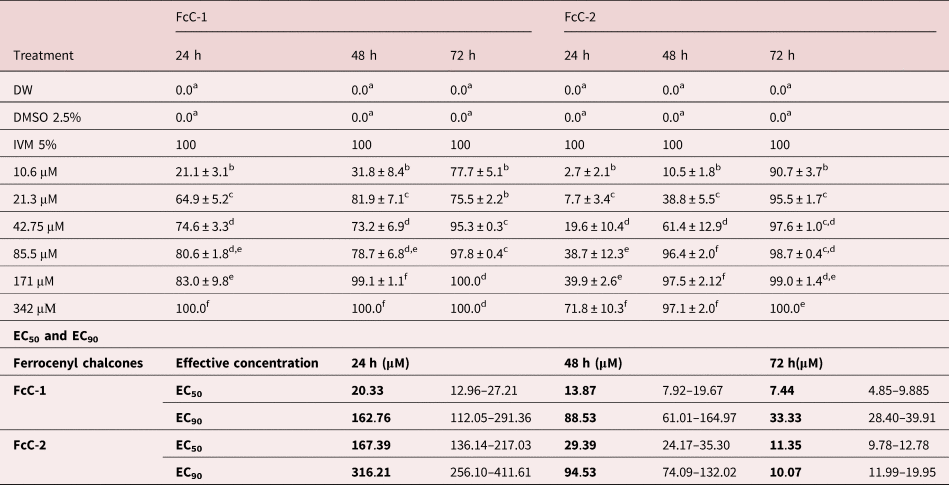
The in vitro mortality induced by FcCs 1 and 2 against H. contortus L3 is shown in table 1. In the case of FcC-1, an anthelmintic activity higher than 64.9% was observed at 21.3 μM and at different evaluation times (24, 48 and 72 h). For obtaining more than 80% mortality, a concentration of 171 μM was necessary over 24 and 48 h.
Mortality data (%) and effective concentration values (EC50 and EC90) of FcCs 1 and 2 against H. contortus (L3) at 24, 48 and 72 h of exposure.

± SD = standard deviation. Superscripts a–f are used to indicate significant differences according to Tukey's test (P < 0.05). DW, distilled water; DMSO, dimethyl sulfoxide; IVM, ivermectin.
However, after 72 h, 100% mortality was observed at a concentration of 171 μM. On the other hand, for FcC-2 at a concentration of 85.5 μM, a mortality of 90% was observed at 48 h and a mortality rate of 100% was obtained at 342 μM over 72 h. FcC-1 showed the highest level of mortality against H. contortus L3, and these values were statistically higher than those of FcC-2 (P < 0.05).
The EC50 and EC90 values of FcCs 1 and 2 are shown in table 2. For FcC-1, the lowest effective concentrations at 72 h were 7.44 μM and 33.33 μM, respectively. In the case of FcC-2, the lowest lethal concentrations at 72 h were 11.35 μM and 10.07 μM, respectively.
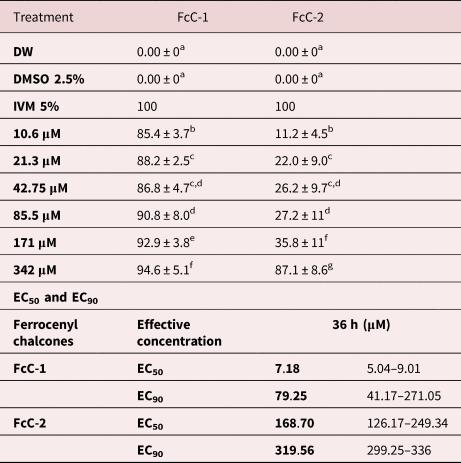
Mortality data (%) and effective concentration values (EC50 and EC90) of FcCs 1 and 2 against N. aberrans (J2) at 36 h of exposure.

± SD = standard deviation. Superscripts a–f are used to indicate significant differences according to Tukey's test (P < 0.05). DW, distilled water; DMSO, dimethyl sulfoxide; IVM, ivermectin.
Nematicidal activity of FcCs 1 and 2 against N. aberrans J2
In vitro mortality of N. aberrans J2 by the action of FcCs is shown in table 1. From the lowest concentration evaluated of 10.6 μM, FcC-1 showed a mortality rate of 85.4% after 36 h of confrontation, while it was possible to observe mortality higher than 80% for FcC-2 only at 342 μM after 36 h. The compound FcC-1 showed higher levels of mortality than FcC-2.
The EC50 and EC90 values obtained for N. aberrans (J2) can be seen in table 2. For FcC-1, the ECs were 7.18 μM and 79.25 μM, respectively, while they were 168.7 μM and 319.56 μM for FcC-2.
SEM
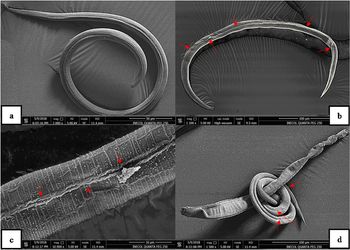
Ultrastructure features of the infective larvae bodies of H. contortus were obtained by SEM and are shown in fig. 2. Specimens presented deformity in the bodies, which were slightly incurved towards the dorsal flank, a flattened anterior part where the lancet is located and another deformation of the posterior part near the tail.
SEM. Ultrastructural features of H. contortus (L3) unsheathed: (a) control group; (b–d) treated group. Note: deformations are indicated by arrows.

Spectroscopic characterization of FcCs 1 and 2
The Fourier-transform infrared spectroscopy (FT-IR) spectra of FcCs 1 and 2 showed two strong absorption bands around 1655 and 1598 cm−1 due to stretching vibrations, which are characteristic for the carbonyl α,β-unsaturated functional groups.
For FcCs 1 and 2, a characteristic feature in proton nuclear magnetic resonance (1H NMR) spectra in deuterated chloroform (CDCl3) is the pair of AB-type doublets at c. 7.76 and 7.13 ppm, whose large coupling constants (3JHH = 15.0 Hz) are indicative for olefinic protons in E-configuration (Nowakowska, Reference Nowakowska2005). The aromatic protons of both compounds appear shifted downfield in the range 7.64–7.22 ppm, along with three peaks from the ferrocenyl moiety in the range of 4.93–4.22 ppm. The methyl protons of compound 2 appear as a singlet centred at 2.42 ppm. Carbon-13 nuclear magnetic resonance (13C NMR) spectra of 1 and 2 display characteristic carbonyl signals at 192.6 and 193.0 ppm, respectively. Moreover, the signal for carbon atom of methyl radical in FcC-2 appears as a singlet centred at 21.4 ppm.
Single-crystal X-ray diffraction studies
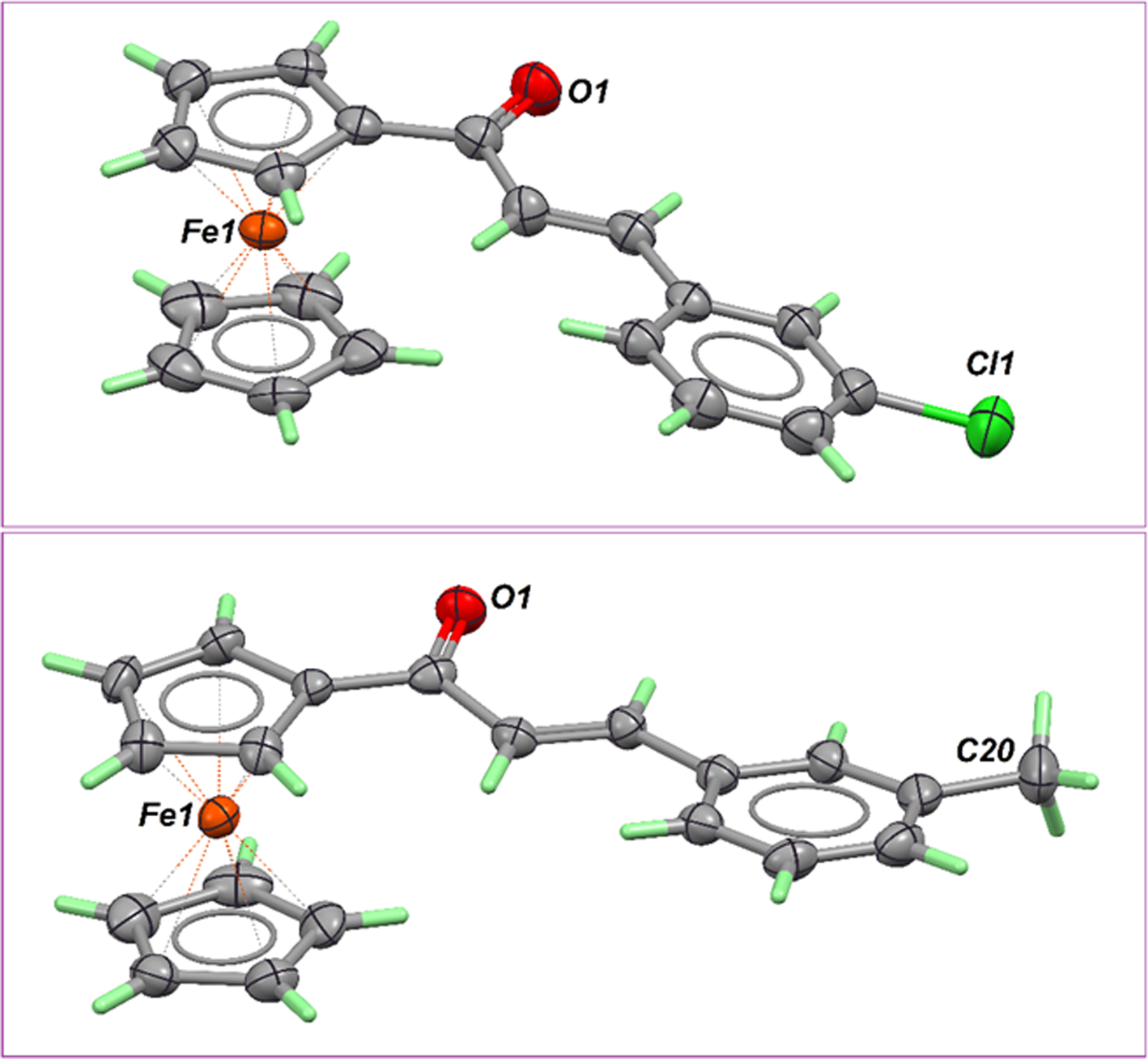
The molecular structures of FcCs 1 and 2, determined by single-crystal X-ray diffraction are shown in fig. 3. Although the structures of 1 and 2 differ only in a 3-chloro or 3-methyl substituent at phenyl radical, their unit cell parameters are quite different: FcC-1 crystallizes in space group P212121 with a = 5.8022(3), b = 10.5286(5) and c = 25.5874(12) Å [α = β = γ = 90°], and FcC-2 crystallizes in space group P21/c with a = 28.5538(16), b = 5.9183(2) and c = 19.7317(11) Å, [α = γ = 90°, β = 110.119(4)°] (supplementary tables S1–S12).
Molecular structures of FcCs 1 (top) and 2 (bottom) determined by single-crystal X-ray diffractometry. For FcC-2, only one of the two independent molecules present in the unit cell is shown.

For FcC-1, the dihedral angle between the phenyl ring and the α,β-unsaturated group is 13.8°. For FcC-2, which carries a methyl group instead of a halogen, two independent molecules are present in the crystal, which show very similar conformations. In this case, the dihedral angle reflecting the planarity of the chalcone moiety is slightly higher, in the range of 15.2–15.3°. Finally, the Fc organometallic fragment displays the expected geometry and the organic chalcone moiety is almost coplanar to the cyclopentadienyl ring (dihedral angles between organic and organometallic parts fall in the range 5.9–16.5°). In the solid state, both molecules have then the required geometric features to be candidates for nematicides. Structural data are provided in the supporting information and full data (cif files) are available at the Cambridge Crystallographic Data Centre (deposition codes 1921682 and 1921683).
Discussion
The main purpose of this study was to determine the in vitro nematocidal activity of FcCs 1 and 2 vs. H. contortus L3 and N. aberrans J2. Both compounds were screened at 10.6, 21.3, 42.75, 85.5, 171 and 342 μM, as well as with IVM (positive control) on H. contortus L3 at 24, 48 and 72 h and then compared. FcC-1 showed the best nematicidal activity (in terms of mortality assay) in comparison with FcC-2, with 100% from 171 μM and 342 μM, respectively, at 72 h. (table 1). These results indicate that the mortality of H. contortus L3 increases as time and concentration of FcCs increase.
Although in terms of EC50 and EC90 for H. contortus L3 mortality assay (table 1), the effectiveness of FcC-1 is lower than other recently synthesized chalcones (Ouattara et al., Reference Ouattara, Sissouma, Koné, Menan, Touré and Ouattara2011; Sissouma et al., Reference Sissouma, Ouattara, Koné, Menan, Adjou and Ouattara2011), our findings are sufficient to suggest that metallocenes have potential use as active compounds for the control of H. contortus L3 in ruminants.
On the one hand, FcC derivatives have a wide spectrum of biological applications over other pathogens such as bacteria; for example, Henry et al. (Reference Henry, Bird, Gowland, Collins and Cassella2020) mention the use of FcC derivatives as possible antimicrobial agents for the treatment of infections caused by clinically resistant bacteria.
Additionally, although there are not reports on the physiological mechanism of these organometallic compounds, the SEM micrographs in fig. 2 showed physical damages in the in vitro trials, which are indicative of strong biological interactions between the FcCs and worms.
On the other hand, FcCs 1 and 2 were screened against N. aberrans J2 at the same conditions as in the case of H. contortus L3, as well as the positive control at 36 h (table 2). These values indicate that as in the case of H. contortus L3, compound 1 is more active than 2 against N. aberrans J2 – this explains why higher concentrations of FcCs 1 and 2 had to be used for obtaining the same mortality effect.
Because 1 and 2 are analogue compounds, the increase of nematicidal activity depends only on the substitution of the methyl radical by the chlorine atom; thus, this fact allows us to suggest that certain functional groups, and maybe also their location on the phenyl ring, could be a key difference in the improvement of the biological activity of FcCs. This suggestion is based on the report of Carboni et al. (Reference Caboni, Aissani, Demurtas, Ntalli and Onnis2016), who synthesized 14 substituted chalcones and tested them in vitro against a Meloidogyne incognita nematode.
Additionally, that study revealed that three of the four compounds with the highest nematicidal activity were 5-halo-2-hydroxyphenylchalcone-type compounds. Recent studies by Attar et al. (Reference Attar, O'Brien, Alhaddad, Golden and Calderón-Urrea2011) on the activity of FcCs vs. organic chalcones against Caenorhabditis elegans strains showed that the nematicidal activity of organometallic chalcones was lower than the activity of the organic ones. They also found that the incorporation of ferrocenyl radical into chalcone is not the unique factor responsible for those results, but also the lipophilicity, polarity and planarity of other substituents. Although the FcCs 1 and 2 showed modest results on the nematicidal activity against N. aberrans J2, it could prompt similar research focused on the control of these PPNs.
With respect to the chemical part of this work, it is important to mention that the FcCs 1 and 2 were prepared in almost quantitative yield by Claisen–Schmidt condensation, starting from acetylferrocene and the corresponding benzaldehyde derivatives in the presence of ethanolic solution of sodium hydroxide. For FcC-1, all of the spectral data (FT–IR, 1H and 13C NMR) and elemental analysis are in good agreement with those reported in the literature (Wu et al., Reference Wu, Wilairat and Go2002, Reference Wu, Tiekink, Kostetski, Kocherginsky, Tan, Khoo, Wilairat and Go2006), but its crystalline structure was not determined.
Concerning their X-ray structures, the most relevant feature is the planarity they show between the rings at both sides of the chalcone system, which is consistent with the delocalization of the π-electrons onto this region; however, in FcC-1, the phenyl ring is slightly curved inwards, probably due to an attractive interaction between H-6 of one molecule with C-18 of the neighbouring molecule, as it is evidenced by a close contact C6-H6⋅⋅⋅C18 of 2.847 Å.
SEM microphotographs showed that the specimens presented deformity in their bodies, which were slightly incurved towards the dorsal flank, a flattened anterior part where the lancet is located and another deformation of the posterior part near the tail; however, it is necessary to carry ultrastructural studies (transmission electron microscopy) to assess the effect at cellular level and determine mechanisms of action for this activity of FcC-1 and FcC-2 against N. aberrans (J2) and H. contortus (L3).
In summary, the FcCs 1 and 2 were obtained in excellent yields and full chemical (FT–IR, 1H and 13C NMR and elemental analysis) and structural characterization by single-crystal X-ray diffraction has been obtained. They showed to possess a moderate in vitro nematicidal activity against H. contortus L3 and N. aberrans J2. SEM micrographs showed that H. contortus L3 is more sensitive at low concentrations of the evaluated chalcones, while N. aberrans J2 required concentrations higher than 90% to achieve mortality. The biological activity of FcCs 1 and 2 against these parasites make them potential candidates as pharmaceutical drugs for the control of ovine haemonchosis and other nematodiases that are of crucial importance for the development of livestock and agriculture.
Supplementary material
To view supplementary material for this article, please visit https://doi.org/10.1017/S0022149X2000070X
Acknowledgements
We are grateful to the Helmintology Laboratory of CENID-SAI, INIFAP, Municipality of Jiutepec, Morelos, Mexico, for the facilities to carry out the biological studies and especially to C. Itzayana Diaz Nuriulú.
Financial support
This research received partial financial support from ‘Proyectos Fiscales Instituto Nacional de Investigaciones Forestales Agrícolas y Pecuarias, INIFAP’ (project number 834432984). SB thanks Conacyt-México for financial support through grant number 268178.
Conflicts of interest
None.
Ethical standards
The animals were kept under controlled housing and feeding conditions according to the good practices of CENID-SAI, INIFAP. The Mexican Official Standard NOM-051-ZOO-199 for the humane treatment in the mobilization of the animals, as well as the Federal Law on Animal Health, were fully adhered to.