A strong trend in normative political theory the last two decades has been to emphasize the importance of deliberation. Democratic politics, according to this view, should be more about giving good reasons than forcing or striking deals. Arguing – discussion on the merits – rather than bargaining or voting is at the heart of democracy. Deliberative democracy is often positioned in contrast to economic conceptions of democracy, where politics is ‘understood mainly in terms of conflict of competing interests – and thus more in terms of bargaining than of public reason’.Footnote 1 Also within international relations arguing has been upheld as a possible and normatively compelling alternative to unmasked power politics.Footnote 2 In the European Union ‘deliberative supranationalism’ has been promoted as a solution to the problems of democratic legitimacy plaguing this organization due to its lack of well-functioning accountability mechanisms in which citizens may hold policy-makers to account.Footnote 3
Lately, the ‘deliberative turn’Footnote 4 in democratic theory has had its own turn towards empirical research. While empirical research cannot be used to test the validity of normative theories, it can test the relevance of such theories to the real world of politics. An increasing number of studies of deliberation at the elite level – not least within the European Union – have taken this as their task.Footnote 5
This article presents an additional effort along this research track. It uses a survey of representatives of all EU member states to analyse the occurrence of arguing and bargaining within the committees and working groups of the Council of Ministers. Three main research questions are addressed: To what extent is decision making within the Council based on arguing rather than bargaining? Under what circumstances is arguing more likely to occur? Are some actors more inclined to engage in arguing than others? The fact that decision making within the European Union is conducted under different procedural requirements depending on the policy area gives an unusual opportunity to test the effects of varying institutional conditions on the presence of arguing and bargaining.
This article also makes a methodological argument. A central problem facing researchers who wish to contribute to this field is the question of how to operationalize and measure arguing and bargaining empirically. This article points at, and proposes a solution to, one particularly difficult problem with respect to operationalization, namely the distinction between arguing and co-operative forms of bargaining. The key to making this distinction is to look not only at whether, but also at why, actors give reasons for their positions.
The findings indicate that arguing is indeed a significant mode of decision making in the Council working groups, but also that there is substantial variation between different actors and different institutional settings. In particular, arguing is more common within intergovernmental policy procedures where unanimity rule and ‘soft law’ apply, and – contrary to the expectations of many deliberative theorists – among well-established and powerful actors. These results, along with related findings in previous research, form the basis for the general argument of the article, namely that higher political stakes make actors less willing and able to argue. Actors who are not particularly pressured by the decision-making situation can ‘afford’ to argue, while actors, who seriously fear losing out in the negotiations, tend towards a bargaining mode. This condition limits the overall significance of arguing in political decision making.
Arguing in the council of ministers: general patterns and contextual conditions
The Council of Ministers is the most important legislative institution of the European Union. This is where representatives from the twenty-seven member states (in 2009) negotiate and decide on EU legislation and other forms of policy. Is arguing a significant mode of decision making in this key arena for European politics? Although international negotiations generally are considered rather difficult cases for deliberation, due to a purported lack of a ‘common lifeworld’ among negotiators,Footnote 6 the European Union is often perceived to be less affected by this problem, due to its strong institutional structures and repeated interactions between the parties.
Several case studies using process tracing in and around the Council framework have provided evidence of deliberative behaviour.Footnote 7 Others, however, have argued that the significance of deliberation within the European Union may have been exaggerated and have pointed at the persistence of bargaining and strategic action in EU politics.Footnote 8 While it is clear from the present research that deliberation happens sometimes in the EU system, it is difficult to know how common this type of behaviour is. Case studies are important tools for developing hypotheses and discovering and describing possible causal mechanisms, for example, mechanisms which may connect deliberative behaviour with different institutional and other contextual factors. But in order to answer the basic question about how important arguing really is as a mode of decision making in the Council, we also need research designs that can say something about Council behaviour in general. For this purpose quantitative studies are better suited.Footnote 9
One pattern which is discernible from the case studies made so far on the Council of the Ministers is that deliberation seems to be present during less politically heated conditions (non-politicised and technical issues, soft law, advisory committees, pre-negotiation phases), but less apparent under more demanding political circumstances. Both Niemann and Jacobsson and Wifell, for example, noted that the deliberative type of behaviour which they found initially in their studies of Council negotiations within trade policy and employment policy, respectively, tended to be substituted by bargaining when the process came closer to a sharp decision-making stage.
This is a pattern which is familiar also from other contexts. For example, Chambers in her study of the discussions on constitutional reform in Canada in the 1990s, noted that the closer the actors involved came to the referendum, the less willing they became to deliberate respectfully. Initially, the discussions were characterized by ‘good will, reasonableness and mutual understanding’. But when the participants felt that the deciding moment was upon them, and that this ‘was a moment of closure with no turning back’, the debate became ‘less of a conversation and more of a win–lose battle’. ‘Under this kind of pressure’, Chambers concludes, ‘diversity becomes “adverserialized”, civility becomes a luxury, and partisanship becomes the safest strategy’.Footnote 10 This pattern has also been noted by Kanra, who argues that students of deliberation must separate the ‘social learning’ and the ‘decision-making’ stages of a deliberative process, and that participants can be assumed to ‘apply different logics to the different stages’. ‘Orientation towards decision-making’, according to Kanra, ‘undermines the role of cooperative interaction by triggering an inclination towards protecting the existing configuration of interests’.Footnote 11
An important task for the empirical turn of deliberative theory is to specify institutional and other contextual circumstances that may be more or less conducive to deliberation. Building on the previous discussion – and the empirical findings of the present study – I will argue that the significance of the political stakes involved is an important determinant of arguing. Two parallel causal mechanisms are involved here, one cognitive and one rational. First, high stakes increase the pressure on the negotiators, which in turn restricts their thinking. As indicated by Chambers and Kanra, facing tough decisions makes people more defensive, more focused on protecting their own interests, less prepared to reach out to others and to open their minds for the arguments and perspectives of others. In this interpretation, higher political pressure makes people less capable of arguing.Footnote 12 Secondly, the reason why high political stakes lead to more bargaining may involve a more rational calculation. For example, Fearon has argued that actors’ behaviour during negotiations partly depends on the degree to which they foresee being bound by the agreement. If credible enforcement mechanisms exist, the potential costs and payoffs of the agreement are more likely to be realized, which in turn means the stakes are higher. The result, according to Fearon, is that the negotiations will be tougher and more prolonged as actors have incentives to negotiate ‘more seriously’.Footnote 13 Engaging more seriously in the issue may also imply putting more effort into defining one’s own preferences, which in turn makes arguing less relevant. When preferences are more or less fixed, bargaining becomes a more effective means for attaining one’s goals. In this interpretation, therefore, high political stakes make actors less willing to argue.
Distinguishing empirically between these two mechanisms is beyond the scope of this article. The argument here is simply that arguing tends to be more common when the political stakes are low. This is a conditioning factor which limits the relevance of deliberation in politics in general.
This arguing also makes better sense of two other common claims in the empirical literature on deliberation concerning institutional factors that may promote argument or hinder it: the impact of the voting rule and the degree of publicity of the process. In the literature a unanimity requirement is assumed to promote arguing, while possibilities for majority voting are thought to lead to a more conflictual communicational dynamic.Footnote 14 However, the causal mechanism behind this argument is a bit unclear. The rationale seems to be that unanimity induces actors to engage in each other’s arguments. ‘Only if actors have veto power, are other actors “forced” to listen and deliberate.’Footnote 15 As I will outline in more detail in the next section, however, this argument fails to consider that co-operative consensus-seeking behaviour is as compatible with bargaining as with arguing. Reaching an agreement without voting is perfectly possible also within a bargaining mode. If, therefore, there is an empirical pattern pointing at arguing being more common than bargaining under unanimity rule – which is in fact the case in the present study, as will be seen – some other explanation must be found than simply pointing at the fact that actors must talk to each other to reach an agreement. An explanation, which focuses on the degree of control that the individual actors have over the outcome of the decision-making process, seems more valid. Veto power (and other sources of power and control) may give the actors the security they need in order to engage in arguing rather than bargaining. The variation in decision-making procedures between different policy areas that is characteristic of the European Union gives the present study a unique opportunity to test empirically the impact of the voting rule.
Another potential conditional factor that has been discussed extensively in the literature on deliberative democracy is the degree of publicity of the process. On the one hand, publicity is sometimes mentioned as a factor that may increase the willingness of political actors to argue rather than bargain. A public audience may force actors to concede to the norms of the ‘forum’, it is argued, which prescribes that in politics one should argue for the common good rather than bargain for self-interests. In more insulated settings ‘market’ behaviour is instead assumed to thrive.Footnote 16 On the other hand, it has also been argued that, while publicity induces actors to adapt to the norms and expectations of the audience, it also makes them more careful about revealing private information. Furthermore, most political actors at the elite level are representatives of some constituency, which means that their incentives to engage in public posturing rather than sincere negotiations increase with the degree of publicity.Footnote 17 Publicity thus raises the political pressure on the actors, reduces their control over the situation, and can be expected to lead to less arguing for the same reason as given above. The degree of publicity is generally low in the Council working groups. Nevertheless, the data used in this study allows at least for a crude test of the publicity factor by means of a comparison between communications during the informal, often bilateral, pre-negotiations and the discussions at the more crowded formal working-group meetings.
On a more explorative basis, I will also analyse whether different types of actors argue or bargain more than others. Most important is the distinction between more and less powerful actors. In normative deliberative democratic theory, arguing is seen as a decision-making mode with the potential of off-setting, to some extent at least, the biases inherent in politics stemming from unequal access to material power resources. There is a hope that less powerful actors will have more of a say in policy processes dominated by arguing rather than bargaining.Footnote 18 Although the present study does not analyse who is influential with respect to the outcome of the negotiations, it will be seen whether a priori less powerful actors (in particular representatives of small and new member states) are more inclined towards arguing.
Furthermore, some scholars have argued that women may tend towards arguing more than men.Footnote 19 On one hand, Grunenfelder and Bächtiger found no such difference between the sexes in their study of deliberation in parliamentary debates in Switzerland and Germany.Footnote 20 Mendelberg and Karpowitz, on the other hand, using data from experimental studies of small group deliberations, found that gender composition made a difference for the deliberative quality of the discussions.Footnote 21 The sample of Council working-group representatives in the present study contained 26 per cent women, and an analysis of whether a difference in the level of arguing can be found between these women and their male colleagues appears later in this article.
Defining and operationalizing arguing and bargaining
How can we define deliberation, arguing and bargaining and operationalize these concepts for empirical research? There is certainly no consensus on how this should be done.Footnote 22 In this section I will outline how I intend to apply these contested concepts.
Arguing and bargaining are two distinct modes of interaction in which social actors can reach agreement on a collective decision. Deliberative theorists usually define bargaining as ‘a form of interest-aggregation that builds on the exchange of threats and promises’, while arguing ‘is based on claims of validity’.Footnote 23 An actor who aims at convincing others of the value of a certain policy option is arguing. The purpose of arguing is the transformation of preferences, which may bring the parties closer to a common position. The method is giving convincing reasons concerning the merits of different options in terms of normative rightness and/or factual validity. Barry called this mode of decision making ‘discussion on merits’: ‘If agreement is reached by means of discussion on merits, the parties to the dispute have changed their minds about what they want; even if one party had the power to get its way completely it would not want to change the solution’.Footnote 24
If the communication is focused on reaching a common decision, but includes no efforts at changing the minds of the other parties about what they want or what they perceive to be right, then bargaining is occurring. A distinguishing feature of arguing in contrast to bargaining is that in the latter mode preferences are assumed to be fixed in the short term, while arguing assumes that preference transformation is possible. To quote Barry again, in bargaining ‘the merits of the question are not introduced’.Footnote 25 Agreement reached by means of bargaining ‘merely involves a recognition on the part of each side that it cannot hope to get more of what it wants than is represented by the settlement’.Footnote 26
But arguing defined as discussion on merits is not enough to capture the concept of deliberation. In deliberative democratic theory, genuine deliberation is considered to be present when the actors involved are not only making attempts at convincing others of the merits of a certain course of action, but also are open themselves for being convinced by the force of the better argument.Footnote 27 The Habermasian concept of communicative action, which is often connected to deliberation, assumes sincerity on the part of the actors. Arguments are not used strategically to further one’s self-interested goals. I will distinguish here between co-operative and competitive arguing, where the former means sincere deliberation, while the latter is termed ‘rhetorical action’, following Schimmelfennig, and describes a mode of interaction, which lacks reciprocity.Footnote 28 Rhetorical action means that arguments are used strategically, with the purpose of persuading opponents rather than reaching common understanding. ‘Plebiscitory reason’, as Chambers has called it, meaning shallow rhetoric, pandering and demagoguery, is one feature of competitive arguing.Footnote 29 The distinction between arguing and bargaining, thus, is not one between strategic and communicative action as arguing may be either strategic or communicative.
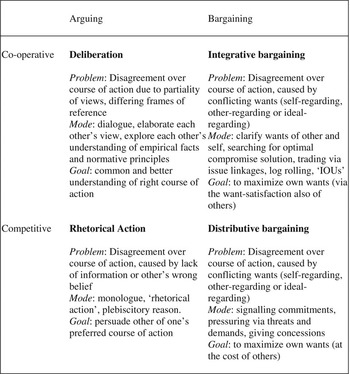
Bargaining also comes in a co-operative and a competitive form. The co-operative version, which presumably is what deliberative theorists have in mind when referring to ‘promises’, is known in negotiation theory as ‘integrative bargaining’.Footnote 30 This involves efforts at reaching agreements by comparing and matching fixed preferences, searching for solutions that will satisfy all participants given their existing preferences. The goal in an integrative bargaining game is not to transform preferences, but to clarify them, put them on the table and in a common effort among the participants seek to maximize the satisfaction of preferences of all those present around the table. For integrative bargaining to occur, the participants should perceive the situation as variable-sum, including opportunities for package deals and log rolling. Communication is characterized by a co-operative attitude, brainstorming, rich information sharing and participants candidly speaking their minds about what they want.
‘Distributive bargaining’, by contrast, denotes a competitive bargaining game, where actors try to solve the conflict by pressuring the other participants to make concessions. The goal is neither to transform preferences, nor to search for mutually advantageous compromise solutions, but to make the others comply with one’s demands. The term ‘distributive’ comes from the notion of having a fixed sum of utilities to allocate, making one participant’s gain a loss to the others. A distributive bargaining process involves manipulating information about the utilities and costs of policy alternatives, making strong commitments and using threats.Footnote 31
Figure 1 describes the four types of interaction, which have in common the goal of reaching agreement on a common course of action. The two bargaining modes and rhetorical action are based on strategic action, while deliberation implies reciprocity and sincere efforts at reaching understanding.
Distinguishing arguing and bargaining as social decision procedures Note: The author thanks Shawn Rosenberg for inspiration on the format, and in some parts also the content, of this figure.

Operationalization Fallacies to Avoid
It is especially important to stress the distinction between integrative bargaining and the two modes of arguing. Most students of the Council of the European Union agree that decision making within this institution is usually consensual. Negotiations are conducted within the frame of a strong consensus norm.Footnote 32 Studies of voting records have found that ministers vote very seldom, at least explicitly, even in cases where qualified majority voting is possible.Footnote 33 Outcomes are routinely sought that satisfy as many of the participants as possible.
But co-operative behaviour should not be confused with arguing. In many cases, and not only in studies of the European Union, researchers have failed to make the distinction between arguing and co-operative bargaining. Steiner et al., for instance, in their ‘Discourse Quality Index’, include ‘constructive politics’ – putting mediating proposals on the agenda – as a criterion for deliberation.Footnote 34 But co-operative and constructive behaviour is as compatible with integrative bargaining (‘if you give us X, we’ll give you Y’) as with arguing (‘X is the best alternative, because of argument Z’). A highly co-operative attitude by the parties does not in itself indicate whether they are arguing or bargaining. Similarly, Öberg includes in his operationalization of deliberation transformations of opinions in response to arguments (which indicates that arguing is present) and accepting compromises (which is rather a feature of bargaining).Footnote 35 Joerges and Neyer distinguish between ‘strategic bargaining to maximize particular utilities at the expense of others and deliberative problem-solving to maximize collective utilities’, where the first seems to denote competitive bargaining and the second a mix of arguing and co-operative bargaining.Footnote 36
Mistaking seeking a consensus for arguing is one way in which empirical studies of deliberation have mixed up arguing with co-operative bargaining. Two other potential errors have the same effect. This is when researchers draw inferences on the presence of arguing based on either (1) whether the actors gave reasons or not for their positions, or (2) whether they changed their positions or not. Neither of these two observations are sufficient evidence of arguing. First, it may seem that actors involved in bargaining could not care less why the other participants have certain preferences and how these may be justified. The hard currency in a bargaining process is not the power of the better argument, but the credibility of threats, the generosity of offers and the creativity of finding compromise solutions. By contrast, justifying one’s position is the most fundamental part of arguing. It is the cognitive reasonableness of the reasons given which must have the power to persuade. Giving reasons thus seems to be more connected to arguing than to bargaining. But bargainers also use justifications, although not for the same reason as actors who are arguing to convince others to change their minds about what they want or perceive to be right. Actors involved in distributive bargaining, for instance, use justifications to show their opponents how committed they are to a certain position. Sometimes actors may want to give the impression that under no circumstances will they back down from their positions. In other cases it may be a better strategy to communicate a certain degree of flexibility. Justifying one’s position may be a useful instrument in that communication.Footnote 37 And giving of reasons is even more important in co-operative bargaining, as the participants need as much information as they can get about each other’s preferences in order to find the optimal compromise solutions. Knowing why the other participant wants X may help to solve the problem.Footnote 38 The mere presence of reason giving, therefore, cannot be taken as evidence of arguing. We also need to know the intentions behind giving reasons.
Whether observable positions have or have not changed during a negotiation process can also not be taken as evidence for the presence or absence of arguing. Arguing does not always and necessarily lead to preference change. Changing someone’s mind about worldviews and normative principles is not easily done. It takes, as pointed out by Mackie, a rather complex psychological process with a lot of ‘natural’ resistance from entrenched network structures of attitudes within our minds. If it occurs at all the effect is often indirect, delayed and disguised.Footnote 39 Thus, actors clinging on to their initial positions even at the end of a negotiation process is not evidence that arguing was not present during the process, with actors trying to change the minds of others but having no (short-term at least) success.
Furthermore, making actors compromise on their positions is the whole point of co-operative bargaining. Confusion on this point in some studies of arguing and bargaining stems from not distinguishing between positions and preferences.Footnote 40 The preference ordering of the actors, on one hand, contains their normative ranking of different courses of action, i.e. what they want or what they believe to be right. Their position, on the other hand, indicates which compromise solution they are willing to accept. While arguing focuses on preferences – by appealing to normative and empirical beliefs – bargaining is about changing positions. Empirically, it is very difficult to distinguish genuine preferences from stated positions, often even for the actor him/herself. In empirical studies of deliberation, especially at the elite level, using ‘changing of minds’ as the dependent variable (operationalized as a change in observable positions) is therefore a very fragile research design. An observed change in an actor’s position could result from new normative or factual insights giving rise to new preferences, or it could be a bargaining move, or a mixture of both. Theoretically, however, the distinction between preferences and positions is crucial for delineating arguing from bargaining.
In sum, my conclusion is that rather than studying co-operative versus competitive behaviour, or whether reasons were given and/or positions changed, empirical studies of arguing and bargaining do better trying to capture actors’ intentions behind giving reasons. Do the actors try to change each other’s minds, by means of discussion on the merits of the proposals? Giving reasons is as compatible with co-operative bargaining as with arguing, the difference lies in the purpose of the act.Footnote 41 Empirical researchers, therefore, need to study not only whether the actors give reasons for their positions, but also why. What was the main intention behind backing up the stated positions with arguments? Was it to convince others of the merits of that position, or to facilitate a compromise?
Analysing motivations for behaviour is a classic methodological challenge. In this case, however, we do not need to give a full account of the reasons that may possibly lead up to a certain course of action. But we should be able to capture the intention of the actor – ‘what the agent was doing in issuing that given utterance’.Footnote 42 In the next section, I will describe how I have designed an interview survey with representatives of member states in the Council working groups in order to capture their intentions behind giving reasons for their positions.
Data and research design
Interviews were conducted with the representatives of all twenty-five member states in eleven working groups to the Council of Ministers, during February–March 2006.Footnote 43 Higher- and lower-level working groups were included, within economic policy, agriculture, internal market, foreign and security policy, environment and justice and home affairs groups.Footnote 44 The response rate was a success, 84 per cent, yielding 231 respondents in all. Although not a random sample, at least this is a broad sample of member state representatives in the Council.
Names and contact details of the respondents were collected from websites and by making contact with permanent representations in Brussels. This was rather daunting detective work, especially for the lower-level working groups. The people selected for interview were first approached with a letter, explaining broadly the purpose of the project and the types of questions addressed. The introductory letter also included more specific information on the questions concerning communication within the working groups, as these were rather complicated and would benefit from some preparatory thought. The respondents were subsequently contacted by telephone and asked whether they were able to give an interview. Usually several calls were needed before the person would be free to set aside time for an interview. The interviews were conducted by telephone. With a few exceptions, the language used was English.
In order to get to the core issue of the intentions behind giving reasons, there was a three-step question tied to a recent policy issue of the respondent’s own choice. First, the respondents were asked to think of a particular issue:
We have some questions concerning communication within your working group. We would like you to think of one particular issue that was discussed in a recent meeting which you participated in, where you were holding a certain position which you communicated to the other delegates. Preferably it should be an issue where there was some controversy, i.e. on which there was no agreement right from the start. We don’t need to know which issue it was, but we want you to keep this issue in mind for our questions.
As this introduction and the subsequent questions had also been given in the introductory letter, the respondents had already been given the chance to think about an issue. Not asking about the content of the particular issue comes with some analytical costs. In particular, it is not possible to analyse the effect of issue-specific factors, for example, whether the issues were redistributive or purely regulatory, whether they were old issues where positions could be expected to be more or less developed or new issues, or whether they were publicly politicized issues or not. The motivation for not asking for detailed information about the issues was to play safe with the interviews. It was likely to have been considered sensitive information by many, and I did not want to risk people refusing to answer the core questions on giving reasons. Therefore, I was content with the respondent having a certain issue in mind, without revealing which issue this was. When they had decided on an issue the following question was put to the respondents:
During the discussions on this particular issue at the meeting, did you find it necessary to explain why your country was holding this particular position, or was it sufficient for you to communicate which position you were holding?
If the answer was ‘Yes, I did give reasons’, this was followed up by asking the respondents to distinguish between two different possible motives for giving reasons. Was the purpose to clarify their own position in order to make it easier to find a compromise, or to convince others to change their minds about the value of their position?
A follow up on this question, concerning why you gave reasons for your position: there may be different motivations for outlining the reasons behind a particular position. One motivation may be to clarify one’s position – to make the others understand why you are in favour of this position. Another reason may be that one wants to convince other delegates to change their minds and to come to realize that this is actually a good position. In this particular case that we are discussing, which of these two motivations was most important for you?
What we have, thus, are 231 negotiators in eleven working groups giving us their main subjective intention behind giving reasons (if they gave reasons) on an issue at a recent meeting that contained some controversy, and where the respondent had made an intervention at the meeting to present his or her position. It is difficult to say how many different policy issues there were, since some respondents probably chose to think about the same issue. Again, what we have is not a random but a broad sample of policy issues and actors.
The questions were subsequently repeated for ‘the preparatory phase before the meeting’. The respondents were thus asked both about communications at the formal meeting and about informal communications before the meeting, to make sure that both arenas were included. Informal networking is important in multilateral negotiations, where the formal meetings are often too crowded to function as the only arena for actors to seek agreements. In the European Union it has become even more important after the 2004 enlargement, which almost doubled the number of participants around the negotiation table from fifteen to twenty-five (and later to twenty-seven).
Empirical research needs operationalizations of the theoretical phenomena it seeks to investigate, and for survey research in particular these must be fairly narrow. In this case, the focus lies on intentions behind giving reasons, which I have argued is a key for distinguishing arguing from bargaining. Left out, however, is the element of reciprocity, which characterizes the normative ideal of deliberation. Just because the actor him/her-self argues – gives reasons in order to convince others – does not necessarily mean that he/she is prepared to be convinced by the arguments of others. With reference to Figure 1, this operationalization means that we cannot be sure whether arguing is competitive or co-operative in each single case. This is a methodological price that must be paid. Asking the respondents whether they consider themselves as being open to the arguments of others – or whether they sincerely believe in the arguments they put forward to others – raises difficult issues of political correctness. The credibility of the answers to such questions would be difficult to evaluate. The conclusions that can be drawn from this study, therefore, concern primarily the distinction between arguing and bargaining – whether agreements are sought based on discussion on the merits or via threats and promises – rather than between communicative and strategic action.
However, even those who are primarily interested in communicative action or ‘genuine’ deliberation should find interest in these data. As Elster has noted, rhetorical action is ‘parasitic’ on deliberation, in the sense that using arguments strategically would not work if everyone was convinced that the arguments were not sincere.Footnote 45 If you try to convince someone to change his or her mind, you will assume that it is possible; otherwise you would not bother. If very few reasons are given with the purpose of convincing others in a certain political arena, therefore, it may be that the actors are not open to changing their preferences. If there are many attempts at convincing, on the other hand, it seems reasonable to assume that actors are relatively often open for being convinced. At an aggregate level, therefore, which is where the research questions of this study are found, rhetorical action and deliberation can be assumed to be – to some extent – coupled.
The three-step question outlined above should be seen as an indicator of the presence of arguing and bargaining, rather than evidence per se, and the findings should be interpreted carefully. The main risk that I see with this operationalization is that the respondents include elements of co-operative bargaining in their interpretation of ‘convince other delegates to change their minds’. The amount of arguing that comes out of this survey should therefore be considered the maximum level.
In order to corroborate the main findings, a second complementary strategy for getting at the ‘how much’ question – i.e. the extent to which negotiations in the Council of Ministers are dominated by arguing or bargaining – is pursued. A common perception of the Council is that a particular type of integrative bargaining is especially common here, namely package deals across issues.Footnote 46 It means that compromises are made possible by trading support on different issues: ‘If you agree to outcome X on policy issue 1 (which is very important for us), we will accept Y on policy issue 2 (which we know is more important for you)’. The bargaining currency then is salience. Linking issues in this way only works if the actors rank the issues differently with respect to how important they find them. Communicating salience, therefore, should be at the centre of the negotiation processes if decisions are often based on linking issues. Here, an attempt to capture such activity is made by comparing whether communicating salience is more or less important for the actors compared to communicating reasons. Admittedly, this is a rather crude measure of arguing and bargaining, and it is used mainly as a robustness check on the findings concerning the intentions behind giving reasons.
To get to the issue of signalling salience, the respondents were asked whether they had communicated ‘how important this issue was for your country’, both at the meeting and in the preparatory phase before the meeting. For those respondents who indicated that they had both given reasons for their position and signalled the importance of the issue, I followed up by asking which act they considered most important in the particular case they were referring to. If communicating salience turned out to be more important than giving reasons, this would be an argument against arguing being the most important mode of communication in the Council. If it was the other way around, we are more confident that arguing is indeed important.
Findings
This section first shows the findings with respect to how much arguing and bargaining there was at an aggregate level in the selected Council working groups. Thereafter, contextual and actor-based variations are explored.
How Much Arguing Is There in the Council?
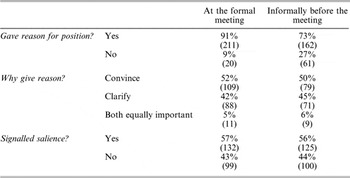
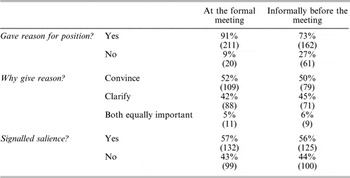
First, we can conclude that stating positions without backing them up with reasons is very uncommon: 91 per cent (211 out of 231) of the respondents claimed that they had explained at the meeting not only which position their country was holding, but also the reasons why they were holding this position (see Table 1). Apparently, negotiators who intervene at meetings to present their position almost always state some reasons as well. On the question concerning communications during the informal preparatory phase before the meeting, a large majority, 73 per cent of the respondents, indicated that they had been in contact with other delegates informally and had communicated their position and the reasons for their position.Footnote 47 Thus, if reason giving alone were taken as evidence of arguing, the Council would seem to be a truly deliberative institution.
Aggregate Levels of Giving Reasons and Signalling Salience
Note: N in parentheses.
But in order to say something about the levels of arguing and bargaining, we need to go one step further to look at the intentions behind the giving of reasons. What was the most important purpose of providing arguments – to clarify one’s own position in order to facilitate compromises or to try to convince others to change their minds about the merits of their position? Rows 3–5 of Table 1 gives the results, for both the formal meeting and the informal contacts before the meeting, for the large majority of respondents who did give reasons. In about half of the cases, both at the formal negotiation table and in the informal communications before the meeting, the respondents claimed that the main reason for backing up their position with arguments was to convince others of the merits of the stated position. Arguing is clearly an important mode of communication in the Council working groups. However, giving reasons mainly to clarify one’s own position in order to facilitate a compromise is also common. In 42 per cent of the cases, this was the most important intention behind giving reasons at the meeting.
The last two rows of Table 1 shows the share of respondents that communicated the importance of the issue for their country during and before the formal meeting. The majority of the respondents did signal the degree of salience, which is a prerequisite for making issue-linkages in a co-operative bargaining game. Comparing with the first column, however, where 91 per cent of the respondents provided reasons for their position, it is less common to communicate salience – 57 per cent did so at the meeting. Again, there is no difference here between the formal and the informal communications. Although not shown in Table 1, those interviewees who both communicated reasons in favour of their position and the importance of the issue for their country were also asked which of these two they considered most important. Reason giving was said to be most important by a clear majority – 58 per cent – while 30 per cent answered that signalling salience was most important and 12 per cent considered both as being equally important.
In sum, in about half of the cases where member state representatives intervened at a working group meeting, they argued in favour of their position, i.e. gave reasons with the intention of changing the minds of other actors. Reason giving is also more common and considered to be more important than communicating salience. Arguing, thus, is not a marginal phenomenon in the working groups of the Council of the European Union. At least quantitatively, it is a large part of what is going on when member state representatives talk to each other in and around meetings. However, in the next section we will see that arguing is more important in some circumstances than in others.
Under What Circumstances Is Arguing Most Common?
While the data do not allow for testing hypotheses on issue characteristic effects on the degree of arguing, some of the institutional factors raised in the literature can be addressed.
First, we have already seen (Table 1) that the formality of the working-group meetings does not seem to affect the degree of arguing. Giving reasons in order to convince others to change their minds about what they want is equally important at the formal meetings as in informal contacts before the meetings. Is this a surprise, given deliberative democratic theory’s expectations on publicity? Would we have expected more arguing at the more crowded formal meetings than in informal corridor negotiations? The increased publicity at the negotiation table compared to the informal communications should not be exaggerated in this case. There is no possibility of the general audience taking part of the discussions, other than asking for the edited minutes afterwards. The working-group meetings are still rather intimate sessions, including around thirty people, who probably have rather similar ideas on what constitutes appropriate behaviour at the meeting. Still, it is notable that the informal face-to-face pre-negotiations do not differ at all with respect to the level of arguing.
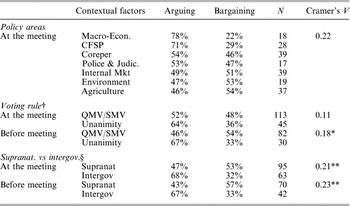
Table 2 presents a series of cross-tabulations analysing the differences in the levels of arguing and bargaining between different working groups. First, the variance between different policy areas is shown. The differences are considerable and it is in the more intergovernmental policy areas – in particular Macro-Economic Policy and the Common Foreign and Security Policy (CFSP) – where the most arguing is found. ‘Intergovernmental’ means that the representatives work under a unanimity requirement and/or that the outcome of the negotiations is ‘soft law’ rather than legally binding legislation. ‘First pillar’ issues (environment, agriculture, internal market issues), where the European Union takes binding legislative decisions with qualified majority voting (QMV), are more prone to bargaining. Although not shown in Table 2, the working group with the highest bargaining score of all is the higher level Special Committee on Agriculture, where 65 per cent of the respondents indicated that they gave reasons mainly to clarify their position.
Contextual Factors Affecting the Level of Arguing

Note: Based on the question concerning which motivation was most important for giving reasons: to clarify your own position (bargaining) or to make other delegates change their minds about their position (arguing)?
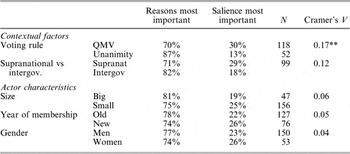
† Majority voting groups include the Economic Policy Committee (Simple Majority Voting (SMV)), and the Special Committee on Agriculture, the Working Party on Agricultural Questions, the Working Party on the Environment, the Working Party on Tax Questions and the Working Party on Competition and Growth (Qualified Majority Voting (QMV)). Groups where unanimity is required are the Political and Security Committee, the Article 36 Committee and the Politico-Military Working Party. Coreper is excluded here as they have both QMV and unanimity issues on their agenda.
§ Supranational groups are the same as QMV/SMV above, except for EPC which is now coded as intergovernmental. Again Coreper is excluded from this analysis.
*p < 0.10, *p < 0.05, ***p < 0.01.
Reshuffling the working groups into the binary categories of unanimity and majority voting, and supranational and intergovernmental procedures respectively, confirms that there is a clear difference with respect to the degree of arguing and bargaining under different procedures. Unanimity is associated with more arguing than majority voting. The difference is largest at the informal meetings, where 67 per cent of the respondents in working groups in which unanimity is the rule argue, while 46 per cent argue in the majority voting groups. Looking at the categories of supranational and intergovernmental procedures (which is the same as the voting rule categories except for one working group, the Economic Policy Committee – a soft law group, where simple majority voting (SMV) is possible) further enhances the difference.
Even though explicit voting is rare in the Council and the consensus norm is strong also in those areas where majority voting is possible, the shadow of the vote seems to affect the mode of communication, making arguing less likely. The difference is even larger when comparing supranational and intergovernmental policy areas. How can we explain this rather striking variance? The fact that the distinction between supranational and intergovernmental procedures is even more important than the voting rule is, in this case, an indicator that we should not only focus on the input procedures but also look at the degree of commitment which comes with the outcome. The key factor that explains these differences in the levels of arguing, I propose, is the degree of coercion and commitment involved. On the one hand, under intergovernmental procedures the representatives of member states are in control of the situation. They know that if things do not turn out the way they would prefer on an important issue, they can veto the decision or refuse to follow the non-binding guidelines. Under supranational procedures, on the other hand, the actor may be outvoted and tied to a legally binding text where the implementation is monitored by the Commission and the European Court of Justice. The pressure not to fail in the negotiations is higher in supranational policy fields. Under intergovernmental procedures, the negotiators can afford to argue.
Who Is Arguing?
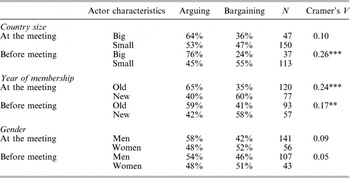
Table 3 shows the findings with respect to different actor characteristics. Given the high hopes of normative deliberative theory that decision making based on deliberation may counter-balance a biased distribution of traditional power resources, as all actors ideally are equally bound by the force of the better argument, the figures are rather remarkable.
Do Some Actors Argue More Than Others?

Note: Based on the question concerning which motivation was most important for giving reasons: to clarify your own position (bargaining) or to make other delegates change their minds about their position (arguing)?
*p < 0.10, **p > 0.05, ***p > 0.01.
Representatives of smaller – in practice, in the Council of the European Union this means less powerful – states argue considerably less often than bigger states. In particular before meetings, bigger states are much more focused on trying to convince others to change their minds than are smaller states. Furthermore, a clear difference is also found between new (post-2004) and old member states. Older member states – which in 2006 can be assumed to have been more well connected in the informal networks and more accustomed at how to ‘play the Brussels game’ – argue significantly more than the newcomers, both at the meetings and before meetings. Although not shown in the table the differences with respect to size and year of membership are stable also when controlling for the fact that nine out of ten new member states are small states (Poland being the exception). When looking only at small states, there is a clear difference between old and new member states, especially at the formal meetings (a statistically significant difference of 32 percentage points). When comparing big and small states among the old EU-15 members, the bigger states argue more than the smaller ones, in particular in the informal contacts before meetings (a difference of 23 percentage points, which is also statistically significant).
Table 3 also demonstrates that men argue more than women, especially at the formal meetings. The differences between the sexes are rather small and uncertain, however.Footnote 48
Big states, old EU members and – although to a lesser degree – men, argue the most. How can this paradoxical finding, from the point of view of normative deliberative democratic theory, be explained? In fact, it does seem to be compatible with the previously proposed explanation that arguing is more likely when actors are under less pressure. A privileged power position is likely to increase an actor’s sense of control of the decision making, thereby reducing the degree of pressure. The common conception of power in the European Union as given by asymmetric dependencies also implies that small actors usually have more to lose from non-agreements.Footnote 49 Furthermore, it is also reasonable to assume that self-confidence and belief in one’s persuasive power makes a rational actor more willing to engage in arguing. Arguing may be seen as a more worthwhile choice for powerful actors who know that others will listen carefully when they speak. Less powerful actors, by contrast, may suspect that others will not pay as much attention to their arguments, which makes it less meaningful to try to make others change their minds by means of giving good reasons.
Robustness Check: Signalling Salience
Although a less precise measure of arguing and bargaining, the comparison between signalling salience and giving reasons may be used as a robustness check of the previous findings. If the variation goes in the same direction as the findings concerning the motivations for giving reasons, we will be more confident with the results.
Table 4 indicates that the pattern is broadly the same, although the effects are generally smaller and more uncertain. Both unanimity voting and the broader category of intergovernmental procedures are associated with a decline in communicating salience and an increase in the importance of giving reasons. The differences between big and small states, new and old EU members and men and women all go in the same direction as in the previous analysis.
Contextual and Actor-based Variation concerning Importance of Giving Reasons compared to Signalling Salience

Note: Included are respondents who communicated reasons and/or the importance of the issue for their country. Those who did both were asked which they considered most important.
*p < 0.10, **p < 0.05, ***p < 0.01.
Overall, signalling salience is considered less important by all categories of actors. In fact, although not shown in the table, only in one working group – the Special Committee on Agriculture – does a majority of the respondents indicate that signalling salience is more important than giving reasons. As mentioned before, this is also the working group which has the lowest score on giving reasons with the purpose of changing each other’s minds. The well-established bargaining image of the European Union’s agricultural policy thus is confirmed in these results. This familiar finding also gives confidence in the validity of the empirical indicators used in this study.
Conclusions
If one were only to look at reason-giving and consensus-seeking behaviour, one would see a picture of the Council of Ministers almost totally dominated by arguing. In 91 per cent of the interventions at working-group meetings the member states’ representatives provided arguments in favour of their position. However, this article has argued that in order to distinguish between arguing and bargaining empirically, researchers need to study the purpose for giving reasons, as reason giving in itself may be compatible with both arguing and bargaining.
Even when specifying arguing as giving reasons with the intention of changing the minds of others concerning what is the best thing to do, the findings indicate that arguing is a common mode of communication in the Council working groups. Trying to convince others is more often the main intention behind giving reasons than is clarifying one’s position in order to facilitate a compromise. Communicating information on salience, which is the currency of package deals, is usually considered less important than giving reasons.
However, there are also substantial variations to the general picture, both between institutional settings and different types of actors, which may limit the overall significance of arguing. In this study, most arguing was found in intergovernmental policy areas and – remarkably, and in contrast to the hopes of normative theorists – by the most powerful and well-connected actors. The proposed explanation, which contains both a rational and a cognitive mechanism, is that actors are more likely to engage in arguing when the degree of political pressure is low. Increasing the seriousness of the issue by raising the degree of coercion and commitment and the risks involved in losing with respect to the outcome tends to pull actors towards a bargaining mode. It does so both by inducing actors to fix their preferences and by making them process information more narrowly. The findings fit with previous research showing that arguing is most important in pre-decision phases, before the deciding moment. The flipside of this is that arguing seems to be most common when it matters the least, i.e. when political stakes are low.