Introduction
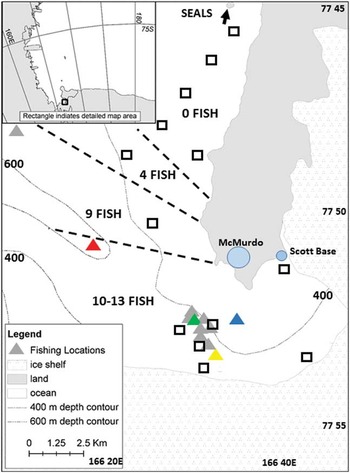
The ecology and natural history of the Antarctic toothfish (Dissostichus mawsoni Norman; hereafter, AnT) has been under investigation in McMurdo Sound and vicinity during the summer for the past 50 years of the modern era of Antarctic science. Information has been accumulated by direct observation of the fish by human divers, use of under-ice observation chambers or remotely operated vehicles (ROV; Kim et al. Reference Kim, Conlan, Malone and Lewis2005, Reference Kim, Ainley, Pennycook and Eastman2011 and references therein, Ponganis & Stockard Reference Ponganis and Stockard2007), observations of Weddell seals (Leptonychotes weddellii Lesson) catching the fish (Ainley & Siniff Reference Ainley and Siniff2009 and references therein), or by the classical means of baited hook and line (Ainley et al. Reference Ainley, Nur, Eastman, Ballard, Parkinson, Evans and DeVries2013, Cziko et al. Reference Cziko, DeVries, Evans and Cheng2014, Parker et al. Reference Parker, Mormede, DeVries, Hanchet and Eisert2016, unpublished data, P. Cziko, personal communication 2016). In regard to the hook and line method, it was found early in the period that if a fish was hooked by gear deployed on the bottom or within ~10 m of the bottom, and if the fish was not retrieved in a timely manner, i.e.<24 h soak time, it would be attacked and consumed by scavenging amphipods (DeVries In Ainley et al. Reference Ainley, Nur, Eastman, Ballard, Parkinson, Evans and DeVries2013). Therefore, what we here call the ‘DeVries fishing array’ was perfected to catch AnT for study (or tag and release) without being scavenged. In this approach, a vertical set line was deployed through a hole drilled through the McMurdo Sound fast ice and ‘15–20 hooks were spaced 3–5 m apart, starting 10 m from the bottom, thus sampling the lower ~100 m of water column’ but not the bottom (Ainley et al. Reference Ainley, Nur, Eastman, Ballard, Parkinson, Evans and DeVries2013, p. 346; see Fig. 1).
Updated from Ainley et al. (Reference Ainley, Nur, Eastman, Ballard, Parkinson, Evans and DeVries2013), approximate sites of scientific fishing. Squares are those of Testa et al. (Reference Testa, Sinniff, Ross and Winter1985), with average catch per set within the areas bounded by dashed lines. Triangles by colour: grey=sites of DeVries 1972–2011 (site clusters 1 and 2), green=Cziko et al. (Reference Cziko, DeVries, Evans and Cheng2014) 2012, and Parker et al. (Reference Parker, Mormede, DeVries, Hanchet and Eisert2016): blue=no fish caught, yellow=four fish caught and red=19 fish caught. During the fishing season, Weddell seals concentrate from Turtle Rock (arrow) northward, with a few near Scott Base. McMurdo Ice Shelf only approximate, as edge changes regularly.

The picture of AnT prevalence that emerged from this long history of research, in our opinion, was that, at least under heavy ice cover, the species existed as a ‘cloud’ of fish (AnT are not schooling). The cloud can extend upward from the bottom, generally ~100 m thick, although at times, especially during that part of the day when summer sunlight was diminished, it can reach within 12 m of the surface, even where the bottom depth is >500 m (Fuiman et al. Reference Fuiman, Davis and Williams2002). In times of brighter light levels, the top of the AnT cloud can descend deeper, as indicated by the observation that seals had to dive to 300 m from the surface to find them (Fuiman et al. Reference Fuiman, Davis and Williams2002). Large AnT can move in the water column without undue swimming effort because once they begin to accumulate significant lipid in their tissues, generally upon surpassing ~100 cm in total length (TL), they become increasingly neutrally buoyant (Near et al. Reference Near, Russo, Jones and DeVries2003). Smaller AnT generally remain close to or on the substrate hiding among the forest of sessile invertebrates there (e.g. Eastman & Barry Reference Eastman and Barry2002, Eastman et al. Reference Eastman, Amsler, Aronson, Thatje, McClintock, Vos, Kaeli, Singh and La Mesa2013 fig. 1e). As of yet, it is not known what proportion of AnT exist at any given time in the cloud or on the bottom or how long their residence time in it might be, though the age-size-condition structure of the AnT in the cloud, and the availability of prey, would be involved in that determination. At depths above the bottom, i.e. in the water column, AnT in the cloud would be pursuing their principal, energetically valuable prey, the Antarctic silverfish (Pleuragramma antarctica Boulenger; Eastman Reference Eastman1985a, Reference Eastman1985b, La Mesa et al. Reference La Mesa, Eastman and Vacchi2004, Lenky et al. Reference Lenky, Eisert, Oftedal and Metcalf2012), which also exhibits a diel vertical migration (Fuiman et al. Reference Fuiman, Davis and Williams2002, Robison Reference Robison2003, O’Driscoll et al. Reference O’Driscoll, Macaulay, Gauthier, Pinkerton and Hanchet2011). Otherwise, available evidence suggests that a major factor that can affect AnT distribution in the water column, besides buoyancy and prey pursuit, is predation, especially by Weddell seals (Ainley & Siniff Reference Ainley and Siniff2009). This is shown by past research results indicating toothfish presence as long as vertical set lines were deployed where the bottom was >300 m and not within foraging range of a high concentration of Weddell seals (Testa et al. Reference Testa, Sinniff, Ross and Winter1985, who fished using the DeVries array at 17 fishing holes spaced around south-eastern McMurdo Sound; Fig. 1). However, changes in these patterns occurred in c. 2000 (Ainley et al. Reference Ainley, Nur, Eastman, Ballard, Parkinson, Evans and DeVries2013), and herein we discuss this change.
A recently published paper, titled ‘Have Antarctic toothfish returned to McMurdo Sound?’ (Parker et al. Reference Parker, Mormede, DeVries, Hanchet and Eisert2016), reported results of a pilot study on AnT. This paper, based on using the DeVries array at three sites, reported 23 AnT caught (bottom depths >500 m at the two sites where fish were caught; Fig. 1) during 11 days in November 2014 (hereafter, ‘Parker dataset’). Also included in this report were results of a vessel-based survey using benthic longlines deployed at similar or deeper depths in northern McMurdo Sound. The paper by Parker et al. (Reference Parker, Mormede, DeVries, Hanchet and Eisert2016) was written as a comment on conclusions drawn from analysis of a 39-year time series of mark–recapture fishing in southern McMurdo Sound (Fig. 1), using the DeVries array, where >5500 fish were caught in October–December 1972–2011 at a closely spaced cluster of sites where bottom depths were <500 m (‘DeVries dataset’, Ainley et al. Reference Ainley, Nur, Eastman, Ballard, Parkinson, Evans and DeVries2013). Additional effort has been expended since then at the same site (Cziko et al. Reference Cziko, DeVries, Evans and Cheng2014; Fig. 1). In the DeVries dataset, TL, abundance (as assessed by catch-per-unit effort (CPUE)), and body condition of fish caught showed a marked decrease, beginning in the late 1990s for condition and after 2001 for CPUE, reflecting fewer large, neutrally buoyant fish in the water column at the depths fished. In the absence of any detectable relationships of CPUE variability to environmental factors, Ainley et al. (Reference Ainley, Nur, Eastman, Ballard, Parkinson, Evans and DeVries2013) hypothesized that the recent trends in the DeVries catch might have been related to a commercial AnT fishery that had been initiated in the Ross Sea in 1997, reaching maximum landings by 2004. The fishery, which has targeted the largest fish, mostly occurs along the Ross Sea continental slope but has spent appreciable effort as well in waters immediately bordering McMurdo Sound, at least since 2004. For example, while perhaps not representing the entire catch, depending on year, there were 1000–7000 fish, from 26–206 hauls in Food and Agriculture Organization Areas 88.1 J and L, that were measured to characterize the fishery, as well as additional catch (3000–6000 fish sampled) in Area 88.1 M, fished through 2008 (SC-CAMLR 2013, p. 6). The latter area includes McMurdo Sound.
Findings from the DeVries dataset were presented to the Commission for the Conservation of Antarctic Marine Living Resources (CCAMLR) Working Group on Fish Stock Assessment (WG-FSA) in 2012 (Ainley et al. Reference Ainley, Nur, Eastman, Ballard, Parkinson, Evans and DeVries2012). The WG-FSA concluded, and Parker et al. (Reference Parker, Mormede, DeVries, Hanchet and Eisert2016) agreed, that the fishery could not be involved in affecting the McMurdo Sound trends, but surmised that the patterns evident in the DeVries dataset were the result of temporary environmental factors. Despite a further WG-FSA conclusion that the DeVries dataset, owing to its small spatial scale, could not have reflected the overall state of the toothfish stock in Area 88.1 (SC-CAMLR 2012, p. 318), this group subsequently reported that recent trends in the commercial catch regarding AnT body condition, as measured by Fulton’s Condition Index (K; Nash et al. Reference Nash, Valencia and Geffen2006), matched trends in the DeVries dataset (p. 318, 346). Moreover, as WG-FSA subsequently noted, consistent with later trends in the DeVries dataset, that the modal length of toothfish caught in the major fishing grounds (Ross Sea slope) has shown a marked decrease in large fish (SC-CAMLR 2013, p. 5–6).
However, there are issues regarding Fulton’s Condition Index. In particular, when comparing individual fish, there is a potential for its values to be confounded by gender and breeding status. If the changes in K were affected by a shift in sex ratio in the two datasets (e.g. Blackwell et al. Reference Blackwell, Brown and Willis2000), then using K would not be appropriate as an assessment of condition. If sex ratio and breeding status differed over time, the change in K in McMurdo Sound fish might well reflect the recent decreased prevalence of female toothfish in the stock (as judged from fishery catch; SC-CAMLR 2014, p. 19–20). However, Fenaughty (Reference Fenaughty2006) showed no significant difference of K between sexes of fish sampled in the southern Ross Sea region (south of 70°S), and concluded that K was thus an appropriate metric to measure toothfish condition among fish over the shelf and slope. Indeed, the fish in Fenaughty’s sample were mostly not reproductively active, similar to fish caught in McMurdo Sound (Ainley et al. Reference Ainley, Nur, Eastman, Ballard, Parkinson, Evans and DeVries2013, Parker et al. Reference Parker, Mormede, DeVries, Hanchet and Eisert2016; see also Eastman & DeVries Reference Eastman and DeVries2000). Therefore, no gender-based differences in fish shape would alter K of Ross Sea shelf-caught fish, as confirmed by Fenaughty et al. (Reference Fenaughty, Eastman and Sidell2008).
While we agree with Parker et al. (Reference Parker, Mormede, DeVries, Hanchet and Eisert2016) that it is scientifically valuable to monitor AnT prevalence in McMurdo Sound using the single-site for a long-term set line effort (but see Discussion), or better some sort of stratified sampling of multiple sites, we have some concerns about the conclusions reached by Parker et al.: i) the implication that AnT had earlier left McMurdo Sound, as implied by the title of the paper and their fig. 3, and ii) their agreement with WG-FSA (SC-CAMLR 2012, p. 319) that later trends in the DeVries dataset may have been the result of temporary alteration of McMurdo Sound hydrography and sea ice owing to the presence, 2001–05, of mega-icebergs in place against the opposite, north-eastern shore of Ross Island. Given restrictions against our attendance at WG-FSA proceedings to argue against the mega-iceberg hypothesis, we here do so in Antarctic Science, appreciating the open discussion allowing additional facts and viewpoints to be presented.
Review of evidence
Parker et al. (Reference Parker, Mormede, DeVries, Hanchet and Eisert2016) suggest that the pattern shown in Ainley et al. (Reference Ainley, Nur, Eastman, Ballard, Parkinson, Evans and DeVries2013) for AnT in McMurdo Sound may have been the consequence of the temporary presence of mega-icebergs that caused shifts in environmental conditions resulting in an absence of AnT in the region. Contrary to implications of the title (and abstract) of Parker et al., neither Ainley et al. (Reference Ainley, Nur, Eastman, Ballard, Parkinson, Evans and DeVries2012, Reference Ainley, Nur, Eastman, Ballard, Parkinson, Evans and DeVries2013) nor other researchers with datasets from the vicinity have reported an absence, other than that of large AnT, in McMurdo Sound. Indeed, after CPUE decreased towards the end of the DeVries dataset, observations of Weddell seals taking small AnT continued (e.g. Ponganis & Stockard Reference Ponganis and Stockard2007, Kim et al. Reference Kim, Conlan, Malone and Lewis2005, Reference Kim, Ainley, Pennycook and Eastman2011) and AnT continued to be caught by scientists, especially using benthic gear (Cziko et al. Reference Cziko, DeVries, Evans and Cheng2014 and P. Cziko, personal communication 2016, also see http://antarcticsun.usap.gov/science/contentHandler.cfm?id=2866). Results presented in SC-CAMLR (2014) do not show a disappearance in numbers or shift in mean CPUE in the fishery, but rather a change in the modal size and condition of the fish caught. In accordance with effects observed elsewhere in the Ross Sea, we therefore contend that what has changed in McMurdo Sound is not the presence of AnT per se but the prevalence of large, neutrally buoyant fish and changes in where these can now be found (Figs 1 & 2).
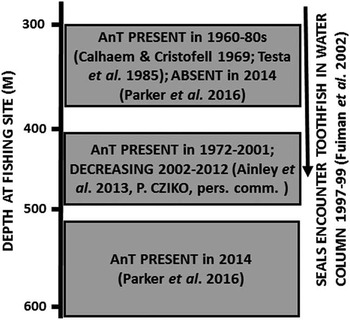
Schematic summarizing results of research on prevalence of Antarctic toothfish (AnT) by depth of fishing site in McMurdo Sound (see Fig. 1); for comparison, the arrow indicates the depth range in the water column of toothfish and silverfish, as encountered by Weddell seals fitted with critter-cams, 1997–99, prior to the decreased fish prevalence noted in Ainley et al. (Reference Ainley, Nur, Eastman, Ballard, Parkinson, Evans and DeVries2013; arrow indicates the maximum depth of the seal diving), at a study site where bottom depth was 570 m and toothfish were observed within 12 m of the surface (Fuiman et al. Reference Fuiman, Davis and Williams2002).

What has changed is that the AnT cloud, which once ascended the McMurdo Sound slopes from its maximum depths of >700 m, apparently no longer does so above ~500 m, although small, negatively buoyant fish are still found on the bottom at shallower depths. The DeVries study, fished at sites where bottom depths were 415–495 m (also Cziko et al. Reference Cziko, DeVries, Evans and Cheng2014 and P. Cziko, personal communication 2016; Fig. 1), provides values of fish size and condition at that depth. The Parker dataset also originates predominantly from a vertical set line, with the exception of two sets using horizontal line. It was fished at sites at which bottom depths either were appreciably shallower or deeper than the DeVries effort (see Figs 1 & 2): 324 m (site 1), 505 m (site 2) or 607 m (site 3). In both datasets, the fish were caught on those hooks that were in the lower ~100 m of the line. This mismatch in bottom depth at the sites fished is critical, and should be understood within the context of the AnT cloud. That is, in order to properly understand the results of Parker et al. (their fig. 3), the size and condition of the AnT caught should be evaluated against some expectation of where DeVries’ fishing (and also that of Testa et al. Reference Testa, Sinniff, Ross and Winter1985), as well as Fuiman’s seals, found them in earlier years, and what condition they could be expected to have attained given their length. However, they report no catch at the shallower site (though Testa et al. Reference Testa, Sinniff, Ross and Winter1985, and seals, had found them at sites having such depths in early years; see Figs 1 & 2), and the fish caught at the deeper sites, though in the water column, were deeper than those caught in the DeVries effort.
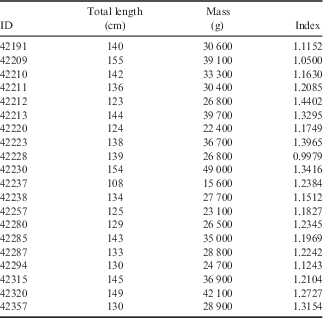
We contend that the results of Parker et al. support the hypothesis presented in Ainley et al. (Reference Ainley, Nur, Eastman, Ballard, Parkinson, Evans and DeVries2013) that the fishery may be affecting the distribution and abundance of large, neutrally buoyant fish in McMurdo Sound, in accord with the changes in fish size shown by SC-CAMLR (2014). Any impacts of the fishery will be evident when contrasted against the expectations resulting from the above-mentioned factors driving habitat selection by the large AnT. Individual vessels target the habitat in which the largest fish occur in order to quickly fill their holds before sea ice formation or attainment of the Total Allowable Catch closes the fishery season. The selective removal of large fish by the fishery would result in a reduction of the neutrally buoyant fish capable of moving throughout the water column, which is the trend detected in the DeVries dataset (cf. Fuiman et al. Reference Fuiman, Davis and Williams2002). The fish in the Parker dataset were all >100 cm TL, but caught only at depths greater than those of the DeVries dataset, and their body condition index, K (mean 1.218±0.0239 standard error (SE), range 0.999–1.444, 5%>1.4), was at the lower end of the range in the DeVries catch (mean 1.267±0.0020 SE, range 0.578–2.992, 15%>1.4; Table I). We deem this worthy of noting, as well as recognizing that differences in sample size could be playing a role. That being said, most of the AnT stomachs reported in Parker et al. were empty, consistent with the fishes’ lower condition, their stomach fullness being quite unlike AnT caught higher in the water column in former years (see Eastman Reference Eastman1985a, Reference Eastman1985b).
Details of the fish caught by Parker et al. (Reference Parker, Mormede, DeVries, Hanchet and Eisert2016) in McMurdo Sound during spring 2014, including calculation of the Fulton Fish Condition Index (K) (see Fenaughty Reference Fenaughty2006, Fenaughty et al. Reference Fenaughty, Eastman and Sidell2008).

Alternative explanations
How may we answer Parker et al.’s (2016) question contained in their title? WG-FSA has maintained that the commercial fishery was not involved, in part arguing that it has been too geographically distant to be generating the trends reported in the DeVries dataset (SC-CAMLR 2012, 319). Instead, WG-FSA surmised that environmental conditions brought about by the mega-icebergs were responsible. Parker et al. (Reference Parker, Mormede, DeVries, Hanchet and Eisert2016) considered the WG-FSA position, and in accord with their title, offered reasons why AnT may indeed have ‘returned’. We review here counter arguments to the WG-FSA/Parker et al. (Reference Parker, Mormede, DeVries, Hanchet and Eisert2016) positions, noting as explained above that AnT never left McMurdo Sound, though large ones that occupied the cloud above the bottom became less prevalent.
First, regarding the contention of the remoteness of the fishery in relation to DeVries fishing sites in the vicinity of Ross Island
This, we maintain, is without basis since AnT have been fished commercially in waters immediately adjacent to Ross Island from the fishery’s inception (e.g. SC-CAMLR 2012, p. 347; see above), and various WG-FSA studies have also shown movement of tagged fish between the shelf and slope (the main area of the fishery).
Second, regarding the contention that mega-icebergs in 2001–05 discouraged movement of Antarctic toothfish into McMurdo Sound
The icebergs had a draft of ~250 m, and, as they were perched on a pinnacle of the Beaufort Caldera, there was >500 m of water beneath them in which AnT could have moved (see MacAyeal et al. Reference MacAyeal, Okal, Thom, Brunt, Kim and Bliss2008). Significantly, Kim et al. (Reference Kim, Ainley, Pennycook and Eastman2011), using video from a ROV, reported AnT beneath the McMurdo Ice Shelf (ice shelves being the source of mega-icebergs in the Ross Sea) 35 km in from the ice shelf edge.
Third, regarding the contention that mega-icebergs altered the hydrography in such a way as to discourage Antarctic toothfish from entering McMurdo Sound
Parker et al. (Reference Parker, Mormede, DeVries, Hanchet and Eisert2016), and WG-FSA earlier, relied on the relevant and timely study by Robinson & Williams (Reference Robinson and Williams2012), who reported the disruption of surface circulation in McMurdo Sound during the icebergs’ presence, adjacent to the north-east coast of Ross Island. However, with bottom depths up to 1000 m and iceberg draft only ~250 m, the icebergs would not have presented a significant barrier and any facilitation of AnT movement by subsurface current flow (used to some degree by AnT; Hanchet et al. Reference Hanchet, Rickard, Fenaughty, Dunn and Williams2008) would not have been seriously compromised. Moreover, Robinson & Williams (Reference Robinson and Williams2012) only investigated hydrography in the eastern third of McMurdo Sound, but not the mixed circulation of the middle Sound nor the opposing circulation in the west that emanates from beneath the McMurdo Ice Shelf (Barry & Dayton Reference Barry and Dayton1988). In these western waters, AnT have been observed recently (Kim et al. Reference Kim, Ainley, Pennycook and Eastman2011 and references therein).
Fourth, regarding the contention that extensive sea ice reduced sunlight during some years in the 2001–05 period, lowering primary production sufficiently to reduce availability of Antarctic toothfish prey
Such speculation assumes carry-over effects into 2011 (and 2012, when P. Cziko (personal communication 2016) reported continued low water column AnT CPUE at sites where bottom depths were <500 m). Note that the microbial community of the sea ice contributes only ~12% of productivity (Saenz & Arrigo Reference Saenz and Arrigo2014), with the remainder advected in from the Ross Sea (Barry & Dayton Reference Barry and Dayton1988). Therefore, changes in food web structure owing to reducing primary productivity within the sea ice microbial community in McMurdo Sound would have had little effect on the water column food web. Moreover, Dugger et al. (Reference Dugger, Ballard, Ainley, Lyver and Schine2014) found that variable productivity in the southern Ross Sea (which includes McMurdo Sound) during the iceberg presence did not affect the breeding success of a trophic competitor of AnT, the Adélie penguin (Pygoscelis adeliae Hombron & Jacquinot). The penguins continued to forage intensively on silverfish, diving typically to depths of 50–80 m in pursuit (see Ainley et al. Reference Ainley, Ballard, Jones, Jongsomjit, Pierce, Smith and Veloz2015b, Saenz et al., personal communication 2015 for foraging studies in McMurdo Sound). In addition, the breeding populations of this penguin species in and bordering McMurdo Sound grew immensely during the iceberg presence (with the exception of the tiny and regularly ice-bound Cape Royds colony; Lyver et al. Reference Lyver, Barron, Barton, Ainley, Pollard, Gordon, McNeill, Ballard and Wilson2014), indicating no food limitation. Other research has indicated that euphausiids and Antarctic silverfish (the shared penguin/AnT prey; cf. Eastman Reference Eastman1985a, Reference Eastman1985b, Ainley et al. Reference Ainley, Ballard, Barton, Karl, Rau, Ribic and Wilson2003) in the southern Ross Sea are not closely coupled with phytoplankton abundance (cf. Smith et al. Reference Smith, Ainley, Arrigo and Dinniman2014, Ainley et al. Reference Ainley, Ballard, Jones, Jongsomjit, Pierce, Smith and Veloz2015b).
Our interpretation of factors affecting changed Antarctic toothfish prevalence
In contrast to Parker et al. (Reference Parker, Mormede, DeVries, Hanchet and Eisert2016) following on from WG-FSA, we hypothesize that predator effects (including that of humans) may be an important factor in the observed trends in AnT prevalence, i.e. the recession in depth of the top of the AnT cloud. Within McMurdo Sound and adjacent habitat under ice shelves (Kim et al. Reference Kim, Ainley, Pennycook and Eastman2011), if the upper water column prevalence of the AnT has been reduced by commercial fishing pressure (targeting the larger fish), this would facilitate the possibility that the area’s high concentrations of AnT predators, killer whales (Orcinus orca L.) and Weddell seals, could contribute to altering AnT prevalence further (within the diving range of these mammals). Owing to the large size and energy density of toothfish (Lenky et al. Reference Lenky, Eisert, Oftedal and Metcalf2012), they are sought by these predators, and fewer AnT might well increase interspecific competition for them, thus decreasing prevalence in easier-to-reach depths. This hypothesis is supported by the observation that depths >500 m (Fig. 2; the part of the water column to which AnT appear to be currently relegated) are below the usual maximum diving depth of fish-eating killer whales (Reisinger et al. Reference Reisinger, Keith, Andrews and de Bruyn2015; although they very occasionally reach 700 m in McMurdo Sound (R. Pitman, personal communication 2015)). The depth of 500 m is below the usual Weddell seal diving range as well, with deeper dives testing breath-holding capacity and reducing the seals’ prey searching ability within respective dives (as well as those of the killer whales), thus increasing foraging effort (Castellini et al. Reference Castellini, Davis and Kooyman1992). Notably, while there is evidence that Antarctic silverfish depth distribution includes the benthopelagic realm (Causse et al. Reference Causse, Ozouf-Costaz, Koubbi, Lamy, Eléaume, Dettaï, Duhamel, Busson, Pruvost, Post, Beaman and Riddle2011, Hanchet et al. Reference Hanchet, Stewart, McMillan, Clark, O’Driscoll and Stevenson2013), a depth of ≥ 500 m is also below the usual depth of these fish (<400 m; Fuiman et al. Reference Fuiman, Davis and Williams2002, O’Driscoll et al. Reference O’Driscoll, Macaulay, Gauthier, Pinkerton and Hanchet2011; see Fig. 2), which are the main prey of AnT (and the shallow-diving Adélie penguins) in McMurdo Sound. Having to feed on less energy-rich prey, perhaps helps to explain the poor condition of the fish caught by Parker et al.
It is not unusual for notothenioid fish to change their use of space as a strategy to reduce predation risk from mammal predators, even if it means occupying waters having lower food availability (Everson Reference Everson1970). In contrast to conjecture by WG-FSA and Parker et al. (Reference Parker, Mormede, DeVries, Hanchet and Eisert2016), we note that the extensive fast ice and pack ice in McMurdo Sound during the icebergs’ presence (see MacAyeal et al. Reference MacAyeal, Okal, Thom, Brunt, Kim and Bliss2008) protected AnT from predation, by restricting access by air-breathing predators, rather than contributing to their disappearance (a possibility noted also by Buckley Reference Buckley2013). It might well be that the fish found by Parker et al. (Reference Parker, Mormede, DeVries, Hanchet and Eisert2016), to reduce predation risk, had become confined to the deep bottom depressions, in one of which those researchers fished (Fig. 1). Indeed, Weddell seal numbers were lower in McMurdo Sound during the mega-iceberg years (2001–05), and only since 2010 has the abundance of Weddell seals that occupy southern McMurdo Sound during spring recovered from their slaughter for dog food in the 1950–80s (>2200 seals were taken from southern McMurdo Sound; Ainley et al. Reference Ainley, LaRue, Stirling, Stammerjohn and Siniff2015a). It is possible that this recovery has contributed to the AnT trends evident during spring in McMurdo Sound, i.e. the disappearance of large AnT at shallower depths in the water column. Even when seal populations were low in the early 1980s, Testa et al. (Reference Testa, Sinniff, Ross and Winter1985) showed not only that AnT prevalence is greatly reduced where seals are concentrated, but also that once the seals began to disperse from pupping/breeding areas following pup weaning, the prevalence of AnT began to decrease farther away from the breeding haul-out location.
Much remains unknown about the life cycle of the AnT. If we were starting over with the 40-year time series, for the purpose of monitoring the fishery, we would implement a more sophisticated randomized sampling design over a wider geographical region and at a range in depth, as this would probably lead to more robust findings. In the meantime, we have tried to give an unbiased interpretation of the data that are currently available.
Acknowledgements
Thanks to Paul Cziko for sharing his data and comments, and to Robert Pitman for sharing his and John Durban’s killer whale foraging data. Comments by Mario La Mesa, two anonymous reviewers and the Editor, David Walton, improved our presentation immensely. DGA and GB time in preparing this paper was supported by National Science Foundation grants ANT-0944411 and -0944141.
Author contribution
All authors participated fully in the writing and subsequent re-writing of this paper.