Equifinality in Faunal Analysis
Distinguishing different kinds of archaeological deposits is not simply a classification issue. Due to the importance of feasting and sacrifice, and their implications in cultural historical and processual interpretation, it is important to classify faunal assemblages in a rigorous manner and identify the behaviors that led to the creation of a collection. Frequently, archaeologists face issues of equifinality. For instance, Rowley-Conwy (Reference Rowley-Conwy2018) argues that we are actually not very good at distinguishing feasting from other types of high-status behaviors in the archaeological record, noting the tendency for archaeologists to categorize unusual deposits as ritual. When different behaviors result in similar faunal assemblages, it hinders our use of these data for anthropological research.
Equifinality was first defined by Ludwig von Bertalanffy (Reference von Bertalanffy1949:157) as reaching the “same final state from different initial states” within an open system, and the concept has been commonly used in zooarchaeological taphonomic literature since the 1980s (Gifford-Gonzalez Reference Gifford-Gonzalez1991; Lyman Reference Lyman1994, Reference Lyman2004:15). Rogers (Reference Rogers2000:721) argues that, by definition, equifinality exists only when the outcomes of two processes are identical, whereas archaeologists use it to describe outcomes that are “merely similar” enough that they are difficult to distinguish using statistical methods. The risk of redefining equifinality in the latter way, Rogers contends, is that citing equifinality as an analytical difficulty distracts from the need for improved statistical methods in taphonomic research. In contrast, Lyman (Reference Lyman2004:22–23) maintains that recognizing the problem of equifinality has motivated taphonomists to develop new analytical methods.
This article takes up Lyman's challenge by developing a new method for analyzing equifinal and indeterminate assemblages in Andean zooarchaeology. To interpret the formation processes of any assemblage, archaeologists make probabilistic inferences based on their observations (Sullivan Reference Sullivan and Schiffer1978). The model I present here allows faunal analysts to make the relative probabilities of different interpretations explicit and replicable.
Andean zooarchaeology is particularly susceptible to equifinal archaeological collections. Although the region is ecologically varied, a handful of species dominate the archaeological record (deFrance Reference deFrance, Arbuckle and McCarty2014; Rosenfeld Reference Rosenfeld2012). Guinea pigs and camelids are ubiquitous: they have played major roles in the social, economic, and ritual realms of many societies over millennia (Bonavia Reference Bonavia2008; Capriles and Tripcevich Reference Capriles and Tripcevich2016; Mengoni Goñalons Reference Mengoni Goñalons2008; Rofes and Wheeler Reference Rofes and Wheeler2003; Sandweiss and Wing Reference Sandweiss and Wing1997). Llamas and alpacas, for instance, were meat sources and the most commonly sacrificed species. Llamas were also pack animals, and alpacas provided wool. Unfortunately, faunal analysts struggle to distinguish the two based on skeletal remains (Bonavia Reference Bonavia2008:81; Pacheco Torres et al. Reference Pacheco Torres, Altamirano Enciso, Guerra Porras and Sandefur1986), and there is no fully reliable method for estimating a skeletonized camelid's sex (Bonavia Reference Bonavia2008:141; Kent Reference Kent1982:1964; Wheeler Reference Wheeler1982). In short, many criteria used to select animals for sacrifice or consumption are archaeologically inaccessible. Without reliable identification of the activities and processes that contribute to the formation of archaeological assemblages, including the behaviors and selection process that led to specific animal remains being included in the site, it becomes more difficult to categorize faunal assemblages. This in turn prevents archaeological assemblages from being used to address anthropological questions.
To address the issue of ambiguity and equifinality in Andean faunal collections, I created a Bayesian network model. This model assesses the relative probability of three hypothesized assemblage types – feasting, sacrifice, and quotidian refuse – and their depositional processes, matching an observed archaeological faunal collection. I then tested the model using five specifically constructed test datasets and five archaeological cases. Using a Bayesian model enables the analysis of complex, multivariate assemblages using a rigorous and replicable methodology.
Bayesian Network Models
Bayes’ theorem is a mathematical equation named for the eighteenth-century English statistician Rev. Thomas Bayes. It is expressed mathematically using the equation
 $$p(h \vert e) = \displaystyle{{P(e,h)p(h)} \over {\,p(e)}},$$
where p(h), p(e) > 0. Howson and Urbach (Reference Howson and Urbach1993:28) explain the theorem as follows:
[We] use the letters h and e, standing for hypothesis and evidence. This form of Bayes’ Theorem states that the probability of the hypothesis conditional on the evidence (or the posterior probability of the hypothesis) is equal to the probability of the data conditional on the hypothesis (or the likelihood of the hypothesis) times the probability (the so-called prior probability) of the hypothesis, all divided by the probability of the data.
Bayesian models update the probability of a hypothesis based on all observations. A Bayesian analysis considers all observations to produce the final likelihoods associated with each hypothesis, making the confidence in it explicit.
There are considerable advantages to using Bayesian models in archaeology. First, they allow us to take qualitative observations and make quantitative statements of probability. Bayesian analysis is an additive process, so the posterior probability is calculated in light of all observations and cannot be overly determined by one variable. Bayesian modeling also allows the researcher to observe how incorporating new data affects the overall likelihood of different hypotheses. Finally, if a particular variable in the model is unobserved, the assemblage can still be analyzed; missing data do not preclude calculating posterior probabilities, although observations that use the full suite of variables produce more definitive results.
Crafting a Bayesian Model
The first step was to define modal faunal assemblage types that could be identified at Andean archaeological sites. Each of the three types – sacrifices, feasts, and quotidian refuse – was defined to encompass a diverse array of prehispanic activities. These types served as hypotheses in the model.
Next, I established the prior probabilities, which express the relative likelihoods of the hypothesized assemblages corresponding to an unknown faunal assemblage given no prior knowledge of that assemblage. There are a number of ways to assign prior probabilities in Bayesian statistics (Howson and Urbach Reference Howson and Urbach1993); I used the principle of indifference, which assigns equal probability to all possible outcomes. The reason for this choice is that the frequency of each assemblage type in the archaeological record is an unreliable basis for defining prior probabilities; archaeologists are often biased in their choices (e.g., excavating certain kinds of deposits more than others), making it difficult to assess the true archaeological frequency of each assemblage type. Using the principle of indifference is considered weaker Bayesianism, but mathematically, prior probabilities do not exert a controlling effect on the final posterior probability (Howson and Urbach Reference Howson and Urbach1993:354).
I then selected the key variables and defined the conditional probabilities for each relative to the three hypothesized outcomes. The method for determining initial conditional probabilities is demonstrated in Supplemental Tables 1–3 using the variable “articulation.” For each variable, a table was created that reflected the variable's possible states in relation to the assemblage types and described the likelihood of each state (Supplemental Table 1). These descriptions were converted to an ordinal scale reflecting likelihood, ranging from very unlikely (1) to very likely (9), in Supplemental Table 2. These likelihoods were derived from ethnohistoric documents, ethnographic literature, archaeological data, and anthropological theory. The sum of all scaled values per assemblage type was then calculated, and each scaled value was divided by this sum, producing the conditional probabilities for the variable (Supplemental Table 3).
Finally, the prior probabilities and conditional probability tables were used to construct the model in the Bayesian network software Netica (Norsys Software Reference Software2017). Each variable is represented in the software by a node; conditional probability tables describe the relationship between assemblage types and the possible observations for the variables.
Figure 1 presents the assemblage type and articulation node after their relationship was defined using the conditional probabilities from Supplemental Table 3. Initially, no observation was made, so the assemblage type probabilities remained equal. In Figure 2, the articulation was set to “extensive disarticulation,” and the assemblage type probabilities were recalculated to reflect this observation. After only one observation, the probability that the assemblage was quotidian refuse increased substantially. As additional observations were made, the posterior probabilities became more refined.
Network nodes for assemblage type and articulation with no observations supplied.

Network nodes for assemblage type and articulation with the observed articulation state set to “extensive disarticulation.” The assemblage type probabilities changed to reflect this observation.

Faunal Assemblage Categories
The ways that ancient Andean peoples used animals varied across space and time, although Andeanists recognize the significant overlap between feasting, sacrifice, and daily life. Ethnohistoric and ethnographic sources demonstrate that animal slaughter is often a sacred ritual, whether the slaughter is for sacrifice or human consumption (Dransart Reference Dransart2002; Flannery et al. Reference Flannery, Marcus and Reynolds1989; Miller Reference Miller1979:35). Indeed, camelids sacrificed in sacred events are often subsequently disarticulated and consumed in a feast (Arriaga Reference Arriaga and Keating1968[1621]:24; Dransart Reference Dransart2002:86; Miller Reference Miller1979:91). Nevertheless, these are discrete classifications for our purposes because they describe not only the ritual of sacrifice but also the entire suite of behaviors surrounding the animal's death and deposition in the archaeological record.
Feasting Refuse
Feasting, “ritual activity that involve[s] the communal consumption of food and drink” (Dietler Reference Dietler, Dietler and Hayden2001:65), plays a substantial role in producing and sustaining critical social relationships (Hayden Reference Hayden, Dietler and Hayden2001:30). In the Andes, feasting played a role in ritual, social, and political life. Prehispanic feasts were employed for labor mobilization, wealth display, reification of asymmetrical relationships, honoring the dead, regeneration, and fertility rituals (Rosenfeld Reference Rosenfeld2012:134).
Feasting refuse frequently consists of prime-age individuals, particularly when the feast has high-status sponsors who could afford losing an animal that has economic value. Bones likely display butchering marks (see Miller Reference Miller1979), and the animal is disarticulated; however, partial articulation, including complete limbs, may be observed because conspicuous waste is sometimes used to display wealth (Hayden Reference Hayden, Dietler and Hayden2001:40). Cooking may also cause thermal modification. Meatier elements such as upper limbs and ribs may be preferred as higher-status foods (Rosenfeld Reference Rosenfeld2012:140); camelid meat may only be available in the form of charki (jerky) in some sites (Miller Reference Miller1979). In the Andes it is also common to roast entire animals, such as cuyes and camelids, resulting in a more complete skeletal representation.
Hayden (Reference Hayden, Dietler and Hayden2001) states that feasts generally offer a variety of plant and animal species for consumption. Although this may be true of plant-based dishes in Andean feasts, Rosenfeld (Reference Rosenfeld2012) argues against faunal diversity as evidence of feasting in the Central Andes. She suggests that archaeologists instead look to element representation and usage to differentiate feasting from other forms of consumption. Dietary diversity in faunal assemblages may reflect social inequality because only elites had the means to import nonlocal species for consumption or sacrifice (deFrance Reference deFrance, Arbuckle and McCarty2014). If we expect diverse fauna in feasting assemblages, we may miss evidence for feasting among groups who lacked the ability to procure exotic resources.
Sacrifice
Anthropological discussions of sacrifice occasionally differentiate “sacrifice” from “offering,” maintaining that these are distinct forms of ritual killing, although many scholars continue to use the words interchangeably. For an extensive review, see Oras (Reference Oras2013) who concludes that these distinctions are dependent on their specific contexts. I use both terms interchangeably, defining sacrifice as “the ritualized taking of life with the expectation that it will bring some benefit” (Yuan and Flad Reference Yuan and Flad2005:252).
Since many forms of Andean sacrifice have been attested, I considered a number of sacrificial “subcategories” in building this model. These draw on the classifications of “ritual killing” delineated by Schwartz (Reference Schwartz, Porter, Schwartz and Carter2012) and the forms of offerings and sacrifice described by deFrance (Reference deFrance2009), with modifications. The borrowed categories are (1) construction sacrifices, (2) retainer sacrifices, and (3) supernatural offerings. I added (4) divinatory or healing sacrifices to account for the ethnographically and ethnohistorically documented practice of soba de cuy, or divination and folk healing by sacrificing a guinea pig (Arriaga Reference Arriaga and Keating1968[1621]; Morales Reference Morales1995; Reyna Pinedo Reference Reyna Pinedo2002). I considered each subcategory separately during the developmental stages of the model but ultimately compressed them into one category, “sacrifice.” The model was built so that if a collection from any of these four sacrificial subtypes was described, the result would be “sacrifice” in each case.
Construction Sacrifice
Construction or foundation sacrifice “consists of the killing of humans or animals for interment in building foundations,” with the “complete or near-complete articulated [remains] embedded in architectural foundations or walls, or adjacent to foundations” (Schwartz Reference Schwartz, Porter, Schwartz and Carter2012:7, 10). Construction sacrifices sometimes accompanied ritual renewals and the termination of buildings. Of course, nonsacrificial animal remains from middens or noncultural remains might have been accidentally introduced into fill. In addition to their context, we can identify construction sacrifices based on articulation and a lack of burning, cut marks, or gnawing.
Retainer Sacrifice
Retainer sacrifices are killed for inclusion in burials for nonfood purposes. They may be spiritual guides (Goepfert Reference Goepfert2010) or serve the deceased in the same roles they held during life (Schwartz Reference Schwartz, Porter, Schwartz and Carter2012:10).
Retainer sacrifices are distinguished from food offerings, which are also commonly associated with human burials. Food offerings may be interred with the deceased or offered symbolically but consumed by the living during a mortuary feast and then deposited in the burial (deFrance Reference deFrance2009). I consider food for the dead an offering to the supernatural, whereas I categorize mortuary feasts as feasts. This distinction is grounded in the understanding that, although any ritual action may have multiple audiences and intents (Hayden Reference Hayden, Dietler and Hayden2001), the primary intent of food offerings is to provide sustenance to the ancestors (Goepfert Reference Goepfert2010), whereas mortuary feasting is primarily a ritual for living participants to convey social meaning.
Offerings to the Supernatural
This subcategory is the broadest of the four sacrificial categories and includes food offerings, as well as animal caches not associated with human remains.
We know a great deal about the Inca ritual and sacrificial calendar from Spanish chroniclers, but they provided scant information on how these animals were deposited in the archaeological record. For instance, Guaman Poma de Ayala (Reference Guaman Poma de Ayala and Dilke1978[1617]) describes a ritual that took place in the month of Uma Raymi Quilla, when the Inca sacrificed 100 white llamas, while another 100 black llamas were starved in the main plaza of Cuzco. Archaeologists are left to wonder whether these 200 llamas were then consumed in a feast, interred in a tomb or cache, or discarded. Where information is available, it hints at regional or ritual variability. Arriaga (Reference Arriaga and Keating1968[1621]) states that some sacrificial animals were butchered and consumed, whereas Cobo (Reference Cobo and Hamilton1990:137) reports that the bones from sacrifices were saved throughout the year and then collected to be burned and tossed into the river.
To compensate for ethnographic variability, archaeologists must consider that sacrifice follows a cultural grammar, resulting in repeated patterns in the “age-, gender-, or species-specific concentrations of animals” that are distinctive from other cultural patterns (Schwartz Reference Schwartz, Porter, Schwartz and Carter2012:10). By documenting repetitive behaviors conducted in the same location, archaeologists are more likely to identify these patterns and deduce the core ideology of the ritual (Marcus Reference Marcus and Kyriakidis2007:67–68).
Divinatory Sacrifice
Divinatory or medicinal sacrifices are animals killed to predict future events or the cause of an illness.
The divinatory sacrifice of guinea pigs dates at least to the Late Horizon (Sandweiss and Wing Reference Sandweiss and Wing1997). This practice, soba or sobada de cuy (“guinea pig massage”), has been described as a ritual diagnosis or “primitive x-ray” (Archetti Reference Archetti, Napolitano and Worsley1997:98–100). Most twentieth-century sources indicate a preference for juvenile guinea pigs (Archetti Reference Archetti, Napolitano and Worsley1997; Bolton and Calvin Reference Bolton, Calvin, Lechtman and Soldi1981; Morales Reference Morales1995).
In a modern archetypal sobada, afflicted individuals bring their own guinea pig to a curandero (folk healer). The healer rubs the animal over the patient's body, often focusing on the ailing body part. Sometimes the guinea pig is asphyxiated during the massage; others state it is killed afterward with a ventral cut from a fingernail or knife, or by asphyxiation or drowning. The ultimate goal is for the curandero to inspect the internal organs of the guinea pig; this inspection aids in diagnosis of the patient and, at times, is a cure in itself. Similarly, Arriaga describes a cuyicuc as a diviner who opens cuyes with a fingernail to inspect its entrails; he portrays this sacrifice not only as a cure but also as a way to divine the future (Reference Arriaga and Keating1968[1621]:171), a practice not described in modern ethnography.
Based on the ethnographic variability observed, we cannot reliably predict all of the details of prehispanic sobadas; nevertheless, some characteristics, such as a preference for younger guinea pigs and opening the guinea pig ventrally, may have persisted. Ethnographers note that a guinea pig used in a sobada is tainted and must be discarded in a remote place so that the illness cannot follow the curandero home. If similar disposal methods took place in prehispanic sobadas, it is unlikely that we would encounter many instances of the practice. I know of only one publication describing archaeologically excavated guinea pigs interpreted as divinatory sacrifice. At the Late Horizon site of Lo Demás (Chincha Valley), Sandweiss and Wing identified four mummified juvenile guinea pigs from midden deposits. Of these, at least one neonate had its stomach opened ventrally in a manner consistent with ethnographic and ethnohistoric descriptions (Reference Sandweiss and Wing1997:52).
Quotidian Refuse
The final assemblage category in this model represents the refuse from everyday human behaviors, including nonspecial meals and secondary-use activities such as leather and tool production. This category includes materials in domestic middens and faunal refuse found within households but excludes sacred deposits such as retainers in subhousehold burials, foundational caches, or refuse from feasts in domestic settings, which are themselves ritual events.
Any species that constituted a regular part of the Andean diet, and particularly camelids, might appear in quotidian refuse. Bones exhibit evidence of butchering and possibly scorching from cooking. Element fragmentation from cultural processes should therefore be higher in quotidian assemblages than in feasting refuse. The skeletal element representation may be random or may represent elements associated with the most commonly consumed cuts of meat (Rosenfeld Reference Rosenfeld2012). Nonfood animals might be included in this category; for instance, a fox that attacks alpacas might be killed by the herder and tossed in a midden. In such cases, we would expect a near-complete skeleton, although scavenging rodents, dogs, or birds may have caused some disarticulation. Carnivore and rodent tooth marks are likely, as is insect activity.
Model Variables and Expectations
The variables are the presence or absence of four taxa (camelids, guinea pigs, canids, and cervids), the observed age profile (for camelids only), and four variables describing modifications to skeletal remains: articulation, cut marks, thermal modification, and gnawing. The archaeological expectations for each variable relative to the three assemblage types are discussed below.
While developing this model, I considered and later discarded certain variables: my goal was to use the fewest and most available variables that enabled good differentiation between assemblage types. Taxa, age, and bone modification are observations included in most faunal analyses; therefore, the model is able to evaluate existing data without conducting new analyses.
Wild versus Domestic Animals
Cross-culturally, anthropologists note that “special” animals, especially domesticates, are preferred for feasting and sacrifice (deFrance Reference deFrance2009; Hayden Reference Hayden, Dietler and Hayden2001), a pattern also found in the Central Andes (deFrance Reference deFrance, Arbuckle and McCarty2014; Goepfert Reference Goepfert2010; Prieto el al. Reference Prieto, Nicolás Goepfert and Vilela2014; Rosenfeld Reference Rosenfeld2012). According to Cobo (Reference Cobo and Hamilton1990:113), an Inca sacrifice was only appropriate if produced through human labor; therefore, only domestic animals were suitable. Numerous explanations have been offered for this pattern. Flores Ochoa (Reference Flores Ochoa1974–1976:256) explains that contemporary Quechua-speaking herders hold a dualistic worldview, dividing the animal kingdom into domestic (uywa) and wild animals (salqa). Domestic animals belong to humans, whereas wild species belong to the Apus (sacred mountains). Goepfert (Reference Goepfert2010) draws on Flores Ochoa's work to explore this dichotomy, focusing on camelids and deer, which Flores Ochoa emphasizes as the llama's wild counterpart. Goepfert concludes that because wild animals already belong to sacred Apus, they make inappropriate sacrifices and are also unsuitable for special meals to feed the ancestors. Essentially, sacrificing a wild species could be considered the Andean equivalent of giving your date a bouquet of flowers picked from their own front yard.
For Schwartz (Reference Schwartz, Porter, Schwartz and Carter2012:5–6), sacrificial victims are a substitute for their sacrificer, so they must be closely associated with the sacrificer. Domesticated animals live within human communities, making them more suitable stand-ins than wild counterparts. Alternatively, perhaps sacrifices must be costly to be considered a sacrifice; rearing a domesticated animal requires a greater investment than hunting. Furthermore, young animals are commonly preferred over older or infirm animals because they represent a greater loss of potential returns. An emphasis on domestic over wild animals is also seen in feasts cross-culturally (Hayden Reference Hayden, Dietler and Hayden2001). Presumably, the same principles that dictate what makes a suitable sacrificial animal also apply to feasting.
Faunal Taxa Modeled
The taxa modeled are camelids, guinea pigs, canids, and cervids. Camelids and guinea pigs are commonly identified species in Andean faunal collections, and their use crosscuts every assemblage category. Canids and cervids, in contrast, play more limited roles in Andean societies. I used general taxa because it can be difficult to identify elements to the species level, particularly if they are worn or fragmented.
This model initially included a larger number of taxa to reflect species occasionally uncovered at archaeological sites; however, most were eliminated because they had low predictive power. Although the Andes are ecologically diverse, archaeological faunal collections typically show limited diversity (deFrance Reference deFrance, Arbuckle and McCarty2014; Rosenfeld Reference Rosenfeld2012). When less common species are found archaeologically, they are often represented by only a few skeletal elements. There is a low probability that an uncommonly used species will be present in an assemblage.
Camelids
Four camelid species are found in the Andes: two wild species, vicuñas (Vicugna vicugna) and guanacos (Lama guanicoe), and two domesticates, llamas (Lama glama) and alpacas (Vicugna pacos). Extensive archaeological and ethnographic research on camelids has demonstrated that they were a critical source of wool, meat, and transportation (Bonavia Reference Bonavia2008; Capriles and Tripcevich Reference Capriles and Tripcevich2016; Flannery et al. Reference Flannery, Marcus and Reynolds1989; Mengoni Goñalons Reference Mengoni Goñalons2008; Miller Reference Miller1979; Miller and Burger Reference Miller and Burger1995; Moore Reference Moore1989).
Camelids were the most frequently sacrificed animals in the ancient Andes (Goepfert Reference Goepfert2010; Miller Reference Miller1979) and were among the earliest animal sacrifices: for example, in the Temple of the Crossed Hands at Kotosh (Izumi and Sono Reference Izumi and Sono1963:153). During the Inca Empire, major festivals involved the sacrifice of hundreds of llamas (Guaman Poma de Ayala Reference Guaman Poma de Ayala and Dilke1978[1617]).
Although sacrifices and feasting assemblages are very likely to involve camelids, they are less common in quotidian contexts, particularly on the coast. Although camelids arrived quite early on the coast (Bonavia Reference Bonavia2008), generally speaking, the farther a group was situated from the herding communities of the puna grasslands, the less likely they were to have regular access to camelid meat.
Caviidae
Guinea pigs (Cavia porcellus) or cuyes were domesticated by 2500 BC (Wing Reference Wing, Vuilleneunier and Monasterio1986) and were used throughout prehispanic times as a food source (Glew and Flannery Reference Glew, Flannery and Marcus2016; Rosenfeld Reference Rosenfeld2008) and in many sacred rituals (Rofes and Wheeler Reference Rofes and Wheeler2003; Rosenfeld Reference Rosenfeld2008; Sandweiss and Wing Reference Sandweiss and Wing1997). They are usually kept inside houses; although cuy pens are easily identifiable, it is uncommon to find coprolites and bones in archaeological households, presumably because households were swept clean to avoid the accumulation of feces (Valdez and Valdez Reference Valdez and Valdez1997).
Archaeological remains of guinea pigs often belong to young individuals (Nigra Reference Nigra2017; Rofes and Wheeler Reference Rofes and Wheeler2003; Rosenfeld Reference Rosenfeld2008; Sandweiss and Wing Reference Sandweiss and Wing1997). This may reflect the previously discussed value placed on young animals in both feasting and sacrifice, but in the case of guinea pigs, it likely also reflects taste. Although cuyes one year of age and older are larger and offer more meat than younger ones, their meat is more fibrous, so the tastier adolescents are preferred (Bolton and Calvin Reference Bolton, Calvin, Lechtman and Soldi1981; deFrance Reference deFrance2006). Furthermore, their rapid reproduction makes it unnecessary to raise them beyond one year. Guinea pigs reach sexual maturity as early as 4 weeks, gestation lasts 59–72 days, and interpregnancy intervals can be as short as 1 week (Richardson Reference Richardson2000).
Though not as extensively used as camelids, cuyes were part of many rituals. Despite being ubiquitous in traditional Andean households, cuy may have been considered a special food and eaten only on ceremonial occasions. Spanish chronicler Garcilaso de la Vega (Reference de la Vega and Livermore1966[1609]:327) writes that meat was generally consumed by commoners “when they celebrated a great occasion by killing one of the rabbits they bred in their houses, called [cuy].” Today they are most often eaten on Christmas, Easter, and Corpus Christi (Archetti Reference Archetti, Napolitano and Worsley1997:70; Bolton and Calvin Reference Bolton, Calvin, Lechtman and Soldi1981). It has been suggested that guinea pigs may fill seasonal nutritional gaps when dietary needs are highest, which coincide with these festivals (Bolton Reference Bolton1979; Rosenfeld Reference Rosenfeld2008). If prehispanic guinea pig consumption was also primarily restricted to festivals, we should expect to see them more strongly associated with feasting assemblages than with regular consumption. With the introduction of Old World animals, cuy became stigmatized in Peru as “peasant” food (deFrance Reference deFrance2006), so we are limited in the extent that we can understand prehispanic cuy consumption through ethnography. Still, it seems unlikely that a social stigma against cuy would cause them to be eaten only on special occasions; more likely, such a stigma would transform guinea pigs into quotidian food, and higher-status delicacies would be procured for special occasions.
To summarize, cuyes are very likely to be present in feasting and sacrificial assemblages. However, there are taphonomic issues associated with guinea pigs: their remains may be consumed by dogs, and their small bones are both easy to disturb and easy to miss. These factors affect their survival and identification in the archaeological record.
Canids
The two genera of Andean canids are domestic dogs (Canis lupus familiaris) and the wild Andean fox, or culpeo (Lycalopex sp.).Footnote 1 Both are observed in faunal samples throughout the prehispanic record, although they typically constitute less than 1% of the total assemblage (Wing Reference Wing, Redford and Eisenberg1989). In the ancient Andes, domestic dogs often helped with hunting and herding (Brothwell et al. Reference Brothwell, Malaga and Burleigh1979). Companion dogs appear in Moche iconography (Donnan Reference Donnan1976) and in drawings by Guaman Poma de Ayala (Reference Guaman Poma de Ayala and Dilke1978[1617]). Culpeos are frequent subjects in Moche art, but unlike dogs, they are usually anthropomorphized. Dogs are commonly found in human burials (Alva Reference Alva1988; Brothwell et al. Reference Brothwell, Malaga and Burleigh1979; Flannery and Glew Reference Flannery, Glew and Marcus2016; Wing Reference Wing, Vuilleneunier and Monasterio1986), although culpeo remains have also been identified in mortuary settings (Wing Reference Wing, Redford and Eisenberg1989). An articulated dog was identified beneath an entrance at Conchopata (Ayacucho), a likely dedicatory offering (Rosenfeld Reference Rosenfeld2011:79).
Although dogs were eaten at feasts elsewhere in the Americas (Marcus and Flannery Reference Marcus and Flannery1996:116; Sahagún Reference Sahagún, Anderson and Dibble1950[1576]), there is little evidence of dogs as food in the ancient Andes. Ethnohistoric assertions that the Wanka ate dogs (Garcilaso de la Vega Reference de la Vega and Livermore1966[1609]:335) were substantiated with the discovery of canid bones with butchery cut marks at multiple sites in the Mantaro Valley (Sandefur Reference Sandefur1988), but canids represented only 1.8% of the meat-weight per excavated square meter, suggesting they were not central to the Wanka diet. To my knowledge, this is the only published case of Andean consumption of dogs. Foxhunts were depicted in Moche ceramic vessels, but Donnan (Reference Donnan1976) suggests these were ritual events. In short, although canids were occasionally eaten in the ancient Andes, their acceptability as food likely varied through time and across cultures. Today, culpeos are considered pests because they hunt cuy (Cossíos Meza Reference Meza and Daniel2004) and camelid yearlings in highland herding communities (Flannery et al. Reference Flannery, Marcus and Reynolds1989:151) Thus, we might expect to find canid remains in an array of contexts as burial companions, mortuary sacrifices, discarded pests, and, infrequently, food remains.
Cervids
Two species are known from the Andes: whitetail deer (Odocoileus virginianus) and the taruka (Hippocamelus antisensis). Cervids are the only taxon in this model that was never domesticated; as wild species, they would have been less appropriate for elite feasting or sacrifice. The llama and alpaca were domesticated by the Formative Period and rapidly replaced cervids as the primary meat source in the Andes (Miller and Burger Reference Miller and Burger1995). Deer hunts continued, but deer often represent a small percentage of the remains in domestic and feasting middens, suggesting they were not a significant part of the diet (Goepfert Reference Goepfert2010). There are notable exceptions, including postcranial deer remains associated with the final feast at the palace at Cerro Baúl (Moseley et al. Reference Moseley, Nash, Williams, deFrance, Miranda and Ruales2005).
Deer were not often used in rituals. In mortuary contexts deer are represented by antler fragments or crania. At Tablada de Lurín on the central coast, Rodríguez Loredo (Reference Rodríguez Loredo, Mengoni Goñalons, Olivera and Yacobaccio2001) describes deer crania associated with male burials. After reviewing faunal reports from large-scale Moche archaeological projects, Goepfert (Reference Goepfert2010) reports a total of three deer elements total: a mandible and two antlers. Although other uses of deer are known, archaeological deer remains are expected to be strongly associated with quotidian consumption.
Camelid Mortality and Survivorship
An animal's age at death and a population's mortality profile are key variables in determining faunal assemblage formation processes. Die-off patterns convey information about herd management and exploitation. It is expected that young guinea pigs would dominate most assemblages. I am unaware of any publications on expected mortality profiles for Andean canids or cervids. Therefore, this model considers only camelid mortality profiles.
That young camelids were valuable sacrifices is supported by archaeological evidence. Camelids under 21 months, the age of first breeding, dominate sacrificial faunal assemblages (Goepfert Reference Goepfert2012; Kent et al. Reference Kent, Tham, Sánchez, Gaither, Berhard, Capriles and Tripcevich2016; Nigra Reference Nigra2017; Prieto et al. Reference Prieto, Nicolás Goepfert and Vilela2014; Szpak et al. Reference Szpak, Millaire, White, Bourget, Longstaffe, Klaus and Marla Toyne2016). By contrast, archaeologists see greater age-at-death variation among camelids consumed by humans (deFrance Reference deFrance, Capriles and Tripcevich2016; Flannery et al. Reference Flannery, Marcus and Reynolds1989; Miller and Burger Reference Miller and Burger1995; Vallières Reference Vallières, Capriles and Tripcevich2016; Wing Reference Wing, Izumi and Terada1972). Age-at-death was affected by numerous variables, particularly whether a herd was raised as a source of meat or wool or to transport goods.
Given the presence of Old World domestic animals, zooarchaeologists must be cautious about using ethnographic data to understand how ancient camelid mortality and survivorship profiles reflect animal use. Camelids are primarily beasts of burden or wool sources and slaughtered when they can no longer work (ca. 7–10 years old; Flannery et al. Reference Flannery, Marcus and Reynolds1989; Miller and Burger Reference Miller and Burger1995). In contrast, prehispanic collections reflect a high die-off pattern for yearling camelids. Although this may reflect higher disease loads (Wheeler Reference Wheeler, Clutton-Brock and Grigson1984), it is also consistent with kill patterns for a meat-focused herd.Footnote 2
A community's status also affects camelid mortality. Comparing survivorship profiles of camelids from high-status and low-status domestic sectors, Miller and Burger (Reference Miller and Burger1995) note that almost 80% of the remains from the high-status sector derive from animals under three years of age, whereas more than 60% of the low-status collections came from camelids aged four years or older. They suggest that younger animals were valued for their tender meat; consuming animals that had not fulfilled their productive potential is also a form of conspicuous consumption.
To accommodate variation in camelid husbandry practices through time, I used intentionally broad terms to describe this variable's possible states. “Young-dominant” means that the majority of the animals (≥51% of the MNI) were less than three years old and were killed before fulfilling their productive potential. “Old-dominant” means that most specimens were more than seven years old and had fulfilled their productive potential. “Other” describes all remaining possible age profiles.Footnote 3 Young-dominated profiles will be strongly associated with sacrificial contexts. There is a moderate association between feasting assemblages and young-dominated profiles, particularly at higher-status feasts, although there are also slight associations between feasting and both old-dominant and other profiles. Quotidian refuse is more likely to consist of adult animals; it is unlikely that young camelids would dominate such assemblages.
Cut Marks
Cut marks, though usually associated with butchering, result from many behaviors. The following expectations describe large animals, especially camelids. That is because cuyes are often left whole, whether they are cooked or sacrificed. Some cuyes may exhibit cut marks associated with the kill method, although often they are killed by suffocation or by having their necks broken (Archetti Reference Archetti, Napolitano and Worsley1997:56). Ribs and vertebrae are most likely to be cut during slaughter and butchering; these bones are infrequently recovered even using fine-mesh screens, and their size makes it difficult to detect cut marks. A cooked cuy can be disarticulated by hand, leaving no marks. Therefore, cut marks on smaller species are likely to go unnoticed.
Large animals processed for consumption are likely to have butchering marks. Miller (Reference Miller1979) discusses contemporary Andean butchery, describing how camelids are dismembered and divided into meat packets. Compared to feasting where waste is common, we should expect quotidian refuse to be more intensively used, including the breaking of bones for marrow extraction or tool manufacture.
Sacrificed camelids may have no cut marks, or they may have only a few associated with the kill method. There are three methods for killing camelids (Guaman Poma de Ayala Reference Guaman Poma de Ayala and Dilke1978[1617]; Miller Reference Miller1979), which may produce cut marks on the sternal ends of the animal's ribs, on the cervical vertebrae, or on the occipital condyles of the cranium. Any of the marks resulting from these kill methods are equally likely to occur on animals killed for consumption. Vertebral or costal cut marks associated with possible sacrifice should be the only cut marks observed on a specimen.
Gnaw Marks
Carnivores and rodents often gnaw on bones, which can provide insight into depositional and taphonomic processes. Dogs are the only species, other than humans, that Miller (Reference Miller1979:82–83) believes make significant taphonomic contributions to archaeological faunal collections in the Andes. Contemporary herders often toss bones to their dogs after removing the meat, although Miller (Reference Miller1979:84) cautions against assuming the same was true in past Andean cultures. Yet, even when bones are not deliberately given to dogs, they may remove them from middens, which are more accessible to scavenging than sealed deposits. The presence of many gnaw marks indicates that the deposit was accessible to scavengers and more likely corresponded to quotidian or feasting refuse.
Thermal Modification
Thermal modification, such as scorch marks or calcination of bones, may be interpreted as evidence of cooking, indicating either feasting or everyday food consumption (Lau Reference Lau2002; Moore et al. Reference Moore, Maria Bruno, Hastorf, Bandy and Hastorf2007; Rosenfeld Reference Rosenfeld2012); however, it is important to note that cooking does not always cause appreciable thermal modification to bones (Lyman Reference Lyman1982:350). In his ethnoarchaeological work, Miller (Reference Miller1979) found that ribs were the only camelid bones that typically showed evidence of roasting because cooking the meat bone-in prevented scorching. Likewise, remains are burned through means other than cooking; food waste and broken bone tools may be kicked or thrown into fires (Lyman Reference Lyman1994; Reitz and Wing Reference Reitz and Wing2008). There is little published material on the thermal modification of guinea pig bones from cooking, but most of the common cooking methods, such as roasting, are unlikely to produce significant thermal modification. Charred cuy bones are known from ritual contexts as well as middens (Sandweiss and Wing Reference Sandweiss and Wing1997:49), suggesting that both immolation and trash burning could result in burned bones within the archaeological record. A further consideration regarding thermal modification is that it might “erase” cut marks on animal bones. This is more likely when bones are blackened or calcined, damaging the bone surface.
Ethnohistoric sources indicate that the bones of animals sacrificed by the Inca in Cusco were often burned (Cobo Reference Cobo and Hamilton1990; Molina 1943[1575]:65). Unfortunately, these burned bones are unlikely to be seen archaeologically because they were subsequently scattered or thrown into a river. Cobo does indicate that the bones of sacrifices were sometimes stored for long periods before being burned (Reference Cobo and Hamilton1990:137), offering some hope that archaeologists may locate an unburned cache. It is also possible that other ancient Peruvian societies had similar practices but deposited the cremains in a context that might be accessible to archaeologists.
In sum, although there is a correlation between thermal modifications and food consumption, either in feasts or quotidian meals, not all food refuse displays thermal modification. Additionally, burned bones are linked to sacrificial activities, although such instances may be less frequently seen archaeologically.
Articulation
The four qualitative skeletal articulation states used in this model are articulated, partially disarticulated, fully disarticulated, and extensively disarticulated. These categories describe in situ articulation, assuming no postdepositional disturbances from looting, burrowing, seismic activity, or other destructive forces.
Articulated skeletal material most likely corresponds with sacrificial offerings (deFrance Reference deFrance2009; Rofes and Wheeler Reference Rofes and Wheeler2003; Rosenfeld Reference Rosenfeld2008, Reference Rosenfeld2012; Sandweiss and Wing Reference Sandweiss and Wing1997). Animals that were processed for feasting or everyday consumption should be either partially or fully disarticulated. Partial disarticulation refers to butchering that leaves some elements articulated. This is more commonly associated with the kind of conspicuous food waste seen in feasting. Animals butchered for quotidian consumption are more thoroughly processed and may be either fully disarticulated, with the bones remaining intact, or extensively disarticulated, with the bones not separated from other elements and also broken into smaller fragments, following the butchering patterns described by Miller (Reference Miller1979).
Excluded Variables
Other variables were excluded from this Bayesian model for a variety of reasons. In some cases, the variables initially were included, but were removed when they did not significantly improve the distinction among the three classifications. Other types of data proved too complex to model in a simple and reliable manner. These data include element representation, associated artifacts, and architectural context, any one of which might provide important information to excavators regarding the nature of the assemblage. Indeed, Schwartz (Reference Schwartz, Porter, Schwartz and Carter2012:10) suggests that identifying animal sacrifices is “dependent on the discovery of remains in contexts understood to be devoted to religious purposes.” This would be a dependable indicator of sacrifice if only sacrificial animal remains, and no other assemblage types, were found in religious spaces, but that is not the case in the Andes. Many site occupations spanned centuries, and spaces were often reused and redefined. Sacrifices and feasts occurred within the same areas, and midden refuse was sometimes repurposed as construction fill. The relationships between faunal assemblages and archaeological spaces proved too dynamic to define within the bounds of this model. Of course, such data are useful to archaeologists, but we should use caution and consider all of the possible explanations at hand. One of the goals in creating this model was to identify a small number of easily observable variables that could allow for discrimination between assemblage types, but of course, the excluded data are still important complements of any faunal analysis.
Lastly, certain variables, such as the ritual preparations that sacrificial animals undergo, were excluded because they appear infrequently in the archaeological record. For instance, camelids today are often displayed, decorated, fed special foods or alcohol, and sung to before being sacrificed (deFrance Reference deFrance2009; Dransart Reference Dransart2002; Flannery et al. Reference Flannery, Marcus and Reynolds1989). Szpak and colleagues (Reference Szpak, Millaire, White, Bourget, Longstaffe, Klaus and Marla Toyne2016) identified several young sacrificed camelids at Huancaco (Virú Valley) that were force-fed Spondylus and turquoise before their deaths, presumably to ritually prepare them for sacrifice. These preparations are a strong indicator of sacrifice, but such evidence is rarely observable.
A Bayesian Network Model for Central Andean Faunal Assemblages
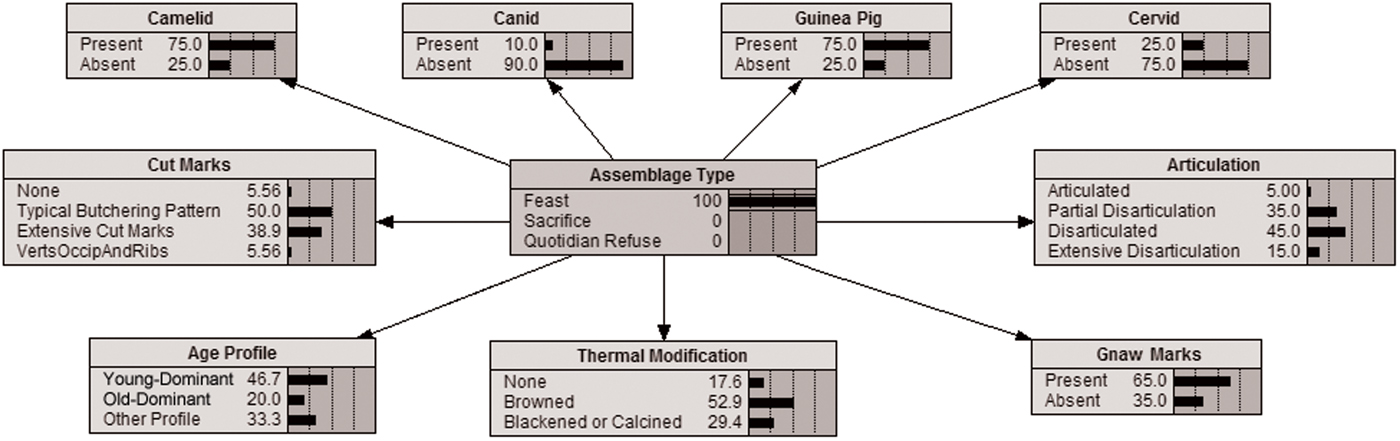
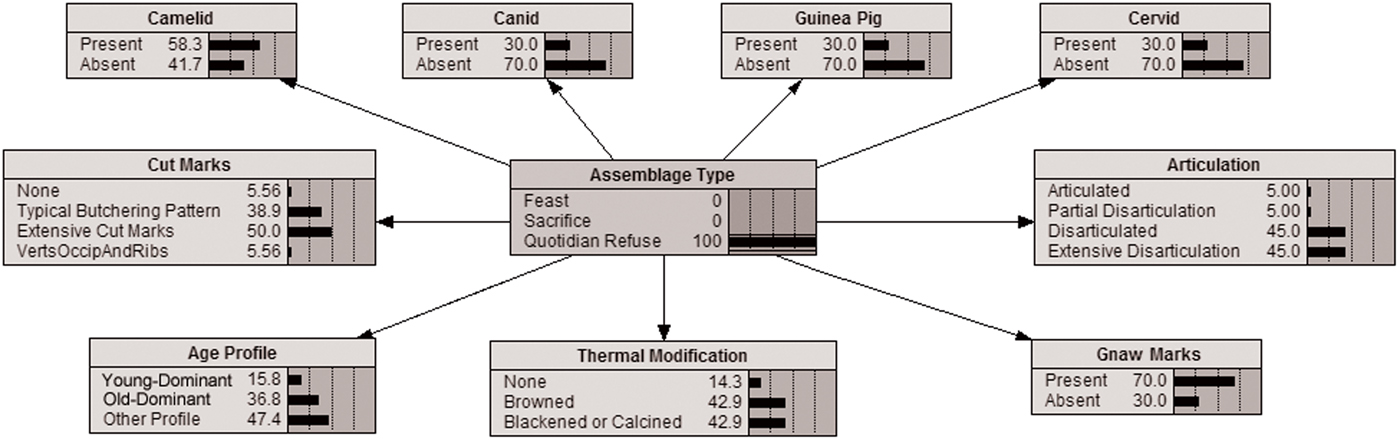
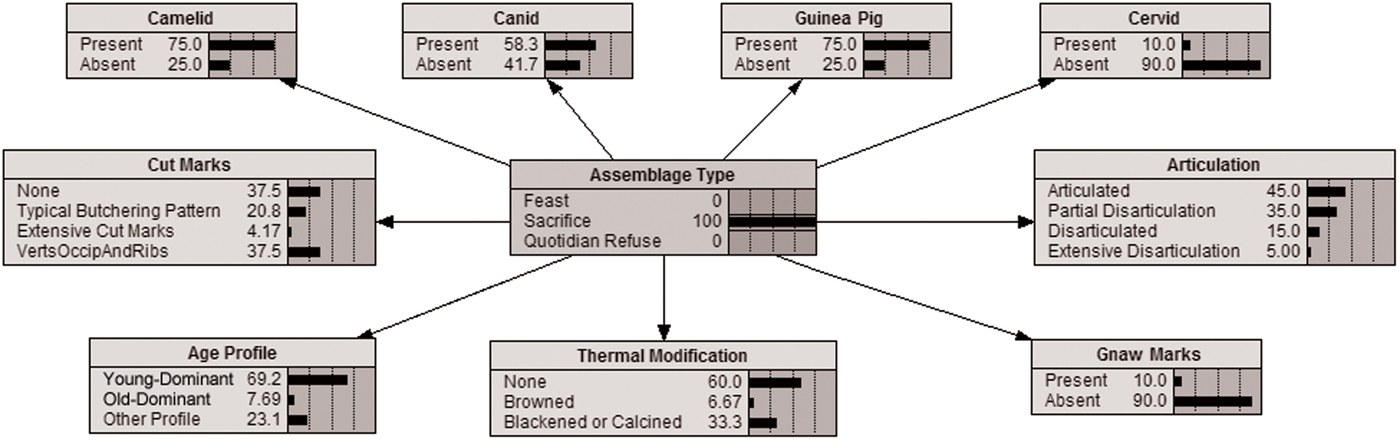
Based on these considerations, I created a Bayesian network model describing faunal collections from Andean archaeological sites. At the center of the model is the parent node, “assemblage type,” which contains the “beliefs” or probabilities associated with each of the three assemblage categories. Because the prior probabilities for the assemblage types are based on the principle of indifference, initially it is equally likely that a given assemblage will be a feast, a sacrifice, or quotidian refuse. The remaining nodes represent the variables and their possible states. Figures 3–5 demonstrate the model expectations when the assemblage type is known; the numerical values by each assemblage state are automatically calculated from the conditional probability tables and represent the posterior probability of observing each state given the assemblage type.
The completed model in Netica, showing the probability of each variable state if the assemblage resulted from a feast.

The completed model in Netica, showing the probability of each variable state if the assemblage resulted from quotidian activities.

The completed model in Netica, showing the probability of each variable state if the assemblage resulted from sacrifice.

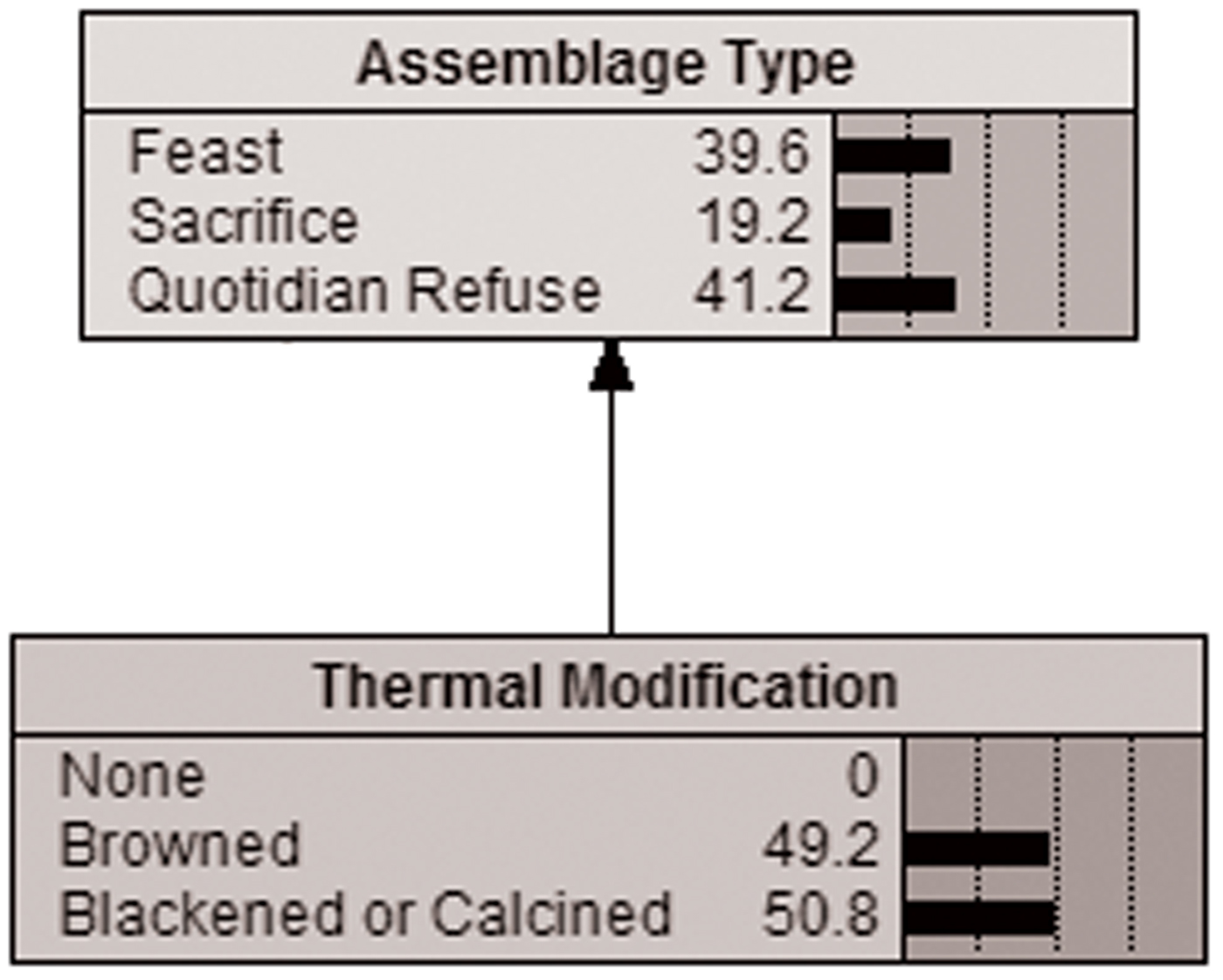
To use the model, select an observed state within a node, and the belief bars in the other nodes update based on this observation. One strength of Netica is that multiple states of a single variable can be selected or a single state deselected. This is useful for describing assemblages in which multiple states may be true or a state is unspecified. For example, if a report indicated bones were “burnt” but did not describe the severity, then in the “thermal modification” node, the state “none” would be set to zero (Figure 6), and the model would recalculate to reflect that some form of thermal modification was observed.
Model results reflecting the observation that the assemblage exhibited unspecified thermal modification.

Hypothetical Test Assemblages
To evaluate whether the model correctly classifies faunal assemblages, I crafted hypothetical test assemblages and described their expected archaeological observations. In these cases, the assemblage classification is known, rather than inferred. Therefore, if the posterior probabilities do not indicate the correct assemblage type, the fault must lie with the model's ability to interpret archaeological findings.
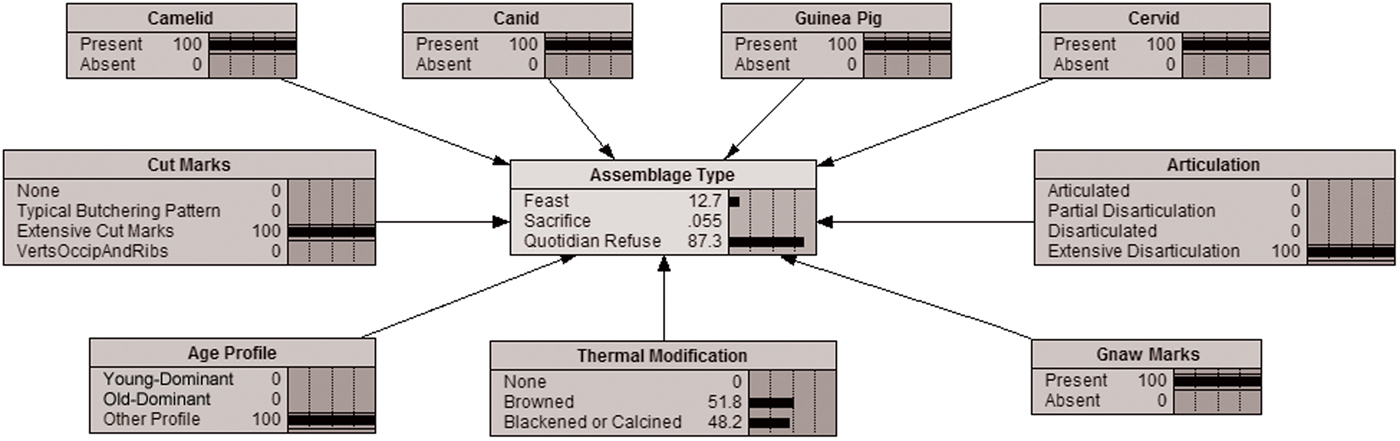
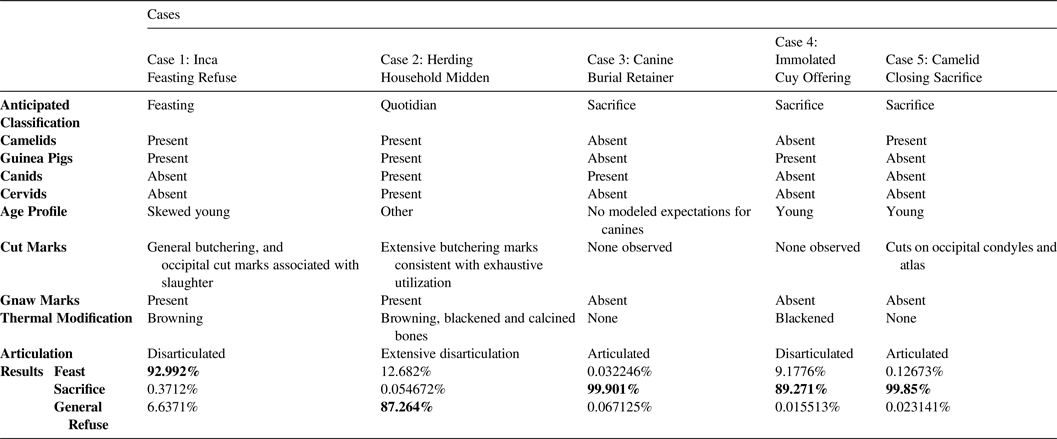
One example of feasting, one domestic midden, and three instances of sacrifice were considered. I created multiple sacrifice cases because, although feasting and household trash have relatively simple sets of archaeological expectations, there are myriad sacrificial modes, all of which must be identifiable by this model. The variable states as they were entered into Netica and the posterior probabilities are presented in Table 1. Figure 7 shows the network with the expected observations for Case 2.
Case 2, a herding household midden, with the expected archaeological observations selected.

Expected Archaeological Signatures of the Hypothetical Cases and the Resulting Probabilities.

The posterior probabilities from these tests all returned high values for the correct assemblage type. Case 3, a canine retainer in a burial, and Case 5, a camelid that was sacrificed and interred as part of a ritual closing event, were both found to be more than 99% likely to be sacrifices. Cases 1 and 2, the feasting and quotidian refuse, had slightly lower probabilities for the correct categories, 92.99% and 87.26%, respectively, but the probabilities are still high enough to be considered strong results and reflect confidence in the conclusion. The strength of these probabilities for known cases demonstrates that the model is capable of correctly classifying faunal assemblages.
Comparison with Archaeological Cases
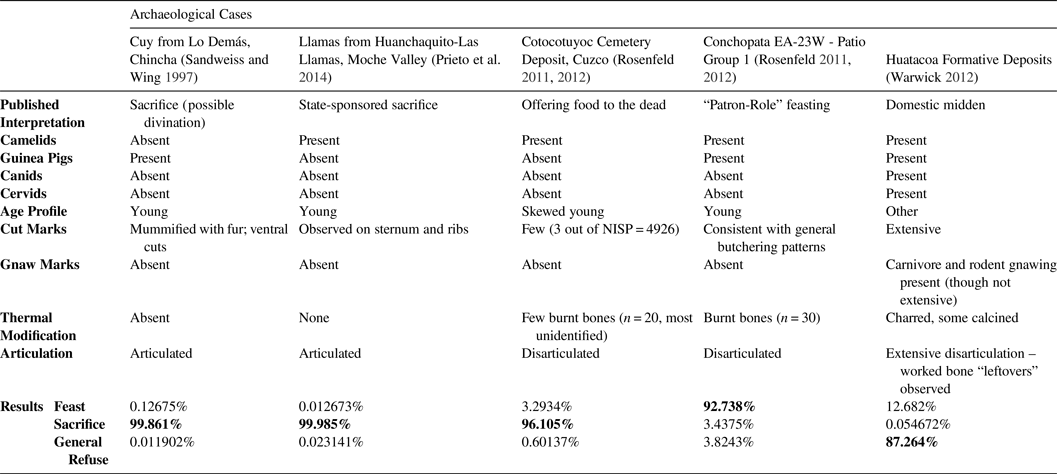
In the next phase, I used findings from published archaeological faunal collections. The five cases were described as (1) a domestic midden (Warwick Reference Warwick2012); (2) a Wari feast at Conchopata (Rosenfeld Reference Rosenfeld2011, Reference Rosenfeld2012); (3) sacrificed cuyes possibly used for divination or healing from the site of Lo Demás in Chincha (Sandweiss and Wing Reference Sandweiss and Wing1997); (4) llamas from a large-scale Chimú-sponsored sacrifice at Huanchaquito-Las Llamas (Prieto et al. Reference Prieto, Nicolás Goepfert and Vilela2014); and (5) a problematic deposit from Cotocotuyoc, Cuzco interpreted as either food offerings to the dead or as wasteful mortuary feasting (Rosenfeld Reference Rosenfeld2011, Reference Rosenfeld2012). Table 2 shows the variables and posterior probabilities for these cases. See Supplemental Text 1 for more detail on each case.
Findings from Archaeological Faunal Assemblages and the Resulting Probabilities.

As with the hypothetical cases, the posterior probabilities from these archaeological cases supported the published interpretations. Two sacrificial cases, the llamas from Huachaquito-Las Llamas and the divinatory cuy from Lo Demás, returned posterior probabilities above 99.8%, indicating an extremely high level of agreement with the archaeologists’ interpretations. This is particularly impressive given the variety of practices contained within the sphere of Andean sacrifice. Conchopata was found to be 92.738% likely to be feasting. The Huatacoa domestic collection produced a posterior probability of 87.264% for quotidian refuse and a probability of 12.682% for feasting, which, though not as robust as the other cases, still provide strong support for the published interpretation.
Perhaps the most interesting case was the Cotocotuyoc deposit (Rosenfeld Reference Rosenfeld2011, Reference Rosenfeld2012). Although Rosenfeld interpreted this collection as a food offering for the dead, she noted an unusual lack of modifications such as cut marks and burning. Given the difficulty surrounding this classification, it is remarkable to see a 96.105% posterior probability for sacrifice, a category that includes mortuary food offerings. This result demonstrates that the model is accomplishing its intended purpose of classifying confusing faunal collections.
Discussion
The Bayesian network model categorized both hypothetical and archaeological test cases in accordance with their expected classifications, and the high posterior probabilities indicate a strong likelihood that the classifications are correct. Together, these results demonstrate this model is capable of correctly classifying a diverse array of Andean faunal assemblages.
Future tests will assess additional difficult and indeterminate archaeological cases to further establish the model's utility in classifying ambiguous collections. It proved difficult to locate suitable examples of indeterminate assemblages, given that such results are rarely published. Archaeologists often hesitate to publish ambiguous or equivocal results, and when we do, we struggle to make it through peer review. This results in a publication bias for unequivocally classified faunal assemblages, when in fact many assemblages are not easily interpreted.
Furthermore, this model demonstrates which kinds of data are the most valuable and minimally necessary to categorize faunal assemblages: the species present, their age at death, the in situ articulation of the remains, and modifications such as cut marks, thermal modifications, and gnaw marks. This is particularly important because certain data, such as articulation, are only observable in situ. Faunal analysis is frequently performed long after excavation ends, and analysts often rely on photographs and field notes for in situ data. Although ideally a zooarchaeologist would be present during excavation, this is not always feasible, so it is helpful for nonspecialists to know the most crucial types of data to record.
Conclusion
Correctly classifying faunal assemblages is critical to studying ancient cultures. This article presented a Bayesian model for categorizing Andean faunal assemblages, including ambiguous faunal collections that might otherwise be misinterpreted or left indeterminate because of equifinality. A Bayesian approach to this problem removes subjectivity by making the relative probabilities of different hypotheses explicit, thereby making assemblage interpretation a more rigorous and repeatable process. The variables in this model are fundamental to faunal analysis, and therefore it is possible to assess relative probabilities using extant data. Given that many analysts first gain access to collections after excavation is complete, it is also important that excavators are aware of the in situ observations they should make. This article sets a minimum standard for the qualitative data that excavators should document so that their faunal collection can be accurately classified.
Acknowledgments
I am grateful to Joyce Marcus, Kent Flannery, Ashley Lemke, and West Resendes for their advice and support on this article. Special thanks to John O'Shea for introducing me to Bayesian modeling and for his role as a sounding board, editor, and motivator.
Data Availability Statement
A complete digital copy of the data presented in this article is available on request from jeosbo@umich.edu.
Supplemental Materials
For supplementary material accompanying this article, visit https://doi.org/10.1017/laq.2019.21
Supplemental Table 1. Likelihood of Articulation by Assemblage Type.
Supplemental Table 2. Likelihood of Articulation by Assemblage Type Scored on an Ordinal Scale.
Supplemental Table 3. Likelihood of Articulation by Assemblage Type Scaled to 1.
Supplemental Text 1. Descriptions of the Archaeological Test Cases.