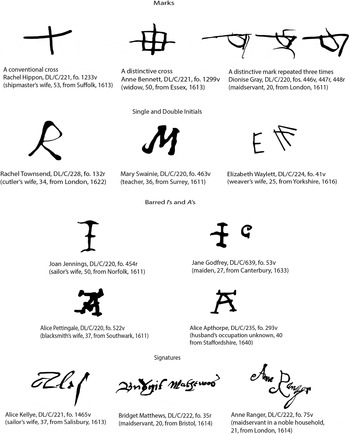
In 1611, a cooper's wife named Mary Swainie told the London Consistory Court that she got her living “by her husbands trade & by teaching of children.”Footnote 1 She was, it seems, one of the innumerable informal schoolmistresses who taught children to read in early modern England. Tacitly tolerated by the ecclesiastical visitors who were supposed to license all teachers, they usually entered the historical record only when they caused offense, or when they were criticized by professional schoolmasters for their ignorance.Footnote 2 Indeed, Mary Swainie, whose profession was recorded only because she happened to depose in a testamentary case, was not a well-educated woman. Instead of signing her deposition, she marked it with a clear initial M—the first letter of her first name (see Figure 1). A historian of literacy counting signatures would typically mark her as illiterate and perhaps marvel that parents entrusted their children to such a poorly qualified teacher.Footnote 3 That painstakingly formed M deserves a closer look, however. Mary Swainie could read, though she could not write, and by reading, it seems that she learned to identify the first letter of her name and to reproduce it when she was called to affirm a legal statement. Her initial and those of hundreds of other women offer a possible key to a problem that has long frustrated historians, the question of how many women were able to read in early modern England.
Marks, Initials, and Signatures from London Consistory Court Deposition Books. London Metropolitan Archives, City of London.

The question is a crucial one for women's participation in England's early modern cultural transformation. Spurred on by the growth of print, in the sixteenth and seventeenth centuries texts of every shape and size and on a bewildering variety of subjects flew off the presses, with perhaps three or four million copies of broadside ballads being produced between 1550 and 1600.Footnote 4 Bibles, medical books, plays, and news pamphlets were only some of the texts that were produced in increasing numbers. The chasm between men's and women's literacy rates, as measured by the ability to sign one's name, calls into question the extent to which women engaged with the new world of the printed word.Footnote 5 This is a particularly timely issue since recent research on early modern Englishwomen's lives has shown that women lived in significantly feminine social worlds, working, talking, and spending time with one another.Footnote 6 At a time in which unlettered people depended on the mediation of their better-educated friends and neighbors to access printed and manuscript texts, women who could read would have served as valuable resources for larger female communities. Conversely, if reading ability was rare among women, whole groups of female relatives and neighbors might have lacked easy access to print. Historians have generally assumed that more ordinary women could read than literacy statistics indicate. So far, however, quantitative evidence for how many women could read and how exposure to literacy was dispersed in society has remained elusive.
How, then, might Mary Swainie's M and the hundreds of other initials carefully penned by women deposing for the London Consistory Court help answer the question of how many women could read? In the following pages, I argue that initials, long ignored by historians of literacy, can be taken as a proxy for a degree of reading ability, much the way signatures are generally counted as evidence of basic writing ability. This hypothesis is based on statistical analyses of how different populations signed, initialed, and marked their depositions. For different socioeconomic groups, the ability to initial is strongly correlated with the ability to sign, which suggests that initials corresponded to an intermediate degree of literacy, something between illiteracy and the ability to write. It is hard to define exactly what that intermediate degree of literacy was, but given the common educational practice of teaching reading before writing, it seems that it must have consisted of some degree of exposure to reading, as well as the first steps in writing letters.
The implications are significant. In the deposition books of the London Consistory Court, Mary Swainie had a great deal of company: only 10 percent of 2,342 London women signed their names, but 15 percent more initialed their depositions. If, as I argue, this means that they had some exposure to literacy, then at least a quarter of these London women had started learning how to read. Moreover, the fine-grained biographical data provided by Consistory Court deponents makes it possible to trace the social contours of female literacy in considerable detail. While some sorts of women were much more likely to have exposure to literacy than others, close examination of the distribution of reading and writing literacy among London women reveals that unlike writing, learning how to read was fairly common even among the humbler women of London's trade and craft communities. Moreover, as women became more mature, they became more likely to write their initials, which suggests that they found reading useful and rewarding enough to hone their skills with practice.
MEASURING EARLY MODERN ENGLISH LITERACY: PROBLEMS
The debate about measuring women's literacy in early modern England has centered on the work of David Cressy, whose Literacy and the Social Order in Early Modern England remains the standard in the field. Following the accepted practice in signature studies, Cressy distinguished between those individuals who signed their full names on legal documents and those who did not, classifying the former as literate and the latter as illiterate. By adopting this standard methodology, he was able to measure a single consistent variable, one for which large amounts of data are available in different contexts, producing results that are broadly comparable over time and space. Like other proponents of signature studies, Cressy argued that the ability to sign, while not in itself a particularly interesting accomplishment, is the only literacy skill that can be consistently measured for large populations, and that it can be taken as a proxy for other elements of literacy that are more difficult to observe.Footnote 7 Cressy found that only 10 percent of English women could sign their names around 1650, while 38 percent could do so a century later. Women as a population became much more literate, even if we do not know exactly of what that literacy consisted.Footnote 8
The value of Cressy's pioneering quantitative work remains broadly recognized, but its reception has suffered from the fact that to keep it meaningfully rigorous on a comparative level, Cressy was obliged to collapse a wide spectrum of early modern literate practices into a single measure. While it is undeniably useful to be able to make statements about relative literacy, many historians find these comparisons unsatisfying. We want to know not just how our subjects compared to other people across the world and over time, but what their skills meant for their engagement with the worlds of print and manuscript. As Keith Thomas has pointed out, literacy in early modern England consisted of a complicated hierarchy of increasingly difficult and rare skills, and few people made their way all the way up to the top. Some people could read only printed black letter, the typeface that was taught to children first, while others mastered roman type. Those who could read print could not necessarily read written hand, and those who read written hand could not necessarily write, since writing was taught after reading. Signing one's name did not necessarily mean that one could write fluently or draft a complicated document.Footnote 9
Since writing was a comparatively rare skill, and one for which most early modern English people had little use, debates about the meaning of signature studies have hinged on the question of reading, and especially reading print. What, if anything, did the ability to sign have to do with the ability to read? While independent evidence of reading ability is difficult to come by, Cressy originally pointed to studies showing that in nineteenth-century France, signing one's name was strongly correlated with knowing how to read and write and suggested that a similarly close relationship might have existed in early modern England.Footnote 10 Accordingly, some historians have concluded that in early modern England, “[t]he vast majority of women … were quite illiterate in both senses,” reading and writing.Footnote 11 Other scholars have been less convinced that signatures serve as a reliable proxy for the ability to read in early modern England. As they have argued, the relationship between reading and writing is dependent on highly variable educational practices. In Sweden, Keith Thomas points out, fully 90 percent of the population could read by 1740, but very few could write: the former skill was broadly taught while the latter was not. Similarly, Thomas Laqueur has shown that in two towns in Lancashire in the mid-nineteenth century, over 60 percent of the population could read even though less than 30 percent could write. In three Rutland parishes, 92 percent could read, while only 61 percent could write.Footnote 12 There are good reasons to believe that reading was far more widespread in early modern England than writing, a skill that was taught to older children and which required quills, paper, and ink, as well as knowledge of at least one of the several competing scripts in use.Footnote 13 Boys and girls from humble backgrounds may both have commonly learned how to read at dame schools or petty schools in early childhood, but they were far less likely to have had access to specialized writing masters.
Class and gender both played a role in restricting the ability to write. Arguing for a broad reading public in the seventeenth century, Margaret Spufford suggested that economic necessity prevented many poorer boys from learning how to write. Working from workhouse records and the rare autobiographies of humble people who became fully literate, she concluded that the age at which writing was taught, seven or eight, coincided with the age at which poor children could begin to contribute to their household economies. Even if they were taught to read, they were likely to be pulled from school before they could complete their educations.Footnote 14 Girls were even less likely to learn to write, a skill generally considered superfluous for their sex: the same schools where boys learned to read, write, and cast accounts generally limited girls to reading, sewing, knitting, and spinning. There is, she concluded, “absolutely no way of knowing how many women below the level of the gentry in England learnt to read.”Footnote 15
For historians interested in early modern men and women's ability to access the world of print, then, the value of Cressy's figures is unclear: they may, as Thomas has suggested, constitute “not just an underestimate of those who could read, but a spectacular underestimate.”Footnote 16 There the matter has rested for more than twenty years. With the growth of widespread doubts about the accuracy of signature studies, quantitative studies of literacy have languished. Peter Earle's study of women's ability to sign in London church court records dating from 1695 to 1725 attracted little attention, even though Earle addressed one of the major complaints made about Cressy's figures for female literacy, the fact that he treated women as an undifferentiated group even though he disaggregated men by occupation and status.Footnote 17 Writing in 1993, Wyn Ford offered a generally negative view of the field's capacity for advancement, and few have been inclined to challenge him.Footnote 18
Scholars of literacy and reading have accordingly moved to different questions and different methods. In her study of literacy, gender, and empire in early modern England and France, Margaret Ferguson calls signature studies “arguably useless,” and she focuses instead on how women used their literacy to both question and reaffirm imperial projects.Footnote 19 “Signature literacy is ultimately so ineffective as a methodology, especially for early modern women, that many scholars have moved away from such statistical analyses altogether,” according to Heidi Brayman Hackel, who uses prefaces, marginal annotations, commonplace books, diaries, letters, portraits, and literary depictions of reading to tease out how early modern men and women read for recreation.Footnote 20 One consistent assumption in many recent works is that literacy was more widespread than Cressy thought, especially among early modern women. Brayman Hackel has shown that authors and publishers assumed that novice readers who could barely sound out words might purchase and attempt to decipher their wares, including difficult literary texts like Shakespeare's First Folio—although they were more likely to bemoan this fact than celebrate the diversity of the reading public.Footnote 21 Citing the enormous increase in cheap print and the ease with which written material made its way into oral traditions, Adam Fox declares that Cressy's figures represent “huge underestimates of basic reading ability in general, and female capability in particular.”Footnote 22 Many ballads and a number of chapbooks targeted a female readership, Bernard Capp notes, calling it “[a] fact that a significant minority of ordinary women possessed some degree of literacy.”Footnote 23 In an essay on the ambiguous, double-edged benefits of literacy for early modern Englishwomen accused of crimes, Frances Dolan writes, “I assume rather than seek to prove that many women could read and/or write. My question is: what difference did—and does—their literacy make?”Footnote 24
New approaches to literacy have produced valuable insights into how men and women read and wrote in early modern England, but less about the quotidian engagement of ordinary women with print. Ferguson focuses on famous writers, Brayman Hackel on mostly elite readers.Footnote 25 Dolan studies the humbler but nonetheless unusual group of women accused of crimes, while other scholars have focused on religious radicals.Footnote 26 Representations of female readers by male authors offer useful insight into female literacy as a site of anxiety and the social challenges facing women readers.Footnote 27 Nonetheless, sources about ordinary women reading remain difficult to find.Footnote 28 Even scholars arguing for more expansive conceptions of literacy that encompass elements of female artisanal activity have tended to focus on gentlewomen.Footnote 29 The most successful studies of ordinary women's engagement with print have generally focused on the cheapest, most widely available texts themselves, chapbooks and ballads. These popular and plentiful texts satisfied growing appetites for print among humble audiences, and some of those readers were women, whose tastes are reflected in the wares they purchased.Footnote 30
The situation is considerably brighter for a somewhat later period, when many more humble women were writers as well as readers: working off a rich archive of unpublished late seventeenth- and eighteenth-century letters, Susan Whyman has recently depicted ordinary people as habitual letter-writers, the possessors of what she has termed “epistolary literacy.”Footnote 31 Unfortunately, such sources become much harder to find as one moves back in time. While women did indeed write letters in the sixteenth and early seventeenth centuries, the surviving manuscripts were largely composed by gentlewomen and noblewomen.Footnote 32 Fox has located several examples of plebeian women writing or composing libels, preserved in the records of subsequent court cases, but such writings were not meant to last, and rarely did.Footnote 33
INITIALING AND LEARNING TO READ
While signature studies have their limitations, scholars have been too quick to abandon them as sources of knowledge about women's literacy. With a more flexible, sensitive methodology and fine-grained data, we can, in fact, begin to map reading ability. As Cressy himself has long argued, the records of the London Consistory Court are especially promising in this regard, for not only did women appear there in great numbers as deponents, they also provided the court with detailed autobiographical information about themselves. Peter Earle has already made use of this bounty for the years 1695 to 1725, dividing up London women by birth cohorts, separating them into London-born women and newcomers, mapping literacy according to area of residence, and categorizing migrant women by their county of origin. Counting signatures as Cressy had done, he concluded that London-born women were substantially more literate than migrants, who were themselves more literate than most provincial women. He provided a more precise mapping of the increase in female literacy from the mid-seventeenth century, and found that the ability to sign increased as women aged, suggesting that many deponents learned to write their names as adults rather than as children—a point with important ramifications about the place of writing in women's lives. Setting literacy against women's reported occupations, he concluded that women in the needle trades, shopkeepers, midwives, and schoolteachers were far more literate than servants and nurses, who were themselves much better educated than hawkers, charwomen, and silkwinders.Footnote 34
A similarly detailed analysis for London women who deposed for the consistory court between 1570 and 1640 provides new data for a population, period, and place for which we have only Cressy's original figure of 90 percent illiteracy.Footnote 35 As a rapidly expanding city that drew migrants from across England and beyond, and the center of English print culture, London is a particularly interesting area for the examination of female literacy. From 1570, when record survival became consistent, to 1640, when the court ceased operations amid political turmoil, the records of the consistory court include remarkable numbers of female deponents and litigants who made their home in the city of Shakespeare and Jonson. In those years, fully 2,342 London women affirmed their depositions with some kind of intelligible mark.Footnote 36 They usually also stated their marital status and whether or not they were in service, their husband's occupation if they were married, and their place of birth, age, and parish of residence. As a sample, they seem to have been reasonably representative of the bulk of the urban female population over the age of eighteen or so. They spanned the social hierarchy from gentlewomen to water bearers. Reflecting the favorable sex ratios for marriage in London at the time, about 64 percent were married when they served as witnesses, while another 21 percent had never been married. Most of the wives were married to small artisans and tradesmen: tailors, carpenters, joiners, bricklayers, and the like. Most single women were described as maidservants although some of them reported living with their families, and others appear to have been living independently. A final 15 percent of the female deponents were widows. This is a broad sample of the poor-to-middling female population of London, then, with a few notable exceptions. French and Dutch women appeared relatively rarely as deponents, since their religious communities made little use of the Anglican consistory court, and women who lived south of the Thames were underrepresented because Southwark belonged to the Diocese of Winchester, not London. For this study, however, the most frustrating absence is that of the very young: because of doubts about children's credibility, few deponents were younger than their late teens.
Asked to affirm their depositions, women responded in varied ways that reflected the broad spectrum of literacy skills present in the population. Most women made marks that ranged from the sign of the cross to idiosyncratic scribbles. Others signed their first or full names in a more or less confident hand, or wrote one or two initials from their names. Classic signature studies ignore this variety, dismissing everyone who could not write their full names as illiterate. Discussing the variety of marks made by illiterate people, Cressy wrote, “[t]heir marks ranged from the simple scrawl of someone who had never held a pen to the elaborate sketch or diagram of another whose dexterity was some compensation for his illiteracy. A few people could reproduce their initials as a personal mark, or attempt a couple of letters of their name, but failing a signature they are also classified as illiterate.”Footnote 37 While Wyn Ford suggested that well-formed initials indicated a degree of literacy, and that qualitative analysis of the ways that people signed documents could refine traditional ways of measuring literacy, he had grave doubts about the potential of such efforts, and scholars have not taken up the challenge.Footnote 38
Given the scanty attention paid to initials in the literature, a casual reader might assume that they were few and far between. For London women, nothing could be further from the truth. Fifteen percent of all women residents in London who deposed for the London consistory court between the years 1570 and 1640 marked their depositions with one or two initials.Footnote 39 Initials were vastly more common than idiosyncratic drawings or pictograms, and substantially more common than signatures: only 10 percent of the female deponents signed their names. It is hard to explain the existence of so many initials without recourse to literacy. Women were rarely asked to indicate written assent for official reasons, and when they were, it was perfectly acceptable for a woman to make a cross or some other mark, the usual practice for the majority of the female population.Footnote 40 Even if women did experience a need for a recognizably distinctive way to make their marks—on tradesmen's bills or other ephemera—they did not need to write letters. Many women who marked their depositions several times used the same sort of scribble or mark each time, and these could be as distinctive and individualized as initials, as the personalized marks in Figure 1 show. Moreover, even if some women did learn to write their initials for the specific purpose of marking documents, it does not follow that they did so by rote. Since personal marks were as legally valid and often as distinctive as initials, a woman who learned to write her initials may have been proudly demonstrating that she could read, even if she could not write her name.
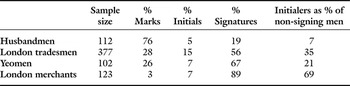
Empirical data support the hypothesis that women who wrote one or two initials had begun learning how to read. Table 1 shows the rates of signatures, initials, and marks for different groups of men who deposed for the London consistory court between 1570 and 1640, and it serves as a test of the extent to which initials were correlated with literacy. The far right column shows the rate of initialing among those who could not sign their names, that is, those who left either initials or marks. Performing this calculation allows us to focus on how initials were distributed among people conventionally classified as illiterate. For example, eighty-five husbandmen marked their depositions, six initialed them, and twenty-one signed their names. Of the ninety-one husbandmen who did not sign their names, six individuals, or 7 percent, wrote their initials.Footnote 41 If initials were random, this percentage would have stayed roughly constant across different populations, but this is not the case. Indeed, as Table 1 shows, it varies dramatically according to the population studied, with non-signing men from more literate socioeconomic groups being considerably more likely to write their initials than those from less literate groups. Thus, only 7 percent of non-signing husbandmen wrote their initials, while fully 69 percent of non-signing London merchants did so. Initialing here correlates strongly with signature literacy, which suggests that both stemmed from the same source: education, in different degrees.
Men's Literacy, 1570–1640
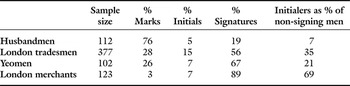
Note: The category “London tradesmen” includes a wide variety of artisans and tradesmen from cobblers to barbersurgeons, with bricklayers, carpenters, cordwainers, tailors, and weavers being the most common. “London merchants” includes merchant tailors, merchants, goldsmiths, drapers, mercers, haberdashers, and vintners.
Here and in all other tables, percentages are rounded to the nearest whole number, so the percentages of marks, initials, and signatures do not always add up to exactly 100.
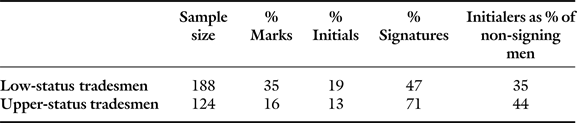
A closer look at artisans and tradesmen in print-saturated London provides further support for initials as a proxy for experience learning how to read. Initials were most common overall among men in these middling urban groups: 15 percent of London tradesmen and artisans wrote their initials, more than twice the percentage for any other group of men, suggesting that those among them who could not access writing instruction were nonetheless interested in learning to read. When the category of London artisans and tradesmen is further divided according to status (see Table 2), it is telling that those of lower status were less likely to sign their names but more likely to write their initials than were their betters. Those of lower status were more likely to be mere readers, while upper-status tradesmen were more likely to be able to write as well. Among those men who could not write their names, prosperous tradesmen were more likely to write their initials than were those of humbler trades. Compared to lower-status tradesmen, wealthier tradesmen were more likely to be able to write, and if they could not write, more likely to write their initials.
Male Artisans and Shopkeepers' Literacy in London, 1570–1640
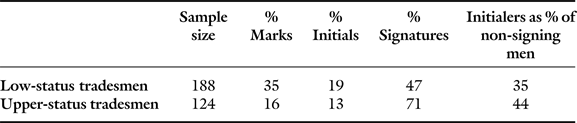
Note: Lower-status artisans and tradesmen include bricklayers, tailors, carpenters, watermen, butchers, and the like, while upper-status tradesmen include fishmongers, cloth workers, barbersurgeons, skinners, and other more prosperous tradesmen.
There is, then, good reason to believe that initials are a proxy for some degree of reading literacy. In scattered cases, an individual may have written his or her initials without knowing how to read at all, but the strong patterns exhibited by the data imply that those who wrote their initials had begun to take the first steps in literacy. They were familiar with letters and the sounds associated with them and could identify and reproduce the first sounds and letters of their names, even if they could not write whole words or sentences. At a minimum, they probably possessed what Brayman Hackel has termed abecedarian literacy: the ability to “spell” out words by sounding them out, letter by letter.Footnote 42
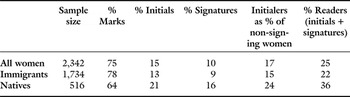
Turning to the sample of London women, it is immediately clear that in comparison to men, women were relatively illiterate: 10 percent signed their names, 15 percent wrote an initial or two, and the great majority wrote no letters at all. Only 17 percent of those who could not write could form their initials, in comparison to 35 percent of low-status tradesmen, and 69 percent of merchants. The most striking difference between women and all the groups of men, however, is the fact that unlike any group of men studied, London women were more likely to write their initials than to sign their names. The rate at which they wrote their initials—15 percent—was matched only by the print-hungry London tradesmen, but even the least literate men, husbandmen, were almost twice as likely to be able to sign their names as were urban women. In comparison to men, women who were interested in literacy and began learning to read faced disheartening barriers when it came to learning how to write.
For girls, one way to overcome those barriers was to learn alongside boys: the handwriting of London women suggests that many of them had been taught to write by the same teachers who taught their brothers. It is commonly asserted that by the late sixteenth century, women rarely used secretary hand since it was considered to be a more masculine, professional script, and so women were taught to write only the easier, more elegant italic hand.Footnote 43 However, London women who signed their names were nearly twice as likely to write secretary hand than italic, and for women born in London, secretary hand was even more dominant. Gentlewomen were indeed increasingly likely to write in the fashionable italic hand, but London women of humbler status continued to write the older script that reflected the commercial and professional society in which they lived.
The specific ways in which letters were formed offers a rare glimpse into the writing practices of novice readers. While educated people wrote in secretary, italic, or mixed hands, deponents who wrote one or two of their initials generally wrote in roman capitals—well formed or less practiced—with two letters sometimes appearing in unusual forms: barred I's are common, and to a lesser extent, barred A's also appear (see Figure 1). These letter forms, rarely found in manuscript and print, are familiar to historians of material culture since they appear frequently in sewn forms. On embroidered samplers for example, Bianca Calabresi has found that roman capitals predominate, and that barred I's and A's are common.Footnote 44 They appear, for example, on a 1598 sampler sewn by Jane Bostocke, as shown in Figure 2. These unusual letter forms do not seem to have been learned from hornbooks, primers, or writing masters. Instead, they appear to be have been learned and transmitted through practice as semiliterate men and women wrote and sewed the comparatively simple roman capitals rather than conventional written hands or the elaborate black letter forms. Since girls learned to sew around the same time that they learned to read, sewing—as Calabresi argues—may have been a common way for them to practice reproducing the letters they were learning to recognize in print. In addition to sewing, beginning readers may have scratched simple roman capitals on slates, written them with sticks in ashes or the dirt, or scrawled them on whitewashed walls with charcoal, even if they lacked access to pen, ink, and paper.Footnote 45 Experimenting with the reproduction of letters seems to have played a larger role in learning how to read than scholars have previously thought.
Sampler sewn by Jane Bostocke, 1598, detail. ©Victoria and Albert Museum, London.

By taking initials as well as signatures into account, we can estimate how many people began learning how to read and how many progressed to writing for a given population. Women who signed their names could almost certainly both read and write, at least on a basic level. While some scholars have objected that those who could sign their names could not necessarily write anything else, by far the bulk of the evidence suggests otherwise.Footnote 46 This was certainly the case for one maidservant, who signed her full name “Bridgit Mathewes” in 1614; she specifically told the court that she could “write and read written hand.”Footnote 47 Some of these women wrote on a regular basis. Alice Sutton, a twenty-five-year-old Bristol native and a musician's wife who signed her deposition in a neat secretary hand “By mee Alse Sutton,” allegedly found writing very useful when she became entangled with one William Adams.Footnote 48 As William's wife angrily told Alice's mother-in-law outside of church one day, Alice had sent him a number of letters by her apprentice, including one in which she explained “that although shee could not enioye the companie of the said William Adames as shee had donne yet shee the said Alice desired againe to imbrace his the said Williams sweet corpes.”Footnote 49 Alice Sutton signed her name confidently in contrast to other women who found writing their names an arduous task.Footnote 50 Those women who signed their names laboriously may not have been able to write very well or fluently, but as Whyman's work demonstrates, that would not have stopped them from trying. Dorothy Soresbie was a halting writer for whom each word must have taken considerable effort, but she expressed her thoughts clearly in a 1689 letter rebuking her cousin Roger: “I heard my cosen eliner had bene very ill and … yo ws sum case of … her ill nes.”Footnote 51 In order not to exclude these hesitant writers, first name only signatures have been classified along with full signatures in this study—a departure from classic methodology. Roughly 90 percent of women who signed their names signed their full names, however, suggesting that they were reasonably comfortable with pen and ink.
Estimating how many women began learning to read is considerably more complicated, because an unknown proportion of women with exposure to reading marked their depositions with marks rather than initials. A tiny sample of four non-signing women whose depositions provide independent evidence of reading ability suggests that only some of the women who could read but not write chose to write their initials. The teacher Mary Swainie, as we have seen, wrote an initial M. Similarly, Elizabeth Burroughs, a Stepney scrivener's wife, maintained herself “in part by keepeing of schoole and partlie by hir husbands trade.” She could presumably read at least a little, and marked her deposition with unskillful initials. However, Elizabeth Ellel, an elderly widow who specifically explained to the court that “shee is a Sempster, and teacheth younge Children to reade & worke with theire needles” signed only with a mark.Footnote 52 So did Bridget Hollett, a sailor's wife who mentioned receiving a letter from her husband and said, “there are noe such words there written nor in any other letters of his that this deponent euer had.”Footnote 53 She could apparently read not only printed text but also her husband's hand. A fifth woman, Alice Dorrington, who signed with a mark and told the court she could “neither wright nor read written hand” may well been able to read printed text.Footnote 54
Because of the uncertainty of the relationship between beginning to learn how to read and initialing, the rates given for “readers” in the tables below should be understood as baseline estimates rather than precise measures, even before taking margins of error into account. They provide, in other words, a minimum estimate of how many women had at least begun to learn how to read. Since not all beginning readers wrote their initials, more women had some ability to read than their signatures and initials suggest. In particular, as we shall see, the relationship between abecedarian literacy and initialing seems to have varied according to age, with readers becoming more likely to write their initials as they gained experience.
MAPPING FEMALE LITERACY IN LONDON
Of the 2,342 London women who marked, initialed, or signed their depositions for the London Consistory Court between 1570 and 1640, 15 percent wrote at least one initial and 10 percent signed at least their first name, suggesting that at least a quarter of London women had at least begun learning how to read.Footnote 55 However, this figure conceals a great deal of variety. Girls who were born in London and other towns and cities were far more likely to be literate—both as readers and as writers—than those who grew up in the countryside, although there are some indications that access to schooling increased for country girls in the late sixteenth and early seventeenth centuries. The importance of where girls spent their childhoods and early teens indicates that most women had their initial schooling during these formative years. Indeed, an analysis of literacy and age shows that the ability to sign did not increase with age, and even seems to have decreased somewhat as women grew older: apparently writing was learned in childhood or not at all. In contrast, the ability to reproduce initials increased with age. This suggests that women found reading to be a useful and meaningful skill, one that they improved with practice as adults. Reading, as measured by initials, was apparently more relevant to women's lives than writing, and it was also much more broadly distributed along the social hierarchy, as an analysis of married women's literacy and their husbands' status suggests. While very few women married to humble craftsmen and artisans could write, about a quarter of them had begun learning how to read. Similarly, reading women could be found all over London, even in the poor eastern suburbs, while women who could also write were more likely to live within the city walls or in the comparatively wealthy western suburbs. In almost every walk of life and in all sorts of neighborhoods, whether haltingly sounding out words or eagerly absorbing texts, London women were reading.
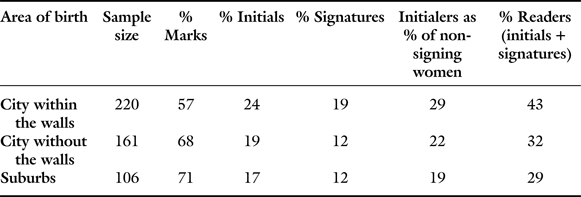
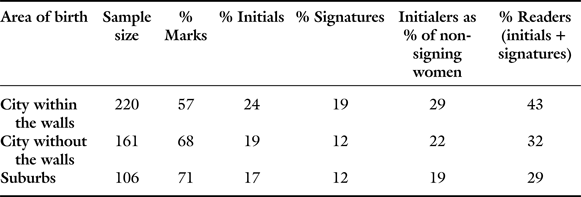
Where women were born strongly affected their access to literacy, as Table 3 shows. Those born within urban areas were far more literate than those who had come to the city from elsewhere.Footnote 56 London was full of informal little schools catering to scholars like “Margaret Stevens a Child wch was going downe the staires to goe to schoole” when Jane Gardner came to quarrel with Anne Foxall at her lodgings in St. Michael Queenhithe in 1617.Footnote 57 These schools, held in tradesmen's shops or private houses, were busy, crowded places, and the children may often have been distracted or diverted by the urban life that went on around them. Their quality was probably low, but so was their cost, and many London girls were able to access some level of instruction, even when they were not taught at home.Footnote 58 This was particularly true for girls born within the city walls: as Table 4 shows, of the 220 deponents born in the heart of London, at least 43 percent had begun learning how to read, and nearly 20 percent could write their names.
London Women's Literacy According to Place of Birth, 1570–1640

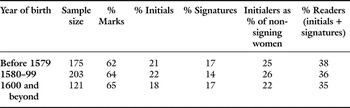
Literacy and Place of Birth for London Natives
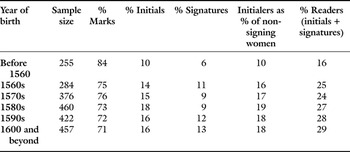
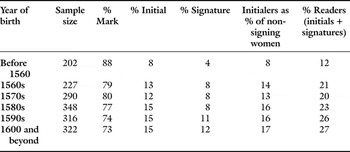
Most London women were not London-born, however, and instead had migrated to the city from elsewhere in England in their teens or early twenties, commonly seeking work as domestic servants. These women spent their formative years outside the city, where schooling was harder to find, a fact reflected in their lower rates of initialing and signing.Footnote 59 This gap narrowed over time, however. While, as Table 5 shows, overall literacy rates in London seem to have increased very slightly from the mid-sixteenth century to the mid-seventeenth, that increase reflected a growth in access to schooling outside of London, rather than within the metropolis itself, where literacy rates had always been high. Tables 6 and 7 show that immigrant women exhibited modest gains, whereas the literacy rates for London-born women may have even declined somewhat.
London Women's Literacy by Year of Birth

Literacy by Year of Birth for Immigrant Women in London

Literacy by Year of Birth for London-Born Women

A closer look at the origins of the immigrant women confirms the importance of an urban upbringing for female literacy. While in general London-born women were considerably more literate than were immigrants to the city, those 186 migrant women who can be identified as having been born in one of the largest thirty cities and towns in England were more literate than other immigrants: 15 percent wrote an initial or two, and 12 percent signed their names. Growing up in an urban environment increased girls' access to schooling, and those girls from provincial cities and towns who took the step of moving to London may have been especially ambitious and eager to read and write.
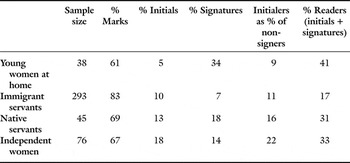
It was relatively easy for girls growing up in towns and cities to learn to read and write, with 21 percent of London natives initialing their depositions and 16 percent signing their names. While young women rich enough to be living at home were especially literate, even London-born maidservants were far more likely to be able to read and write than their country-born counterparts, as Table 8 shows. This table makes use of the ways that never-married women were classified by the Consistory Court to distinguish between maidservants, young women living with their parents or other close relatives, and those who were apparently neither servants nor at home.Footnote 60 The sample sizes of young London-born women are small, but even assuming large margins of error, they were much more literate than the immigrant maidservants. Thus when four maidservants deposed about Michael Groome's violence against his wife Ellen, it is not surprising that the only one of them who was able to sign her name was Goulde Pettie, a twenty-year-old native Londoner. Jane Lewes from Anglesey, Susan Bonner from Leicestershire, and Elizabeth Hust from Hertfordshire all signed with marks.Footnote 61
Unmarried London Women's Literacy, 1570–1640

Intriguingly, those categorized as “independent women,” never-married women apparently living out of service and away from home, were substantially more literate than were immigrant maidservants, even when they were born outside of the city. Of sixty independent immigrants, 15 percent wrote initials and 13 percent signed. It is hard, however, to make generalizations about the group, which included gentlewomen living in lodgings in London, skilled artisans, hawkers, and poor girls who usually worked as domestic servants but were—by reason of pregnancy, illness, other misfortune, or insubordinate behavior—between jobs. While most independent single women did not describe their economic situations in any detail, what little evidence there is suggests that young gentlewomen and skilled artisans were far more likely to be literate than were out-of-work maidservants.
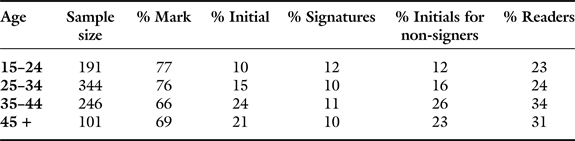
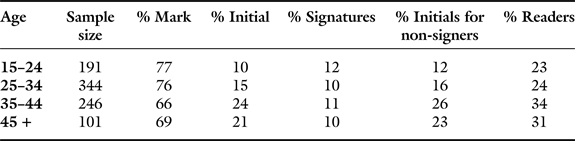
With the exception of independent single women, few never-married women of any background wrote their initials. The most likely explanation for this is that they had less practice reading and writing letters than their elders. To further examine how literacy was affected by age, one can break down the sample of women by birth cohorts: analyzing a single cohort is a basic way of controlling for change over time. In Table 9, deponents born between the years 1580 and 1599 have been disaggregated according to their stated ages. This birth cohort has been chosen because it provides a relatively large sample size of 878 people and because literacy rates changed little during those years, minimizing the complications resulting from overall increases in literacy. For the women born in the 1580s and 1590s, achieving maturity was associated with an increase in the ability to write initials, but not with an increased ability to sign. Only 10 percent of young women between the ages of fifteen and twenty-four wrote their initials, but 24 percent of middle-aged women between the ages of thirty-five and forty-four did so. Only for the oldest group, those over forty-five, is there a slight decline in the ability to write initials, down to 21 percent; this may reflect worsening eyesight in an aging population. While the proportion of women writing their initials more than doubled as they grew to mature age, those signing their names remained static over time, fluctuating around 10 or 11 percent. Some women may even have forgotten how to write due to lack of practice, since the rate of signing was highest for the youngest group.
Initials and Signatures by Age for Women Born 1580–1599
Similarly, an analysis of literacy by marital status for the entire sample reveals that as women grew up and took on more senior roles in their communities, they might learn how to write their initials, but had little chance of learning to sign their names. Maids, wives, and widows all signed their names in roughly the same proportions—around 10 percent—but exhibited very different abilities to write their initials. Only 11 percent of all maids did so, in comparison to 15 percent of wives and fully 20 percent of widows. Bridget Hollett and Alice Dorrington, two of the women identified above as knowing how to read but signing with marks, were both only nineteen years old. If they had deposed again at the age of thirty or forty, they might have written their initials instead.
The fact that wives and especially widows wrote their initials at far higher rates than young single women suggests that using and displaying literacy was important to them. As household mistresses, artisans, shopkeepers, and market traders, London wives were enmeshed in complex webs of credit relations, despite the restrictions of coverture, and the ability to read and initial bills, account books, and receipts may have been useful.Footnote 62 Freed from coverture, widows acted for themselves, dealing with their husbands' estates, shops, and apprentices—and in disease-ridden London, many wives passed through a period of widowhood.Footnote 63 Adult women may have used initialing to signal that they were able to read and understand documents. Business aside, social prestige may have been attached to the ability to decode ballads, devotional works, letters, and other texts for neighbors and friends. For others, initials may have communicated private satisfaction at making sense of the printed page.
In any case, women's increased ability to write initials as they aged suggests that for them, literacy was an ongoing project. The London women who wrote their initials were probably first introduced to the alphabet when they were children, judging from the close links between literacy levels and where women had spent their childhood. The fact that more older women could write their initials suggests, significantly, that reading and initialing were skills that they honed with regular practice. They not only could read a little, it seems, but did read. Indeed, if literacy had not been relevant to their daily lives, one would expect initialing rates to have declined with age as women's unused skills became increasingly rusty. There are similar indications from London ca. 1700 that women's literacy generally improved with age. Peter Earle finds that by then, the percentage of women signing their names increased from about 49 percent for those under twenty to as many as 62 percent for women in their thirties and forties.Footnote 64 By then, when literacy was more broadly widespread, women's opportunities for learning to write and practicing writing in adulthood seem to have expanded. In general, the London evidence provides support for Thomas Laqueur's argument, based on nineteenth-century sources, that “the acquisition of basic literacy … was not the result of a single period of childhood schooling but of a more informal and protracted process which could continue well into adolescence and even adulthood.”Footnote 65
We might imagine poor and middling women practicing reading by candlelight, after working hours had ended, aided by a friend, suitor, or husband. Mothers might have become more fluent readers as they supervised the studies of their children who attended school. Without formal support or easy access to paper, pens, and ink, such women were unlikely to become fluent writers, but they could hope to improve their ability to read printed text. Susan Hills, a London maidservant in the 1620s, was one of these. Her sweetheart Robert Lowther, who lived in the same household, gave her a Bible to read since she did not have one, and when he went abroad to serve his master as a factor in Italy, he wrote her a letter that ended: “I feare you can heardly read this because you doe not practice.”Footnote 66 Indeed, Susan had to go to a literate friend, Sara Hodgkinson, for help reading the manuscript letter, though she may well have been able to read print on her own.
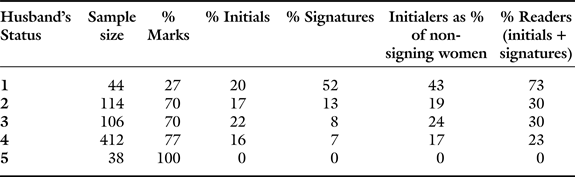
Learning how to read was far more widely diffused among the population than the ability to both read and write. Of ninety-four sailors' wives, only 4 percent could sign their names, but another five women wrote their initials for every woman who signed. As Table 10 shows, the ability to sign decreased rapidly with declining social status, from 52 percent for women married to gentlemen and esquires, down to only 7 percent for those married to tailors, carpenters, shoemakers, butchers, and the like. Nonetheless, 16 percent of these last women were able to write their initials. Only in the lowest status group, one that comprised laborers' and porters' wives, did all evidence of literacy disappear. Among the wives of small tradesmen and artisans, who composed the bulk of the sample, at least 23 percent had started learning how to read, even if few of them could sign their names.
London Wives' Literacy and Social Status
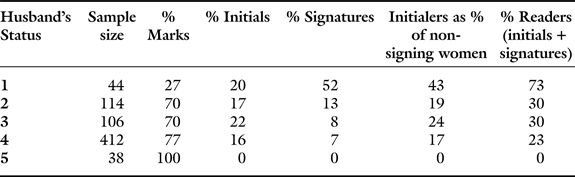
Note: Status group 1 includes gentlemen and esquires. Group 2 is composed of merchants, merchant tailors, drapers, goldsmiths, clergymen, etc. Group 3 refers to middle-status tradesmen such as innholders, brewers, cloth workers, barbersurgeons, and coopers. Group 4 is made up of lower-status tradesmen and artisans: tailors, carpenters, shoemakers, bakers, butchers, bricklayers, etc. Water bearers, porters, and laborers make up group 5.
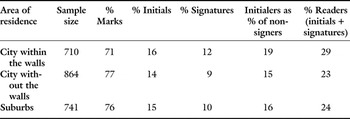
Literacy and Area of Residence for London Women

A close focus on the humblest women who knew how to write, the thirty wives of lower-status tradesmen and artisans who signed their names, reveals unsurprisingly that these were disproportionately likely to be London-born and, if they were immigrants, disproportionately likely to have been born in cities and towns.Footnote 67 Some of these literate women were not as poor as one might think. One of them, at least, came from a background of relative privilege: a cordwainer's wife named Mildred who signed “By me Milbreb Addesone,” was the London-born sister of George Humble, a wealthy leatherseller who was able to give his daughter Honor a three hundred pound portion.Footnote 68 Her husband was surely no petty cobbler. Two others had previously lived in service in knightly and intellectual households before their marriages: Margery Downham had served Lady Plat, the wife of the writer and inventor Sir Hugh Plat, for a year, and Margery Exall had lived with the multilingual courtier and translator Sir Lewes Lewknor. Margery Downham kept her own sempster's shop, so reading and writing may have been of daily practical use for her.Footnote 69
While learning how to read was widely dispersed across social ranks, literacy was also widely distributed geographically. Women living within the city walls were most likely to be able to sign their names, but women who lived further out exhibited a roughly similar ability to read. Not all suburban parishes were equal, however: of 290 women in the comparatively genteel western suburbs (Westminster, St. Martin in the Fields, St. Andrew Holborn, and St. James Clerkenwell) 13 percent of women signed their names, in comparison to only 5 percent of 340 women living in the poor eastern neighborhoods of Stepney and Whitechapel. The difference between their ability to write their initials was reversed, 17 percent for Stepney and Whitechapel residents and only 10 percent for the residents of the western parishes. Overall, it seems that similar proportions of women had begun learning how to read in the eastern and western suburbs, but many more of the western residents had progressed to learning to write as well.
While reading women could be found all over early modern London, it remains difficult to know what they did with their skills. Consistory court depositions and other legal records make it possible to map female literacy in the capital, but they provide only brief glimpses of ordinary women reading and writing, activities that rarely generated enough trouble to enter into the historical record. Still, what little we have is suggestive. Those who could write and read written hand may often have exchanged letters, for consistory court cases indicate that letters could be useful even in cases when people lived nearby. Letters could be written by friends or scriveners, of course, but there were certain obvious advantages to writing them oneself. Even though early modern Londoners lived with minimal privacy, they did not necessarily wish to expose their business or personal affairs to the gossipy judgment of strangers or neighbors. When Alice Ashmore, a maidservant raped by her former master, “writt a letter to her said master and sent it by one Goodman Fowler a brickmaker at shorditch which letter was concerning hir being with Child by him,” she probably penned it herself if she could.Footnote 70
Men and women both were probably especially eager to read and write love letters themselves rather than with the help of a literate friend or a scrivener. Many courtships were semisecret, since apprentices, who were barred from marriage, often wished to conceal their doings from disapproving masters or kin. Ralph Yardley, a grocer's apprentice, wrote “letters of protestacon of Love and frendshipp” to his master's maid Joan Carew, even though they lived in the same house.Footnote 71 Joan, the daughter of a poor laundress, probably did not know how to write, but being a native Londoner, she seems to have been able to read written hand despite her humble origins. She kept the letters and tried unsuccessfully to use them against Ralph when he later jilted her.Footnote 72 If courtship could be delicate, adultery was even more so. As we have seen, Alice Sutton, a married woman, was said to send explicit letters to her equally married lover after circumstances prevented them from meeting in person. Letters written by one's own hand were a valuable means to communicate privately when being alone together was not an option. One Mistress Saunders reproved Thomas Barwick, a married man, for having “divers times frequented hir the said Mrs Saunders companie in hir owne house contrarie to hir will and liking … as also that he had written vnto hir letters which she liked not.”Footnote 73
The written word could be used to publicize disagreements rather than to keep private business secret. In 1613, when Alice Baker called the maidservant Elizabeth Edwards a whore and a saddle-nosed queane, Elizabeth retorted that she would be ashamed to have a husband and to wear his breeches. Nor was she content to leave it at that, for the next day after the falling out, another maidservant saw “the said Alice Bakers husbands prentice pull from offe a post neare her the said Alice Bakers dore a paper where as [she] hath heard was written that Alice Baker aforesaid did weare her husbands breeches.”Footnote 74 Joan Honey, a quarrelsome resident of St. Giles Cripplegate, similarly “sett her boye to sett a libel at Elizabeth Crowders dore & to defyle her dore with dung and filthe most lothesomly in envie & malice to her.”Footnote 75 Whether or not women could write them themselves, libels were a satisfying way of publicizing quarrels, and their contents would soon be known and discussed even by those who could not read.Footnote 76
In comparison to these vivid examples of women making use of the written word, the marks, initials, and signatures women left in the deposition books of the consistory court are terse and fragmentary. In aggregate, however, these seemingly opaque markings tell a tantalizing—if incomplete—story about early modern women's engagement with reading and writing. Judging from these records, more than a third of women born in London, as well as nearly a quarter of immigrants from elsewhere, had begun learning to read. Urban spaces—provincial towns as well as the capital city—fostered girls' literacy, and provided opportunities for women to improve and display their understanding of print and writing as they grew to adulthood. It was easiest for gentlewomen and London girls born within the city to learn to write, but a much broader group of women took at least the first steps in literacy, and could reasonably hope to try to make sense of the printed page for themselves, however haltingly. If, as Adam Fox has most prominently argued, print and oral culture were closely intertwined during this period of vibrant literary production, this was surely due in part to women's interest in reading.Footnote 77
These findings call for more research to determine whether initialing can cast light on intermediate literacy in other contexts as well. In other areas, were women also more likely to initial than to sign, and did literacy rates follow similar patterns? What can initials tell us about male literacy, and in particular about the distribution of humble readers in the English countryside? In the London data, women and humble male artisans and shopkeepers were most likely to initial their depositions, and the sample of husbandmen in Table 1 suggests that abecedarian literacy was less common among rural communities. By the late seventeenth century, when large numbers of chapbooks were being marketed to rural buyers, this may no longer have been the case. Finally, the fact that people who ostensibly could not write engaged in distinctive writing practices calls out for more research. What social purposes did forming individual letters serve? What meanings did they carry for those who reproduced them? To address the scattered and fragmentary evidence that survives, artificial boundaries between quantitative and qualitative methods must be dismantled. By creatively reconfiguring older statistical approaches in conjunction with the insights of cultural historians, we can begin to recover the experiences of ordinary people in a world of print.