There is robust evidence supporting the negative impact of social withdrawal on children's psychosocial well-being, including peer interactions (Rubin, Coplan, & Bowker, Reference Rubin, Coplan and Bowker2009). Social withdrawal refers to the process whereby a child removes or isolates him or herself from the peer group (Rubin et al., Reference Rubin, Coplan and Bowker2009). In comparison to peer rejection or isolation from peers due to factors outside of the child's control, social withdrawal is conceptualized as arising from internal, individual factors, particularly approach and avoidance motivations (Coplan & Armer, Reference Coplan and Armer2007; Gray, Reference Gray, Nebylitsyn and Gray1972; Rubin & Asendorpf, Reference Rubin and Asendorpf1993).
Theory and a considerable body of recent work suggest that social withdrawal may be best understood as a term encompassing several forms of withdrawal, namely shyness, unsociability, and avoidance (Asendorpf, Reference Asendorpf1990; see Rubin et al., Reference Rubin, Coplan and Bowker2009 for a review). Shyness is conceptualized as being due to a combination of high approach and avoidance motivations (Rubin & Coplan, Reference Rubin and Coplan2004; Rubin et al., Reference Rubin, Coplan and Bowker2009). For instance, a shy child may strongly desire to join peers on the playground yet feels high levels of anxiety and fear surrounding these interactions and the possibility of negative social evaluations (i.e., high levels of negative affect). Unsociability, also referred to as social disinterest (Coplan, Ooi, & Baldwin, Reference Coplan, Ooi and Baldwin2018a; Coplan, Prakash, O'Neil, & Armer, Reference Coplan, Prakash, O'Neil and Armer2004), is conceptualized as being due to a combination of low approach and avoidance motivations. In this case, an unsociable child does not have a strong desire to interact with peers but is neither afraid nor anxious about social interactions (i.e., low levels of negative affect). These children prefer to play alone and tend to select solitary activities when given the option. Lastly, socially avoidant children are characterized as having a combination of low approach and high avoidance motivations (Coplan, Wilson, Frohlick, & Zelenski, Reference Coplan, Wilson, Frohlick and Zelenski2006). Socially avoidant children do not have a strong desire to interact with their peers and “actively seek to avoid” peer interactions.
Owing to unsociability and avoidant forms of social withdrawal involving an affinity or preference for being alone, some theories argue for combining these withdrawal subtypes into a single form representing a preference for solitude (Wang, Rubin, Laursen, Booth-LaForce, & Rose-Krasnor, Reference Wang, Rubin, Laursen, Booth-LaForce and Rose-Krasnor2013). One goal of the current study was to examine whether social withdrawal is a multidimensional construct when examining social withdrawal behavior in conjunction with negative affect. Specifically, the first aim of the current study was to test a bifactor model of affective dimensions of social withdrawal in early childhood that comprises a withdrawal dimension (i.e., withdrawal or no withdrawal) and a negative affect dimension (i.e., high vs. low negative affect).
There are many different conceptualizations of social withdrawal and researchers at the forefront of the field have concluded that it is a “fuzzy construct” (Harrist, Zaia, Bates, Dodge, & Pettit, Reference Harrist, Zaia, Bates, Dodge and Pettit1997; Rubin et al., Reference Rubin, Coplan and Bowker2009). In the current study, instead of categorizing children into different social withdrawal types (i.e., shy, avoidant, and unsociable), continuous latent factors were used in a bifactor model. Bifactor models allow for a hierarchical model of constructs, by permitting the items to contribute to specific factors over and above their contribution to a general factor (Chen, Hayes, Carver, Laurenceau, & Zhang, Reference Chen, Hayes, Carver, Laurenceau and Zhang2012). These models are particularly useful for measuring multidimensional constructs, as the common variance in the items is partialled into a general factor (i.e., what the set of items have in common) and the unique variance in the items is partialled into specific “pure” factors (i.e., what is unique about each set of items; Chen et al., Reference Chen, Hayes, Carver, Laurenceau and Zhang2012). There are several advantages of the bifactor model over categorical approaches (i.e., latent class analysis). Bifactor models allow for social withdrawal factors to be measured dimensionally, can account for measurement error, and capture a full range of social withdrawal behaviors (Hallquist & Wright, Reference Hallquist and Wright2014). Additionally, a bifactor approach is advantageous because there are several ways model fit, dimensionality, and reliability are evaluated compared to a categorical approach where individuals are often grouped based on arbitrary terms (e.g., high withdrawal is 1 SD above the mean) and there is no report on the reliability and validity of these categories (Hallquist & Wright, Reference Hallquist and Wright2014).
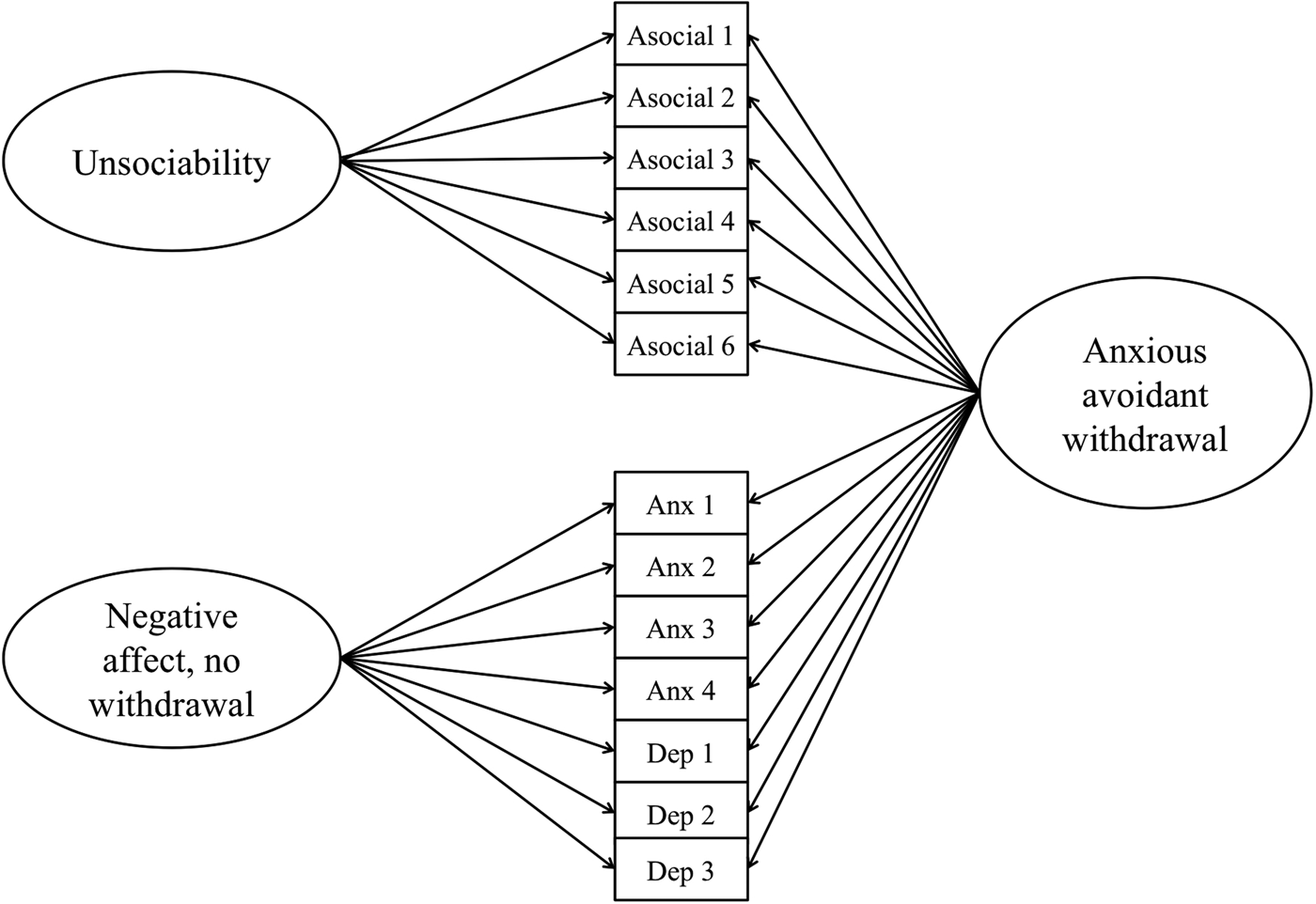
Previous work has demonstrated that shy and avoidant withdrawal during childhood and adolescence are associated with depressive and anxious symptoms (e.g., Coplan et al., Reference Coplan, Wilson, Frohlick and Zelenski2006; Coplan, Ooi, Xiao, & Rose-Krasnor, Reference Coplan, Ooi, Xiao and Rose2018b; Spangler & Gazelle, Reference Spangler and Gazelle2009). However, different subtypes of social withdrawal, such as unsociability, are not always related to depressive and anxious behavior (Coplan et al., Reference Coplan, Ooi, Xiao and Rose2018b) and negative affect can occur independent of social withdrawal. Therefore, one goal of the current study was to parse apart different facets of internalizing problems and social withdrawal. A model was specified representing the affective dimensions of social withdrawal, where items representing negative affect (i.e., anxious-fearfulness and depressed affect) and general withdrawal (i.e., asocial behavior) were partialled into specific factors and a general factor. The general factor comprised the common variance in the negative affect and withdrawal items, which theoretically represents withdrawal in the presence of negative affect, referred to as anxious-avoidant withdrawal. Furthermore, this general factor likely encompasses both shy and avoidant children, as the motivation to engage with peers is not being examined in the current study. The first specific factor represents the variance in the unique negative affect items that remains once withdrawal behavior is controlled for and therefore represents negative affect without withdrawal, or children who are high on negative affect whom do not withdraw from social interactions. The second specific factor represents the unique variance in withdrawal once negative affect is partialled out, and therefore, represents unsociability (i.e., Coplan et al., Reference Coplan, Ooi and Baldwin2018a), or children who prefer solitude but do not display negative affect (see Figure 1 for the conceptual model).
Graphical depiction of the bifactor measurement model. Anx, Anxious-fearful; Dep, Depressed affect. Anxious avoidant withdrawal (general factor) is defined as withdrawal with negative affect, Unsociability (specific factor) is defined as withdrawal without negative affect, and negative affect, no withdrawal (specific factor) is defined as negative affect without social withdrawal.

Social withdrawal and peer victimization
Broadly speaking, a key developmental task during early childhood (i.e., 3–5 years) is the initiation of peer relationships (Sroufe, Reference Sroufe2013). Further, social interactions in early childhood play a key role in developing early social and emotional skills (McClelland & Morrison, Reference McClelland and Morrison2003) and subsequent positive academic success (see Rimm-Kaufman & Pianta, Reference Rimm-Kaufman and Pianta2000). It is also the case that young children learn through play with peers and that these positive social interactions with peers predict engagement in academics and classroom learning activities (Coolahan, Fantuzzo, Mendez, & McDermott, Reference Coolahan, Fantuzzo, Mendez and McDermott2000). Thus, one of the main concerns for children who are withdrawn is the quantity and quality of their peer interactions (e.g., Rubin et al., Reference Rubin, Coplan and Bowker2009). Children who are withdrawn interact less with peers and when they do interact with peers they exhibit less social competence, are more likely to experience peer rejection (e.g., Ladd, Reference Ladd2006), and are more likely to be victims of bullying (i.e., unwanted aggressive acts involving a perceived power imbalance and repeated acts; Gladden, Vivolo-Kantor, Hamburger, & Lumpkin, Reference Gladden, Vivolo-Kantor, Hamburger and Lumpkin2014) and general peer victimization (i.e., unwanted aggressive acts without a perceived power imbalance or repetition; Ostrov, Kamper-DeMarco, Blakely-McClure, Perry, & Mutignani, Reference Ostrov, Kamper-DeMarco, Blakely-McClure, Perry and Mutignani2019; Rubin et al., Reference Rubin, Coplan and Bowker2009).
Conceptually, researchers have theorized that withdrawn children may be passive victims such that they are victims characterized by anxious and submissive behavior and low likelihood of retaliation, which makes them easy targets (Olweus, Reference Olweus1978; Perry, Kusel, & Perry, Reference Perry, Kusel and Perry1988; Rubin et al., Reference Rubin, Coplan and Bowker2009). Consistent with this conceptualization of social withdrawal and negative peer experiences, previous work has found evidence that social withdrawal is concurrently and longitudinally related to peer victimization (e.g., Boivin, Hymel, & Bukowski, Reference Boivin, Hymel and Bukowski1995; Gazelle, Reference Gazelle2006). Moreover, meta-analytic work has found that internalizing problems, including social withdrawal, are prospectively predictive of peer victimization (Reijntjes, Kamphuis, Prinzie, & Telch, Reference Reijntjes, Kamphuis, Prinzie and Telch2010).
Physical victimization (i.e., being the recipient of physical aggression, such as hitting, kicking, or threats of physical harm) and relational victimization (i.e., being the recipient of relational aggression, such as exclusion, malicious ignoring, and gossip) are relatively common in early childhood (Casas & Bower, Reference Casas, Bower, Coyne and Ostrov2018). It is important to note that there are differences in developmental manifestations of relational victimization, such that behaviors such as malicious gossip are less frequent during this developmental period relative to later developmental periods (Casas & Bower, Reference Casas, Bower, Coyne and Ostrov2018). Relational victimization is also often direct during early childhood, where behaviors such as exclusion and gossip happen right in front of the victim (Crick, Ostrov, Appleyard, Jansen, & Casas, Reference Crick, Ostrov, Appleyard, Jansen, Casas, Putallaz and Bierman2004; Ostrov, Blakely-McClure, Perry, & Kamper-DeMarco, Reference Ostrov, Blakely-McClure, Perry, Kamper-DeMarco, Coyne and Ostrov2018). In regards to physical victimization, it is not until the end of the transition to school that physical victimization drops for typically developing children (for review see Casas & Bower, Reference Casas, Bower, Coyne and Ostrov2018). Both physical and relational victimization are common peer victimization forms and have been assessed among preschoolers with some exemplars of relational aggression studied in children as young as 30 months old (Crick et al., Reference Crick, Ostrov, Burr, Jansen-Yeh, Cullerton-Sen and Ralston2006). The majority of prior work in this area has focused on middle childhood and adolescence (for review see Murray-Close, Nelson, Ostrov, Casas, & Crick, Reference Murray-Close, Nelson, Ostrov, Casas, Crick and Cicchetti2016), which is unfortunate as we have less information on the onset and initial course of peer victimization and related precursors, such as, negative affect and social withdrawal.
One criticism of prior work on social withdrawal and victimization is that the function of a child's withdrawal plays a role, such that the different subtypes of withdrawal may be related to victimization, particularly the different forms of victimization, in different ways. Children who are unsociable (i.e., withdrawal without negative affect), experience comparatively fewer negative outcomes (Bowker & Raja, Reference Bowker and Raja2011; Coplan & Armer, Reference Coplan and Armer2007; Coplan et al., Reference Coplan, Ooi, Xiao and Rose2018b). To the best of our knowledge no research has examined the subtypes of withdrawal with changes in relational and physical victimization in early childhood, but in later developmental periods, researchers have found that unsociable children are not at an increased risk for peer victimization (Ladd, Kochenderfer, Eggum, Kochel, & McConnell, Reference Ladd, Kochenderfer, Eggum, Kochel and McConnell2011; Ojanen, Findley-Van Nostrand, Bowker, & Markovic, Reference Ojanen, Findley-Van Nostrand, Bowker and Markovic2017). Importantly, consistent with Coplan et al.'s (Reference Coplan, Ooi and Baldwin2018a) theoretical model of unsociability, unsociability should have the smallest negative impact in early childhood when peers are not as integrated in children's lives, children are more ego-centric, and peer interactions are less sophisticated.
Regarding anxious-avoidant withdrawal (i.e., withdrawal with negative affect), the evidence is also mixed. In middle childhood, the related construct of shyness, which is included in the anxious-avoidant latent factor, has been found to be concurrently related to overt (i.e., physical and verbal victimization) but not relational victimization (Putallaz et al., Reference Putallaz, Grimes, Foster, Kupersmidt, Coie and Dearing2007). Another study in middle childhood found that there was a longitudinal association between shyness and victimization, but not a concurrent association, suggesting that shyness may take time to impact peer relations (Dill, Vernberg, Fonagy, Twemlow, & Gamm, Reference Dill, Vernberg, Fonagy, Twemlow and Gamm2004). Conversely, in adolescence, there is evidence that anxious withdrawal is concurrently (Markovic & Bowker, Reference Markovic and Bowker2015; Ojanen et al., Reference Ojanen, Findley-Van Nostrand, Bowker and Markovic2017), but not longitudinally related to peer victimization (Markovic & Bowker, Reference Markovic and Bowker2015). However, early childhood is a unique period for peer relations relative to middle childhood and adolescence because peer victimization is often direct in nature and is in response to what is happening immediately in the moment (Crick et al., Reference Crick, Ostrov, Appleyard, Jansen, Casas, Putallaz and Bierman2004; Ostrov et al., Reference Ostrov, Blakely-McClure, Perry, Kamper-DeMarco, Coyne and Ostrov2018). In fact, prior research has found that one of the key predictors of preschool children's victimization is playing with peers, suggesting that proximity alone is a key risk factor in being victimized (Hanish, Ryan, Martin, & Fabes, Reference Hanish, Ryan, Martin and Fabes2005). Therefore, in early childhood any form of withdrawal, regardless of affect, may be a method for avoiding victimization.
These mixed findings may partially be due to the difficulty of disentangling affect from withdrawal when examining withdrawal subtypes. Therefore, the second aim of the current study is to evaluate how the different affective dimensions of withdrawal (i.e., anxious-avoidant withdrawal, unsociability, and negative affect without withdrawal) predict changes in relational and physical peer victimization across early childhood (i.e., 3–5 years). Children's display of negative affect may be what is driving robust effects between internalizing symptoms and future peer victimization (see Reijntjes et al., Reference Reijntjes, Kamphuis, Prinzie and Telch2010 for a meta-analysis) rather than their avoidance or withdrawal. Specifically, when children with anxious avoidant tendencies approach peer interactions, their negative affect within these interactions may be driving peer victimization.
In sum, prior research has failed to disentangle affect from withdrawal, has not included both relational and physical victimization or longitudinally modeled peer victimization, and has not adequately examined these relations in early childhood. The current study remedies these prior limitations by using a bifactor model which statistically partitions the unique and general variance among withdrawal and negative affect items and examines victimization as children transition into a new classroom across early childhood. In the current study, it was hypothesized that once negative affect without avoidance is controlled, anxious-avoidant withdrawal (i.e., withdrawal with negative affect) would predict reductions in victimization over time, such that withdrawal itself is a strategy for avoiding peer victimization within early childhood. Conversely, it was hypothesized that negative affect without withdrawal would be related to increases in peer victimization over time. Finally, given the research on unsociability as a relatively benign form of withdrawal in early childhood, it was hypothesized that unsociability would be unrelated to changes in peer victimization over time.
Method
Primary sample
Participants
This study included 238 participants (56.3% boys, M age = 44.92 months, SD = 5.32 months) from two cohorts of a larger longitudinal study (see Ostrov et al., Reference Ostrov, Kamper-DeMarco, Blakely-McClure, Perry and Mutignani2019 for more information). Children were from relatively diverse backgrounds (3.3% African American, 5.9% Asian/Pacific Islander/Indian, 1.3% Hispanic/Latinx, 8.4% multiracial, 63.6% White, 17.5% missing) consistent with the larger metropolitan area from which it was drawn in the northeast United States. Children were recruited from 33 classrooms within 10 schools. Based on parent-reported demographics (e.g., family income, occupation), the sample was on average middle to upper middle class.
Procedure
Data collection began in the spring of the children's three-year-old preschool year (Time 1, T1). Observer reports of social withdrawal and anxious-fearfulness and teacher reports of depressed affect and peer victimization were collected at T1. Teacher reports of victimization were also collected in the fall (Time 2, T2) and spring (Time 3, T3) of the children's pre-kindergarten year when children were usually in a new classroom. Data collection for cohort 1 began one year prior to data collection for cohort 2. There were no differences between the two cohorts in regards to age [F(1, 236) = .02, p = .88, R 2 = .00], gender [χ 2(1) = .69, p = .41], missing data at T2 [χ 2(1) = .16, p = .69] or T3 [χ 2(1) = .31, p = .58], victimization at T1, T2, or T3 [all F values <1.05, p > .30, all R 2 < .003], or the Child Behavior Scale (CBS) asocial [F(1, 234) = .09, p = .77, R 2 = .00], CBS anxious-fearful [F(1, 234) = .24, p = .63, R 2 = .001], and Preschool Social Behavior Scale (PSBS) depressed affect [F(1, 231) = .20, p = .66, R 2 = .001] subscales at T1. See the data analysis section for information about attrition.
All children in participating classrooms were invited to participate and parents provided written consent for their children's participation prior to beginning the study. The consent rate was approximately 51% for the first cohort and 65% for the second cohort across classrooms. Head teachers provided written consent prior to report completion. This study was approved by the local institutional review board (IRB). Teachers were compensated $10–$25 dollars per time point depending on the number of reports they completed.
Measures
Observer reports
Observer ratings of behavior were used for the CBS anxious-fearful and CBS asocial subscales of the CBS (Ladd & Profilet, Reference Ladd and Profilet1996). Initially, trained undergraduate and graduate research assistants collected school-based naturalistic observations in the classroom and on the playground using a focal child sampling with continuous recording procedure (Ostrov & Keating, Reference Ostrov and Keating2004). Prior to classroom entry, observers underwent stringent training by completing readings, discussing behavior via videotape, completing six standard observation sessions using videotape, and passing a written vignette test assessing their knowledge of the constructs. Observers were trained to identify relational and physical aggression and victimization, play styles, withdrawn behavior, in addition to prosocial behavior (Ostrov & Keating, Reference Ostrov and Keating2004). Additionally, observers were trained to identify depressed/sad behaviors (i.e., cries, sulks, whimpers, tearful, unhappy, visibly looks sad), as well as adjustment more generally. Inter-observer reliability was available for a subset of participants (N = 135) and based on approximately 15% of the total sample of observations. Observers were reliable in identifying depressed/sad behaviors [intraclass correlation (ICC) = 0.77].
Typically, there were two to three observers per classroom. On average, each child had a total of 7.71 sampling sessions at the end of the two-month period and observers spent approximately nine hours a week or 72 hours total in the classroom. Therefore, observers are likely knowledgeable informants of the child's behavior. After completing behavioral sampling sessions over a two-month period, one undergraduate observer from each classroom was randomly selected to complete a set of measures for each participant that comprise the observer ratings of behavior, which are used in the present study. The undergraduate observers were not privy to the study hypotheses or predictions. Prior research has validated the use of observer reports and their high associations with teacher reports and significant overlap with the naturalistic observations (Murray-Close & Ostrov, Reference Murray-Close and Ostrov2009; Ostrov, Murray-Close, Godleski, & Hart, Reference Ostrov, Murray-Close, Godleski and Hart2013). Observers may be less biased than teachers because they are not explicitly interacting with children, and thus are not influenced by a personal relationship history with the child (Ostrov & Hart, Reference Ostrov, Hart and Little2013).
Teacher reports of victimization are used in lieu of naturalistic observations given that observations of victimization are only available at T1 and T3 and there is likely less shared method variance between observer reports, used for the bifactor model, and teacher reports, relative to observer reports and observations. Observer reports of withdrawal were used in lieu of observations because these data were not available for one cohort.
Asocial with peers and anxious-fearful, observer report
The CBS (Ladd & Profilet, Reference Ladd and Profilet1996) comprises 59 items that ask how often a child's behavior occurs towards peers and is rated on a three-point scale (1 – Doesn't apply to 3 – Certainly applies). Two of the six subscales were used in the present study: asocial with peers (six items; e.g., “prefers to play alone”) and anxious-fearful (four items; e.g., “is worried, worries about many things”). The remaining subscales (i.e., excluded by peers, hyperactive-distractible, aggressive with peers, and prosocial with peers) were not used in the present study. Prior research suggests that the subscale scores are internally consistent, relatively stable, and distinct over time (Ladd & Profilet, Reference Ladd and Profilet1996). The subscales demonstrated adequate internal consistency in this sample [CBS anxious-fearful (Cronbach's α = .66), CBS asocial (Cronbach's α = .93)].
Depressed affect, teacher report
Depressed affect was measured using teacher reports of the depressed affect subscale from the Preschool Social Behavior Scale-Teacher Form (PSBS-TF, Crick, Casas, & Mosher, Reference Crick, Casas and Mosher1997). Teacher report was used in lieu of observer report because one cohort had missing observer report data for this measure. The items were rated on a 5-point Likert scale (1 – Never or almost never true to 5 – Always or almost always true) and averaged to compute a final score. The depressed affect scale includes three items, “the child looks sad,” “the child smiles at other kids,” and “the child doesn't have much fun,” where item 2 was reverse coded. Despite acceptable reliability in prior studies (e.g., Crick et al., Reference Crick, Casas and Mosher1997; Kamper-DeMarco & Ostrov, Reference Kamper-DeMarco and Ostrov2017), the subscale had less than ideal consistency in this sample (Cronbach's α = .55). The limited number of items (i.e., three items) also likely contributed to the lower level of reliability. Given that these items were used with items from other subscales, and the reliability of the bifactor model was the more relevant indicator of reliability in the sample, these items were still retained. A final two-factor modelFootnote 1 of social-withdrawal and negative affect (i.e., depressed affect and anxious-fearful behavior), where each item loaded on only one factor, provided an acceptable fit to the data [χ 2(63) = 173.72, p < .001, CFI = .99, SRMR = .05, RMSEA = .09]. At T3, when a depressed affect teacher and observer report was available for the entire sample, the reports were significantly, albeit weakly, correlated (r = .18, p = .02), consistent with prior work examining concordance of this measure between observers and teachers (rs range from .21 to .34; Kamper-DeMarco & Ostrov, Reference Kamper-DeMarco and Ostrov2017) and similar to concordance rates between teachers and other informants in early childhood (Bayer, Sanson, & Hemphill, Reference Bayer, Sanson and Hemphill2006; Kerr, Lunkenheimer, & Olson, Reference Kerr, Lunkenheimer and Olson2007).
Physical and relational victimization, teacher report
Physical and relational victimization were measured using teacher reports of the physical and relational victimization subscales from the Preschool Peer Victimization Measure-Teacher Report Revised (PPVM-TR-R, Crick, Casas, & Ku, Reference Crick, Casas and Ku1999; Godleski, Kamper, Ostrov, Hart, & Blakely-McClure, Reference Godleski, Kamper, Ostrov, Hart and Blakely-McClure2015). Each subscale contains four questions rated on a 5-point Likert scale (1 – Never or almost never true to 5 – Always or almost always true), where responses were averaged to get a final score. Items on the physical victimization subscale contain content such as, “This child gets hit, kicked, or pinched by peers” and “This child gets toys or objects taken away by peers when they are mad at him/her.” Items on the relational victimization subscale contain content such as, “This child gets ignored by playmates when they are mad at him/her” and verbal items such as, “This child gets told ‘you can't play’ by peers when they are angry at him/her.” The subscales have demonstrated good psychometric properties in the past (e.g., Ostrov, Reference Ostrov2010) and in this sample, at T1 and T3 teacher reports of relational and physical victimization were significantly correlated with observations of relational and physical victimization (rs range from .15 to .25, ps < .05), consistent with other researchers’ concordance rates of victimization between observations and other reporters (Goodman, Stormshak, & Dishion, Reference Goodman, Stormshak and Dishion2001). Additionally, the teacher reports demonstrated good internal consistency in this sample [physical victimization at T1, T2, and T3 (Cronbach's αs > .77), relational victimization at T1, T2, and T3 (Cronbach's αs> .90)].
Validation sample
A common critique of bifactor models is reliability and replicability. To address this concern, an independent sample was used to validate the bifactor model. An additional aim of using a validation sample was to test how the teacher report items of depressed affect may have impacted the overall model fit and pattern of results in the original sample. This was accomplished by using all observer reported items in the validation sample and examining how factor loadings were different across the two models. The data have been used before in an examination of a higher order model of internalizing and externalizing behavior problems (see Perry & Ostrov, Reference Perry and Ostrov2018) but the individual items have not been of interest in previous research.
Participants
This sample included 332 participants (M age = 47.11 months, SD = 7.32 months; 47.4% girls) from three separate cross-sectional studies conducted over a four-year period. Children were from relatively diverse backgrounds (4.6% African American, 11.4% Asian/Pacific Islander/Indian, 67.3% White, 2.8% Hispanic/Latinx, 0.3% Native American, 13.6% multiracial) and the sample was on average middle class based on parent-reported demographics. One study sample was significantly older given that data were collected in the spring instead of the fall, as was the case with the other two samples [F (2, 305) = 15.53, p < .001, R 2 = .09]. Given the cross-sectional nature of the data, missing data were minimal. See Perry and Ostrov (Reference Perry and Ostrov2018) for more information regarding the sample.
Procedures
All children in participating classrooms were invited to participate and parents provided written consent for their children's participation prior to beginning the study. The consent rate was approximately 79% across the three studies. Head teachers also provided written consent prior to report completion. This study was approved by the local social and behavioral sciences institutional review board (IRB). Teachers were compensated $10–$25 dollars depending on the number of reports they completed at each time point.
Measures
Asocial with peers and anxious-fearful, observer report
The Child Behavior Scale-Observer Report (CBS-OR) was again used to measure asocial and anxious-fearful behavior with peers. The subscales demonstrated good internal consistency in this sample [CBS anxious-fearful (Cronbach's α = .82), CBS asocial (Cronbach's α = .94)].
Depressed affect, observer report
Depressed affect was measured using observer reports of the depressed affect subscale from the Preschool Social Behavior Scale-Observer Report (PSBS-OR; Ostrov, Reference Ostrov2008). The subscale was internally consistent (Cronbach's α = .79).
Data analysis
First, descriptive data of the measures were obtained, including means, standard deviations, and an analysis of outliers. An outlier was defined as any value that is greater than three standard deviations above or below the mean. Outliers were modified by adjusting the outlier value to +/− three standard deviations from the mean (Kline, Reference Kline2015). Skew statistics were assessed, where skew values ranged from 0.46 to 1.52 and kurtosis statistics ranged from – 1.08 to 1.89.
Models were tested sequentially to examine the measurement portion of the model prior to the structural portion of the model. First, all analyses were run in the primary sample in the following order: (a) a confirmatory factor analysis (CFA) of a negative affect factor comprised the depressed affect and anxiety scale was assessed, (b) the measurement invariance of the victimization measure was evaluated across time, (c) a bifactor model of social withdrawal and negative affect was estimated, (d) the full hybrid model was tested where a path analysis was specified that regressed relational and physical victimization at T2 and T3 on the bifactor model while controlling for initial levels of victimization. Second, in the validation sample, the fit of the withdrawal bifactor model was examined.
All models were estimated in Mplus version 8.3 (Muthén & Muthén, Reference Wang, Rubin, Laursen, Booth-LaForce and Rose-Krasnor1998–2019) using the weighted least squares mean and variance estimator (WLSMV) due to the categorical nature and skew of several of the indicators. The maximum likelihood with robust standard errors (MLR) estimator was used in the longitudinal measurement invariance analyses for victimization to account for any skewness. Additionally, children nested within classroom at T1 was accounted in the final hybrid model using the cluster function in Mplus. Full information maximum likelihood (FIML) was used to accommodate missing data. Due to the longitudinal nature of the study across school years (i.e., children changed schools for free or reduced cost universal pre-kindergarten programs or attended kindergarten in some cases), missing data were expected. At T2 (fall of year 2), there were missing data for 31.8% of the sample and at T3 (spring of year 2) there were missing data for 33.5% of the sample. Little's (Reference Little1988) missing completely at random (MCAR) and F tests were used to examine whether the data were MCAR or missing at random (MAR). All control and target variables were examined with the MCAR test. The MCAR test demonstrated that the data were most likely MCAR [χ 2(139) = 111.71, p = .96]. However, follow-up analyses demonstrated that the data were not MCAR, because missing data at T2 [F (1, 230) = 5.58, p = .02] and T3 were related to relational victimization at T1 [F (1, 230) = 4.63, p = .03], such that children with lower relational victimization scores at T1 were more likely to have missing data at T2 and T3. Therefore, the data are most likely MAR (Baraldi & Enders, Reference Baraldi and Enders2010). Relational victimization at T1 was already included in the model, thus ensuring that the maximum likelihood process works efficiently (Baraldi & Enders, Reference Baraldi and Enders2010).
The likelihood ratio χ2 test was used to test overall model fit where p > .05 indicates good model fit. Alternative fit indices were also used to determine model fit. Specifically, the comparative fit index (CFI), root mean square error approximation (RMSEA), and standardized root-mean-square residual (SRMR) fit indices were used. Specific cut-offs for assessing “good” fit cannot be generalized across all models (Hu & Bentler, Reference Hu and Bentler1999; Marsh, Hau, & Wen, Reference Marsh, Hau and Wen2004), therefore, ranges were used to determine the acceptability of model fit (for CFI <.90 is poor, .90 to .94 is acceptable, and >.95 is excellent; for RMSEA, .08 is poor, .05 to .07 is acceptable, and <.05 is excellent; and for SRMR > .09 is poor, .06 to .09 is acceptable, and <.06 is excellent). To test comparisons in model fit chi-square difference tests using the appropriate procedure based on the estimator were used (e.g., Satorra-Bentler scaled chi-square test statistics for MLR model comparisons; Satorra & Bentler, Reference Satorra and Bentler2010).
It is important to note that there have been important statistical and conceptual criticisms of bifactor models (e.g. Bonifay, Lane, & Reise, Reference Bonifay, Lane and Reise2017). Given these concerns, several alternative statistics were evaluated to examine the multidimensionality, reliability, and replicability of the model. Specifically, omega and omega hierarchical were used to evaluate the reliability of unit weighted composites of the specific and general factors. Explained common variance (ECV) examines the amount of extracted variance attributable to the general compared to the specific factors. ECV and percentage of uncontaminated correlation (PUC) are used together to help determine whether the data were unidimensional or multidimensional, such that as PUC increases, ECV becomes less important for determining whether there is bias in fitting the model into a unidimensional framework. Finally, construct replicability (H), was used to assess the replicability of the loadings in a SEM framework (Rodriguez, Reise, & Haviland, Reference Rodriguez, Reise and Haviland2016a, Reference Rodriguez, Reise and Haviland2016b). Values from prior research suggest that when ECV > .70 and PUC > .70 there is little bias in fitting a multidimensional model in a unidimensional manner when using SEM techniques (Rodriguez et al., Reference Rodriguez, Reise and Haviland2016a, Reference Rodriguez, Reise and Haviland2016b). Additionally, within a SEM framework researchers have set a standard value of H at .70 to ensure that a factor is represented adequately by the items (Hancock & Mueller, Reference Hancock, Mueller, Cudeck, du Toit and Sörbom2001; Rodriguez et al., Reference Rodriguez, Reise and Haviland2016a).
After assessing model fit of the bifactor model and testing for measurement invariance of victimization across time, a hybrid model (i.e., a model that comprised both the latent measurement models as well as structural paths between the bifactor model and victimization outcomes), where the victimization indicators were regressed on the bifactor model latent factors, was specified that controlled for the stability of physical and relational victimization across all three timepoints.Footnote 2 Post-hoc analyses, which can be found in the supplementary materials, were conducted to assess the robustness of the results. Specifically, both relational and physical victimization were modeled using a random-intercept cross-lagged panel model (RI-CLPM; Hamaker, Kuiper, & Grasman, Reference Hamaker, Kuiper and Grasman2015). The CLPM allows for the disaggregation of within- and between-person effects and has been argued to be a more appropriate method of accounting for across time stabilities.
Results
Preliminary analyses
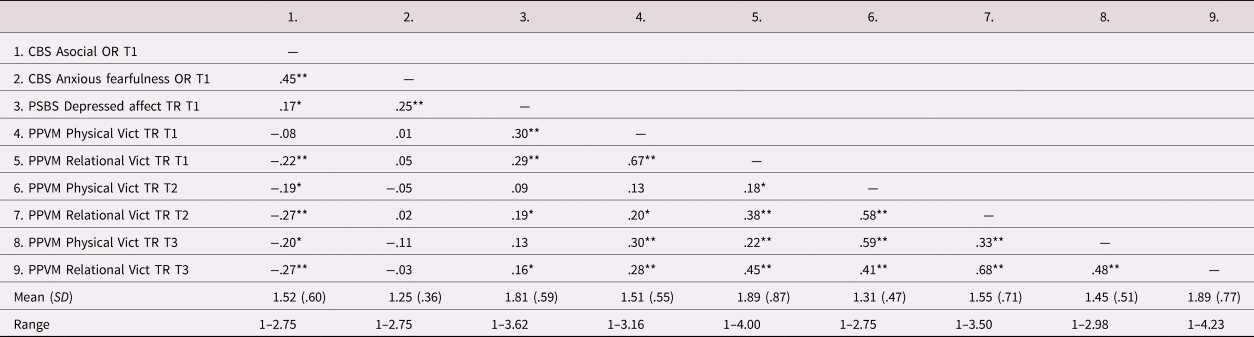
Descriptive statistics and correlations are provided in Table 1. Gender and age were considered as covariates for the hybrid model. Age was related to the CBS asocial behavior scale at T1 (r = −0.17, p = .009) but not victimization at any time point. Gender was related to physical and relational victimization at T1 and T3, such that girls had higher scores for relational victimization than boys at T1 [F (1, 229) = 8.67, p = .004, R 2 = .04] and T3 [F (1, 157) = 4.17, p = .04, R 2 = .03] and boys had higher levels of physical victimization at T2 [F (1, 161) = 10.47, p = .001, R 2 = .06] and T3 [F (1, 157) = 11.57, p = .001, R 2 = .07]. Therefore, age and gender were controlled for in the hybrid models.
Descriptive statistics and correlations of key study variables

Note: CBS, Child Behavior Scale; PSBS, Preschool Social Behavior Scale; PPVM, Preschool Peer Victimization Measure; Vict, Victimization; TR, Teacher report; OR, Observer report; T1, Time 1; T2, Time 2; T3, Time 3. T2 took place six months after T1 and T3 took place one year after T1. *p < .05, **p < .01.
Measurement invariance of victimization
Relational victimization
A configural invariance model was tested for the relational victimization subscale. The model provided a poor fit to the data [χ 2(39) = 130.17, p < .001, CFI = 0.92, SRMR = .05, RMSEA = .10]. Nested model tests supported constraining all item factor loadings [Δχ 2(6) = 2.66, p = .85], intercepts [Δχ 2(5) = 7.31, p = .20], and residual variances [Δχ 2(8) = 11.70, p = .17] to be equal across time. Therefore, the relational victimization scale demonstrated strong longitudinal measurement invariance and the final model provided an acceptable fit to the data [χ 2(58) = 144.61, p < .001, CFI = .93, SRMR = .06, RMSEA = .08].
Physical victimization
The configural invariance model for physical victimization provided an acceptable fit to the data [χ 2(39) = 74.53, p < .001, CFI = 0.95, SRMR = .06, RMSEA = .06]. Nested model tests supported constraining all item factor loadings [Δχ 2(6) = 7.53, p = .28] and intercepts[Δχ 2(8) = 8.88, p = .11] to be equal across time. Finally, constraining residual variances to be equal across time resulted in a significant decrement in model fit [Δχ 2(8) = 40.42, p < .001]. Freeing the residual variances for item 7 (“child gets things thrown at him/her”) at T2, item 4 (“child is pushed or shoved”) at T1, and item 11 (“child gets toys taken away”) at T1 resulted in a non-significant decrement in model fit [Δχ 2(5) = 6.59, p = .25]. Therefore, the physical victimization scale demonstrated partial residual invariance and the final model provided an acceptable fit to the data [χ 2(55) = 115.02, p < .001, CFI = .94, SRMR = .09, RMSEA = .06].
Measurement models
Bifactor model
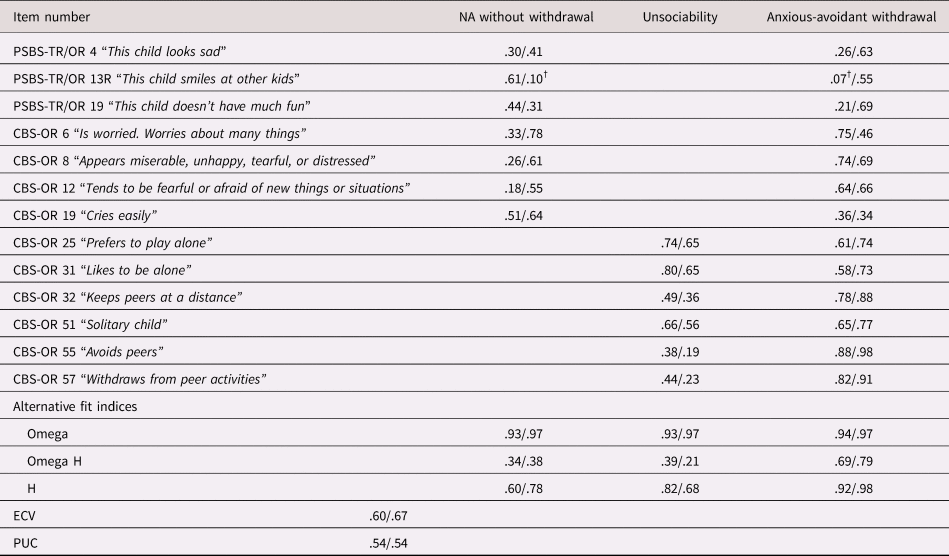
The bifactor model provided an acceptable fit to the data [χ 2(51) = 97.09, p < .001, CFI = 1.00, SRMR = .05, RMSEA = .06]. PSBS item 13 did not load significantly on the general factor (standardized loading = .07, p = .46) but all other loadings were significant. Loadings ranged from .07 to .88 for the anxious-avoidant withdrawal general factor (M factor loading = .57), .18 to .61 for the negative affect without withdrawal specific factor (M factor loading = .38), and .38 to .80 for the unsociability specific factor (M factor loading = .59). The standardized factor loadings and alternate fit statistics are shown in Table 2. The alternate fit indices suggest that most of the reliable variance was in the anxious-avoidant general factor, and that the unsociability and anxious-avoidant factors would be well replicated in a Structural Equation Modeling (SEM) framework. ECV and PUC values suggest that there may be some bias in fitting this model into a unidimensional framework and therefore, negative affect and social withdrawal may be better represented multidimensionally.
Standardized factor loadings and alternative fit indices for the social withdrawal bifactor model
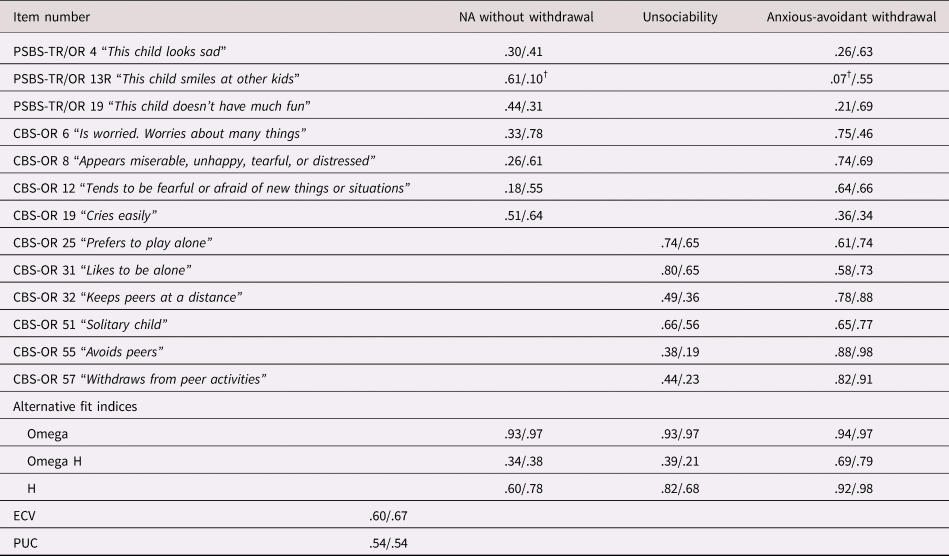
Note: CBS, Child Behavior Scale; PSBS, Preschool Social Behavior Scale. The primary sample statistics are on the left of the diagonal and the validation sample statistics are on the right of the diagonal. In the primary sample teacher report of the PSBS was used and in the validation sample observer report of the PSBS was used. All standardized factor loadings are significant at p < .05 unless indicated by a † (i.e., p > .05). OR, observer report; TR, teacher report; R, reverse coded; ECV, explained common variance; PUC, percentage uncontaminated correlations. Omega and Omega H are indices of factor reliability, H is a measure of construct replicability. Anxious-avoidant withdrawal is the general factor, and the unsociability and negative affect without withdrawal factors are the specific factors.
Bifactor model validation sample
In the validation sample, the bifactor model provided an acceptable fit to the data [χ 2(52) = 193.92, p < .001, CFI = 0.99, SRMR = .04, RMSEA = .09]. PSBS item 13 did not load significantly on the specific negative affect factor (loading = .10, p = .14) but all other factor loadings were significant. Loadings ranged from .34 to .98 for the anxious-avoidant withdrawal general factor (M factor loading = .70), .10 to .78 for the negative affect without withdrawal specific factor (M factor loading = .49), and .19 to .65 for the unsociability specific factor (M factor loading = .44). The standardized factor loadings and alternate fit statistics are shown in Table 2. Values were similar to those in the primary sample with the exception of the PSBS items. In the primary sample, teacher report was used for the PSBS and observer report was used for all other items and in the validation sample observer report was used for all measures including the PSBS. Therefore, as expected, results suggest that the factor loadings were stronger for the PSBS items in the validation sample given that there is shared measurement variance between the PSBS and the other items.
In sum, across samples, a bifactor model appeared to fit the data well. Moreover, alternative fit statistics demonstrated that there may be some bias in fitting the social withdrawal and negative affect items in a unidimensional manner, providing evidence for the multidimensional nature of social withdrawal. Finally, there were concerns about how the teacher report of the PSBS may influence results in the primary sample, but based on the pattern of factor loadings across samples it appears that the unsociability and anxious-avoidant factor loadings are similar adding support to the generalizability of those factors.
Hybrid model
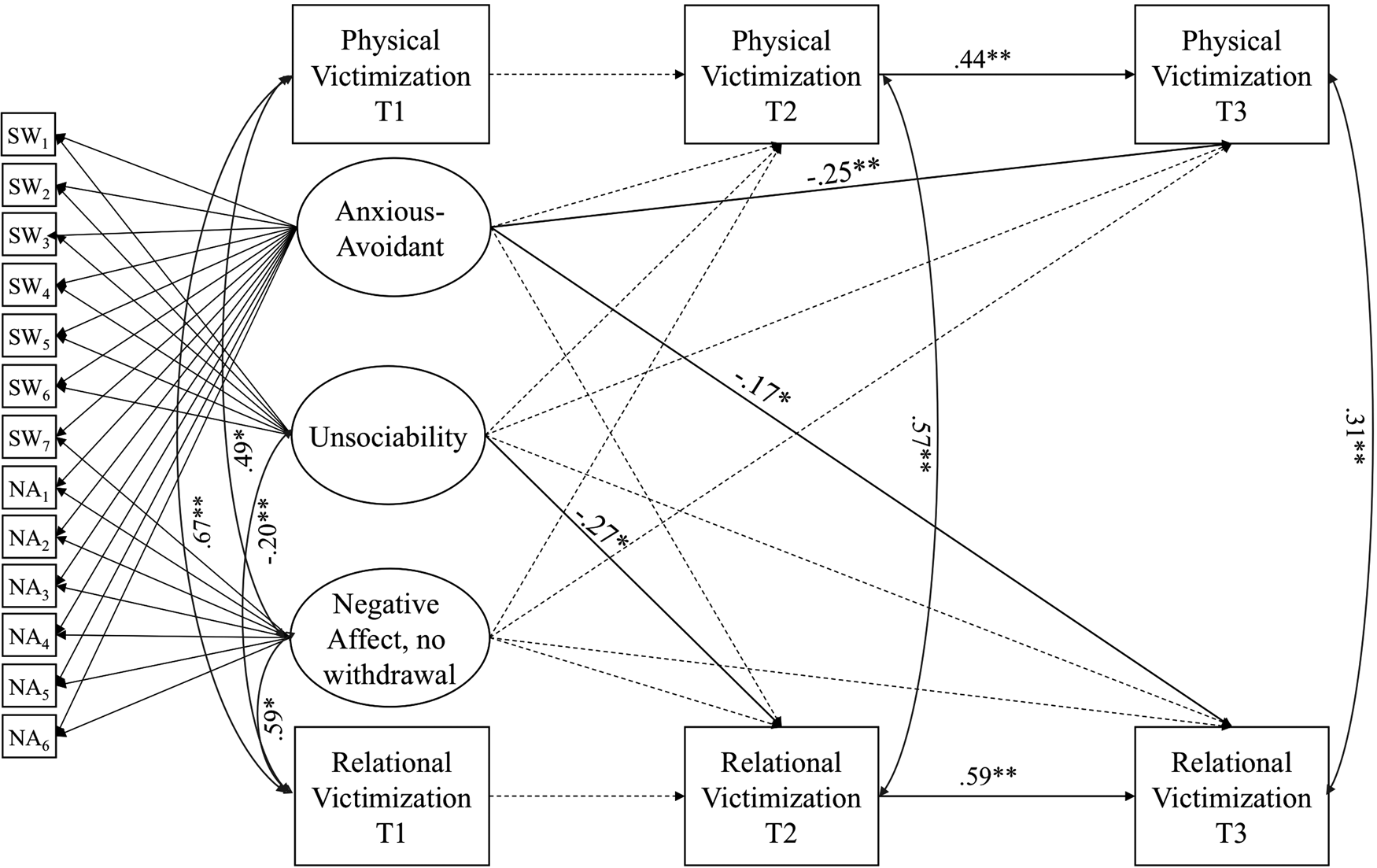
The final hybrid model controlling for children nested within classrooms at T1, provided an acceptable fit to the data [χ 2(139) = 167.83, p = .05, CFI = 1.00, SRMR = .07, RMSEA = .03]. To be consistent with the RI-CLPM (analyses located in the supplementary materials), no cross-lagged paths between relational and physical victimization were estimated. See Figure 2 for significant standardized factor loadings. Older children had lower levels on the unsociability specific factor (β = −.21, p = .003). Relative to boys, girls had significantly lower levels on the unsociability specific factor (β = −.20, p = .02) and T2 physical victimization (β = −.25, p = .002), and had significantly higher levels of T1 (β = .19, p = .001) and T3 (β = .15, p = .047) relational victimization. As seen in Figure 2, stabilities for relational victimization were not significant from T1 to T2 (β = .10, p = .42) but were significant from T2 to T3 (β = .59, p < .001). The stability for physical victimization was not significant from T1 to T2 (β = .04, p = .70) but was significant from T2 to T3 (β = .44, p < .001). T1 covariances indicated that higher levels on the unsociability specific factor were associated with lower levels of relational victimization (r = −.20, p = .03). Higher levels on the negative affect without withdrawal specific factor at T1 were associated with both higher levels of relational (r = .59, p = .005) and physical (r = .49, p = .02) victimization at T1. The anxious-avoidant general factor was not significantly associated with physical or relational victimization at T1 or T2. In contrast, the anxious-avoidant general factor was prospectively associated with lower levels of T3 relational victimization (β = −.17, p = .04) as well as lower levels of T3 physical victimization (β = −.25, p = .004). The unsociability specific factor was prospectively associated with lower levels of T2 relational victimization (β = −.27, p = .04). The negative affect specific factor was not significantly associated with physical or relational victimization at either T2 or T3.
Final hybrid model between bifactor model of the affective dimensions of withdrawal and physical and relational victimization. *p < .05, **p < .01, **p < .001. NA, negative affect; SW, social withdrawal; T, time. Significant paths are indicated by solid lines and standardized parameter estimates. Non-significant estimated paths are indicated by dashed lines. Pathways including gender and age are not included to reduce figure complexity. Within time covariances between anxious-avoidant withdrawal, unsociability, and NA no withdrawal are constrained to zero consistent with a bifactor model conceptualization.

In sum, at T1 unsociability was negatively associated with relational victimization and negative affect without withdrawal was positively associated with relational and physical victimization. Across time, anxious-avoidant withdrawal at T1 was predictive of lower levels of relational and physical victimization at T3 and unsociability at T1 was predictive of lower levels of relational victimization at T2.
Discussion
One goal of the current study was to examine and replicate a bifactor model of affective withdrawal in early childhood. The bifactor model comprised a general factor labeled “anxious-avoidant withdrawal,” characterized by withdrawal from peer interactions with negative affect, a specific factor labeled “unsociability,” characterized by withdrawal from peer interactions without negative affect, and a specific factor labeled “negative affect without withdrawal,” characterized by approach in peer interactions with high levels of negative affect. The bifactor model fit the data well in the primary and validation samples and there was some evidence of multidimensionality based on the alternative fit statistics.
The second aim of the current study was to evaluate how the different affective dimensions of withdrawal predict relational and physical victimization over time as children enter a new peer group and then remain in that peer group. Given that path analysis techniques were used, results reflect changes in children's relative standing in victimization over time rather than within level change. Results demonstrated that negative affect without withdrawal was associated with higher initial levels of physical and relational victimization but not changes over time. Unsociability (i.e., withdrawal without negative affect) was predictive of decreases in relative standing in relational peer victimization when children enter a new classroom (T1 to T2). Conversely, anxious avoidant withdrawal was predictive of decreases in relational and physical victimization as children remain in a classroom after controlling for their initial entry into the new peer group (T2 to T3).
Negative affect without withdrawal was associated with higher initial levels of physical and relational victimization but not changes in children's victimization over time in either model. In early childhood, social interactions are less coordinated and complex and more focused on the here and now rather than a history of prior peer interactions (Crick et al., Reference Crick, Ostrov, Appleyard, Jansen, Casas, Putallaz and Bierman2004; Rubin, Coplan, Chen, Buskirk, & Wojslawowicz, Reference Rubin, Coplan, Chen, Buskirk, Wojslawowicz, Bornstein and Lamb2005). Therefore, current negative affect may be more influential in predicting current victimization than future victimization. Additionally, the negative affect specific factor had the lowest level of reliability and replicability and the lowest mean standardized factor loading across the items which may be influencing our power to detect effects.
Theoretical conceptualizations of unsociability posit that an affinity for solitude that does not derive from negative emotion or external circumstances may not be problematic in early childhood when solitary play is common (Coplan et al., Reference Coplan, Ooi and Baldwin2018a). It was hypothesized that unsociability would be unrelated to victimization over time. However, results suggest that in fact unsociability may be protective against relational victimization as children enter a new peer group. As children become acclimated into the new peer group, unsociability appears to have no subsequent impact on relational victimization. Given that solitary play is common in early childhood and victimization often occurs as a function of proximity (Hanish et al., Reference Hanish, Ryan, Martin and Fabes2005; Rubin et al., Reference Rubin, Coplan, Chen, Buskirk, Wojslawowicz, Bornstein and Lamb2005) unsociability may be protective because it reduces the number of interactions a child has with peers, thus reducing the likelihood of them experiencing victimization when they enter a peer group. However, given that unsociability is not strongly associated with negative outcomes/peer difficulties, unsociable children may begin to have more interactions with peers as social networks become more concrete later in the year (Gifford-Smith & Brownell, Reference Gifford-Smith and Brownell2003). In turn, this increase in peer interactions may explain why there is not a subsequent decrease in peer victimization at the end of the school year (i.e., no relation between unsociability and T3 relational victimization).
Finally, anxious-avoidant withdrawal (i.e., withdrawal characterized by negative affect), was predictive of reductions in children's relative standing in relational and physical victimization as children become acclimated to a new peer group. Interestingly, in contrast to unsociability, there was no relation between anxious-avoidant withdrawal and victimization when children enter a new peer group. Prior research has found that avoidance is more strongly related to shyness, similar to anxious withdrawal in the current study (r = .52, p < .001), than unsociability (r = .31; Coplan, Ooi, Xiao, & Rose-Krasnor, 2016), which may explain why unsociability is related to decreases in victimization from T1 to T2 but not T2 to T3, when anxious-avoidance becomes a stronger predictor of decreases in victimization due to avoidance. These reductions in peer victimization may be a function of anxious-avoidant children changing their behavior in the classroom over time, peers changing their behavior towards anxious-avoidant children, or a combination of both. Prior research has found that temperamental traits related to shyness display moderate stability over time, and shyness itself increases within early childhood (Degnan & Fox, Reference Degnan and Fox2007; Karevold, Ystrom, Coplan, Sanson, & Mathiesen, Reference Karevold, Ystrom, Coplan, Sanson and Mathiesen2012). Given this research and the importance of proximity in victimization in early childhood, anxious-avoidant children may be increasing their avoidance of peers in the classroom over time, thus reducing their overall peer interactions, and their opportunities for peer victimization. Congruent with this hypothesis, prior research has found that in middle childhood to adolescence, children who experience early peer victimization (i.e., trajectory started with high levels of peer victimization which became lower over time), had lower levels of social anxiety in kindergarten compared to children who had low peer victimization (i.e., continuous low levels of victimization; Ladd, Ettekal, & Kochenderfer-Ladd, Reference Ladd, Ettekal and Kochenderfer-Ladd2019). Additionally, those who experienced chronic victimization (i.e., continuous high levels of victimization) experienced an increase in preference for solitude over time (Ladd et al., Reference Ladd, Ettekal and Kochenderfer-Ladd2019). This suggests that low social anxiety or low approach behavior, puts individuals at risk for victimization potentially through proximity, but then their experience of victimization may lead to avoidance of future peer interactions.
Moreover, peers may also change how they respond to anxious-avoidant children over time. Specifically, peers may find interactions with anxious-avoidant children to be less reinforcing and thus may start to avoid or exclude peers (i.e., peer neglect, peer exclusion; Rubin et al., Reference Rubin, Coplan and Bowker2009). This neglect or exclusion may also lead to a reduction in overall peer interactions and thus a reduction in peer victimization. It should be noted that even though anxious-avoidant withdrawal was related to lower levels of victimization, it is still associated with many other negative psycho-social outcomes (Rubin et al., Reference Rubin, Coplan and Bowker2009).
Currently, there are parent interventions (Rapee, Kennedy, Ingram, Edwards, & Sweeney, Reference Rapee, Kennedy, Ingram, Edwards and Sweeney2005), parent–child dyad interventions (e.g., Parent Child Interaction Therapy for separation anxiety; Choate, Pincus, Eyberg, & Barlow, Reference Choate, Pincus, Eyberg and Barlow2005), and child-focused interventions that work with young children in the peer group (e.g., Social Skills Facilitated Play program; Coplan, Schneider, Matheson, & Graham, Reference Coplan, Schneider, Matheson and Graham2010) to address social withdrawal, social anxiety, and shyness in young children. Given the complex factors that contribute to social withdrawal, particularly with avoidance (e.g., parents, peers, physiology, temperament) researchers have called for dynamic interventions that include parent and child components (Chronis-Tuscano, Danko, Rubin, Coplan, & Novick, Reference Chronis-Tuscano, Danko, Rubin, Coplan and Novick2018). Moreover, it is important for clinicians to accurately conceptualize the function of a child's peer problems (e.g., negative affect within peer interactions, avoidance of peer interactions), identify the function of children's withdrawal, and understand how this may be reinforcing their avoidance of peer interactions. For example, results from the current study suggest that unsociability may be relatively benign in early childhood consistent with theoretical conceptualization of unsociability (Coplan et al., Reference Coplan, Ooi and Baldwin2018a), and therefore monitoring of an unsociable child's behavior may be appropriate to ensure that they do not develop avoidance. Clinicians and researchers should take a developmentally informed approach to social withdrawal, as the different subtypes of social withdrawal have different impacts on peer behavior throughout childhood and adolescence (Coplan et al., Reference Coplan, Ooi and Baldwin2018a; Rubin et al., Reference Rubin, Coplan and Bowker2009). Importantly, even though results showed that unsociability and anxious-avoidant withdrawal were related to lower levels of victimization in our sample in early childhood, in later developmental periods when aggressors seek out victims, withdrawal may become a risk factor for victimization (Boivin et al., Reference Boivin, Hymel and Bukowski1995).
Limitations and future directions
Despite the novelty of the work and longitudinal nature of the data, there are limitations to the current study. Bifactor models are a statistically advantageous method for studying unique facets of behavior but they may have limited practical or applied use because in reality variability in behavior cannot be statistically partialled apart (Underwood, Reference Underwood2003). Additionally, observer and teacher reports of negative affect and social withdrawal were used, and reliability was not ideal for these subscales in the primary sample, although results were replicated in the validation sample with reliable indices. Teacher and observer reports of depressed affect were significantly but weakly correlated in the primary sample. This is consistent with other research that has examined concordance rates in this age range (Bayer et al., Reference Bayer, Sanson and Hemphill2006; Kerr et al., Reference Kerr, Lunkenheimer and Olson2007) and is likely a reflection of the difficulties of evaluating internalizing problems in this developmental period. Future work should replicate these findings using naturalistic observational methods of social withdrawal during early childhood. Finally, in the current study we were not able to evaluate mechanisms, such as social avoidance, to explain why unsociability and anxious-avoidant withdrawal are related to decreases in peer victimization at certain time points. Future research should focus on delineating these mechanisms, which may identify important avenues for intervention. Additionally, moderators such as, peer acceptance, may play an important role in determining how unsociability is related to socio-emotional outcomes in early childhood (Sette, Zava, Baumgartner, Baiocco, & Coplan, Reference Sette, Zava, Baumgartner, Baiocco and Coplan2017).
The use of a validation sample is a strength of the current study, but the same measures were used across the validation and primary samples. Future work should examine a bifactor model using different measures of negative affect and social withdrawal. Regarding victimization, correlations were low between Time 1 and Time 2 which impeded our ability to model latent growth trajectories. Moreover, based on the means of the victimization measure, a quadratic model appeared to fit the data best, which we were unable to test because there were only three time points of data. Future research should examine trends of victimization across early childhood using more than three measurement time points. Future work can also examine a broader construct of verbal victimization as verbal threats were only included in the current study if they were threats related to the relationship.
Finally, this study was limited to early childhood and children enrolled in preschool, suggesting that results may not be generalizable to children in other developmental periods or children who do not attend preschool. Moreover, parents with more education are more likely to send their children to preschool (National Center for Education Statistics, 2019), suggesting that a preschool sample may be less generalizable towards families with less education. Therefore, future research should evaluate the importance of developmental factors in the social consequences of withdrawal, and examine the antecedents of social withdrawal across developmental periods, particularly across transition periods, such as the transition to kindergarten.
Conclusion
The goal of the current study was to test a bifactor model of the affective dimensions of social withdrawal and examine how these dimensions are related to subsequent peer victimization. The bifactor model comprised a general factor of anxious avoidant withdrawal (i.e., withdrawal with negative affect), a specific factor of unsociability (i.e., withdrawal without negative affect), and a specific factor of negative affect without withdrawal fit the data well. The model was replicated in a validation sample. When examining relations with peer victimization, negative affect without withdrawal was concurrently positively associated with physical and relational victimization, unsociability was negatively related to relational victimization from T1 to T2 as children enter a new peer group, and anxious-avoidant withdrawal was negatively related to both forms of victimization from T2 to T3 as children are acclimated to their new peer group. Overall, results suggest that in early childhood negative affect may be related to higher levels of victimization whereas withdrawal may be protective against peer victimization.
Supplementary material
The supplementary material for this article can be found at https://doi.org/10.1017/S0954579420000346
Acknowledgments
We thank the PEERS project staff, Dr. Dianna Murray-Close for intellectual contributions, and the participating families for their contributions and support of this project. We would like to thank Dr. Craig Colder for statistical consultation, Dr. Sarah Blakely-McClure, Dr. Kimberly Kamper-DeMarco, Lauren Mutignani, Sarah Probst, and Samantha Kesselring for data collection and coordination, Phoebe Lippe for reference checking, and Gretchen Perhamus for editing. Research reported in this publication was supported by the National Science Foundation (BCS-1450777) to the fourth author and manuscript preparation for both the first and fourth authors was supported by Eunice Kennedy Shriver National Institute of Child Health and Human Development grant to the fourth author (R01HD095832). Additionally, preparation of the manuscript was supported by the National Institute of Alcohol Abuse and Alcoholism (F31AA025521) awarded to the second author. The content is solely the responsibility of the authors and does not represent the official views of the National Science Foundation or the National Institutes of Health.