Introduction
The emission of volatile pheromones is associated with calling behaviour in several species of Cerambycidae (Coleoptera). Two types of calling behaviour have been reported, both of which are associated with the presence of pheromone-producing glands (Hanks and Millar Reference Hanks and Millar2016). Male Neoclytus acuminatus acuminatus (Fabricius) (Coleoptera: Cerambycidae) emits an aggregation pheromone while elevating the body above the host substrate by extending the legs. This posture is maintained for as long as 30 minutes (Lacey et al. Reference Lacey, Ginzel, Millar and Hanks2004). A similar behaviour was also documented in Tetropium fuscum (Fabricius) (Coleoptera: Cerambycidae) (Lemay et al. Reference Lemay, Silk and Sweeney2010). The release of the male-produced pheromone ([2S,3S]-hexanediol) in N. acuminatus acuminatus is associated with this calling behaviour (Lacey et al. Reference Lacey, Moreira, Millar, Ray and Hanks2007a, Reference Lacey, Ray and Hanks2007b). Ray et al. (Reference Ray, Lacey and Hanks2006) suggested that this calling behaviour may be common among the Cerambycinae (Coleoptera: Cerambycidae) due to the presence of similar male-specific gland pores on the prothoraces of another 48 cerambycine species. In the Prioninae (Coleoptera: Cerambycidae), the females of some species exhibit a different type of calling behaviour. The females of Prionus californicus Motschulsky (Coleoptera: Cerambycidae) extend the ovipositor while lowering the head and raising the abdomen (Barbour et al. Reference Barbour, Cervantes, Lacey and Hanks2006; Cervantes et al. Reference Cervantes, Hanks, Lacey and Barbour2006; Rodstein et al. Reference Rodstein, McElfresh, Barbour, Ray, Hanks and Millar2009). This behaviour persists for up to 10 minutes and it is sometimes associated with the extrusion of an eversible sac emerging along with the ovipositor. A volatile sex pheromone was extracted from the ovipositor, supporting the conclusion that the function of the calling behaviour is to release pheromone (Cervantes et al. Reference Cervantes, Hanks, Lacey and Barbour2006; Rodstein et al. Reference Rodstein, McElfresh, Barbour, Ray, Hanks and Millar2009). Similar behaviour in association with releasing volatile sex pheromones was also found in females of other prionines (Benham and Farrar Reference Benham and Farrar1976; Gwynne and Hostetler Reference Gwynne and Hostetler1978; Paschen et al. Reference Paschen, Schiff and Ginzel2012).
The Asian longhorned beetle, Anoplophora glabripennis (Motschulsky) (Coleoptera: Cerambycidae), is originally distributed in East Asia and is now an invasive species on three continents owing to international trade (Lingafelter and Hoebeke Reference Lingafelter and Hoebeke2002; Haack et al. Reference Haack, Herard, Sun and Turgeon2010). A. glabripennis is a broadly polyphagous wood borer of broad-leaf trees, with tree species from at least 15 families as hosts (Haack et al. Reference Haack, Herard, Sun and Turgeon2010). Newly hatched A. glabripennis larvae initially feed in the cambium and then bore into the xylem, where the most serious damage occurs due to the loss of structural integrity and disruption of nutrient transport that finally leads to the death of the infested branches or even whole trees (Morewood et al. Reference Morewood, Neiner, McNeil, Sellmer and Hoover2003). In addition to the direct damage caused by A. glabripennis, infested trees are vulnerable to further infestation by other secondary pests exploiting the weakened host defences (Luo et al. Reference Luo, Huang and Li2000). The infestation of A. glabripennis, following the weakening of plantations caused by soil water insufficiency, has seriously damaged forested ecosystems and destroyed large-scale afforestation efforts in arid and semiarid regions of China (Gao and Li Reference Gao and Li2001; Cao Reference Cao2008).
Three male-produced (4-(n-heptyloxy) butanal, 4-(n-heptyloxy) butanol, and (3E,6E)-α-farnesene) and one female-produced (a blend of three aldehydes) putative volatile pheromone components have been identified in A. glabripennis (Zhang et al. Reference Zhang, Oliver, Aldrich, Wang and Mastro2002; Wickham et al. Reference Wickham, Xu and Teale2012; Crook et al. Reference Crook, David and Mastro2014). However, the mating system of A. glabripennis is still poorly understood. Identifications of some cerambycid pheromone components associated with the studies on calling behaviour described above may provide us new insights into unknown pheromones and improved understanding of mating behaviour in A. glabripennis. Lu et al. (Reference Lu, Zhang and Zhang1998) observed that female A. glabripennis often extruded their ovipositor, resembling the calling behaviour of female prionines, which suggests that genital extrusion may be a calling behaviour in A. glabripennis adult females. Nevertheless, more complete understanding (i.e., frequency, duration, triggers, and behavioural functions) of this behaviour is needed.
In this study, we investigated whether (1) genital extrusion is a common behaviour in adult female A. glabripennis and is affected by factors including temperature and posteclosion feeding, and (2) male adults respond to the volatiles from either live females or female genital extracts. In phytophagous insects, host plants or their volatiles may stimulate pheromone production, stimulate calling behaviour, or enhance insect responses to pheromones (McNeil and Delisle Reference McNeil and Delisle1989; McNeil Reference McNeil1991; Landolt and Phillips Reference Landolt and Phillips1997). Thus, all of our observations and bioassays were conducted in the presence of host plants. Our findings suggest a calling function of genital extrusion and the presence of volatile sexual attractants associated with the genitalia of female A. glabripennis.
Materials and methods
Source of insects
Adult A. glabripennis were obtained from the Sarkaria Arthropod Research Laboratory at Cornell University, Ithaca, New York, United States of America. Males were stored in the Sarkaria Arthropod Research Laboratory or transported under permit to the laboratory at the State University of New York, College of Environmental Science and Forestry in Syracuse, New York, United States of America. Females were used only in the Sarkaria Arthropod Research Laboratory. Anoplophora glabripennis were sexed during the pupal stage according to antennal length. After eclosion, beetles were individually kept in 500-mL plastic cups in an environmental chamber at 23 °C and on a 16:8 (light:dark) photoperiod in the Sarkaria Arthropod Research Laboratory or at ambient room temperature on a 14:10 (light:dark) photoperiod at the State University of New York. Three to four striped maple twigs (Acer pensylvanicum Linnaeus (Sapindaceae), 2–10 mm diameter × approximately 8 cm long) were supplied as food for each beetle, and replaced weekly. To investigate the influence of posteclosion feeding on genital extrusion, some females were not fed after emergence. Beetle ages were approximated as three-day ranges because newly emerged adults were retrieved every three days at the Sarkaria Arthropod Research Laboratory.
Observations of adult Anoplophora glabripennis genital extrusion
The behaviour of five adult virgin females (20–31 days posteclosion) or five adult virgin males (30–35 days posteclosion) were simultaneously observed. Beetles were individually kept in containers as described above and provided with fresh striped maple twigs ad libitum. Observations were carried out for three hours between 10:00 and 16:00 for three days at room temperature (23–27 °C) during photophase (light:dark, approximately 14:10 hours). The same observer recorded the times of genital extrusion by each beetle and timed the duration of each extrusion by using a digital timer.
Factors affecting genital extrusion
Temperature
The behaviour of four virgin females (15–18 days old) was observed simultaneously in the Sarkaria Arthropod Research Laboratory for three hours between 12:00 and 15:00 at 32–34 °C. All other conditions were as described previously. The number of times and the duration of genital extrusion by each female were recorded following the same method described above.
Age
The behaviour of eight virgin females respectively at (1) 7–9, (2) 15–17, (3) 22–24, and (4) 32–34 days posteclosion was observed for three hours between 10:00 and 16:00 for three days at room temperature (23–27 °C) during photophase (light:dark, approximately 14:10 hours). Four females were observed at once. The times of genital extrusion by each female and the duration of each extrusion was recorded following the same method described above.
Feeding
The behaviour of eight unfed virgin females (7–9 days posteclosion) was observed for three hours between 12:30 and 15:30 under room light and temperature (approximately 25 °C) in the Sarkaria Arthropod Research Laboratory. Four females were observed at once. In order to provide the same environmental conditions and cues as those during observation of females fed with host twigs (above), fresh striped maple twigs were placed in the beetle containers when observations commenced.
Male response to live female volatiles
We observed the behaviour of male A. glabripennis adults elicited by the volatiles from live female adults. One male and one female were respectively put in two 500-mL glass flasks with fresh striped maple twigs. Polytetrafluoroethylene (PFTE) tubing was used to connect two flasks with a charcoal-filtered air flow (500 mL/minute) from the flask containing the female to the flask containing the male. Paperboard (40 × 30 cm2) was placed between the two flasks to obstruct visual cues (Fig. 2A). One male and one female were observed at a time. A total of four males (30–45 days posteclosion) and four females (35–45 days posteclosion) were observed for two hours between 9:00 and 16:30 under fluorescent light at 22–25 °C in the Sarkaria Arthropod Research Laboratory. The number of female genital extrusions and the duration of each were recorded while male behaviour was observed. The behaviour of the same males in response to volatiles from striped maple twigs was also recorded using the same method.
Olfactometer assays
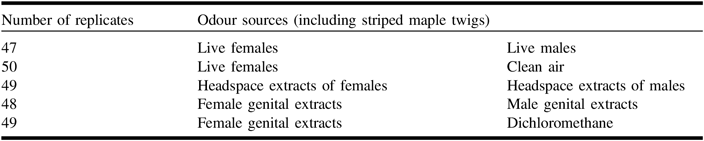
We conducted two-choice assays using a Y-tube olfactometer to assess male responses to different pairs of odour stimuli, with one male per replicate (shown in Table 1). All the stimuli were combined with volatiles from fresh striped maple twigs to allow for potential synergistic effects (Landolt and Phillips Reference Landolt and Phillips1997).
Odour stimulus and numbers of replicates tested in two-choice Y-tube olfactometer assays.

Extruded female genitalia were rapidly excised with clean forceps and microdissection scissors. The excised genitalia were individually extracted in 500-μL dichloromethane in a 2.0-mL amber glass vial for 24 hours. Extracts were then concentrated to 100 μL under a stream of nitrogen and stored at −5 °C until use. Male genitalia were pulled with forceps and excised, and then individually extracted as described above for female genital extraction. To collect headspace odours of live beetles, charcoal-filtered air was pulled (500 mL/minute) through stoppered 2-L glass Erlenmeyer flasks containing individual beetles and striped maple twigs for 24 hours. Volatile chemicals were collected in Porapak Q adsorbent traps (200 mg; Sigma-Aldrich, St. Louis, Missouri, United States of America) secured in glass tubes by glass wool plugs. Trapped volatiles were eluted from the adsorbent with 0.5-mL dichloromethane. All samples were stored at −5 °C until future use.
A Y-shaped glass olfactometer (main arm: 28 cm length × 6 cm internal diameter; two choice arms: 22 cm length × 6 cm internal diameter, 70º between arms) was placed on a table with an approximately 15º upward slant toward the arms under a 500-W halogen lamp centred above. Two 250-mL glass Erlenmeyer flasks containing odour sources were connected to the ends of choice arms with polytetrafluoroethylene tubing. Charcoal-filtered, humidified air (1000 mL/minute) was pushed into the Erlenmeyer flasks. Visual cues were obstructed by encircling the olfactometer with three pieces of brown paperboard (70 cm length × 60 cm width) in all directions except the main arm. A single virgin male was placed into the Y-tube through the hole at the end of the main arm. After a male walked to the end of the choice arm within 20 minutes, it was scored as a positive response to the stimuli. Beetles that failed to reach the end of either arm within 20 minutes were recorded as no responses. Only one pair of stimuli was tested per day. The orders of stimuli and males were both random. The males were used once per day, and most were re-used in the trials for a different pair of stimuli on different days due to limited numbers of males that were available. None of the males were re-tested for the same pair of stimuli. Single females or males used as odour sources were replaced every 10 trials; fresh extracts or dichloromethane were loaded on filter paper (1 × 1 cm2) for each assay. The olfactometer was cleaned with acetone and dried at room temperature after every second assay. The olfactometer arms and the odour stimuli were physically alternated after every assay, to prevent potential position effects. All tests were performed between 09:00 and 17:00 at 25–30 ºC and 60–70% relative humidity inside the olfactometer. All A. glabripennis used in the assays were virgin, 20–40 days old and fed on striped maple twigs after emergence. Host twigs were refreshed daily.
Statistical analyses
Because both raw and transformed data of the frequencies of female genital extrusion failed to meet the assumption of normality, Kruskal–Wallis one-way analysis of variance was applied to examine the differences among different age groups. The log-transformed duration of female genital extrusion in different age ranges was normally distributed and homoscedastic, and was thus analysed for significant difference with one-way analysis of variance followed by Bonferroni-adjusted multiple comparisons. For laboratory assays, since data were not normally distributed, binomial tests were performed to compare the numbers of male A. glabripennis, which made choices between two odour stimuli, with the expected value as 0.5. All analyses were conducted using SAS 9.4 (SAS Institute 2011).
Results
Observations of adult Anoplophora glabripennis genital extrusion
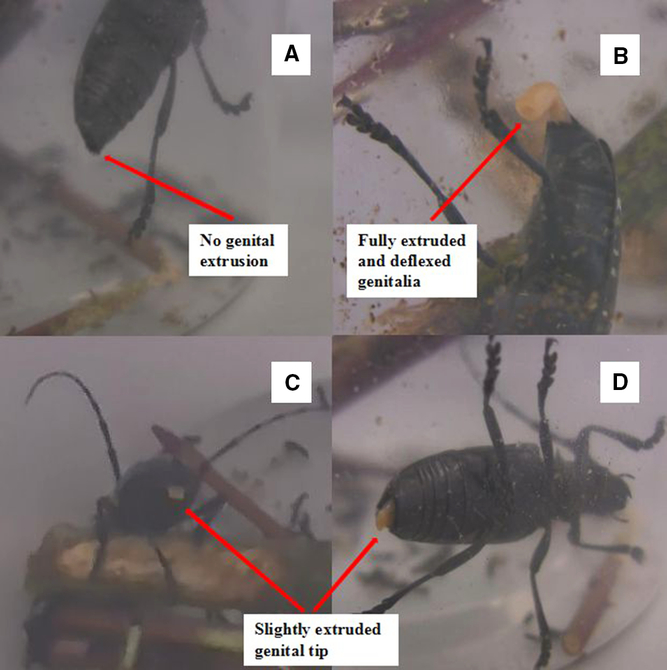
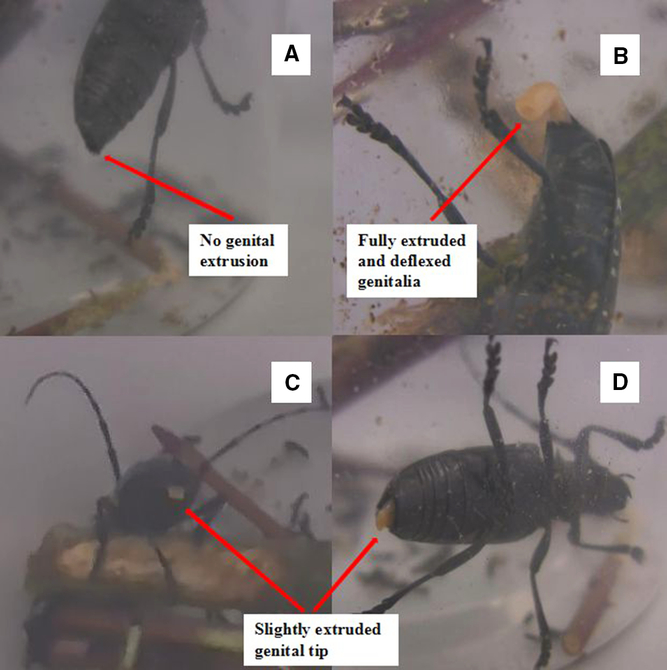
Females periodically extruded their genitalia beyond the abdominal tip, usually with the abdomen slightly raised. Based on the degree of genital extrusion, this behaviour could be categorised into two types: (1) genital tip slightly extruded (approximately 1–2 mm; Type I; Fig. 1C–D) and (2) genitalia fully extruded ( > 5 mm) and deflexed (Type II; Fig. 1B). Some females were feeding on twigs (Fig. 1C) or slowly moving (Fig. 1D) while performing Type I, but all females that were performing Type II remained motionless. All female A. glabripennis were observed to extrude their genitalia, whereas no male was observed to perform this behaviour. Each female extruded its genitalia for an average of 2 ± 1.07 times, and lasted for 85 ± 87.47 seconds (range from 5–354 seconds) on average, during each three-hour observation period.
Genital extrusion of Anoplophora glabripennis female (20–31 days posteclosion). A, A female moving without genitalia extruded; B, genitalia fully extruded and deflexed; C, females slightly extruding genitalia beyond the abdominal tip while feeding; D, females slightly extruding genitalia beyond the abdominal tip while slowly moving. Photograph credits: J.D. Wickham.
Factors affecting genital extrusion
Temperature
All of the females were very active at the elevated temperature (32–34 ºC) and moved continuously throughout three-hour observation period. No genital extrusion was observed.
Age
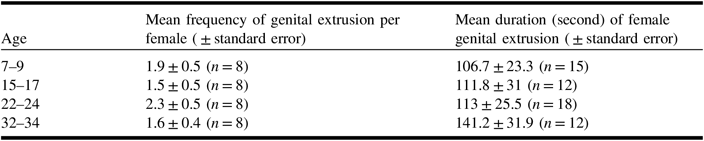
Females in all age ranges were observed extruding their genitalia. The 22–24-day-old females performed this behaviour most frequently. The mean duration for each behaviour increased slightly with increasing beetle age. However, no significant effect of age was detected in either the frequency or duration of genital extrusion (Table 2).
Mean frequency of genital extrusion during three-hour observation and mean duration (second) of genital extrusion performed by the female Anoplophora glabripennis, respectively, at 7–9, 15–17, 22–24, and 32–34 days old.

Feeding
Only one of the eight unfed females slightly extruded its genital tip (Type I) once for 41 seconds. Others fed on the host twigs during the observation period.
Male response to live female volatiles
When exposed to odours from live females with host twigs, two of the four males flexed their abdomens ventrally and extruded their genitalia one and two times, respectively. This behaviour was not observed in the same males when exposed to the volatiles from host twigs alone. Three of the four females used as odour sources extruded their genitalia for three, five, and two times during the observation period, respectively, and each extrusion lasted for an average of 203 ± 242.87 seconds (range from 25–828 seconds). However, none of the genital extruding behaviour were performed simultaneously by males and females.
Olfactometer assays
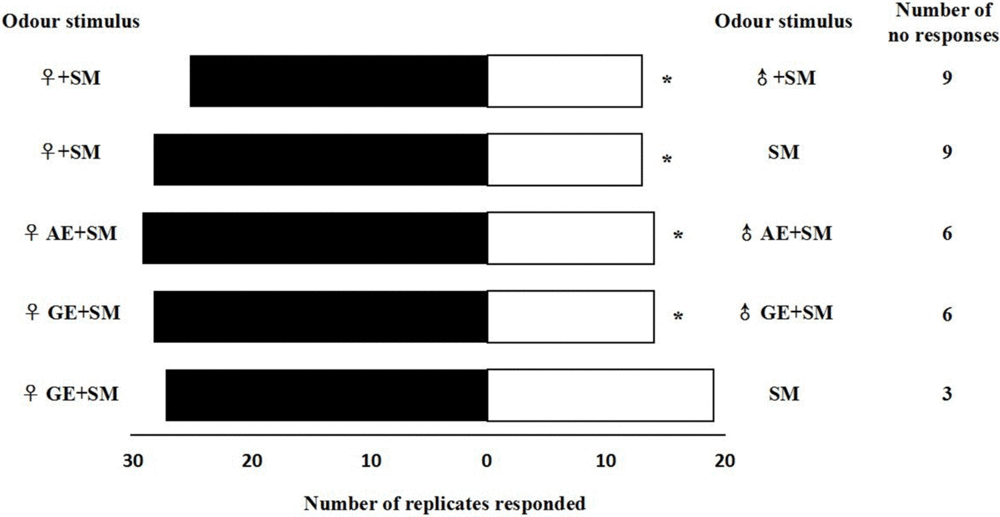
Significantly more male A. glabripennis were attracted to the odours from live females together with striped maple twigs than those from live males plus striped maple twigs (P = 0.02; Fig. 2A). Volatiles from live females with striped maple twigs were significantly more attractive to males compared to those from striped maple twigs alone (P = 0.008; Fig. 2B). Solvent extracts of the headspace volatiles from females plus striped maple twigs were significantly more attractive to males than those from males plus striped maple twigs (P = 0.009; Fig. 2C). Solvent extracts of female genitalia attracted significantly more males than those of male genitalia, when combined with host volatiles (P = 0.012; Fig. 2D). Marginally, more males were attracted to the volatiles from striped maple twigs when combined with female genital extracts than those from striped maple twigs alone (P = 0.059; Fig. 2E).
Responses of male Anoplophora glabripennis to five pairs of odour stimulus in two-choice Y-tube olfactometer assays. Odour sources in each assay were: live females with striped maple (Acer pensylvanicum) twigs (♀ + SM) and live males with striped maple twigs (♂ + SM); live females with striped maple twigs (♀ + SM) and striped maple twigs (SM); headspace aeration extracts of females with striped maple twigs (♀ AE + SM) and headspace aeration extracts of males with striped maple twigs (♂ AE + SM); female genital extracts with striped maple twigs (♀ GE + SM) and male genital extracts with striped maple twigs (♂ GE + SM); female genital extracts with striped maple twigs (♀ GE + SM) and striped maple twigs (SM), respectively. Bars with an asterisk (*) are significantly different from the bars of opposite treatments (P < 0.05).

Discussion
Several volatile pheromone components have been identified in A. glabripennis, though their attraction in the field is nominal, which may be due to several factors including incomplete knowledge of A. glabripennis behaviour and incomplete component blends (Crook et al. Reference Crook, David and Mastro2014). He and Huang (Reference He and Huang1993) found that male A. glabripennis were significantly more attracted to live females than live males in a wind tunnel assay. In their field bioassay using traps baited with a live female or male, no A. glabripennis were captured in the traps, but there were always several males found inside a range of 1 m from the traps containing female-baits, while no A. glabripennis were observed around the traps baited with males. A female-produced trail pheromone was also identified in A. glabripennis (Hoover et al. Reference Hoover, Keena, Nehme, Wang, Meng and Zhang2014). These findings suggest that long-range sex pheromones may be emitted by females. Our results from the Y-tube olfactometer bioassay also support that A. glabripennis females are attractive to males, though at a shorter range. Male-produced pheromones or visual cues may attract females to males at short distances after males have been attracted to the vicinity of females over longer distance by female-produced pheromones (Wickham et al. Reference Wickham, Xu and Teale2012; Hoover et al. Reference Hoover, Keena, Nehme, Wang, Meng and Zhang2014), which may also explain the low field trap catches using male-produced pheromones.
Our results indicate that female A. glabripennis display calling behaviour. This behaviour was previously observed and briefly described by Lu et al. (Reference Lu, Zhang and Zhang1998). In later bioassays, A. glabripennis males were observed orienting to either excised female ovipositors or live females that were extruding their ovipositors (Lu et al. Reference Lu, Zhang, Wang and Zhang2000), which is consistent with our results. However, we also observed that males flexed their abdomens and extruded their genitalia while exposed to volatiles from a live female with host twigs, which was not reported in previous studies. This is a typical mating behaviour triggered by female-produced contact pheromones after male antennae or palpi contact a female body (Li et al. Reference Li, Tokoro and Nacashima1999; Zhang et al. Reference Zhang, Oliver, Chauhan, Zhao, Xia and Xu2003). The reason behind this behaviour observed in the case of A. glabripennis males is unclear. Genital extrusion was also interpreted as an indication of female sexual maturity by Lu et al. (Reference Lu, Zhang and Zhang1998), whereas we observed it in all of the females at 7–34 days posteclosion, with no significant differences in either frequency or duration, suggesting that this behaviour is not likely associated with the maturity of the female reproductive system. However, our results illustrated that females that had not fed on any food posteclosion almost never performed this behaviour, suggesting that posteclosion feeding may influence genital extrusion.
Calling behaviour in some cerambycid species such as N. acuminatus acuminatus and P. californicus is associated with the release of volatile pheromones (Barbour et al. Reference Barbour, Cervantes, Lacey and Hanks2006; Cervantes et al. Reference Cervantes, Hanks, Lacey and Barbour2006; Lacey et al. Reference Lacey, Moreira, Millar, Ray and Hanks2007a, Reference Lacey, Ray and Hanks2007b; Rodstein et al. Reference Rodstein, McElfresh, Barbour, Ray, Hanks and Millar2009). Our results from both behavioural observations and laboratory bioassays reveal that A. glabripennis males significantly responded to the volatiles from female genitalia, suggesting potential production of volatile pheromone components in the genitalia of A. glabripennis females. If the pheromone released from female genitalia is attractive in the field at long range, it may contribute significantly to the development of an effective trap lure for detecting and monitoring this notoriously invasive pest.
Acknowledgements
We thank the Alphawood Foundation for supporting this study. The A. glabripennis used in this study were provided by Ann Hajek and Sana Gardescu, Cornell University, with funding by the Alphawood Foundation. We thank Dr. Jacob D. Wickham, State Key Laboratory of Integrated Management of Pest Insects and Rodents, Institute of Zoology, Chinese Academy of Sciences (Beijing, China), for providing photographs and videos.