
I. INTRODUCTION
In recent years, people have paid more attention on lanthanide ion-doped phosphors for their application in remote temperature sensor and cell imaging, etc., Reference Muhr, Wilhelm, Hirsch and Wolfbeis1–Reference Chen, Shi, Tao, Ji, Zheng, Sang, Liu and Qiu4 which the reason is that the exist of 4f n energy manifolds breaks the limit of the electric dipole selection rule. In addition, Yb3+/Er3+ co-doped NaLa(MoO4)2 phosphor have lower phonon energy, slimmer emission bands, and longer fluorescence lifetimes, compared to conventional luminescent materials, for example, organic fluorescent dyes. Reference Matioli, Brinkley, Kelchner, Hu, Nakamura, DenBaars, Speck and Weisbuch5–Reference Sun, Mai, Dang, Qiu, Deng, Shi, Yan and Zhang9
In particular, optical thermometry is widely used in internal temperature test and electrical power stations by using the FIR technology, in which the temperature-decided UCL spectra from thermally coupled energy levels (TCLs) of rare earth ions are contributed to it. Reference Wang, Lin, Yang, Lin and Pun10,Reference Gouveia-Neto, Bueno, do Nascimento, da Silva, da Costa and do Nascimento11 The range of ΔE between TCLs is from 200 cm−1 to 2000 cm−1 and the quasiequilibrium is needed due to Boltzmann distribution. Reference Li, Guo, Jiang, Agrawal and Li12 In addition, the energy difference between the 2H11/2 and 4S3/2 levels of Er3+ is approximately 800 cm−1 according to previous publications, the result suggests that they have the potential to regard as an optical temperature sensor by using FIR technique. Reference Yang, Mi, Yu, Su, Guo, Li, Zhang, Liu, Liu and Li13,Reference Liu, Fu, Gao, Yang, Fu, Wang and Yang14 The molybdate belongs to the sheelite-like (CaWO4) iso-structure, which shows great properties for broad range of application, such as catalysts, UC material, etc. Reference Hizhnyi, Chornii, Nedilko, Slobodyanik, Terebilenko, Boyko, Gomenyuk and Sheludko15–Reference Mani, Vimal, Biju, Joseph, Unnikrishnan and Ittyachen18 Furthermore, the UC efficiency of molybdate is higher than traditional materials due to the lower lattice phonon energy. Reference Singh, Kumar and Rai19–Reference Lei, Song, Yang, Yu, Liu, Pan, Bai and Fan23 So the rare earth ions-doped molybdate have ideal potential to act as an optical thermometer.
The near infrared light can be absorbed by some materials and translated into heat owing to the electron–phonon coupling, leading to the temperature of materials increasing. Reference Yang, Mi, Yu, Su, Guo, Li, Zhang, Liu, Liu and Li13,Reference Zheng, Gao, Liu, Li and Xu24 In particular, the temperature rises highly when the crystal size is in nano-range. The property can be used for photothermal therapy (PTA) in medicine due to the biological tissues have little absorption for near infrared light. Reference Verma and Rai25 Moreover, the internal temperature of materials and cells can be estimated by FIR of rare earth ions. Reference Cai, Wei, Hu, Cao, Zhao, Chen, Duan and Yin26,Reference Verma, Rai, Kumar and Rai27
In this paper, Yb3+/Er3+ co-doped NaLa(MoO4)2 phosphor is prepared through hydrothermal processes. Reference Liao, Qiu and Lai28,Reference Li, Wang, Pan, Qu, Liu and Feng29 The UCL properties of NaLa(MoO4)2 phosphor are studied in detail. And the FIR (2H11/2/4S3/2 → 4I15/2 transitions) of Er3+ is used to investigate the optical temperature sensing from room temperature to 573 K. Then the varieties of the UCL spectra with different powers under the pump laser of 980 nm are obtained. Furthermore, the temperature of sample under different powers is calculated by FIR. The results show that the sample can be regarded as an optical temperature sensor and optical heater.
II. EXPERIMENTAL
A. Preparation of NaLa(MoO4)2:Yb3+/Er3+ phosphor
1. Synthesis of NaLa(MoO4)2:Yb3+/Er3+
The hydrothermal method was utilized to prepare the phosphor of NaLa(MoO4)2:x Er3+, yYb3+ [(a) y = 5%; x = 0.5, 1, 2, 3, 4, 5, 6%; (b) x = 2%; y = 5, 10, 15%] (mole fraction). Reference Gao, Wang, Fu, Yang, Fu, Wu and Jeong30 All the reagents were commercially available and used without further purification. The raw materials including (NH4)6Mo7O24·4H2O (99.5%, Beijing Chemical Reagent Co., Ltd), ethylene diamine tetraacetic acid (EDTA, ≥99%, Sinopharm Chemical Reagent Co., Ltd), aqueous solutions of La(NO3)3 (0.12 M), Er(NO3)3 (0.05 M), Yb(NO3)3 (0.05 M), NaOH (5 M) were obtained by dissolving lanthanide oxide and NaOH (99.99%, Shanghai Yuelong Nonferrous Metals Ltd) in dilute nitric acid solution under heating with agitation, respectively. Stoichiometric weights La(NO3)3, Er(NO3)3, and Yb(NO3)3, stoichiometric amount of (NH4)6Mo7O24·4H2O and EDTA were measured and dissolved in 20 and 15 mL of deionized water to obtain solution A and solution B under stirring for 20 min and 15 min, respectively. The solution B was dropped into solution A slowly under magnetic stirring for 10 min. The value of pH was adjusted to 9 through the addition of Na(OH) (5 M) solution in the maxing solution. After stirring for half an hour, a Teflon-lined autoclave (60 mL) was needed to contain the solution and heated for 24 h at 180 °C. Then the temperature of autoclave decayed to room temperature spontaneously. The centrifugation was needed to separate the production, and the deionized water and ethanol were used to wash precursor for 3 times, then it was dehydrated 60 °C for overnight. After grinding, the precursor was burned at 800 °C for 3 h to obtain the white powder.
B. Characterization
A Rigaku-Dmax 2500 diffractometer (Rigaku Corporation, Tokyo, Japan) equipped with graphite monochromatized Cu Kα radiation (λ = 0.15405 nm) is used for measuring the x-ray diffraction (XRD), which performs the crystal structure of sample. The morphology and size of the as-obtained samples were measured by a field emission-scanning electron microscope (FE-SEM; XL30, Philips, Almelo, The Netherlands). All the results are obtained at room temperature. An Omni-λ300 spectrograph (Zolix Instruments Co. Ltd., Beijing, China) was used to detect the UCL spectra. The signal was collected by a CCD detector, which include a monochromator. The pump source is a 980 nm diode laser, which equipped with fiber (core diameter 400 μm, numerical aperture 0.22). An Andor SR-500i spectrometer (Andor Technology Co, Belfast, UK) is used for recording the UCL spectra under the pump laser of 980 nm. The NaLa(MoO4)2:Yb3+/Er3+ sample is heated from 298 to 573 K in an iron sample cell. The measurement error (±1.5 K) of sample's temperature is monitored by a copper-constant thermocouple. The sample is excited in the iron sample cell by 980 nm pump power in the range of 0.036–0.797 W.
III. RESULTS AND DISCUSSION
A. The morphology and chemical characterization of NaLa(MoO4)2:Yb3+/Er3+ phosphor
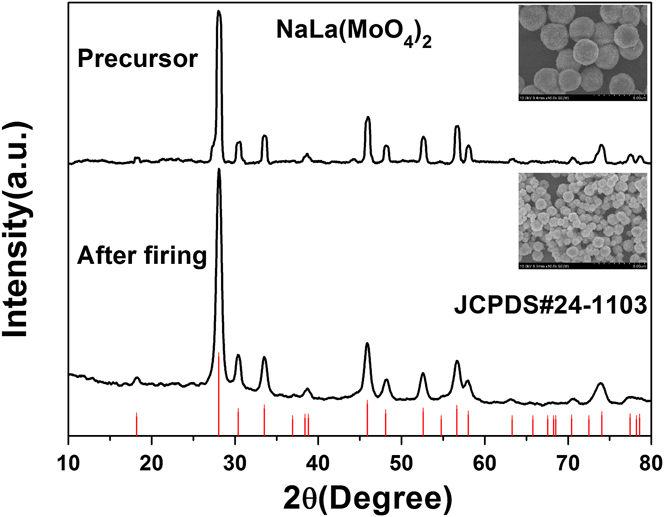
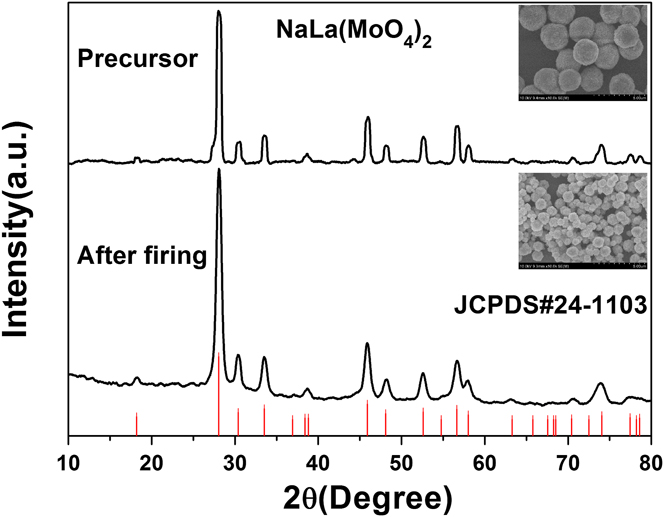
The XRD patterns of NaLa(MoO4)2:Yb3+/Er3+ (precursors and after firing at 800 °C for 3 h) and the standard JCPDS card (no. 24-1103) are presented in Fig. 1. The result indicates that all the diffraction peaks of precursors and phosphors of after firing are perfectly consistent with the standard card of JCPDS (no. 24-1103), and no other impurity peaks are observed, suggesting that the sample is pure tetragonal and simultaneously Yb3+/Er3+ ions have been entered into the host lattices. The FE-SEM images of samples are illustrated in Fig. 1. The precursors are uniformly distributed with the micro-flower morphology and the average size is around 3 μm. The phosphors of after firing are spherical in shape and the average size is about 1 μm.
XRD patterns of Yb3+/Er3+ co-doped NaLa(MoO4)2 phosphor (precursor and phosphor after firing) at pH = 9. The standard data for NaLa(MoO4)2 (JCPDS card no. 24-11053) is shown as reference. The inset shows the FE-SEM images of precursor and phosphor after firing.
B. UCL properties and energy diagram
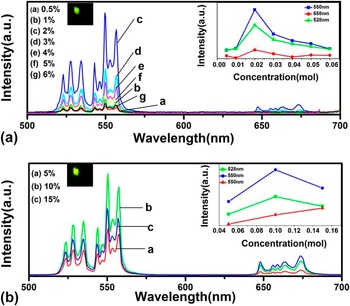
NaLa(MoO4)2 phosphors are usually regarded as an excellent host material for its outstanding thermal and hydrolytic stability. Reference Xu, Li, Li, Chai, Peng, Yang and Lin31–Reference Gomes, Linhares, Hmdmd Ichikawa, Martinez and Baldochi34 Fig. 2 represents that the UCL intensity is a function of rare earth ion-doping concentrations under the irradiation of 980 nm laser. The spectra consist of two intense green emissions and a weak emission in the red region, which come from 2H11/2/4S3/2 → 4I15/2 transitions centered at 528/550 nm and 4F9/2 → 4I15/2 transition centered at 660 nm, respectively. In particular, the two green emissions are used to the optical temperature sensing based on FIR technique. Fig. 2(a) presents the UCL intensities of different Er3+ concentrations (from 0.5% to 6%) with fixed Yb3+ concentration (5%), the intensity rises firstly and then decreases with increasing Er3+ concentration in the green region due to concentration quenching effect. The intensity is highest when the Er3+ concentration rises to 2%. As we all know, the increase of Er3+ concentration leads to the shorter distance among rare earth ions, which enhances the nonradiative energy transfer. Furthermore, the UCL intensity decreases. Reference Gomes, Linhares, Hmdmd Ichikawa, Martinez and Baldochi34 At the same time, the UCL intensities of different Yb3+ concentrations (from 5% to 15%) with fixed Er3+ concentration (2%) are shown in Fig. 2(b), and a similar situation is observed based on concentration quenching effect. The intensity is highest when the Yb3+ concentration is 10%. But it cannot be contributed to explain the red emission because the intensity of red emission rises with the raising Yb3+ concentration. Reference Chung, Ryu, Eun, Lee, Lee, Hes, Choi and Shim35 And the phenomenon can be explained by energy transfer (ET) from Yb3+ to Er3+. The Yb3+ ions could absorb effectively 980 nm laser for its bigger absorption cross section, the ET between Yb3+ and Er3+ rises while the concentration of Yb3+ exceeds 10% with fixed Er3+ concentration, leading to the population of 4F9/2 (Er3+) level increases, and speeding up the emission from 4F9/2 to 4I15/2. Furthermore, the red emission enhances. Reference Zhang, Wang, Rong and Chen36 The insets show the digital photographs of the NaLa(MoO4)2:2%Er3+,5%Yb3+ [Fig. 2(a)] and the NaLa(MoO4)2:2%Er3+,10%Yb3+ [Fig. 2(b)]. The intense fluorescence can be observed by the naked eye under the excitation of 980 nm in the digital photographs. In addition, we can find that the green emission intensity is strong in the digital photograph of Fig. 2(a), and the red emission intensity rises in the digital photograph of Fig. 2(b) due to the raise of Yb3+ concentration.
Typical UCL spectra of NaLa(MoO4)2:xEr3+,yYb3+: (a) y = 5%; x = 0.5, 1, 2, 3, 4, 5, 6% marked by (a), (b), (c), (d), (e), (f), (g), the digital photograph presents fluorescence for the NaLa(MoO4)2:5%Yb3+,2%Er3+ under the excitation of 980 nm laser; (b) x = 2%; y = 5%, 10%, 15% marked by (a), (b), (c), the digital photograph presents fluorescence for the NaLa(MoO4)2:10%Yb3+,2%Er3+ under the excitation of 980 nm laser. Insets show the normalized integrated intensities of the different peaks in the emission spectra as a function of Er3+ and Yb3+ concentrations.

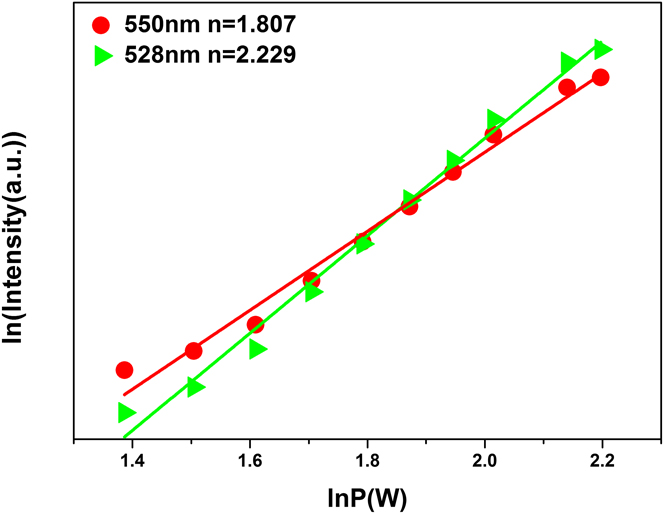
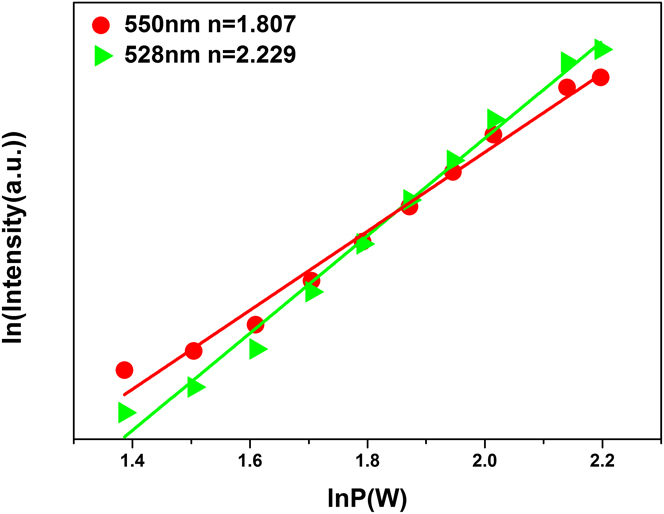
Figure 3 presents the dependent UCL intensity peaks under the 980 nm pump power. The intensity of UCL increases visibly with the increasing pump power. The relation between UCL intensity and pump power can be given Reference Zeng, Lin, Zhang, Chen, Liang, Xu and Chen37 :
 $${I_{\mu {\rm{p}}}} \propto {\left( {{P_{{\rm{pump}}}}} \right)^n}\quad .$$
where the number of infrared photons is represented by n, which can be obtained from the slope of fitting straight line,
 ${I_{\mu {\rm{p}}}}$
notes the UCL intensity, and
 ${P_{{\rm{pump}}}}$
represents the pump power, respectively.
Reference Wei, Dong, Zhao, Ma, Zhang, Xie, Zhou and Li38,Reference Li, Hao, Zhang, Luo, Zhao, Lu, Cao and Zhang39
We obtain the value of n, 2.229 and 1.807 for 528 and 550 nm emissions, respectively. The result indicates that one UC photon is obtained by two infrared pumping photons in NaLa(MoO4)2:Yb3+/Er3+ phosphor. The transitions of 2H11/2/4S3/2 → 4I15/2 and 4F9/2 → 4I15/2 can be observed under the 980 nm laser excitation. And the UC process of Er3+-doped materials is investigated widely in previous reports.
Reference Li, Xue and Liu40–Reference Adhikari, Choi, Narro-García, DelaRosa, Tohru and Soo Wohn43
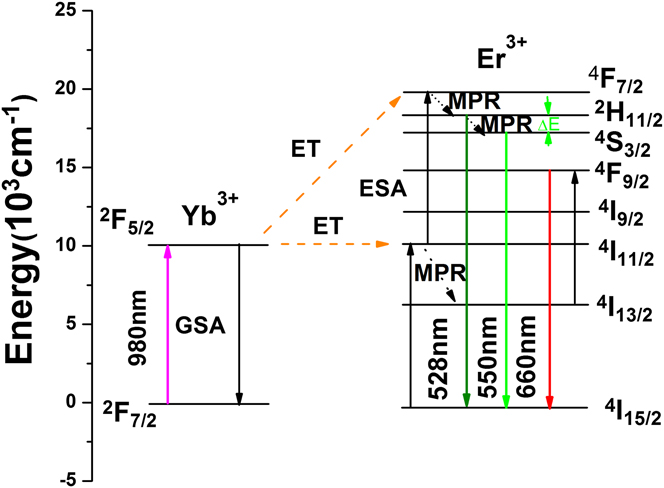
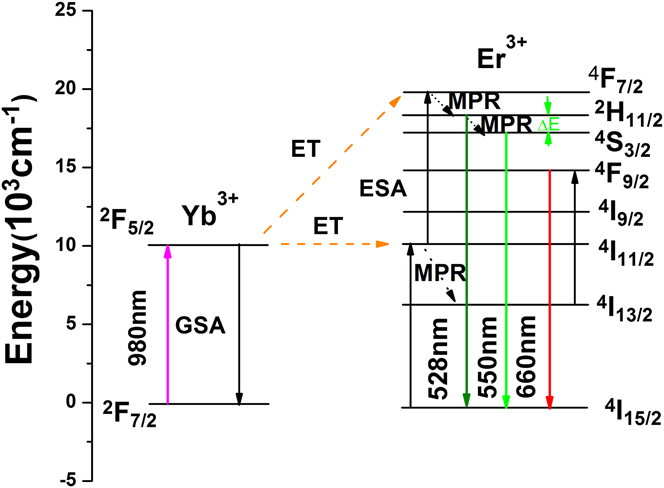
Fig. 4 represents a possible UC mechanism for Er3+ ions. The population of 2F7/2(Yb3+) state can be populated to 2F5/2(Yb3+) state via the ground absorption (GSA) process. Next the population of 4I15/2(Er3+) state is populated to the metastable state 4I11/2(Er3+) based on the energy transfer (ET): 2F5/2(Yb3+) + 4I15/2(Er3+) → 2F7/2(Yb3+) + 4I11/2(Er3+), simultaneously the population of 2F5/2 state populates to 2F7/2 state, then the second ET is contributed to the increase of population of 4F7/2(Er3+) state: 2F5/2(Yb3+) + 4I11/2(Er3+) → 2F7/2(Yb3+) + 4F7/2(Er3+), simultaneously partial population of 4I11/2 state populate to the 4I13/2 state via a multiphonon relaxation (MPR) process and the population of 2F5/2(Yb3+) state populates to 2F7/2(Yb3+) state again. Moreover, an excited state absorption is also contributed to it: 4I11/2 + hν → 4F7/2. Then the population of 4F7/2 state populate to 2H11/2(4S3/2) state by a MPR process. After the first-level excitation, the population of 4I13/2 state is populated to 4F9/2 state under the 980 nm pump laser. Thus we can observe that the green and red emissions from 2H11/2(4S3/2) and 4F9/2 states to ground state, respectively.
Reference Chung, Ryu, Eun, Lee, Lee, Hes, Choi and Shim35,Reference Adhikari, Choi, Narro-García, DelaRosa, Tohru and Soo Wohn43
The log–log plots of UCL intensity of NaLa(MoO4)2:10%Yb3+,2%Er3+ as a function of 980 nm pump power.
The energy level diagrams of Yb3+/Er3+ co-doped NaLa(MoO4)2 under excitation of 980 nm and possible UC processes.
C. Optical temperature sensing
The Er3+/Yb3+ co-doped NaLa(MoO4)2 phosphor is good candidate for optical temperature sensor based on thermally coupled levels (TCLs), and the UCL emission spectra are investigated. What we can find is that the FIR (2H11/2/4S3/2 → 4I15/2 transitions) is proportional to the temperature. In fact, the Boltzmann law can be used to explain the population distribution of TCLs. Reference Qin, Zhao, Cai, Zhang and Cao44,Reference Wade, Collins and Baxter45 The population of 4S3/2 state can be populated to the 2H11/2 state with temperature rising via the thermalization process, leading to the intensity of 2H11/2 → 4I15/2 transition stronger and simultaneously the 4S3/2 → 4I15/2 transition weaker, which results in the FIR increasing. According to above results, the FIR from TCLs can be given as: Reference Cai, Wei, Hu, Cao, Zhao, Chen, Duan and Yin26,Reference Lu, Hao, Shi, Gao, Wang, Song, Wang and Zhang46,Reference Kumar, Tiwari, Kumar and Rai47
 $${\rm{FIR}} = {{{N_2}} \over {{N_1}}} = {{{I_{2j}}} \over {{I_{1j}}}} = {{{g_{2j}}{\sigma _{2j}}{\omega _{2j}}} \over {{g_{1j}}{\sigma _{1j}}{\omega _{1j}}}}\,\exp \left[ {{{ - \Delta E} \over {{K_{\rm{B}}}T}}} \right] = B\,\exp \left[ {{{ - \Delta E} \over {{K_{\rm{B}}}T}}} \right]$$
where
 $$B = {{{g_{2j}}{\sigma _{2j}}{\omega _{2j}}} \over {{g_{1j}}{\sigma _{1j}}{\omega _{1j}}}}$$
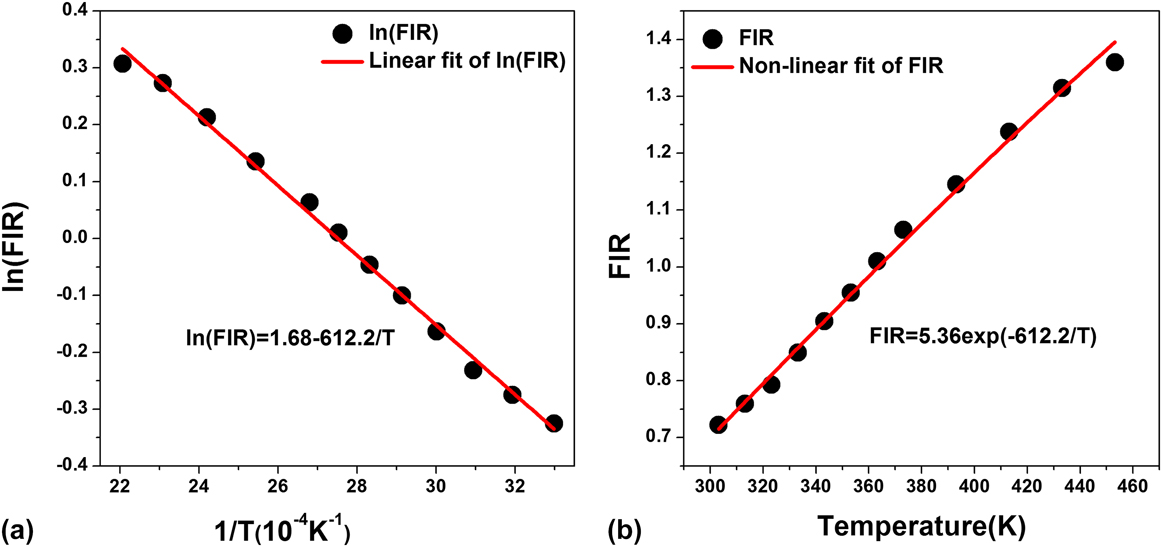
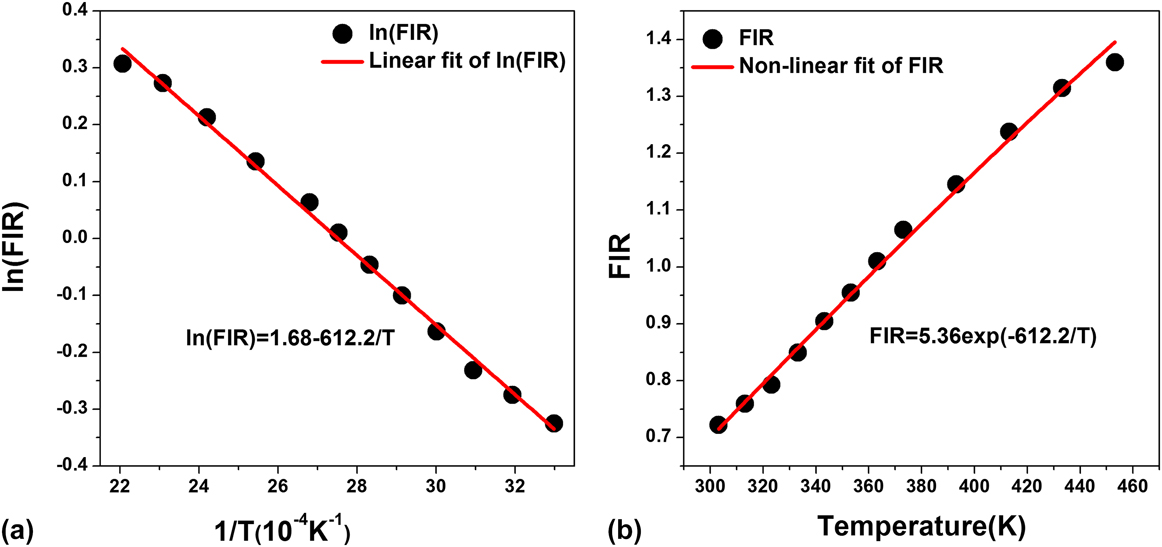
N notes the population of state, I represents the integrated intensity, g represents the degeneracy, σ denotes emission cross-section, and ω denotes the angular frequency. ΔE is the energy gap between the TCLs of Er3+ ions, K B denotes the Boltzmann constant and T denotes the absolute temperature. Reference Cai, Wei, Hu, Cao, Zhao, Chen, Duan and Yin26 The evolution of FIR (I 528/I 550) with inverse absolute temperature from 298 K to 573 K on a monologue is presented in Fig. 5(a). The result shows that the data can be fitted through a straight line. And the slope is 612.2, which denotes the ΔE/K B. Figure 5(b) shows the evolution of FIR (I 528/I 550) with temperature simultaneous. Equation (2) is appropriate to fit the data and the value of B (5.36) is obtained.
(a) The monologue plot of the FIR (I 528/I 550) versus 1/T for the Yb3+/Er3+ co-doped NaLa(MoO4)2 phosphor; (b) the FIR (I 528/I 550) as a function of temperature in the range of 298–573 K.
It is prominent to know the change of FIR along with a certain variety of temperature for sensing application, which the sensor sensitivity of an optical thermometer could be regarded as an important reference value for it. The temperature sensitivity S is given: Reference Dong, Cao and He48–Reference Cao, He, Feng, Li and Dong50
 $$S = {{{\rm{dFIR}}} \over {{\rm{d}}T}} = {\rm{FIR}}\left[ {{{\Delta E} \over {{K_{\rm{B}}}{T^2}}}} \right] = B{{\Delta E} \over {{K_{\rm{B}}}{T^2}}}\,\exp \left[ {{{ - \Delta E} \over {{K_{\rm{B}}}T}}} \right]\quad .$$
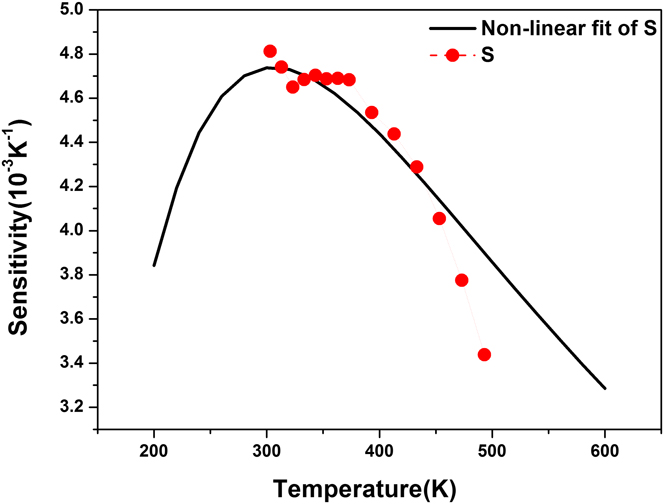
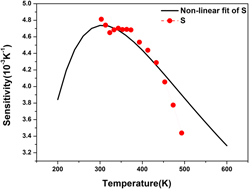
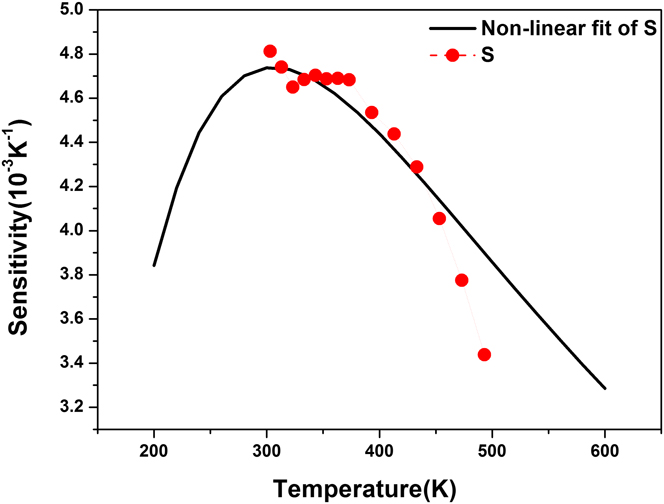
Equation (3) implies that broad energy gap is contributed to the increase of sensor sensitivity. What calls for special attention is that the energy gap is not too wide, otherwise there will be a lack of thermalization. Figure 6 shows the variety of NaLa(MoO4)2:Yb3+/Er3+ sensitivity with increasing temperature. And the maximum value (0.00474 K−1) is obtained at the temperature of 313 K, indicating that the sample can be used as an excellent temperature sensor, comparing to fluoride matrix, oxide, and hybrid nanoparticles. Reference Yang, Mi, Yu, Su, Guo, Li, Zhang, Liu, Liu and Li13
The sensor sensitivity S = dFIR/dT as a function of the temperature for Yb3+/Er3+ co-doped NaLa(MoO4)2 phosphor. S represents the value of experiment sensitivity.
D. Analysis of thermal effect
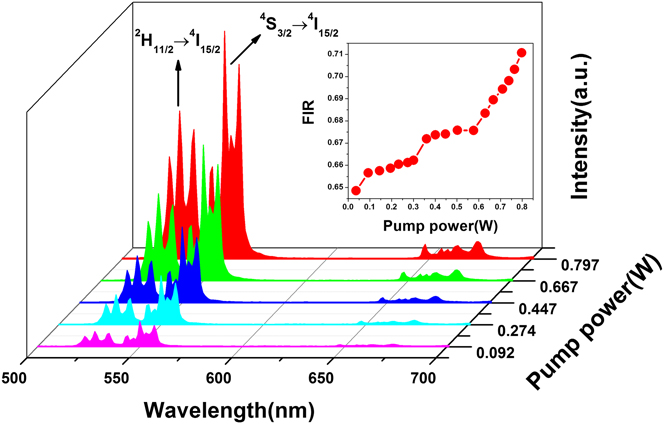
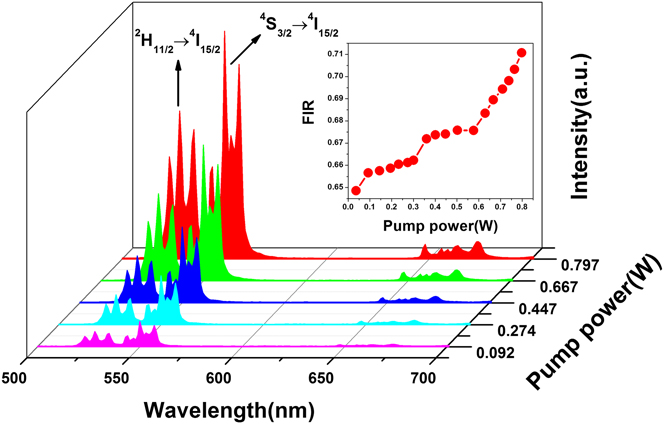
As we all know, the excited energy can be absorbed by some material, leading to the internal temperature of material rising. And the effect of heating induced by pump laser has potential application in bio-therapy. In fact, the effect can be investigated by the fluorescence spectra in the rare earth ions doped materials, in which the calculated FIR can be used to obtain the internal temperature of material under the excitation of 980 nm pump power. Figure 7 represents the fluorescence spectra of NaLa(MoO4)2:Yb3+/Er3+ phosphor and the inset notes the evolution of FIR (I 528/I 550) under 980 nm laser excitation. We can find that the luminescence intensity and FIR rise with the rise of pump power. In addition, the internal temperature of material under different pump power could be calculated by FIR, Eq. (4), which is rearranged from Eq. (2), is shown as follows Reference Challenor, Gong, Lorenser, Fitzgerald, Dunlop, Sampson and Iyer51 :
 $$T = \left[ {{1 \over {\ln \,B - \ln ({\rm{FIR}})}}} \right]\left[ {{{\Delta E} \over {{K_{\rm{B}}}}}} \right]\quad .$$
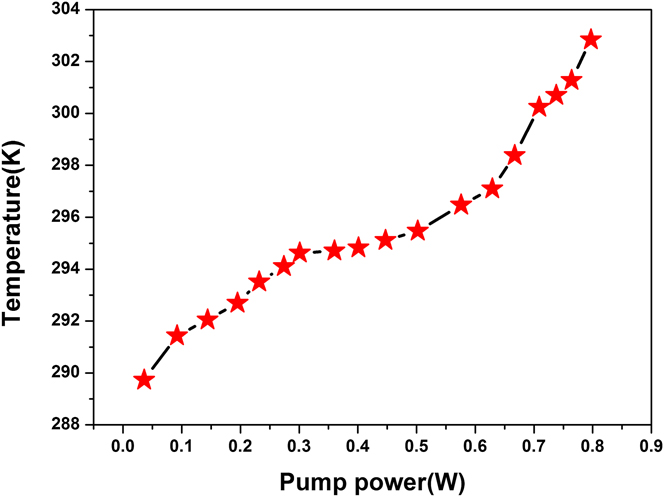
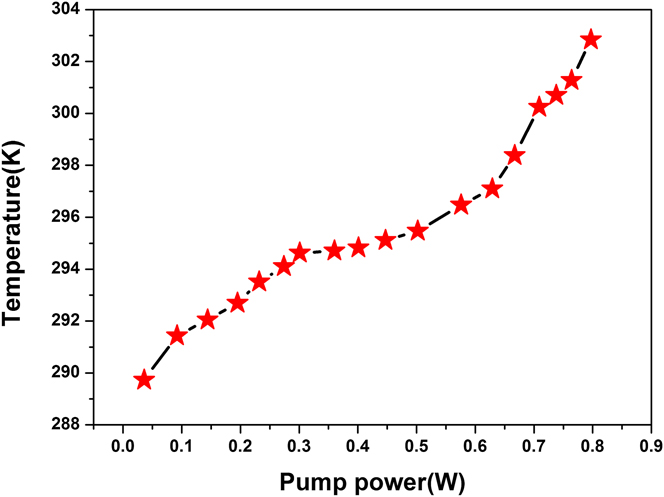
where the terms in Eq. (4) have the same meaning as Eq. (2). That the lattice temperature reaches to 302.84 K at 0.797 W. The calculated temperature of NaLa(MoO4)2:Yb3+/Er3+ phosphor based on FIR is shown in Fig. 8. According to the above results, the crystalline nature of the material could be used to explain the phenomenon that the temperature of the sample increases at a particular value of excitation laser and the induced heat becomes prominent by nonradiative relaxation. In general, the charged mobile carriers are driven by the laser electric field, the electrons get the infrared energy and translate it into thermal energy by the interaction between electrons and phonons. The laser induces heat transmission in the crystal by which the lattice temperature rises. The electron–phonon interactions increase in host material based on the quantum confinement of phonons, which enhances heat in the crystalline. Reference Verma and Rai25,Reference Kikhomirov, Driesen, Rodriguez, Gredin, Mortier and Moshchalkov52–Reference Singh, Singh, Kumar, Rai and Kumar54
The UCL spectra of the Yb3+/Er3+ co-doped NaLa(MoO4)2 phosphors under different pumping powers. The inset represents that the FIR (I 528/I 550) as a function of laser pump power.
Estimation of the temperature under different pump powers (980 nm) for Yb3+/Er3+ co-doped NaLa(MoO4)2 phosphors.
IV. CONCLUSION
Yb3+ sensitized Er3+ doped NaLa(MoO4)2 phosphors are successfully synthesized via hydrothermal method and further calcination at 800 °C for 3 h. The UCL spectra have been investigated in different Yb3+ and Er3+ concentrations, and the UCL intensity reaches maximum value at NaLa(MoO4)2:2% Er3+,10% Yb3+ in green region. The UC spectra of material are investigated for its application in optical temperature sensing during the 298–573 K. And the maximum value of sensitivity is about 0.00474 K−1, which is obtained by FIR technique. Moreover, the material can be heated by pump laser. The temperature of material induced by pump laser is estimated by the FIR technique. Above all, Yb3+ sensitized Er3+ doped NaLa(MoO4)2 phosphors can be regarded as an optical heater and temperature sensor with high sensitivity.
ACKNOWLEDGMENTS
We are grateful to the Science and Technology Development Planning Project of Jilin Province (20160101294JC), partially sponsored by China Postdoctoral Science Foundation and by the National Science Foundation of China (no. 21521092), supported by National Found for Fostering Talent of Basic Science (no. J1103202) and by the Outstanding Young Teacher Cultivation Plan in Jilin University.