The Middle East produces large amounts of fermented dairy products as labneh (concentrated yoghurt) due to its unique organoleptic characteristics and nutritional value. However, these products are perishable owing to the possible microbial contamination resulting from inadequate heat treatment, the lengthy filtration process used during labneh production, improper handling practice, and poor storage conditions (Halim et al., Reference Halim, El-Essawy, Awad, El-Kutry and Ahmed2022).
Customers’ demand for naturally preserved dairy products, along with growing concerns about the adverse public health effects of currently utilized chemical preservatives, emphasized the significance of continued research into natural alternatives. Essential oils (EOs) are potential alternatives that have gained popularity in recent years due to their organoleptic, medicinal, and antimicrobial properties (Eskander et al., Reference Eskander, Hassan, Alshara, Taher and Ali2023). Their applications in the food industry have increased since the US Food and Drug Administration approved EOs as generally recognized as safe (GRAS) (FDA, 2016).
Ginger (Zingiber officinale Roscoe, Zingiberacae) and clove (Syzygium aromaticum) are widely used herbs and spices around the world. They pose potent antioxidant, anti-fungal, and antibacterial properties (Shahbazi, Reference Shahbazi2019). They consist of a complex mixture of secondary metabolites, including phenols and terpenes, which are known to have powerful biological and antibacterial properties. They have the capacity to denature proteins and interact with phospholipids in cell membranes, resulting in the inhibition of a wide range of gram-negative and gram-positive bacteria, as well as different kinds of yeast and mould (Ahmed et al., Reference Ahmed, Ibrahim, Abdel-Salam and Fahim2021). However, the application of EOs in the dairy plant is challenged by their limited solubility in aqueous solutions, oxidation resulting from exposure to heat and light, and food matrix nature (high protein and lipid) that might hinder their antimicrobial efficiency (Singh and Pulikkal, Reference Singh and Pulikkal2022). Therefore, high concentrations of EOs are necessary to achieve significant antimicrobial activity; their potent flavour impairs dairy product's sensory qualities (El-Sayed and El-Sayed, Reference El-Sayed and El-Sayed2021). Because of the high dispersion ability of nanoparticles, EO nano-emulsions are thought to be a feasible alternative for preserving dairy products by overcoming those formerly mentioned drawbacks (El-Sayed and El-Sayed, Reference El-Sayed and El-Sayed2021). The small size of nano-emulsion droplets (<200 nm) helps in increasing the surface area and thus enhance the functional characteristics of EOs. Additionally, the strong physical stability of nano-emulsions (stability to gravitational forces, flocculation, and coalescence), high bioavailability, and low turbidity makes them more desirable systems for food applications. Likewise, droplet size diameter, pH, storage temperature, and type of emulsifiers used are among the variables that affect the stability of these nano-emulsions (Singh and Pulikkal, Reference Singh and Pulikkal2022).
Previous research exploring natural alternatives for improving microbiological quality and bio-preservation of labneh is still scarce. Hence, this study was conducted to evaluate the antimicrobial activity of ginger and clove oil nano-emulsions characterized by transmission electron microscope (TEM) against some food-borne pathogens (E. coli, S. Typhimurium, and S. aureus) and spoiling microorganisms (P. aeruginosa and A. flavus). In addition, viability assessment of the S. aureus and A. flavus in lab manufactured labneh fortified with the tested EO nano-emulsions over a storage period of 30 days at 4oC along with evaluating their potential impact on the sensory attributes and starter culture activity.
Material and methods
Preparation and characterization of EO nano-emulsions
Preparation of EO nano-emulsions
The examined ginger and clove essential oils were previously extracted and chemically analysed by gas chromatography – mass spectrometry (GC-MS) in our previous paper by Ahmed et al. (Reference Ahmed, Ibrahim, Abdel-Salam and Fahim2021).
The EO nano-emulsions were prepared based on the slightly modified method of ionotropic gelation described by Nguyen and Le (Reference Nguyen and Le2021). Briefly; 50 mL of chitosan (CS) solution (0.2% w/v) was swirled with Tween 80 (Sigma Aldrich Co. Germany) for 2 h/ 45°C/ 1200 rpm. The CS: Tween 80 ratio was 1:1.12. Then, 0.05 g of the tested ginger and clove oils were added to obtain a concentration of (1:1 w/w) (CS: oil). The produced emulsion remained for 15 minutes in the ultrasonic bath. Ionic gelation was employed for the cross-linking stage of the CS polymer. Twenty-five mL of aqueous glacial acetic acid sodium tripolyphosphate (TPP solution) (0.1% w/v) (Sigma Aldrich Co. Germany) was added to 25 mL of the emulsion while being stirred for 40 minutes at room temperature and 800 rpm. After centrifugation at 10,000 rpm at 4°C for30 minutes, the mixture was washed several times with deionized water. The collected wet pellets were gently vortexed and dispersed in distilled water (DW), followed by freeze-drying.
Characterization of ginger and clove oil nano-emulsion
Determination of mean droplet size, polydispersity index, and Zeta (ζ) -potential
The mean droplet size, polydispersity index and ζ-potential of the prepared nano-emulsion were measured by a Zeta sizer Nano ZS90 (Malvern Instruments, UK) according to Yousefi et al. (Reference Yousefi, Khanniri, Sohrabvandi, Khorshidian and Mortazavian2023). Additionally, Transmission Electron Microscope (TEM) analysis was carried out to study the structure and morphology of the prepared nano-emulsions according to El-Sayed and El-Sayed (Reference El-Sayed and El-Sayed2021). Sample was diluted with deionized water, sonicated for 10 minutes (Crest Ultrasonics Corp., New Jersey, USA), then a few drops of the samples were loaded on carbon-coated copper grids, left to dry, and stained with a few drops of phosphor tungstic acid (1%). The grids loaded with the stained samples were examined by HR-TEM (JEOL, JEM-2100, Tokyo, Japan).
Stability tests
The stability of the prepared nano-emulsion was determined using thermodynamic stability tests (Centrifugation test, Heating-Cooling test, and Freeze- thaw test) following the method estimated by Mulia et al. (Reference Mulia, Zaenal and Krisanti2019).
Briefly, during the centrifugation test, the prepared nano-emulsions were centrifuged at 3400 × g for 30 minutes (Biofuge, Primo Heraeus, Osterode, Germany) to assess the occurrence of phase separation. The nano-emulsions remained stable when the prepared emulsion did not separate at the end of centrifugation period. The centrifugation of the material in the stability test is similar to the influence of gravity for a year, as was previously indicated by Mulia et al. (Reference Mulia, Zaenal and Krisanti2019). Therefore, samples that did not exhibit phase separation following centrifugation have a minimum of one year of shelf life. Regarding heating-cooling test, after centrifugation test, nano-emulsions were stored at 4°◦C for 48 hours and 45°C for 48 hours with observation for phase separation at the end of the storage period. Finally, nano-emulsions were exposed to three freeze–thaw cycles at -21°C for 48 hours and 25°C for 48 hours after applying heating-cooling test. Absence of separation phase revealed stable formulations.
Determination of the minimum inhibitory concentrations (MIC)
MIC was assessed using the following ATCC standard strains (S. aureus ATCC25923, E. coli ATCC25922, S. Typhimurium ATCC14028, and P. aeruginosa ATCC27853) that were obtained from the National Research Centre of Dokki, Egypt, in addition to the isolated strain of A. flavus from Microbiological Department, Faculty of Veterinary Medicine, Cairo University. Selected strains were prepared and counted on the specific media for each strain according to the method cited by Nadi et al. (Reference Nadi, Taher, Awad and Ahmed2023).
MIC of EO nano-emulsions and chitosan (used for preparation of EO nano-emulsion) against the tested microorganisms was carried out using the broth micro dilution method described by Al-Habty and Ali (Reference Al-Habty and Ali2022). Using sterile distilled water, the following concentrations of nano clove and ginger oils solutions (0.0001, 0.001, 0.01, 0.1 µg/mL) were prepared and utilized freshly in the experiments. 100 µL of S. aureus (1.3 × 10⁹ cfu/ml), E. coli (2.6 × 10⁹ cfu/ml), S. typhimurium (3.7 × 10⁹ cfu/ml), P. aeruginosa (8.5 × 10⁸ cfu/ml), and A. favus (1.4 × 10⁵ cfu/ml)] were added separately to 5 mL of Muller Hinton broth (Oxoid, UK) supplemented with the previously mentioned EOs nano-emulsion concentrations and incubated aerobically at 37°C for 2 h. Then, the incubated broth was plated on the specific media for each strain. MIC was estimated as the lowest concentration that inhibited the growth of microorganisms.
Assessment of the influence of the tested EO nano-emulsion on the sensory properties of labneh
Full-fat raw milk from Buffalos was tested for the presence of inhibitory substances according to the method described by Fahim et al. (Reference Fahim, Noah, Gamal, Ibrahim and Ahmed2021). Raw milk was laboratory pasteurized at 85°C for 30 min and rapidly cooled to 42°C. Following that, the starter culture (Yoflex, US- mixed culture of Streptococcus thermophilus and Lactobacillus delbrueckii subsp. bulgaricus) was added following the manufacturer's instructions, mixed well, and then divided into three treatments; the first group was fortified with 1 µg /mL nano clove oil (T1), the second one was fortified with 1 µg /mL nano ginger (T2), and the third part was served as control (C: labneh without fortification). Then manufacturing of labneh was completed according to the method described by Mohamed et al. (Reference Mohamed, Zaky, Kassem, Abbas, Salem and Said-Al Ahl2013). The prepared labneh groups were stored in the refrigerator at 4oC/30 days for sensory evaluation at zero-time (end of manufacturing), 24 h, 3day, and then every week until the end of the storage period according to the method reported by Ali et al. (Reference Ali, Abd El-Tawab and Ebrahim2019). During the sensory evaluation, 21 panellists were selected from the students and staff of the Faculty of Veterinary Medicine at Cairo University, including ten women and 11 men, ranging in age from 20 to 40. Participants were trained on labneh descriptive profiles of sensory parameters: appearance (10), body and texture (30), flavour (45), packaging (5), and taste (10).
Influence of the tested EO nano-emulsion on viability of S. aureus and A. flavus with their impact on the starter culture activity of fortified labneh
Lab-pasteurized milk was inoculated with the exact amount of starter culture (Yoflex, US) according to the manufacturer's instructions and well mixed. Then the milk was divided into three groups: the first group was spiked with S. aureus (7 log10 cfu/mL), mixed well, and subdivided into three treatments: CS: fortified with 0.1 µg /mL nano clove oil, GS: fortified with 0.1 µg /mL nano ginger, and C1: was served as control group (inoculated labneh without EOs fortification). The second group was spiked with A. flavus (4.1 log10 cfu /mL), mixed well, and subdivided into three treatments: CA: fortified with 1 µg /mL nano clove oil, GA: fortified with 1 µg/mL nano ginger oil, C2: served as control group (inoculated labneh without EOs fortification). The third group was subdivided into three treatments: C: fortified with 1 µg /mL Nano clove oil, G: fortified with 1 µg/mL nano ginger oil, and C3: was served as control (labneh without fortification). The prepared groups were processed as previously mentioned and stored at 4oC for 30 days. The different treatments were examined at zero-time (end of manufacturing), 24 h, 3 d, and then every week until the end of the storage period for titratable acidity %, total count of the inoculated microorganisms on their specific media according to American Public Health Association “APHA” (Reference Fahim, Noah, Gamal, Ibrahim and Ahmed2015). In addition, counting of starter culture was determined on their specific media according to the method described by Silva et al. (Reference Silva, Taniwaki, Junqueira, Silveira, Okazaki and Gomes2018) for evaluating the starter culture activity in group three.
Statistical analysis
All experiments were carried out in triplicate, and the mean of the results was calculated and recorded using SPSS Version 26.0 software. Comparing the results was done using one-way analysis of variance (ANOVA), Kruskal-Wallis H and Mann–Whitney U tests. Significant results were set at a P-value < 0.05. Pearson's correlation test was used to study the relationship between acidity and the total number of inoculated microorganisms.
Results
Characterization of nano-emulsion
Table 1 shows that the mean particle size of ginger and clove oil nano-emulsions were 250 and 260 nm, respectively, with a narrow size distribution. Additionally, the polydispersity index (PDI) was 0.687 to 0.587 for ginger and clove oil nano-emulsions, respectively. Furthermore, the ζ-potential of EO-free nano-emulsion was + 48.60 ± 6.40 mV, while it was + 44.50 ± 6.1 and + 43.80 ± 5.80 mV for ginger and clove oil nano-emulsions, respectively. Finally, the TEM image revealed that ginger and clove nano-emulsions were nearly spherical with approximately uniform shape, size and evenly dispersed in the aqueous phase (Fig. 1).
TEM image of ginger (A) and clove oil (B) nano-emulsions.

Particle size, polydispersity index (PDI), and ζ-potential of ginger and clove oil nano-emulsions

CS/TPP: chitosan/ tripolyphosphate.
Stability tests
Regarding stability of the prepared nano-emulsions using the thermodynamic stability tests, results revealed absence of phase separation.
Antimicrobial activity of nano-emulsion
Results revealed that E. coli and S. Typhimurium were the most sensitive to clove and ginger EOs nano-emulsion, respectively, with MIC value of 0.001 µg/mL. Both clove and ginger EOs nano-emulsions had the same effect against P. aeruginosa, S. aureus, and A. flavus with MIC values of 0.1, 0.01, and 0.1 µg/mL, respectively (Table 2). There was no significant difference between the effect of both oils nano-emulsions (P > 0.05).
Minimum inhibitory concentration (MIC) of the tested EO nano-emulsions against the examined microorganisms

Values with the same superscript within a row did not differ significantly (p > 0.05)
Assessment of the influence of the tested EO nano-emulsion on the sensory properties of labneh
The sensory characteristics of any product are considered among the most important elements influencing consumer perception. The flavour of labneh achieved an excellent score during the first two weeks and a very good score during the last two weeks of storage period, whereas control samples presented an excellent flavour score during the first 24 h, then decreased to a very good score until the end of the third week and a poor grade during the last week of the storage period (Table 3). From the obtained data, labneh fortified with EO nano-emulsions had higher flavour and over all acceptability score than that of control samples. However, this difference was not statistically significant (P > 0.05).
Sensory evaluation of the fortified lab-manufactured labneh with the studied EO nano-emulsions

C: without EOs nano-emulsion, T1: clove nano-emulsion (1 µg/mL), T2: ginger nano-emulsion (1 µg/mL). 1: Excellent, 2: Very Good, 3: good, 4: Poor.
Values with the same letter superscript within a row or column did not differ significantly (p > 0.05)
Influence of the tested EO nano-emulsion on viability of S. aureus and A. flavus with their impact on the starter culture activity of fortified labneh
Results shown in Table 4 revealed the changes in mean viable count of starter culture during the cold storage period of labneh. The mean count of Lb. bulgaricus and St. thermophilus were (8.30 ± 0.30, 8.30 ± 0.40), (8.16 ± 0.16, 8.35 ± 0.36) and (8.25 ± 0.60, 8.30 ± 0.70) log10 cfu/g, respectively for nano clove, nano ginger fortified labneh, and control samples and reached to (7.50 ± 0.5, 7.50 ± 0.50), (7 ± 1.31, 8 ± 1.31), and (7 ± 0.80, 7.40 ± 0.80) log10 cfu/g by the end of the storage period of the different treatments. Additionally, labneh had Titratable acidity%(TA%) of 0.85 ± 0.03, 0.765 ± 0.03, and 0.9 ± 0.05% at the end of the manufacturing process (zero time), respectively for nano clove, nano ginger fortified labneh (1 µg/g), and control samples. Then TA slightly increased to 1.5% at the end of the storage period for control and treatments (Table 5). According to these findings, there was no-significant difference between the counts of starter culture and TA% in the control and treated groups (P > 0.5) during the storage periods.
Mean value of counts (log10 cfu/g) of starter culture in fortified labneh during cold storage 4oc

C: Labneh contain starter culture + clove oil nano-emulsion (1 µg/mL), G: Labneh containing starter culture + ginger oil nano-emulsion (1 µg/mL), C3: Labneh containing starter culture only without EOs nano-emulsion.
Values with the same superscript within a row or column did not differ significantly (p > 0.05)
Titratable acidity% of the fortified labneh samples with clove and ginger oils nano-emulsion during the storage period at 4o

Values with the same superscript within a row or column did not differ significantly (p > 0.05)
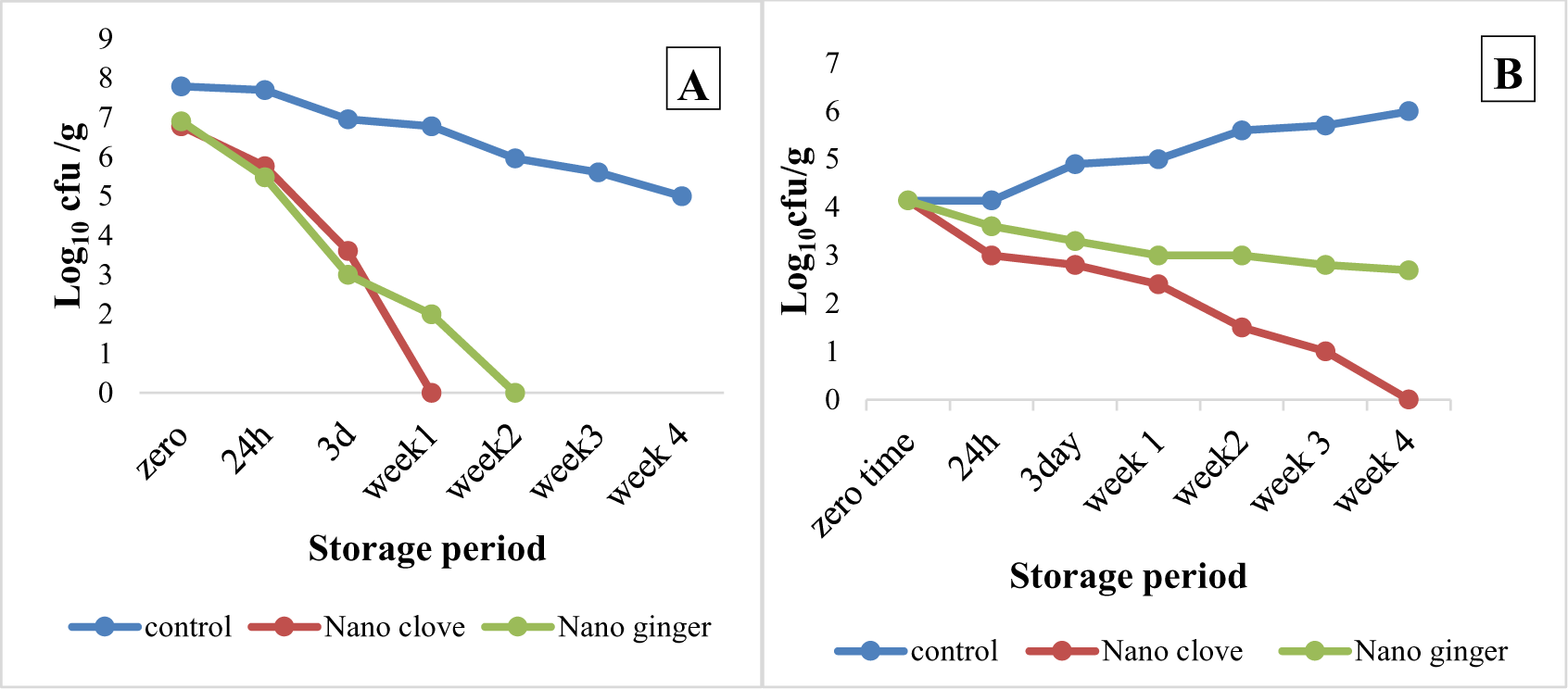
Total S. aureus count inoculated into milk used for labneh manufacturing was 7 log10 cfu/mL (Fig. 2). This count was considerably reduced after 3 days, with percentages of 46.8, 56.5, and 10.7% in CS (nano clove), GS (nano ginger), and control samples (without fortification), respectively (Supplementary fig. SF1). This reduction proceeded until the inoculated S. aureus completely disappeared at the first and second week for CS and GS, respectively. However, it remained viable until the end of the storage period in control samples with reduction percentage of 35.8%.
Mean counts of S. Aureus (A) and A. Flavus (B) in fortified labneh during the storage period (4oC/30 day).

A. flavus was reduced (32.3 and 20.2%) after 3 days of the storage period for nano clove and nano ginger oil fortified labneh then reached 100 and 35% by the end of the storage period, respectively (Supplementary fig. SF1). There were non-significant differences between the two EOs used (P > 0.05). Contrarily, A. flavus persisted viable and increased by 2 log (Fig. 2) in the control group during the storage period despite the high acidity percentage of labneh which reached 1.5% (Table 3).
Discussion
The World Health Organization estimated that food-borne diseases cause approximately 420,000 deaths, 600 million hospitalizations, and $110 billion in economic losses each year (Nadi et al., Reference Nadi, Taher, Awad and Ahmed2023). Furthermore, it is estimated that microbial spoilage accounts for up to 25% of food losses. Therefore, food industries need to implement substitutes that prevent such microbial growth while also fulfilling the consumers’ demands for natural alternatives. Consequently, EOs such as ginger and clove oil are getting more attention in the dairy industry due to their potent antimicrobial activity and safety. Our team (Ahmed et al. Reference Ahmed, Ibrahim, Abdel-Salam and Fahim2021) previously showed that these oils exhibited very low cytotoxicity on normal human lung fibroblasts with CC50 728.94–841.66 μg/mL. Furthermore, Wang et al. (Reference Wang, Ma, Liu, Liu and Niu2022) and Alharbi et al. (Reference Alharbi, Albalawi, Alghrid, Alhwity, Qushawy, Mortagi, El-Sherbiny, Prabahar and Elsherbiny2023) reported the safety of the prepared clove and ginger oil nano-emulsion. The results of these studies support the potential application of these EOs and their nano-emulsions in dairy plant as safe, non-toxic, and potent natural preservative additives.
Characterization of EO nano-emulsions
Determination of particle size, polydispersity index and zeta (ζ)- potential
Zeta potential is a measure of the stability and surface charge of nano-emulsion. Ζ-potential of essential oil-free nano-emulsions was + 48.60 ± 6.40 mV because of NH3 + groups of chitosan which decreased in the prepared nano-emulsions and boosted their stability since ζ-potential values greater than 30 mV cause particle repulsion (Yousefi et al., Reference Yousefi, Khanniri, Sohrabvandi, Khorshidian and Mortazavian2023). In accordance, López-Meneses et al. (Reference López-Meneses, Plascencia-Jatomea, Lizardi-Mendoza, Fernández-Quiroz, Rodríguez-Félix, RR and Cortez-Rocha2018) found that Schinus molle essential oil-nano-emulsion had a ζ-potential of + 40.2 mV. The PDI is used to determine how homogeneous the particle size distribution and diameter uniformity is in suspensions. The lower PDI of the examined ginger and clove oil nano-emulsion indicated more homogeneous particle and uniform size distribution. The small size particles are advantageous in improving nano- emulsion properties of strong stability, large surface area, improved interfacial contact, and dispersion of oils through the food matrix (El-Sayed and El-Sayed, Reference El-Sayed and El-Sayed2021). Similarly, Shehabeldine et al. (Reference Shehabeldine, Doghish, El-Dakroury, Hassanin, Al-Askar, AbdElgawad and Hashem2023) found that clove oil nano-emulsion showed a spherical shape on TEM micrographs and were in the range of 27.7–52 nm.
Stability test
A freeze-thaw cycle was conducted to determine whether ice crystals formed during the freezing process would affect droplet breakup when the nano-emulsion was thawed. Heating-cooling cycles simulate heating or cooling processes that may affect the stability of nano-emulsions by evaluating the effects of rapid temperature changes. At higher temperatures, the sample's viscosity decreases, causing collisions between droplets and a difference in density between phases. The changes in temperature can weaken the interfacial film surrounding the droplets thus allowing them to destabilize. Moreover, nonionic surfactants become less hydrated in water as the temperature rises. The nano-emulsions were stable after centrifugation, heating-cooling test and freeze-thaw test which indicated that the nano-emulsions maintained their uniform composition and did not separate into different layers over time. Such long-term stability is crucial for ensuring the effectiveness and shelf-life of the prepared nano-emulsions in various applications. Similarly, Alharbi et al. (Reference Alharbi, Albalawi, Alghrid, Alhwity, Qushawy, Mortagi, El-Sherbiny, Prabahar and Elsherbiny2023) prepared ginger oil nano-emulsion and found that there was no phase separation after centrifugation at 5000 rpm for 30 min.
In addition, stability of the prepared nano-emulsions in fortified lab- manufactured labneh throughout its storage period of 30 days was observed by evaluating its sensory properties. Results of the sensory properties including the body and texture property indicated absence of oil separation with over-all acceptability score higher than that of control samples, and with non-statistically significant differences between them (P > 0.05).
Antimicrobial activity of nano-emulsion
The obtained results confirmed the antimicrobial activity of ginger and clove nano-emulsions and revealed that Gram-negative bacteria were more sensitive than Gram-positive. This may be attributed to the high percentage of the sesquiterpene hydrocarbons (58.4%) and zingiberene (47.56%) in ginger oil and eugenol phenolic compounds (54.28%) in clove oil (Ahmed et al. Reference Ahmed, Ibrahim, Abdel-Salam and Fahim2021), which proved to have strong antimicrobial properties against the tested microorganisms. In addition, the ability of nano droplets to interact with lipopolysaccharide (LPS) in the bacterial cell membrane leads to disruption of the membrane's integrity, leakage of macromolecular components such as proteins, and nucleic acids, depletion of ATP, and finally bacterial death (Firoozi et al. Reference Firoozi, Zahra and Navideh2020). In line with the obtained results, Firoozi et al. (Reference Firoozi, Zahra and Navideh2020) found that ginger oil at higher concentration (10 µg/mL) was more effective against Gram-negative (E. coli) than Gram-positive (S. aureus). In contrast, Shahbazi (Reference Shahbazi2019) recorded that Gram-positive bacteria (S. aureus) were more sensitive to clove oil nano-emulsion effect than Gram-negative (E. coli and S. Typhimurium). Additionally, a higher MIC value of 20 µg/mL against A. flavus was reported by FL et al. (Reference FL, FM and MM2020). Regarding Chitosan used for preparation of the nano-emulsion, it had no inhibitory effect against the tested microorganisms. This could be attributed to the low concentration of chitosan (less than 0.1%) compared to the concentrations used in the studies that found an antimicrobial effect of chitosan, in which the effective concentrations of chitosan ranged from 0.5 to 10% (Atia et al., Reference Atia, Mohamed, Aboelroos and Awad2023; Yousefi et al., Reference Yousefi, Khanniri, Sohrabvandi, Khorshidian and Mortazavian2023). Finally, EO nano-emulsion is an effective alternative compared to the pure EO that recorded higher MIC value (0.01 mg/mL) against the same pathogenic and spoilage microorganisms in the study applied by Ahmed et al. (Reference Ahmed, Ibrahim, Abdel-Salam and Fahim2021).
Assessment of the influence of the tested EO nano-emulsion on the sensory properties of labneh
Sensory results indicated that incorporating of EOs nano-emulsion into dairy products could enhance, or at least not adversely affect their sensory characteristics. Similar results were observed in the study applied by Salama et al. (Reference Salama, El-sayed H, Kholif and Edris2022) who recorded that yoghurt fortified with clove oil nano-emulsion (20 and 50 µg/g) had a highly preferable flavour score during the storage period. Moreover, Kim et al. (Reference Kim, Seo, Chon, Youn, Jeong and Song2022) reported that the addition of ginger oil could enhance the yoghurt's colour, taste, and general acceptability.
Influence of the tested EO nano-emulsion on viability of S. Aureus and A. Flavus with their impact on the starter culture activity of fortified labneh
The outcomes of this part showed that neither the starter culture's growth rate nor the labneh's onset of coagulation time was impacted by the EO nano-emulsions fortification. Similarly, El-Sayed and El-Sayed (Reference El-Sayed and El-Sayed2021) reported that the addition of EOs had no effect on the starter culture activity.
Regarding the viability studies, higher EO concentrations were evaluated for microbial inhibition inside the labneh matrix than that used in vitro (MIC value) against the tested S. aureus and A. flavus, respectively because of the high protein and lipid content of fortified labneh (El-Sayed and El-Sayed, Reference El-Sayed and El-Sayed2021).
S. aureus was isolated from different dairy products including labneh due to its ability to grow in a broad range of temperatures (7°C- 48.5°C) and pH, (4.2- 9.3) (Halim et al., Reference Halim, El-Essawy, Awad, El-Kutry and Ahmed2022). Staphylococcus aureus food poisoning is a common global cause of food-borne outbreaks, causing various human diseases, including mild skin infections and severe pneumonia (CDC, 2019).
There were non-significant differences between the two examined EOs on S. aureus reduction percentages (P > 0.05). However, there was a statistically significant difference between the control and fortified groups (P < 0.05). The reduced percentages in the fortified groups was attributed to the secondary components of EOS that had antibacterial influence as previously mentioned in MIC part. In addition, the solubilisation of the tested EOs in nano-emulsion systems increased the number of binding sites which could interact and disrupt the bacterial membranes, resulting in bacterial death (Zhao et al., Reference Zhao, Ma, Wang and Xiang2023). Sun et al. (Reference Sun, Luo, Zheng and Xu2022) reported similar results nonetheless; they used higher concentrations of nano clove (0.25 mg/mL). Furthermore, the limited reduction percentage in the control group could have arisen from the activity of the starter culture that was used and the produced acidity (r = − 0.970).
Aspergillus flavus is a serious threat to human and animal health because of its ability to produce aflatoxins that cause various complications such as hepatotoxicity, teratogenicity, and immunotoxicity. Furthermore, contamination of dairy products with mould causes serious economic losses because its growth is associated with visible signs of spoilage such as off flavour and discoloration that eventually result in product rejection (Esam et al., Reference Esam, Hafez, Khafaga, Fahim and Ahmed2022). Our results revealed the strong positive correlation (r = 0.826) between acidity percentages and count of the inoculated microorganism in control samples demonstrated that acidity alone wasn't sufficient to inhibit the fungal growth. Additionally, a statistically significant difference (P < 0.05) was observed between the control and treated groups, highlighting the antifungal activity of the nano-emulsion. This effect was attributed to the small particle size of the nano-emulsion, which enhances its ability to damage the fungal cell wall, alter membrane permeability, and disrupt mitochondrial membranes, ultimately resulting in fungal cell death (Maurya et al., Reference Maurya, Singh, Das, Prasad, Kedia, Upadhyay, Dubey and Dwivedy2021). Comparable results were reported by Botião et al. (Reference Botião, Jéssica, Zoratto, Lydiana and Nakasugi2020):, that ginger EOs at concentrations of 25 and 50 µg/g suppressed A. flavus after 14 days. On the other hand, Arekemase and Babashola (Reference Arekemase and Babashola2019) observed that ginger and clove oils caused an increase in the fungal counts.
The studied EO nano-emulsion demonstrated significant antimicrobial activity against the pathogens under investigation. However, their antimicrobial influence on a broader range of gram positive, gram negative, and fungal microorganisms as well as the potential resistance of microorganisms to these EOs, still needs further investigation. Additionally, Further research is still necessary to explore their potential utilization in other dairy products and, consequently, their application in the food sector.
In conclusion, this study assessed the MIC of ginger and clove oil nano-emulsions and their impact on the microbial and sensory characteristics and starter culture activity of lab-manufactured labneh. These nano-emulsions displayed significant antimicrobial activity against the tested food-borne microorganisms (E. coli, S. Typhimurium, S. aureus, P. aeruginosa and A. flavus) using low concentrations. Also, they inhibited the survivability of S. aureus and A. flavus in lab-manufactured labneh, without altering the product's sensory characteristics or interfering with the starter culture activity. It suggests that ginger and clove nano-emulsions may be used in dairy products as natural preservatives.
Supplementary material
The supplementary material for this article can be found at https://doi.org/10.1017/S0022029925101143