The new coronavirus disease 2019 (COVID-19) is a virus that first appeared in China toward the end of 2019 and continues to spread today. This virus is highly contagious and has spread quickly all over the world. The World Health Organization (WHO) has declared this situation as a pandemic. It is transmitted by the droplets emitted by sick people by coughing or sneezing directly or by touching the mouth, nose, and eyes of other individuals in the environment. The disease is mainly transmitted by droplets. As of January 10, 2021, the number of cases worldwide was over 90 million, while the total number of deaths reached 1.93 million. Although COVID-19 has become alarming, the pandemic affects all sectors, especially the health sector, economy, service, tourism, education, etc. Governments are trying to take the necessary measures by making preparations regarding the pandemic. Therefore, the number of studies in this field being performed and published is increasing day by day. Identifying tendecies by performing bibliometric analyses of these studies will help in future studies.
In the evaluation of COVID-19 publications, bibliometric analysis, formed by examining the publications with mathematical and statistical techniques, will be used. Bibliometric analysis is defined as the quantitative analysis of certain characteristics of scientific documents or publications, such as the number of authors, journal, subject, and publication information. In bibliometric analysis, effective results are obtained for scientific communication by performing analyses according to certain characteristics, and these results will help in future studies. Methods used in bibliometric analysis include summarization as citation index, bibliographic matching, co-citation analysis, and bibliometric mapping method. Analysis uses a quantitative approach to observe, evaluate, and define published studies. These methods require a systematic, transparent, and repeatable review process, and this increases the quality of the examinations. It also makes it possible to get to know and promote the disciplines better and have an idea of the state of the field. 1–Reference Ivan and Cater6
The aim of this study is to analyze the publications in the field of COVID-19 with the help of bibliometric methods. After bibliometric analysis, the second aim is to investigate the relationship between the number of publications in countries and the number of total cases.
Methods
In this study, the publications related to COVID-19 were analyzed using the bibliometric technique. All the data in the study were obtained from the Web of Science (WOS) site, saved in ANSI format, and transferred to VOSviewer (version 1.6.16) by making the necessary transformations. Bibliometric analysis and mapping processes were obtained with the VOSviewer program. The words “COVID-19”, “Novel Coronavirus”, “2019-nCoV”, “SARS-CoV-2” were used as key words for analysis. The data include publications from 2019 to 2021 (January 10). Only publications are included in the analyses; a total of 38,080 publications were evaluated. In the second stage of the study, as a result of bibliometric analysis, the number of publications related to COVID-19 belonging to the countries were obtained, and the relations of these numbers with the number of total cases on 10 January 2020 were examined. 7 Spearman correlation coefficient was used to examine the relationships. The statistical significance level was taken as 0.05, and SPSS (version 21) was used as a package program.
Results
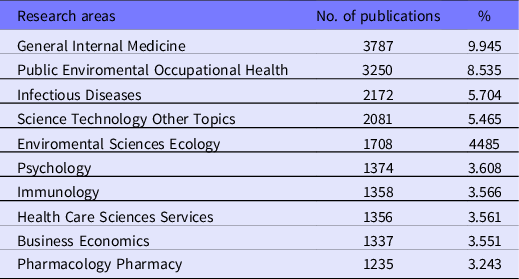
The number of studies carried out in the field of COVID-19 between 2019 and 2021 (January 10) has been determined as 38,080. It was determined that 9.945% (3787) of the studies were carried out in the field of general internal medicine. In Table 1, information was given about in which area the studies on COVID-19 were conducted the most. It was seen that, the top 10 research areas about COVID-19 were general internal medicine (3787; 9.945%), public environmental occupational health (3250; 8.535%), infectious diseases (2172; 5.704%), science technology other topics (2081; 5.465%), enviromental sciences ecology (1798; 4485%), psychology (1374; 3.608%), immunology (1358; 3.566%), health care sciences services (1356; 3.561%), business economics (1337; 3.551%), and pharmacology pharmacy (1235; 3.243%).
Top research areas of COVID-19 articles

Most of the work in the field of COVID-19 has been written in English. It was seen that, 94.407% (35950) of the publications were published in English, and the second most used language was Spanish (2.009%; 765).
Considering the number of studies in the field of COVID-19 by years, it was determined that 97.264% of the studies were made in 2020, 1.605% was done in 2019 and 1.132% was published in January 2021.
Table 2 includes the numbers of COVID-19 publications made by country and the number of citations. All publications were written in 189 countries. When the countries were examined according to the number of publications, it was found that the countries with the highest number of publications were China and the United States. When the most cited numbers are evaluated, China ranks first.
Number of articles and citation numbers by country

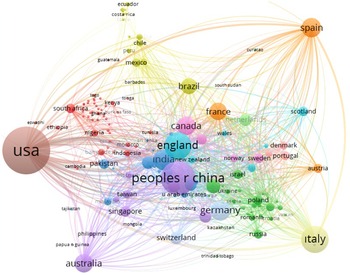
In Figure 1, a map showing the number of publications and collaboration relationships between countries around the world was obtained. The size of the circle in the map indicates the number of publications. The larger the circle, the higher the number of publications. The colors on the map show the clusters. As a result of bibliometric analysis, a total of 14 clusters were obtained. And these clusters are obtained as follows. In addition, the thickness of the lines in the graph indicate the strength of the relations between countries.
Network visualization map for international collaboration of worldwide.

Cluster 1: Algeria, Bangladesh, Benin, Botswana, Burkina Faso, Burundi, Cambodia, Cameroon, Cent Afr. Republ, Comoros, Cote Ivoire, Dem. Rep. Congo, Eswatini, Ethiopia, Gabon, Gambia, Ghana, Guatemala, Guinea, Indonesia, Kenya, Laos, Lesotho, Liberia, Madagastar, Malawi, Maldives, Mali, Mauritania, Mauritius, Morocco, Mozambique, Namibia, Niger, Nigeria, Rep. Congo, Rwanda, Senegal, Seychelles, Sierra Leone, Somalia, South Africa, Tanzania, Togo, Tonga, Tunisia, Uganda, Zambia, Zimbabwe
Cluster 2: Albania, Armenia, Azerbaijan, Belarus, Bosnia&Herceg, Bulgaria, Crotia, Cyprus, Czech Repuclic, Estonia, Georgia, Greece,Hungary, Israel, Kazakhstan, Kosovo, Kyrgyztan, Latvia, Lithuania, Malta, Moldova, Montenegro, North Macedonia, Poland, Romania, Russia, Serbia, Slovakia, Slovenia, Trinidad Tobago, Turkey, Ukranie, Uzbekistan, Vatican
Cluster 3: Afghanistan, Bahrain, Bhutan, Egypt, India, Iran, Iraq, Jordan, Kuwait, Lebanon, Libya, Malaysia, Myanmar, Nepal, Oman, Pakistan, Palestine, Qatar, Saudi Arabia, Sri Lanka, Sudan, Syria, Tajikistan, U Arap Emirates, Yemen,
Cluster 4: Argentina, Barbados, Bolivia, Brazil, Chile, Colombia, Costa Rica, Cuba, Dominician Rep, Ecuador, El Salvador, French Guiana, Honduras, Jamaica, Mexico, Nicaragua, Panama, Paraguay, Peru, Uruguay, Venezuela
Cluster 5: Australia, Brunei, Fiji, Japan, Mongolia, New Calendonia, Papua n Guinea, China, Philippines, Singapore, Solomon İslands, South Korea, Taiwan, Thailand, Vietnam
Cluster 6: England, Gibraltar, Ireland, New Zealand, Northern Ireland, Scotland, Wales
Cluster 7: Andorra, Austria, Bahamas, France, Monaco, Spain
Cluster 8: Dominica, Grenada, Haiti, Nauru, Saint Maarten, United States
Cluster 9: Belgium, Bermuda, Canada, Iceland, Norway, Sweden
Cluster 10: Denmark, Finland, Guinea Bissau, Portugal, South Sudan
Cluster 11: Aruba, Curacao, Netherlands
Cluster 12: Germany, Liechtenstein, Switzerland
Cluster 13: Italy, San Marino
Cluster 14: Luxembourg
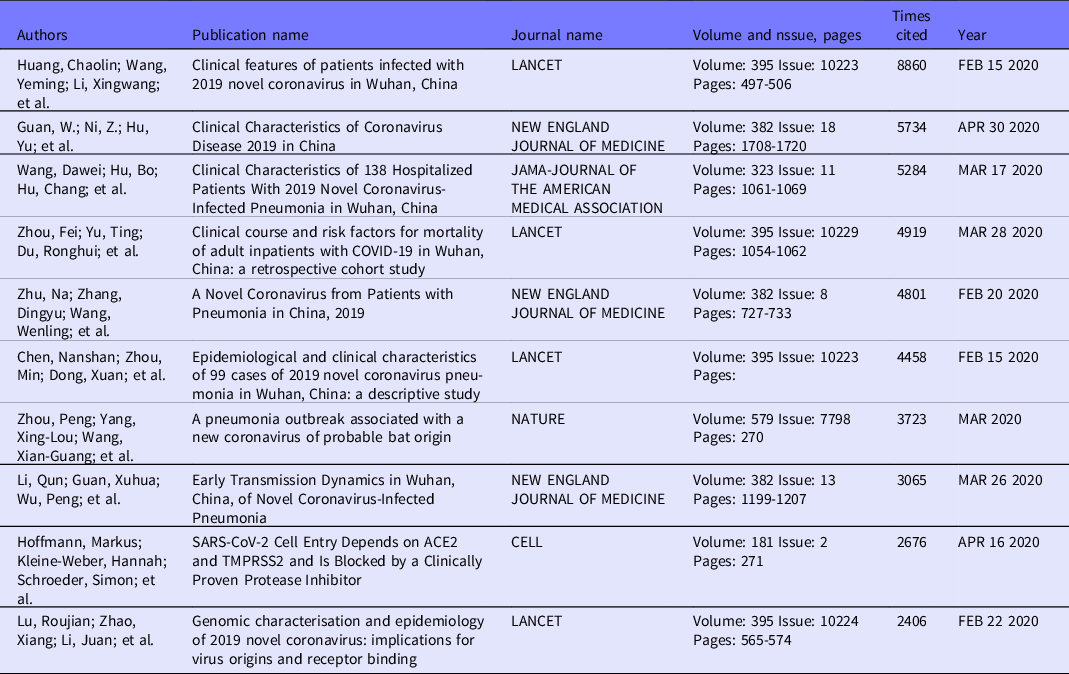
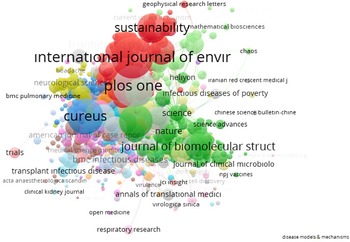
In Table 3, the 10 most cited studies on COVID-19 are given. It was seen that LANCET was very successful publications about COVID-19. A total of 38,080 publications were published in 5787 journals. Of these journals, there were 907 journals that have at least 10 publications. Of these journals, there were 1438 journals that have at least 10 citations. In Figure 2, the network visualization map shows these journals. In the figure, the size of the circles indicates the number of citations.
The 10 most cited studies on COVID-19

Network visualization map for citation analysis of journals.

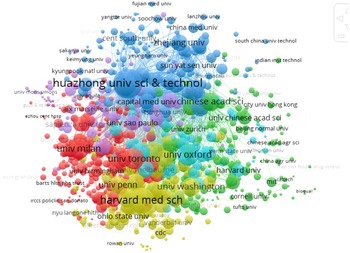
The network visualization map obtained as a result of bibliometric analysis of publications on COVID-19 in terms of organizations is given in Figure 3. As a result of the analysis, taking into account the number of documents and citations numbers, the most active 10 institutions were Huazhong University Science & Technology, Wuhan University, Capital Medical University, Chinese Academy of Sciences, Tsinghua University, University of Hong Kong, Chinese Academy of Medical Sciences, Harvard Medical School, China-Japan Frienship Hospital, and Fudan University, respectively.
Network visualization map for citation analysis of organizations.

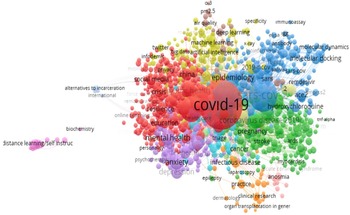
As a result of the examination of the biometric analysis in terms of the keywords in the COVID-19 publications, Figure 4 was obtained. There were 48,522 keywords used in the publications about COVID-19. These keywords had 1162 keywords that were used in at least 15 different publications.
Network visualization map for keywords.

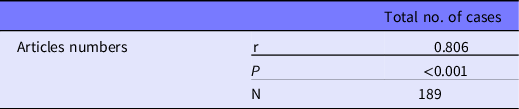
In the second stage of the study, as a result of bibliometric analysis, the numbers of publications related to COVID-19 belonging to the countries were obtained, and the relations of these numbers with the number of total cases on January 10, 2020, were examined (Table 4). It was found that there was a statistically significant relationship between the number of publications of the countries and the number of total COVID-19 cases. In addition, the strength of this relationship was found to be high (r = 0.806; P < 0.001). Therefore, with the increase in the number of cases, the number of studies conducted by countries in this field has increased.
Relationships between the number of articles and the total number of cases for countries

Discussion
With the continued spread of the COVID-19 pandemic, the number of studies in this area is constantly increasing. Studies are carried out in many areas related to the subject. However, evaluating the quality of these publications and obtaining valuable information about the publications will helpful on future studies.
De Felice and Polimeni applied a bibliometric analysis on coronavirus using the Scopus database. They analyzed 1883 studies. Similar to our study, the countries with the most studies were determined as China and the United States. Also, Farooq et al. made a bibliometric analysis on coronavirus and examined a total of 6694 registered studies on WOS. They found that the most studies about coronavirus was reported from within the United States and China, with The Journal of Medical Virology and CUREUS being the favorite publications. Reference De Felice and Polimeni8,Reference Farooq, Rehman and Ashiq9
In our study, 38,080 papers about COVID-19 were evaluated. The most used keywords in the studies were determined as COVID-19, SAR-COV2, and coronavirus. When the countries were examined according to the number of papers, it was found that the countries with the highest number of papers were China and the United States. When the most cited numbers were evaluated, China ranked first; Huazhong University Science & Technology and Wuhan University were among the most active institutions considering the number of documents and citations. In the second stage of the study, the relationship between the number of publications about COVID-19 and the number of total cases was examined. The relationships were found to be significant and high.
With this study, bibliometric analyses on countries, institutions, authors, and subject area related to COVID-19 were performed, and a general perspective was created. Another advantage of the study is, the investigation of the relations between the number of publications of the countries and the number of total cases per countries. We found that there was a statistically significant relationship between the number of publications of countries and the number of COVID-19 cases. These results show us that with the increase in the number of cases, the number of studies conducted by countries in this field has increased. Studies in the field of COVID-19 will constitute an important source of information in other sectors, especially in the health sector. These studies has an important role for goverments to take necessary precautions and plans.
Authors Contributions
All authors contribute to all stages of the article.
Competing interests
The authors declare that there is no other conflict of interest to disclose.