INTRODUCTION
Bottlenose dolphins are among the most widespread and best known of the small cetaceans. They occur in nearly all tropical and temperate seas and are typically found in shallow and coastal habitats, although they also occupy oceanic waters (Leatherwood & Reeves, Reference Leatherwood and Reeves1983). The common bottlenose dolphin Tursiops truncatus (Montagu, 1821), hereafter bottlenose dolphin, is the commonest cetacean in the continental shelf of the Mediterranean Sea and, because of its close proximity to Man's area of influence, it is heavily exposed to anthropogenic disturbance. In 2006, the International Union for Conservation of Nature (IUCN) Red List Authority and ACCOBAMS (Agreement on the Conservation of Cetaceans in the Black Sea, Mediterranean Sea and contiguous Atlantic area) agreed to qualify the Mediterranean ‘subpopulation’ of bottlenose dolphins as ‘Vulnerable’ according to the IUCN Red List criteria, (Bearzi & Fortuna, Reference Bearzi, Fortuna, Reeves and Notarbartolo di Sciara2006; Reeves & Notarbartolo di Sciara, Reference Reeves and Notarbartolo di Sciara2006). This decision was taken based on a suspected population decline of at least 30% in the Mediterranean Sea over the last 60 years. Although climate change may also be involved in the process, the central causes for the decline are the direct kills by fishermen to reduce competition and avoid net damage, incidental mortality in fisheries, overfishing of key prey and habitat degradation, particularly chemical pollution and the disturbance caused by boat traffic (Bearzi et al., Reference Bearzi, Fortuna and Reeves2008). The species has also been catalogued as vulnerable and subject to significant levels of threat in the European Habitats Directive (Annex II), the Barcelona and Bern Conventions, the ACCOBAMS agreement (Bonn Convention) and, locally, in the red lists of both Spain and the Balearic Islands, as well as in the Spanish National Catalogue of Threatened Species.
In the western Mediterranean, the distribution of the species is sparse and appears to be fragmented into small population units, with a key one inhabiting the Balearic Islands (Notarbartolo di Sciara, Reference Notarbartolo and Notarbartolo di Sciara2002; Gazo et al., Reference Gazo, Forcada, Aguilar, Fernández-Contreras, Borrell, Gonzalvo, Tornero, Raga and Pantoja2004). Recommendations by the IUCN conservation action plan for cetaceans on the need to estimate the size of bottlenose dolphin subpopulation in the Mediterranean Sea (Reeves et al., Reference Reeves, Smith, Crespo and Notarbartolo di Sciara2003) led to the first absolute abundance estimate of bottlenose dolphins in north-western Mediterranean waters (Forcada et al., Reference Forcada, Gazo, Aguilar, Gonzalvo and Fernández-Contreras2004). This study reported a low absolute density in open waters and a relatively high mean abundance around the Balearic Islands, highlighting the importance of the inshore waters for the conservation of the subpopulation. However, the area is severely influenced by a number of anthropogenic activities, mostly resulting from mass tourism, which plays a crucial role in local socioeconomics. These include fisheries, extensive urbanization, coastal development and leisure boat traffic, which is particularly intense during summer. In this context, assessing the abundance of bottlenose dolphins and their group dynamics, site-fidelity and movement patterns is necessary to evaluate local potential threats to the subpopulation. This paper provides information on these issues with the objective of providing baseline information to ensure adequate management and conservation measures.
MATERIALS AND METHODS
Study area
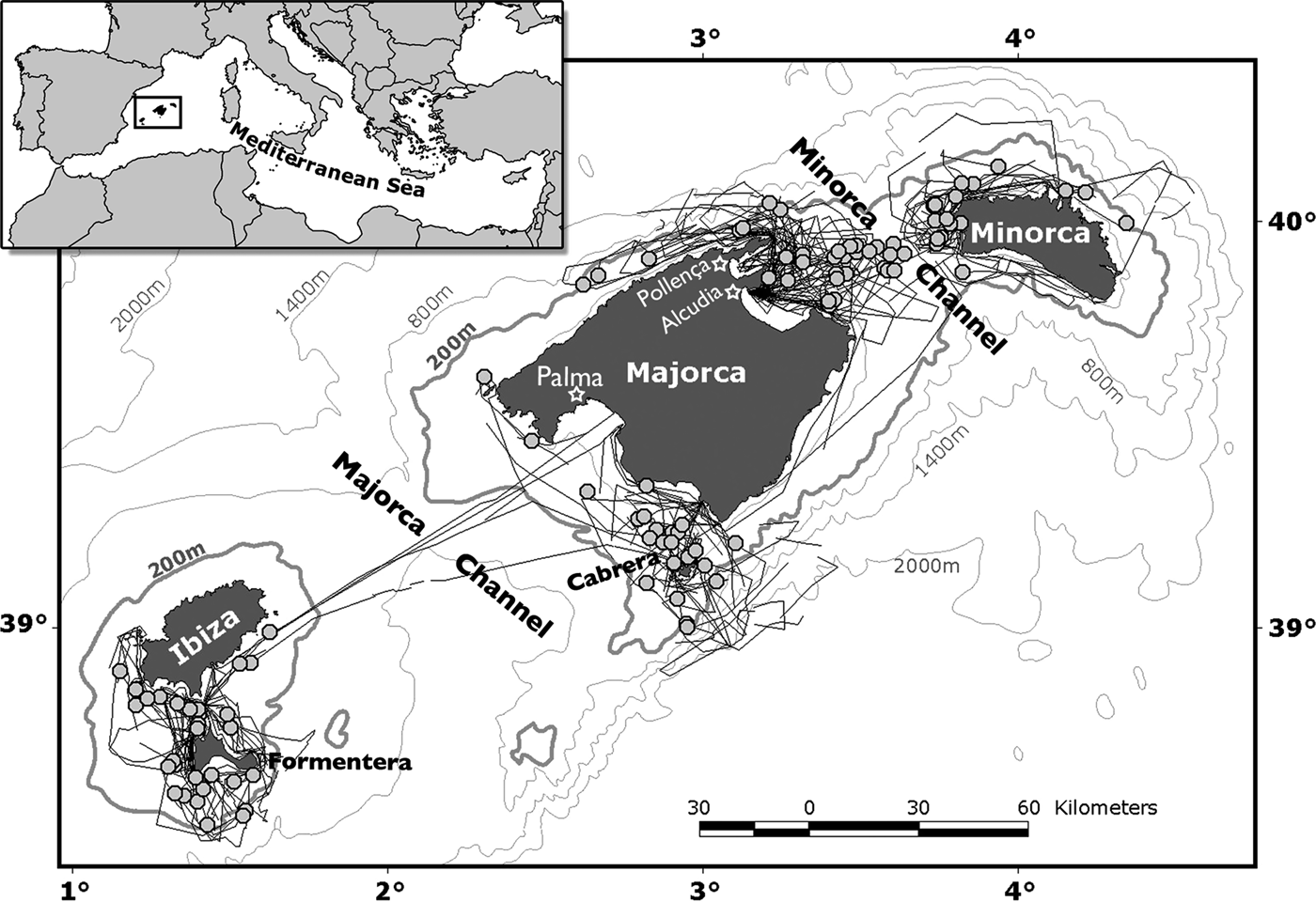
The Balearic Islands (Figure 1), in the western Mediterranean Sea, is an archipelago separated from the Iberian Peninsula by large geological barriers with depths ranging from 800 to 2000 m. This area has a high hydrographical variability, mainly influenced by the circulation pattern of its channels (Pinot et al., Reference Pinot, López-Jurado and Riera2002). The Balearic continental shelf consists of two shallow (<200 m), practically horizontal shelves that together extend over an area of approximately 15,800 km2.
Map of the study area showing survey effort between 2002 and 2004, under adequate sighting conditions, and sightings of bottlenose dolphins. In bold, the 200 m isobaths lines evidencing the limits of both shelves: Gimnèsies (Majorca–Minorca) and Pitiüses (Ibiza–Formentera).

The largest shelf is that of the Gimnèsies Islands and includes the main islands of Majorca and Minorca. It covers an area of approximately 12,315 km2 and extends eastwards. It is narrow and is mainly surrounded by a rocky coast, with predominance of seagrass meadows and sand or sandy–muddy bottoms. In the northern and southern areas off Majorca the bays of Alcudia, Pollença and Palma, the Minorca Channel and the channel between Majorca and the archipelago of Cabrera enlarge the continental shelf and increase the presence of muddy–sandy bottoms. Overall, the continental slope is very steep and there are no submarine canyons. The shortest distance between Majorca and the Iberian Peninsula is 172 km. The smallest shelf is that of the Pitiüses Islands and includes the main islands of Ibiza and Formentera. It covers an area of approximately 3480 km2 and extends westwards. Its coastal waters are characterized by seagrass meadows and sand or sandy–muddy bottoms. Seagrass meadows are particularly important in the shallow waters between southern Ibiza, the small island of Espalmador and La Savina area (northern Formentera). The shortest distance between Ibiza and the mainland is 87 km. The Gimnèsies and Pitiüses shelves are separated by the Formentera basin, a depression that can be as deep as 1000 m, but which, in its northernmost part, between Ibiza and Majorca, is only 600 m.
Boat survey
Fieldwork was carried out during June, July and September 2002, from the middle of March to the end of July 2003, and from the middle of March to end of June 2004. Boat surveys were conducted ad libitum from a 6.80 m long inflatable boat with a fibreglass keel (Sacs-680 Ghost) powered by a Yamaha 115 HP four-stroke engine, which typically sailed at an average speed of 17 knots. Survey conditions were considered adequate when navigation was carried out under daylight and good visibility, sea state was ≤3 Beaufort (large wavelets, crests beginning to break and scattered whitecaps) and with, at least, two observers scanning the sea surface looking for dolphins. Binoculars were not used to search for dolphins during navigation. When spotted, dolphin groups were approached at low speeds, progressively converging with the routes they followed, and avoiding sudden changes of speed and directionality to minimize potential disturbance caused by the boat. The position of the group was recorded, together with water depth and the shortest distance to the coast determined with a GPS chart-plotter. Boat course was interrupted and navigation went off effort when dolphins were sighted or whenever the sea or weather conditions deteriorated.
Whenever a bottom trawler was detected, the survey was also interrupted to approach the vessel to investigate potential presence of dolphins. To do so, the survey boat followed the stern of the trawler at a distance of about 300–500 m for a minimum of 10 min and dolphins were searched for specifically along the trawler stern track.
Group size
As suggested by Mann (Reference Mann, Mann, Connor, Tyack and Whitehead2000), when observing a dolphin group we considered both dolphin activity and distance among individuals. A group was defined as ‘dolphins within approximately 100 m radius of each other (Irvine et al., Reference Irvine, Scott, Wells and Kaufmann1981) that were moreover observed in apparent association, moving in the same direction and often, but not always, engaged in the same activity (Shane, Reference Shane, Reeves and Leatherwood1990)’. Size of the group was estimated independently by at least two observers at each sighting and the mean number recorded. These field estimates of group size were corrected a posteriori whenever the photo-identification analysis provided more accurate information. Estimates included number of adults, juveniles, calves and newborns present, based on visual assessment of sizes as compared to average adult size (based on Bearzi et al., Reference Bearzi, Notarbartolo di Sciara and Politi1997).
Photo-identification
At each encounter, we aimed at obtaining as many good images as possible of every individual present throughout the duration of the observation, avoiding bias toward any particular individuals. Photo-identification was consistently based on long-term natural marks such as notches and nicks in the dolphins' dorsal fins (Würsig & Würsig, Reference Würsig and Würsig1979; Würsig & Jefferson, Reference Würsig, Jefferson, Hammond, Mizroch and Donovan1990; Wilson et al., Reference Wilson, Thompson and Hammond1997), as well as any additional mark in other parts of the body. We used an AF SLR camera Canon EOS-30 equipped with Canon EF 70–200 mm f/2.8 L USM zoom lens, and Kodak Elitechrome 100 ASA slide film. The photographic slides taken during the surveys were examined on a light-box using a 10× loupe magnifier.
Selection of photographs was based only on high photographic quality, taking into account focus/clarity, contrast, angle, environmental interference and proportion of the frame filled (adapted from Friday, Reference Friday1997). All photo-identified individuals included in the posterior mark–recapture analysis bore marks suitable for reliable long-term identification from either side of the fin. The best images of every dolphin during each sighting were selected and compared with a catalogue of identified individuals. When a match was not found, the individual was given a unique identification code and added to the catalogue. The number of photo-identified dolphins in a sighting was then compared with the field estimate of group size. If the number of photo-identified dolphins was equal to or greater than the field estimate it was modified to be the number of photo-identified dolphins. The matching procedure was done twice by two different experienced researchers, working independently and using exactly the same equipment and protocol to minimize the number of matching errors.
Identifications and details relating to dolphin group/sighting membership were recorded on a database to construct individual sighting histories. A population estimate was produced with mark–recapture methods and the photo-identification data.
Population analysis
Bottlenose dolphin numbers were modelled with the generalized Jolly–Seber models of Schwarz & Arnason (Reference Schwarz and Arnason1996), which provide robust estimates of numbers. The total number of unique dolphins available for capture ( $\hat N$) was the sum of the number of new individuals encountered every year (
 $\hat B$ι). New numbers of dolphins were modelled as
 ${\hat \beta}_{\iota}$, the fraction of
 $\hat N$ that entered between capture years i and i + 1 and stayed around the Balearic Islands until the following year. In the model likelihood, the
 $\hat B$ι followed a multinomial distribution with parameters
 $\hat{N}$ and
 ${\hat \beta}_{\iota}$, which accounted for the number of unmarked dolphins in each year.
Like Jolly–Seber models, our models assumed that: every dolphin present in the population in year i had the same probability,  $\hat p$ι, of being captured; every dolphin present in the population immediately following year i had the same probability,
 ${\hat \phi}_{\iota}$, of surviving and staying around the islands until year i + 1; marks were not lost or overlooked, and were recorded correctly; the emigration of dolphins from the area was permanent; and the fate of each dolphin with respect to
 $\hat p$ι and
 ${\hat \phi}_{\iota}$ was independent of the fate of any other dolphin.
We fitted models with different sources of variability in these parameters. These were: time specificity, constancy over time and field effort in days. Model selection based on AICc provided a set of best candidate models, which were used to estimate the parameters of interest. These were the  $\hat B$ι, the total number of dolphins at each occasion (
 $\hat N$ι), and
 $\hat N$. These estimates excluded non-captured dolphins, which were those entering and leaving the islands between years. To account for these individuals, we obtained gross estimates of these parameters,
 $\hat B$ι* and
 $\hat N$*, assuming a uniform entry of new dolphins and a uniform emigration of the same dolphins between consecutive years (Schwarz et al. Reference Schwarz, Bailey, Irvine and Dalziel1993); i.e. with equations
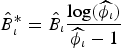 $$\hat{B}_{\iota}^{\ast}=\hat{B}_{\iota} {\log \lpar \widehat{\phi_{\iota}}\rpar \over \widehat{\phi_{\iota}}-1}$$
and
 $$\hat{N}^{\ast}=\Sigma_{\iota}\hat{B}_{\iota}^{\ast}$$
The  ${\hat \beta}_{\iota}$ were modelled together with
 ${\hat \phi}_{\iota}$,
 $\hat p$ι, and
 $\hat N$, subject to the constraint that Σi=1k−1
 ${\hat \beta}_{\iota}$ = 1(Schwarz & Arnason, Reference Schwarz and Arnason1996). We enforced this constraint by fitting our models with a multinomial logic link function of the
 ${\hat \beta}_{\iota}$. All the models were fitted with program MARK (http://www.cnr.colostate.edu/~gwhite/mark/mar).
The total estimated number of bottlenose dolphins was corrected using the estimated proportion of individuals in each group which could not be identified because their natural marks were indistinguishable. The corrected estimate was obtained as  $\hat N$c* =
 $\hat N$*/d, where d is the proportion of distinguishable dolphins. We estimated the variance using the delta method, and the confidence intervals were computed assuming a lognormal distribution; the lower and upper 95% confidence limits computed as
 $$\hat{N}_{L}^{\ast}=\hat{N}_c^{\ast}/C$$
and
 $$\hat{N}^{\ast}_{U}=\hat{N}_{c}^{\ast}C\comma \, {\rm where}\, C= exp \left\{1.96 \sqrt {log_e \lpar 1+\lsqb CV\lpar \hat{N}_c^{\ast}\rpar \rsqb ^2 \rpar }\right\}.$$
RESULTS
Survey and photo-identification effort
The survey coverage between 2002 and 2004 totalled 10,143 km in adequate sighting conditions over 136 daily surveys; 30 in 2002, 54 in 2003 and 52 surveys in 2004. Adverse sea state conditions unusually persistent during the first year of the study resulted on a smaller survey effort, compensated during the following two years of monitoring. From 105 sightings of bottlenose dolphins (Figure 1), 91 were adequately photo-identified. Identification of the other 14 sightings was incomplete either because of adverse weather conditions or because the group was lost before adequate photo-identification images could be obtained. Dolphin groups were followed for a total of approximately 136 h, resulting in more than 6400 images. Once the bad/poor quality images were discarded, 5208 were eventually catalogued. These corresponded to 253 identified individuals.
Commercial trawlers operating in the study area were approached in search of dolphins on 63 occasions. In 25 of them, dolphins interacting with the fishing gear were observed. In this way, 96 dolphins were photo-identified while following active trawling boats at least once.
Dolphin movements
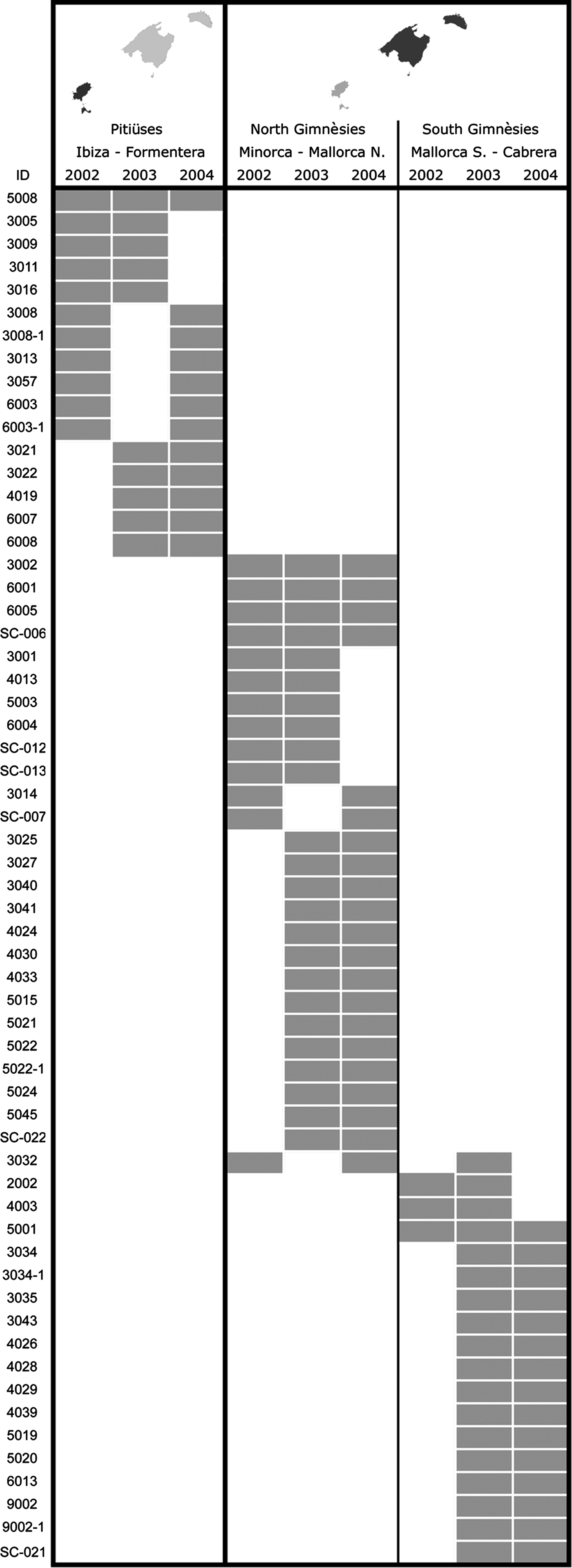
A total of 100 catalogued dolphins were recaptured (dolphins identified in at least two different sightings). Sixty of these individuals were recaptured in different years. Recaptured individuals showed strong site-fidelity, almost always being detected in the same area (Figure 2). An exception was a dolphin (code 3023) seen in the Minorca Channel in 2002, 13 km south from Cabrera in 2003, and 6 km north from Pollença Bay in 2004. The shortest distance between the two positions located further apart from was 136 km, which represented more than twice the distance between recaptures for any other dolphin during our study. While some dolphins were identified both in Majorca and Minorca, thus indicating that dolphins occasionally move across the Minorca Channel, no dolphin was identified in both the Gimnèsies and Pitiüses shelves, suggesting apparent isolation.
Residency pattern of 60 marked individuals recaptured in different years in the Balearic Islands, organized in three different geographical areas (i.e. Pitiüses, North Gimnèsies and South Gimnèsies). Grey cells indicate presence documented through photo-identification and ‘IDs’ are the identified individuals.
Group sizes
Out of the 105 sightings, only one could not be used for the analysis. The average group size of the remaining 104 sightings was 6.65 ± 5.27, with a range between 1 and 40.
Group sizes of sightings with calves and/or newborns (N = 54, average group size 9.67 ± 5.44) were significantly larger (Mann–Whitney's U = 232.50, P < 0.005) than those without immature animals (N = 50, average group size 3.40 ± 2.36). Sightings in which dolphins interacted with trawlers (N = 25, average group size 8.68 ± 4.03) were significantly larger (Mann–Whitney's U = 581.50, P <0.005) than those observed independently of trawlers (N = 79, average group size 6.01 ± 5.48).
Abundance estimates
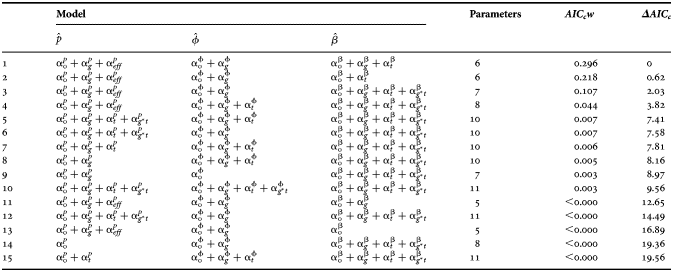
Because of the reduced number of parameters to model with only three capture occasions, there was comparable empirical support for most of the models fitted (Table 1). Therefore, we used model averaging to obtain a derived estimate of total number of dolphins in the Balearic Islands during the period 2002–2004. The mean proportion of distinguishable dolphins was 0.91 (SE = 0.01), from which we obtained a corrected estimate of 517 bottlenose dolphins (%CV = 12.4; 95% CI: 406–658). The number of dolphins in the Pitiüses shelf was estimated as 248 (%CV = 20.1; 95% CI: 168–367) and in the Gimnèsies shelf as 268 (%CV = 8.7; 95% CI: 226–318).
Summary of most plausible models of  ${\hat \beta}_{\iota}$,
 ${\hat \phi}_{\iota}$ and
 $\hat{\,p_{\iota}}$ to obtain estimates of numbers of bottlenose dolphins around the Balearic Islands from 2002 to 2004. AICcw is the relative weight of a model in relation to the model with lowest AICc; and ΔAIC c is the difference in AICc between a model and the best model fitted. Subscript ‘t’ refers to capture occasion specificity in a parameter, ‘c’ to constancy across capture occasions, ‘g’ to geographical strata, and ‘eff’ to the number of days on effort as a linear covariate. Model notation indicates the combination of parameters on a logic scale used to model
 ${\hat \beta}_{\iota}$,
 ${\hat \phi}_{\iota}$ and
 $\hat{\,p_{\iota}}$. For example,
 $log\lsqb \hat{\,p}/\lpar 1-\hat{\,p}\rpar \rsqb =\alpha^{\,p}_{0}+\alpha^{\,p}_{g}+\Sigma \alpha^{\,p}_{t}+\Sigma \alpha^{\,p}_{g\ast t}$ indicates that recapture was modelled as geographical stratum and time specific, with an interaction of time and geographical stratum.
The estimates of survival, equivalent to site-fidelity, were very high for the Pitiüses shelf ( $\hat \phi$P = 0.999; 95% CI: 0.550–1.000), and significantly lower for the Gimnèsies shelf (
 $\hat \phi$G= 0.457; 95%CI: 0.308–0.613). The combined estimate for the Balearic Islands was
 $\hat \phi$BI= 0.578; 95% CI: 0.361–0.769).
DISCUSSION
The size of bottlenose dolphin groups varies according to biogeographical region, prey availability, activity and other factors. The average group size found in this study is comparable to estimates reported elsewhere in the Mediterranean, where the majority of encounters involved groups of fewer than ten individuals (Bearzi et al., Reference Bearzi, Fortuna and Reeves2008). Although no bottlenose dolphin abundance estimate is available for the entire western Mediterranean basin, total population size is likely to be in the low 10,000s based on the densities observed in the areas that have been studied until now (Bearzi et al., Reference Bearzi, Fortuna and Reeves2008). Our best estimate of the total number of bottlenose dolphins inhabiting the Balearic Islands continental shelf, based on photo-identification data collected between 2002 and 2004, resulted in 517 dolphins. In 2002, an aerial survey conducted in the inshore waters of the Balearic Islands (Forcada et al., Reference Forcada, Gazo, Aguilar, Gonzalvo and Fernández-Contreras2004) produced subpopulation numbers that ranged from 727 in spring to 1333 in autumn, with a mean annual value of 1030. While the order of magnitude of the two estimates is similar, the somewhat lower number obtained in our study can be explained by at least two reasons: (a) our survey did not cover the whole continental shelf (Figure 1), while the aerial survey did; and (b) our sighting effort was mostly concentrated during spring and summer, when bottlenose dolphins may be avoiding the upper shelf because of increased boat traffic and human presence (Gonzalvo et al., Reference Gonzalvo, Valls, Cardona and Aguilar2008). Whatever the case, the two estimates, produced in different moments and using different techniques, clearly show that, despite the islands are considered to be a hotspot for the species in the Mediterranean and to shelter what is probably the largest population of bottlenose dolphins in Spain, the total abundance of dolphins there is small and is likely only in the few hundreds.
Information on the movement patterns of bottlenose dolphins and other cetacean species can be successfully derived from individual photo-identification (Baird et al., Reference Baird, Gorgone, McSweeney, Gorgone, Thieleking, McSweeney, Robertson and Webster2009; Bearzi et al., Reference Bearzi, Bonizzoni and Gonzalvo2010). This study suggests high site-fidelity in the Pitiüses shelf, and possibly a lower site-fidelity (larger movements of dolphins) in the Gimnèsies shelf. Bottlenose dolphins are believed to live in open social networks which, together with relatively low costs of locomotion, would promote movement and dispersal of individuals (Randic et al., Reference Randic, Connor, Sherwin and Krützen2012). However, habitat characteristics are also known to determine, and highly restrict, the movement patterns of bottlenose dolphins (Natoli et al., Reference Natoli, Birkun, Aguilar, Lopez and Hoelzel2005), so the observed higher site-fidelity in the Pitiüses area might reflect the fact that the continental shelf there is much smaller than in the Gimnèsies area, where the habitat available to dolphins is larger. This would be reinforced by the likely fact that the deep waters of the Majorca Channel represent an effective barrier between the two areas, as has been suggested to occur with the deep waters between the Balearic Islands and the Iberian Peninsula based on differences in the DDT/PCB ratio of dolphin blubber (Borrell et al., Reference Borrell, Aguilar, Tornero, Sequeira, Fernandez and Alis2006). In addition, a strong site-fidelity would increase knowledge of the local environment and allow the exploitation of predictable prey resources, including those obtained through the interaction with trawlers or other fishing gear.
Due to their predominant coastal distribution, bottlenose dolphins are particularly subject to negative human influence (Bearzi & Fortuna, Reference Bearzi, Fortuna, Reeves and Notarbartolo di Sciara2006) and the Balearic Islands, regarded as a key area for the species in the Mediterranean (Notarbartolo di Sciara, Reference Reeves, Smith, Crespo and Notarbartolo di Sciara2002), is no exception. Historically, bottlenose dolphins have interacted frequently and in conflict with coastal commercial fisheries throughout the Mediterranean (Bearzi, Reference Bearzi and Notarbartolo2002). In the Balearic Islands, interactions between artisanal fisheries and the local bottlenose dolphin population have been reported for decades, but the frequency of interaction reported to the administration in terms of fish loss, net damage and by-catch has increased dramatically over the last two decades. A study conducted in Alcudia Bay, north-eastern Majorca, coinciding with the striped red mullet Mullus surmuletus (Linnaeus, 1758) fishing season, when dolphin predation events were claimed by local fishermen to be more frequent, reported an economic damage caused by dolphins of €1094 per trammel boat; this figure was calculated exclusively on the loss of catch, so actual damage would be certainly larger if net damages were incorporated into the calculation (Gazo et al., Reference Gazo, Gonzalvo and Aguilar2008). Another study covering the complete Archipelago and all fishing gear estimated that these interactions would represent an economic cost, this time including both fish loss and net damage, of 6.5% (95% CI: 1.6–12.3%) of the value of landed catch (Brotons et al., Reference Brotons, Grau and Rendell2008a).
When dolphins play around the nets to steal fish they risk becoming entangled. Moreover, economic damage caused by dolphins is sufficient to impel some fishermen to take retaliation measures against dolphins and demand culling. As a consequence, this interaction has been estimated to cause the death of 30 to 60 dolphins annually (Silvani et al., Reference Silvani, Raich, Aguilar and Evans1992; Brotons et al., Reference Brotons, Grau and Rendell2008a, respectively). Taking into account the population estimates above detailed, such mortality levels substantially exceed the acceptable removals considered to be safe for the maintenance of the population, which for dolphin populations are commonly set at about 1–2% of population size (Wade, Reference Wade1998). Recent studies in the Balearic Islands have suggested that pingers (i.e. acoustic deterrent devices) could be an effective way to reduce bottlenose dolphin interactions with bottom-set nets (Brotons et al., Reference Brotons, Munilla, Grau and Rendell2008b; Gazo et al., Reference Gazo, Gonzalvo and Aguilar2008) by reducing interaction and thus the damage to the nets and the risk of by-catch. However, general use of pingers has not been authorized to avoid the exclusion of dolphins from valuable habitat to the species and also because of the fear that dolphins may become used to pinger sounds or even become attracted as result of what has been described as a dinner-bell effect, thus increasing the intensity of the conflict (Richardson et al., Reference Richardson, Greene, Malme and Thomson1995). Associated with this issue, it should be noted that the strong site-fidelity observed in the present study suggests a lack of dolphin movements across deep waters beyond the continental shelf and relatively limited movements around the coast; as a consequence, it appears unlikely that the same animals are responsible for net depredation in different regions within the Archipelago, an information that should be taken into consideration when designing potential conflict-mitigation strategies.
The Balearic Islands fishing fleet includes 416 artisanal boats, 61 bottom-trawlers, three drifting longliners and 11 purse-seiners (Carreras et al., Reference Carreras, Cardona and Aguilar2004; General Directorate Fisheries of the Balearic Islands database). Besides interacting with trammel nets used by artisanal boats, bottlenose dolphins in the Balearic Islands were found to frequently associate with local trawlers. This interaction has been also reported for bottom trawlers operating along Israel's continental shelf, where dolphin by-catch in this fishing gear is reportedly a major cause of bottlenose dolphin annual mortality (Scheinin, Reference Scheinin2010). By contrast, in the Balearic Islands, by-catch in trawling nets appears to be a relatively uncommon occurrence, and dolphins are likely to play a parasitic role over the fishing activity, water depth being one of the main factors associated with the occurrence of this interaction (Gonzalvo et al., Reference Gazo, Gonzalvo and Aguilar2008). A trawler might be considered a moving patch of food source and, by moving with it, dolphins would presumably use less time and energy to forage, thus resulting in a positive association for dolphins. This might explain why dolphin group sizes recorded during our surveys at sea were significantly larger when dolphins were engaged in this activity. However, it is likely that trawling would also have negative effects on dolphin prey by damaging the sea bottom and overfishing, a common scenario in the Mediterranean Sea that has brought about dramatic ecological changes in the region (Bearzi, Reference Bearzi and Notarbartolo2002; Sala, Reference Sala2004; Tudela, Reference Tudela2004; Gonzalvo et al., Reference Gonzalvo, Moutopoulos, Bearzi and Stergiou2011). Fish species subject to heavy exploitation in the region include hake Merluccius merluccius (Linnaeus, 1758), conger eel Conger conger (Linnaeus, 1758) and octopus Octopus vulgaris (Cuvier, 1797), all species that are central to the diet of Mediterranean bottlenose dolphins (Blanco et al., Reference Blanco, Salomón and Raga2001). Hake depletion is of particular concern because it is a main target of bottom trawlers in the Balearic Archipelago, and a recent report showed that its stock is being exploited far beyond sustainable levels, posing a high risk of stock depletion or collapse (GFCM, 2010).
However, the conflicts with fisheries, whether operational or ecological, are not the only threat to the conservation of bottlenose dolphins in Balearic waters. Tissue levels of pollutants, particularly organochlorine compounds, are very high compared to those reported in populations of the same species in other regions and, in any given area, they are also higher than in other dolphin species (Bearzi et al., Reference Bearzi, Fortuna and Reeves2008). Thus, in the western Mediterranean Sea, bottlenose dolphins carry considerably higher concentrations of these compounds than striped Stenella coeruleoalba (Meyen, 1833) and short-beaked common dolphins Delphinus delphis (Linnaeus, 1758), a difference commonly attributed to dissimilarities in diet composition and to the more coastal habits of the bottlenose dolphins as compared to the other species (Borrell et al., Reference Borrell, Aguilar, Tornero, Sequeira, Fernandez and Alis2006). The organochlorine tissue levels reported in the Balearic Islands dolphins exceed several times the thresholds commonly accepted as safe in mammals and those that have been shown to induce adverse effects, particularly on reproduction, in other bottlenose dolphin populations (Hall et al., Reference Hall, McConnell, Rowles, Aguilar, Borrell, Schwacke, Reijnders and Wells2006). Hence, the importance of potential adverse effects in this bottlenose dolphin population caused by pollution should not be disregarded, especially when considering the high levels of mortality suffered by the sympatric striped dolphins in the early 1990s (Aguilar & Raga, Reference Aguilar and Raga1993), reportedly resulting from depressed immunocompetence caused by PCBs leading to an increase in individual susceptibility to a morbillivirus infection (Aguilar & Borrell, Reference Aguilar and Borrell1994). However, because the impact of this type of pollutants on mammals is indirect and typically occurs through depressions of the reproductive rate or through increased susceptibility to infectious diseases (Reijnders et al., Reference Reijnders, Aguilar, Borrell, Perrin, Würsig and Thewissen2009), the actual relevance of the observed levels of pollutants on the maintenance of the population is difficult to evaluate.
The great expansion of recreational boat traffic and shipping in the Archipelago in recent decades is another potential threat that cannot be ignored. According to the Ministry of Tourism of the Balearic Government (2010) there has been a steady increase in nautical tourism between 2004 and 2010 with increases of both large cruise ships and small recreational boats. In the Balearic Islands there are currently a total of 69 ports offering a total of 20,488 berths (one thousand more than in 2007). While collisions of bottlenose dolphins with boats do not seem to be a cause of concern, there is growing evidence that prolonged direct (or physical) disturbance and noise caused by boat traffic can affect the dolphin's behaviour and use of habitat (Nowacek et al., Reference Nowacek, Wells and Salow2001; Lusseau, Reference Lusseau2005; Christiansen et al., Reference Christiansen, Lusseau, Stensland and Berggren2010). Although no conclusive results have been produced in this regard, previous studies on bottlenose dolphins in the area have suggested that the increased levels of boat traffic and human presence during the summer months, when tourism reaches its peak, forces displacement of dolphins to suboptimal habitats situated further away from coast (Forcada et al., Reference Forcada, Gazo, Aguilar, Gonzalvo and Fernández-Contreras2004; Gonzalvo et al., Reference Gazo, Gonzalvo and Aguilar2008). Last but not least, the Balearic Islands are the region of Spain in which recreational maritime fishing has the longest-standing tradition, social relevance and economic importance. There are about 70,000 recreational fishermen (8% of the population) that practise more than 60 different techniques, predominantly from a boat (63%), yielding annual catches totalling about 25% of those of the professional fleet (Grau, Reference Grau and Basurco2008). Despite the importance of recreational fishing for the local economy, its environmental implications must be taken firmly into account in the management of the region's fishery resources. With this in mind, it would be necessary, not only to apply some measures to promote selective fishing (e.g. introduction of minimum hook sizes), but also to inform and educate recreational fishermen on sustainability issues and to involve them in the management. In Florida, dolphin interaction with recreational fishing gear has reportedly caused a 2% bottlenose dolphin population decline (Powell & Wells, Reference Powell and Wells2010). Removal of, or damage to, bait or catch by dolphins creates an economic loss, degrades a recreational experience, and increases the chance of retaliation by the angler (Read, Reference Read2008). No studies have been conducted in the Balearic Archipelago on this matter; however, due to the large extent of this activity a similar degree of interaction cannot be ruled out.
Considering the problems listed above for the conservation of this fragile population of bottlenose dolphins, and given its manifested strong site-fidelity, which renders the species highly dependent on an increasingly degraded habitat, therefore augmenting its vulnerability from a conservation standpoint, and in compliance with existing political and legal commitments to preserve marine biodiversity, high priority should be given to produce ecosystem-based management strategies, including: (a) promotion of sustainable fisheries to ensure stable food resources to dolphins; (b) mitigation of adverse dolphin–fishery interactions, particularly eradication of dolphin kills; (c) prevention of marine pollution; and (d) regulation of tourism, with special attention to boat traffic, in areas where bottlenose dolphins aggregate and show a higher site-fidelity and, ideally, create marine protected areas. These measures should be developed in parallel with educational programmes to raise awareness and promote the collaboration with local stakeholders.
ACKNOWLEDGEMENTS
The authors wish to thank Irene Alvarez, Maite Lijalad, Vanessa Martin, Monica Revelles, Fabiana Saporiti and Silvia Scali for their help with data collection during boat surveys. Important logistic support was also given by the personnel of the Archipelago of Cabrera National Park and by Manu Sanfélix from Vellmarí Diving Centre in Formentera.
FINANCIAL SUPPORT
This study was funded by EU-LIFE project NAT/E/7303, IEO-DEMO and IEO-MEGA-2 projects.