Introduction
Psychological research about first intentional gestures has largely accepted the classical distinction between (1) deictic gestures that direct attention to a present referent (e.g., showing a toy to an adult, or pointing to request an object that is out of reach), and (2) representational gestures that feature an absent referent (Capirci & Volterra, Reference Capirci and Volterra2008). According to Bates, Camaioni, and Volterra (Reference Bates, Camaioni and Volterra1975), deictic gestures may comprise four different functions: ritualised request, showing, giving, and pointing. From this classification, their role in the origins of referential communication has been widely documented (Gullberg, de Bot, & Volterra, Reference Gullberg, de Bot, Volterra, Gullberg and de Bot2010; Iverson, Capirci, Volterra, & Goldin-Meadow, Reference Iverson, Capirci, Volterra and Goldin-Meadow2008).
Although other types of gestures have been described, pointing is by far the most explored deictic gesture. Previous studies on intentional communication and shared reference in non-human primates (Gómez, Reference Gómez2010; Leavens, Hopkins, & Bard, Reference Leavens, Hopkins, Bard, Zlatev, Racine, Sinha and Itkonen2008), and with toddlers (Andrén, Reference Andrén2010; Liszkowski & Tomasello, Reference Liszkowski and Tomasello2011) highlight the predictive value of pointing for language development. Like language, pointing allows children to: (1) interact with others, and (2) communicate their intentions, feelings, and requests about present but distant referents.
However, some authors today may overlook the unambiguous findings of Bates and her colleagues about the intentional and communicative nature of ostensive gestures. In recent years, the status of ostensive gestures has been questioned (Gräfenhain, Behne, Carpenter, & Tomasello, Reference Gräfenhain, Behne, Carpenter and Tomasello2009; Grosse, Moll, & Tomasello, Reference Grosse, Moll and Tomasello2010) rather than supported. Indeed, with some exceptions (see holdout and giving gestures in Cameron-Faulkner, Theakston, Lieven, & Tomasello, Reference Cameron-Faulkner, Theakston, Lieven and Tomasello2015), research has largely focused on distal pointing gestures as the gestures for communicating about shared referents.
In the scholarly literature, there is a lack of consensus regarding on what grounds a gesture can be discriminated (F. G. Rodríguez, Reference Rodríguez2012). Also, while some agree that gestures are movements with manifest deliberate expressiveness (Kendon, Reference Kendon2004), this definition does not typically include object manipulations. Object manipulations are usually referred to as ‘practical’ or ‘social’ actions, which are not part of a deliberate act of expression (Andrén, Reference Andrén2010; Goldin-Meadow et al., Reference Goldin-Meadow, Levine, Zinchenko, Yip, Hemani and Factor2012). This fact is particularly relevant for the study of the development of ostensive gestures, as it blurs their communicative status while broadening the considerable gap between the amount of empirical evidence on pointing and ostensive gestures (Clark, Reference Clark and Kita2003; Csibra, Reference Csibra2010; Dimitrova & Moro, Reference Dimitrova and Moro2013; Mount, Reference Mount2008; Parise & Csibra, Reference Parise and Csibra2013).
An additional concern is the operationalisation of distal pointing as a natural product (Butterworth, Reference Butterworth1998), which often implies morphological restrictions. According to this conceptualisation, pointing gestures are solely produced by the extension of the index finger in opposition to the rest of the hand, and to the distance, without touching the referent. On the other hand, for well-known semiologists (Eco, Reference Eco1976; Peirce, Reference Peirce1987) indexical gestures are not limited to such distal pointing, but exist in a huge variety of communicative forms that mix traces of contiguity and vectoriality to different extents, depending on the distance between sign and referent. For instance, touch-pointing would be a means for the understanding of the communicative intention in joint actions, as it has been reported on adult–baby interactions (Rodríguez & Moro, Reference Rodríguez and Moro1999), toddlers (Kettner, Reference Kettner2014), and children with autism (Christie, Newson, Prevezer, & Chandler, Reference Christie, Newson, Prevezer and Chandler2009).
But distal pointing gestures are not the sole facilitators of shared reference. Both pointing and ostensive gestures are effective communicative techniques for directing the attention of others towards a present referent (Clark, Reference Clark and Kita2003). We could not understand gestures and their importance for intentional communication without recognising both types of utterances. Research has shown that ostensive gestures and object uses play a key role in communicative exchanges between the adult and the child. From the beginning of life, adults share objects with their children using rhythmic ostensive gestures that enhance an infant's attention to them (Alessandroni, Moreno-Núñez, Rodríguez, & del Olmo, Reference Alessandroni, Moreno-Núñez, Rodríguez and del Olmo2019; Moreno-Núñez, Reference Moreno-Núñez2014; Moreno-Núñez, Rodríguez, & del Olmo, Reference Moreno-Núñez, Rodríguez and del Olmo2015, Reference Moreno-Núñez, Rodríguez and del Olmo2017). According to the Pragmatics of the Object (Rodríguez & Moro, Reference Rodríguez and Moro1999, Reference Rodríguez, Moro, Zlatev, Racine, Sinha and Itkonen2008), objects are complex communicative referents involving social rules of use. They are not interchangeable; hence, their communicative intention may change if the object is replaced. Therefore, when adults direct an object toward their children, using it for them with a communicative intention, they are also mediating how children construct semiotic systems of increasing complexity.
On the development of child gestures, several studies have stressed that infants use similar gestures towards themselves to those that adults used during mutual communicative interactions. From a Vygotskyan point of view, self-directed gestures also emerge from the interaction with adults and peers, and would imply a basic level of self-communication in young children. In the early 1960s, Werner and Kaplan (Reference Werner and Kaplan1963) reported that self-directed pointing gestures emerge before other-directed pointing. This fact has been later confirmed by further studies (Bates et al., Reference Bates, Camaioni and Volterra1975; Carpendale & Carpendale (Reference Carpendale and Carpendale2010); Delgado, Gómez, & Sarriá, Reference Delgado, Gómez and Sarriá2011). Children could also perform self-directed ostensive gestures with a reflexive or a private function (Dupertuis & Moro, Reference Dupertuis and Moro2016; Rodríguez & Palacios, Reference Rodríguez and Palacios2007).
Considering the direction of gestures (whether they are self- or other-directed) is particularly relevant when analysing their functions. Today, the imperative and declarative functions of deictic gestures proposed by Bates et al. (Reference Bates, Camaioni and Volterra1975) are widely accepted. In gestures with an imperative function, adults are means to achieving a goal. In declarative gestures, the child usually refers to an object or an action in order to attract the attention of the adult to it. Although recent studies on functions of gestures have been mostly focused on distal pointing, there could be additional communicative functions beyond imperative and declarative. For instance, there is a distinction between the declarative expressive and declarative informative functions of distal pointing (Liszkowski, Carpenter, & Tomasello, Reference Liszkowski, Carpenter and Tomasello2007a, 2007b; Tomasello, Carpenter, & Liszkowski, Reference Tomasello, Carpenter and Liszkowski2007). The former would be the classic function of sharing attention over a referent, and the latter would imply that the child provides relevant information to someone who was not present during a certain event. In both cases children have to use their knowledge about what their partner knows, which is a commonality with interrogative gestures, performed when children request adult regulation to fulfil a challenging task (Begus & Southgate, Reference Begus and Southgate2012; Moro & Rodríguez, Reference Moro and Rodríguez1991; Rodríguez, Reference Rodríguez2009; Southgate, van Maanen, & Csibra, Reference Southgate, Van Maanen and Csibra2007).
In the scholarly literature, there is also evidence of the diversity of functions of self-directed gestures. On the one hand, there are self-ostensive gestures with an exploratory or contemplative function, although they have been seldom explored (Dupertuis & Moro, Reference Dupertuis and Moro2016; Moro, Dupertuis, Fardel, & Piguet, Reference Moro, Dupertuis, Fardel and Piguet2015). These exploratory, self-directed ostensive gestures would differ from a mere exploration of the object in young infants, as they stop their action to contemplate the object. Aligned with Piaget's notion of ‘perceptive acts’ (Reference Piaget1936/2007), these gestures would be an act of attention focus. On the other hand, there are studies on private contemplation of objects (Werner & Kaplan, Reference Werner and Kaplan1963) and private pointing (Delgado et al., Reference Delgado, Gómez and Sarriá2011) as a tool for self-regulation. Unlike exploratory gestures, self-directed gestures with a private function require certain knowledge about the conventional use of the object that acts as a referent of the interaction (Rodríguez, Moreno-Núñez, Basilio, & Sosa, Reference Rodríguez, Moreno-Núñez, Basilio and Sosa2015; Rodríguez & Palacios, Reference Rodríguez and Palacios2007).
The main goal of this study is to describe the emergence of ostensive and indexical gestures and their functions. Thus, this paper examines the role of objects as an essential part of the communicative act by analysing: (1) the semiotic diversity among deictic gestures, distinguishing between ostensive, ostensive–indexical, and indexical gestures; (2) instances of self- and other-directed gestures performed by children; and (3) the function of those gestures according to the object that was referenced.
Methods
Participants and procedures
This study was conducted within the scope of the project ‘Procesos Educativos en la Primera Infancia: Comunicación y Desarrollo Cognitivo [Educational Processes in Early Childhood: Communicative and Cognitive Development]’, whose overall goal was to examine how the educational processes between adults and children unfold during the first two years of life. The present paper draws on a subsample of six typically developing childrenFootnote 1 (three male, three female) who were video-recorded longitudinally at 9, 11, and 13 months of age in their own home in Madrid, Spain. All six children were the second child of their families, and three of them attended Early Childhood Education centres at the time of data collection. All families were of high to medium socioeconomic status. Regarding parental education, 50% of the parents indicated that their highest academic qualification was a diploma, while 41.7% graduated with a university degree. One of the parents (8.3%) hold a PhD.
We conducted non-structured observations during playful triadic interactions (mother–child–object), where children were sitting between their mother and a box full of toys. Infants were recorded for a minimum of 10 minutes by the same researcher and with the same eight objects (see the next section ‘Materials’ for further details). All objects were provided together in the box, while parents were instructed to play with their child as they normally would. No specific instructions were provided on how to use the objects, in order to leave parent and child to engage with one another through their own strategies, so interchanges remain as spontaneous as possible.
Materials
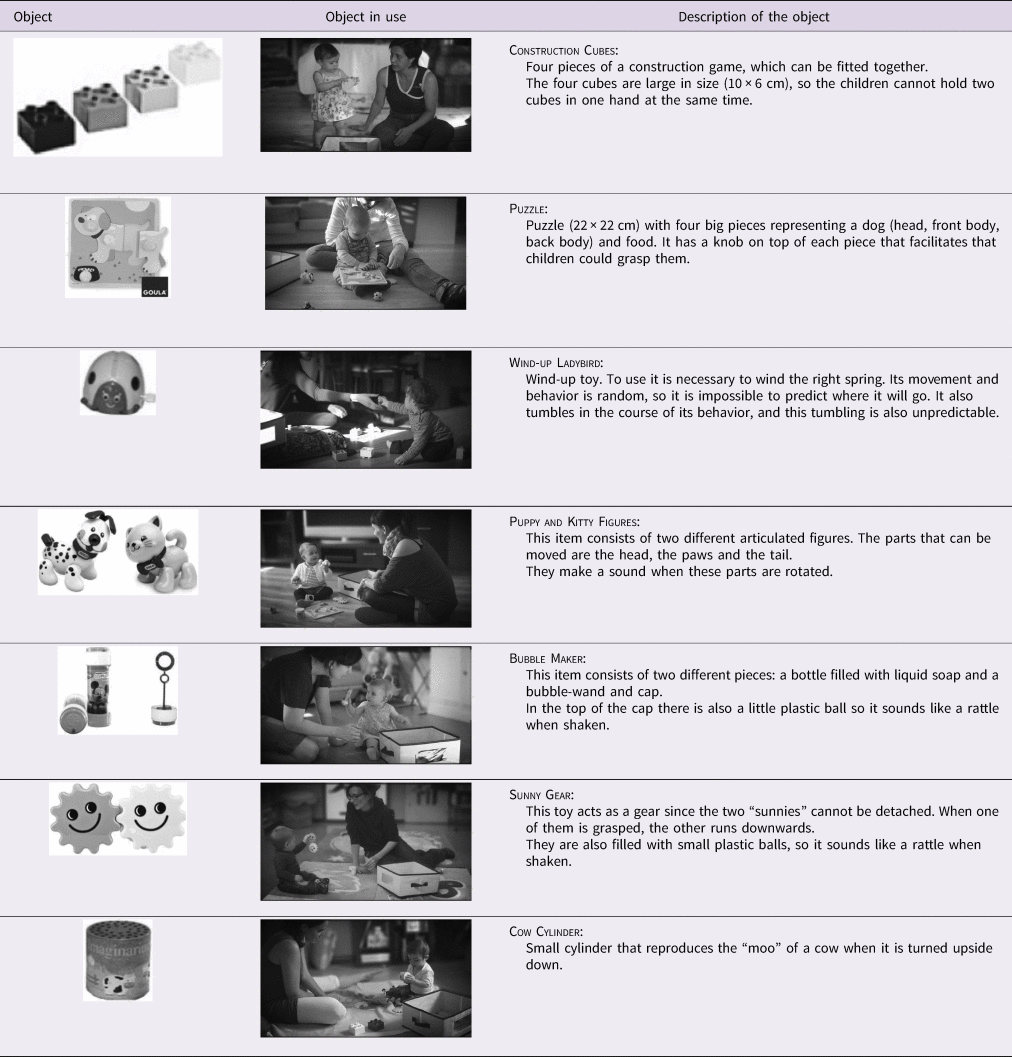
The eight objects supplied by the researcher (Table 1) were chosen for this study because they (1) are easy to grasp (given their weight and size), (2) varied regarding their potential uses, and (3) are complex in terms of their conventional use, which may favour children to request the intervention of adults when they are not yet able to use them on their own – e.g. the wind-up ladybird, with self-motion.
Description of the objects

Analyses of data
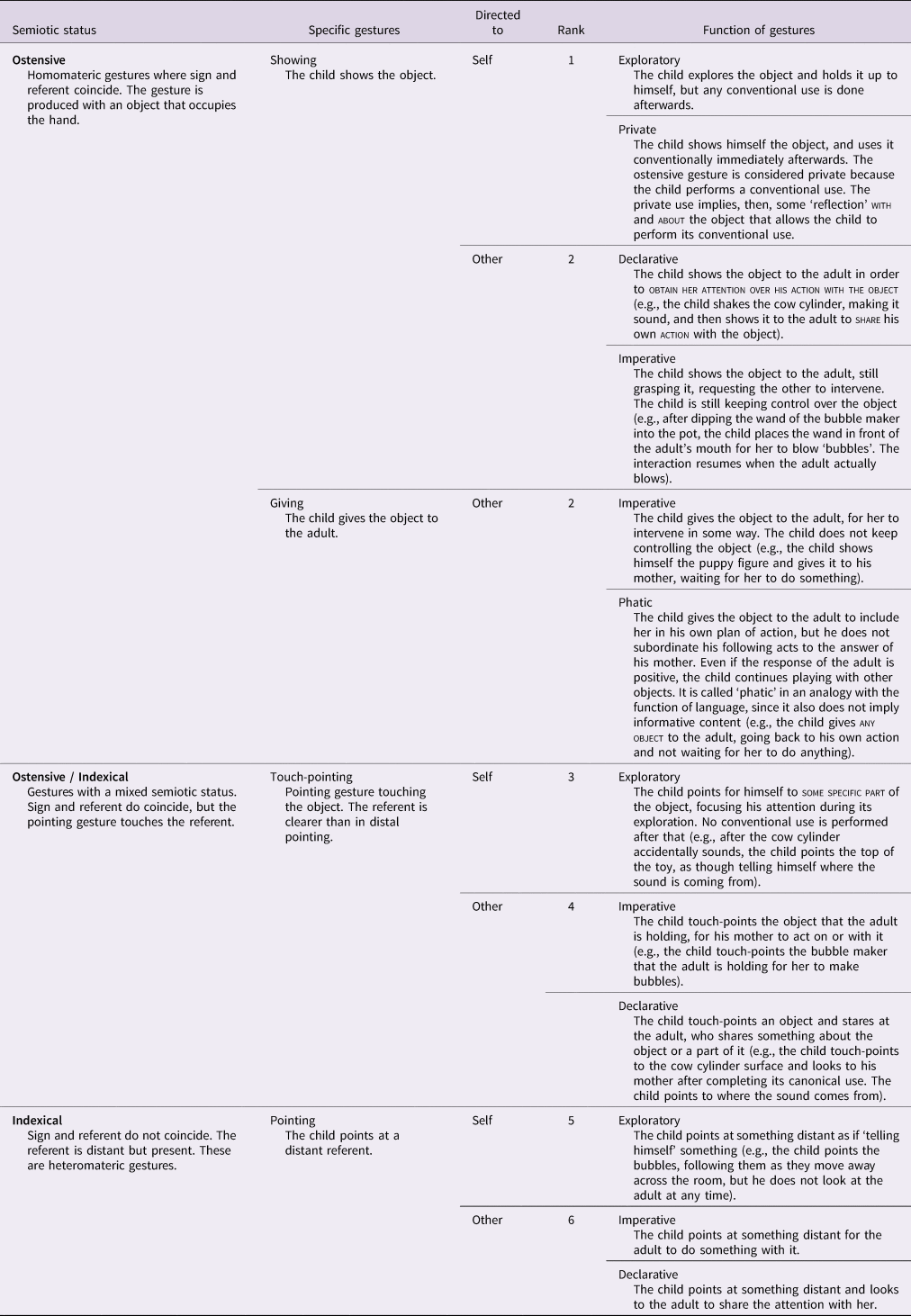
Because our study aimed at analysing the features of gestural communication in children, we first examined the raw footage and performed a micro-genetic qualitative analysis of the video clips to find interactive exchanges displaying gestures. To do this, we codified the behaviours of the mother and the child within second-by-second data frames using ELANFootnote 2 (Version 5.2; Lausberg & Sloetjes, Reference Lausberg and Sloetjes2009) and the procedure described by Rodríguez and Moro (Reference Rodríguez and Moro1999). We defined 12 mutually exclusive codes (Table 2) related to the nature of the functions of the gestures in triadic interactions. We considered the type of gesture, the object to which the gesture refers, and the particular circumstances of production (Rodríguez, Reference Rodríguez2009; Rodríguez et al., Reference Rodríguez, Moreno-Núñez, Basilio and Sosa2015).
Analytical codes and complexity values of gestures that were used for rank transformation

Frequencies, binomial tests, and proportion comparisons were calculated using IBM SPSS Statistics for Windows (v. 21). The coding system was content-validated by two of the authors, both researchers with experience in early cognitive and communicative development, who assessed the suitability of the analytical categories for the observations under consideration. Definitions were revised and further refined on several occasions prior to the analysis of inter-rater reliability. The first author and two external researchers independently analysed 33% of randomly selected video clips to calculate inter-rater reliability (Krippendorff's alpha was .86).
We followed a rank transformation procedure (Conover & Iman, Reference Conover and Iman1981) to prepare our data for further quantitative exploration. This methodological strategy is considered a more appropriate tool for analysing non-normal data distributions, as it ensures a better preservation of their parametric properties. We used rank transformation for analysing the complexity of the semiotic status and the direction of the gesture. The procedure resulted in six levels of complexity (see Table 2). Each observed gesture was transformed into one of these ranks and organised from lowest to highest complexity. Note that this is not a ‘scale’ of semiotic complexity, but a variable for comparing groups or single participants according to the complexity of their observed behaviours.
Results
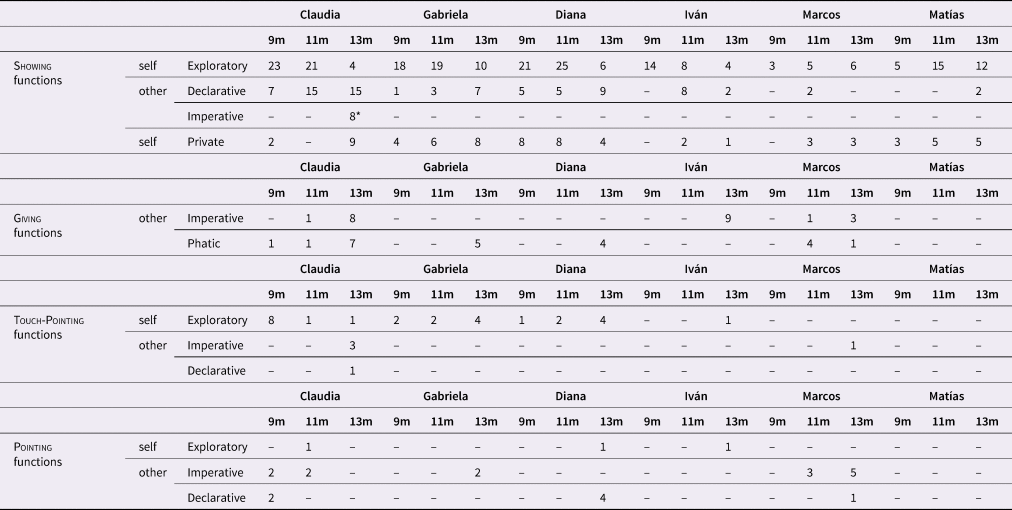
We identified a total of 480 instances of gestures (Table 3), which constitute the main dataset for the quantitative analysis that we conducted. Proportion comparisons highlighted some characteristics of the gestures in our dataset. At the age of 9 months, self-directed gestures were more frequent than those directed to others, eventually reversing this trend at 13 months of age (p < .05).
Absolute frequencies of self- and other-directed gestures performed by children

Ostensive gestures were the most frequently produced from 9 months old as compared to other gestures of higher semiotic status. This contrast reached its peak at 11 months (p < .05). Among ostensive gestures, showing were significantly more frequent than giving at 9 and 11 months of age (p < .05), while this difference was shortened at 13 months. Indeed, showing gestures were more frequent than all other gestures at 9 months of age. Children slightly increased their production at 11 months (p > .05) prior to decreasing it to a lower level at 13 months of age (p < .05). The production of Giving gestures greatly increased at 13 months of age, presenting a statistically higher proportion (p < .05) as compared to 11 and 9 months separately.
Touch-pointing gestures of a mixed semiotic nature (ostensive–indexical), were also identified. They are immediate gestures because they are performed while touching the referent. At 9 and 11 months of age, touch-pointing gestures were all self-directed, while touch-pointing gestures directed to others were not observed until 13 months of age. Their frequency slightly dropped at 11 months, but re-established at 13 months.
Indexical gestures observed in this study were all distal pointing. They were less frequently produced by children than other types of gestures at 9 months (p < .05), though their production increased at 11 months, and again at 13 months of age. Most of these productions were other-directed, while self-directed pointing gestures were barely identified at 11 and 13 months.
Functions of ostensive, mixed, and indexical gestures
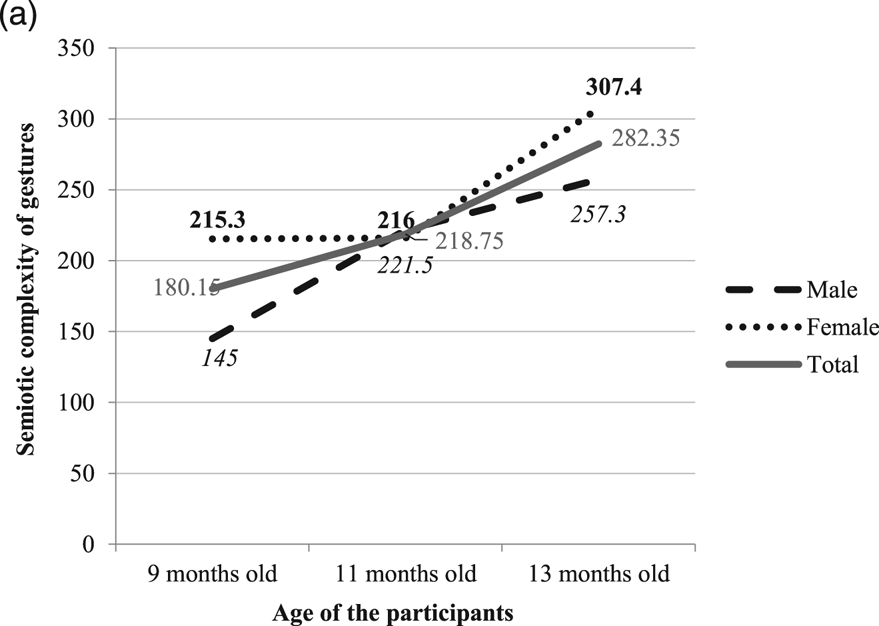
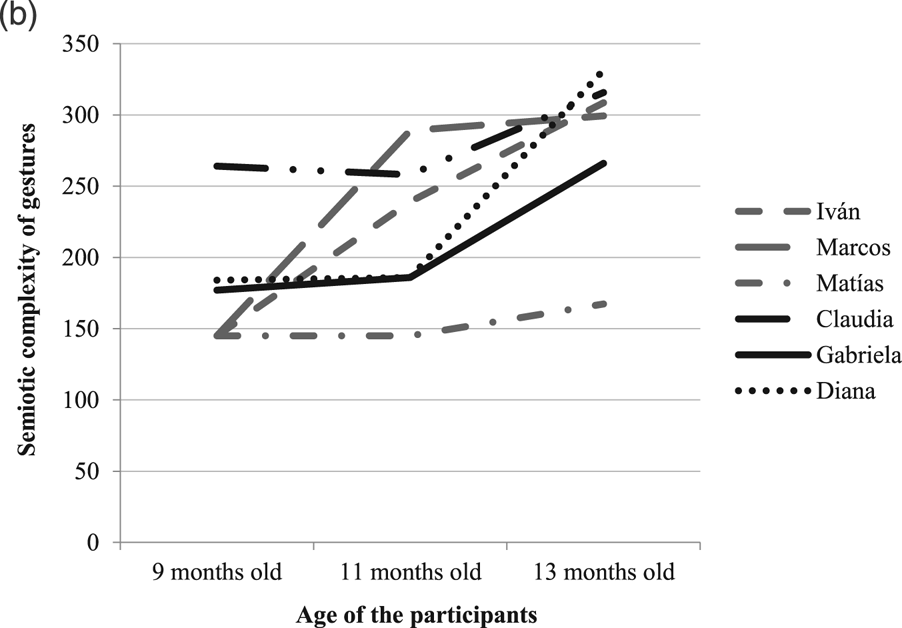
After the rank transformation procedure, we used the resulting dataset as a dependent variable of a repeated measures ANOVA for the examination of the average level of complexity along the three moments of observation, both by gender (Figure 1a) and by participant (Figure 1b). This variable is represented in the y-axis of both figures.
Interaction between age, gender, and the semiotic complexity of gestures.

Interaction between age and the semiotic complexity of gestures by participant.

While this is not a study of gender effect on development, we would like to note some variations in gesture production that were observed in male and female participants. The multivariate test of Pillai's trace shows an interaction effect of age (in months) and gender (F(2,477) = 430.06, p < .01). Mauchly's test proved the sphericity of the differences among participants (p < .01). We also performed a within-subjects effect test that showed a statistically significant interaction between gender and age (F(2,956) = 195.10, p < .01). This means that male and female participants significantly performed gestures of different complexity within the three moments of observation. Girls performed more complex gestures than boys at 9 months of age, although the productions of all participants tended to balance from 11 months onwards. At 13 months of age, all children increased the complexity of their gestures, even though girls still over performed their male counterparts.
This analysis of the complexity of gestures was also conducted by participant to stress individual differences (Figure 1b). All participants but Claudia increased the complexity of their gestures with age. However, note that Claudia already demonstrated a higher level of gesture complexity than the rest of participants at 9 months of age. Even when she produced slightly less complex gestures at 11 months, the complexity of her production increased at 13 months, reaching one of the highest levels in our sample. The lower growth and less complex gestures were both observed in Matías, who underperformed other children especially at 11 and 13 months of age.
In order to explore the developmental processes of child–mother communicative interactions about and through the objects, we selected for this paper seven illustrative episodes (see Observation figures in the following subsections) that justify the functions of gestures through narrative descriptions. According to our analytical codes, in the following subsections we examine whether the observed gestures were exploratory or private (for self-directed gestures), or imperative, declarative, or phatic (for other-directed gestures) (Table 4).
Gestures performed by children and their functions

Note. * Imperative showing gestures were subordinated to a self-regulatory function (to blow bubbles with the bubble maker).
Ostensive gestures
Ostensive gestures comprise showing and giving gestures. The object-referent is in the hand of the child – i.e., sign and referent coincide. Individual differences in showing gestures are stressed in Table 4. In this study, children frequently performed showing gestures with all objects and at all the ages examined. However, these gestures were increasingly shorter at 11 (M = 2.3s, SD = 0.9) and 13 months of age (M = 1.9s, SD = 0.5) than they were at 9 months (M = 3.4s, SD = 1.3). This could be due to children augmenting their effectiveness in catching the attention of adults, turning back to their action more quickly. From 11 months of age, children did not merely show objects to the adult, but they showed them after performing their conventional use (e.g., obtaining sound from the cow cylinder). These showings would be more complex because they imply a greater knowledge about the object and its function.
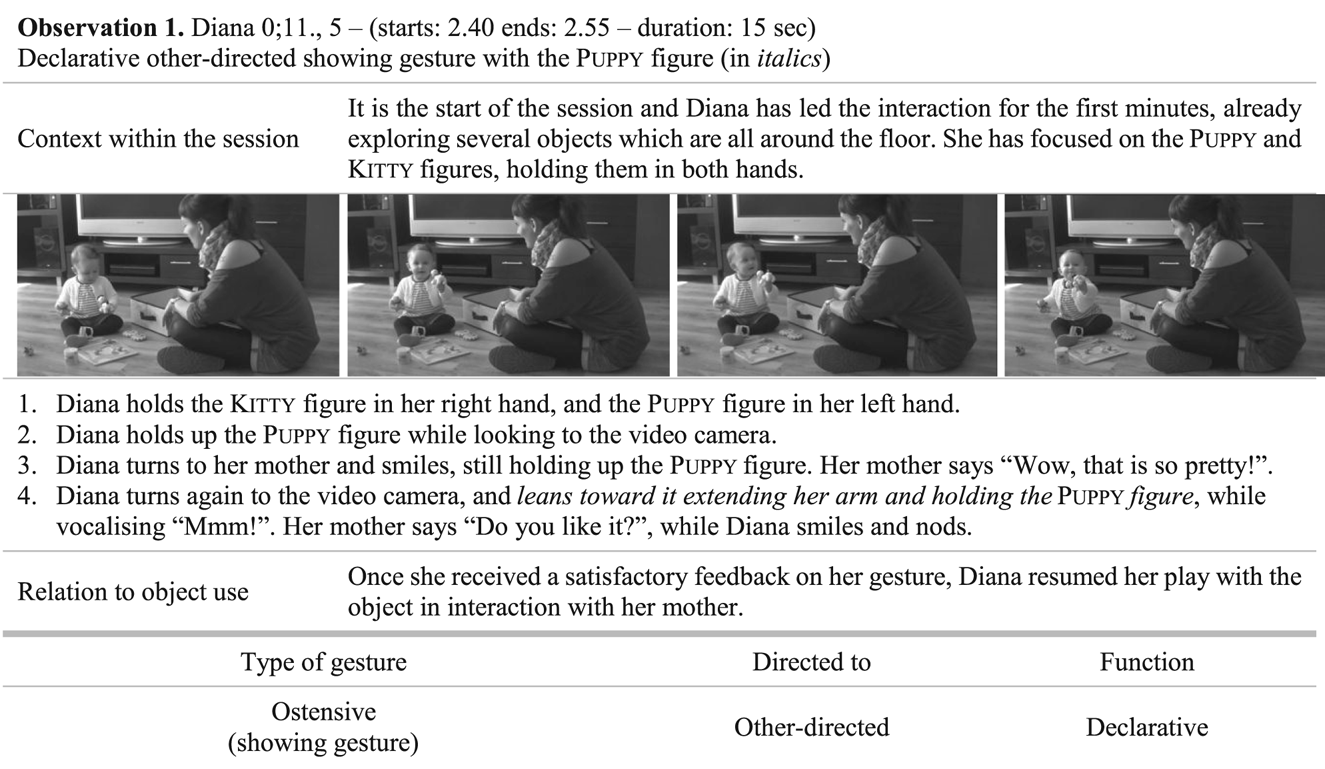
Four different functions were found for showing gestures, namely: exploratory, imperative, declarative, and private. The exploratory function was identified for most productions of self-directed showing gestures (i.e., self-ostensive gestures), which were observed in all participants. Conversely to what was noted in the literature in relation to different types of other-directed gestures, children performed declarative showing gestures before imperative ones. All children in this study performed declarative other-directed showing gestures (see example in Figure 2), but they were less frequently observed in male participants (p < .01).
Illustration of a declarative other-directed showing gesture.

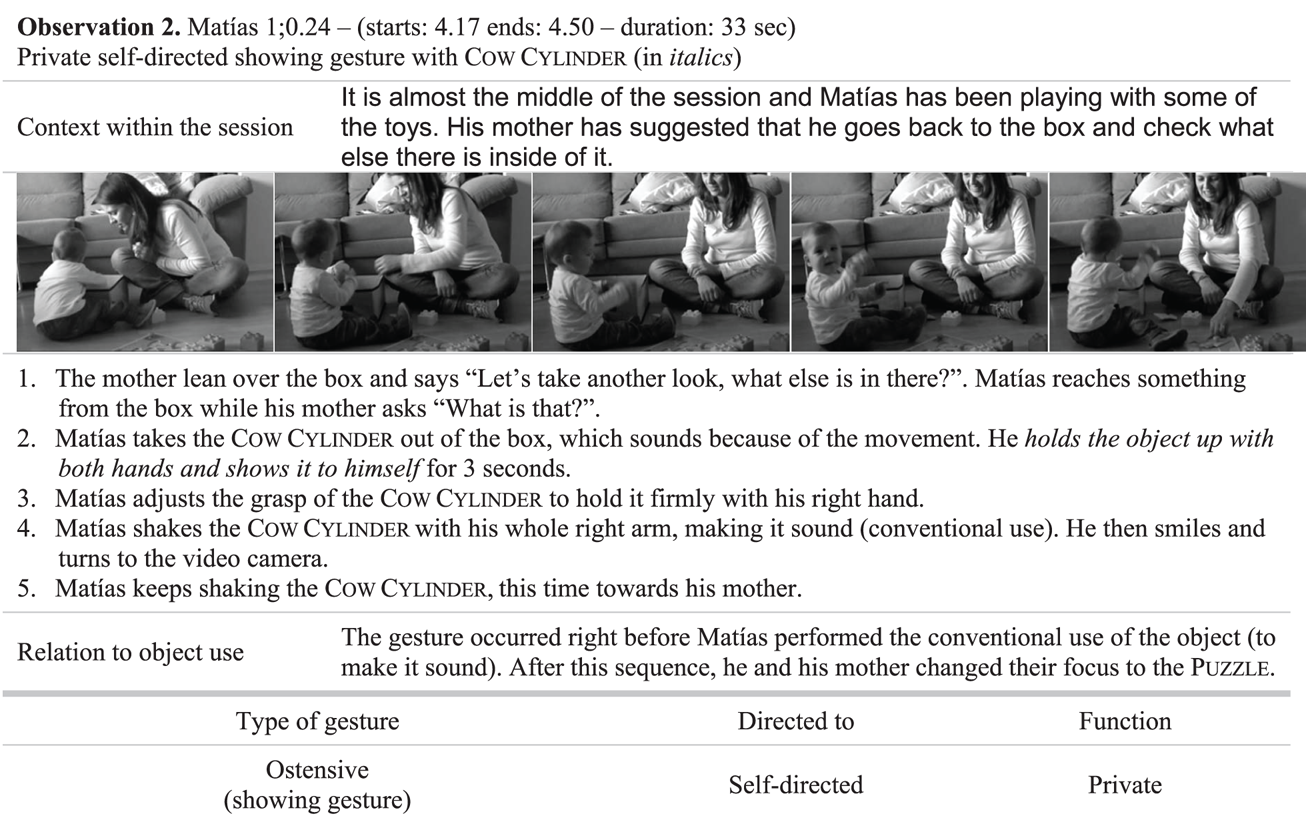
Imperative other-directed showing gestures were rather infrequent. Note that, when identified, they were often subordinated to a self-regulatory function of a higher level of complexity (Table 4), related to the conventional use of the object. More precisely, we observed that Claudia, at 13 months of age, was already able to take in and out the handle of the bubble maker, but she still needed her mother to actually blow the bubbles. Private self-directed showing gestures (Figure 3) were scarcely present in our data, but they tended to progressively increase with age.
Illustration of a private self-directed showing gesture.

Giving gestures, by definition, have to be directed to someone else, so we did not define any self-directed codes. Giving gestures in our study (Table 4) were observed with two functions: imperative and phatic. We found no evidence of declarative giving gestures within our sample.
Only three children used giving gestures with an imperative function: Claudia and Marcos, at 11 and 13 months of age, and Iván, at 13 months. The objects used for this purpose were the puzzle, the construction cubes, the cow cylinder, the wind-up ladybird, and the bubble maker. All of them involve a certain complexity for their conventional use, requiring adults to intervene when children were unable to complete the action by themselves.
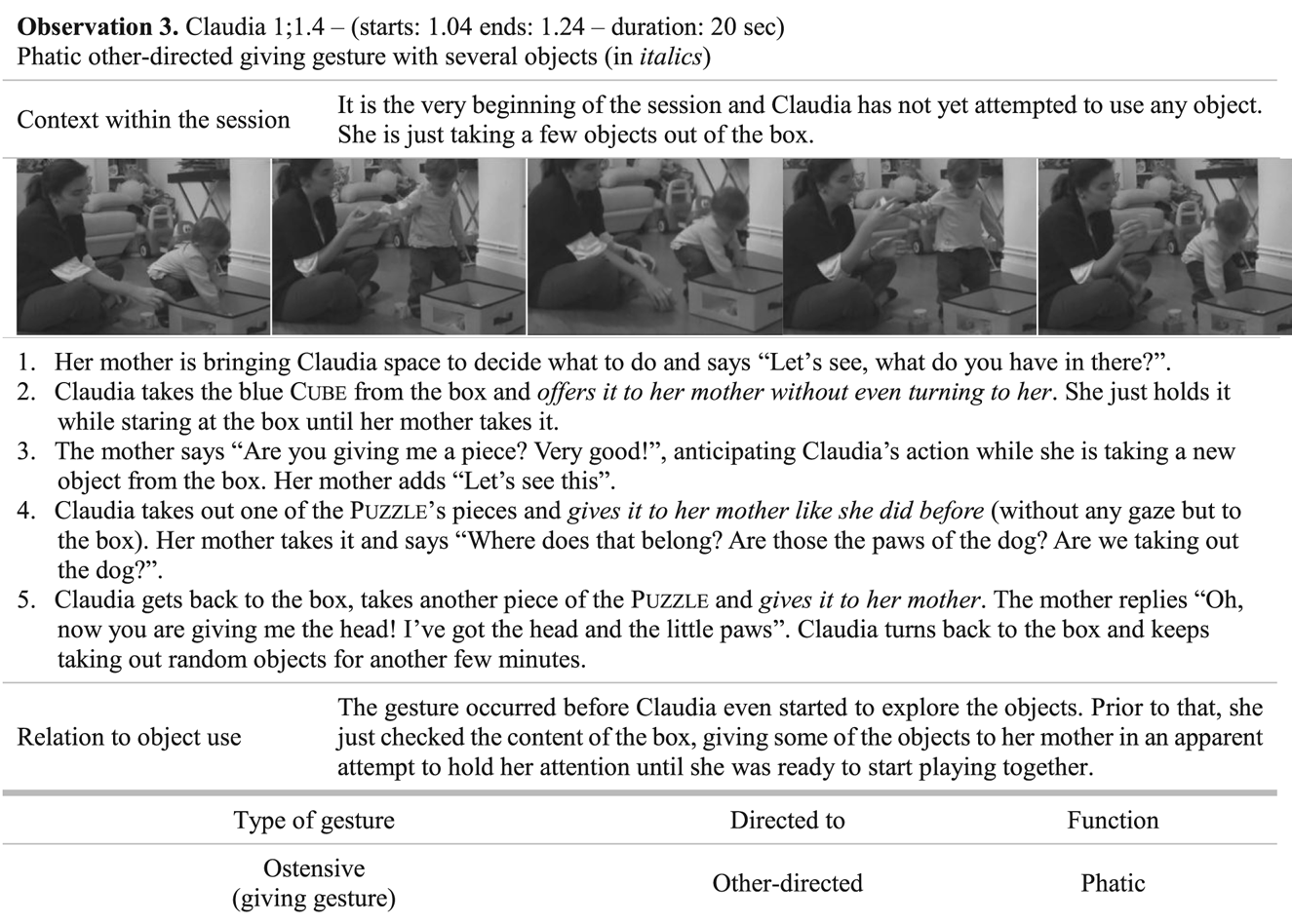
In addition, we identified a third function within giving gestures, whose relevance lay in the very act of giving, rather than in the specific object given. We have named it the phatic function, in analogy with the function of language, because the functional aspects of the objects seemed irrelevant in these instances: children gave anything. Objects were here vehicles of pure communicative intention, and not a sign linked to a particular conventional use. Phatic giving gestures (Figure 4) were performed by Claudia at 9 – being the sole production of giving gesture found at this age –and 11 months, and by the three girls at 13 months of age. Among the boys, only Marcos produced phatic giving gestures at 11 and 13 months.
Illustration of a phatic other-directed giving gesture.

Ostensive–indexical gestures
Mixed ostensive–indexical gestures are produced with the empty hand, but touching the referent. They act as a ‘bridge’ between the ostensive and indexical worlds by comprising some aspects from both semiotic statuses. The ambiguity about what is the referent of the communication is thus reduced as compared to distal pointing, which facilitates the understanding of the sign. Touch-pointing gestures were not observed in all participants in this study (Table 4). Nevertheless, we identified gestures with exploratory, imperative, and declarative functions.
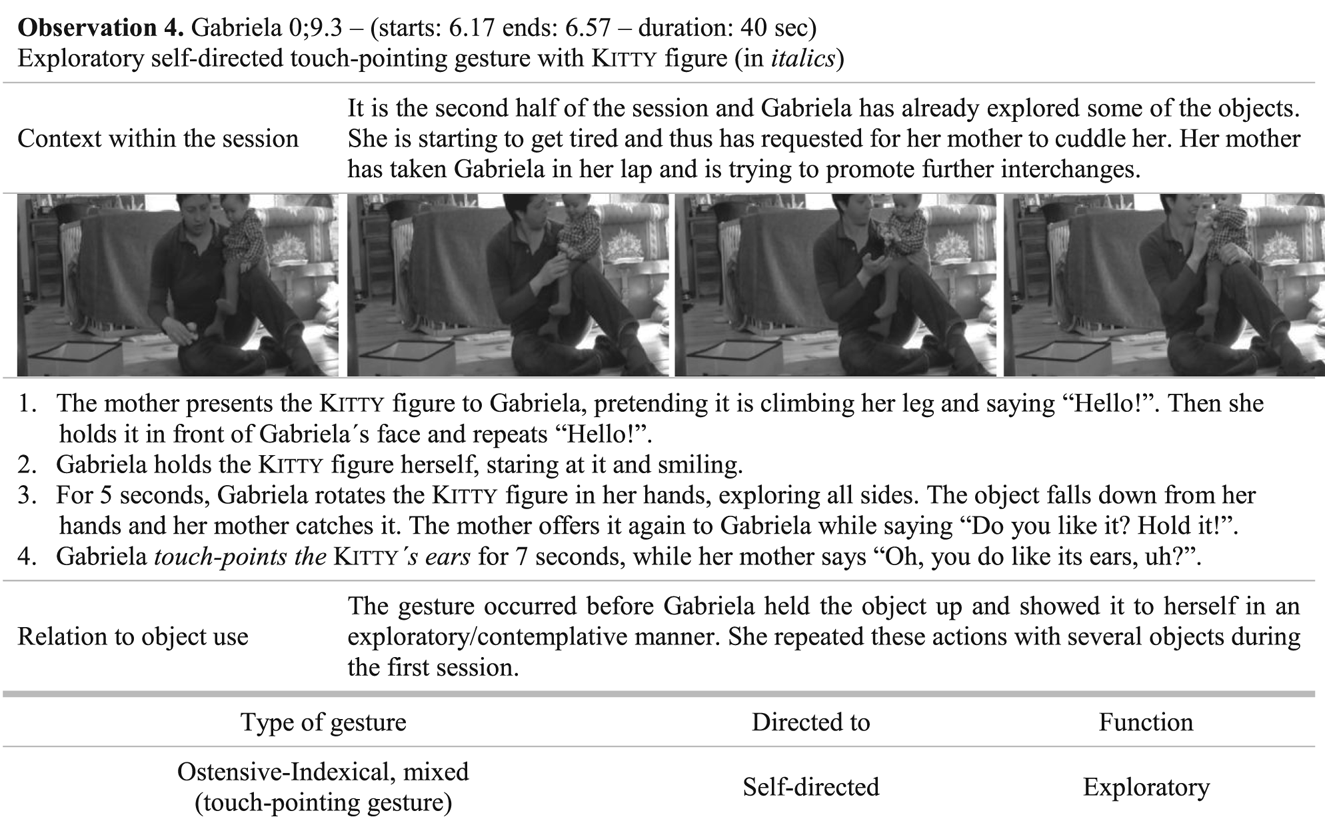
The three female participants performed exploratory self-directed touch-pointing gestures (Figure 5) from 9 months of age, directing their own attention towards the object. This was maintained at 11 and 13 months of age, while they were still rare in the performances of male participants. Imperative other-directed touch-pointing gestures were only observed in a very specific situation: when adults stopped blowing bubbles. Children then touch-pointed the bubble maker held by the mother as a request for her to ‘keep doing that action’. Observations of declarative other-directed touch-pointing gestures were infrequent.
Illustration of an exploratory self-directed touch-pointing gesture.

Indexical gestures
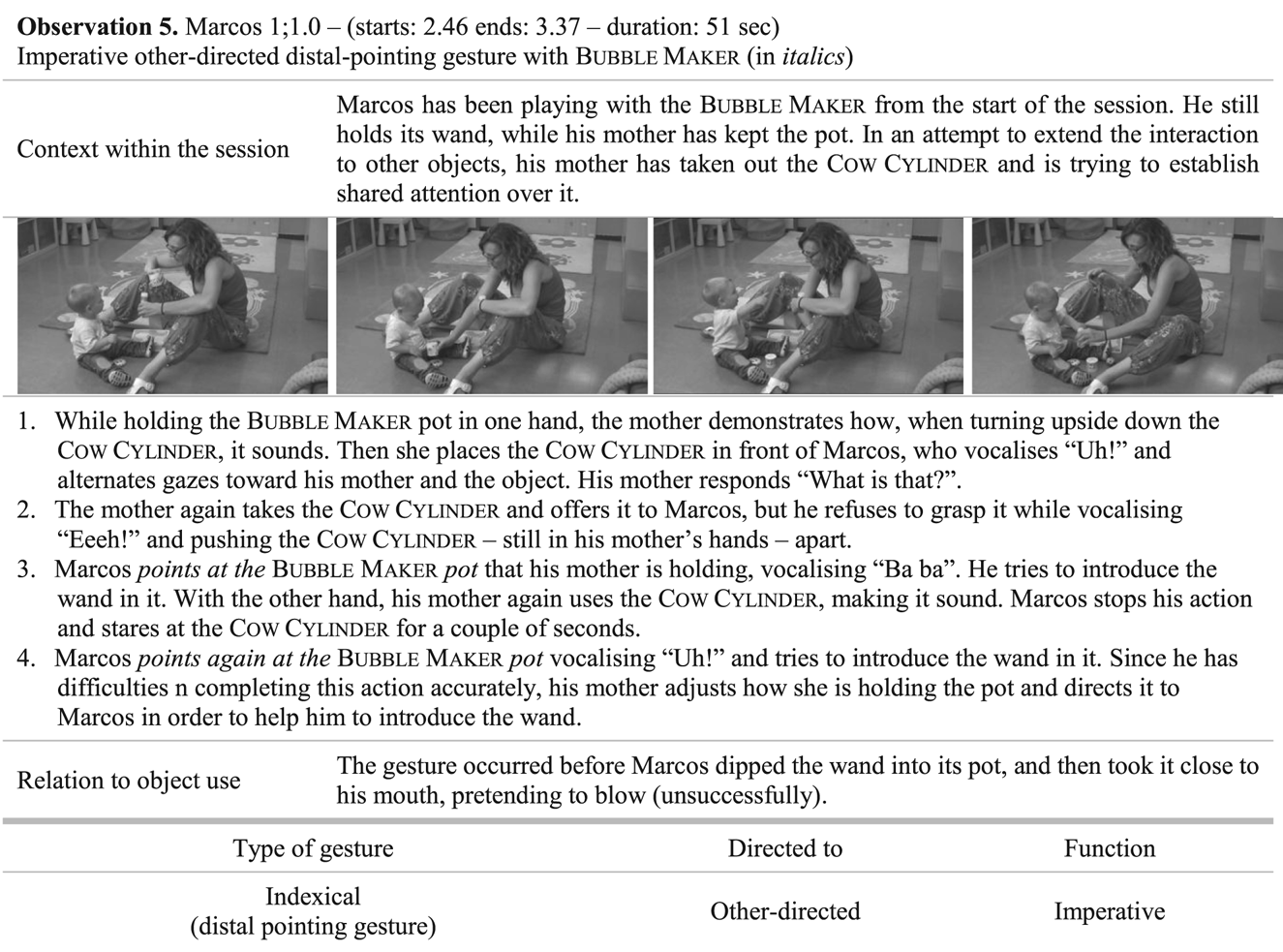
All indexical gestures observed in this study were distal pointing (Table 4). No other indexical gestures (e.g., reaching) were found. Despite the little evidence that we obtained, we identified distal pointing gestures with three different functions: exploratory, imperative, and declarative. Exploratory self-directed distal pointing was used by children to direct their own attention towards the referent and its use. Almost all the occurrences were observed in 13-month-olds. Only Claudia performed imperative other-directed distal pointing at 9 months, while some other children were able to perform them at 11 and 13 months of age (Figure 6). Declarative pointing gestures were barely observed in this study.
Illustration of an imperative other-directed distal-pointing gesture.

Discussion
In this section, we will address three main findings. First, there was variation in the production of ostensive, mixed, and indexical gestures. From 9 to 13 months of age, children performed ostensive gestures much more frequently than mixed or indexical gestures, so it seems logical to address them separately rather than from a general classification of deictic gestures. Second, we identified both self- and other-directed gestures. Considering both in our analysis might contribute to a better understanding of the emergence of intentional communication in children. Third, functions of gestures are not restricted to declarative and imperative. Infants in this study performed gestures with at least three more functions: exploratory and private function in self-directed gestures, and phatic function in other-directed giving gestures.
Children produced several ostensive gestures (showing and giving) towards an intentional communicative goal from 9 months of age. However, the low frequency of indexical (pointing) and ostensive–indexical gestures (touch-pointing) at that same age was striking. The imbalance between these three types of gestures opens an interesting debate. We agree that distal pointing is very important for establishing a shared reference, and as such it has received great attention for decades from scholars and researchers (Crais, Douglas, & Campbell, Reference Crais, Douglas and Campbell2004; Werner & Kaplan, Reference Werner and Kaplan1963). However, infants become able to perform ostensive gestures before they fully develop the fine motor movements that pointing requires.
A revised and more comprehensive research focus is needed on the emergence of early gestures, especially when objects are within a space of proximal interaction, as in this study. Considering the progression of semiotic complexity (Eco, Reference Eco1976; Peirce, Reference Peirce1987), ostensive gestures are easier to interpret and produce because sign and referent coincide (Rodríguez et al., Reference Rodríguez, Moreno-Núñez, Basilio and Sosa2015), while indexical gestures require a greater effort of interpretation and coordination within interactions. Children performed ostensive gestures (both self- and other-directed) before pointing, which might play a role in the later development of more complex signs.
In between this developmental process, touch-pointing gestures could ease the understanding of the sign–referent relationship by children. These gestures would be of medium semiotic complexity since they integrate both indexical and ostensive components. They reduce the ambiguity involved in the identification of the referent. In the scholarly literature, touch-pointing gestures have been often overlooked, or considered within a single category of pointing. However, previous studies have shown that adults frequently draw upon touch-pointing gestures for clarifying the referent in interactions with preverbal children (Rodríguez & Moro, Reference Rodríguez and Moro1999) and atypically developing children (Christie et al., Reference Christie, Newson, Prevezer and Chandler2009). There is also evidence that infants point to nearby objects before they do so to distal ones (Carpenter, Nagell, & Tomasello, Reference Carpenter, Nagell and Tomasello1998). These results suggest that the distance between sign and referent is progressively built – and understood – during communicative interchanges. In our study, touch-pointing gestures were observed from 9 months of age. There is a need, however, to further explore their distinction from distal pointing in terms of their development and communicative potential.
Although the communicative functions of gestures have traditionally been studied in other-directed utterances, we propose that self-directed gestures may also contribute to shaping early communicative development. According to our results, self-directed gestures allow children to direct their own attention towards a novel object or event, to reflect about it (e.g., in order to complete a challenging task), or to keep themselves focused on their action. Self-directed gestures could play a crucial role as instruments of communication when infants are not yet fully competent in using varied representational and semiotic signs.
An important focus of this study is the analysis of the functions of gestures (i.e., for what purpose they were performed by children). In addition to classic functions such as proto-imperative and proto-declarative (Bates et al., Reference Bates, Camaioni and Volterra1975), we distinguished other functions in both self- and other-directed gestures. In increasing degree of complexity, we observed several instances of self-directed gestures that children do with (1) a basic exploratory function, where the child paused his action in order to contemplate the object, but there was still no evidence of knowledge about its conventional use (Masataka, Reference Masataka and Kita2003); and (2) a private function for self-regulation (Rodríguez & Palacios, Reference Rodríguez and Palacios2007), where the gesture was produced immediately before or during the use of the object. As previous studies indicate, private gestures require more complex cognitive processes than exploratory gestures, since they imply both a certain knowledge on the task and a self-regulatory ability. Gestures with communicative functions such as emotional (Racine & Carpendale, Reference Racine and Carpendale2007), informative (Liszkowski et al., Reference Liszkowski, Carpenter and Tomasello2007b), or interrogative (Begus & Southgate, Reference Begus and Southgate2012; Rodríguez, Reference Rodríguez2009) were not observed in this study. We attribute this fact to the age of our participants by the time of our observations, who were younger than those of the aforementioned studies.
It is worth mentioning that we have not found more recent references to declarative showing and giving gestures than in Bates et al. (Reference Bates, Camaioni and Volterra1975), in which give and show were considered as a whole. However, it is necessary to analyse for what purpose the child gives (or shows) the object to the adult. What does the child expect from his mother? Is the adult simply an agent who holds the object while the child performs the action? Or is it someone to share the action with, or to ask for help in a shared use of the object? Listing giving and showing gestures without referring to the circumstances in which the gesture occurs seems insufficient to understand the communicative intention of the child (and, therefore, the function of his gestures).
The four different functions of showing gestures that we identified have some implications for the understanding of communicative development. First, we observed self-directed exploratory gestures, similar to the so-called self-ostensive gestures (Dupertuis & Moro, Reference Dupertuis and Moro2016; Moro et al., Reference Moro, Dupertuis, Fardel and Piguet2015) that seem to constitute one of the most basic levels of semiotic complexity. Second, the frequency of declarative showing gestures was particularly high, which in this case challenges the widely accepted idea that the imperative function emerges first and is less complex than the declarative function (Behne, Carpenter, & Tomasello, Reference Behne, Carpenter and Tomasello2005; Cochet & Vauclair, Reference Cochet and Vauclair2010). Third, imperative showing gestures could involve some traces of a self-regulatory function when the child asks the adult for help, but controlling what, where, and when his mother should act. And fourth, private gestures, where the child shows the object to himself while facing a challenging task, evidenced that at some point children become able to think about the referent with the referent itself (Rodríguez & Palacios, Reference Rodríguez and Palacios2007).
As in showing gestures, children do not only give objects to adults for them to act upon the referent (Bates, Reference Bates1976; Bates et al., Reference Bates, Camaioni and Volterra1975; Capirci, Contaldo, Caselli, & Volterra, Reference Capirci, Contaldo, Caselli and Volterra2005), i.e., with an imperative function. In addition to this, we identified a phatic function in the giving gestures that children do. Similar to the phatic function of language (Jakobson, Reference Jakobson1988), the referent (i.e., the object given) becomes a pure instrument of communication. Any object would serve the same purpose (to keep the adult engaged in the interaction). There were no other indicators (e.g., sustained gaze, or a certain expectation for the reaction of the adult) that suggest an intention of the child to actively interact with the other. Moreover, the child disregarded what the mother did after receiving the object, proving that these gestures are neither of a declarative (see ‘mutual joy’ interactions in Bates et al., Reference Bates, Camaioni and Volterra1975) nor a cooperative nature (Liszkowski, Carpenter, Striano, & Tomasello, Reference Liszkowski, Carpenter, Striano and Tomasello2006).
As we discussed earlier, most studies exploring indexical gestures and its communicative functions refer to distal pointing. While it is very often assumed that imperative pointing gestures emerge from actions, declarative distal pointing would be of a communicative nature (Cochet & Vauclair, Reference Cochet and Vauclair2010). Curiously, this view neglects the fact that the child is born in a world where adults point every day and repeatedly to present referents (Wilkins, Reference Wilkins and Kita2003), which may be related to the emergence of indexical gestures. This has to be considered along with the progression of both touch-pointing and distal pointing gestures in children. In this study, infants performed exploratory pointing (either touching the referent or from a distance) as part of a contemplative action when there was a novel object, or when they faced a difficulty while completing a task. These gestures were observed at a younger age than gestures with an imperative or a declarative function.
Therefore, when determining the function of gestures (i.e., for what purpose children point, show, or give an object), it is crucial to consider the specific object involved and its public norms of use. Communication is rooted in shared actions, and is mediated by signs in specific realities and interactions. Uses of objects are thus influenced by culture, informal education, and communicative interchanges. For this reason, we used a naturalistic research design to capture genuine communicative situations with and about objects, while not restricting the plurality that characterises triadic interactions. We acknowledge that this approach may affect our results because of the objects chosen and their physical proximity to the participants. However, this is also representative of typical adult–child interactions at these ages in our culture. A more comprehensive understanding of the social and cultural construction of communicative development requires further studies that consider the particularities of how interactions with others and objects unfold.
Conclusions
In conclusion, our findings show that children share referents intentionally through ostensive gestures, with others and with themselves, even when they are still unable to point. The predominance in the production of ostensive gestures highlight two issues: (1) a precise operationalisation of communicative intentionality requires the consideration of the referent – children communicate with others or themselves about and through the object – and (2) the communicative functions of gestures should be interpreted according to the specific object involved. Additionally, including gestures of a mixed semiotic nature in our analysis helped us to understand the developmental process of intentional communication, as they may be a bridge between ostensive and indexical signs. If this is the case, more research would be necessary to explore whether or not pointing gestures develop from ostensive gestures. This would enrich the literature on the development of intentional communication before language.
Ostensive gestures are gestures in their own right because they meet the necessary requirements for being considered as instruments of intentional communication. More precisely, ostensive gestures allow (1) self- and other-directed communication about specific material referents, and (2) the gathering of the other and the world in a simultaneous communicative act. Given their lower semiotic complexity, ostensive gestures emerge before distal pointing in terms of both their understanding and production. The cultural specificity of objects (i.e., their social function) is fundamental in determining the communicative function of the gestures performed about them. The debate on the role of objects as material culture and as instruments for communication is still open-ended, thus further discussion would be necessary.
Acknowledgements
This study was supported by the programme for the Training of University Teachers (Formación de Profesorado Universitario – FPU) of the Spanish Ministry of Education granted to the first author [reference AP2009-4064], and project EDU2011-27840 (MINECO, Spain).