I. INTRODUCTION
The improvement of thermal efficiency by increasing the operating temperature and pressure of boilers has recently led to the development of new families of high temperature-resistant steels.Reference Vaillant, Vandenberghe, Hahn, Heuser and Jochum1 The high Cr ferritic heat-resistant steels are widely used in critical components of power plant with its high temperature stability, high creep strength, low thermal expansion coefficient, and outstanding corrosion resistance.Reference Mythili, Thomas Paul, Saroja, Vijayalakshmi and Raghunathan2, Reference Klueh and Nelson3 The properties of the steel depend upon the final microstructure, and the control of phase transformation is especially important to the formation of final microstructure. It has been proven that martensite is the predominant structure for modified high Cr ferritic heat-resistant steel.Reference Vaillant, Vandenberghe, Hahn, Heuser and Jochum1, Reference Bhadeshia, Strang and Gooch4–Reference Ning, Shi, Yan, Fu, Liu and Bie6
To understand the process of microstructure formation, the martensite transformation features have to be analyzed in detail. Martensite transformation is a nucleation-controlled heterogeneous reaction, and it is not thermally activated in most iron alloys. During the transformation, the martensite formation rate is very rapid (within a few seconds), and no further transformation to martensite occurs during isothermal holding.Reference Klotz, Solenthaler and Uggowitzer7 It has been interpolated that martensite transformation is accomplished by coordinated displacements of atoms over distances shorter than an atomic distance. The martensite transformation curve indicates the martensite behavior in carbon steels, and it has been frequently expressed by some classic empirical equations, e.g., Koistinen and Marburger (K-M),Reference Koistinen and Marburger8 van Bohemen and Sietsma.Reference van Bohemen and Sietsma9 Recently, GuimaraesReference Guimaraes10 investigated the kinetics of martensite formation from the perspective of nucleation and growth types (“spread” and “full-in”). It has been known that the austenite grain size has an effect on the heterogeneity of the martensite transformation.Reference Raghavan11
Generally speaking, a small austenite grain size inhibits martensite formation. During martensite transformation for the fine grain size, the initial martensite nuclei transform only in a few austenite grains and then with gradual spreading of lath formation into all austenitic grains.Reference Guimaraes12 The process that the transformation extends over the austenite grains has been named as “spread” transformation. Grain size is confirmed to have a significant geometrical influence on the “spread” of martensite transformation. However, that does not exclude the possible role of grain boundaries as sources of defects to initiate martensite transformation.Reference Guimaraes12 The “spread” martensite transformation model is widely used to Fe–Ni–C or Fe–Ni–Mn system, in which the content of carbon is low, i.e., it is about 0.02 wt%. The density of martensite nuclei is also an important factor that should be considered, for it can determine from the final martensite laths size, which finally affects the properties of material.Reference Fisher, Hollomon and Turnbull13
In this work, the martensite transformation features of the modified high Cr ferritic heat-resistant steel upon continuous cooling were studied in a wide range of cooling rates. A differential dilatometer using inductive heating was used to obtain the information of martensite transformation curves as functions of temperature and time at various cooling rates. The corresponding density of martensite laths and the martensite transformation curve were analyzed according to the “spread” martensite transformation model.
II. EXPERIMENTAL PROCEDURES
A. Materials preparation
The material used in this work is the modified high Cr ferritic heat-resistant steel upon hot rolling and followed by air cooling (see the typical microstructure in Fig. 1). The chemical composition was determined by Inductively Coupled Plasma Optical Emission Spectrometry; the thus obtained chemical compositions are gathered in Table I. The samples used for the dilatometric measurements were cylindrical specimens, φ 6 × 10 mm, which were machined from the rolled pipe with a thickness of 9 mm.
Optical microstructure of the modified high Cr ferritic heat-resistant steel upon hot rolling and followed by air cooling. (color online)

Chemical compositions of the modified high Cr ferritic heat-resistant steel (in weight percent).

After the dilatometric experiment, the microstructure of the specimen was observed by optical microscopy (OM). OM specimens were prepared by mechanical polishing, followed by etching in a solution of water (100 mL), hydrochloric acid (20 mL), and iron trichloride (5 g). Vicker’s microhardness tests were carried out with an applied load of 50 gf. The austenite grain size can be obtained by computer-aided software based on the optical microstructural images adopting standard metallographic preparation techniques.
B. Dilatometric experiments and thermal cycle
The length change of the samples was measured by a high-resolution differential dilatometer, which uses inductive heating and records the thermal dilation as function of temperature and time during the application of a specific heat treatment cycle. With this instrument, the length difference between the sample and a reference rod of quartz is measured, which results in a length change resolution of about ±20 nm (i.e., the relative length change accuracy is about 2 × 10⁻⁵%). The dilatometric experiments were performed under vacuum (6 × 10⁻⁶mbar) to avoid oxidation of the specimen.
The thermal treatment cycle for modified high Cr ferritic heat-resistant steel was as follows: the samples were first heated from room temperature up to 1100 °C at a rate of 200 °C/min, and held at this temperature for 10 min, and then cooled to room temperature under various cooling rates (10, 100, 1000, 2000, and 6000 °C/min).
C. Relative length changes upon thermal expansion
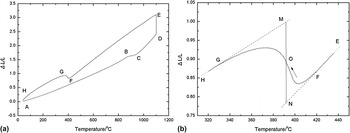
During the whole heat treatment cycle, the recorded relative length changes (ΔL/L, where ΔL is the length change and L is the initial length of the sample) of modified high Cr ferritic heat-resistant steel specimen are shown in Fig. 2(a). Segment AB corresponds with the normal thermal expansion of the specimen during continuous heating (with a rate of 200 °C/min) without phase transformation. Segment BC represents the austenite formation, in which a length contraction occurs. Segment CD stands for the normal expansion upon heating to 1100 °C. Segment DE exhibits the holding of austenitization at 1100 °C; it is a shrinkage ascribed to the transformation stress relaxation. Segment EF denotes the contraction of austenite during cooling. Segment FG indicates the process of martensite formation, which is associated with an increase of length. After the martensite transformation is completed, the sample decreases down to room temperature due to normal thermal change (indicated by GH).
Measured relative length changes of the modified high Cr ferritic heat-resistant steel during continuous cooling (with a cooling rate of 1000 °C/min). (a) The whole thermal dilation curve, (b) the relative length changes of martensite transformation and the calculation of phase fraction by the lever rule.

D. Measured dilatometric curve upon the fastest cooling rate
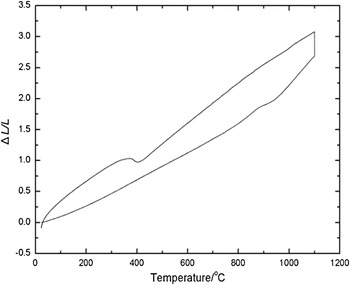
To obtain a homogeneous temperature profile within the modified high Cr ferritic heat-resistant steel specimen during the fastest cooling rate of 6000 °C/min, the initial size of the dilatometric specimens used was decreased down to about φ 3 × 5 mm. The corresponding recorded curve of the relative length changes is displayed in Fig. 3. As seen from it, the tendency of recorded relative length changes was approximately consistent with the other recorded curves [e.g., the recorded curve at 1000 °C/min in Fig. 2(a)]. It has to be admitted that the fastest cooling rate (i.e., 6000 °C/min) cannot be completely reached in the center of the steel specimen, in particular, at temperatures below 400 °C. However, it may contain essential kinetic information when a relationship between the microstructure and dilation feature is recognized.
Recorded curve of relative length changes of the modified high Cr ferritic heat-resistant steel cooled with a rate of 6000 °C/min.

E. Determination of martensite fraction
When new phase forms, the change of dilatation can be assumed to be largely isotropical in material, so the dilatation in volume due to phase transformation is very small compared to the initial volume of the specimen. The relative dilatation volume change (ΔV/V) of the sample undergoing the martensite formation is three dimensional that can be approximately equal to three times the relative length change (ΔL/L), which is one dimensional. So it is obtained asReference Liu, Sommer and Mittemeijer14:
 $${{\Delta V} \over V} \cong 3 \times {{\Delta L} \over L} = f \times \left( {{{V_{{\rm{\alpha }}\prime } /2 - V_{\rm{\gamma }} /4} \over {V_{\rm{\gamma }} /4}}} \right)\quad,$$
where ΔV is the relative dilatation volume changes, V is the initial volume of material, f is the degree of transformation and the value is in the range of 0–1,  $V_{{\rm{\alpha }}\prime } $ is the unit cell volume of martensite (i.e., the product phase), and V γ is the unit cell volume of austenite (i.e., the parent phase).
Thus, based on the recorded relative length changes from the dilatometric measurements, the martensite fraction can be calculated as a function of time/temperature. Figure 2(b) shows the change of dilatation during the explored martensite transformation. The dashed line represents the normal dilatation of martensite in the upper left and austenite in the lower right, respectively. Lever rule is an effective method commonly used to calculate phase transformation process, so the martensite fraction can be expressed as:
 $$f = {{\left| {NO} \right|} \over {\left| {NM} \right|}}\quad.$$
III. ANALYTICAL MARTENSITE TRANSFORMATION MODEL
The martensite phase transformation can generally be described by three steps: nucleation, growth, and impingement. The martensite transformation depends on the extent of the undercooling below an onset temperature of martensite formation, M s. Generally, the M s point was decided by the temperature that the related deffects nucleation sites existing in the austenite started to propagate. Such defects would possess different potencies and would be scarce at the M s point. It is assumed that the initial nucleation of martensite is first generated only in a few austenite grains and then that can induce continuous martensite formation in an adjacent untransformed grain, if the austenite grain size is small, which is the occurring of so-called “spread” transformation.Reference Machlin and Cohen15 The growth of martensite is stopped by internal boundaries, i.e., grain boundaries and austenite–martensite interfaces, which are high-energy barriers that martensite laths cannot cross or nucleate. In other words, the first martensite unit forming in a grain may be as large as the grain diameter. Much kinetic information can be received from the martensite formation curve, and the curve based on a classic model that was established by K-M equation. The K-M equation has often been used to describe the progress of martensite formation during cooling asReference Koistinen and Marburger8:
 $$f = 1 - \exp [{\rm{\alpha }}(M_{\rm{s}} - T)]\quad,$$
where T is the Kelvin temperature and α is approximately equal to a constant of about −0.011 for the martensite transformation in low carbon steels.Reference Bhadeshia, Strang and Gooch4, Reference Chatterjee and Bhadeshia16–Reference Kang and Im18
A. Nucleation model
It is well known that the martensite reaction is nucleation controlled. If it is assumed that the new martensite units divide the austenite grains, new units would form in such partitions, so forth the initial martensite lath, the maximal lath, will cross all the austenite grain and reach to the austenite grain boundary, and other laths decrease with the formation of new martensite units. As a consequence, the mean lath volume will decrease, and it can be expressed asReference Fisher, Hollomon and Turnbull13:
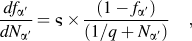 $${{df_{{\rm{\alpha }}\prime } } \over {dN_{{\rm{\alpha }}\prime } }} = {\rm{\varsigma }} \times {{(1 - f_{{\rm{\alpha }}\prime } )} \over {(1/q + N_{{\rm{\alpha }}\prime } )}}\quad,$$
where  $N_{{\rm{\alpha }}\prime } $ is the density of martensite laths,
 ${\rm{\varsigma }}$ is the aspect ratio of martensite laths (i.e., the ratio of width to length, usually the value is in the range of 0.03–0.1), q is the mean austenite grain volume, and
 $f_{{\rm{\alpha }}\prime } $ is the martensite fraction. During the “spread” of the transformation over the grains, the mean lath volume could be considered to be independent of the product fraction. The microstructure of partially transformed austenite is strongly affected by its grain size, and it is apparent that (1/q) touches “spread”.Reference Guimaraes10 Recalling Eq. (4), it can be written as:
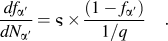 $${{df_{{\rm{\alpha }}\prime } } \over {dN_{{\rm{\alpha }}\prime } }} = {\rm{\varsigma }} \times {{(1 - f_{{\rm{\alpha }}\prime } )} \over {1/q}}\quad.$$
By integrating Eq. (5), the relationship between  $f_{{\rm{\alpha }}\prime } $ and
 $N_{{\rm{\alpha }}\prime } $can be expressed as:
 $$f_{{\rm{\alpha }}\prime } = 1 - \exp ( - {\rm{\varsigma }} \times q \times N_{{\rm{\alpha }}\prime } )\quad.$$
Thus, the martensite density  $N_{{\rm{\alpha }}\prime } $can be written as:
 $$N_{{\rm{\alpha }}\prime } = {1 \over q} \times \left[ {\ln (1 - f_{{\rm{\alpha }}\prime } )^{ - 1/{\rm{\varsigma }}} } \right]\quad.$$
B. Martensite transformation curves
Fisher et al.Reference Fisher, Hollomon and Turnbull13 were the first to assume the initial martensite units dividing the austenite grains. In sequence, the new units would form in such partition, and so forth so that martensite transformation finishes. With temperature decreasing, there will be some sites that can become preferentially available nucleation sites when the temperature reduces to slightly higher than M s. When the first martensite lath grows up and reaches an austenite grain boundary, other martensite laths will start to nucleate at the internal boundaries (austenite grain boundary and the former martensite boundary).
The transformation curve of lath martensite can be described in terms of packets to avoid the complexity of autocatalysis. The fraction of martensite may be written as a function of  $N_{{\rm{\alpha }}\prime }^T $ that can be expressed asReference Guimaraes and Rios19:
 $$f = 1 - \exp ( - {\rm{\varsigma }} \times q \times N_{{\rm{\alpha }}\prime }^T )\quad,$$
where  $N_{{\rm{\alpha }}\prime }^T $ is the density of nucleation sites at temperature T and
 ${\rm{\varsigma }}$ is the aspect ratio. Generally, a nucleation site proceeds to a martensite unit.Reference Zhao and Notis20 It means that the mumber of martensite nuclei can be considered the number of martesite laths, so it is obtained
 $N_{{\rm{\alpha }}\prime }^T = N_{{\rm{\alpha }}\prime } $
 $N_{{\rm{\alpha }}\prime } $.
The analysis of Guimaraes and RiosReference Guimaraes and Rios21–Reference Guimaraes and Rios23 has pointed out that  $N_{{\rm{\alpha }}\prime }^T $ should not be dependent on the particle size and would increase with the enhancement of the reaction driving force. Martensite formation starts once the reaction driving force, ΔG(T), reaches a certain value that exhibited by the M s temperature.Reference Entwisle24, Reference Gil, Manero and Planell25
 $N_{{\rm{\alpha }}\prime }^T $ is assumed to increase with the excess of driving force. A critical value of the chemical driving force, while the nucleation sites becoming available martensite embryos is ΔG 0. Therefore, the density of nucleation sites can be expressed as:
 $$N_{{\rm{\alpha }}\prime }^T = N_{{\rm{\alpha }}\prime }^0 \left( {{{\Delta G(T) - \Delta G_0 } \over {kT}}} \right)\quad,$$
where  $N_{{\rm{\alpha }}\prime }^0 $ stands for the value of
 $N_{{\rm{\alpha }}\prime }^T $ when
 $\Delta G(T) - \Delta G_0 = kT$, which suggests that the density of embryos or the number of preexisting nucleation sites becomes available while the transformation temperature reaching to the M s point.Reference Rios and Guimaraes26k is the Boltzmann constant.
It should be noted that the value of  $N_{{\rm{\alpha }}\prime }^0 $ can be adjusted by various thermomechanical treatment, autocatalysis, or an external field, and the values of
 $N_{\alpha \prime }^T $ cannot completely reflect the counted nucleation sites but can relate to the embryos transformed to nuclei. So
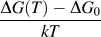 ${{\Delta G(T) - \Delta G_0 } \over {kT}}$indicates that the nucleus density is affected not only by the driving force but also by the transformation temperature.
Based on the consideration of the influence of temperature on the initial nucleation sites density, CechReference Cech27 analyzed the small martensite particles formation and introduced the concept of entropy change during phase transformation. Using the well-known approximation, ΔG(T) can be expressed as  $\Delta G(T) \cong \Delta S(T_{{\rm{\alpha }}\prime \gamma } - T)$, where
 $T_{{\rm{\alpha }}^{\rm{’}} {\rm{\gamma }}} $ is the temperature at which martensite is in equilibrium with austenite, and ΔG 0 = 0 in equilibrium, ΔS is the entropy change of martensite transformation. So recalling Eq. (9), it comes:
 $$N_{{\rm{\alpha }}\prime }^T \cong N_{{\rm{\alpha }}\prime}^0 \left( {{{\Delta S} \over k}{{T_{{\rm{\alpha }}\prime {\rm{\gamma }}} - T} \over T}} \right) = N_{{\rm{\alpha }}\prime }^0 \left( {{{\Delta S} \over k}{{T^* - T} \over T}} \right)\quad,$$
where T* is the temperature at which ΔG(T*) = ΔG 0. That is to say, it indicates the highest temperature at which nucleation sites become available. Therefore, it is generally assumed when the temperature decreased to the onset of martensite transformation, the nucleation sites are effective. Based on this assumption, T* can be expressed as:
 $$T^* \cong M_{\rm{s}} \quad.$$
Substituting Eqs. (10) and (11) into Eq. (8), the resultant martensite formation curve can be described as:
 $$f_{{\rm{\alpha }}\prime } = 1 - \exp \left[ { - {\rm{\varsigma }}qN_{{\rm{\alpha }}\prime }^0 \left( {{{\Delta S} \over k}{{M_{\rm{s}} - T} \over T}} \right)} \right]\quad.$$
C. Determination of the relative parameters
The martensite fraction,  $f_{{\rm{\alpha }}\prime } $, can be obtained by calculating the relative length change of the sample.
 $N_{{\rm{\alpha }}\prime }^T $ is equal to the number per unit volume of martensite units initially formed. The initial martensite lath is transformed from one nucleus, and it is assumed that only one martensite embryo nucleates and grows up to a nucleus in an austenite grain. In addressing, it is can be considered that the density of embryos at initial transformation,
 $N_{{\rm{\alpha }}\prime }^0 $, is equal to the density of austenite grains, N γ, i.e.,
 $N_{{\rm{\alpha }}\prime }^0 = N_{\rm{\gamma }} $. Therefore,
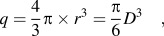
 $N_{{\rm{\alpha }}\prime }^0 $ can be obtained by measuring the number of austenite grains per unit volume of the sample. ΔS, the entropy change of martensite transformation, is difficult to obtain a certain value in complicated system, especially in such modified high Cr ferritic steel, which has many alloying components. Kaufman and CohenReference Kaufman and Cohen28 made a convenient transformation to avoid the calculation of ΔS. They reported that the ratio of ΔS/k could be directly used and its value is ∼0.67. The average volume of austenite grain size q should be a constant here due to the same austenization treatment process adopted; it is assumed that the austenite grain is spherical, so it can be expressed as follows:
 $$q = {4 \over 3}{\rm{\pi }} \times r^3 = {{\rm{\pi }} \over 6}D^3\quad ,$$
where r is radius and D is the mean diameter of austenite grain, which is directly measured from OM.
IV. RESULTS AND DISCUSSION
A. Variation of the martensite fractions
The martensite transformation behaviors of the modified high Cr ferritic steel specimens were explored upon continuous cooling at the respective rate, 10, 100, 1000, 2000, and 6000 °C/min. The martensite fraction,  $f_{{\rm{\alpha }}\prime } $, was calculated from the recorded relative length changes ΔL/L following the lever rule as described in Sec. II. E. The thus obtained
 $f_{{\rm{\alpha }}\prime } $ undergoing various cooling rates is displayed in Fig. 4 as a function of the temperature. The relationship between the obtained martensite formation rate,
 $df_{{\rm{\alpha }}\prime } /dt$, and the martensite fraction,
 $f_{{\rm{\alpha }}\prime } $, is represented in Fig. 5. It is indicated that the martensite transformation exhibits certain kinetic characteristics. First, the start temperature of martensite formation, M s, has a certain relation with cooling rate: M s decreases with the increase of cooling rate; especially, the change of M s cannot be recognized for the cooling rate above 2000 °C/min, and the same behaviors are also observed for the offset temperature of martensite formation, M f. Second, the temperature range of martensite transformation, from M s point to M f point, unchanged (i.e., about 50 °C) at all applied cooling rates. It means that martensite transformation range is not strongly affected by the cooling rate applied. Last, the reaction rate bursts at the beginning of transformation, reaches a peak rapidly while forming a small amount of martensite, and then decreases slowly to zero when the transformation finishes. Moreover, the peak of the martensite formation rate maximum increases slightly with the increase of cooling rate. The value of peak transformation rate is just about 0.2 s−1 at cooling rate 10 °C/min. But it reaches 0.65 s−1at 6000 °C/min, which is three times larger than that of 10 °C/min.
The martensite fraction,  $f_{{\rm{\alpha }}\prime } $, as a function of temperature, T, as determined from the isochronally recorded dilatometric data of the modified high Cr ferritic heat-resistant steel upon various cooling rates: 10, 100, 1000, 2000, and 6000 °C/min.

The martensite formation rate,  $df_{{\rm{\alpha }}\prime } /dt$, as a function of the martensite fraction,
 $f_{{\rm{\alpha }}\prime } $, for the modified high Cr ferritic heat-resistant steel as determined from the relative length change measurements recorded at various cooling rates.

Generally, the martensite transformation is an athermal reaction in low carbon steel; it means that the degree of reaction during martensite transformation is independent on the reaction time and just has a relationship with the temperature. In other words, the martensite will continue forming only when the temperature decreases.Reference Guimaraes and Rios29 When the transformation onsets, the initial martensite embryos are activated and transform into the nuclei, then grow up to the initial martensite laths, which lead to the lower product fraction for the reason that the number of the initial nuclei are small. During the nucleation/growth of the initial martensite laths, the process simulates the change of surrounding environment in the parent austenite, which makes the nucleation and growth of new martensite. After most of the martensites finish transforming, the number of nucleation is less, and the growth of new martensite is also inhibited. Therefore, the martensite fraction exhibits a trend as illustrated in Figs. 4 and 5.
The boundary of δ/γ acts an important role on the degradation of creep strength of high Cr ferritic steels. The alloy elements have been partitioned in two sides of these boundaries which are the interface of two inconsistent phases. The migrations of alloying elements between δ/γ boundary need certain time, until the alloying elements reach an equilibrium. With the increase of cooling rate, the migrated time reduced, and more alloying elements were “frozen” in the δ phase; these lead to the nonequilibrium in the two sides of δ/γ boundary. The content of alloying elements reduced in the γ phase, which might decrease the precipitation of MX/M23C6precipitates.
The optical microstructures of the explored high Cr ferritic heat-resistant steel specimens are displayed in Fig. 6. It is clear that the δ-ferrite can be found in the microstructure of the modified high Cr ferritic heat-resistant steel samples. Particularly, the content of δ-ferrite undergoing a cooling rate of 6000 °C/min [see Fig. 6(e)] is much higher than those cooled with other cooling rates. The primary δ-ferrite, which forms in hot rolling and followed by air cooling, cannot completely transform to austenite/martensite during the subsequent cooling, and the transformation from δ-ferrite to austenite becomes more and more difficult with the increase of the cooling rate applied. The reasoning for this phenomenon could be found in our previous study.Reference Gao, Liu, Di, Dong and Yan30 It should be pointed out that the content of δ-ferrite increases with the increase of cooling rate. The austenite grain size is approximately the same, which can be distinguished from the optical morphologies, for all the materials underwent the same austenization time before continuous cooling (holding on 1100 °C for 10 min). By observing the microstructure carefully, it also can be found that the corresponding martensite is in lath style, and the martensite lath becomes more refined with the increase of cooling rate.
Optical microstructures of the modified high Cr ferritic heat-resistant steel samples after undergoing continuous cooling at various rates: (a) 10 °C/min, (b) 100 °C/min, (c) 1000 °C/min, (d) 2000 °C/min, and (e) 6000 °C/min.

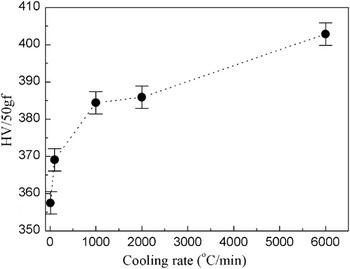
Figure 7 exhibits the distribution of Vicker’s hardness for the material as a function of cooling rate. The value of Vicker’s hardness is strongly dependent on the change of cooling rate (it increases with the increase of the cooling rate applied). Nevertheless, the slope is different at the various rate ranges. It increases more rapidly at low cooling rates (below 2000 °C/min) than that at high cooling rates (above 2000 °C/min). There are four major points can be considered, which lead to the above results. First, the martensite lath becomes thinner with the increase of cooling rate, and the refined particles increase the Vicker’s hardness. Second, the lath martensite possesses a high density of dislocations and thus harder than δ-ferrite.Reference Qiao, Liu, Yu and Gao31 The defects increase with the increase of cooling rate, which leads to the heightening of dislocation density and results in the strengthening of martensite laths. Third, besides the effect of dislocations, the content of δ-ferrite should be considered. δ-ferrite is a high temperature phase. According to the earlier reports, the computed constant carbon section of (Fe–xCr–0.1C) system suggests that for a 9Cr steel, the δ-ferrite phase forms at around 1100 °C,Reference Jeya Ganesh, Raju, Kumar Rai, Mohandas, Vijayalakshmi, Rao and Raj32 and for the standard 9Cr–1Mo steel, the inflection at 1050 °C can be taken to mark the entry of the system into the γ + δ-ferrite two-phase field on continuous heating estimated using Thermo-calc software.Reference Helis, Toda, Hara, Miyazaki and Abe33 Related researchersReference Gao, Liu, Di, Dong and Yan30, Reference Lee, Cho and Choi34, Reference Maehara and Ohmori35 have illustrated that the migration of the δ/γ interface boundary into the ferrite phase region resulted from the nucleation and growth of M23C6 carbides with patterns of “lamellar” and “larva.” The transformation from δ-ferrite to austenite becomes less sufficiently followed by the increase of cooling rate and that leads to reduction in the amount of austenite formation. The interface boundary of δ-ferrite/new austenite will continuously migrate into δ-ferrite, and then, new austenite grain grows up. For the cooling rates from 10 to 2000 °C/min, the change of δ-ferrite contents keep increasing. The hardness of δ-ferrite is lower that martensite, so the total hardness of the material should be decrease with the increase of δ-ferrite content. Last but not least, the effect of precipitation strengthening, such as MX and M23C6 precipitates. Ma et al.Reference Ma, Wen, Tang, Xu, Mei and Wang36 have proposed that the volume fraction of the precipitates and the size of the particles are reduced with the increase of cooling rate. These phenomena will lead to two contradictory results with the reduction of MX and M23C6 precipitates: on the one hand, the precipitation strengthening would decrease, while on the other hand, the migration of dislocations becomes easier due to the reduction of pinning force, which comes from the precipitate particles, and these will lead to so many dislocations which migrated to the boundaries of subgrain boundaries (the boundaries of martensite laths), will reinforce subgrain boundaries strengthening. The combined effects of the martensite laths, dislocation density, content of the δ-ferrite, and precipitation strengthening lead to the observation results, shown in Fig. 7.
Vicker’s hardness of the modified high Cr ferritic heat-resistant steel after continuous cooling at various rates.

B. Martensite transformation kinetics
During fitting based on Eq. (12), the martensite fraction that  $f_{{\rm{\alpha }}\prime } $ < 0.05 and
 $f_{{\rm{\alpha }}\prime } $ > 0.95 of the experimental data have not been considered, as the values of the corresponding interface velocity data are not reliable due to mathematical instability of Eq. (12): upon approaching
 $f_{{\rm{\alpha }}\prime } $ = 0 and
 $f_{{\rm{\alpha }}\prime } $ = 1, both the left- and right-hand sides of Eq. (12) become zero, independent of the value of the interface velocity.
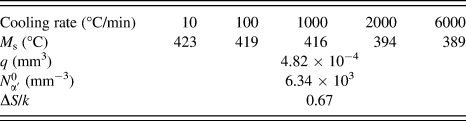
The thus obtained kinetic parameters are collected in Table II. Validation of Eq. (12) was accomplished by fitting the experimental transformation data displayed in Fig. 4, and the obtained fitted results are illustrated in Fig. 8. Figure 9 shows the aspect ratio of martensite laths as a function of cooling rate based on the fitted results.

The fitted data of the martensite fraction,  $f_{{\rm{\alpha }}\prime} $, as a function of temperature, T, for the modified high Cr ferritic heat-resistant steel during continuous cooling based on the experimental data. The lines through the experimental data were fitted by applying Eq. (12).

The aspect ratio of martensite laths,  ${\rm{\varsigma }}$, as a function of cooling rate. The values of
 ${\rm{\varsigma }}$ were calculated by the fitted data based upon Eq. (12).

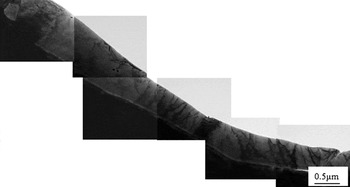
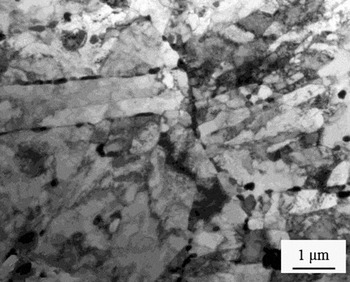
A complete martensite lath formed under the cooling rate of 6000 °C/min was shown in Fig. 10. Based on Fig. 10, the aspect ratio of martensite lath that can be measured was about 0.06, and the value is approximate to the calculated result, 0.062. For obtaining a more accurate experimental data, many martensite laths were count based on transmission electron microscope (TEM) graphs as follows: the number of martensite laths measured in one prior austenite grain were about 15–20, and the total statistics number of prior austenite grains was more than 20; the statistic average data were considered as the final results. Both the experimental and calculated data are displayed in Fig. 9.
A complete martensite lath in the modified high Cr ferritic heat-resistant steel upon the cooling rate, 6000 °C/min.

Martensite transformations are nucleation controlled and heterogeneous in most steel, and the initial formation of clusters of martensite laths only occurs in some austenite grains, with gradual spreading of plate formation into all austenitic grains, which is the so-called spread transformation.Reference Rios and Guimaraes26, Reference Rios and Guimaraes37 It means that martensite lath initially nucleates in the austenite grains, propagates at very high speeds, and then stops suddenly while growing up to the grain boundary. Nevertheless, the grain boundaries also provide a suitable environment for the nucleation of later martensite. The aspect ratio decreases with the increase of cooling rate as the results of Fig. 9. The austenite grain boundary is a barrier of martensite growth. If only the initial martensite lath is considered, the length of martensite lath is a constant that is equal to the diameter of austenite grain. Hence, the initial martensite lath becomes wider with the increase of cooling rate. Nevertheless, other martensite laths cannot grow freely due to the presence of the austenite boundaries and the austenite-formed martensite interfaces, so the martensite lath becomes thinner. This would lead to a refinement of the martensite laths with the cooling rate increasing, which is in agreement with the results of the optical microstructures (see Fig. 5).
Based on Eq. (7), the density of martensite laths,  $N_{{\rm{\alpha }}\prime } $, can be calculated as a function of martensite fraction (as shown in Fig. 11). The density of martensite laths is directly proportion to cooling rate; that is to say, it increases with the increase of cooling rate. In the same austenite grain, if the density of martensite laths is smaller, it means that the martensite lath will be coarser. The martensite nuclei increase when cooled to the onset of the martensite formation with the increase of cooling rate, and the new nuclei form continuously during the martensite transformation. Both of them grow up to the final martensite laths. The increase of the martensite lath number is low at initial stage and becomes rapid when martensite fraction approximately approaches above 0.7. The laths produced from the initial martensite nuclei are larger than the later martensite laths. So as reaction, the martensite laths become smaller and smaller with the increase of the product fraction. Hence, the number of martensite laths increases slowly at the beginning, and with the progress of martensite reaction, it increases quickly.
The density of martensite nuclei (martensite laths),  $N_{{\rm{\alpha }}\prime } $, as a function of martensite fraction,
 $f_{{\rm{\alpha }}\prime} $, calculated by Eq. (7), for the modified high Cr ferritic heat-resistant steel upon continuous cooling at various rates.

C. Kinetic reasoning
The microstructure of material is strongly dependent on the addition of alloying elements. The final microstructure of high Cr ferritic heat-resistant steel normally consists of lath martensite with intragranular precipitates of M23C6, MX, and M2X carbides, which precipitated primarily along the prior austenite grain boundaries and/or the lath martensite boundaries (see Fig. 12). The mechanism of precipitation strengthening is dominant in improving the high temperature performance of high Cr ferritic steel. The alloying components of the modified high Cr ferritic heat-resistant steel here are slightly different from the traditional high Cr ferritic steels, i.e., the addition of boron (B) and cobalt (Co). Generally, boron can gather on grain boundaries and restrain both the diffusion of the other alloying components and the migration of grain boundaries. However, Hattestrand and AndrénReference Hattestrand and Andrén38 reported that all of boron were incorporated and evenly distributed within the M23C6 carbides, and the amount dissolved in the matrix was very low. The small amounts of boron interacting with vacancies in the matrix probably slow down the diffusion of alloying atoms, which leads to a decrease of coarsening rate of M23C6 carbides.Reference Lundin, Fallman and Andren39 The locations that boron actually gathered are not considered temporarily in this paper, what is important is that the gather of boron. During the process of austenitization (holding at 1100 °C), boron gathered on the grain boundaries or in the M23C6 carbides. The content of gathered boron would increase with the increase of cooling rate due to more boron atoms were “frozen” and less could migrate during the followed continuous cooling. The final result is that the gather of boron can pin the migration of grain boundaries (boron gathered on the grain boundaries) or restrain the coarsening of M23C6 carbides (boron gathered in the M23C6 carbides). The M23C6 carbides precipitated on martensite lath boundaries pin the migration of lath boundaries, and the pinning force will reinforce when the M23C6carbides are finer with higher number density.
The martensite laths and the precipitated carbides of the modified high Cr ferritic heat-resistant steel.

It is known that Co is another important austenite-stabilizing alloying component to suppress the formation of the δ-ferrite during high-temperature treatment of high Cr ferritic steels. Co may indirectly affect on microstructural change in the complicated martensitic structure. Semba et al.Reference Semba, Igarashi, Yamadera, Iseda and Sawaragi40 considered that Co accelerated one of intermetallic compounds, μ phase in 9Cr–2.6W–Mo, Nb, V steels. Hald and StraubReference Hald and Straub41 indicated that various precipitation phenomena would be retarded with the addition of Co in bearing steel. The addition of Co in ferrite steel refines the prior austenite grain size and promotes the homogeneous precipitation of fine MX carbides in the martensite laths, which leads to the strengthening of martensite.Reference Yamada, Igarashi, Muneki and Abe42 The detailed influence of alloying components on the precipitation of Carbides during phase transformation will be investigated in our future work.
As the empirical equation to describe the martensite formation in carbon steels, the K-M equation has been extensively discussed by Magee.Reference Magee43 Recently, van Bohemen and SietsmaReference van Bohemen and Sietsma9 developed a composition-dependent correction to the rate parameter in K-M’s equation to improve its ability to describe the transformation curve of Fe–C–Mn alloys. There is no doubt that the K-M equation has a classical description of martensite transformation. In this approach, both the nucleation of martensite and the growth of lath were considered in the equations used to describe the martensite transformation curve, and the available initial nucleation sites were also introduced. The “spread” transformation kinetics considered for the austenite grain size was small (as value 4.82 × 10⁻⁴ mm3in our work).
V. CONCLUSIONS
Using the kinetic model of martensite nucleation and growth, the martensite transformation features of modified high Cr ferritic heat-resistant steel upon continuous cooling were studied. The results can be summarized as:
(i) The onset temperature of martensite transformation, M s, decreases with the increase of cooling rate.
(ii) The martensite formation rate bursts at the beginning of transformation, and it decreases slowly to zero, while the transformation ends.
(iii) According to the kinetic model of martensite transformation based on K-M equation, the aspect ratio of martensite laths decreases with the increase of cooling rate, which indicates a refinement of the formed martensite laths.
(iv) The kinetic reasoning suggests that the density of martensite laths is initially low and it increases with the increase of martensite fraction.
ACKNOWLEDGMENTS
The authors are grateful to the National Natural Science Foundation of China and Shanghai Baosteel Group Company (Grant No. 50834011) and the National Natural Science Foundation of China (Grant No. 51104107) for grant and financial support.