INTRODUCTION
High-altitude lakes, which are located in remote regions of the globe with absence of human settlements and anthropogenic disturbances, are valuable environments that allow continuous sediment accumulation over a long period of time. Therefore, sediments that are deposited in such environments are important for paleoclimate reconstruction and identification of climate cycles/periods (Engstrom and Wright, Reference Engstrom, Wright, Haworth and Lund1984; Li and Ku, Reference Li and Ku1997; Cohen, Reference Cohen2003; Martin-Puertas et al., Reference Martin-Puertas, Tjallingii, Bloemsma and Brauer2017; Żarczyński et al., Reference Żarczyński, Wacnik and Tylmann2019).
The Holocene is an important geologic epoch encompassing both shortened and extended alternations of climate periods (Turner, Reference Turner1997; Kuhlmann et al., Reference Kuhlmann, Meggers, Freudenthal and Wefer2004; Maxbauer et al., Reference Maxbauer, Shapley, Geiss and Ito2019). As a result, the Holocene is important for understanding paleoclimate variability as well as current and future climate changes, which are anticipated to be dominated by human-induced changes (Cook et al., Reference Cook, Anchukaitis, Touchan, Meko and Cook2016; Han et al., Reference Han, Gao, Yu, Yu, Li, Cong and Wang2019). Within the Holocene epoch, the Late Holocene is of particular importance in terms of understanding paleoclimate and current climate changes (Corella et al., Reference Corella, Stefanova, El Anjoumi, Rico, Giralt, Moreno, Plata-Montero and Valero-Garcés2013; Viana et al., Reference Viana, Sifeddine, Turcq, Albuquerque, Moreira, Gomes and Cordeiro2014). A large number of European Late Holocene reconstructed paleoclimate studies have reported a drier/colder Dark Ages Cold Period (DACP, ca. AD 400–750), wetter/warmer climate events (Medieval Climate Anomaly, MCA, ca. AD 950–1250), and a drier/colder period (Little Ice Age, LIA, ca. AD 1400–1850) (Baker et al., Reference Baker, Hellstrom, Kelly, Mariethoz and Trouet2015; Koutsodendris et al., Reference Koutsodendris, Brauer, Reed, Plessen, Friedrich, Hennrich, Zacharias and Pross2017; Moreno et al., Reference Moreno, Fatela, Leorri, Gonçalves, Gómez-Navarro, Araújo, Freitas, Trigo, Blake and Moreno2019). The DACP has been reported as a cold period with societal impacts (Helama et al., Reference Helama, Jones and Briffa2017). Reports from historical sources suggest there were crop failures, famine, flood, and turmoil during the MCA and LIA (Brázdil et al., Reference Brázdil, Kiss, Luterbacher, Nash and Řezníčková2018). Although, synchronicity issues between geographical locations and/or atmospheric circulation remain unresolved, the DACP, MCA and LIA have been widely used in the literature between ca. AD 400–750,ca. AD 950–1250, and ca. AD 1400–1850, respectively (Mann et al., Reference Mann, Zhihua, Scott, Bradley, Hughes, Shindell, Ammann, Faluvegi and Ni2009; Sachs et al., Reference Sachs, Sachse, Smittenberg, Zhang, Battisti and Golubic2009). Global atmospheric circulation patterns, volcanic forcing and solar activity were proposed as possible reasons for the underlying climate events (Goosse et al., Reference Goosse, Arzel, Luterbacher, Mann, Renssen, Riedwyl, Timmermann, Xoplaki and Wanner2006; Cronin et al., Reference Cronin, Hayo, Thunell, Dwyer, Saenger and Willard2010; Pyrina et al., Reference Pyrina, Moreno-Chamarro, Wagner and Zorita2019).
The eastern Mediterranean (EM) is an area of significant historical and archaeological importance, and the seasonal precipitation patterns are vital for the ecosystem and inhabitants of the region (Roberts et al., Reference Roberts, Moreno, Valero-Garcés, Corella, Jones, Allcock and Woodbridge2012). Moreover, the region is susceptible to extreme weather events such as flash floods and heat waves, which can have severe effects on the local population and environment. Similar to under-reported regions in which few studies exist, the spatio-temporal character of the DACP, MCA, and LIA are still unresolved. Although previous research has linked them to changes in climate modes (e.g., North Atlantic Oscillation, NAO), orographic differences, volcanic activities, prolonged sea ice/oceanic feedbacks, and solar activity, more regional studies are needed (Goosse et al., Reference Goosse, Arzel, Luterbacher, Mann, Renssen, Riedwyl, Timmermann, Xoplaki and Wanner2006; Roberts et al., Reference Roberts, Moreno, Valero-Garcés, Corella, Jones, Allcock and Woodbridge2012; Kushnir and Stein, Reference Kushnir and Stein2019). Links of the DACP, MCA, and LIA to socio-political developments in the EM have also been investigated (Bar-Matthews et al., Reference Bar-Matthews, Ayalon, Kaufman, Issar and Brown1998; Xoplaki et al., Reference Xoplaki, Fleitmann, Luterbacher, Wagner, Haldon, Zorita, Telelis, Toreti and Izdebski2016). In line with most published records in the North Atlantic region (Mann, Reference Mann and Elias2013; Auger et al., Reference Auger, Mayewski, Maasch, Schuenemann, Carleton, Birkel and Saros2019), the EM records reveal a wet MCA and dry LIA associated with alternating pattern of NAO (Roberts et al., Reference Roberts, Moreno, Valero-Garcés, Corella, Jones, Allcock and Woodbridge2012; Lüning et al., Reference Lüning, Schulte, Garcés-Pastor, Danladi and Gałka2019). Although, NAO is an important component of climate variability in the region, interplay of other factors such as Mediterranean Sea surface temperature, orographic differences, North Sea/Caspian Pattern (NCP), Atlantic Multidecadal Oscillation, and East-Atlantic Pattern could not be ruled out (Bozkurt and Sen, Reference Bozkurt and Sen2011; Roberts et al., Reference Roberts, Moreno, Valero-Garcés, Corella, Jones, Allcock and Woodbridge2012; Lüning et al., Reference Lüning, Schulte, Garcés-Pastor, Danladi and Gałka2019). Therefore, the mechanisms behind the unprecedented climate changes are still a subject of discussion.
In accordance with the EM studies, an emerging body of literature on Anatolia is focused on understanding climate changes during the MCA and LIA (Cullen and deMenocal, Reference Cullen and deMenocal2000; Akkemik and Aras, Reference Akkemik and Aras2005; Touchan et al., Reference Touchan, Akkemik, Hughes and Erkan2007; Kuzucuoǧlu et al., Reference Kuzucuoǧlu, Dörfler, Kunesch and Goupille2011; Woodbridge and Roberts, Reference Woodbridge and Roberts2011; Heinrich et al., Reference Heinrich, Touchan, Dorado Liñán, Vos and Helle2013; Tudryn et al., Reference Tudryn, Tucholka, Özgûr, Gibert, Elitok, Kamaci, Massault, Poisson and Platevoet2013; Ocakoğlu et al., Reference Ocakoğlu, Dönmez, Akbulut, Tunoğlu, Kır, Açıkalın, Erayık, Yılmaz and Leroy2016; Akçer Ön, Reference Akçer Ön2017; Köse et al., Reference Köse, Tuncay Güner, Harley and Guiot2017; Danladi and Akçer-Ön, Reference Danladi and Akçer-Ön2018; Kılıç et al., Reference Kılıç, Caner, Erginal, Ersin, Selim and Kaya2018; Erginal et al., Reference Erginal, ÇaĞatay, Selim, KarabiyiKoğlu, Çakir, Yakupoğlu, Acar, Akbaş and Kaya2019). These studies have made significant progress in understanding and linking the climate events with natural modes of climate variability (NAO, East-Atlantic Patterns, NCP, and the Indian Monsoon), orographic differences, volcanic activities, and solar activity. Jones et al. (Reference Jones, Roberts, Leng and Türkeş2006), using a record from annually dated Lake Nar, reported a wet period (AD 1000–1350) and dry LIA (AD 1400–1950), which are related with NAO, NCP, and the Indian Monsoon. Historical literature has documented a wide range of dry conditions during the LIA (White, Reference White and White2012, Reference White and Mikhail2013; Köse, Reference Köse2018), which have been confirmed by tree ring reconstructions (Touchan et al., Reference Touchan, Akkemik, Hughes and Erkan2007; Köse et al., Reference Köse, Tuncay Güner, Harley and Guiot2017). However, in Anatolia, high-resolution climate records with robust chronologies are still needed.
In this paper, a high-resolution multi-proxy data investigation of a piston core from Lake Gölcük sedimentary record, combining lithological description, magnetic susceptibility, μXRF elemental analysis, pollen, and stable isotopic measurements of carbon (δ13C) and oxygen (δ18O) is presented. The age-depth model was constructed based on seven radiocarbon dates. The study allows comparison of different climate indicators of the sediment core, which form the basis for a paleoclimate interpretation since AD 400 (1550 cal years BP). To understand the climate variability since AD 400, Lake Gölcük proxies have been compared with NAO reconstruction and solar activity proxy. The records also were compared with regional data to assess the spatio-temporal character of the DACP, MCA, and LIA climate events.
STUDY AREA
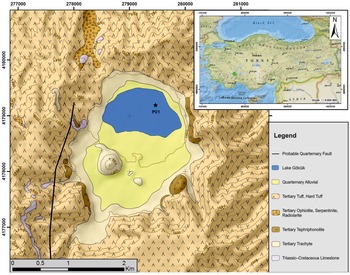
Lake Gölcük is a small volcanic crater lake that is located at a high altitude (1380 m asl) in the Isparta Province of SW Anatolia (Fig. 1). Lake Gölcük has a surface area of 1.05 km2 and a diameter of 1500 m; the deepest measured depth of the lake is 40 m (DSİ, 1978). The lake is located in the Lake District of Isparta Province in southwestern Anatolia. The region surrounding Gölcük Lake is characterized by volcanic activity, with various volcanic cones and domes in the area. The region has been the subject of extensive research, primarily focused on Quaternary volcanic events, surrounding faults, and lineaments (Cengiz et al., Reference Cengiz, Sener and Yagmurlu2006; Platevoet et al., Reference Platevoet, Scaillet, Guillou, Blamart, Nomade, Massault and Poisson2008; Schmitt et al., Reference Schmitt, Danišík, Siebel, Elitok, Chang and Shen2014; Canpolat, Reference Canpolat2015). The underlying geology is volcanic with andesite and trachyandesites ranging from the Tertiary to the Quaternary (Figure 1).
Location map of Lake Gölcük (green dot) together with the regional geology. The location of the drilled core is indicated with a black star.

In terms of vegetation, the lake is situated in the Oro Mediterranean vegetation zone, which presently includes Quercus cerris, Quercus calliprinos, Pinus brutia, and Pinus nigra in regions at ~1000 m asl, and Cedrus libani, Abies cilicica, and Juniperus in regions between 1000–2000 m asl (Zeist et al., Reference Zeist, Woldring and Stapert1975).
The region is in a boundary close to the continental Anatolian and Mediterranean climate (Deniz et al., Reference Deniz, Toros and Incecik2011). Instrumental records of the Isparta Province documented between 1929 and 2019 show an average annual temperature and precipitation of 12.2°C and 570.2 mm, respectively (Danladi et al., Reference Danladi, Akçer-Ön, Ön and Schmidt2021). High pressure systems over Europe, North Africa, and monsoon regions combined with the Mediterranean SST influence the temperature and precipitation variations in the region (Bozkurt and Sen, Reference Bozkurt and Sen2011).
METHODOLOGY
A 198-cm-long continuous, undisturbed sediment core (Golcuk18-P01) was recovered in September 2018 at a water depth of 22 m in the N-NE part of Lake Gölcük using a piston sediment corer. The core was split lengthways into halves. One half was used for sample selection and preparation for lithological description (at mm scale), stable isotope analyses (δ18O and δ13C), and 14C dating, whereas the other half was used for scanning for magnetic susceptibility and μXRF elemental analysis.
Elemental analysis was carried out at the Istanbul Technical University (ITU) East Mediterranean Centre for Oceanography and Limnology (EMCOL) using molybdenum tube embedded in Itrax core scanner. The scanner can measure elements ranging from Al to U, as well as radiography of cores (Croudace et al., Reference Croudace, Rindby and Rothwell2006, Reference Croudace, Löwemark, Tjallingii and Zolitschka2019). The core Golcuk18-P01 was scanned at 1-mm intervals using a scan time of 30 seconds with current of 10 kV and 0.3 mA. Although the analysis was carried out at 1-mm intervals, the results were averaged to 5-mm intervals for noise reduction and better visual correlations. The radiography also was measured using the same equipment.
The elemental results of Fe, Ti, Ca, Mn, Sr, and K obtained from μXRF analysis were subjected to factor analysis. However, since μXRF counts conform to compositional statistics (Weltje and Tjallingii, Reference Weltje and Tjallingii2008), data transformation and outlier removal were conducted prior to the factor analysis. The outCoDa function, a robust outlier detection approach (Filzmoser and Hron, Reference Filzmoser and Hron2008), was employed for this purpose. This function is part of the robcompositions package (Filzmoser et al., Reference Filzmoser, Hron and Templ2018; Reimann et al., Reference Reimann, Filzmoser, Garrett and Dutter2008) in R (R Core Team, 2021). The factor analysis algorithm described by Fizmoser et al. (Reference Filzmoser, Hron, Reimann and Garrett2009), which utilizes the principal factor analysis of centered log-ratio transformed data, was applied using the pfa function in the robcompositions package in R.
Magnetic susceptibility (MS) analysis was carried out using Bartington point sensor embedded in a Geotek Multi Sensor Core Logger (MSCL) (Weber et al., Reference Weber, Niessen, Kuhn and Wiedicke1996), which is also located at the ITU-EMCOL laboratory. The analysis was carried out at 5-mm intervals.
Fifty samples were selected at ~2.5-cm intervals for δ18O and δ13C analyses. The samples were cleaned of impurities by washing with water and 63-μm sieving. Light microscope was then used for selecting the shells of Candona neglecta, which is the most abundant and available ostracod species throughout the core. The samples were then analyzed using the normal procedure for δ18O and δ13C at the Environmental Isotope Laboratory, University of Arizona Tucson (Bar-Matthews et al., Reference Bar-Matthews, Ayalon, Kaufman, Issar and Brown1998; Roberts et al., Reference Roberts, Jones, Benkaddour, Eastwood, Filippi, Frogley and Lamb2008).
Sediment samples measuring 4 cm3 were collected at ~2.5-cm intervals from the P01 sediment core. In total, 50 sediment samples were collected for pollen analysis. Using the standard pollen preparation procedure of Faegri and Iversen (Reference Faegri and Iversen1989), the samples were analyzed through the chemical and sieving procedure. As a marker for absolute pollen and non-pollen palynomorph concentrations, a lycopodium tablet was added (Stockmarr, Reference Stockmarr1971). The pollen diagrams and stratigraphic cluster analysis were evaluated using Tilia software (Grimm, Reference Grimm1987).
AMS 14C analyses of seven samples, which included both ostracod shells and organic carbon, were carried out in different laboratories (see Table 1 for details). The laboratory in which the analyses were carried out and number of samples dated (in parentheses) are as follows; Beta Analytic (1), ETH Zurich (5), and Poznan (1). The AMS 14C dating at the Poznań Radiocarbon Laboratory in Poland was carried out on the organic remains in the sediments. On the other hand, the analyses at Beta Analytic USA and ETH Zurich Switzerland were made on ostracod shells using standard AMS 14C and Mini Carbon Dating System (MICADAS) methods, respectively. The rationale for using the MICADAS method (ETH Zurich) is because the amount of ostracod in the 5 samples was lower (<5 mg) compared to the amount of ostracod sample (≥10 mg) required for dating at Beta Analytic USA.
14C laboratory (uncalibrated) results of core Golcuk18-P01 showing Lab ID, age (BP), depth (cm), and dated materials.

RESULTS
Chronology
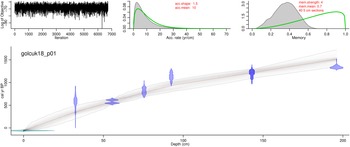
The age-depth model was reconstructed using a Bayesian procedure implemented in the rbacon package in R (Blauw and Christen, Reference Blaauw and Christen2011). Calibration of each radiocarbon date was conducted using the IntCal13 curve (Reimer et al., Reference Reimer, Bard, Bayliss, Beck, Blackwell, Ramsey and Buck2013) within the same package to take advantage of the full form of the curve as a prior distribution in the stochastic process of the rbacon package. Since the approach is Bayesian, it requires incorporation of prior assumptions expressed as probability distributions in the model. The model assumes a gamma distribution to describe the core's accumulation rate and a beta distribution for the memory of the accumulation. The parameters selected for the gamma and beta distributions were (α,β) = (1.5,10) and (α,β) = (4,0.7), respectively. According to our age-depth model, Golcuk18-P01 covers approximately the last 1550 cal years BP (see Fig. 2).
The age-depth model of the Golcuk18-P01 core reconstructed from seven 14C dates. Top panel, from left to right: trace plot of Markov chain Monte Carlo (MCMC) runs of the log-posterior distribution (left), prior (green), and posterior (shaded) distributions for accumulation rate and the memory models. Below, the age depth model is given and the 95% confidence intervals for all depths are shown as gray shade. The blue shapes represent the vertically mirrored probability distribution of each calibrated date.

The mean uncalibrated ages of samples taken from depths of 32.5 cm and 55.5 cm in the core are almost identical, with the latter date being slightly younger (Table 1). It should be noted that the laboratories and dated materials used for each depth were different: ostracod shells were analyzed at 32.5 cm and bulk material at 55.5 cm. The apparent inconsistency may be due to variations in analytical procedures, specifically the use of different laboratories or materials during the analyses. However, the calibrated age ranges show that the 2σ uncertainty intervals are consistent with the depths of the dates. The vertical blue bulbs in Figure 2 represent the probability distributions of calibrated ages at each depth, where the distribution at 32.5 cm elongates down to the distribution at 55.5 cm.
Factor Analysis
Factor analysis revealed three groups of elements that correspond to an elemental variance of 74% (Table 2). The first group was represented by K and Ti; the second group was represented by Mn and Fe; and the third group was represented by Ca and Sr (Fig. 3).
Biplots depicting the three factors resulting from robust factor analysis for centered log-ratio transformed X-ray fluorescence (μXRF) counts of Mn, Fe, K, Ca, Ti, and Sr. The plots illustrate the relationships among the variables and factors, with each arrow representing a variable and the angle between pairs of arrows indicating the strength and direction of the relationship. The factors are labeled according to the main variables that contribute to them, and can provide insights into the underlying patterns and sources of variation in the μXRF data.

The results of the factor analysis showing three factors (groups of elements). Lower panel shows the proportional variance explained by each factor and cumulative variance i.e. summation of proportional variances that show the percentage of the total variance explained by the extracted factors.

Abiotic Proxies
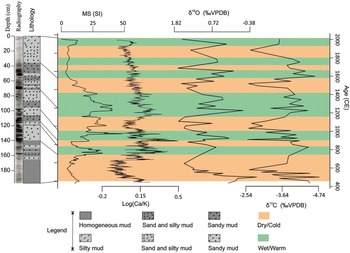
The lithology of core Golcuk18-P01 between AD 450–730 is characterized by homogeneous mud lithology (Fig. 4). Between AD 730–810, sandy lithology is noted, followed by mud lithology from AD 810–880. Below AD 880 re-emergence of sandy lithology dominated until AD 1400. Finally, the lithology shows a prevalence of silty mud until AD 2018.
Plot of the multiproxy results of the Lake Gölcük P01 record. From left to right; radiography measurement of the core from micro XRF, lithological description, magnetic susceptibility measurement (MS), log ratio of Ca to K, ∂18O, and ∂13C. VPDB = Vienna Pee Dee Belemnite.

The radiography results on the other hand suggest a generally light radiography between AD 450–750 (Fig. 4). From AD 750–1000, dark radiography is observed, which is followed by a light radiography until AD 1150. Between AD 1150–1600, a generally dark radiography prevailed, followed by a light radiography until AD 2018.
The MS documented relatively low values from AD 450–730, followed by high values between AD 730–810 (Fig. 4). Conversely, relatively high MS values persisted between AD 730–810. Reaching AD 880, relatively low values were observed. The MS values between AD 880–1400 were relatively high, with exception of the values from AD 1000–1150. From AD 1400–2018, the MS documents relatively low values.
Isotopes of δ13C and δ18O between AD 450–730 show relatively elevated values, which are followed by relatively depleted values between AD 730–810 (Fig. 4). From AD 810–880, the δ13C and δ18O revealed relatively high values, followed by relatively low values between AD 880–1400. However, interruption from relatively low values were documented from AD 1000–1150. Between AD1400–2018, the δ13C and δ18O data indicate generally relatively low values, except for AD 1450–1550, AD 1645–1715, and AD 1790–1820 periods.
Low values of log(Ca/K) were recorded in the period AD 450–730, followed by relatively high values between AD 730–810 (Fig. 4). In the period AD 810–880, relatively low log(Ca/K) values were documented. On the other hand, the period AD 880–1400 generally documents relatively high values, except for AD 1000–1150. From AD 1400–2018, the log(Ca/K) data have relatively low values.
Biotic proxies
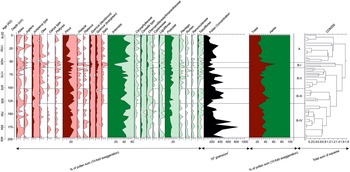
High percentages of herbaceous (Artemisia and Poaceae) taxa between AD 450–750 (196–130 cm), followed by relatively higher trees and shrubs from AD 750–950 (130–105 cm) were documented. The tree taxa are mainly represented by Pinus and to a lesser extent Juniperus type, Quercus (deciduous), and Quercus (evergreen). Based on Lake Gölcük's pollen record, Artemisia was the most abundant taxon followed by Poaceae in the steppe vegetation (Fig. 5). The percentage of Cerealia is low. with an average of 2.3%. The pollen concentration in this zone is high.
Pollen diagram of Lake Gölcük core P01 plotted against depth with most abundant taxa, pollen concentrations, percentage of trees, shrubs, and herbs, LPAZ (local pollen assemblage zones), and cluster analysis.

From AD 750–950 (130–105 cm), the percentage of the herbaceous (Artemisia followed by Poaceae) taxa declined, whereas the trees slightly increased. Conifers (Pinus, Juniperus), Quercus (deciduous), and Quercus (evergreen) all increased. In this period, a relatively high pollen concentration in the pollen assemblage zone was observed.
From AD 950–1220 (105–60 cm), Artemisia followed by Poaceae dominated the steppe elements. The trees in the pollen assemblage (Pinus, Juniperus, Quercus [deciduous], and Quercus [evergreen]) were reduced. Plantago and Cerealia increase slightly.
From AD 1410–2018 (50–0 cm), herbaceous taxa (mainly Artemisia and Poaceae) increased, whereas the tree pollen (Pinus, Juniperus, Quercus [deciduous], and Quercus [evergreen]) declined.
DISCUSSION
Mn, Fe, Ti, and K are siliciclastic components of lakes, which are commonly derived from the lake surroundings (Cohen, Reference Cohen2003; Croudace et al., Reference Croudace, Löwemark, Tjallingii and Zolitschka2019). However, Ca and Sr may not only be derived from the lake surrounding but also form within the lake system and are widely regarded as endogenic components (e.g., Davies et al., Reference Davies, Lamb, Roberts, Croudace and Rothwell2015). In Lake Gölcük, the siliciclastic components are derived from volcanics, which are rich in Mn, Fe, Ti, and K. But the factor analysis results suggest loading of Mn and Fe in group one, whereas Ti and K loaded in group two. This can be seen as a contradiction to our interpretation. However, given the redox behavior of both Mn and Fe, one can suspect the redox behavior of Fe and Mn in lake systems to be the reason (Cohen, Reference Cohen2003; Żarczyński et al., Reference Żarczyński, Wacnik and Tylmann2019). Nevertheless, the correlation between the two groups is positive (Fig. 3), meaning both group 1 and 2 are from siliciclastic components. For Sr and Ca, the factor analysis suggests loading in group three, which is interpreted as endogenic components because they are neither positively correlated with group 1 nor with group 2. It is acknowledged that stating the exact source of Ca and Sr based on the current proxy can be problematic, as a result, it is assumed to be precipitated and/or biotic in origin.
The lithological changes in the Lake Gölcük P01 core indicate varying sediments deposited due to three agents: mass wasting (seismic activities), varying climate, and/or changes within the lake system. Mass wasting can be easily identified by observing sediment sorting in core sediments, which was not observed in the P01 record. Although evidence based on a single proxy can be misleading, no reversal in the radiocarbon dates that would indicate sediment mixing due to mass wasting was encountered. Based on these lines of evidence, mass wasting is ruled out and energetic (non-energetic) environments is proposed, possibly during wet (dry) periods, as the reason for varying lithology in the lake. The interpretation of energetic (non-energetic) environments is supported by dark (light) radiography image. Dark radiographic images in core sediments usually represent accumulated coarser-grained sediments in lake systems due to precipitation (Danladi and Akçer-Ön, Reference Danladi and Akçer-Ön2018). On the other hand, light radiography reflects more fine-grained sediments that accumulated in a more stable, or dry climate period.
The log(Ca/K) reflects calcite versus siliciclastic inputs and can be interpreted as precipitated calcite in the lake system. The justification is that warm summer temperatures lead to increase in precipitated calcium in water column. In fact, Danladi et al. (Reference Danladi, Akçer-Ön, Ön and Schmidt2021) found the log(Ca/K) in Lake Gölcük to be a direct proxy for summer temperature. MS is a proxy for siliciclastic materials entering lacustrine environments and its high (low) values usually suggest high (low) input of siliciclastic materials in a lake (Thompson et al., Reference Thompson, Battarbee, O'Sullivan and Oldfield1976). The siliciclastic materials migrate into the lake due to precipitation, mass wasting, or reduced lake water level in a lacustrine environment. Since there is no evidence of mass wasting in the Lake Gölcük core, the MS record is interpreted as a proxy for wet/dry periods. δ13C and δ18O isotopes in closed basins are interpreted as proxies for precipitation/evaporation. The justification is fractionation processes of δ13C and δ18O, which are controlled by the precipitation/evaporation ratio (Li and Ku, Reference Li and Ku1997; Roberts et al., Reference Roberts, Jones, Benkaddour, Eastwood, Filippi, Frogley and Lamb2008).
Increase in tree pollen is often associated with increased moisture, whereas the prevalence of steppe vegetation is linked to decrease in moisture or increase in human activities (England et al., Reference England, Eastwood, Roberts, Turner and Haldon2008; Bakker et al., Reference Bakker, Kaniewski, Verstraeten, de Laet and Waelkens2012; Şenkul et al., Reference Şenkul, Memiş, Eastwood and Doğan2018). Such human activities could be related to land clearance for agricultural and/or settlement purposes. Evidence of land clearance is often associated with decrease in woodlands. In Lake Gölcük the increase/decrease in tree pollen can be ascribed to increase/decrease in moisture because of several reasons: (1) tree pollen increase is often associated with increase in conifers followed by Juniperus type and Quercus (evergreen and deciduous); (2) the overall high concentration of pollen indicates the prevalence of well-vegetated land cover; and (3) the low amount of anthropogenic indicators such as Cerealia, and in some cases herbs such as Chenopodiaceae/Amaranthaceae, also increase with climate improvement.
LAKE GÖLCÜK CLIMATE CHANGE THROUGH TIME
Dark Ages Cold Period (DACP: AD 450–750)
The homogeneous mud lithology in the Lake Gölcük P01 core between AD 450–750 indicates a dry climate contributing to the accumulation of mud materials. Similarly, the light radiography image suggests low siliciclastic input. This agrees with low value of MS reflectance, which suggests less magnetic siliciclastic materials entering the lake (Thompson et al., Reference Thompson, Battarbee, O'Sullivan and Oldfield1976). The relatively high δ13C and δ18O values between AD 450–730 imply dry climate conditions (Li and Ku, Reference Li and Ku1997; Roberts et al., Reference Roberts, Jones, Benkaddour, Eastwood, Filippi, Frogley and Lamb2008). The low log(Ca/K) values during this period indicate cold climate conditions (Danladi et al., Reference Danladi, Akçer-Ön, Ön and Schmidt2021). Also supporting the multiproxy interpretation during this period, the dominance of Artemisia and Poaceae and low tree pollen (Pinus, Juniperus type, Quercus [deciduous and evergreen]) suggest the prevalence of steppe vegetation under dry climate conditions. The low amount of Cerealia-type vegetation (average 2.3%) during this period suggests that the taxa probably are not cultivated, but growing on their own (Zeist et al., Reference Zeist, Woldring and Stapert1975).
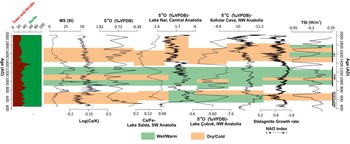
Comparison of the multiproxy record with local climate data reveals a general climate pattern (Fig. 6). At Lake Beyşehir, a period of reduced conifers and increased herbaceous pollen (mainly Artemisia and Chenopodiaceae) was recorded between AD 400–750 (Zeist et al., Reference Zeist, Woldring and Stapert1975). δ18O of Kocain Cave data suggest dry climate conditions between ca. AD 460–830 (Jacobson et al., Reference Jacobson, Flohr, Gascoigne, Leng, Sadekov, Cheng, Edwards, Tüysüz and Fleitmann2021). A similar dry period is recorded from AD 600–770 in Ca/Fe data from SW Anatolian Lake Salda (Danladi and Akçer-Ön, Reference Danladi and Akçer-Ön2018). Similarly, dry climate conditions are evidenced by a shift from crop cultivation to pastoralism in Gravgaz Marsh of SW Turkey from AD 650–940 (Bakker et al., Reference Bakker, Kaniewski, Verstraeten, de Laet and Waelkens2012). However, Lake Burdur, also in SW Anatolia, records wet climate conditions during this period (Tudryn et al., Reference Tudryn, Tucholka, Özgûr, Gibert, Elitok, Kamaci, Massault, Poisson and Platevoet2013). The deviation of results between Lake Burdur and SW Anatolian lakes Beyşehir, Salda, and Gölcük may be associated with age-related issues because the former is better age constrained than the latter.
Side-by-side comparison of the Lake Gölcük proxies to contemporary Anatolian records from Lake Salda (Danladi and Akçer-Ön, Reference Danladi and Akçer-Ön2018), Lake Nar (Jones et al., Reference Jones, Roberts, Leng and Türkeş2006), Lake Çubuk (Ocakoğlu et al., Reference Ocakoğlu, Dönmez, Akbulut, Tunoğlu, Kır, Açıkalın, Erayık, Yılmaz and Leroy2016), and Sofular Cave (Göktürk et al., Reference Göktürk, Fleitmann, Badertscher, Cheng, Edwards, Leuenberger, Fankhauser, Tüysüz and Kramers2011), stalagmite growth rate (NAO) (Baker et al., Reference Baker, Hellstrom, Kelly, Mariethoz and Trouet2015), and TSI (Delaygue and Bard, Reference Delaygue and Bard2011). DACP = Dark Ages Cold Period; LALIA = Late Antique Little Ice Age; LIA = Little Ice Age; MCA = Medieval Climate Anomaly; VPDB = Vienna Pee Dee Belemnite.

In Central Anatolia, the pollen records of Lake Nar suggest a period of elevated grass pollen from AD 450–670 (England et al., Reference England, Eastwood, Roberts, Turner and Haldon2008), whereas the δ18O of this lake suggests wet climate conditions (Jones et al., Reference Jones, Roberts, Leng and Türkeş2006). As a result, England et al., Reference England, Eastwood, Roberts, Turner and Haldon2008, suggested that climate change may not be a direct vegetation driver in the Lake Nar vicinity. In the eastern Anatolian Lake Van, dry and cold climate conditions were documented from AD 650–950 (Barlas Şimşek and Çağatay, Reference Barlas Şimşek and Çağatay2018). Increased Pinus and Ranunculaceae pollen in Central Anatolian Lake Tuzla suggest a wet climate at Lake Tuzla between AD 40–835 (Şenkul et al., Reference Şenkul, Memiş, Eastwood and Doğan2018). In NW Anatolia, the δ18O record of Lake Çubuk and δ13C of Sofular Cave suggest wet climate conditions between ca. AD 500–730 (Göktürk et al., Reference Göktürk, Fleitmann, Badertscher, Cheng, Edwards, Leuenberger, Fankhauser, Tüysüz and Kramers2011; Ocakoğlu et al., Reference Ocakoğlu, Dönmez, Akbulut, Tunoğlu, Kır, Açıkalın, Erayık, Yılmaz and Leroy2016). Therefore, it broadly appears that cold and dry conditions prevailed during the DACP in SW Anatolia, whereas wet conditions occurred in central and northern Anatolia.
In EM, multiproxy analyses of a sediment core suggest dry climate conditions from AD 350–650 in the Gulf of Saros (NE Aegean Sea) (Bozyiğit et al., Reference Bozyiğit, Eriş, Sicre, Çağatay, Uçarkuş, Klein and Gasperini2022). In contrast, paleoclimate records from Lake Stymphalia in Greece suggest cooler temperature from AD 400–500 (Seguin et al., Reference Seguin, Bintliff, Grootes, Bauersachs, Dörfler, Heymann and Manning2019). In the central Mediterranean, δ18O and δ13C planktonic foraminifer studies in the Gulf of Toronto suggest wet climate conditions from AD 500–750 (Grauel et al., Reference Grauel, Goudeau, de Lange and Bernasconi2013). During a similar period, cold climate conditions were documented by stalagmite records in the central Mediterranean (Frisia et al., Reference Frisia, Borsato, Spötl, Villa and Cucchi2005). In their synthesis of contemporary Mediterranean and European regional studies, Helama et al. (Reference Helama, Jones and Briffa2017) suggested widespread prevalence of dry climate conditions during the DACP. Within the DACP timeframe, a period of cold climate from AD 536–660 has been referred to as the Late Antique Little Ice Age (LALIA; Büntgen et al., Reference Büntgen, Myglan, Ljungqvist, McCormick, Di Cosmo, Sigl and Jungclaus2016). The LALIA is of particular interest to climate scientists and historians interested in testing and building hypotheses about climatic-societal links (Haldon, Reference Haldon2016).
Medieval Climate Anomaly (MCA: AD 950–1250)
From AD 950–1220, the sandy lithology implies wet climate during this period. This is also evidenced in the dark radiography image indicating wet climate condition.
The mostly sandy lithology during this period implies an energetic environment (precipitation) leading to the deposition of coarse-grained sediments. Accordingly, the MS, δ13C, and δ18O suggest an increase in precipitation, albeit with interruption of a dry period between AD 1000–1150. MS data also increase between AD 1000–1150 suggesting a probable wet period and thus, a contradiction. The contradiction can be explained by the increase in erosion of terrestrial materials possibly due to a dry period that resulted in low water level. On the other hand, the generally relatively high Ca/K suggests an increase in carbonate precipitation due to an increase in summer temperature. Conversely, relatively low Ca/K between AD 1000–1150 suggests a decrease in carbonate precipitation due to a decrease in summer temperature. During period between AD 950–1250, steppe vegetation dominated, albeit with continuous interruption by tree pollen. However, we cannot clearly see the dry period between AD 950–1250, possibly because of proxy sensitivity. In the herbaceous pollen, Artemisia followed by Poaceae dominated the steppe elements. For the tree pollen, the main fluctuations involved conifers (mainly Pinus), followed by Quercus (deciduous) and Quercus (evergreen). The secondary anthropogenic indicator, Plantago, followed by the primary anthropogenic indicator, Cerealia, both show slight increases, suggesting either cultivation or taxa response to climate amelioration.
The proposed climate reconstruction in this study is similar to the wet climate condition (AD 900–1000) followed by dry climate (AD 1000–1150) and wet climate (AD 1150–1250) in Lake Salda (Danladi and Akçer-Ön, Reference Danladi and Akçer-Ön2018) (Fig. 6). In Gravgaz Marsh, wet climate conditions and the re-emergence of human activity were recorded from AD 940–1280 (Bakker et al., Reference Bakker, Kaniewski, Verstraeten, de Laet and Waelkens2012). Contrary to the SW Anatolian records, the δ18O of Kocain Cave suggested a rather dry climate from AD 850–1300 (Jacobson et al., Reference Jacobson, Flohr, Gascoigne, Leng, Sadekov, Cheng, Edwards, Tüysüz and Fleitmann2021). In Central Anatolia, reduced arboreal pollen in Lake Tuzla suggests dry climate conditions between AD 830–1100 (Şenkul et al., Reference Şenkul, Memiş, Eastwood and Doğan2018). Cereal farming, pastoralism, and steppe elements were recorded between AD 950–1090 in Cappadocia (England et al., Reference England, Eastwood, Roberts, Turner and Haldon2008). However, the δ18O data from Lake Nar suggest wet climate conditions from AD 1000–1400 (Jones et al., Reference Jones, Roberts, Leng and Türkeş2006). In the eastern Anatolian Lake Van, wet and warm climate conditions were documented from AD 950–1250 (Wick et al., Reference Wick, Lemcke and Sturm2003; Barlas Şimşek and Çağatay, Reference Barlas Şimşek and Çağatay2018). In NW Anatolia, during the period between AD 900–1250, the δ18O record of Lake Çubuk suggests a generally wet climate, which is interrupted by a dry climate ca. AD 1000 (Ocakoğlu et al., Reference Ocakoğlu, Dönmez, Akbulut, Tunoğlu, Kır, Açıkalın, Erayık, Yılmaz and Leroy2016). Similarly, the Sofular Cave record of δ13C suggests wet climate conditions between AD 900–1200 (Göktürk et al., Reference Göktürk, Fleitmann, Badertscher, Cheng, Edwards, Leuenberger, Fankhauser, Tüysüz and Kramers2011).
In the Mediterranean region, paleoclimate records suggest a generally opposite climate between the EM and the western Mediterranean (WM). In the EM region, a paleoclimate record in the NE Aegean suggests wet climate conditions (Bozyiğit et al., Reference Bozyiğit, Eriş, Sicre, Çağatay, Uçarkuş, Klein and Gasperini2022). Similarly, a record from Lake Stymphalia in neighboring Greece showed increase in terrigenous elements from AD 1000–1400, suggesting wet climate conditions (Seguin et al., Reference Seguin, Bintliff, Grootes, Bauersachs, Dörfler, Heymann and Manning2019). In Israel, high water levels were reported from AD 1100 to ca. AD 1300 (Bookman et al., Reference Bookman, Enzel, Agnon and Stein2004). In the WM, several studies from the Iberian Peninsula and Morocco reported a rather cold and dry climate period, which is opposite of the EM climate (Roberts et al., Reference Roberts, Moreno, Valero-Garcés, Corella, Jones, Allcock and Woodbridge2012; Ait Brahim et al., Reference Ait Brahim, Khodri, Sifeddine, Jochum, Beraaouz, Wassenburg and Pérez-Zanón2017; Lüning et al., Reference Lüning, Schulte, Garcés-Pastor, Danladi and Gałka2019). This East-West climate dipole has been previously ascribed to the NAO and its influences through the westerlies (Lüning et al., Reference Lüning, Gałka, Danladi, Adagunodo and Vahrenholt2018; Roberts et al., Reference Roberts, Moreno, Valero-Garcés, Corella, Jones, Allcock and Woodbridge2012). In the Levant, cyclogenesis together with topographical differences were attributed to precipitation changes (Kushnir and Stein, Reference Kushnir and Stein2010). In Europe, warmer and wetter climate conditions attributed to the NAO were documented by paleoclimate records from AD 950–1250 (Andres and Peltier, Reference Andres and Peltier2016; Mann et al., Reference Mann, Zhihua, Scott, Bradley, Hughes, Shindell, Ammann, Faluvegi and Ni2009). In fact, the MCA is thought to be comparatively warmer and wetter than the current warm period (Mann, Reference Mann, MacCracken and Perry2002; Musk, Reference Musk1980).
Little Ice Age (LIA: AD 1250–1850)
Between AD 1400–1850, the lithology shifted from sandy to mostly silty and muddy, suggesting a shift towards drier climate conditions. Similarly, the light radiography image suggests low terrestrial input, which resulted from drier climate conditions. Accordingly, relatively low MS suggests a reduction in terrigenous supply owing to reduced precipitation. During the same period, the δ13C and δ18O data have relatively low values, except for AD 1450–1550, AD 1645–1715, and AD 1790–1820, implying increased P/E ratio because of high evaporation. These exceptional periods, AD 1450–1550, AD 1645–1715, and AD 1790–1820, with relatively high values suggest a reduction in the P/E ratio owing to increase in precipitation. However, MS and log(Ca/K) did not capture these changes, implying possible differences in proxy sensitivity or that a possible change in lake chemistry occurred. These dry periods may be related to periods of reduced solar activity (Spörer Minimum: Jiang and Xu, Reference Jiang and Xu1986; Maunder Minimum: Eddy, Reference Eddy1976; Dalton Minimum: Wagner and Zorita, Reference Wagner and Zorita2005). From AD 1250–1850, a shift from high tree pollen to high herbaceous pollen is recorded, which suggests a climate shift from wetter to drier conditions. Most of the changes were captured by the conifers (mainly Pinus followed by Juniperus type) and oak trees (Quercus [deciduous] and Quercus [evergreen]). Conversely, steppe elements are evident in the herbaceous taxa (mainly Artemisia and Poaceae).
In Lake Salda, generally dry climatic conditions were recorded from AD 1400–1850 (Fig. 6). Similarly, dry climate conditions, evinced by low lake water level, were reported in Lake Burdur (Tudryn et al., Reference Tudryn, Tucholka, Özgûr, Gibert, Elitok, Kamaci, Massault, Poisson and Platevoet2013). In Gravgaz Marsh, dry climate conditions and reduced cereal cultivation were evident from AD 1280 (Bakker et al., Reference Bakker, Kaniewski, Verstraeten, de Laet and Waelkens2012). Contrary to our record and the other records in SW Anatolia, the record of Kocain Cave suggests wet climate conditions during the period AD 1400–1700 (Jacobson et al., Reference Jacobson, Flohr, Gascoigne, Leng, Sadekov, Cheng, Edwards, Tüysüz and Fleitmann2021). In Central Anatolia, the Lake Nar δ18O data suggest a shift towards dry climate from AD 1400–1850 (Jones et al., Reference Jones, Roberts, Leng and Türkeş2006). Similarly, the δ18O data in Lake Tecer (Central Anatolia) record dry climate conditions between AD 1400–1800. The δ13C data of Sofular Cave only record a dry climate from AD 1600–1700.
In the EM, the paleoclimate record in the NE Aegean suggests dry climate conditions from AD 1220–1840 (Bozyiğit et al., Reference Bozyiğit, Eriş, Sicre, Çağatay, Uçarkuş, Klein and Gasperini2022). On the coast of Syria, dry and cold climate conditions have been documented from AD 1520–1870 (Kaniewski et al., Reference Kaniewski, Van Campo, Paulissen, Weiss, Bakker, Rossignol and Van Lerberghe2011). Similarly, data from Lake Stymphalia in Greece suggest an unstable climate condition that might have resulted in drying of the lake (Seguin et al., Reference Seguin, Bintliff, Grootes, Bauersachs, Dörfler, Heymann and Manning2019). However, the record from Etiliko Lagoon suggests climate amelioration, possibly because the latter was in a coastal region or because of proxy responses (Koutsodendris et al., Reference Koutsodendris, Brauer, Reed, Plessen, Friedrich, Hennrich, Zacharias and Pross2017). In Israel, dry climate conditions are suggested by δ18O data from the Ashdod Coast (Schilman et al., Reference Schilman, Ayalon, Bar-Matthews, Kagan and Almogi-Labin2002). In the WM region, wetter and warmer climate conditions have been documented in Iberian Peninsula and Morocco (Abrantes et al., Reference Abrantes, Rodrigues, Rufino, Salgueiro, Oliveira, Gomes and Oliveira2017; Ait Brahim et al., Reference Ait Brahim, Khodri, Sifeddine, Jochum, Beraaouz, Wassenburg and Pérez-Zanón2017).
CLIMATE MECHANISMS
To understand the climate drivers and mechanisms, the record in this study was compared to the NAO index (Baker et al., Reference Baker, Hellstrom, Kelly, Mariethoz and Trouet2015) and Total Solar Irradiance (TSI) data (Delaygue and Bard, Reference Delaygue and Bard2011) (Fig. 6). The comparison shows that all the dry (wet) periods in the Lake Gölcük record are correlated with NAO+ (NAO−), suggesting that precipitation in the region was controlled by NAO. With a pressure difference between the Icelandic high and sub-polar low, the NAO is reported to be the largest atmospheric circulation in the North Atlantic (Cullen and deMenocal, Reference Cullen and deMenocal2000). NAO influence is exerted through the jet stream and storm tracks, which transport the energy for major changes in precipitation and temperature. Depending on the pressure differences, NAO−/NAO+ southward/northward displacement of the storm tracks occur. During the NAO−, increases in storms and low-pressure systems lead to higher precipitation in Anatolia, resulting in above-average rainfall (Kahya, Reference Kahya, Vicente-Serrano and Trigo2011). Whereas the NAO+ results in weak trade winds and consequently fewer storms, which result in lower-than-normal precipitation. A number of EM studies had reported the NAO as an important contributor of winter moisture (Cullen and deMenocal, Reference Cullen and deMenocal2000; Jones et al., Reference Jones, Roberts, Leng and Türkeş2006; Luterbacher et al., Reference Luterbacher, García-Herrera, Akcer-On, Allan, Alvarez-Castro, Benito, Booth and Lionello2012; Danladi and Akçer-Ön, Reference Danladi and Akçer-Ön2018). In fact, the NAO is not only important for the formation of winter climate of the EM, but also for the whole Mediterranean region. Furthermore, a dipole pattern of the NAO has been observed between the EM and the WM (Roberts et al., Reference Roberts, Moreno, Valero-Garcés, Corella, Jones, Allcock and Woodbridge2012; Lüning et al., Reference Lüning, Schulte, Garcés-Pastor, Danladi and Gałka2019). For instance, Roberts et al. (Reference Roberts, Moreno, Valero-Garcés, Corella, Jones, Allcock and Woodbridge2012) observed that NAO− (NAO+) was associated with wet (dry) periods in the EM and the opposite for the WM. This is also confirmed by a recent literature compilation (Lüning et al., Reference Lüning, Schulte, Garcés-Pastor, Danladi and Gałka2019) stating that the situation exists even for paleotemperature variations. However, reduced correlation between precipitation and NAO towards the Levant has been suggested (Cullen and deMenocal, Reference Cullen and deMenocal2000; Enzel et al., Reference Enzel, Bookman, Sharon, Gvirtzman, Dayan, Ziv and Stein2003). Following this assertion, Kushnir and Stein (Reference Kushnir and Stein2010) explained that precipitation changes in the Levant are related to cyclogenesis (Cyprus Lows), which formed due to the encounter of cold pressure systems from Europe with warm sea surface of the EM.
It is also important to note that other atmospheric circulation patterns, such as the East Atlantic or the North Sea–Caspian pattern, have been suggested previously in contemporary Anatolian and EM studies (Kutiel et al., Reference Kutiel, Maheras, Türkeş and Paz2002; Touchan et al., Reference Touchan, Xoplaki, Funkhouser, Luterbacher, Hughes, Erkan, Akkemik and Stephan2005; Jones et al., Reference Jones, Roberts, Leng and Türkeş2006). For example, at Lake Nar (Central Anatolia) and Lake Salda (SW Anatolia), possible influence of the NCP was suggested for Late Holocene paleoclimate reconstructions (Jones et al., Reference Jones, Roberts, Leng and Türkeş2006; Danladi and Akçer-Ön, Reference Danladi and Akçer-Ön2018). However, the East Atlantic/Western Russia pattern was suggested for Lake Tecer (Central Anatolia) during the Middle–Late Holocene (Kuzucuoǧlu et al., Reference Kuzucuoǧlu, Dörfler, Kunesch and Goupille2011).
Comparison of the Lake Gölcük record to TSI (solar activity proxy) revealed that all the dry (wet) periods are correlated with low (high) TSI data. Several studies previously had recorded a close link between NAO phases and solar activity (Thiéblemont et al., Reference Thiéblemont, Matthes, Omrani, Kodera and Hansen2015; Yukimoto et al., Reference Yukimoto, Kodera and Thiéblemont2017). These studies suggested a possible medium in the stratosphere through which the phases of NAO were categorically modulated by solar activity. Because high (low) TSI in the Lake Gölcük record corresponds to wet (dry) periods, these climate changes may have been caused by solar activity, possibly through solar influence on mid-latitude westerlies. Danladi et al. (Reference Danladi, Akçer-Ön, Ön and Schmidt2021) previously had demonstrated, through instrumental data and a 300-year paleoclimate reconstruction, that the Lake Gölcük climate changes are directly influenced by the TSI. Accordingly, the influence of solar activity on paleoclimate records has been observed in SW Anatolian Lake Salda (Akçer Ön, Reference Akçer Ön2017; Danladi and Akçer-Ön, Reference Danladi and Akçer-Ön2018), Lake Köyceğiz (Akçer Ön, Reference Akçer Ön2017), and a tree-ring reconstruction in Antalya (Heinrich et al., Reference Heinrich, Touchan, Dorado Liñán, Vos and Helle2013). In the EM, similar solar influence also has been recorded in paleoclimate records of neighboring Greece (Koutsodendris et al., Reference Koutsodendris, Brauer, Reed, Plessen, Friedrich, Hennrich, Zacharias and Pross2017). Similarly, a review article of the EM and Mesopotamia by Kushnir and Stein (Reference Kushnir and Stein2019) suggested an antithetical relationship between paleoclimate records and solar activity. In the WM, the influence of solar activity also has been documented (Koutsodendris et al., Reference Koutsodendris, Brauer, Reed, Plessen, Friedrich, Hennrich, Zacharias and Pross2017; Brahim et al., Reference Brahim, Wassenburg, Cruz, Sifeddine, Scholz, Bouchaou, Dassié, Jochum, Edwards and Cheng2018). In addition, an increasing number of climate models provide some evidence through which solar activity affects climate (Swingedouw et al., Reference Swingedouw, Terray, Cassou, Voldoire, Salas-Mélia and Servonnat2011; Yukimoto et al., Reference Yukimoto, Kodera and Thiéblemont2017; Hernández et al., Reference Hernández, Sánchez-López, Pla-Rabes, Comas-Bru, Parnell, Cahill, Geyer, Trigo and Giralt2020). Through a medium in the troposphere, these studies suggest that solar activity results in a shift in the state of the North Atlantic Oscillation (NAO), thereby resulting in NAO+(NAO−) conditions, which is later translated into precipitation/temperature changes in climate in the North Atlantic, Eurasia, and the Mediterranean regions (Kahya, Reference Kahya, Vicente-Serrano and Trigo2011; Thiéblemont et al., Reference Thiéblemont, Matthes, Omrani, Kodera and Hansen2015).
CONCLUSIONS
The results of this study show the relationship of climate variability and the imprint of regional climate change at Lake Gölcük (SW Anatolia) through several climate periods since ca. AD 400 (1550 cal years BP). The lithology, radiography, MS (SI), δ13C, and δ18O data reflect wet/dry climate periods caused by variations of the NAO−/NAO+, whereas the log(Ca/K) data indicate summer temperature caused by direct influence of solar activity on Ca precipitation.
Several climate periods were identified. The DACP (AD 450–750) shows relatively cold and dry periods. In the first phase of the MCA (AD 950–1000), the climate was warm and wet. This was then followed by cold and dry climate between AD 1000–1150. Here, the MS (SI) was relatively high, and a sandy lithology was observed, indicating a possible wet period and a contradiction with the other proxies (radiography, MS [SI], δ13C, and δ18O). The increases in MS and sandy lithology are due to erosion of coarser materials into the lake. The last part of the MCA (AD 1150–1250) was warmer and wetter. In contrast, the LIA (AD 1400–1850) was a period with dry and cold events, as indicated by multiple proxies.
When comparing the Lake Gölcük records with local and regional data, a generally similar climate pattern since ca. AD 400 was observed. However, there were some contradictions due to age uncertainties resulting from the limited 14C dates in those studies. It was noted that all dry/wet periods were associated with NAO+/NAO− and warm/cold periods were associated with an increase/decrease in solar activity. The wet/dry periods were explained by the southward/northward displacement of storm tracks during NAO−/NAO+ conditions. The relationship between warm/cold periods and an increase/decrease in solar activity was explained by the direct influence of solar activity on the lake, leading to an increase in Ca precipitation in the summer.
Acknowledgments
The research was carried out as part of the PhD studies of the first author with grants from the Scientific and Technological Research Council of Turkey (TUBITAK, 117Y517), the Scientific Research Projects (BAP, 19/081/05/2 and 17/104) of the Muğla Sıtkı Koçman University, and the German Academic Exchange Program (DAAD). The authors thank Prof. Dr. Kadir Kürşad Eriş for providing space for the EMCOL laboratory analysis, and Dursun Acar for organizing and taking part in the drilling campaign.