Over the last several decades, three metalinguistic skills have consistently emerged as integral foundational processes underlying word reading development: phonological awareness, orthographic knowledge, and morphological awareness (Apel & Masterson, Reference Apel and Masterson2001; Ehri, Reference Ehri1995, Reference Ehri, Snowling and Hulme2005a, Reference Ehri2005b). Much attention has been garnered over the shared and independent contributions of these metalinguistic skills to word reading with children enrolled in K–12 settings; however, despite prominent theoretical conjectures about the interactive nature of the three metalinguistic skills to word reading (Ehri, Reference Ehri1995, Reference Ehri, Snowling and Hulme2005a, Reference Ehri2005b; Plaut, McClelland, Seidenberg, & Patterson, Reference Plaut, Mcclelland, Seidenberg and Patterson1996; Seidenberg & McClelland, Reference Seidenberg and McClelland1989; Share, Reference Share1995), only one study has assessed this with children (Deacon, Reference Deacon2012). Research to understand individual differences in word reading skills with struggling adult readers has lagged far behind the research base with children. In separate studies, phonological awareness and orthographic knowledge (Greenberg, Ehri, & Perin, Reference Greenberg, Ehri and Perin1997, Reference Greenberg, Ehri and Perin2002) as well as morphological awareness (To, Tighe, & Binder, Reference To, Tighe and Binder2016) have been identified as important contributors to the word reading skills of struggling adult readers. Yet, these studies have not considered the three metalinguistic skills simultaneously, and methodological limitations (smaller sample sizes and single measures of constructs) have precluded the use of latent variable modeling to better understand the relations among these metalinguistic skills with this population. Therefore, the purpose of this study was to include a larger battery of measures to simultaneously investigate the shared and independent latent effects as well as the interactive latent effects of the metalinguistic skills to word reading abilities for struggling adult readers.
Relations among the metalinguistic skills
Metalinguistic awareness represents the conscious understanding and ability to think about, manipulate, and reflect upon the structural elements of written and spoken language (Nagy, Reference Nagy, Wagner, Muse and Tannenbaum2007; Pratt & Grieve, Reference Pratt, Grieve, Tunmer, Pratt and Herriman1984). In particular, phonological awareness (manipulation and reflection on the sound structure of language; Wagner & Torgesen, Reference Wagner and Torgesen1987), orthographic knowledge (sensitivity to conventional spelling patterns and rules as well as mental graphemic representations; Apel, Reference Apel2011), and morphological awareness (conscious manipulation and understanding of small units of meaning [e.g., prefixes]; Carlisle, Reference Carlisle2000) form the three core recognized metalinguistic processes in the development of children’s early word learning skills (Apel & Masterson, Reference Apel and Masterson2001; Ehri, Reference Ehri1995, Reference Ehri, Snowling and Hulme2005a, Reference Ehri2005b; Share, Reference Share1995). Research with children has primarily considered these three metalinguistic skills as separate, yet moderately correlated (rs = –.06–.61; average around .3), constructs with independent contributions to word reading skills across the range of children’s word reading development (first- to eighth-grade levels; Apel, Wilson-Fowler, Brimo, & Perrin, Reference Apel, Wilson-Fowler, Brimo and Perrin2012; Deacon, Reference Deacon2012; Kim, Apel, & Al Otaiba, Reference Kim, Apel and Al Otaiba2013; Nagy, Berninger, Abbott, Vaughan, & Vermeulen, Reference Nagy, Berninger, Abbott, Vaughan and Vermeulen2003; Roman, Kirby, Parrila, Wade-Woolley, & Deacon, Reference Roman, Kirby, Parrila, Wade-Woolley and Deacon2009).
Although no studies for struggling adult readers have considered the three metalinguistic skills concurrently, preliminary evidence suggests that phonological awareness exhibits weak to moderate relations with orthographic knowledge (rs = .06–.40; Greenberg et al., Reference Greenberg, Ehri and Perin1997, Reference Greenberg, Ehri and Perin2002) and moderate relations with morphological awareness (rs = .39–.47; Tighe & Binder, Reference Tighe and Binder2015). No research has simultaneously included orthographic knowledge and morphological awareness. Collectively, these findings suggest that similar relations may exist among the metalinguistic skills with struggling adult readers and children; however, more research is needed to assess the magnitude of these relations. Given the dearth of research on metalinguistic skills with our population, we rely largely on empirical and theoretical literature with children to inform our hypotheses.
Shared and unique contributions of the metalinguistic skills to word reading
The shared and unique, independent contributions of the metalinguistic skills to word reading have been extensively explored with children (Apel et al., Reference Apel, Wilson-Fowler, Brimo and Perrin2012; Deacon, Reference Deacon2012; Kim et al., Reference Kim, Apel and Al Otaiba2013; Nagy et al., Reference Nagy, Berninger, Abbott, Vaughan and Vermeulen2003; Roman et al., Reference Roman, Kirby, Parrila, Wade-Woolley and Deacon2009). In conjunction with age and vocabulary knowledge or rapid automatic naming skills, the three metalinguistic skills accounted for a substantial shared portion of the variance in real and pseudoword decoding skills (40% to 82%) with first through eighth graders (Deacon, Reference Deacon2012; Roman et al., Reference Roman, Kirby, Parrila, Wade-Woolley and Deacon2009). Moreover, the majority of these studies have reported that each of the metalinguistic skills contributed uniquely to children’s word reading skills. For instance, Deacon (Reference Deacon2012) found that controlling for vocabulary knowledge and age, phonological awareness, morphological awareness, and orthographic knowledge accounted for unique variance in first- and third-grade students’ real word (7%, 0.7%, and 10%, respectively) and pseudoword decoding skills (17%, 2%, and 5%, respectively). Similarly, in a first-grade sample, Kim et al. (Reference Kim, Apel and Al Otaiba2013) reported unique effects of all three metalinguistic skills to word reading skills independent of vocabulary knowledge. One discrepant finding with struggling second graders reported that only orthographic knowledge contributed unique variance to word reading after parsing out the effects of morphological awareness, phonological awareness, and vocabulary knowledge (Nagy et al., Reference Nagy, Berninger, Abbott, Vaughan and Vermeulen2003). However, in older, typically developing children (fourth, sixth, and eighth grades), all three metalinguistic skills accounted for unique variance in real and pseudoword decoding, independent of rapid automatic naming (Roman et al., Reference Roman, Kirby, Parrila, Wade-Woolley and Deacon2009). These findings suggest considerable overlap among the metalinguistic skills across children’s development of word reading skills. Yet, the unique contributions suggest that typically developing children draw on multiple types of metalinguistic knowledge to decode words.
As previously mentioned, for struggling adult readers, no research to date has investigated the three metalinguistic skills in tandem within a single study. However, in separate studies, phonological awareness and orthographic knowledge emerged as unique predictors of adults’ word reading skills (Greenberg et al., Reference Greenberg, Ehri and Perin1997, Reference Greenberg, Ehri and Perin2002) and morphological awareness contributed unique variance (5%) to adults’ word reading skills (To et al., Reference To, Tighe and Binder2016). In summary, these studies provide substantial evidence for the shared and unique contributions of these metalinguistic skills to the word reading abilities of children across first- through eighth-grade levels as well as preliminary evidence with struggling adult readers. Thus, the first aim of this study was to examine the magnitudes of the shared and unique latent effects of the three metalinguistic skills to word reading independent of vocabulary with struggling adult readers.
Theories in support of an interacting role of metalinguistic skills to word reading
Multiple prominent theories support the need to investigate interactions among the metalinguistic skills in relation to word reading skills. For example, Ehri’s 1995 phase model asserts that children pass through four stages of word reading development: pre-alphabetic, partial alphabetic, full alphabetic, and consolidated alphabetic phases. Children transition and develop through the early phases using visual cues, letter recognition and context, sight word reading, and blending skills. In particular, readers begin to develop and accrue phonological awareness during the partial and full alphabetic phases to aid in reading unfamiliar words. During the fourth phase, letter patterns recurring across different words are consolidated into larger units based on morphemes (e.g., affixes and root words), graphemes, syllables, and subsyllabic units (e.g., onsets and rimes; Ehri, Reference Ehri1995, Reference Ehri, Snowling and Hulme2005a). Ehri postulates that the integration and mappings of phonemic, graphemic, and morphemic units are necessary for word reading development; however, it is unclear as to how separable or intertwined these metalinguistic processes are in their contributions to word reading.
Similarly, Share’s (Reference Share1995) prominent phonological and self-teaching hypothesis identifies phonological awareness and orthographic knowledge as two of the major skills required for early word reading development. In the first component, readers translate print into sound based on their exposure to words. A second feature of the hypothesis includes the modification of letter–sound correspondences as a result of lexical constraints developed through increasing orthographic knowledge. The final component requires the independent contributions of phonological awareness and orthographic knowledge to word recognition. In accordance with Ehri, Share speculates that phonological awareness is the primary driving force in the development of word reading, with orthographic knowledge emerging as a secondary, less distinct skill during word reading development. Ehri’s model maintains that orthographic knowledge and phonological awareness are differentially important during development, with orthographic knowledge increasing its contribution at later phases. However, both models are unclear as to the role of morphological awareness and separateness of the phonological awareness and morphological awareness constructs to word reading skills. These models suggest the likelihood of overlap of the three metalinguistic skills in the development of word reading and the need for integration among the skills in order to be a successful decoder. Thus, given the vital role of these metalinguistic skills to word reading at different stages of development, it is reasonable to conjecture that these skills may interact differentially to predict word reading skills.
A final, theoretical consideration of the interactions among metalinguistic skills is the connectionist model (Seidenberg & McClelland, Reference Seidenberg and McClelland1989), which was developed through simulations of written words (orthography) being mapped onto spoken forms (phonology). This simulation successfully pronounces real words, and is not a result of two separate mechanisms, but rather, a more general framework in which orthographic, phonological, and semantic information interact (competitively and cooperatively) to process lexical input. This simulation had a few shortcomings, in particular, that it was unable to read pseudowords, which is a primary facet of currently administered word reading tasks (e.g., Woodcock–Johnson Word Attack subtest; Schrank, McGrew, & Mather, Reference Schrank, McGrew and Mather2014). To address this and other limitations of the model, Plaut et al. (Reference Plaut, Mcclelland, Seidenberg and Patterson1996) formulated an alternative connectionist network for English word reading that successfully learned the statistical structure among orthographic, phonological, and semantic (morphological and vocabulary) representations to interpret lexical inputs. This evidence supports the theory that phonology, orthography, morphology, and vocabulary interact with each other (competitively and/or cooperatively) to assist in the word reading process.
More recently, connectionist models have also incorporated a potential role for morphological awareness in word reading (Harm & Seidenberg, Reference Harm and Seidenberg2004; Rueckl, Reference Rueckle2010; Rueckl & Raveh, Reference Rueckle and Raveh1999). Connectionist computations demonstrate that statistical regularities in morphology increase learning rates for reading as well as vocabulary size (Rueckl & Raveh, Reference Rueckle and Raveh1999). Studies have also shown that the effect of morphological structure on word reading occurs as a result of statistical regularities in the dynamics of orthographic and phonological representations (for a review, see Rueckl, Reference Rueckle2010). Further, acquiring meaning from words has been shown to occur not only through the interaction of orthography, phonology, and semantics but also through cooperation of pathways of these components (i.e., orthography → semantics → word meaning; and orthography → phonology → semantics → word meaning; Harm & Seidenberg, Reference Harm and Seidenberg2004). Therefore, the connectionist models, along with Share’s (Reference Share1995) and Ehri’s (Reference Ehri1995) models of word reading development, explain the substantial shared and modest unique contributions of each of the three metalinguistic skills to word reading. A critical missing piece is to empirically examine the interactive nature of the metalinguistic skills to more clearly understand the nuances and integration of these skills to word reading.
Evidence of the interactive nature of metalinguistic skills to word reading
In support of these theories, only one study to date has assessed the interactive roles of the metalinguistic skills in the prediction of word reading. In addition to shared and independent contributions, Deacon (Reference Deacon2012) assessed the unique contributions of three metalinguistic skill interactions (phonological awareness × orthographic knowledge, phonological awareness × morphological awareness, and orthographic knowledge × morphological awareness) to real and pseudoword decoding with first and third graders. Controlling for vocabulary knowledge, a single metalinguistic interaction emerged (phonological awareness × morphological awareness) as uniquely predictive of real and pseudoword decoding at both grade levels. Probing the interaction revealed that morphological awareness was more influential to real word and pseudoword decoding at lower rather than higher levels of phonological awareness. One limitation of the Deacon (Reference Deacon2012) study was that only a single measure per construct was utilized in the regression analyses. The current study addressed this limitation by including multiple measures per construct in order to consider broader metalinguistic latent constructs. Thus, the second aim of the current study was to examine the potential interactive effects of the metalinguistic skills controlling for vocabulary knowledge to the word reading skills of struggling adult readers.
Current study
The purpose of the current study was to examine the shared, independent, and interactive contributions of three metalinguistic skills (phonological awareness, orthographic knowledge, and morphological awareness) to the word reading skills of struggling adult readers. Based on past studies conducted with children (e.g., Deacon, Reference Deacon2012; Roman et al., Reference Roman, Kirby, Parrila, Wade-Woolley and Deacon2009) and the limited empirical evidence with struggling adult readers (Greenberg et al., Reference Greenberg, Ehri and Perin1997, Reference Greenberg, Ehri and Perin2002; To et al., Reference To, Tighe and Binder2016), it was hypothesized that all three metalinguistic skills would emerge as uniquely predictive of word reading skills. In addition, based on past theory (e.g., Ehri, Reference Ehri1995, Reference Ehri, Snowling and Hulme2005a; Plaut et al., Reference Plaut, Mcclelland, Seidenberg and Patterson1996) and empirical evidence with children (Deacon, Reference Deacon2012), we hypothesized unique interactive effects among the metalinguistic skills to word reading for struggling adult readers. However, it is important to note that given the novelty and exploratory nature of the study with our sample, we do not speculate on the magnitudes of the metalinguistic skills to word reading. In accordance with the studies with children, we include vocabulary knowledge as a covariate in our analyses.
The study addressed two research questions with a sample of struggling adult readers:
RQ1: Controlling for vocabulary, what are the magnitudes of the shared and unique contributions of the metalinguistic skills (phonological awareness, orthographic knowledge, and morphological awareness) to word reading skills?
RQ2: Controlling for vocabulary, are there interactive effects between the metalinguistic skills in predicting word reading skills?
Method
Participants
The participants were 220 native English-speaking adults enrolled in adult literacy programs. The sample included 49% females (N = 108), with ages ranging from 16 to 69 years (M = 24, SD = 10.99). The participants represented several racial/ethnic backgrounds: 62.3% African American, 26.8% Caucasian, 6.4% Hispanic, 4.0% mixed, and 0.5% Asian. Participants’ educational attainment also varied: 0.5% below a middle school level, 12.2% some or all of middle school completion, 71.4% some high school, and 15.9% high school completion. Reading grade equivalencies ranged from 1st grade to 12th grade, 9 months (M = 7.4, SD = 3.02), as reported by the Test of Adult Basic Education Reading subtest provided from the adult literacy centers. All sample demographics are consistent with national adult literacy programs (Lesgold & Welch-Ross, Reference Lesgold and Welch-Ross2012), and therefore, we consider this a representative sample of native English-speaking adult literacy students.
Measures
The measures included a battery of 12 norm-referenced and experimental assessments. These measures spanned the constructs of word reading, phonological awareness, morphological awareness, orthographic knowledge, and vocabulary knowledge. Multiple measures of each construct were used to allow for latent variable analyses.
Word reading
Two subtests of the Test of Word Reading Efficiency—Second Edition (TOWRE-2), Phonemic Decoding Efficiency (PDE) and Sight Word Efficiency (SWE), were administered to assess word reading skills (Torgesen, Wagner, & Rashotte, Reference Torgesen, Wagner and Rashotte2012). In the PDE subtest, the participant was presented with a list of pseudowords and then asked to read aloud as many pseudowords as possible in 45 s. In the SWE subtest, the participant was presented with a list of real words and then asked to read aloud as many real words as possible in 45 s. The alternate forms reliability coefficients exceed .90 for the PDE and SWE subtests.
Phonological awareness
Three subtests from the Comprehensive Test of Phonological Processing—Second Edition (CTOPP-2), Elision, Blending Words, and Phoneme Isolation, were administered to assess phonological awareness (Wagner, Torgesen, Rashotte, & Pearson, Reference Wagner, Torgesen, Rashotte and Pearson2013). In the Elision subtest, the participant was asked to repeat words presented orally (e.g., blend), and then say the words again after deleting specific sounds (e.g., eliminate /l/ sound; bend). In the Blending Words subtest, the participant was asked to listen to individually presented, audio-recorded sounds (e.g., /t/-/ɔI/) and then required to combine those sounds and say the newly formed word (e.g., toy). In the Phoneme Isolation subtest, the participant was asked to isolate and identify individual sounds in words. For example, the examiner would state the word man and then the examiner would identify the individual sounds that comprise the word (/m/ /æ/ /n/). Next, the examiner would ask the participant to identify the first sound in the word man (/m/). For all three subtests, testing was discontinued if the participant produced three consecutive errors. The internal consistency coefficients exceed .80 for these subtests.
Morphological awareness
Three experimental tasks were used to assess morphological awareness: Derived Form Morphology (DMORPH) task, Derivational Suffix Choice Test, and Morphological Analogy Real Word (ARW) task. All tasks have been previously used with struggling adult readers and exhibit strong Cronbach’s α coefficients (.81–.90; Tighe & Binder, Reference Tighe and Binder2015; Tighe & Schatschneider, Reference Tighe and Schatschneider2015, Reference Tighe and Schatschneider2016a, Reference Tighe and Schatschneider2016b). These tasks were selected to represent a broader conceptualization of the morphological awareness construct (Apel, Diehm, & Apel, Reference Apel, Diehm and Apel2013; Tighe & Schatschneider, Reference Tighe and Schatschneider2015). All tasks were untimed, and the participant had access to a printed version of the task items (to reduce listening and working memory demands) as well as auditory access as the examiner read items aloud (to reduce decoding and reading demands).
The DMORPH task was adapted from the children’s literature (Carlisle, Reference Carlisle2000; Leong, Reference Leong2000) and previously used with struggling adult readers (Tighe & Binder, Reference Tighe and Binder2015; Tighe & Schatschneider, Reference Tighe and Schatschneider2015, Reference Tighe and Schatschneider2016a, Reference Tighe and Schatschneider2016b). The participant was asked to transform root words into derived, multimorphemic words. The examiner presented a target base word aloud, which served as a prime for the participant. Next, the examiner read aloud a short sentence that concluded with a fill-in-the-blank item. The participant was expected to fill in the blank with the correct derived, multimorphemic word form from the original target base word that was given. For example, “Happy. Money does not buy _____.”; “happiness.” A correct response was given 1 point and an incorrect response or no response resulted in zero points. Participants were given 2 practice items and then completed 28 test items. A Cronbach’s α coefficient of .87 was obtained for the sample.
The Derivational Suffix Choice Test was adapted from the children’s literature (Mahony, Reference Mahony1994; Singson, Mahony, & Mann, Reference Singson, Mahony and Mann2000) and utilized with struggling adult readers (Tighe & Binder, Reference Tighe and Binder2015, Tighe & Schatschneider, Reference Tighe and Schatschneider2015, Reference Tighe and Schatschneider2016a, Reference Tighe and Schatschneider2016b). In this 18-item task, the participant was read aloud a sentence that contained a fill-in the-blank. The participant was also provided with four answer choices. The participant was prompted to select the correct answer choice from the four listed. For example, “She met her first _____ when she moved out.” The four answer choices followed: benedumptize, benedumptify, benedumptist, and benedumptuous. The correct answer, benedumptist, was given 1 point while an incorrect answer or no answer resulted in zero points. A Cronbach’s α coefficient of .82 was obtained for the sample.
The Morphological ARW task was adapted from the children’s literature (Deacon, Reference Deacon2012; Nunes, Bryant, & Bindman, Reference Nunes, Bryant and Bindman1997, Reference Nunes, Bryant and Bindman2006; Tong, Deacon, Kirby, Cain, & Parrila, Reference Tong, Deacon, Kirby, Cain and Parrila2011) and has been used with struggling adult readers (Tighe & Schatschneider, Reference Tighe and Schatschneider2015, Reference Tighe and Schatschneider2016a, Reference Tighe and Schatschneider2016b). The task follows an analogy format: A : B :: C : D. The participant was read aloud a pair of inflected words (“A” and “B”) followed by the first word of the second pair (“C”). The participant was asked to supply the second word of the second word pair (“D”). An example was: “push : pushed :: lose : _____.”; “lost” (an irregular shift from present to past tense). The word pairs could be either regular or irregular shifts from present to past tense. A correct answer was given 1 point and an incorrect or no answer was given zero points. The participant completed 2 practice items and 15 test items. A Cronbach’s α coefficient of .74 was obtained for the sample.
Orthographic knowledge
Two experimental tasks were used to assess orthographic knowledge: the Orthographic Choice Real Word (OCRW) task and the Orthographic Choice Pseudoword (OCP) task. The OCRW task measures an individual’s store of mental graphemic representations and the OCP task measures conventional knowledge of orthographic patterns and rules. Both types of tasks were included for a broader representation of the construct (Apel, Reference Apel2011).
The OCRW task was adapted from use with children (Deacon, Reference Deacon2012; Olson, Forseberg, Wise, & Rack, Reference Olson, Forseberg, Wise, Rack and Lyon1994) and represents a commonly administered task. The participant was presented with pairs of alternative spellings for different words (e.g., rane/rain). Next, the participant was prompted to circle the correct spelling for the word (e.g., rain). All incorrect response choices represented orthographically plausible variations on the correct pronunciation of the given word. A correct answer was given 1 point and an incorrect or no answer received zero points. The participants completed 2 practice items and 30 test items. A Cronbach’s α coefficient of .70 was obtained for the sample.
The OCP task was also adapted from use with children (Apel et al., Reference Apel, Wilson-Fowler, Brimo and Perrin2012; Cassar & Treiman, Reference Cassar and Treiman1997). The participant was shown a pair of pseudowords (e.g., zeg and zzeg) and then asked to circle the pseudoword that most closely resembled an actual word (e.g., zeg). In this sample item, the double consonant (zz) in zzeg does not adhere to traditional English orthotactics (i.e., allowable letter sequences and patterns); thus, zeg represents a more plausible answer choice. A correct answer was given 1 point and an incorrect or no answer received zero points. The participant completed 2 practice items and 35 test items. A Cronbach’s α coefficient of .67 was obtained for the sample.
Vocabulary knowledge
Two norm-referenced assessments were administered to assess vocabulary knowledge: the Peabody Picture Vocabulary Test—Fourth Edition (PPVT-4; Dunn & Dunn, Reference Dunn and Dunn2007) and the Expressive One-Word Picture Vocabulary Test Fourth Edition (EOWPVT-4; Martin & Brownell, Reference Martin and Brownell2011). The PPVT-4 represents a receptive vocabulary task, and the EOWPVT-4 represents an expressive vocabulary task. For the PPVT-4, the examiner read aloud a word and provided four pictures. The participant was required to select the picture that best matched the meaning of the given word. We started the participants with an easier set of 12 items (age 10, Set 9) to increase the chances that the participants reached a basal set. If more than one error was recorded in the first set, testing continued with easier sets until a basal set was reached. After a basal set was determined, testing continued (with sets increasing in difficulty) until eight errors were reached (a ceiling set). The PPVT-4 has a reported split-half reliability of .94.
In the EOWPVT-4, the participant was presented with single pictures (one at a time) and asked to supply a single-word name for each picture shown. These pictures represented different objects, actions, and/or concepts. Testing began on item 65 (age 8;0 to 9;11), to increase the chance of reaching a basal. A basal was reached when the participant named eight consecutive pictures correctly. Testing continued (with items increasing in difficulty) until six consecutive incorrect responses were recorded (a ceiling). The EOWPVT-4 has a reported median internal consistency reliability of .95.
Procedure
Trained graduate assistants administered the 12 tasks individually to each participant in two 30- to 40-min sessions over a 2-day period. In addition, a demographic survey, encompassing age, gender, race/ethnicity, and educational background information, was always administered on the first day of testing. The ordering of both testing sessions and tasks within sessions was counterbalanced to avoid time sampling error. Testing took place in quiet spaces (e.g., unoccupied classrooms) at each adult literacy center. Participants received a $10 gift card as compensation for their time. A total of 213 participants completed both days of testing and an additional 7 participants completed one of the testing sessions.
Results
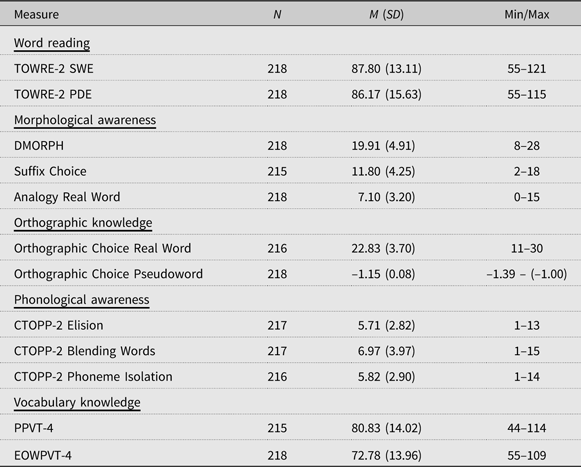
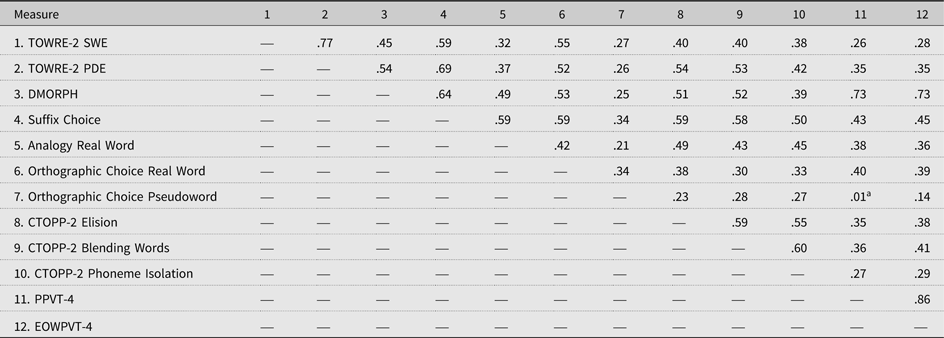
Means and standard deviations for all measures are presented in Table 1. Correlations between measures are included in Table 2. All predictor measures are positively correlated with measures of word reading (TOWRE-2 SWE and PDE; rs = .26–.69, ps <.05).
Descriptives for all measures
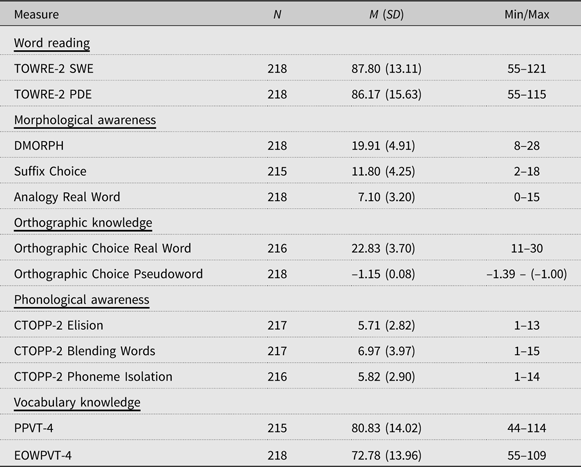
Note: Age-based standard scores are reported for all norm-referenced assessments. TOWRE-2, Test of Word Reading Efficiency—Second Edition. SWE, Sight Word Efficiency. PDE, Phonemic Decoding Efficiency. DMORPH, Derived Form Morphology. CTOPP-2, Comprehensive Test of Phonological Processing—Second Edition. PPVT-4, Peabody Picture Vocabulary Test—Fourth Edition. EOWPVT-4, Expressive One-Word Picture Vocabulary Test—Fourth Edition.
Correlations between measures

Note: N = 200. TOWRE-2 SWE, Sight Word Efficiency. TOWRE-2 PDE, Phonemic Decoding Efficiency. DMORPH, Derived Form Morphology. PPVT-4, Peabody Picture Vocabulary Test—Fourth Edition. EOWPVT-4, Expressive One-Word Picture Vocabulary Test—Fourth Edition. Correlations are significant, p < .05. aCorrelations are not significant, p > .05.
Data analytic strategy
To address our two research questions, structural equation models (SEMs; RQ1) and latent moderated SEMs (RQ2) were conducted using Mplus, Version 7.4 software (Muthén & Muthén, Reference Muthén and Muthén1998–2016). Prior to running our analyses, we evaluated normality assumptions for our data. Including all 12 measures, 38 univariate outliers were found and brought to the boundaries of +/– 2 interquartile ranges. No bivariate outliers were identified. The OCP task was highly kurtotic (3.86) and exhibited slight negative skew (–1.62). This task was transformed using a reflective log transformation, which resulted in acceptable skew (–.63) and kurtosis (.46) values. All other measures exhibited acceptable skew and kurtosis values.
In Mplus, full information maximum likelihood estimation was used to handle missing data because there were relatively few missing data points (36 across measures; Kline, Reference Kline2011). For RQ1, we relied on Hu and Bentler’s (Reference Hu and Bentler1998) model fit indices to determine acceptable model fit: Root Mean Square Error of Approximation (RMSEA) values less than .08, Tucker–Lewis Index (TLI) and Comparative Fit Index (CFI) values above .95, and Standardized Root Mean Square Residual (SRMR) values of less than .05. For all non-nested model comparisons, we relied on differences in Akaike information Criterion (AIC) values (lower AIC values with differences of 10 or greater between models are preferred; Burnham & Anderson, Reference Burnham and Anderson2004). For RQ2, traditional model fit indices (e.g., RMSEA, CFI, and TLI) are not estimated for latent moderated SEMs. Instead, a log-likelihood ratio (–2LL) test is used to identify relative decrement in model fit of a more parsimonious baseline model (Model 0, without the interaction term included) relative to an alternative model (Model 1, with the interaction term included; Maslowsky, Jager, & Hemken, Reference Maslowsky, Jager and Hemken2015). Significance between Models 0 and 1 can be determined with a χ2 difference test by using the –2LL difference and the difference in free parameters (degrees of freedom) between the models. In addition, latent moderated SEMs provide AIC values; however, –2LL ratio tests are preferred for determining significance (Maslowsky et al., Reference Maslowsky, Jager and Hemken2015). Thus, we report traditional baseline model (Model 0) fit indices, –2LL ratio tests between Models 0 and 1, and AIC values for Models 0 and 1.
Prior to addressing RQ1 and RQ2, we fit a five-factor measurement CFA to examine whether our 12 observed measures loaded onto our proposed constructs (word reading, phonological awareness, morphological awareness orthographic knowledge, and vocabulary knowledge). This model exhibited less than adequate fit to the data, χ2 (44) = 163.81, p < .001, CFI = .923, TLI = .884, RMSEA = .111, and SRMR = .054. Of note, was that the DMORPH task wanted to cross-load on morphological awareness and vocabulary knowledge latent factors.
Cross-loading this task represents a theoretically plausible modification as past research with adult literacy students has reported high correlations between morphological awareness and vocabulary knowledge (r = .62; Tighe & Schatschneider, Reference Tighe and Schatschneider2015) and inseparability of these constructs in some literature with children (Muse, Reference Muse2005; Spencer et al., Reference Spencer, Muse, Wagner, Foorman, Petscher, Schatschneider and Bishop2015). Thus, we allowed the DMORPH task to cross-load on the morphological awareness and vocabulary knowledge latent constructs. This post-hoc five-factor CFA exhibited good fit to the data, χ2 (43) = 85.90, p < .001, CFI = .972, TLI = .958, RMSEA = .067, and SRMR = .039. All indicators loaded on the appropriate constructs and were significant (ps < .001). Given the non-nested nature of the two models, we examined the difference in AIC between the five-factor CFA (AIC = 6015) and the post-hoc five-factor CFA (AIC = 5939). Based on the AIC difference criteria (reduction of 10 or more; Burnham & Anderson, Reference Burnham and Anderson2004), the post-hoc five-factor CFA was deemed a more parsimonious fit to the data, and this structural model was retained for our subsequent predictive models of word reading.
RQ1: Examining predictors of word reading
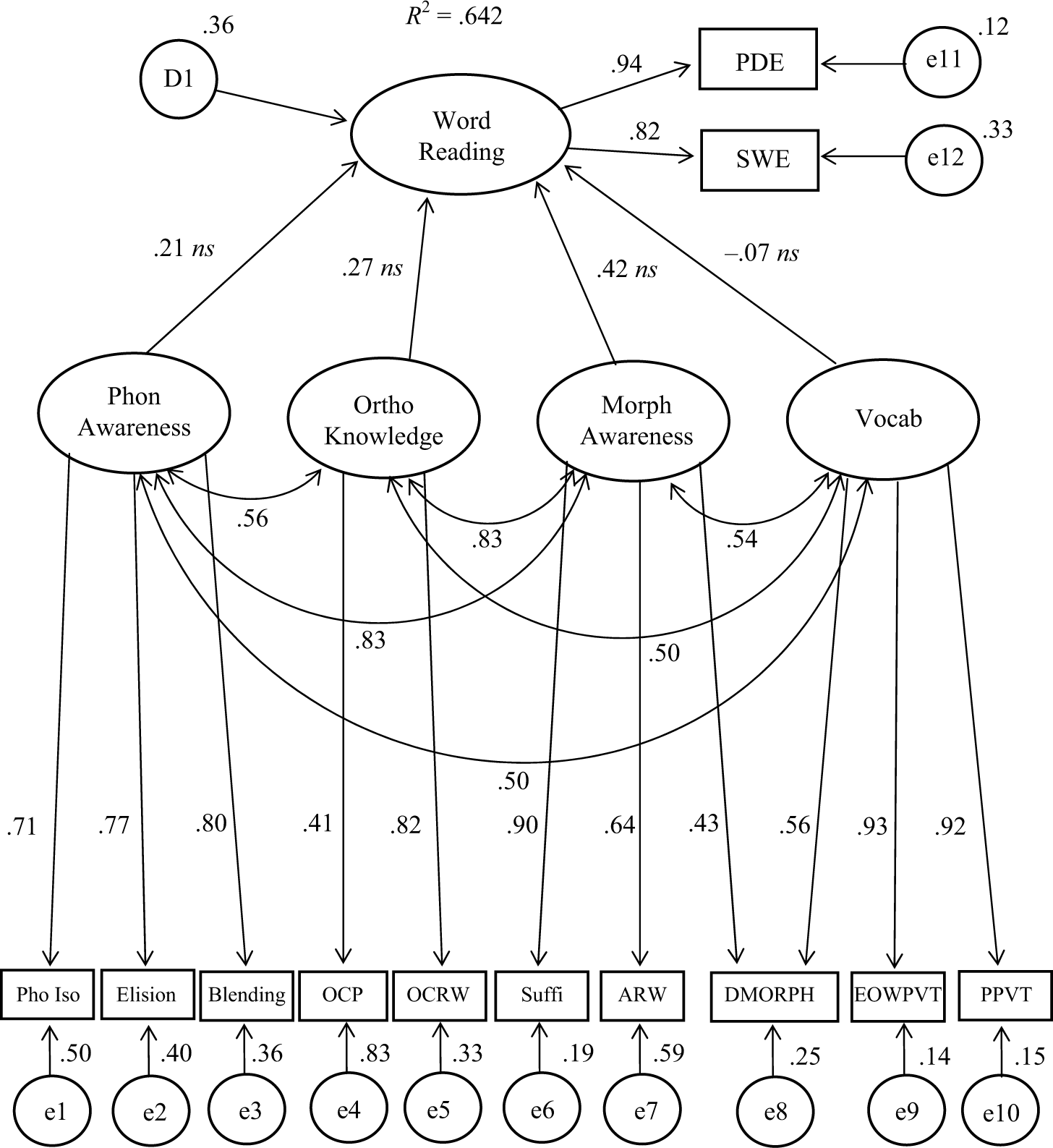
To address RQ1, a four-factor SEM was specified to examine the shared and unique contributions of phonological awareness, morphological awareness, orthographic knowledge, and vocabulary knowledge constructs to word reading (see Figure 1). This model exhibited good fit to the data, χ2 (43) = 85.90, p < .001, CFI = .972, TLI = .958, RMSEA = .067, and SRMR = .039. The four predictors accounted for 64% of the word reading variance; however, none of the predictors emerged as uniquely predictive of word reading: phonological awareness, β = .213, p = .232; orthographic knowledge, β = .271, p = .200; morphological awareness, β = .423, p = .172; and vocabulary knowledge, β = –.067, p = .327. Given the large amount of shared variance accounted for by the predictors (64%), it appears striking that none of the predictors emerged as uniquely predictive of word reading. Of particular concern are the high intercorrelations among the latent metalinguistic constructs (rs ranging from .56 to .83; Figure 1).
Four-factor structural equation model of word reading. These are standardized parameter estimates. PDE, Phonemic Decoding Efficiency. SWE, Sight Word Efficiency. Pho Iso, Phoneme Isolation. OCP, Orthographic Choice Pseudoword. OCRW, Orthographic Choice Real Word. ARW, Analogy Real Words. DMORPH, Derived Form Morphology. EOWPVT, Expressive One-Word Picture Vocabulary Test. PPVT, Peabody Picture Vocabulary Test. ns, not significant.

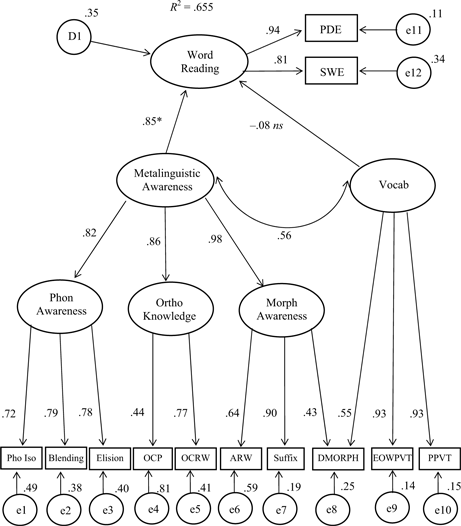
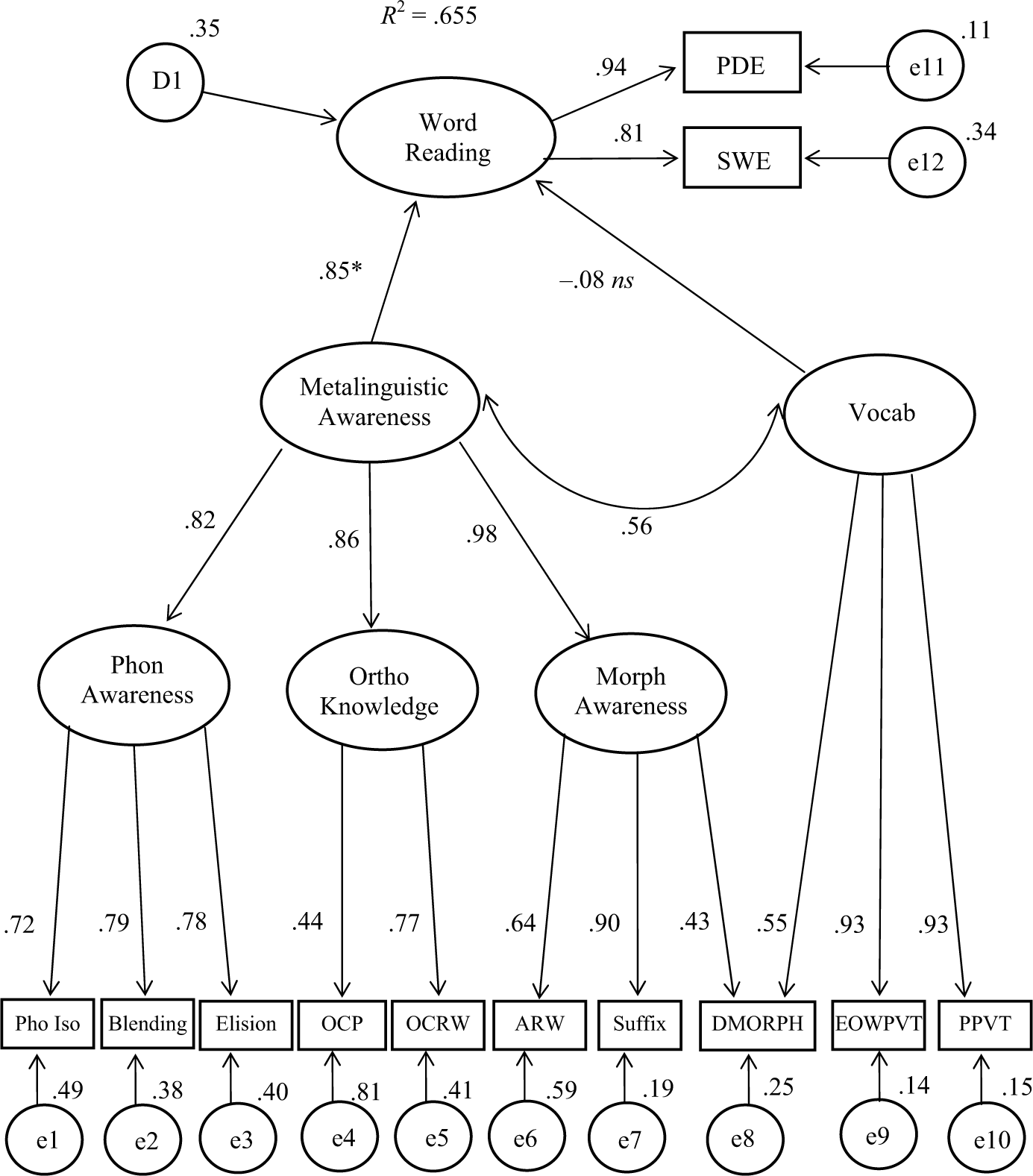
To address this potential multicollinearity issue, we ran a post-hoc model in which we formed a second-order factor of metalinguistic awareness (composed of latent phonological awareness, morphological awareness, and orthographic knowledge constructs; see Figure 2). The three latent constructs exhibited high loadings on the second-order metalinguistic awareness factor (ranging from .82 to 98, ps < .001). This model exhibited good fit to the data, χ2 (47) = 96.50, p < .001, CFI = .968, TLI = .955, RMSEA = .069, and SRMR = .041. Jointly, the predictors accounted for 65.5% of the variance in word reading, and metalinguistic awareness emerged as a significant, unique predictor (β = .851, p < .001, R 2 = .625). Vocabulary knowledge remained a nonsignificant unique predictor (β = –.08, p = .274). Based on the AIC values, we determined no significant loss of fit between the four-factor SEM (AIC = 5939) and the second-order metalinguistic awareness SEM (AIC = 5942; Burnham & Anderson, Reference Burnham and Anderson2004). Thus, the second-order factor represents a reduction in multicollinearity and a seemingly more parsimonious way to identify the relations among metalinguistic skills and word reading. Given the seemingly similar overall model fit between the two models, yet discrepant findings in terms of unique contributions of the metalinguistic skills, it is imperative to assess whether the metalinguistic predictors contribute to word reading in an interactive as opposed to an independent way.
Second-order metalinguistic awareness structural equation model. These are standardized parameter estimates. PDE, Phonemic Decoding Efficiency. SWE, Sight Word Efficiency. Pho Iso, Phoneme Isolation. OCP, Orthographic Choice Pseudoword. OCRW, Orthographic Choice Real Word. ARW, Analogy Real Words. DMORPH, Derived Form Morphology. EOWPVT, Expressive One-Word Picture Vocabulary Test. PPVT, Peabody Picture Vocabulary Test. *p < .001; ns, not significant.
RQ2: Interactive effects of metalinguistic skills to word reading
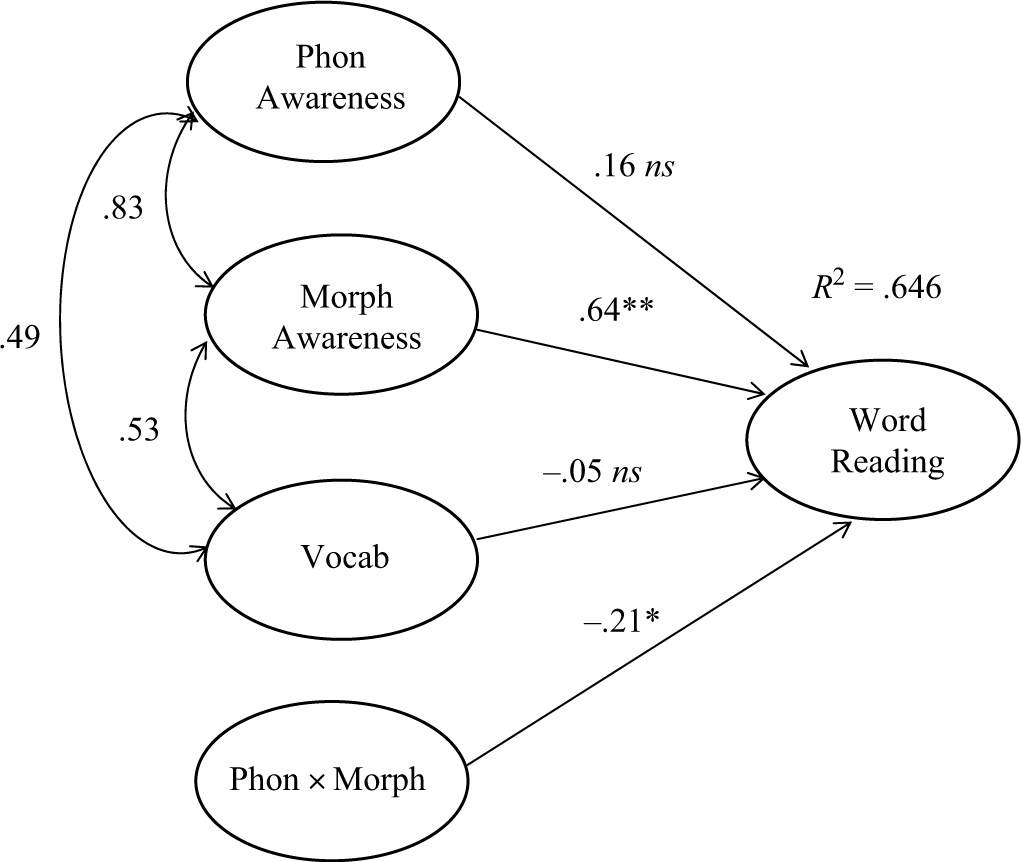
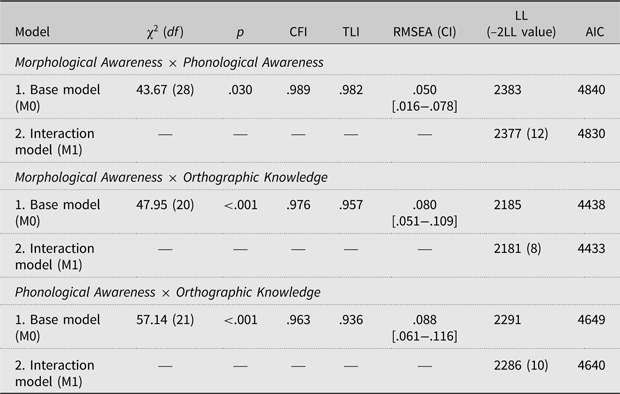
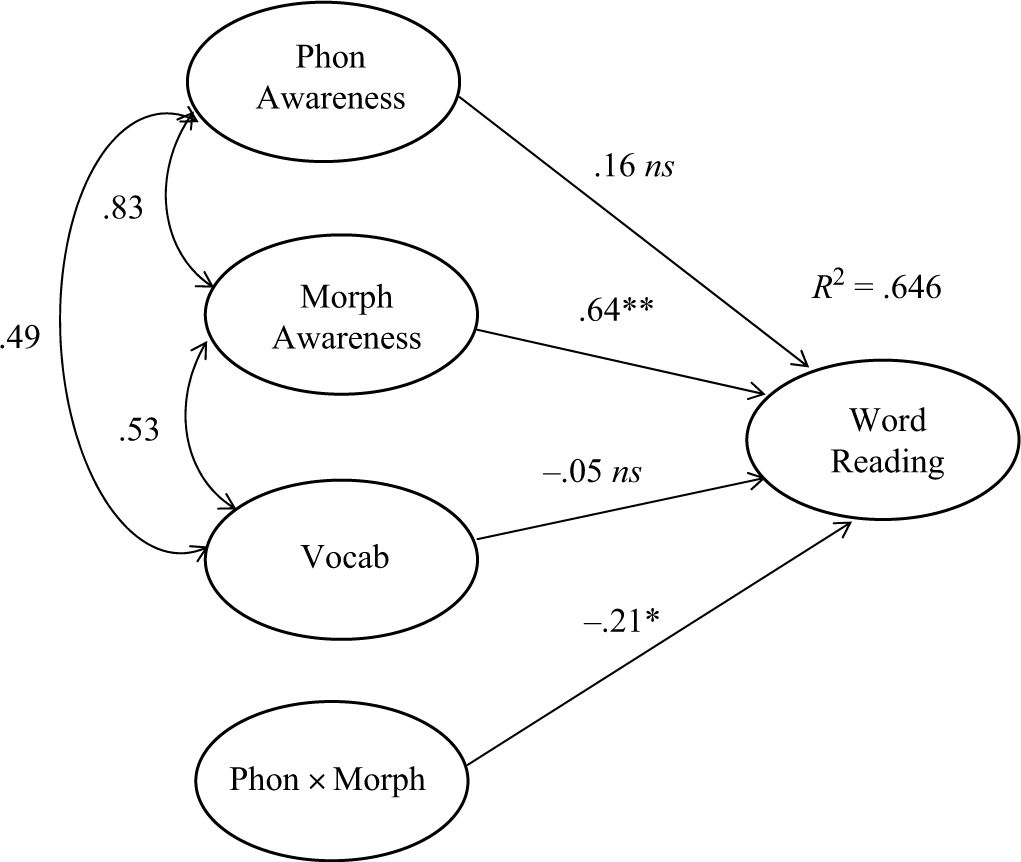
To address RQ2, we investigated the contributions of two-way latent interactive effects among the different metalinguistic skills (phonological awareness × morphological awareness, morphological awareness × orthographic knowledge, and phonological awareness × orthographic knowledge) to word reading, controlling for vocabulary knowledge. This research question was based on theoretical conjectures (Ehri, Reference Ehri1995, Reference Ehri, Snowling and Hulme2005a, Reference Ehri2005b; Plaut et al., Reference Plaut, Mcclelland, Seidenberg and Patterson1996; Share, Reference Share1995) and preliminary evidence of a significant phonological awareness × morphological awareness interaction to the word reading skills of first and third graders (Deacon, Reference Deacon2012). To test this, three separate baseline SEMs (Model 0; excluding the respective interaction terms) and three latent moderated SEMs (Model 1; including the respective interaction terms; Figures 3–6) were run in Mplus. Each baseline model included latent constructs of vocabulary knowledge and latent main effects (separate latent constructs of the metalinguistic skills involved in the interaction term; see Table 3 for model fit indices).
Phonological Awareness x Morphological Awareness Latent Moderated SEM.
Model fit indices and comparisons for moderation analyses

Note: χ2 = chi-square statistic. df = degrees of freedom. CFI = Comparative Fit Index. TLI = Tucker–Lewis Index. RMSEA = Root Mean Square Error of Approximation. CI = 90% Confidence Intervals. LL = Log-Likelihood Value. –2LL = –2 times the difference between log-likelihood values of Model 0 and Model 1. AIC = Akaike Information Criterion.
Phonological awareness × morphological awareness interaction
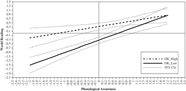
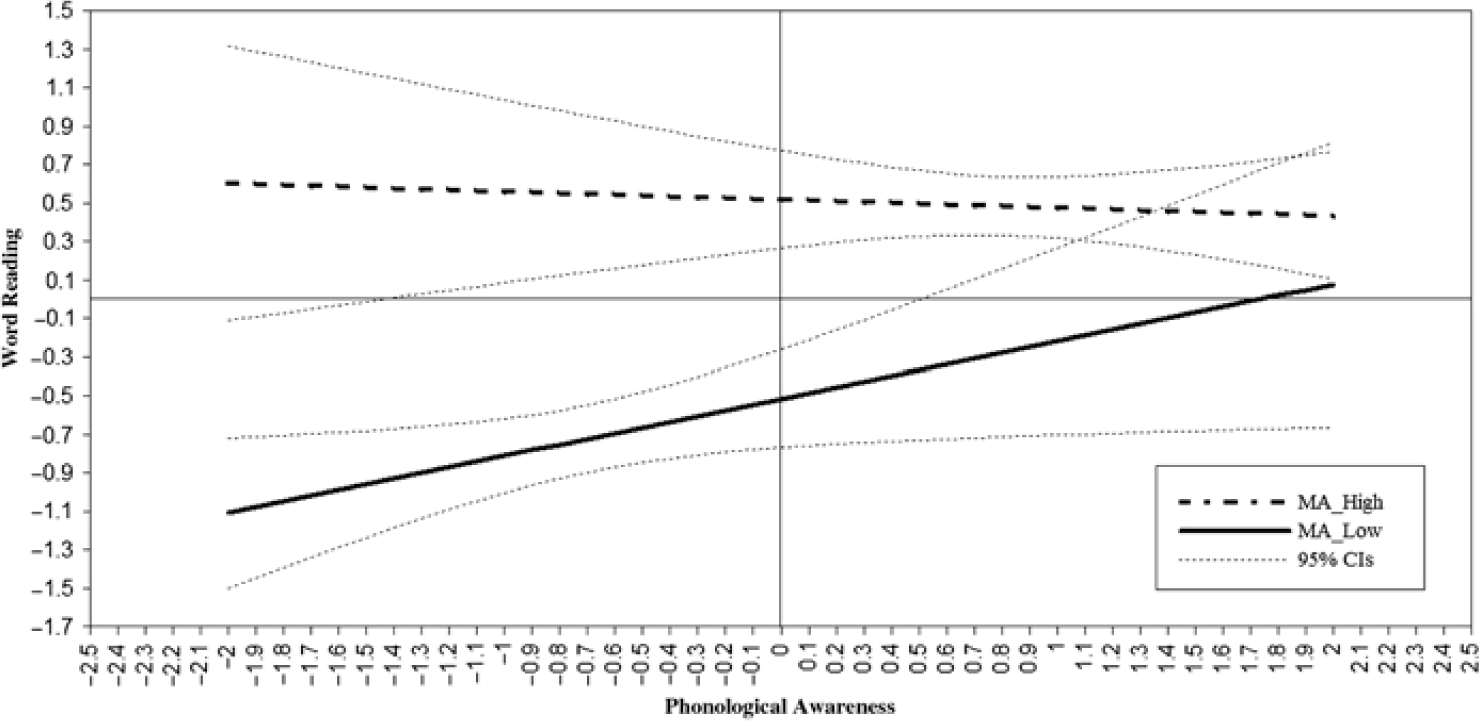
The phonological awareness × morphological awareness interaction term was a significant, unique predictor of word reading (β = –.21, p = .001, R 2 = .045), controlling for the main effects of phonological awareness and morphological awareness as well as vocabulary knowledge (Figures 3 and 4). In addition, the main effect of morphological awareness emerged as a significant, unique predictor (β = .644, p < .001, R 2 = .270). The –2LL ratio test revealed a difference of 12 (with 1 degree of freedom difference) between Model 0 and Model 1, which indicates a significant decrement in fit (p < .001) favoring the model with the phonological awareness × morphological awareness interaction term included (Table 3; Figures 3 and 4). Probing the phonological awareness × morphological awareness interaction term at +/– 1 SD of morphological awareness (high and low morphological awareness), indicated that high morphological awareness skills are uniquely predictive of higher word reading skills, irrespective of higher or lower phonological awareness skills. In addition, as expected, a double deficit of lower morphological awareness and lower phonological awareness predict weaker word reading skills, whereas higher morphological awareness and higher phonological awareness predict stronger word reading skills. However, higher morphological awareness skills predict higher word reading skills regardless of the level of phonological awareness whereas higher phonological awareness skills coupled with lower morphological awareness skills are not predictive of better word reading skills (see Figure 4).
Relation of phonological awareness to word reading at high and low levels of morphological awareness. The axes are in standard deviation units. Vocabulary knowledge is controlled for in this model. MA_High, high morphological awareness (+1 SD). MA_Low, low morphological awareness (–1 SD).
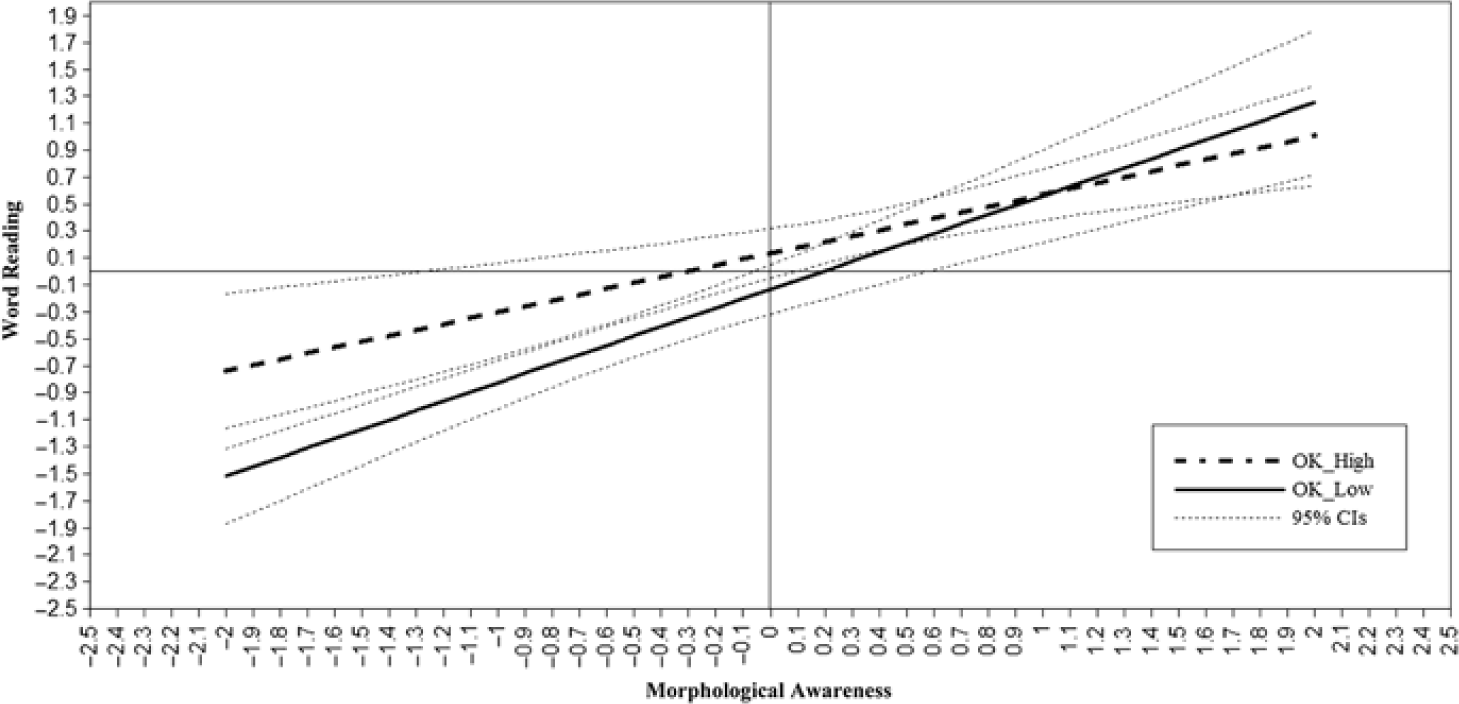
Relation of morphological awareness to word reading at high and low levels of orthographic knowledge. The axes are in standard deviation units. Vocabulary knowledge is controlled for in this model. OK_High, high orthographic knowledge (+1 SD). OK_Low, low orthographic knowledge (–1 SD).

Morphological awareness × orthographic knowledge interaction
The morphological awareness × orthographic knowledge interaction term was a significant, unique predictor of word reading (β = –.156, p = .009, R 2 = .010), controlling for the main effects of morphological awareness and orthographic knowledge as well as vocabulary knowledge (Figure 5). In addition, the main effect of morphological awareness emerged as a significant, unique predictor (β = .554, p = .004, R 2 = .148). The –2LL ratio test revealed a difference of 8 (with 1 degree of freedom difference) between Model 0 and Model 1, but only a difference of 5 between AIC values. The –2LL ratio test still suggests a significant decrement in fit (p = .005) favoring the model with the morphological awareness × orthographic knowledge interaction term included (Table 3). Probing the morphological awareness × orthographic knowledge interaction term at +/– 1 SD of orthographic knowledge (high and low orthographic knowledge) indicated that higher morphological awareness skills are uniquely predictive of higher word reading skills, irrespective of higher or lower orthographic knowledge skills. Lower morphological awareness skills, regardless of high or low orthographic knowledge skills, are predictive of lower word reading skills. In addition, a double deficit of lower morphological awareness and lower orthographic knowledge predicts the weakest word reading skills; however, lower morphological awareness coupled with higher orthographic knowledge also produces relatively weak word reading skills. In other words, the findings suggest that higher morphological awareness skills, regardless of level of orthographic knowledge, are more beneficial to improved word reading skills (see Figure 5).
Phonological awareness × orthographic knowledge interaction
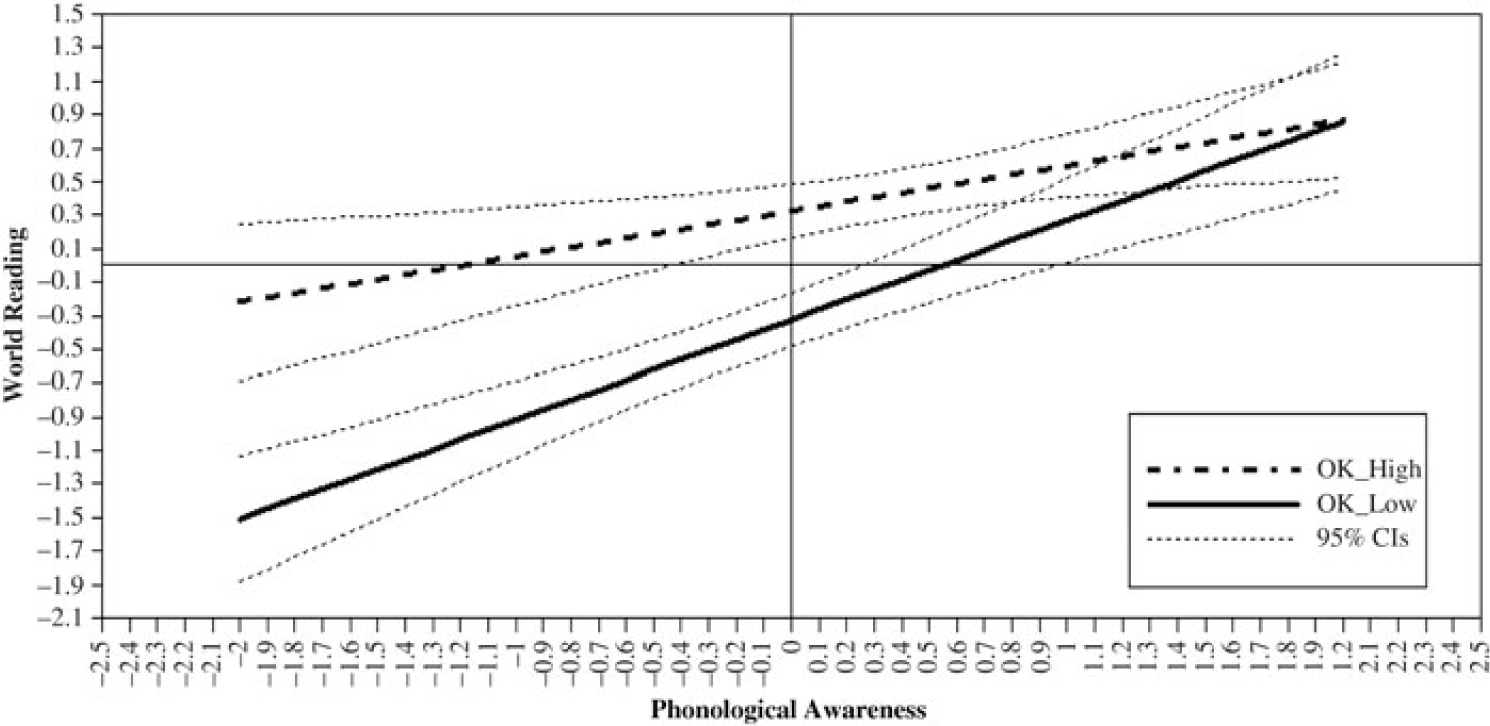
The phonological awareness × orthographic knowledge interaction term was a significant, unique predictor of word reading (β = –.222, p = .002, R 2 = .052), controlling for the main effects of phonological awareness and orthographic knowledge as well as vocabulary knowledge (Figure 6).Footnote 1 In addition, both main effects of phonological awareness and orthographic knowledge emerged as significant, unique predictors (βs = .408, .509, ps < .001, R 2 = .193, .233, respectively). The –2LL ratio test revealed a difference of 10 between Model 0 and Model 1 (with 1 degree of freedom difference), which suggests a significant decrement in fit (p = .002) favoring the model with the phonological awareness × orthographic knowledge interaction term included (Table 3). Probing the phonological awareness × orthographic knowledge interaction term at +/– 1 SD of orthographic knowledge (high and low orthographic knowledge) indicated that higher phonological awareness skills are uniquely predictive of higher word reading skills, irrespective of high or low orthographic knowledge skills. In addition, participants lower in phonological awareness skills are better decoders if these individuals have high orthographic knowledge skills. Once again, participants with lower phonological awareness skills coupled with low orthographic knowledge skills exhibit the biggest deficit in word reading (see Figure 6).
Relation of phonological awareness to word reading at high and low levels of orthographic knowledge. The axes are in standard deviation units. Vocabulary knowledge is controlled for in this model; however, the Derived Form Morphology (DMORPH) task has been removed. OK_High, high orthographic knowledge (+1 SD). OK_Low, low orthographic knowledge (–1 SD).
Discussion
This study presents a more nuanced account of the shared, independent, and interactive effects of three metalinguistic skills (morphological awareness, phonological awareness, and orthographic knowledge) to the word reading skills of struggling adult readers. The results indicated that metalinguistic skills and vocabulary knowledge accounted for a large portion of the word reading variance (64%–65.5% across models). As a second-order factor, metalinguistic awareness captured unique variance (62.5%) in adults’ word reading skills. Further, controlling for vocabulary and individual metalinguistic main effects, unique two-way interactions (phonological awareness × morphological awareness, morphological awareness × orthographic knowledge, and phonological awareness × orthographic knowledge; 1%–5.2%) emerged as predictive of word reading skills. Collectively, the nature of these interactions suggests that higher levels of morphological awareness are critical to higher word reading skills irrespective of lower or higher orthographic knowledge and phonological awareness. In addition, high phonological awareness skills are critical to higher word reading irrespective of higher or lower orthographic knowledge. Double deficits in metalinguistic skills (e.g., low phonological awareness and low orthographic knowledge skills) are predictive of the weakest levels of word reading for all of the interactive models. These findings augment the current paucity of research on individual differences in the word reading skills of struggling adult readers. Moreover, the findings have important theoretical, empirical, and applied implications for struggling adult readers that extend but also deviate from the existing literature with children (Apel et al., Reference Apel, Wilson-Fowler, Brimo and Perrin2012; Deacon, Reference Deacon2012; Kim et al., Reference Kim, Apel and Al Otaiba2013; Nagy et al., Reference Nagy, Berninger, Abbott, Vaughan and Vermeulen2003; Roman et al., Reference Roman, Kirby, Parrila, Wade-Woolley and Deacon2009), which we expand upon in greater detail below.
Shared and unique, independent contributions of metalinguistic skills to word reading
The first aim of the study was to investigate the shared and unique contributions of the metalinguistic skills to word reading, controlling for vocabulary knowledge. Loading the three metalinguistic skills as a second-order factor of metalinguistic awareness provided the most parsimonious fit to the data and a better way to reflect the collinearity among the individual metalinguistic skill factors. Jointly, metalinguistic awareness and vocabulary knowledge accounted for 65.5% of the word reading variance, and metalinguistic awareness was also a unique predictor (62.5%). Although previous studies have suggested a role for vocabulary knowledge to children’s word reading (Nation & Snowling, Reference Nation and Snowling2004; Oullette, Reference Ouellette2006; Ricketts, Nation, & Bishop, Reference Reed2007), consistent with the children’s literature that has included the three metalinguistic skills in tandem (Apel et al., Reference Apel, Wilson-Fowler, Brimo and Perrin2012; Deacon, Reference Deacon2012; Kim et al., Reference Kim, Apel and Al Otaiba2013), vocabulary knowledge did not contribute uniquely to word reading skills with our sample. Across studies, expressive oral vocabulary (Kim et al., Reference Kim, Apel and Al Otaiba2013) and receptive oral vocabulary (Apel et al., Reference Apel, Wilson-Fowler, Brimo and Perrin2012; Deacon, Reference Deacon2012) measures were included. Similarly, the current study included a broader, latent oral vocabulary knowledge factor with expressive and receptive measures. Consistent with the connectionist model (Plaut et al., Reference Plaut, Mcclelland, Seidenberg and Patterson1996), which suggests an interaction among semantic information (vocabulary and morphological awareness), phonological awareness, and orthographic knowledge, it is possible that vocabulary knowledge may interact with the metalinguistic skills to differentially influence word reading skills. Similarly, past work with children has also speculated that semantic knowledge may moderate and/or mediate the relations between orthographic knowledge and phonological awareness with word reading skills (in particular irregular word reading given the inconsistent English orthography; Nation & Snowling, 2004; Oullette, Reference Ouellette2006; Ricketts et al., Reference Reed2007). In addition, recent work has suggested that morphological awareness acts as a “binding agent,” which connects semantics, orthographic knowledge, and phonological awareness in the formation of mental word representations (see binding agent triangular model; Kirby & Bowers, Reference Kirby, Bowers, Cain, Compton and Parrila2017, p. 440). More work is needed to elucidate the nature of the relations (mediation/moderation) among oral vocabulary knowledge and the metalinguistic skills to word reading as well as to consider additional types of vocabulary knowledge (e.g., academic vocabulary and written vocabulary knowledge).
Disparate from the children’s literature, our second-order metalinguistic awareness factor suggests that we are unable to find unique effects for each metalinguistic skill to adults’ word reading. Further, and perhaps the most striking finding, were the high inter-correlations among the metalinguistic latent constructs (rs = .56–.83), which may have reduced the independently explained variance. These findings deviate from the multitude of studies that have simultaneously considered the three metalinguistic skills in the context of children’s word reading abilities (average rs = .2–.3 among metalinguistic skills; Apel et al., Reference Apel, Wilson-Fowler, Brimo and Perrin2012; Deacon, Reference Deacon2012; Kim et al., Reference Kim, Apel and Al Otaiba2013; Nagy et al., Reference Nagy, Berninger, Abbott, Vaughan and Vermeulen2003; Roman et al., Reference Roman, Kirby, Parrila, Wade-Woolley and Deacon2009). One potential explanation for the discrepant results may be the sample. The majority of the children’s studies were conducted with typically-developing readers in early elementary school grades (e.g., Apel et al., Reference Apel, Wilson-Fowler, Brimo and Perrin2012; Deacon, Reference Deacon2012; Kim et al., Reference Kim, Apel and Al Otaiba2013). In contrast, the struggling adult readers in our study have an atypical trajectory of acquiring component reading skills and represent considerable diversity in terms of reading levels (M = 7.4, SD = 3.02), educational background and schooling experiences, age, race/ethnicity, and motivational reasons for pursuing literacy classes (Lesgold & Welch-Ross, Reference Lesgold and Welch-Ross2012).
It is also not clear whether the differences in the higher correlations observed suggest actual differences between the two groups or may be an artifact of the differences in the measures utilized and/or analyses conducted (regression analyses vs. SEMs). In particular, many of the studies conducted with children considered the effects of each metalinguistic skill to real word and pseudoword reading separately (Deacon, Reference Deacon2012; Roman et al., Reference Roman, Kirby, Parrila, Wade-Woolley and Deacon2009) or only to real word reading (Apel et al., Reference Apel, Wilson-Fowler, Brimo and Perrin2012; Kim et al., Reference Kim, Apel and Al Otaiba2013). In general, the metalinguistic skills contributed more shared variance to real word reading (73%–82%) compared to pseudoword reading (40%–75%; Deacon, Reference Deacon2012; Roman et al., Reference Roman, Kirby, Parrila, Wade-Woolley and Deacon2009). With the exception of orthographic knowledge, phonological awareness and morphological awareness measures were more strongly correlated with our pseudoword reading task compared to our real word reading task. This may suggest that struggling adult readers rely on phonological and morphological information when encountering unfamiliar words in particular, given that higher levels of phonological awareness and morphological awareness seemed to be most important to word reading skills, relative to orthographic knowledge, in our moderation analyses. Overall, the current study did not separate real word and pseudoword reading because a latent variable best represented our two tasks. However, our word reading tasks were speeded, which may explain some of the differences observed between the children’s literature and the current study. Future research with struggling adult readers should include untimed word reading measures to assess the robustness of the contributions of the metalinguistic skills to word reading as well as the separateness of real word and pseudoword tasks.
Interactive contributions of metalinguistic skills to word reading
The second aim of the study was to consider the unique interactive effects among the metalinguistic skills to word reading with struggling adult readers. Controlling for individual metalinguistic effects and vocabulary knowledge, unique two-way latent interactions (phonological awareness × morphological awareness, morphological awareness × orthographic knowledge, and phonological awareness × orthographic knowledge; 1%–5.2%) contributed to word reading in each latent moderated SEM. The finding of interactions among the various metalinguistic skills provides empirical support for theoretical conjectures from several prominent early word learning theories (Ehri, Reference Ehri1995, Reference Ehri, Snowling and Hulme2005a, Reference Ehri2005b; Plaut et al., Reference Plaut, Mcclelland, Seidenberg and Patterson1996; Share, Reference Share1995). This finding suggests a much more complex, interactive and intertwined nature of the metalinguistic skills as they relate to word reading for struggling adult readers. The significant interactions also imply differential relations of the metalinguistic skills to word reading, rather than are solely additively (individually and collectively) predictive of word reading skills.
The results corroborate and extend the findings from the only study to explore metalinguistic interactions in the context of children’s word reading skills (first and third graders; Deacon, Reference Deacon2012). Comparable to this work, we also found a significant phonological awareness × morphological awareness interaction. For both first and third graders, Deacon (Reference Deacon2012) interpreted this finding as morphological awareness having a greater impact on real and pseudoword word reading at lower rather than at higher levels of phonological awareness. She concluded that this provides preliminary evidence for the importance of morphological awareness to word reading relative to phonological awareness deficits with children. In our study, we found that high levels of morphological awareness were crucial to word reading skills irrespective of high or low phonological awareness. In addition, contrary to Deacon (Reference Deacon2012), we found significant morphological awareness × orthographic knowledge and phonological awareness × orthographic knowledge interactions for the struggling adult readers. Similarly, regardless of orthographic knowledge level, higher morphological awareness skills remain crucial to better word reading skills. Higher phonological awareness also emerges as important to word reading regardless of orthographic knowledge level. These findings place more importance on the role of morphological awareness to word reading skills beyond phonological awareness and orthographic knowledge. In addition, phonological awareness seems to be an important skill beyond orthographic knowledge. This augments past findings that consistently suggest an important, unique role for morphological awareness to adults’ reading comprehension skills (Tighe & Binder, Reference Tighe and Binder2015; Tighe & Schatschneider, Reference Tighe and Schatschneider2016a, Reference Tighe and Schatschneider2016b; To et al., Reference To, Tighe and Binder2016) and preliminary evidence that word reading skills may play a mediating role between metalinguistic skills (phonological awareness, morphological awareness, and orthographic knowledge) and reading comprehension (Tighe et al., Reference Tighe, Little, Arrastia, Schatschneider, Diehm, Quinn and Edwards2019). In addition, the findings are consistent with the notion that morphological awareness may act as a “binding agent”, the linchpin interconnecting the other linguistic skills and semantic information to word-level skills (Kirby & Bowers, Reference Kirby, Bowers, Cain, Compton and Parrila2017). Thus, morphological awareness, and secondarily phonological awareness, could be malleable component skills to target in adult literacy programs to build word reading skills and subsequently reading comprehension. In summary, our findings lend support to the complexity and interweaved nature of the relations among the metalinguistic skills as described in theories of word reading (Ehri, Reference Ehri1995, Reference Ehri, Snowling and Hulme2005a, Reference Ehri2005b; Plaut et al., Reference Plaut, Mcclelland, Seidenberg and Patterson1996; Share, Reference Share1995).
Implications of findings to adult literacy learners
The findings from this study have important theoretical, empirical, and applied implications for multiple stakeholders (researchers and practitioners) invested in adult literacy. For all stakeholders, the results advance our understanding of the processes underlying adults’ word reading skills. In particular, the finding that higher morphological awareness (regardless of phonological awareness and orthographic knowledge) and phonological awareness (regardless of orthographic knowledge) emerged as crucial to better word reading skills indicates the importance of targeting these skills in future intervention work and instructional practices in adult literacy programs. In particular, a growing body of literature with struggling and typically-developing child readers has reported that explicit morphological instruction has fostered growth in word reading skills (Berninger et al., Reference Berninger, Winn, Stock, Abbott, Eschen, Lin and Nagy2008; Goodwin & Ahn, Reference Goodwin and Ahn2013; Katz & Carlisle, Reference Katz and Carlisle2009; Nunes & Bryant, Reference Nunes and Bryant2006). In addition, some intervention work has utilized hybrid instructional approaches with morphological awareness and phonological awareness (Nunes & Bryant, Reference Nunes and Bryant2009), and positive effects have been reported for multiple reading outcomes (Bowers, Kirby, & Deacon, Reference Bowers, Kirby and Deacon2010; Reference ReedReed, 2008). Recent work with struggling adult readers (third- to eighth-grade levels) has started to focus on developing a curriculum that integrates multiple component skills (e.g., vocabulary, fluency, word reading, and text analysis) to build word reading and reading comprehension skills. Preliminary pilot data suggests that the curriculum is effective at fostering growth in word reading skills (Lovett, Frijters, Goudey, Graesser, & Greenberg, Reference Lovett, Frijters, Goudey, Graesser and Greenberg2017); however, this work is still ongoing, but represents a promising direction for adult literacy instruction. More work to explicitly incorporate morphological awareness and phonological awareness into interventions and instructional practices with this population is essential to build word reading and subsequently reading comprehension skills.
Our findings also raise concerns over the applicability of children’s literature (empirical research studies and theories) to struggling adult readers. Much of the adult literacy field seems to be overly reliant on developmental reading theories, assessments, materials, and instructional practices developed for children enrolled in K–12 education (Lesgold & Welch-Ross, Reference Lesgold and Welch-Ross2012). Yet, it is not clear that the findings directly translate between child and adult readers (see Greenberg et al., Reference Greenberg, Ehri and Perin1997, Reference Greenberg, Ehri and Perin2002; Nanda, Greenberg, & Morris, Reference Nanda, Greenberg and Morris2010). As an expanding field, it is crucial to develop reading theories specific to struggling adult readers that incorporate the similarities between child and adult readers as well as to highlight the differences. For instance, the prominent Simple View of Reading (SVR) framework (Gough & Tunmer, Reference Gough and Tunmer1986) has been successfully applied and the findings replicated with multiple child (e.g., Adlof, Catts, & Little, Reference Adolf, Catts and Little2006; Tighe & Schatschneider, Reference Tighe and Schatschneider2014; Tilstra, McMaster, Van den Broek, Kendeou, & Rapp, Reference Tilstra, McMaster, Van Den Broek, Kendeou and Rapp2009) and struggling adult reader samples (Braze et al., Reference Braze, Katz, Magnuson, Mencl, Tabor, Van Dyke and Shankweiler2016; Braze, Tabor, Shankweiler, & Mencl, Reference Braze, Tabor, Shankweiler and Mencl2007; Sabatini, Sawaki, Shore, & Scarborough, Reference Sabatini, Sawaki, Shore and Scarborough2010; Tighe et al., Reference Tighe, Little, Arrastia, Schatschneider, Diehm, Quinn and Edwards2019). Although considerable variability exists in terms of reading levels, measures, and analytic techniques across studies, the SVR components of word reading and linguistic competence are consistently important to adults’ reading comprehension skills (accounting for 62.5%–82% of the variance). The current study suggests that we augment the word reading aspect of the SVR to also include metalinguistic skills, in particular morphological awareness and phonological awareness within this framework. In addition, independently, the metalinguistic skills have been found as important to reading comprehension in different studies (Fracasso, Bangs, & Binder, Reference Fracasso, Bangs and Binder2016; Tighe & Binder, Reference Tighe and Binder2015; Tighe & Schatschneider, Reference Tighe and Schatschneider2016c; To et al., Reference To, Tighe and Binder2016). As described in a forthcoming chapter (Tighe, Reference Tighe and Perinin press), extending the SVR may allow adult literacy research to develop a more comprehensive framework that is tailored specifically to research with this group. The current study suggests interactive, as opposed to purely additive, contributions of the metalinguistic skills to word reading, which seems to deviate in some ways from the children’s findings (Deacon, Reference Deacon2012). Refining the SVR framework to encompass the recent component skill work with struggling adult readers will help to develop theories specific to this population that are greatly needed, as well as to inform future intervention work in adult literacy settings.
Limitations
Two limitations are worth mentioning. First, the high inter-correlations among the metalinguistic constructs led us to consider a post-hoc model. These inter-correlations appear higher than the children’s literature (Apel et al., Reference Apel, Wilson-Fowler, Brimo and Perrin2012; Deacon, Reference Deacon2012; Kim et al., Reference Kim, Apel and Al Otaiba2013; Nagy et al., Reference Nagy, Berninger, Abbott, Vaughan and Vermeulen2003; Roman et al., Reference Roman, Kirby, Parrila, Wade-Woolley and Deacon2009) but also higher than ones observed in other samples of struggling adult readers (Greenberg et al., Reference Greenberg, Ehri and Perin1997, Reference Greenberg, Ehri and Perin2002; To et al., Reference To, Tighe and Binder2016). Although none of the past work with struggling adult readers has simultaneously included all three metalinguistic skills, it is unclear whether these findings are sample- or measure-specific. Further obscuring this issue is the large amount of heterogeneity present in samples of adult learners (e.g., age, race/ethnicity, reading levels, and English language status; Lesgold & Welch-Ross, Reference Lesgold and Welch-Ross2012). The current study attempted to curb part of this issue by including only native English speakers; however, some differences have been noted in recent work looking at component skill profiles of struggling adult readers (see Binder & Lee, Reference Binder and Lee2012; MacArthur, Konold, Glutting, & Alamprese, Reference MacArthur, Konold, Glutting and Alamprese2012; Mellard, Fall, & Mark, Reference Mellard, Fall and Mark2009). Future work is needed to assess the robustness of the magnitudes of the relations among metalinguistic skills and word reading and to consider variations by demographic characteristics and reading levels.
Second, there is current debate as to the reliability and validity of using measures that are normed on typically-developing children and skilled adults with a struggling adult reader population (see Greenberg, Pae, Morris, Calhoon, & Nanda, Reference Greenberg, Pae, Morris, Calhoon and Nanda2009; Pae, Greenberg, & Williams, Reference Pae, Greenberg and Williams2012). For instance, our measures of phonological awareness (CTOPP-2) and word reading (TOWRE-2) are only normed on samples up to age 24, which could be problematic with our sample. In addition, given the lack of norm-referenced orthographic knowledge measures, we administered two experimental measures adapted from use with children that exhibited lower reliability estimates with our sample (.67, .70), and the OCP task exhibited lower loadings on the orthographic knowledge latent factor (.41–.44). In particular, the OCP task exhibited ceiling effects and may not have been a good indicator of orthographic knowledge. In addition, it is possible that the orthographic knowledge construct was less metalinguistic in nature, in that the tasks may require less active reflection on spelling patterns and greater reliance on visual memory skills. It is imperative to try and replicate the findings with additional measures in order to assess the robustness of our findings with this population. Relatedly, it is unclear whether orthographic knowledge is a contributor to or a product of word reading independent of other metalinguistic skills with our sample. Past research with children and adolescents has found evidence for orthographic knowledge as a unique contributor to word reading (e.g., Deacon, Reference Deacon2012; Kim et al., Reference Kim, Apel and Al Otaiba2013; Nagy et al., Reference Nagy, Berninger, Abbott, Vaughan and Vermeulen2003; Roman et al., Reference Roman, Kirby, Parrila, Wade-Woolley and Deacon2009); however, one longitudinal study also reported that word reading predicted orthographic knowledge (controlling for vocabulary, nonverbal reasoning, and phonological awareness, but not morphological awareness; Deacon, Benere, & Castles, Reference Deacon, Benere and Castles2012). Future research is needed to address the directionality of the orthographic knowledge–word reading relation longitudinally with children as well as struggling adult readers.
Conclusion
This is the first study to simultaneously consider the shared, independent, and interactive effects of the three metalinguistic skills (phonological awareness, morphological awareness, and orthographic knowledge) to the word reading abilities of struggling adult readers. The findings suggest that the metalinguistic skills operate synergistically, as opposed to independently, in predicting adults’ word reading skills. More specifically, the results suggest an important role for morphological awareness to word reading skills, such that higher morphological awareness skills may be critical to fostering higher word reading abilities irrespective of adults’ phonological awareness and orthographic knowledge levels. Similarly, higher phonological awareness skills are crucial to higher word reading skills irrespective of adults’ orthographic knowledge levels. These findings enhance our understanding of the mechanisms underlying adults’ word reading skills. Morphological awareness and phonological awareness represent potentially malleable component skill targets that could be incorporated in future intervention and instructional practices in adult literacy programs to build word reading skills.
Author ORCIDs
Elizabeth L. Tighe, 0000-0002-0593-0720
Acknowledgments
Support for this manuscript was provided by a 1905 Fellowship awarded to the first author from the Mount Holyoke College Alumnae Association. Support was also provided by Predoctoral Interdisciplinary Research Training Fellowships R305B04074 and R305B090021 from the Institute of Education Sciences.