Significant outcomes
-
The strengths of the current paper include the large number of persons who filled the questionnaire and the large bulk of information obtained, as well as the detailed way of post-stratification of the study sample.
Limitations
-
The major limitation was that the data were obtained anonymously online through self-selection of the responders.
-
Additionally, the assessment included only the cross-sectional application of self-report scales, although the advanced algorithm used for the diagnosis of probable depression corrected the problem to a certain degree. However, what is included under the umbrella of ‘probable depression’ in the stressful times of the pandemic remains a matter of debate.
-
Also, the lack of baseline data concerning the mental health of a similar study sample before the pandemic is also a problem.
Introduction
So far, it has been solidly proven that the COVID-19 outbreak triggered feelings of fear, worry and stress, as responses to an extreme threat for the community and the individual (Fountoulakis et al., Reference Fountoulakis2021). Clinical depression, sleep disorders and post-traumatic stress disorder (PTSD) were also reported both in the general population as well as in health care professionals (HCP). Apart from the effect of the virus itself, in addition, changes in social behaviour, as well as in working conditions, daily habits and routine, are expected to impose further stress, especially with the expectation of an upcoming economic crisis and possible unemployment (Saladino et al., Reference Saladino, Algeri and Auriemma2020). The term ‘infodemic’ was introduced for the first time to denote the overwhelming flow of information of unknown reliability and validity (Asmundson and Taylor, Reference Asmundson and Taylor2021).
Concerning the general population, a recent meta-analysis reported the presence of anxiety in 25% and depression in 28% of individuals (Ren et al., Reference Ren, Huang, Pan, Huang, Wang and Ma2020) while a second one reported that 29.6% of people experienced stress, 31.9% anxiety and 33.7% depression (Salari et al., Reference Salari, Hosseinian-Far, Jalali, Vaisi-Raygani, Rasoulpoor, Mohammadi, Rasoulpoor and Khaledi-Paveh2020). Meta-analytical studies with data on HCW reported that anxiety is present in 23-38%, depression in 22-32% and insomnia in 38.9% (Luo et al., Reference Luo, Guo, Yu, Jiang and Wang2020, Pappa et al., Reference Pappa, Ntella, Giannakas, Giannakoulis, Papoutsi and Katsaounou2020). The prevalence of general psychiatric symptoms during outbreaks ranges between 17.3 and 75.3% (Preti et al., Reference Preti, Di Mattei, Perego, Ferrari, Mazzetti, Taranto, Di Pierro, Madeddu and Calati2020).
In Greece, where the spring 2020 lockdown was extremely successful in terms of containing the outbreak, worries concerning the effects on mental health were also predominant. The ultra-fast application of measures was probably the reason for this outstanding success (Fountoulakis et al., Reference Fountoulakis, Fountoulakis, Koupidis and Prezerakos2020b); however, an impact on the mental health status of the general population and of university students has already been documented (Patsali et al., Reference Patsali, Mousa, Papadopoulou, Papadopoulou, Kaparounaki, Diakogiannis and Fountoulakis2020, Kaparounaki et al., Reference Kaparounaki, Patsali, Mousa, Papadopoulou, Papadopoulou and Fountoulakis2020, Fountoulakis et al., Reference Fountoulakis, Apostolidou, Atsiova, Filippidou, Florou, Gousiou, Katsara, Mantzari, Padouva-Markoulaki, Papatriantafyllou, Sacharidi, Tonia, Tsagalidou, Zymara, Prezerakos, Koupidis, Fountoulakis and Chrousos2020a, Skapinakis et al., Reference Skapinakis, Bellos, Oikonomou, Dimitriadis, Gkikas, Perdikari and Mavreas2020, Parlapani et al., Reference Parlapani, Holeva, Voitsidis, Blekas, Gliatas, Porfyri, Golemis, Papadopoulou, Dimitriadou, Chatzigeorgiou, Bairachtari, Patsiala, Skoupra, Papigkioti, Kafetzopoulou and Diakogiannis2020). There were also some data on the impact on HCP (Blekas et al., Reference Blekas, Voitsidis, Athanasiadou, Parlapani, Chatzigeorgiou, Skoupra, Syngelakis, Holeva and Diakogiannis2020)
The aim of the study was to investigate the rate of anxiety, dysphoria, probable depression and suicidality in HCP in Greece, during the period of the spring 2020 lockdown. The secondary aim included the investigation of the spreading of conspiracy theory beliefs concerning the COVID-19 outbreak among HCP. Conspiracy theories concerning the origin of the outbreak or even their existence per se were widespread during the early phase of the pandemic, while later they were replaced by theories pertaining to vaccines. All these theories had a profound negative effect on health behaviours and reduced the efficacy of measures against COVID-19.
Material and methods
Method
The full protocol used has been published before and is available as a webappendix; each question was given an ID code; throughout the results, these ID codes were used for increased accuracy (Fountoulakis et al., Reference Fountoulakis, Apostolidou, Atsiova, Filippidou, Florou, Gousiou, Katsara, Mantzari, Padouva-Markoulaki, Papatriantafyllou, Sacharidi, Tonia, Tsagalidou, Zymara, Prezerakos, Koupidis, Fountoulakis and Chrousos2020a). The protocol gathered demographic data and also data pertaining to general health, previous psychiatric history, current symptoms of anxiety (STAI-Y1 state) (Fountoulakis et al., Reference Fountoulakis, Papadopoulou, Kleanthous, Papadopoulou, Bizeli, Nimatoudis, Iacovides and Kaprinis2006), depression (CES-D) (Fountoulakis et al., Reference Fountoulakis, Iacovides, Kleanthous, Samolis, Kaprinis, Sitzoglou, St Kaprinis and Bech2001) and suicidality (RASS), (Fountoulakis et al., Reference Fountoulakis, Pantoula, Siamouli, Moutou, Gonda, Rihmer, Iacovides and Akiskal2012) as well as a detailed protocol to investigate changes because of the lockdown in sleep, sex, family relationships, finance, eating and exercising and religion/spirituality. Additionally, the beliefs concerning the COVID-19 outbreak, including the measures taken and conspiracy theories, were investigated.
According to a previously developed method (Fountoulakis et al., Reference Fountoulakis, Iacovides, Kleanthous, Samolis, Kaprinis, Sitzoglou, St Kaprinis and Bech2001, Fountoulakis et al., Reference Fountoulakis, Pantoula, Siamouli, Moutou, Gonda, Rihmer, Iacovides and Akiskal2012, Fountoulakis et al., Reference Fountoulakis, Apostolidou, Atsiova, Filippidou, Florou, Gousiou, Katsara, Mantzari, Padouva-Markoulaki, Papatriantafyllou, Sacharidi, Tonia, Tsagalidou, Zymara, Prezerakos, Koupidis, Fountoulakis and Chrousos2021), the cut-off score 23/24 for the CES-D and a derived algorithm were used to identify cases of probable depression, as those identified by both methods. This algorithm utilised the weighted scores of selected CES-D items in order to arrive at the diagnosis of probable depression and has already been validated. Cases identified by only either method were considered cases of distress (false positive cases in terms of depression), while cases identified by both the cut-off and the algorithm were considered as probable depression.
The data were collected online and anonymously from April 11 to May 1, 2020, during the period of the full implementation of lockdown in the country. Announcements and advertisements were done on the social media and through news sites, but no other organised effort had been undertaken.
Approval was given by the Ethics Committee of the Faculty of Medicine, Aristotle University of Thessaloniki, Greece.
Participants were informed of the existence of the study and the questionnaire through announcements on the social media and news sites. The first page included a declaration of consent which everybody accepted by continuing with the participation.
Material
The survey collected data from 3399 persons from the general population, of which 512 were HCP. They included 432 females (84.37%; aged 33.86 ± 8.63) and 75 males (14.64%; aged 39.09 ± 9.54), while 5 declared ‘other’ (0.97%; aged 29.00 ± 5.29). The analysis included only the 507 individuals which were self-identified as either males or females because of the very small number of the third group. The results concerning the general population have been published and are available elsewhere (Fountoulakis et al., Reference Fountoulakis, Apostolidou, Atsiova, Filippidou, Florou, Gousiou, Katsara, Mantzari, Padouva-Markoulaki, Papatriantafyllou, Sacharidi, Tonia, Tsagalidou, Zymara, Prezerakos, Koupidis, Fountoulakis and Chrousos2020a).
The study sample was self-selected, and there was no effort to adjust it to the characteristics of the respected health professionals population of the country since such data were not available. This constitutes one of the limitations of the current study.
Statistical analysis
The study population was self-selected. A method of simplified post-stratification was used (Sarndal, Reference Sarndal1992, Holt and Smith, Reference Holt and Smith1979, Little, Reference Little1993, Lavrakas, Reference Lavrakas2008, Keeble et al., Reference Keeble, Law, Barber and Baxter2015) in order to create a standardised study sample with characteristics as close as possible to those of the Greek general population. The detailed method can be found in the webappendix of the publication concerning the general population (Fountoulakis et al., Reference Fountoulakis, Apostolidou, Atsiova, Filippidou, Florou, Gousiou, Katsara, Mantzari, Padouva-Markoulaki, Papatriantafyllou, Sacharidi, Tonia, Tsagalidou, Zymara, Prezerakos, Koupidis, Fountoulakis and Chrousos2020a).
Chi-square tests were used for the comparison of frequencies when categorical variables were present, and for the post hoc analysis of the results, a Bonferroni-corrected method of pair-wise comparisons was utilised (MacDonald and Gardner, Reference Macdonald and Gardner2016).
Multiple forward stepwise linear regression analysis was performed with Schefee as post hoc test to investigate which variables could contribute to the development of others.
Factorial analysis of variance (ANOVA) was used to test for the main effect as well as the interaction among categorical variables.
Results
Demographics (Table 1)
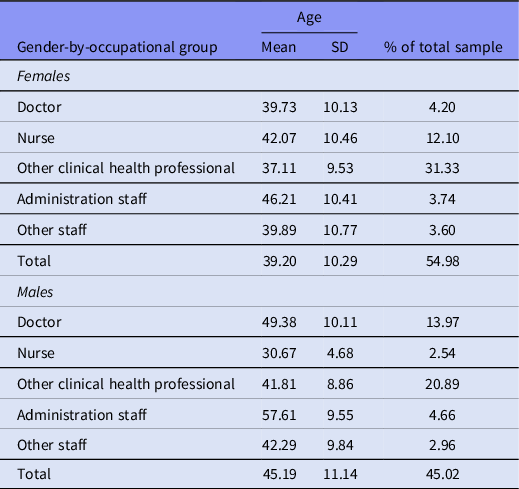
The demographics of the stratified study sample are shown in Table 1. They are clearly different from those of the raw sample, are close to the general population in terms of gender and age. There was a difference in age concerning gender and specific profession as well as in their interaction (df = 4, MS = 5120, F = 55.3, p < 0.001). The study sample was quite heterogenous with most groups differing from most others in terms of age. Although official data are not available, these ages reflect the age of these professional groups in the country, at least concerning doctors and nurses.
Demographics of the stratified study sample. Most groups (gender-by-profession) differ from most others in terms of age (Factorial ANOVA; df = 4, MS = 5120, F = 55.3, p < 0.001)

Probable depression (Table 2)
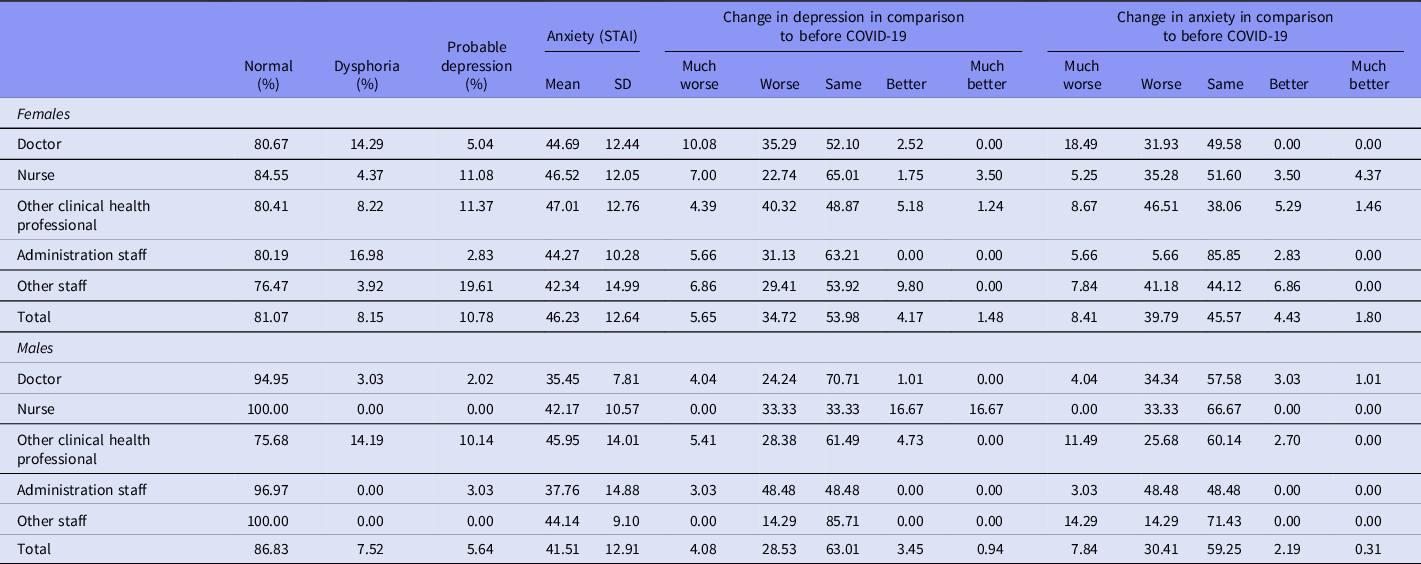
Probable depression was present in 10.78% of females and 5.64% of males. In both cases, the results are approximately double of what is expected from the general population. For comparison, in the raw dataset, the overall rate of probable depression was 13.4% and was identical in the two sexes. This is three to four times higher than expected from the general population.
Rates of dysphoria, clinical depression and anxiety in the standardised population as well as rates of change in comparison to the pre-COVID-19 period

In both sexes, the high rates of depression are driven by other ‘clinical health professionals’ and female nurses and female other staff while both male and female doctors manifest not higher than expected rates of probable depression. One-fifth of females belonging to ‘other staff’ were classified as suffering from probable depression, which is approximately four times higher than expected.
Chi-square test revealed a significant gender-by-occupation interaction (chi-square = 18.907, df = 4, p < 0.001).
The depressive affect was worse in 40.37% of females (same in 53.98%) and in 32.61% of males (same in 63.01%) in comparison to the pre-COVID-19 period (chi-square = 1.299, df=1, p = 0.254).
Dysphoria (Table 2)
Non-clinical dysphoria was found in 8.15% of females and 7.52% of males, which is very close to what is expected from the general population under normal conditions (Fountoulakis et al., Reference Fountoulakis, Iacovides, Kleanthous, Samolis, Kaprinis, Sitzoglou, St Kaprinis and Bech2001, Fountoulakis et al., Reference Fountoulakis, Pantoula, Siamouli, Moutou, Gonda, Rihmer, Iacovides and Akiskal2012). No difference was found by chi-square test.
Anxiety (Table 2)
STAI scores were higher two-fold for females and 1.5-fold for males in comparison to what is expected from the general population and at the levels expected in patients with depression (Fountoulakis et al., Reference Fountoulakis, Papadopoulou, Kleanthous, Papadopoulou, Bizeli, Nimatoudis, Iacovides and Kaprinis2006). Sub-analysis revealed that anxiety scores were elevated in all subgroups, including non-depressed individuals (41.09 ± 11.37), and were even higher for dysphoric individuals (56.09 ± 8.03), and depressed patients (62.77 ± 13.01). There was a difference in STAI score concerning gender and specific profession as well as in their interaction (df = 4, MS = 1696, F = 11.14, p < 0.001). Scheffe post hoc test revealed that the difference was due to the significantly lower scores male doctors and administration staff had in comparison to the rest.
In total, individuals with scores above two standard deviations from the expected mean (>67; severe anxiety) accounted for 4.57%, while those with scores one standard deviation above the mean (>36; at least moderate anxiety) accounted for 69.37%.
Increased anxiety due to the lockdown was reported by 48.20% of females (same in 45.57%) and by 38.25% of males (same in 59.25%) in comparison to the pre-COVID-19 period (chi-square = 2.017, df = 1, p = 0.1555).
Sleep problems (Table 3)
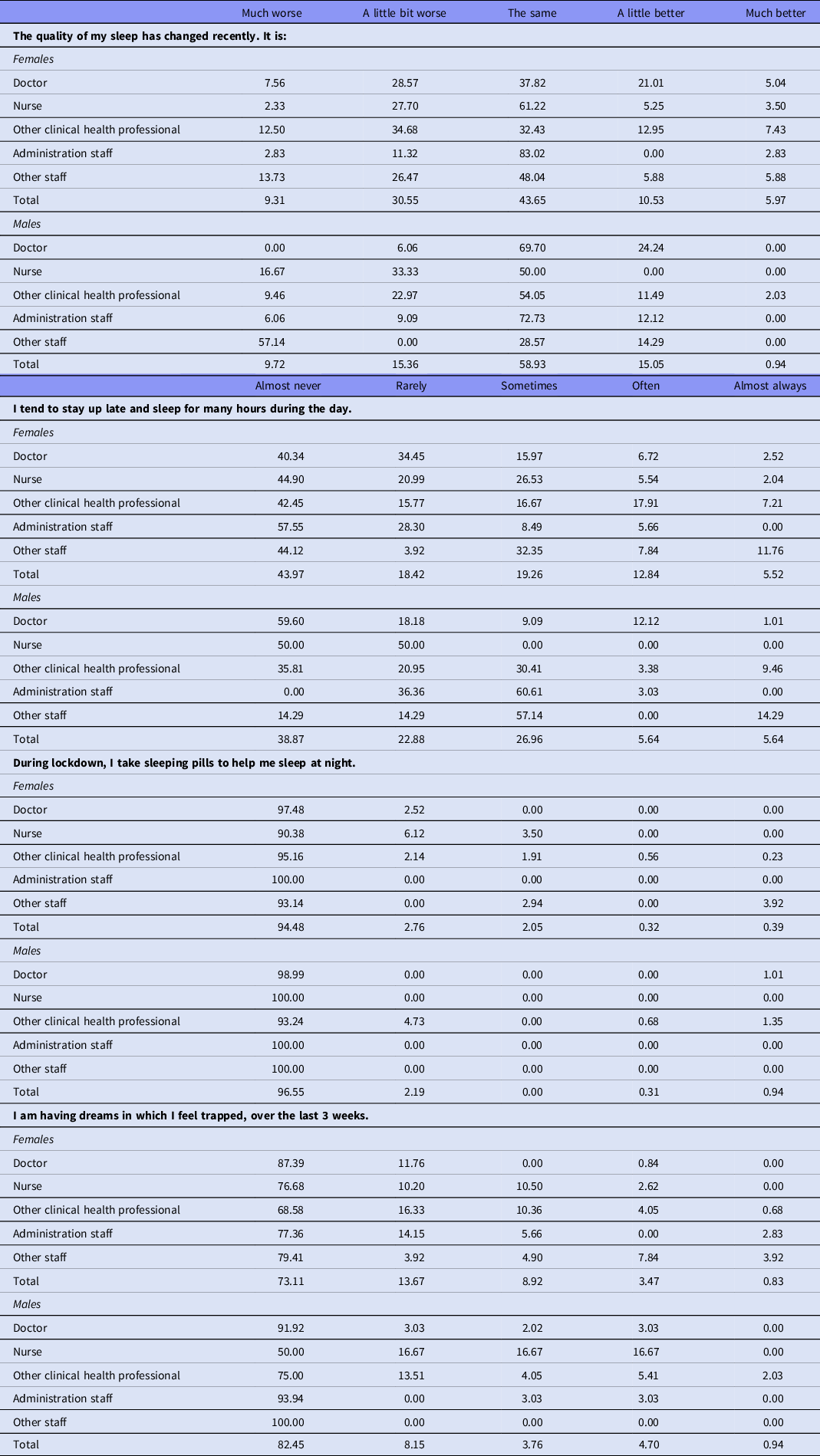
A recent worsening of the quality of sleep was reported by 39.86% of females and 25.08% of males while an improvement was reported by 16.5% and 15.99% respectively (worsening vs. the rest, chi-square = 4.981, df = 1, p = 0.0256). There was a high variability in terms of gender-by-professional identity subgrouping. On the contrary, there was a homogenous shift of the sleep timetable, with all subgroups reporting staying awake very late in the night and sleep much more during the day, but use of sleeping pills was negligible. Nightmares, recently, were reported by 26.89% of females and 17.55% of males, but with male nurses reporting the highest percentage (50%) (chi-square = 9.421, df = 1, p = 0.051).
Changes in parameters of sleep in comparison to the pre-COVID-19 period

Suicidality (Table 4)
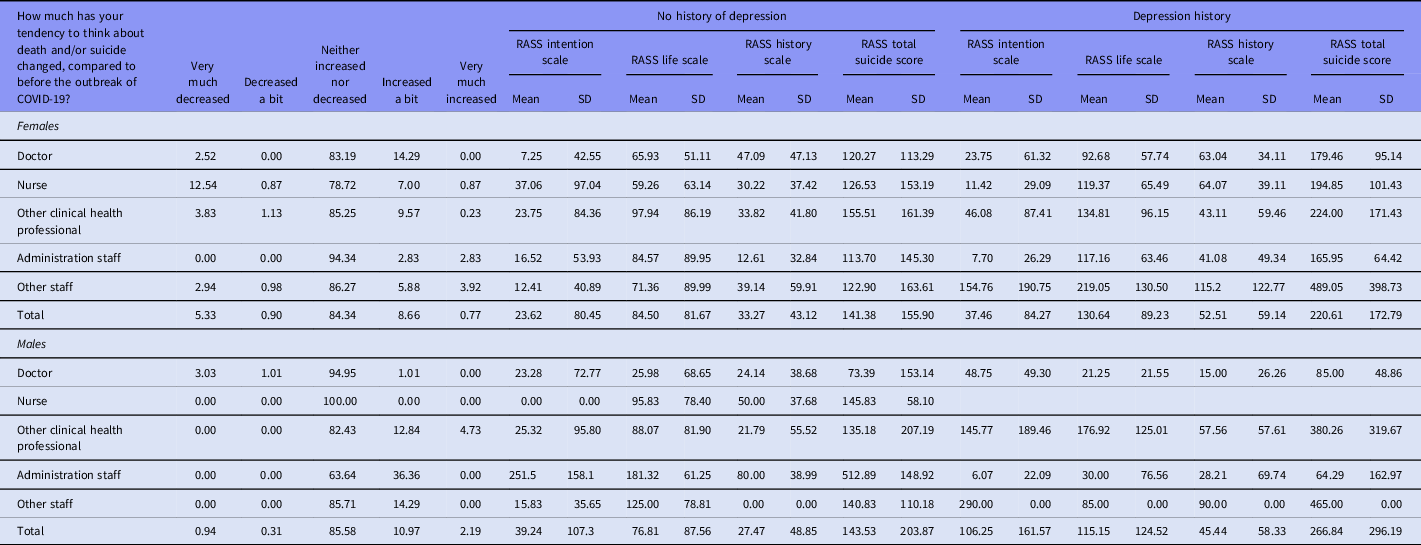
A similar percentage in both sexes reported no change in suicidal thoughts (85%) but approximately in 10% these thoughts increased. In the total stratified sample, 7.26% (5% of females and 10.03% of males) answered that they think at least sometimes of killing themselves, and this is two-fold higher than what is expected. The highest percentage was found in male administrative staff (36.36%) and the lowest in male nurses (0%) and male doctors (2.02%).
Changes in suicidal thoughts and in relationship to a previous history of depression

The effect of history of mental disorder (Tables 5 and 6)
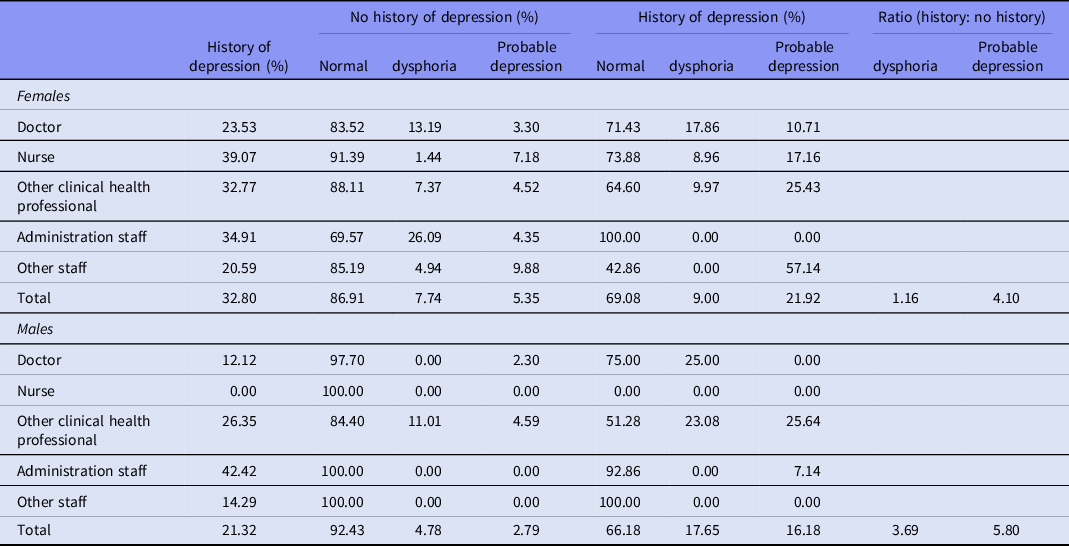
The history of any mental disorder was driven exclusively by the history of unipolar depression, which was present in 32.80% of females and 21.32% of males, with doctors manifesting again the lower rates (Table 5). While in those without history of depression, the rates of the presence of probable depression were what expected cross-sectionally from the general population (5.35% for females and 2.79% for males); the respected rates for those with a history of depression were four to six times higher (21.92% for females and 16.18% for males), and the difference was significant (females: chi-square = 11.658, df = 1, p = 0.0006; males: chi-square = 10.442, df = 1, p = 0.0012).
History of depression and rates of dysphoria and probable depression in individuals with and without history of depression

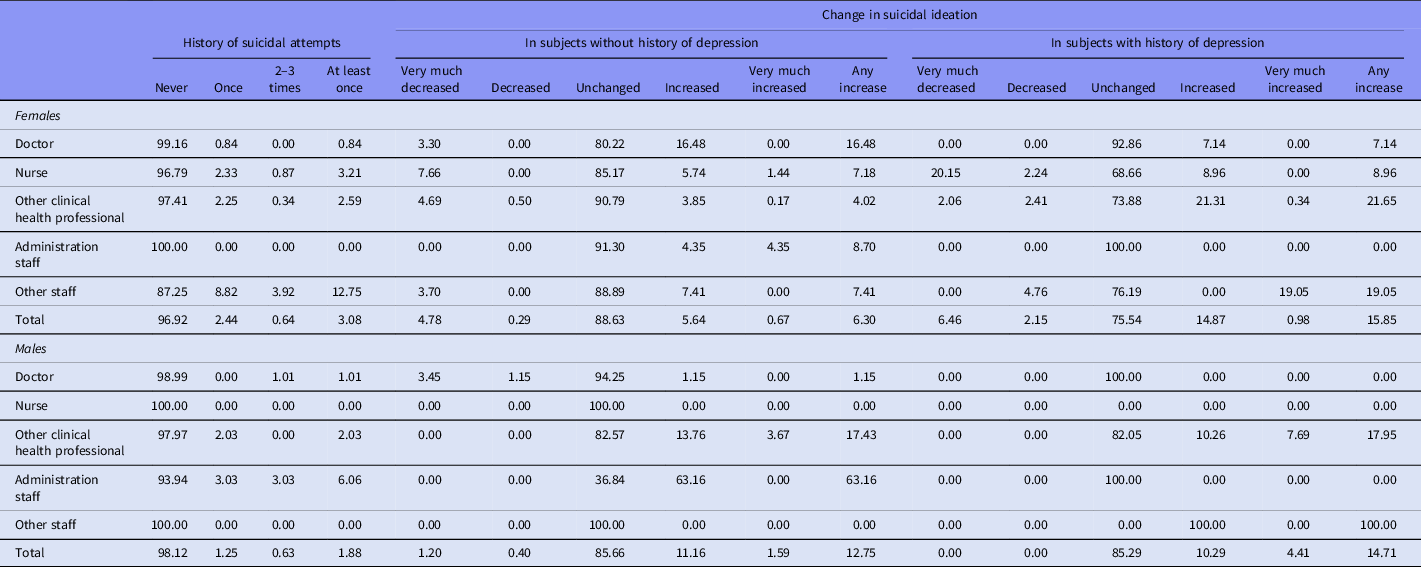
Rates of history of suicidal attempts and change in suicidal ideation in subjects groups by history of depression

The presence of dysphoria was not affected by the history of depression in females but in males with such a history, dysphoria was 3.69 times higher. Interestingly, while in persons without a history of depression, the sum of the rates of dysphoria and depression is approximately double in females in comparison to males (13.09% vs. 7.57%), in persons with a history of depression this sum is similar (30.92% vs. 33.83%) (Table 5), suggesting that in females the effect of history is stronger and they progress easier to clinical depression, although chi-square was not significant.
Overall, the rates of history of suicidal attempts are similar to what would be expected from the general population (Fountoulakis et al., Reference Fountoulakis, Pantoula, Siamouli, Moutou, Gonda, Rihmer, Iacovides and Akiskal2012) and this adds to the validity of the stratification process. Males reported almost half the rates of history of suicidal attempts in comparison to females (1.88% vs. 3.08%; Table 6) but although they manifested lower rates of depression, their suicidal tendencies were higher than those of females. While for both sexes with a previous history of depression the increase in suicidal thoughts was similar (approximately 15%), in those without history of depression, the rates were double in males (12.75% vs. 6.30%; Table 6). The number of patients with history of suicidal attempts was too small to do a similar analysis with grouping subjects according to suicidal history.
The RASS Suicidal intention score was higher in the group with previous history of depression and while in the subgroup without depression the RASS scores were similar between the two genders, in the group with a history of depression the total RASS score was double in males. Additionally, the RASS subscale scores were similar to the scores expected in the general population (Fountoulakis et al., Reference Fountoulakis, Pantoula, Siamouli, Moutou, Gonda, Rihmer, Iacovides and Akiskal2012) except from those of males with a positive history of depression (Table 4). Factorial ANOVA suggested a significant difference among the groups defined by gender-by-profession concerning RASS Intention and Life subscales. The Scheffe post hoc test suggested that these differences were due to the high scores of the male administration and other staff (p < 0.001).
Believing in conspiracy theories (Table 7)
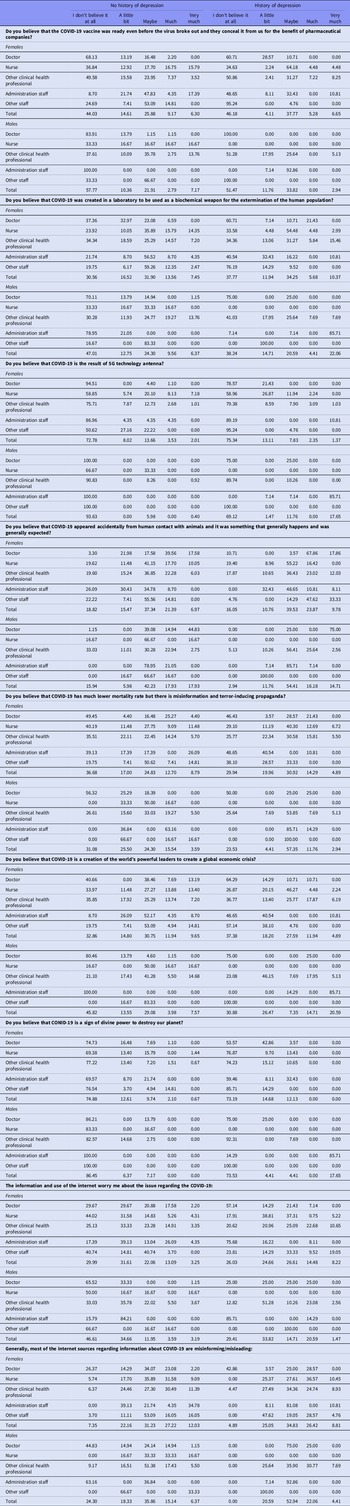
The rates of the believing in conspiracy theories concerning the COVID-19 epidemic are at least partially impressive and alarming. For example, only one-third of HCP definitely rejects the belief that COVID-19 is deliberately exaggerated via terror-inducing propaganda, and this includes an astonishingly low rate close to 50% for doctors. Only 30.56% of females and 47.01% of males reject the idea that the COVID-19 was created in a laboratory and deliberately released as a biochemical weapon to exterminate human population. To at least some extent, this idea is followed by more than 60% of female and almost 30% of male doctors. The 5G conspiracy theory is to some extend accepted by approximately 23% of females (including 5.5% of female doctors) and 6.5% of males (including one-third of male nurses). Conceptualising the outbreak as a form of direct and real divine punishment was embraced by 25% of females and almost 15% of males, and these same rates hold for doctors.
Rates of believing in various conspiracy theories related to the COVID-19 outbreak, with subjects grouped by gender and occupational position

Discussion
During lockdown, among health professionals, probable depression was present in 10.78% of females and 5.64% of males (increased 2-fold) and was higher in females and nurses but levels of dysphoria were not increased. Depressed affect worsened in 40.37% of females and in 32.61% of males in comparison to the pre-COVID-19 period. Anxiety increased two-fold for females and 1.5-fold in males and worsening of the quality of sleep in 39.86% of females and 25.08% of males. Nightmares, recently, were reported by 26.89% of females and 17.55% of males, but with male nurses reporting the highest percentage (50%). Previous history of depression was the main risk factor behind high rates of depression especially in females and the 2-fold increase in suicidal thoughts especially in males. The rates of the believing in conspiracy theories concerning the COVID-19 epidemic were alarming with the majority of individuals following some theory to at least some extend and with females having higher acceptance rates. Even among doctors, these beliefs were highly prevalent, and this concerned even the most extreme of them.
While the results concerning probable depression are more or less similar to those previously reported concerning the general population (Fountoulakis et al., Reference Fountoulakis, Apostolidou, Atsiova, Filippidou, Florou, Gousiou, Katsara, Mantzari, Padouva-Markoulaki, Papatriantafyllou, Sacharidi, Tonia, Tsagalidou, Zymara, Prezerakos, Koupidis, Fountoulakis and Chrousos2020a), there is a significant difference: in HCP, the history of depression seems to be the decisive factor; individuals without such a history manifest the rates expected from the general population during normal periods (which is still high because ‘general population’ includes also persons with positive history of depression), while those with such a history had at least four to six times higher rates. These results suggest a probable increase in first episodes of depression but also an explosive increase in relapses during lockdown. It is unknown which percentage of those persons with a previous history manifested a relapse and which had an ongoing episode with onset before the outbreak.
Concerning the increase of suicidal ideation in HCP, this seems to be higher concerning the reported from the general population (Fountoulakis et al., Reference Fountoulakis, Apostolidou, Atsiova, Filippidou, Florou, Gousiou, Katsara, Mantzari, Padouva-Markoulaki, Papatriantafyllou, Sacharidi, Tonia, Tsagalidou, Zymara, Prezerakos, Koupidis, Fountoulakis and Chrousos2020a).
The results of the current study should be considered by having in mind that they were gathered during a period of strict lockdown. This kind of lockdowns have a complex but overall negative impact on the mental status of the population, and it is believed they cause distress and depression (Foa et al. Reference Foa, Gilbert and Fabian2020, Recchi et al., Reference Recchi, Ferragina, Helmeid, Pauly, Safi, Sauger and Schradie2020, Di Blasi et al., Reference Di Blasi, Gullo, Mancinelli, Freda, Esposito, Gelo, Lagetto, Giordano, Mazzeschi, Pazzagli, Salcuni and Lo Coco2021, Rossi et al., Reference Rossi, Jannini, Socci, Pacitti and Lorenzo2021).
The literature is already rich concerning the mental health of HCPs although the bulk of data come from a limited number of countries, and generalisability is questionable. Most of the data were gathered through online questionnaires and their study samples are not standardised. However, concerning doctors, most of the data suggest high rates of up to 60% of psychopathology (Maciaszek et al., Reference Maciaszek, Ciulkowicz, Misiak, Szczesniak, Luc, Wieczorek, Fila-Witecka, Gawlowski and Rymaszewska2020) and especially of anxiety (Al Mahyijari et al., Reference Al Mahyijari, Badahdah and Khamis2020, Amin et al., Reference Amin, Sharif, Saeed, Durrani and Jilani2020) and depression (Amin et al., Reference Amin, Sharif, Saeed, Durrani and Jilani2020). Rates vary from 32.9% for stress and anxiety (Chatterjee et al., Reference Chatterjee, Bhattacharyya, Bhattacharyya, Gupta, Das and Banerjee2020) 34.9% for depression (Chatterjee et al., Reference Chatterjee, Bhattacharyya, Bhattacharyya, Gupta, Das and Banerjee2020) and 45% of symptoms of stress (Das et al., Reference Das, Sil, Jaiswal, Rajeev, Thole, Jafferany and Ali2020) and 63.5% of symptoms of depression (Das et al., Reference Das, Sil, Jaiswal, Rajeev, Thole, Jafferany and Ali2020). Female gender was related to higher rates of anxiety and depression (Hacimusalar et al., Reference Hacimusalar, Kahve, Yasar and Aydin2020, Maciaszek et al., Reference Maciaszek, Ciulkowicz, Misiak, Szczesniak, Luc, Wieczorek, Fila-Witecka, Gawlowski and Rymaszewska2020).
Also in nurses, there are reports of high anxiety (Al Mahyijari et al., Reference Al Mahyijari, Badahdah and Khamis2020), higher than those reported in other health professionals (Wang et al., Reference Wang, Ma, Yang, Cai, Hu, Zhang, Tang, Bai, Guo, Wu, Du, Kang, Tan, Li, Yao, Wang and Liu2020, Ning et al., Reference Ning, Yu, Huang, Li, Luo, Huang and Chen2020, Lai et al., Reference Lai, Ma, Wang, Cai, Hu, Wei, Wu, Du, Chen, Li, Tan, Kang, Yao, Huang, Wang, Wang, Liu and Hu2020, Jo et al., Reference Jo, Koo, Seo, Yun and Kim2020, Cabarkapa et al., Reference Cabarkapa, Nadjidai, Murgier and Ng2020, Azoulay et al., Reference Azoulay, Cariou, Bruneel, Demoule, Kouatchet, Reuter, Souppart, Combes, Klouche, Argaud, Barbier, Jourdain, Reignier, Papazian, Guidet, Geri, Resche-Rigon, Guisset, Labbe, Megarbane, Van Der Meersch, Guitton, Friedman, Pochard, Darmon, Kentish-Barnes and Group2020), and this is also true concerning depression (Hacimusalar et al., Reference Hacimusalar, Kahve, Yasar and Aydin2020) and PTSD (Wang et al., Reference Wang, Ma, Yang, Cai, Hu, Zhang, Tang, Bai, Guo, Wu, Du, Kang, Tan, Li, Yao, Wang and Liu2020, Song et al., Reference Song, Fu, Liu, Luo, Wang, Zhou, Yan and Lv2020). Rates of anxiety are reported to be up to 50.4% (Azoulay et al., Reference Azoulay, Cariou, Bruneel, Demoule, Kouatchet, Reuter, Souppart, Combes, Klouche, Argaud, Barbier, Jourdain, Reignier, Papazian, Guidet, Geri, Resche-Rigon, Guisset, Labbe, Megarbane, Van Der Meersch, Guitton, Friedman, Pochard, Darmon, Kentish-Barnes and Group2020), depression being as high as 30.4–43.61% (An et al., Reference An, Yang, Wang, Li, Zhang, Cheung, Ungvari, Qin, An and Xiang2020, Azoulay et al., Reference Azoulay, Cariou, Bruneel, Demoule, Kouatchet, Reuter, Souppart, Combes, Klouche, Argaud, Barbier, Jourdain, Reignier, Papazian, Guidet, Geri, Resche-Rigon, Guisset, Labbe, Megarbane, Van Der Meersch, Guitton, Friedman, Pochard, Darmon, Kentish-Barnes and Group2020) and trauma-related disorders up to 32–39.3% (Azoulay et al., Reference Azoulay, Cariou, Bruneel, Demoule, Kouatchet, Reuter, Souppart, Combes, Klouche, Argaud, Barbier, Jourdain, Reignier, Papazian, Guidet, Geri, Resche-Rigon, Guisset, Labbe, Megarbane, Van Der Meersch, Guitton, Friedman, Pochard, Darmon, Kentish-Barnes and Group2020, Chen et al., Reference Chen, Sun, Chen, Jen, Kang, Kao and Chou2020). In terms of symptomatology, it has been reported that 8.1–40% had anxiety, 9.4–46% had depressive symptoms, and 42.7% had somatic symptom, while 6.5% reported suicidal ideation (Hong et al., Reference Hong, Ai, Xu, Wang, Chen, Zhang, Wang and Kuang2020, Hu et al., Reference Hu, Kong, Li, Han, Zhang, Zhu, Wan, Liu, Shen, Yang, He and Zhu2020, Tu et al., Reference Tu, He and Zhou2020, Xiong et al., Reference Xiong, Yi and Lin2020). Up to 60% reported poor sleep quality (Tu et al., Reference Tu, He and Zhou2020). Again, also in nurses, female gender was related with higher scores of depression, anxiety and trauma-related disorders (Hacimusalar et al., Reference Hacimusalar, Kahve, Yasar and Aydin2020, Cabarkapa et al., Reference Cabarkapa, Nadjidai, Murgier and Ng2020, Chen et al., Reference Chen, Sun, Chen, Jen, Kang, Kao and Chou2020, AlAteeq et al., Reference Alateeq, Aljhani, Althiyabi and Majzoub2020), although there are also negative reports concerning the effect of gender (Xiong et al., Reference Xiong, Yi and Lin2020). Other risk factors included lack of access to adequate personal protective equipment (Arnetz et al., Reference Arnetz, Goetz, Sudan, Arble, Janisse and Arnetz2020).
When considering health care workers as a whole, anxiety disorders were present in 10–27.1% (Wang et al., Reference Wang, Ma, Yang, Cai, Hu, Zhang, Tang, Bai, Guo, Wu, Du, Kang, Tan, Li, Yao, Wang and Liu2020, Awano et al., Reference Awano, Oyama, Akiyama, Inomata, Kuse, Tone, Takada, Muto, Fujimoto, Akagi, Mawatari, Ueda, Kawakami, Komatsu and Izumo2020, Badahdah et al., Reference Badahdah, Khamis, Al Mahyijari, Al Balushi, Al Hatmi, Al Salmi, Albulushi and Al Noomani2020, Salopek-Ziha et al., Reference Salopek-Ziha, Hlavati, Gvozdanovic, Gasic, Placento, Jakic, Klapan and Simic2020), while depression was present in 11–27.9% (Salopek-Ziha et al., Reference Salopek-Ziha, Hlavati, Gvozdanovic, Gasic, Placento, Jakic, Klapan and Simic2020, Awano et al., Reference Awano, Oyama, Akiyama, Inomata, Kuse, Tone, Takada, Muto, Fujimoto, Akagi, Mawatari, Ueda, Kawakami, Komatsu and Izumo2020). There is also a high prevalence of up to 28–98.5% concerning symptoms of anxiety (Zhang et al., Reference Zhang, Liu, Afshar Jahanshahi, Nawaser, Yousefi, Li and Sun2020, Xing et al., Reference Xing, Xu, Sun, Wang, Ge, Jiang, Du and Li2020, Suryavanshi et al., Reference Suryavanshi, Kadam, Dhumal, Nimkar, Mave, Gupta, Cox and Gupte2020, Shechter et al., Reference Shechter, Diaz, Moise, Anstey, Ye, Agarwal, Birk, Brodie, Cannone, Chang, Claassen, Cornelius, Derby, Dong, Givens, Hochman, Homma, Kronish, Lee, Manzano, Mayer, Mcmurry, Moitra, Pham, Rabbani, Rivera, Schwartz, Schwartz, Shapiro, Shaw, Sullivan, Vose, Wasson, Edmondson and Abdalla2020, Lai et al., Reference Lai, Ma, Wang, Cai, Hu, Wei, Wu, Du, Chen, Li, Tan, Kang, Yao, Huang, Wang, Wang, Liu and Hu2020, Firew et al., Reference Firew, Sano, Lee, Flores, Lang, Salman, Greene and Chang2020, Awano et al., Reference Awano, Oyama, Akiyama, Inomata, Kuse, Tone, Takada, Muto, Fujimoto, Akagi, Mawatari, Ueda, Kawakami, Komatsu and Izumo2020, Juan et al., Reference Juan, Yuanyuan, Qiuxiang, Cong, Xiaofeng, Yundong, Jing, Peifeng, Yan, Xiaojiao and Yujie2020, Khanal et al., Reference Khanal, Devkota, Dahal, Paudel and Joshi2020, Que et al., Reference Que, Shi, Deng, Liu, Zhang, Wu, Gong, Huang, Yuan, Yan, Sun, Ran, Bao and Lu2020, Sahin et al., Reference Sahin, Aker, Sahin and Karabekiroglu2020), 25.2–92.5% concerning those of depression (Zhang et al., Reference Zhang, Liu, Afshar Jahanshahi, Nawaser, Yousefi, Li and Sun2020, Xing et al., Reference Xing, Xu, Sun, Wang, Ge, Jiang, Du and Li2020, Suryavanshi et al., Reference Suryavanshi, Kadam, Dhumal, Nimkar, Mave, Gupta, Cox and Gupte2020, Song et al., Reference Song, Fu, Liu, Luo, Wang, Zhou, Yan and Lv2020, Shechter et al., Reference Shechter, Diaz, Moise, Anstey, Ye, Agarwal, Birk, Brodie, Cannone, Chang, Claassen, Cornelius, Derby, Dong, Givens, Hochman, Homma, Kronish, Lee, Manzano, Mayer, Mcmurry, Moitra, Pham, Rabbani, Rivera, Schwartz, Schwartz, Shapiro, Shaw, Sullivan, Vose, Wasson, Edmondson and Abdalla2020, Sahin et al., Reference Sahin, Aker, Sahin and Karabekiroglu2020, Lai et al., Reference Lai, Ma, Wang, Cai, Hu, Wei, Wu, Du, Chen, Li, Tan, Kang, Yao, Huang, Wang, Wang, Liu and Hu2020, Khanal et al., Reference Khanal, Devkota, Dahal, Paudel and Joshi2020, Firew et al., Reference Firew, Sano, Lee, Flores, Lang, Salman, Greene and Chang2020, Awano et al., Reference Awano, Oyama, Akiyama, Inomata, Kuse, Tone, Takada, Muto, Fujimoto, Akagi, Mawatari, Ueda, Kawakami, Komatsu and Izumo2020, Juan et al., Reference Juan, Yuanyuan, Qiuxiang, Cong, Xiaofeng, Yundong, Jing, Peifeng, Yan, Xiaojiao and Yujie2020, Que et al., Reference Que, Shi, Deng, Liu, Zhang, Wu, Gong, Huang, Yuan, Yan, Sun, Ran, Bao and Lu2020), and 32–37.5% for symptoms of peritraumatic dissociation (Juan et al., Reference Juan, Yuanyuan, Qiuxiang, Cong, Xiaofeng, Yundong, Jing, Peifeng, Yan, Xiaojiao and Yujie2020, Azoulay et al., Reference Azoulay, Cariou, Bruneel, Demoule, Kouatchet, Reuter, Souppart, Combes, Klouche, Argaud, Barbier, Jourdain, Reignier, Papazian, Guidet, Geri, Resche-Rigon, Guisset, Labbe, Megarbane, Van Der Meersch, Guitton, Friedman, Pochard, Darmon, Kentish-Barnes and Group2020). Insomnia was reported by 28.75–50.4% (Sahin et al., Reference Sahin, Aker, Sahin and Karabekiroglu2020, Que et al., Reference Que, Shi, Deng, Liu, Zhang, Wu, Gong, Huang, Yuan, Yan, Sun, Ran, Bao and Lu2020, Lai et al., Reference Lai, Ma, Wang, Cai, Hu, Wei, Wu, Du, Chen, Li, Tan, Kang, Yao, Huang, Wang, Wang, Liu and Hu2020, Khanal et al., Reference Khanal, Devkota, Dahal, Paudel and Joshi2020). PTSD was reported in 9.1–9.8% (Song et al., Reference Song, Fu, Liu, Luo, Wang, Zhou, Yan and Lv2020, Wang et al., Reference Wang, Ma, Yang, Cai, Hu, Zhang, Tang, Bai, Guo, Wu, Du, Kang, Tan, Li, Yao, Wang and Liu2020). Burnout and distress are also frequently reported (Zhang et al., Reference Zhang, Liu, Afshar Jahanshahi, Nawaser, Yousefi, Li and Sun2020, Firew et al., Reference Firew, Sano, Lee, Flores, Lang, Salman, Greene and Chang2020, Sahin et al., Reference Sahin, Aker, Sahin and Karabekiroglu2020, Salopek-Ziha et al., Reference Salopek-Ziha, Hlavati, Gvozdanovic, Gasic, Placento, Jakic, Klapan and Simic2020, Shechter et al., Reference Shechter, Diaz, Moise, Anstey, Ye, Agarwal, Birk, Brodie, Cannone, Chang, Claassen, Cornelius, Derby, Dong, Givens, Hochman, Homma, Kronish, Lee, Manzano, Mayer, Mcmurry, Moitra, Pham, Rabbani, Rivera, Schwartz, Schwartz, Shapiro, Shaw, Sullivan, Vose, Wasson, Edmondson and Abdalla2020) as well as low quality of life (Suryavanshi et al., Reference Suryavanshi, Kadam, Dhumal, Nimkar, Mave, Gupta, Cox and Gupte2020).
In general, being female appeared to confer greater risk (Cabarkapa et al., Reference Cabarkapa, Nadjidai, Murgier and Ng2020, Elkholy et al., Reference Elkholy, Tawfik, Ibrahim, Salah El-Din, Sabry, Mohammed, Hamza, Alaa, Fawzy, Ashmawy, Sayed and Omar2020, Kang et al., Reference Kang, Ma, Chen, Yang, Wang, Li, Yao, Bai, Cai, Xiang Yang, Hu, Zhang, Wang, Ma and Liu2020, Lai et al., Reference Lai, Ma, Wang, Cai, Hu, Wei, Wu, Du, Chen, Li, Tan, Kang, Yao, Huang, Wang, Wang, Liu and Hu2020, Ning et al., Reference Ning, Yu, Huang, Li, Luo, Huang and Chen2020), and this was also true concerning individuals with a history of mental disorder (Sahin et al., Reference Sahin, Aker, Sahin and Karabekiroglu2020).
Meta-analytical studies reported that in health care professionals anxiety was found in 23–38% and depression in 22-32% and was similar with that of the general population and insomnia in 38.9% (Luo et al., Reference Luo, Guo, Yu, Jiang and Wang2020, Pappa et al., Reference Pappa, Ntella, Giannakas, Giannakoulis, Papoutsi and Katsaounou2020). In general, during epidemics, depressive symptoms are reported in 27.5–50.7%, insomnia symptoms in 34–36.1% and severe anxiety symptoms in 45%. General psychiatric symptoms during outbreaks have a range comprised between 17.3 and 75.3%; high levels of stress related to working are reported in 18.1–80.1% (Preti et al., Reference Preti, Di Mattei, Perego, Ferrari, Mazzetti, Taranto, Di Pierro, Madeddu and Calati2020).
The results of the current study, while in accord with more or less with the literature, point also to the decisive effect of the previous history of depression, and in this way, our results identify a particularly vulnerable population among HCPs.
Also, the high rates of believing in conspiracy theories are in accord with findings from other countries (Ahmed et al., Reference Ahmed, Vidal-Alaball, Downing and Lopez Segui2020, Uscinski et al., Reference Uscinski, Enders, Klofstad, Seelig, Funchion, Everett, Wuchty, Premaratne and Murthi2020, Fountoulakis & in Reference Fountoulakis2021) and are a worrying manifestation. Conspiracy beliefs – especially those regarding science, medicine, and health-related topics – are widespread (Oliver and Wood, Reference Oliver and Wood2014) and capable of prompting people to eschew appropriate health-related behaviours (Jolley and Douglas, Reference Jolley and Douglas2014, Bogart et al., Reference Bogart, Wagner, Galvan and Banks2010). Being widely spread within HCPs is an even greater danger for public health. Our results are in accord with the announcement by the Greek Ministry of Health that by August 19, 2021 in hospitals, and in primary care units, 90% and 93% of doctors, 78% and 85% of nurses, 79% and 82% of administration staff and 74% and 83% of other health professionals, respectively, were either vaccinated or had suffered from COVID-19 and are immune. The percentage that had suffered and was at that time immune was 3% and 4% of doctors, 5% and 6% of nurses, 6% and 7% of administration staff and 5% and 6% of the rest of health professionals.
The probability they constitute a dysfunctional coping mechanism as they probably constitute in the general population is strong also here (Fountoulakis et al., Reference Fountoulakis, Apostolidou, Atsiova, Filippidou, Florou, Gousiou, Katsara, Mantzari, Padouva-Markoulaki, Papatriantafyllou, Sacharidi, Tonia, Tsagalidou, Zymara, Prezerakos, Koupidis, Fountoulakis and Chrousos2020a, Freyler et al., Reference Freyler, Simor, Szemerszky, Szabolcs and Koteles2019, Tomljenovic et al., Reference Tomljenovic, Bubic and Erceg2020). This probability of an affective component in the frame of a dysfunctional copying mechanism is in accord with the finding that believing was more frequent in females and could be explained through higher temperamental levels of anxiety and harm avoidance (Sacher et al., Reference Sacher, Neumann, Okon-Singer, Gotowiec and Villringer2013, Aleman and Swart, Reference Aleman and Swart2008, Fischer et al., Reference Fischer, Sandblom, Herlitz, Fransson, Wright and Backman2004, Lee et al., Reference Lee, Liu, Chan, Fang and Gao2005, Lee et al., Reference Lee, Liu, Hoosain, Liao, Wu, Yuen, Chan, Fox and Gao2002, McClure et al., Reference Mcclure, Monk, Nelson, Zarahn, Leibenluft, Bilder, Charney, Ernst and Pine2004, Schirmer et al., Reference Schirmer, Zysset, Kotz and Yves Von Cramon2004, Schroeder et al., Reference Schroeder, Hennenlotter, Erhard, Haslinger, Stahl, Lange and Ceballos-Baumann2004, Fusar-Poli et al., Reference Fusar-Poli, Placentino, Carletti, Landi, Allen, Surguladze, Benedetti, Abbamonte, Gasparotti, Barale, Perez, Mcguire and Politi2009).
However, one should have in mind that believing in conspiracy theories does not necessarily mean that one acts in accord with these beliefs. On the contrary, the discrepancy between beliefs and behaviour is what distinguishes conspiracy beliefs from delusional ideas.
Conclusion
The current paper reports high rates of depression, distress and suicidal thoughts in the HCPs during the lockdown, with a high prevalence of beliefs in conspiracy theories. Female gender as well as previous history of depression acted as risk factors, while it is possible that belief in conspiracy theories acts as a protective factor. These results are alarming in many ways, especially concerning the wide prevalence of believing in conspiracy theories and the suggested impact of these beliefs on mental health and health-related behaviours. Probably, countries should invest in the targeted training and education of health professionals concerning health-related conspiracy theories but also on topics of specific interest, for example better education on how the system works and why some assumptions (e.g. the inflated number of deaths theory) could not be right. Overall, it seems unlikely that a single country can make a difference concerning in its own people; internationally coordinated action seems necessary.
Acknowledgements
None.
Author contributions
All authors contributed equally to the paper.
KNF conceived and designed the study. The other authors participated formulating the final protocol, designing and supervising the data collection and creating the final dataset. KNF did the data analysis and wrote the first draft of the paper. All authors participated in interpreting the data and developing further stages and the final version of the paper.
Financial support
None.
Conflict of interest
None pertaining to the current paper.