Introduction
Despite the financial incentives governments offer employers (Luecking, Reference Luecking2008) and the individualised support available to employees with disability (Lewis et al., Reference Lewis and Priday2013), the workforce participation rate for disabled people is just 53 per cent compared to 81 per cent for other Australians (Australian Bureau of Statistics, 2012). A minority of employers are positive about employing disabled people, viewing them as productive and reliable employees (Chan et al., Reference Chan, Strauser, Maher, Lee, Jones and Johnson2010). But most employers have negative attitudes (Pruett et al., Reference Pruett, Lee, Chan, Wang and Lane2008) and concerns (Fraser et al., Reference Fraser, Johnson, Hebert, Ajzen, Copeland, Brown and Chan2010) that prevent them from hiring disabled people.
Employment support agencies play an important role as information conduits (Fraser et al., Reference Fraser, Johnson, Hebert, Ajzen, Copeland, Brown and Chan2010). Employment support agency consultants establish realistic employer expectations of new employees (Chan et al., Reference Chan, Strauser, Maher, Lee, Jones and Johnson2010) as well as educate disabled people and employers about available financial packages and support services (Roessler et al., Reference Roessler, Hennessey, Neath, Rumrill and Nissen2011). Employers who are concerned about what it takes to hire and maintain disabled people in their workforce might be encouraged to hire disabled people if they had accurate information when making hiring decisions. With the right government support, agencies should be able to deliver services to increase job opportunities for disabled people (Perkins, Reference Perkins2007). But research is required to improve on policy and job opportunities for disabled people (Perkins, Reference Perkins2007).
We use the marketing literature to segment the employer market to help employment support agency consultants craft effective strategies to communicate with employers. Buyers of a product or service are generally more positive about attributes of that product or service than non-buyers. For example, buyers might view a product or service as safer, or more trustworthy, than non-buyers do (Driesener and Romaniuk, Reference Driesener and Romaniuk2006). Sharp (Reference Sharp2010) further distinguishes between loyal buyers (frequent and/or high volume buyers) and light buyers (infrequent and/or low volume buyers). These three groups (loyals, light buyers and non-buyers) display different purchasing patterns and present different marketing challenges to sellers. Loyal buyers will repurchase from their trusted seller as their needs arise and may require little marketing attention from the seller. Light buyers are not loyal but are particularly susceptible to marketing messages, whereas non-buyers are unlikely to buy without a need and may be impervious to marketing messages. Understanding the differences between market segments helps sellers to customise marketing messages and efficiently allocate marketing resources across segments. This marketing typology (loyals, light buyers and non-buyers) might similarly differentiate employment opportunities for disabled people. We use the term ‘buyer’ here with no disrespect intended. Our intent is to highlight the opportunities a marketing perspective offers to employment support agencies trying to source employers who will hire disabled people.
Employment support agencies represent (Stafford et al., Reference Stafford, Roberts and Duffy2012) and ‘reverse market’ disabled people to employers (Lewis and Priday, Reference Lewis, Dobbs and Biddle2008). By comparing employers who have hired disabled people (hirers) with employers who have never hired disabled people (non-hirers), we might identify positive aspects of employers that an agency could use to change the behaviour of employers that do not hire disabled people. But if further distinctions can be made among employers that hire disabled people (for example, between loyal and light hirers), then we might be able to identify other employer segments whose hiring behaviour is malleable. For example, employment support agencies could target light hirers (employers that seldom hire disabled people) and motivate them to hire more disabled people. In this research, we talked to employers who have hired and those that have never hired disabled people. We make a contribution to the literature on employment participation of disabled people by identifying distinct employer cohorts that might provide jobs to disabled jobseekers.
Reasons employers are reluctant to hire disabled people
Employers are concerned about costs directly associated with hiring disabled people. For example, employers worry that a new employee will require physical workspace alterations (for example, Solovieva et al., Reference Solovieva, Wallsh, Hendricks and Dowler2010). However, start-up costs can be negligible (less than $500) (Hernandez et al., Reference Hernandez, McDonald, Divilbiss, Horin, Velcoff and Donoso2008). Employers are also concerned about ongoing financial costs associated with integrating disabled people into their workforce (Anema and Sligar, Reference Anema and Sligar2010). These costs may include absenteeism, training, development and turnover of disabled employees (Unger, Reference Unger2002), as well as training non-disabled employees as supervisors and altering jobs for disabled people. But publicly funded disability support is available for employers and employees (Humber, Reference Humber2014); employment support agencies can provide resources to alleviate employer costs (Chan et al., Reference Chan, Strauser, Maher, Lee, Jones and Johnson2010).
Employer reluctance to hire disabled people also stems from concerns about other people's reactions to disabled employees (Miller and Werner, Reference Miller and Werner2005; Balser and Harris, Reference Balser and Harris2008). For example, job performance ratings of disabled employees may be inaccurate (overly generous or harsh), depending on the inconveniences they impose on co-workers (Miller and Werner, Reference Miller and Werner2005). Co-worker perceptions that disabled employees receive preferential treatment can complicate workplace dynamics and cause employers to view hiring disabled people as harder than hiring non-disabled people (Balser and Harris, Reference Balser and Harris2008).
Employers also believe that employees will find working with a disabled person stressful, particularly if the person displays unpredictable or aggressive behaviour (for example, Mills and Rose, Reference Mills and Rose2011). However, co-workers are remarkably sympathetic to disabled people, particularly if their impairments were not preventable (Miller and Werner, Reference Miller and Werner2005). Hiring disabled people is not always as hard as employers might think, despite presenting some challenges that may require employment support assistance.
The stigma attached to disability is reflected in low employment rates (Smith, Reference Smith2007) and presents a ‘major’ barrier to disabled people's work engagement (Massie, 2006, cited in Hannon, Reference Hannon2011: 7). Australia's Disability Discrimination Act aims to prevent exclusion from employment on the basis of disability (Australian Government, 1992). But employers often unconsciously avoid hiring disabled people (Duggan et al., Reference Duggan, Bradshaw and Altman2010) and their beliefs about disabled peoples’ future work performance are based on inaccurate negative stereotypes (Williams-Whitt and Taras, Reference Williams-Whitt and Taras2010). Literature examining people with specific disabilities seeks to break through the ‘myths’ associated with these disabilities (for example, Siperstein et al., Reference Siperstein, Romano, Mohler and Parker2006). Subtle discrimination against disabled people is difficult to eradicate because victims rarely complain (Beauchemin et al., Reference Beauchemin, Hamel, Lesné and Simon2010) but it has a cumulative negative effect on well-being (Deitch et al., Reference Deitch, Barsky, Butz, Chan, Brief and Bradley2003).
As a result of these negative employer beliefs, job search can be a frustrating process for disabled people (Hergenrather et al., Reference Hergenrather, Turner, Rhodes and Barlow2008). Frustrated job-seekers often opt-out of job seeking altogether (Rafaeli, Reference Rafaeli2006) and can experience a general negativity about employment (Grösch, Reference Grösch2013). Lowered self-esteem can result (Hall and Parker, Reference Hall and Parker2010). Wide-reaching effects of non-employment have prompted some governments to force employers to include a defined proportion of disabled people in their workforce and to reward people who enter disability-focused enterprises or self-employment (Huang et al., Reference Huang, Guo and Bricout2009). In Australia, support for disabled jobseekers and their employers continues to be a government priority through initiatives such as the National Disability Insurance Scheme, Disability Employment Services and supported employment such as Australian Disability Enterprises (sheltered workshops) (Australian Government, 2015). Yet, these policy initiatives fail to provide the social integration and high wages available in mainstream employment (Houtenville and Katargyrou, Reference Houtenville and Kalargryou2012).
Employment support agency consultants: part of the solution?
Employment support agency consultants inform mainstream employers about disabled people and/or a specific disabled person; they also inform disabled people about employers and/or specific jobs (Wehman et al., Reference Wehman, Brooke, Green, Hewett and Tipton2008). However, consultants are largely unsuccessful in countering employer misconceptions (Roessler et al., Reference Roessler, Hennessey, Neath, Rumrill and Nissen2011) and struggle to effectively represent qualified disabled people to corporate gatekeepers (Chan et al., Reference Chan, Strauser, Maher, Lee, Jones and Johnson2010).
Employer openness (Siperstein et al., Reference Siperstein, Romano, Mohler and Parker2006) or receptiveness (Chan et al., Reference Chan, Strauser, Maher, Lee, Jones and Johnson2010) is a key attitudinal construct that signals an employer's enthusiasm for hiring disabled people. Openness is influenced by the frequency of, and impressions following, interactions with disabled people (Pruett et al., Reference Pruett, Lee, Chan, Wang and Lane2008). Employers are most likely to hire disabled people if they have hired them before (Luecking, Reference Luecking2008) and have not had strongly negative experiences (Graffam et al., Reference Graffam, Shinkfield, Smith and Polzin2002). Negative experiences or infrequent contact can adversely affect openness and receptiveness to hiring disabled people. Yet, these attitudes can change following better interactions (Choi, Reference Choi2011). Employment support agency consultants may be able to influence an employer's openness, and therefore increase their propensity to hire disabled people.
Careful design of employment support agency communication with employers may help employers form positive inferences about disabled people and the value of hiring them. The marketing literature emphasises that advertising messages enable customers to form inferences about a product's quality or value; these messages are most important when customers do not have the knowledge or ability to evaluate the product (Bloom and Reve, Reference Bloom and Reve1990). Similarly, employers who misunderstand what it takes to have disabled people in a workplace, or who under-estimate the resulting benefits, may be unable to evaluate requests from employment support agencies to hire disabled people. The challenge for employment support agencies is therefore to identify the most important signals that will compensate for an employer's lack of knowledge of disabled people, negative judgements of their capabilities, and reluctance to see value from hiring them.
Astute employment support agencies have an existing client base of employers where they have previously placed disabled people into jobs. But relying on ‘loyal’ or existing customers (i.e. those who have bought previously and have a predisposition to purchase again from the same seller) is unwise (Sharp, Reference Sharp2010). ‘Loyals’ should not be the sole focus of employment support agency consultants searching for job opportunities for disabled people, because loyalty erodes over time. Relentless pursuit of past purchasers can build resistance to marketing efforts (Nuttavuthisit, Reference Nuttavuthisit2010). Consultants could inadvertently increase employer resistance to hiring disabled people. With loyal purchasers usually few and far between, acquiring new customers is ‘a necessity’ (Sharp, Reference Sharp2010: 37).
A better strategy might be for employment support agency consultants to target light hirers and non-hirers. In marketing terms, light buyers are people who have bought a product or service once, but have no strong connection to a particular product for future purchases. Non-buyers may have just not purchased a product in a given time period (Romaniuk, Reference Romaniuk2011). Employers who have hired disabled people but do not have any employed through a specific agency or consultant (i.e. light hirers), and employers who have never hired disabled people or not hired in a given time period (i.e. non-hirers) are more likely to respond to employment support agency consultant job sourcing efforts.
Employers resent being targeted by multiple agencies and may perceive consultants as naıve or unfamiliar with business practices (Luecking, Reference Luecking2008). Employment support agency consultants therefore need to target employers with the right information and avoid information exchanges that might worsen employer attitudes and/or increase barriers to hiring disabled people. Too little or too much information about a disabled person might adversely influence an employer and motivate them to hire a non-disabled person. An employer's decision to hire a non-disabled person instead of a disabled person may not be the ‘best’ hiring decision, but rather the ‘easier’ hiring decision. This research asks whether light hirer and non-hirer groups can be identified in the employer marketplace. If these groups exist, consultants could target them to source jobs for disabled people.
Method
The research is a qualitative study of employers conducted in South Australia. Individuals generally restrict their job searches to local labour markets (Killacky and Waghorn, Reference Killackey and Waghorn2008). Ethics approval was provided by the Human Research Ethics Committee of the University of South Australia.
Sample
Face-to-face interviews were conducted by the lead researcher and three trained research assistants in March and August 2012 with business owners and managers responsible for hiring decisions. All researchers were educated to graduate level in psychology, social work or marketing. All transcripts were reviewed by the lead researcher in manuscript preparation.
Business people were randomly selected from a publicly available online directory of local businesses. In total, 812 phone calls were made to secure ninety-two bookings, and eighty-six interviews were conducted for a response rate of 10.6 per cent; 70.7 per cent of participants operated a family owned business and 20.7 per cent of participants operated franchise businesses. The industries included real estate (20.7 per cent), automotive (18.5 per cent), other business or personal services (17.4 per cent) and building (13.0 per cent). Eight other industries were represented in small numbers (less than 7 per cent), such as retail, manufacturing and wine production.
Public sector and large organisations provide disabled people with more jobs, longer lasting jobs and higher paying jobs than smaller private sector organsations (Robertson et al., Reference Robertson, Lewis and Hiila2004). However, South Australia has very few large employers. In 2014, 4,607 companies in South Australia employed fewer than twenty people; only seventy-five employed twenty people or more (Australian Bureau of Statistics, 2015). Only one large public company was represented in our sample and that was through two separate regional franchises of a multi-national car sales company.
Fifty-seven per cent of participants operated businesses in urban areas and 43 per cent were from ‘regional’ areas beyond urban boundaries. Jobs are harder to find beyond the boundaries of urban centres because regional businesses often fill jobs through personal networks rather than advertising. The employment gap between disabled and non-disabled people is even larger outside urban boundaries (Mitra and Sambamoorthi, Reference Mitra and Sambamoorthi2008).
Data collection
The interviews lasted thirty to forty-five minutes and were semi-structured. Participants were aware of the purpose of the interview but were not advised of the questions in advance as, when participants have time to reflect on their responses, they may censor their final responses, thus reducing the quality of the data (Shillito, Reference Shillito1992). Additional questions were introduced during the interview to probe for more detail (Neuman, Reference Neuman2011). We aimed to capture participants’ thoughts in their own words (Kingsley et al., Reference Kingsley, Phillips, Townsend and Henderson-Wilson2010). Interview transcripts were compared to the digital recordings as a quality control check.
The interview questions asked managers to first report whether they currently employed, or had ever employed, disabled people: ‘Do you currently have disabled people working for you?’ (Yes/No); ‘Have you had disabled people working for you in the past?’ (Yes/No). We then asked managers to reflect on those work experiences (‘What is/was it like?’). These questions were designed to elicit objective and subjective barriers to employment of disabled people (Anema and Sligar, Reference Anema and Sligar2010). We also asked managers to report on their experiences with disabled people outside the workplace because research suggests that employer knowledge of, and experience with, disabled people increases the likelihood that an employer will hire disabled people (Chan et al., Reference Chan, Strauser, Maher, Lee, Jones and Johnson2010).
Data analysis
Directed content analysis involves two stages. First, coders deductively analyse the qualitative data to sort respondents into theoretically meaningful categories, focusing on passages of text that identify the respondent as a category member (Hsieh and Shannon, Reference Hsieh and Shannon2005). In our case, we first categorised employers as hirers (employers that had hired disabled people) or non-hirers (employers that had never hired disabled people), based on their response to a direct question about whether they had ever employed a disabled person. The lead researcher verified the categorisation by sorting through original transcripts for confirmation of their hirer/non-hirer status.
Second, researchers inductively analyse the data to extend the theoretical taxonomy (Hsieh and Shannon, Reference Hsieh and Shannon2005). In our case, coders thematically analysed (Braun and Clarke, Reference Braun and Clarke2006) interview transcripts, focusing on factors leading to hire/not-hire decisions, and extracted illustrative verbatim comments. In this inductive stage, researchers reviewed coded text to confirm subcategories and overarching patterns in verbatim interview transcriptions (Hsieh and Shannon, Reference Hsieh and Shannon2005). We were not trying to predict what an employer would do when faced with a hiring decision involving disabled people, but to develop a causal explanation (Neuman, Reference Neuman2011) for the hiring decisions they had already made.
Results
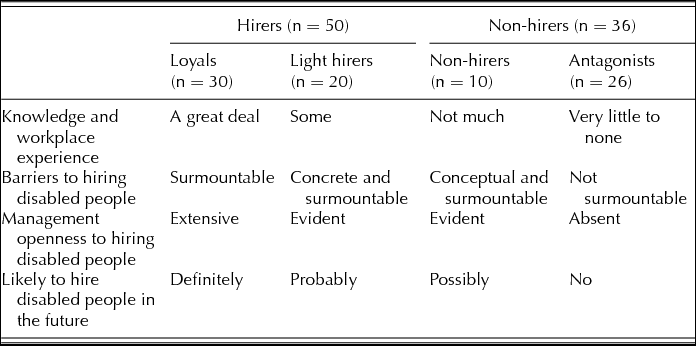
Our data analysis revealed three major themes (manager knowledge and workplace experience, barriers to hiring disabled people and management openness to hiring disabled people) that differentiated two subgroups of employers that had hired disabled people and two subgroups of employers that had not hired disabled people. These four employer groups displayed distinctly different patterns of experience/knowledge, reported different types and levels of anticipated barriers, expressed different levels of openness and could be arrayed along a continuum reflecting their willingness to hire disabled people in the future. Table 1 summarises the taxonomy we constructed. In many cases, participants explicitly stated their intentions to hire disabled people in the future; in some cases, this intention was inferred from surrounding text.
Employer taxonomy

Loyal hirers
In marketing taxonomies, loyal buyers are those with prior experience with a specific product or product category; they are generally more positive about the product than non-buyers (Sharp, Reference Sharp2010). Further, loyal buyers are highly likely to purchase again (Sharp, Reference Sharp2010). We identified thirty employers in our sample that we categorise as loyal hirers. Having previously hired a disabled person, loyals had extensive knowledge and experience. Many reported positive experiences.
He's going good so we signed him up [and kept him]. (employer 26, hired)
In the kitchen here, that's worked out really good for Ben. (employer 20, hired)
When their experiences were not positive, loyals were able to put the problems in perspective.
We haven't had any problems with him, I mean no more so than if we'd have taken on any other seventeen-year-old apprentice, I wouldn't have thought. I mean, he's got a lot to learn, but he's doing an apprenticeship . . . We're very happy that we've taken him on. (employer 33, hired)
Their prior experience had taught managers strategies to accommodate disabled people in the workplace.
If we were to take on another person, ah, we'd probably have to look at whether we think they could work on their own, or whether they would need someone, you know, someone, alongside them at all times. (employer 32, hired)
As a result, these managers recognised barriers to employing disabled people but generally viewed the barriers as surmountable.
If we weren't going to hire people with disabilities half of our workforce wouldn't work for us. We have a gentleman that has partial use of his left arm, so he drives an automatic bus. He can still steer, just doesn't have to worry about the gears. So, we accommodate people the best we can, with disabilities. (employer 34, hired)
Loyal managers did not see disabled people as employable in all job categories, but they could easily identify jobs in their organisations that would be suitable.
The office would be the only place. (employer 35, hired)
I've had them up in the cleaning bay too, because that's a very low skilled type of job. (employer 19, hired)
Loyals exhibited the highest levels of interest in hiring disabled people in the future. They expressed pride in their attitudes towards hiring disabled people.
‘I don't discriminate. I'm an equal opportunity employer and I'm happy to be so. (employer 5, hired)
The young lady that we had . . . moved onto another workplace.
Interviewer: are you open to taking others?
Oh, absolutely, yeah. (employer 35, hired)
Light hirers
Light buyers have experience with a product, product category or seller but are not committed to repurchasing (Sharp, Reference Sharp2010). They are likely to purchase again, but not from a particular seller or a particular brand. We identified twenty employers in our sample that we categorise as light hirers. Having previously hired disabled people, light hirers had some knowledge and experience. Some reported positive experiences.
We get on quite well, with, you know, ah, it's not really a disability, she's got a job. (employer 22, hired)
He left nothing to be desired. He did it all from a wheelchair. (employer 15, hired)
However, some light hirers were negative about their experiences. These managers expressed more concern about the impact of disabled people on their business performance and workplace dynamics than loyal managers.
I did find that it was a bit of a nuisance to the business. (employer 2, hired)
It put them [co-workers] under a lot of stress, and when they stressed out, he stressed out and it stressed the rest of the team. (employer 4, hired)
Very aggressive, and wanted to punch someone, ah, um at work, so we, um, we got rid of him. (employer 8, hired)
Light hirers did not blame the impairment, but instead they recognised that individual disabled people possessed unique capabilities and skills.
The schizophrenia, as it was, I don't, didn't seem to be a major issue. (employer 10, hired)
Some people with disabilities can, some people with disabilities can't. (employer 17, hired)
When their experiences were not positive, light hirers were able to see these as unique situations that presented barriers for those disabled people in their workplaces. For example, employers prefer to hire disabled people who will fit into their organisation without negatively affecting workplace dynamics.
They're not a barrier to employment until such time as they start to throw a load on the other, on the other employees, and that has to be a major consideration, when employing someone who's not doing what is the accepted norm . . . Or not being what is considered the accepted norm . . . Doesn't mean to say it won't work, just got to make sure it fits. (employer 15, hired)
Light hirers reported their previous hiring decisions were financially unsustainable.
You pay him to do it and you have to pay someone else to come in and re-do it. (employer 6, hired)
Working with her, required her to be buddied up together with another worker, and that went on for beyond six months, which, although she didn't have a problem doing it, it did take away from another staff member's duties, and the financial reimbursement that came from the provider didn't really cover that. (employer 13, hired)
When you get someone who comes in who has a disability, you have to get someone to work with them . . . it's really hard. It's really hard. (employer 23, hired)
Light hirers could personally accommodate the constraints a disability imposed on individual performance, but their other employees were less tolerant.
If they can't do it to the high standard, we'll try and make allowances, but then the other workers see that they're not up to the same standard, it's, ‘well why are they getting away with it?’. (employer 7, hired)
Light hirers expressed openness to hiring disabled people in the future, but their openness was conditional. They frequently couched their willingness to hire disabled people in the context of ‘if’ and ‘it depends’ statements.
If someone's willing to give it a go and meets our requirements, if they've got their own tools, and eager enough, well, I'll give anyone a go. (employer 17, hired)
If they could work with the existing conditions or something, then that could easily be done. (employer 9, hired)
Sure. Depending what it was though, and how it would fit in, whatever job I'm doing. Whether it be this one, or wherever I might be. (employer 29, hired)
Light hirers were positive about hiring disabled people in the future and expressed interest in getting support to make it happen.
That's probably the biggest thing, you know having anybody with a disability is having that support network behind them and you. (employer 11, hired)
There are industries like [disability employment agencies] . . . brilliant for how they do it . . . really didn't want anybody at that stage, but because they were subsidising, we gave them a go. (employer 28, hired)
Coming through the group schemes . . . if you don't want them, if you run out of work, you can hand them back. (employer 3, hired)
Non-hirers
Non-buyers have not purchased a product in the past. They may not be aware of the benefits a product offers or be apathetic about such products (Gardyn, Reference Gardyn2003), so they purchase other products to meet their needs (Sharp, Reference Sharp2010). For example, non-buyers may not be aware of the benefits of merino-wool summer garments, or be apathetic about buying natural fibre garments, but they would almost certainly have bought garments made from other materials.
We identified ten employers in our sample that we categorised as non-hirers. Having never hired disabled people, non-hirers had no knowledge of, or experience with, disabled people in the workplace.
I don't think I've been anywhere where I've worked [with someone with a disability] . . . No, I wouldn't think so . . . I wouldn't really know what they're capable of. (employer 10, never hired)
I've never really looked at even taking on someone that's even on a traineeship because I did go down that little path, and um, someone approached me, and said would you be willing to and I said I don't know. (employer 7, never hired)
These non-hirers were open to hiring disabled people in principle.
I have a bit of a soft spot for that. (employer 28, never hired)
No reason why not, in the administration side of it, yep. (employer 26, never hired)
But in contrast to light hirers, the ‘if’ and ‘it depends’ constraints expressed by non-hirers were narrower and more specific.
Depends what the disability is, you know? . . . If he was say, a welder by trade, and he got crook, something like that, and wanted to get back into work, like this sort of place, yeah, we can employ him. He can do components, you know, it's not heavy, it's all small stuff. Yeah . . . Like I said, depends what the disability is, you know?. (employer 25, never hired)
They focused on the things that disabled people could not do and found it difficult to generate examples of jobs that disabled people could perform.
Um, it's really, I mean I spose, office work could be done by that person, but manual work is, is a bit past that scope. (employer 24, never hired)
Someone that can't do all their jobs, their tasks at work, is a problem. (employer 7, never hired)
Non-hirers believed that only dramatic policy changes and unsustainable levels of support would make it possible for them to hire disabled people.
The Government would need to fund someone basically to watch them in that employment. (employer 17, never hired)
Funding available for that side of it, to um, create the physical environment that would support a person with a disability. But then, as far as intellectual, then the Government's going to need to pay someone who can then, who is qualified to then watch that person all the time. (employer 15, never hired)
Antagonists
Antagonists are aware of the product category (Gardyn, Reference Gardyn2003) but have solid reasons why they will not buy such products and may be quite unsympathetic to those that do buy them (Woodside and Megehee, Reference Woodside and Megehee2010). For example, a person may be aware of cars, need transport to get around, be strongly against others purchasing cars on environmental grounds and advocate against those that do buy cars. We identified twenty-six employers in our sample that we categorise as antagonists.
Antagonists acknowledge the impact of impairment on the lives of disabled people.
You feel compassionate and you know, you want to help him out and do stuff but . . . (employer 6, never hired)
They even acknowledge the impact of impairment for job seeking and employment.
She's in the country area now so she gets very little opportunities now. (employer 25, never hired)
He'll just be a, he'll just be a, a council type worker for the rest of his life. I mean, he always goes to work and he's employed and always will be employed, reliable as anything, but his, their brains just aren't the same. They can't focus and concentrate. It's a pity to see it happen. (employer 25, never hired)
However, these employers could justify never having hired disabled people. Limited capacity to perform a job is one reason why antagonists had never hired disabled people.
We can't have someone that doesn't understand protocol. (employer 14, never hired)
It's a fast thinking kind of a job and um, sometimes they have to be up and running down for something, yeah. This building here is probably not set up to be super duper um, for someone in a wheelchair or anything like that. (employer 8, never hired)
Antagonists expect disabled people to hold negative attitudes towards mainstream work as another reason for never having hired disabled people.
There's no point in sending somebody to soccer practice if they wanna play football. Know what I mean?. (employer 20, never hired)
However, financial concerns were the dominant reason that antagonists had never hired disabled people.
I really want[ed] to give her a job [but] in the end it was cost . . . extra cost that really killed it. (employer 11, never hired)
These financial concerns are so strong that antagonists will continue to exclude disabled people from their workplace in the future.
I just couldn't make things profitable if it's gonna take too long and it would require too much support of that individual . . . I just couldn't afford it. (employer 6, never hired)
There's some have had a disability, they don't want to work . . . Well . . . like a one armed person is not going to be much good . . . There'd have to be some substantial difference in pay rates so that you still had that person who was capable. (employer 13, never hired)
We're not, we're not funded to employ more than the people that we already have. We're a small centre and a not-for-profit. (employer 3, never hired)
Discussion
We aimed to identify where there is scope for employment support agency consultants to help disabled people find jobs. Mainstream employment is very important for social and economic inclusion of disabled people (Grover and Piggott, Reference Grover and Piggot2013; Humber, Reference Humber2014). Adopting a marketing perspective to classify employers into cohorts with similar characteristics, our key finding is that employers fall into four categories that have been extensively documented in consumer marketing literature (Sharp, Reference Sharp2010). Employers can be grouped first into hirers and non-hirers, and then into two further sub-categories. In marketing terms, buyers are generally more positive and better informed than non-buyers (for example, Sharp, Reference Sharp2010). Our data confirm that employers with experience hiring disabled people were more positive and informed about hiring disabled people than those who had not. We will now describe in detail the four categories of employers, i.e. loyals, light hirers, non-hirers and antagonists, to highlight opportunities for employment support agency consultants to source mainstream employment for disabled people, to provide benefit to them and their families.
Somewhat counter-intuitively, loyals offer little opportunity for consultants to source jobs for disabled people. Loyal employers exhibit extensive management openness to hiring disabled people in principle. They report the most experience in the workplace and social contexts, identify surmountable barriers to employing disabled people and express a definite propensity to hire disabled people in the future. However, despite their willingness to hire disabled people, loyals are not prepared to expand their hiring practices. Relying on loyals is foolhardy because they are neither frequent nor high volume purchasers (Sharp, Reference Sharp2010) and cannot sustain a business in the long run (Reinartz et al., Reference Reinartz, Thomas and Kumar2005). Employers with experience know the extent to which a specific impairment may restrict a person's functional ability (Baglieri et al., Reference Baglieri, Valle, Connor and Gallagher2011) and may be well prepared to integrate disabled people within their organisation. These employers know what they need. They are ready to hire but are difficult to persuade and unlikely to respond to employment support agency attempts to increase their hiring frequency or the volume of job opportunities for disabled people.
In contrast, light hirers offer greater hope for consultants to source jobs for disabled people. These employers are open to hiring disabled people in principle and in practice, compared with loyals who may be open only in principle. They have experience with, and knowledge of, hiring disabled people. These employers had hired people with schizophrenia (boat manufacturing), chronic health conditions such as diabetes (network cable laying), and substance addiction (automotive repair). The barriers they identified were derived from past experience, so they are concrete but surmountable. Messages that might persuade light hirers to hire disabled people would represent disabled people as a competitive labour source, available and accessible to employers and not too hard to hire. Mainstream jobs are most likely to arise within a local employer market and in regular community businesses where employee and employer can collaborate to access available supports and services without cost or inconvenience to the employer. Employment support consultants play an important role in facilitating such agreements by focusing the employer on capabilities rather than inabilities of the disabled person, the value the disabled person adds to the workplace through their skills, talents and interests and availability of externally funded programmes that support employee‒employer work arrangements (Australian Government, 2011). Mitigating their concern for costs in the longer-term is critical to attract these light hirers.
Non-hirers represent a cohort of employers for whom management openness is evident, but knowledge and experience is incomplete. These employers may have inaccurate information but consider hiring disabled people to be possible, or at least not impossible. These employers may fail to translate their incomplete or inaccurate knowledge about disabled people into actual hiring (for example, Jarzabkowski and Searle, Reference Jarzabkowski and Searle2004). Non-hirers are a viable source of jobs because they express fewer and weaker concerns than other employers, and because consultants can organise support for disabled people and employers (for example, Chan et al., Reference Chan, Strauser, Maher, Lee, Jones and Johnson2010). Absence of knowledge or incomplete knowledge present opportunities for employment support agencies to send messages that promote disabled people as a viable labour resource. Communication strategies could educate employers about the available support and cost management programmes, their ease of use and the benefits of changing hiring practices and workforces.
Rather more intuitively, antagonists offer little hope for employment support agency consultants to find mainstream job opportunities for disabled people. These employers exhibit no management openness to hiring disabled people, possess little or no knowledge and experience with disabled people and cite insurmountable barriers to hiring disabled people. Antagonistic employers are not just reluctant to hire disabled people, they are adamant that they cannot afford expensive or unproductive staff. They may acknowledge disabled people's rights to employment, but they have no propensity to hire disabled people themselves. Overcoming resistance to disabled people is a long-term issue requiring dissemination of much new knowledge through policy and media (Grover and Piggot, Reference Grover and Piggot2013).
Implications for jobs for disabled people
Employment support agency consultants should take advantage of positive employer attitudes towards disabled people to overcome concerns about disabled people in the workplace (Vilchinsky et al., Reference Vilchinsky, Findler and Werner2010) and facilitate positive first-hand employer experiences with disabled people (Lennox et al., Reference Lennox, Taylor, Rey-Conde, Bain, Purdie and Boyle2005). Both light hirers and non-hirers will respond to these messages and experiences because they are similarly positive about hiring disabled people. Creating opportunities for disabled people to engage with employers in the workplace as volunteers or casual visitors (for example, calling regularly to ask for work or delivering employment support agency brochures) and in community settings will provide these first-hand experiences.
Employer education is viewed in the literature (for example, Beckett, Reference Beckett2009) as a way to reduce barriers to inclusion of disabled people in work and society. Re-educating and training non-hirers is most likely to get these employers to hire disabled people (Chan et al., Reference Chan, Strauser, Maher, Lee, Jones and Johnson2010). Employment support agency consultants should take on a significant educative role to teach employers that employment of disabled people does not need to compromise profit-seeking goals. Hiring disabled people can enhance customers’ and workers’ views of employers through agendas beyond profit seeking and by giving back to the community (Lengnick-Hall et al., Reference Lengnick-Hall, Gaunt and Kulkarni2008). Employers that do hire disabled people can receive some government financial assistance. But, the challenge to increase workforce participation of disabled people in mainstream jobs will require government support that resolves financial and non-financial concerns of disabled people, employers and support agencies (Grover and Piggott, Reference Grover and Piggot2013).
Financial concerns may mask employer uncertainty, fear of change and other unknowns around hiring disabled people. Employer perceptions and misconceptions about hiring disabled people are common drivers of reluctance and fear of introducing change to workplaces (Dong et al., Reference Dong, Oire, MacDonald-Wilson and Fabian2013). Consultants should raise employer consciousness of disabled people as a viable labour resource whose capabilities can fill job requirements and fit workforce dynamics and performance. Raising consciousness is not a simple process, but it has been found particularly effective for improving openness and overcoming attitudinal and behavioural barriers (Mirvis, Reference Mirvis2008). Building salience is an essential precursor to new and ongoing purchases (Sharp, Reference Sharp2010). Employment support agencies should regularly remind employers in all four categories (i.e., loyals, light hirers, non-hirers and antagonists) how to hire, and the benefits to their organisations of hiring, disabled people.
Limitations
This study was conducted in South Australia, leveraging the commitment from a regional Disability Employment Service Provider to improve job prospects for their job seekers. The findings may not apply to other geographic regions in which employment support agencies struggle to source employers to employ their job seekers. The evidence presented in this article might be used to reconsider social policy (for example, Neylan, Reference Neylan2008) because many jurisdictions struggle to alleviate the employment challenges faced by disabled people. If policy rewarded non-hirers and light hirers for hiring disabled people, then social inclusion agendas could advance because more disabled people would occupy mainstream jobs across a broad range of employers and communities.
Conclusion
We have identified a foundation for hope that certain employers will provide disabled people with mainstream job opportunities, particularly those who have hired disabled people (light hirers) and those that have never hired disabled people (non-hirers). There are also some mountains that cannot be moved (antagonists). To reduce the public cost of welfare payments from poor employment participation of disabled people, employment support agency consultants have an important job to do. Targeting non-hirers and light hirers can establish hiring disabled people not as a ‘a luxury’ [employer 18, hired], but instead as part of normal hiring practice for all employers, with the same risks, costs and benefits associated with hiring any new employee. Employers that ‘newly’ hire, or return to hiring, disabled people would have fresh opportunities to overcome pre-existing reasons for not hiring disabled people ever, or recently. Hope for disabled people obtaining mainstream jobs comes from employment support agencies attracting new and light hirers to create positive knowledge about employing disabled people.
Acknowledgement
This research was supported by an Australian Research Council Linkage Grant (LP110200141) in partnership with Finding Workable Solutions Inc.