Civil Society Organizations in international governance
As international governance increases in impact and scope, the legitimizing link between citizens and the political institutions governing them is stretched, and, as many argue, overstretched (Scholte, Reference Scholte2004). The hazard of an isolated, unobserved, unaccountable, and unresponsive political elite at the international level has been identified by a range of authors (Follesdal and Hix, Reference Follesdal and Hix2005; Vibert, Reference Vibert2007; Gustavsson et al., Reference Gustavsson, Karlsson and Persson2009), and the elitist character of global and European governance is often regarded as a key feature of its democratic deficit (Halpin and McLaverty, Reference Halpin and McLaverty2010: 55–57). As a reaction to this real or perceived democratic deficit, many International Organizations (IOs) have actively engaged in involving citizens and organized civil society in their decision-making processes via a range of participatory mechanisms (Brown and Fox, Reference Brown and Fox2001; Alger, Reference Alger2002; Greenwood, Reference Greenwood2007; Steffek and Nanz, Reference Steffek and Nanz2008). They have done so in part to increase their perceived legitimacy, but the growing role and influence of organized civil society is also a result of IOs seeking information, expertize, and implementation capacities (Greenwood, Reference Greenwood2004; Dingwerth, Reference Dingwerth2007; Saurugger, Reference Saurugger2008; Steffek, Reference Steffek2010b). In addition, more and more transnational Civil Society Organizations (CSOs) have come into existence in recent decades, actively striving for influence on international policy-making and, to some degree, able to factually exercise it (Arts, Reference Arts1998; Martens, Reference Martens2005: 45–94; Dür, Reference Dür2008).
Many commentators welcome this development. With a view to mitigating the democratic deficit of international governance, CSOs may fulfill a number of functions, sometimes summarized by the metaphor of a ‘transmission belt’ (Steffek and Nanz, Reference Steffek and Nanz2008: 8). The idea is that CSOs can convey issues and interests ‘upwards’ from citizens to IOs, and political information ‘downwards’ from IOs to citizens. Moreover, they may spread information and critical commentary toward the wider public, thus contributing to public debate over IOs and their policies. CSOs may act as a supplement to the media and contribute to an informed public discourse (Beyers, Reference Beyers2004; Altides, Reference Altides2011). However, in recent years skeptical voices that question the ability of CSOs to either make international governance more participatory, or more accountable have grown louder (Kohler-Koch, Reference Kohler-Koch2010).
According to the transmission belt view, the key virtue of transnational CSOs is linking international policy-making back to citizens. If this is so, it seems that a critical distinction needs to be made within transnational CSOs that so far has been poorly explored in the literature: a distinction between CSOs that have members, and hence are prima facie better equipped to function as transmission belts, and those that do not have a societal constituency. Indeed, one does not even need to subscribe to the transmission belt thesis to believe that members matter. The intuition that a membership base is an asset to CSOs is widespread in the literature; especially in a time of increasing concern that professionalized CSOs may themselves become part of a largely unaccountable transnational governing elite (Lahusen, Reference Lahusen2004; Saurugger, Reference Saurugger2006).
In this paper, we are hence addressing not only the debate over the democratic (il)legitimacy of international organizations and other venues of global policy-making. We also take issue with the organizational legitimacy of CSOs themselves, which is increasingly challenged in academic and public discourse (see Section ‘Membership, activities and legitimacy of CSOs: theoretical considerations and potential causal links’). We contend that, in one important respect, the two problems of legitimacy are related. CSO participation can only become a remedy for the democratic deficit of international public governance if transnationally operating CSOs are actually able to connect global policy-making to citizens. Whether or not they are able to do so crucially depends upon their ability to remain in touch with their societal constituency. There is good evidence in the literature of a considerable number of transnational CSOs that sail under the flag of the transnational civil society organization, but are in reality creations of a very small number of international professionals, and at times even founded by international organizations themselves (Martens, Reference Martens2005; Greenwood and Halpin, Reference Greenwood and Halpin2007; Pleines and Buskova, Reference Pleines and Buskova2007). There is, hence, a compelling reason to normatively privilege membership CSOs over others, assuming that close interaction with a societal constituency renders them more legitimate. By legitimate we do not mean that, empirically, they are more successful in mobilizing adherence and support. We rather imply that organizations with a high degree of legitimacy fulfill certain normative expectations, in this case derived from democratic theory and notions of good governance more broadly.
In this article, we do not want to stop at the question of whether transnational CSOs have members or not, and then declare those that have (many) members more legitimate than others. Formally having a membership directory is one thing; being in touch with members and handing them influence over the agenda of the CSO is quite another. We therefore seek to explore how membership CSOs actually behave. Do they involve the members they have? Do they use more, or different, political options and strategies than other transnational actors? Are they more critical of IOs and their policies? Do they contribute to public debate more vigorously than others? Are they more willing than others to reach out to disenfranchised citizens?
To answer these questions we will compare the activities of 60 heterogeneous CSOs, looking for systematic patterns of CSO activities and roles, which may correspond to the distinction between member/non-member CSOs. The ultimate goal is to identify the properties of CSOs that have a positive impact on their organizational legitimacy. We find that member- and consultancy-type CSOs do not differ substantially in those aspects of legitimacy and activities addressing the IO, which were covered by our survey. The role of members in a CSO's work, and their influence on the CSO's policy is highly limited. The main difference is that members are an additional resource for the CSOs, enabling them to address the public and the media more effectively, thus affecting their choice of instruments for advocacy efforts.
Membership, activities, and legitimacy of CSOs: theoretical considerations and potential causal links
The activities of transnational CSOs have become a major topic for the discipline of International Relations since the 1990s. Extensive research on CSO activity has illustrated how CSOs advocate certain policies or norms, and what resources and strategies they use (Beyers, Reference Beyers2004; Bouwen, Reference Bouwen2004); what roles they perform vis-à-vis IOs in various settings, ranging from economic issues in the World Trade Organization (WTO; Steffek and Ehling, Reference Steffek and Ehling2008) to legal issues in the International Criminal Court (Glasius, Reference Glasius2008), in institutionalized settings (Martens, Reference Martens2005), or negotiations (Brühl, Reference Brühl2010). The legitimacy of transnational CSOs, by contrast, has appeared in scholarly debates only in more recent years (Steffek et al., Reference Steffek, Bendrath, Dalferth, Hahn, Piewitt and Rodekamp2010). Our research is based on the assumption that it is possible to distinguish CSOs that have organizational legitimacy from CSOs that lack it. We hence need to clearly specify what we mean by the term legitimacy in this context, what criteria of organizational legitimacy we take into account, and why.
First of all, we must stress that we use the term legitimacy here in a normative and not an empirical–analytical way. We are not investigating to what extent CSOs enjoy support in society but to what extent they comply with standards of governance that can be defended on normative grounds. Second, legitimacy in this normative sense is a context-dependent concept. This is to say that we cannot evaluate the legitimacy of all types of societal organizations with reference to the same criteria. We agree that one should not measure a government and a CSO to the same standards of legitimacy, because they have completely different competences and greatly different tasks. In particular, CSOs neither have the right to issue legally binding rules, nor do they have the capacity to coerce citizens. What criteria of legitimacy should we then apply in the case of CSOs? The literature is divided over the issue. Those who view CSOs and their activities to be legitimate without further qualification usually refer to the voluntary character of these associations, their aims and their altruistic orientation (Goodin, Reference Goodin2003). Critics, such as Johns (Reference Johns2003) or Collingwood and Logister (Reference Collingwood and Logister2006) regard CSOs as pressure groups without democratic legitimation who are willing, and to some degree able, to impose their views on society at large. They are able to do so because they have the power to shape the political agenda, to mobilize the public around certain issues while silencing others, and because they often have privileged access to decision-makers. In addition, we contend that the extremely widespread notion that CSOs represent citizens, or at least issues that are of concern to citizens, begs the question of their internal functioning. If we are of the view that CSOs should be conceptualized as associations of citizens that speak on their behalf, we cannot neglect the question of how a CSO actually interacts with these very citizens.
As sketched in the introduction, we conceive of CSOs as ideally acting as ‘transmission belts’ between the centers of political decision-making and the citizenry. CSOs connect the international level at the top, where decisions are made by IOs and governments, and citizens at the bottom end of the decision-making hierarchy. We do not assume that CSOs are able to represent all societal interests equally, nor do we argue that their participation in governance can make up for the lack of parliamentary representation or control. And we do not expect public institutions to give voting power to non-state organizations. Rather, we conceptualize CSOs as transmission belts that supplement other forms of representation and accountability, both nationally and internationally. And we contend that it is precisely this transmission belt ideal that underlies, explicitly or implicitly, a good number of positive assessments of the role of CSOs in international politics. Consequently, the criteria of legitimacy that we apply here center on the ability of CSOs to function as such transmission belts. A legitimate CSO, generally speaking, is one rooted in a discernable societal constituency, and not just simply faking such a home base.
If we require that CSOs have a societal home base, a connection with citizens via membership is, at least at first glance, the most likely candidate to empirically distinguish the legitimate from the problematic organizations. This is an initial intuition that we would like to put to the test here. Why is such a test necessary? For two reasons: First, it is conceivable, and especially so in the transnational setting, that CSOs, which formally have members do not consult them. In our view, membership is an asset to legitimacy only if members have a say in the organization and the organizational elite listens to them. Second, there is more to CSO legitimacy than internal participation. For instance, one would also expect that CSOs be transparent about their funding sources, the composition of their leadership, their current agenda and their political aims. Whether or not a CSO conforms to these more general standards of good governance is logically independent of membership. However, it would be interesting to know whether having members makes it more likely that CSOs comply with such normative expectations.
Having established the rationale for comparative research on CSO legitimacy, and for critical scrutiny regarding the effects of membership, we now turn to the normative criteria of CSO legitimacy applied in this study. We confine the discussion to the definition of the criteria we use for assessing a CSO's legitimacy. Details about the operationalization of the criteria and the empirical indicators used can be found in the empirical section, Section ‘A quantitative comparative analysis of transnational CSOs’, of the paper.
• We call the first criterion participation, defined as the institutionalized opportunity for the members, supporters and beneficiaries of a CSO to affect the process of agenda-setting, policy-formulation, policy-implementation, and review within the organization through oral or written statements. Participation is normatively crucial as it opens up communication between the CSO and its societal constituency. As we are chiefly interested in the role of members in CSOs in this paper, we study member involvement extensively. However, we also touch upon interaction with non-members under the heading of ‘inclusion’, see below. For policy-formulation we further distinguish the strategic level of decision-making and the tactical level. Far-reaching decisions about, for instance, campaign topics and alliances with other political actors are made at the strategic level. At the tactical level, by contrast, we identify decisions about adjustments of these overall strategies in the light of new circumstances.
• The second criterion we call transparency, defined as a CSO providing the general public with information about the organization, its policies and its sources of funding. Transparency is important for members and non-members alike as it enables them to form an opinion about the organization. It is also a precondition for accountability (see below). We further distinguish the dimension of political transparency and financial transparency. Political transparency concerns the CSO's activities, its general political goals, and its concrete political decisions. Financial transparency refers to where the revenue of a CSO comes from, and how it is spent.
• Our third criterion is accountability. The definition of the term is contested, as is the question of how many forms/types of accountability exist. Some forms of accountability resemble principal–agent relationships, others, such as legal accountability to courts, do not. Following Bovens we define accountability here as ‘(…) a relationship between an actor and a forum, in which the actor has an obligation to explain and to justify his or her conduct, the forum can pose questions and pass judgment and the actor may face consequences’ (Bovens, Reference Bovens2007: 9). For the purpose of this paper we were especially interested in the question of whether or not the CSO's leadership feels particularly accountable to its societal basis, defined as members, supporters, and beneficiaries, based on the normative assumption that in a legitimate CSO this should be the case.
• Our fourth criterion is inclusion, referring to institutionalized efforts by an organization to actively reach out to those members, supporters, and beneficiaries who face particular difficulties in making their voices heard. Depending on the geographical reach and political objective of a CSO these disadvantaged individuals may be indigenous people, women, illiterate people, etc. We expect a legitimate CSO to make efforts to consult with these groups if it engages in political advocacy in their name, or if its projects target them.
The potential causal effects of membership
In the previous section, we explained why having members may be an asset for CSOs from a normative perspective. We suggested that the behavior of membership CSOs may be different from the behavior of those organizations that do not have members, thus implying a causal relationship. What causal effects of the variable ‘having members’ can we expect in CSOs, generally speaking? Scrutinizing the existing literature on transnational CSOs it appears that having members is a mixed blessing. On the one hand, having members can bolster a CSO's political position when it can make reference to its members’ support and its representativeness. A wide range of theoretical and empirical work on the European Union (EU) has found that CSOs’ ability to represent sizable constituencies matters for their access and influence (cf. Bouwen, Reference Bouwen2002; Greenwood, Reference Greenwood2004). On the other hand, being a think-tank with excellent connections ‘to the ground’, a good reputation and no apparent ideology, may also give a CSO standing in political consultations and its activists good access to policy-makers. After all, the need for information and expertize is one of the key motivations for IOs and public administrations to engage with transnational CSOs (Steffek, Reference Steffek2010a).
Members may also be both a resource and a handicap in dealing with an IO. If a CSO does not have members, its opportunities to stage a public campaign are limited, which may affect the CSO's strategies. Having members and assigning a strong role to them can also be a liability: active members are likely to demand more extreme positions and are less willing to compromise than the CSO's central office – all of which makes a strongly member-driven CSO a difficult partner in complex negotiations (see Saurugger, Reference Saurugger2008; Kohler-Koch and Buth, Reference Kohler-Koch and Buth2011). Moreover, when looking at the communication between CSOs and the wider public, Eising (Reference Eising2008) argues and Altides (Reference Altides2011) finds that there is a trade-off between engaging in dense two-way communication and the chance to influence IOs. Crudely put, informing the public or members in detail is an obstacle to being seen as a trustworthy and discreet negotiation partner by the IO (Steffek and Ferretti, Reference Steffek and Ferretti2009). Furthermore, we may expect a gap between think-tanks and member organizations regarding the involvement of beneficiaries. It can be argued that consultancy-style CSOs need more to connect with beneficiaries. Lacking representation on a democratic or membership basis, they derive their legitimacy from being the ‘voice’ of the beneficiaries (cf. Risse, Reference Risse2006; Halpin and McLaverty, Reference Halpin and McLaverty2010). To do so with at least some credibility they need some institutionalized connection with beneficiaries.
Regarding the type of membership that a CSO has we need to distinguish between CSOs with individuals, or predominantly individuals, as members and those that have predominantly other organizations as members. While these organizational members often have individual members themselves, such umbrella organizations may have more levels to bridge before they can reach individual citizens in world society. On the other hand, we would expect that member involvement is stronger in the case of organizations as members compared with individuals as members, because the collective good problem of steering and controlling the CSO is less severe for the former. The connection of CSOs with citizens via membership can be imagined as an ordinal scale, ranging from having individuals as members, via having organizations as members (which in turn have individuals as members) to having no members at all.
So far we have argued that differences in CSO performance should be caused by the effects of different membership structures. However, we should specify other possible explanations for the observed variation. Starting again from the existing literature on the politics of interest intermediation, we consider Wilson and Lowi's ‘policy determines politics’ framework (Wilson, Reference Wilson1980) as providing a rival explanation. The properties of the policy field may be the original cause of variation in CSO behavior and outreach to citizens, with membership structures being at best an intervening variable. The suspicion is that in some policy fields there are more incentives for CSOs to consult with citizens, or that a participatory policy style has emerged, requiring the involvement of citizens. We do not therefore limit our focus to comparing CSOs with different membership structures, but also compare CSOs across policy fields.
Our research strategy is to start our investigation of whether members matter with some general characteristics of member CSOs in terms of their resource mobilization and strategies (section ‘Roles, resources, and advocacy instruments’). We then consider the role that members play in the policy-making process of membership organizations: does having members mean consulting with members? (section ‘Member involvement in CSO’). In a third step, we investigate if member CSOs better fulfill generally accepted requirements of good governance, such as transparency, and inclusion of disadvantaged stakeholders (section ‘Good governance criteria’).
Case selection
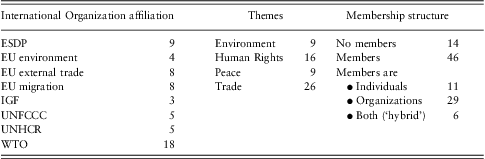
The sample of CSOs used is not random, instead it aims to include exemplary cases from the CSO population. The CSO population can be stratified in ‘ecosystems’ covering themes and IOs active in these themes. Thus, the sampling is nested: CSOs and IOs within certain themes. We chose four of the most prominent themes of international governance today: Trade, Environment, Peace, and Human Rights. Each is covered by a wide range of IOs, differing in their scope and institutional setting. The policy field of trade was covered by two IOs/fora: the WTO and EU External trade policy. Environmental protection was covered by EU Environmental Policy and the UN Framework Convention on Climate Change (UNFCCC). For human rights, three fora were chosen, the UN Human Rights Council (UNHRC), the Internet Governance Forum, and EU Migration policy. Last, for peace, the conglomerate of institutions in the frame of the European Security and Defense Policy (ESDP) was selected. In the paper, we chose the notion ‘forum’, as we refer not only to formal institutions such as Directorates General, but to the whole ecosystem constituted of formal institutions and the CSOs orbiting around them.
CSOs come in different types, and in our sample we tried to gather at least some cases for each. There are classic member CSOs, where only individuals are members, for example, Amnesty International; there are organizations of organizations, for example, EU Associations made up of national-level members like the European Trade Union Confederation; hybrid organizations with both individuals and organizations as members, and CSOs without any members, for which we use the label consultancy CSOs. Some of the latter are based on a foundation combined with an initial donation, others operate in a manner comparable to commercial consultancies, albeit with a clientèle consisting of IOs and governments.
While not a statistically representative survey, the sample includes those mentioned by practitioners as being among the most influential and important in the themes under consideration. Thus, our findings cover a significant ‘part of the action’ in the CSO population. As with other specialist surveys, the sampling was subject to the availability of a contact person. Because the CSOs differ substantially in many features, the analyses presented are based only on those features, which are comparable across the sample. While we cannot say anything definitive about the entire universe of transnational CSOs, or about the properties determining the importance of a CSO, we can say something about the degree to which CSOs fulfill criteria of legitimacy, what patterns exist between membership, legitimacy, and activities, and whether the most prominent CSOs in a certain policy field share some distinct features (see Table 1).
Sample composition
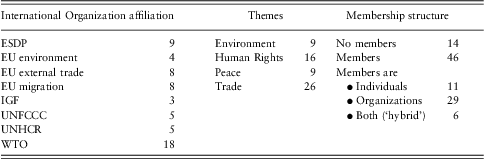
ESDP = European Security and Defense Policy; EU = European Union; IGF = Internet Governance Forum; UNFCCC = UN Framework Convention on Climate Change; UNHCR = UN Human Rights Council; WTO = World Trade Organization.
Action Aid; Asian Legal Resource Center/Asian Human Rights Commission; Amnesty International EU Office; Swiss Coalition of Development Organisations; Amnesty International; Asylkoordination Österreich; Vereinigung für eine Besteuerung von Finanztransaktionen zum Nutzen der Bürger; The CEE Bankwatch Network; BirdLife International; Bund für Umwelt und Naturschutz Deutschland e. V.; BUSINESSEUROPE – The Confederation of the European Business; Climate Action Network International; Churches’ Commission for Migrants in Europe; Christian Aid; Crisis Management Initiative; The Conference of Non-Governmental Organisations in Consultative Relationship with the United Nations; Deutscher Bauernverband; European Citizen Action Service; European Council on Refugees and Exiles; European Network Against Racism; The European Peacebuilding Liaison Office; The European Services Forum; European Trade Union Confederation; Association of Commerce of the European Union; Friedrich-Ebert Stiftung; Foundation for International Law and Development; Friends of the Earth Europe; Franciscans International; The Foreign Trade Association; GERMANWATCH Nord-Süd-Initiative e.V.; Global Communications Platform; Greenpeace e.V. Deutschland; Greenpeace International; Health & Environment Alliance; Human Rights Watch; Institute for Agriculture and Trade Policy; Internationale Handelskammer (German); International Chamber of Commerce; International Centre for Trade and Sustainable Development; International Humanist and Ethical Union; International Institute for Sustainable Development; International Alert; International Crisis Group; International Organisation of Employers; IP Justice; International Security Information Service; International Trade Union Confederation; Oxfam International; Der Paritätische Wohlfahrtsverband; Pax Christi e.V.; The Platform for International Cooperation on Undocumented Migrants; The Quaker Council for European Affairs; The Quaker United Nations Office; Saferworld; Search for Common Ground; SOLIDAR; UN Watch; Women in Development Europe; World Wide Fund For Nature (German Section); World Wide Fund For Nature (International).
CSOs are present at IOs with an advocacy office (AdO), in charge of promoting the CSO's agenda and monitoring the IO's activities. The interviewees were recruited from the AdOs, and questioned about their own and the CSO's connections with citizens and beneficiaries, their activities and roles vis-à-vis the IO, and their resources and activities. The data was gathered using semi-structured interviews with representatives from CSO AdOs targeting three institutional frameworks, the WTO, the EU, and the UN, during autumn 2007 to summer 2008. The interview information was supplemented by data from the CSOs’ homepages. The available documentation varies among CSOs, constraining what indicators can be used. If a CSO mentions that it is financed by industry contributions, for example, this may indicate dependency but the absence of such information does not indicate independence. It does, however, indicate a lack of transparency. As the sample is by no means meant to be representative of the CSO population, we cannot make a statement about the relative frequency of non-member and member CSOs in the population of all CSOs.
A quantitative comparative analysis of transnational CSOs
Roles, resources, and advocacy instruments
The behavior of CSOs vis-à-vis the IOs they are covering is characterized by the roles CSOs pursue, the resources they have at hand, and the activities they engage in.
CSO roles
The interviewees were asked about the roles they play vis-à-vis an IO. Specifically, we asked whether they see themselves in one or several of the following four roles:
(a) ‘Counterpart of the IO’ – the IO has a certain agenda, and the CSOs may try to influence this agenda, either by raising new issues (e.g. social aspects of trade negotiations) or it may explicitly try to counter the IO's mission, that is, argue why the IO should abstain from certain activities.
(b) ‘Partner of the IO in projects’ – some IOs conduct projects, for example, dispensing development aid, and here CSOs may act as partners in executing projects ‘on the ground’. This may be a contractual relationship or more informal.
(c) ‘Provider of information’ – like national-level regulators, IOs need reliable information, in particular on what the problem is, what options there are, and what the likely effects of a certain solution will be for what groups. The IO also needs information on current developments, and some CSOs specialize in monitoring developments and keeping the IO informed.
(d) ‘Counterweight’ – no CSO is alone in the field and in most issues there are several opposing opinions, embodied in CSOs. Unsurprisingly, one role of CSOs is to balance the advocacy efforts of other actors, for example, other CSOs, businesses or states. This ‘counterweight’ characterizes issues with clear distributive effects, for instance where industry and labor interests clash; but also issues without a distributive dimension: in the issue of conflict prevention and human rights, some CSOs reported that they are a counterweight to member states of the IO, which are unwilling to act in a certain way.
CSO resources
CSOs differ with regard to the resources they have at their disposal to engage with IOs. These resources may stem from properties of the CSO (members, media access, information) or from an exchange, for instance the capability to perform tasks for the IO. We asked which of the following resources the CSOs can command to make an IO listen to them:
(a) Providing information – CSOs can be crucial providers of information, exerting influence by giving the ‘right’ information or by exchanging information for influence.
(b) Moral arguments – the CSOs can resort to their moral authority and the moral quality of their arguments in pushing for certain policies.
(c) Representation – the CSOs can claim to speak for a substantial share of the population, not necessarily in their role as political citizens but for instance in their role as employees or employers.
(d) Service provision – CSOs can provide services for IOs, be it by way of formal sub-contracting or in less formal ways, such as monitoring developments.
(e) Direct links – CSOs can have close and personal links to people who make or influence decisions, and can use them as a valuable resource.
(f) Threat potential – CSOs, notably well-organized and multinational CSOs, can make use of their ‘brand name’ and their connection to the public as a means to engage in public action via the national level, or in ‘naming and shaming’.
CSO instruments
Regarding instruments of advocacy, there are several typical activities that CSOs engage in when dealing with an IO:
(a) they can engage in public protest;
(b) they can issue press releases to create public pressure and influence public opinion;
(c) they can submit policy papers in response to invitations or on their own initiative;
(d) they can resort to the classic technique of lobbying IO officials and political decision-makers;
(e) they can participate in formal consultations launched by the IO, where they present their positions.
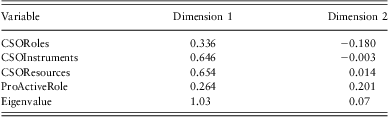
To simplify, the information about the availability of resources, the use of advocacy instruments and roles was combined in three additive indices: The ‘CSORoles’ index summarizes the multitude of roles the CSO can play vis-à-vis the IO. ‘CSOInstruments’ summarizes the instruments typically used by the CSOs. Last, the ‘CSOResources’ index covers the different resources the CSO relies on when influencing the IO. In the analysis, these indices were supplemented by information about whether the CSO engages in a proactive role. While all CSOs react to invitations to participate, deliver opinions to themes set by the IO, and the like, some are actively engaged in securing access and bringing issues to the agenda; this is a ProActiveRole. While there is no information about the success of such activities, it is an important element of the self-concept of the CSO (see Table 2).
Patterns in relations between CSOs and IOs
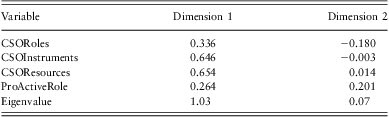
CSO = Civil Society Organization; IO = International Organization.
Remark: N = 60; unrotated factor scores.
Exploring the patterns in roles, activities, and resources of CSOs vis-à-vis the IO, as in Table 2, shows that there is substantial independent variation in the four properties used to describe the CSOs. There is no correlation between the number of available resources and whether the CSO is proactive or only reacts to the IO (e.g. by responding to inquiries from the IO). While most CSOs – 47 out of 60 – are proactive, the more passive 13 neither act in this way because of a lack of resources, nor because they pursue a different set of roles.
There is a significant positive correlation between resources and instruments, in that CSOs with more and different resources also use more political instruments to influence the IO. This is what one would expect, since for a certain activities certain resources are indispensable: for example, lobbying requires direct personal connections to decision-makers. On the other hand, there is no noteworthy correlation between either resources or instruments and the roles of CSOs. It is not the case that CSOs with more resources also see themselves as performing more roles. Rather, they pursue their roles with more instruments and more resources, that is, may be with higher success rates.
Availability of instruments and resources
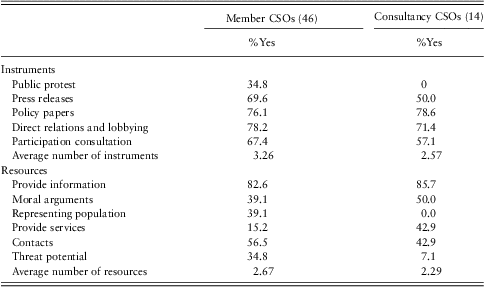
Next, we want to study in more detail whether there is a linkage between having members and a CSO's activities. Do membership-based CSOs have a different set of resources available to them, and thus use a different set of instruments to advocate their positions? To control for alternative explanations, we also compared the properties and activities of CSOs for the different policy fields and the different IOs that the CSOs cover in their work. Table 3 shows the results of our comparison of member CSOs and consultancy CSOs in terms of resources and instruments available for influencing IOs.
Instruments and resources for advocacy
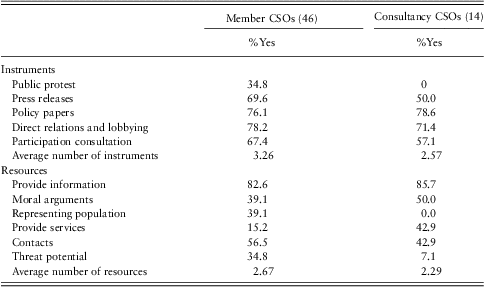
CSO = Civil Society Organization.
The range of instruments of member and consultancy CSOs differs only in that the former also use public protests, and tend to use press releases more often. This demonstrates that having members creates more public visibility in society, with each member acting as multiplier for the CSO. This also creates more media interest for the group. This is not a substitute for other resources, but an additional instrument that member CSOs may use. Their threat potential is based on publicity, either in the form of organizing public protests or addressing the media, cf. the section on media presence below. Consultancies, in contrast, never recur to public protests as an instrument and never argue that they should be heard because they represent large shares of the population. Nor, with the exception of one case, do they perceive themselves as able to avail themselves of, or actually use, threat potential. They more often provide services. In terms of other instruments and resources, the two types of CSOs do not differ substantially.
As for whether CSOs are proactive, there are no systematic differences between member and consultancy CSOs. Most are proactive and there are no noteworthy differences between the proactive and the reactive CSOs in terms of their policy fields, covered IO, resource endowment or type of members.
CSO roles
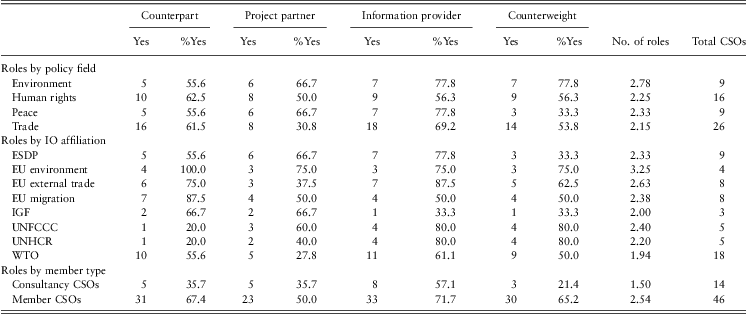
We now want to investigate the roles CSOs pursue vis-à-vis different IOs in more detail. We would presume that roles are determined by members, but also by the policy field and the IO the CSO/AdO is covering. As Table 4 indicates, most CSOs have many roles: the majority of CSOs in whatever policy field, in relation to whatever IO, or of whatever membership type, fulfill multiple roles, on average two. Still, some CSOs state that they do not fulfill any of the four roles, and merely provide organizational infrastructure for other CSOs. Regarding roles in the contexts of various IOs, two IOs stand out: those CSOs tracking the EU Environmental Policy have, on average, the most roles, typically three, while those tracking the WTO have the fewest, typically only one or two.
Roles of CSOs
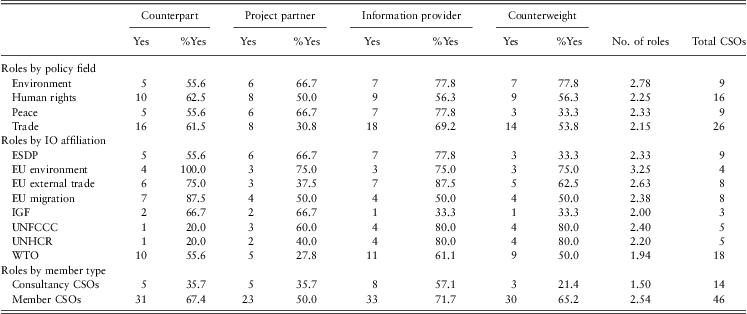
CSO = Civil Society Organization; IO = International Organization; ESDP = European Security and Defense Policy; EU = European Union; IGF = Internet Governance Forum; UNFCCC = UN Framework Convention on Climate Change; UNHCR = UN Human Rights Council; WTO = World Trade Organization.
The more specific findings confirm the a priori expectations: in the policy field of trade, the role of partner in a project is less frequent than in domains where there is project work ‘on the ground’, that is, environment, human rights and peace. Trade-oriented CSOs are slightly more often counterparts with the IO (not surprising given the clear free trade agenda of most trade IOs and the WTO in particular), and less often a counterweight to other interests present in the forum. In the issue area of peace, few CSOs see themselves as a counterweight, simply because there are hardly any organizations against peace. In environmental policy, most CSOs are both information providers and a counterweight, a reflection of the persistent conflict between industry and environmental groups.
When differentiating the picture on the basis of the IOs covered by the CSOs, two IO sub-sectors stand out: the UN Climate and the UN Refugees sectors are not seen as counterparts by the CSOs covering them, a finding one could interpret as an indication that the policies of both IOs are very much along the lines of what the CSOs in this domain want. Contrasting cases are IOs dominated by actors that do not share the views of CSOs in this domain, for instance the EU Migration and the EU External Trade, and to a lesser degree the WTO.
As for the effect of membership, member CSOs pursue 2.5 roles on average, while consultancy CSOs pursue only 1.5, reflecting the fact that consultancy CSOs are much more specialized in their functions, usually as providers of information and services, and not as lobbyists trying to counteract other lobbyists. The differences are slight, however, and one cannot make a statement about whether this finding can be generalized for the universe of CSOs orbiting around a certain IO.
As for the question of whether certain roles are associated with the use of certain instruments, only a very few and weak patterns emerge: CSOs that also see themselves as counterparts to an IO engage less often in direct lobbying. By contrast, ‘partners’ of the IO abstain from public protests as a means to exercise influence and use direct relations and lobbying much more often. The same is true for those who see themselves as providers of information. Regarding the availability of resources, there is no indication that certain roles are associated with certain resources.
CSOs and the public
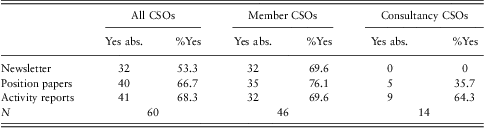
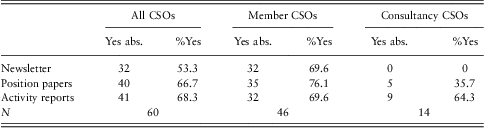
CSOs can, irrespective of their membership structure, contribute to informing the public by publishing newsletters, reports, and policy papers, which not only inform about their own actions but also about events in the area of international governance they cover. Findings in the literature indicate that even this one-way flow of information is basically underdeveloped, presumably for strategic reasons (cf. Altides, Reference Altides2011 for a recent comparative study). What is the situation in our sample? Table 5 below displays the share of CSOs that publish newsletters, position papers, and activity reports that are available to the general public.
Providing information to the public
CSO = Civil Society Organization; abs. = absolute.
Table 5 shows that newsletters, while not per se confined to this function, are a feature of member CSOs, and thus predominantly used to address members. Member CSOs are also more open about what positions they take in a debate, as a more significant amount of them produce political positions papers. When it comes to their own activities, member CSOs and consultancy CSOs are equally open about what they do, as an ample majority publish activity reports.
What can we say about the receiving end of the CSOs’ communication efforts? Studies like Altides’ (Reference Altides2011) and Tresch and Fischer's (Reference Tresch and Fischer2008) indicate that the role of CSOs in publicizing EU politics as well as the resonance of CSOs in national media is low, albeit with substantial cross-national variation. While we cannot engage in something similar to Altides’ content analysis, we did investigate the media presence of our 60 CSOs using the number of mentions in the LexisNexis Press database,Footnote 1 averaged for 3 years, 2007–09.
Analyzing the media presence of CSOs yields some interesting findings, even when considering that these findings are to some degree time specific, depending on current events and fads. On average, each CSO was mentioned in 1544 media reports during the 3 years. The variation is substantial, with some CSOs never mentioned and some CSOs mentioned very often, such as Greenpeace, Amnesty International and Human Rights Watch, with average numbers of mentions of 26,189, 26,153, and 17,040, respectively. These three CSOs together account for 74% of all mentions in the database, a clear indication that a very few CSOs disproportionately dominate the public perception of what transnational CSOs are and do.
There are substantial differences in media presence by issue area. For the 3 years under consideration, Human Rights was the most present theme in the media, giving CSOs tracking this theme (and covering the relevant IOs, EU Migration, and the UNHCR) substantially higher media attention than others (on average 2823 mentions). Media presence is also spread unevenly within different issue areas. In some policy fields, for example, Environment and Human Rights, a few flagship CSOs dominate the scene (Greenpeace, Amnesty); in other fields, such as trade, the spread of media presence is more even.
The main activities and properties of CSOs, notably the degree to which they resort to public pressure as a resource, affects their media presence. CSOs using threat potential and public protests have a much higher media presence than CSOs, which do not resort to such confrontational strategies. This indicates that threat potential in practice means threatening with negative publicity in the media, rather than withholding critical information and ending cooperation in projects with the IO. As for the effect of membership, the most media-present CSOs are those with individuals as members (on average 4928 hits), and consultancy CSOs (on average 1635 hits). Organizations of organizations or hybrid organizations are rarely mentioned in the press.
Consultancies presumably achieve their media presence via their ability to provide essential information. Member CSOs, by contrast, may be mentioned so often because many readers are aware of their existence. Handing out press releases in the course of day-to-day work does not directly create media presence, indicating that CSOs need additional characteristics to be of interest for the media. Still, CSOs transmitting information in our definition are mentioned more than twice as often as CSOs who do not (2267 vs. 867 mentions). CSOs involved in joint projects with an IO are less present in the media than CSOs, which also perceive their role as being a counterpart to the IO.
Taken together, our results on media presence confirm to some degree that there are two disjunct strategies for CSOs, loosely corresponding to the insider–outsider model of interest intermediation (Grant, Reference Grant1978; Broscheid and Coen, Reference Broscheid and Coen2003). A CSO can cooperate with an IO, which leads to a different set of activities, or it can be more confrontational, for which media presence and access to the public are the most important resources.
Member involvement in CSO
In this section we look at the involvement of members in CSOs. Obviously, only membership CSOs can consult with members. We nevertheless found it interesting to investigate how intensive that participation really is, and if membership CSOs really involve their constituencies to a considerable degree. It should be stressed that participatory governance extends beyond the group of CSO members and concerns the involvement of latent groups and beneficiaries. This aspect will be covered in section ‘Good governance criteria’ below. The indicators of member involvement in CSOs are the following:
(a) CSOs should involve members at the strategic and tactical level of decision-making, that is, determining policy aims and how these are pursued. We covered whether strategic- and tactical decision-making procedures involve members through direct consultations (member conferences) or surveys. We called this variable MemberInput.
(b) Participation can also involve members at the operational level. CSOs focus their activities regarding IOs not only in the form of advocating certain policies, but also engage in other activities as well, addressing society at large for instance. Here, members can come into play. Examples are: to provide services for the CSO, to provide ad-hoc input (information, ideas for policy alternatives, etc.), to plan or implement projects with the CSO, to engage in fund-raising, or to evaluate what the CSO does, be it advocacy work or the evaluation of projects. The presence or absence of these types of member involvement were combined in the variable MemberRoleIndex.
Member involvement
The first aspect we want to look at is how members are consulted when the CSO makes decisions about what policies to pursue (strategic aspect), and by what means (tactical aspect).
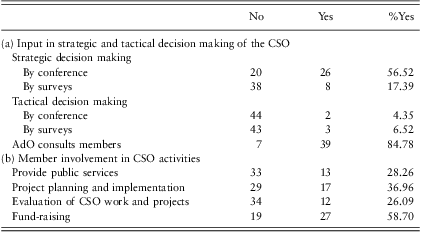
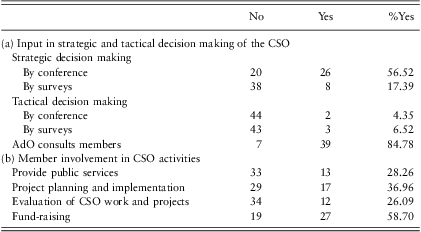
Concerning patterns in relations between CSOs and their members, our results, displayed in section (a) of Table 6, show that member involvement only occurs in half of the cases. Institutionalized consultation with members comes in the form of conferences, and mostly concerns strategic decision-making, while tactical decisions are made by the AdOs. These, however, report that they have in regular, informal contact with individual members, mostly the most committed individuals, on questions concerning their daily work; one respondent aptly referred to some members as the ‘external team’. All AdOs report that they coordinate and consult with staff from other like-minded CSOs when deciding on their efforts, and all AdOs report that they join their efforts with like-minded CSOs, at least on an ad hoc basis.
Member involvement
CSO = Civil Society Organization; AdO = advocacy office.
The correlation between MemberRoleIndex and MemberInput is 0.38; it is significant, but of small magnitude. That members have multiple roles in the CSO's work (such as participating in implementing projects, variable MemberRoleIndex) does not mean that they also have a substantial influence on what the CSO does (e.g. are involved in setting the strategic aims of the CSO's work, variable MemberInput), nor vice versa.
As section (b) of Table 6 indicates, member involvement in executing CSO activities is a fairly rare event: only one-third of all member CSOs in our sample involve their members in their activities. Some CSOs involve members when running projects and providing services to the public, for some CSOs this is indeed their original raison d’être. Feedback on projects, an additional opportunity for members to pass a judgment on the work the CSO is doing, is rarely collected. Only 12 of 46 member CSOs give members the opportunity to give feedback on specific projects. The most frequent role for members, which we regard as qualitatively different from involvement in actual CSO work, is fund-raising, that is, either by making donations or by organizing fund-raising from non-members.
Modes and direction of communication
CSOs can potentially create a link between IOs and citizens by engaging in communication, in particular two-way communication. This may be facilitated if the CSO has members, but the information transmission function is not logically dependent on the membership of individuals. CSOs can send information to members and citizens, ideally enabling them to form an opinion about the IO and the themes it covers, which in turn is the precondition for the emergence of an ‘informed public’. Second, regular communication can serve to receive input from members, supplementing ‘official’ occasions when members are asked for their views via periodical votes, surveys, and elections.
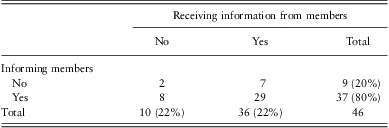
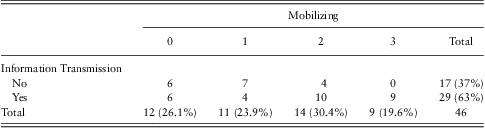
As these are different aspects of communication, several variables were generated. The variable ‘Informing’ covers whether the AdO, when communicating with members, provides information about the issues, solutions, etc. currently being worked on. The opposite direction is covered by the variable ‘Receiving’, capturing whether the AdO is also engaged in receiving information from members when formulating policies and deciding on tactics. Both were combined in the variable ‘InformationTransmission’, which captures whether the flow of information goes both ways. A third motive for communicating with members is mobilizing them to support the CSO and the AdO. Specifically, these efforts consist of convincing members that transnational advocacy is important for achieving the aims of the CSO; to create policy-support for the CSO's position; or to mobilize members, for example, to engage in national-level advocacy efforts. This yields a 0–3 scale; ‘Mobilizing’.
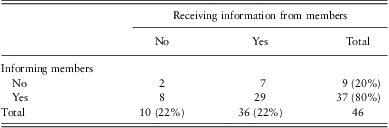
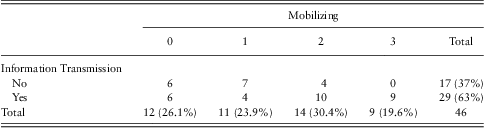
The results displayed in Table 7 show, interestingly, that there is no correlation between whether AdOs engage in informing members and whether they receive information from members. That a CSO has members by no means implies that the AdO – where the actual advocacy work is done – is directly connected to them. At best, there may be intermediate connections via the CSO's main policy-making body. Among the 46 member CSOs in the sample, in 10 cases the AdO failed to report any communication with the aim of receiving direct input from members. If these AdOs communicate, they do so only for the purpose of informing and motivating their members, that is, to influence members’ preferences. Table 8 shows that among the 46 CSOs with members, a majority of 34 also engage in mobilization, while 11 engage in mobilization only without taking input from members.
Communication with members
Remark: Member Civil Society Organizations only; Correlation: 0.01.
CSOs as information transmitters and mobilizers
CSO = Civil Society Organization.
Remark: Member CSOs only, correlation: 0.39 (significant at the 5% level).
Good governance criteria
In section ‘Member involvement in CSO’, we sketched the role that members play in CSOs, if they have them. In this section we return to the structured comparison of member and non-member CSOs. Are membership CSOs doing better than others with regard to generally accepted criteria of good governance? We studied transparency, accountability, and inclusion efforts.
Transparency
A CSO should be transparent in what it does, advocates, about how it makes its decisions, and also about the content of its decisions. It should be clear where its funding comes from, and where it goes. As empirical indicators of CSO transparency we included transparency about (a) the internal policy-making process and (b) funding.
(a) Organizational transparency concerns the following questions: Are the substantive positions of the CSO documented in position papers and conference reports? Is it clear what the CSO does, for example, are annual activity reports published? As for internal workings, transparency implies that how CSOs make decisions is clear. Is something like the ‘constitution’ online, laying out how the various committees and boards are determined and how substantive policy decisions are made in the CSO? This information was combined into an index, TransparencyOrganizational.
(b) Financial transparency concerns whether sources of financing (government grants, IO grants, private donations, etc.), the overall size of the budget, and its use (projects, fund-raising activities, salaries, etc.) are publicly accessible. These items of information were combined into an index, TransparencyFinancial.
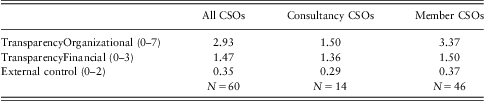
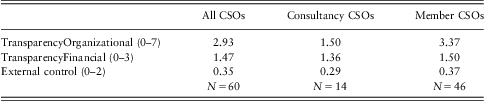
Given that many CSOs claim to speak not only for their members but for the public in general, they should also be open to the public, and the internet is the current mode of achieving that. To measure the institutionalized accountability of CSOs, we created an index of ExternalControl, which covers whether the CSO subjects itself to some form of external auditing in order to ensure the quality of its governance. We investigated whether the CSO is (1) subject to a financial audit on a regular basis, and whether it (2) abides by an external code of conduct, for example, the EU's ‘Code of Conduct for Interest Representatives’. The aggregated results for the 60 CSOs are displayed in Table 9 below.
Levels of transparency and external control
CSO = Civil Society Organization.
Remark: Averages of scales for member/non-member CSOs.
Overall levels of transparency are substantially below the possible levels defined by our criteria. Member and consultancy CSOs do not differ much in terms of their transparency in financial matters and external controls. Still, consultancy CSOs are typically less transparent in financial and organizational terms compared with member CSOs, and the largest difference is in terms of organizational transparency, a finding that is due to the fact that member CSOs describe the roles and procedures of member conferences in some detail, while consultancy CSOs do not elaborate on how they arrive at policy decisions. The effect of membership on the transparency of CSOs thus seems to be beneficial but limited.
Accountability
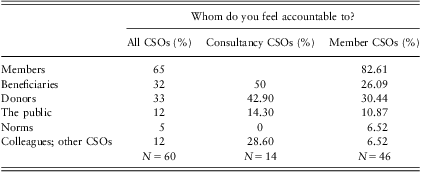
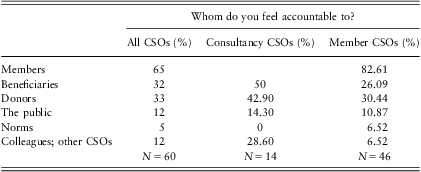
Accountability is generally seen to be an asset for all types of organizations, not just CSOs. In our research we were, first of all, interested in whom the interviewees actually felt they were accountable to, and we asked them to pick one or more options from a list. The results are shown in Table 10 below.
Perceived accountability relations of CSO officials
CSO = Civil Society Organization.
If a CSO has members, it is highly likely that the respondent (also) feels accountable to them. For both member and non-member CSOs, accountability to donors is high. The most notable difference is that non-member CSOs (consultancies) twice as often also feel accountable to the ultimate beneficiaries of their efforts, while an astonishing 75% of member CSOs feel no such accountability. As will be shown below, this lack of accountability to beneficiaries is not reflected in differences in a CSO's actual inclusion efforts. In addition, the peer group effect of seeing oneself in reference to other CSOs working in the same issue area or to colleagues is much higher among the consultancy-type CSOs. As for the question of whether CSOs also bear the general public in mind, the evidence is to the contrary: norms and the general public (including future generations) do not feature prominently among the entities mentioned.
Inclusion efforts
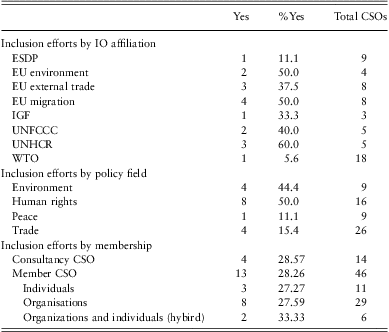
Inclusion efforts – including specifically those groups that are affected by policies and are most likely to be ‘forgotten’ – are an asset to CSO governance. CSOs should reconnect with beneficiaries and hence ask people ‘on the ground’ for their opinions, whether they support or oppose the CSO policy proposal. During the interviews, two practices proved to be relevant in this context: first, giving grants, usually travel grants, so that certain people could attend meetings and conferences; second, quota rules stating that board or staff members must be from certain groups. As the occurrence of such efforts is quite rare, we coded the InclusionEfforts variable as binary, in terms of yes or no.
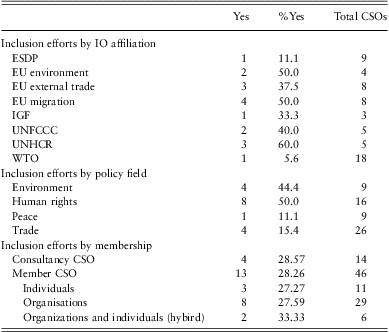
What can we say about the occurrence of inclusion efforts on the basis of the CSO's theme, that is, the policy field and the IO covered? One could argue that in issue areas where the risks and consequences of not including beneficiaries are severe, CSOs acknowledge this and react by increasing their inclusion efforts. The risks and potential consequences of not including beneficiaries are, for instance, highly relevant in themes concerning Third World countries, where there is potentially a large gap in terms of world-views and preferences between beneficiaries and CSO staff. The same argument holds for IOs covering these themes. Table 11 displays inclusion efforts calculated by policy field, by IO and membership.
Inclusion efforts of CSOs
CSO = Civil Society Organization; IO = International Organization; ESDP = European Security and Defense Policy; EU = European Union; IGF = Internet Governance Forum; UNFCCC = UN Framework Convention on Climate Change; UNHCR = UN Human Rights Council; WTO = World Trade Organization.
While inclusion efforts among CSOs tracking the policy field of trade and the WTO are low, inclusion efforts are lowest for those CSOs in the policy field of peace. Only one in nine CSOs reports efforts to include those who are ultimately affected by the activities of the IOs the CSO seeks to influence. Even in the domain of Human Rights, only half of the CSO sample engage in active inclusion efforts. As for the effect of membership, the two CSO types do not differ in their inclusion efforts. Notably, it is not the case that consultancy CSOs, which are less connected with citizens by way of immediate member participation, compensate for this by engaging more heavily in inclusion. Given that InclusionEfforts referred to the inclusion of beneficiaries in internal decision-making, and given the fact that in consultancies there is no decision-making in the sense comparable to member CSOs, consultancies may use other means to obtain information about the preferences of their beneficiaries.
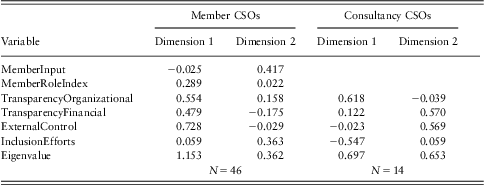
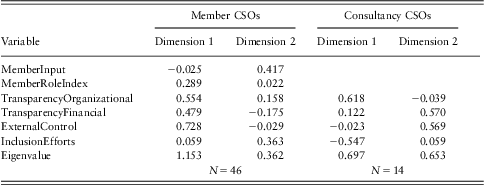
We now present (Table 12) an overview of our results, comparing patterns of legitimacy in the two groups of CSOs.
Legitimacy patterns among member and consultancy CSOs
CSO = Civil Society Organization.
Comparing the two CSO types reveals a differing pattern of legitimacy. Among member CSOs there is no evidence that where members are involved in many roles in the organization, they also have more access to policy-making, cf. also Table 6 above. Involvement in activities, mostly in terms of fulfilling functions for the CSO, seems to be independent of setting the course of the CSO. There is a pattern, however, in that member CSOs either consistently try to connect with citizens or consistently exclude them: if CSOs give members access to policy-making, they also engage more often in inclusion efforts. In a similar vein, organizational transparency, financial transparency, and external control (submission to external audit and codes of conducts) go together among member CSOs. If member CSOs engage in creating transparency, they are transparent in all regards, and vice versa. Still, as shown in Table 9 above, transparency among member CSOs is not substantially higher than among consultancy CSOs.
Among consultancy CSOs, the resulting pattern of governance differs: transparency in financial terms is one distinct dimension, while organizational transparency constitutes, together with inclusion efforts, a second, largely independent dimension. Moreover, consultancies that offer more details about their internal workings are putting less effort in including beneficiaries.
The solution obtained, in particular the low factor loadings, indicates that while there is some kind of pattern, the manifest legitimation criteria are to a great degree independent of each other. If a CSO is highly legitimate in one aspect, it is not necessarily highly legitimate in all other aspects. Regarding membership structures, we could hypothesize that if citizens are involved, they might insist on the observance of other criteria of legitimacy, such as transparency or inclusion. Yet this does not turn out to be the case. The low factor loadings also indicate substantial independent variation in the legitimacy variables.
Summary and outlook
In this paper, we studied the degree to which a range of diverse CSOs fulfill certain criteria of organizational legitimacy, and how membership structures relate to their resources, instruments, and activities in dealing with IOs. We also tested for systematic patterns between legitimacy, membership structure, and the policy field of the CSO. What is striking in the results is the large variation we find, and the lack of certain patterns one would expect. Notably, it is not the case that CSOs from a certain policy field are characterized by shared features, neither in terms of legitimacy nor in their dealings with IOs. We take this to be an indication that the task of advocacy in the setting of an IO is largely functionally similar across all themes (thus no similarities based on IO affiliation) and that CSOs have endogenous organizational traditions (thus a large variation between CSOs in terms of roles and strategies).
As for differences between member and non-member CSOs (‘consultancies’) in their activities, they are limited: member CSOs have the option to launch public protests and to build up public pressure. This can work because many of them, such as Greenpeace and Amnesty International, are household names, while some consultancy CSOs, like International Alert, are not known to the wider public. The availability and usage of these strategies implies a more critical role vis-à-vis the IO. Consultancy CSOs rely more on providing services and information to the IO, which implies a more cooperative role.
As for their role of contributing to a public debate by providing the public with information about IOs and international governance, the member CSOs in our sample do not provide more information to the public than others, nor do they function particularly well as transmitters of information from citizens (or at least from their members) up to the IO level. Qualitative information obtained in the interviews suggests that there is a notable gap between the CSO, which may be controlled by members, and the AdO, in that all AdO staff interviewed reported substantial leeway in terms of the aims and tactics they pursue. As for the criteria of good governance and organizational legitimacy, the overall finding is that the CSOs sampled show low levels of legitimation, typically remaining well below what is possible and what at least some CSOs achieve. Having members is no guarantee that other criteria of legitimacy, such as inclusion or transparency, are achieved. The transparency of most CSOs, according to the criteria we apply, is low. Yet again, some CSOs are outstanding in terms of transparency because they provide detailed financial reports, which are also audited on a regular basis.
In summary, our research shows that having members does not automatically render CSOs more connected to their societal constituencies. Not all CSOs that have members consult with them, or provide them with ways and means to influence their internal agenda-setting and policy-making. In other words, the fact that a CSO has a good number of members is no guarantee that it is in touch with society; nor does having a membership base correlate positively with compliance to standards of good governance (except transparency). We should make it clear, however, that there are single CSOs that seem to be extremely attentive to standards of good governance across the board, including consulting with their members and those affected by their work. In the future, researchers should study these organizations in more depth in order to identify the dynamics behind their good performances. As our evidence clearly shows, the question of membership is secondary in this respect.