Introduction
‘Nutritional programming’ is a concept used to describe a permanent change in the structure or function of an organism caused by a food or food component during early development. Programming by early diet may provide a safe and practical approach for optimizing bone health throughout life. Although some aspects of programming by early diet can be investigated directly in humans, mechanistic studies often require appropriate use of animal models to closely mimic the human scenario. The CD-1 mouse model is commonly used to assess biological effects of exposure to isoflavones (ISO) during early life, including effects on bone development.Reference Piekarz and Ward1–Reference Kaludjerovic and Ward3 We previously reported in CD-1 mice that neonatal exposure to ISO, resulting in similar total serum ISO levels as human infants fed soy protein formula, favorably programs bone health in females at adulthood. The benefits include higher vertebral bone mineral density (BMD) and improved structure (greater trabecular thickness and connectivity) that translate to stronger lumbar vertebrae (LV) at 4 months of age, representing young adulthood.Reference Kaludjerovic and Ward2, Reference Kaludjerovic and Ward3 Although the mechanism of these programming effects has not been elucidated, ISO are selective estrogen receptor modulators that can bind to estrogen receptors to elicit estrogen-like responses in bones, ovaries, uteri, prostate, the central nervous system and the cardiovascular system but inhibit estrogen stimulation in the breast and endometrium.Reference Klein, Nahin and Messina22 As such, exposure to ISO during sensitive stages of development offers the possibility of permanent alterations in bone-specific gene expressionReference Bronikowski, Carter and Morgan4 or rapid non-genomic action that modulates a diverse array of intracellular signal transduction cascades that affect processes associated with bone metabolism.Reference Losel, Falkenstein and Feuring5 To date, published studies investigating early life exposure to ISO and bone development have used a 5-day dosing protocol, starting at postnatal day (PND) 1 and ending on PND 5. To more closely represent the duration of exposure (first year of life) that human infants are fed soy protein formula, the protocol was lengthened such that mice are exposed to ISO throughout suckling (the first 21 days of life). The objective of this study was to determine if exposure to ISO from birth throughout suckling enhances the previously observed positive effects of 5-day exposure to ISO on LV and, unlike the 5-day protocol, has favorable effects on femur outcomes at young adulthood.
Methods
Animals and treatment
Six-week-old outbred CD-1 mice (Charles River Laboratories, St Constant, Quebec, Canada) were housed in the Department of Comparative Medicine at the University of Toronto under standard environmental conditions (12 h light and 12 h dark cycle; 23°C), were provided water ad libitum and fed a semi-purified casein-based diet devoid of ISO (AIN93G; Dyets Inc., Bethlehem, PA, USA).Reference Reeves6 After 2 weeks of acclimatization to the environment and diet, mice were bred harem style. Once females were identified as being pregnant they were housed in individual cages until pups were born. Offspring of six different dams that delivered on the same day were studied. To avoid a littermate effect, cross-fostering was performed at birth and a maximum of one male and one female pup from each dam was assigned to each of the six litters. Cross-fostered litters were subsequently randomized to corn oil or ISO treatment from PND 1 through 21. Control (CON) pups (n = 24–30) received corn oil as it is used as the vehicle for ISO.Reference Kaludjerovic and Ward2, Reference Kaludjerovic and Ward3 The group receiving ISO (n = 24–30) was administered a daily dose containing daidzein and genistein, the two major ISO in soy infant formula. The dose of ISO, 2 mg of daidzein and 5 mg of genistein/kg of body weight, resembles the quantity and ratio of each ISO in soy protein formula,Reference Setchell, Zimmer-Nechemias and Cai7 and mimics the total circulating ISO levels of human infants fed soy protein formula.Reference Kaludjerovic and Ward2, Reference Setchell, Zimmer-Nechemias and Cai8 Treatments were administered via a single daily subcutaneous injection with a total volume of 20 μl/pup/day. On PND 21, gender was determined and females were housed 3–4 per cage (male offspring were not studied beyond PND 21). Body weight was measured once weekly and mice were studied to 4 months of age, which is the time when peak bone mass is established in this mouse strain.Reference Ward, Piekarz and Fonseca9 Femurs and LV1–LV4 were excised and stored at −80°C until analyses were performed. All experimental procedures respected the policies set out by the Canadian Council on Animal Care and were approved by the University of Toronto Animal Ethics Committee.10
Bone mineral content (BMC) and BMD of femurs and LV1–LV3
BMC and BMD of the femur and intact spine (LV1–LV3) was determined by dual energy X-ray absorptiometry (pSabre, Orthometrix, White Plains, NY, USA) and a specialized software program (Host Software Version 3.9.4; Scanner Software Version 1.2.0) that scanned bones in air at a speed of 2 mm/min with a resolution of 0.01 mm × 0.01 mm as previously described.Reference Kaludjerovic and Ward2, Reference Kaludjerovic and Ward3
Microarchitecture of the femur and LV4
Microcomputed tomography (GE Healthcare System, Model No. MS0900325-0010) was used to analyze the microarchitecture of trabecular bone as previously described.Reference Kaludjerovic and Ward2, Reference Kaludjerovic and Ward3 Trabecular bone was evaluated at LV4 and femur neck. To analyze a specific bone volume, a contoured region of interest (ROI) was created using the advanced ROI module (MicroView Version ABA 2.2). For femur neck analysis, the ROI was defined from the top of the growth plate to the narrowest part of the femur shaft.
Biomechanical strength properties of femurs and LV2
Biomechanical strength properties of the right femur and LV2 were measured using a material testing system (Model 4442, Intron Corp., Canton, MA, USA) and specialized software (Series IX Automated Materials Tester, Version 8.15.00) as previously described.Reference Piekarz and Ward1–Reference Kaludjerovic and Ward3, Reference Fonseca and Ward11
Statistical analyses
Statistical analyses were performed using SigmaStat (Version 3.5, Jandel Scientific, San Rafael, CA, USA). Results are expressed as mean ± s.e.m. Student's t-test was used to compare the outcomes between the CON- and ISO-treated groups. Pearson coefficient of determination (r 2) was used to examine the relationship between vertebral bone volume/total volume (BV/TV) and stiffness as well as BV/TV and peak load for the CON- and ISO-treated groups. Statistical significance was defined as P < 0.05.
Results
Body weight at weaning (CON 12.2 ± 0.36 g; ISO 12.1 ± 0.25 g) and week 4 (CON 22.4 ± 0.68 g; ISO 25.4 ± 0.4 g) did not differ between CON- and ISO-treated mice. At week 6 (CON 25.0 ± 0.87 g; ISO 29.6 ± 0.70 g) and week 8 (CON 26.7 ± 1.17 g; ISO 32.2 ± 0.69 g) ISO-treated mice had higher (P < 0.05) body weight than the CON group.
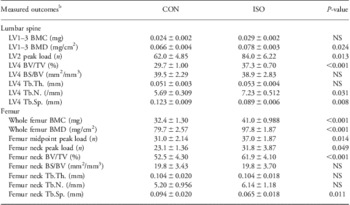
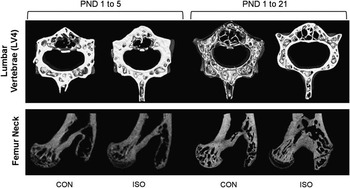
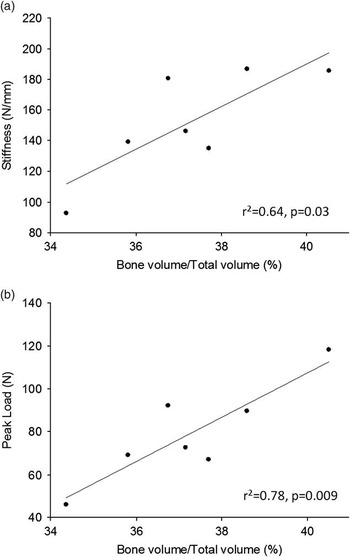
The ISO intervention resulted in higher (P < 0.05) BMD of LV1–3 (Table 1); higher (P < 0.05) trabecular number (Tb.N.) and lower (P < 0.05) trabecular separation (Tb.Sp.) of LV4 (Table 1); and greater (P < 0.05) peak load of LV2 (Table 1) compared with the CON group. The ISO intervention also resulted in higher (P < 0.05) BV/TV of LV4 (Table 1) compared with the CON group. Qualitative assessment demonstrated that the ISO group had improved trabecular network at LV4 compared with the CON group (Fig. 1). There was no significant coefficient of determination for vertebral BV/TV and stiffness, or BV/TV and peak load among mice exposed to corn oil. In contrast, the coefficient of determination of vertebral BV/TV and stiffness (r 2 = 0.64) as well as vertebral BV/TV and peak load (r 2 = 0.78) were significant (P < 0.05) for the ISO group (Fig. 2). These findings indicate that the variability in vertebral BV/TV can predict the variability in vertebral stiffness and peak load by 64% and 78%, respectively.
BMD, peak load and trabecular bone parameters at the spine and femur with 21-day ISO exposureFootnote a

BMD, bone mineral density; ISO, isoflavones; CON, control; LV, lumbar vertebrae; BMC, bone mineral content; BV/TV, bone volume/total volume; BS/BV, bone surface area/bone volume; Tb.Th., trabecular thickness; Tb.N., trabecular number; Tb.Sp., trabecular separation.
a Values are expressed as mean ± s.e.m. Statistical significance was defined as P < 0.05.
b Sample size was n = 10–14 for BMC, BMD and peak load; and n = 6–7 for outcomes of bone structure.
Representative microcomputed tomography images of the lumbar vertebrae (LV4) and femur neck. The trabecular network is visibly improved at the lumbar spine in ISO-treated females compared with CON. The cortical thickness of ISO-treated females is visibly improved at the femur neck compared with all other treatment groups. PND, postnatal day; CON, control; ISO, isoflavones.

Relationship of bone volume/total volume (BV/TV) and (a) stiffness or (b) fracture load of female mice exposed to ISO.

Whole femur BMC and BMD, as well as femur neck and femur midpoint peak load were higher (P < 0.05) in the ISO group compared with the CON group (Table 1). BV/TV was higher (P < 0.05) and Tb.Sp. was lower (P < 0.05) in the ISO group compared with the CON group (Table 1). Qualitative assessment at the femur neck for females exposed to ISO showed greater trabecular connectivity and cortical thickness than all other treatment groups (Fig. 1).
Discussion
Exposure to ISO from birth to 21 days of age resulted in greater effects at the lumbar spine and femur than 5-day exposure to ISO. Although it had been previously shown that the first 5 days of life provides a window of opportunity for programming of bone development by early diet,Reference Piekarz and Ward1–Reference Kaludjerovic and Ward3 findings from this study suggest that the window of opportunity exists beyond this age. Thus, duration of exposure to ISO is a factor to consider when using this animal model to mimic the human infant scenario.
Our studies have shown that skeletal sites rich in trabecular bone (i.e. lumbar spine) are more easily influenced by ISO than sites rich in cortical bone (i.e. femur midpoint).Reference Piekarz and Ward1–Reference Kaludjerovic and Ward3 This may be because trabecular bone has a higher surface-to-volume ratio and is more metabolically active. Although both the 5- and 21-day exposure to ISO improved trabecular connectivity of the lumbar spine in female CD-1 mice by increasing Tb.N. and decreasing Tb.Sp., only the 21-day exposure improved the apparent bone density (BV/TV) at the lumbar spine as well as the femur neck. These improvements in apparent bone density (BV/TV) suggest that longer duration of ISO exposure is needed for trabeculae to be significantly resorbed with bony tissue and merged into cortical bone, which is abundant in the femur. This is important because a small improvement in bone mass and structure during adolescence lowers the risk of fracture in later life.Reference Eisman, Kelly and Morrison12 Observational studies indicate that a 5% increase in bone mass at young adulthood can reduce fracture risk by 40% during aging.Reference Johnston and Slemender13, Reference Johnston, Miller and Slemenda14
The apparent bone density (BV/TV) of ISO group was significantly correlated with stiffness (r 2 = 0.63) and peak load (r 2 = 0.78) at the lumbar spine. This discovery is similar to findings in humans and identifies that improvements in bone volume induced by ISO exposure can predict the probability of vertebral fracture by 78% in the mouse model. Chevalier et al.Reference Chevalier, Quek and Borah15 showed that there is a strong correlation between increases in BV/TV and increases in vertebral stiffness and failure load among alendronate and risedronate treated postmenopausal women with osteoporosis. Thus, the relationship of BV/TV and stiffness, and BV/TV and failure load exists in both this mouse model and older humans. Vertebral fractures are the most common manifestation of osteoporosis and account for nearly half of all fractures.Reference Ensrud and Schousboe16 Fracture prevention has largely focused on attenuating the rate of age-related bone loss and reducing falls during older age. Findings from this study suggest that early life nutrition is also an important consideration when developing lifestyle approaches to improve bone health throughout the life cycle.
In addition to effects on bone, prolonged ISO treatment induced weight gain at an earlier stage of life than 5-day exposure. Our published data shows that female mice exposure to ISO (7 mg/kg body weight/day) from birth to 5 days of life have higher body weight than CON mice from 28 weeks of age, but not at earlier stages of development.Reference Kaludjerovic and Ward3 Findings from other researchers indicate that higher doses of ISO (50 mg kg/body weight/day) from PND 1 to 5 result in higher body weight at 12 and 16 weeks of age.Reference Newbold, Padilla-Banks and Snyder17 In this study, the body weight of ISO-treated females was higher at 6 and 8 weeks of age. Therefore, the dose as well as the duration of ISO exposure may program the time when female mice begin to gain weight.
The timing of when ISO exposure should be introduced in the developing mouse model to mimic human infants fed soy protein formula has been debated.Reference Reinwald and Weaver18, Reference Dinsdale and Ward19 Mice suckle for the first 21 days of life and thus, it could be argued that ISO exposure should take place during suckling to mimic the stage of development in which human infants are fed soy protein formula. However, unlike human infants, mice reach sexual maturation 3 weeks post weaning, a much shorter duration between neonatal life and sexual maturity. To better understand the time of life when peak bone mass and strength is reached in the CD-1 mouse, we previously established that BMC, BMD and peak load of femur and lumbar spine were similar between 3 and 4 months of age, demonstrating that peak bone mass is attained by 4 months of age in the CD-1 mouse.Reference Ward, Piekarz and Fonseca9
It is hypothesized that the programming effects on bone may be mediated through permanent estrogen receptor-induced changes in gene expressionReference Bronikowski, Carter and Morgan4 or through non-genomic action that modulates a diverse array of intracellular signal transduction cascades.Reference Reinwald and Weaver18, Reference Unfer, Casini and Costabile20 Moreover, exposure to ISO during early postnatal life has the potential to exert biological effects that would otherwise be diluted in the presence of higher endogenous sex steroid concentrations that exist at later stages of the life cycle.
Establishing an animal model to study ISO exposure to human infants requires careful consideration of the dose and composition of ISO, the route of ISO administration, as well as the duration and frequency of ISO exposure. Our previous research has shown that the dose and ratio of ISO (5 mg of genistein and 2 mg of daidzein per kg of body weight) used in this study result in total serum levels of ISO, specifically daidzein and genistein, that are similar to those of human infants fed soy protein-based infant formulas.Reference Kaludjerovic and Ward2 Moreover, during early postnatal life, both human infants and rodents have a poorly developed microflora that limits their ability to metabolize daidzein to equol, the most estrogenic metabolite of ISO. Route of administration has also been studied.Reference Kaludjerovic, Franke and Ward21 Because of small size of mice from birth through the first days of life it is technically challenging to administer ISO orally and thus, administering ISO by subcutaneous injection is more commonly used. Recent findings have shown that oral v. subcutaneous delivery, and once daily v. multiple oral doses per day does not result in significantly different levels of total serum ISO in neonatal CD-1 mice.Reference Kaludjerovic, Franke and Ward21 This study is the first to evaluate how duration of ISO exposure during postnatal life affects peak bone mass, bone structure and bone strength of female CD-1 mice.
In conclusion, the present study further characterizes the CD-1 mouse model by identifying that longer duration of exposure to ISO has more profound benefits to bone health at multiple skeletal sites than the previously used 5-day exposure. Future studies should consider the duration of ISO exposure when using the CD-1 mouse model to evaluate the effect of early life exposure to ISO on programming of bone development. This mouse model may also be useful for studying effects of other environmental estrogens on bone development. Examples include bisphenol A, diethylstilbestrol (DES), dichlorodiphenyltrichloroethane (DDT) and dioxin. Duration of exposure to such environmental estrogens may be an important consideration when extrapolating findings to understand effects of exposure to human infants.
Acknowledgments
J. Kaludjerovic received graduate student funding from a Frederick Banting and Charles Best Canada Graduate Scholarship through the Canadian Institutes of Health Research. This study was supported by a grant from the Canadian Institutes of Health Research to W. E. Ward (funding reference number 89941).