Introduction
Characteristics of habitats occupied by hosts may explain the presence of certain parasites in a host population through the effects of environmental factors (temperature, humidity, soil composition, etc.) on the survival of infective stages (cysts, eggs or larvae) that are free in the environment (Poulin & Morand, Reference Poulin and Morand2004). The overlapping geographical distribution of different host species (sympatric distribution) facilitates the transfer of parasites, and as a result it is common to find a higher species richness in those hosts that have broad geographic ranges, compared to those with restricted ranges (Poulin & Morand, Reference Poulin and Morand2004; Morand et al., Reference Morand, Krasnov, Poulin, Degen, Morand, Krasnov and Poulin2006). Moreover, islands are characterized by a significant reduction in species richness compared to continental areas of similar size (MacArthur & Wilson, Reference MacArthur and Wilson1967). Thus, host species with good dispersal ability, widespread and abundant in their native range, are favoured on islands (Sarà & Morand, Reference Sarà and Morand2002). These host species that successfully establish themselves on an island do not harbour the entire community of parasites that is observed in the area from which they originated. Rather, on the island the host retains but a specific subset of parasite species. In fact, while host species may be successful, parasites must themselves find conditions for survival. These include, among others, the presence of suitable intermediate or definitive hosts, or environmental conditions that allow the free-living stages to survive (Torchin et al., Reference Torchin, Lafferty, Dobson, McKenzie and Kuris2003; Torchin & Mitchell, Reference Torchin and Mitchell2004; Magnanou & Morand, Reference Magnanou, Morand, Morand, Krasnov and Poulin2006).
The large hairy armadillo, Chaetophractus villosus (Desmarest, 1804) (Xenarthra: Dasypodidae), is the most abundant armadillo in Argentina, and it is found in a wide range of habitats, including pampas, Chaco dry forests, savannas, forests and agroecosystems (Reference Abba, Tognelli, Seitz, Bender and VizcaínoAbba et al., Reference Abba, Poljak and Superina2012, Reference Abba, Poljak, Gabrielli, Teta and Pardiñas2014). It is a carnivorous–omnivorous mammal with a high consumption of coleopterans (both larvae and adults) and plant material (Abba & Cassini, Reference Abba, Cassini, Vizcaíno and Loughry2008). Poljak et al. (Reference Poljak, Confalonieri, Fasanella, Gabrielli and Lizarralde2010), based on the phylogeography of the species, proposed the Pampean Region as the origin for C. villosus because they found a dominant haplotype in this region, and the largest number of derived haplotypes. Also, the oldest fossils of Euphractinae were found in the same region (Carlini & Scillato-Yané, Reference Carlini, Scillato-Yané, Rabassa and Salemme1999; Soibelzon et al., Reference Soibelzon, Carlini, Tonni and Soibelzon2006). Chaetophractus villosus is distributed from the Bolivian Chaco and Paraguay in the north to southern Santa Cruz in Argentina and the Magellan's Region in Chile (Abba et al., Reference Abba, Poljak and Superina2014a). Abba et al. Reference Abba, Poljak, Gabrielli, Teta and Pardiñas(2014b) argue that C. villosus entered and colonized all of Patagonia during the past 100 years. Approximately 30 years ago, this species was introduced in Tierra del Fuego and it was established in the San Sebastián Bay area (Poljak et al., Reference Poljak, Escobar, Deferrari and Lizarralde2007, Reference Poljak, Confalonieri, Fasanella, Gabrielli and Lizarralde2010).
The archipelago of Tierra del Fuego is located at the southern tip of South America, separated from the mainland by the Magellan Strait. The terrestrial mammal fauna consists of about 30 species, of which 66% are species introduced by humans (e.g. beaver, mink, rabbit) (Massoia & Chebez, Reference Massoia and Chebez1993; Poljak et al., Reference Poljak, Escobar, Deferrari and Lizarralde2007). To date, few parasitological studies of the mammal fauna from Tierra del Fuego have been conducted (Navone & Merino, Reference Navone and Merino1989; Zanini et al., Reference Zanini, Laferrara, Bitsch, Pérez and Elissondo2006).
In summary, the conditions described above make the Tierra del Fuego population of C. villosus a good model for study. In the present work we compare diversity of parasite species of C. villosus in its native population and in another recently introduced population (Tierra del Fuego), and evaluate whether the isolation and/or climatic conditions of the latter determine a change in its parasitic diversity.
Materials and methods
Armadillos were sampled in two different provinces of Argentina: five locations in Buenos Aires (native population) and one in Tierra del Fuego (introduced population). The native population occurs in the Pampas ecoregion, which is characterized by a temperate sub-humid to humid climate, with average rainfall ranging from 600 mm/year in the southwest to 1100 m/year in the northeast and average temperatures of 18°C in the north and 15°C in the south. The typical vegetation is temperate grassland, and soils are mollisols with high amounts of organic matter (Burkart et al., Reference Burkart, Bárbaro, Sánchez and Gómez1999). The introduced population occurs in the Patagonian steppe where the climate is cold and dry with mean annual temperatures ranging between 5 and 8°C. Strong winds are frequent, with snow in winter and frosts most of the year. The vegetation consists of xeric grasslands with predominance of ‘coirones’ (Festuca gracillima) (Burkart et al., Reference Burkart, Bárbaro, Sánchez and Gómez1999). Forty specimens of C. villosus were collected overall: 21 from the native population (33–39°S, 57–63°W; Buenos Aires province, Disposition 10/08, Ministerio de Asuntos Agrarios de la Provincia de Buenos Aires), and 19 from the introduced population (53°20′S, 68°10′W; Tierra del Fuego island, collected by Poljak et al., Reference Poljak, Confalonieri, Fasanella, Gabrielli and Lizarralde2010). The digestive tracts of the specimens were fixed in a 10% formaldehyde solution and dissected in the laboratory. Nematodes were preserved in 70% ethanol, cleared in lactophenol, mounted on a slide under a cover slip, and examined using an Olympus BX51 compound microscope (Olympus Corporation, Tokyo, Japan). Prevalence (P), mean intensity (MI) and diversity (H) were calculated by population. Population parameters were compared between the insular colonizing population and the native population. Prevalences were analysed using the chi-square test and/or Fisher's exact test (α = 0.05). Mean intensities were compared using the t-test, while the stochastic equality of intensity distributions was evaluated through non-parametric Wilcoxon–Mann–Whitney, Brunner–Munzel and bootstrap tests, using the program Quantitative Parasitology 3.0 (Rózsa et al., Reference Rózsa, Reiczigel and Majoros2000; Reiczigel & Rózsa, Reference Reiczigel and Rózsa2005).
Results and discussion
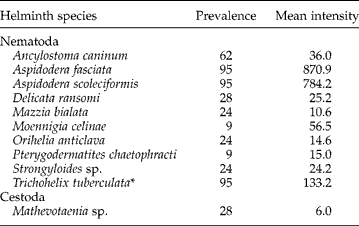
All individuals sampled in the native population were parasitized, while in the Tierra del Fuego population the prevalence was 89%. The parasite diversity in the native population was high, with 11 parasite species (H = 1.13), but only one parasite species was present in Tierra del Fuego, Trichohelix tuberculata (table 1). When prevalence and mean intensities of T. tuberculata between the two host populations were compared, no significant differences were observed (P= 0.489; P= 0.43 respectively).
Prevalence (%) and mean intensity of infection of helminth species in the native population of Chaetophractus villosus.

* The introduced C. villosus population on Tierra del Fuego island had a prevalence of 89% and mean intensity of 84.2.
Torchin et al. (Reference Torchin, Lafferty, Dobson, McKenzie and Kuris2003) analysed parasitological data of seven different taxa (molluscs, crustaceans, fishes, birds, mammals, amphibians and reptiles) in their native and introduced ranges, and observed that parasite richness as well as prevalence and intensity of infection decreased in colonized areas, with some changes in the taxonomic composition, since introduced populations may acquire new parasitic taxa from other host species in colonized areas. These authors considered that the most prevalent parasite species accompany their hosts to new locations, but less prevalent parasites species in the native population do not accompany hosts to their new distributions.
The large hairy armadillo was introduced in Tierra del Fuego around 1982; eight individuals from Buenos Aires Province, an undetermined number from Santa Cruz Province and four individuals of unknown provenance were released (Poljak et al., Reference Poljak, Escobar, Deferrari and Lizarralde2007). The parasite richness declined dramatically in the population of Tierra del Fuego (1 versus 11) and typical parasites from other host species were not observed. The presence of only one parasitic species in the population from Tierra del Fuego could be explained because individuals introduced to the island had low parasite diversity, or the parasite fauna went extinct because of environmental factors, and/or intermediate hosts for parasites with indirect cycles were absent.
The first explanation proposed above may be invalid, because a high number of C. villosus came from the native population and this would be expected to have carried the full parasite fauna. On the other hand, climatic conditions may also prevent encounters between potential host species and infective forms of parasites. Moreover, the existence of long winters and very low temperatures, with frozen soil most of the year, in these latitudes could affect the normal development of infective forms of parasites. Probably species such as Aspidodera fasciata and A. scoleciformis, with very high prevalences and intensities in the native distribution, did not resist freezing. However, some groups of nematodes possess adaptations for survival in adverse conditions, such as Trichostrongylina, which have free infective larva (L3) that retain the moult of the previous stage (L2) as a cover that prevents drying (Anderson, Reference Anderson2000). These larvae live off food stores and generally exhibit behaviour patterns that increase their chances of reaching a new host (Roberts & Janovy, Reference Roberts and Janovy2009). Finally, when intermediate hosts for parasites with indirect cycles were analysed, we observed that four parasite species – Pterygodermatites chaetophracti, Mazzia bialata, Mathevotaenia sp. and Orihelia anticlava – which were found in the native population with prevalences of approximately 10–30%, were absent from the population of Tierra del Fuego, probably because intermediate hosts or vectors for these parasites are also absent from Tierra del Fuego (Dermaptera and Coleoptera for Pterygodermatites; Coleoptera for Mazzia and Mathevotaenia, and ticks for Orihelia) (Yamaguti, Reference Yamaguti1959; Anderson, Reference Anderson2000).
The only parasite species found in Tierra del Fuego, T. tuberculata (Parona & Stossich, 1902) (Nematoda, Trichostrongylina), is a specific parasite of Dasypodidae, with C. villosus, Chaetophractus vellerosus, Cabassous unicinctus and Euphractus sexcinctus their frequent hosts (Navone, Reference Navone1987, Reference Navone1990; Fujita et al., Reference Fujita, Abe, Oku, Sanabria, Inchaustti and Kamiya1995; Hoppe et al., Reference Hoppe, Araújo de Lima, Tebaldi, Athayde and Nascimento2009). In Argentina, T. tuberculata is known from the central region of the country (provinces of Buenos Aires, Córdoba, La Pampa and Santa Fe) (Navone, Reference Navone1987, Reference Navone1990). This study extends the geographical distribution of T. tuberculata to the southernmost region from Argentina, and confirms the presence of this species on Tierra del Fuego island for the first time.
This work highlights the importance of studying parasites accompanying hosts introduced to new areas, to determine whether introductions will be successful or risk the exposure of native fauna to invasive parasites. Additionally, further sampling throughout the entire Patagonia steppe will be needed to evaluate the taxonomic composition and distribution of parasitic fauna in C. villosus across the armadillo's southern distribution.
Acknowledgements
We thank Sebastián Poljak for providing the material from Tierra del Fuego; Luis G. Pagano, Fernando C. Galliari, Juan P. Luaces and Luis Rossi for their valuable help in the field, Andrew Noss for English corrections and Carlos A. Galliari for his comments.
Financial support
This work was supported partially by the Agencia Nacional de Promoción Científica y Tecnológica (PICT R2002-0074), Consejo Nacional de Investigaciones Científicas y Tecnológicas (PIP 02 731) and Universidad Nacional de La Plata (N627).
Conflict of interest
None.