Introduction
Sleep-disordered breathing is associated with a group of disorders, of which obstructive sleep apnoea (OSA) is the most severe. It involves repetitive narrowing of the upper airway during sleep, with concomitant breathing cessations, that lead to intermittent hypoxia and sleep fragmentation due to frequent arousals. The prevalence of OSA has been estimated at 1–4 per cent in the paediatric population,Reference Carroll 1 with a prevalence of approximately 13 per cent in adult males and 6 per cent in adult females.Reference Peppard, Young, Barnet, Palta, Hagen and Hla 2 Data about its prevalence in young adults are lacking.
The current study aimed to screen young adults for sleep-disordered breathing, and compare those with high and low risk for sleep-disordered breathing, using subjective and objective methods to determine the major group differences. The investigation of young adults may yield a link between sleep-disordered breathing research on children and on older adults.
Materials and methods
The study was approved by the Bioethical Committee of the Medical University of Warsaw. Oral and written consent were obtained from every participant in the study.
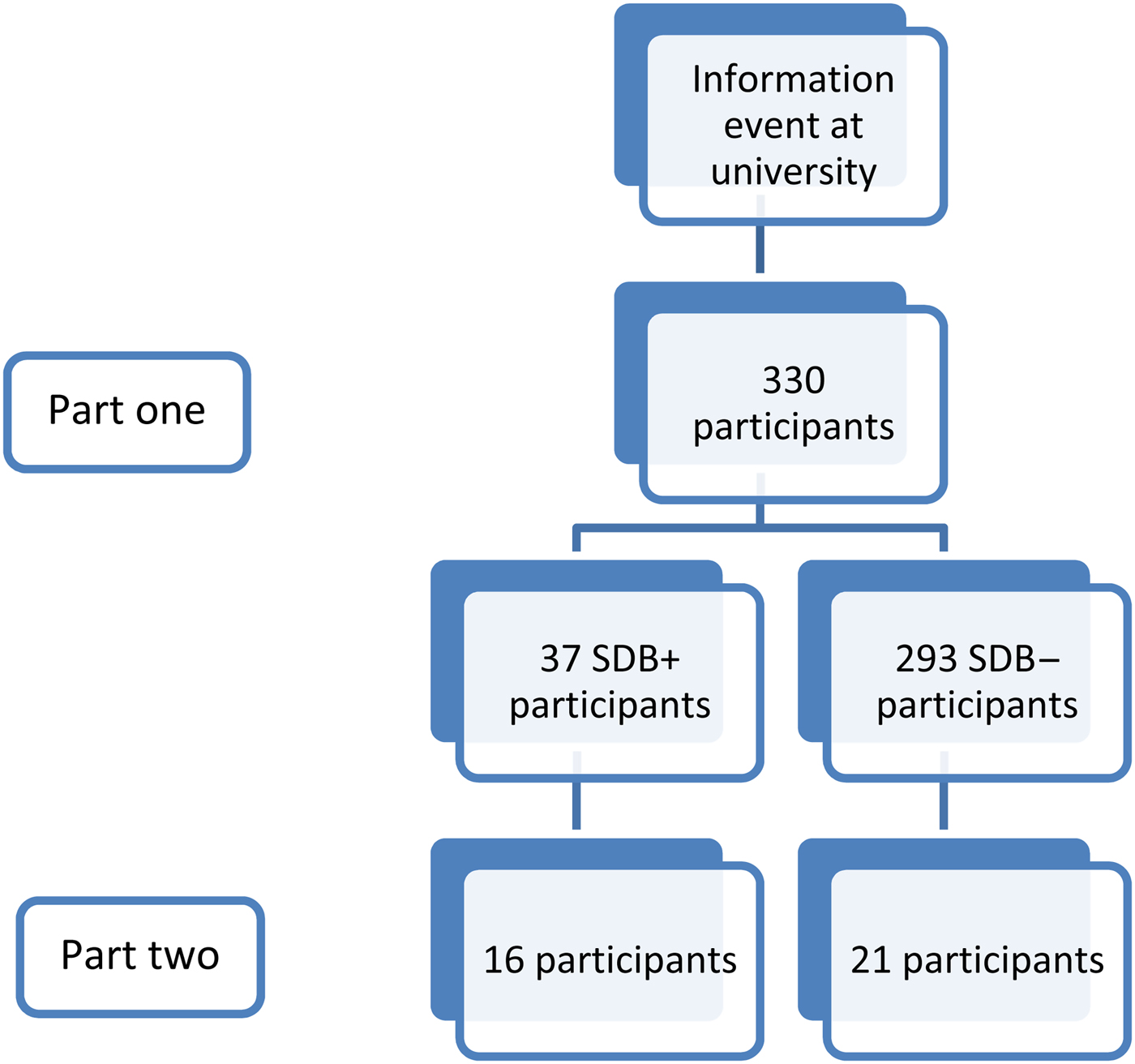
This study consisted of two parts. First, a screening questionnaire was provided to a group of university students (part one), and participants were divided into two sleep-disordered breathing groups – sleep-disordered breathing positive and negative groups – according to their responses. Second, a sample was randomly chosen from each cohort, and the selected participants underwent a sleep study, detailed otolaryngology examination and additional surveys (part two). Figure 1 shows the design of the study.
Study design. Part one involved assessment using the authors’ questionnaire (based on the Berlin Questionnaire). Part two involved assessment via sleep study, ENT examination, Epworth Sleepiness Scale, and Nose Obstruction Symptom Evaluation Scale. SDB = sleep-disordered breathing

Part one
Participants were initially recruited from a sample of university students at the Warsaw School of Economics in Poland during an event devoted to sleep-disordered breathing, held on World Sleep Day (13 March) in 2015. It was promoted by a social media campaign two weeks beforehand. Participants were recruited randomly during the event at the main hall of the Warsaw School of Economics building, and through social media followed by completion of an online questionnaire. A total of 330 students completed the questionnaire and signed the written informed consent form.
The survey consisted of a modified version of the Berlin Questionnaire,Reference Netzer, Stoohs, Netzer, Clark and Strohl 3 with additional questions about nasal and oral breathing, morning headache, and history of adenotonsillectomy. There were nine questions altogether: does anybody notice you snore?; does anybody notice you have apnoeas/breathing pauses during the night?; does anybody notice you are a mouth breather during sleep?; do you have concentration disturbances, fatigue and/or daytime sleepiness?; do you have a morning headache?; do you have an obstructed nose after waking up?; do you have an obstructed nose during the day?; have you ever had an adenotonsillectomy?; and do you have hypertension? The first seven items were scored on a five-point Likert scale indicating the incidence or frequency of each symptom, where 1 = never, 2 = occasionally, 3 = sometimes, 4 = often and 5 = always. The last two questions had three answers: 1 = yes, 2 = no and 3 = I don't know.
Following the analysis, students were divided into two groups: sleep-disordered breathing positive and negative groups. The sleep-disordered breathing positive group consisted of participants who answered ‘often’ or ‘always’ to either of the first two questions (‘does anybody notice you snore?’ and ‘does anybody notice you have apnoeas?’), or answered ‘sometimes’ to both. There were 37 participants in the sleep-disordered breathing positive group and 293 in the sleep-disordered breathing negative group.
Part two
All 37 of the sleep-disordered breathing positive participants were invited to partake in the second part of the study; 16 participants (43 per cent) accepted the invitation. The control group consisted of 21 participants randomly selected from the 293 sleep-disordered breathing negative participants using the Microsoft™ Excel® spreadsheet software ‘RAND’ function.
Sleep study
The home-based sleep study was conducted using the WatchPAT™ (Itamar Medical) portable sleep apnoea diagnostic system, which tracks peripheral arterial tonometry, oximetry, heart rate, actigraphy, body position and snoring. The WatchPAT sleep study report showed real sleep time, peripheral arterial tonometry apnoea/hypopnoea index, peripheral arterial tonometry respiratory disturbance index, oxygen desaturation index, heart rate, body position, snoring intensity (in decibels), and rapid eye movement and non-rapid eye movement sleep.
ENT examination
A routine ENT examination was performed; the tonsils and soft palate were assessed according to the Friedman staging system for OSA.Reference Friedman, Tanyeri, La Rosa, Landsberg, Vaidyanathan and Pieri 4
Questionnaires
All students completed the Nose Obstruction Symptom Evaluation (‘NOSE’) scale, and the Epworth Sleepiness Scale. The Nose Obstruction Symptom Evaluation scale evaluates the influence of nasal obstruction on quality of life and is mainly used to assess the effect of septoplasty. It contains five questions on: nasal congestion or stuffiness, blockage or obstruction, difficulties breathing through the nose, trouble sleeping, and inability to get enough air through the nose during exercise. It is well correlated with examination findings and computed tomography.Reference Kahveci, Miman, Yucel, Yucedag, Okur and Altuntas 5 The Epworth Sleepiness Scale is widely used in primary care and sleep medicine for screening patients with a high risk of OSA. It contains questions on the probability of taking a nap in common daily situations.Reference Johns 6
Statistical analysis
The variables were tested for significant differences using the Mann–Whitney U test or Pearson's test. P-values of less than 0.05 were considered to indicate statistical significance. Correlations were measured using the Spearman test.
Results
Part one
The mean age of the studied group was 21.87 years (± standard deviation (SD) = 1.85). Of the 330 participants, 177 (59 per cent) were female and 153 (41 per cent) were male. Thirty-seven participants (11.2 per cent) reported habitual snoring and/or observed apnoeas, 26 of whom were male. There was a significant difference in mean body mass index (BMI) between the sleep-disordered breathing positive and negative groups: 25.0 ± 4.8 kg/m2 versus 22.0 ± 3.2 kg/m2, respectively.
The symptoms of mouth breathing, morning headache, nasal obstruction after waking and nasal obstruction during the day were significantly more frequent in the sleep-disordered breathing positive group.
Of the sleep-disordered breathing negative group, 6.1 per cent had undergone adenotonsillectomy and 6.8 per cent had hypertension, compared with 13.5 per cent and 13.5 per cent for the sleep-disordered breathing positive group, respectively (p = 0.165 for adenotonsillectomy and p = 0.255 for hypertension).
Part two
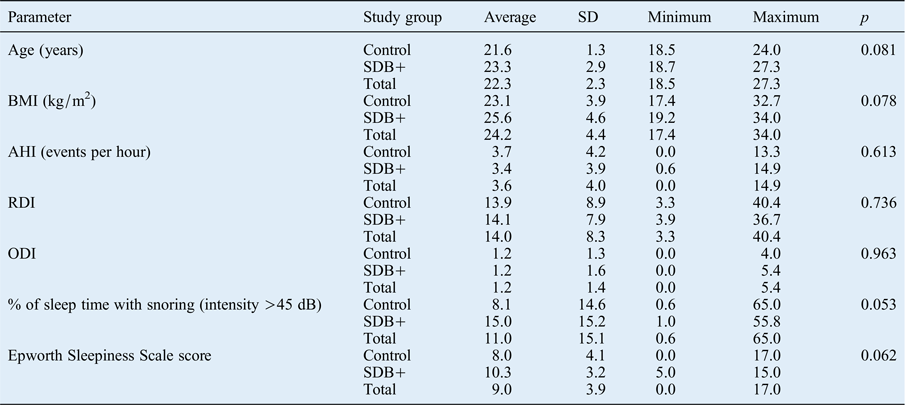
The sleep study results (obtained using the WatchPAT) and the Epworth Sleepiness Scale scores are presented in Table I. There were no significant differences between sleep-disordered breathing positive and negative groups in terms of: apnoea/hypopnoea index, respiratory disturbance index, oxygen desaturation index, percentage of sleep time with snoring (intensity more than 45 dB) and Epworth Sleepiness Scale scores. There were significant differences in Nose Obstruction Symptom Evaluation scale scores (p = 0.018), with sleep-disordered breathing positive and negative group mean scores of 49 and 32, respectively.
Age, BMI, sleep study parameters and epworth sleepiness scale scores by study group

BMI = body mass index; SD = standard deviation; SDB+ = sleep-disordered breathing positive; AHI = apnoea/hypopnoea index; RDI = respiratory disturbance index; ODI = oxygen desaturation index
The Spearman's rank correlation coefficient was used to determine correlations between the questionnaire and age and BMI in the cohort of 330 participants (part one of the study), and between the subjective and objective parameters and age and BMI in the cohort of 37 participants (part two of the study). In part one, a positive correlation was observed only between the question ‘does anybody notice you snore?’ and BMI (r = 0.26, p = 0.000002). In part two, a positive correlation was observed between apnoea/hypopnoea index and BMI (r = 0.35, p = 0.034), and between the Nose Obstruction Symptom Evaluation question on difficulties with breathing through the nose and BMI (r = 0.44, p = 0.008).
Apnoea/hypopnoea index subgroup findings
Nine of the 37 participants (24 per cent) examined in the second part of the study had an apnoea/hypopnoea index of 5 or more events per hour (4 of 16 participants (25 per cent) in the sleep-disordered breathing positive group and 5 of 21 participants (23.8 per cent) in the sleep-disordered breathing negative group).
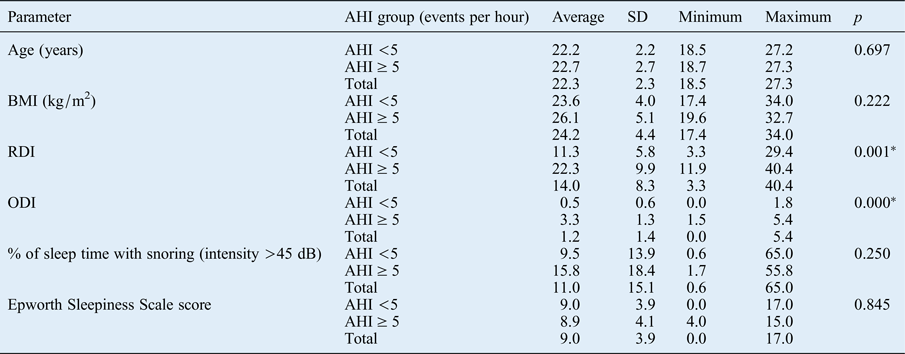
Table II incorporates a comparison of age, BMI, Epworth Sleepiness Scale scores and the other sleep study parameters for those with an apnoea/hypopnoea index of five or more events per hour (n = 9, 24 per cent) and those with an index of less than five events per hour (n = 28, 76 per cent). Only respiratory disturbance index and oxygen desaturation index were significantly higher in the group that had an apnoea/hypopnoea index of five or more events per hour.
Age, BMI, sleep study parameters and epworth sleepiness scale scores by AHI group

*Indicates statistical significance. BMI = body mass index; AHI = apnoea/hypopnoea index; SD = standard deviation; RDI = respiratory disturbance index; ODI = oxygen desaturation index
Discussion
Many epidemiological studies on adults have comprised large cohorts and used objective methods to diagnose sleep-disordered breathing. However, none have examined individuals aged under 30 years. For instance, the Wisconsin Sleep Cohort Study is an ongoing community based study, established in 1988, with participants randomly selected from an employed population of Wisconsin adults (aged 30–70 years) whose sleep-disordered breathing was diagnosed using polysomnography.Reference Young 7 The Sleep Heart Health Study is a prospective cohort study designed to investigate sleep-disordered breathing risk factors for the development of cardiovascular disease.Reference Quan, Howard, Iber, Kiley, Nieto and O'Connor 8 The study enrolled 6600 participants (aged over 40 years) who underwent home polysomnography. Epidemiological studies in China, India, Korea and Spain have also examined participants aged over 30 years.Reference Ip, Lam, Lauder, Tsang, Chung and Mok 9 – Reference Duran, Esnaola, Rubio and Iztueta 12
On the other hand, quality of sleep is well studied in young adults. In particular, the effects of factors such as BMI, social media, physical activity and immune status have been investigated.Reference Levenson, Shensa, Sidani, Colditz and Primack 13 – Reference Gijselaers, Elena, Kirschner and de Groot 16 The Pittsburgh Sleep Quality Index or Sleep-50 questionnaire were used in most cases. None of them used sleep studies to specifically evaluate sleep-disordered breathing prevalence in this population. A 2015 review on sleep disturbances among medical studentsReference Azad, Fraser, Rumana, Abdullah, Shahana and Hanly 17 mentioned snoring and OSA problems once, citing a Pakistani article in which snoring was present in 27 per cent of males and 12 per cent of females.Reference Pasha and Khan 18
A previous study of 548 Indian medical students, which used the Berlin Questionnaire and Epworth Sleepiness Scale,Reference Singh, Pandey, Singh, Gupta, Prasad and Singh Negi 19 found that 17.7 per cent were snorers, and 5.2 per cent reported breathing pauses during sleep that occurred 3–4 times per week or more.
Another survey, of 413 Estonian medical students, utilised the Sleep and Daytime Habits Questionnaire, and included 24 questions on sleep and daytime habits, of which only 1 concerned snoring, with possible answers of: 1–2 times per week, 3–5 times per week, or every night.Reference Veldi, Aluoja and Vasar 20 The prevalence of snoring was 9 per cent.
Nojomi et al. investigated sleep patterns in 400 Iranian medical students and residents.Reference Nojomi, Ghalhe Bandi and Kaffashi 21 Again, of 24 questions, only 1 was dedicated to sleep-disordered breathing. Respondents were asked whether they snored or not, and the reported snoring rate was 14 per cent.
Brockmann et al. analysed the medical records of 2147 Chilean adolescents and young adults (aged 15–40 years) in terms of sleep-disordered breathing.Reference Brockmann, Damiani and Gozal 22 The prevalence of habitual snoring was 53.8 per cent in men and 38.3 per cent in women, in response to the binary question ‘do you always snore?’. Of the participants, 2.5 per cent were sleep-disordered breathing positive, having answered ‘yes’ to the three questions on whether they ‘always snore’, whether someone had ‘witnessed them having an apnoea’ and whether they had ‘daytime somnolence’.
Stoohs et al. compared 155 college students with 134 older participants in terms of snoring measured using a validated questionnaire and a portable recording device (MESAM 4; MAP, Martinsried, German).Reference Stoohs, Blum, Haselhorst, Duchna, Guilleminault and Dement 23 Three out of 20 questions focused on sleep-disordered breathing, and asked about loud snoring, apnoeic snoring and witnessed breathing pauses. The results showed good correspondence between subjectively reported and objectively measured snoring in students only. Only 6.1 per cent of students reported often or always snoring, while the continuous snoring index (measured using the MESAM 4 device) was 22.6 ± 21.9 per cent in this group. The Epworth Sleepiness Scale score was greater than 11 in 51 per cent of these individuals.Reference Stoohs, Blum, Haselhorst, Duchna, Guilleminault and Dement 23
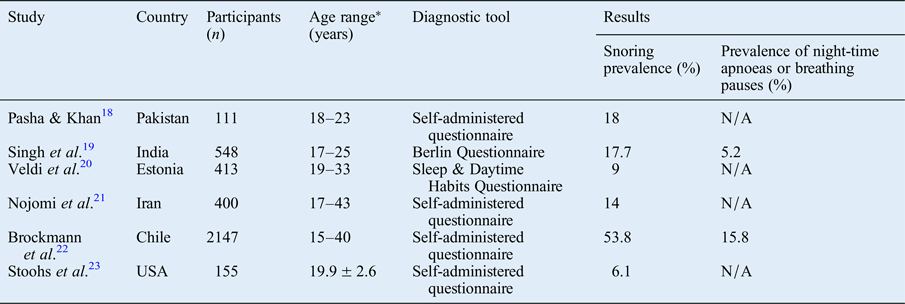
The results of our initial screening are similar to those mentioned above and abbreviated in Table III.Reference Pasha and Khan 18 – Reference Stoohs, Blum, Haselhorst, Duchna, Guilleminault and Dement 23
Comparison of studies on sleep disorders in young adults

*Mean ± standard deviation reported for study by Stoohs et al.Reference Stoohs, Blum, Haselhorst, Duchna, Guilleminault and Dement 23
Typically, screening questionnaires are more sensitive to OSA than objective measures, and one would expect a questionnaire to identify more individuals as having OSA (or being at risk for OSA) than would be found based on objective testing. Our study suggests that the prevalence of sleep-disordered breathing in young adults may be as high as 11.2 per cent based on questionnaires and 24 per cent using objective sleep studies. According to the questionnaire, the sleep-disordered breathing positive and negative groups significantly differed in terms of coexisting sleep-disordered breathing symptoms, such as mouth breathing, morning headache, and nasal obstruction after waking and during the day, as well as in age and BMI.
Interestingly, our study showed no significant differences between sleep-disordered breathing positive and negative groups with regard to sleep study parameters (apnoea hypopnoea index, respiratory disturbance index, oxygen desaturation index, snoring intensity) and Epworth Sleepiness Scale scores. The respiratory disturbance index was similar in both groups (14.1 and 13.9 in sleep-disordered breathing positive and negative groups, respectively), while the percentages of total sleep time with loud snoring were 15 per cent and 8.1 per cent, respectively.
In the individuals selected for the second part of the study, nine (24 per cent) had an apnoea/hypopnoea index of five or more events per hour, of whom four were sleep-disordered breathing positive and five were sleep-disordered breathing negative (according to the primary questionnaire). This suggests that sleep parameters may also be abnormal in young, healthy adults with no sleep-disordered breathing symptoms and normal BMI. When all individuals from the second part of the study were separated according to apnoea/hypopnoea index (with five events per hour as the cut-off point), only respiratory disturbance index and oxygen desaturation index differed significantly between the groups, suggesting that the diagnosis of OSA may require a more thorough analysis of sleep study and clinical data in this population segment. Those subjects with an apnoea/hypopnoea index of five or more events per hour may be young enough to compensate for sleep-disordered breathing at this time and thus present as healthy.
An early diagnosis of sleep-disordered breathing is important because simple interventions at this stage in life, such as weight gain prevention and appropriate nasal breathing, may protect such individuals from developing severe forms of OSA in the future.
This research raised many questions regarding how to deal with this population, as follows. What type of diagnostic method should be used in young adults? Should it be mainly based on questionnaires and history, as in children, or on objective studies (such as polysomnography), which are obligatory in adults prior to any kind of treatment? What are the diagnostic criteria in sleep study for young adults? Should young adults be treated as children, for whom the apnoea/hypopnoea index threshold in polysomnography is one event per hour, or as adults, where the threshold is five events per hour (according to the American Academy of Sleep MedicineReference Epstein, Kristo, Strollo, Friedman, Malhotra and Patil 24 )? A recent study shows that even this threshold may be too sensitive to diagnose sleep-disordered breathing,Reference Heinzer, Vat, Marques-Vidal, Marti-Soler, Andries and Tobback 25 as many asymptomatic participants in that study had an apnoea/hypopnoea index of more than five events per hour. When and how should people be screened for sleep-disordered breathing? When do they develop complications from sleep-disordered breathing, and when is screening too late?
Study limitations
Our study is not without limitations. It took place during a sleep-related event. The studied cohort is not large. This analysis is based on only 330 questionnaire responses. All of the sleep-disordered breathing positive students (n = 37) were invited to continue the study, but only 43 per cent accepted the invitation for the sleep study (an expected percentage). The remainder were not willing to continue the study or did not respond, despite being informed that they were in the group at higher risk of sleep-disordered breathing and should have an objective examination, which was free of charge. It seems that awareness of sleep-disordered breathing in this age group is very low, and few consider screening worthwhile.
The sleep study was conducted using the WatchPAT home study device, instead of polysomnography, which is the ‘gold standard’ for diagnosing OSA. The peripheral arterial tonometry technology indirectly detects apnoeas and hypopneas by selectively measuring peripheral arterial volume changes. The WatchPAT has been validated against full polysomnography in multiple studies, and it represents a viable alternative to polysomnography for confirmation of clinically suspected sleep apnoea.Reference Yalamanchali, Farajian, Hamilton, Pott, Samuelson and Friedman 26
Neither the Epworth Sleepiness Scale nor the Nose Obstruction Symptom Evaluation scale have been validated in Polish, but they were adapted by the authors. The questionnaires were translated into Polish by a bilingual interpreter, while a separate interpreter, who was blinded to the original survey, translated the Polish version back into the source language and compared it to the original.
Conclusion
This study used both subjective and objective methods to measure sleep-disordered breathing prevalence in young adults, and yielded three important conclusions. First, the prevalence of sleep-disordered breathing in this age group is high when based both on questionnaire-based responses (11.2 per cent) and on objective sleep study findings (24 per cent). When the diagnosis was made according to the questionnaire only, significant differences were observed in coexisting symptoms between sleep-disordered breathing positive and negative groups. Second, no significant differences were found in terms of sleep parameters and Epworth Sleepiness Scale scores when comparing selected participants from sleep-disordered breathing positive and negative groups. Third, of the selected subjects, 25 per cent of the sleep-disordered breathing positive group showed an abnormal apnoea/hypopnoea index in the sleep study. A surprisingly similar percentage of participants with an abnormal apnoea/hypopnoea index was found in the sleep-disordered breathing negative group.
-
• Limited data exist on sleep-disordered breathing epidemiology in young adults
-
• There are no standards for screening and diagnosing sleep-disordered breathing in young adults
-
• Sleep-disordered breathing prevalence in adults aged under 30 years is 11.2 per cent according to the questionnaire
-
• Abnormal sleep parameters were found in 25 per cent of sleep-disordered breathing positive and negative groups
-
• There were no significant differences between sleep-disordered breathing positive and negative groups in sleep study parameters
This study raises new questions, of which one stands out: should young adults be screened, diagnosed, and treated as children or as adults? Investigation in this transitional group may illuminate a link between the pathophysiology of sleep-disordered breathing in children and in adults.
It seems that questionnaires have limited usefulness for sleep apnoea screening in young adults because most of these individuals have mild clinical symptoms. Therefore, objective diagnostic tools like home diagnostic sleep studies should be given preference. More studies using both subjective and objective tools are needed to elaborate on the algorithm for diagnosing sleep-disordered breathing in this population.
Acknowledgements
The authors thank the Polish Healthy Sleep Foundation, which supported and financed this study, and Conquest Consulting (a student consulting company), which helped to promote and execute the event on World Sleep Day (13 March) 2015, when all study participants were recruited. We also thank Dr Robson Capasso at the Division of Sleep Surgery and Medicine, Stanford Hospitals and Clinics, for his thoughtful suggestions.